Via de la Plata Camino – Day 21 (Montamarta to Tábara). Tuesday 10 April 2018. 27.5 kms.
I took the Camino Sanabrés rather than passing back through places on the Camino Francés (Astorga etc) which I had visited the year before.
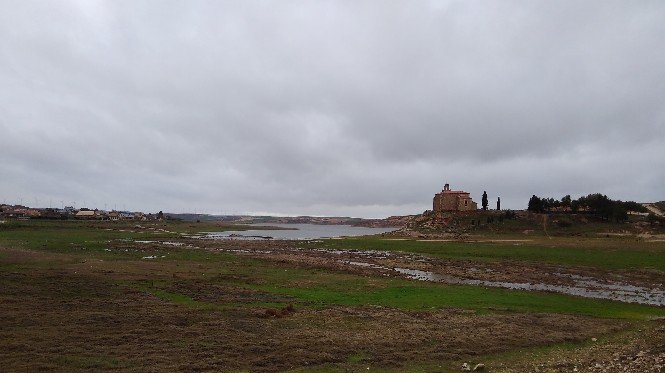
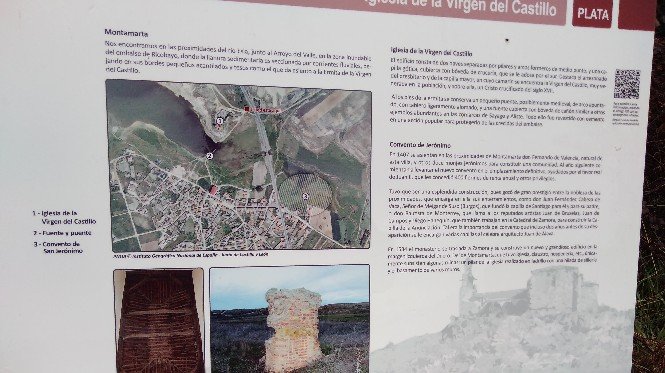
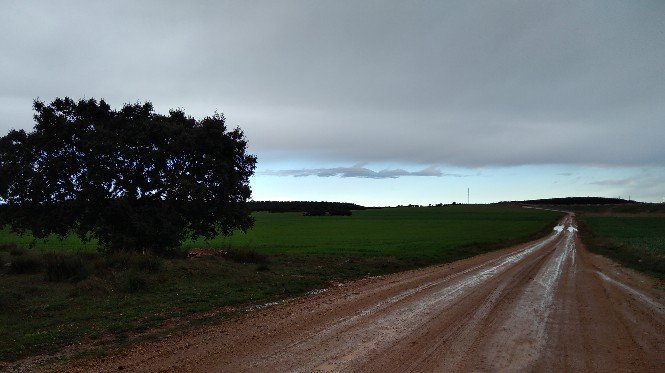
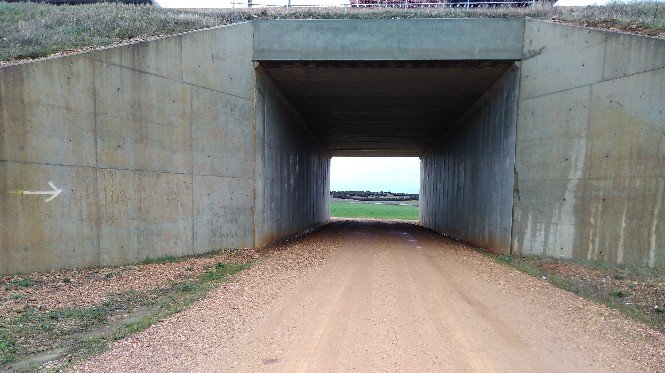
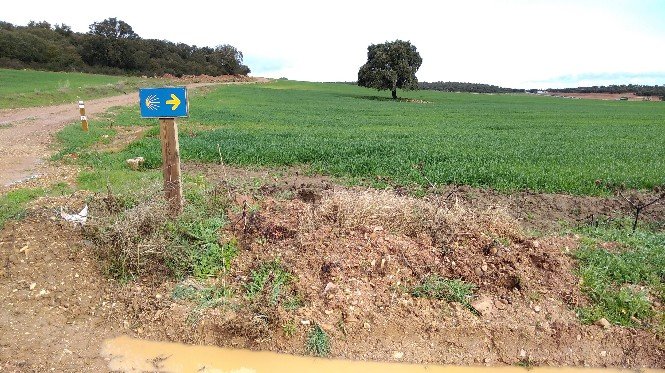
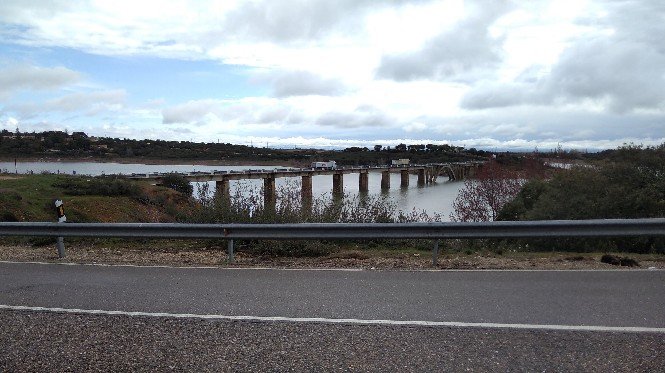
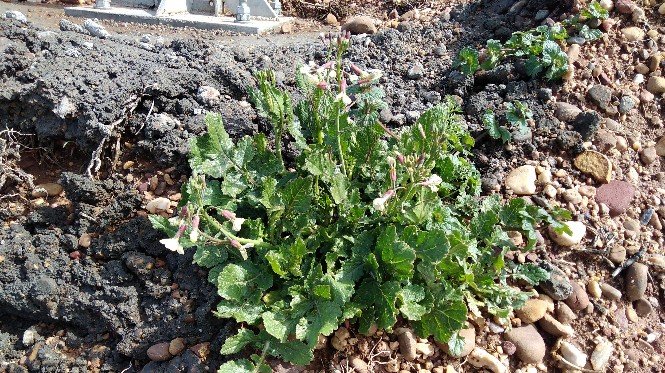
The best view of the day – unless you count the sight of the albergue in Tábara when I eventually got there.Telling you all about Montamarta – not somewhere I ever want to go back to I must say.Just like yesterday, except duller.Yep, under another motorway tunnel.I took the right, turned back and went straight on, then retraced my steps and went around the motorway flyover.Kilometer after kilometer on the tarmac with road works as a view.Spring primroses amongst the rubble and stones.
There was a small village strung out along the road, not so far from Tábara, with a cafe. I sat on the bridge and sunbathed – it was glorious.
Once I got going again it started to rain and I stopped, de-rucksacked and covered up. Then there was a rumble and a thunder and it got dark. The lorries were roaring past and spraying and I was ducking in and out of the ditch at the side of the road to avoid it when there was a fork of lightning at my left shoulder. I have never been so close. I wondered what I should do. Looking around there was nothing and nobody – just trees. I did think perhaps the metal batons weren’t such a good idea, but I couldn’t exactly abandon them and they had rubber handles and tips to earth me. I hoped. (Two days afterwards I met up with the American women and one of them did throw her sticks into the fields because she said she was so scared of being struck.)
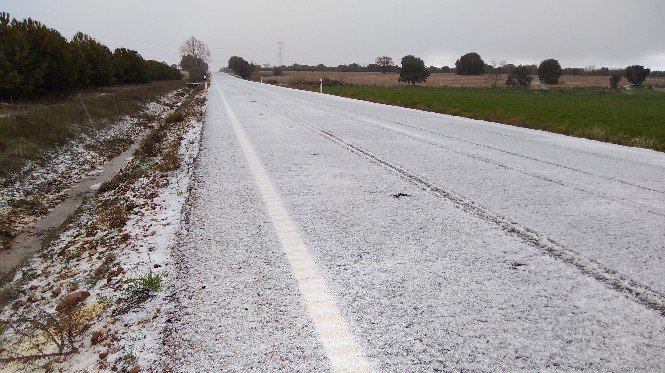
Then the hail started and brought about a total landscape transformation.
In two seconds flat the road was covered in white, the traffic had completely ceased and a hush came over the world. I walked on, telling myself ‘it will be over soon’.
It did stop eventually and on and on I went, every part of every mile seeming an age. I was very wet, too sopping to be able to get the map book out. Then again, there was only the one road to choose from.
There was a service station on the outskirts of Tábara and I stumbled in to get some cover and ask for directions to the albergue. There was pandemonium in there because the electric storm had shut down the till and no-one could pay for their petrol. I waited with heaviness on my back and realised how exhausted and hungry I was. And I waited.
In the end, I did something I have never done before: I took a chocolate bar off the shelf, sunk to the ground, sat with my legs splayed out in front of me like a rag doll, and devoured it without paying for it first. It was wholly necessary.
To my horror it was a further 30 minutes walk to the hostel and I had thought I was at the complete end of my energy. Hey, I simply had to find more.
It was uphill and a very long road, and just as I was despairing that it would not end, there was a shriek and who should I see coming towards me but Marie-Noelle and her smile, someone I had not seen for several days. She gave me a big and welcome hug on her way to the bar.
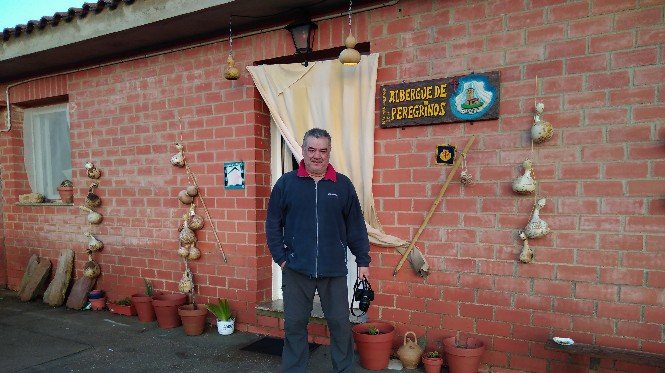
The hospitalero made me a cup of tea when I needed it most, and proceeded to cook for us all that evening. He describes himself as a ‘spiritual author’, is resident at the hostel all year round, and something of a Camino VIP.
There were 10 people round the table drinking wine and eating simple fare. Some I had met before, some I had not, each of us from a different country, and of course we made ourselves understood – a true camino experience at the end of a most trying day.
I am walking the St Magnus Way on Orkney, and this is one of the blog series – 27th May 2018. Below, you can find links to all the others (introduction, transport, accommodation, resources etc). The overall walk is 55 miles (88.5 kms) over 5 days plus a visit to the island of Egilsay where St Magnus was said to have been murdered and, initially, buried.
– on timelessness, forgiveness, and dialect
Criss-crossing the west mainland of Orkney: Having started in Evie in the north east; curved around the cliffs to Birsay in the north west; walked coast-to-coast eastwards to Finstown; today I would drop directly south to Orphir. I didn’t know what I would find
Why to Orphir if Magnus’ bones weren’t taken there? The organisers of this route write that today’s trajectory ‘shifts attention to Haakon, Magnus’s cousin who ordered his death and ruled the united Earlship afterwards.’
Highlights: A traditional Scottish moorland, some slopes, and the wonderful shoreline between The Breck and the Bu
People met : a record 3 (between Finstown and Orphir), then loads after that
Theme: forgiveness
Favourite and unusual animals encountered: 1 donkey, Shetland ponies, llamas
17.1 kms / 10.65 miles
Time: 6.5 hours Finstown to Orphir village; another 2 minimum to St Nicholas church and back, but I did have a sleep
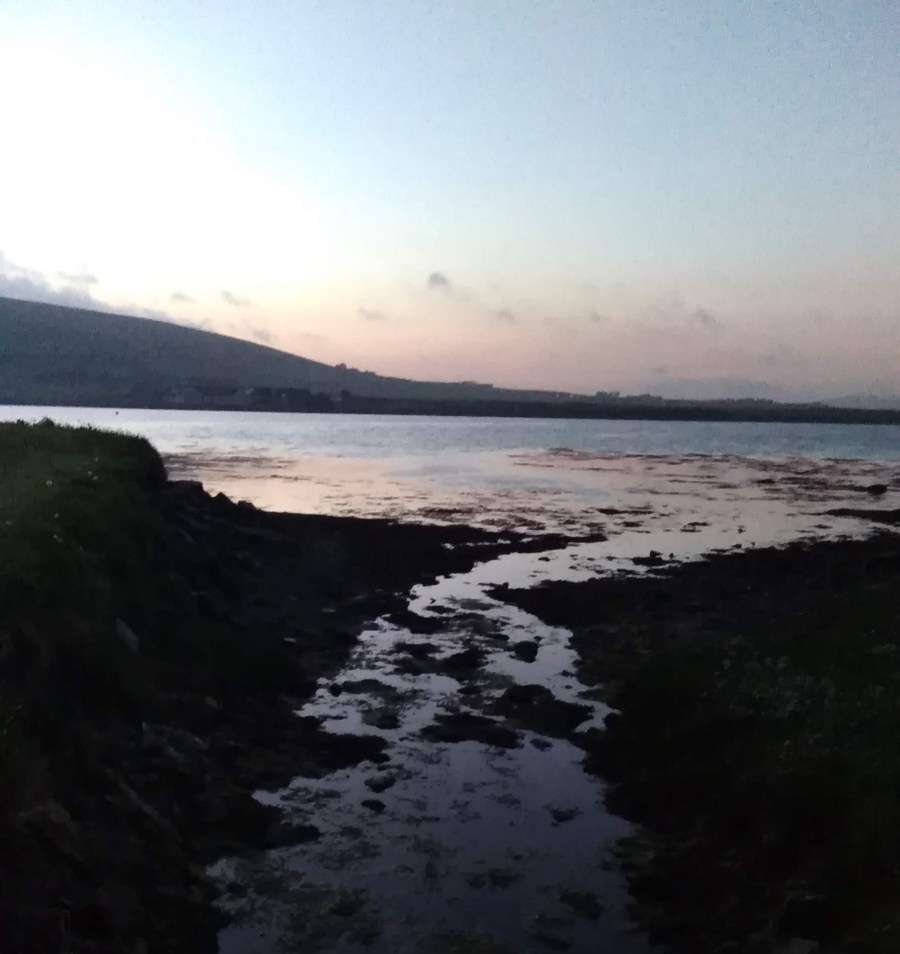
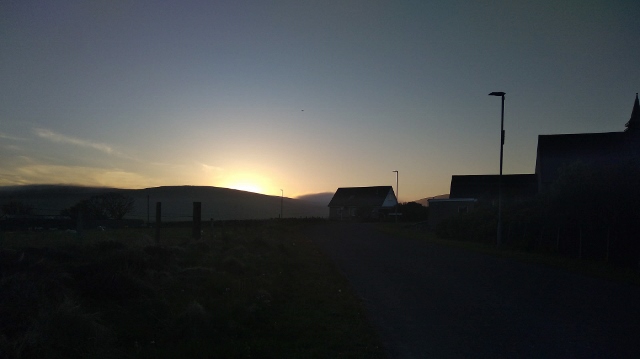
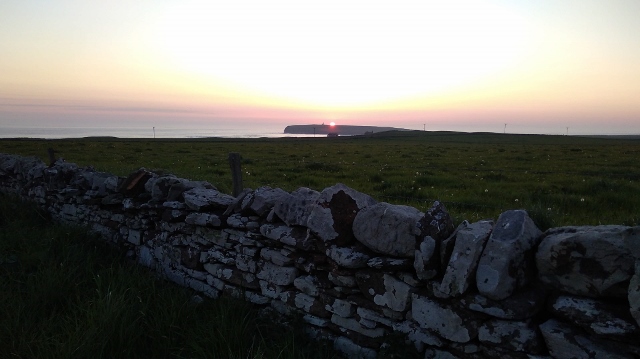
Last night, on the way ‘home’ from the concert, the haar had cleared and there was a beautiful sunset which this photo doesn’t really capture. Last night, on the way ‘home’ from the concert, the haar had cleared and there was a beautiful sunset which this photo doesn’t really capture.
A screech of tyres heralded two carloads of revellers needing the toilet at 2am (I was camped beside the public conveniences in Finstown). I got up to retrieve my walking top which I had unwisely washed the evening before (unwise because it was too cold to dry properly), and it was cold on my return so that I stuffed my coccoon with newspaper. As I was awake I texted Heather, my lodger about cat litter, and finally dropped off.
When I woke again the sun was shining on me through the tent and it was warm. I think there may have been dew on the outside of my sleeping bag, but thankfully not on the inside!
I had dreamt my recurring dream of being lost in a big house full of rooms. I am convinced they began when I moved from my small town primary school in Sevenoaks to the much bigger secondary in Tonbridge and could not find the right classrooms. Ah, but this time it was my own house. Now, that’s change for you!
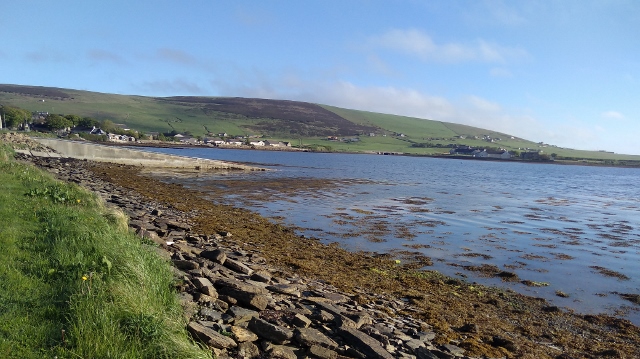
I crawled out and found the calm waters ahead, guarded by the pier on my right with the already warm sun rising behind it, and Snaba or Cuffie Hill to my left. Ahead, I guessed from my map, were the Holm of Grimbister, Scarva Taing, the Skerries of Coubister with perhaps Chapel Knowe broch in the far distance. (A holm is an islet, a skerry is a rocky island, and a broch is a stone tower dating from prehistoric times.)
7am was so quiet. I was delighted to see a sleek headed seal swimming in the bay, watching as it made its way across to the other side and then back again and then climb out onto the jetty. Oh, not a seal, a mermaid, I mean, a woman taking her Sunday morning exercise! She changed in my / the toilets and I couldn’t stop myself going to say ‘hi’. She was as surprised as I was to see someone up at this time, not having noticed my tent.
None of the remaining matches would light my stove, so there was no tea for me, worst luck. (How come I didn’t bring a lighter? It’s not as if I haven’t been camping many times in my life before). Instead I had the Rhubarb Soda I had bought at the post office (made by Bon Accord in Edinburgh £1.50 – delicious).
I was on permanent battery saver now which, because there was no signal anyway, meant I could not book the homewards ferry.
A million drops sat on the blades of grass, shining in the sun, gleaming, a simple collection of diamonds, of miniscule, suspended orbs.
The jetty where I saw my mermaid! Bay of Firth, Orkney.
Having charged my phone at the Community Hall the previous evening, I received two air bnb booking texts, making that five in five days – lucky for me August is busy in Edinburgh with the festivals.
Half way up the hill I was looking the first St Magnus Way marker of the day and, turning, I saw back towards The Bay of Firth where I had spent the night.
I climbed up and onto the moors, first on a path and then into the wilderness. I met a lovely jolly South African lady with a white bun and skyblue clothes. She didn’t have a rucksack or a dog. Once again a woman had appeared, as if from nowhere, to advise me. She said she had searched and searched and there were no St M Way signs, and predicted that the haar would come in again from the east. ‘I’ve walked all these hills but they don’t cater for walkers here on Orkney’, she said.
Getting higher – Finstown in the distance. Orkney.Along the warm grassy track, Cuween area, Orkney.
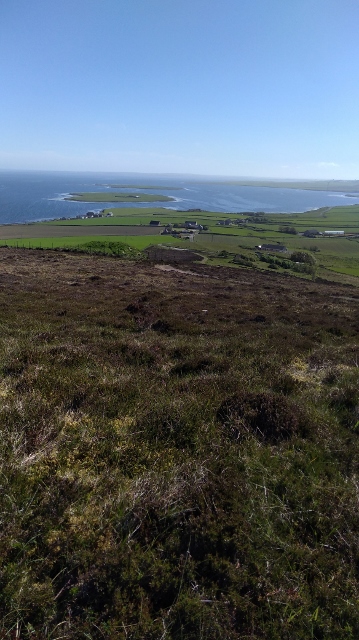
Of course the higher I got, the more I could see behind me when I stopped to catch my breath: the green lilypad islands in the blue ocean; flashes of silver indicating the main road. It was hard going with the backpack on the uneven ground, though I was glad that I did find the markers when I cast around for them – perhaps I had my eye in after three days.
A frog could very easily sit on these islands (see Beatrix Potter)! Seen from Cuween Hill, Orkney.
I was already hungry, but it was OK because I had a whole lettuce in my John Lewis bag (my children would be able to explain, it’s because I believe I need my greens every day!) And talking of rabbits, they were bounding around, keeping me company as I stumbled.
It is simply not done in hiking circles, to have a carrier bag but there was no room in my rucksack for food. I hung it from my straps where it swung annoyingly when I got into my stride and had to be restrained when clambering over stiles. It lasted the whole 10 days! Maybe I should have got people to take photos of me and tried for sponsorship – missed a trick there.
Beautiful view, Finstown, Orkney.
There are clumps of Lady’s Mantle down in the ditches, out of the wind and by the side of the stony track.
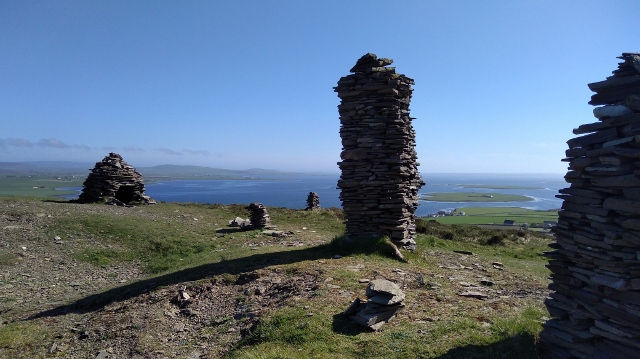
Man-made stacks in a stunning setting, Cuween, Orkney.
Forgiveness is an end-point: only after a proper process of understanding both points of view, acknowledging the hurt or the sadness, and coming-to-terms with all of that can we forgive and then act on it. I shed terrible tears on watching the part of the film ‘Calvary’ where the main character (played by Brendan Gleeson) goes into prison to see his son and you know he has been forgiven. My reaction was testimony to the power of this in my life. ‘I think forgiveness has been highly underrated’, says Gleeson’s priest.
There is a tomb you can visit, but I only read about it afterwards.You can see the clear division between farm fields and wilder moorland.
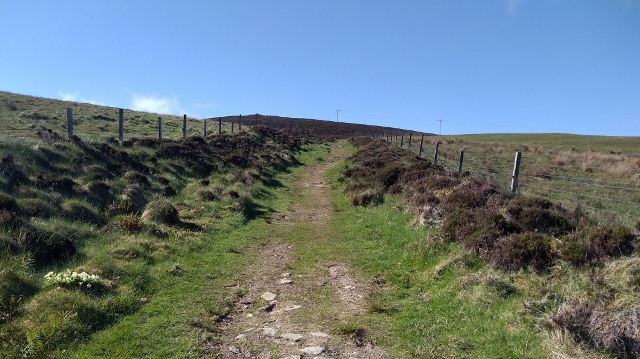
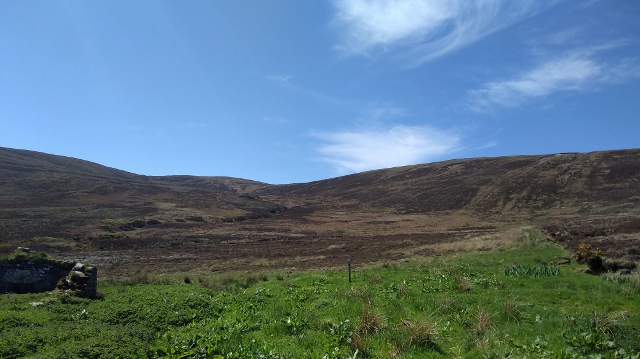
After a while the track peters out and it was just me surrounded by hillocks of heather and bog cotton – rabbit tails on spindly stalks. Mossy mounds had green spears poking out of them, and there were the sort of birds which hover and flutter just above the ground in constant conversation. In places there were canine and then human footprints.
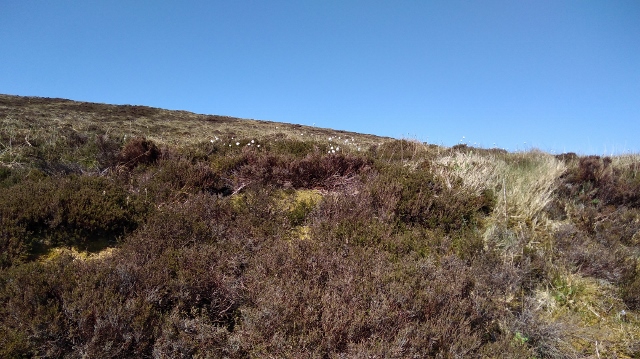
Bog cotton (the white dots) and heather on the moors, Orkney.
Gradually the landscape started to remind me of Highland walks with its peat banks, bogs and pools. Scrambling through the scratchy shrubs was painful on my knees but I avoided squelching underfoot. It had become very, very quiet. There was no bird song.
Shelves of peat and a St M sign in the middle of nowhere.
Forgiveness is offered to those who ‘follow the faith’, on earth by priests, and elsewhere by God, so it is said. To promise it to a child, who early on has no understanding of sin – not of others’ or their own – is to immediately puzzle her. It is a suggestion that there is already something wrong with that child, that she has already transgressed, and if there is no internal cognition of this, it’s a disaster waiting to happen. What else, but that child grows up with an aura of mistake, not able to make an actual connection between the forgiveness and an awareness that forgiveness is necessary.
A typical peaty pool on the moors, Orkney.
Yes, in fact there were odd snatches of various sounds – the distant thrum of an engine, for example. And I could see oil tankers far away on my left. Amethyst violets and rose quartz orchids were glinting at my feet, and then I was on a soft downhill track again.
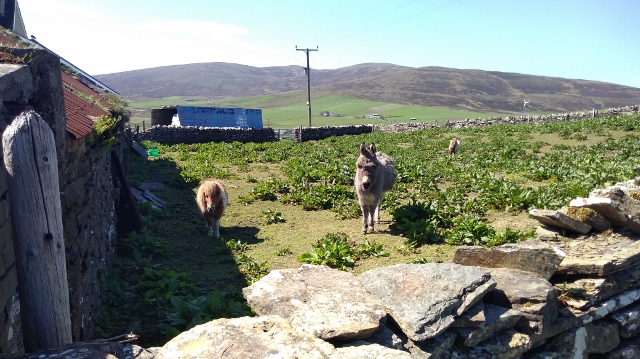
I came across a pregnant donkey and two brown-and-white Shetlands. She came up close, sort of in-breathed at me and flicked her left ear. It was the ponies who got the carrot which was intended for the donk.
The namesake of my blog!
And … what’s more, to be an adult who can offer a child forgiveness sets the offerer apart, as is often the aim. Again, the child is reduced to a transgressor, and what’s more, encouraged to understand that the adult is even more powerful than adults already are compared to children, and yet it is most painfully obvious to them that adults are not always good. How to make sense of that? These things I was with as I walked.
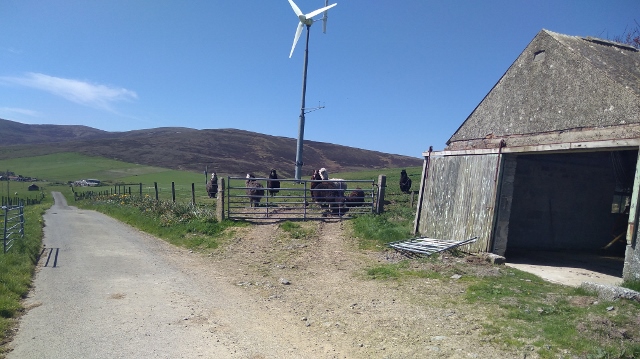
A bird mewed, a flap-fast one, its wings tipped with white. There was rather scaredy herd (or flock) of llamas (with crias which is what the young ones are called), and the ubiquitous wind turbine at Kebro Farm, where like all the places I passed farmers were working even though it was a Sunday. In this area there are many incredibly confusing signs saying to go back up (arrows and ‘To Oback Cottage’ etc). Note: Ignore them and keep on going down. There is eventually a St M Way sign at the junction when you get there!
A flock of llamas. At the bottom of this road there is a St Magnus Way sign, Kebro, Orkney.
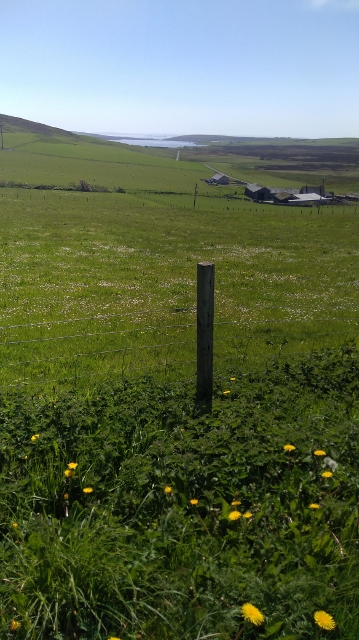
In the same way as Reading is a town of roundabouts, and Glasgow’s all traffic lights, so Orkney’s made up of a complex network of fences, poles upstanding and barbed wire, deadly taut and ready to snatch enough wool to knit a sheep or catch an unsuspecting elbow in passing.
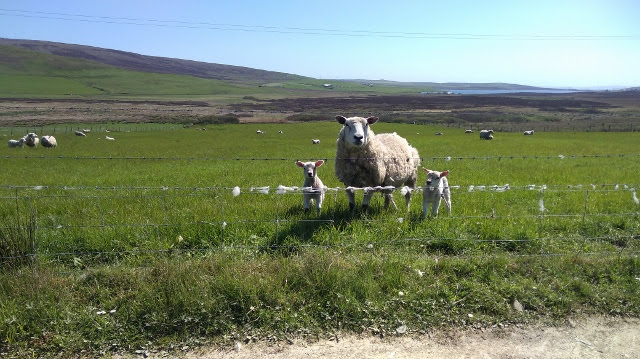
It was lambing time on Orkney in late May. Just look at their little faces!
With four per cent of battery left on my phone I could check the time, but why bother? Instead I watched a butterfly doing what butterflies do, and let a chunk of Orkney fudge melt in my mouth leaving a too sugary, but addictive residue.
There was no need for me to be anywhere by any given time – being close to midsummer and because I was so far north, there was endless daylight. In fact there was almost no night. It has been said that stress levels are particularly high when deadlines of time and distance are combined (ie I have to get across town by 8am), so it is a good sign that I can let that go and relax into the walking. I will get there when I get there, that’s my motto.
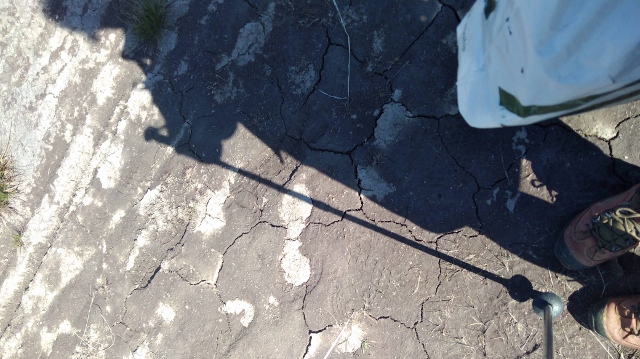
Baked earth – not something you expect to see in Scotland.
I noticed, that like the three guys last night who accompanied the lead singer of ‘The Once‘, the sheep looked identical but had different voices – some bass, some treble and some soprano, or is it counter tenor?
I liked the grey cows – I was not sure I had ever seen grey ones before. (No photos, for the above reasons). I went past birds doing that spectacular balancing thing where they sway on top of stalks so thin that the human eye cannot see them, thinner than one of their own legs. How do they do that!
The farmers forked the deep brown, well-rotted manure onto a trailer; an ideal lane between fields offered springy soil that actually massaged my feet from the underneath; there was only one place where I had to step into an empty blue trough and cling onto the, yes you guessed it, the barbed wire, to avoid the too-marshy path. There were bog grasses there, honed to a calf-tickling tip, but space enough to walk inbetween.
I was heading for the nearly-full moon. Every time I needed a pee I had to take the rucksack off and it required a sort of humpfy-jump to get it back on and arrange all my layers – the tucking in was the worst. I cracked my knee which certainly got the blood flowing again. ‘It’ll pass’, I reminded myself.
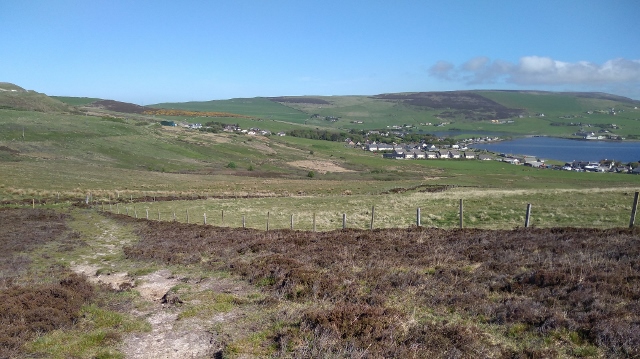
I was just as I was about to head off up the hill to the right across the moors towards Orphir after the last sign, when I most unexpectedly spotted a couple coming up. She was pregnant and telling amusing stories to the man with her – great to hear them laugh! My phone was dead by then so how lucky it was that I saw them, because Orphir wasn’t on the right in that direction at all!
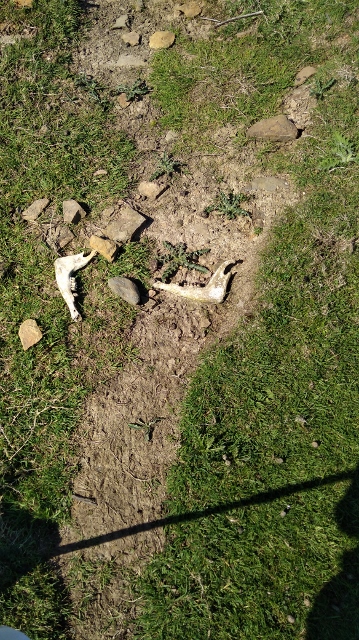
Down I went, taking the correct course. There was a bed of irises, a red bridge and the delightful sound of trickling, peaty, crystal-clear Scottish water. I found another bird’s wing, pure snow-coloured with bones attached, and a patch of curly white feathers to mark the spot. Butterflies played above like the very spirit of the bird which had died, like the petals of today’s flowers come to life.
It was hot by this time with a welcome breeze by the burn. There were no signs (although the notes I had made from the route description last night were pretty good from here on), so I trusted my instinct, tripping on downhill now.
For some reason I had put my single double-layered sock into the rucksack before leaving home, and now it had come in useful because I dropped one of yesterday’s pair down the loo when changing in a tight space with an armful of clothes, and after washing it hadn’t dried in time. (I had no idea what happened to the pair. I left them both to dry on a rack in Salamanca and one wasn’t there on my return).
I guessed the repeated but uneven banging up on my right must be people hunting. On the far left I could see a gorgeous beach – Waulkmill Bay I identified from the map – and I would have enjoyed a paddle there and then. Despite another internal debate about the way I decided to keep going on straight. The cuckoo called and I had a sudden memory – did my dad collect butterflies? I must have been very, very young.
Much as I deplore the waste and emissions of plastics, and of course a wooden staff is more traditional for the pilgrim, this baton is better: wood ones chafe the palms after several hours. What a marvellous view I had from up there! It was still a bit misty to be sure, but I could see all the islands, tankers and trawlers, big ships and little boats, as well as what looked like a submarine.
I always talk to the animals I meet, especially the farm ones. I expect they have a relationship with humans already, and probably my mum used to do that and I learned it from her. Perhaps she still does! I was so glad to have my map because I couldn’t connect the Route Direction info with the reality on the ground and got confused.
The two wooden men either end of a bench wi flooer pots atap thar heids cheered me up. In the same way I think in French or Spanish when walking in those countries, I seemed to be rocking some variation of the Orkney tongue in my head.
Then I came across a field of delightful weeny Shetland ponies, foals and their families – somehow I felt a bond! I was gutted that I couldn’t take any photos.
‘Bin fer a dander?’ (Have you been for a walk?), a gentleman asked me as I turned onto the road. There was a further man hanging out washing in his boxers at the next house – he scuttled inside sharpish when he saw me! At the brow of the hill, the wooden fella was half way up a ladder. And as I walked into Orphir there were full-sized horses who looked gigantic in relationship to the mini ones from 15 minutes back.
Then I was in civilisation: coachloads, a duet on a tandem, ‘sites available for eco-new builds’ the sign said, and another wooden bench – this time there was a bear at one end and a fish at the other and the top of the back of it was the fishing line connecting them both. Whoever makes these garden ornaments is very inventive.
Orphir (say ‘offer’ like the Queen does, or ‘Or’ followed by the ‘fa’ from ‘titfer’)
I went straight on through the village initially, towards the round tower of Earl’s Bu in the hot sun. But then I changed my mind and went back to set up camp first. Thank goodness I did – it was miles more by road and path so I was glad not to have the pack on my back.
Note: Allow at least two hours to go to The Breck, St Nicholas Church, Earls Bu, the Bu of Orphir and back, and take a picnic with you!
Orphir is a collection of grey houses with wooden garden sculptures and people mowing their lawns. At its centre is a church with a milennium garden where I pitched my tent, hidden from view by the shrubs which dripped dew the next morning. There are no shops and one hotel with a bar/restaurant – in other words there was nowhere to charge my phone until the place opened later. A woman on foot passed the time of day with me, a cyclist did too.
I enquired about food and asked what the time was – 3.30pm – gutted – it was two hours before I could eat, and not one cup of tea had I drunk all day. I had my shorts on and there was a slight wind. Oh, but what absolutely idyllic countryside and what a gentle perambulation it was!
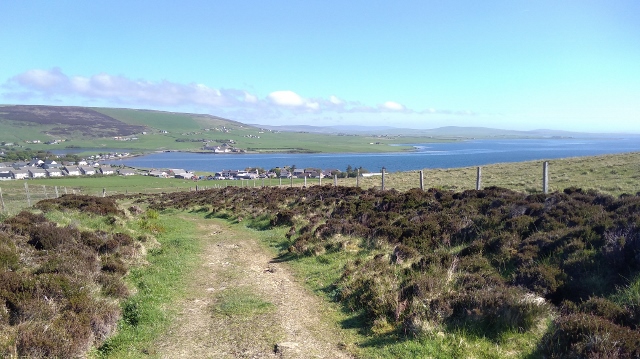
I took the sign to Gyre from the Orphir A964 road, and then a left which was signed to Breck. I was confused again just before the sea, but now I know the correct way I would recommend you keep to the right. The soft, flat turf of the coastal path around Scapa is even more beautiful on the cliffs above the rocks and the sea was there too and the birds were wheeching. Wonderful.
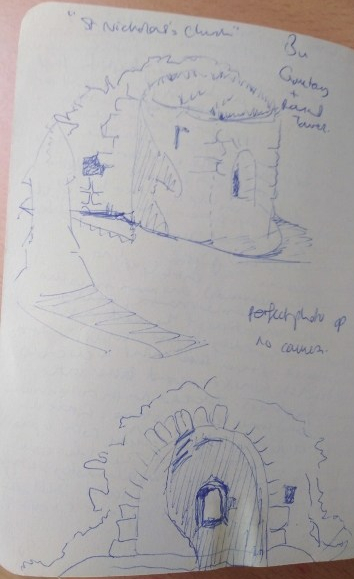
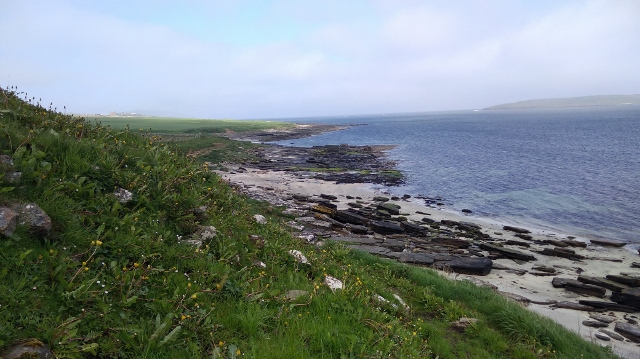
I slept a while, perched on the edge between the track and a small fall to the dark stoned beach, prickly with heather underneath but therefore cushioned. Further along is the broken-down bridge (which I crossed anyway) and the churchyard of St Nicholas. The ruin made a big impression on me, and I tried to record it in a sketch.
Only half of the tower remains, facing you as you arrive through the gap in the wall with its grassy hair and rugged exterior.
As you come around, the inside is exquisite – pale, smooth stone with a single arched window. Plain and undecorated, it seemed to encapsulate a holiness I rarely felt in the gold and silver interiors of the many cathedrals I have visited.
Nearby is the Orkneyinga Saga Centre which tells the story of the Norse Earls of Orkney. It closes at 6pm and I didn’t get that far. When I went on the Viking Hiking tour a couple of days later and the lovely Ragnhild ‘quoted oft’ from this famous text, I wished I had, and when I got home I thought with hindsight that I could have carried the tent and spent the night there, but I didn’t quite understand what I would find at the time. Even the bit I did see was one of the highlights of this trip.
There were 10 times as many walkers on this little stretch then ever I saw during the entirety of the past days. Probably because it was an unusually sunny, Sunday afternoon. The scenic loveliness probably also had something to do with it.
The long, winding return walk was equally enjoyable under trees which met above my head, a flood of bluebells beneath. Hoardes of almost-golden gorse branchlets reached out, so crowded with mouths bursting open I could almost hear them, ‘me first, me first’; while the individual kingcups presented their simple faces imploringly sunwards. The feathered petals of the only-slightly-paler dandelions on their juicy stalks were any moment ready to transform into translucent orbs of parachutes. I didn’t need to look where I was treading, so birdwatching was easy: jet black crows picking in fields of alabaster daisies; the now-familiar voices of mew and maow and peep (birds); and the gull-gliding, goose-flapping and sparrow-fluttering were all present and accounted for.
Walking when hungry at the end of the day can lead to morosity, but after a while it’s only walking – finding ways to release hip pains, just one foot in front of another.
And then I got to order my food at The Noust Bar and Restaurant – what a shame British restaurants don’t bring bread while you wait these days! – but I did enjoy the beer (the second from the Orkney brewery) which unsurprisingly went straight to my head. The service was good. The food would have been delicious whether or not it was, if you see what I mean. The monster, beer-battered fish, well-cooked chips and frozen peas hit the spot, as did the blackcurrant crumble and ice cream (£20 with a cup of tea to round it all off). At last I could charge my phone somewhat and as I had wifi access I took care to write notes ahead of the next day’s hike.
Finally I went off to my sleeping bag between the leaves of the garden, and halleluja! I was hot. I got up once in the night, and it was all mist and ghostliness. I even had some battery power to take this photo.
I am walking the St Magnus Way on Orkney, and this is one of the blog series – 24th May 2018. Below, you can find links to all the others (introduction, transport, accommodation, resources etc). The overall walk is 55 miles over 5 days plus a visit to the island of Egilsay where St Magnus was said to have been murdered and, initially, buried.
Orkney.
Day 2 – on shame, fear, and foolhardiness
Scenery: simply stunning
Burns crossed: too many to count
Whales seen: Nil. Dolphins? Also nil. (Another northern Scottish trip without a single sighting. Sigh)
People encountered between start and finish: 3 (at the end)
20 kms / 12.5 miles
Time: 8.5 hours
Falls to death: thankfully zero, but it was a close thing once or twice. Sound extreme? It was
Moral of the story: follow the signs
Theme established by the St Magnus Way group, to be found on their website: Loss
‘All pilgrimages share certain characteristics, features which define them as holy walks. A vow or promise at the journey’s beginning; and at the end a ritual prayer for enlightenment, forgiveness or miracle.’ p. 104, Spanish Steps, by Tim Moore.
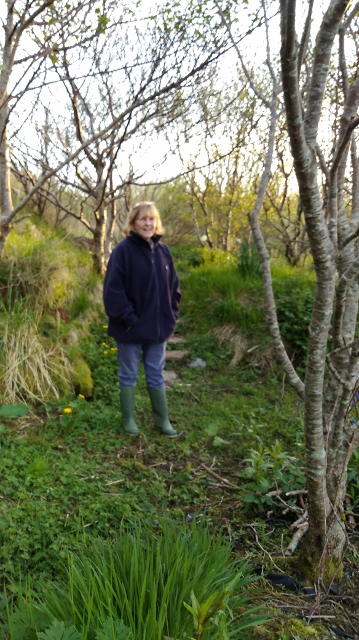
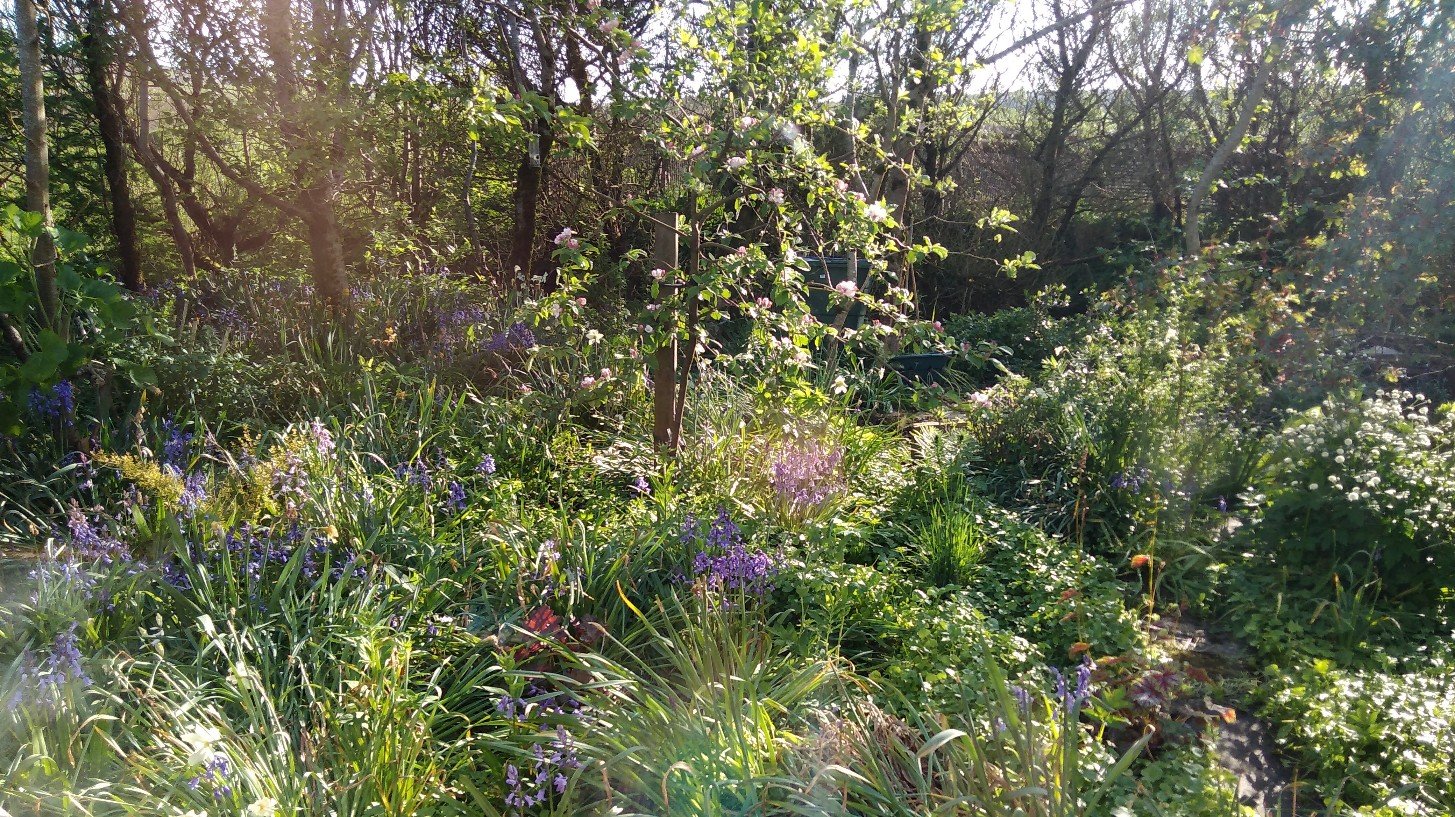
I stayed the night with Meg and Frank and enjoyed their company, conversation and beautiful woodland garden in the evening sunshine (photos above and below).
The next morning I gave a Shiatsu session and then stepped across their threshold for my first full day’s walk. Five geese honked in formation. As I tripped down past their lovely wood, a smell of earth was in my nostrils. A dry stone wall swept around the Sands of Evie in the Eynhallow Sound. Note that the recommended path begins at the Broch of Gurness.
Evie, Orkney.
On my right, barbed wire; on my left an expanse of green. Peep peep peep and twitter twitter regaled me. I was off. The haar was clearing. Cock-a-doodle-doo he crowed in celebration.
My three stones, on the Sands of Evie beach. Orkney.
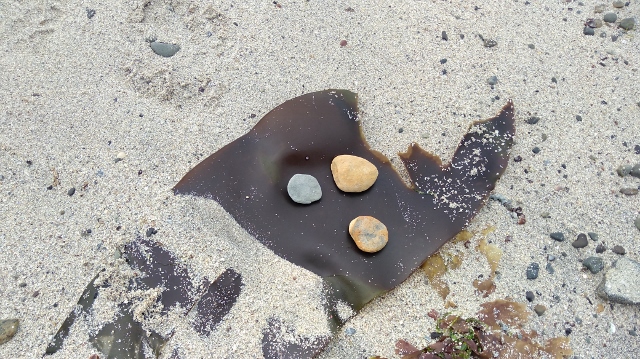
The St. Magnus Way website suggests using stones for various reasons: focus, something that ‘weighs heavily’, to remind you of something, or as a companion, to keep or to discard. So, I selected three stanes that the beach offered up: one for the fear that I won’t manage the walk – that was lobbed into the sea straight away! One was for worries about the future, and that I laid with all the monumental ones further along the coast. I kept the third until the end of the day. I had discussed the way with locals before leaving. I knew that sections of this first day had been closed due to unsafe conditions, although I did not know any details. My friend said she would not take a détour, and that matched my own spirit. So, I had already established that I would try to stay near the coast rather than being redirected onto the road.
Call that a path! Orkney.
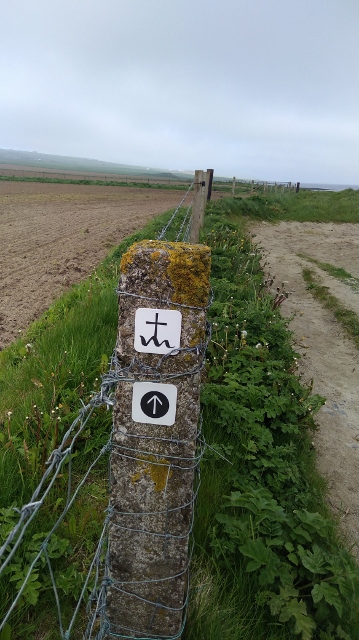
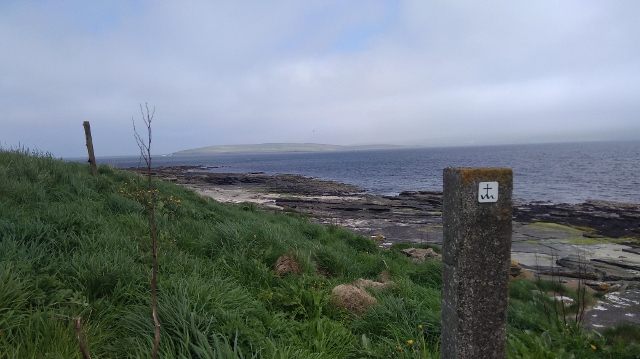
The first marker is attached to a wooden post – a simple, classy image of a black cross standing on a single wave-y line. Here was lush greenery but there was no path. Quite quickly I heard the phrase in my head ‘shame on such a path’. Now that is a phrase straight out of my childhood and the Church of England in the 1960s and 70s – one which I do not expect to have in my vocabulary. There are reasons I have continued to walk long distances, and one is the vital opportunity it offers for me to hear my internal prejudices and judgments. Away from the constant noise of the city and interactions with others, and with the quieter natural environment around me, I was giving myself the chance to choose to change. Well, to try to, at least – to notice. After all, old habits do die hard!
Orkney.
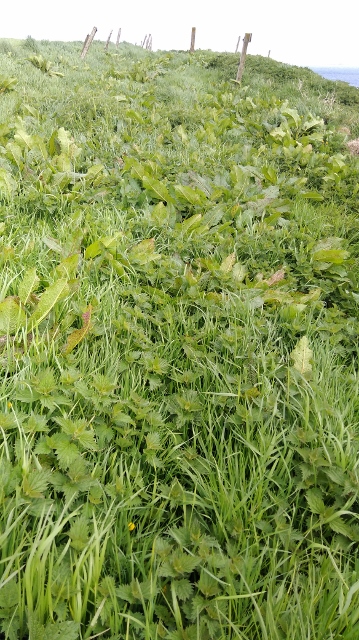
Shame on you. – it is a turn of phrase, right enough, but it carries a world of significance with it. What I meant was, how could ‘they’ let this pathway become so overgrown with nettles? My legs are very short and what with the heavy rucksack weighing me down, I was knee deep in them. Thank goodness I had the bottoms of my walking trousers still attached!
Anyone will tell you, I am a great supporter of self-reflection. Taking the time to review one’s actions, trying to honestly recognise what I say and do is an important part of self-development, and that is necessary at least for being a Shiatsu Practitioner, but also for learning about myself and how I am in relationship. I do not want to instill shame in others or suggest they should feel it, just because I think they should have done something different. It is, anyway, not a useful way to bring about change, if indeed that is needed.
‘It is not intended to be a manicured track, but a route of great variety, stunning scenery, historical significance and space to breathe’ From The Orkney Islander magazine.
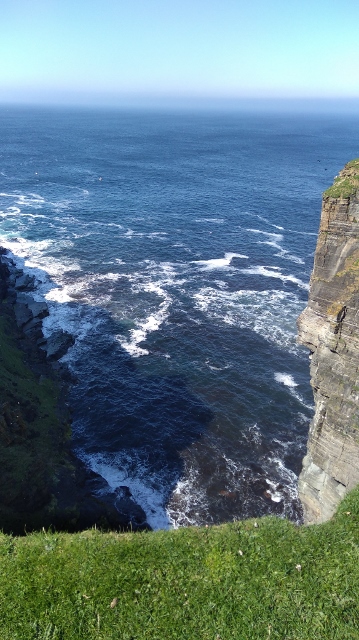
The Evie to Birsay coast, Orkney.
This is essentially a Christian pilgrimage I am on, set up by a Church of Scotland minister, the Reverend David McNeish, and a group of people from different churches. McNeish stresses, in the above mentioned article, that the walk is for anyone, an essentially spiritual experience for those who believe in God and also for those who do not.
‘The St Magnus Way is rooted in the Christian faith, as was Magnus, but welcomes all people and faith perspectives‘.
Interestingly the St Magnus Cathedral in Kirkwall, the pilgrimge’s final destination, ‘is unique in Europe in that it belongs to no particular denomination… since it has been owned by the people of Orkney since 1486’ (taken from The Society of the Friends of St Magnus Cathedral leaflet). It turned out that this walk, for me, was already becoming a golden opportunity to face up to some of my outdated beliefs around religion.
Orkney.
As I made my way eastwards, I clambered over chunks of beach where the course was hard to follow on the headlands but perfect for the sheer and simple joy of being so close to the sea. I waded thigh-high through more nettles, and these were interspersed with periods of striding forth when the way was clear. Then I could stare out, and out there was the glittering ocean while underneath me were the brooding, cracked rocks.
Orkney.
Mostly the going was oh-so-slow, and I had to remind myself not to try and make up for that by moving more quickly when I could. ‘Just don’t be in a hurry’, I told myself. Planting one foot in front of the other, and focusing on each step is a meditation in itself. Engage with it mindfully and it will automatically slow down the pace of your life. These types of long treks, like the contrast between going away for a fortnight’s holiday rather than for only a few days, allow for the gradual slowing of the system, a calming of the autonomic nervous system in fact. Almost all of us need that: mentally, emotionally and physically. So there I was, walking, when…oh, oh, a ghostly sound and I looked in the direction the sound came from, and the land out there on the point seemed to be writhing. On closer inspection, it was a shoal of seals flopping in and out of the sea. I know you do not talk about a shoal, but they really were like glistening fish newly caught in a net, with the water all sparkling around them.
Towards the Broch of Birsay and its lighthouse. The water all made of diamonds. Orkney.
They were jumping off their bellies, backs arched tautly. What cooing and barking noises they made. Even the occasional snort (or old-man-eating sound, one I had not heard before) made its way across to me high up on the cliff. Black and dappled grey, with sleek snouts bobbing up and down in the waves along the coast, they made eerie, windy noises. Slug-like they were, until their ends (tails and heads) curved up making them look like kids’ wobbly toys.
You can see the glorious colours, but probably not the seals at the very end of those rocks. The zoomed shot I took was too blurry to reproduce here. Orkney.
Suddenly my foot slipped on a loose stone. Then they all spotted me, and before I realised it, more of them than I knew were there, so well camouflaged were they, leapt off their rock. What a delightful treat! Being a rebel, and because I was not going to miss the possibility of seeing a cetacean, I soldiered on when the signs signalled to turn left. Here were great slabs of the past, immense layers of time immemorial. Glorious it was.
Orkney.
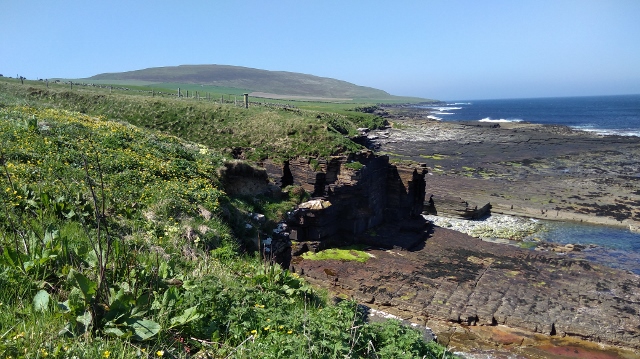
Words like strata and striated popped into my mind from O’ Level geography as I picked my way between the blocks of rock on the lower parts of the beach to avoid the dodgy path above. I crept up on more seals unawares as they were sunbathing. A second later, they were gone, highly sensitive to extraneous sound. There was not a sight of a human unless you count the aluminium yacht which caught my eye because it was glinting in the rays. A slight movement and again on the water like ever so many periscopes, there were the tops of seal heads checking to see if I had gone.
Orkney.
I was looking at my feet to find safe footing, when, meanwhile, I realised there was another set of wary eyes fixing me: Fresian ones! Cows were to be my almost constant companions throughout the days of this pilgrimage: clattering away down the fields as I approached even when I tiptoed, and then drawn almost immediately back to the fence between us. They were playing grandmother’s footsteps when my back was turned. One minute they were way away, and the next I heard a moo. There they were, right behind me with their penetrating stares!
Most of the path was terrifyingly narrow, a foot’s width perhaps, so that I had to cling to the barbed wire fences as I inched my way around.
A lesson (re)learned
If it feels hard, and especially if you are honest and it feels too, too hard, there will always be an easier way. Stop, look up, breathe and reassess.
Not so much a path as a sheer drop! Orkney.
I reflect that I need to learn this over and over again. It must be a deeply ingrained habit, even a belief system, that makes me keep on going through hardship. Here was another theme that was to re-appear repeatedly.
It is not in my nature to admit defeat.
Alexandra David-Neel, ‘My Journey to Llasa’ p. xiii
I admired the deep cravasses full of rock pools. The weed, seen from above, gleamed wet and slimy, shiny green like new buds. If you were lucky enough to have roamed on the beach when you were younger, like I was at Kingsdown on the south coast of England, you will recognise these types of rock pools. You will be able to guess what might be in their shady corners even though you are too high up to see.
Crazy paving beach, Orkney.
I was enjoying the round Neolithic corner of Eynhallow when a raven started up. A warning sound, it cra cra-ed over and over again, and I heard it. The going was precarious all along that stretch, and the bird looped me, taking off from one fence post, flying out and around my shoulders and then back. Back and round and back it went, for all the world as if it was weaving lines of protection around me, holding me in close to the land and discouraging falling. Perhaps I have read too many North American Indian stories about the traditions of totem animals, but I was duly warned and took extreme care.
Eynhallow island in the distance with its distinctive cliff corner. Orkney.
The raven – can you see it? Orkney.
There were other birds around: ones with bottoms the exact colour of the black and red stationery invoice books – you know those? Anywhere gannets build their nests is too dangerous for humans, I realised. I should not have been there.
That’s what the white dots are: gannets. See how precipitous it is. Orkney.
It was all made much worse by the continuous barbed wire fences: on and off came my rucksack. I felt real fear. Clearly other fools had gone before me because there were places where the wire was stretched. My advice: Absolutely do not do it. I have got myself into some scrapes before, but this was properly dangerous. It was entirely my own decision and every time I looked down into the next sheer gully, I expected to spot a skeleton. By this time I knew I wanted to go an easier way, but it was equally difficult to go back.
It was here I sustained the injury.: a gash from the barbed wire as I fell, deep, very bloody, but luckily not life threatening. Orkney.
After the next de-rucksacking amidst spears of irises with cabbage whites darting in and out, I headed finally inland for the road. I was close to the church ruin and I spotted Orkney vole holes in the dry grass. But, would you believe it, I was on the road for less than five minutes when the official signs directed me back to the coast. I will confess that I was feeling a trifle wabbit (exhausted) by this time.
Barbed wire fences, a stile that is almost impossible to get to – they have tried to stop us walking here that’s for sure. The Hesta Geo beyond. Orkney.
An uncharacteristic stumble necessitated yet another stop. I have to be very careful not to let this happen with the backpack on because I can topple very easily if its weight tips over. This time I snacked to give me some energy: chocolate, cheese and lettuce.
Showing a geo, a long, narrow, steep-sided cleft formed by erosion in coastal cliffs. Orkney.
I had confidently said I would manage 20 kilometres by early afternoon, but it was 1pm and I was nowhere near the end. Below my feet was a carpet of primroses, bluebells and king cups with teeny violets. There was often a sewage scent assailing my nostrils (ugh!) though with the odd whiff of warm grass. Now the nettles were up to my armpits so stings were sustained and still there were many fences to cross. I was becoming covered in scratches too. The tussocks were soft and uneven making the going even slower, my feet sinking unexpectedly deeper however carefully I placed them.
Costa Hill in the distance. Doesn’t look tricky but it was – augur of what was to come later in the trail. Orkney.
I startled a pheasant and it startled me. What was he up to at the edge of the West Mainland? He must have been admiring the view, he must have been. I also saw a rabbit – first I had ever seen on a beach. And a cat, easily managing the foot’s width of path that was available between fence and fall.
Orkney.
I was impersonating St Magnus now, wearing my beanie hat with feathers stuck in either side instead of horns and my baton instead of a staff which he would surely have used on his own pilgrimage.
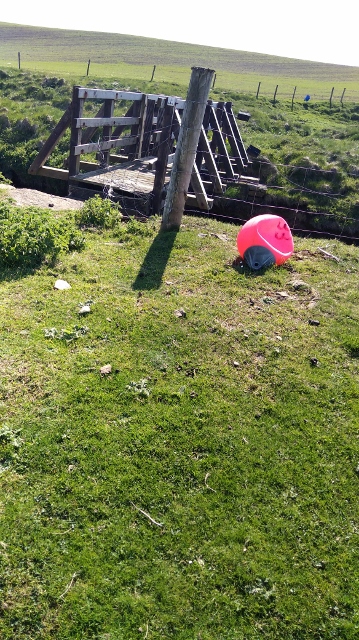
Wooden bridge over the Swannay Burn. Orkney.
I was once again very happily traipsing; fair bowling along I was after those revitalising calories. I even noticed my thoughts turning to old friends from my daughters’ primary school days. They used to go to Orkney with their children at every possible chance and now I understood why. Orkney, I was told by the woman from Elgin who I got to know on the return train, has the best quality of life of any rural area in the UK (1).
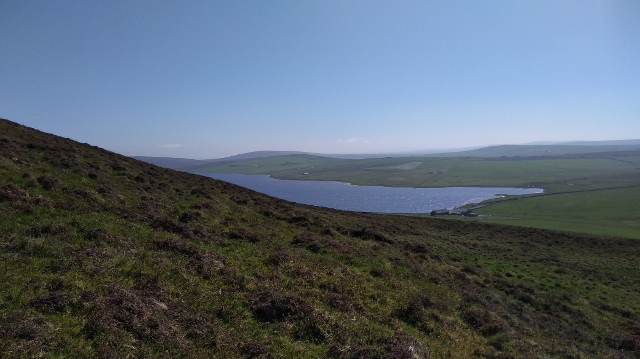
Loch of Swannay inland. Orkney.
Day one was certainly a ‘baptism by fire’, I thought. And there was another biblical phrase – how easily such words trip off my tongue! In the modern understanding of the phrase, I was being initiated to the pilgrimage with hardship and difficulty. Interestingly, that phrase is more likely to have been meant as ‘the conferring of the Holy Spirit’, which of course would relate well to a Christian pilgrimage. I understood that some of the adults around me when I was growing up still subscribed to the Victorian idea that hardship was a good thing for children. I suspect that many of my ideas come from novels which made an impression on me at an impressionable age – church-run orphanages which housed Oliver or Jane Eyre.
There were times when there was no point in complaining that something was hard because it was accepted as right and normal – in fact a cause for celebration. It was all in the hope that I would be strengthened by it, and not expect a life of Riley, a bed of roses. Well here I was, not on the sofa but spending my time on a challenging hike. Many of us do this sort of thing these days – conquering unconquerable mountains, running 43 marathons in 51 days (2) – mostly thought of as laudable and great achievements, particularly when done for charity. Hardship is popular. “Suffering is optional” (3).
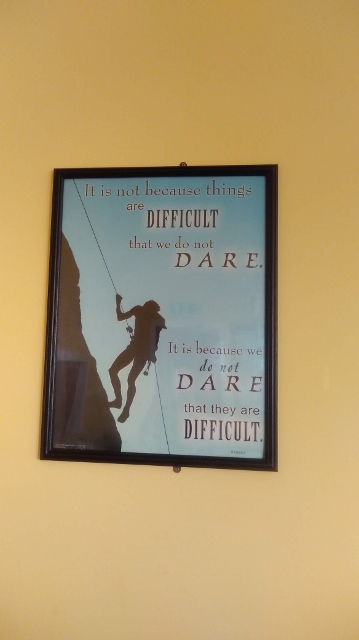
After encountering danger on and off all day, I discovered this poster at the campsite in the evening!
‘Suffering is something you have to learn to figure out in your life; it’s nothing to be afraid of,’ Jennifer Fox, documentary writer in the Guardian Newspaper 23.5.18
Rebecca Nicholson interviewed Sheila Hancock in the Guardian newspaper about a new film role in Edie where she had to climb a mountain:
“‘I was so frightened,’ she gasps, but still she did it, ‘Honest to God, I don’t know how.’… ‘I would love to enjoy leisure, but I find it very difficult to sit down and do nothing,’ ..” (25.5.18)
You can see it is starting to get misty. Orkney.
So, in the 21st century we have an issue with personal choice and with hardship versus that life of Riley. And a pilgrimage, like mountain climbing or other dangerous pursuits (as opposed to a sedentary lifestyle with few thrills) will hep you understand your own approach to life and raise the very things you struggle with on a daily basis. As 3.30pm approached I could see the haar (misty fog) rolling in again and I could not see from whence I came. Up hill and down dale I went, still happy. I admit I kept thinking about beer. I mean all pilgrims drink ale don’t they? At 4.10pm I took the series of photos below. This is inspiration. This is one of the main reasons I do these walks. When I am back home giving Shiatsu, I call up these sorts of images in the hope that the energy of these places comes through my touch.
Orkney.
Orkney.
Orkney.
Orkney.
Orkney.
I thought: ‘You having a laugh?’ as I went along a line of flattened grass that didn’t resemble a path. The problem with being tired is that you focus on the end and when you then come over the next knoll it can be disappointing to see the way still stretching far ahead. I reminded myself of a lesson learned on my first Camino: one-step at a time – poco a poco as they say in Spain.
Birsay village in the distance with the Earl’s Palace. Orkney.
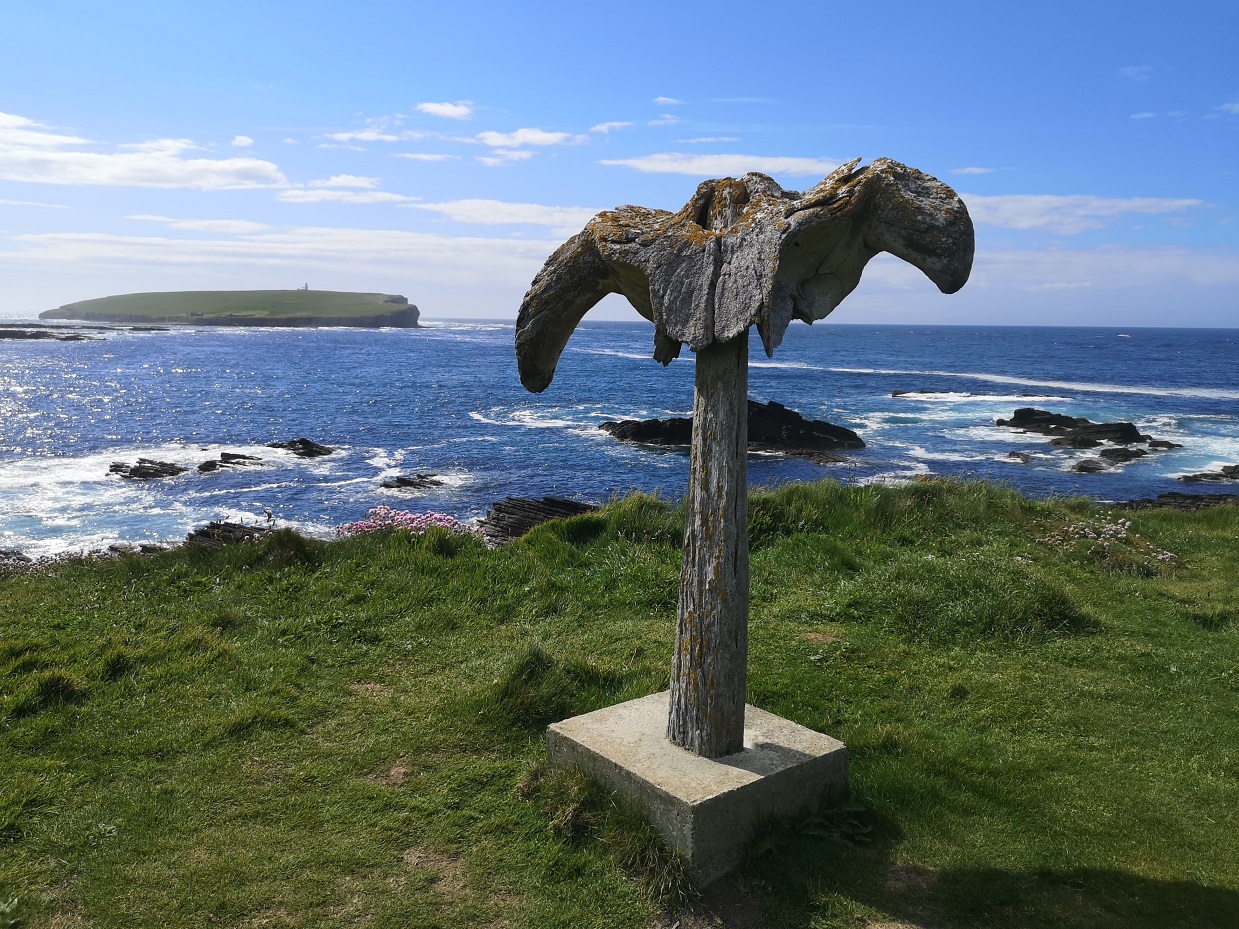
There are, in fact, midges on Orkney, contrary to what I read on the internet when I was wondering whether to take ointment or not! I didn’t see the Whalebone on this trip, but I did when I went back in 2021 (see bottom of post for a photgraph).
The nousts (scalloped earth for storing small fishing boats) at Skibbigeo, Orkney.
Luckily I got some help towards the very end when I was lost. First a woman in her garden came across and advised me over the garden fence to go between the two towers. But before I could do that, a most kind couple suggested I take the small road and they gave me a banana and a flapjack together with my filled water bottle. They even offered me a lift but see above – I was determined!
The Earl’s Palace in contrast to the local houses behind. Birsay, Orkney.
Seagulls were tucked into nooks and crannies, perhaps bedding down for the night when I arrived at 6pm at the Brough (say bruff) of Birsay car park. I went into the village where the Earls Palace looked amazing in the late sun. I deposited my last stone hurriedly at the Kirk (the end of the day’s route) – dedicated to the beautiful world. And then I took a bus. ‘Just take a seat’ said the driver when I asked him how much, and he let me off a few minutes later at the end of the campsite road.
Eventually I arrived in Birsay, Orkney.
The official wasn’t there yet, but a group of Italians were. I showed them how to book on-line and we took our places and pitched camp. Like the one at Stromness, the site was well equipped, clean and had a good energy about it. When she did come along at the allotted time, the woman in charge was wonderful and I took her suggestion and walked (yes, more walking but this time in sandals which made all the difference) to the Barony Hotel and enjoyed that ale and some well won victuals.
On my final car journey, when Christopher was giving me a lift to Stromness for the ferry, we discussed this Evie to Birsay day, and he told me a guide had stepped back from his group on another part of the island and fallen to his death. I would not have missed my walk ‘for the world’, but it was stupid of me to ignore the signs and I would not recommend anyone else did the same. Thank you everyone who helped me along the way today. Thank you.
I am walking the St Magnus Way on Orkney, and this is one of the blog series – 21 – 30 May 2018. Below, you can find links to all the others (introduction, transport, accommodation, resources etc). The overall walk is 55 miles (88.5 kms) over 5 days plus a visit to the island of Egilsay where St Magnus was said to have been murdered and, initially, buried.
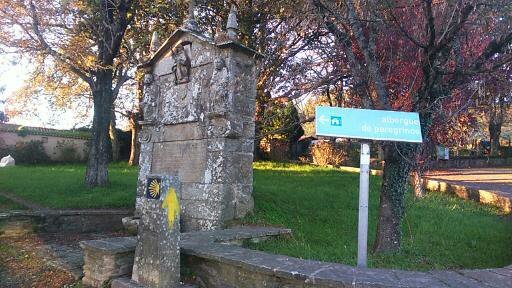
Spanish camino yellow arrows and other signposts.
Signposts
If, like me, you are used to finding the yellow Spanish Camino Santiago de Compostella arrows, then you will:
a. be at an advantage – you know that it is important to slow down at junctions or if you get that funny feeling you might have gone the wrong way, and really scout around for the sign. You know to look in unusual places, and that they will not always be at the same height as you, or immediately obvious.
b. On the other hand you will be at a disadvantage – yellow shows up better than the more environmentally friendly St Magnus Way black and white signs on wooden posts. You will expect lots of guidance (eg through a wood where the path twists and turns and there are tributaries (as it were)) and that is not the case here – on the whole one must follow what seems to be the main way. (This is certainly my experience with many other pilgrimages, not just this one. The Via Sacra signs were really hard to find, whereas the Fife Coastal Path is great).
The signs are sometimes before a junction, sometimes at it, and sometimes afterwards.
I believe they were positioned by people taller than me, so for example if the next one is over a hill, a taller person may be able to stand with her back at the previous one and see the following, but not always.
In fact, now I am on this subject, the stepping stones which have been helpfully laid over burns and bogs are also very far away from each other – perhaps at the correct distance for the average male stride – but not mine, not with a rucksack anyway. In these cases I took a deep breath and leapt!
Bluetooth
There is a system of Bluetooth waymarks provided by the Pilgrimage organisers, with information so that when you walk you use your phone to connect and can listen as you go. I would have loved to try it but the system was down when I was there. Of course you would need a smart phone with that capacity to use this facility. I don’t know how long the recordings are, but don’t forget that you would also want headphones.
Many people love music or podcasts as they walk. Personally, I like the sounds around me and in addition there’s always plenty going on in my head! I have tried but I always give up quickly as I feel cut off from my surroundings.
Route descriptions
There is no guide book as yet, although the organisers of the Pilgrimage are in the process of producing one which will be great I am sure.
They do already provide Route Descriptions on their website and these were updated and published on 30 May 2018 after I returned home. They are generally of a very high standard. I suggest you print them out and laminate them before you leave in case of emergencies. I know this sounds a bit geeky but you never know what might happen, especially with technology.
There are also documents, audio recordings, videos, photos and all manner of amazingly useful and interesting resources on the St Magnus Way website.
Compass / maps
A compass comes highly recommended (make sure you know how to use it!) because north, south-east etc are used in the St M Way directions. I planned to use the one on my phone, not imagining that the phone would be virtually unusuable.
You can download Route Maps from the St M Way website.
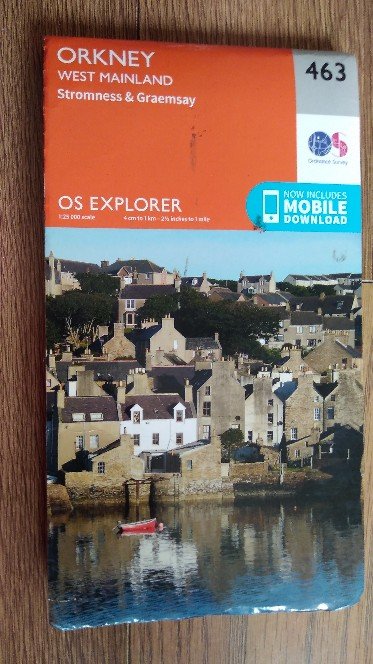
I would also suggest bringing an Ordnance Survey (OS) map so that you can see where the St M Way Route Description landmarks are. The mast on Keelylang for example, is listed on the Route Description for Finstown to Orphir as a way of orientating yourself. It is on Googlemaps but not the St M Route Map. Kebro is on the St M Route Map but not on Googlemaps. Both are on the OS map 463 which has most of the West Mainland on it, but not Kirkwall, so for the hard part of the final day’s walk you will need to carry a second map. You can buy maps at Rae’s Paper Shop in Stromness and in Kirkwall.
Whichever map you use, you need to know the direction you are physically pointing towards (see compass above) otherwise it’s almost no use knowing where the place you are searching for is on the map anyway!
Please note that if you have the facilities, know how and space on your phone, there are gpx connections on the official site. I suspect, from looking at other websites and talking to some (mostly male, it has to be said) hikers, that using technology is the thing to do, but I am a trifle old fashioned in this respect so you would be better looking elsewhere for that information (though there is a helpful quote below). I think you have to spend more on your mobile phone than I do to be able to use it all. There is of course the argument that a pilgrimage is a place of silence and self-reflection and we all know that technology isn’t always helpful with that; then again, getting lost is a bummer.
In any discussion of routes, navigation or GPS devices, you have probably seen people mentioning ‘GPX files’. GPX is shorthand for GPS eXchange Format and is a type of file that’s really helpful to anyone who loves the outdoors, and is the most popular way of saving and exchanging routes. Ordnance Survey Blog
Tetanus
Be sensible and check if your tetanus jab is up-to-date before you go hiking! I was so careful, doing everything slowly, but my foot slipped down a hole I couldn’t see and the barb from the wire was too close. I had tea tree essential oil with me which is a serious antiseptic and so I wapped that on immediately, repeating several times a day for the next few days and I was fine. Check the symptoms of tetanus.
Cold at night
It’s hard to imagine it can be so cold at night in a tent in May when the day-time temperatures are so moderate, but it can, so you have been warned! See Resources – what I took with me (link below). Weather, Kirkwall
I am walking the St Magnus Way on Orkney, and this is one of the blog series – 26th May 2018. Below, you can find links to all the others (introduction, transport, accommodation, resources etc). The overall walk is 55 miles (88.5 kms) over 5 days plus a visit to the island of Egilsay where St Magnus was said to have been murdered and, initially, buried.
Day 4 – on a faulty phone charger, change, and curious cows
Scenery: roads and fields – a ‘pasteurised’ day
Barbed wire fences negotiated: on-going
Animals/birds met along the way: 1 dead, 1 empty shell, 1 left wing; and 100s well and truly alive
People encountered between start and finish: one
Theme: Change
16.6 kms / 10.3 miles
Time: 5 hours
A photo between Birsay and Dounby when the sun shone.
It was a dull and chilly start to the day and I left Dounby along the main road as directed. It felt really nice to have my feet on the ground. I passed signs to B&Bs and a hotel, and took note of this information for any readers who might want to visit Orkney but not camp (see accommodation – where I stayed).
This beautiful creature was dead by the roadside.
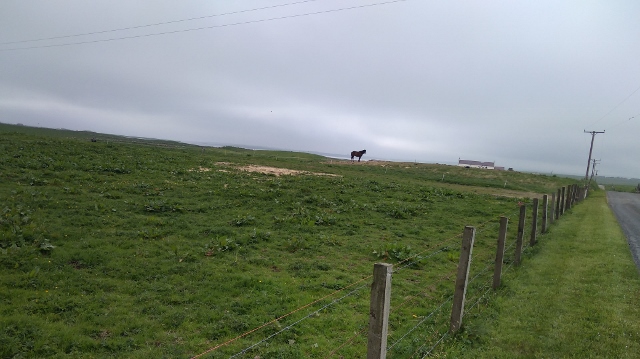
I was fielding texts when my attention was drawn by a cock’s wakening call. There was also the enthusiastic tweeting you get at this time of the day – far better than the mobile phone kind. So, I focused my mind on the path ahead, and walked on beside dry stone walls, a big grey house, farms and, looking up, spotted a lone horse.
Silhoutted on the horizon.
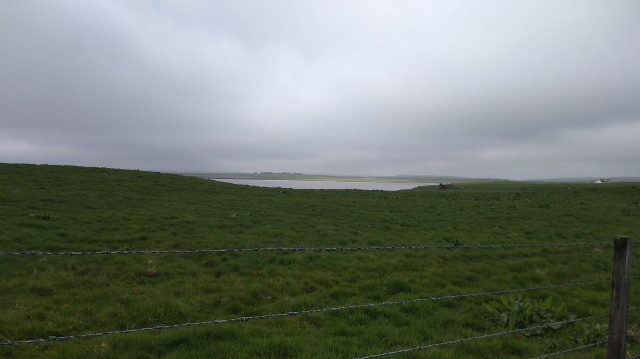
There was a beautiful loch view as I made my way off the highway in the direction of Howaback.
It is often hard to get photos without barbed wire fences. See the water in the distance on this cloudy day.
A westerly wind blew, with the occassional breakthrough of sun. My phone was playing up even more and I knew I must limit my photo taking because of the lack of battery. I was now very disappointed that I had chosen to take my camera out of the pack at the last minute, to lighten it. What’s more I had looked at mobile chargers in the outdoor shop before I left – you know, ones that don’t need an electric wire – and how I wished I had heeded my intuition instead of my purse strings.
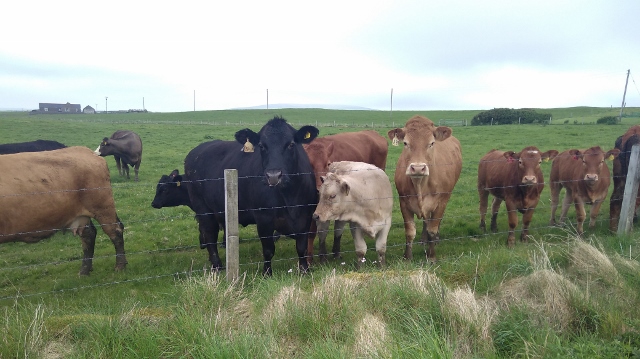
The cows had cheery hairstyles, matching quiffs. There was no pavement and most cars which sped by were respectful and pulled out into the middle of the road to give me room when they could. I thanked them all with my Royal Wave.
Fetching fringes and hard stares! I startled them initially, but when I initiated a conversation they came up, curious. Huffing hot air, they produced copious yellow pee and sported impressively dangly earrings.
The Loch of Harray was getting closer.
I turned along the Old Drover’s Track and past the Merkister Hotel.
A black-headed gull startled the ducks and there was a wader which was, well, wading. He had an elongated beak, upturned at the end, and spindly legs to enable him to negotiate the puddly part at the edge of the water. Then in a flash of black and white, he took off. Looking on the internet when I got home it looks like I saw an avocet.
Sketches of the avocets from my notebook.
If I had only bought binoculars… Well, it was hard to make choices of what to carry when most of the knapsack was full of tent, ground sheet and sleeping bag. I was carrying it all for the first time to see if I could manage the weight. (see Resources – what I took with me).
The road goes hard by the Loch of Harray on the St Magnus Way, Orkney. A breeze just rippled the water.
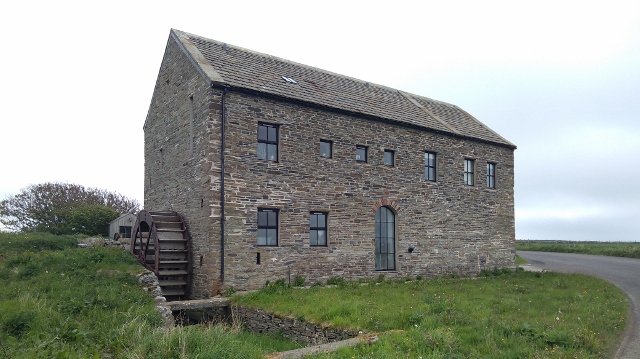
Three men were a boat, pootling, when I got nearer the shoreline. I was starting to see more camper vans as well – the tourists were coming. Here was the old mill mentioned in the Route Description of the St Magnus Way website.
Now it is a private residence.
I noticed the red poppies in this garden, and what I hoped weren’t gallows. There was a haunting ‘hoar-wiii’ birdsound which added an eerie tone to the scene.
I saw sea swans (can you say that quickly?) at Birsay and here there were more, their impressive, extra-long necks and massive, slowly-flapping wings reminded me of those early films of men trying to fly. The grass curved round where it met the gentle waves.
Perfect for migrating birds who need to stop over on their way to and from warmer climes.
Inland, I headed towards Quean (such great place names aren’t they?). On the way I was struck by the delapidated buildings with missing or staved-in rooves, and a triangular field with only a few random crops all of which had been allowed to go to the white and yellow flower stage, betraying the fact that the land used to be farmed. I spotted old, irregularly shaped stones, but they had no wire attached so perhaps they were standing ones rather than practical supports.
The cloud was hanging wispily over the hills, the sun illuminating small settlements far away.
I had been basking in the landscape around me, the glorious flowers in ditches by the road, but now my right hip (from poor ballet training as a child), and the left sciatic nerve (from a strain during my first pregnancy) started to attract my attention instead. They were probably triggered by walking on the hard surfaces.
Nevertheless I walked on. That house, I muse, must be inhabited because there’s a jaunty wee wooden fellow pushing a barrow with his flower-pot hat on in the front garden.
I admired the pink and white cuckooflowers and felt as if I had all the time in the world – something I never catch myself thinking at home. I watched a cat, on the other hand, racing to avoid the wheels of a fast advancing vehicle. Hmm, that’s an apt metaphor!
I spent some time trying to work out the ‘wheeeeen’ sound. Perhaps it was the wind in the electric overhead wires? It was like a one-stringed cello being played by the elements.
I passed a pond with six black and white duck-type swimming birds in it. They had turquoise beaks – Orkney is a bird watcher’s paradise!
Crouching down to eat my yogurt I thought, now they’ve raised the bottom of the cartons, doesn’t the end always come sooner than expected?
A silent cyclist passes. Mrs Armitage on Wheels comes to mind, a charming book I read and reread to my children when they were young. With illustrations by Quentin Blake, it is about a determined woman whose nose pointed her where she wanted to go. Later she came past in the other direction. I saw no-one else for a long time after that.
I was carrying an extra load of food because I stocked up at the store the night before, just in case I didn’t find anywhere to sup that evening. It was heavier, but oh so much yummier than usual. Being out in the open air all day every day, I was far hungrier than usual. After eating I noticed that my mind was lively and my body sluggish – busy digesting probably.
At one and the same time the sun was warming my left shoulder and the wind was finding the wee crevices between my hat and hoodie. Which was best, midges or wind? It was a bit of a toss up between them, the latter keeping the former at bay.
I tried to put my rubbish in someone’s wheelie bin but it was full to the brim with bottles – you know what they say about Scottish drinking habits.
An empty bird’s eggshell sat at a tilt on the path – a delicate sage green. More poppies drooped their teenage, soft-whiskered heads in mock prayer, scarlet petticoats irreligiously showing under green skirts. Leaves stabbed the sky beside ferns yet to unfurl. Dock and bell, lion and clocks. I’m having more of a wander than a walk, half the time – no wonder it takes me so long to get anywhere! It is more a series of unhurried hiaituses than a hike!
There was a church on the hilltop to my right. ‘School on the hilltop’ was our school song, and as I walked upwards, I not only remembered the tune but also every word. This of course meant that it was then going round and round in my head for a good while afterwards.
St Michael’s Church (1836), Orkney, has sobering Commonwealth War graves. Beyond was the Loch of Harray, still dominating the landscape.
St Michael’s churchyard (and a little of the church on the right), Orkney. There were urns on tombs and pointed memorials, with stone drapes and unnaturally crimson carnations at their feet.
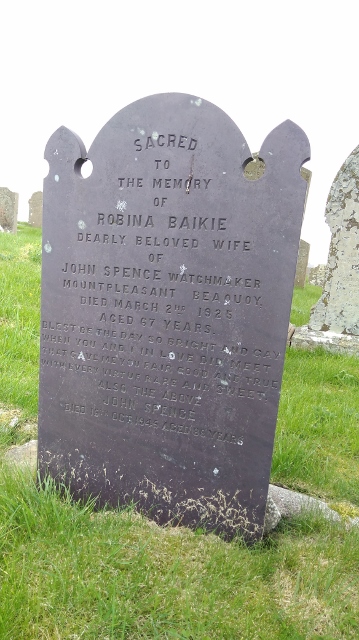
A roll-call of local families: Flett from the 1890s; Hourston; Harvey; Merriman; Jonston; Kirkness, and Baikie about whom my friend Elaine messaged me when she heard I was coming. (Her ancestors bore this name.) WG 201964 Private Dudgeon who died on the Seaforth Highlander in 1919 aged 36 years; Betsy Walls and her son, both aged 70 were laid to rest in the same patch of consecrated ground; John Anderson from Applehouse, Harray; A Clouston who became a Flett through marriage; and the sad reminder of Emily Mary aged 3 years and 5 months, eldest daughter of the Reverend Masson, ‘Drawn in tears’ in 1834. So very sad.
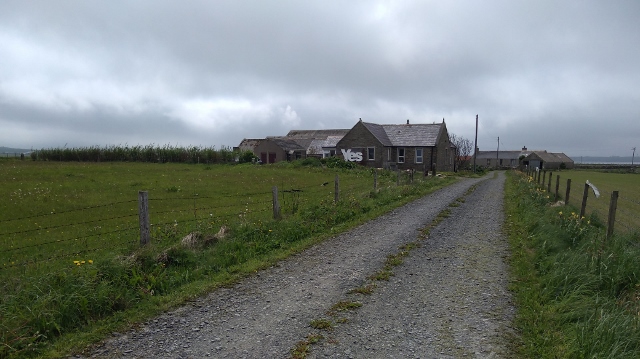
A supporter of Scottish Independence must own this house!
I heard a number of Orcadians refer to the part of Scotland where I live, not as ‘the mainland’, as I think of it, but as ‘Scotland’. These islanders have a history of being independent.
‘More than half of Orkney’s councillors have forced through a motion demanding an investigation into “greater autonomy or self-determination” amid the vote to leave the European Union and a possible second independence referendum.
Many residents have hoped for greater autonomy from the Scottish Government in the past, and were promised more powers in the event of Scottish independence.’ Taken from the telegraph newspaper.
I was born in England and have English parents. Although I have lived in Scotland for more than 30 years, no Scot would describe me as Scottish. When I lived in the Forest of Dean years ago (on the border between Wales and England), I learned that you had to be born in the Forest of Dean hospital to be called a Forester, and therefore the threat of closing it was very serious. I wasn’t one of them either.
Issues of identity are at the forefront of many Scottish people’s consciousness just now as the majority of people who are eligible to vote (which includes me) did not elect to leave the EU. Our society is rich with the variety of cultures represented within it, and I am lucky to be able to move around Europe without difficulty.
I cannot identify as either English or Scottish, and perhaps that partly explains my choice of vote, being European IS something I am (but only until March 2019?). My joy of travel is related to many things, but it must be in part to do with this complex sense of identity.
Scots believe birthplace and parentage count most – living in Scotland for ten years doesn’t make you Scottish
Ideal for birds and wild flowers, it was very peaceful with only a few parked cars in the distance.
I took my attention back to the ground and carried on walking. I spotted an electric blue acoustic guitar through the window – it had a red rim. It was uphill a bit and there were starlings (electric blue they were!), and free range hens. The farm chemicals assaulted my nose buds. Teasal and horsetail grew where I planted my feet. Tyres were piled on top of haystacks. The sun came out for a moment over the green pastures. Four-legged beasts were grazing and a yellow digger was upended, offering them shade.
I was snapping blind by then because with my phone on energy saving mode I couldn’t see the screen properly. It was a noisy stretch: to my right, racing car noises; to the left the bellowing of calving beasts. I was surprised how my feathered friends had barks bigger than their scrawny black bodies. Perhaps they were trying to make themselves heard!
The theme of the day was ‘change’: the constantly changing landscape; the fact that we are born, we live, we die; the weather which changes the sky from grey to blue; war coming and going, and then coming again – every step I took brought about change in me. If I was mindful I noticed those alterations by the minute, the very second even, a sense of some of my cells regenerating and some dying for the last time.
See how the green expanse offsets the shared blue of the sky and sea in the background.
Hub-caps littered the sides of the roads (why don’t manufacturers attach them better?) A line of whites – pants and vests – were neatly arranged for blowing dry. Waterfalls of clematis gushed over the wall. Buds were blushing, ready to open at the first sign of their sun suitor’s touch. Black crows waddled in daisy fields. Is that rain ahead, I asked myself, there being no-one else to ask, not for miles around. Although the clouds were hiding the summits, I knew they were there, clad in pink heather.
Ooh, for a yellow dauber! There were so many places I would have added an arrow if I had a pot of paint with me. Yellow arrows are the signs which hikers look out for when following the Spanish Caminos. Here, on Orkney, the spaces between sign posts were much greater and I was often moving forward on spec, past side options and through open land, just hoping that I was taking the right route. If I found myself going too far without seeing one then I had to simply double back and try another way.
I had developed ‘tarmac foot ‘, as I called it – plantar fasciitis is the official term. It causes a tenderness of the bottoms and a painful tearing at the heels. One thing I did buy before I left was new in-soles and they did seem to be helping.
There were small piles of oats at regular intervals along the road at this stage, a contrast to the Spanish anthills to be found on tracks between Seville and Salamanca for example. Were they to lure the flock?
I traipsed across a pretty stone bridge and admired the gardens, spotting more of the wooden fellows with their flower pot titfers: one fishing, one climbing a ladder. Someone on the island is obviously doing good business making and selling them.
Without my camera I was reduced to sketching. Sweat trickled as I drew. Of course I also had no idea of the time (my phone had died and my watch was left on Egilsay). It didn’t matter. Woolly detritus was strewn all over the grass from the mama sheep – does the hair of all mammals fall out during pregnancy? Once more I hunkered down out of the wind. In the lee of the wall the grass was damp under me and I snacked on a Scottish-sounding apple – a braeburn – probably grown in New Zealand or South Africa.
I had finished my book yesterday and bought a newspaper, tearing out the sports pages to keep my load as light as possible. I admit that I did already feel rather concertinaed, sort of compressed vertically, by my backpack. This is a bit of a problem as I am already diminutive (4 foot 11 and three quarters which is 1.5m) and so can’t afford to lose a single inch.
Wisps of sheep snagged on their barbed boundaries like the white washing I had seen earlier – discarded, uncarded. A concave sow still to give birth, bulged. I passed a woman painting her fence – a human encounter of the kind kind (ugh) – and like ‘the good witch’ in the fairy tales, she bestowed on me good weather for the morrow. A luminous sky was over there where I was not. A warm slab offered me a weary seat – the mind was still willing, but the weight deterred me a while.
Tim Moore (author of Spanish Steps which I had just finished reading) would love the place names round here: Hobbitsville, Hobister, Tuskerbister and Stymilders. Let your imagination run with those and there will be stories aplenty!
The theme of change was still with me: A leopard never changes her spots; change for changes sake; nothing remains constant except change. Every day the environment changed around me and I would take pictures if I could, to fix the place in my memory. People turn up in my life unexpectedly and then they leave – change inevitably happens.
‘Solvitur ambulando’, a Latin phrase meaning, ‘It is solved by walking.’
from Tadhg Talks blog, ‘An Encounter with Vulpes Vulpes in London’.
Binscarth Woods
I had reached the haven which is Binscarth Woods and my tiredness disapparated. I sketched the scenes of pink blooms under yellow gorse, undulating walls and fence posts which leaned on account of the wind. Unfortunately here in this beautiful place, there were dog-poo bags hanging from a tree like they do in Edinburgh. Why? Never mind, because twisted silver branches, fragrant roses, wild garlic and bluebell woods made up for it. Here were dells such as are inhabited by fairies and blithe sylvan spirits. The evening sun accompanied me out into the grassy field and there I came upon Finstown.
Finstown (say Fin-s-toon)
Finstown is named after Phin, an Irish soldier, who established the Tody Hole Inn, in 1821.
What did I see first? The Baikie Stores wherein more kindly women offered me tea (the cafe was of course shut by this time). I left my phone to charge out-the-back, and bought a replacement cup (mine had broken when I threw my rucksack over a fence so I could slip underneath it). I picked up some local news – it seems that although the fog was down over this village, apparently the sun was shining everywhere else! I perused the magazine rack: Orkney Farmer; Farmers Guardian; The Scottish Farmer; Smallholder; and my favourite, Classic Tractor. I could have added a CD to my basket entitled ‘Orkney Rocks’ which included ‘Fields of Gold’ which we sing in my choir back home.
I took a walk, scouting for a place to pitch my tent. On the way down the hill I visited the post office. Outside was the inscription: Come sit on the peedie porch with me, our ice cream is cold and the warm welcome is free. (Peedie means little). It was certainly warm, and I was able to buy a book by local author, Lorraine Bichen – ‘Three Weeks and Counting’. I was warned it was sad one, and sad it was. Later I met the Post Office couple again and they offered me their floor to stay on. I was settled by then but was very grateful for the thought.
I visited the rather old-fashioned Pomona pub I had been told about, where Wilma who had been there for many a long year was as sweet as anything. She couldn’t offer me food, but said I could eat mine in her bar if I bought a drink. The only other person in there, a guy from Skye, laughed his head off when I asked if there was wifi! I eschewed a beverage and continued on down looking for a site. On my way back up later to retrieve my phone, he was waiting for the bus and we had a chat about his work at the timber yard. What a friendly lot they all are!
After that, on a whim, I popped into Creation Cuts and asked the proprietor Gillian how much she would charge for washing my hair – what with not having been able to take a shower for a few days and all. She said yes, and wanted to know if I was alone and what was I up to. In the end she did it for me for free and I loved her for it.
That evening I set up camp on the shore and had such a struggle to boil my pasta, I used half a box of matches and my new solid fuel stove, but the wind was against me. I tried to light one in the tent. The tip broke off suddenly and made a hole in my new orange mat – disaster. Then I decided to give up on the outdoors and squatted down by the wash hand basin of the public toilets next door out of the wind, nervous in case anyone discovered the smoke or I burned the floor. All was well. Soon my tummy was filled at last.
While I was taking my walk, Orkney was alive with the Folk Festival. Someone suggested I take the bus back to Stromness to take advantage of it, but happily I didn’t need to because there was a satellite concert playing at the Firth Community Centre. When I arrived the first notes were being played. The tickets were sold out and I was really lucky to get a return. Can you guess who was compèreing? The very same minister who set up the St Magnus Way and who had given me a lift into Dounby the day before! And who should I sit next to in the audience? the couple from the post office. I felt like a real local knowing people like that. Top of the bill was the Quebecois band ‘Le Vent du Nord’ and the evening was wonderful – I fair jiggled about in my seat with enjoyment.
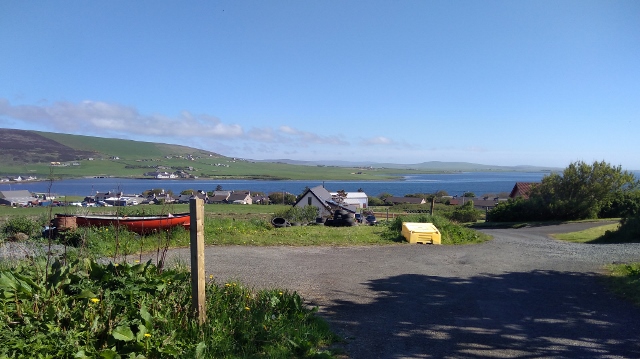
It was very cold in my sleeping bag that night- even with Kiersty’s thermals on – and many drunken revellers interrupted my sleep when they stopped their cars to use the facilities at the back of me. However, I survived to tell another day and this was the view I woke up to. How absolutely beautiful was that.











 Walking without a donkey