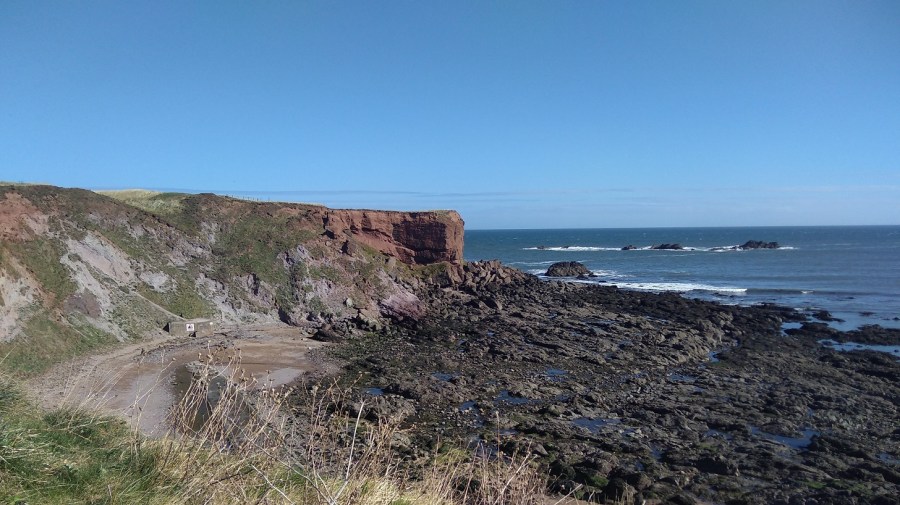
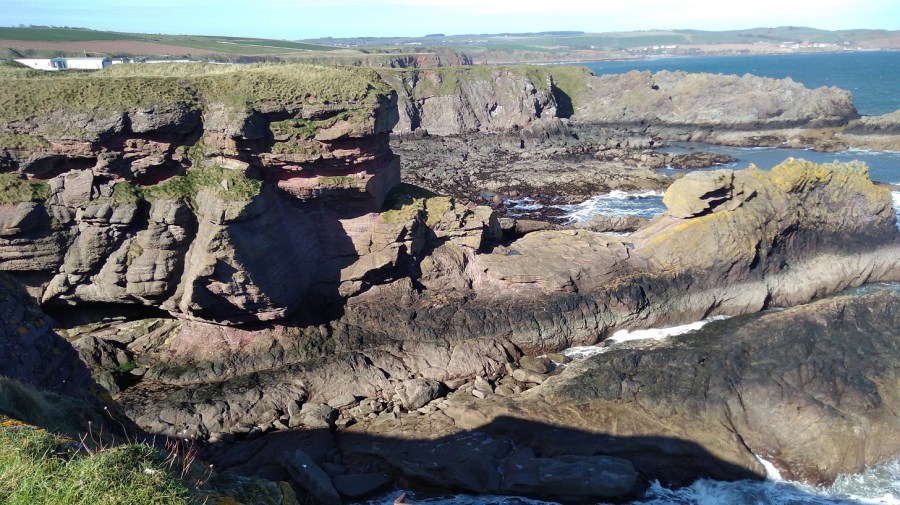
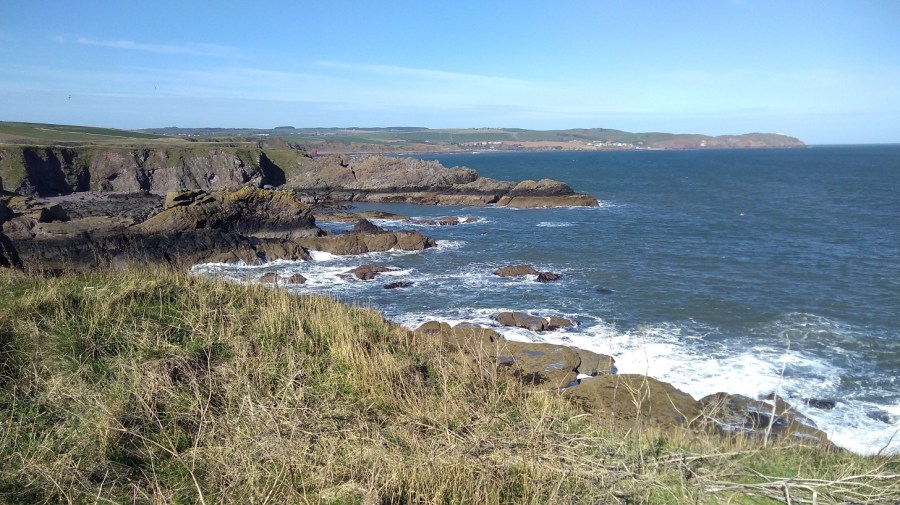
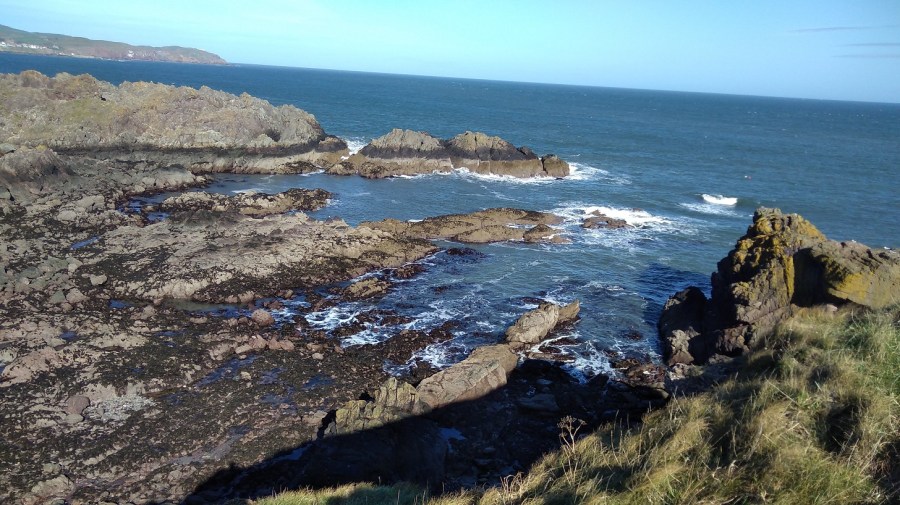
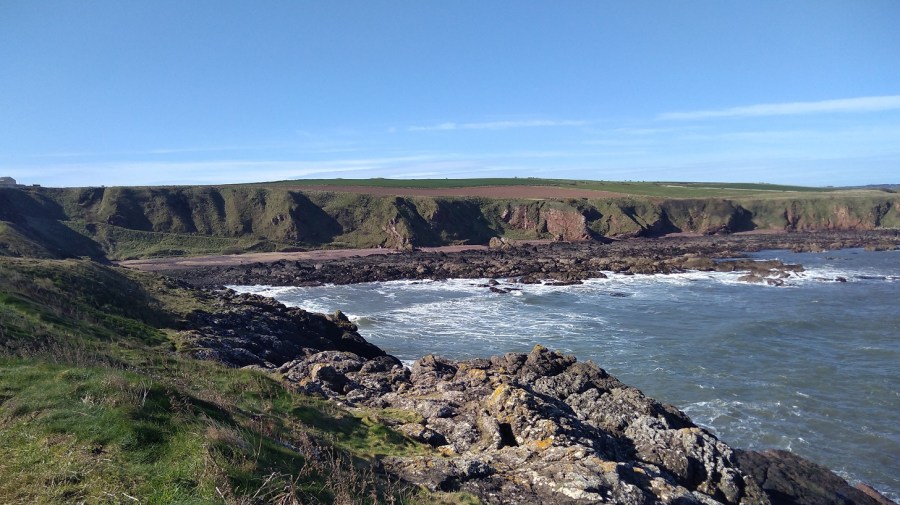
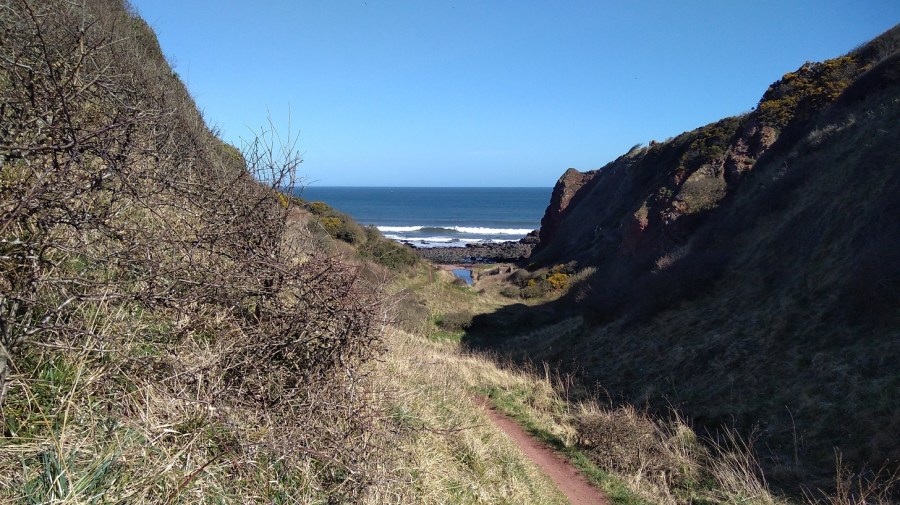
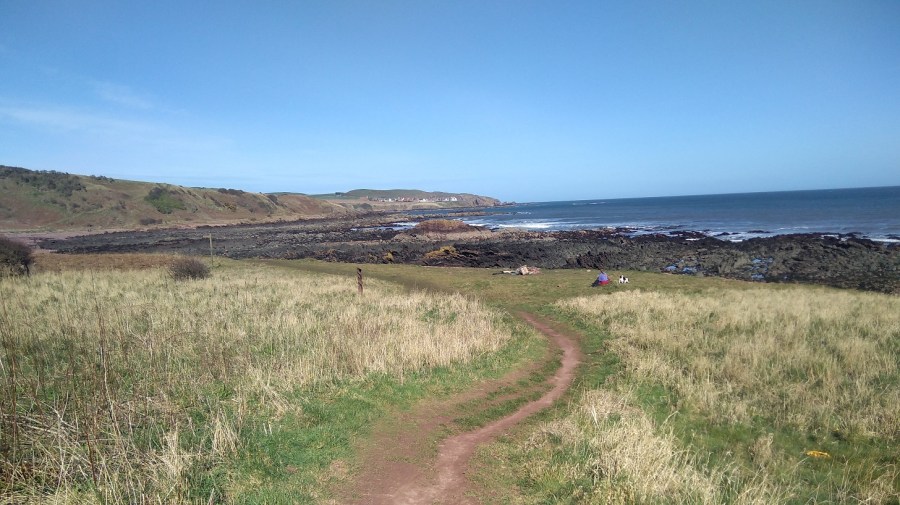
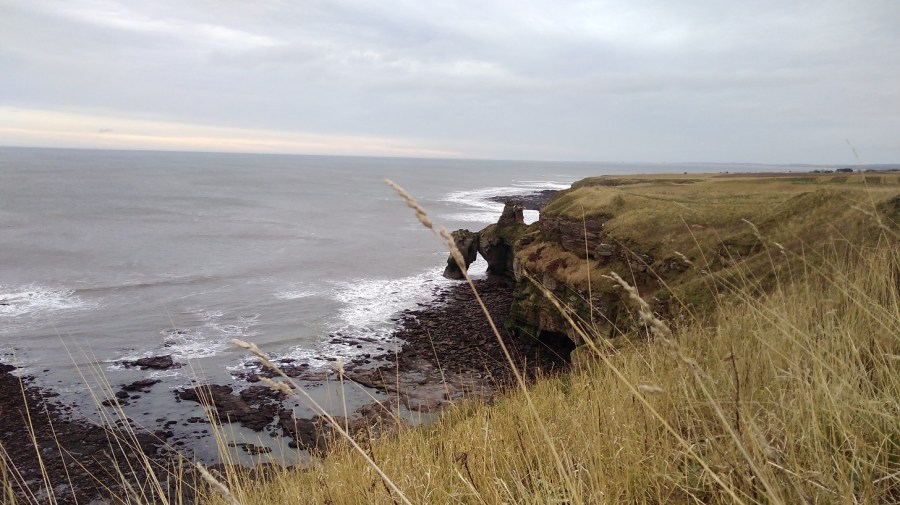
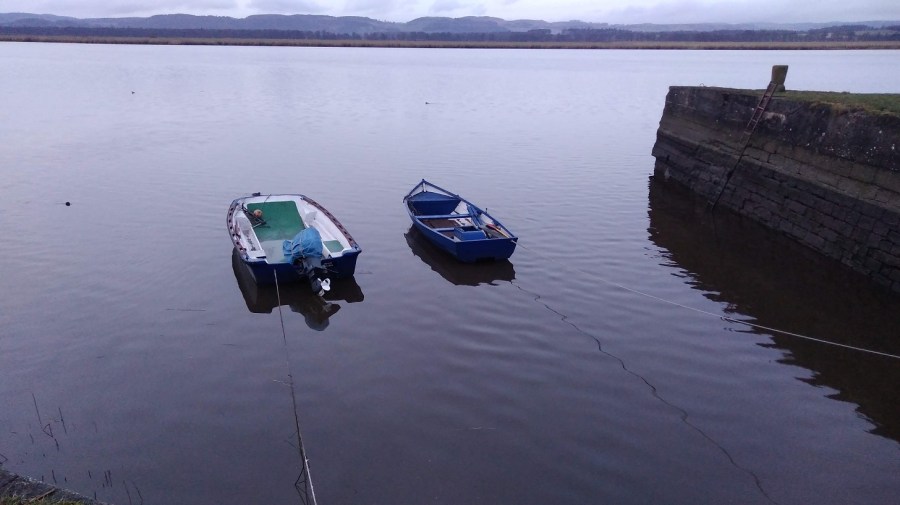
Berwickshire Coastal Path: St Abbs to Cockburnspath

January 2020. The third and final section of the Berwickshire Coastal Path (BCP), Scotland. 25+kms (15.5 miles minimum). There are facilities at the Pease Bay Leisure Park (perhaps 6.5 hours in – the Smugglers Restaurant), otherwise, not until Cockburnspath, unless you count behind-the-bracken as a facility! It is a difficult walk for those who haven’t recently done Scottish cliff walking. Total 7.5 hours.

Berwick-upon-Tweed
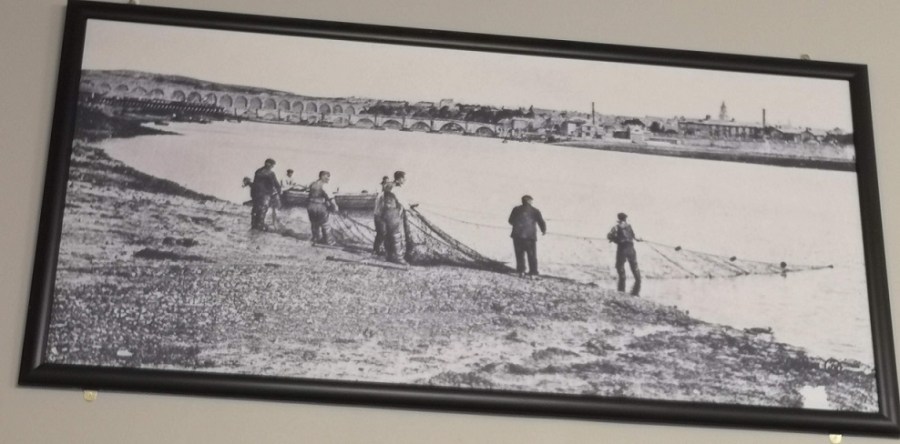
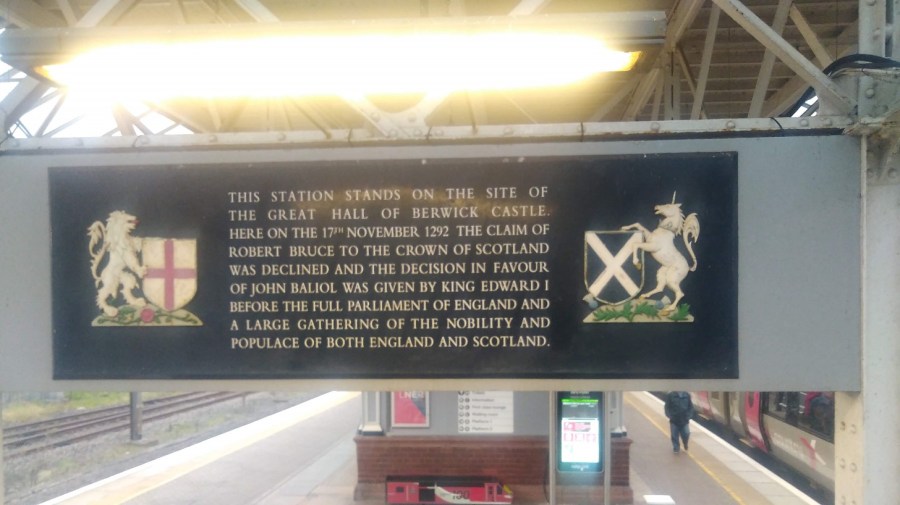
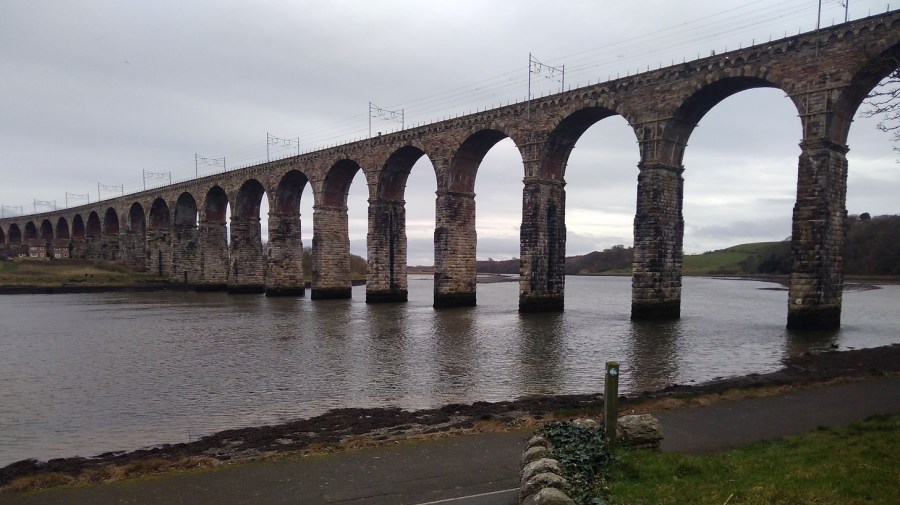
Old photo of fishermen on the River Tweed with the iconic bridge behind them. Berwick-upon-Tweed railway station, England
IMG_20200124_185157 (1)
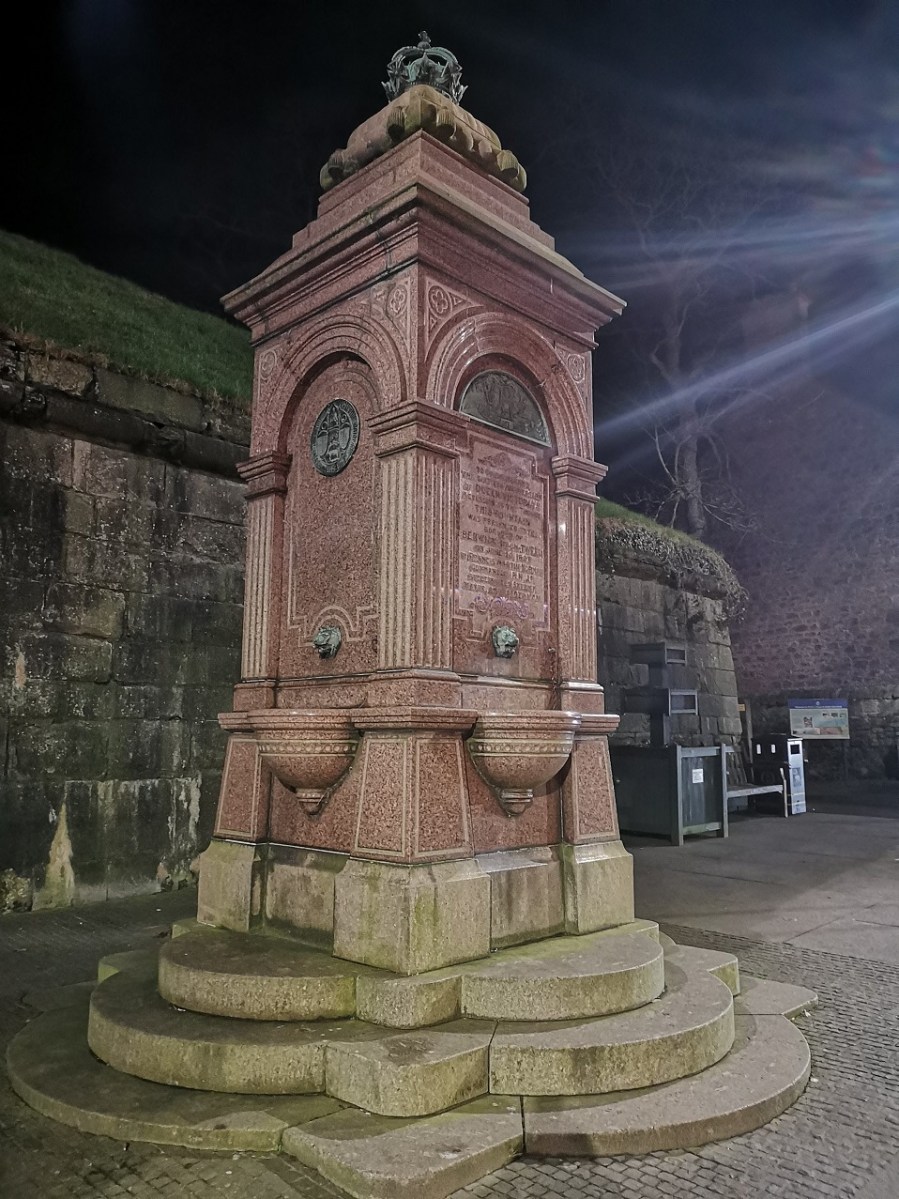
Monument with a coat of arms which has a cow in a gold chain on it, Berwick-upon-Tweed, England

St Abbs

It takes quite a while to get to St Abbs from my home in Edinburgh by public transport (train then local bus), so this time I went the night before and stayed at the Seaview B&B 6, Brierylaw, St Abbs. I highly recommend it. The owners are really friendly and generous with their time, and they went out of their way to make me comfortable (I had a luxurious bath), and ensure I was well-fed.
IMG_20200125_082821 (1)
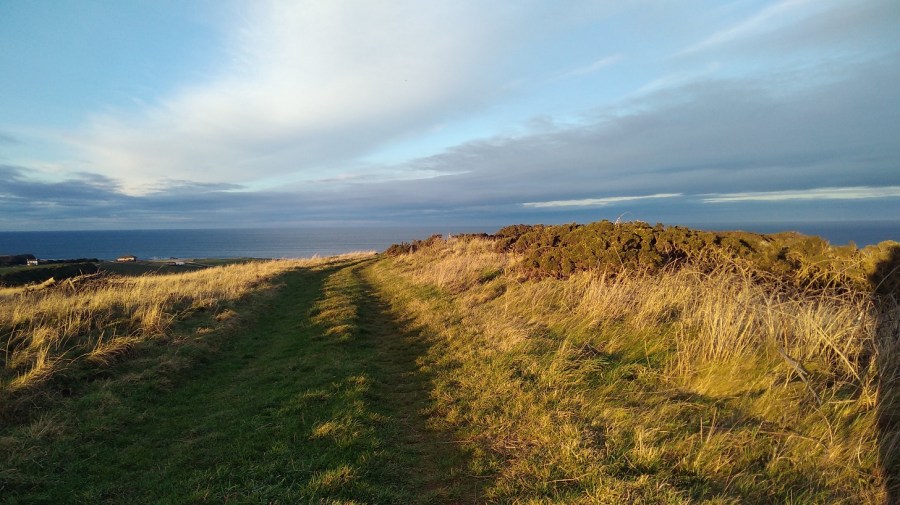
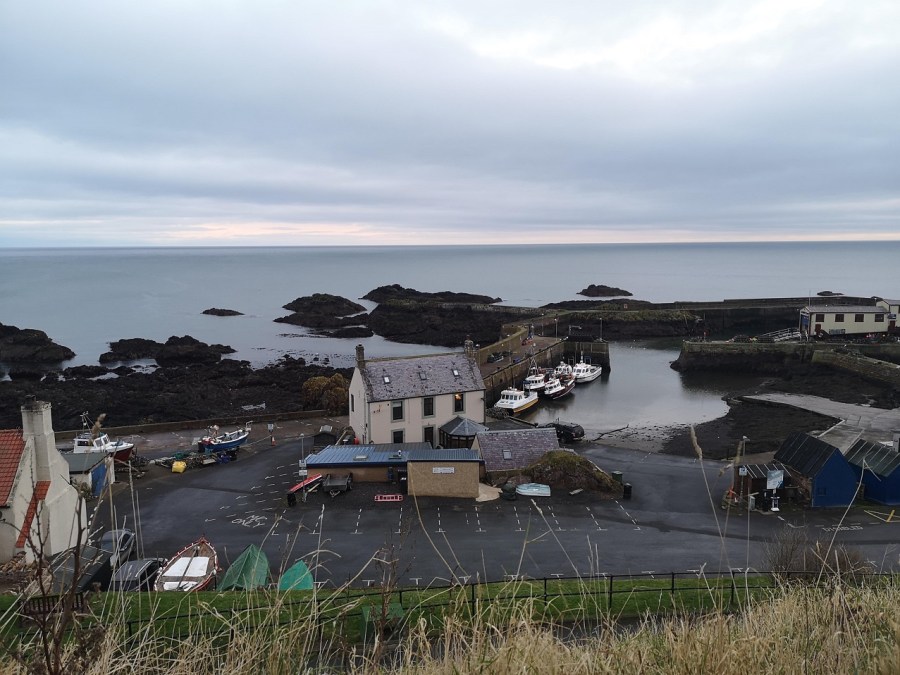
St Abbs, Berwickshire Coastal Path, Scotland

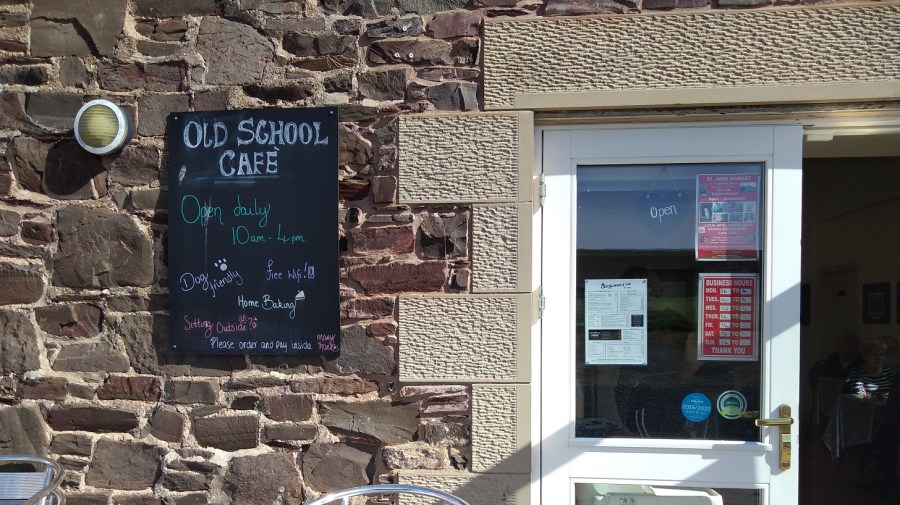
Another shoutout for the Old School Cafe at the Ebba Centre. Full story of their delicious cakes and kindness here (day 2 of the Berwickshire Coastal Path)
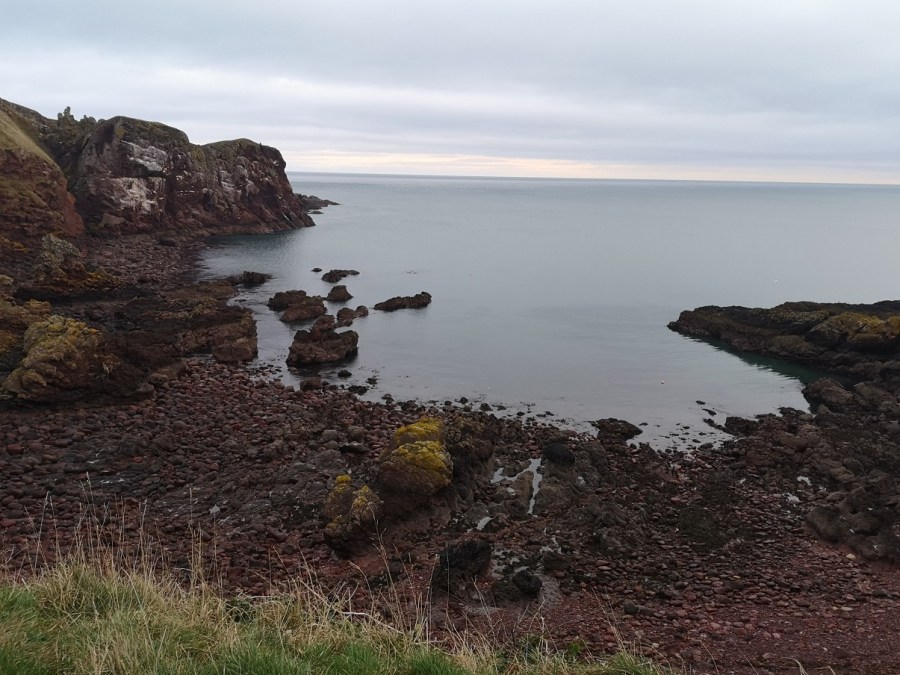
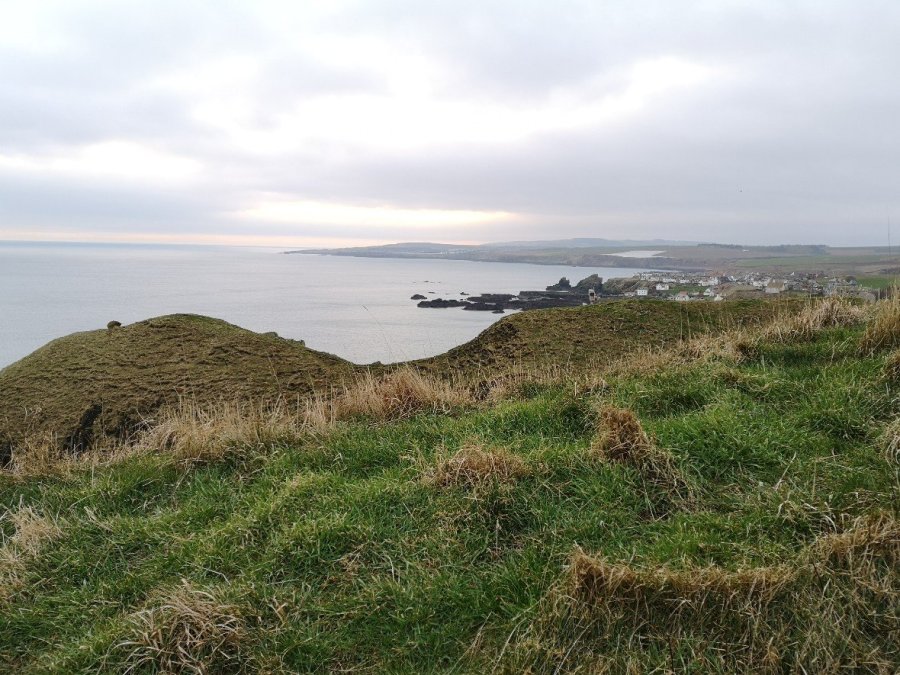
Berwickshire Coastal Path, Scotland
wp-15806417472572134981477857271577.jpg
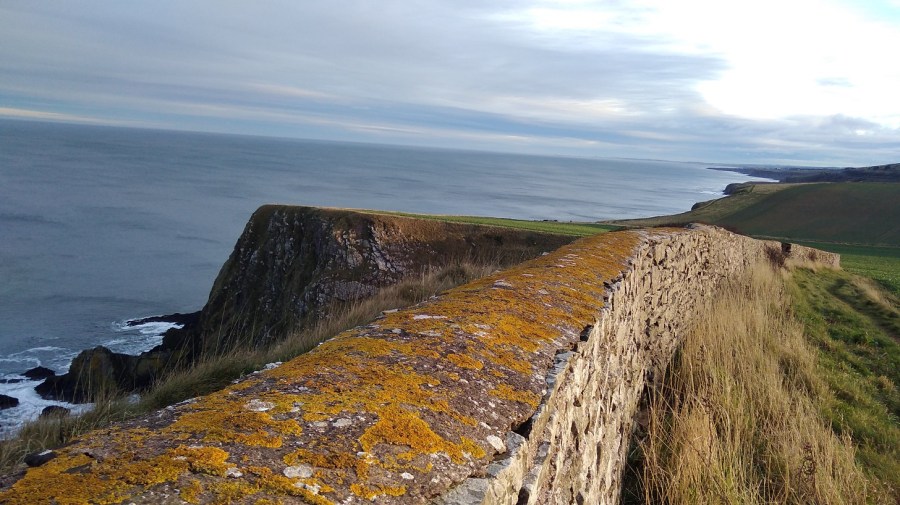
St Abbs over the undulating hills, Berwickshire Coastal Path, Scotland

Maps and interesting facts

I took photos of the Ordnance survey (OS) Explorer map 346 entitled Berwick-upon-Tweed, Eyemouth, Cockburns Path etc, before I left my accommodation.

I left at 8.30am and walked the St Abbs to St Abbs Head path again. The National Nature Reserve is a paradise for birdwatchers, hikers and great fun for tiring out children. I scouted round the first little mound to save my legs at this early stage and remembered nuggets of information I gleaned from the Ruth and Barry at Seaview:

  • that the guillemots are starting to return from their winter sojourn
  • that you can see up to 1000 seal pups (a great piece in the Herald by Virginia Wilde about seals) on beaches near here in the season (October / November)
  • that, ‘St Abb’s Head is carved almost entirely out of lavas, which are flows of molten rock across the earth’s surface. These lavas were sticky and flowed slowly because they are composed of a silica-rich rock called andesite (named after the Andes Mountains).’ from the Edinburgh Geological Society pdf
  • that the sea cleanses west-east along the coast making for the calm waters which delight scuba divers.
wp-15806417471983855919334392288700.jpg
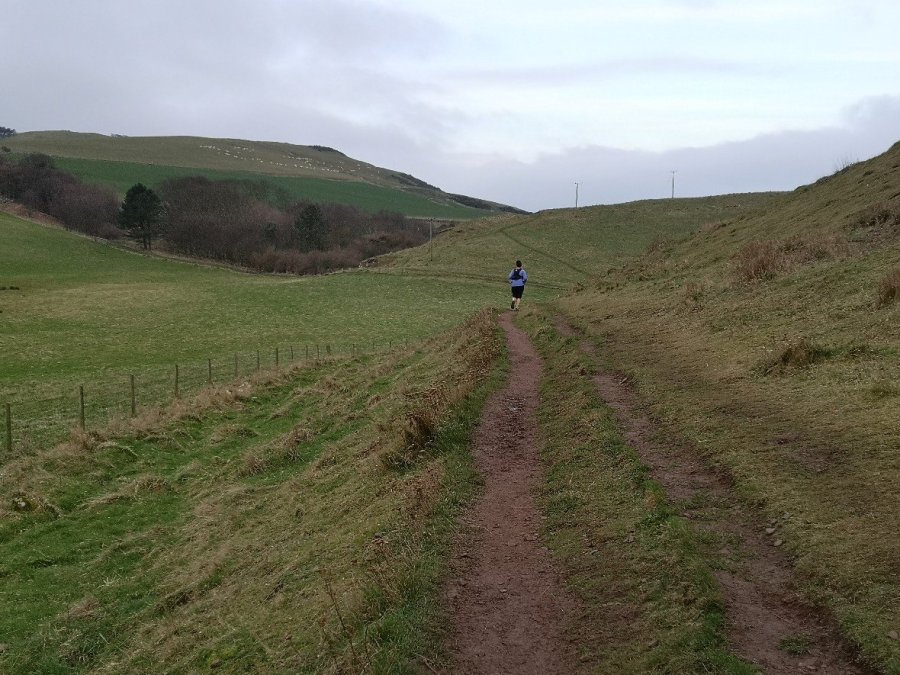
I saw two joggers and a birder, but no hikers during the whole day, Berwickshire Coastal Path, Scotland

This is a walk with wild and varied terrain

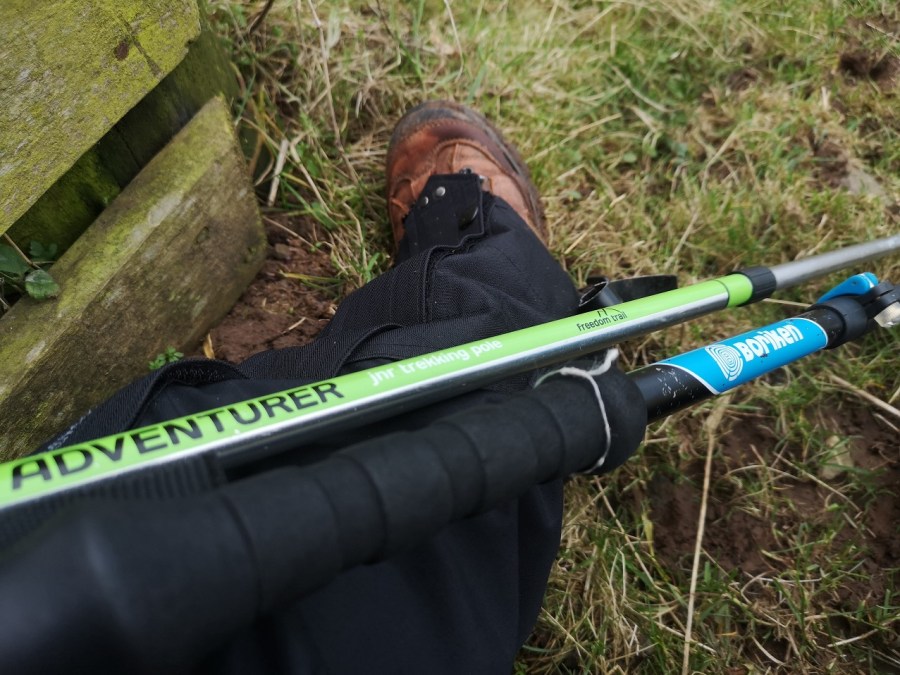
Then the first climb: I had to stop several times because I was so unused to it; I realised that my poles were uneven (one for a child and the other more sturdy, for adults), and the new gaiters which were discovered in the back of one of mum’s cupboards had long straps which are supposed to be trimmed before using – they kept getting in the way.  I could feel a headche looming (a reminder to drink water regularly as I hike), and the cold wind was at the nape of my neck. I was mighty glad for the rucksack protecting my kidneys – it would have been freezing if I hadn’t been properly dressed. Let’s hope, I thought to myself, that it’s 8 and not 10 hours as some of my treks have been. It looked so easy on the map!
IMG_20200125_130506
I am so grateful for my decent boots, mismatched walking batons and new gore-tex gaiters (waterproof material which you wrap around the lower legs to stop mud and water entering over the edge of boots or up the bottom of trousers). They still had the security tag on them which Barry kindly released me from before I left). Berwickshire Coastal Path, Scotland
wp-15806417471252567188060057851932.jpg
Berwickshire Coastal Path, Scotland

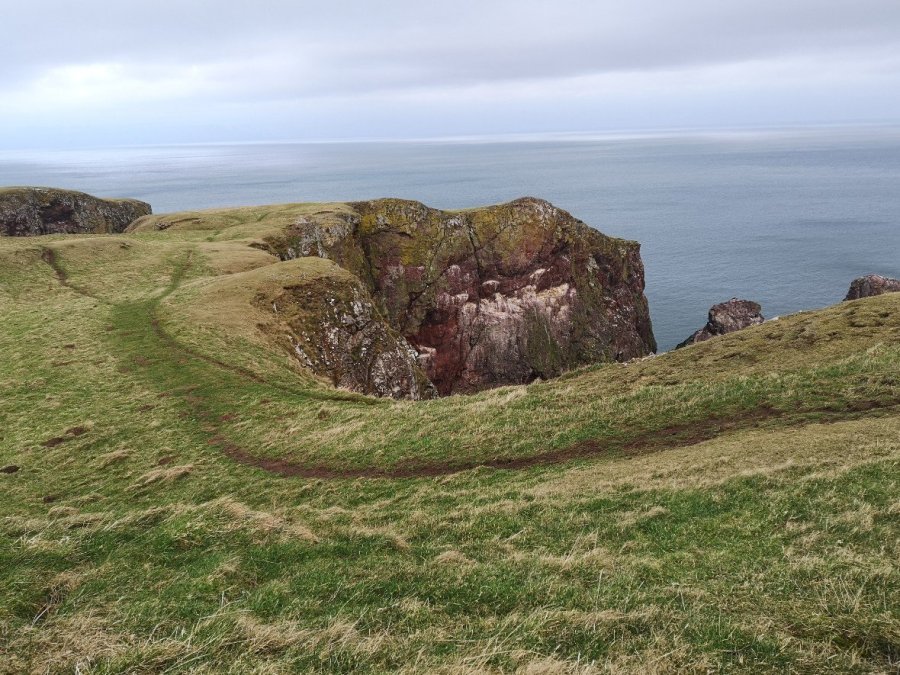
I could feel Xmas, heavy and bulky around my waist. Wow! was it hard work up and down what I discovered were the highest cliffs in Berwickshire. Overhead, pairs of birds were chasing each other, long-necked with a wide wingspan.
wp-15806417995651564258576816512679.jpg
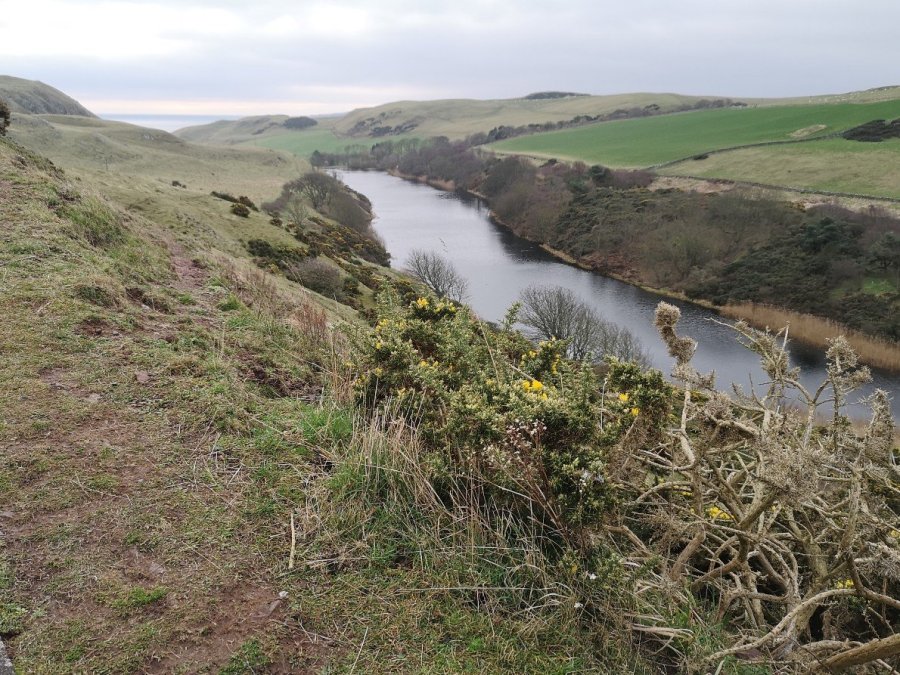
Mire Loch and the North Sea in the distance, Berwickshire Coastal Path, Scotland
wp-15806422138765258525180309203326.jpg
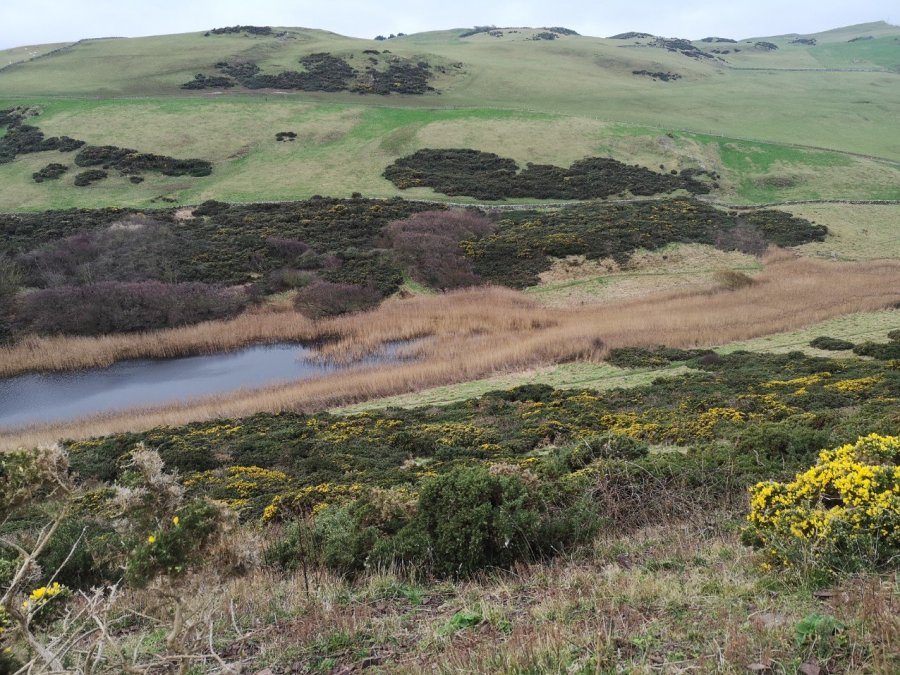
Mire Loch and the yellow gorse, Berwickshire Coastal Path, Scotland

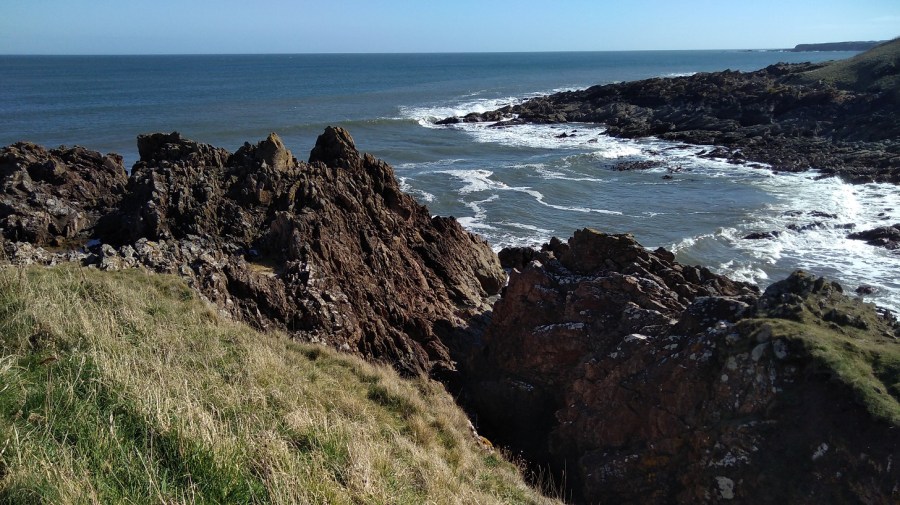
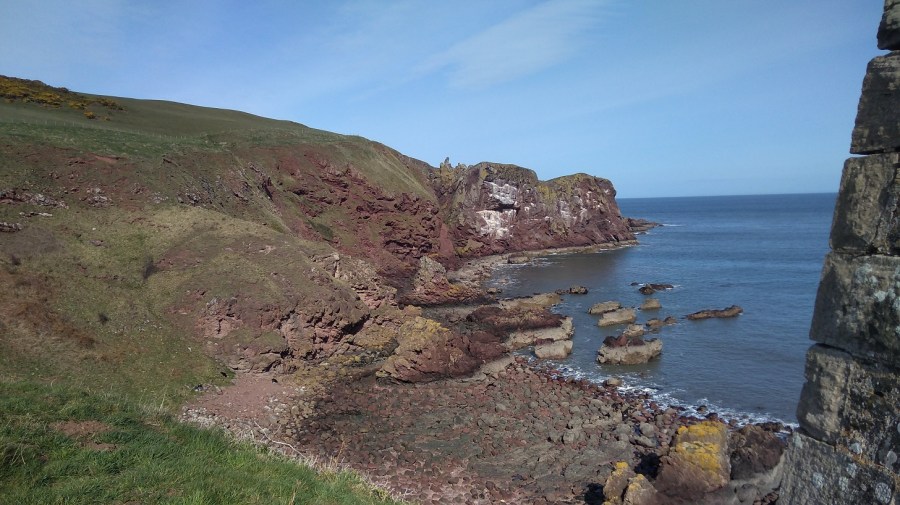
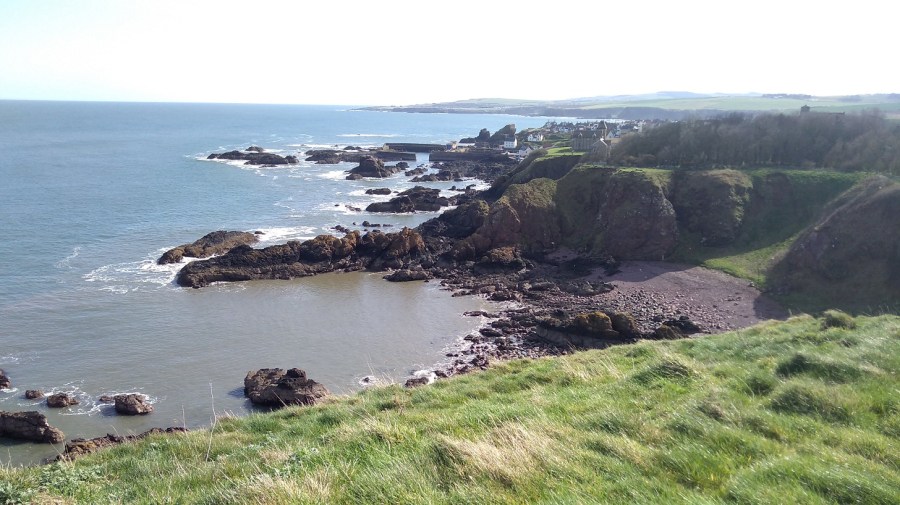
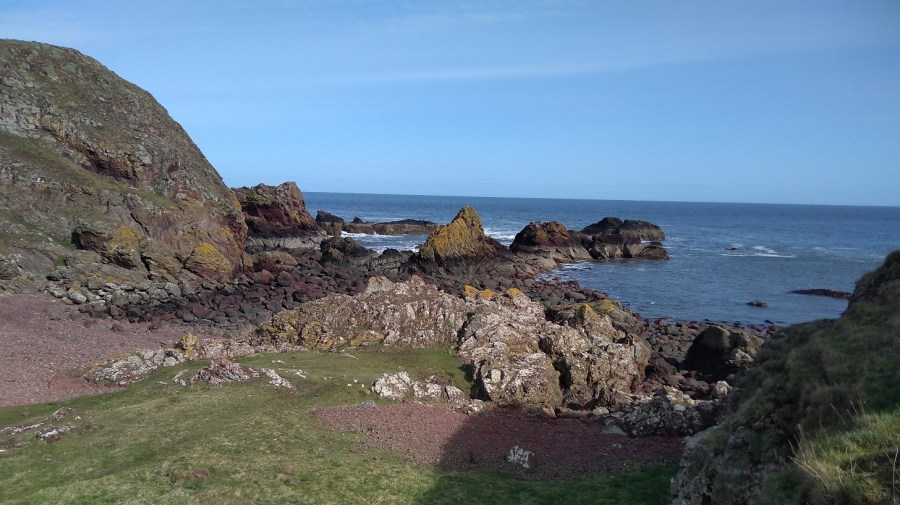
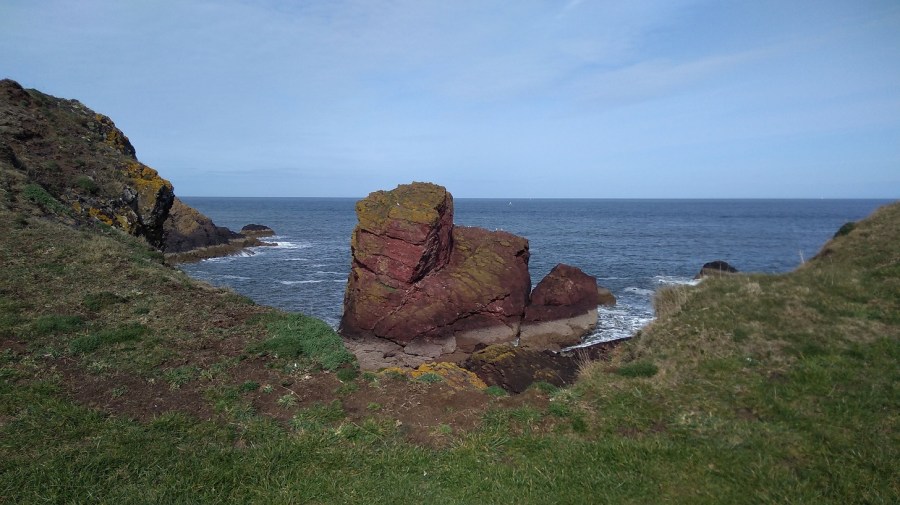
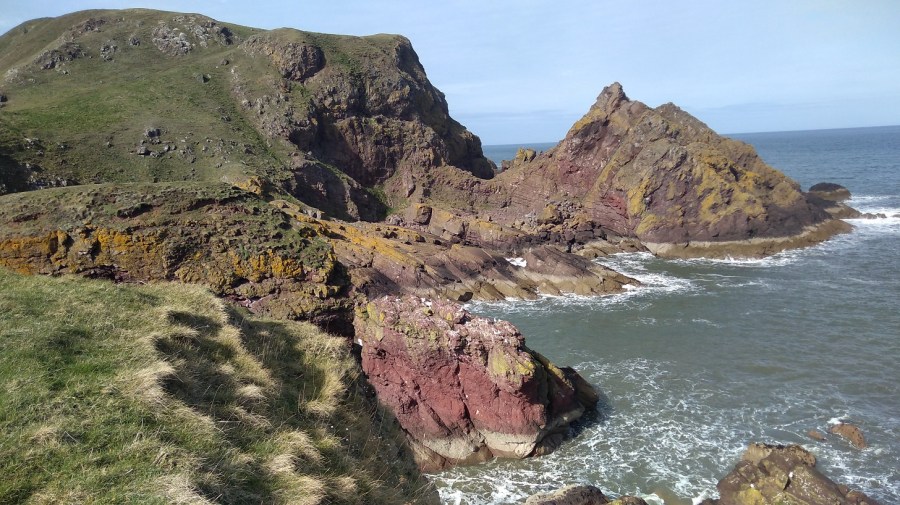
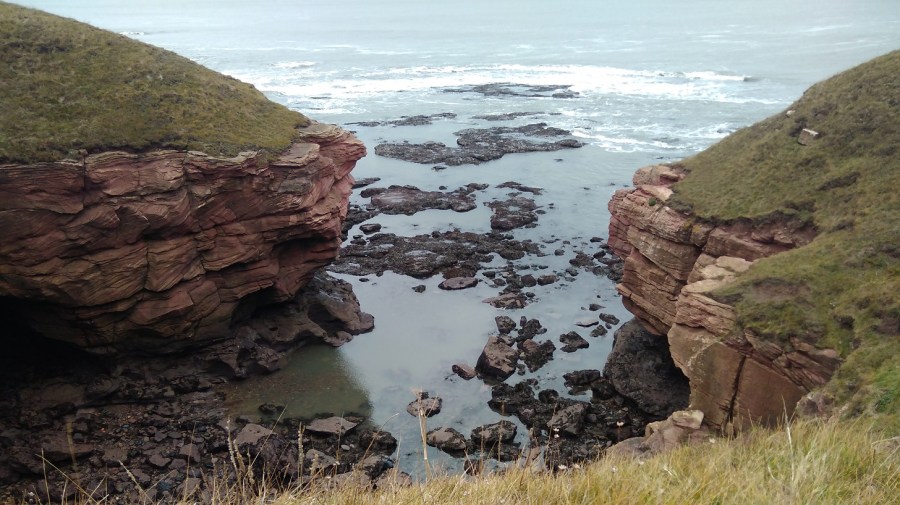
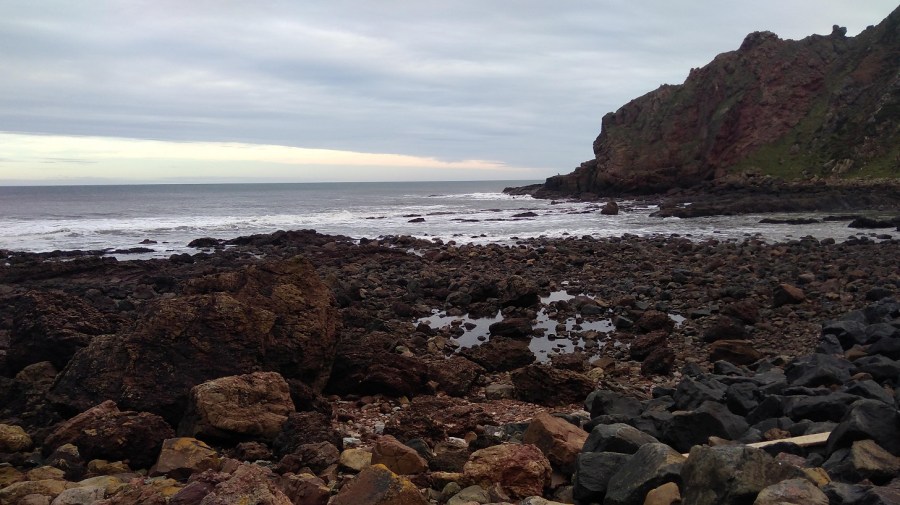
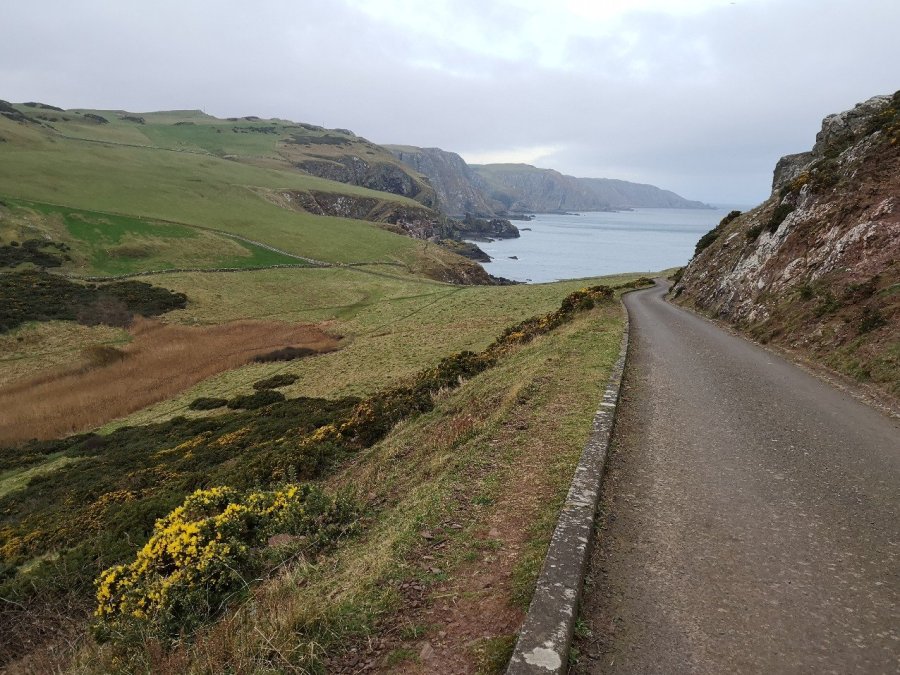
The closer I got to the water, the louder the seabirds and the wind. The white sky was dissected by the trail of a plane, and I had forgotten the red, the pink-burgundy-purple of the land round here. ‘Between each lava flow there is commonly a reddened zone, because the lava may have been weathered for hundreds of years in a subtropical climate until the next lava covers it’ (Edinburgh Geological Society pdf as above).
wp-15806422138035377520110578496876.jpg
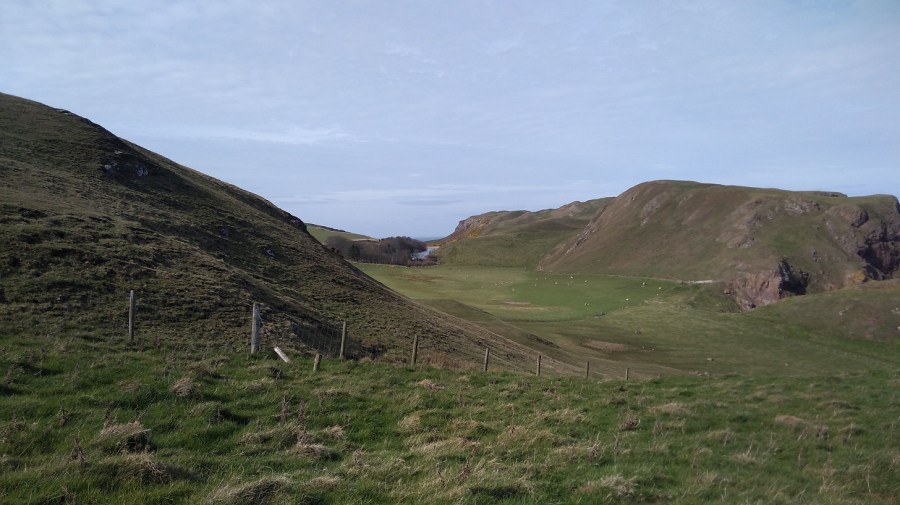
Going downhill on the road, the silence descended and the view opened up again, Berwickshire Coastal Path, Scotland

Gorgeous Geology

Sniffing on account of the cold wind, I came to my first path dilemma – do I go by the road or off to the right? There was no sign. I chose the road, but was very unsure and got into a bit of a (short-lived) state about it, trying to look at the photos I had taken of the OS map without my phone being blown out of my hands, and comparing them to the insubstantial BCP leaflet while the wind was coming towards me like nothing on earth. There was a sign further on, so the road was the correct course of action.
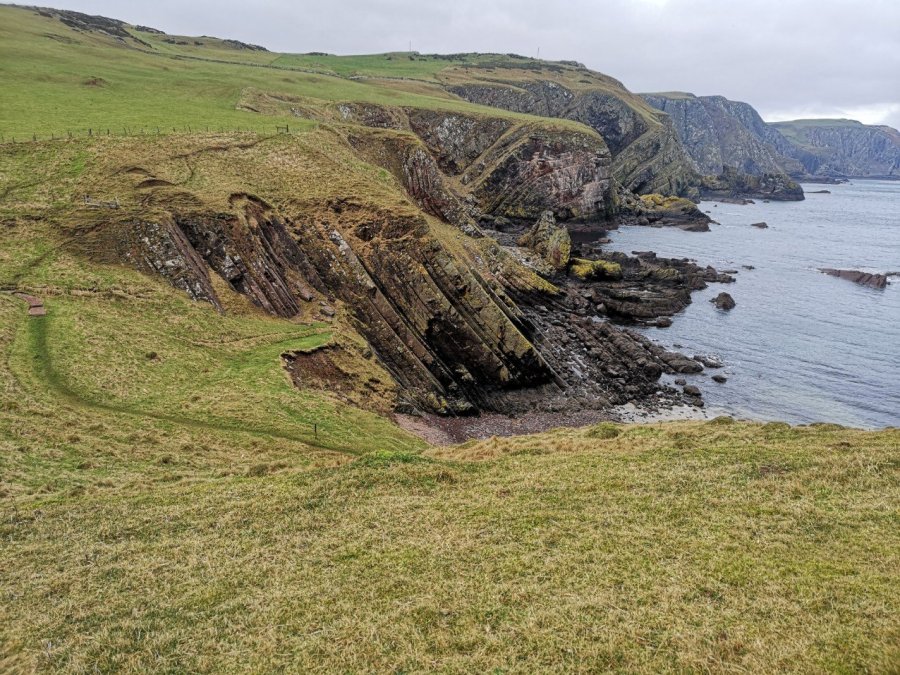
wp-15806422137213143995503587857946.jpg
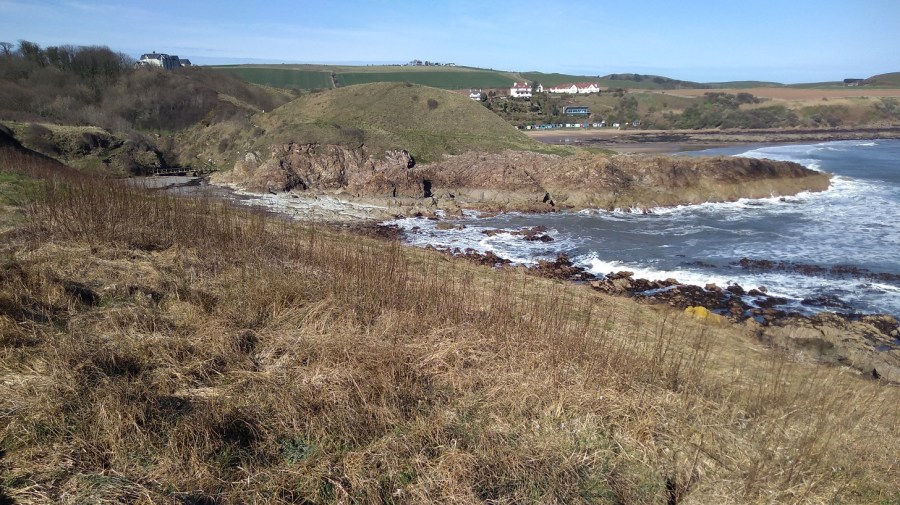
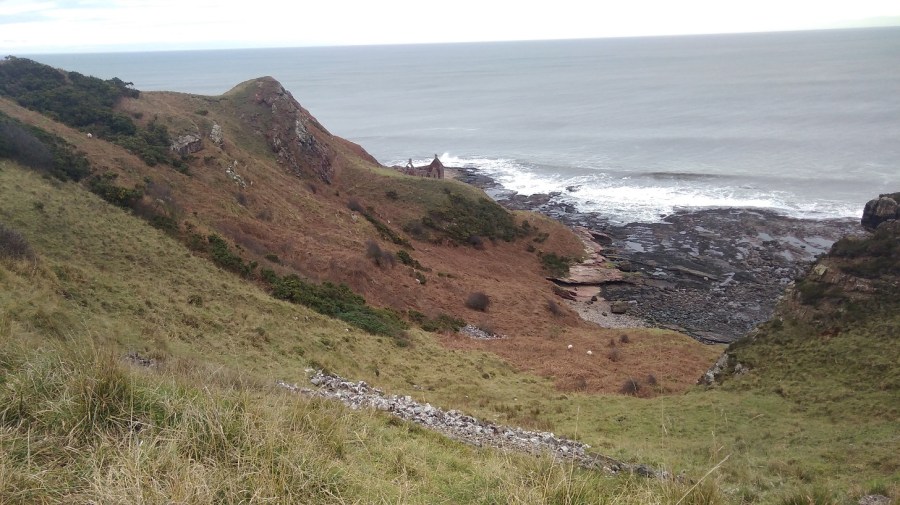
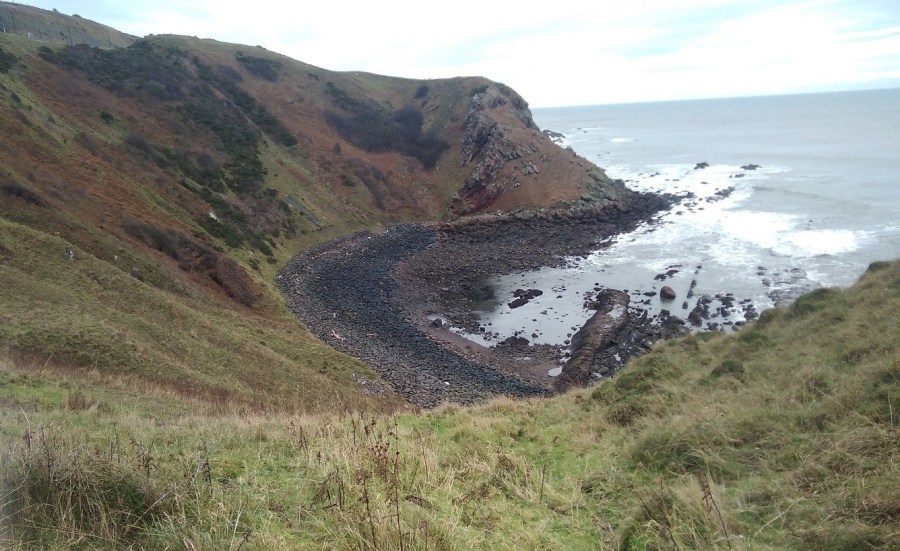
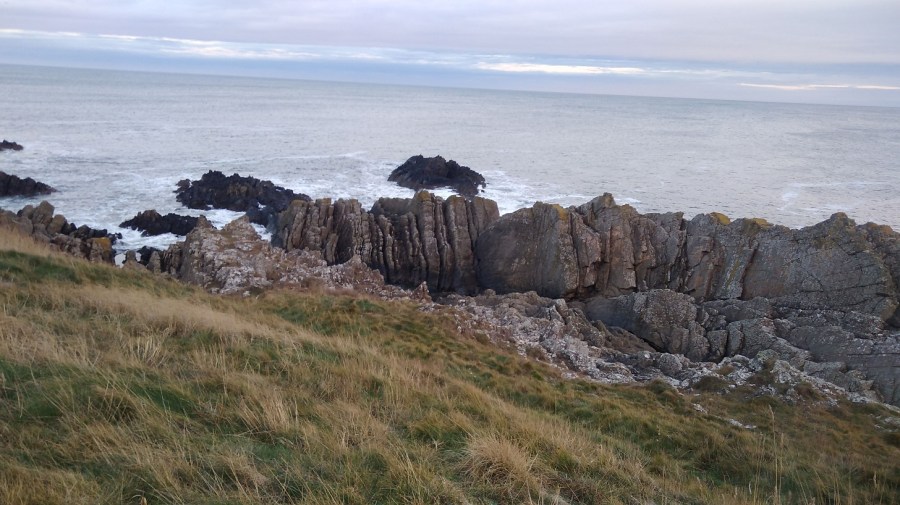
When I rounded the headland to be faced with this bay, I was astonished to remember reading someone who said he hadn’t noticed the strata of rock, Berwickshire Coastal Path, Scotland

The second female runner, red faced, grinned as she ran on, then stopped to hold open the gate for me. As she disappeared into the distance, I was left with the sound of the waves. I adore the quiet.

My poles stuck into the soft, brown clay which soon changed to clods around the edge of a field where cattle had clearly been. The cow pats had orange fungus (pezizales) on them and there were great clumps of shiny, black pastilles, deer droppings.

It struck me how little I know about so many jobs: diving, fishing, farming, lighthouse keeping, all of which I depend on. Such things I mused as I walked.
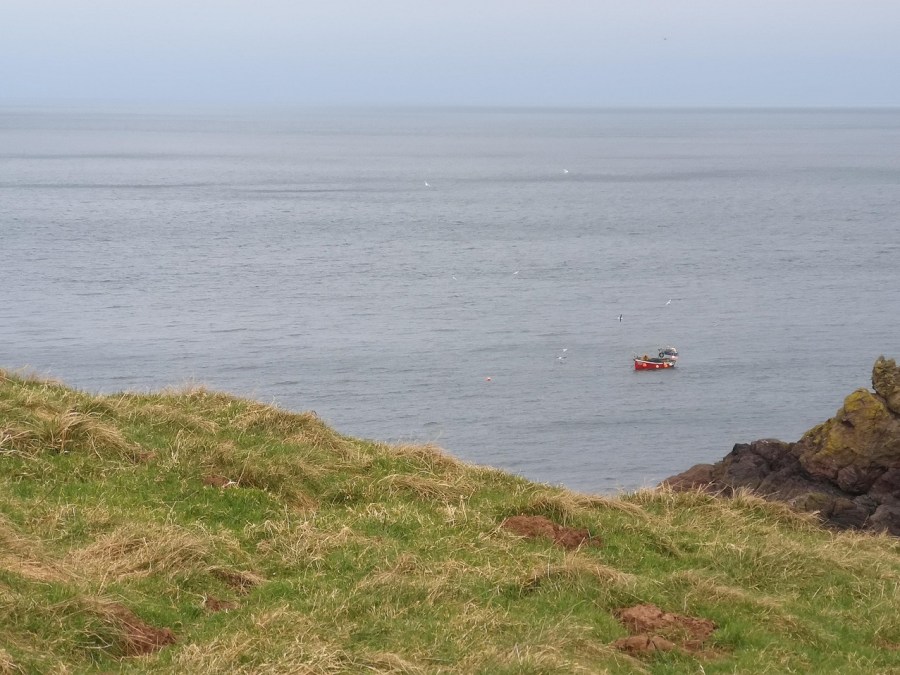
IMG_20200125_092756
In the distance, a single fisherman in his orange all-in-one suit was chugging along at the same time as laying his nets. He was followed by squawking, white birds. Berwickshire Coastal Path, Scotland

I heard the birds going sweeeak, squweeeak, sqweeeak, sqweeeak, sqweeeak, tda, tda, tda very fast!

I, on the other hand, was going so, so slowly and feeling incredibly unfit, breathing heavily on the ascents – great exercise for inner and outer health. As I paced, I could feel my heart sighing. My head was still zizzy and a bit anxious, but I could also actually feel myself grounding, as if lead was working its way down my legs which of course made them feel altogether too heavy to climb hills. My system was settling. The intense breathing had cleared away some of what was clogging my lungs; the bowel clearing which went on an hour after starting, resulted in a very easy sensation in my abdomen. This was good for me.

Cliffs, stiles and wind turbines

What sort of terrain was it? Two stiles, a little burn, up a very steep bit, over a stone wall, ribboned white, and through a gate with a metal spike to shut again after me – I struggled with it. More stout stiles, wind turbines and wet burns (where your water bottle might fall out of its pouch, getting muddy even around the lip under the lid), even more stiles (too high for short legs), curving round contours and up more slopes – pwhew!

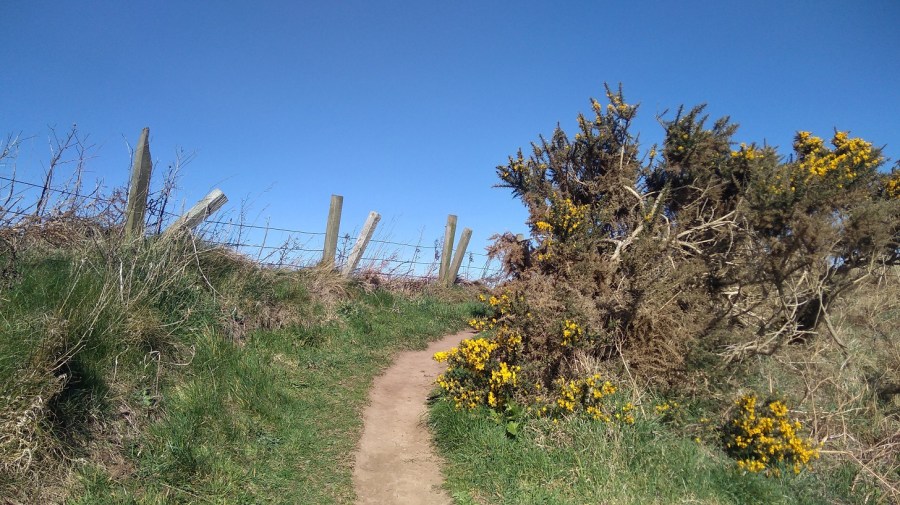
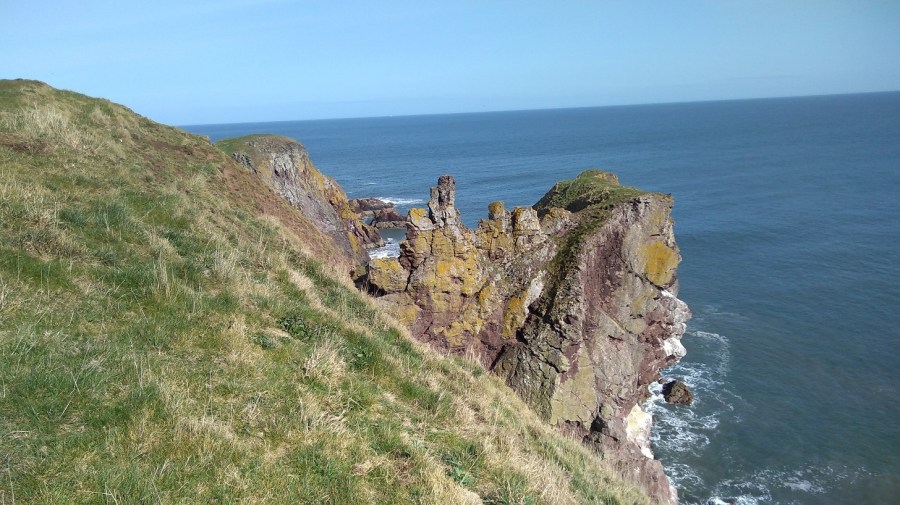
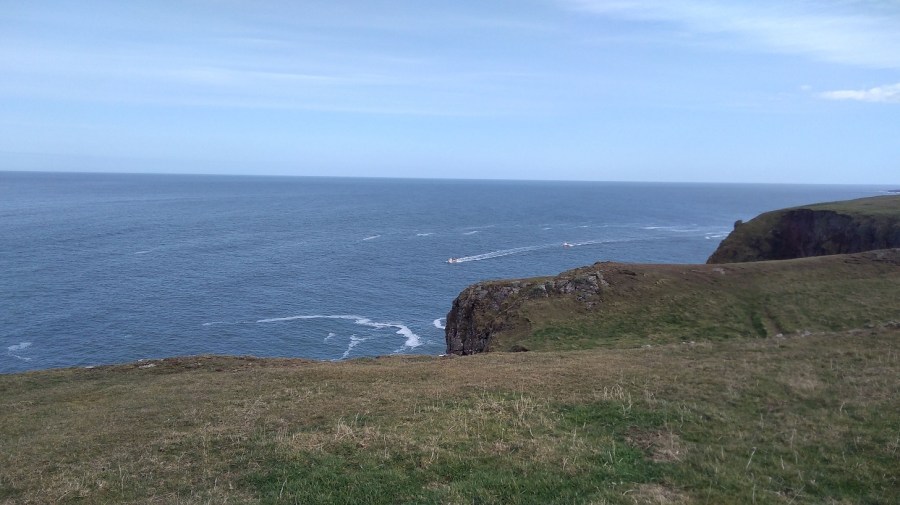
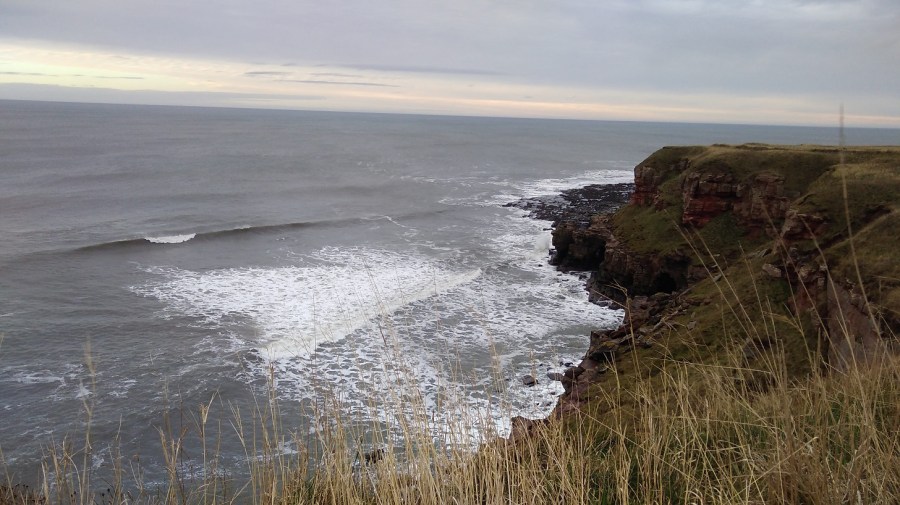
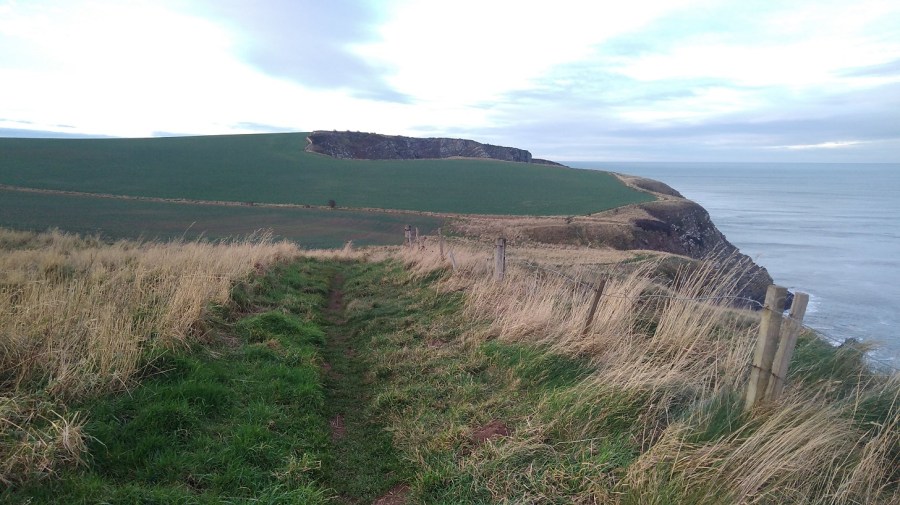
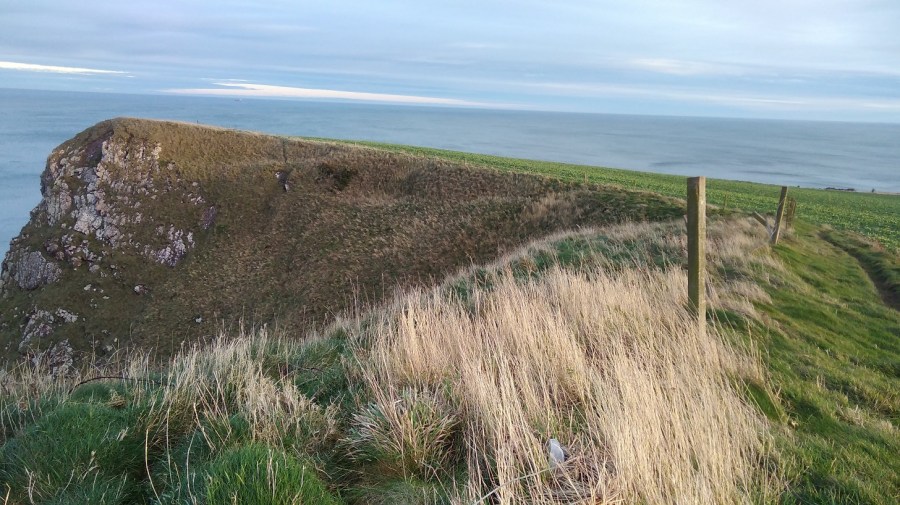
After the highest cliffs (the Tun Law Forts) and the two admiralty poles (to measure nautical miles), the path hugs the coast (I went inland by mistake). The sea was all glassy, rippling gently in the wind. The wind was incredibly heavy up here, but down at the sea it looked magical. The path is sometimes dizzingly close to the edge of steep gorges with white foam at the bottom. The gorse was olive green from a distance, and their glorious sunshine flowers matched the yellow arrows.
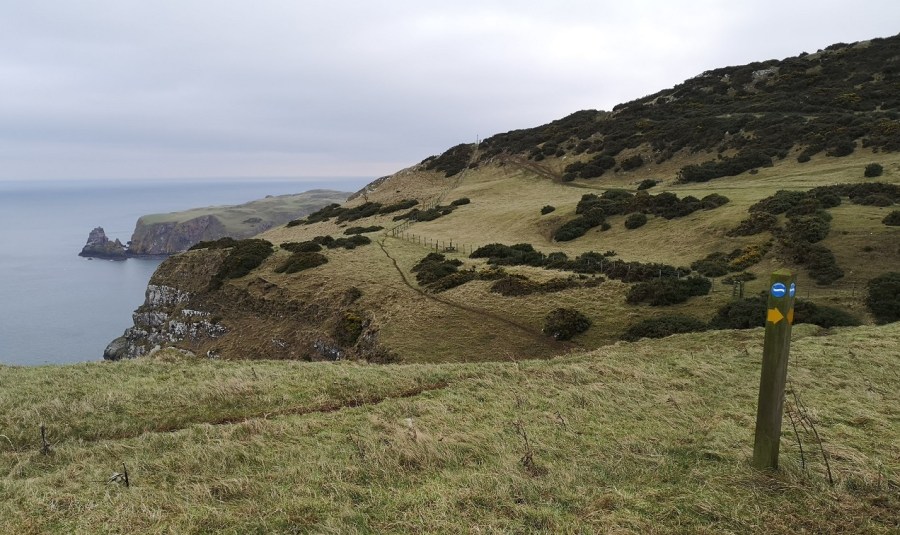
IMG_20200125_100446
The stunning landscape of the Berwickshire Coastal Path is, generally, well signposted. I was warned by two sources that it is easy to get lost – maybe my several years of experience paid off, because I only went off-course for a sum of 10 minutes or so over the day. Here you can see the various possibilities which converge at one point

Then there was a beautiful flat stretch: Small brown birds were tweeting. They appeared and disappeared like helicopters doing vertical take-off and landing practice (skylarks?). I couldn’t see any dolphins or whales, which I always wish I could, but then I realised how lucky I am to see seals almost every day outside my house. Gulls with black wing tips were gliding over the sea. There were feathered swarms, like bees, inland over the sheep-filled fields.

I heard the sound of a quad bike before I saw it, like the brrr you do with your lips, spitting saliva a bitty, to make a baby laugh. Then I saw a man holding back a collie dog with great difficulty. He gestured and spoke, but the wind stopped me from hearing what he said. I got the gist and waited. They were driving the escaped sheep back up the cliff and we all had to be very careful in case they panicked and rushed in the wrong direction, to their death.
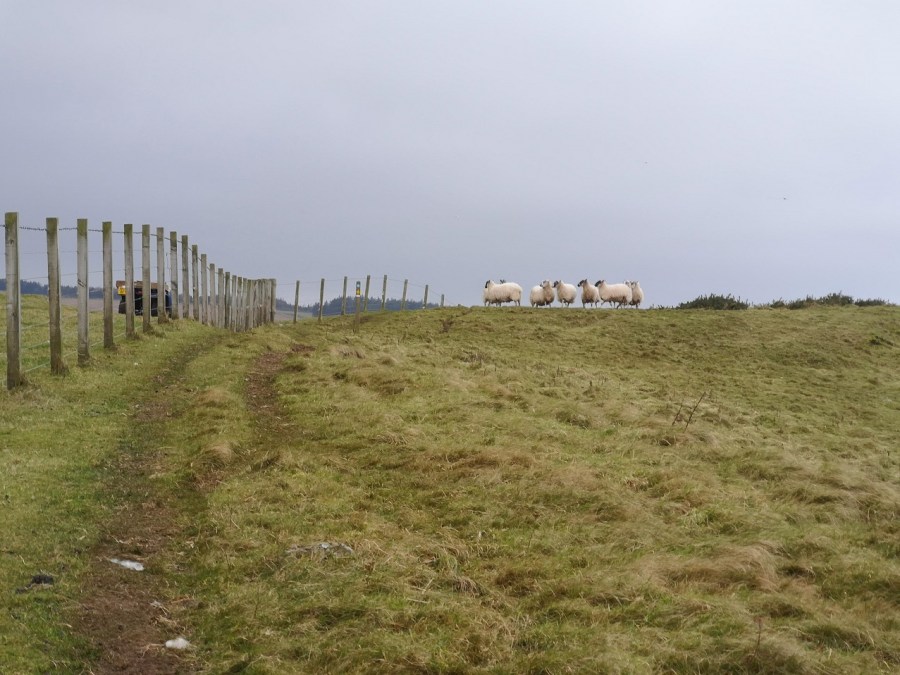
IMG_20200125_100855

This was my first ‘proper’ walk after injuring my left foot on the Portuguese Camino. It had taken months to heal and I was nervous about future walks, but I became more confident as the day progressed. My ankles felt weak – that was the lack of Scottish hill walking practice – and so I was careful to place my feet flat where possible, which sometimes hard on the side of these hills.
IMG_20200125_102227
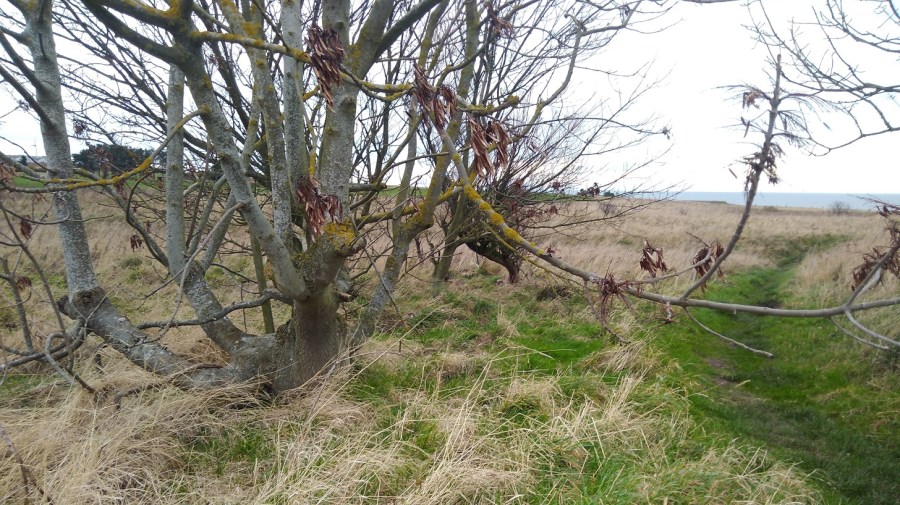
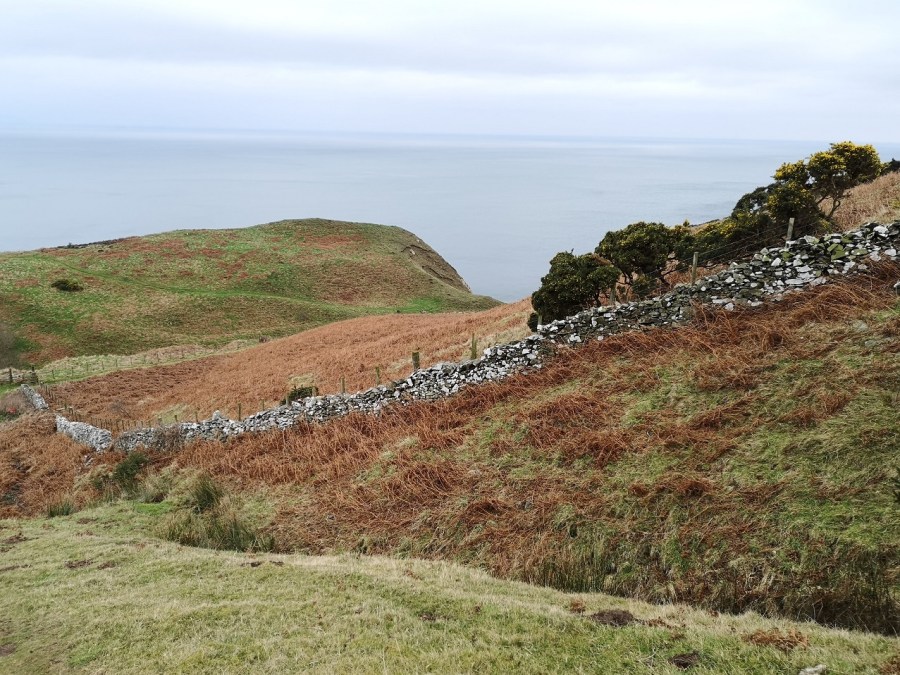
The fawn-deer-brown bracken was lying almost flattened to the ground after winter storms. Berwickshire Coastal Path, Scotland

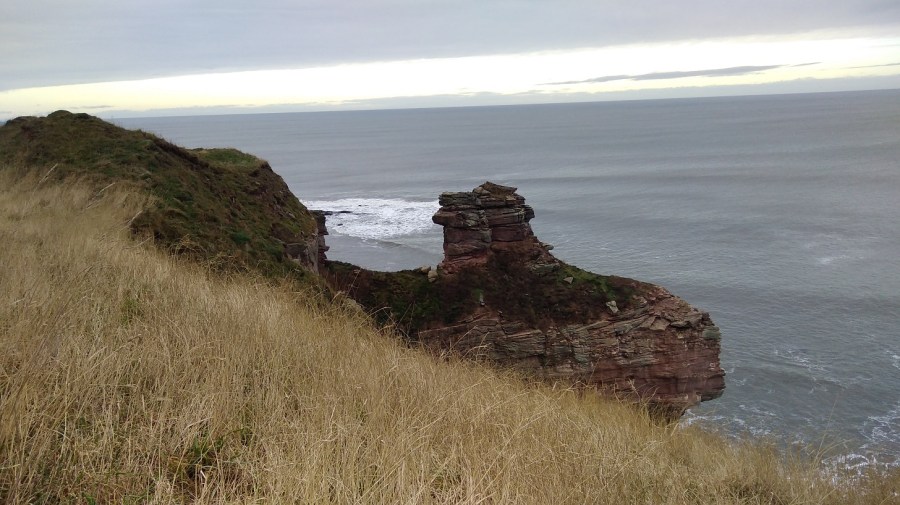
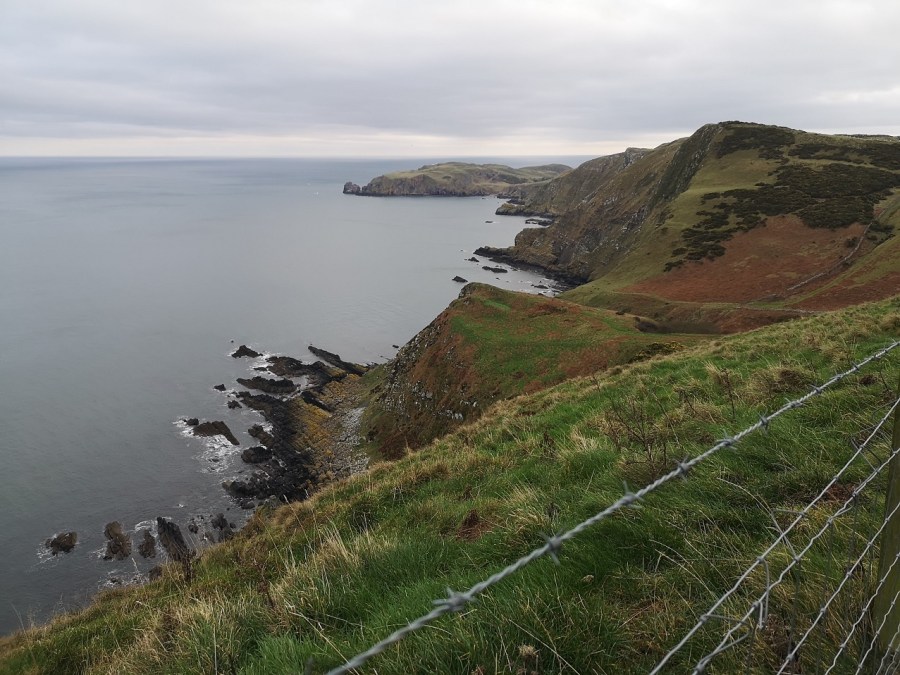
Higher and higher, I looked back at the most wonderful rocks which angled down and reached their guano covered fingers into the sea, some with athritic knuckles all jagged as if they had rough skin.
IMG_20200125_105052
Berwickshire Coastal Path, Scotland

More sheep

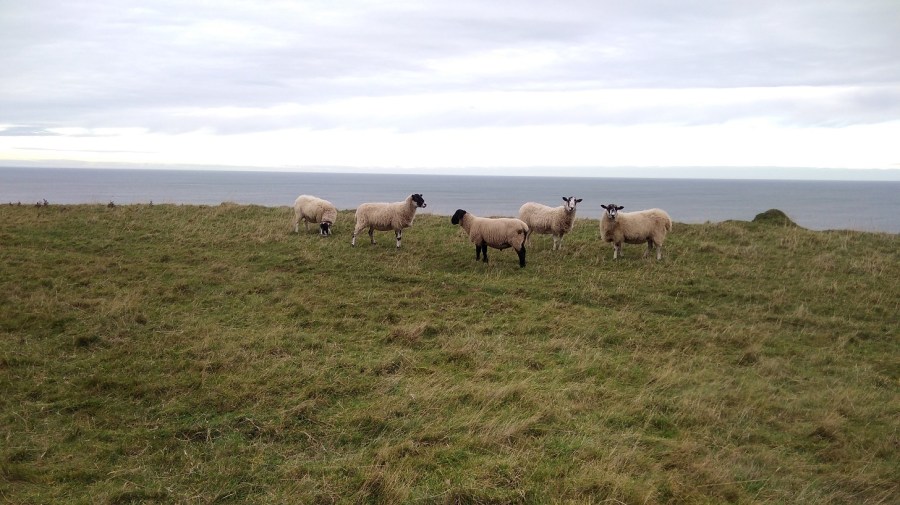
For the first time I saw sheep head-butting each other, their hind legs sort of bouncing off the ground as they did it. As soon as I stopped to watch, though, they stopped too, like embarrassed teenagers caught doing something they shouldn’t be – it was so funny.
IMG_20200125_110904

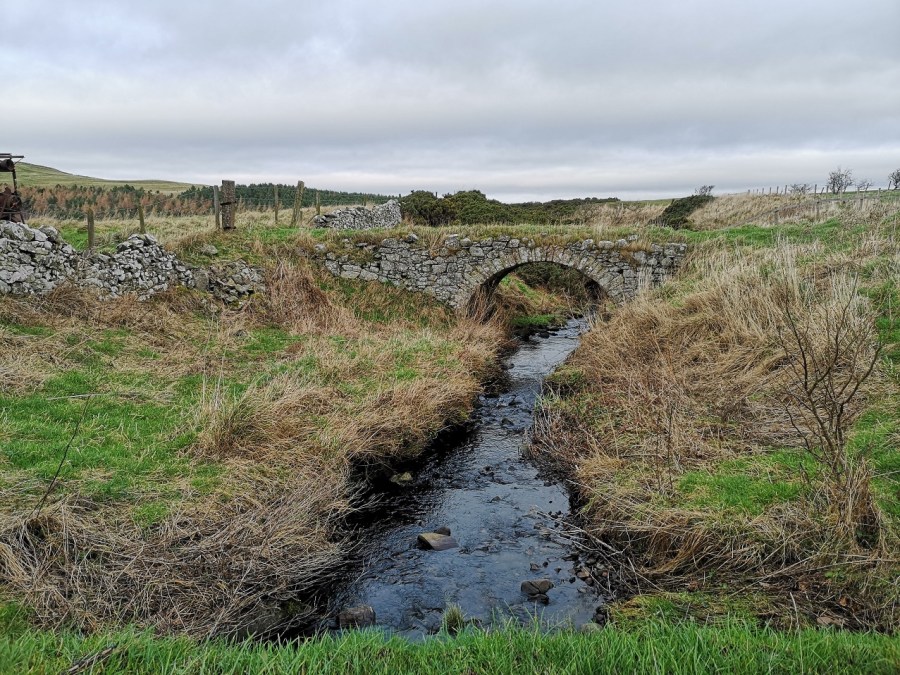
Three hours in and the ground was flatter – forest and fence, new coppice of some type of pine.  Ditches full of rainwater were squidgy to negotiate. There was not much sign of a path here until the next metal fence and a gully with thorn trees, inland.
IMG_20200125_113928

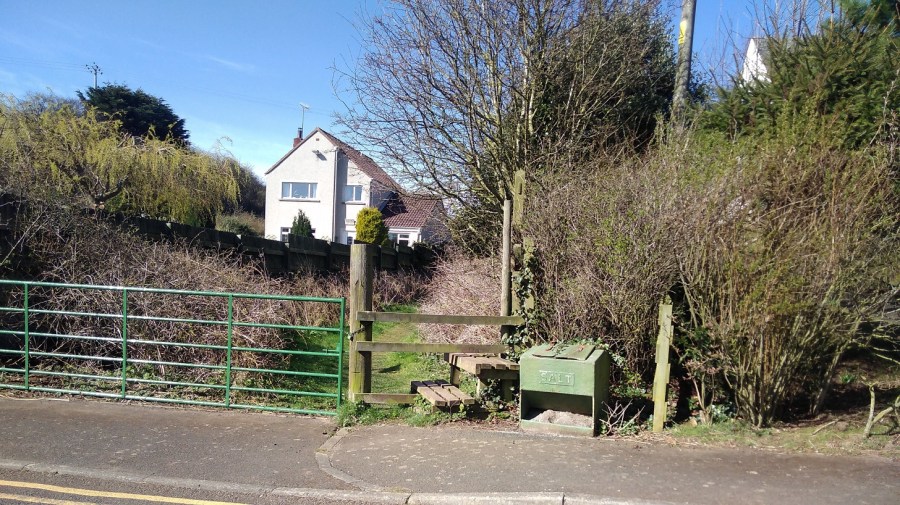
On this walk, you just keep on going and you eventually get there. I arrived at Dowlaw (say doolaw) farmhouse at 12 noon – 3.5 hours exactly which was good going given that the time for this stage was listed as 3.5 – 4 hours. As you approach the dwelling, remember to turn right through a small copse, do not take the left at the farm machinery.
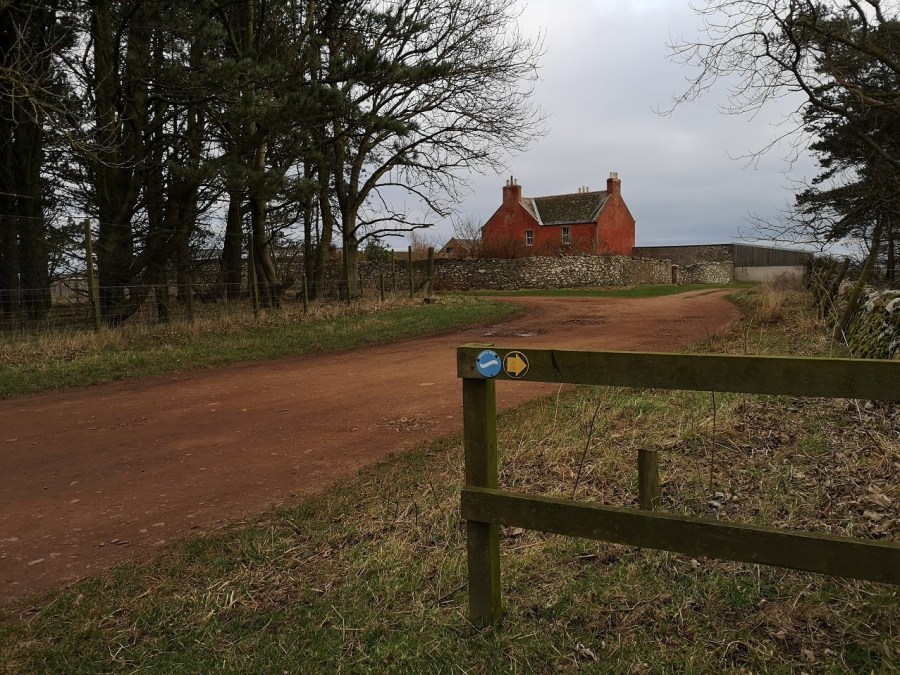
IMG_20200125_120212

The half way mark – Dowlaw

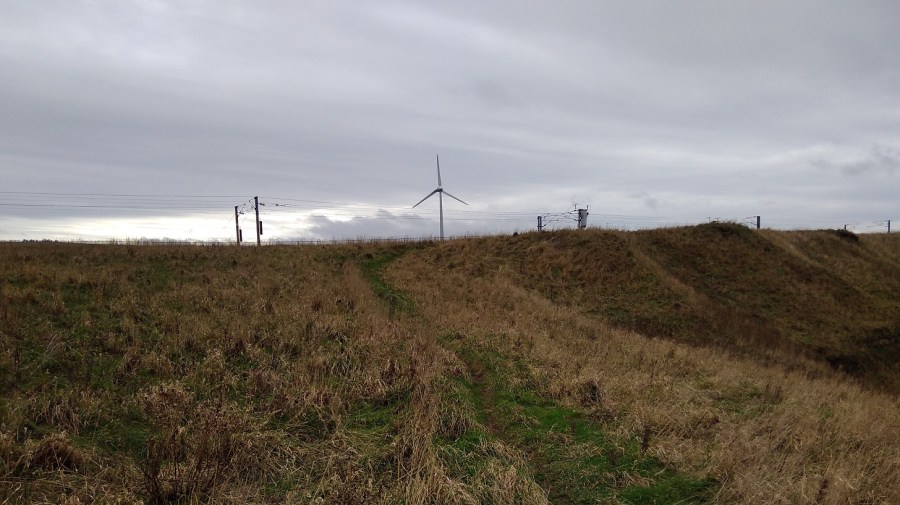
I lay down and rested out of the howling wind for a few minutes, but it was very wet. I had been hearing a conversation going on beyond my left shoulder which when I stopped I couldn’t identify the origin of. Slowly I realised it was the wind turbines turning, chatting away to themselves.

I followed the road and then left it as the map showed, perhaps too early, because there was a dearth of signs. I traversed grass with almost no noticeable track to speak of. Yes, the signs were unclear, seeming to point across more moorland, but I was unsure. There was a car with its engine running, a solo man in it, a big screen on his dashboard that he was watching, despite facing out to sea.

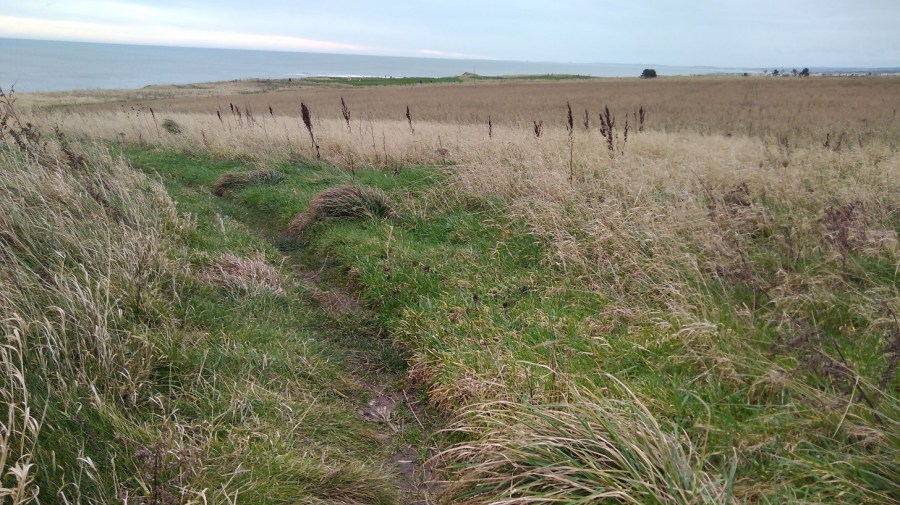
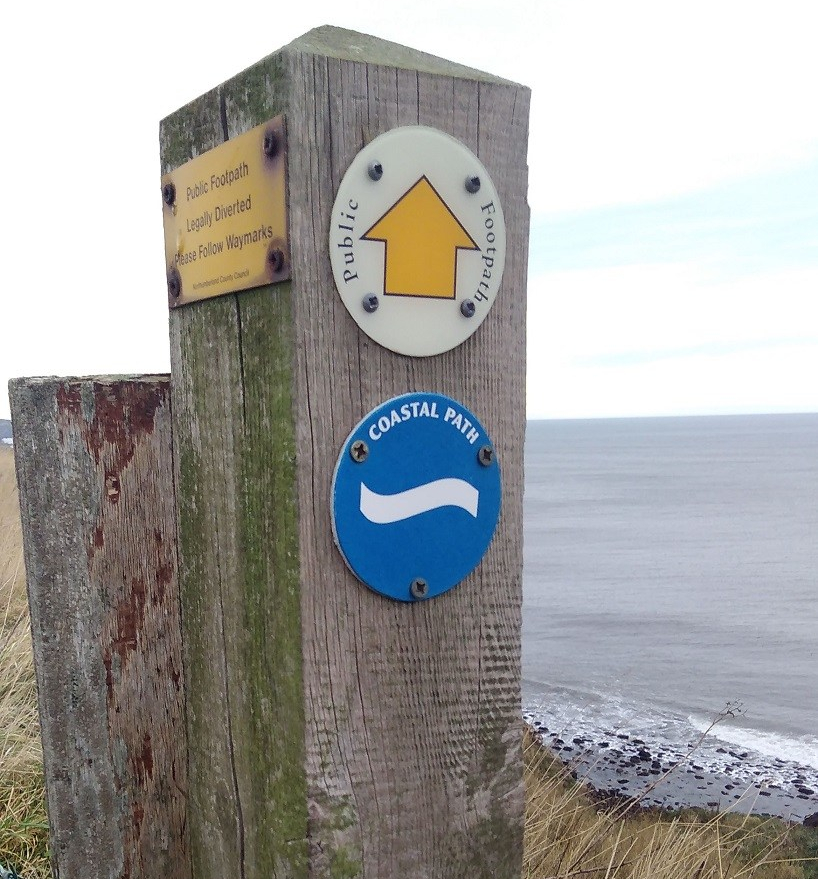
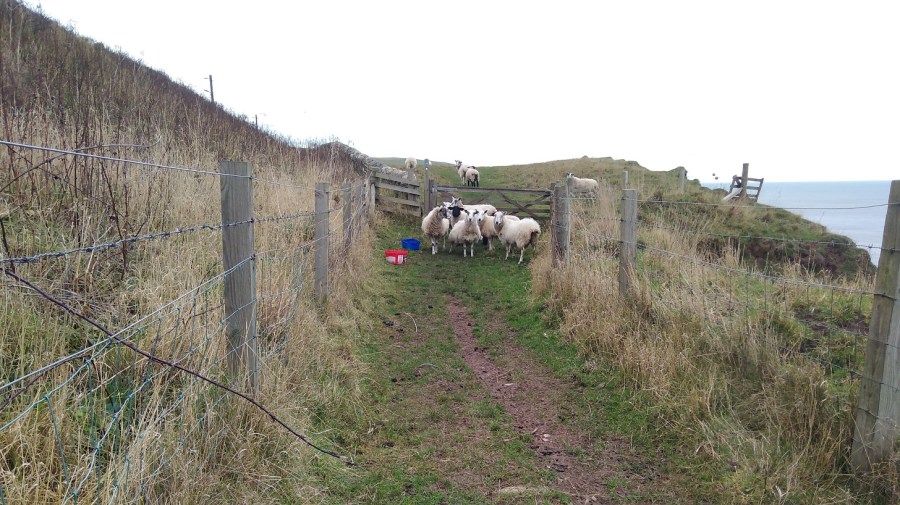
I was very, very tired by this time, so I was glad that it was more level, overall, on this final stretch. I was amongst the sheep, passing through gate after gate,  and molehills were everywhere. It must all be taken carefully – the route twists and turns, over waterways and round field corners. When you doubt that you are on the right track because you come to a junction where there are options, scan far, far ahead into the distance looking for a small pole with a yellow arrow and a blue and white sign to guide you.
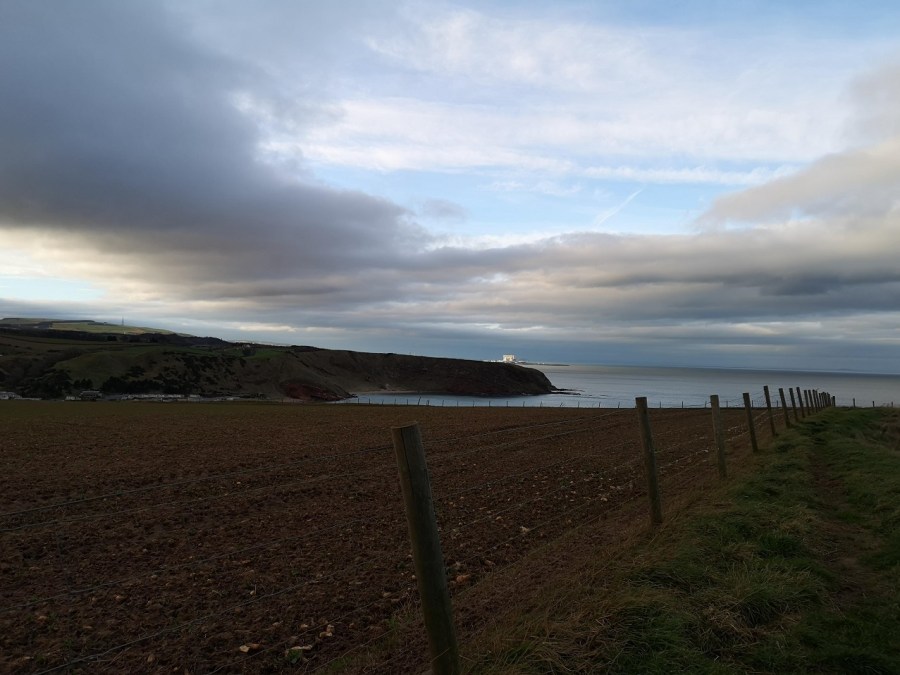
IMG_20200125_143650
Torness shining in the distant sun, Berwickshire Coastal Path, Scotland

Next was a farm yard with very pretty, nervous calves inside a barn, and three barking dogs, enclosed. Crows lined up on the telegraph wire. A sheep with a horrible rasping cough was on my left. It was if something had gone down the wrong way, most distressing. In the road in front of me were two running, waddling birds (game birds? I did hear shooting earlier). Every now and then they took off, their wings whirring as fast as those of flies. More cottages were ahead and smaller, brown birds with white tail feathers twittered away. They looped horizontally in and out of the hedgrows as if they were hanging the decorations.
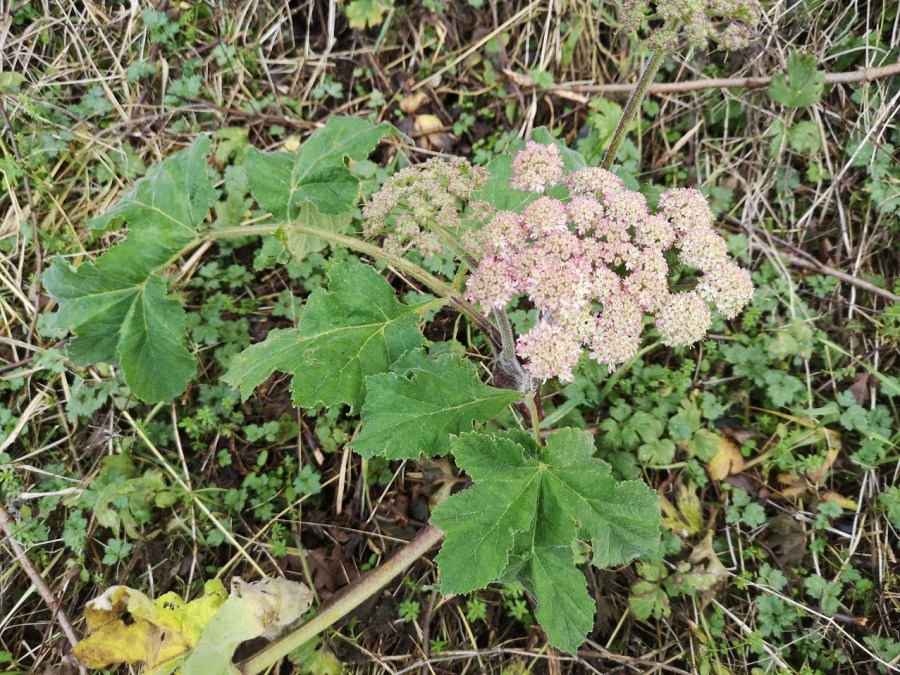
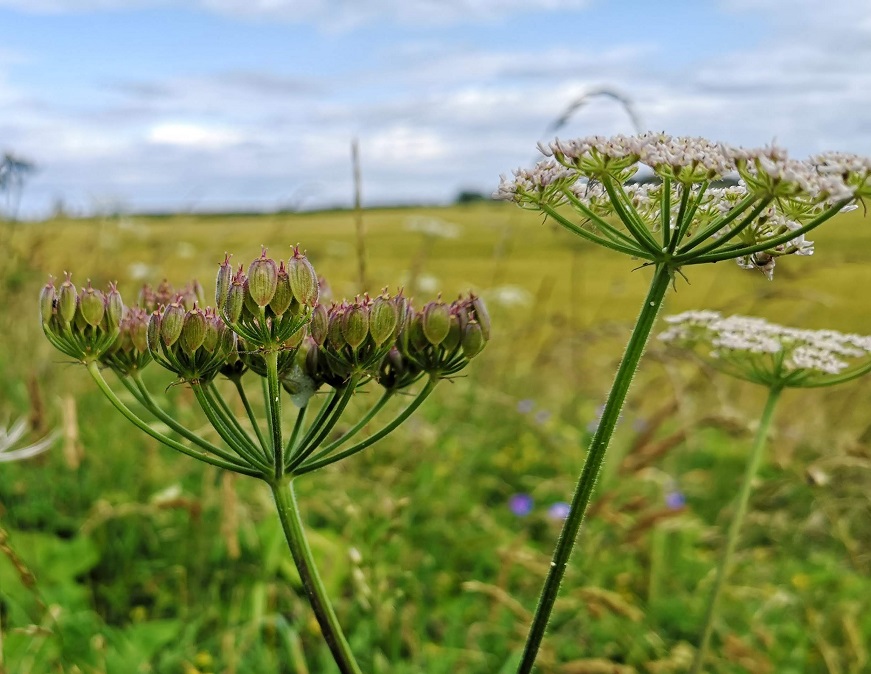
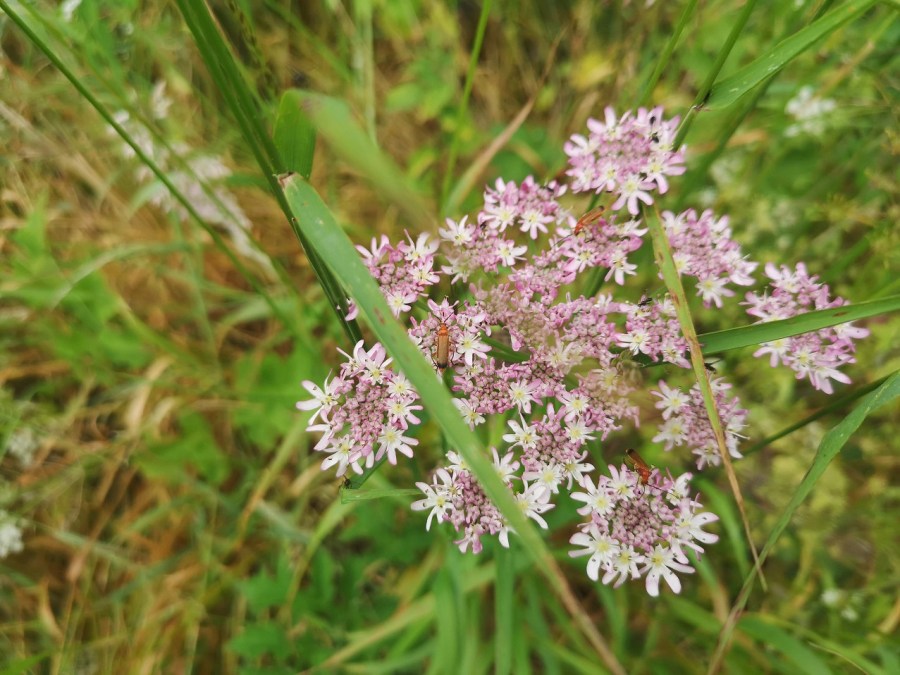
Cow parsnip hogweed (heracleum sphondylium)

Flora and fauna -Old Cambus

My eye was drawn to the catkins flibbaling in the wind, snowdrops harbouring under a stone ledge, pussywillow shining white, and hogweed/cow parsnip in flower. Thoughts flitted in and out about a book I was recently given: Melissa Harrison’s Rain. I wasn’t sure about it at the beginning, but it was starting to grow on me – four, easy essays written about seasonal walks in different parts of England, all about rain and the effects it has on animals and the earth – interesting facts, well written.  I wondered to myself if she learned from books / the internet or if it was local lore from people she had spoken to along the way.

‘Here and there hazels have produced their yellow catkins; there are hips bright as blood, too, and beside the path a straggle of field mustard, most likely a farmland escapee…’

This was Old Cambus and I went straight on, as far as the T-junction, and there I thought I must be wrong. I was right! Retracing my footsteps (right hip and soles sore from road walking) I asked a woman getting into a car and she pointed me to the seagreen shed. I had to go past the garden with the tin / metal sculptures of a sheep and a pelican.
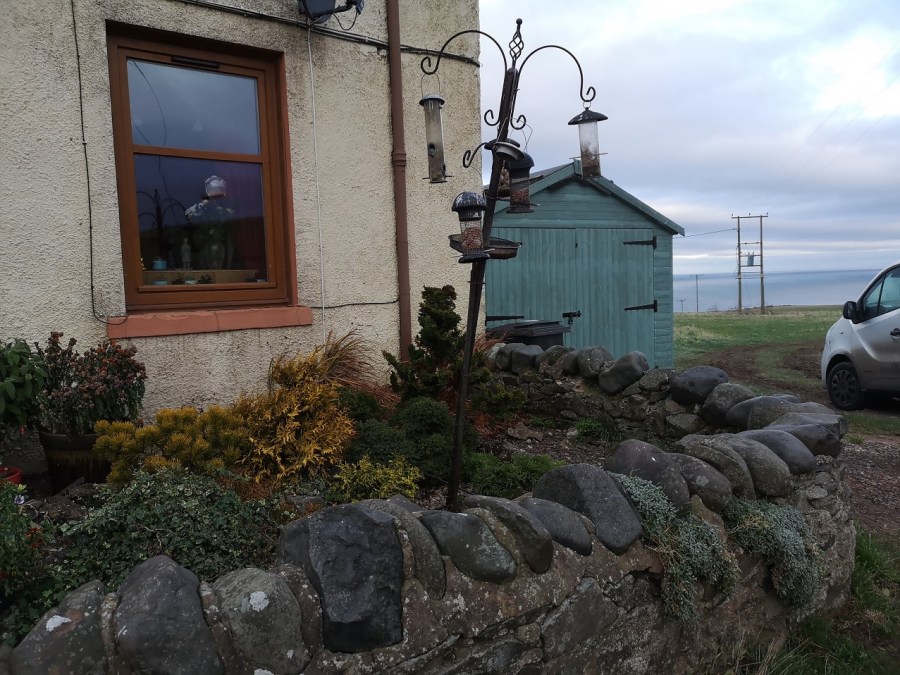
IMG_20200125_140718
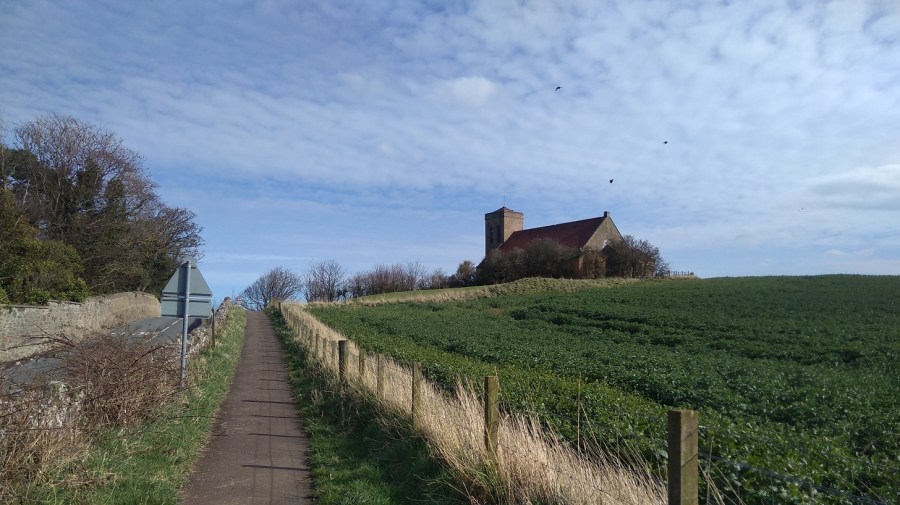
Turn right at this cottage, walk straight down the left hand side of the field and then, although it is counter-intuitive, turn right (do not go across the farmyard full of wood even though there is a sign pointing left there). Berwickshire Coastal Path, Scotland

So, now I was going back in the opposite direction (sea on my left) to another sign in the corner of the field. Then, straight downhill (not left) towards the sea. There was a ruin up ahead.
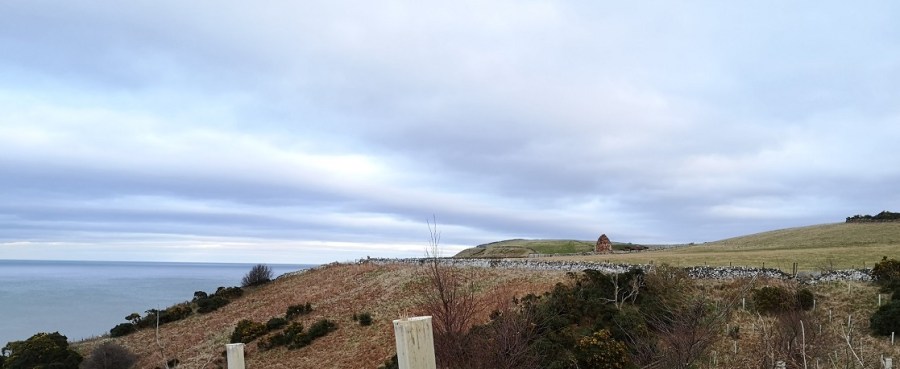
ruin
The ruin seen from the other side. The day was brightening as it came to its end. Berwickshire Coastal Path, Scotland

Siccar Point

Although the path goes inland here, I was able to get a photo, later, looking back towards the famous Siccar Point or Hutton’s Unconformity.

Siccar Point (Hutton's Unconformity)
Siccar Point or Hutton’s Unconformity, of immense geological interest, Berwickshire Coastal Path, Scotland

‘In 1788, James Hutton first discovered Siccar Point, and understood its significance. It is by far the most spectacular of several unconformities that he discovered in Scotland, and very important in helping Hutton to explain his ideas about the processes of the Earth.’

 ‘At Siccar Point, nearly vertical sedimentary rocks of Silurian age – greywacke sandstones and mudstones – are covered unconformably by a younger sequence of red sandstone and breccia.’ The Geological Society

‘Hutton used Siccar Point to demonstrate the cycle of deposition, folding, erosion and further deposition that the unconformity represents. He understood the implication of unconformities in the evidence that they provided for the enormity of geological time and the antiquity of planet Earth, in contrast to the biblical teaching of the creation of the Earth.’

Over a cattle grid I traipsed, and took a right with lots of signposts giving mileages to Cockburnspath which turned out to be erroneous, but kept me forging forwards at the time. A long stretch along the edge of a fence was very steep with very little space to walk.

Pease Bay
IMG_20200125_144208
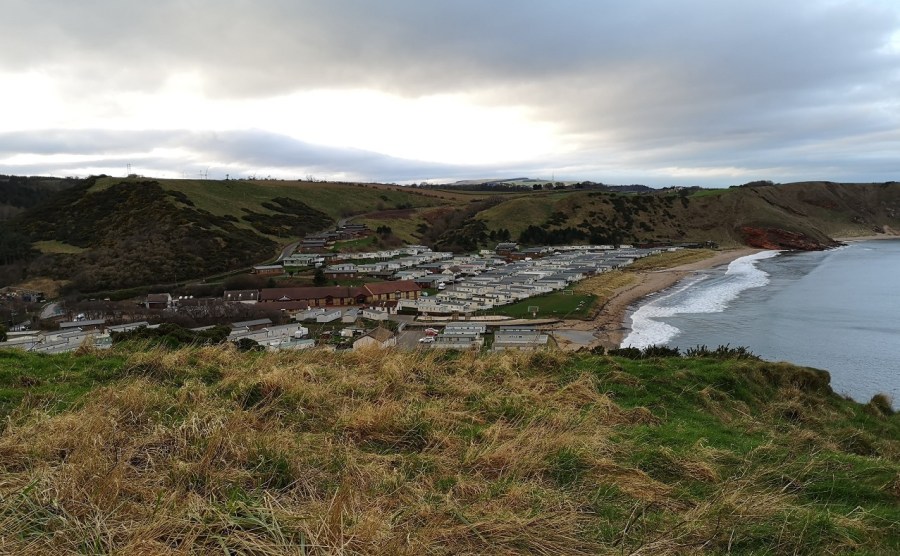
There was Pease Bay  ahead – how did they ever get planning permission to fill the bay like that with caravans? Berwickshire Coastal Path, Scotland
IMG_20200125_144548
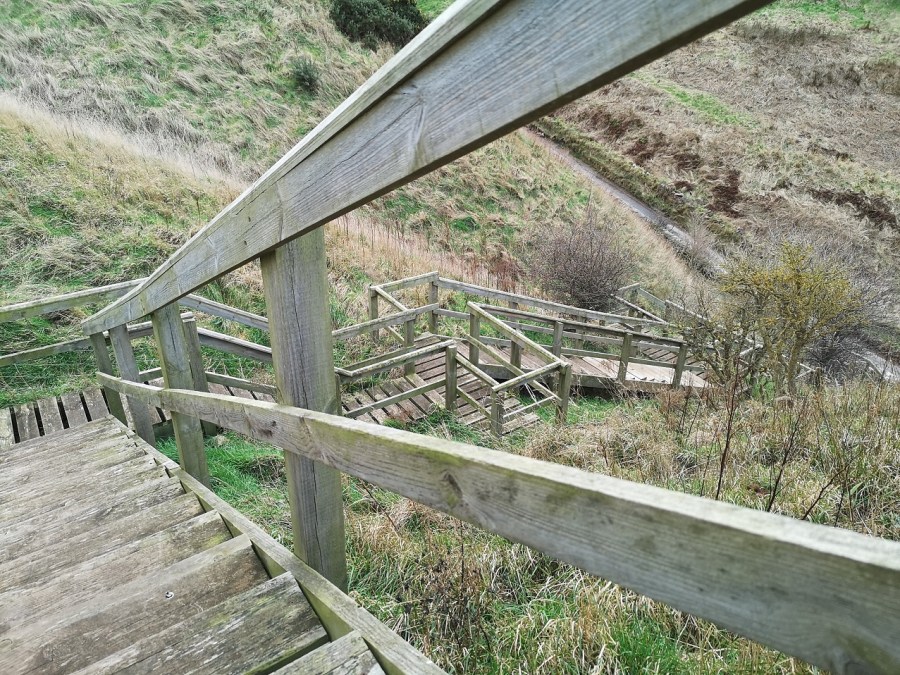
I sat for five minutes and ate some sugary snacks before stumbling down a long flight of wooden steps to Pease Bay, Berwickshire Coastal Path, Scotland

Up a very steep road on the other side, past some houses, I joined the very end of the Southern Upland Way (which starts at Portpatrick, south western Scotland 214 miles / 344kms). More tough steps, this time, up.
IMG_20200125_150410

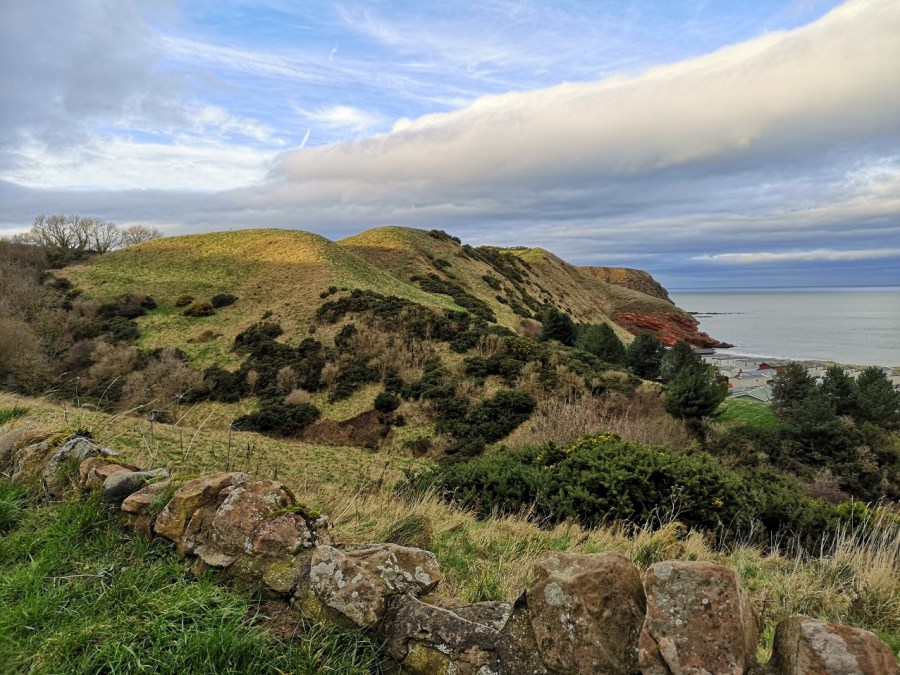
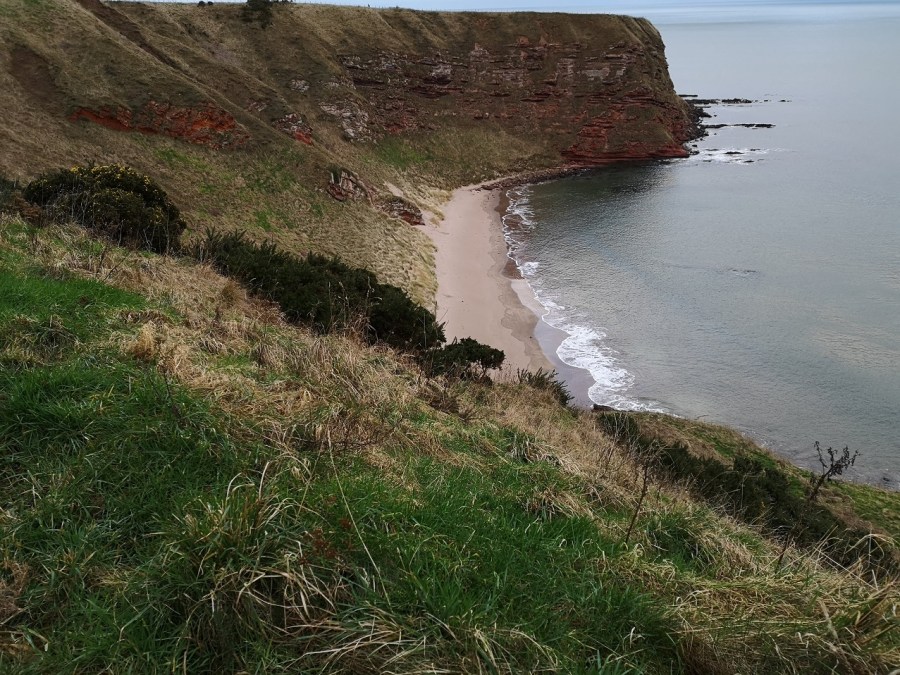
Crossing a burn with little waterfalls on a boardwalk, I came across a sweet bay which could not be reached except by boat.
Beach cusps link to Coastal Wiki
Beach cusps – scallop-shaped patterns made by the sea at the edge of the shore where waves have collapsed into a thin bore. Berwickshire Coastal Path, Scotland
IMG_20200125_152814
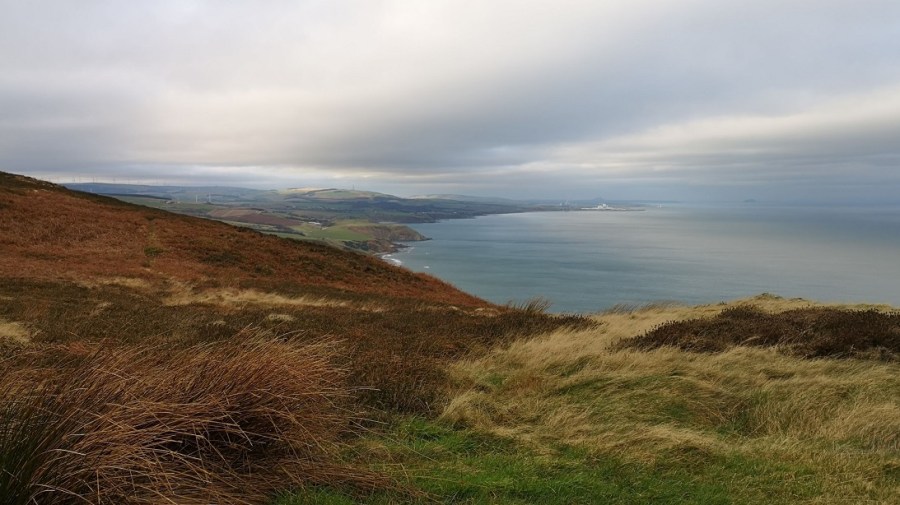
The complicated coastline of Berwickshire with the picturesque houses of Cove and Torness Power Station in the distance, looking towards Edinburgh, Scotland

Cove and Cockburnspath

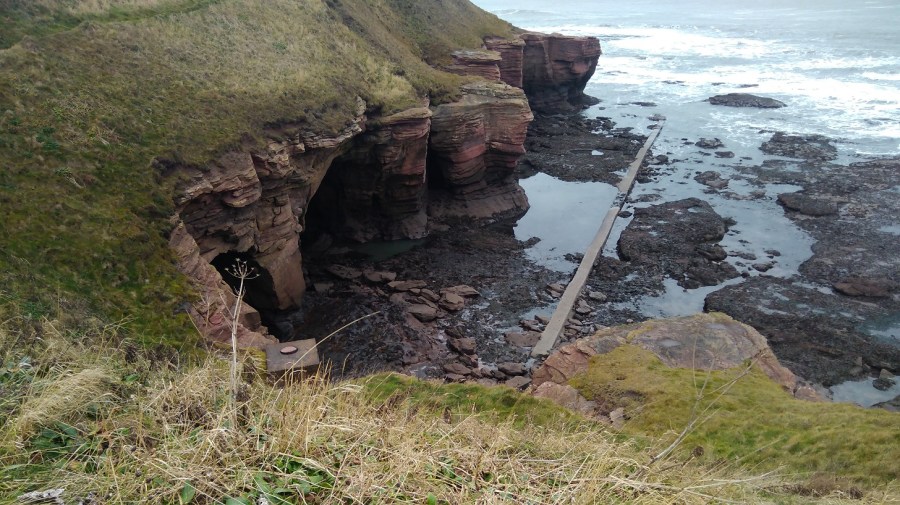
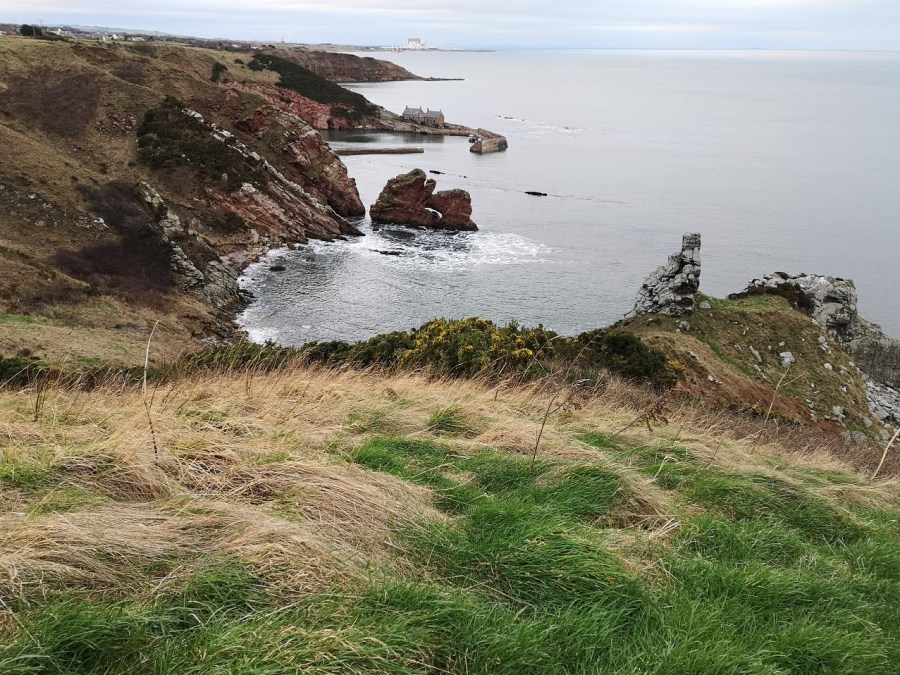
At Cove, there are caves in the red rock and stacks to rival Orkney’s. Striated rock comes down into the water. I spied a single cormorant on a rock with another swimming towards it out at sea. A solitary, brown, fluffy caterpillar was at my feet.
IMG_20200125_155039
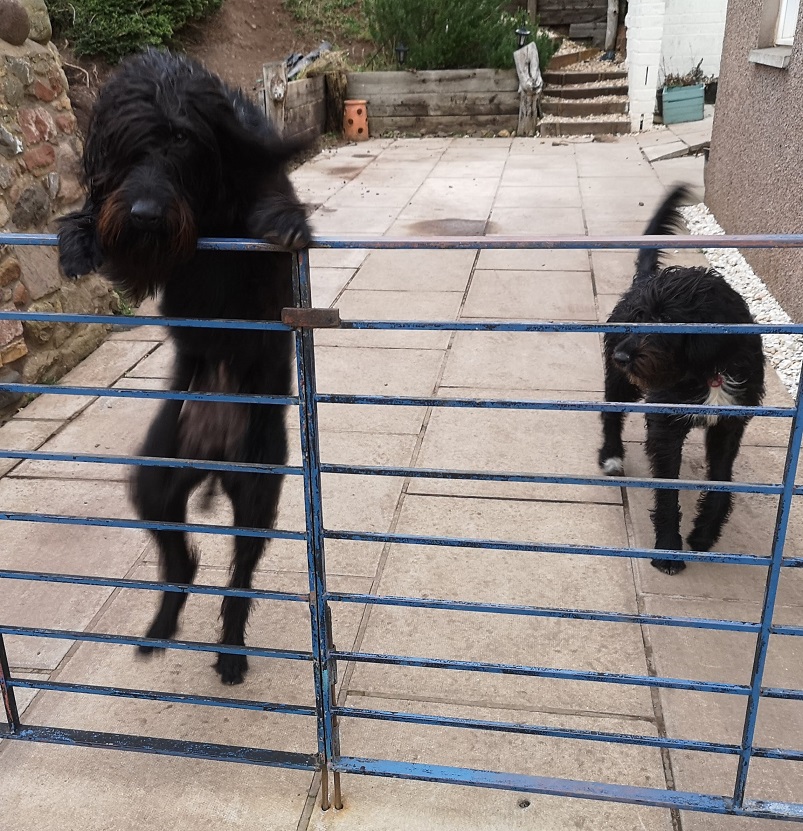
On one side a man mended his car, on the other, a funny dog jumped off the ground in his enthusiasm to be petted – cute or what! Berwickshire Coastal Path, Scotland

oznorHB

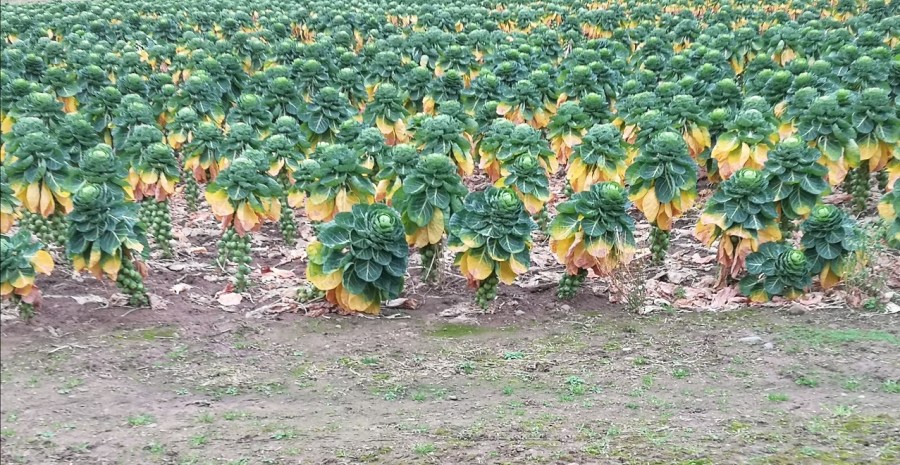
Past a field of prize-winning sprouts, this stretch is noisy with motorway traffic and, as I passed under the railway, yet another train sped across. I viewed the peace and biscuits graffiti which was exactly as ‘Ettrick Shepherd’ on the Walk Highlands website stated (long distance walks / Berwickshire Coastal Path / St Abbs to Cockburnspath). I am indebted to him for his account, which I read before I walked.

IMG_20200125_155512
Never mind the spelling, it’s the sentiment which counts! Berwickshire Coastal Path coming into Cockburnspath at the end – hooray! Scotland

I arrived at Cockburnspath at 4pm, before it was dark. To get the bus back to Edinburgh, you need the stop on the Bowling Club side of the road. It turned out I could have got the 4pm bus, but I went for a celebratory cup of tea at the post office and village shop (which very sadly closes in 5 weeks due to bereavement) and so, missed it. I waited over an hour, regaled by very loud rock music coming from the house nearby, as it got darker. My right cheek was glowing hot from walking all day, much of it with the wind in my face. Thankfully, it’s a nice old fashioned bus stop with a covered wooden seat but, being wet throughout from the sweat of the walk, I chilled very quickly and so snuck behind and changed into dry clothes from the day before.
cof
Berwickshire Coastal Path, Scotland

Birdwatching on the Berwickshire Coast

Really good leaflet on wildlife of the Welsh coast, many of which species can be seen in Berwickshire too. pdf

You might also like Day 1 of the Berwickshire Coastal Path and North Berwick to Dunbar
North Berwick to Dunbar

A walk from North Berwick to Dunbar, part of the John Muir Way, East Lothian. July 13th 2019. 30 kms / 18.6 miles

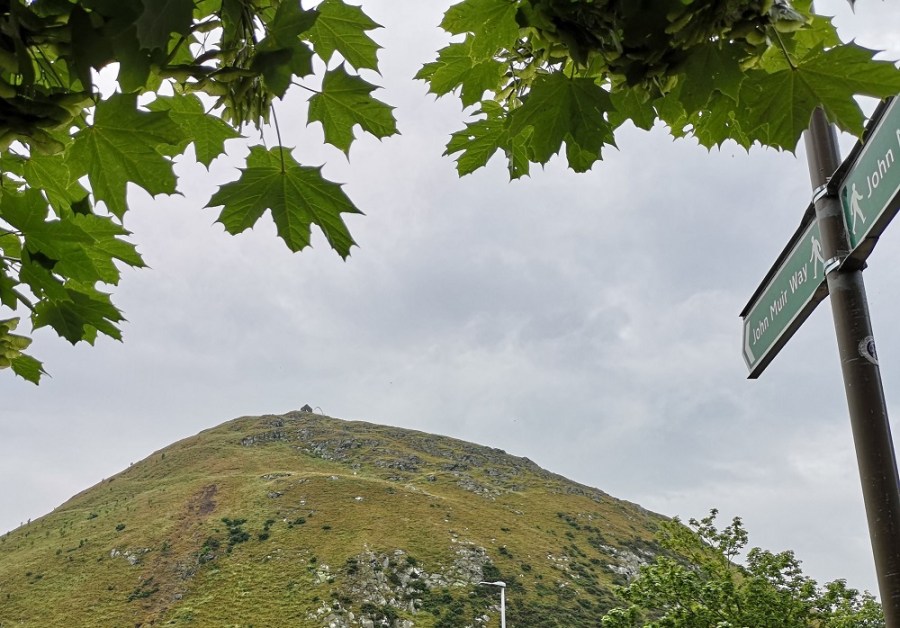
John Muir Way signpost to hill
The mound of Berwick Law. You can just see the chapel and the famous herringbone on the summit

I remembered: the binoculars – definitely worth taking because East Lothian is a birdwatcher’s paradise. I saw 5 spoonbills through a kind man’s telescope (he had to lower it considerably so I could see, which was sweet of him). They looked like huge fluffy white poodoodles (or whatever they are called), with Edward Lear beaks (you know how he made drawings of amalgamated animals and kitchen utensils!) Also my walking baton pole which came in handy for the mud caused by the torrential rain.
I forgot: tissues / toilet paper and my mobile phone charger – when will I learn?
I lost: my sun hat. Twice. Once a motorist stopped and rolled his window down so I went back quite a long way to get it – all run over it was with muddy tyre marks. I wore it when the sun came out and then lost it again. Never to be found – not by me anyway.

Water with trees reflected in it
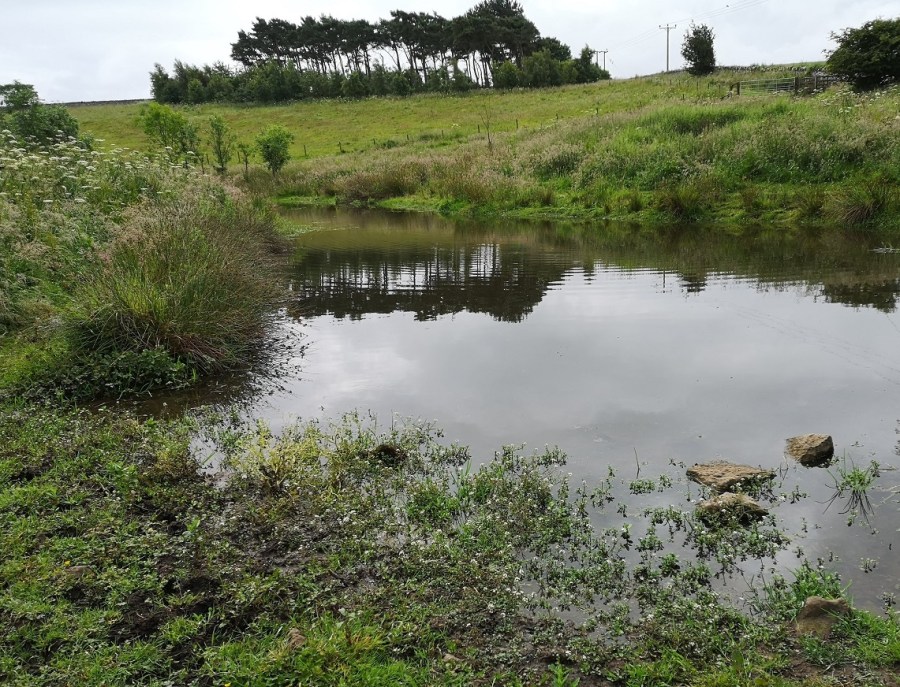
Pool at the foot of Berwick Law, near North Berwick, East Lothian, Scotland
Blue sky with plants and wall
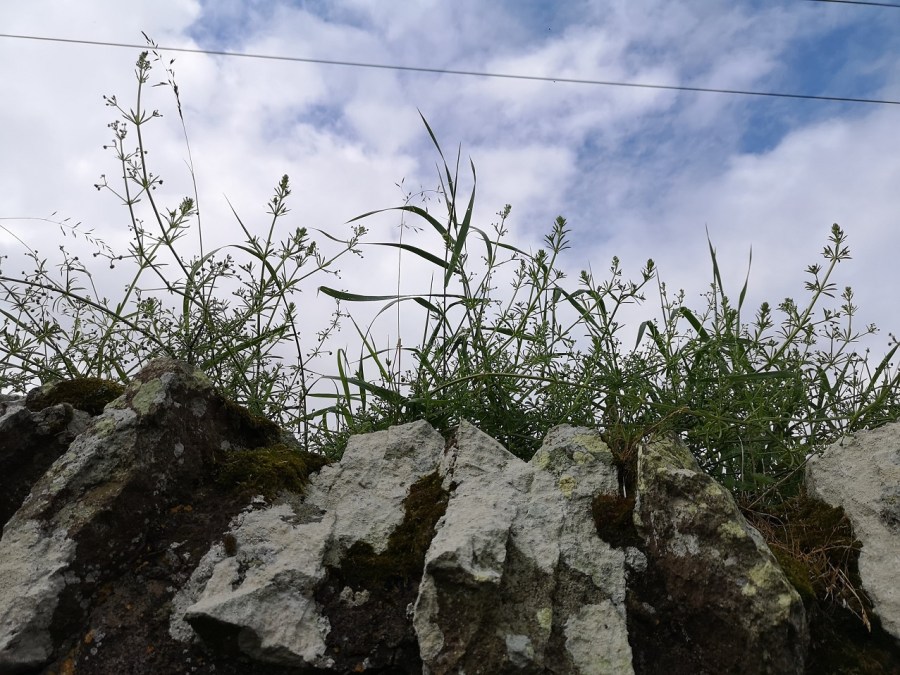
A rather picturesque Wall I thought
Landscape between the stones
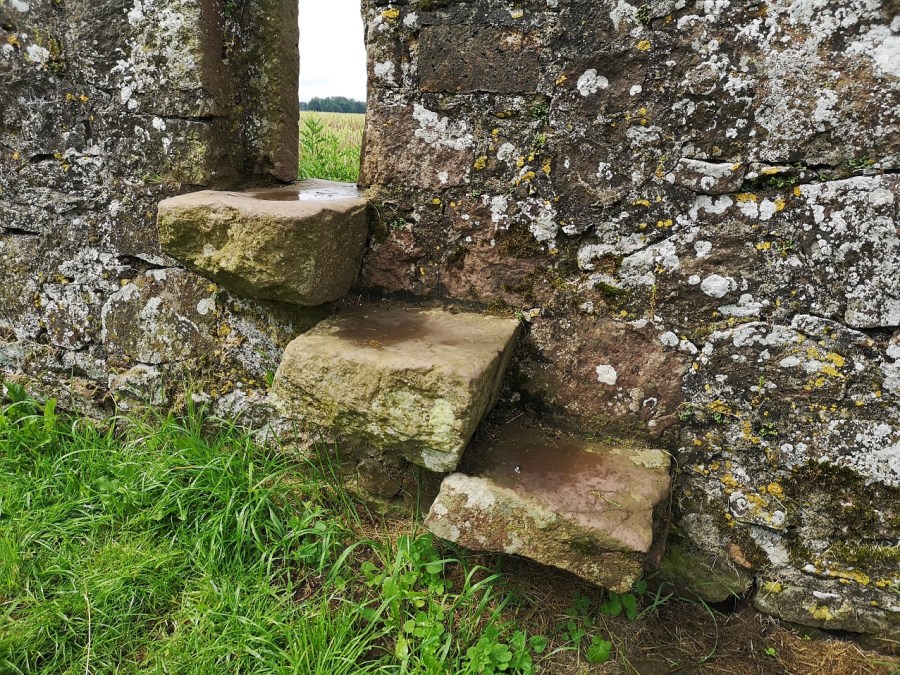
Looking through the gap in a stone wall to the wheat beyond

I had not done a long-distance walk for a long time and I managed to get quite stressed to start with, meaning that more little things went wrong, until… I got into the first green part and the butterflies (some chocolate brown and others white – twice one kissed me on the cheek) were playing, and the raindrops sat bulbous on the bramble flowers catching the glint of the sun, and I got bitten by black and white flying beasties. I was back!

Green fields with tracks through them
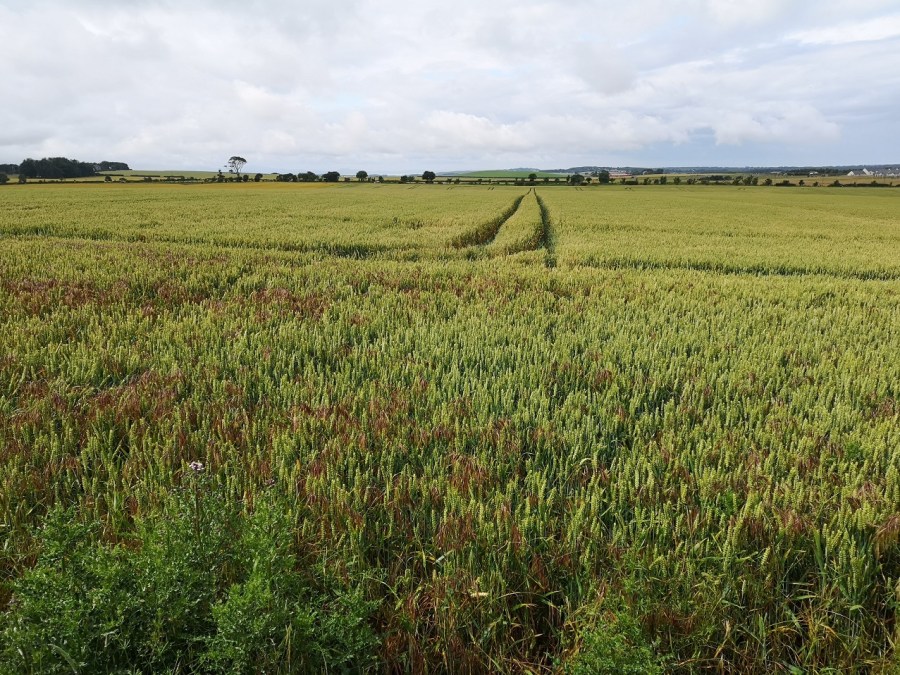
Arable fields, East Lothian, Scotland

The man in a green National Trust for Scotland t shirt said ‘Lady on a mission’ as I swung through the gate and skirted around Berwick Law. I have been up to the top in the past and it’s well worth it, but today I was headed south through meadows and woods, around fields and coastline – it was delightful.

tree trunks and grassy path
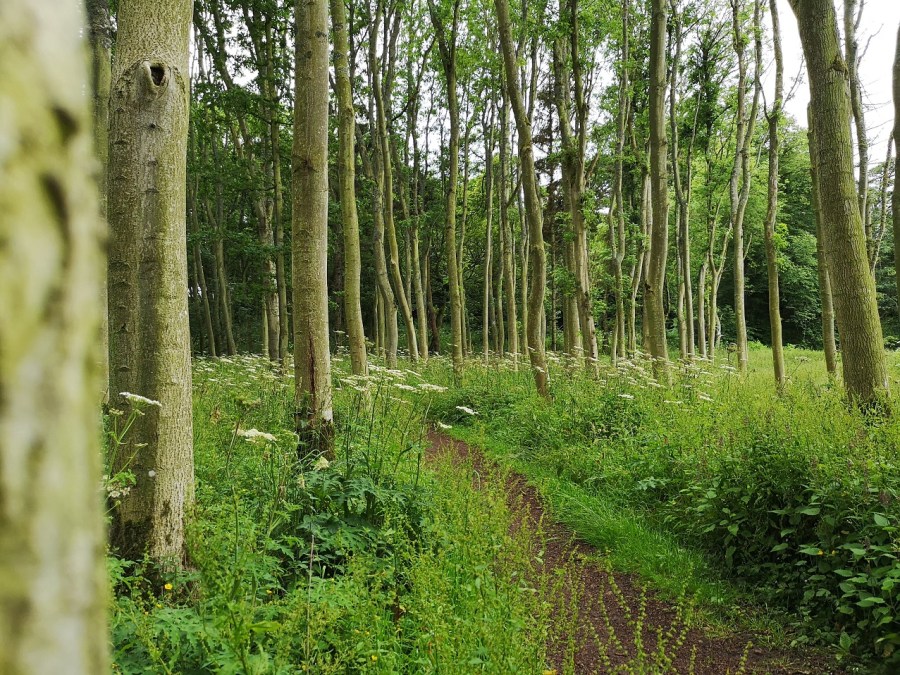
I smiled out loud as I made my way through an ash wood, all smooth, straight, pale trunks

Two runners in electric blue went jogging slowly past, having a laugh. Several jaunty ladies wished me good day, and I rather rashly added to my brief conversation with a hiker going in the opposite direction, that at least it had not rained.

Dark brooding clouds in East Lothian
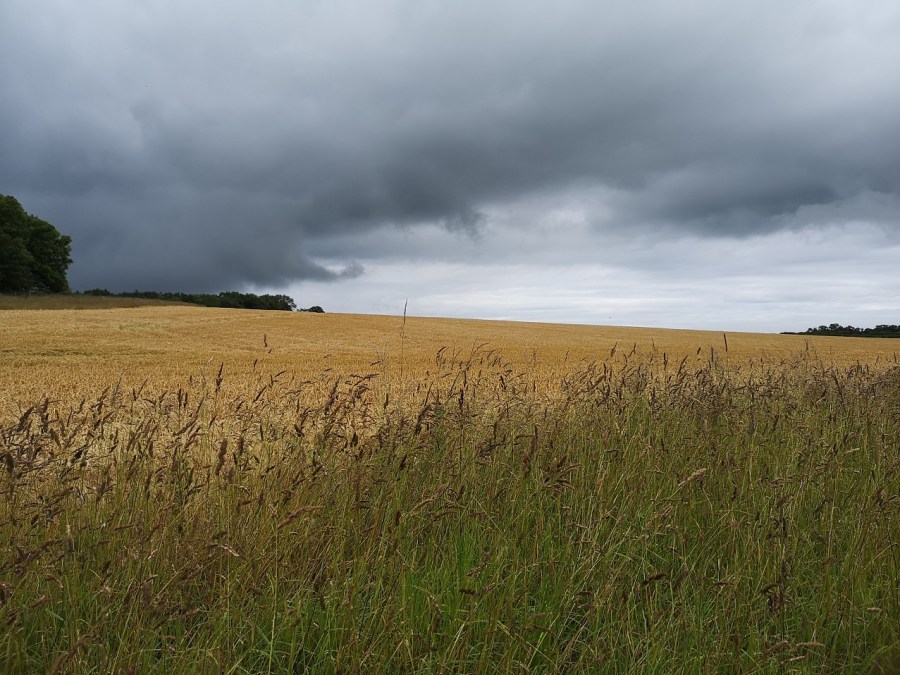
The very definition of a lowering sky!

I squelched along a narrow way with piles of horse manure and single tyre marks which suggested other users I thankfully did not meet. When it rained I was on a long farm track which quickly became two channels of fast flowing water. There was a section which reminded me of a Kent walk, because it had serious new, silver metal fences on each side, and one smelly uphill section through the Drylaw Composting site where I discovered a make-shift children’s play area.

There was the unmistakable sound of a wild bee swarm several times along the way, and the hideous screech of racing cars around East Linton. One blissful result of the downpour was that they stopped, although they restarted when the sun reappeared.

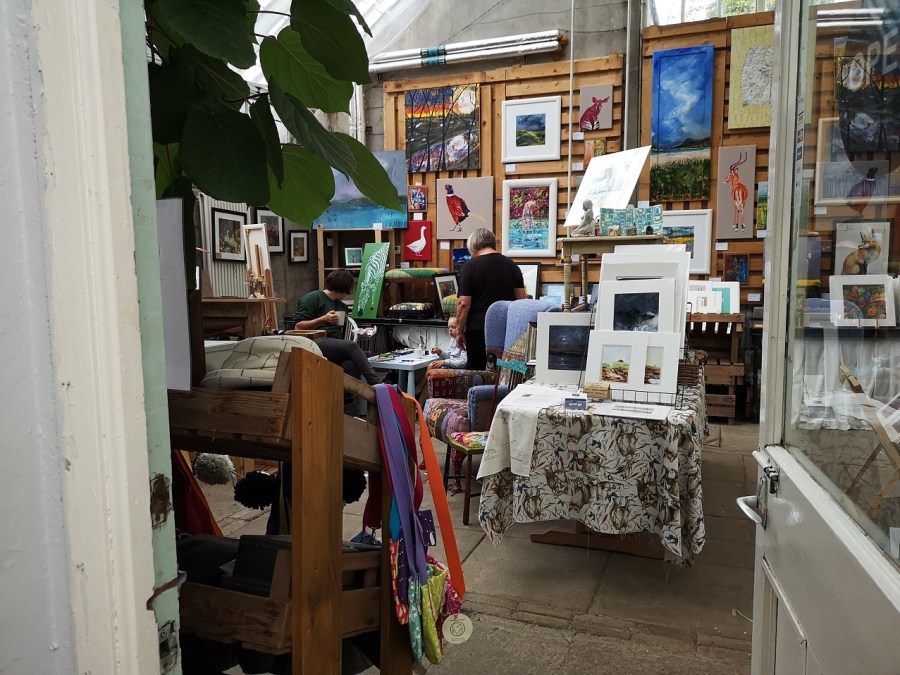
Paintings for sale in the gallery
Half way I stopped for refreshments at Smeaton Nursery where there is a gallery and shop. Helen Gray is the Smeaton Estate Artist

There are lots of plants, a Victorian tea room (soup, salads, cream teas, delicious looking cakes), and a gallery shop selling all manner of paintings, cards and gifts. The staff were particularly friendly and helpful while I dried off a little in the sun – boots off and not so waterproofs laid out on the table.

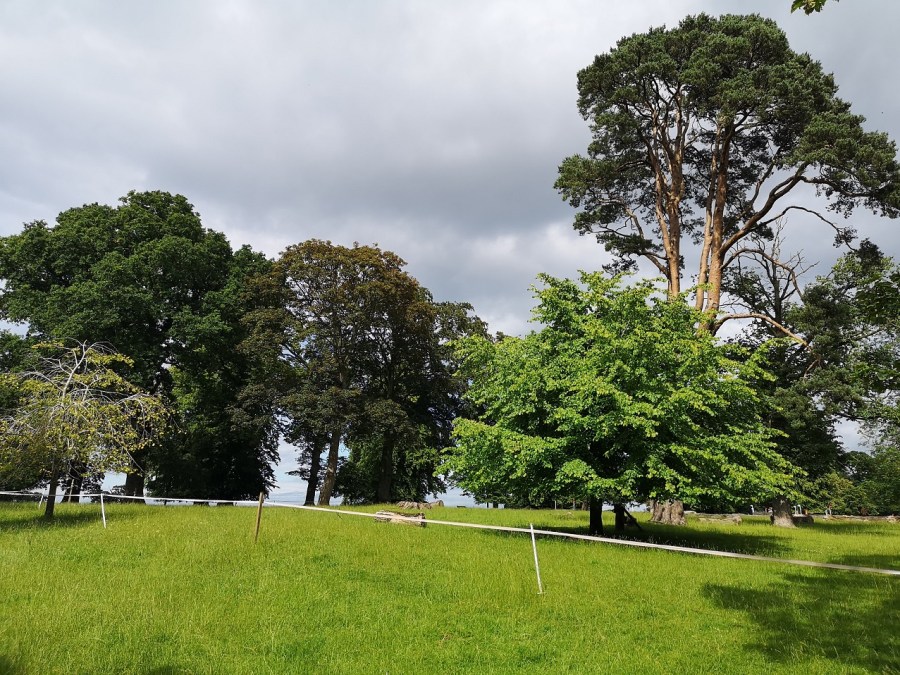
Big old trees
The mature trees of Smeaton Nursery grounds where there are woods, a lake and pony arena
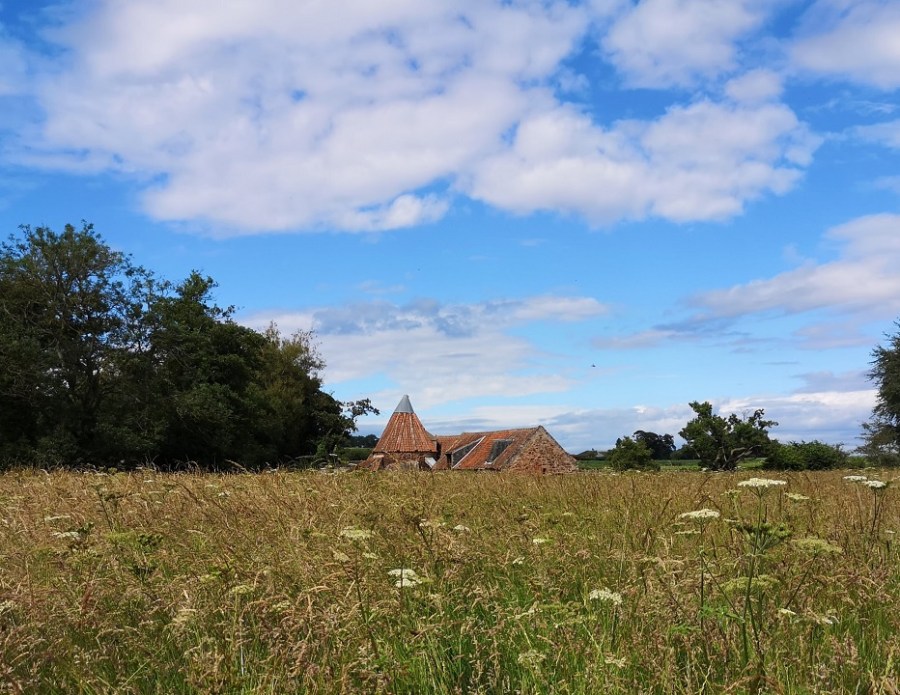
Red brick building seen across a wildflower meadow
Preston Mill reminding me of a disused oast house in Yalding
River reflections with bridge
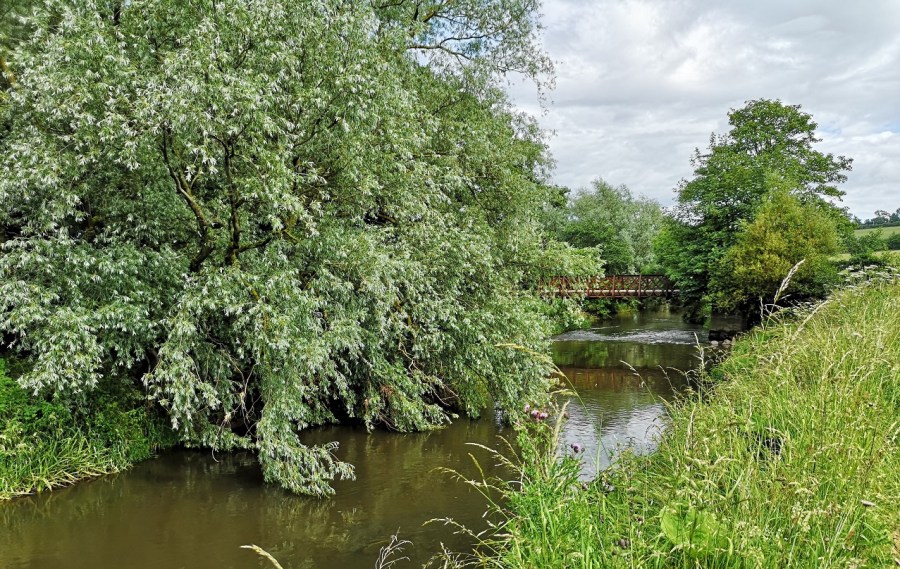
Stunning weeping willows along the River Tyne outside East Linton

You could be forgiven for thinking there was no bee or butterfly problems if you saw the number of them I did on this walk. There is a beautiful long stretch along the river where comfrey grows in abundance and the sliver green fronds of the willows dip into the water.

Wooden bridge with red metal railings
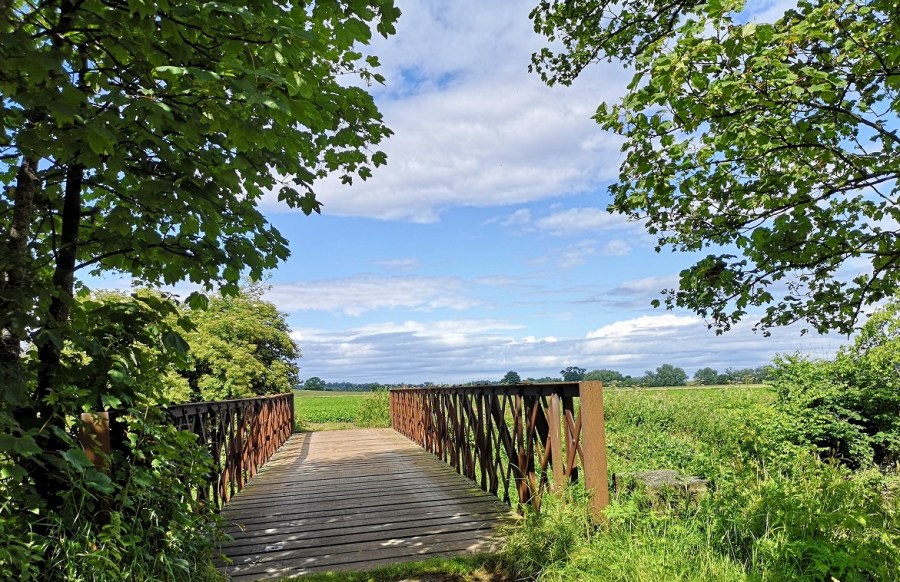
Bridge over the River Tyne

There were so many wild flowers I lost count: chamomile with green orbs which had lost their white petals – not just short stalked, but long and waving in the breeze;
elder flowers practically turning into berries as I passed; ripe cow parsley covered with Comon Red Soldier Beetles; ox eye daisies amongst the fields of bearded barley; brilliant scarlet poppies in the hedgerows; and miles of roses, sweet secented and in a variety of firey colours.

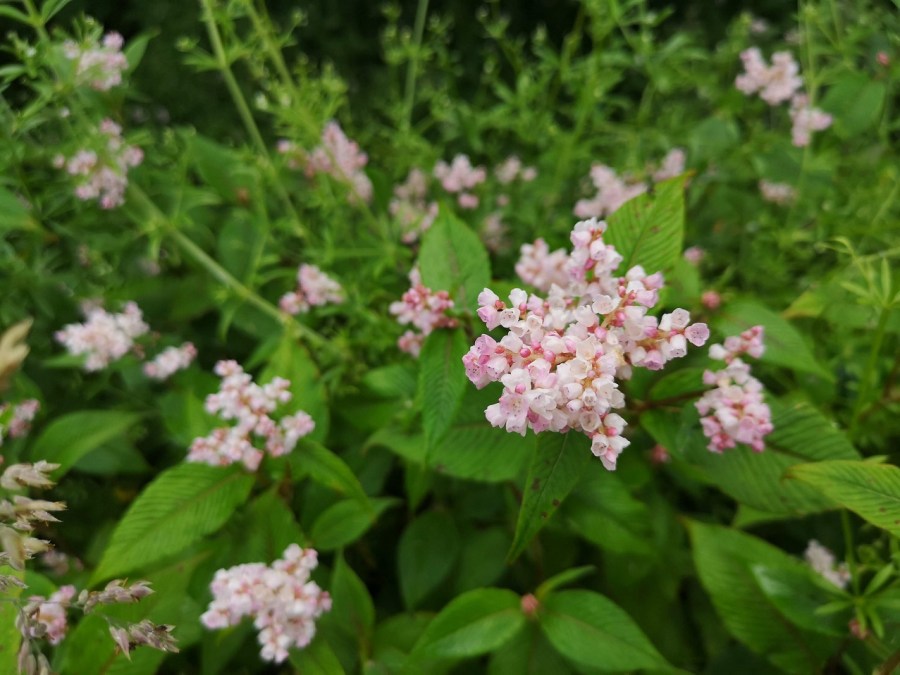
Pink flowers and green leaves
Wild flowers
wild flowers beside a field
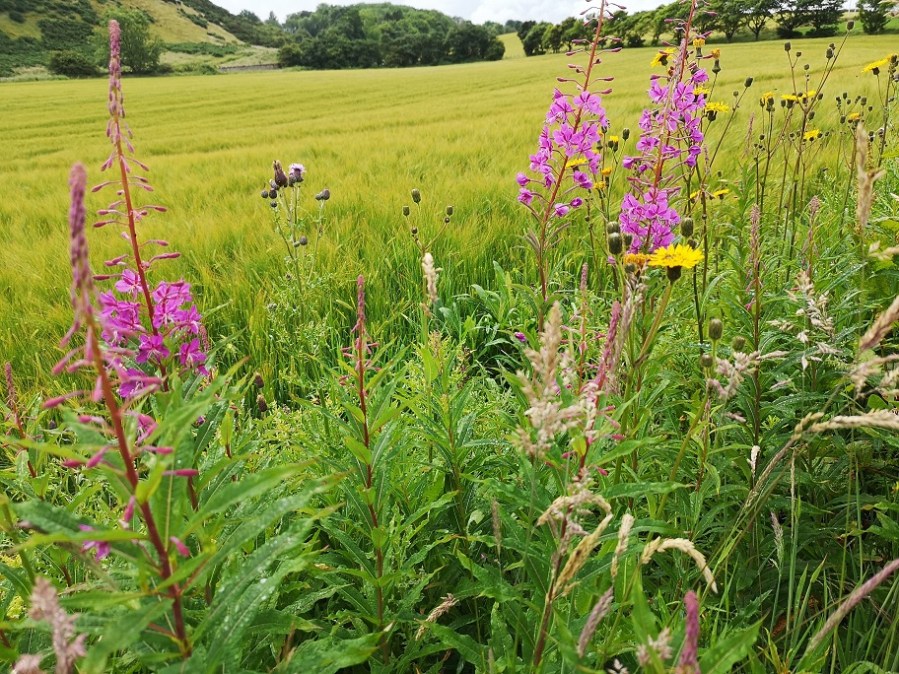
Pink rose bay willowherb contrasting with yellow ray flowers
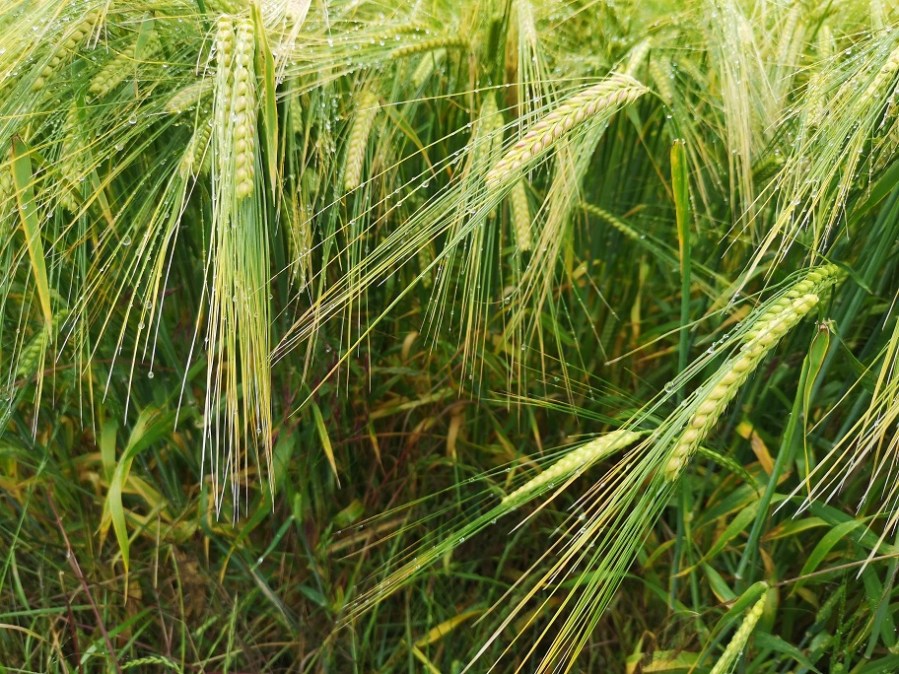
whisps of barley growing
Barley tickling the ground
Three flowers heads
Cowparsley
North Berwick to Dunbar
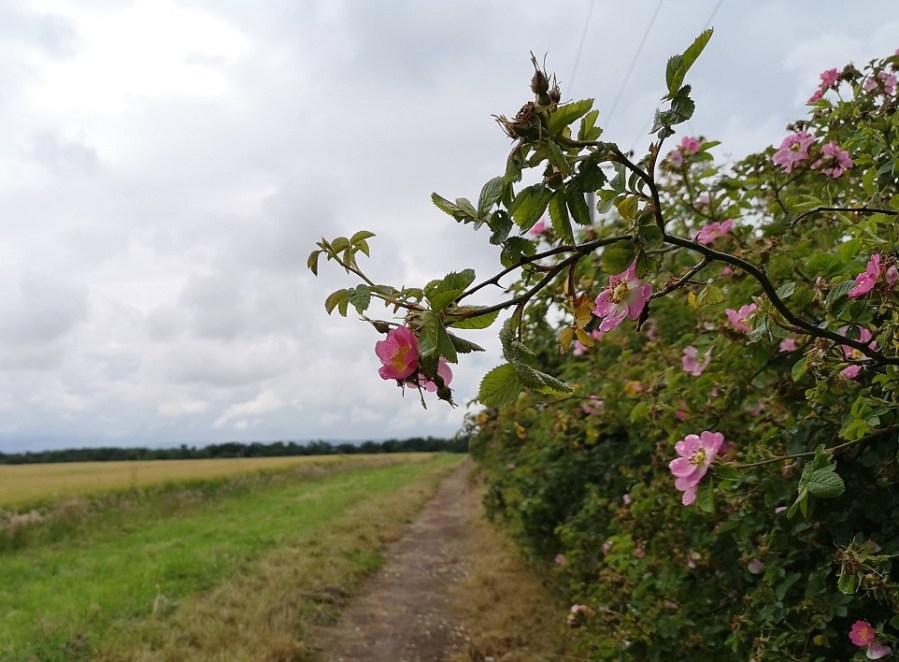
Dog roses in the hedgrows

As well as the spoonbills (above), there was a buttercup headed yellow hammer bathing in a puddle, gaggles of very excited sparrows with their wings all a flutter near the horse paddock, and a piebald square tailed kite sailing overhead.

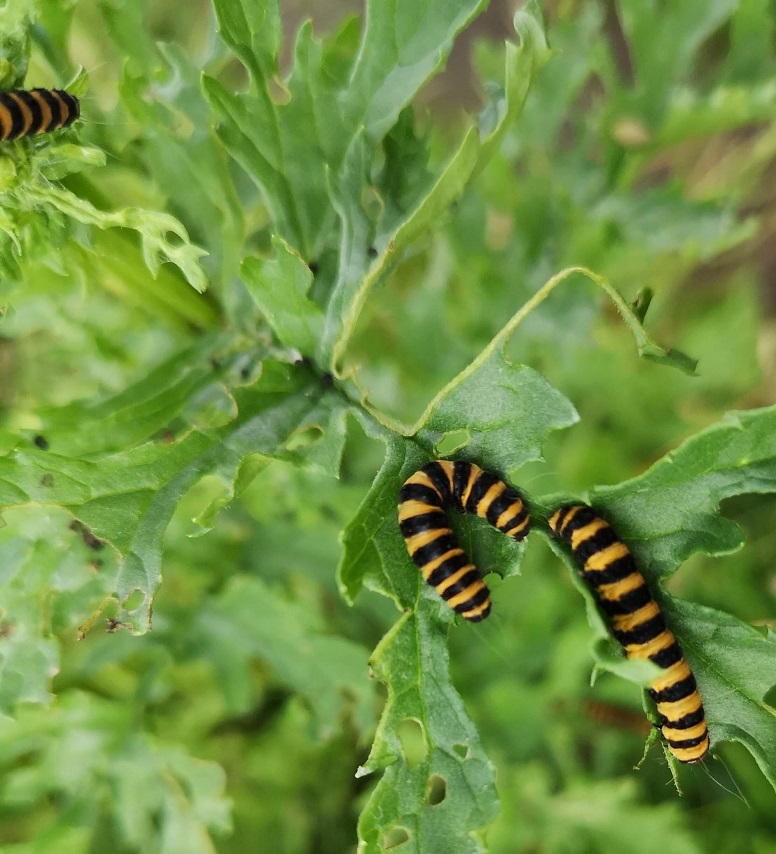
Stripey caterpillars
Caterpillars having a feast – there were about 20 on this one plant
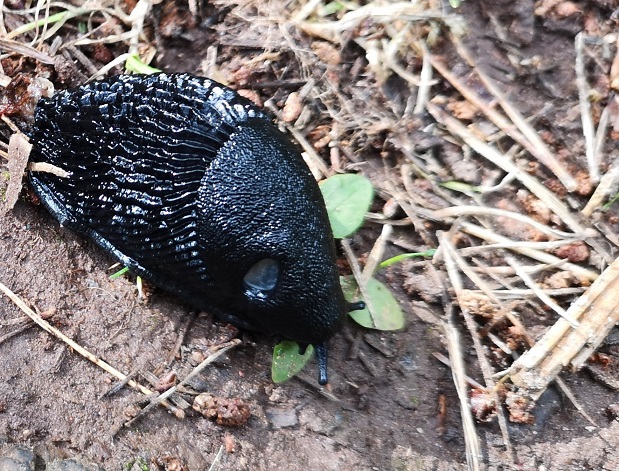
Shiny, black slug crawling
Squelchy slug – one of the biggest ever – seen in the dappled woods opposite the East Links Family Park where there were emus grazing alongside llamas and donkeys
Clusters of wild flowers
Red beetles on cow parsley

The more you walk the better it is because there are so many memories of other treks gone by, people met, places visited. The first black raven crawed and reminded me of Orkney. The second clearly warned me of the coming shower, which I promptly ignored and so got very quickly wet through. I was still damp 4 hours later when I marched into Dunbar.

River flowing under bridge
Old stone bridge over the River Tyne, East Lothian, Scotland

There are three bays at the end of the day: the flat wetlands of Tyninghame, the red sandstone stacks of Belhaven (not to mention the real ale, the yellow house, and the John Muir Country Park with its caravans and little swan lake), and finally around the golf links I went barefoot to the gull studded cliffs of Dunbar itself.

Scots Pine
The distinctive Scots Pines of Tyninghame Bay, East Lothian, Scotland
North Berwick to Dunbar
Creek at Tyninghame Bay
North Berwick to Dunbar
Bass Rock and Tyninghame Bay, East Lothian, Scotland
North Berwick to Dunbar
Belhaven Bay, East Lothian, Scotland
North Berwick to Dunbar
Coming through the arch into Dunbar Bay, East Lothian, Scotland
North Berwick to Dunbar
The man himself – John Muir, featured in Dunbar Bay, East Lothian, Scotland

It’s a hedgrow and fields walk
Its a meadows walk
Its a skirting round the hills and not going up walk
It’s a coast to coast walk with arable land in between
It’s a walk full of wild roses,
A very well signposted walk
While the birds call all you have to do….. is walk!

Practicalities

I arrived at North Berwick around 11.30am, and in Dunbar 7 and a half hours later, with an hour’s stop and an extra 2 kms in the middle to and from the Smeaton Nursery tea rooms off the main route. I was reliably informed that the tea room at Tyninghame is also lovely.

I took the train from Edinburgh to North Berwick with Scotrail (who very kindly refinded my fare to Dunbar which I made by mistake – thank you). It took 45 minutes and cost £7 single. I might have rather annoyed the gentleman in a cravat opposite, but had lovely chat with a Northern Irish dog walker from Glasgow on his way to follow Mcllroy round the golf course.
Walk from the station in NB to Lady Jane Road, turn right up it and after a few minutes on the right you will find the John Muir Walkway signs. Alternatively start at the Seabird Centre and walk through Lodge Grounds by St Andrews Well. There is a lot to see in NB.

My return was by bus from Dunar on the Edinburgh Express which leaves at 29 minutes past each hour on a Saturday afternoon / evening and costs £5.70. It takes an hour, leaves from the high Street, and doesn’t put you down at the bus station but at Waverley Railway Station, Edinburgh.

The John Muir Way

More info about the walk on these two sites

Visit East Lothian

The Independent Walk of the Month

Thanks to Lesley for her local knowledge.

Berwickshire Coastal Path: Eyemouth to St Abbs Head Lighthouse

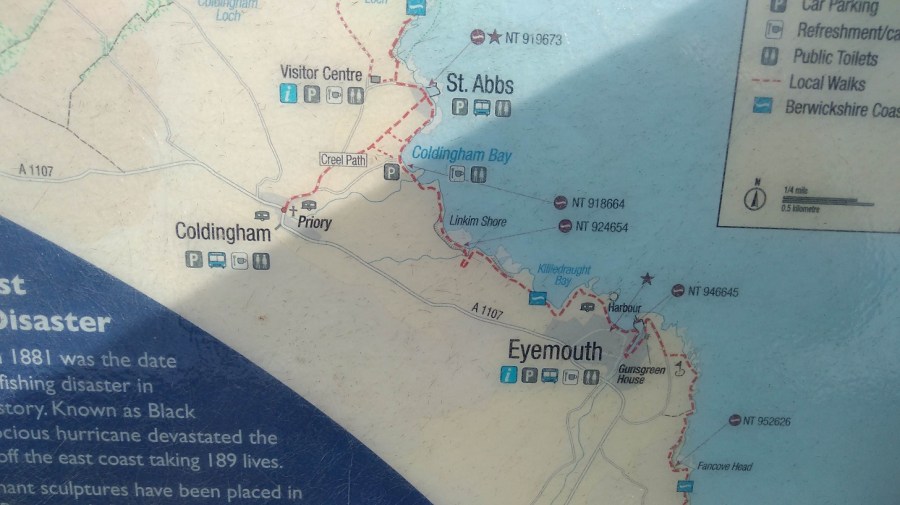
I took the bus from Edinburgh to Eyemouth where I ended the previous stage of the Berwickshire Coastal Path (BCP). From there I walked to St Abbs (6 km, 3.5 miles) going north east wards, and on to St Abbs Head and the lighthouse. Then I hiked back again to get the bus! (The village of Coldingham is 1.5 miles inland). More practicalities are at the end of the blog.

IMG_20190325_143543

The Journey

As I left Edinburgh (on the 253 bus at 8am), almost everyone else was going to Monday morning work. There were four of us heading eastwards: a cyclist and three walkers including a second solo woman who was consumately prepared (that was when I realised I had left my pole at home!) She was doing walking the BCP over 2 days, for the second time.

Everyone was reading books rather than their phones as we passed through the pretty town of Haddington where children were making their way to school.  Even before we drove into Dunbar, the odour from the Belhaven Brewery assailed my nostrils!

The others alighted in the sun at Cockburnspath, near the wee round-towered church, technically the start of the Berwickshire Coastal Path (BCP). I went on to Eyemouth and wondered why I was doing it backwards. It seems to be a habit of mine: reading the Sunday paper from the back to front; starting the Via de la Plata in Santiago de Compostella (rather than in Seville which I did later). What does that say about my personality?

IMG_20190325_101414
This stretch has the second highest cliffs on the east coast of Britain

Note to those who might want to do this: leaving Eyemouth (10.05am), be careful not to walk along the road as it is a dead end. Instead, go across the sands to the steps and up there are BCP signs. On the beach it was ever so warm, whereas at the top I needed a hat and a hood to keep out the gusts.

IMG_20190325_100743
A giant red forehead looks out over Eyemouth Harbour and sands

Eyemouth to Coldingham

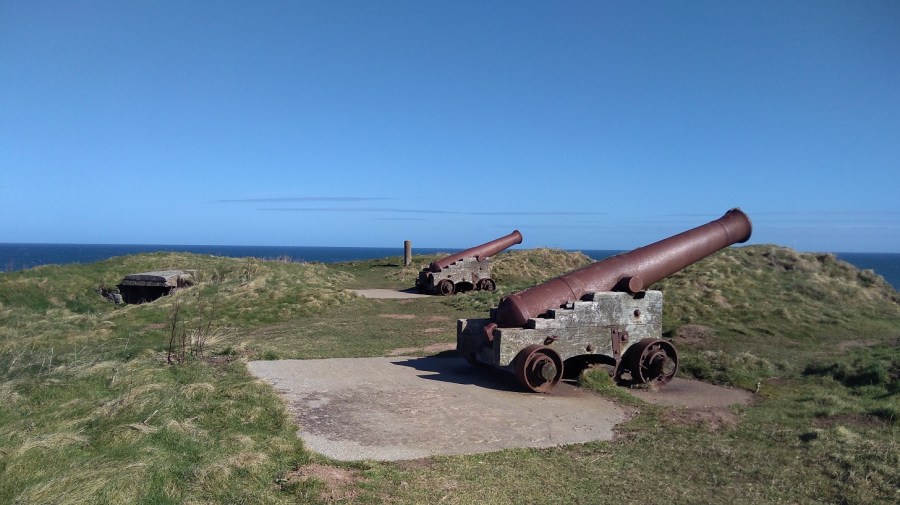
I visited the site of two forts: one English (1547) and the other French (1557), neither of which survived due to changes to the Crown of the day. Guns mark their existence now, facing out to foreign lands – a sign of outmoded protectionism, sadly very present in current foreign policy.

IMG_20190325_101856
Eyemouth Fort – all grass now apart from the guns, and the  stone shelter which you can see on the left. Scottish Borders

I inhaled the smell of brine and sun-warmed turf. The woman walking in the other direction had a north English accent and needed sunglasses it was so bright. We both turned and looked up at the tuneful sound and when I asked her if she knew what it was she said, ‘a type of skyark, I only do generic when it comes to birds.’

IMG_20190325_102108
Monumental

Immediately there is a caravan park which was inhabited: a black labrador sitting patiently by the door; a woman inside with her hat on. There were daffodils lining the fence and Danger signs (people do disregard these and have serious accidents). Not much further along were lots of memorials – benches, bunches of dead or pretend flowers, and moving inscriptions, perhaps to those whose ashes had been taken by the wind out to sea.

IMG_20190325_101927
The land juts out into the ocean and there is a wonderful view

Further along was a camper van and a coachload of German tourists, but they didn’t stray far – just had a quick look and then left. Of course there were dog walkers here too, close to the road where they could get easy access. One small hound barked vociferously at me and his owner said it was the rucksacks which set him off!

IMG_20190325_102435
Rock strata of varying hues

The wind was so strong that it moved my camera as I pointed it.

IMG_20190325_103131
Spectacular landscape
IMG_20190325_112224
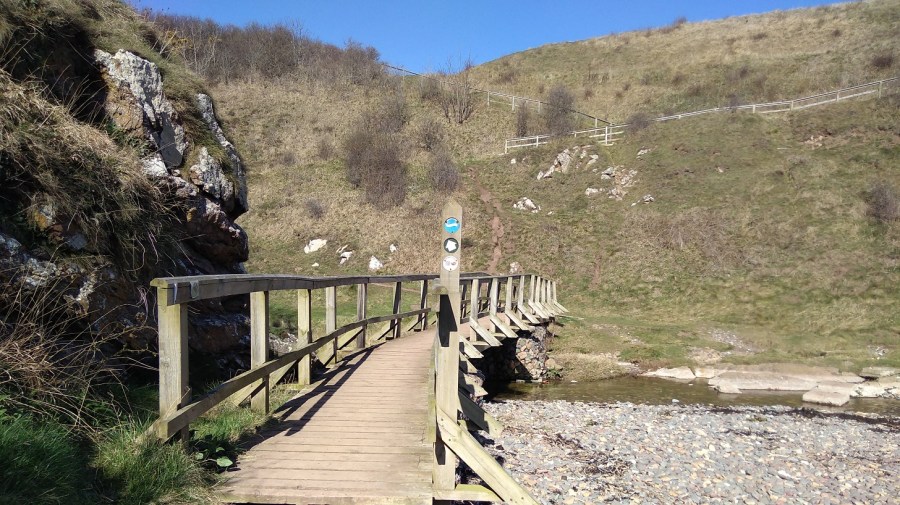
A series of wooden bridges boasting various signs including the BCP one (blue circle with white wave)
IMG_20190325_104831
A freestanding wall of rock on the right and a hard-packed, cracked and curving path to the left
IMG_20190325_105925
Across the first wooden bridge the path wound down a river valley to the huge foamy rollers –  water reflecting the blue sky in the distance

You could easily miss the tiny sign at the top of an orangy-red clay track to the right, but I had watched a hiker ahead of me turn down, so I knew to look out for it.

IMG_20190325_110218
A rusty metal drill bit is sticking out of the grass on the left and on the other side, picnicking, sit an Australian woman and her most protective black and white shortie

Just ahead is the sign that you are not advised to take to ‘Coldingham via Fleurs Farm’. There was a woman beachcombing at the next cove which was full of smelly seasweed.

IMG_20190325_111438
Sunshine flowers – gorse against azure and underneath them hidden blue birdseye (speedwell) to match the sky
IMG_20190325_111646
Purple ploughed fields with very loud birds on the left (the ones which make the sound of unoiled wheels) while the peep peeps of the oyster catchers reached my right ear on the breezes
IMG_20190325_111759
Coldingham Bay in the distance

There were violets by the path and the merest hint of primrose scent, taking me back to my childhood when we used to pick them at St Julian’s (Sevenoaks, Kent). Can I pick wildflowers in Britain? Technically yes if you don’t uproot them or take them from an area of Outstanding Natural Beauty, but think carefully first – they don’t last in a vase and do look ever so good in their native surroundings.

IMG_20190325_112509
Jagged rocks

The wildflowers were all yellow here (the photo was not good enough to use): celandine, dandelion, daffoldils and gorse.

Coldingham

IMG_20190325_112555
Coldingham Sands (11.30am) with its brightly coloured beach huts
IMG_20190325_113014
Memories of playing with the children when they were little and them not wanting to get out of the sea “not ever”!
IMG_20190325_113209
Coldingham Sands – a blue flag beach
IMG_20190325_113737
In Memory of Isabel Cowe , well known business woman and suffragist

Here I saw my first bluebells of 2019 as I climbed very steeply up behind the beach huts and past the bed and breakfast (now a private house) where I stayed for my birthday with Lesley a few years ago.

IMG_20190325_114136
Easy to miss the mossy sign to the Creel Path off the road – this time I had read the instructions in advance so I knew to go over the stile
IMG_20190325_114329
The thickets of the Creel Path

At the T junction, the signs point left to Coldingham which this time I did not visit and I therefore missed the Coldingham Priory which was a Benedictine Abbey. There has been Christian worship on the site for over a thousand years and the present Priory Church building includes walls dated to around 1200. The Priory was founded in 1098 by Edgar, King of Scots, son of Queen Margaret (later Saint M) and Malcolm III, after recovering his kingdom from Donald Bane, his uncle, who had usurped it at his father’s death. 

The first monastic community consisted of thirty Benedictine monks from Durham until 1590. The original Church, built in Edgar’s time, was destroyed by King John of England in 1216, but was replaced by a greater and more magnificent one, which in turn was largely destroyed in 1545 during the great raid of the Earl of Hertford, which brought ruin also to the abbeys of Kelso, Dryburgh and Melrose. The choir, however, though further damaged by the forces of Oliver Cromwell in 1650, survives and constitutes the present Priory Church.

I passed two other signs indicating that I could have taken earlier ways, but I was pleased to have walked along the famous Creel Path. It is so called because the fishermen used to carry their creels (lobster pots) along here to the beach in days gone by.

IMG_20190325_115415
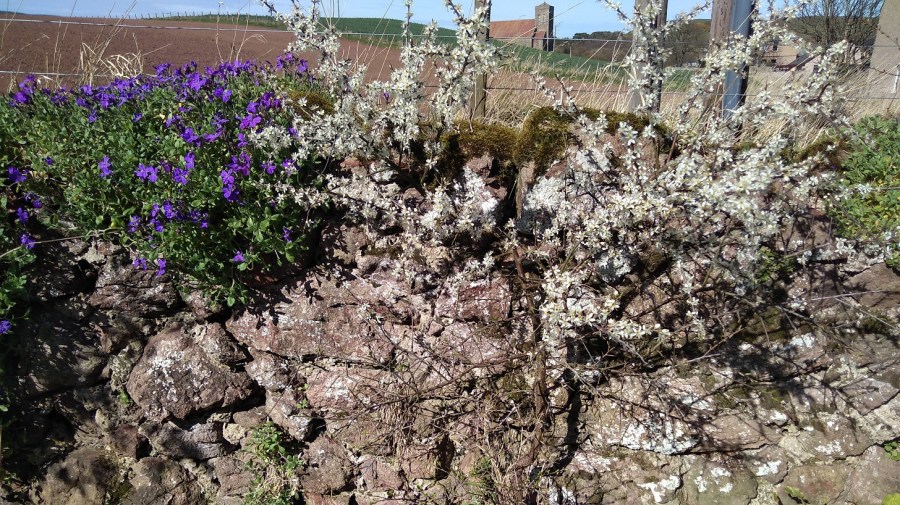
Aubretia and hawthorn as I entered the village of St Abbs (arrival at noon), at the end of the Creel Path

Earlier I spotted the old, brown seed heads of tansy and teasle, but here in the warmth that came off the earth were haphazard flies and in sheltered corners there were the new season’s flowers. What a welcome, bright sight they were attracting the first butterfly I had seen after the long winter. I was about to come across primula and pansies, even white garlic flowers on top of juicy wild garlic stalks. That confirms it, I thought to myself, no argument, Spring is here!

St Abbs

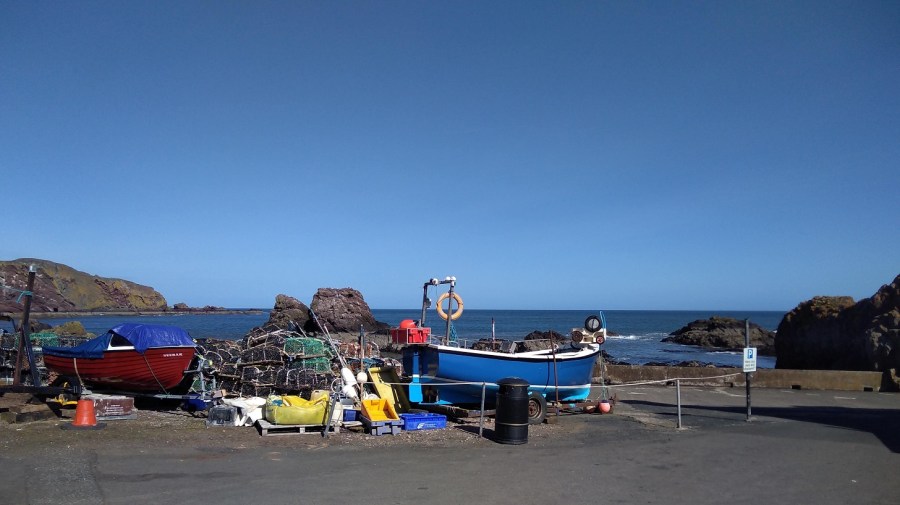
On entry down the hill, there was white washing fluttering in the breeze and a restaurant and visitor centre, both shut of course on account of the time of year.

Through the harbour and up the other side, to my delight however, was an old school building with an open cafe. I had a picnic with me, but can never seem to resist a hot cup of tea. The baking (avocado and courgette gluten free cake) was excellent and the staff were all kindness – initially organising a chair and table outside for me and then adding a cosy blanket for warmth. By the way, you can also buy a very pretty, homemade pink magic wand for £3.50 too!

After a break and refreshments in the sun (with wi-fi), I continued along the road and then entered the protected Nature Reserve to the St Abbs lighthouse at St Abbs Head. where I have walked many times before.

IMG_20190325_120035
Memorial

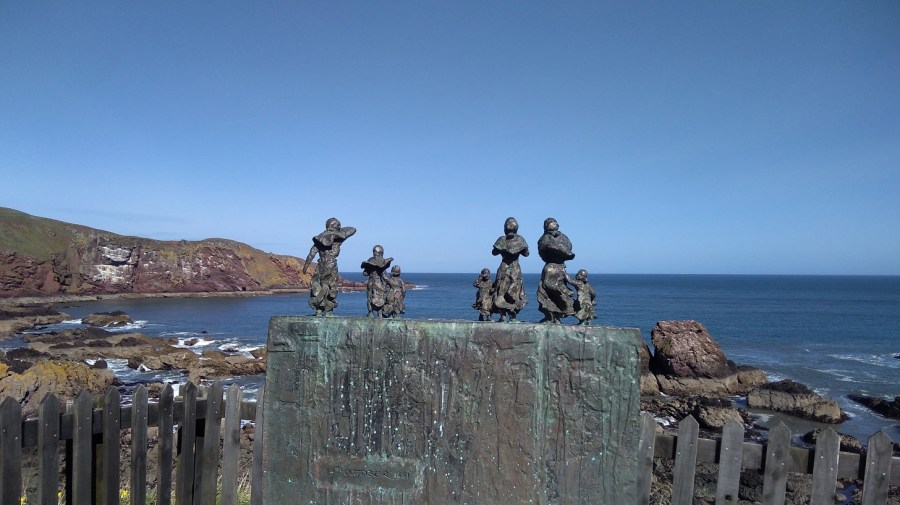
These small bronze figures are the wives and children of Charles Purves and brothers William and James Thorburn who were lost in the great storm of 1881 when 189 fishermen lost their lives. The harbour does not belong to the Council but to the local people via the Community Council and a Trust. There is an important Lifeboat Station here, privately funded and independent.

IMG_20190325_115810
St Abbs harbour

St Abbs with its super clear waters is a favourite place for scuba divers, including beginners. For details of the new bunkhouse, see below.

IMG_20190325_120731
The Ebba Centre and Old School Café – highly recommended

The cafe is named after Ebba (Ebbe), ‘Mother of Northumbria’, so the signs in the Ebba Centre told me. She was born c. 615 AD, daughter of Aethelfrith the first king of Northumbria and in 643 AD she founded a nunnery nearby which predates the priory mentioned above. Later she was made a saint.

IMG_20190325_125223
On leaving the village of St Abbs – typical Scottish sentiment
IMG_20190325_125524
The coastline north of St Abbs has high cliffs and belongs to the National Trust for Scotland.  It is a popular tourist area both for bird watchers, wildflower lovers, and hikers

I spent ages admiring the gliding birds with blanched tips to their tail feathers  – they seemed effortless. Many were perched on the rocks like tiny pearls in an invisible hairnet. Apart from the bumble bee, everything here was white: feathers and wool, gulls chests, and the foamy most-white of the waves between the rocks.

IMG_20190325_125908
Looking back towards the village of St Abbs, Scottish Borders

I was reading about Sarah Marquis, a very experienced walker who could smell water when she was hiking in Australia. I believe I could smell the grass happily growing in the sun after being dormant for so long.

IMG_20190325_130614
Verdant pastures in the lee of the hill where lambs were supping at troughs, maaa-ing to their mums who were down on their elbows supping the new grass

The path took me around and behind hillocks on the way, but I went up and over them on my return. Once I caught myself avoiding looking – the grandeur of the views, the colours – as if I didn’t know what to do with them they were so wonderful.

IMG_20190325_130850 (1)
The sun lit up the pink and gold rock formations

Going back I wasn’t the only one out on this beautiful afternoon – I discovered it is quite a busy stretch.

IMG_20190325_131057
Stacks and white waves
IMG_20190325_131253
The sun was already starting to lower throwing blotchy shadows

Gentle paths curve through the spring-green grass, undulating with the landscape – there is some good climbing to strengthen your thighs!

IMG_20190325_130141
Berwickshre Coastal Path – St Abbs to St Abbs Head part. Coming from the other direction, the stack  in the middle looked like a flat cactus

You can spot the Northern Brown Argus butterfly according to the sign, and it’s a bird watchers paradise (guillemots and razorbills, shags and cormorants amongs others). I watched a starling with its petrol green head, perched on a fencepost, feathers disrupted as the wind attempted to dislodge it.

St Abbs Lighthouse

IMG_20190325_132856
The lighthouse at St Abbs Head

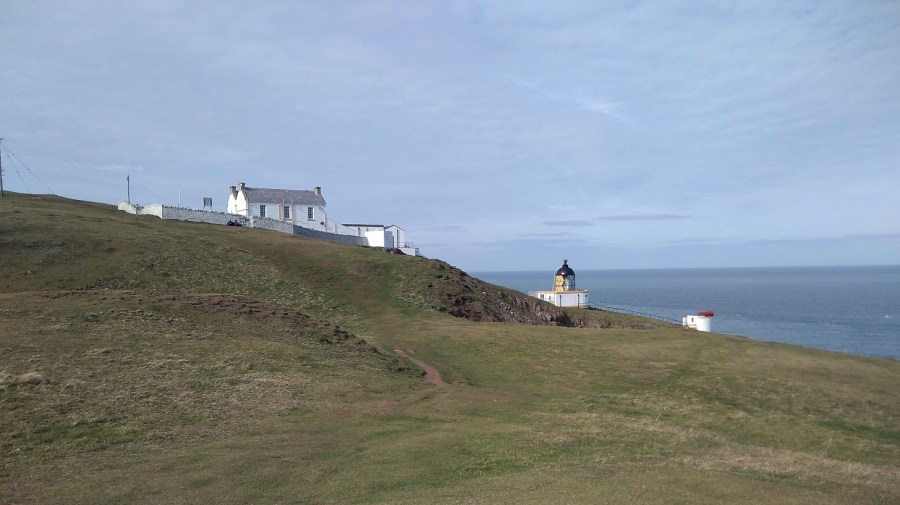
68 Metres above sea level, the lighthouse was built by David and Thomas Stevenson. It is automated now, remotely monitored, so there is no lighthouse keeper. It flashes white every 10 seconds to warn sailors of the rocks below.

My walking future was ahead of me: a tarmaced road between knolls, jagged rocks and chiselled cliffs; the power station with a polluting cloud coming out of its tallest chimney; Berwick Law (a little hill all on its own near North Berwick); Bass Rock (an island off that coast); and Edinburgh beyond.

IMG_20190325_142122
I went back the same way past this gate with a beatific, female face

Back in the village, I was sitting dozing in the sun when William came up to tell me his life story. At 88 years he has had two sticks and two wives, he told me in his Sussex accent. He was born 2 months after his parents were married, he explained, which was why they left the place of his birth, but later they were forgiven and returned. He was a member of the fire service in both Salisbury and Hereford (both places I have relatives, I said, but he wasn’t really listening!). He was drawn to speak to me with my rucksack beside me because he is a lifelong member of the Berwick Ramblers.

IMG_20190325_142103
I got a good view of St Abbs church which was beside the cafe where I had rested earlier and which I had also sighted on my initial approach from the Creel Path

After our conversation, the bus came into view and only then did I realise that I barely had any cash. The driver said coins only and waited while I dashed back to the cafe (visit #3 that day) where they gave me £2 (they couldn’t do cash-back) saying I could give it to them another time. What a fantastic gesture!

It was a short day’s walk (4 hours maximum) with quite a lot of climbing. I felt taller and prouder inside and only at the end did I feel a twinge in the instep of my left foot, otherwise no pain or difficulty at all. Less is more!

Practicalities

I advise you to walk in the other direction if you do not have a car and a friendly person to pick you up because there is nowhere to stay at Drylaw, only a car park, and it is too far (29 kms – remember that there are a lot of slopes and hills) to walk from Eyemouth all the way to Cockburnspath.

My timings: 2 hours on the bus from Edinburgh to Eyemouth; 1.5 hours walk to Coldingham Bay; half an hour on to St Abbs Village; 45 minutes to St Abbs Head lighthouse. You could probably do it quicker, but I savoured it all. The 235 bus from St Abbs to Berwick-upon-Tweed takes about half an hour (£3 odd), and the train from Berwick to Edinburgh about 45 minutes.

Remember to check the sunrise and -set, and co-ordinate with travel and walking times if you are also hiking in winter/early spring!

There is almost no accommodation along the path excepting at Berwick-upon-Tweed. If you know of any (other than the bunkhouse below) please do let me know and I will add it to the blog later. Of course if it was summer you could wild camp like Rucksack Rose.

IMG_20190325_134015
If you are planning to walk this way, I hope you enjoy it as much as I did

For more information about the Berwickshire Coastal Path, please see the excellent leaflet produced by Scottish Borders Council Newtown St Boswells, Melrose TD6 0SA 0300 100 1800 enquiries@scotborders.gov.uk www.scotborders.gov.uk

Bunkhouse email address: divestabbs@gmail.com (Paul Crowe, skipper of the boat MV> Topline who takes fishermen, tourists and divers out to see the area).

St Abbs Visitor Centre

St Abbs Marine Station (research into marine science, conservation and education).

National Trust for Scotland Seal pups at St Abbs Head

The benefits of walking on uneven ground

Berwickshire Coastal Path: Berwick upon Tweed to Eyemouth

12th January 2019

The second highest cliffs on the east coast of Britain are to be found along this path.

It may be that when we no longer know what to do
we have come to our real work,

and that when we no longer know which way to go
we have come to our real journey.

The mind that is not baffled is not employed.

The impeded stream is the one that sings.

by Wendell Berry

IMG_20190112_082111
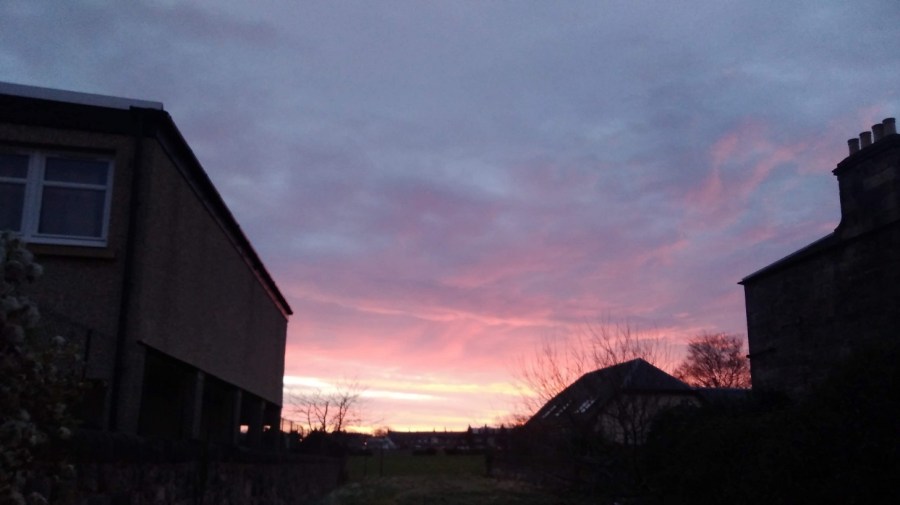
Sunrise as I waited for the bus in Edinburgh

In the middle of winter I headed south on a train to Berwick-upon-Tweed along the coast of East Lothian with the sea on my left. It was just after 9am and I could see brown fields, a slate grey sea, even darker land on the other side of the Firth of Forth and the silhouettes of the trees without their leaves. As it lightened there was more detail: cows in coats; four-by-fours speeding between fields; ruined castles; and low, red-roofed farm buildings. The train was quiet.

IMG_20190112_094201
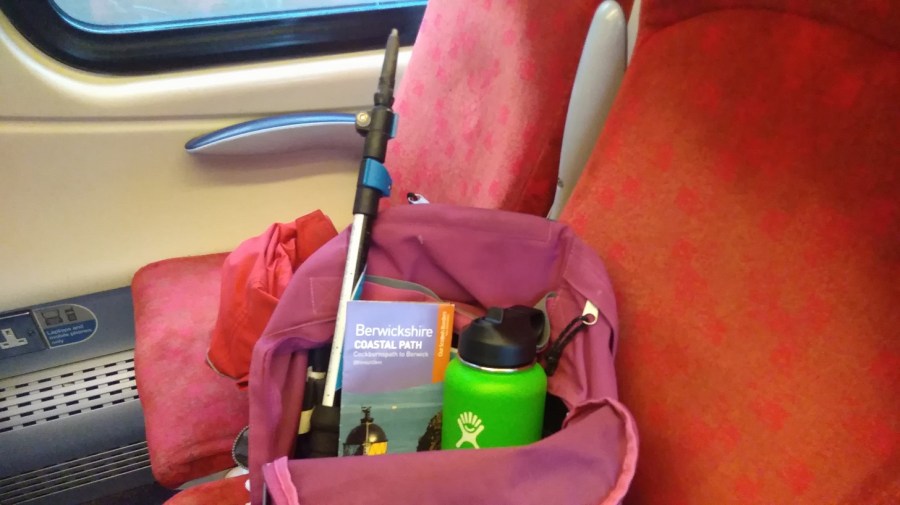
Just a light pack today, including my new flask which Isobel gave me for Xmas

I am hiking part of the Berwickshire Coastal Path (45.5 kms / 28.5 miles in total = a recommended 3 day walk). Berwick upon Tweed is technically in England (although their football team is Scottish!) and my destination is Eyemouth, 17km (11 miles) away.

The fields become green as I travel and on my left is the point of Berwick Law, the only high place in this flat landscape. Combine harvesters are frozen mid field; barrels of wrapped up straw lie waiting; there are borders of louring pines in the distance; and beyond, a complicated sky: wispy dark clouds against a bright blue though pale background and at the same time, little bands of cotton wool balls stretching from east to west.

Found photos of (from top left) Torness Nuclear Power Station, Dunbar Town House, St Abbs Head Lighthouse.
A few golden strips of corn have been left lying in the fields, birds are black shapes in the bright sky, the bare bones of the trees are like hardened and flattened seaweed fans. People were sniffing and blowing their noses all around me.

There were acres of half-built houses as I drew near to Dunbar, birthplace of John Muir, friend to all walkers and nature lovers. A small town with the arrow-head tower of the newly-painted-white, 16th century Town House; Saturday people with pushchairs; glimpsing the sea between buildings.
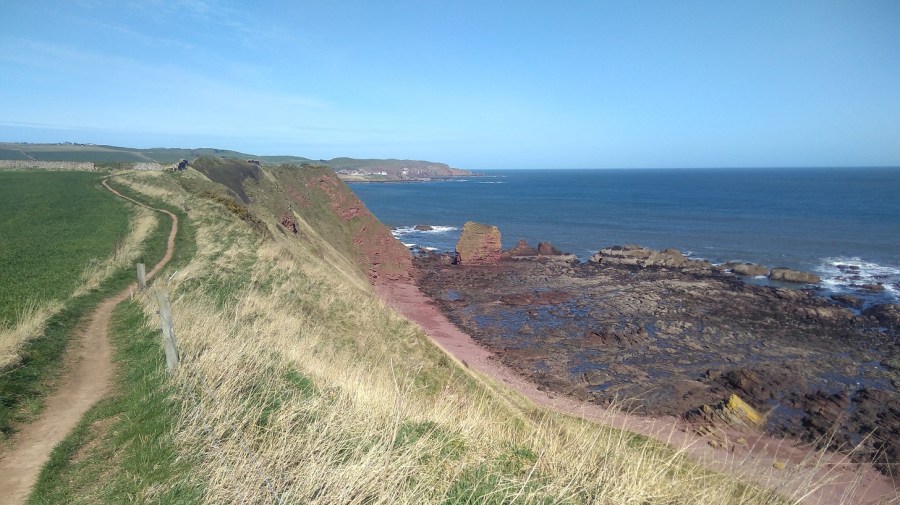
Then once more rolling by the deep chestnut loam, and a more varied landscape. We were edging further from the sea where the iconic Torness nuclear power station like children’s blocks which have been fitted together wrongly. Sheep grazed in miles of brussel sprouts fields; low, dry stone walls divided; and a solo bird perched, waiting for the morning to come. We skimmed past the St Abbs Lighthouse, where I was planning to walk to today (see below).
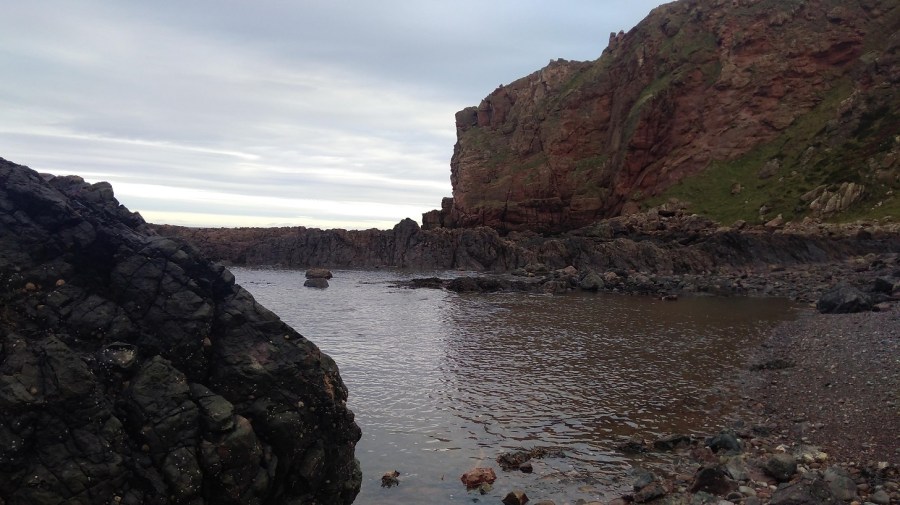
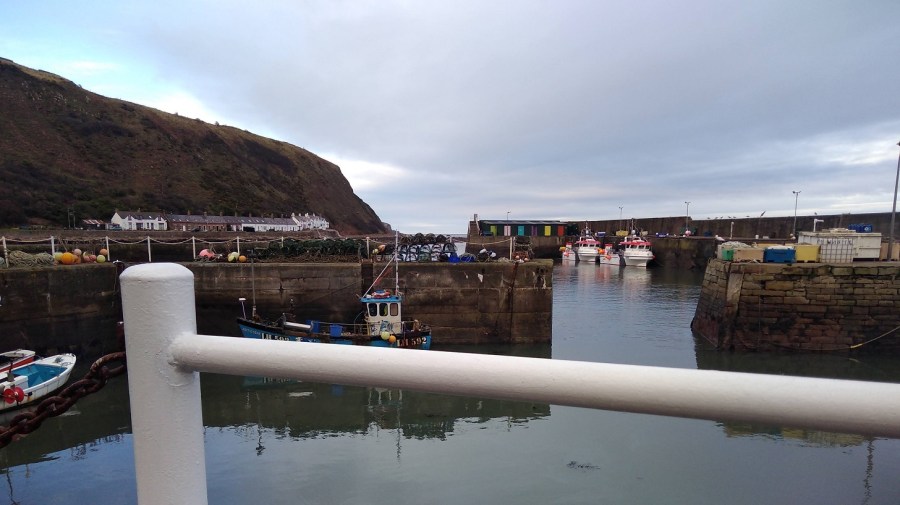
I could see the path I was going to be walking at the top of the cliffs as they tumbled down to the rocks and the white waves below. Men in red and blue were playing golf, their trolleys angled beside them, pools of sand dipped in the ocean of green turf.

IMG_20190112_095143
Arriving at Berwick-upon-Tweed station
IMG_20190112_100117
A detour almost, before I started, through Castlevale Park to the riverside walk, to take a photo of the brick bridge across the River Tweed

As always, it was difficult to find the beginning of the walk, so, here are the directions for you: come out of the station, go up the little slope, turn left and then take the first right.

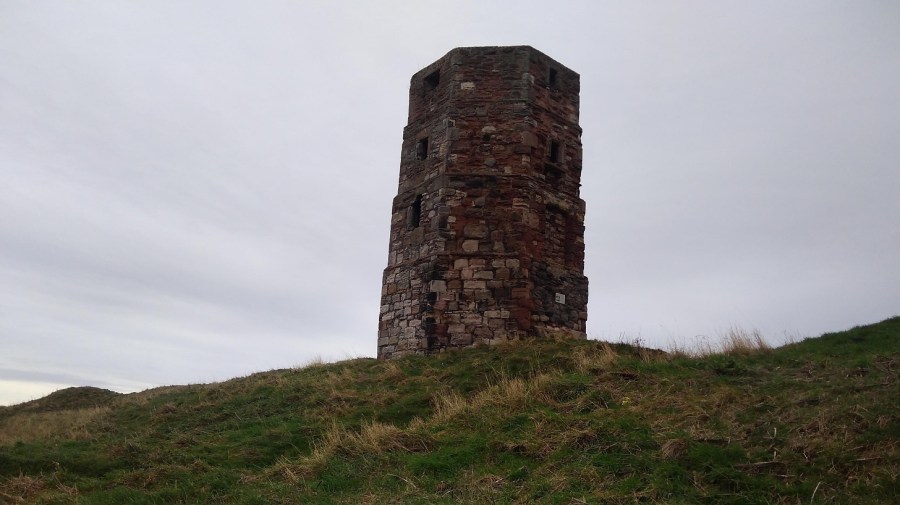
A man with 2 dogs stopped while I was taking a photograph of the Round Bell Tower , not knowing that I was waiting for him to come into shot so that I could include him! He told me that he used to work for the local newspaper and one April Fool’s Day he took a photo of it leaning, said it was toppling over, and published it with the caption, The Leaning Tower of Berwick. Crowds of people came to watch it, he said!

IMG_20190112_101423
The upright Round Bell Tower, Berwick-upon-Tweed

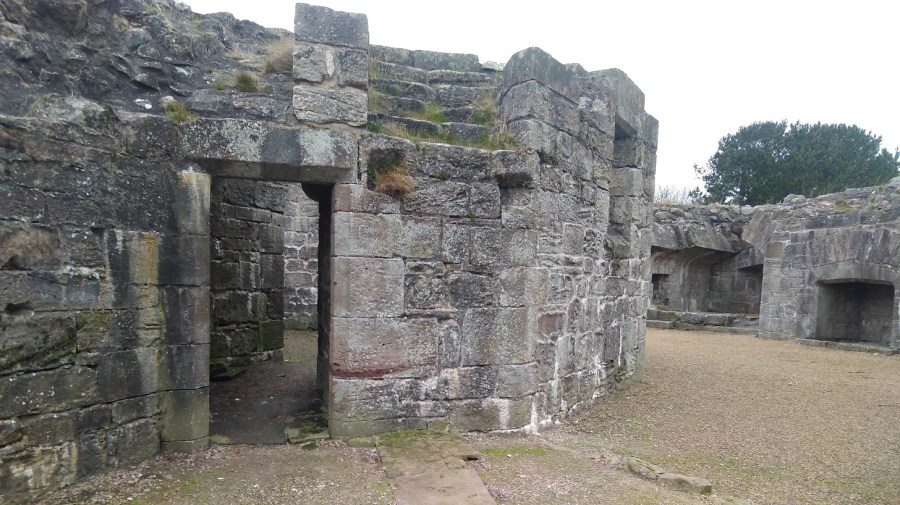
Next to the tower is Lord’s Mount, Henry VIII’s gun tower (completed in 1542). Its massive wall contains six gun positions and a latrine. The artillery included ‘the falconet’ which fired a solid ball 1000 yards (914 m).

IMG_20190112_101905
Lord’s Mount, Berwick-upon-Tweed

Before I even got to the sea I lost my pole, which I went back for and luckily found, and a glove which I didn’t.

The Northumberland people I met were lovely and friendly and gave me directions out of the town and onto the path.

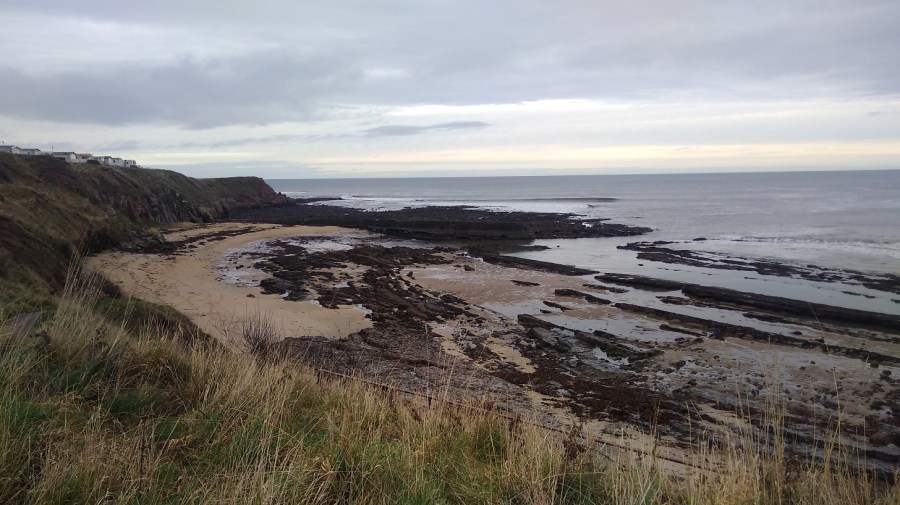
Oyster catchers were wading and ridges of diagonal rocks showed dark against the washed yellow sands. I went down the steps to a tiny cove, and along the well-trodden beach full of footprints and seaweed. There was the sound of trickling water as I made my way up at the other end.

IMG_20190112_103239
The first bay
IMG_20190112_103633
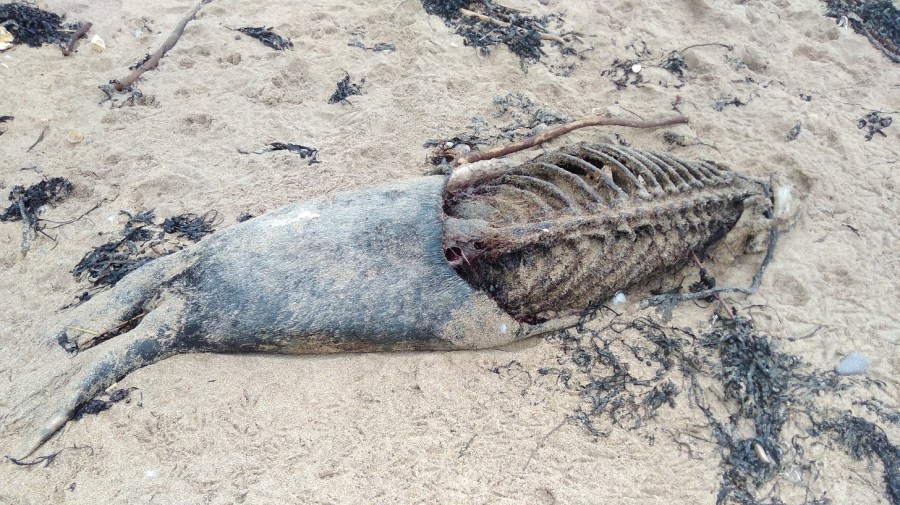
A dead seal was washed up on the shore. A disturbing, though not an unusual sight

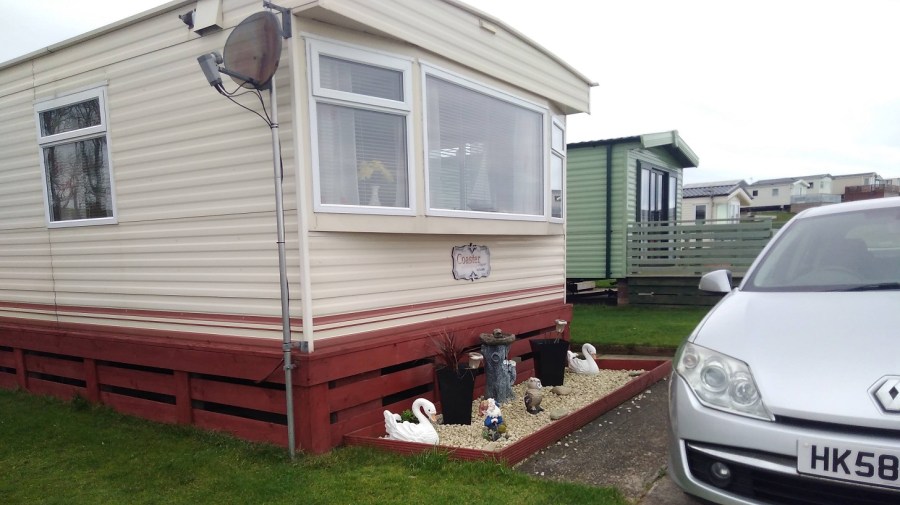
Up above were ranks of holiday caravans where shells had been hung between railings.  I could see a red and white lighthouse beacon at the end of the pier in the distance and hear the single, shrill whistle of a bird overhead – just as if he fancied me.

IMG_20190112_103755
Looking back to the bay, Berwickshire Coastal Path
IMG_20190112_104121
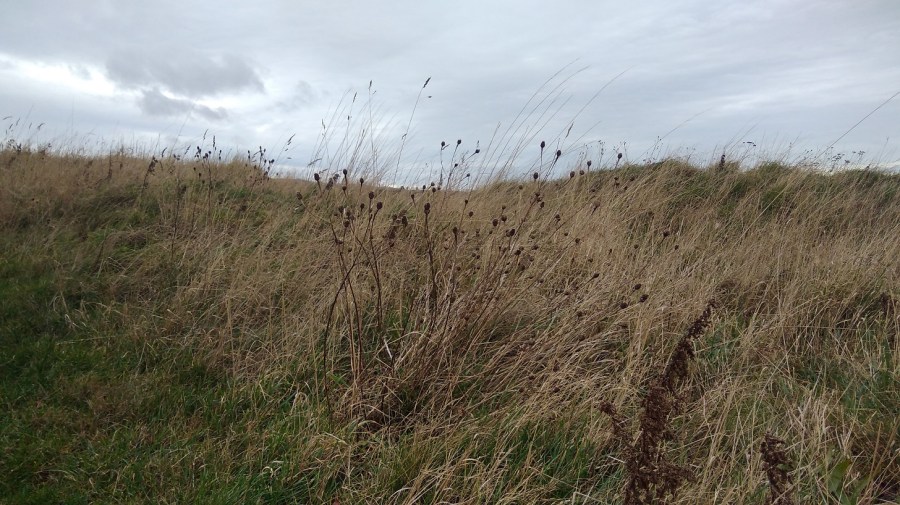
Winter seedheads and kind grass underfoot, the sounds of waves crashing and my Camino shell clinking at the back of me

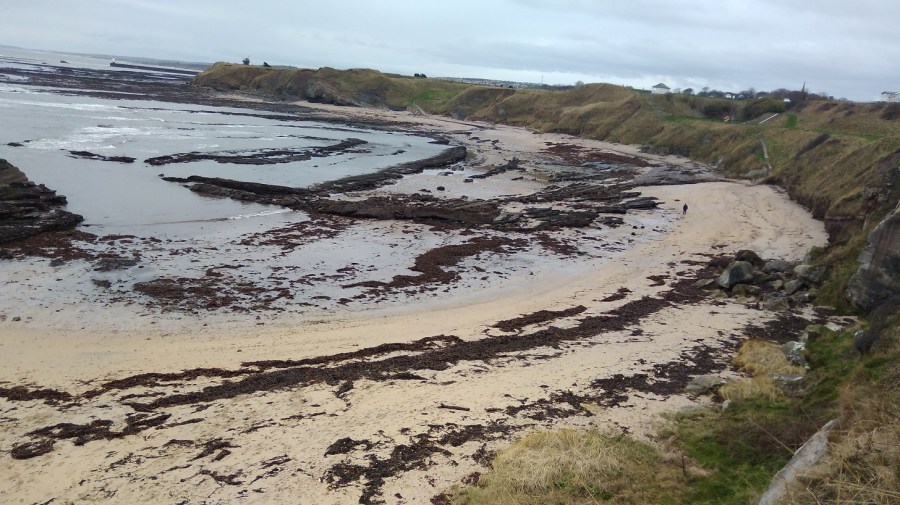
Immediately I came round to the next bay. It was larger this time with delightfully pig-pink cliffs and tufty tops. The wind was trying to blow the pale, beige stalks seaward. Once again it was just me and another man with his dog. Vestiges of yellow flowered gorse gleamed on the bank opposite.

IMG_20190112_104729
Clattering seed heads above and the odd flower low down sheltering from the winds; a nettle, some brambles and litters of rubbish

The squawk of the train reminded me that the railway line matches the path to the left, and I was walking between that and the sea.

IMG_20190112_112743
Wind turbines lazily turned despite the knots, and there were rusty metal steps down to the beach
IMG_20190112_105741
The path curved round a mixture of natural rock and man-made straight lines with a very enticing cavern underneath

The links (golf course) was on my left; slippy mud down to a little wooden bridge over a trickle of water; the sweet tweet of a leaf shaped bird overhead, its wings fluttering fast. It was a very narrow, windy and uneven part so I was glad that I had found my pole to steady myself – it is definitely not accessible to wheelchairs or baby buggies.

IMG_20190112_103010
Marshall Meadows, a lovely name – the first signposted stop, 2.5 miles

The path follows the highly eroded coast line in and out; my nose was running, tickling; and my mind returned to other similar trails: Normandy,  Brittany, and Orkney.

It is an impressive landscape: thin horizontal layers of pink rock, tiny slices but massive boulders. My eyes were getting a welcome break from the computer as I gazed out to sea and admired the hues and cries of this stimulating view and the birds who live here.

IMG_20190112_110237
The camera is not doing the colour of the rocks justice. They are almost carnation pink, practically unnatural except that they are all real

The sky was opening up; I could identify the peeps of oyster catchers and see sparks of black ravens; I was scanning the sea for any sign of whales. My forehead was cold as I walked straight into the northerly wind. How I appreciated not heaving the heavy rucksack for once.

IMG_20190112_110835
The upstanding and nearly empty sorrel had turned the same deep chestnut brown of the fields

I only stopped for a couple of minutes for a comfort break and to put some chapstick on my lips, but I was already cold afterwards. There were single, brown birds with long curving beaks (curlews, probably), and others in huge crowds sweeping around in the sky above me, sticking together in formation, communicating wordlessly. I was entranced by these murmurations.

IMG_20190112_112022
White horses and rolling waves

For a moment I wondered why I do this, especially in winter when it is so chilly. Then I looked out to the horizon and saw the world – so much bigger than me, and down at the rocks and the majestic sea stack – the land simply missing between it and the cliff; and it was good to be reminded how small I am.

IMG_20190112_112524
A sea stack – close-up

I saw the people in their cars rushing between Edinburgh and Newcastle on the A1, and the high speed train making its way down south to London. Here I was being blown and buffeted by the wind, breathing the fresh air, listening to the natural sounds around, the brushing of my feet as they passed through the grasses, stumbling and toppling over uneven ground which is good for balancing my brain, and looking ahead. Things were coming into perspective.

IMG_20190112_113044
A natural, geological arch

Up a short wooden ladder, over a stone wall and I discovered I was in a caravan park called Marshall Meadows. Much to my disappointment it was not the pastures I had imagined!

IMG_20190112_115401
It afforded me a few minutes of shelter away from the sea’s edge and the wind though

Back onto concrete I immediately felt my sore feet and realised I hadn’t been aware of them since the pavements in Berwick.

IMG_20190112_120426
Aah a sign! As I pass through the site, I wonder if the people who hire these caravans realise that their windows will look out onto the railway

By this time I was looking for a place to shelter and sit for a cup of tea and a banana to keep my sugar levels up. I didn’t want to lose my sense of proportion, which has happened in the past.

IMG_20190112_120829
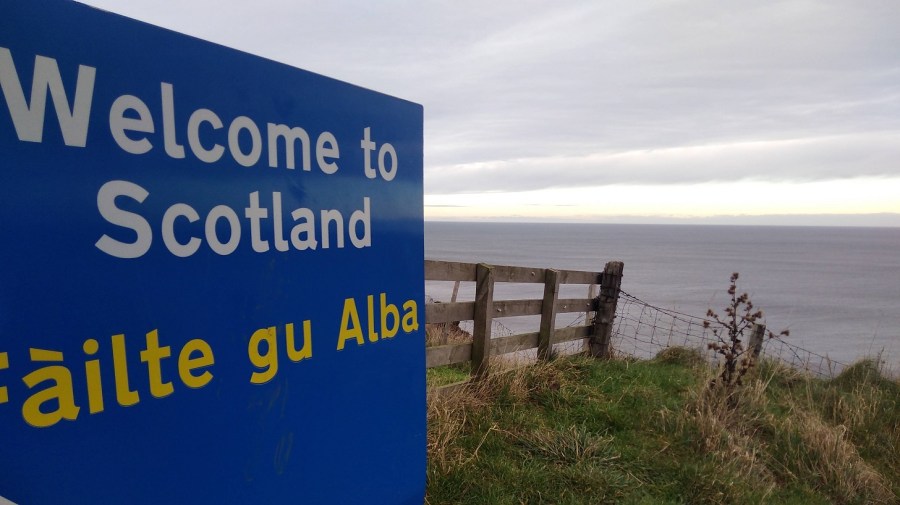
Crossing the border into Scotland (the sign is written in English and Gaelic)

The Cuddy Trail is here. Cuddy is Scots for a donkey and the ‘beasts of burden’ were used to transport coal and fish from the shore to Lamberton and the Great North Road.

IMG_20190112_121359
I hastily put my hood back up over my woolly hat and found myself walking between two rows of barbed wire fence by signs saying to clear up your dog poo (it can be poisonous to farm animals)
IMG_20190112_121631
They were scared of me, yet interested. I think they were female sheep because they were multi-tasking: walking, eating and going to the toilet all at the same time!

I had to climb over the gate as the farmer, in his wisdom, had padlocked it shut despite this being a public right of way and well-known footpath.

Then I curved back towards the wild cliff corner and the sound of the crashing water. The wind was causing shadows on the ocean. It had that look about it as if it was rising up to the horizon and down to the beach. It was heaving. The surface colour looked flat and even, until I really paid attention to it. Then I saw the variations of the olive, seaweed and sage green, with slate, business suit, and pewter grays, all edged with white lace and set against a peach sky.

There were lots of helpful signs indicating that badgers, yellow meadow ants and peregrine falcons can be seen here, but not by me. I did get glimpses of the fulmars on the ‘cliffes’, nesting in their flint and white plumage, so far away that all the photos were too blurred to be reproduced.

IMG_20190112_124423
I was interested in a ruined bothy on the steep slopes which only the sheep could negotiate, and went to the edge to take a photo. That might have been where I mistook my way

Twenty minutes earlier I had passed two men getting out of a car and preparing to surf, clad in black wetsuits with their white boards. I bet they had a good time in those rollers!

It was then that things started to go wrong.

IMG_20190112_124909
A bowl of dark boulders – I shouldn’t have gone down there!

But I did. I thought, ‘really?’ but I couldn’t see anywhere else to walk as the railway came so close to the edge, so I went anyway.

I skirted the steep slope first of all, grabbing handfuls of grass to stop myself slipping and edging my feet into the side, until it became too hard going. Then I dropped down onto the rocks. They didn’t look too bad from a distance, but they were – it was really hard scrambling over them. I could see a way out on the other side and I still assumed that was the right way. I pushed and tore through the brambly undergrowth, I fell down and got myself back up. I persevered. My pole kept collapsing itself and up at the top was a sheep’s face peering over at me. I could see hoof marks where they obviously managed fine, but I sure was struggling. Was there a way? What could I do?

IMG_20190112_130345

Go back, that’s what! It was impossible. I was very hot and bothered and there was nothing for it but to retrace my steps, which was easier said than done and something I don’t enjoy. I traversed the rocks closer to the sea which were slippery as well as treacherously uneven.

I had completely lost my cool until I came across such a beautiful sight that I just had to stop and breathe.

IMG_20190112_131952
A calm pool between the jet volcanic rocks and the pink cliff profile

It took a lot of time (perhaps three quarters of an hour) and I used up a great deal of my available energy. And it took quite a bit of serious tramping to get over the anger and frustration of the experience. On the back of the BCP map it says: It may seem unnecessary to provide directions other than saying – walk north or south keeping the sea on your right or left!’ Am I the only person to have missed the most straightforward path?

Slowly I realised I had to relax and get back onto the right path. I had to let it go or I couldn’t enjoy the remainder of the walk, so I focused on anything but my feelings and picked up pace.

In my recording I said that I chose not to walk where two others were, around a field when I could clearly see a short-cut straight across the top of it. I saw the trampled down barbed wire and said to myself, I’m not falling into that trap again!

Next was a straight and concrete side road to Homestead, and I spotted a brightly coloured lifeboat chugging along. When I turned round, there was a deer lolloping in the undergrowth very close by with its beacon of a white tail. It seemed to be rather a special sight. The Medicine Cards say that when deer appears, ‘apply gentleness to your situation.

At 1.50pm, my phone battery was already down to 32% and I quickly came across another conundrum. I took a second wrong turn. This time I crossed a field to the left because it looked as if the alternative went over the edge. It was not clear, so I stood and debated and as the gate was open I chose to go through.

Right to the end of that green field I went, past all the sheep who may well have been watching wisely for all I knew! And then I didn’t know where to go but back – it was a dead end. Never again will I walk without an ordnance survey map, I declare to the sheep!

So I went through the other field (not in a straight line), climbed over a stile, and doubled back (presumably the path avoids the farm land).

IMG_20190112_142425
Burnmouth – not a sign of life, not a soul

There was the village of Burnmouth below me at last, tucked under the heights. I zigzagged steeply down in the opposite direction from the yellow arrows, behind the gardens and at last found a BCP sign. Amazing how this often happens at a time when there is absolutely no other possible way anyway! For some reason the walk is not as enjoyable if I am not going in the right direction.

Apparently Burnmouth was ‘once a hotbed of smuggling’ (tea, brandy, silks etc) engendering lively stories from 1780. A pretty but secluded village, it is divided into two halves with a harbour inbetween. Candy coloured cottages seemed to be for visitors. The tide was out leaving streaks of low rocks, as if someone had painted on a glassy surface and the paint had separated unevenly.

Burnmouth
Burnmouth from the tops of the cliffs

A man stopped to do up the zip of the woman he was with and my black mood meant I could barely manage to say a friendly hello. My knees hurt going down and my insteps going up. The sign pointed in the direction of two roads, one to the right and the other uphill. I took the path which ran to the right of a dour chapel, curving through woods, over a planked boardwalk, then up a steep hillside with a horrible groaning noise going on – something to do with the fishing in the harbour.

There was a handy bench ‘Dedicated to William Telford, born Burnmouth 1925’ for resting my weary feet and admiring the vista but I was very stiff when I got up. I hadn’t been walking for a month of so and it was showing. I thought I wouldn’t need the chocolate I bought yesterday and wished I hadn’t left it at home.

Blue tits played in the briars, zipping in front of me; silvery green lichen covered the branches. Humbled and cut down, I did not recover quickly. I was reduced to little more than zero miles an hour.

Once up high again and back into the windy onslaught, I needed a hat and two hoods – it was a mere two weeks after the winter solstice.

Then, halleluja! the sun started to show its lovely self. 3.15pm. What a wonderful light.

IMG_20190112_150233
The colours deepened, became lucid and my mood eventually mellowed
IMG_20190112_150408
Faint and fragile fingers against a mackerel sky
IMG_20190112_151405
See how the coastline meanders!
IMG_20190112_151459
The sky and sea got bluer and bluer. There were two options and I went over the wall, hoping it was the right decision. I found myself out of the sun’s warmth
IMG_20190112_151640
Self-portrait
IMG_20190114_051409
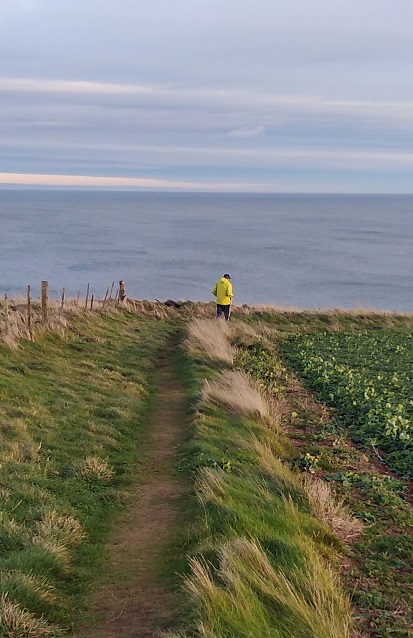
A yellow clad fellow walks southwards – that’s the right idea – wind at the back of him!
IMG_20190112_151704
I simply loved the contrast between the orange lichen on the wall and the blue and green beyond
IMG_20190112_154155
Rock macaroons
IMG_20190112_154759
The sun was starting to set. I felt chastened, very quiet inside
IMG_20190112_155304
I only got as far as Eyemouth, having lost valuable daylight time going the wrong way and needing to get the bus back

I had to ask for directions from a group of teenagers heading out for some fun, giggling. I wound my way along the jetty and around the end remembering that I was here for my birthday with Lesley in 2016. The wandering geese took no notice. I was aiming for the co-op store at the centre (ye cannae miss the co-op, it’s the biggest building in the toun I was told) and the most helpful girl who checked the bus times on her phone for me – my fingers were too cold to work mine and it was threatening to run out of battery.

I was focused now on getting warm and fed as I always am after a long day’s hike. I had to spend a great deal of time in a Wetherspoons in Berwick until my return train to Edinburgh, but I warmed up and rested my weary limbs.

I didn’t make it to St Abbs so I will have to start next time at Eyemouth and cover that stretch on day 2.

IMG_20190112_152131
All’s well that ends well! (one of Shakespeare’s ‘problem plays’ from around 1600)

Train: Edinburgh to Berwick upon Tweed (Scotrail £14.60)

Fife Coastal Path: Wormit to Newburgh

The final stage of the Fife Coastal Path (FCP)

Date: 3rd February 2019

From / to: Wormit to Newburgh

Distance: 15-18 miles (25-30 kms)

Direction: Walking east to west

Facilities: There are none on this stretch

Timing: Beware! the official coastal path website says this day’s walking takes 3-5 hours. I defy a human to do it in 3 hours – I think it is a mistake. I am not the quickest walker, but it took me 7 hours with 3 x 15 minute stops and a last minute detour

Overall: I would not recommend that people do this all in one day, especially immediately after the previous stage of the FCP, and with the transport difficulties and wintry conditions

Dundee to Woodhaven via St Andrews

My day began in Dundee where I had unwittingly spent the night. See Leuchars to Wormit for details. I took the earliest 99B bus to St Andrews (8.19) which was straightforward.

IMG_20190203_083350
Crossing the Tay back to Fife as the sun rose

Unfortunately when I arrived at the St A bus station the bus company no longer operated out of it. I phoned up to find out where I could get the 77 back to the Wormit road, connecting to the ’emergencies’ line and feeling a little guilty as it was not exactly a life and death situation.  I was concerned that I would not get to Newburgh before dark. The exceptionally kind man on the phone explained that there never has been a Sunday service of the sort I was waiting for! In the end, on hearing the note of desperation in my voice, he came up with a plan and 5 minutes later a second gentleman appeared in a van to pick me up. He had been called out of his bed to fill in for someone who was sick, left his own car at the depot and was on his way back to get it. He took me along with him!

IMG_20190203_094248
Woodhaven Pier, between Newport and Wormit, River Tay, Scotland

It was half an hour’s walk from Woodhaven to Wormit, first along the B946 (a residential connecting road where the pavement was all slippery from the snow which had hardened into ice overnight)……

IMG_20190203_095651
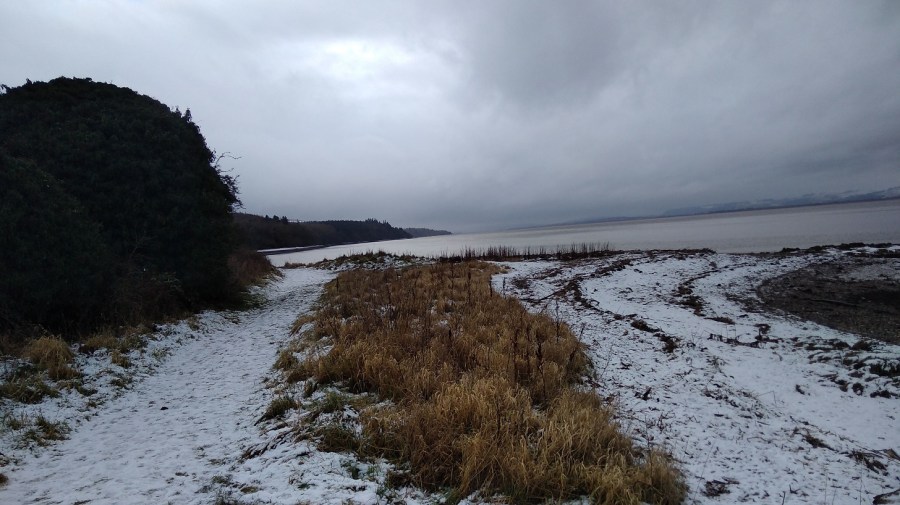
The air was very clear as I looked across someone’s wintry garden to Dundee, Scotland

….then taking a right onto Bay Road…..

IMG_20190203_095848
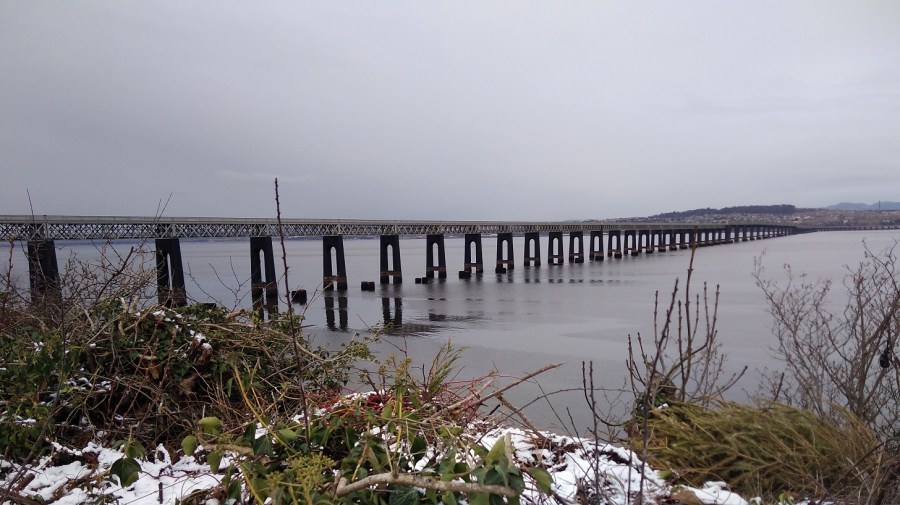
Tay Rail Bridge

….bypassing Wormit proper and heading straight to the beach where the FCP runs across the strand for a bit.

IMG_20190203_100803
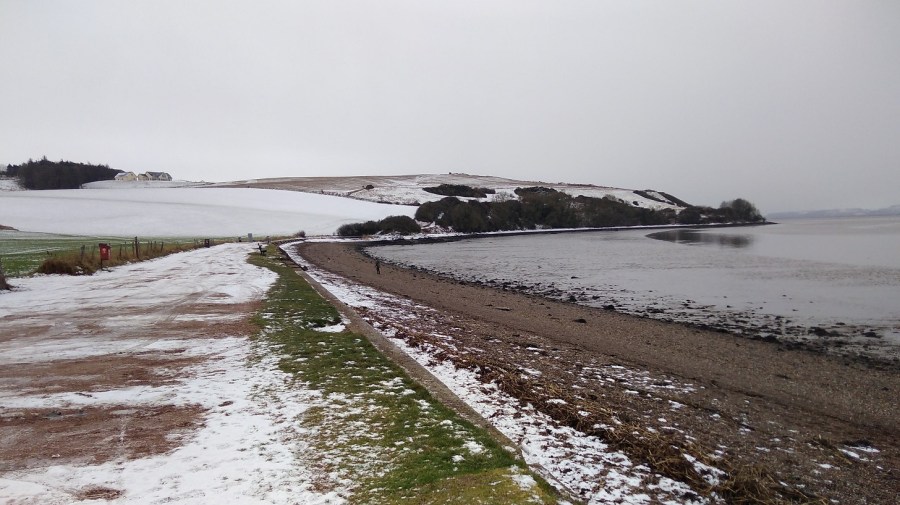
I could see where I would be walking, Wormit Bay, Fife, Scotland

Wormit to Creich

It took half an hour to get to the start of this stage, so yesterday would have been exactly 7 hours if I had finished and today I must add an extra 30 minutes to the walk if I am to reach the final ending point in Newburgh.

It was raining / snowing – a dull, grey day.

IMG_20190203_101147
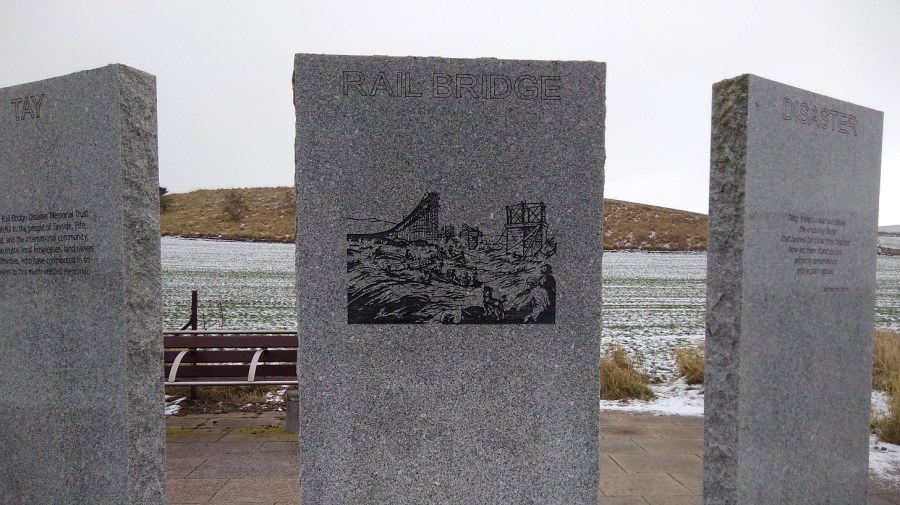
Tay Rail Bridge Memorial at Wormit Bay

The local lady was right that I was due for a climb, despite the way it appeared on the map. She said she had avoided it because it was so slidey underfoot. I passed through the metal gates to keep the cattle in, and further on I appreciated the landlocked wooden seal sculpture.

IMG_20190203_101705
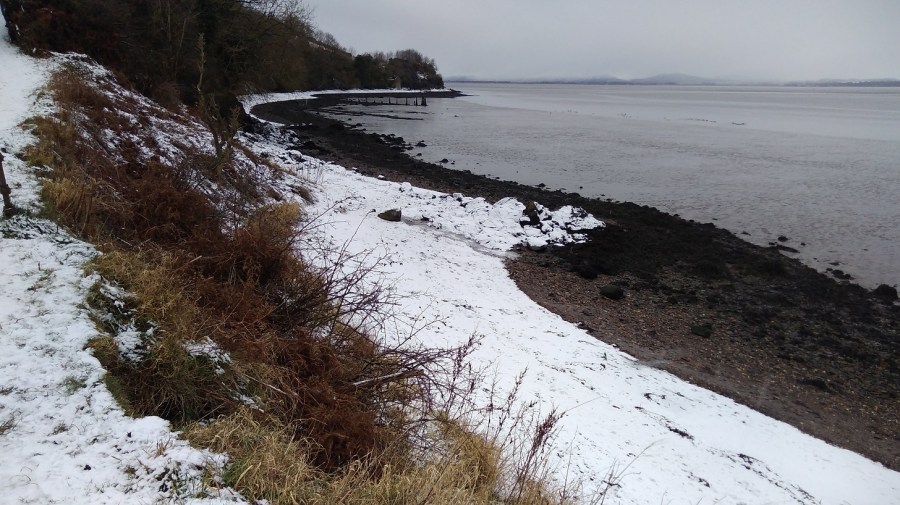
Looking down onto the waterside
IMG_20190203_103742
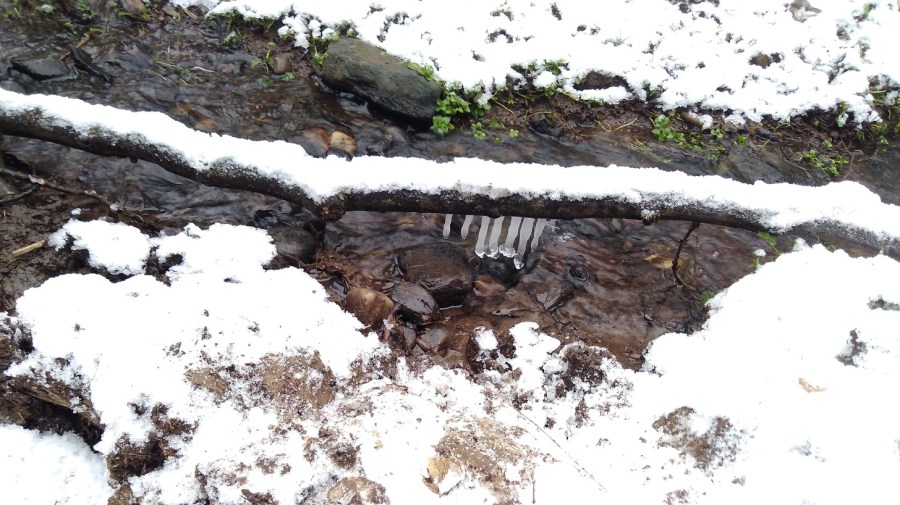
Icicles in the dells
IMG_20190203_103906
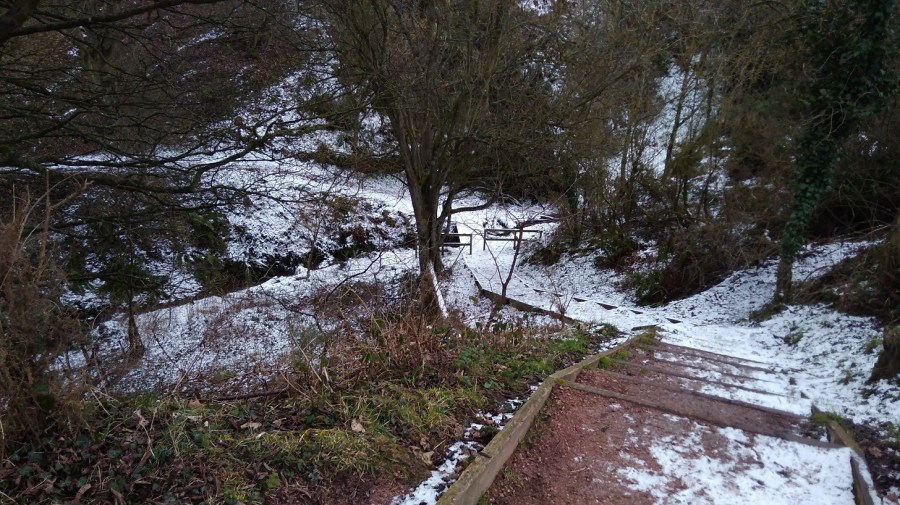
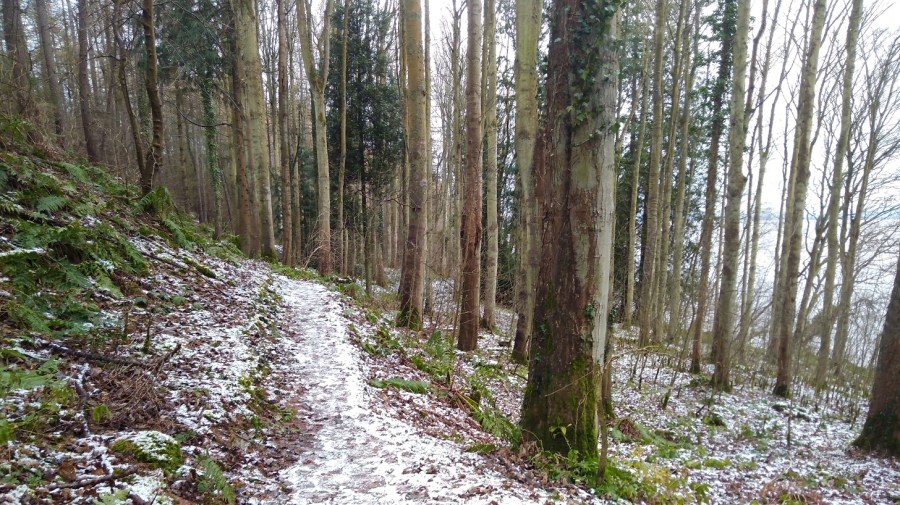
The path wound through woods away from the coast, up and down steps and across wee burns
IMG_20190203_104102
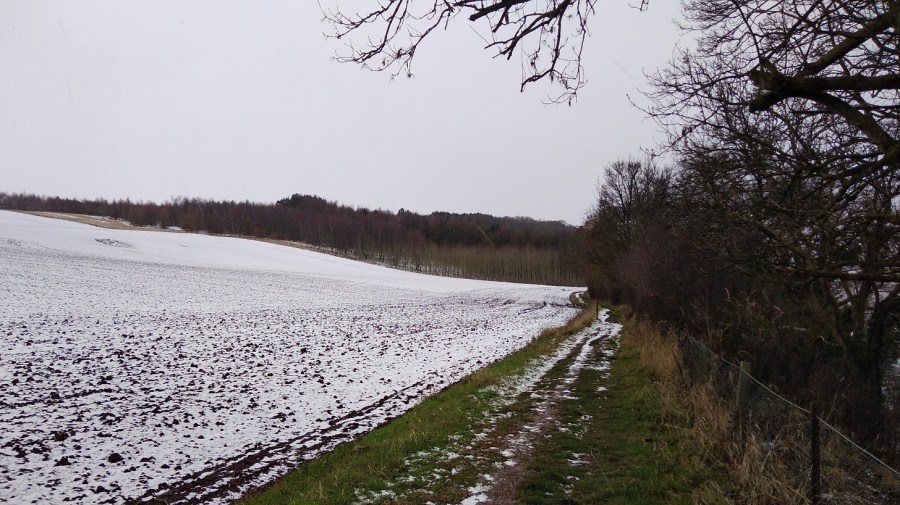
Then it opened out – the arable fields were slopes of white and the copses made of bare twigs

Catkins dangled olive green, and other peoples’ footsteps showed me the way.

IMG_20190203_105339
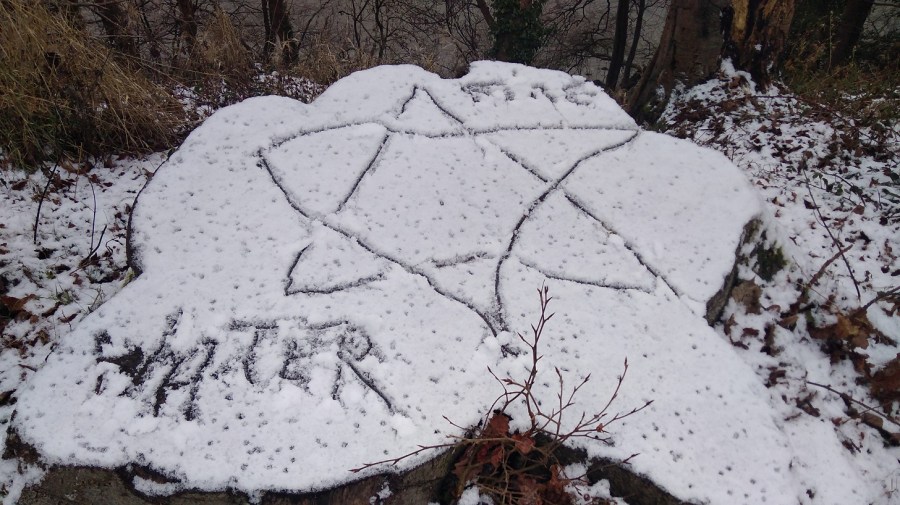
Drawn to making more of my marks in the snow – the dynamic relationship between the elements of fire and water, sun and ice, passion and reflection
IMG_20190203_110614
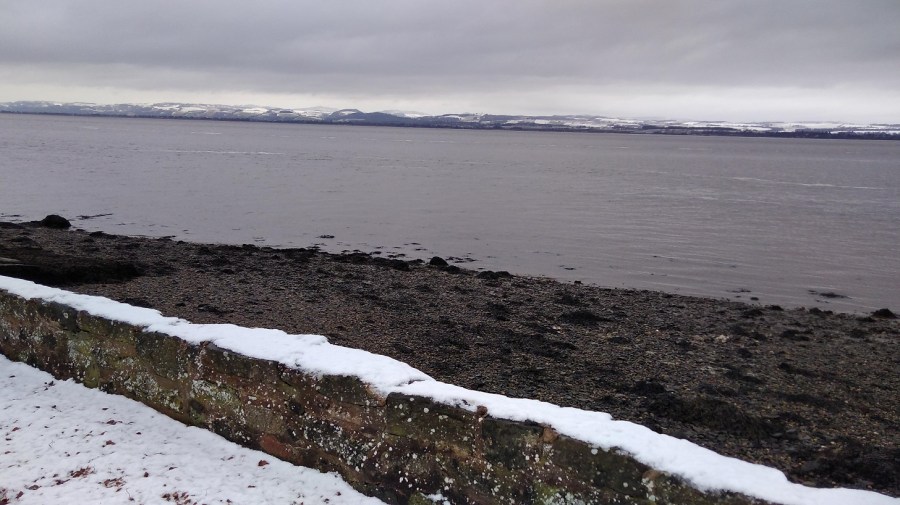
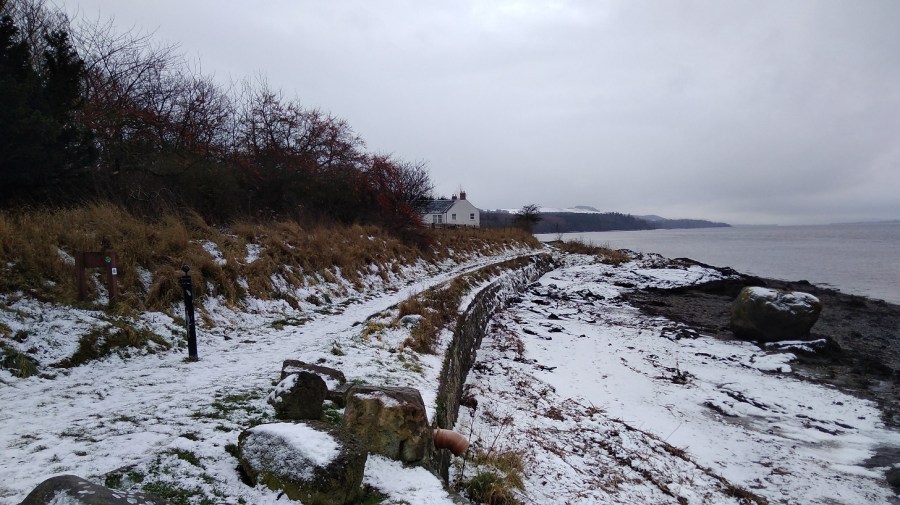
Stripes of muted greys: snow, stone wall, shingle, the estuary and the white covered hills of Tayside in the distance
IMG_20190203_110727
There were occassional dwellings along the way. I saw no-one

There was a quiet, gentle lapping of waves on the shore as I went between two houses.

IMG_20190203_110759
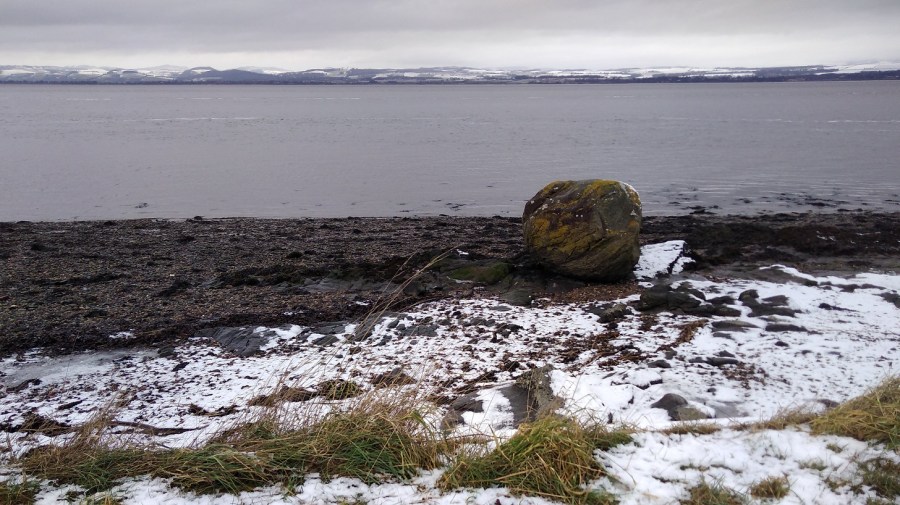
A massive boulder covered in gorse-yellow lichen on the half-white beach. The rest was grey. A flock of oyster catchers whizzed past, low to the water, followed by a loner, white stripes flashing to match the snow

oyster catcher  A flying oyster catcher, Wikipedia.
Near here were plaques with children’s poems about the sea on them: I liked, ‘River lying patient and flat’

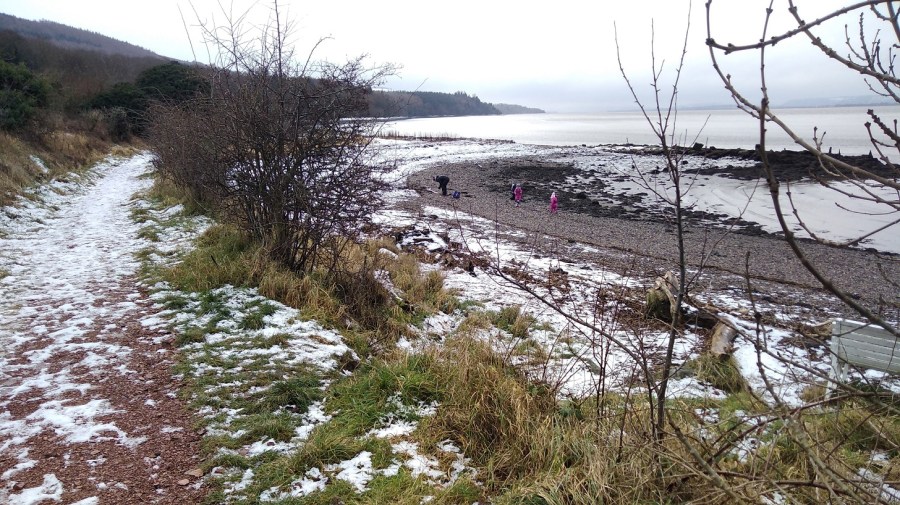
There is a stretch of stony beach at Balmerino – unusual for the FCP. I checked with three extremely well armed fishermen and yes, for sure it was along here and then through the woods. It was a great curving bay of bleak beauty.

IMG_20190203_111738
Two little girls in their pink all-in-one ski suits pottered with their parents

I missed Balmerino Abbey which was marked on the map – it must have been inland, off the path.

At 11.30 I was having a lovely, peaceful, early lunch with my back against a gorgeous trunk with ivy vines twining up it, when the sounds of a boisterous group signalled they were clearly approaching from whence I had come. Surely they would have caught me with my knickers down had I followed the call of nature, so I didn’t do that! I hastily moved on and almost immediately passed another group going in the opposite direction. This pretty stretch is obviously popular for Sunday morning walking.

IMG_20190203_111812
The Fife Coastal Path between Wormit and Newburgh, February 2019

My thighs were tight and stiff this morning after yesterday, and I could feel the effects of carrying the heavy pack such a long way.

IMG_20190203_115513

Leaving the water behind, I started on the long, steep and icy uphill part. I realised that perhaps the official website meant 3 plus 5 hours not 3 to 5 hours, and I worried that I would not make it before dark. I was not sure what to do, so I picked up pace.

Up high and with a right turn I was on hard ground which was much quicker to walk on, near a residential area. I was trying to remember to keep my eyes open for the signs which are always harder to see in this type of situation.

IMG_20190203_125009
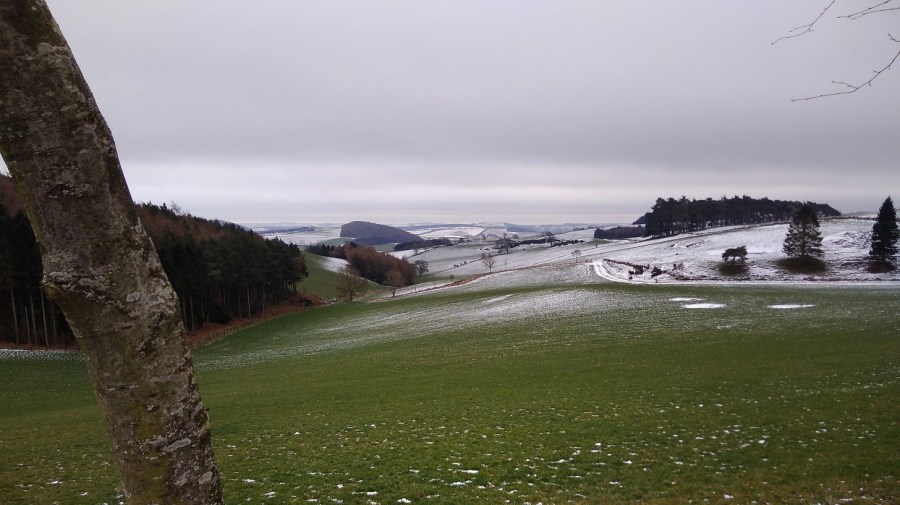
The hard climb rewarded this view – there are not many wide open vistas like this on the FCP

They made me think about hiking the Via Sacra in Austria and of some places I have walked in Switzerland.

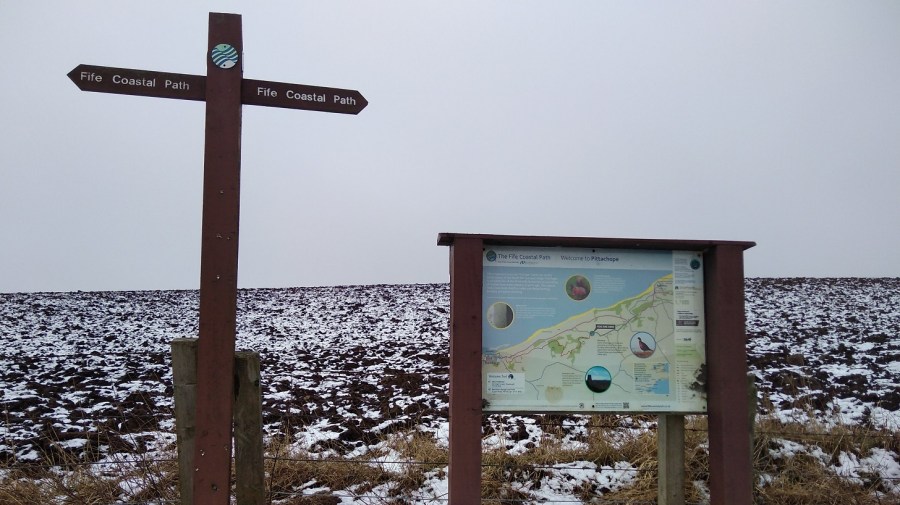
I passed places with names like Hazelton Walls, Creich and Pittachope (perhaps meaning ‘farm of the willow-place’). Black Craig Hill (203 m) was on the right.

IMG_20190203_125649
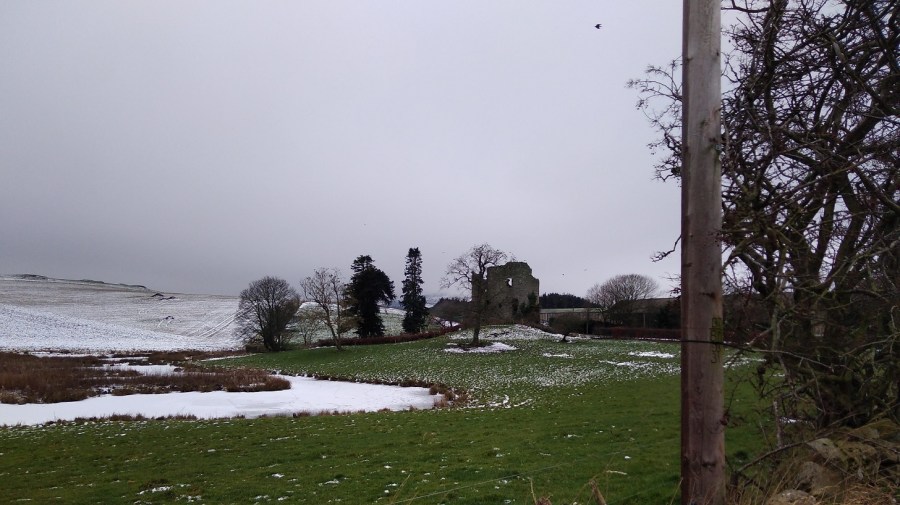
Ruined castle at Creich, Fife

Pittachope to Glenduckie

At 1.30 I was hauling myself gradually up a rural road with the cold wind on my cheeks. There was good visibility but with damp and wet in the air. It was a bit of a plod but I was focusing more on the moment than the future.

IMG_20190203_132506

Then I took the left off the road to a steeper incline, passing a bearded man who cheerfully greeted me. His two boys were brightly clad in winter gear, and all three were pulling scarlet sledges up behind me, to play.

Ahead was Norman’s Law (285 m), the very same which was mentioned in the information I saw yesterday in Tentsmuir Forest. A law in this context, is a round or conical hill, often in isolation. It is at the eastern end of the Ochil Fault and you can walk in this place using the Walk Highlands directions. Also a hill fort site with its neighbour, Glenduckie Hill (what a great name!), you can follow Fifewalking’s instructions here.

IMG_20190203_133033
Serious, dark pines and red-brown crags, FCP, Scotland

What with the website duration being erroneous, gates which say ‘push’ when they mean ‘pull’, and these signs which say ‘keep left’ when they mean ‘right’ at the turn – nothing is as it seems – which exactly sums up my life right now!

IMG_20190203_133001
Looking back I admire the Tay from a height

It was misty at the top of the steep climb. Some of the snow was like soft egg-whites and therefore hard to walk on.

There was a gorgeous smell of burning pine, presumably not a natural occurrence in this icy weather. Maybe, I mused, it was not mist or snow blowing, but the smoke. I thought I was at the top and about to go down at last, but maybe not.

IMG_20190203_135059
A tree platform had been erected; the puddles were deeply frozen; I spied various animal tracks in the snow as I passed Red Fox Wood

I sat for a cup of tea and meditated for 5 minutes. There was a cave opposite and rustles were coming from it; a bird was making the sound which a dog makes when it has a squeezy, squeaky toy in its mouth. It was a peaceful moment.

IMG_20190203_143137
I was coming to terms with the fact that there was more climbing ahead which meant views revealing bodies of dusty blue water including one shaped like a bagel somewhere in the vicinity of Blinkbonny (another wonderful place name)
IMG_20190203_143142
Going slowly downhill but there was another challenge ahead: Glenduckie Hill

I zig-zagged around farmer’s fields – cows in one, sheep in another. It was 14.45 and the sun had come out.

IMG_20190203_143356
A brief lowland patch, past attractive cottages, well-loved gardens and woodland, nurtured sunshine anemones and snowdrops with their heads swaying from side to side in the breeze

Glenduckie was indeed an even steeper trawl uphill, albeit not to the actual summit. The path curved round and round, and up, and then there was a tiny slope down before another arduous climb.

I felt totally exhausted, but stopping meant that starting was well nigh impossible. It was still frozen underfoot – an icy rockscape and, beyond, windswept sheep.

IMG_20190203_154021
With great views of the mouth of the Tay Estuary, Fife

The approach to Newburgh

A steady descent, bumpy and slippery, meant I could see what I assumed was Newburgh in the distance for a long time – tantalising!

Lindores Hill (172 m) was on my left and to the right the estuary looked wonderful. The water was almost completely smooth, like glass. It reflected the tufty grey clouds and already there were the very faint hues of the sunset.

I struggled to stop thinking how tired I was, how much my body hurt, and that I hadn’t understood how long the day was going to be in advance. I spent some time using Clean Language questions to honestly ask myself why I was doing this. I knew I would get there eventually and that I wouldn’t do this again all in one stage. Once started it was tricky to stop, especially as I was so close to the end.

IMG_20190203_160309
No danger of getting lost on this continual farm track. Or so I thought…

According to the map, at Old Parkhill there should be a right – Newburgh was clearly there, but the sign was to the left, so against my better judgment I took it. Of course it was wrong! I went through one very difficult gate and then straight on where there were lots of roots to negotiate at the bottom of a tree-lined slope. I admit I felt a tad miserable.

I had to climb over two fences. There was a huge hay bale and the barbed wire had been pushed down, suggesting that I wasn’t the first person to make this mistake. I couldn’t get over because I was too short and had the rucksack, so I found another way through.

I was back on the A913, the Abernethy Road, going into Newburgh past the church where the bus I planned to take later rattled past me. I found my way to the water’s edge using google maps as the sun was going down.

IMG_20190203_164926
Oil-slick-smooth harbour water and a trek along the front to the park where the FCP ends, Newburgh, Fife

This last trundle seemed very long and the signs were once again poor. A helpful dog walker directed me at the last. Under the arch in Mugdrum Park, Newburgh I went, alone as I started….

the end!
Hooray – I had finished. How peculiar I always look in selfies!

From a public sign: ‘The Kings have gone but the kingdom lives on! Locked between the Firths of Forth and Tay, Fife is island-like, resolute and proud. It was the Pictish province of Fibh, last ruled by a king in the 9th century. Today, Fife’s wealth lies in the variety of landscapes, seascapes and townscapes which you can savour. Some say it taks a lang spoon to sup wi a Fifer, but you can be sure of a warm welcome from the people of the Kingdom.’

I went through the car park, took a left down Shuttlefield Street and left again along the High Street, where I found the bus stop by the Co-op supermarket (chocolate was needed). Opposite was The Bear Tavern where I toasted myself with a reviving Famous Grouse (whiskey) at the fabulous price of £1.20. The pub is run by the friendliest of folk and full of locals who were curious to know why I was there.

The 36 bus took me to Glenrothes where I narrowly missed the connection to Edinburgh. Fortunately there was an X54 along soon after at 18.55, and I was back home in Edinburgh around 9pm.

You may like to know that there is a highly recommended Shiatsu practitioner and yoga teacher (Heidi) in Balmerino.