“In today’s twitter-centred terms, ‘ Exits to Edinburgh’ could be described as a hashtag that walkers used to refer to the type of walk I guided: one which would meet at Edinburgh castle, choose a location at the periphery of the city, and then walk an unplanned route in order to reach that location. A fourth stage might include sharing our creative responses to the walk afterwards.”
The walks I make have a beginning and an end, but I get lost in-between. I ‘lose myself’ in my thoughts and sensations, miss the signs and find myself somewhere else. I start out with an intention, a stone in my hand perhaps, and I end up with a living plan(t) for the future inside me.
Having discarded the prompt-stone at a prominent juncture (it has served its purpose) I turn in a new direction, towards a new East. I may go wrong in the process and end up who-knows-where in my quest, which has no name until afterwards.
What was related, tangentially, to what I started with, is metamorphosing and becoming. It appears little by little, takes shape as I move.
When I go my own way like this, take the “unplanned route to reach the periphery” (which by its nature is just outside my forward-seeing vision), I find myself in an unfamiliar location, a place which contains new possibilities. In my brain, new neural tracks are trodden and remembered, in my mind unexpected links are forged which lead me in directions not previously imagined.
I walk
I notice
It reminds me of …
That connects with …
… and before I know it I find myself in a new place.
I feel the thrill. I recognise it has to be done, followed through with and, later, communicated.
Once lost, and noticing that the daylight is fading, my task is to find my way back to a path and continue until I arrive at a place of safety for the night.
‘The pathways get stronger with repetition until the behavior is the new normal.‘
I sleep on it, like a mattress of new endeavours under which is a pea that cannot be ignored. The pea sprouts while I dream. In the morning, I discover that my subconscious has fertilised that small plant, and when I step out again onto the continuation of that route the next day, it leads me somewhere else and the shoot inside continues to grow with the next set of new experiences and meetings.
‘and like many of them he ceased to be lost not by returning but by turning into something else.”
A virus is a tiny particle and needs a host cell to be able to live and spread. If each of us takes a short walk this weekend; if we all listen and record the sounds around us and the feelings which go with them; within a 2 km / 1 mile radius; and if I host a platform for collating these – then we can co-create a record of our extraordinary times. For those who cannot leave the house or hospital, we will collect the sounds of the outside for them to hear indoors.
Share
You might take a circular walk, or a there-and-back one. On foot, in a wheelchair, or buggy
For children and adults, dogs and tortoises
Aim to be silent throughout – don’t speak (although don’t be rude! If you talk, make a note of why and when)
You have 5 tasks to complete –
You will need a basic smartphone – nothing fancy. If you don’t have a sound recorder or video option on your phone, simply listen and record on paper:
Make a sound recording (or video with sound) of one minute duration somewhere along the route
Stop at another spot and listen for 5 minutes – write down what you hear at the time (or you can record yourself speaking on your phone and write it down when you get home). You can make a list or be creative
Take 1-5 photos at any stage of the route. Write down when and why you took them. (I do not recommend that you take a photo of yourself or your house, for privacy reasons)
When you get home, create an account of your walk in words, sound, drawing or other art form
Share what you have made (see below for sharing platforms)
Listen
Please note these things when you share:
Time: Start and end time, recorded sound at… Sat down, listened and wrote at… Took photos at…
Location: My route began and ended at home / where I am staying or living now (give general location). I went this way …. (list route or places or make another sort of record of it)…
Here is an example:
I walked between 5 and 5.30pm; recorded sound at minutes 7-8; sat, listened and wrote at minutes 24-28; took photos at minute 4 (because it was pretty),14 (because she reminded me of my mum), 24 (because that’s my favourite cafe) and 28 (because I was interested in the shadows); My route began and ended where I am staying now in Yalding, Kent, England. I went across the road, through Kinton Lane, around the field, through the gate at the far side…. … And ended back where I started (or I might draw a picture of my route or use my phone technology to digitally produce my route etc. You choose)
Note down anything else you think is interesting, eg if you take your donkey with you, please note this down as well.
What is the point of doing this?
To take a walk, focus on your environment and how it makes you feel
To notice how the area has changed since we have been in ‘lockdown’ and again, if repeated, how these things change over time
To know that you will be walking with other people who are doing the same thing in different locations around the world, thereby creating a walking community at this time of separation
For fun / exercise / to boost your immune system / be more grounded
To see what happens
To create a record of this event for posterity
You can probably think of more reasons – please tell each other
Walk (2 m or 6 feet apart)
Social Media
The Facebook group is called Walk This Weekend
Twitter/Instagram #walkgoesviral
I will use my twitter for sharing info @walknodonkey
Once you have shared, I will
Collate the data and share in a blog
Record how many people walked and where
Make a film with the photos, words and sounds (help will be appreciated as I am an amateur filmmaker )
Privacy
I will not reveal or use any personal information or data (if you do share your email with me for the purposes of sending recordings etc, I will keep it only for that purpose and delete after. It will never be shared with anyone else)
The future
Hopefully, we can each repeat the same walk the following week so that changes in you, in nature, and in your environment during that time can be noted.
A 3 hour round walk, to and from Yalding High Street. March 2020
At this time, when we are not allowed to leave the house more than once a day unless there’s an emergency, and should only be doing it for the purposes of exercise, my awareness of the connections between nature and our situation is alive in my mind as I walk.
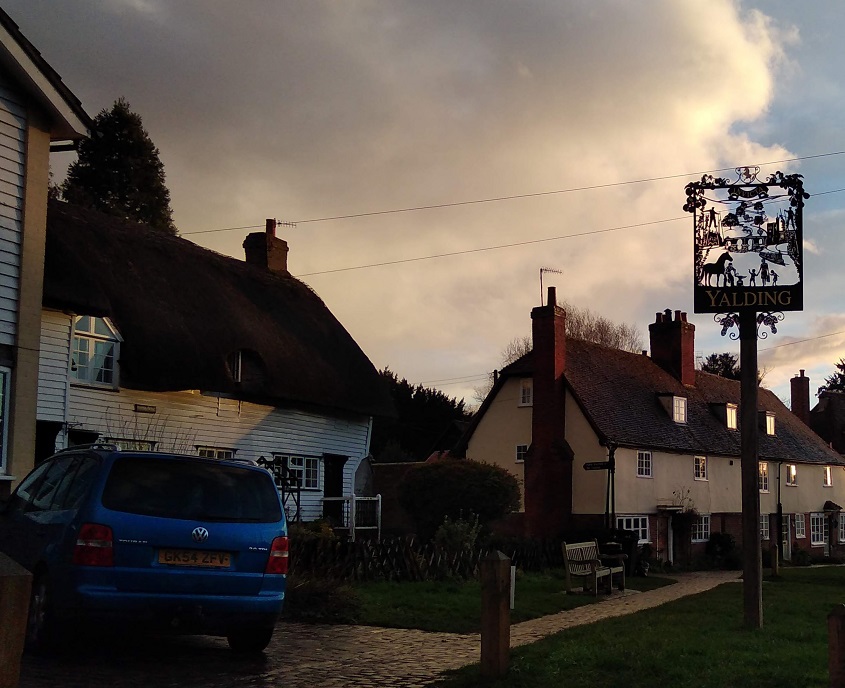
Thatched cottage on the left and tiled on the right of the lane behind the wooden bench. (Photo taken in the evening of another day)
There’s a little lane off Yalding High Street, between the white-boarded, thatched house and the pale daffodil-yellow brick one with matching tiles (on the same side as St Peter’s and St Paul’s church). It takes you past the churchyard and through a gate which is now propped open with a sign saying it’s because of the corona virus. (It took me a while to work out why, but I think it’s so that you don’t have to touch the wood and possibly leave or catch germs). The cemetery with H’s grave and the rifle range are almost facing each other and you can see the controversial new builds and the rubble which has been left over. The Kintons is a well-used sports and dog-walking patch of grass with a children’s play area.
The Kintons
In the far left hand corner, past the bluebell woods, is a track which darts straight ahead. A field was being mowed to the right, a rather portly little dog was scampering behind, and I could see into the scrubby woods, with the back entrance to a grand mansion opposite. A woman was coming towards me and she couldn’t avoid being closer than two metres due to the narrowness of the track, but she awkwardly tilted her upper body as far away as possible. I had a lot of bible teaching when I was a child and stories often pop into my mind. I had been thinking about the image from the Good Samaritan of people crossing over to avoid having to help the injured and needy. Nowadays, on the contrary, we are taking care of each other by doing just that: by-passing on the street. Equally, many of us are going out of our way to look out for others – the phone and the doorbell ring approximately seven times a day at my mother’s house where I am currently staying, with folk from near and far checking if she is okay because she usually lives alone and is over 80 years old.
Crossing Vicarage Lane at a slight angle, I clambered over the stile, sleeve pulled down over my supporting hand to avoid skin contact, tromped through the grass, crossed an access road, and followed the footpath signs (you do not have the Right to Roam in England as we do in Scotland).
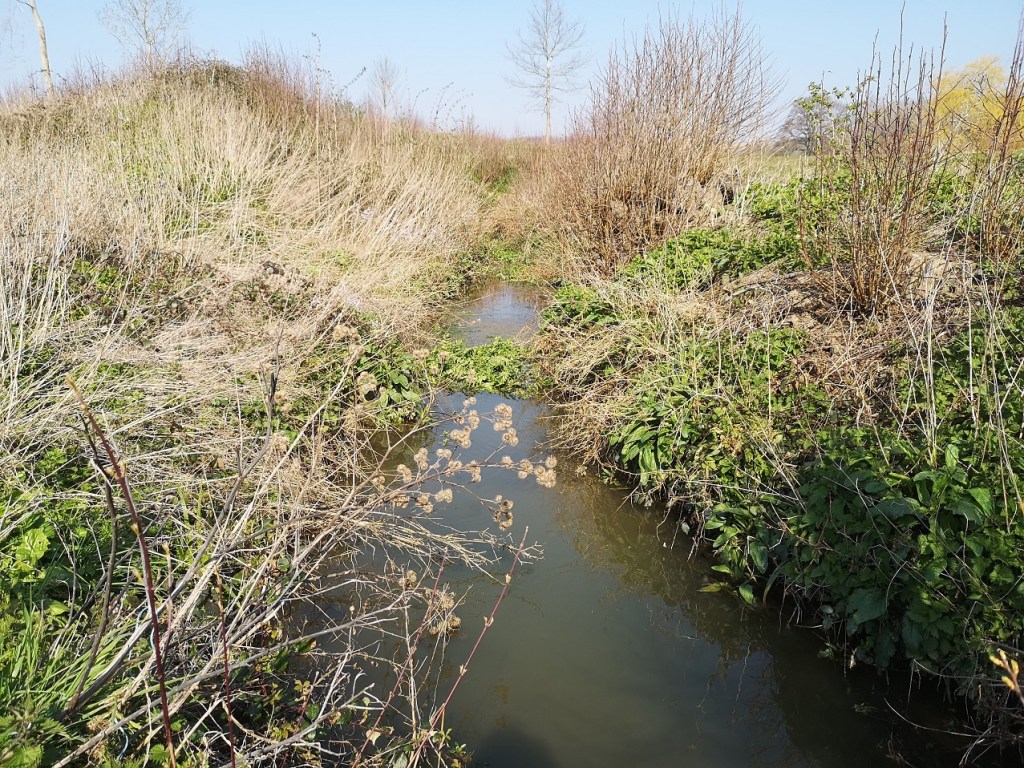
There are little streams and waterways everywhere, often almost hidden by overhanging undergrowth, Kent
Water weaves through this landscape at the best of times. It floods regularly, inundating the copses and arable lands; contrastingly, it is often so dry that great fissures appear and hose pipes are banned. Locals are constantly reminded of what is vital to life, forced to focus on conserving it and appreciating it when it is in balance. This virus we are now dealing with, is, maybe unwittingly, protecting our landscape (yesterday drones were spying on the Yorkshire moors to even stop hikers (for different reasons)). Although many fear that we have damaged it for good, we do also know how resilient nature can be.
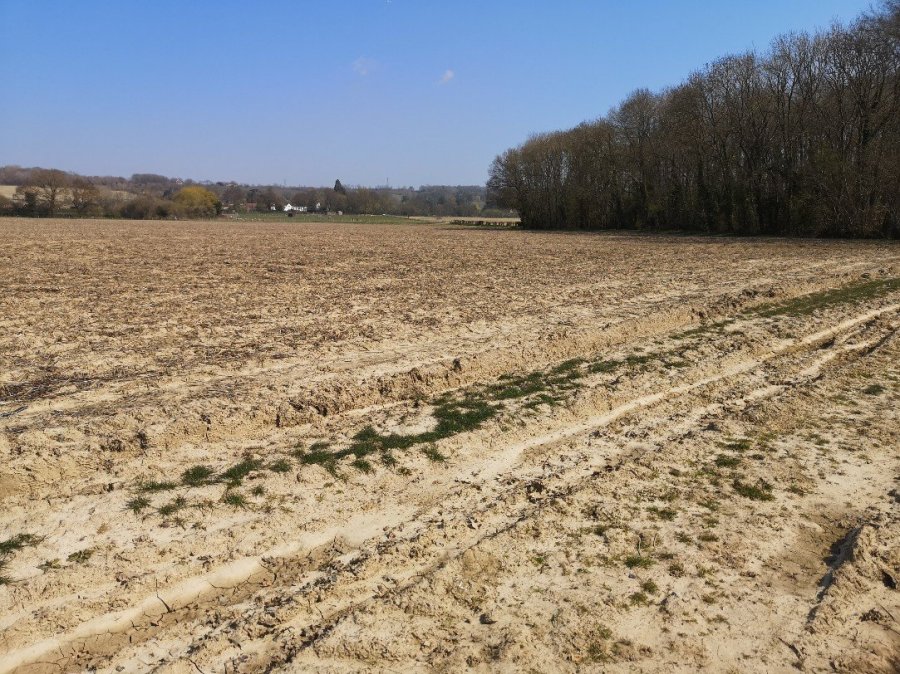
Wide expanses of sandy coloured, cracked earth, Kent
The earth was bright in the sun, hardening and whitening every day now Spring is here. Often so solid and unyielding in the south east of England, there are still sodden patches and the odd sinkhole of wetness left from Winter and you might not be so safe if you stepped there. I reflected that it is change, especially unforseen changes, which challenge our sense of security. Although we want to trust that we will one day be able to plan and move around the world again, we do not know when that will be. In fact, we know deep down that nothing will be exactly the same; we understand that this is serious enough to bring about a new order. We don’t yet know what shape that will take because, metaphorically speaking, the ground underneath us has shifted. This is why walking, even when we have to watch our footing, is such a reassuring activity – we still get from a to b and survive the experience. I could feel myself becoming grounded, and then I sighed and felt a movement in my heart area. (Chinese medicine practitioners: in the Five Phases, when the child’s happy (Earth), so is the mum (Fire)).
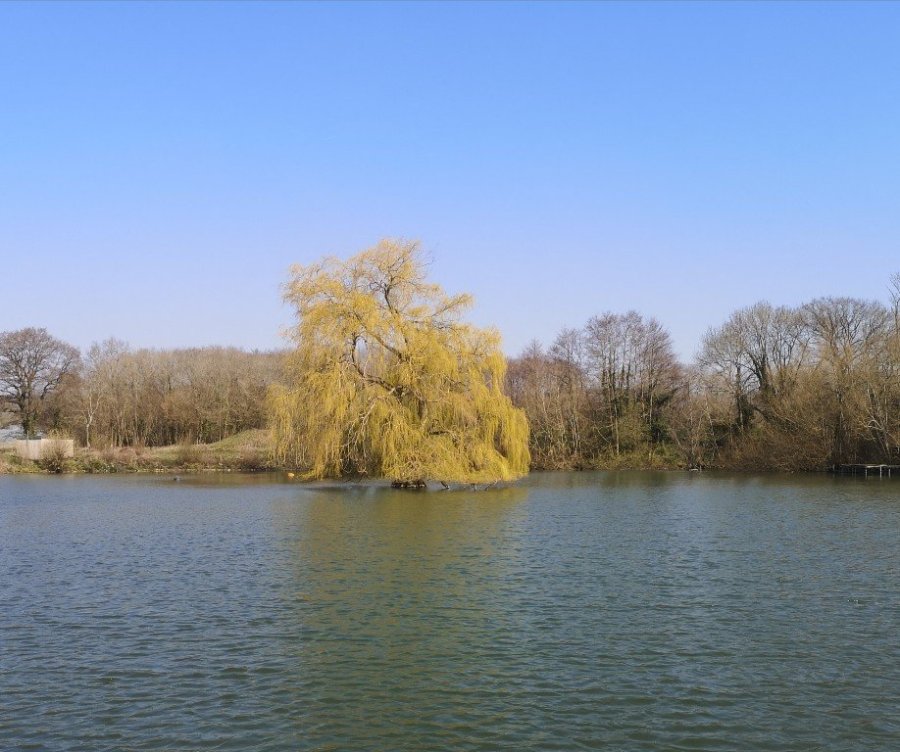
Contrasting colours – the yellow green of the tree with its new vestments and the blue of the lakelet and sky, Cheveney, Kent
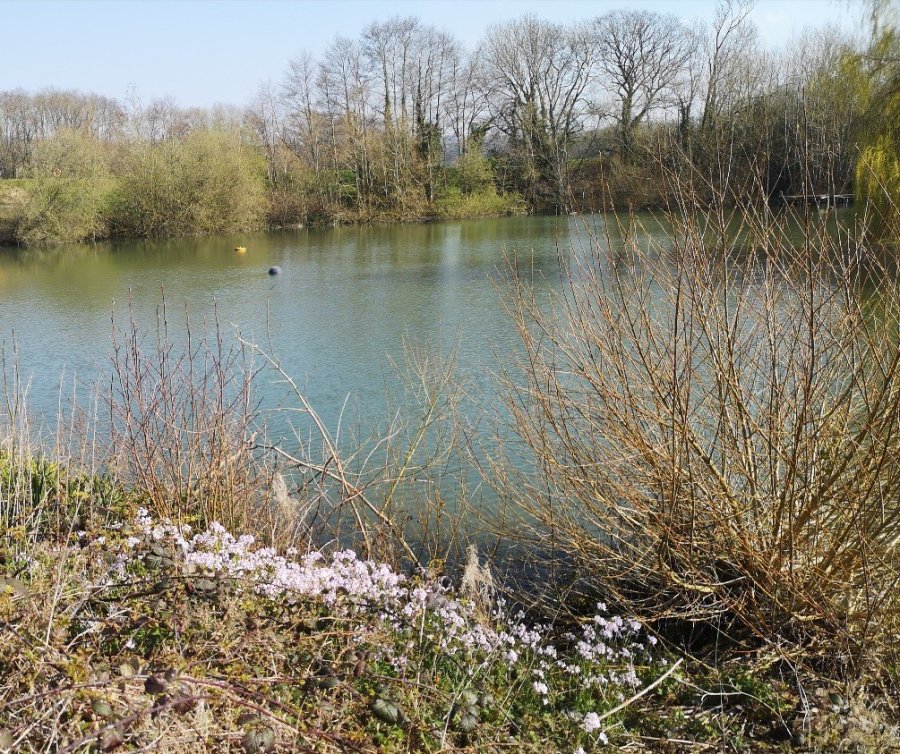
Banks of Lady Smock around the water, Cheveney, Kent
Walking towards Grove Lane, there is an almost imperceptible gap on the left which opens out to a small lake. It looked grand. Skirting it, I admired the wild flowers. What a beautiful setting on such a day, with the cool wind causing mini waves and turning the surface a myriad of shades of blue.
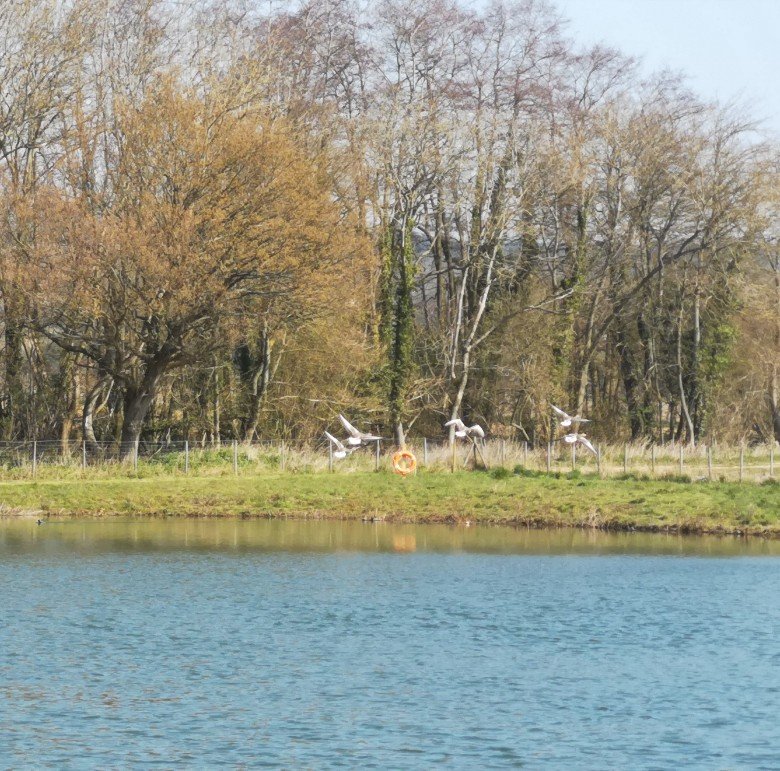
I am used to giving wildlife a wide berth, but this time I startled the flock of geese who were grazing on the grass a long way ahead. They made ‘We are very disturbed’ noises
All that was left was the Goose down
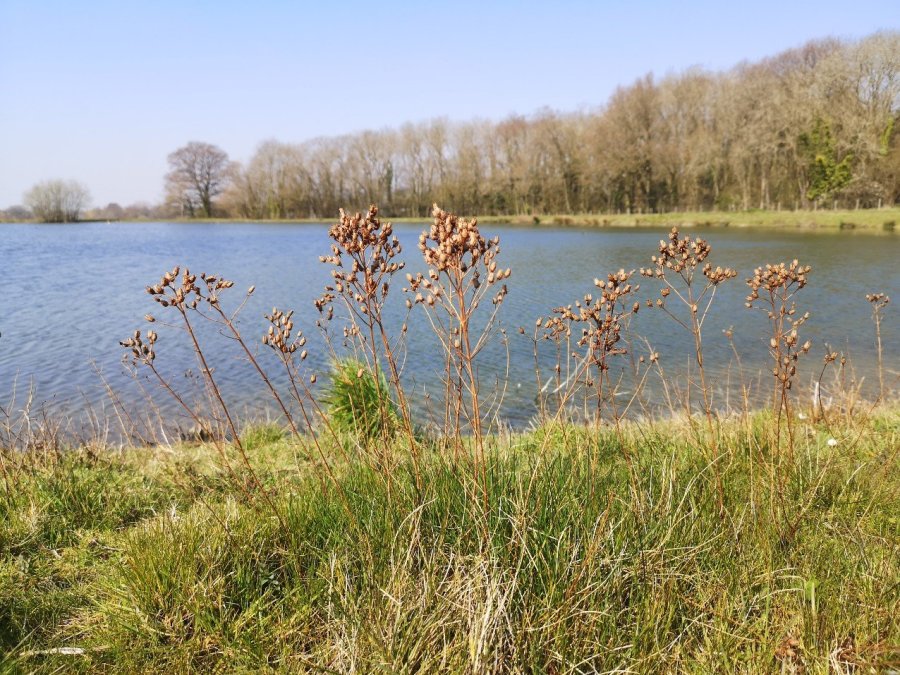
Seed heads from last winter
Daisies and Eye Bright
I crouched down to watch a bee collecting from between delicate mauve petals. He was only just about holding his own way in the breeze, but he kept on, goal clear. I admired the water birds and the Daisies with their sunshine faces. Bird’s Eye nestled at their feet, making another stunning combination of hues. There were sharply serrated Nettles and whorls of Thistles. Neon orange lifebelts hung at either end, and the whole was chicken-wire-edged so that I made an entire cycle before exiting precisely where I entered, stepping over the fallen fence.
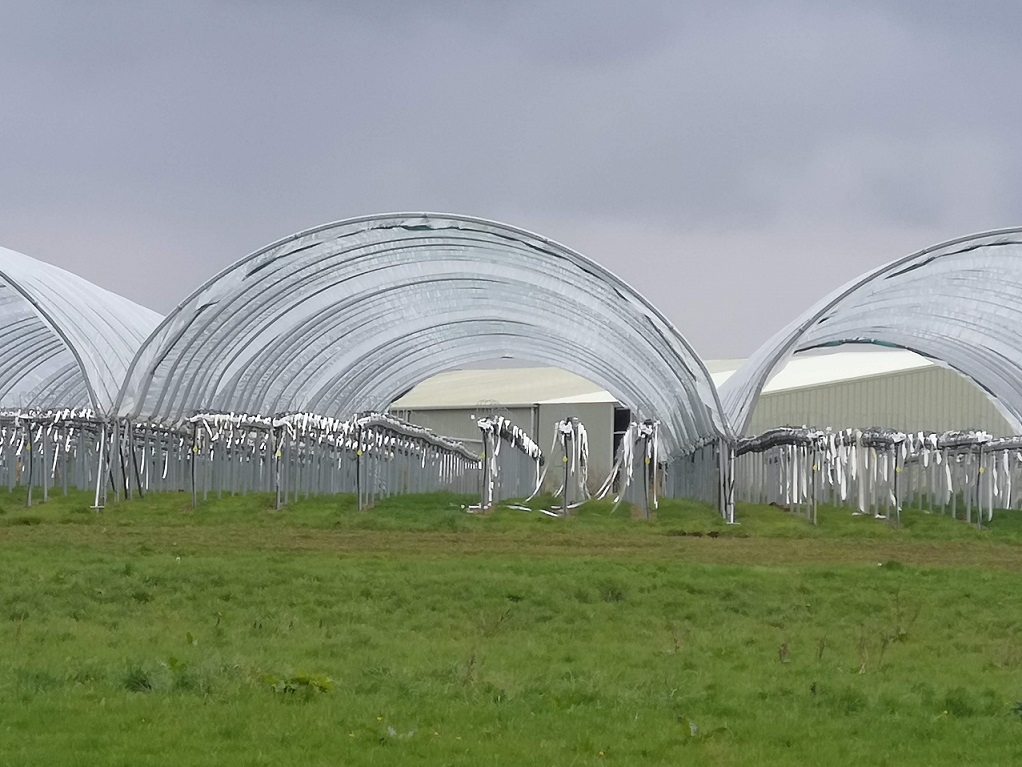
These polythene tunnels are from another farm nearby, but you can see the silver-looking straps hanging down which attach to the plants. 10 days ago the old plants were on them, the next day they had been removed, now they are being replaced for the coming season
Doubling back on myself by the lane which curves around the lake, my attention was attracted by men’s voices, the first of several groups I passed during the morning, working away hard in close proximity. They were setting the strawberry plants onto the stands under the plastic hoods.
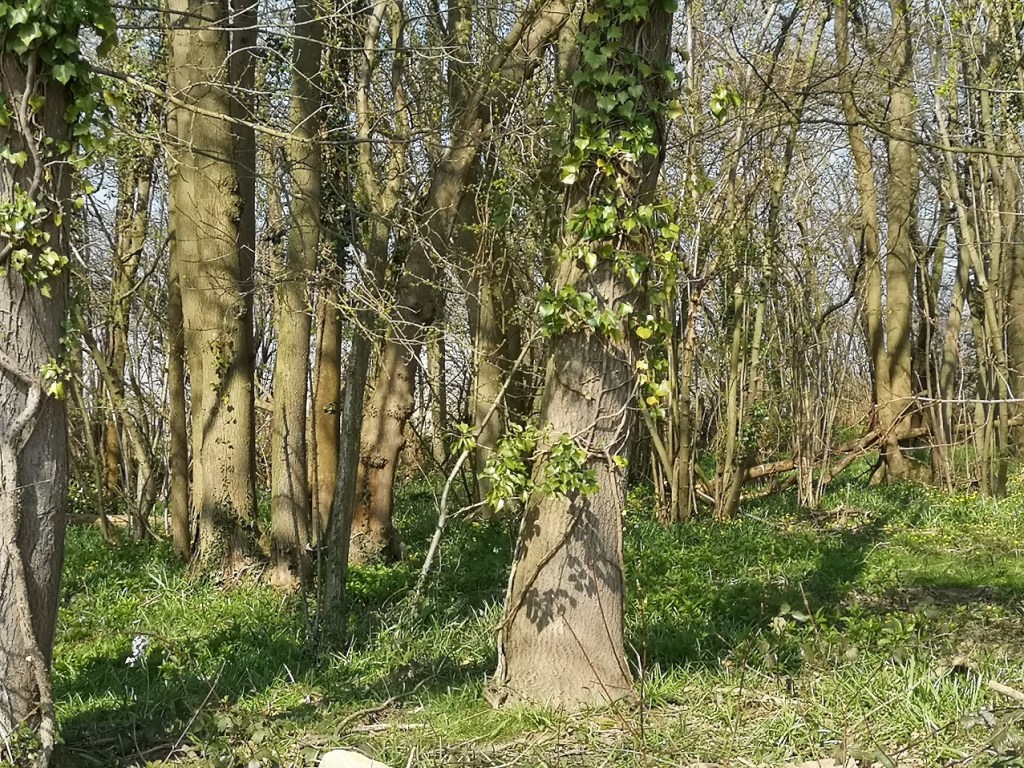
Trees in unseen communion
Coot on Cheveney Mill pond. They are also inhabitants of the upper lake I visited on this walk
I heard the coots before I saw them and I suspect that they were born here, that their life has been, and will continue to be, spent in this pond, (according to the RSPB they are resident here all year round), just as the trees in the wood next to it have stood in the same place for 100s of years. Other waterfowl return to their homes, well to their second homes every winter like Brits on the Costa Brava.
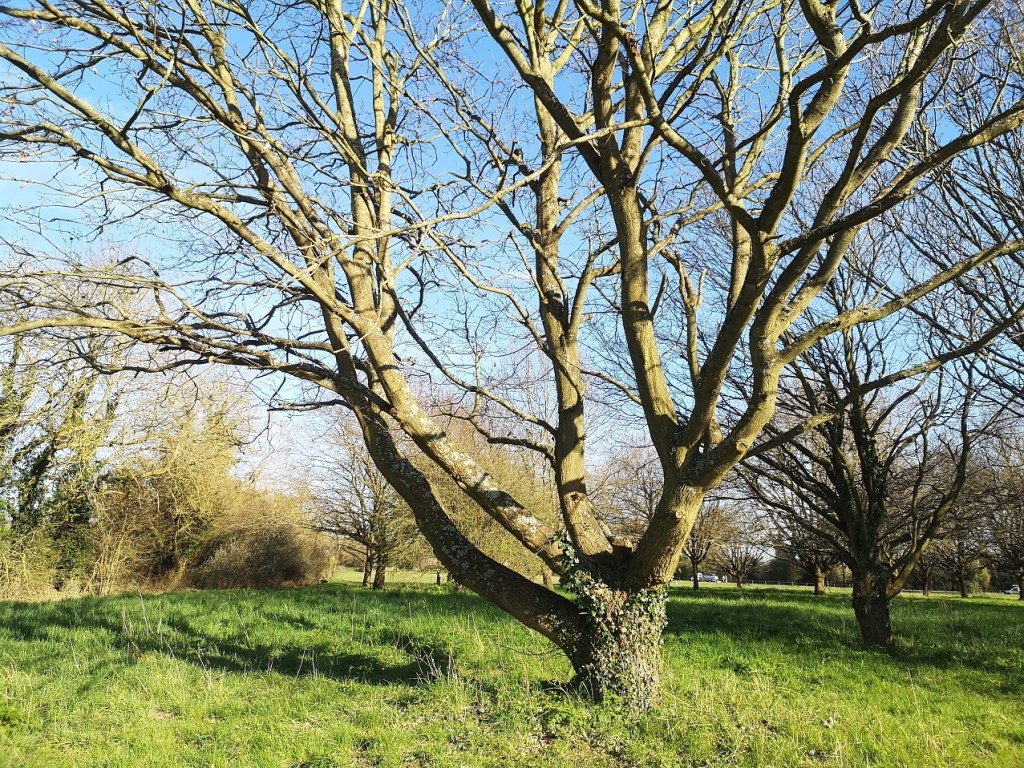
Witness the staying power of trees!
Witness the staying power of trees! There they are, in one spot, come month, come year. And what do they do while they’re standing there? It turns out they are very quietly, and probably slowly, fostering their community through their roots, just as so many of us are only now starting to do.
The word ‘Foster’ is associated with the Old English ‘fostrian‘ meaning to supply food, nourish and support.
Kentish footpath
At the same time as processing the CO2 (carbon dioxide) for us, looking beautiful and smelling divine, trees offer a home to insects, birds and other creatures. And yet, so many humans were living and suffering alone before this crisis and are now even more isolated. This can be an unnatural, even a dangerous situation for certain people. Questions arise: What can we do to make sure that those who want it can get support and companionship? How can we plan in advance for the next virus? Trees will grow taller and straighter, needing less pruning, if they are planted close to each other in the way that they naturally reseed in a woodland area. What a lot we have to learn! What a lot we are learning right now, thanks to the Covid-19.
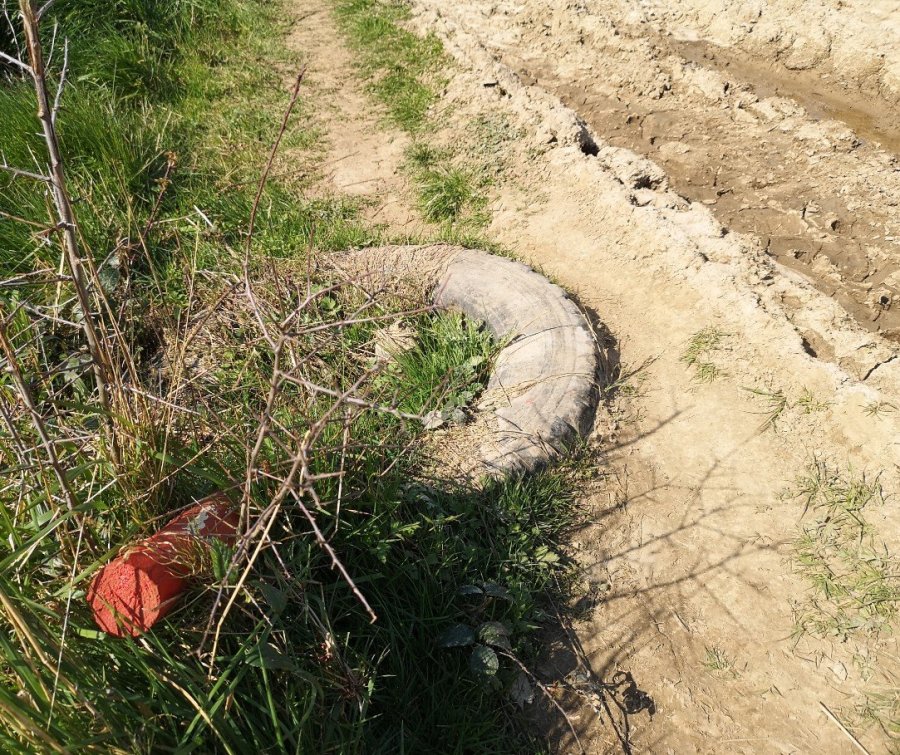
Sunken tyre
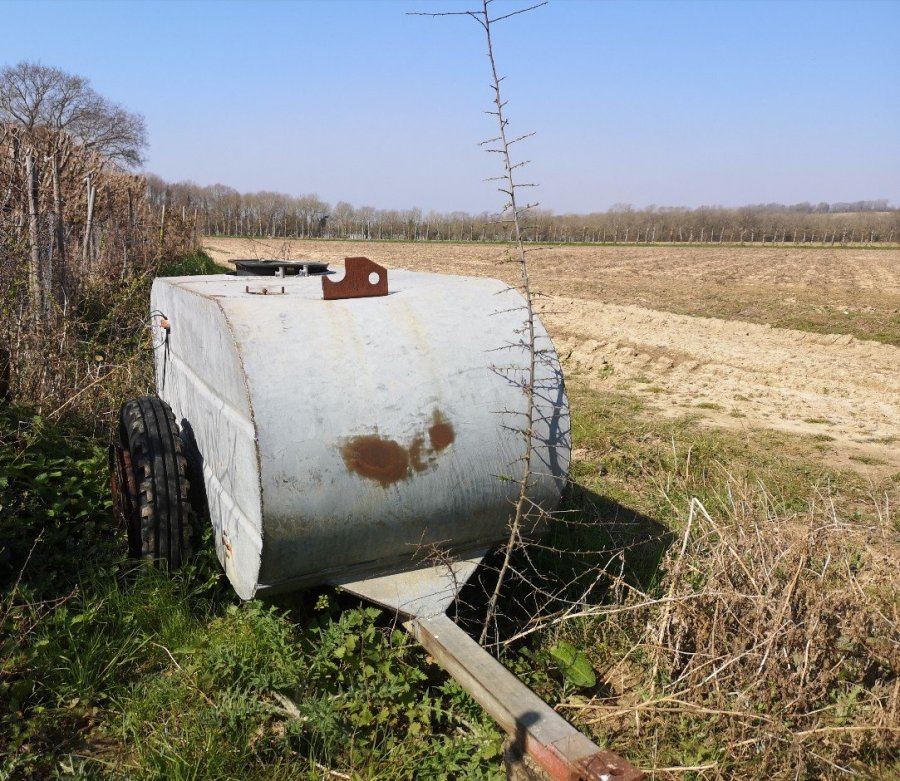
Discarded farm machinery
The path took me around a corner where some old equipment was half buried and put out to pasture. Wide open fields were flattish, a gentle rise in the distance and the wind from the north was chilly except when sheltered by the hedgerows.
Looking uphill in the direction of West Farleigh, Kent
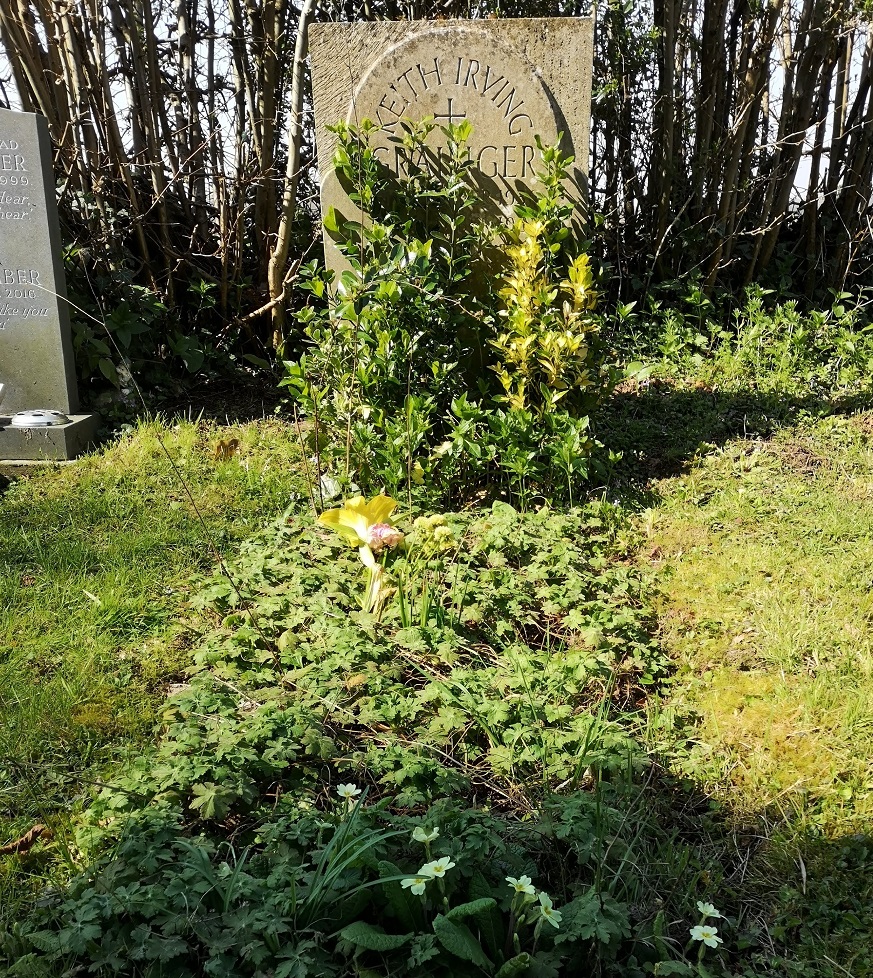
Dad’s gravestone at St Mary’s Parish Church, Hunton, Kent
I took the Permissive Path (that is, not a public Right of Way, but one which is permitted by the landowner) over a tiny, planked bridge to West Street and stopped at Hunton St Mary’s church to visit my father’s grave. I took a quick photo of the Village Hall to send to my sister – she got married there – and then crossed back over, past the Engineering Works and went right. I wandered beside more agricultural land until I reached the junction between Barn Hill and the wonderfully named Lughorse Lane.
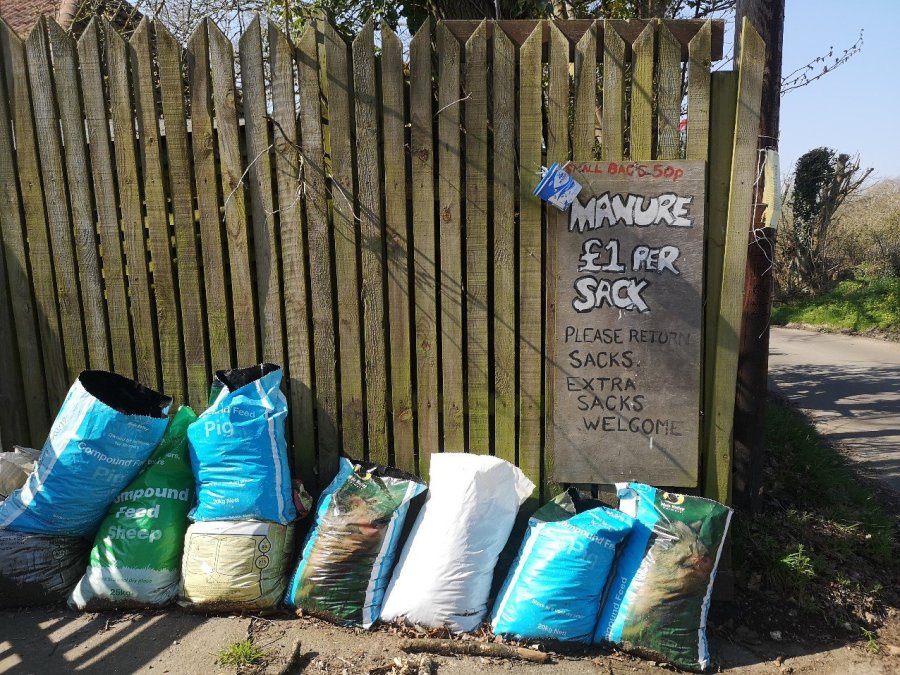
Manure for sale
Mare’s Tail or Horse Tail (thanks to Mick Summersgill; and in Icelandic it translates as Claw Lightening (thanks to Robyn Vilhjalmsson). Equisetum arvense
Clumps of proud daffodils with orange trumpets kept their eyes on me as I passed. There were also some plants which resembled long and upright poos, or if I am to be less disgusting, vertical pine cones in the deep grass (see above).
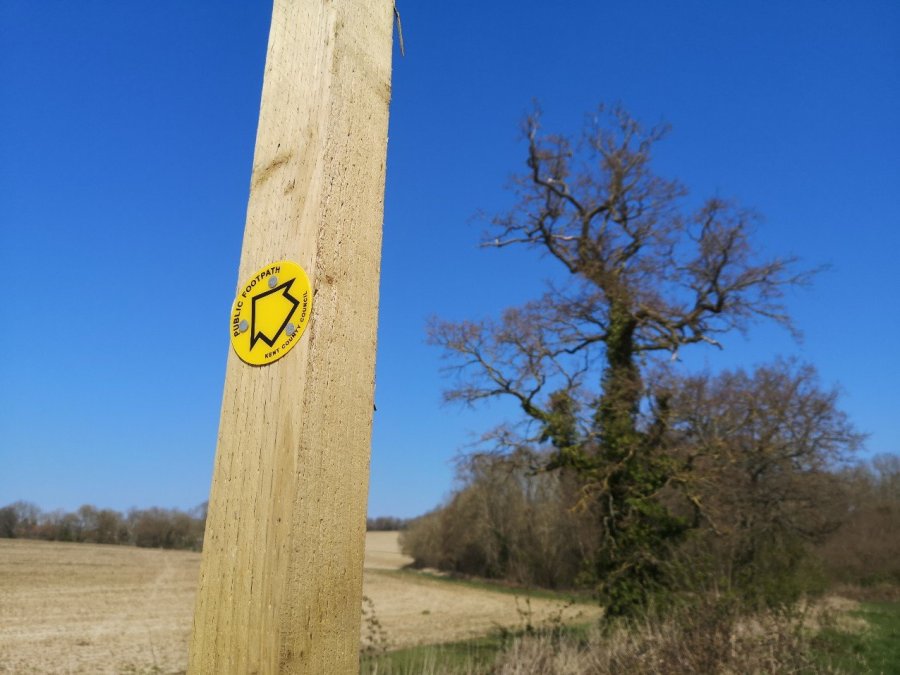
Stick to the footpaths!
Before long there was a footpath off to the right and I started to climb quite steeply. It was peaceful. This was my exercise (in case any(official)one is reading this). There was stubble from what appeared to be bamboo on my right, but I doubt it; more likely wheat. There were mostly Magpies, Pigeons and Crows around although I did see a Jay a few days ago which was exciting. I spied a raptor nearer the top, most likely a buzzard, sailing on outstreched wings, but the photo was too indistinct to reproduce it here.
Buston Manor – disused oasthouses without their cowls, the white oparts with a sail which move with the wind
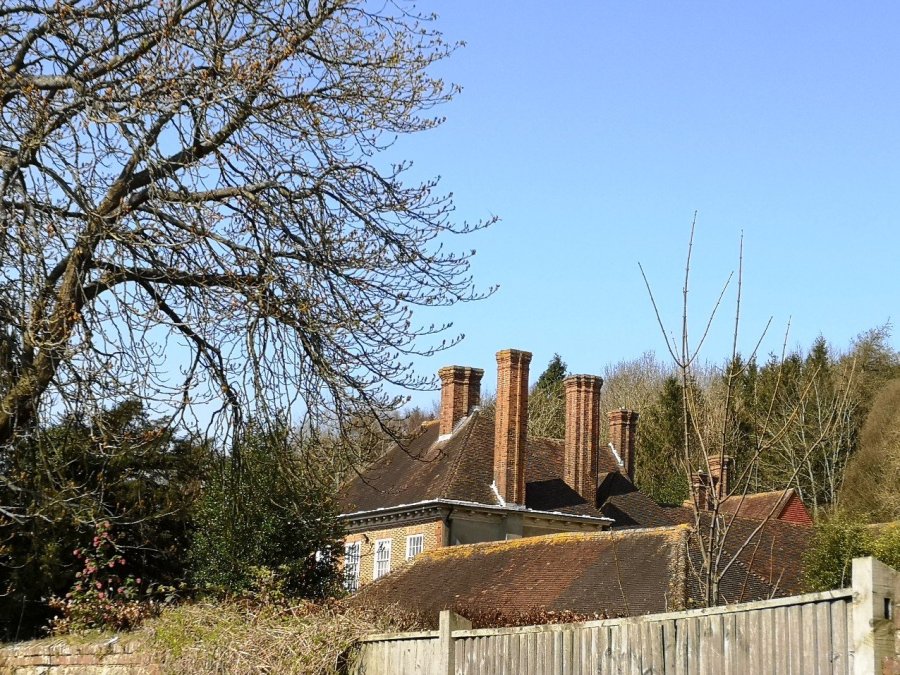
The Elizabethan chimneys of Buston Manor
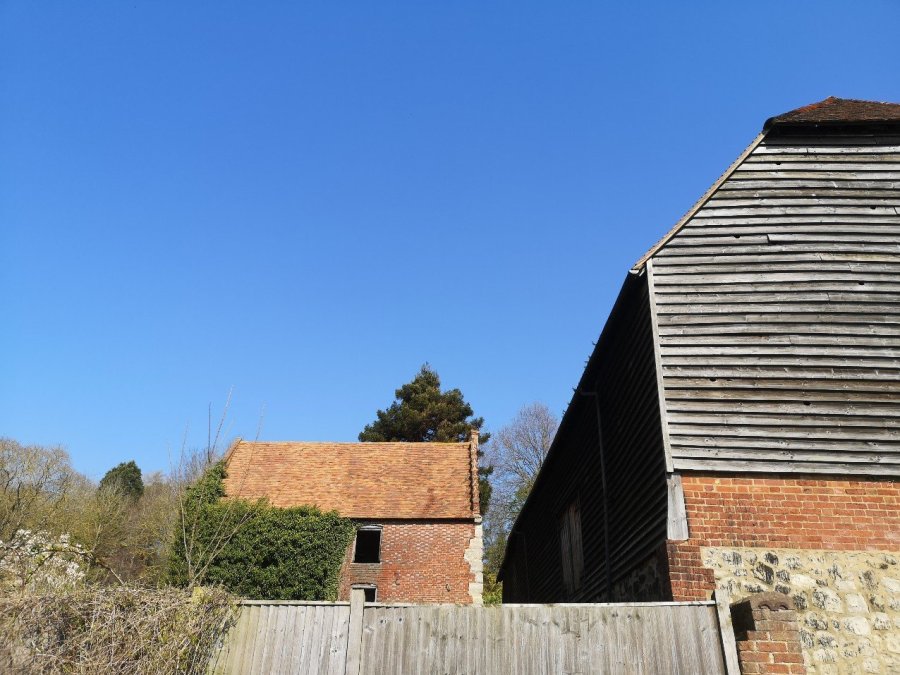
Capacious barn and other red brick outbuildings at Buston Manor, Kent
Flowering Currant looking bonny against the clear sky
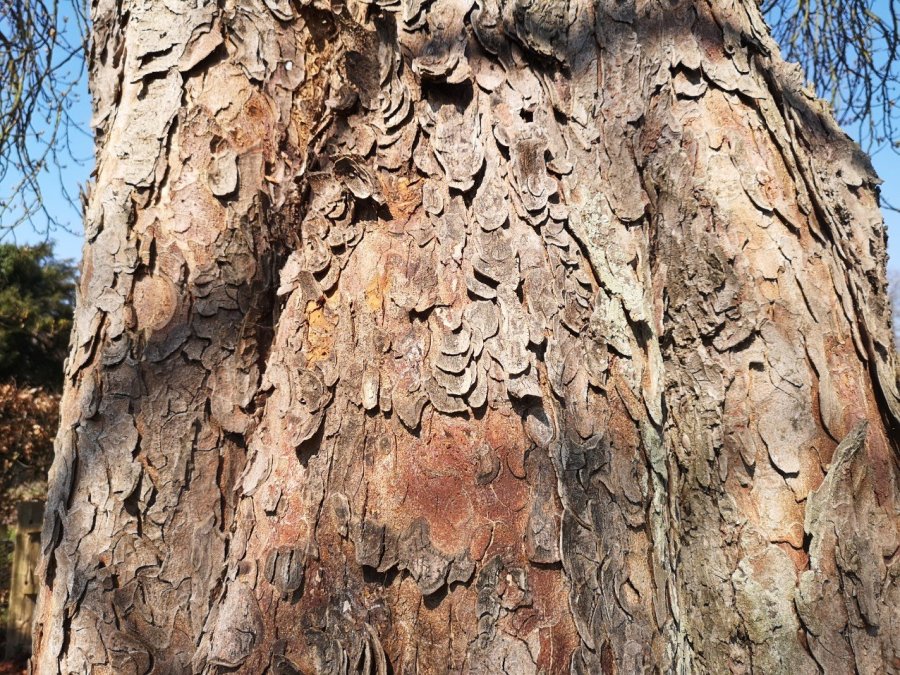
A dinosaur of a trunk with scales
Although a dogwalker took the private road uphill on the right, I turned left on the official way and walked through the Buston Manor yard. First a jogger and then a proper walker with a staff who wore headphones, came towards me. But I was drawn aside by the gardens, architecture and tree bark design, never mind the extensive walled garden. I was told, later, that it is often used for filming TV and features.
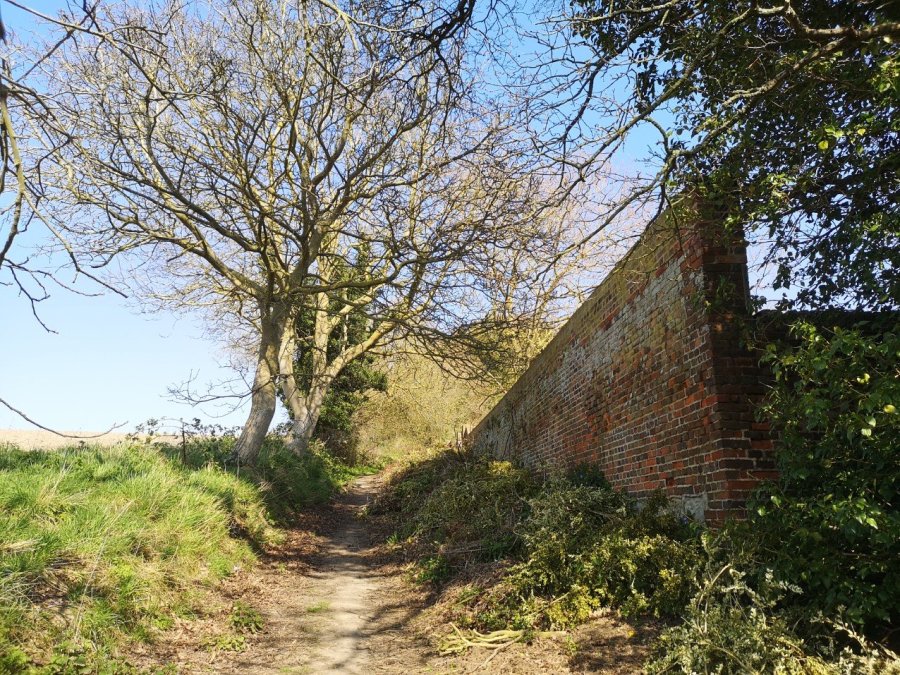
Right at the end of the walled garden, Buston Manor, Kent (they obviously dump their garden waste over the wall!)
Up again and a little sit-down to eat my satsuma, wind in my ears and at the back of my neck. We have to be careful of that as an acupoint GB20, aptly named Wind Pool, where Wind can enter causing headaches or worse (flu), certainly making us vulnerable. My (and my grandmother’s) advice – wear a scarf!
Once more at the top, she and her dog went one way, I another
Call that a footpath! Kent
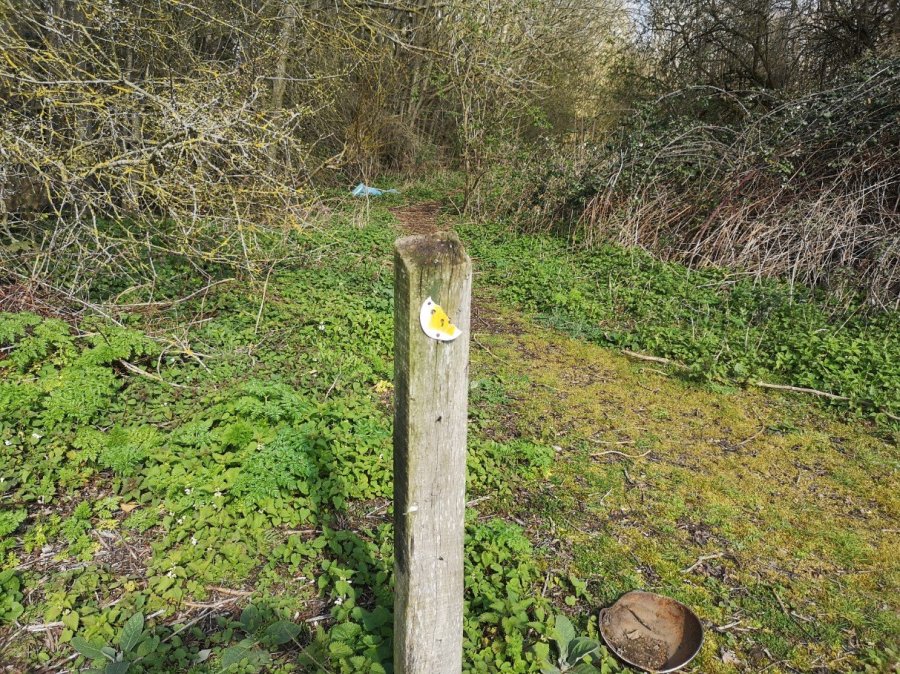
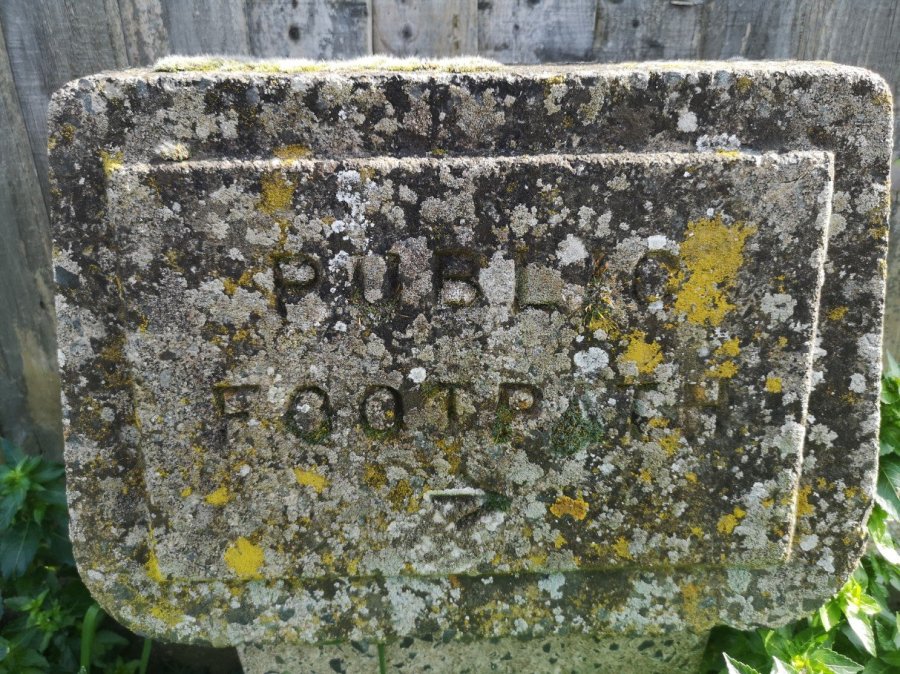
Through a metal gate, I went left onto a farm track of very dark loam, ploughed by machinery wheels and criss-crossed with tree shadows and sunshine-saturated grass. Steeply down now, until I unfortunately spied a Public Footpath stone and so took a right up a slight bank and out into the open again where there was one of the ‘footpaths’ I have walked the length of before in this area. This narrow enclosure drew me along and then, suddenly ending in a field, it showed me up to the right (where admittedly the vibrant green of ground-spreading chamomile was growing alongside left-over broad bean seedlings) and, without realising where I was heading, I was through another metal gate and onto Yalding Hill.
Yalding Hill is to be avoided at all costs if you are on foot as it is a very busy, narrow road with no pavements. Being very familiar with such situations, I was brazen and made sure every vehicle speeding towards me knew I was there (waving my arms, making eye contact, thanking them afterwards), but many were going too fast and several times I had to flatten myself against a bank. Had I known this in advance, I would have turned back.
Tip: Do turn back if you find yourself on Yalding Hill. Find another, safer way down.
Towards the bottom, where the village starts, are some very attractive gardens, the Walnut Tree pub and Village tearooms (both now closed of course), and the war memorial. The Greensand Way is off to the left
I walked through the garden gate three hours to the minute from when I left – good timing!
16.3.20. This blog is unashamedly full of flowers, birds and other natural phenomena. I was very grateful to see that nature is carrying on (perhaps a little less interfered with than before) while all this is going on. It is intended as reassurance, and as a reminder that walking is allowed in the UK, even if you are at risk or at home because others in your family are unwell! I never thought I would have to use that phrase – how is it possible that walking needs to be sanctioned by a government? These are mighty strange times.
Teapot island which sells, well, teapots, and is also a cafe / take-away
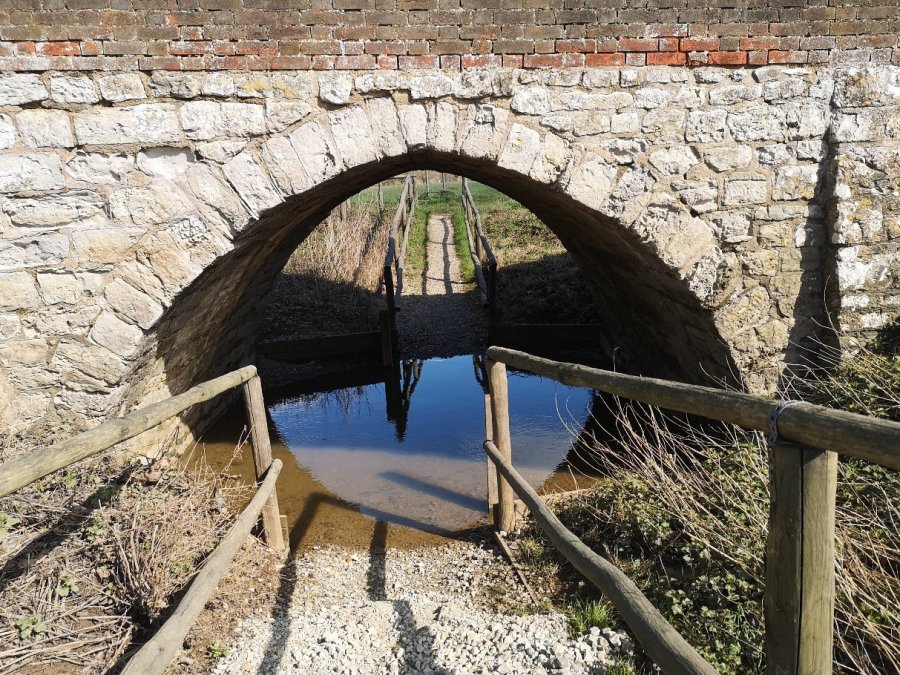
Under the Hampstead Lane bridge, impassable
I walked across the Lees (more here) and tried to go under Twyford Bridge but it’s still flooded. I took the pedestrian way that bypasses Hampstead Weir (see above link for sunny photos from an earlier time) and comes out at Teapot Island. From there I took a left to walk along the towpath with the River Medway on my right. There were no fishermen today, but there was a man in wellies and shorts, his knees looking rather vulnerable, having a smoke, and another further on, busy weeding. They were outside the new fixed caravans which are lined up neatly there – rather liable to getting wet, I would hazard.
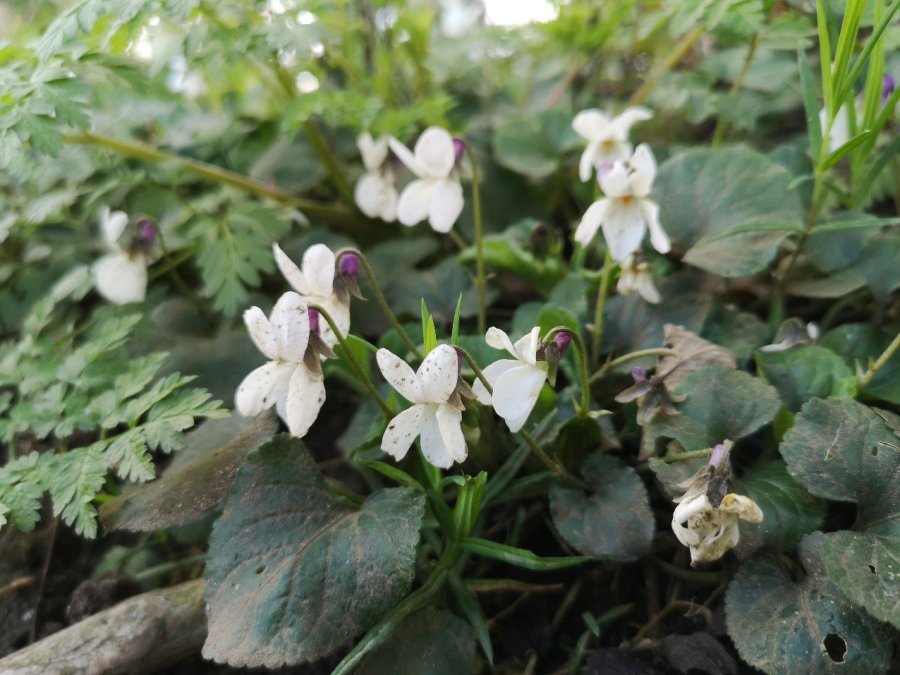
Tiny white violets crouching beside the path
Dock leaf, backlit with Spring sunshine. I took this walk, alone
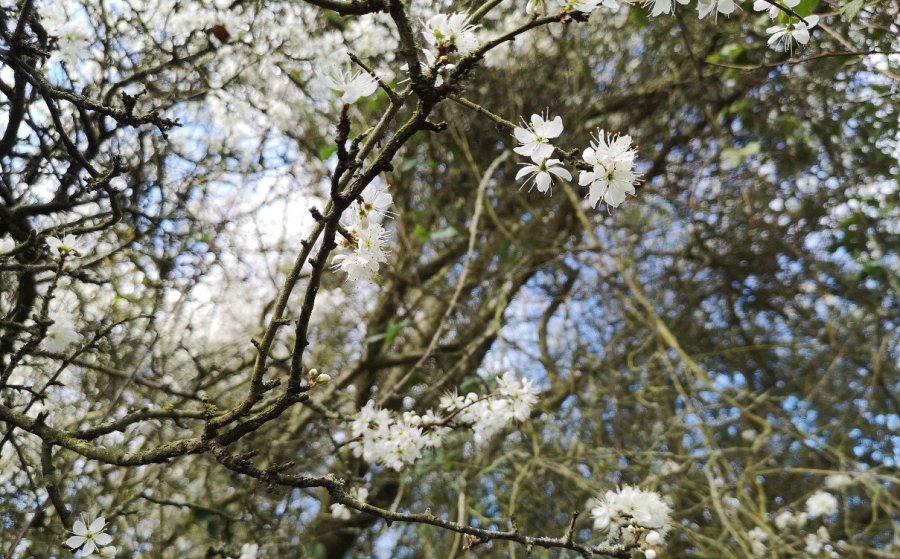
Blackthorn blossom. It’s about when you look and know that if you stroked them they would be soft as down
The sun shows up all manner of miniscule details: a strand, a filament of spider’s web stuck to a bramble new-leaf which is coexisting with the old ones on the same stem. There are also aged twigs, dry leaves, spent old man’s beard alongside the new blackthorn flowers and buds. We are all together in this.
A sign of new life hiding somewhere in the undergrowth
I began in a thwarted frame of mind: It was about when you want to walk from a-to-b-to-c, but have to settle with there-and-back. Then, quickly, it was just as glorious as it could be. I had planned to walk The Pilgrim’s Way from Winchester to Canterbury across the North Downs. I even had the Pilgrim’s Passport sent to me by a very helpful woman at the Cathedral in C. Another time!
Winnie-the-Pooh, or Pooh for short, was walking through the forest one day, humming proudly to himself. He had made up a little hum that very morning, as he was doing his Stoutness Exercises …Well, he was humming this hum to himself, and walking along gaily, wondering what everybody else was doing, and what it felt like, being somebody else, when suddenly he came to a sandy bank, and in the bank was …..
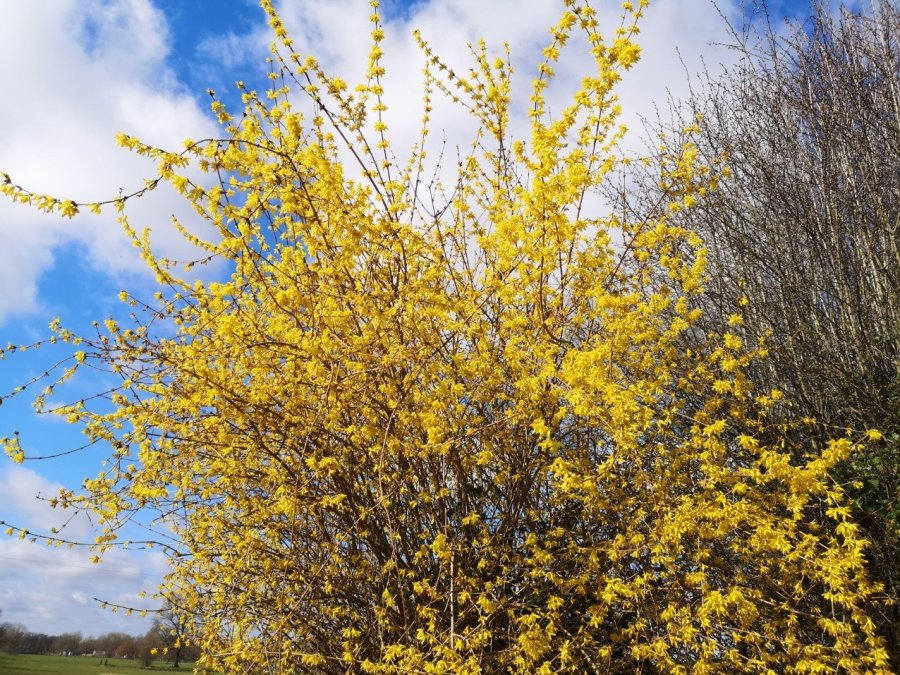
What a day for a daydream – ‘one of those days for taking a walk outside… a walk in the sun’. Yellow against skyblue makes for a sunshine combination
Stretching your wings at a time like this opens the lungs, lets in the necessary oxygen for staying as healthy as possible
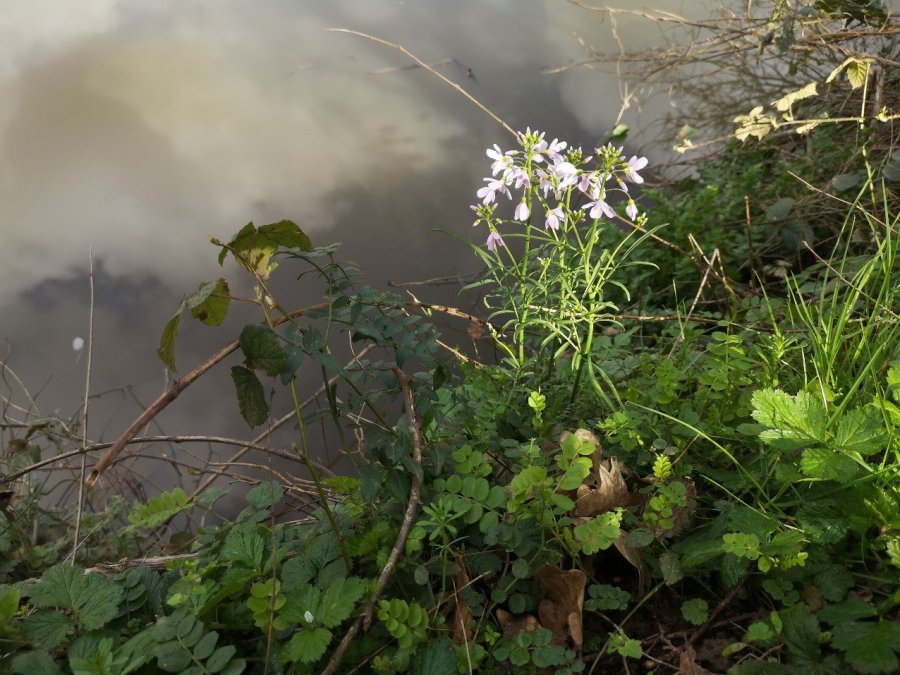
Lady’s Smock / Cuckoo flower (Cardamine pretensis) Thanks, as ever, to my mum and the people at Houzz.com for their help in identifying, being sure about names
There was the scent of wood smoke, and the sound of water under the bridge and through the lock, of twittering, and an occassional parping from a train that was still running even despite the reduction in passengers due to the crown shaped virus.
The river looked particularly glossy with gentle ripples making a regular, stripey effect
Foxglove preparing to bloom
There were regal foxgloves – no flowers yet, just a fascinator of leaves tilted at a jaunty angle on a mount. Many, many wood anemones were spread across the earth. Copious bird calls either drowned out this winter’s new tinnitus (mostly in my right ear) or it just stopped. There was, however, the thrum of engines from somewhere offstage (which was not the sound in my head!)
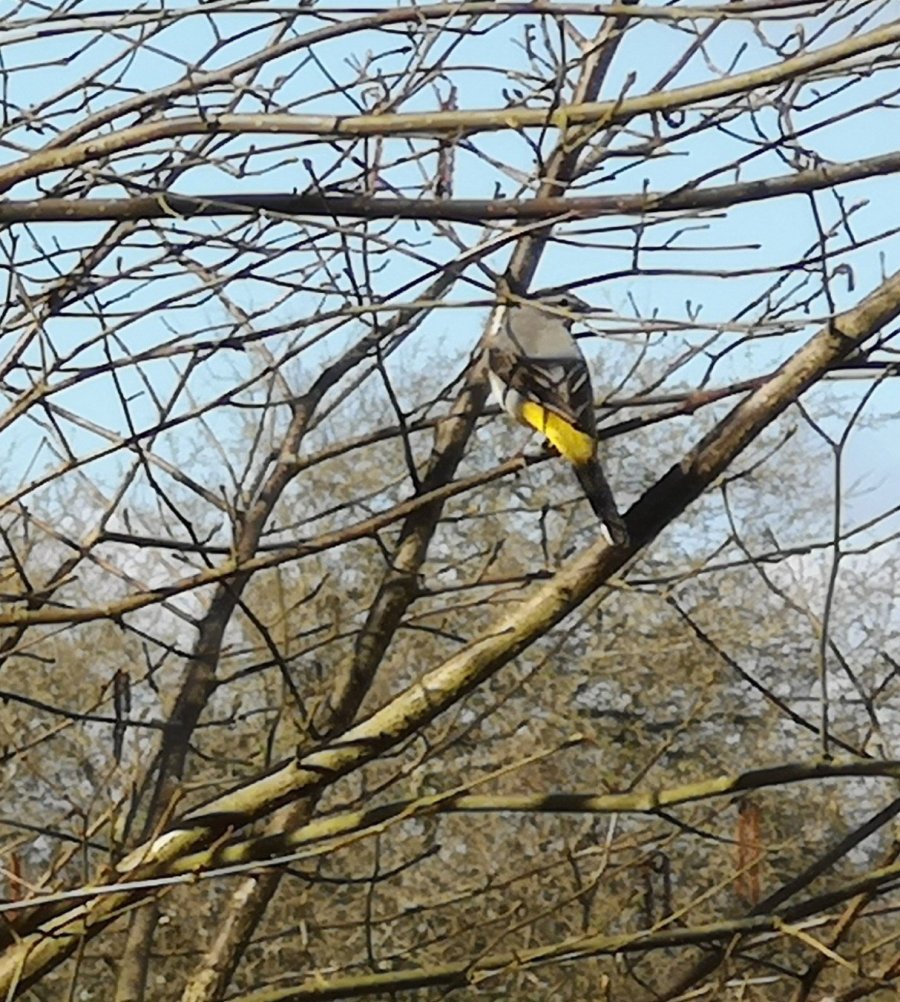
Grey Wagtail. That sunshine gets everywhere. (Thanks Lesley S for identifying)
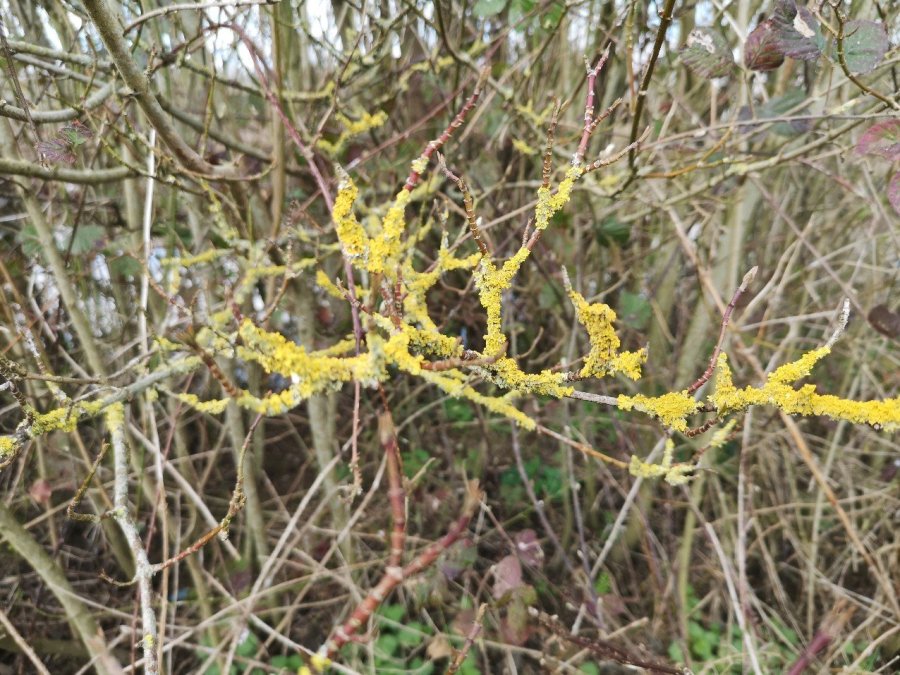
Matching lichen – continuing the theme of yellow
Busy collecting pollen
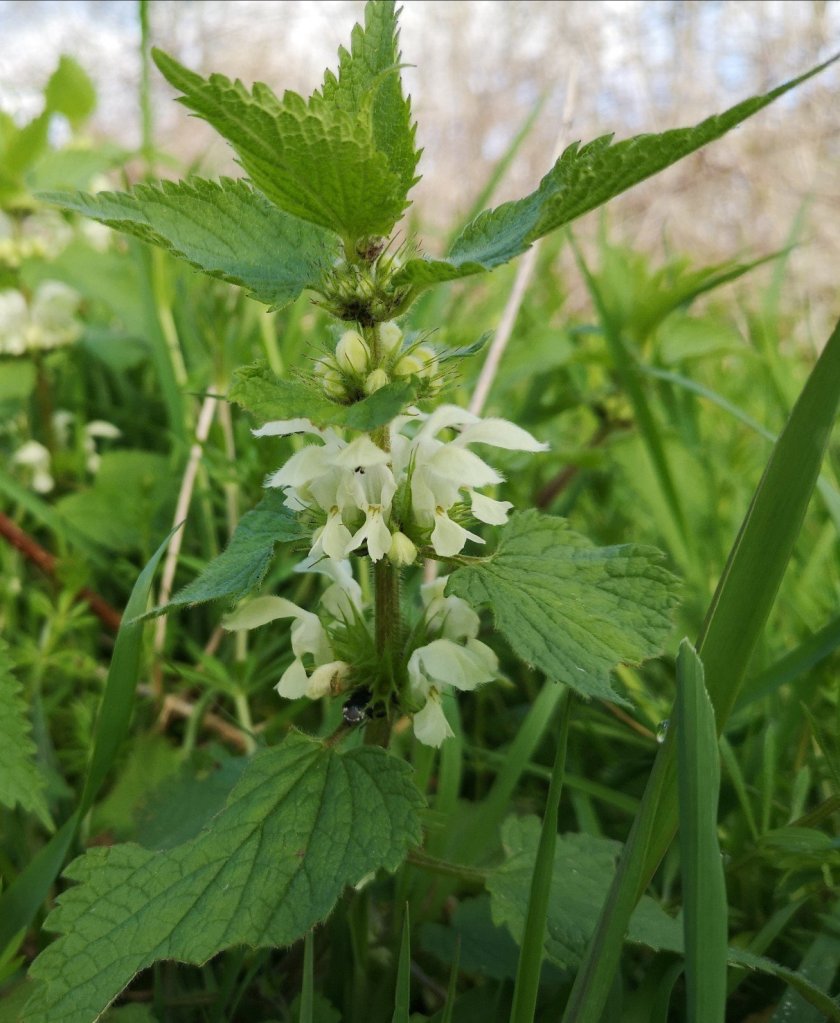
White deadnettle – I know this one from my childhood
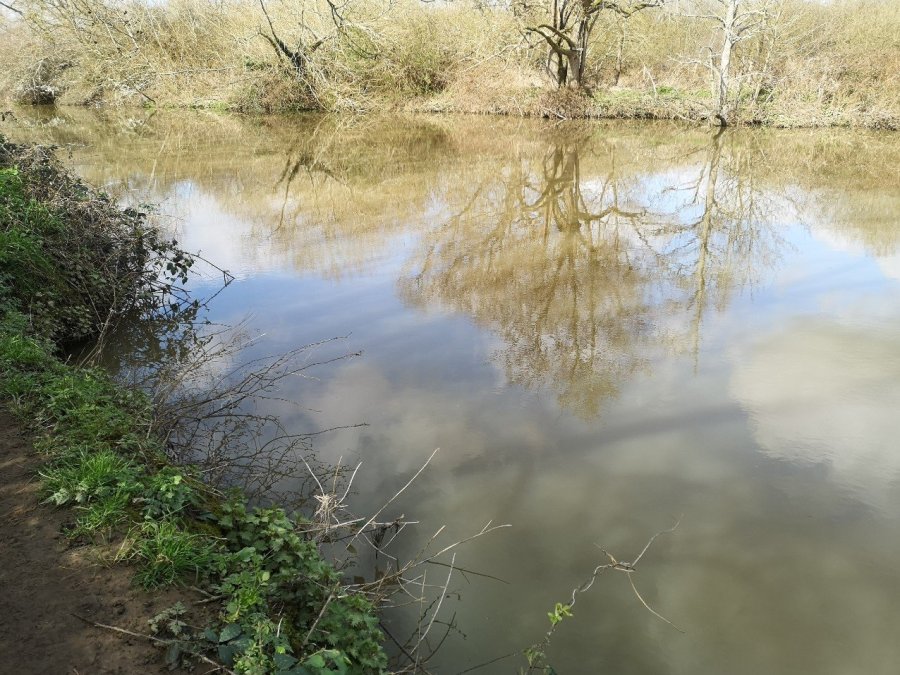
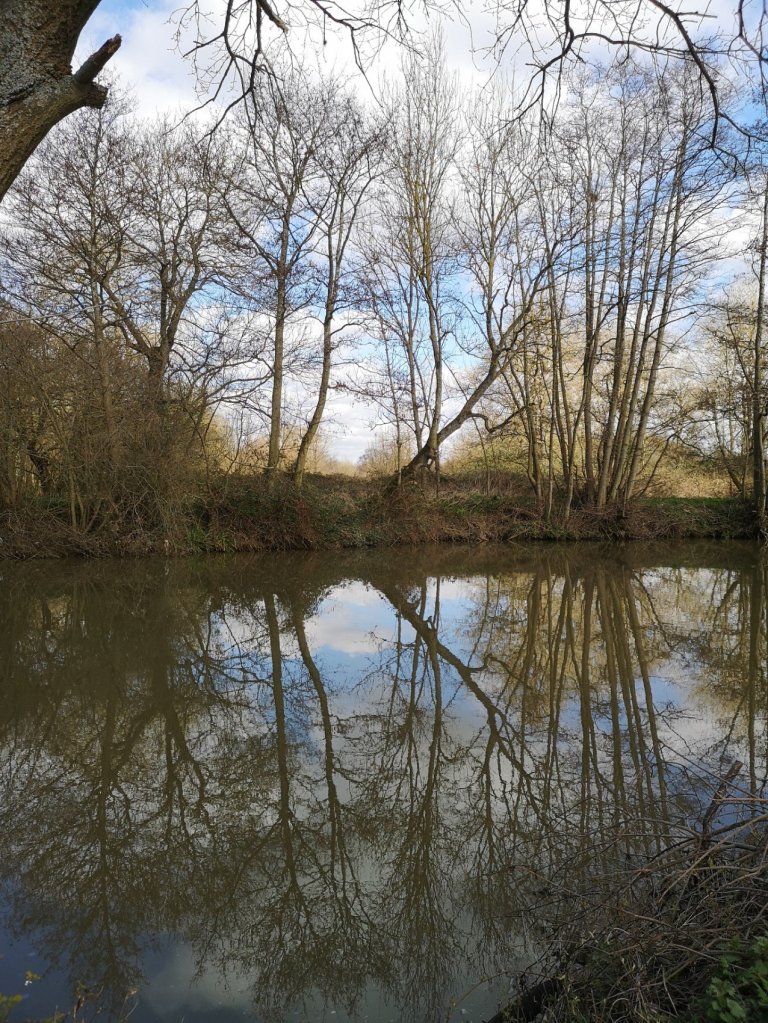
Reflections in the River Medway
See the stalks growing through the mossy mound!
Detour to the other side to satisfy my curiosity
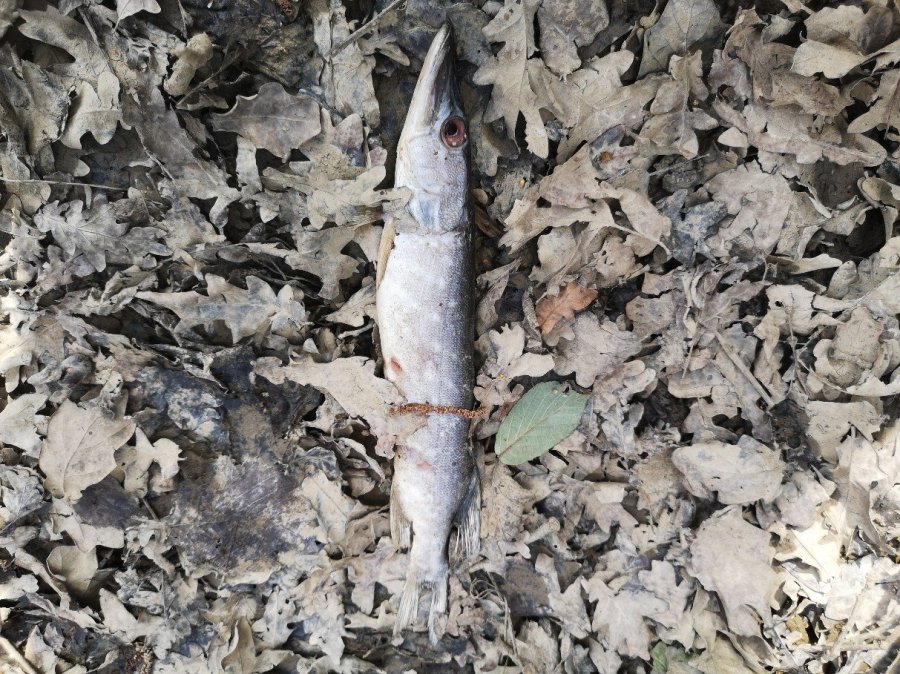
Northern pike, also known as a snot rocket, apparently. (source: Wikipedia)
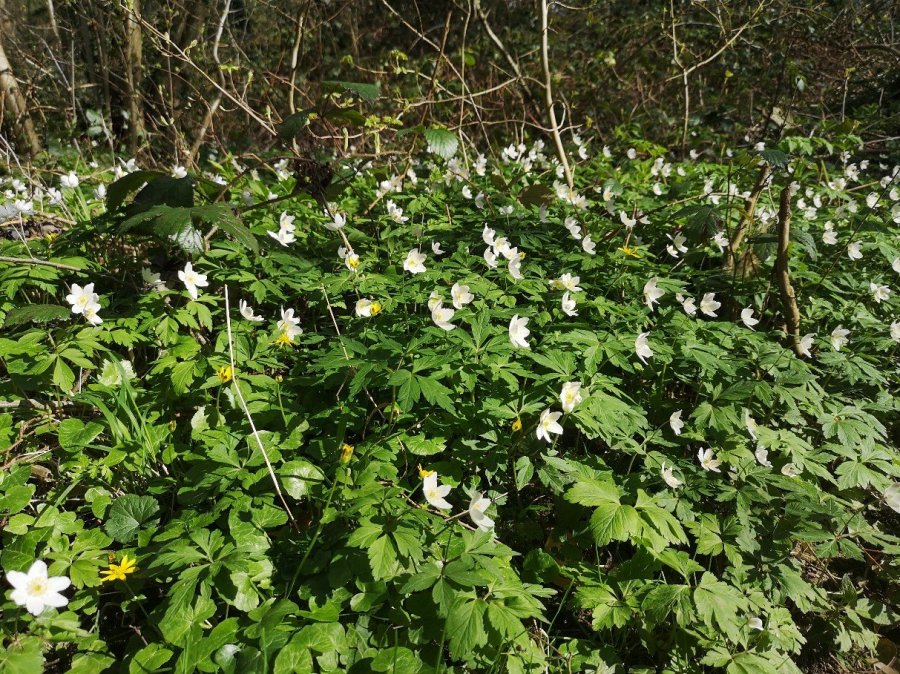
Banks of yellow eyed wood anemones
I spied one or two little settlements almost hidden by trees over the water, indications that people are living there quietly, in those beautiful spots. At a little bridge, I crossed to investigate the white flowers on the other side – were they wild garlic? No, instead a veritable sea of anemones. And, I spotted a large dead fish with a long nose – a pike – which I thought must have been flung there when the water broke the banks, because the greenery around it was all covered in a film of earth-dust. However, there was a hole in its side, so it must have been hoiked out by a human and not returned.
In the essence of full disclosure, I actually like the way northern pike taste. However, many would rather eat the aluminum foil the pike was cooked on than the fish itself. Well, with that in mind, one chef in Canada is about to change all that.
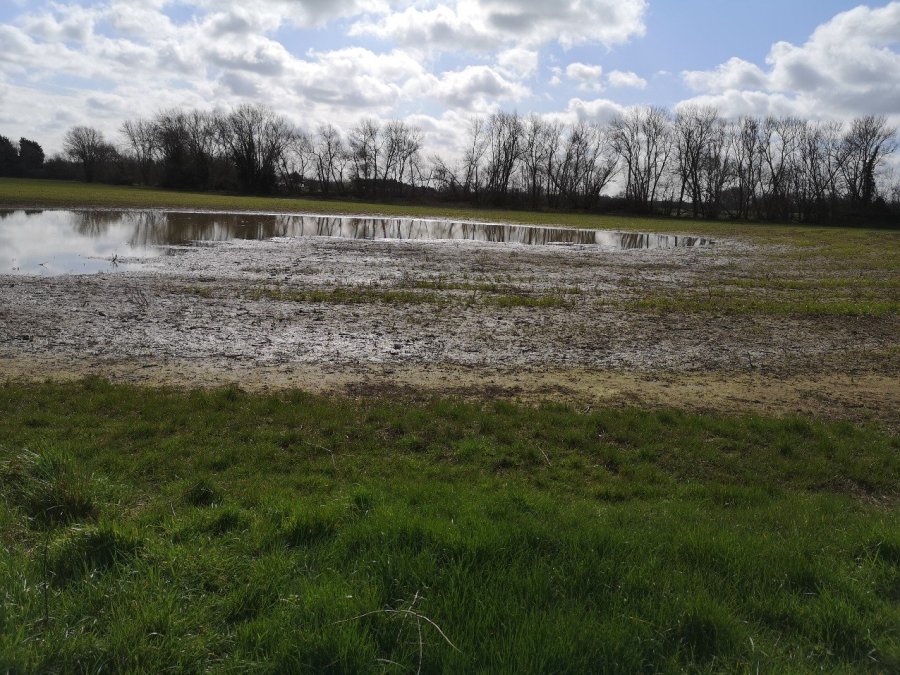
More excess water on the (slightly wonky) fields to my left
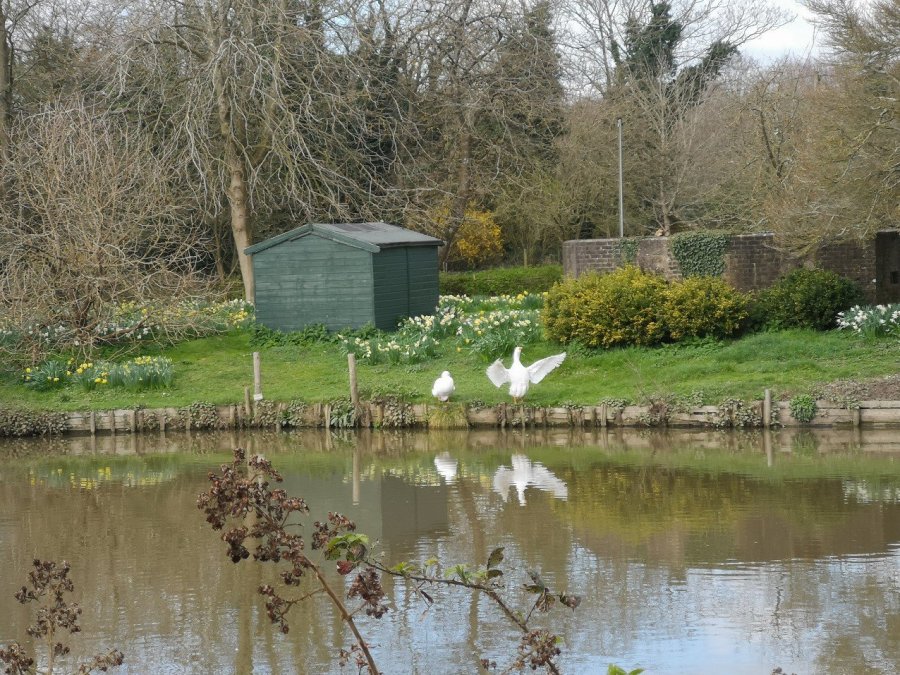
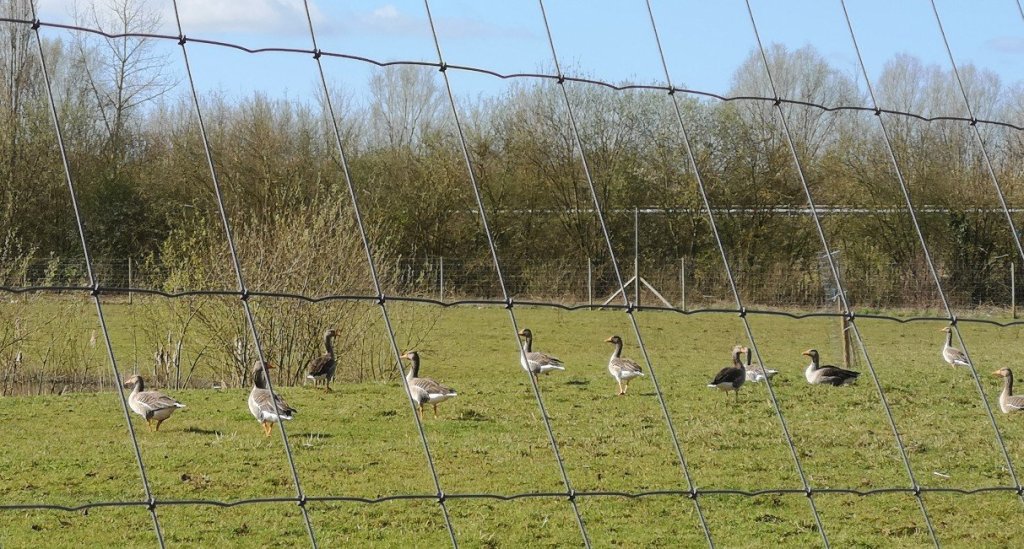
The Greylag geese were happy there
Where graffiti artists and pigeons congregate to make art and to coo
Which way? The clear sign posting at East Peckham
Coming up onto the road, I was in East Peckham with the food Co-op to my left. I spotted footpath signs up ahead pinting to the industrial area where they burn acrid things in backyards and the flooded woods are full of metal rubbish. Nevertheless, birds sang, woodpeckers clacked their beaks against bark, I spotted mallards and blackbirds, a thrush, a chaffinch – simply delightful.
Primroses
Across here to the weir
I was not clear which path to take at Sluice Weir Lock #6 located between the ‘River Walk Junction (Junction with the northern route to the railway bridge) (5 miles and 7¾ furlongs and 5 locks to the west) and Yalding Wharf (2 miles and 1 furlong to the northeast)’ also known as Branbridge’s Whark, Arnold’s Mill Lock, Pinkham. ‘Straight on to Hadlow and Golden Green, or over there to East Peckham which is very pretty’ said the male half of a couple I had been playing overtaking with for half an hour or so. They had a massive dog called Rudolf who, when he jumped up, was taller than me! I took the attractive route and they took the other. After all, we were supposed to be ‘social distancing’ which is possible but a bit weird – speaking to others with a 2 metre gap.
Note: a furlong is an eighth of a mile, 220 yards or 201 metres
Showing the footpath through the woods to Pinkham, East peckham – unclear. However, at the foot if the warm wood was a basking butterfly
A significantly older public foothpath stone with splashes of sunshine
I explored the lock a little and then perused the woods where a huge bumble buzzed around my feet and a robin warbled and squeaked alongside me. There was the first butterfly of the year – bright orange like the redbreasts chest – on my return I saw a uniformly delicate yellow one.
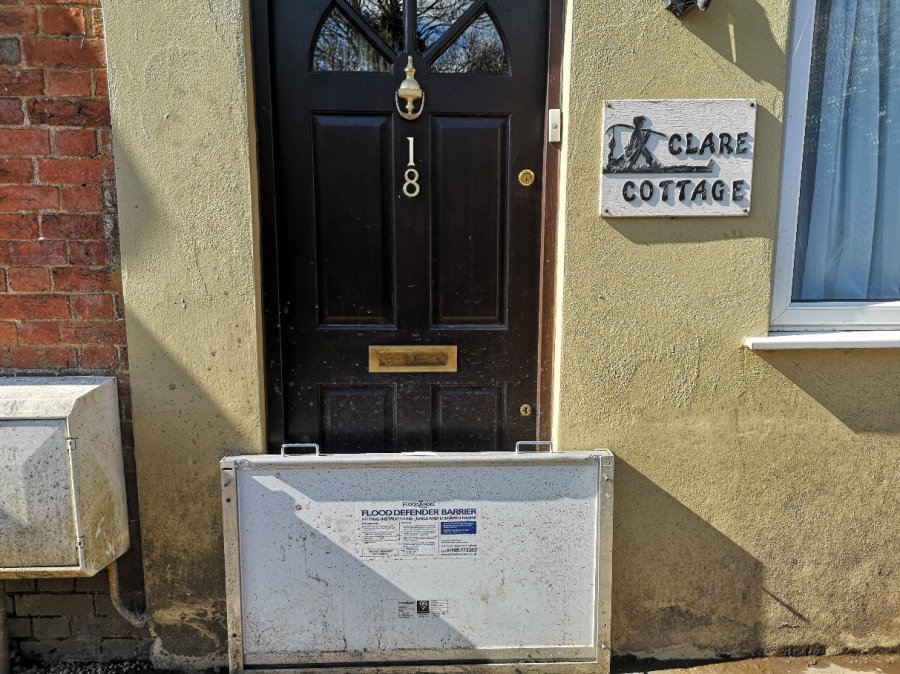
The little figure on the outside of Clare Cottage reminded me of a boy walking with a stick and victuals, but it maybe that he is a fisherman or something else
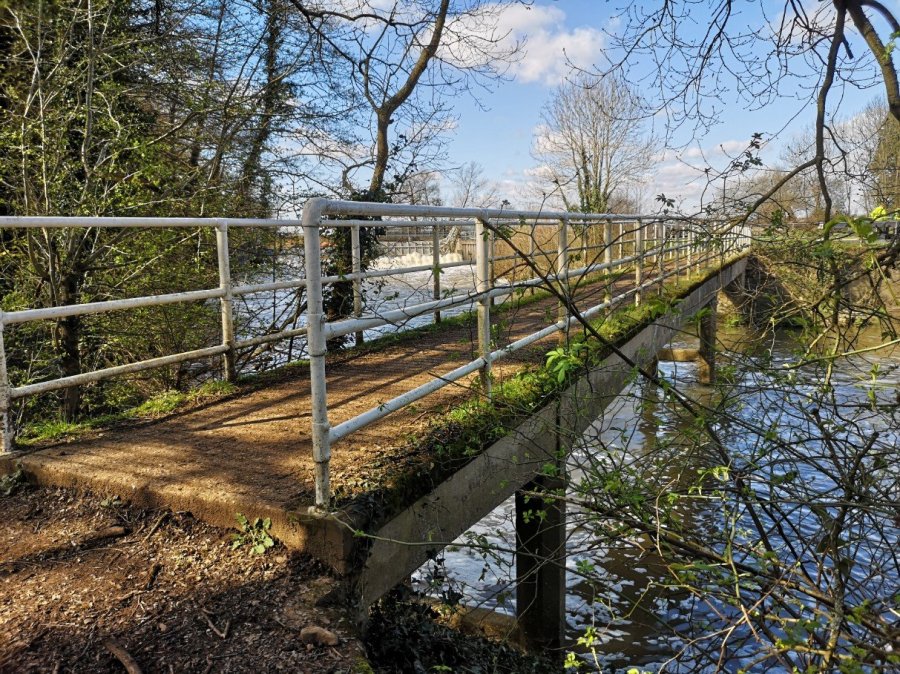
I meanered through the trees, across a pedestrian bridge and came out at a big house and paddock, then a row of cottages. The house plaque reminded me of Dick Whittington which I took as a good sign – a pilgrim if ever there was one, with his staff and pack over his shoulder.
Popular legend makes Dick Whittington a poor orphan employed as a scullion by a rich London merchant. He ventures his only possession, a cat, as an item to be sold on one of his master’s trading ships. Ill-treated by the cook, Dick then runs away, but just outside the city he hears the prophetic peal of bells that seems to say “Turn again, Whittington, lord mayor of great London”
I came out by bus stop on Old Road, East Peckham, opposite the street with the General Store and post office. The sun was warm and my 1.5 hours almost up before turning back. Retracing my footsteps and having a seat on the steps of the bridge, an satsuma revived me. I watched a cat emerge from the woods. She caught sight of me and took a sharp angle to avoid contact. There was a squirrel, but no chatter nor conversation.
Classical, traditional Kentish oasthouses – I liked the way the garden shrubbery was the same colour as the roof
I waved at a woman sitting under blossom reading. She had on a cardi which exactly matched the house and brown-red bush to her left. It tuned out to one of my mother’s friends – a village is a small place. She was bemused, not knowing me at all.
This walk took me just under 3 hours from yalding High Street to Pinkham and back along the river (allowing plenty of time for photo taking!)
It could almost be a gingerbread cottage, were it not for the sandbags at the door – protecting the cellars from the flood waters which have engulfed parts of this village three times this winter
Walking keeps my energy flowing so I find I can be kinder. It does no-one any harm, and it feels as if it boosts my immune system. Do you like to walk? What effect does it have on your spirits?
Camino Portuguese da Costa – Days 7 and 8, September 25th – 27th 2019
La Guarda / A Guarda, Galicia, Spain
La Guarda is in Spain, even though it is a town on the Portuguese Camino. I was happy to be back in Galicia, one of my favourite parts of Spain. I should have liked to see the Celtic hill fort and village of Castro de Santa Trega which connects with Scottish history (I live in Edinburgh) on the top of the hill that La Guarda sits beside, but I was not comfortably ambulant.
In the morning, I walked a short way (30 minutes, 2 kilometers) from the Albergue Municipal in La Guarda where I had spent the night, to visit the churches, but it was a strain and took me much longer than it should have. As a result of the pain in my foot, I decided to turn back and take a different route.
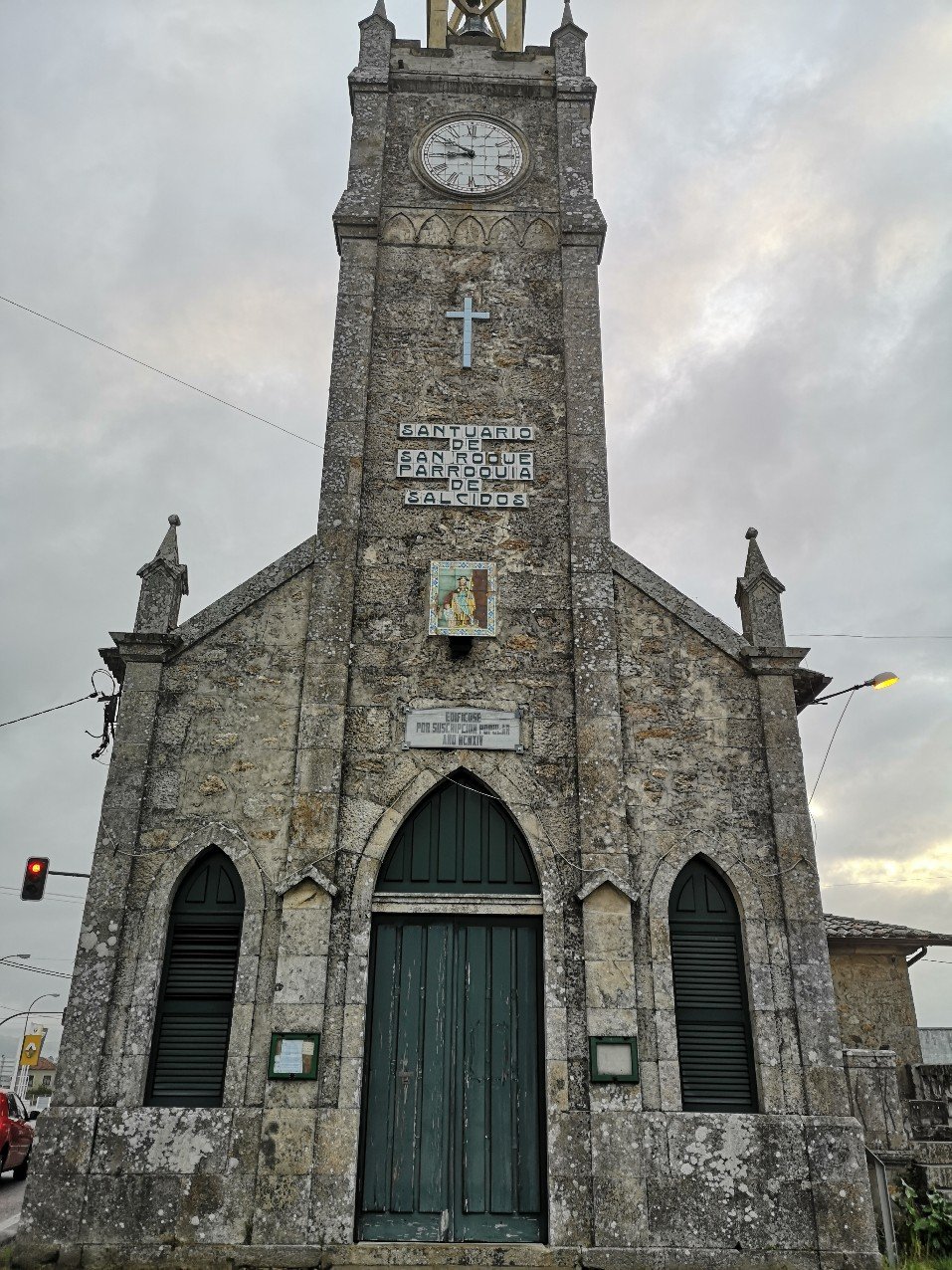
Santuario de San Roque, Parroquia de Salcidos with Saint James in the front
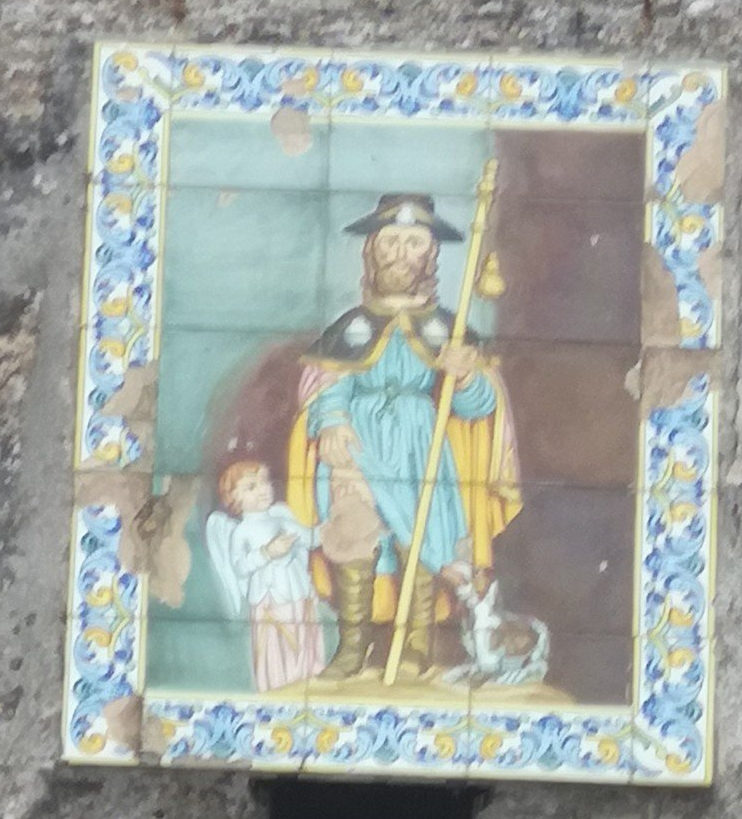
St James carrying his crook with wearing his hat with the camino shell on it. Also with an angel and a dog. Apologies for the quality of the photo, but I thought they were charming tiles
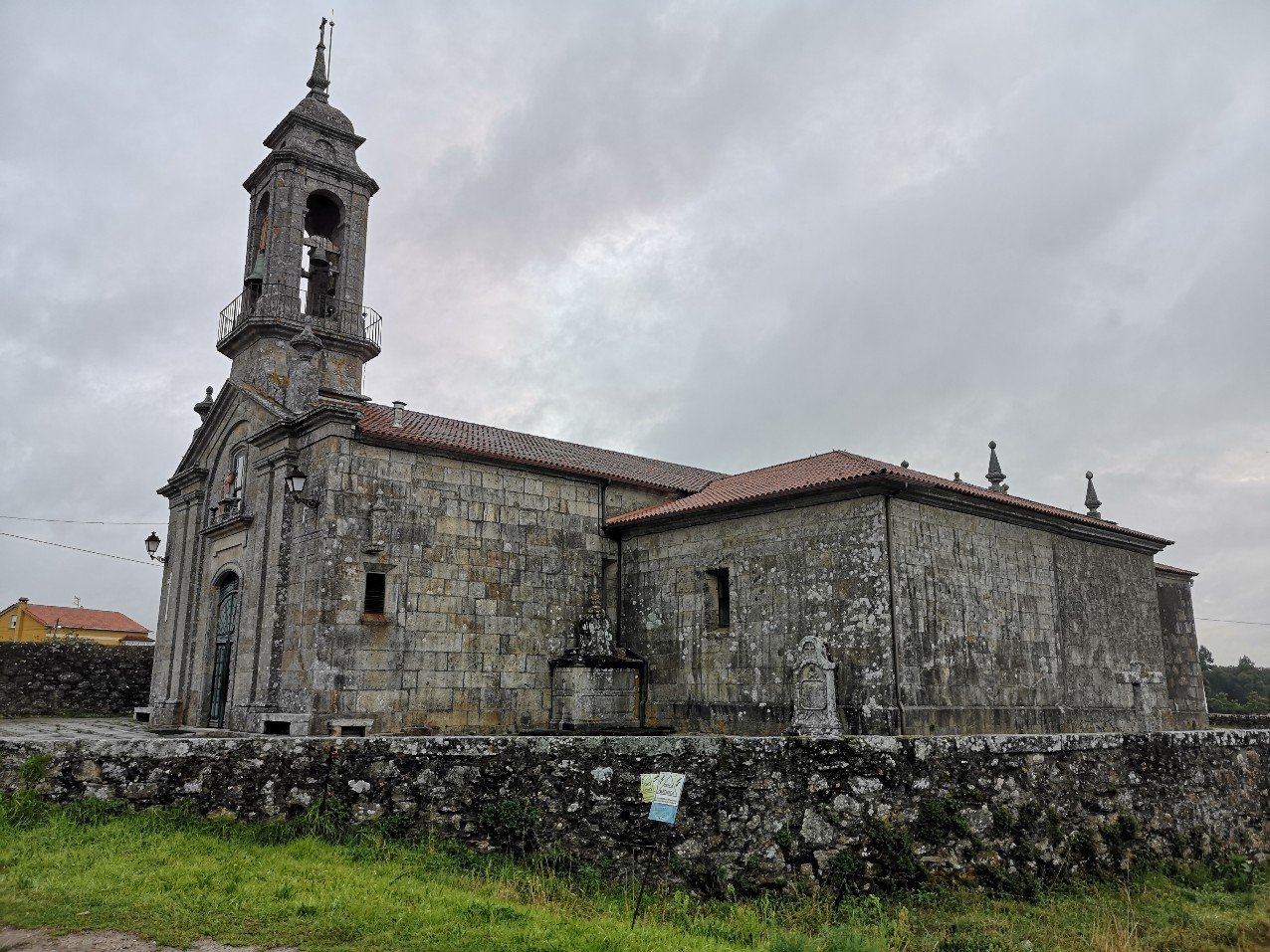
The two churches (above and below) are almost next to each other and I was the only one there. A few people were on their way to work and school, on the main road, and the churches were closed as they always are unless there is a service on. However, I admired their grandeur and solidity, the Santuario de San Roque having seen many pilgrims over the centuries.
Igrexa Parroquial de San Lorenzo de Salcidos, Portugal
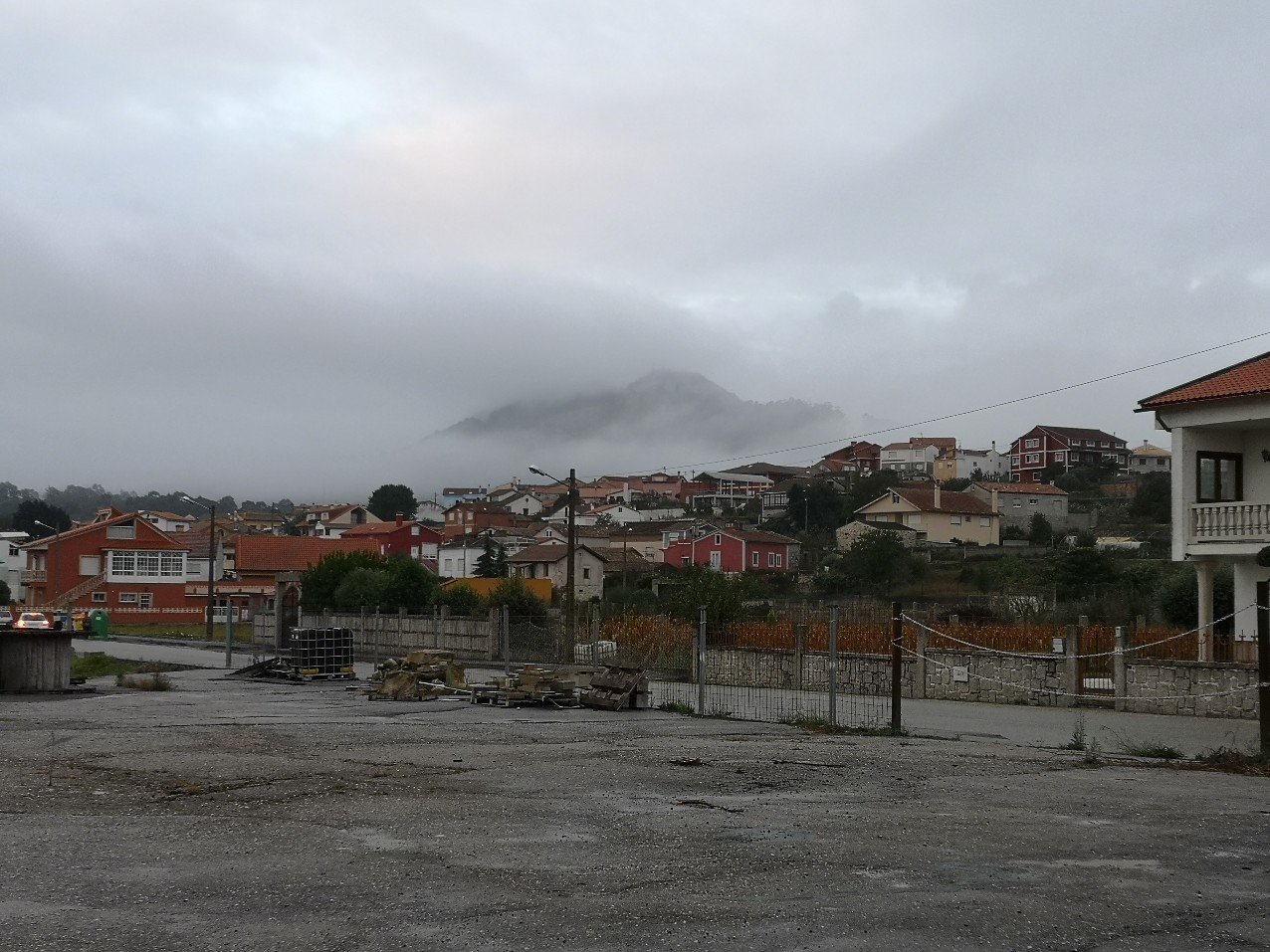
The mountain was just visible above the clouds as I looked from Salcidos, a borough of La Guarda, Spain
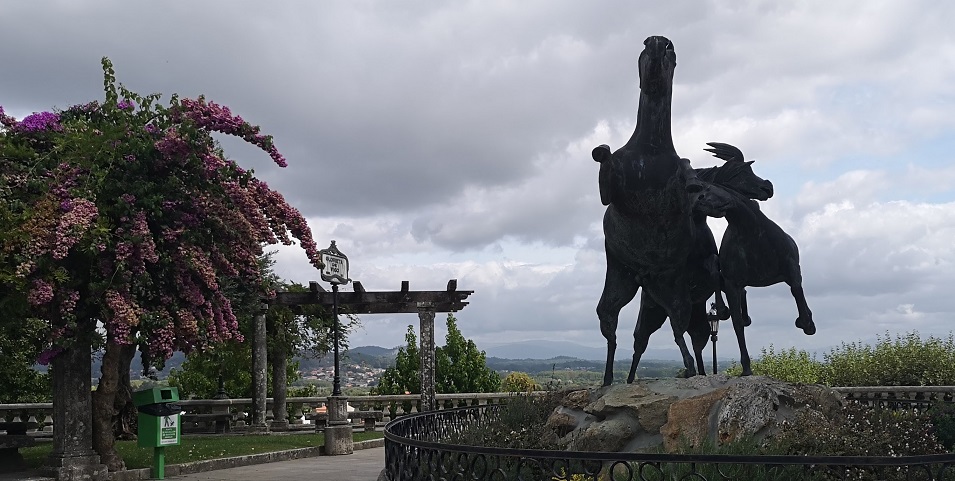
Then I rested for 20 minutes and took the bus. It runs from Salcidos to Tui (get off / on near Repsol gas station (estacion de servicio) on N-550) regularly and takes around an hour. This was the second day that I could not walk, something that had, thankfully, never happened to me before, and it was very hard to accept. The journey took me through urban areas with grey stone buildings boasting elegant balustrades around the windows, along the northern side of the River Miño, and deposited me opposite some public gardens bright with bougainvillea and sporting a grand metal statue of cantering horses, the Monumento al Caballo Salvaje.
Monumento al Caballo Salvaje (wild horses monument) in the park, Glorieta de Vigo, Tui, Spain
Tui
Tui is a busy city, full of hustle and bustle and with all facilities you could possible need. There is an excellent market, with cafes and shops galore. Not far from the Albergue is a friendly eating place / hostel (Albergue Ideas Peregrinas – not the cheapest, but with a European atmosphere and great, healthy breakfasts, including vegan food), and that is opposite one selling crêpes, and so on…! All tastes are catered for and many people holiday here even if they are not hiking. There is an extensive Natural Park to the north west with hills, Monte Aloia, for excellent views of Baiona, Vigo and the whole region.
I picked up a copy of Jim Crace’s The Melody in the hostel the night before and made the most of my enforced resting time to have a good read. Described as a meditation on grief, it connects with all my recent writing on the subject – there’s no such thing as a coincidence!
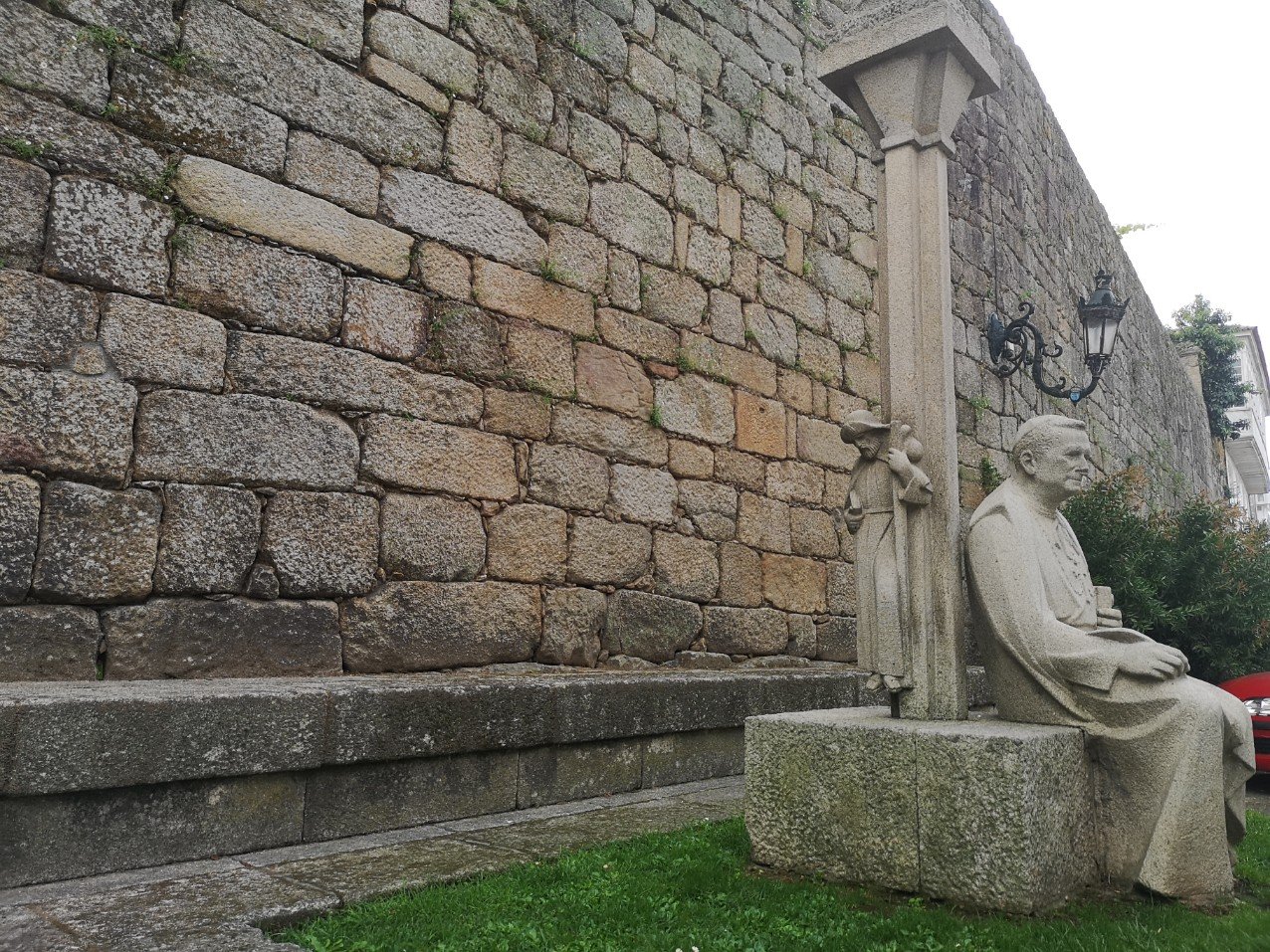
See St James peeking out from behind the column where Arzobispo (Archbishp) Lago Gonzalez (1865-1925) sits. His high cheekbones and benign expression make him look as if he is listening to a child telling him a story.
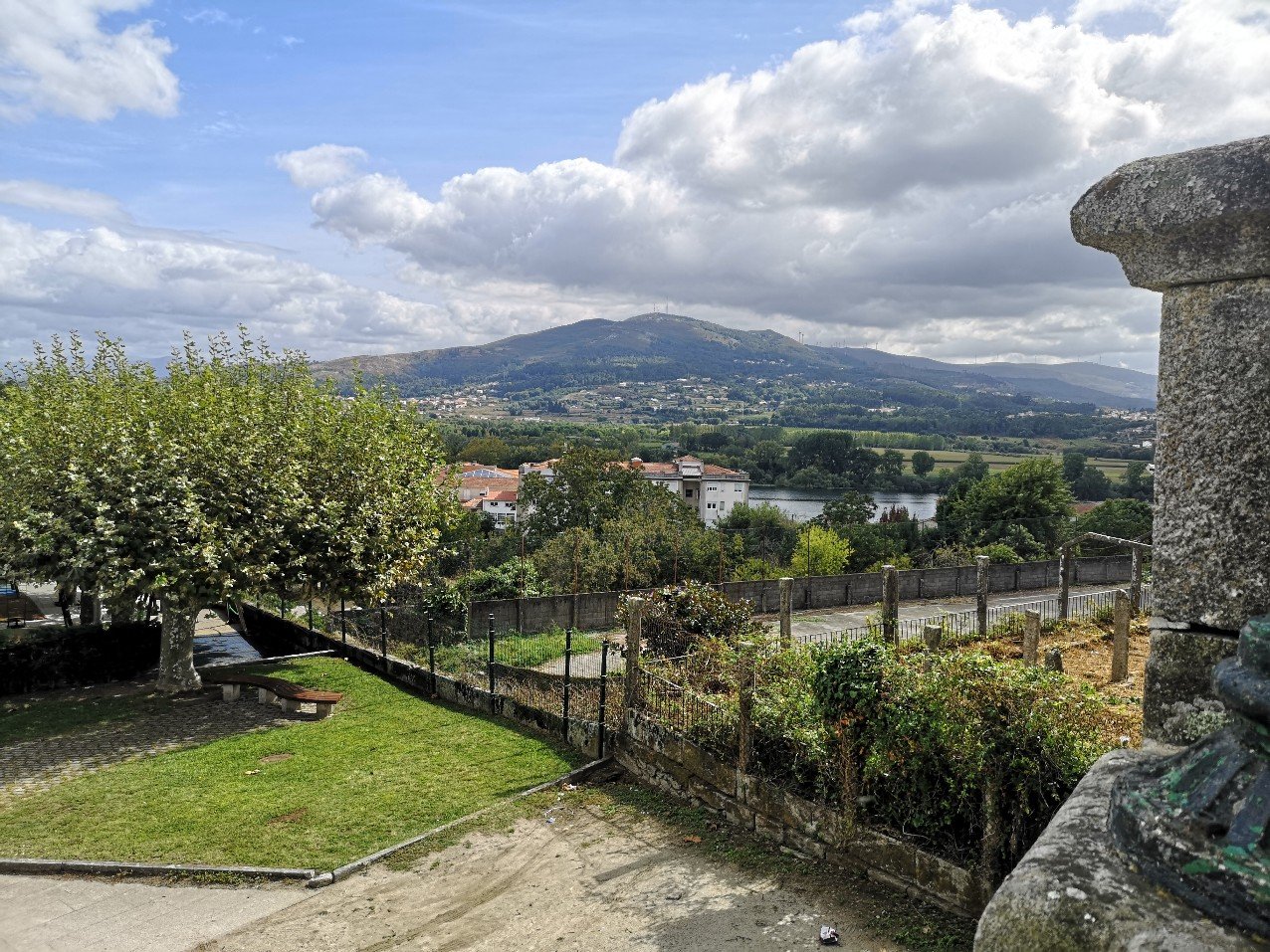
The location of the Albergue de Peregrinos is magnificent with views from the rocky hill across the river Miño and hills of northern Portugal
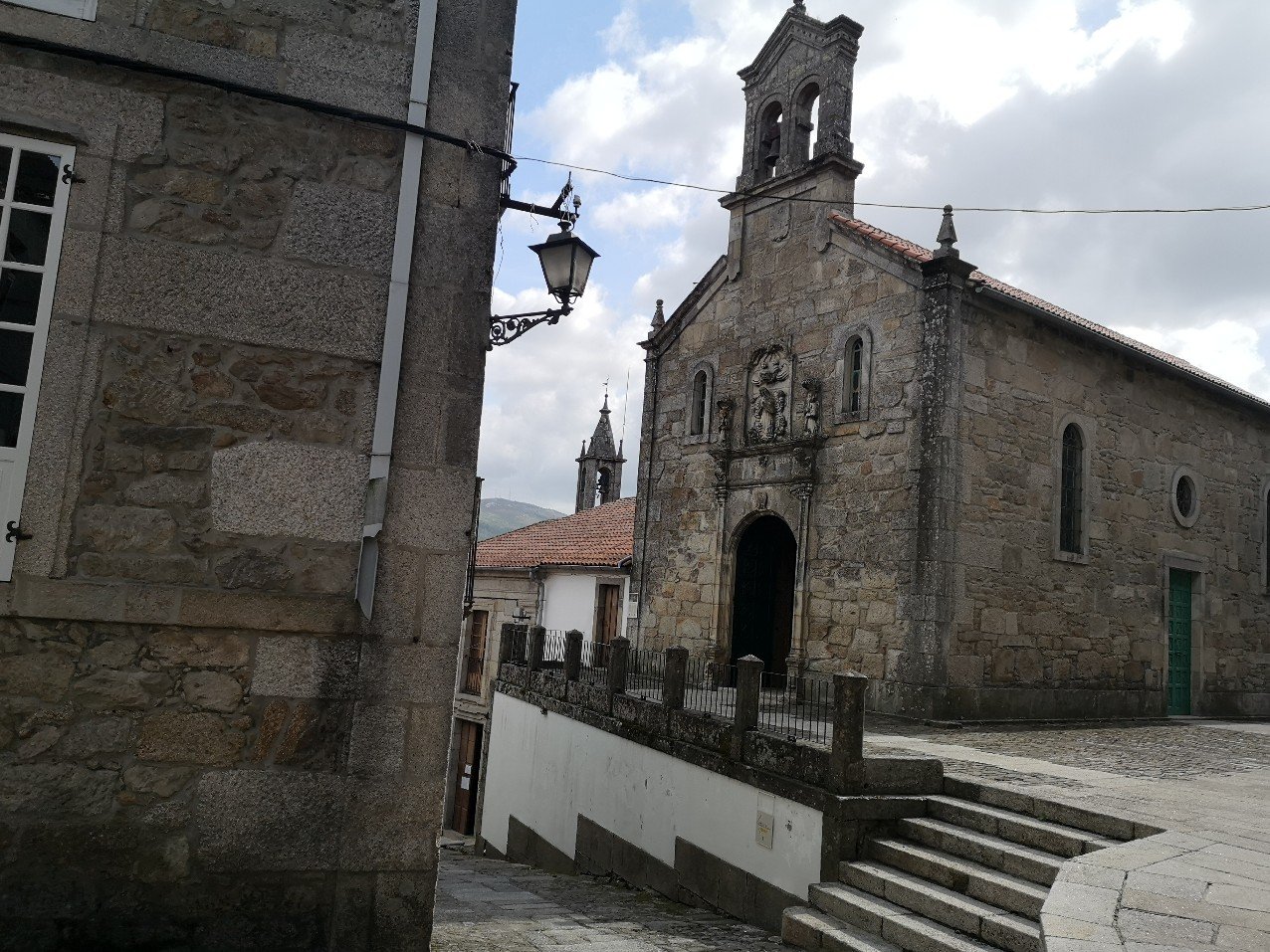
The Capela da Misericordia is right next door and only slightly uphill (Rua Parroco Rodriguez Vazquez) from the Albergue de Peregrinos. Situated at the back of the Santa Maria Cathedral of Tui, it is simpler and almost unadorned. Spain
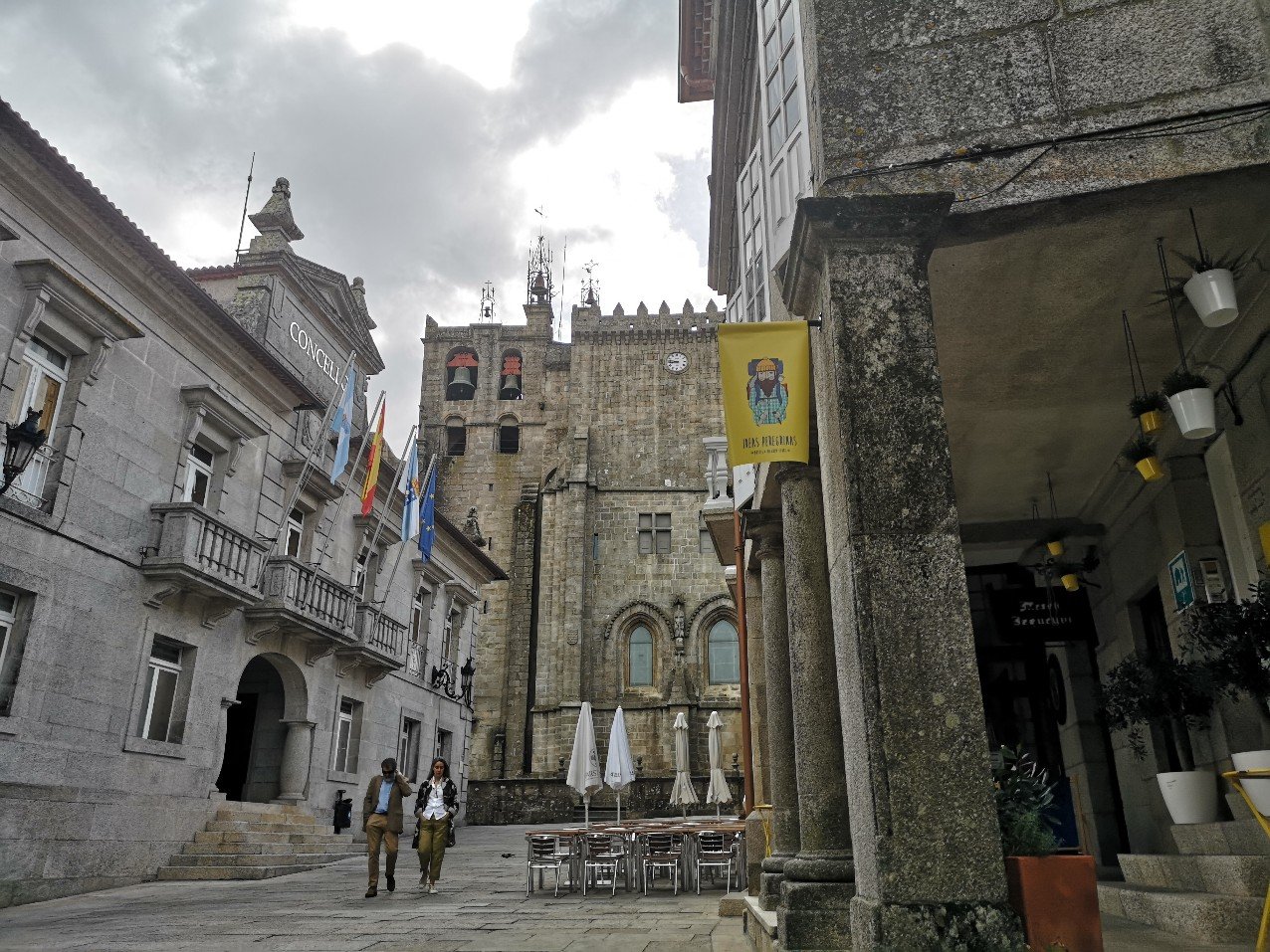
The hostel is wonderfully situated in this historic city. Elegant cafes are to the right of the Plaza da Concello, opposite the Concelo (the government offices of the social security finance department) and the Police. The side of the Santa Maria Cathedral is in the middle (in the background) and just past the flags, on the left and down the steps is the Albergue de Peregrinos, Tui, Spain
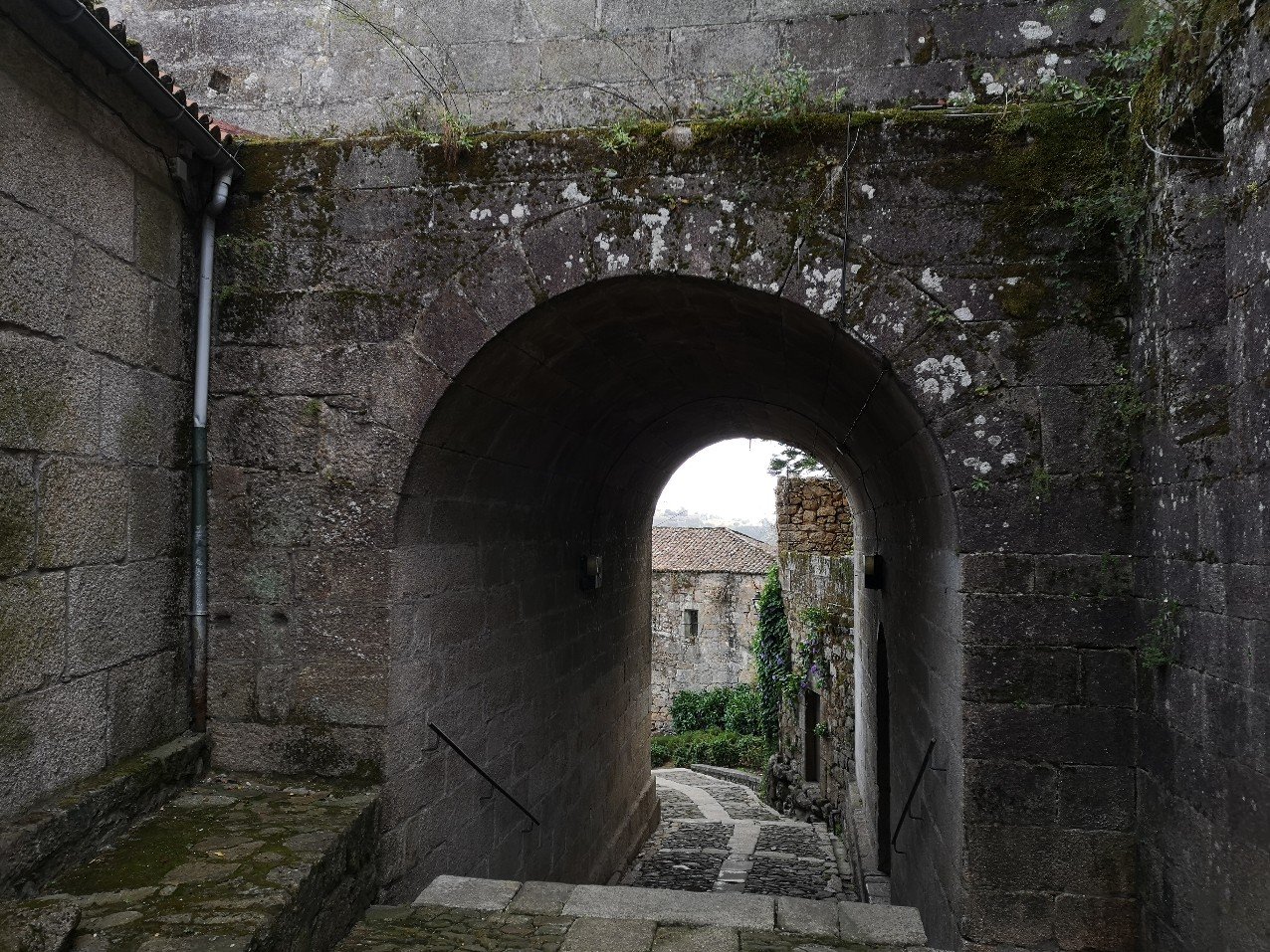
Through and archway in the eleventh century city walls you can see the old Roman street which predates it, giving a sense of the elevation of the town, Tui, Spain
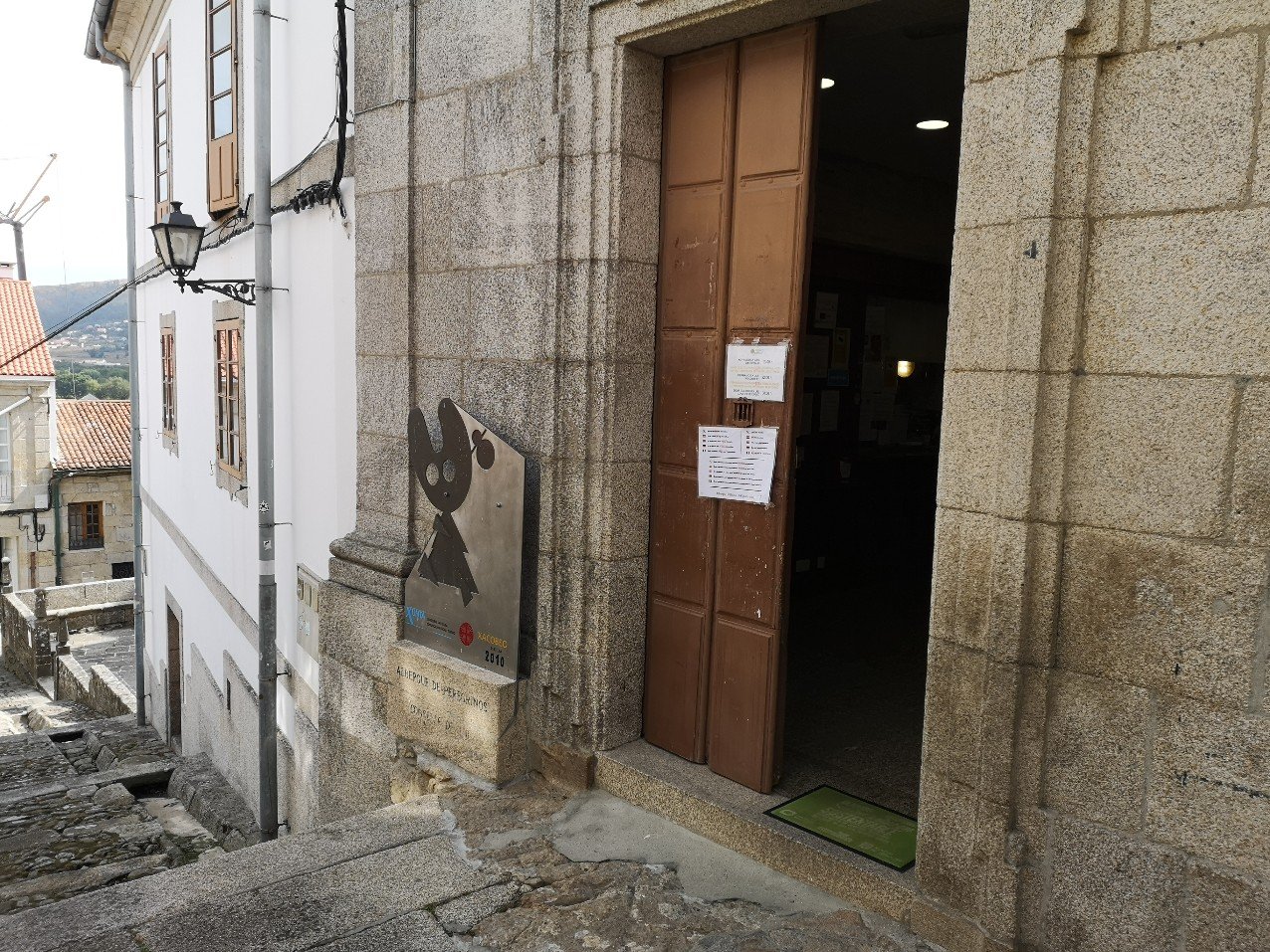
Entrance to the Albergue de Peregrinos with the typical Galician government, metal sign of a cartoon-type pilgrim with her water gourd over her shoulder, Tui, Spain
I was early into the town from La Guarda and encountered a difficulty: the hospitalera behind the reception at the hostel was talking animatedly to a gentleman who was lounging nearby. On seeing me, she launched into an attack on pilgrims who pretend to be walking, but actually must have come by public transport because they would never, otherwise, have arrived by this time. She laughed, he laughed, they compared notes and got increasingly irate about such behaviour.
I was dying to get the weight off my back and feet, and trying to explain in Spanish that I had not done this before, but had no choice with my foot pain. She ridiculed me and said I shouldn’t be carrying such a heavy load. It was most upsetting and as I became distressed she started to shout, saying that she wasn’t being nasty, just that ….
It is true that the municipal Xunta (the Galician council) albergues are for the pilgrims and that, increasingly, people are either not carrying their own packs or are taking buses and trains some or all of the way. It may have been an external voice, too, uttering the very words which I was hearing inside my head, and been part of my having to come to terms with being human and not always strong. Anyway, I said I would go away and then she started calming down and took me through the familiar process: passport check, credential stamp, payment (cash), and bedding. I was shaken.
It is a large hostel with solid wooden bunks. Although there is a sitting area where you can eat inside at the back, the kitchen is across the little garden and so I sat there for my tea as the sun set and it cooled down.
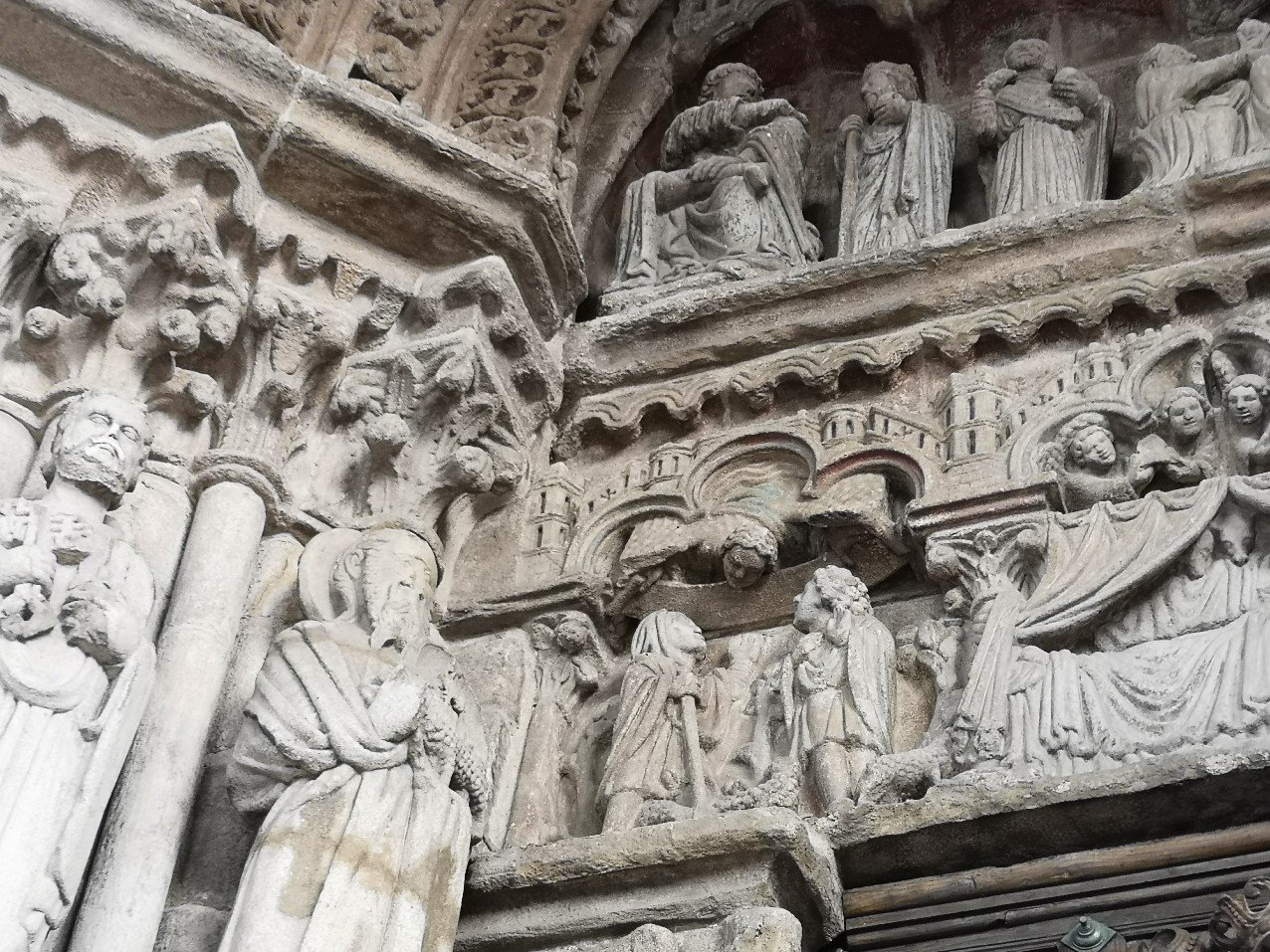
I delighted in the little face peering over as if she was having a chat with what look like two shepherds (there is a lamb at the feet of the right hand character). Catedral (cathedral) Santa María, Tui, Spain
You can see the beautiful cloisters and internal gardens of the Santa María Cathedral de Tui in the photos on their website.
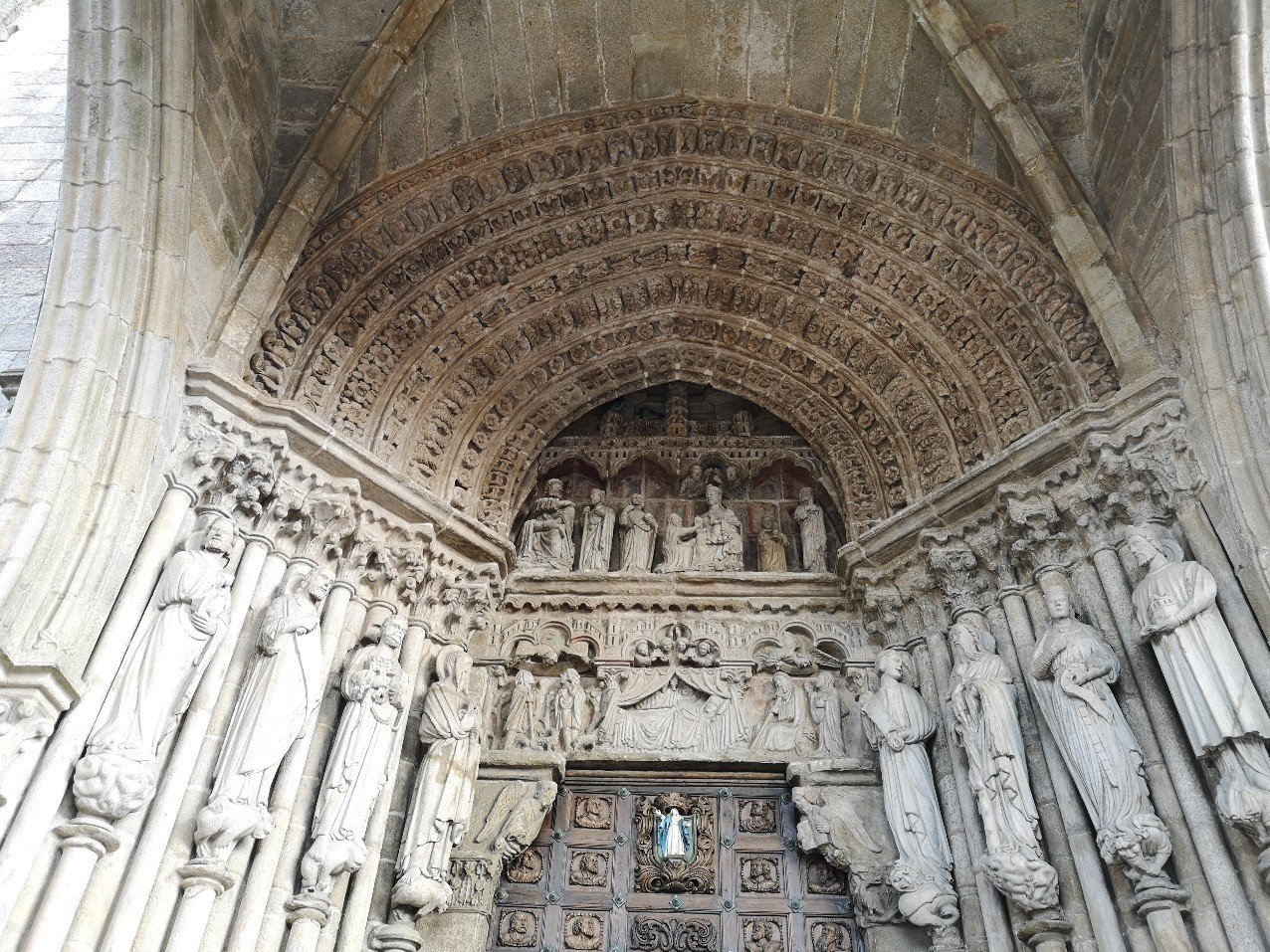
The very grand entrance to the Santa Maria Cathedral on San Fernando Square, Tui, Spain
The tourist information is also in San Fernando Square and the staff are extremely helpful and kind there.
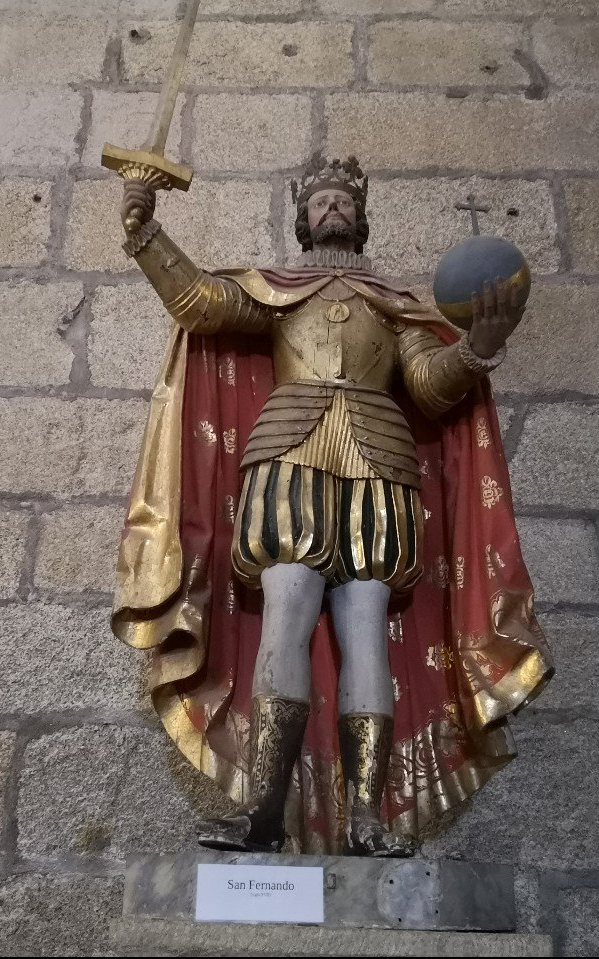
The seventeenth century, richly attired King Fernando carrying a sword and globe with a cross on it representing the might of the expansion of his Catholic empire around the world
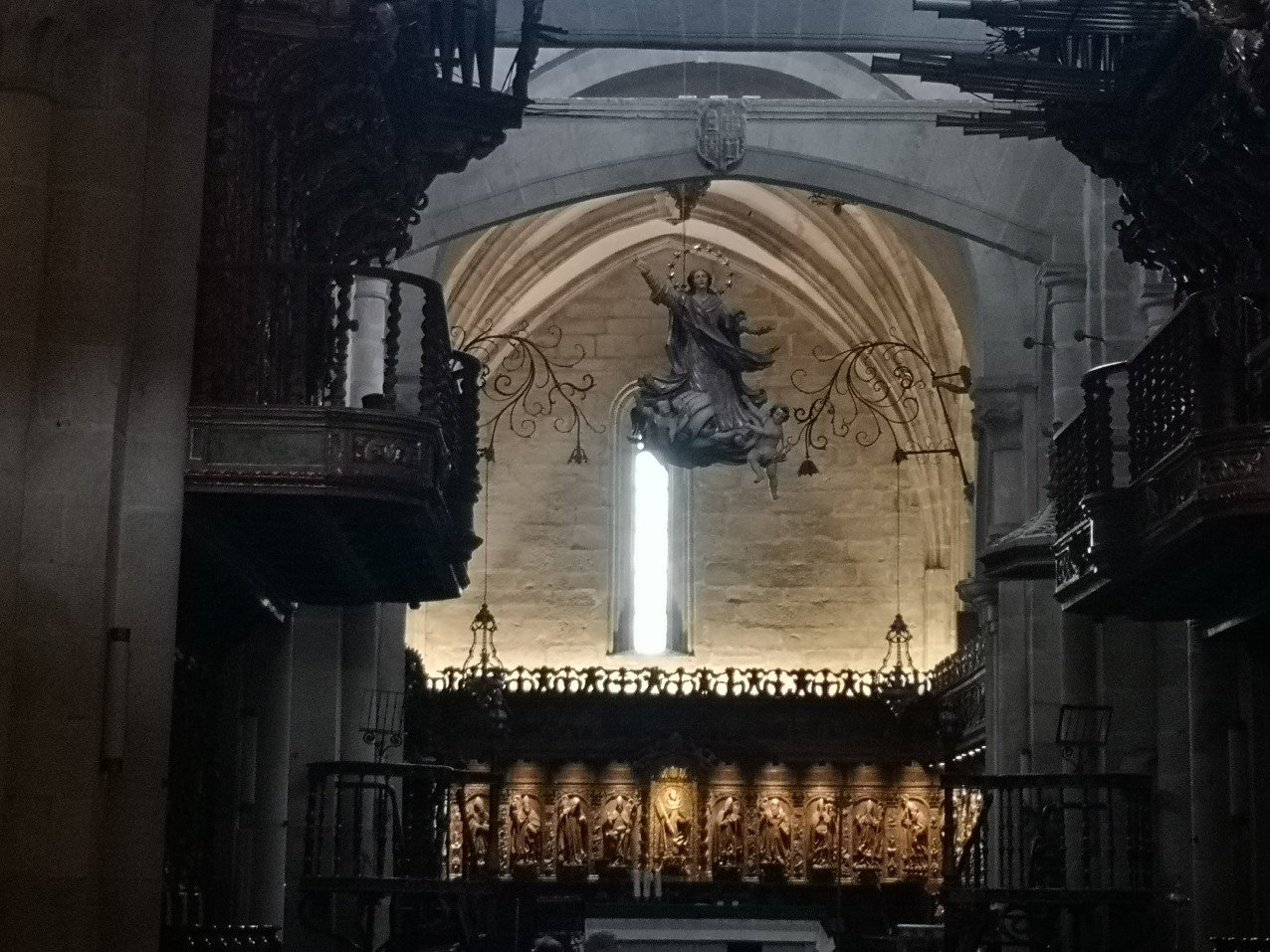
The Virgin with a halo of golden stars, robes flying and cherubs dangling in the interior of the Cathedral Santa María, Tui, Spain
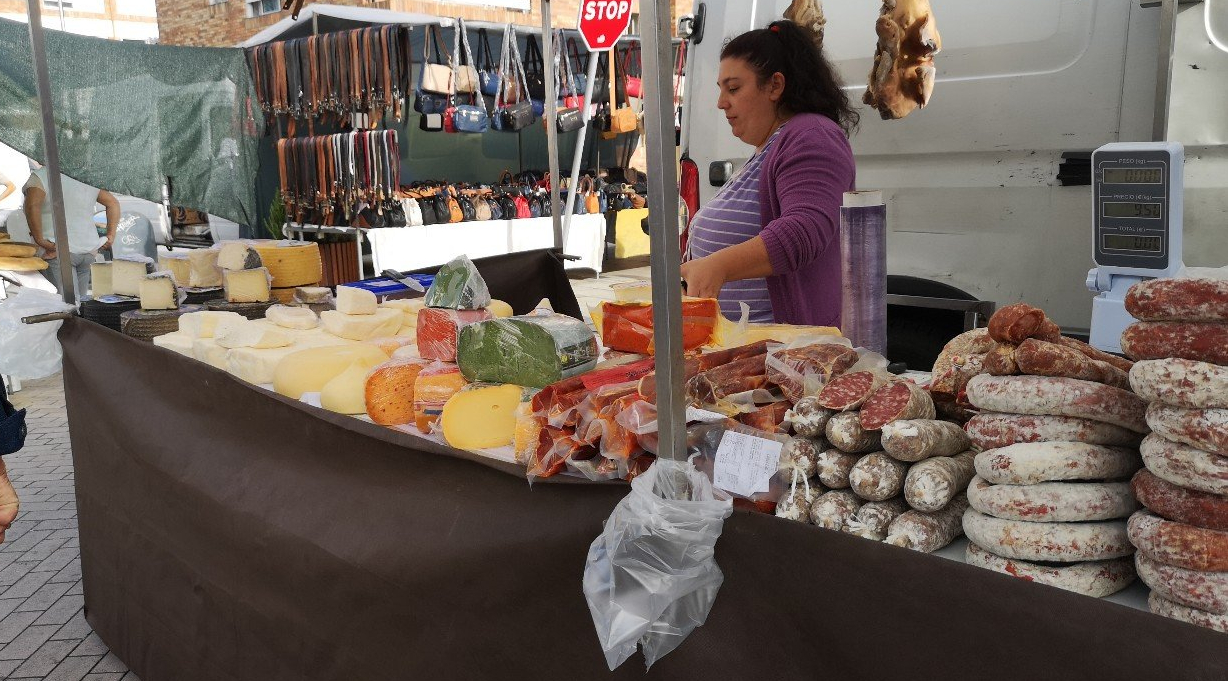
Market stall with salami and cheese – local products of the area, Tui, Spain
Tui to Mos
It is 25 kilometers to Mos and even though I had rested up for 2 days (well, a lot less walking than usual), it was too far, so I took a bus part of the way and trekked the rest (only 8 kilometers) to see whether I could manage. It was such a beautiful day and I was so happy to be on my feet again under the blue sky.
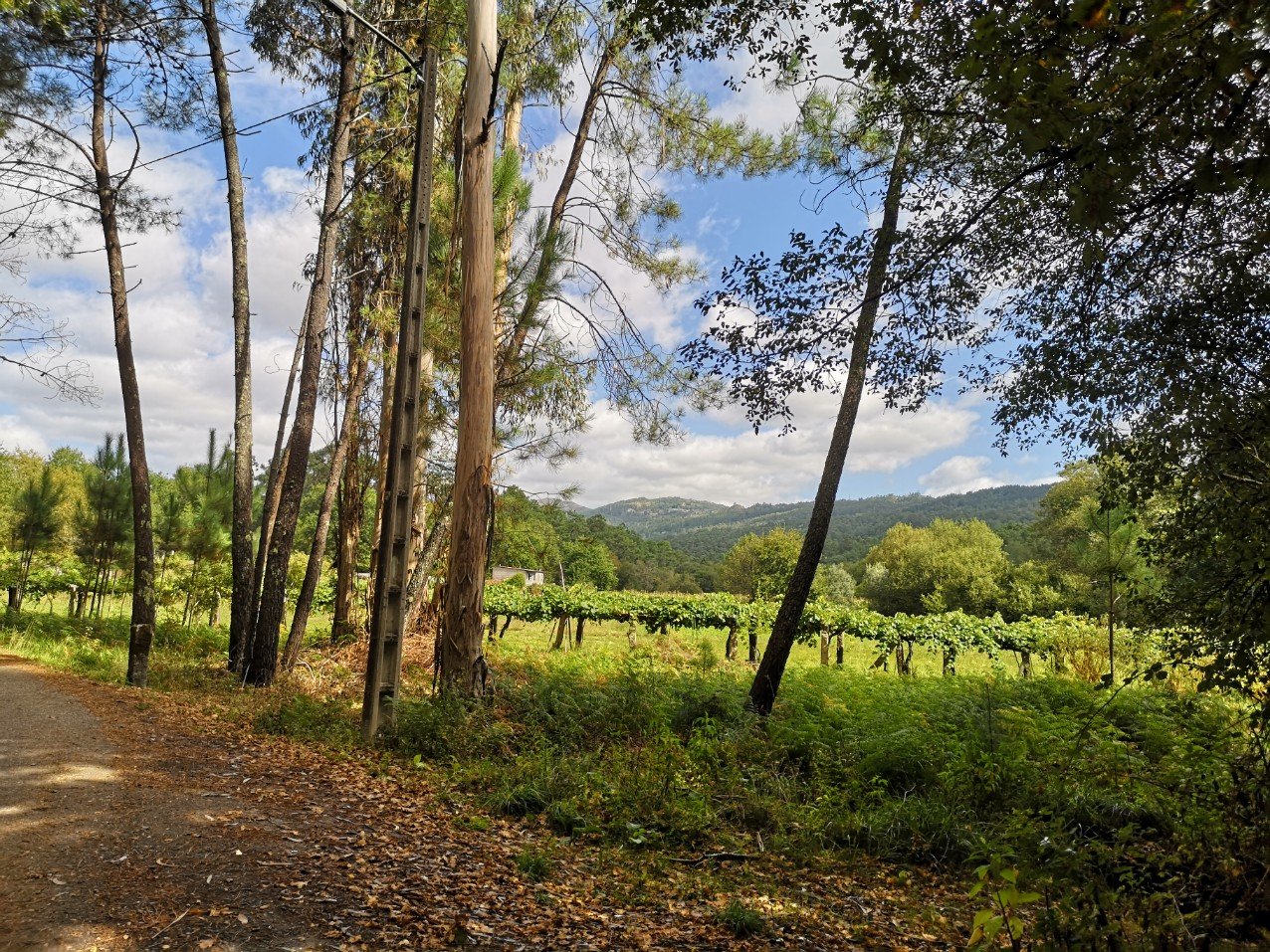
Vines loaded with dusky black jewels are spied between tall, thin trunks with mountains in the distance
I am walking along the Via Romana XIX linking Braga and Astorga, enjoying listening to the birds and smelling the countryside after being in towns for the last few days. Sometimes the signs are hidden amongst pink roses. In the distance the open fields are empty now after harvest.
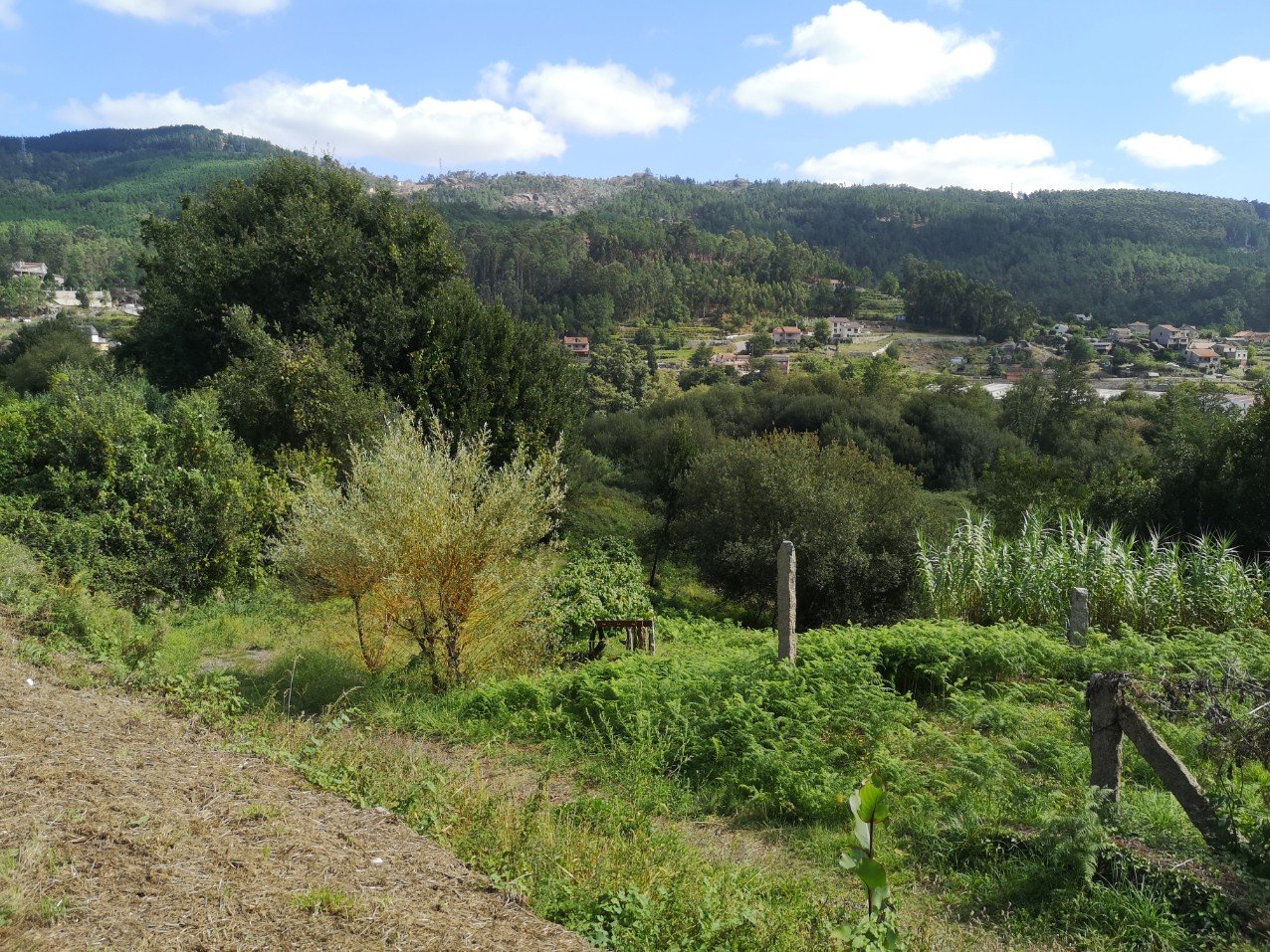
Ferns and lush farmland. The Mos population is spread across the region, with no one major centre. It is at a relatively high altitude commanding open views
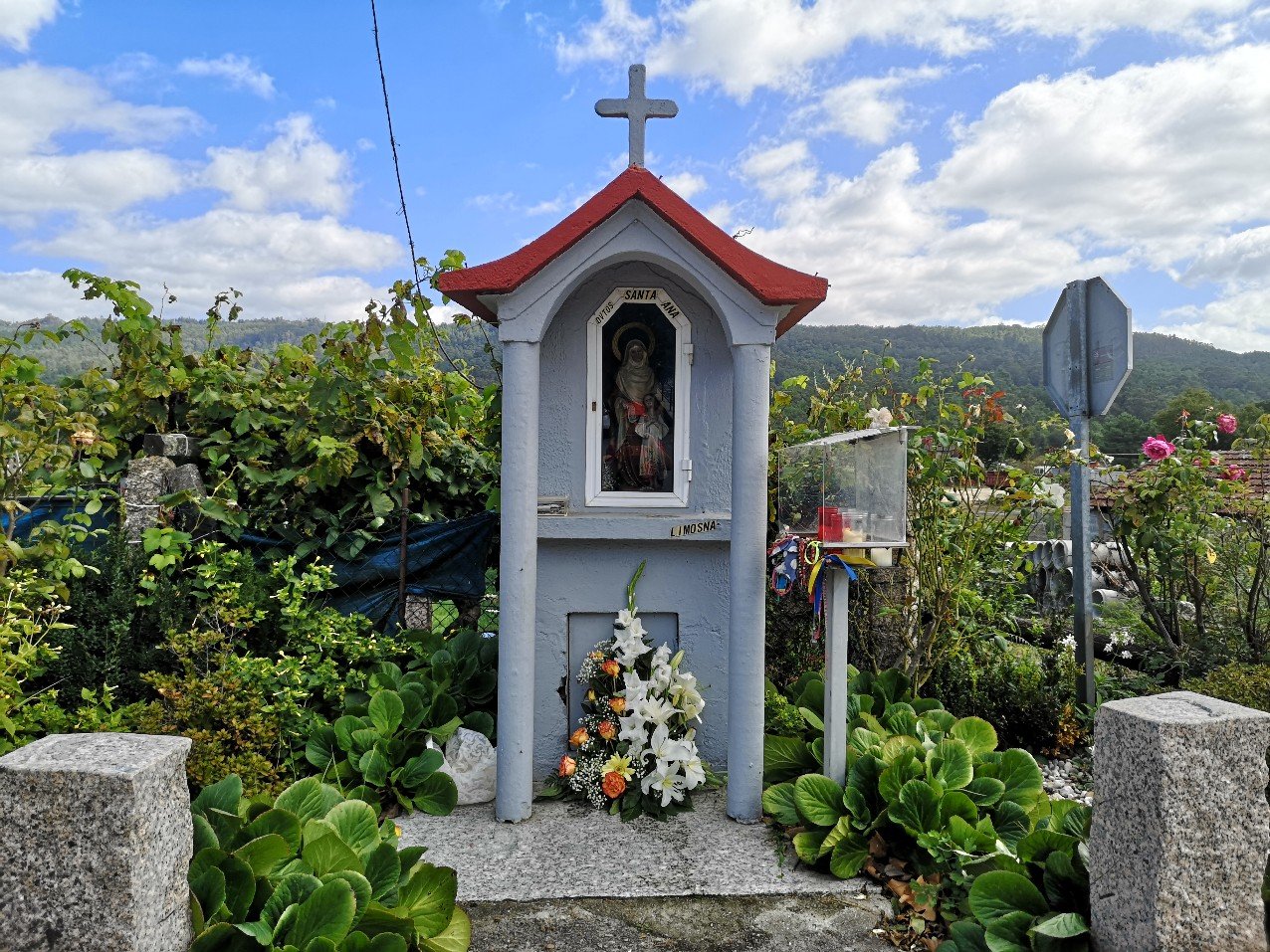
This quiet area has a respectful energy about it with fresh lillies and roses decorating this wayside shrine
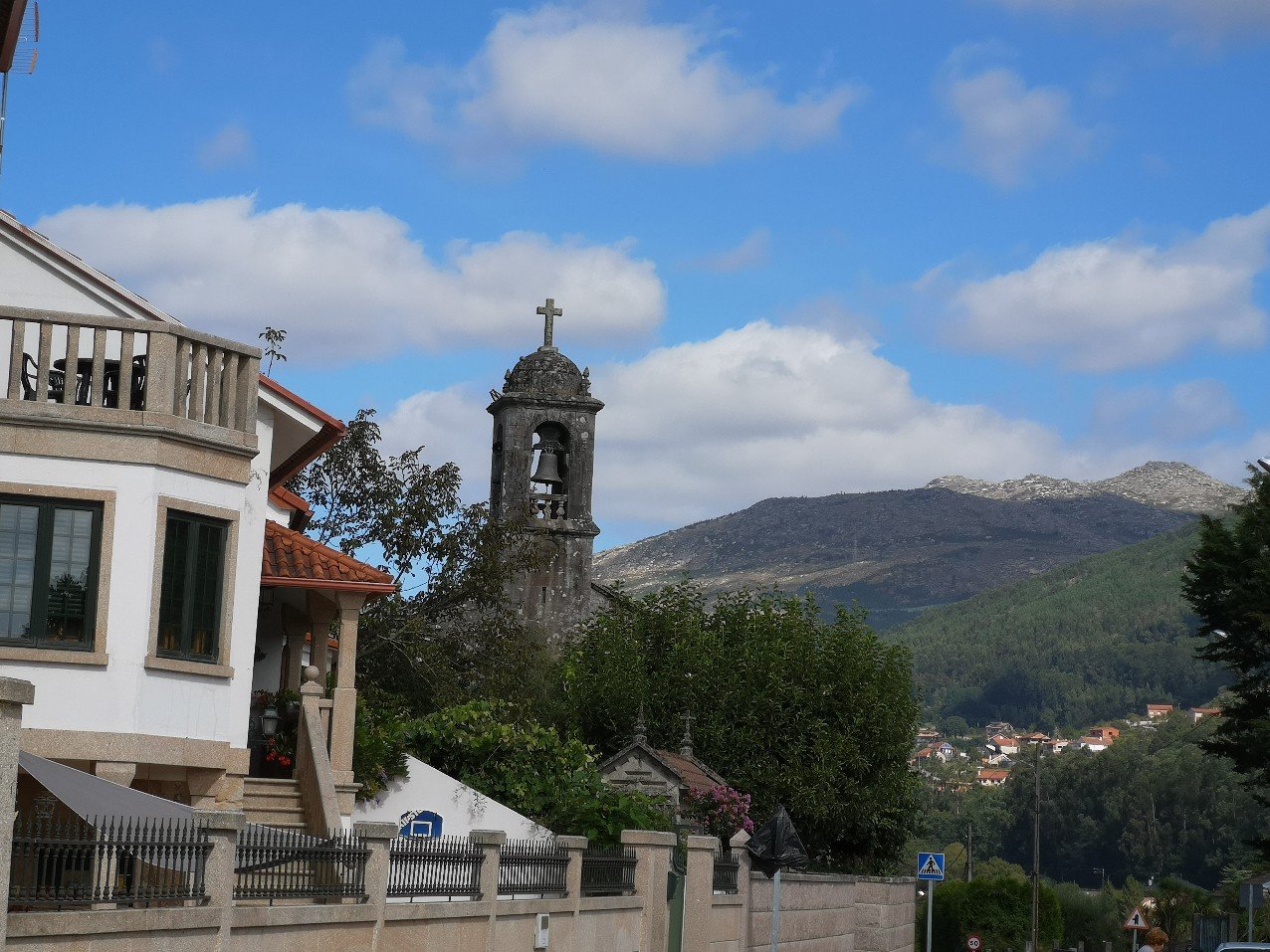
Belltower of the Iglesia (church) Santa Eulalia. Nearby there is a very tall column with a crucified Christ at the top. It is a well-to-do area in places with carefully kept gardens (white camelias were spotted) and expensive cars, not like some parts of Galicia on the Camino Frances
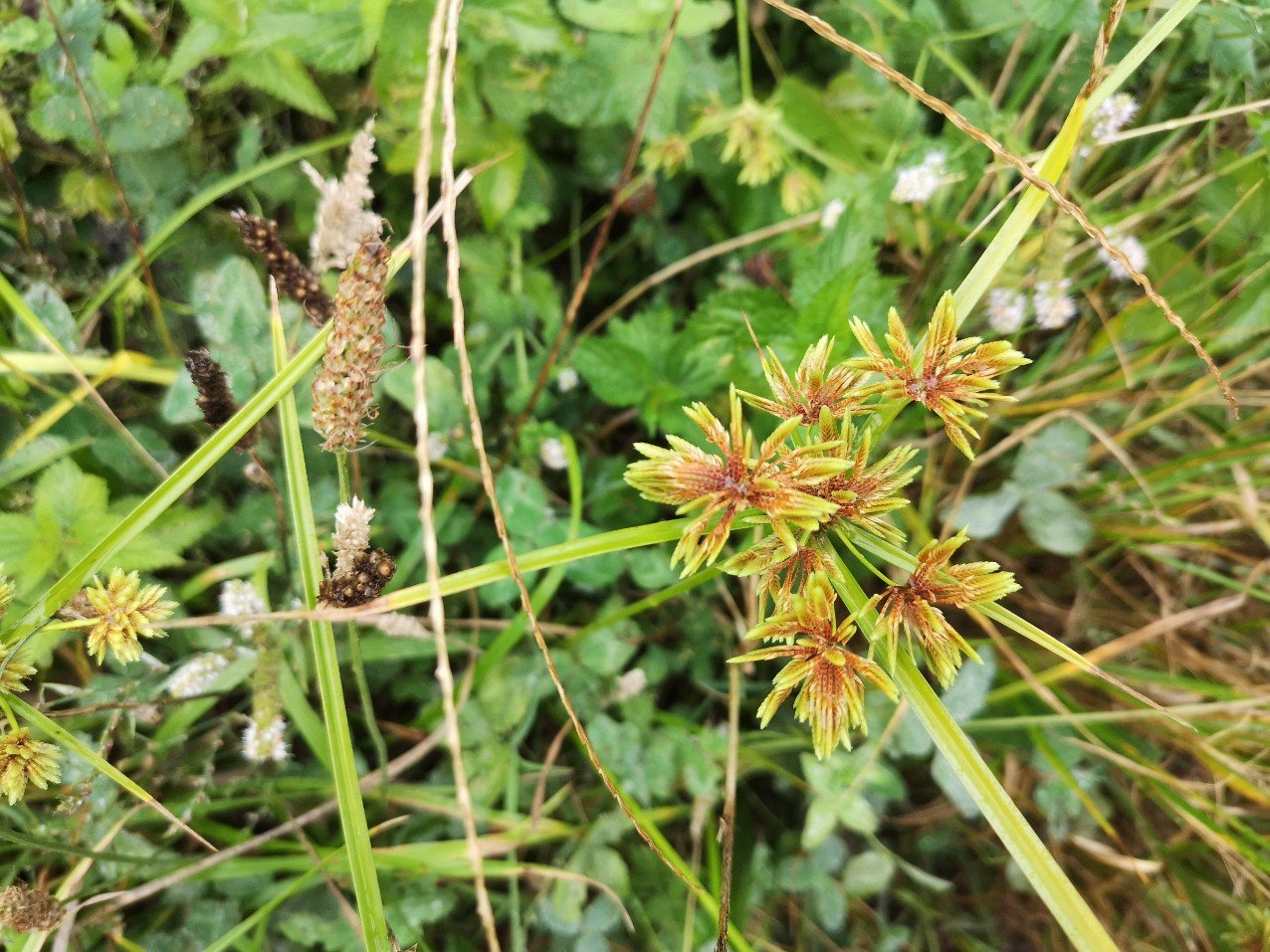
Beautiful tall flatsedge, nutgrass or umbrella sedge (Cyperus eragostis)
There is a native, milky coloured drink called horchata de chufa or horchata de Valencia which is the region where I first came across it. It is made from the tubers of the nutsedge (not the type in the photo above). (Thank you to floral_uk on the ‘name that plant’ forum of houzz.com for this information). It is similar to a Mexican version except that the latter is made from rice, not this sedge.
Mos, Galicia (Redondela Region)
I stayed at the Casa Blanca hostel near the Santa Baia church where I sat in the evening. The albergue is new with a bar that serves ice cream and snacks, and there is a restaurant oppostite which cooks wonderful Padron peppers and does breakfast as well as evening meals. The accommodation is in a separate building and all are situated on quite a hill. There is a coin-operated washing machine and I shared a load with others after much negotiation, however there is not enough room to hang the clothes to dry outside and, anyway, it was already cold at night so my things had to come in at bed time to avoid being damp by morning.
I went up looking for a fruit and veg shop. Instead, I saw a man on the top of a ladder picking grapes who told me I had gone in the wrong direction. On the way back down a woman pulled up in her car and spoke to me in French. She took me through to the back of her gradmother’s house (derelict) into the stepped garden full of fruit trees and picked figs. We stood and chatted over these juicy fruits and then she introduced me to her husband. He filled my shopping bag with massive bunches of black grapes for sharing with the other pilgrims back at the hostel. I laid them on large fig leaves in the self-catering kitchens for folk to help themselves.

























 Walking without a donkey