The last few days, which I walked first going backwards from Santiago de Compostella – Outerio – Bandera – Laxe. In the direction of Seville (north to south)
Via de la Plata Camino – Day 22 (Tábara to Santa Marta de Tera). Wednesday 11 April 2018. 22 kms.
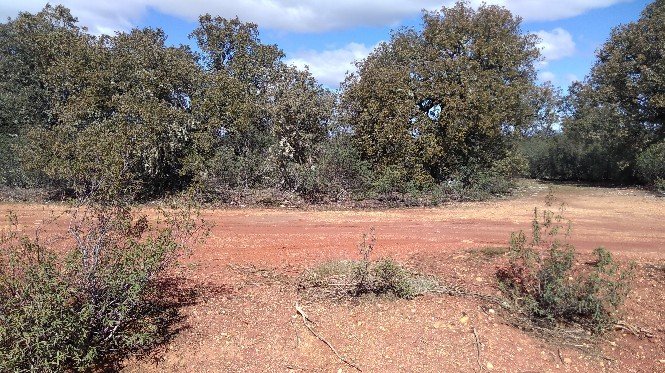
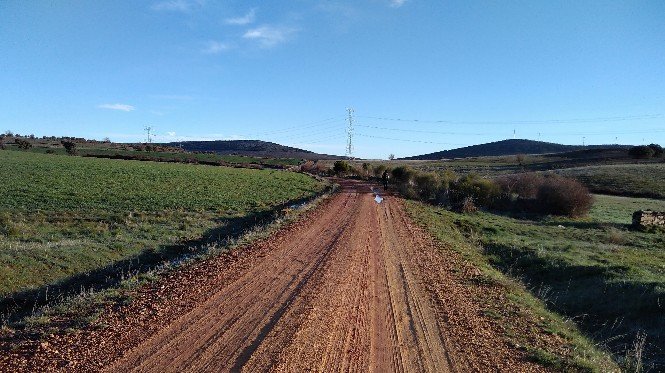
The red earthed path of the Via de la Plata, Castille y Léon, Spain
‘And what’s best is that you are always received without fuss, welcomed, as if they had been expecting you to come. ‘ From Ursula le Guinn’s Left Hand of Darkness
Not in Oliva de Plasencia! I was reading le Guinn on my Kindle while I travelled because it was the Leith Bookworms book and my friends were reading it at the same time. I liked to keep up even if I couldn’t attend the meetings. It can be a good challenge to follow the list because I read books I wouldn’t usually choose for myself, move out of my comfort zone. In this case I had never read sci-fi before but I knew that le Guinn was extremely well thought of (after all she is used as an important part of the plot in the decidedly mainstream Jane Austen Book Club film!)
José / Almeida
There was a photo session at the front door with José / Almeida (his pen name), the hospitalero who had looked after us so well, and then I set off with my friend Marie Noëlle and her pals Sascha (Luxembourg) and Maria (Switzerland) under a white sky. Sometimes we all three walked alongside each other, but more often I held back and took a quieter way, meeting up at intervals for coffee and wee chats.
Sascha, Maria and Marie Noëlle
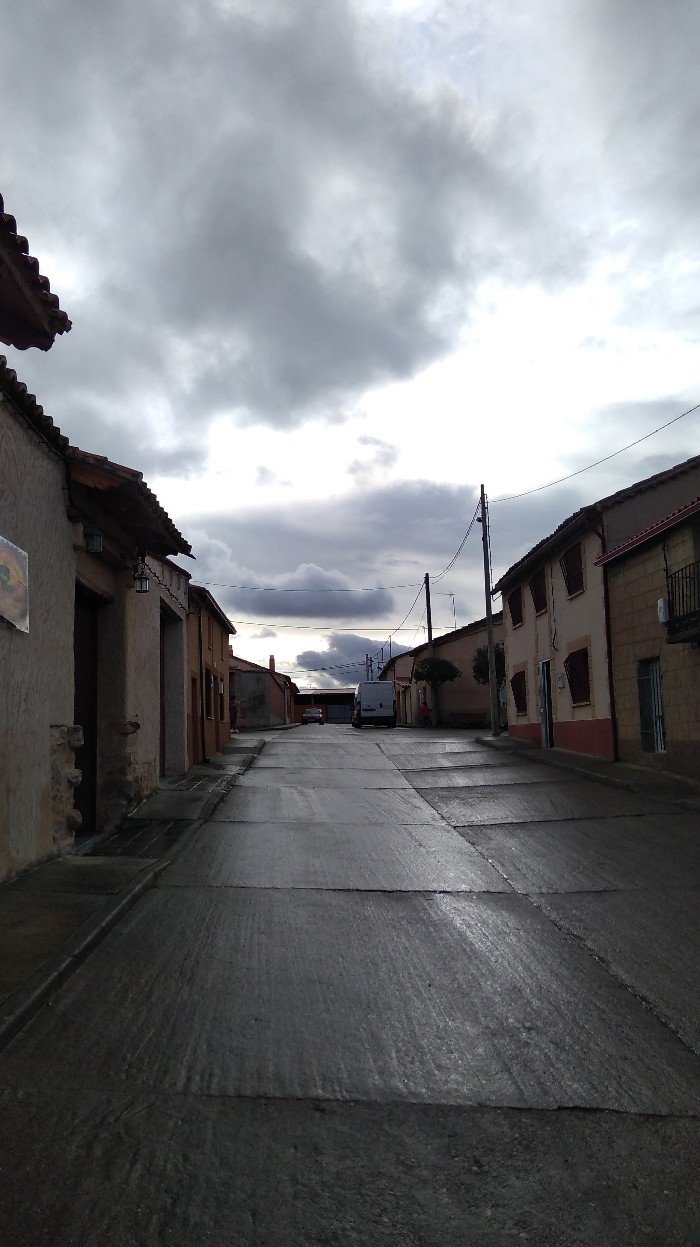
We left the town of ridged terracotta rooves and telephone poles behind, and headed quickly into open country. There is an alternative way to regain the camino by retracing your steps back the way you came, perhaps for shopping before leaving. For me, it was too early for them to be open and I was keen to get off the tarmac asap.
Looking back at Tabara
As I walked I reflected on the things I wished I had brought with me: my swimming costume which I left on the line in Caldzada, a pair of flipflops to protect my feet from dirty floors and ideal for wet and dry (though uncomfortable with socks), clothes pegs (there are often a few at the hostels but not enough to go round), a plastic tupperware pot to put food in (although I was able to buy one for a few euros), and ointment for bites.
The beautiful contrasts between the orange houses, silver-dry grass and Spanish sky
I was keeping a list of topics for the teaching I had been engaged to do later in April. It was for the Shiatsu Society whose biennial congress was being held in Edinburgh. Topic: people watching – most apt given how many new people I am meeting and walking behind every day, and how lovely it is to sit in Spanish cafes with tired feet and gawp at passers by.
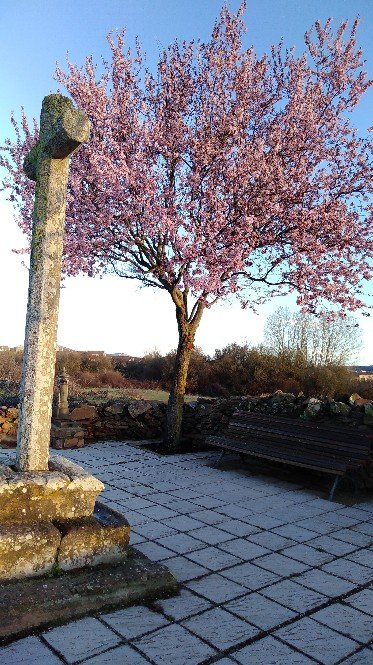
April blooms
The Galician hills in the distance
A blanket of blossom like snow
Just in case it rains
Sparkling over the rocks and tempting for hot feet
The Rio (river) Tera, Spain reflecting the sumptuous sky
There’s a sort of charm in the delapidation
The others walked by without noticing these houses with their distinctive yellow walls, built into the hill – grass roofs with chimneys poking through
Flat expanses of farmland, Spain
There are almost never any pavements. Cotton wool balls of clouds
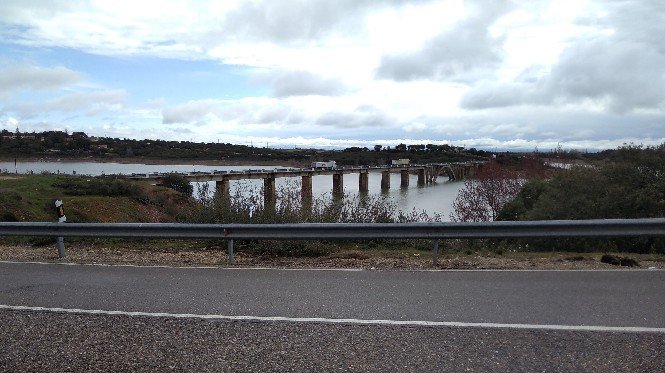
From the bridge at Santa Croya de Tera (the last small village before our destination) where the Casa Anita private hostel is situated. Castille y Léon, Spain
Via de la Plata Camino – Day 21 (Montamarta to Tábara). Tuesday 10 April 2018. 27.5 kms.
I took the Camino Sanabrés rather than passing back through places on the Camino Francés (Astorga etc) which I had visited the year before.
The best view of the day – unless you count the sight of the albergue in Tábara when I eventually got there.
Telling you all about Montamarta – not somewhere I ever want to go back to I must say.
Just like yesterday, except duller.
Yep, under another motorway tunnel.
I took the right, turned back and went straight on, then retraced my steps and went around the motorway flyover.
Kilometer after kilometer on the tarmac with road works as a view.
Spring primroses amongst the rubble and stones.
There was a small village strung out along the road, not so far from Tábara, with a cafe. I sat on the bridge and sunbathed – it was glorious.
Once I got going again it started to rain and I stopped, de-rucksacked and covered up. Then there was a rumble and a thunder and it got dark. The lorries were roaring past and spraying and I was ducking in and out of the ditch at the side of the road to avoid it when there was a fork of lightning at my left shoulder. I have never been so close. I wondered what I should do. Looking around there was nothing and nobody – just trees. I did think perhaps the metal batons weren’t such a good idea, but I couldn’t exactly abandon them and they had rubber handles and tips to earth me. I hoped. (Two days afterwards I met up with the American women and one of them did throw her sticks into the fields because she said she was so scared of being struck.)
Then the hail started and brought about a total landscape transformation.
In two seconds flat the road was covered in white, the traffic had completely ceased and a hush came over the world. I walked on, telling myself ‘it will be over soon’.
It did stop eventually and on and on I went, every part of every mile seeming an age. I was very wet, too sopping to be able to get the map book out. Then again, there was only the one road to choose from.
There was a service station on the outskirts of Tábara and I stumbled in to get some cover and ask for directions to the albergue. There was pandemonium in there because the electric storm had shut down the till and no-one could pay for their petrol. I waited with heaviness on my back and realised how exhausted and hungry I was. And I waited.
In the end, I did something I have never done before: I took a chocolate bar off the shelf, sunk to the ground, sat with my legs splayed out in front of me like a rag doll, and devoured it without paying for it first. It was wholly necessary.
To my horror it was a further 30 minutes walk to the hostel and I had thought I was at the complete end of my energy. Hey, I simply had to find more.
It was uphill and a very long road, and just as I was despairing that it would not end, there was a shriek and who should I see coming towards me but Marie-Noelle and her smile, someone I had not seen for several days. She gave me a big and welcome hug on her way to the bar.
The hospitalero made me a cup of tea when I needed it most, and proceeded to cook for us all that evening. He describes himself as a ‘spiritual author’, is resident at the hostel all year round, and something of a Camino VIP.
There were 10 people round the table drinking wine and eating simple fare. Some I had met before, some I had not, each of us from a different country, and of course we made ourselves understood – a true camino experience at the end of a most trying day.
Via de la Plata Camino – Day 20 (Zamora to Montamarta). Monday 9 April 2018. 19 kms.
There was a deal of road walking on this leg of the journey.
Here are predominantly photos as the notes app on my phone failed and all were lost despite it promising to back-up. Aim: to find a way to reinstate it!
Walkers, be careful soon after leaving Zamora, because there are arrows off to the left to the Portuguese camino!
The tracks of the dog who went before me on the path.
Cars stacked up beside the road. There are many car dealers in this area. The camino is not all beautiful countryside and olive groves.
In fact, this part has long straight tracks of red earth between arable fields. Cloudy skies herald more rain.
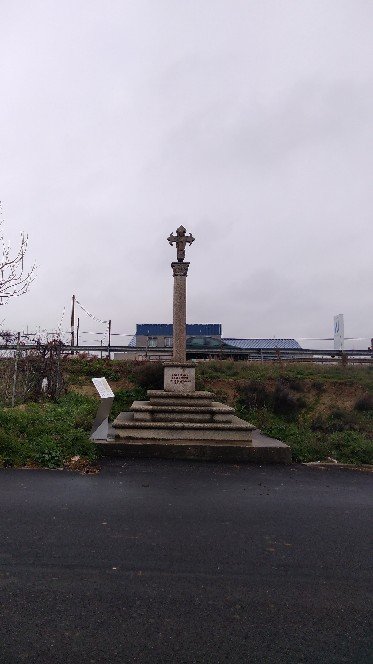
On the cross is a quote from Pablo Neruda: amar es vivir la existencia desde el corazón del otro which means something like, we live to love and be loved by others, to be in each other’s hearts.
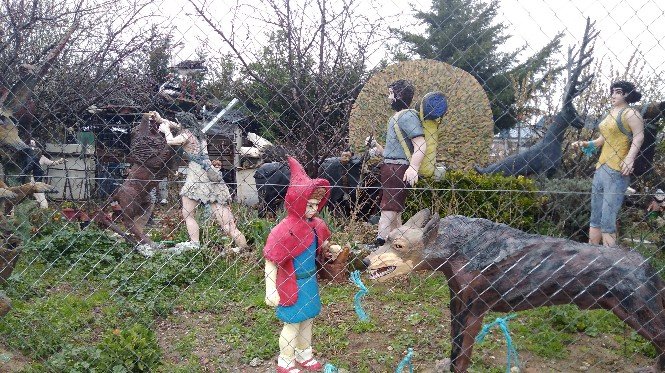
These statues of fairy tale characters were in someone’s front garden in Roales del Pan as I walked through.
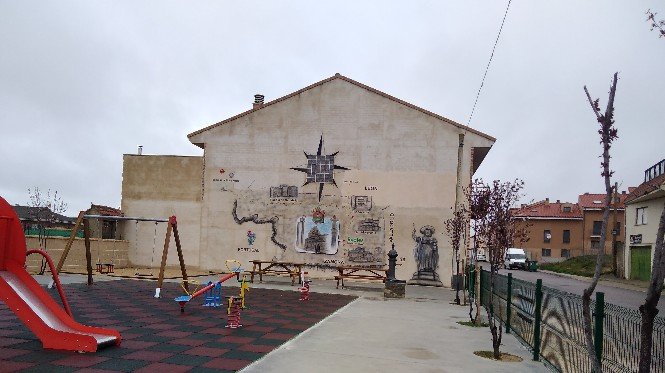
St James watches over the children’s playpark.
Big puddles on the chemin, and a row of diddy little trees.
Gobble, gobble, gobble, gob.
The owners of the private hostel Tio Bartolo also have a bar and work at the Covitan supermarket where you get the keys. It looks good in the photos and was recommended by the hospitaliere in Zamora, but I picked up some sort of infection walking barefoot on their floors. There were two American women and myself in the large dormitory under the roof, and we huddled in our beds and in our sleeping bags (there were blankets available). The weak, free-standing heaters which the landlady found us because all our clothes were wet, shorted the electric circuit and anyway, when the husband discovered she had given them to us (because he had to come and switch things back on) he shouted and swore and took them away. There were people in the small rooms downstairs who paid much more than we did (15 euros including breakfast which was left in the cupboards by the long-suffering wife and was not up to much at all).
The hostel was on this street and I would absolutely not recommend it. Run by a kind woman and her angry husband, the rain came in downstairs and it was extremely cold.
Hostels and facilities
There are many facilities in Montamarta including a municipal albergue which had been shut for a while and opened the night I was there, but I had been told it was closed so didn’t try to find it. It is now rennovated and had good reports from the people I spoke to the day afterwards. There were two others mentioned in my book – El Bruñedo and El Asturiano – neither of which were open.
I had decided to go to Montamarta because otherwise it was a very long day (33 kms I think) and the pains I had been having in my feet dissuaded me from such a trek. I found a bar that wasn’t owned by the proprietor, on the main road, and charged my phone. The waitress was very kind, but it wasn’t somewhere I could stay long.
That was a really low few hours, and I used Facebook to send out a message to my friends, ‘Should I just go home?’ Some said yes, some no! I kept on going. And you know what? It got a whole lot worse the next day – in a different sort of way!!
‘But my business is unlearning, not learning, and I’ll change with the world but I won’t change it.’ from Ursula le Guinn’s Left Hand of Darkness.
Via de la Plata Camino – Day 18 (Villaneuva de Campéan to Zamora). Sunday 8 April 2018. 18 kms.
I have lost all my notes for this week and there are a lot of photos for 8th April so there are few words.
It was early morning when I set off.
I was not the first to leave along the Roman road.
The sun rose on my right. It lit up the lush fields on my left as if it was a different time of day there.
This gorgeous light speaks for itself.
Right in the middle of nowhere. Nowhere else to do a pee.
Just look at the detail!
Mini ant mountains all over the path.
A traditional skyline on the Via de la Plata camino, Spain.
Calendula (marigolds) and roses in full flower in San Marcial. Red and white cycle path signs reminiscent of the Grande Randonnee in France.
Bird foot prints in the clay. There are also dog (or wolf?) ones on all the paths although I only saw one hound running for miles unattended.
Coming into the city of Zamora (‘The pearl of the 12th century’) along the River Duero, close to the border with Portugal in north-west Spain.
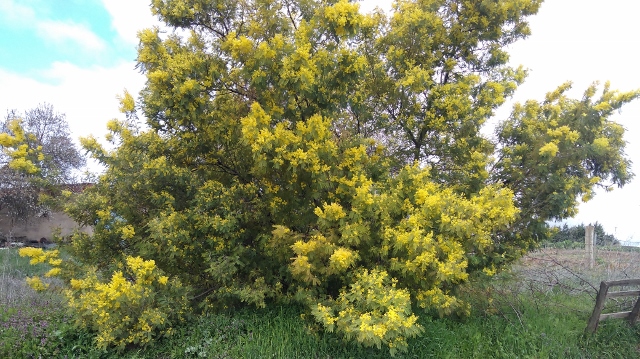
Fragrant Mimosa.
The rainbow colours of the local rock, yesterday seen as pebbles on the path, today making up these walls.
Puente de Piedra (Bridge of Stone).
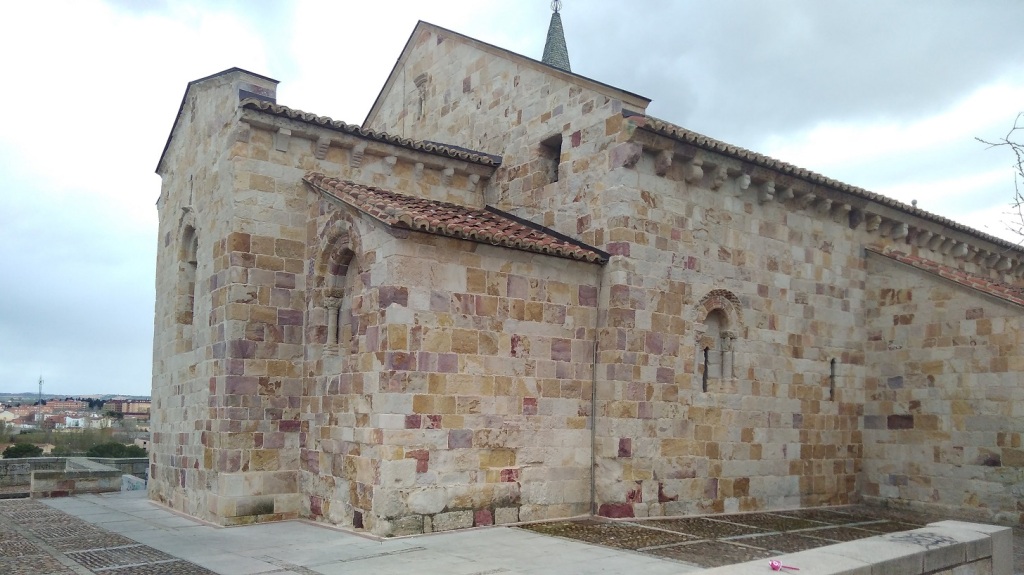
Zamora architecture.
The charming Plaza de San Cipriano, Zamora, Spain.
Zamora Castle, 11th century, Spain.
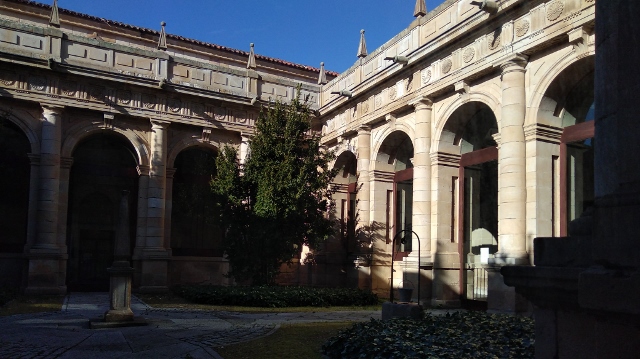
Courtyard at the Cathedral, Zamora, Spain.
Zamora Cathedral, Spain.
Iglesia de los Remedios, viewed between the columns surrounding the Cathedral, Zamora, Spain.
The albergue.
When I arrived it was fine, sunny weather, and there was a notice on the door explaining that it would not open for 3 hours.
The Albergue de Peregrinos is beside San Cipriano Catholic Church where we left our stuff with the nervous woman while we went off to explore.
Later there was a queue of us waiting at the allotted time and, unexpectedly, it hailed hard. There was only a tiny ledge for everyone to huddle under and not enough space for the luggage, so in five minutes the rucksacks, boots, everything was soaked.
The hospitalera was most hospitable (sorry!). She was a fountain of knowledge having worked there for a long time and she was clearly in her dream job – loving chatting and finding out where we were all from. She had great English and knew what we needed. There is a fantastic kitchen and Marie Noelle had been before us, messaging me to say that she had cooked meals for the Seuil men – one vegan for E and the other with meat for the growing lad. I was very lucky that they shared it with me – a veritable feast.
Rams head fountain, Plaza de Viriato, Zamora, Spain.
Interlocking trees, Plaza de Viriato, Zamora, Spain.
Great graf.
Museo Etnografico, Zamora, Spain.
Detail from the larger than life-size wall painting Saint Christopher and the Infant Christ, which caught my eye in the Cathedral, Zamora, Spain.
Solid silver altar de plata in the Cathedral, Zamora, Spain.
Museo Etnografico, Zamora, Spain.
Baltasar Lobo (artist 1910-1993 buried in the Cimetiere du Montparnasse, Paris, France)
His work is in a dedicated gallery (free entry) beside the Castle and also scattered around the grounds nearby.
He was particularly interested in the pregnant form and relationship between mother and child.
San Pedro de la Nave with the Cathedral in the background. Zamora, Spain.
I highly recommend Zamora as a tourist destination.





















 Walking without a donkey