Reflecting is a vital part of taking a walk. It helps to embed or integrate the walking experiences – where I have been, and what I have learned – in the hope that any changes wrought will last.
Most of all, though, I failed to comprehend that the best things in life aren’t things that are visibly sexy on the surface. They don’t scream for attention, and they rarely invite adrenaline. Rather they come from quiet commitment, respectful engagement, and a love of something greater than yourself.
Before a sitting meditation I start by acknowledging or noting any issues which are bothering me, either to clear my mind, to problem-solve, or create focus. Then I try to simply sit. I have been doing that for years. As a result I sometimes come up with creative ideas, solutions and greater understanding, or at the very least a recognition of patterns of behaviour.
Walking is a kind of meditation and the more I walk pilgrimage, the more I realise that simply doing it: starting, trekking, and managing to complete, I’m learning what I need to.
I have habits that I try to pretend aren’t there most of the time. However, when walking a pilgrimage they come to the fore. It’s in the planning and facing of the realities of the land and the practicalities of accommodation and food that I am brough face to face with myself.
Is walking pilgrimage synonymous with being religious?
I do not follow a recognised religion. I was christened into the Church of England by my parents and had to learn tracts of the bible overnight for reciting in primary school the next day. Joining in assembly every morning at secondary school was obligatory, and I sang and read lessons during services; went on a Sunday School holiday; and spent years in the Girl Guides where Christianity was important.
I was steeped in it – the tenets seem to be in my soul (or perhaps in my cells). When I was learning to speak, religion provided me with a moral and ethical language, and I have discovered that it’s hard to shrug off.
Maybe I’m on a mission to get rid of the destructive part of what I was taught in those early years. I was encouraged to feel guilty, it was assumed that I had Original Sin, and I was told that I was bad in my core as were all other humans. Perhaps I now take ecumenical walks to give myself the time to recognise the impact of this and to let go of what seem now to be unhelpful lessons.
I do visit churches sometimes and I certainly respect believers, but I do not take communion. I have read widely, listened, and discussed religion with friends, but I cannot follow a Faith which seems to exclude or criticise people for being the way they are or believing what they do.
Historically, pilgrimage was a religious practice, so it’s not surprising that people keep asking me why I walk pilgrimage.
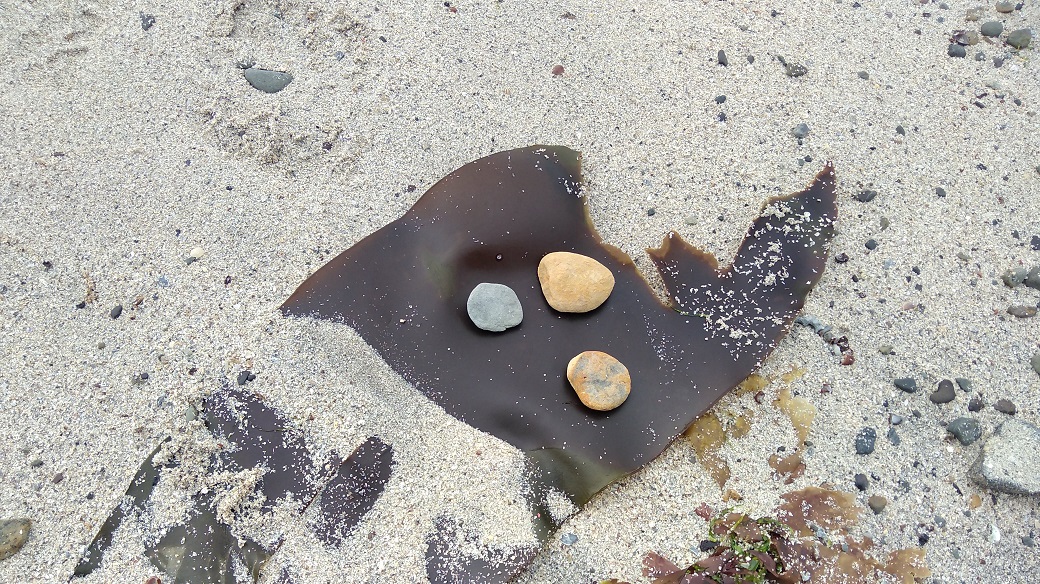
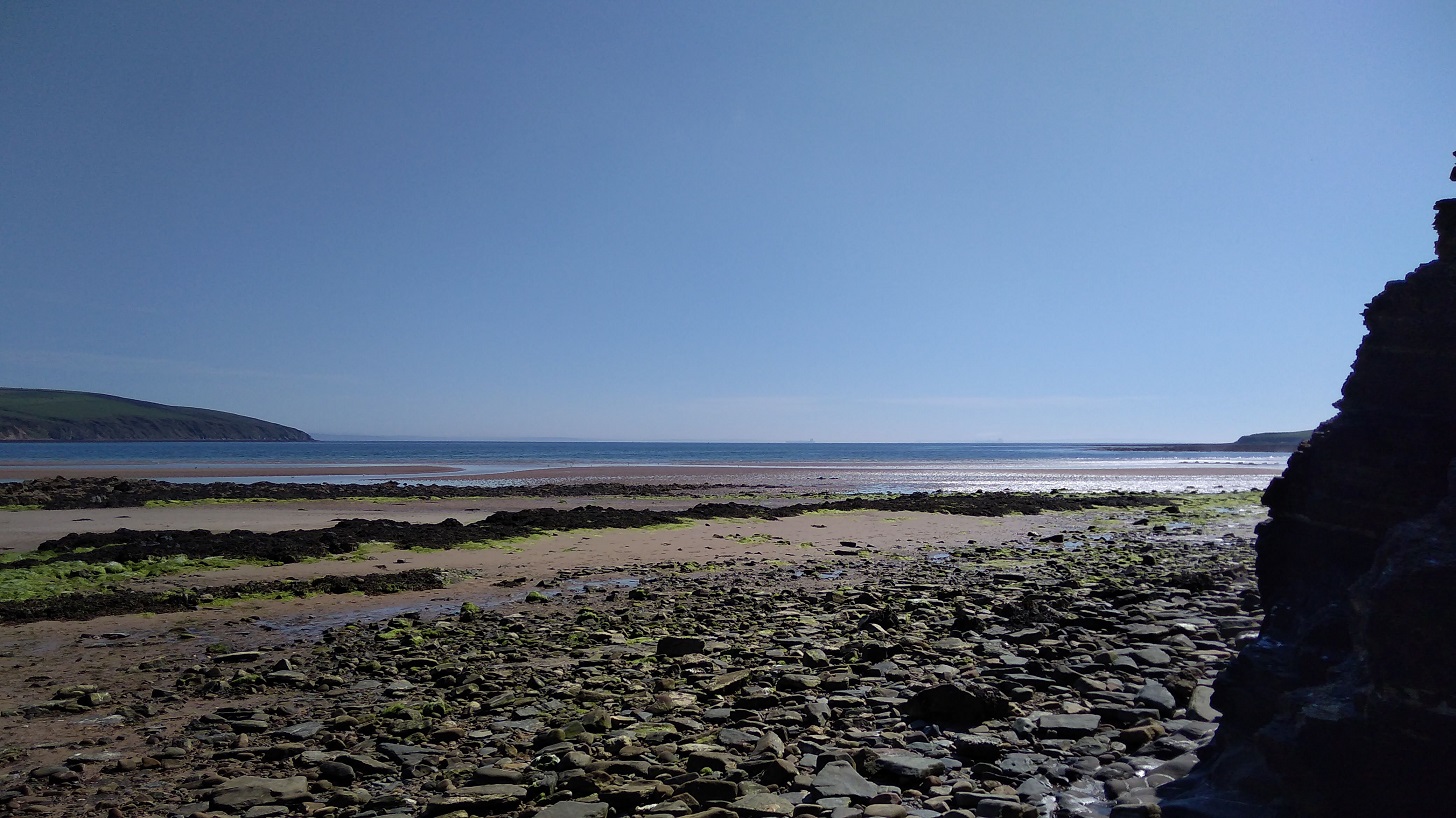
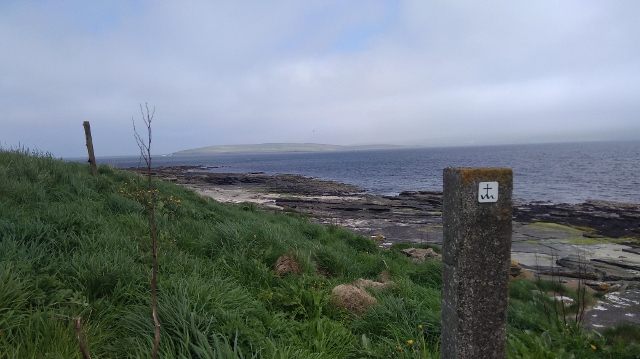
The three stones I found on Evie beach at the start of the St Magnus Way
Why pilgrimage?
For me, pilgrimage is more than a long-distance walk. It’s a walk with the added zizz of a specific intention, held to, and later reflected on. I’m walking in the fotsteps of others who were seeking enlightenment. Made with awareness and respect for tradition, there’s an in-built beginning, middle, and end, and it’s a project all in itself.
“The present, the present. It never stops, no matter how weary you get. It comes unstintingly, as a river does, and if you aren’t careful, you’ll be swept off your feet.”
Olivia Laing, To The River (p111)
Spirit, soul and understanding
In Chinese Medicine I was delighted to learn that there are a number of different ways to describe the spirit or soul. In Icelandic there are more words for snow than we have in English; in the Orient the parts of ourselves which relate to spirituality, to nature or to our innate relationship with other people are as important as our physical and mental aspects. Although the spirit is amorphous, hard to define, it is something I have a tangible sense of, particularly when I walk in nature. Although sometimes I am content to ‘be’, at other times I become curious and try to understand this puzzle.
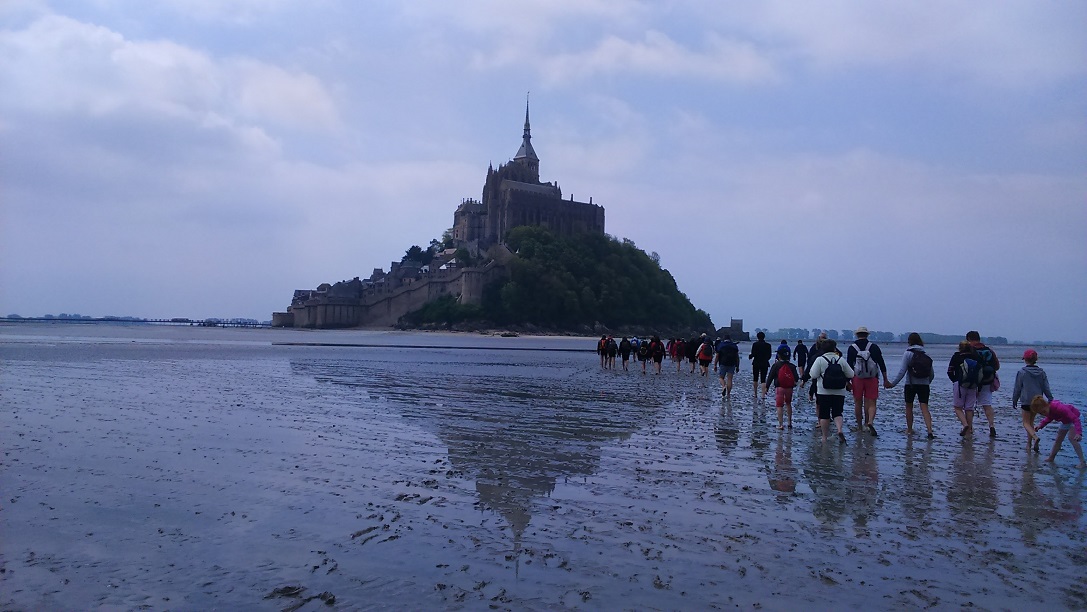
When I sit and meditate in my Shiatsu room in Edinburgh I can simultaneously be in Tibet or Japan or China. I don’t know why that is or how it happens and so I ponder on these things as I walk. I privately thought that at least one explanation was that I was a nun and a monk in former lives. It’s the best explanation I could come up with. The feeling I had, for example, when I crossed the sands, barefoot, to Mont Saint Michel was real – I ‘knew’ I had walked there before.
Walking across the sands to Mont Saint Michel, France May 2017
What is ‘knowing’?
We have discovered in the last 100 years or so that our physical cells destruct and reconstruct, so the ones I have now shouldn’t be the same ones I had when I was a baby, never mind the ones my mother or grandmother had. And yet we know that we share genetic material.
There is a theory that there is a collective knowledge which accumulates from the generations which came before. It could be this wisdom which tells me where to go to find what I seek, and what has got me here in the first place. However, current scientific methodology and outcomes deny me entry into this collective unconscious. It insists that I enter through the portal of logic and I am not sure that logic is the right way into that sort of understanding.
I have an intrinsic sense of the English phrase, ‘I know it in my bones’. My bones are made up of cells and that genetic material, yet in every text I read about pilgrimage something inside me recognises it. I seem to share the centuries of that collective knowledge, it is familiar.
There is my DNA and my body. There are my mind and my thoughts. There is my self, my soul, my spirit. In my work and my walking I am enquiring into the connections and (re)discovering dissociations between these.
It’s all about love
The more I listen to myself as I traipse, and the more I hear my clients in the Shiatsu room, the more I think that what we all seek is the connection to LOVE. It sounds like a familiar new-age thing to say, it’s straight out of the ‘all you need is ….’ 1960s, but I keep coming back to it.
I have a hunger for that ‘something for which we search’, and I know it isn’t just me, because when I tell folk what I do, they say, ‘Oh, I wish I could do that’ or, ‘I have wanted to do that for ages’. Or maybe they too have already started!
I seem to be part of a contemporary pilgrimage movement in which it is possible that we are seeking ways to integrate, comprehend and connect our-selves, personally and in community.
Pilgrims walking the Via de la Plata, Spain; Tourists flocking to the Sacre Coeur in Paris, France.
Restlessness
In addition to all this, I notice a compunction to move on, to save my soul, to find and to seek. The ‘thing’ I am looking for is at the same time inside me right now and just ahead of me. It is that towards which I reach or walk. It isn’t new. Everything I have done in my life so far is part of this instinctive movement towards being purer, ironing out the creases. That’s what I believe we are all doing wherever we are.
I know that inside me lies this knowledge, just as tangibly as I know my organs are there. I recognise that I am part of a continuum, a humanity of seekers. What is necessary is the time and space to better hear what is happening, and that is hard to find when I am at home looking after people and my surroundings, doing what most of us do in our adult Western lives.
The answer, it seems, lies in introspection. Without trying to be precious, I go quietly back inside myself when I walk, to hear the still, small voice.
Nan Shepherd wrote ‘These moments come… most of all after hours of steady walking, with the long rhythm of motion sustained until motion is felt, not merely known by the brain, as the “still centre” of being…
And so it appears I am descended from the ascetics and hermits of my history. I’m reborn into the liberated 21st century. I am, at one and the same time, part of a shared community – walkers and pilgrims, fellow monks and nuns, a group with shared values – and I am alone to ponder.
Some things are proving intractable and I expect that’s why I have to keep on doing it!
I am walking the St Magnus Way on Orkney, and this is one of the blog series – 21-30 May 2018. Below, you can find links to all the others (introduction, transport, accommodation, resources etc). The overall walk is 55 miles (88.5 kms) over 5 days plus a visit to the island of Egilsay where St Magnus was said to have been murdered and, initially, buried.
Stromness
I was in Stromness for less than 24 hours. The places I have visited there are:
Betty’s Reading Room – free, open and full of useful and interesting things for backpackers.
Tingwall
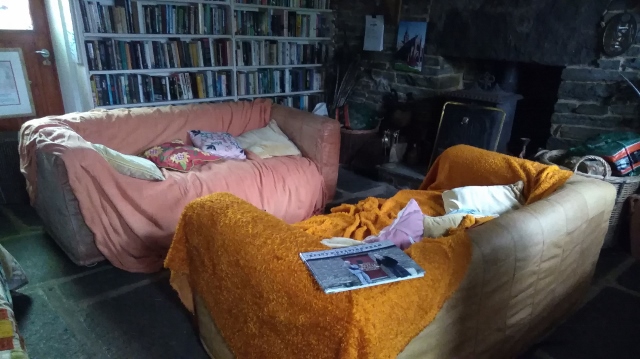
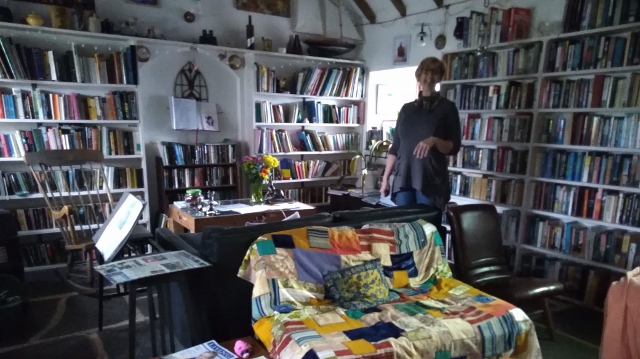
Tingwall – Betty’s Reading Room (always open, tea and biscuits, books, comfy place to sit and charge your phone). Kiersty who put me up in Evie, showed me this wonderful place which is very close to the ferry terminal. It was erected in memory of a member of the local community and is a peaceful place to sit and read – tea and biscuits are available. Occasional readings or other events happen there. The main thing is that the door is open – you can just step inside and make yourself comfortable.
(In other words, there was no need for me to walk all the way to the Fernvalley Wildlife Centre and find that it was shut, and then walk all the way back and into Evie along the busy road, only to find that the Eviedale Cafe was also shut – all in order to charge my phone and find the address where I was staying that night!)
Kiersty shows me Betty’s Reading Room, Tingwall, Orkney.
Egilsay
there are no shops nor anywhere to stay on the island
Evie
Mistra is a perfect wee post office cum shop (10am to 5pm)
Eviedale Bistro (Weds – Sun 11am – 3.30pm). It wasn’t open when I was there
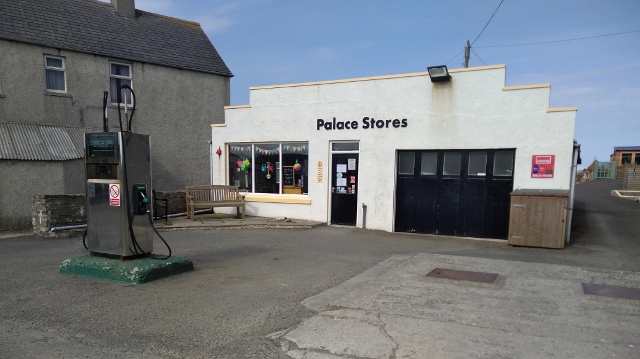
The Palace Stores, Birsay. Also shut when I arrived.
Birsay
The Palace Stores where you can buy drinks (opens at 10am (12noon on Sundays) and shuts at 5pm)
Tearoom (10.30-5pm. Shut Tues / Weds)
Barony Hotel (about 20 minutes walk from campsite. Good food, but book in advance as it has erratic opening times)
Dounby
a good co-op which sold a disposable thing I not seen before to plug into your phone to charge it. Cost £2.50 (did not work well on my phone because it was not working properly)
I am walking the St Magnus Way on Orkney, and this is one of the blog series – 27th May 2018. Below, you can find links to all the others (introduction, transport, accommodation, resources etc). The overall walk is 55 miles (88.5 kms) over 5 days plus a visit to the island of Egilsay where St Magnus was said to have been murdered and, initially, buried.
– on timelessness, forgiveness, and dialect
Criss-crossing the west mainland of Orkney: Having started in Evie in the north east; curved around the cliffs to Birsay in the north west; walked coast-to-coast eastwards to Finstown; today I would drop directly south to Orphir. I didn’t know what I would find
Why to Orphir if Magnus’ bones weren’t taken there? The organisers of this route write that today’s trajectory ‘shifts attention to Haakon, Magnus’s cousin who ordered his death and ruled the united Earlship afterwards.’
Highlights: A traditional Scottish moorland, some slopes, and the wonderful shoreline between The Breck and the Bu
People met : a record 3 (between Finstown and Orphir), then loads after that
Theme: forgiveness
Favourite and unusual animals encountered: 1 donkey, Shetland ponies, llamas
17.1 kms / 10.65 miles
Time: 6.5 hours Finstown to Orphir village; another 2 minimum to St Nicholas church and back, but I did have a sleep
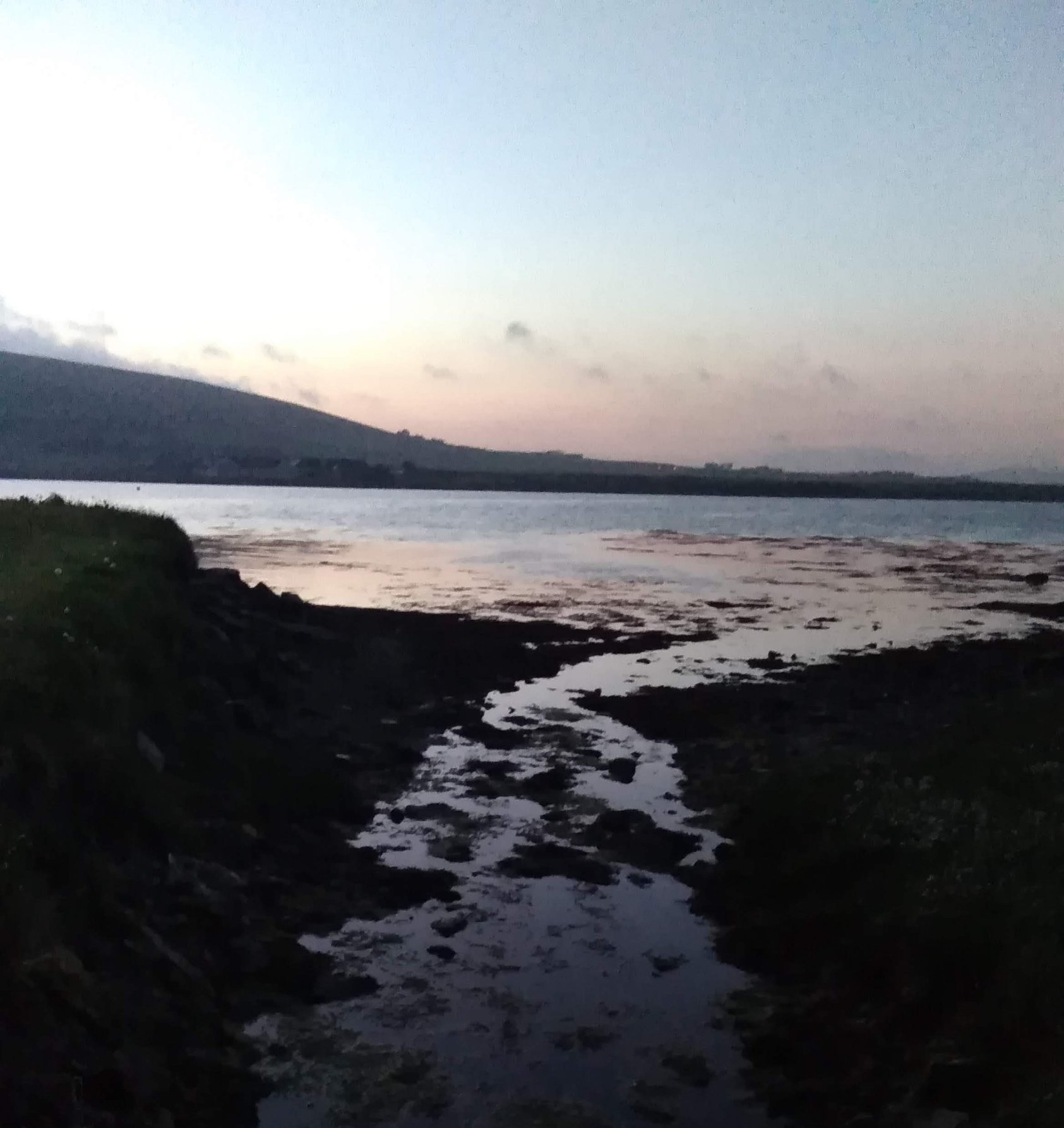
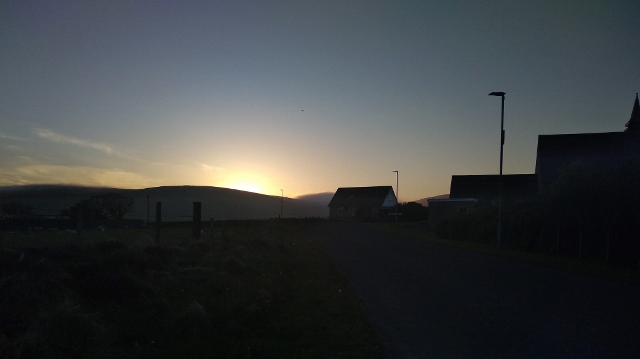
Last night, on the way ‘home’ from the concert, the haar had cleared and there was a beautiful sunset which this photo doesn’t really capture. Last night, on the way ‘home’ from the concert, the haar had cleared and there was a beautiful sunset which this photo doesn’t really capture.
A screech of tyres heralded two carloads of revellers needing the toilet at 2am (I was camped beside the public conveniences in Finstown). I got up to retrieve my walking top which I had unwisely washed the evening before (unwise because it was too cold to dry properly), and it was cold on my return so that I stuffed my coccoon with newspaper. As I was awake I texted Heather, my lodger about cat litter, and finally dropped off.
When I woke again the sun was shining on me through the tent and it was warm. I think there may have been dew on the outside of my sleeping bag, but thankfully not on the inside!
I had dreamt my recurring dream of being lost in a big house full of rooms. I am convinced they began when I moved from my small town primary school in Sevenoaks to the much bigger secondary in Tonbridge and could not find the right classrooms. Ah, but this time it was my own house. Now, that’s change for you!
I crawled out and found the calm waters ahead, guarded by the pier on my right with the already warm sun rising behind it, and Snaba or Cuffie Hill to my left. Ahead, I guessed from my map, were the Holm of Grimbister, Scarva Taing, the Skerries of Coubister with perhaps Chapel Knowe broch in the far distance. (A holm is an islet, a skerry is a rocky island, and a broch is a stone tower dating from prehistoric times.)
7am was so quiet. I was delighted to see a sleek headed seal swimming in the bay, watching as it made its way across to the other side and then back again and then climb out onto the jetty. Oh, not a seal, a mermaid, I mean, a woman taking her Sunday morning exercise! She changed in my / the toilets and I couldn’t stop myself going to say ‘hi’. She was as surprised as I was to see someone up at this time, not having noticed my tent.
None of the remaining matches would light my stove, so there was no tea for me, worst luck. (How come I didn’t bring a lighter? It’s not as if I haven’t been camping many times in my life before). Instead I had the Rhubarb Soda I had bought at the post office (made by Bon Accord in Edinburgh £1.50 – delicious).
I was on permanent battery saver now which, because there was no signal anyway, meant I could not book the homewards ferry.
A million drops sat on the blades of grass, shining in the sun, gleaming, a simple collection of diamonds, of miniscule, suspended orbs.
The jetty where I saw my mermaid! Bay of Firth, Orkney.
Having charged my phone at the Community Hall the previous evening, I received two air bnb booking texts, making that five in five days – lucky for me August is busy in Edinburgh with the festivals.
Half way up the hill I was looking the first St Magnus Way marker of the day and, turning, I saw back towards The Bay of Firth where I had spent the night.
I climbed up and onto the moors, first on a path and then into the wilderness. I met a lovely jolly South African lady with a white bun and skyblue clothes. She didn’t have a rucksack or a dog. Once again a woman had appeared, as if from nowhere, to advise me. She said she had searched and searched and there were no St M Way signs, and predicted that the haar would come in again from the east. ‘I’ve walked all these hills but they don’t cater for walkers here on Orkney’, she said.
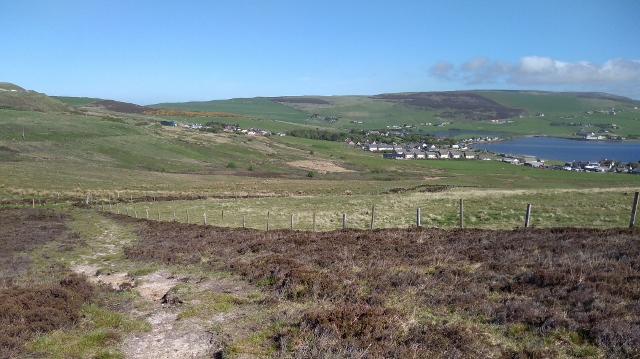
Getting higher – Finstown in the distance. Orkney.
Along the warm grassy track, Cuween area, Orkney.
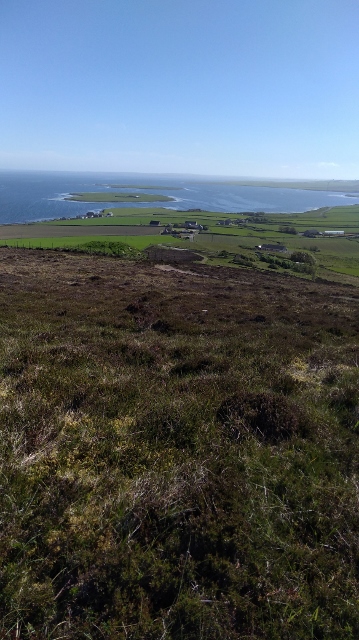
Of course the higher I got, the more I could see behind me when I stopped to catch my breath: the green lilypad islands in the blue ocean; flashes of silver indicating the main road. It was hard going with the backpack on the uneven ground, though I was glad that I did find the markers when I cast around for them – perhaps I had my eye in after three days.
A frog could very easily sit on these islands (see Beatrix Potter)! Seen from Cuween Hill, Orkney.
I was already hungry, but it was OK because I had a whole lettuce in my John Lewis bag (my children would be able to explain, it’s because I believe I need my greens every day!) And talking of rabbits, they were bounding around, keeping me company as I stumbled.
It is simply not done in hiking circles, to have a carrier bag but there was no room in my rucksack for food. I hung it from my straps where it swung annoyingly when I got into my stride and had to be restrained when clambering over stiles. It lasted the whole 10 days! Maybe I should have got people to take photos of me and tried for sponsorship – missed a trick there.
Beautiful view, Finstown, Orkney.
There are clumps of Lady’s Mantle down in the ditches, out of the wind and by the side of the stony track.
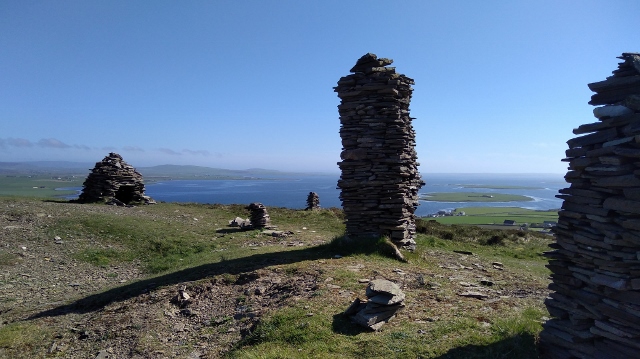
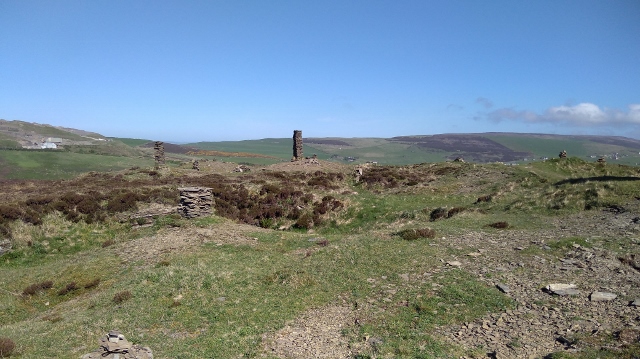
Man-made stacks in a stunning setting, Cuween, Orkney.
Forgiveness is an end-point: only after a proper process of understanding both points of view, acknowledging the hurt or the sadness, and coming-to-terms with all of that can we forgive and then act on it. I shed terrible tears on watching the part of the film ‘Calvary’ where the main character (played by Brendan Gleeson) goes into prison to see his son and you know he has been forgiven. My reaction was testimony to the power of this in my life. ‘I think forgiveness has been highly underrated’, says Gleeson’s priest.
There is a tomb you can visit, but I only read about it afterwards.
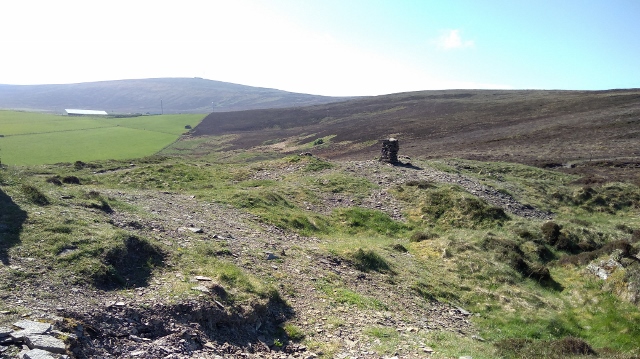
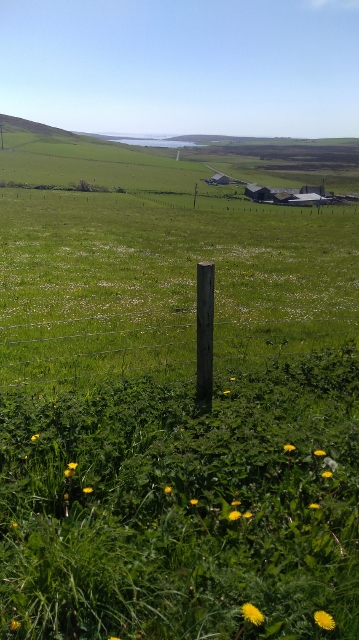
You can see the clear division between farm fields and wilder moorland.
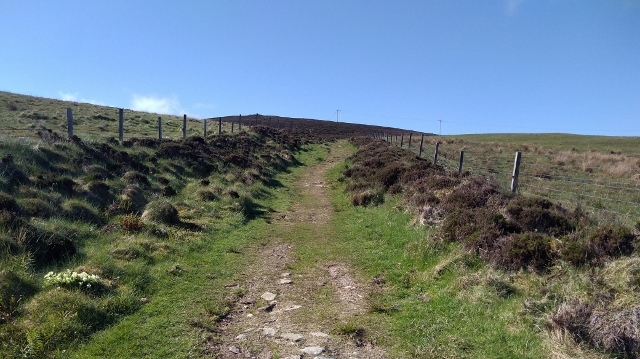
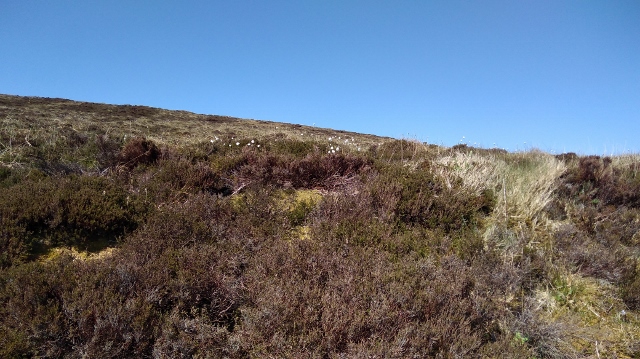
After a while the track peters out and it was just me surrounded by hillocks of heather and bog cotton – rabbit tails on spindly stalks. Mossy mounds had green spears poking out of them, and there were the sort of birds which hover and flutter just above the ground in constant conversation. In places there were canine and then human footprints.
Bog cotton (the white dots) and heather on the moors, Orkney.
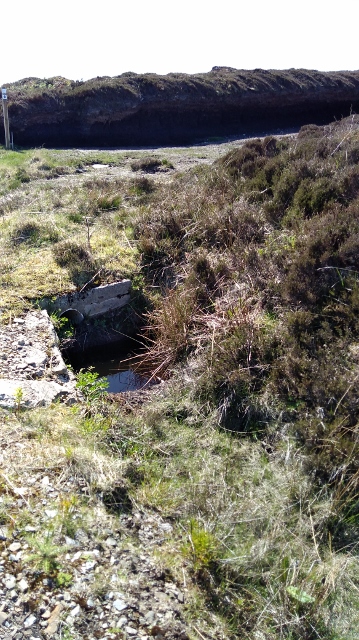
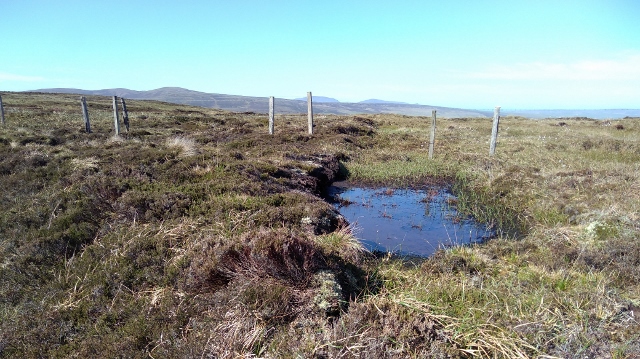
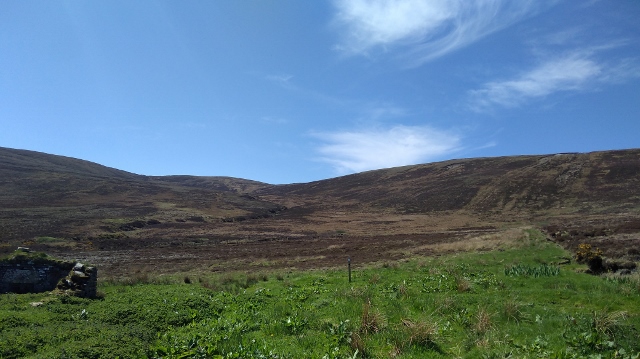
Gradually the landscape started to remind me of Highland walks with its peat banks, bogs and pools. Scrambling through the scratchy shrubs was painful on my knees but I avoided squelching underfoot. It had become very, very quiet. There was no bird song.
Shelves of peat and a St M sign in the middle of nowhere.
Forgiveness is offered to those who ‘follow the faith’, on earth by priests, and elsewhere by God, so it is said. To promise it to a child, who early on has no understanding of sin – not of others’ or their own – is to immediately puzzle her. It is a suggestion that there is already something wrong with that child, that she has already transgressed, and if there is no internal cognition of this, it’s a disaster waiting to happen. What else, but that child grows up with an aura of mistake, not able to make an actual connection between the forgiveness and an awareness that forgiveness is necessary.
A typical peaty pool on the moors, Orkney.
Yes, in fact there were odd snatches of various sounds – the distant thrum of an engine, for example. And I could see oil tankers far away on my left. Amethyst violets and rose quartz orchids were glinting at my feet, and then I was on a soft downhill track again.
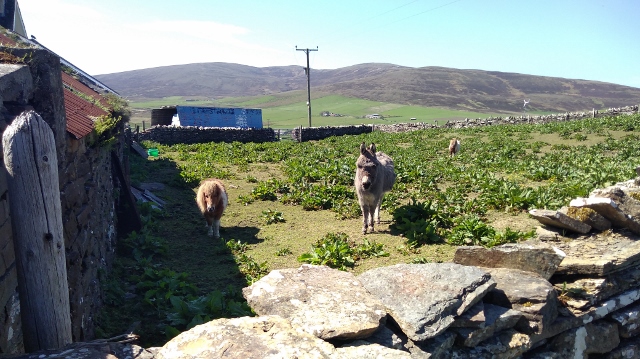
I came across a pregnant donkey and two brown-and-white Shetlands. She came up close, sort of in-breathed at me and flicked her left ear. It was the ponies who got the carrot which was intended for the donk.
The namesake of my blog!
And … what’s more, to be an adult who can offer a child forgiveness sets the offerer apart, as is often the aim. Again, the child is reduced to a transgressor, and what’s more, encouraged to understand that the adult is even more powerful than adults already are compared to children, and yet it is most painfully obvious to them that adults are not always good. How to make sense of that? These things I was with as I walked.
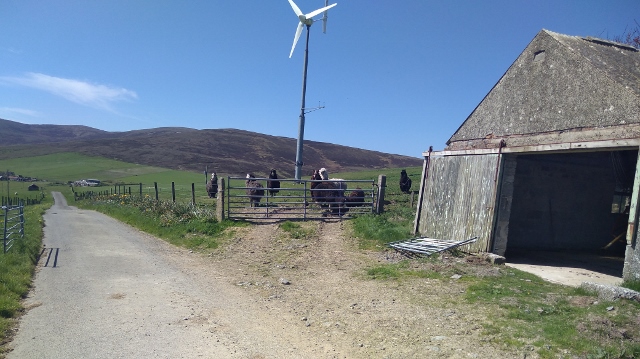
A bird mewed, a flap-fast one, its wings tipped with white. There was rather scaredy herd (or flock) of llamas (with crias which is what the young ones are called), and the ubiquitous wind turbine at Kebro Farm, where like all the places I passed farmers were working even though it was a Sunday. In this area there are many incredibly confusing signs saying to go back up (arrows and ‘To Oback Cottage’ etc). Note: Ignore them and keep on going down. There is eventually a St M Way sign at the junction when you get there!
A flock of llamas. At the bottom of this road there is a St Magnus Way sign, Kebro, Orkney.
In the same way as Reading is a town of roundabouts, and Glasgow’s all traffic lights, so Orkney’s made up of a complex network of fences, poles upstanding and barbed wire, deadly taut and ready to snatch enough wool to knit a sheep or catch an unsuspecting elbow in passing.
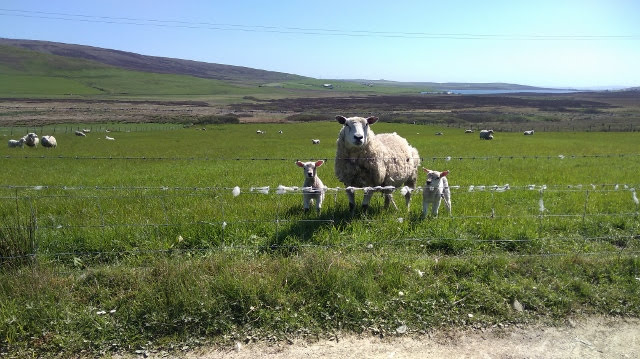
It was lambing time on Orkney in late May. Just look at their little faces!
With four per cent of battery left on my phone I could check the time, but why bother? Instead I watched a butterfly doing what butterflies do, and let a chunk of Orkney fudge melt in my mouth leaving a too sugary, but addictive residue.
There was no need for me to be anywhere by any given time – being close to midsummer and because I was so far north, there was endless daylight. In fact there was almost no night. It has been said that stress levels are particularly high when deadlines of time and distance are combined (ie I have to get across town by 8am), so it is a good sign that I can let that go and relax into the walking. I will get there when I get there, that’s my motto.
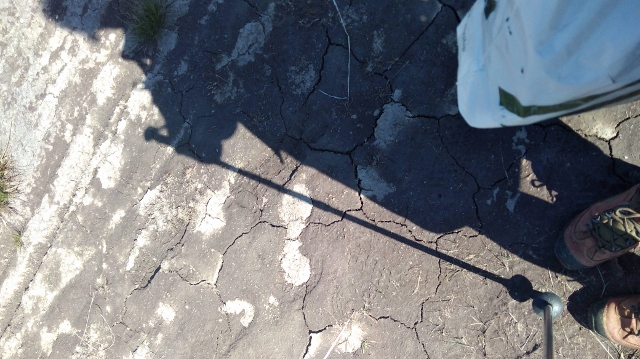
Baked earth – not something you expect to see in Scotland.
I noticed, that like the three guys last night who accompanied the lead singer of ‘The Once‘, the sheep looked identical but had different voices – some bass, some treble and some soprano, or is it counter tenor?
I liked the grey cows – I was not sure I had ever seen grey ones before. (No photos, for the above reasons). I went past birds doing that spectacular balancing thing where they sway on top of stalks so thin that the human eye cannot see them, thinner than one of their own legs. How do they do that!
The farmers forked the deep brown, well-rotted manure onto a trailer; an ideal lane between fields offered springy soil that actually massaged my feet from the underneath; there was only one place where I had to step into an empty blue trough and cling onto the, yes you guessed it, the barbed wire, to avoid the too-marshy path. There were bog grasses there, honed to a calf-tickling tip, but space enough to walk inbetween.
I was heading for the nearly-full moon. Every time I needed a pee I had to take the rucksack off and it required a sort of humpfy-jump to get it back on and arrange all my layers – the tucking in was the worst. I cracked my knee which certainly got the blood flowing again. ‘It’ll pass’, I reminded myself.
I was just as I was about to head off up the hill to the right across the moors towards Orphir after the last sign, when I most unexpectedly spotted a couple coming up. She was pregnant and telling amusing stories to the man with her – great to hear them laugh! My phone was dead by then so how lucky it was that I saw them, because Orphir wasn’t on the right in that direction at all!
Down I went, taking the correct course. There was a bed of irises, a red bridge and the delightful sound of trickling, peaty, crystal-clear Scottish water. I found another bird’s wing, pure snow-coloured with bones attached, and a patch of curly white feathers to mark the spot. Butterflies played above like the very spirit of the bird which had died, like the petals of today’s flowers come to life.
It was hot by this time with a welcome breeze by the burn. There were no signs (although the notes I had made from the route description last night were pretty good from here on), so I trusted my instinct, tripping on downhill now.
For some reason I had put my single double-layered sock into the rucksack before leaving home, and now it had come in useful because I dropped one of yesterday’s pair down the loo when changing in a tight space with an armful of clothes, and after washing it hadn’t dried in time. (I had no idea what happened to the pair. I left them both to dry on a rack in Salamanca and one wasn’t there on my return).
I guessed the repeated but uneven banging up on my right must be people hunting. On the far left I could see a gorgeous beach – Waulkmill Bay I identified from the map – and I would have enjoyed a paddle there and then. Despite another internal debate about the way I decided to keep going on straight. The cuckoo called and I had a sudden memory – did my dad collect butterflies? I must have been very, very young.
Much as I deplore the waste and emissions of plastics, and of course a wooden staff is more traditional for the pilgrim, this baton is better: wood ones chafe the palms after several hours. What a marvellous view I had from up there! It was still a bit misty to be sure, but I could see all the islands, tankers and trawlers, big ships and little boats, as well as what looked like a submarine.
I always talk to the animals I meet, especially the farm ones. I expect they have a relationship with humans already, and probably my mum used to do that and I learned it from her. Perhaps she still does! I was so glad to have my map because I couldn’t connect the Route Direction info with the reality on the ground and got confused.
The two wooden men either end of a bench wi flooer pots atap thar heids cheered me up. In the same way I think in French or Spanish when walking in those countries, I seemed to be rocking some variation of the Orkney tongue in my head.
Then I came across a field of delightful weeny Shetland ponies, foals and their families – somehow I felt a bond! I was gutted that I couldn’t take any photos.
‘Bin fer a dander?’ (Have you been for a walk?), a gentleman asked me as I turned onto the road. There was a further man hanging out washing in his boxers at the next house – he scuttled inside sharpish when he saw me! At the brow of the hill, the wooden fella was half way up a ladder. And as I walked into Orphir there were full-sized horses who looked gigantic in relationship to the mini ones from 15 minutes back.
Then I was in civilisation: coachloads, a duet on a tandem, ‘sites available for eco-new builds’ the sign said, and another wooden bench – this time there was a bear at one end and a fish at the other and the top of the back of it was the fishing line connecting them both. Whoever makes these garden ornaments is very inventive.
Orphir (say ‘offer’ like the Queen does, or ‘Or’ followed by the ‘fa’ from ‘titfer’)
I went straight on through the village initially, towards the round tower of Earl’s Bu in the hot sun. But then I changed my mind and went back to set up camp first. Thank goodness I did – it was miles more by road and path so I was glad not to have the pack on my back.
Note: Allow at least two hours to go to The Breck, St Nicholas Church, Earls Bu, the Bu of Orphir and back, and take a picnic with you!
Orphir is a collection of grey houses with wooden garden sculptures and people mowing their lawns. At its centre is a church with a milennium garden where I pitched my tent, hidden from view by the shrubs which dripped dew the next morning. There are no shops and one hotel with a bar/restaurant – in other words there was nowhere to charge my phone until the place opened later. A woman on foot passed the time of day with me, a cyclist did too.
I enquired about food and asked what the time was – 3.30pm – gutted – it was two hours before I could eat, and not one cup of tea had I drunk all day. I had my shorts on and there was a slight wind. Oh, but what absolutely idyllic countryside and what a gentle perambulation it was!
I took the sign to Gyre from the Orphir A964 road, and then a left which was signed to Breck. I was confused again just before the sea, but now I know the correct way I would recommend you keep to the right. The soft, flat turf of the coastal path around Scapa is even more beautiful on the cliffs above the rocks and the sea was there too and the birds were wheeching. Wonderful.
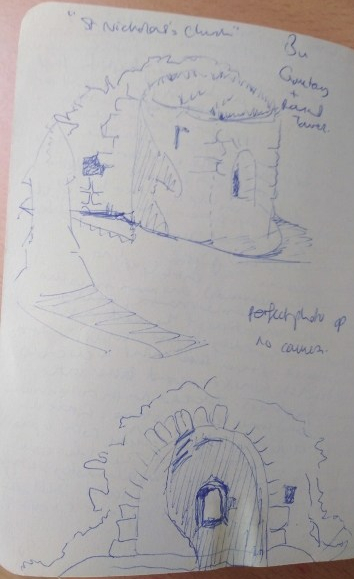
I slept a while, perched on the edge between the track and a small fall to the dark stoned beach, prickly with heather underneath but therefore cushioned. Further along is the broken-down bridge (which I crossed anyway) and the churchyard of St Nicholas. The ruin made a big impression on me, and I tried to record it in a sketch.
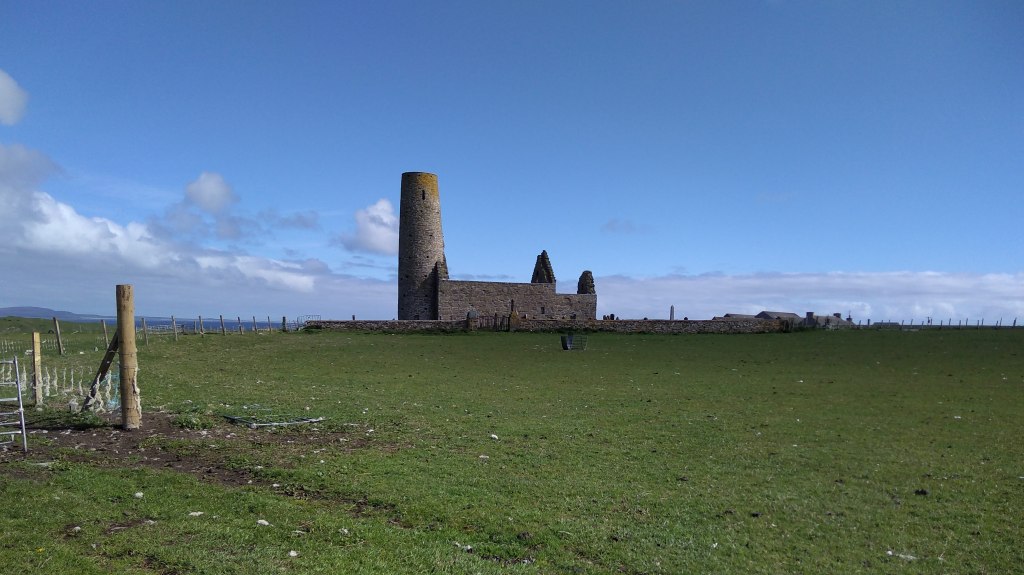
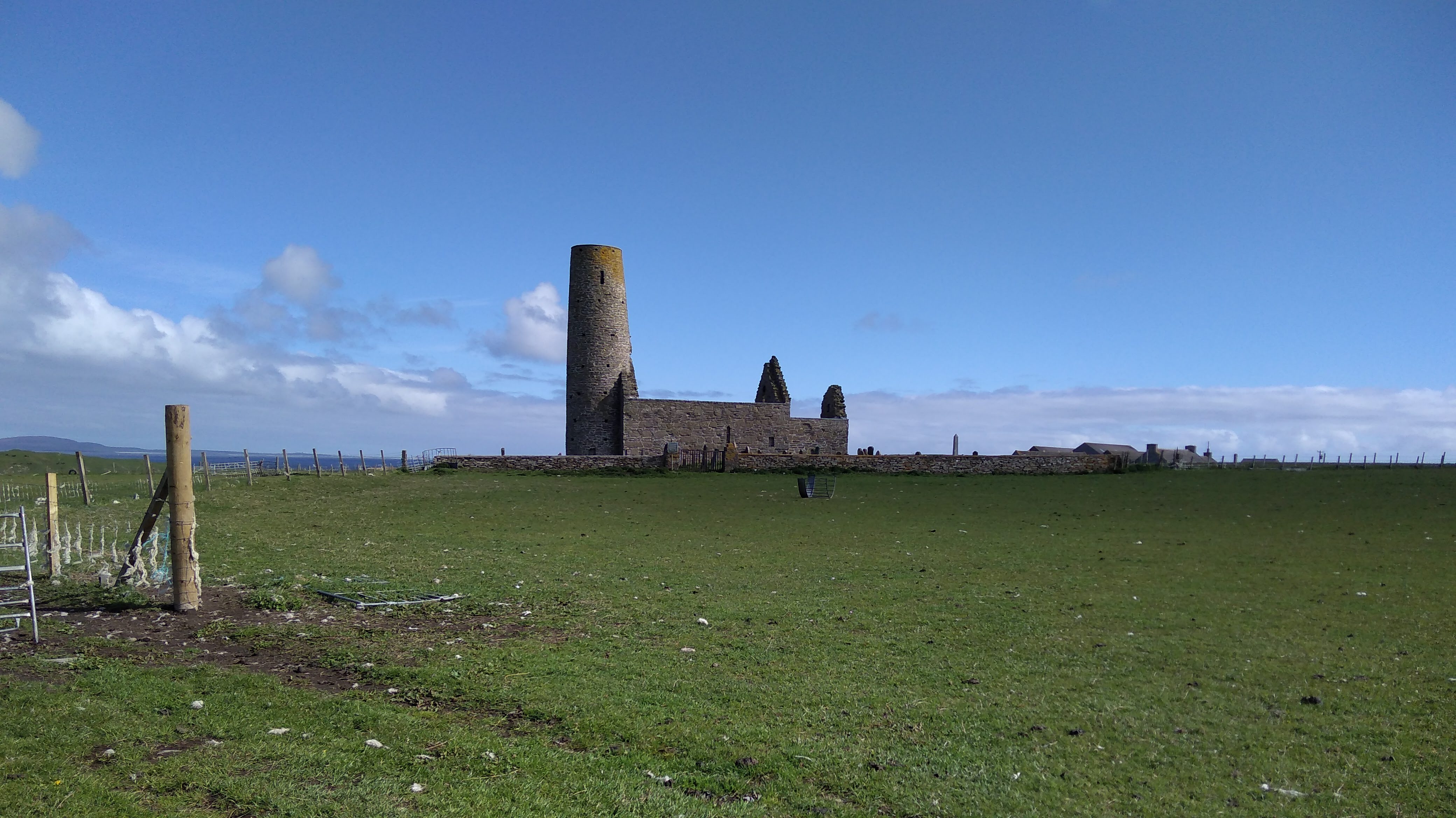
Only half of the tower remains, facing you as you arrive through the gap in the wall with its grassy hair and rugged exterior.
As you come around, the inside is exquisite – pale, smooth stone with a single arched window. Plain and undecorated, it seemed to encapsulate a holiness I rarely felt in the gold and silver interiors of the many cathedrals I have visited.
Nearby is the Orkneyinga Saga Centre which tells the story of the Norse Earls of Orkney. It closes at 6pm and I didn’t get that far. When I went on the Viking Hiking tour a couple of days later and the lovely Ragnhild ‘quoted oft’ from this famous text, I wished I had, and when I got home I thought with hindsight that I could have carried the tent and spent the night there, but I didn’t quite understand what I would find at the time. Even the bit I did see was one of the highlights of this trip.
There were 10 times as many walkers on this little stretch then ever I saw during the entirety of the past days. Probably because it was an unusually sunny, Sunday afternoon. The scenic loveliness probably also had something to do with it.
The long, winding return walk was equally enjoyable under trees which met above my head, a flood of bluebells beneath. Hoardes of almost-golden gorse branchlets reached out, so crowded with mouths bursting open I could almost hear them, ‘me first, me first’; while the individual kingcups presented their simple faces imploringly sunwards. The feathered petals of the only-slightly-paler dandelions on their juicy stalks were any moment ready to transform into translucent orbs of parachutes. I didn’t need to look where I was treading, so birdwatching was easy: jet black crows picking in fields of alabaster daisies; the now-familiar voices of mew and maow and peep (birds); and the gull-gliding, goose-flapping and sparrow-fluttering were all present and accounted for.
Walking when hungry at the end of the day can lead to morosity, but after a while it’s only walking – finding ways to release hip pains, just one foot in front of another.
And then I got to order my food at The Noust Bar and Restaurant – what a shame British restaurants don’t bring bread while you wait these days! – but I did enjoy the beer (the second from the Orkney brewery) which unsurprisingly went straight to my head. The service was good. The food would have been delicious whether or not it was, if you see what I mean. The monster, beer-battered fish, well-cooked chips and frozen peas hit the spot, as did the blackcurrant crumble and ice cream (£20 with a cup of tea to round it all off). At last I could charge my phone somewhat and as I had wifi access I took care to write notes ahead of the next day’s hike.
Finally I went off to my sleeping bag between the leaves of the garden, and halleluja! I was hot. I got up once in the night, and it was all mist and ghostliness. I even had some battery power to take this photo.
I am walking the St Magnus Way on Orkney, and this is one of the blog series – 29th May 2018. At the bottom of this post you can find links to all the others (introduction, transport, accommodation, resources etc). The overall walk is 55 miles (88.5 kms) over 5 days plus a visit to the island of Egilsay where St Magnus was said to have been murdered and, initially, buried.
On this, my last day on the island, I woke up in a bed instead of a tent, which was novel! It’s amazing how quickly you get used to something new. My hosts were most hospitable. It was a house full of books, toys, antiques, bric-a-brac, smiles and shyness.
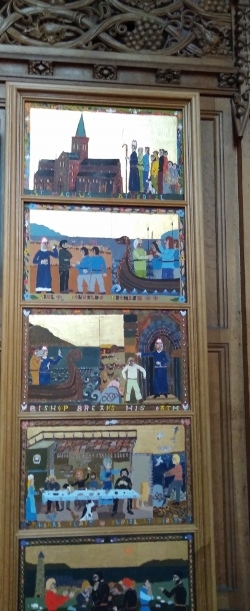
The St Magnus story tapestry, St Magnus Cathedral, Kirkwall, Orkney
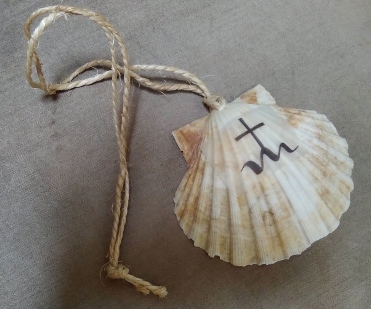
After giving Shiatsu, I made my way into the city to revisit the St Magnus Cathedral and other sights. I was given my prize shell but could not discover how many other backpackers from outside Orkney had managed the whole walk as there are no records.
There is a gorgeous stained glass window by Crear McCartney from 1987 (unfortunately the photos didn’t come out well). It depicts St Magnus’s pilgrimage to the Holy Land and includes a crucifix from Trondheim, Norway. I also found the sheela-na-gig in the chapel at the far end (a squatting female figure), the green man and the Marwicks’s Hole where women who were accused of witchcraft were sometimes held.
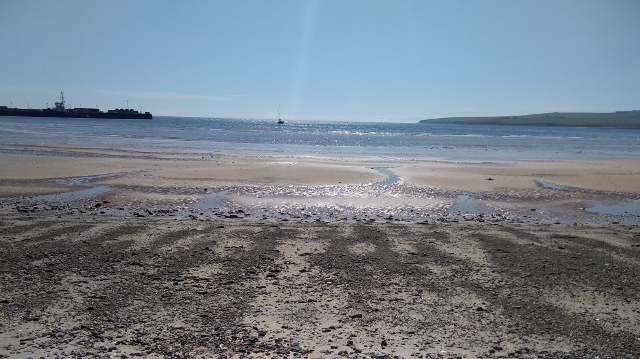
It was another wonderful beach afternoon with sand of luxurious softness and a diamante sea. Scapa Bay, Orkney.
An artist survives on the beauty that surrounds her.
Winifred Milius Lubell, political graphic artist and book illustrator.
My afternoon treat was to go on the very first Viking Hiking trip with Ragnhild and Mark. We gathered at the Tourist iCentre (ie information bureau) next to the bus station and wound our way through the city, stopping to view and learn about some of its highlights.
Then we meandered towards Scapa Bay (the largest natural harbour in the Northern Hemisphere) from whence I had come the previous afternoon. Back past the hospital, once again around the roundabout, and along the Cantit Trail. I retraced my footsteps across the strand westwards. This time I had a fully charged phone and could take as many photos as I wanted.
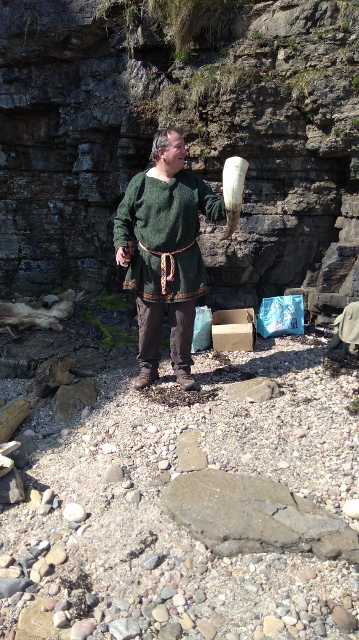
Mark holds out a Viking horn for the Orkney beer.
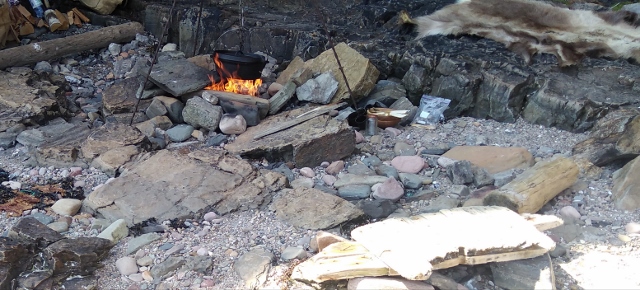
It was the first time I had sampled Viking food around a live fire, and I enjoyed being regaled with stories inspired by the Orkneyinga saga, amongst other sources. Ragnhild, being Norwegian as well as a scholar and qualified tour guide, was most entertaining and knowledgeable, able to answer any questions we cared to throw at her.
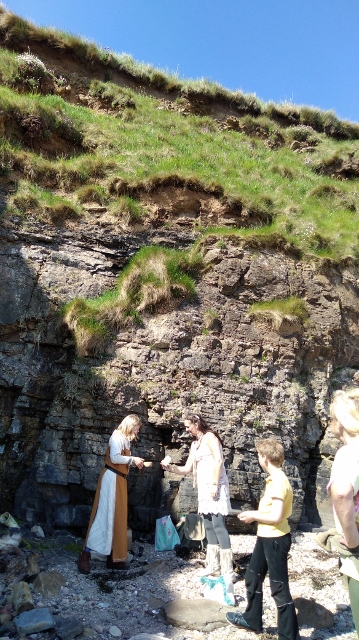
Ragnhild in her Viking costume, with other members of the group. We mixed, formed and cooked bannocks from peas, barley meal, honey, salt and of course sand to suit all tastes!
We churned the butter to spread, and ate our broth with horn spoons. It being the first one, I was in the company of a hotelier, various newspaper and on-line reporters, adults and children. We were all very impressed and the others vowed to display leaflets and publish articles etc. It was live streamed on Facebook!
There was singing and dancing around the fire under the cliffs.
After another delicious meal at their home, Christopher took me through the balmy evening to Stromness, where I was able to pick up my phone charger from The Ferry Inn where the kind woman I met on day 1 had left it for me.
The Peedie Sea (Kirkwall, Orkney) had ethereal steam lifting off it.
After that we drove through heavy fog before arriving into Stromness under a bright sky 25 minutes (14 miles / 22.5 kms) away. The weather is always a good topic of conversation with the British and those on Orkney were no exception, but it really depended on personality: when the fog was down someone would tell me, ‘it’ll be bound to lift soon’, another, ‘it won’t lift today’, and a third, ‘it might lift though’. Overall, I had the most sun anyone could ever expect on these islands for my pilgrimage, and felt duly lucky.
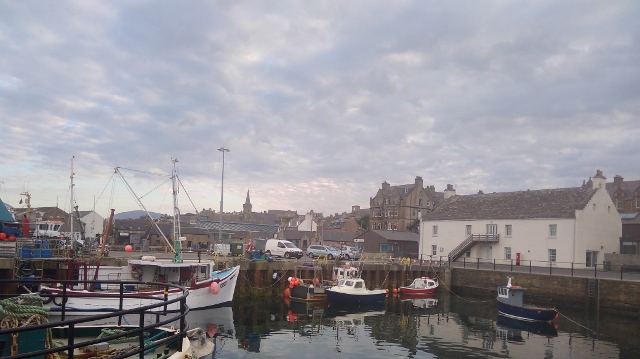
Stromness Harbour, Orkney. I remembered seeing a seal’s head in the limpid sea here the first time I came.
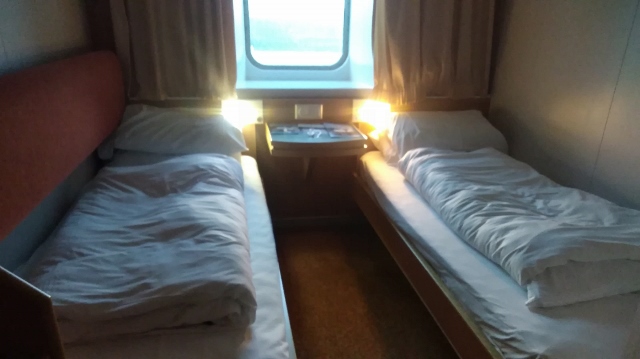
A gin and tonic later, I boarded the Northlink ferry where I found my two-person birth empty – which I was pleased to say it remained. There was a salon with all manner of snacks and drinks, books and magazines to entertain the 12 of us, and then I happily took to my bed for some note writing and reflection.
Ferry cabin, Stromness Harbour.
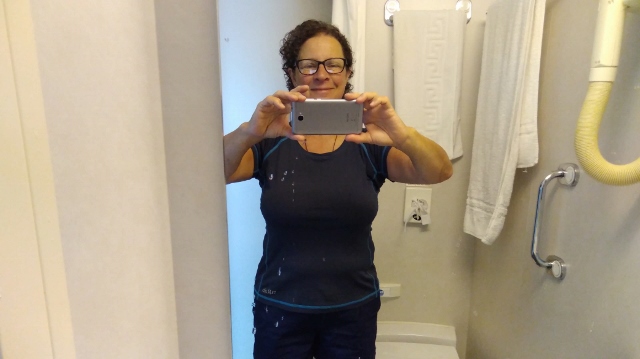
Happy and quite tanned after my lovely walk, despite the latitude.
The overnight ticket includes an all-you-can-eat breakfast which carried me right through to Edinburgh, eight hours later!
Travelling home
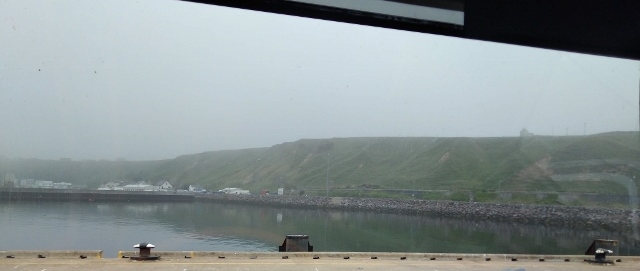
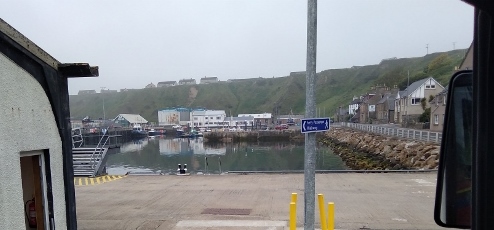
Arriving in Scotland / on the mainland – at Scrabster Ferry terminal.
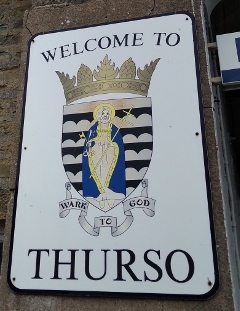
We docked at Scrabster and I jumped on the bus to Thurso, just five minutes along the road.
I wasn’t sure how to get to the station and so made an enquiry of someone passing. Like several others, he offered me a lift, telling me, while we drove, how he had moved from the east end of London some years ago to take a small holding, and now dealed in 4 by 4 cars.
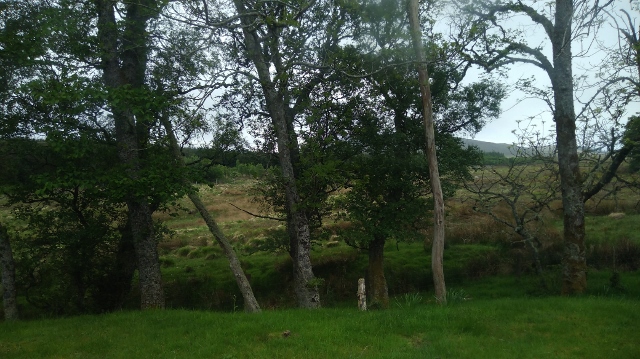
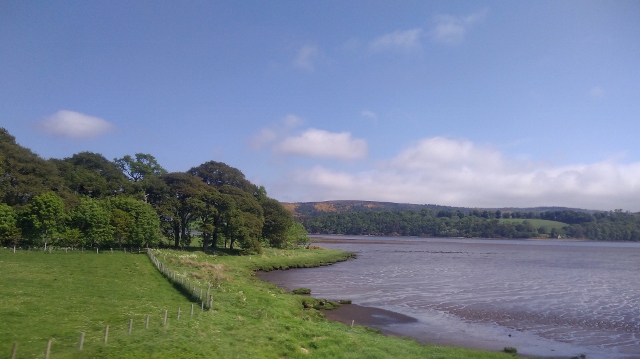
Through the rectangular window – trees again!
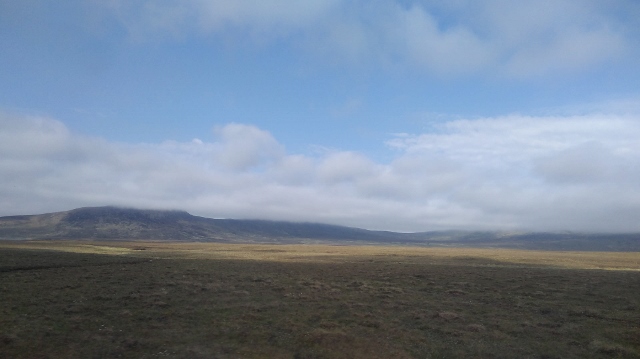
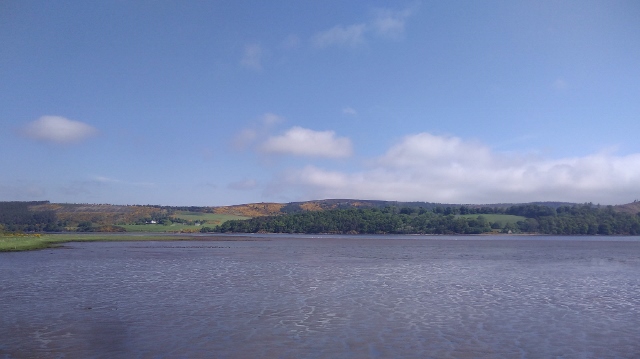
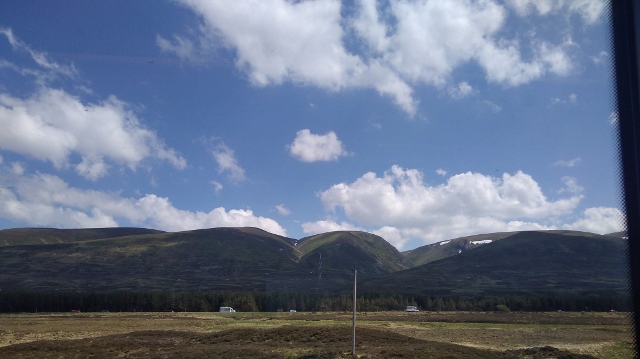
Hilltops in the cloud.
Not nearly as bleak as the Orkney moorland.
Although I arrived hours early because of taking the overnight ferry, I decided to chance it and leaped onto the first arrival. All went smoothly, no-one looked at my ticket and told me I was on the wrong train. The scenery was stunning of course, and as the sun still shone, I could snap away to my heart’s content.
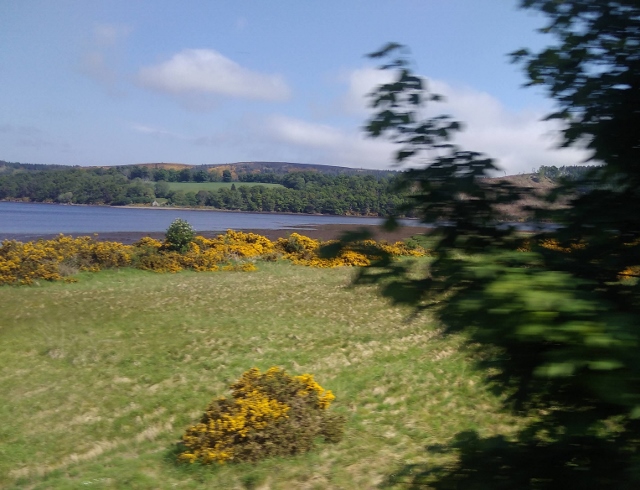
Such blue!
Contrasting with the yellow gorse.
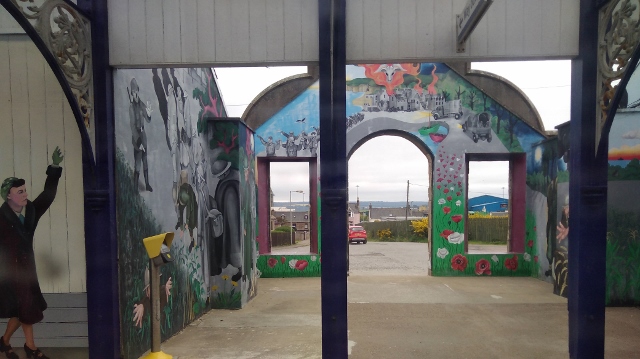
Murals at Invergordon Station – very original.
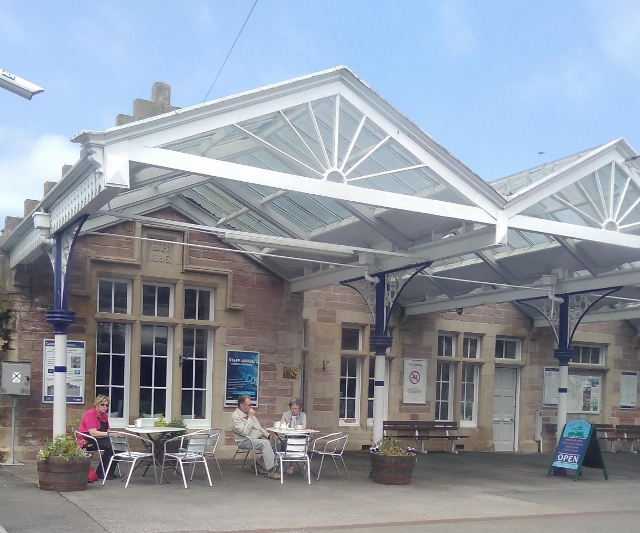
The elegant arches of Dingwall Station where you can take refreshments at Tina’s Tearoom.
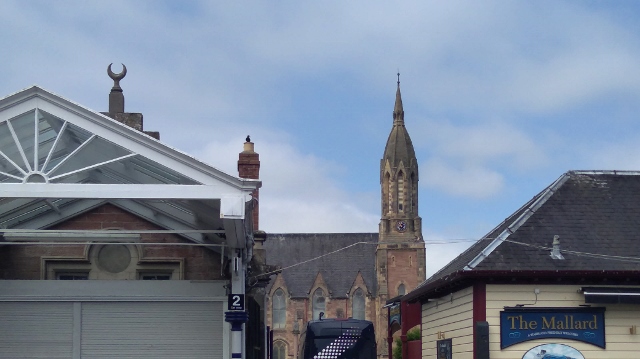
Dingwall and Strathpeffer Free Church, The Mallard Bar, and perhaps a mosque with the crescent on top of the building on the left.
As we waited beside the platform in Dingwall, the guard explained that there must be another, more important train on the line which had priority over us, ‘like a nuclear warhead or The Flying Scotsman’, he said. None of us were sure what to make of this.
Meanwhile, the man across the aisle kept calling the woman beside him, ‘pet’, even though they didn’t know each other; someone ripped their velcro; another rummaged in her bag; and the woman in the cerise T-shirt cleaned the tables at Tina’s. As the power surged on and off, my screen failed so I could see green bubbles alternating with the picture of my daughters; we disagreed about the new Murder On The Orient Express film; we waited.
Then the energy of the other train hit us and we gave a great shudder. Yes, it was The Flying Scotsman with its smart burgundy livery and glimpses of crisp white table linen at high speed. Too fast to snap it.
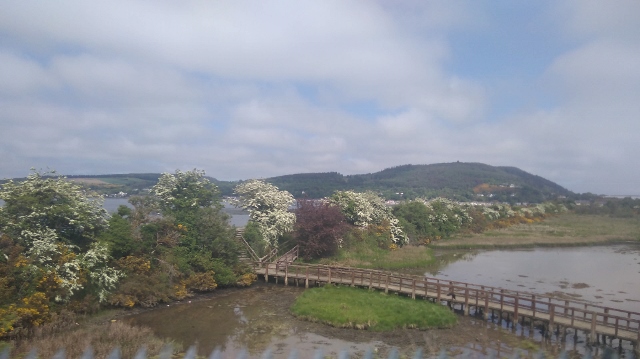
Actually after that we were delayed some more before the perfect spire against the baby blue sky shifted sideways, and it was all white hawthorn and green hills once more.
I changed trains at Inverness and the run through the Cairngorms was, if possible, even more impressive. My newly met companion from Elgin, on hearing my tale of woe, insisted on trying her charger with my phone, and it worked: she was right, it was the charger that was the problem, not the phone. Whew – that was one extra dreaded visit to the Three shop on Princes Street I could avoid!
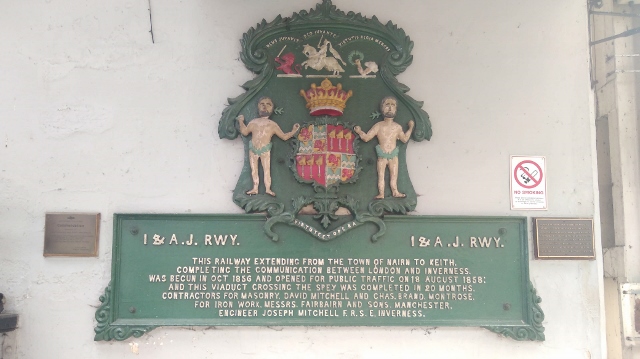
The Coat of Arms at Inverness Station. But why are the men naked except for fig leaves?
As the afternoon wore on, it became very hot and crowded and I started to write, but the thoughts came too fast for my typing. I became feared that I would never manage to write it all up the way I wanted to, in the book I had so easily envisaged while I was walking. How strange to be sitting all day and hurtling through the landscape so fast. I slept.
In the end I was able to return in record time, and in all, four hours earlier than planned. As this was my fifth trip, knew to expect a period of adjustment after the intensity of being away. I knew I would be grateful to see my daughter, and sleep in my own bed with the cat purring on top; and also that this writing would give me a focus to bridge the gap to what I still call, ‘normal life’.
I am walking the St Magnus Way on Orkney, and this is one of the blog series – 21 – 30 May 2018. Below, you can find links to all the others (introduction, transport, accommodation, resources etc). The overall walk is 55 miles (88.5 kms) over 5 days plus a visit to the island of Egilsay where St Magnus was said to have been murdered and, initially, buried.
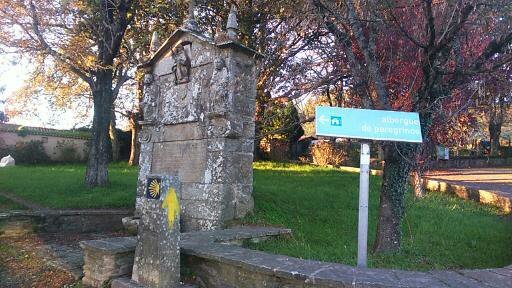
Spanish camino yellow arrows and other signposts.
Signposts
If, like me, you are used to finding the yellow Spanish Camino Santiago de Compostella arrows, then you will:
a. be at an advantage – you know that it is important to slow down at junctions or if you get that funny feeling you might have gone the wrong way, and really scout around for the sign. You know to look in unusual places, and that they will not always be at the same height as you, or immediately obvious.
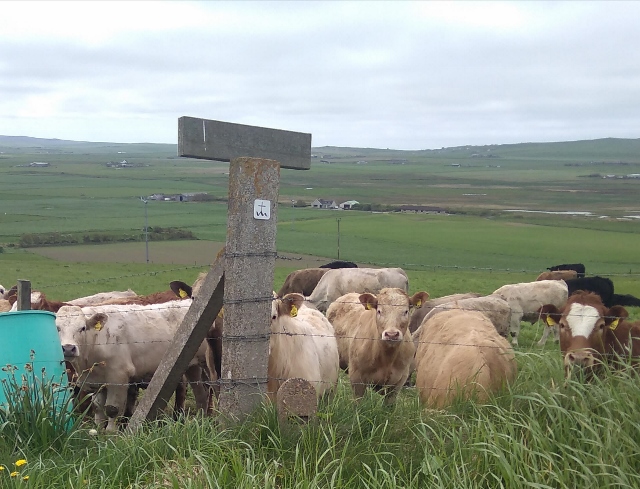
b. On the other hand you will be at a disadvantage – yellow shows up better than the more environmentally friendly St Magnus Way black and white signs on wooden posts. You will expect lots of guidance (eg through a wood where the path twists and turns and there are tributaries (as it were)) and that is not the case here – on the whole one must follow what seems to be the main way. (This is certainly my experience with many other pilgrimages, not just this one. The Via Sacra signs were really hard to find, whereas the Fife Coastal Path is great).
The signs are sometimes before a junction, sometimes at it, and sometimes afterwards.
I believe they were positioned by people taller than me, so for example if the next one is over a hill, a taller person may be able to stand with her back at the previous one and see the following, but not always.
In fact, now I am on this subject, the stepping stones which have been helpfully laid over burns and bogs are also very far away from each other – perhaps at the correct distance for the average male stride – but not mine, not with a rucksack anyway. In these cases I took a deep breath and leapt!
Bluetooth
There is a system of Bluetooth waymarks provided by the Pilgrimage organisers, with information so that when you walk you use your phone to connect and can listen as you go. I would have loved to try it but the system was down when I was there. Of course you would need a smart phone with that capacity to use this facility. I don’t know how long the recordings are, but don’t forget that you would also want headphones.
Many people love music or podcasts as they walk. Personally, I like the sounds around me and in addition there’s always plenty going on in my head! I have tried but I always give up quickly as I feel cut off from my surroundings.
Route descriptions
There is no guide book as yet, although the organisers of the Pilgrimage are in the process of producing one which will be great I am sure.
They do already provide Route Descriptions on their website and these were updated and published on 30 May 2018 after I returned home. They are generally of a very high standard. I suggest you print them out and laminate them before you leave in case of emergencies. I know this sounds a bit geeky but you never know what might happen, especially with technology.
There are also documents, audio recordings, videos, photos and all manner of amazingly useful and interesting resources on the St Magnus Way website.
Compass / maps
A compass comes highly recommended (make sure you know how to use it!) because north, south-east etc are used in the St M Way directions. I planned to use the one on my phone, not imagining that the phone would be virtually unusuable.
You can download Route Maps from the St M Way website.
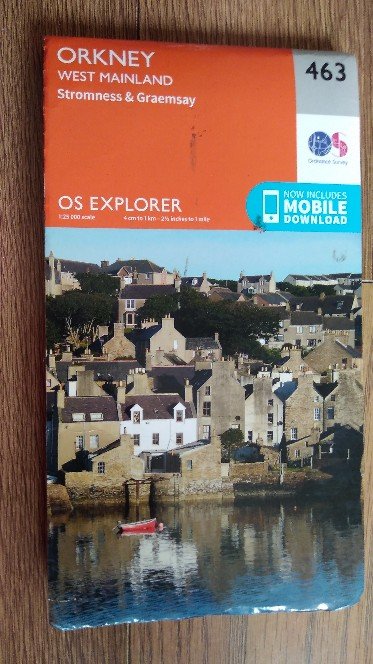
I would also suggest bringing an Ordnance Survey (OS) map so that you can see where the St M Way Route Description landmarks are. The mast on Keelylang for example, is listed on the Route Description for Finstown to Orphir as a way of orientating yourself. It is on Googlemaps but not the St M Route Map. Kebro is on the St M Route Map but not on Googlemaps. Both are on the OS map 463 which has most of the West Mainland on it, but not Kirkwall, so for the hard part of the final day’s walk you will need to carry a second map. You can buy maps at Rae’s Paper Shop in Stromness and in Kirkwall.
Whichever map you use, you need to know the direction you are physically pointing towards (see compass above) otherwise it’s almost no use knowing where the place you are searching for is on the map anyway!
Please note that if you have the facilities, know how and space on your phone, there are gpx connections on the official site. I suspect, from looking at other websites and talking to some (mostly male, it has to be said) hikers, that using technology is the thing to do, but I am a trifle old fashioned in this respect so you would be better looking elsewhere for that information (though there is a helpful quote below). I think you have to spend more on your mobile phone than I do to be able to use it all. There is of course the argument that a pilgrimage is a place of silence and self-reflection and we all know that technology isn’t always helpful with that; then again, getting lost is a bummer.
In any discussion of routes, navigation or GPS devices, you have probably seen people mentioning ‘GPX files’. GPX is shorthand for GPS eXchange Format and is a type of file that’s really helpful to anyone who loves the outdoors, and is the most popular way of saving and exchanging routes. Ordnance Survey Blog
Tetanus
Be sensible and check if your tetanus jab is up-to-date before you go hiking! I was so careful, doing everything slowly, but my foot slipped down a hole I couldn’t see and the barb from the wire was too close. I had tea tree essential oil with me which is a serious antiseptic and so I wapped that on immediately, repeating several times a day for the next few days and I was fine. Check the symptoms of tetanus.
Cold at night
It’s hard to imagine it can be so cold at night in a tent in May when the day-time temperatures are so moderate, but it can, so you have been warned! See Resources – what I took with me (link below). Weather, Kirkwall



 Walking without a donkey