A virus is a tiny particle and needs a host cell to be able to live and spread. If each of us takes a short walk this weekend; if we all listen and record the sounds around us and the feelings which go with them; within a 2 km / 1 mile radius; and if I host a platform for collating these – then we can co-create a record of our extraordinary times. For those who cannot leave the house or hospital, we will collect the sounds of the outside for them to hear indoors.
Share
You might take a circular walk, or a there-and-back one. On foot, in a wheelchair, or buggy
For children and adults, dogs and tortoises
Aim to be silent throughout – don’t speak (although don’t be rude! If you talk, make a note of why and when)
You have 5 tasks to complete –
You will need a basic smartphone – nothing fancy. If you don’t have a sound recorder or video option on your phone, simply listen and record on paper:
Make a sound recording (or video with sound) of one minute duration somewhere along the route
Stop at another spot and listen for 5 minutes – write down what you hear at the time (or you can record yourself speaking on your phone and write it down when you get home). You can make a list or be creative
Take 1-5 photos at any stage of the route. Write down when and why you took them. (I do not recommend that you take a photo of yourself or your house, for privacy reasons)
When you get home, create an account of your walk in words, sound, drawing or other art form
Share what you have made (see below for sharing platforms)
Listen
Please note these things when you share:
Time: Start and end time, recorded sound at… Sat down, listened and wrote at… Took photos at…
Location: My route began and ended at home / where I am staying or living now (give general location). I went this way …. (list route or places or make another sort of record of it)…
Here is an example:
I walked between 5 and 5.30pm; recorded sound at minutes 7-8; sat, listened and wrote at minutes 24-28; took photos at minute 4 (because it was pretty),14 (because she reminded me of my mum), 24 (because that’s my favourite cafe) and 28 (because I was interested in the shadows); My route began and ended where I am staying now in Yalding, Kent, England. I went across the road, through Kinton Lane, around the field, through the gate at the far side…. … And ended back where I started (or I might draw a picture of my route or use my phone technology to digitally produce my route etc. You choose)
Note down anything else you think is interesting, eg if you take your donkey with you, please note this down as well.
What is the point of doing this?
To take a walk, focus on your environment and how it makes you feel
To notice how the area has changed since we have been in ‘lockdown’ and again, if repeated, how these things change over time
To know that you will be walking with other people who are doing the same thing in different locations around the world, thereby creating a walking community at this time of separation
For fun / exercise / to boost your immune system / be more grounded
To see what happens
To create a record of this event for posterity
You can probably think of more reasons – please tell each other
Walk (2 m or 6 feet apart)
Social Media
The Facebook group is called Walk This Weekend
Twitter/Instagram #walkgoesviral
I will use my twitter for sharing info @walknodonkey
Once you have shared, I will
Collate the data and share in a blog
Record how many people walked and where
Make a film with the photos, words and sounds (help will be appreciated as I am an amateur filmmaker )
Privacy
I will not reveal or use any personal information or data (if you do share your email with me for the purposes of sending recordings etc, I will keep it only for that purpose and delete after. It will never be shared with anyone else)
The future
Hopefully, we can each repeat the same walk the following week so that changes in you, in nature, and in your environment during that time can be noted.
16.3.20. This blog is unashamedly full of flowers, birds and other natural phenomena. I was very grateful to see that nature is carrying on (perhaps a little less interfered with than before) while all this is going on. It is intended as reassurance, and as a reminder that walking is allowed in the UK, even if you are at risk or at home because others in your family are unwell! I never thought I would have to use that phrase – how is it possible that walking needs to be sanctioned by a government? These are mighty strange times.
Teapot island which sells, well, teapots, and is also a cafe / take-away
Under the Hampstead Lane bridge, impassable
I walked across the Lees (more here) and tried to go under Twyford Bridge but it’s still flooded. I took the pedestrian way that bypasses Hampstead Weir (see above link for sunny photos from an earlier time) and comes out at Teapot Island. From there I took a left to walk along the towpath with the River Medway on my right. There were no fishermen today, but there was a man in wellies and shorts, his knees looking rather vulnerable, having a smoke, and another further on, busy weeding. They were outside the new fixed caravans which are lined up neatly there – rather liable to getting wet, I would hazard.
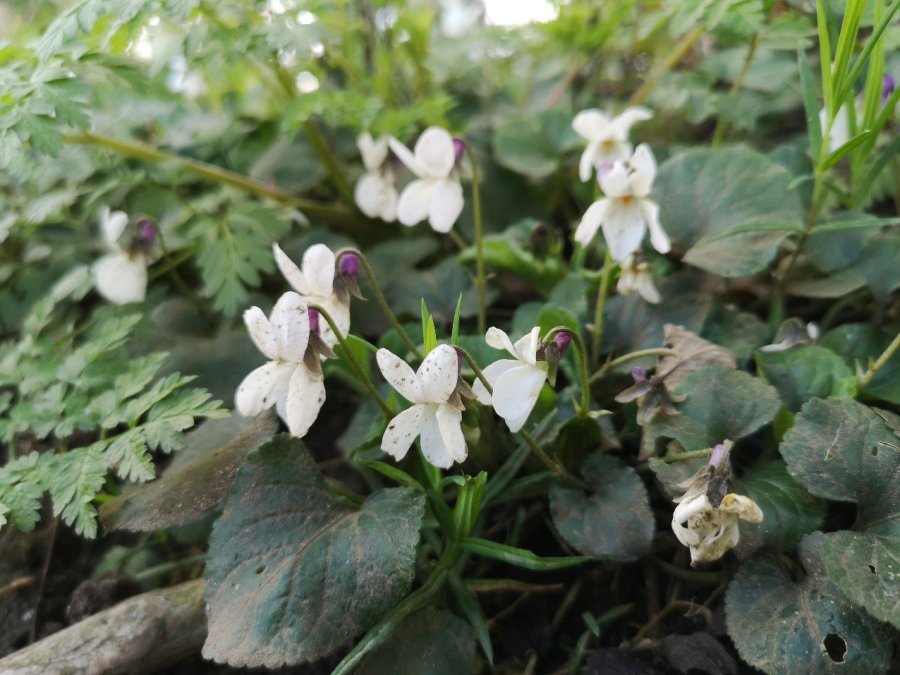
Tiny white violets crouching beside the path
Dock leaf, backlit with Spring sunshine. I took this walk, alone
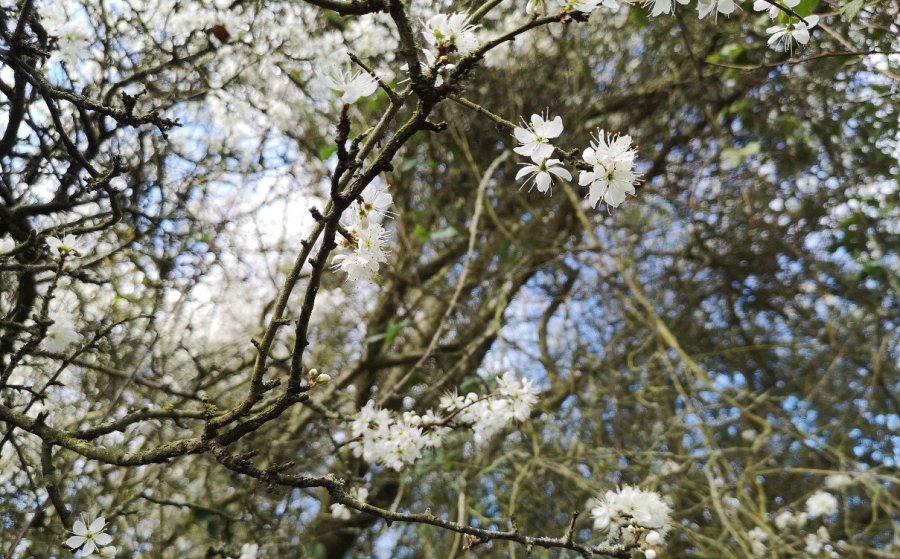
Blackthorn blossom. It’s about when you look and know that if you stroked them they would be soft as down
The sun shows up all manner of miniscule details: a strand, a filament of spider’s web stuck to a bramble new-leaf which is coexisting with the old ones on the same stem. There are also aged twigs, dry leaves, spent old man’s beard alongside the new blackthorn flowers and buds. We are all together in this.
A sign of new life hiding somewhere in the undergrowth
I began in a thwarted frame of mind: It was about when you want to walk from a-to-b-to-c, but have to settle with there-and-back. Then, quickly, it was just as glorious as it could be. I had planned to walk The Pilgrim’s Way from Winchester to Canterbury across the North Downs. I even had the Pilgrim’s Passport sent to me by a very helpful woman at the Cathedral in C. Another time!
Winnie-the-Pooh, or Pooh for short, was walking through the forest one day, humming proudly to himself. He had made up a little hum that very morning, as he was doing his Stoutness Exercises …Well, he was humming this hum to himself, and walking along gaily, wondering what everybody else was doing, and what it felt like, being somebody else, when suddenly he came to a sandy bank, and in the bank was …..
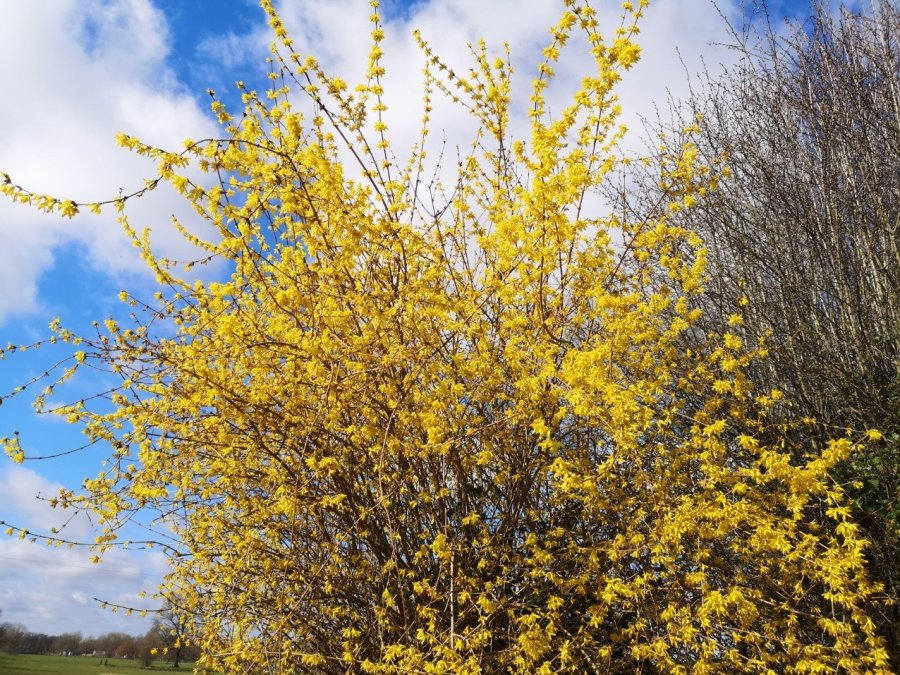
What a day for a daydream – ‘one of those days for taking a walk outside… a walk in the sun’. Yellow against skyblue makes for a sunshine combination
Stretching your wings at a time like this opens the lungs, lets in the necessary oxygen for staying as healthy as possible
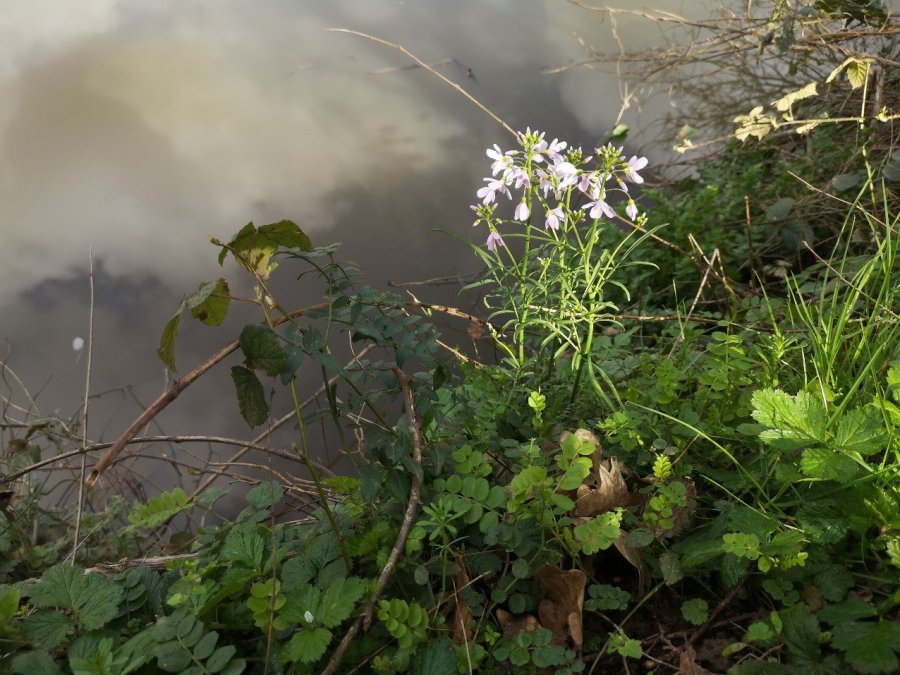
Lady’s Smock / Cuckoo flower (Cardamine pretensis) Thanks, as ever, to my mum and the people at Houzz.com for their help in identifying, being sure about names
There was the scent of wood smoke, and the sound of water under the bridge and through the lock, of twittering, and an occassional parping from a train that was still running even despite the reduction in passengers due to the crown shaped virus.
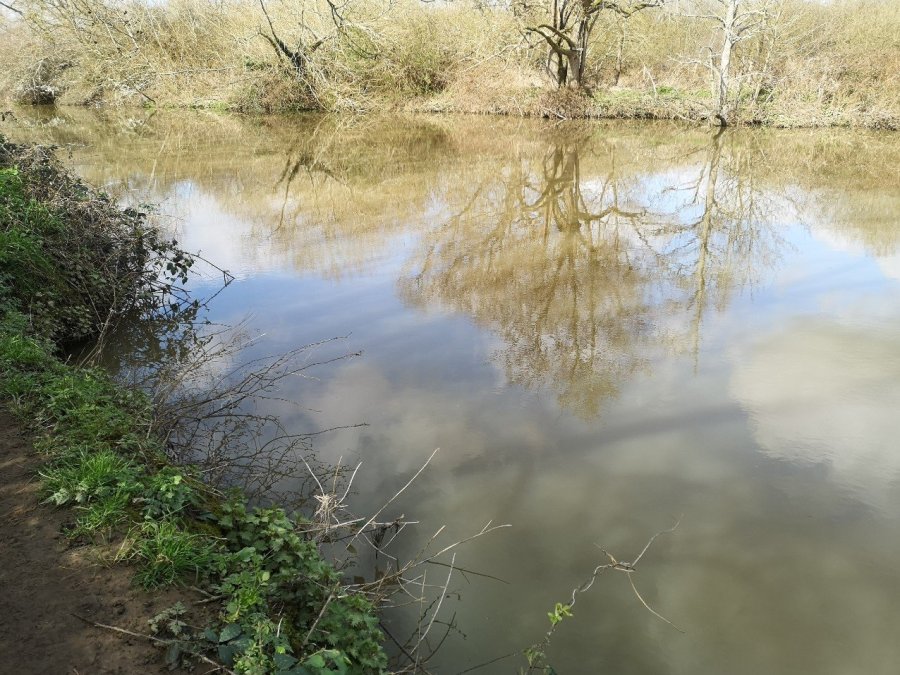
The river looked particularly glossy with gentle ripples making a regular, stripey effect
Foxglove preparing to bloom
There were regal foxgloves – no flowers yet, just a fascinator of leaves tilted at a jaunty angle on a mount. Many, many wood anemones were spread across the earth. Copious bird calls either drowned out this winter’s new tinnitus (mostly in my right ear) or it just stopped. There was, however, the thrum of engines from somewhere offstage (which was not the sound in my head!)
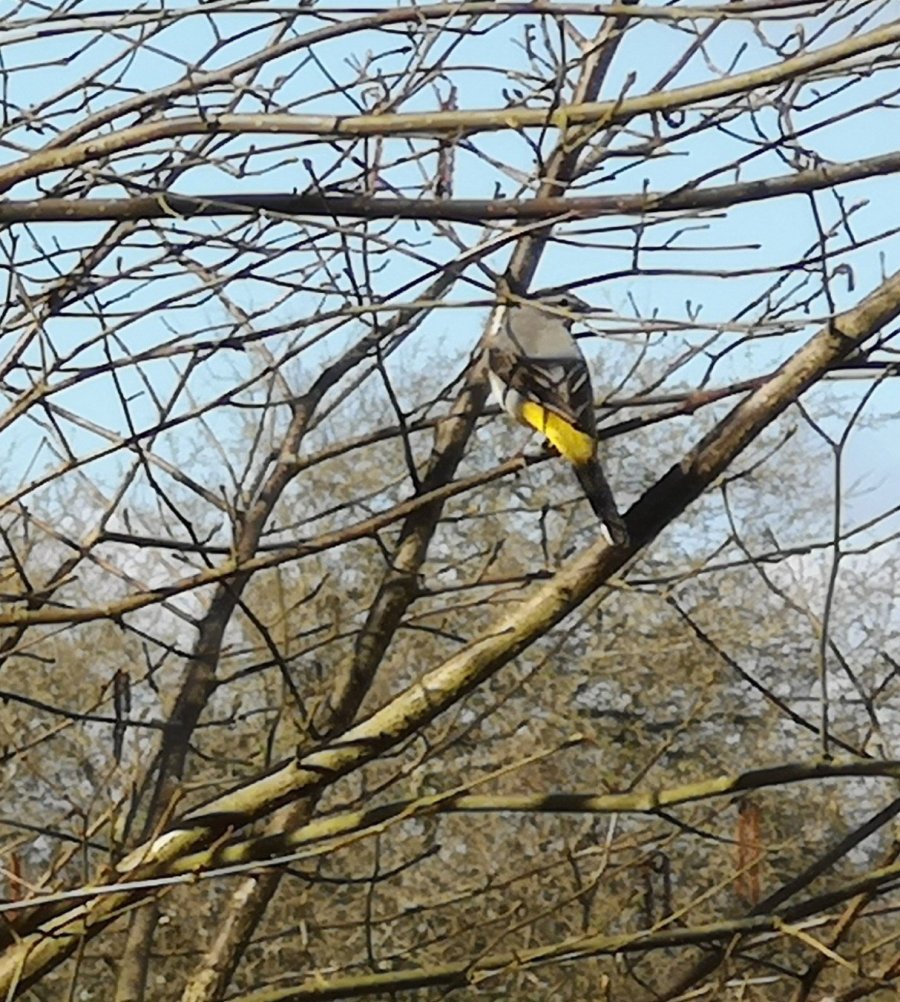
Grey Wagtail. That sunshine gets everywhere. (Thanks Lesley S for identifying)
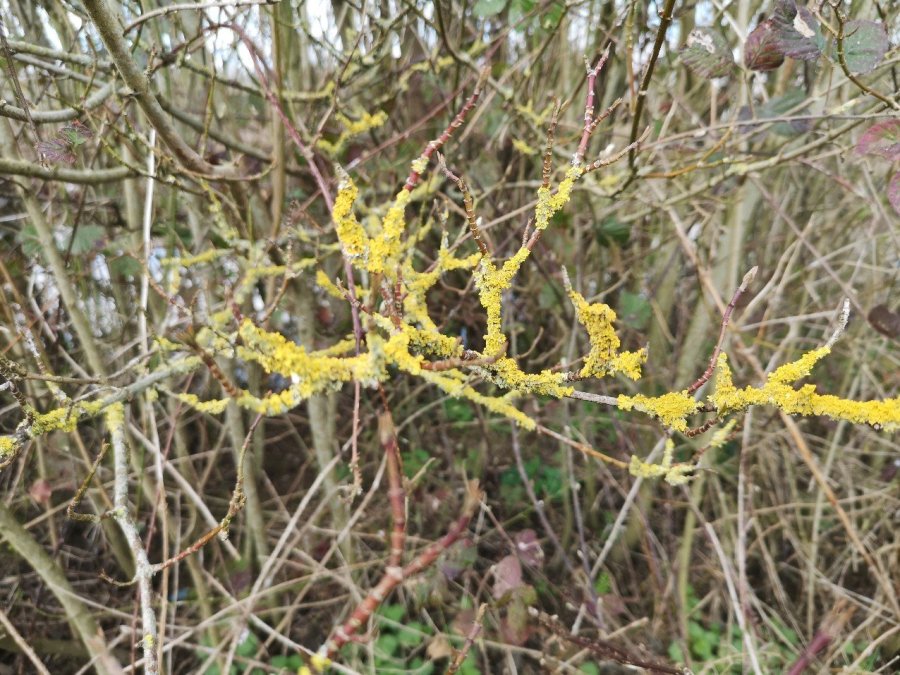
Matching lichen – continuing the theme of yellow
Busy collecting pollen
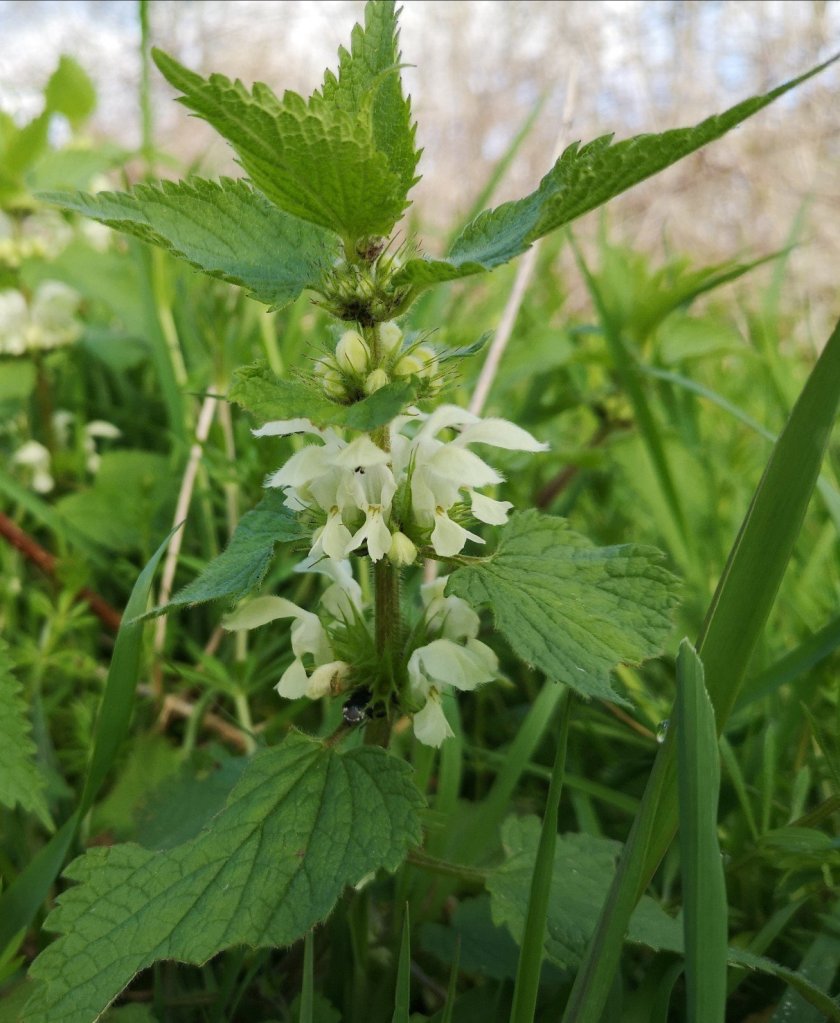
White deadnettle – I know this one from my childhood
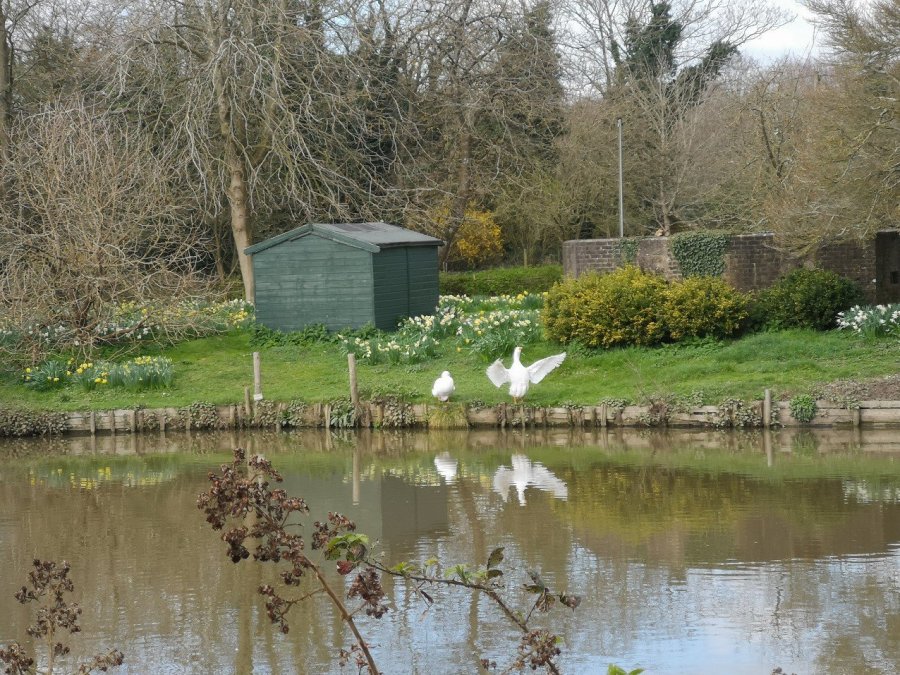
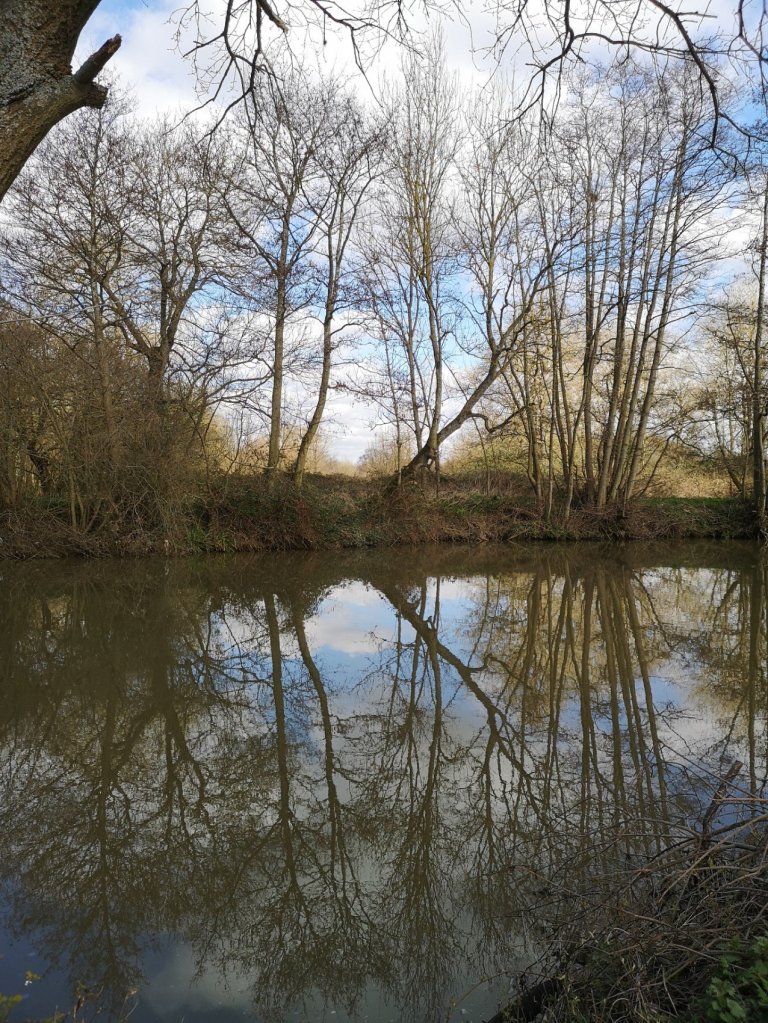
Reflections in the River Medway
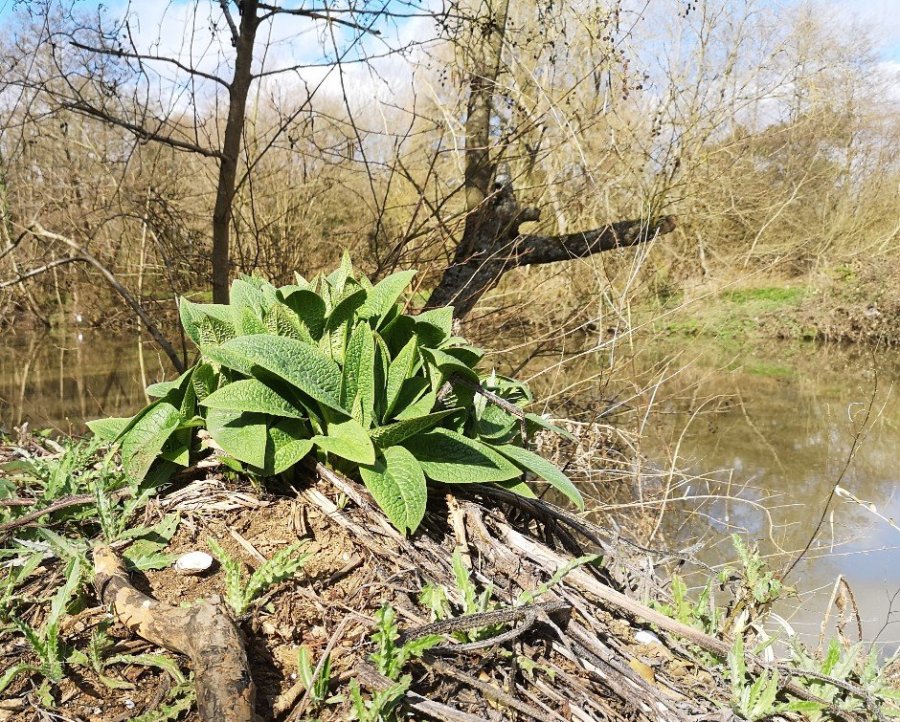
See the stalks growing through the mossy mound!
Detour to the other side to satisfy my curiosity
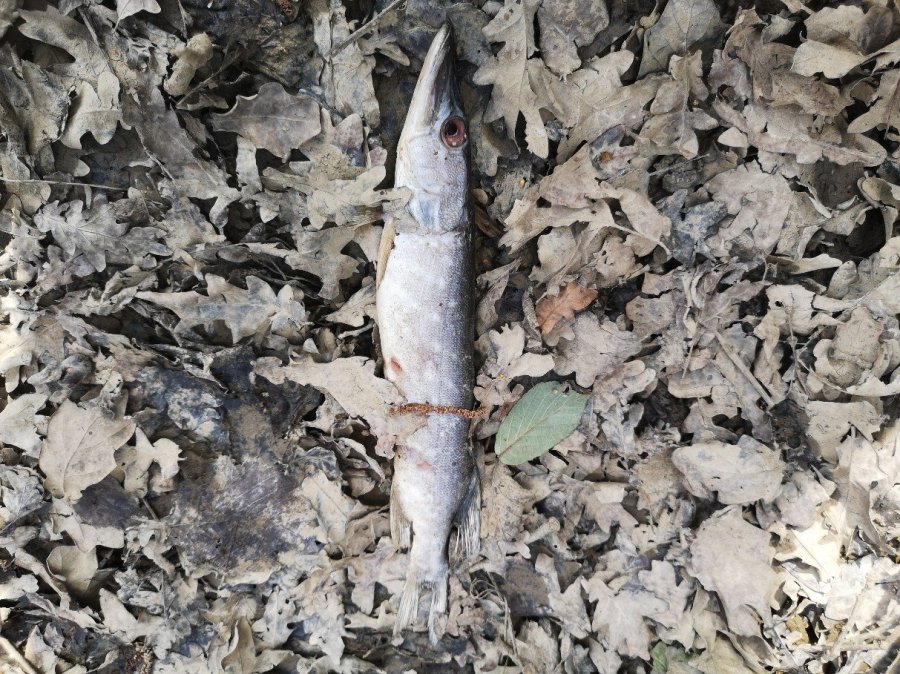
Northern pike, also known as a snot rocket, apparently. (source: Wikipedia)
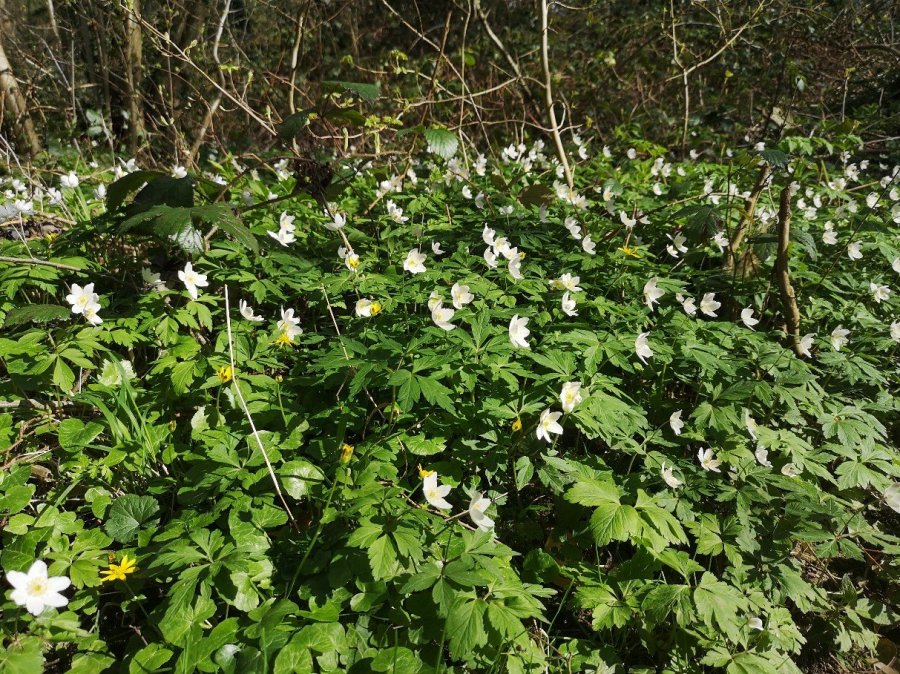
Banks of yellow eyed wood anemones
I spied one or two little settlements almost hidden by trees over the water, indications that people are living there quietly, in those beautiful spots. At a little bridge, I crossed to investigate the white flowers on the other side – were they wild garlic? No, instead a veritable sea of anemones. And, I spotted a large dead fish with a long nose – a pike – which I thought must have been flung there when the water broke the banks, because the greenery around it was all covered in a film of earth-dust. However, there was a hole in its side, so it must have been hoiked out by a human and not returned.
In the essence of full disclosure, I actually like the way northern pike taste. However, many would rather eat the aluminum foil the pike was cooked on than the fish itself. Well, with that in mind, one chef in Canada is about to change all that.
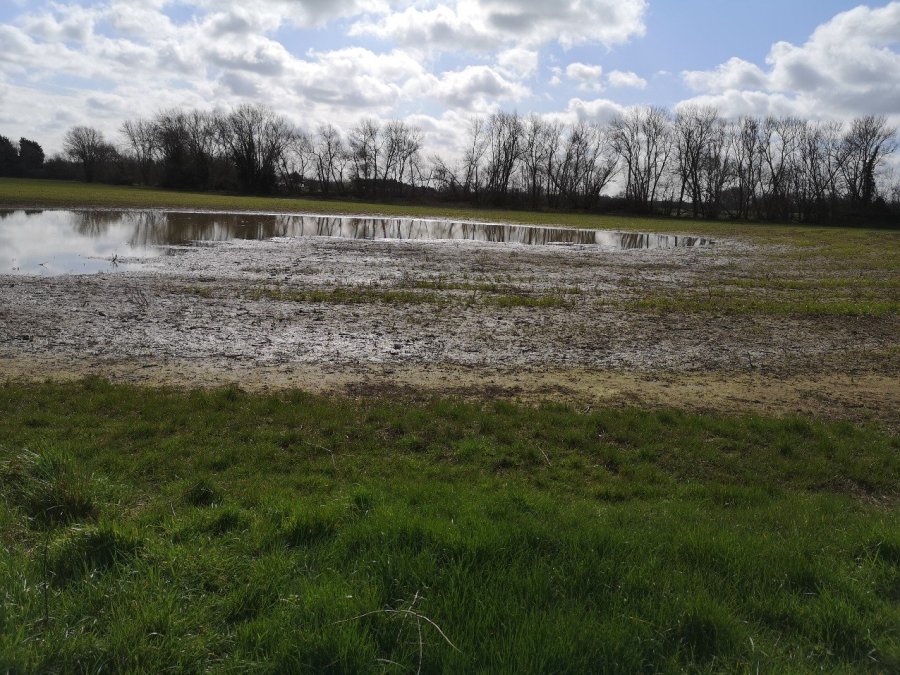
More excess water on the (slightly wonky) fields to my left
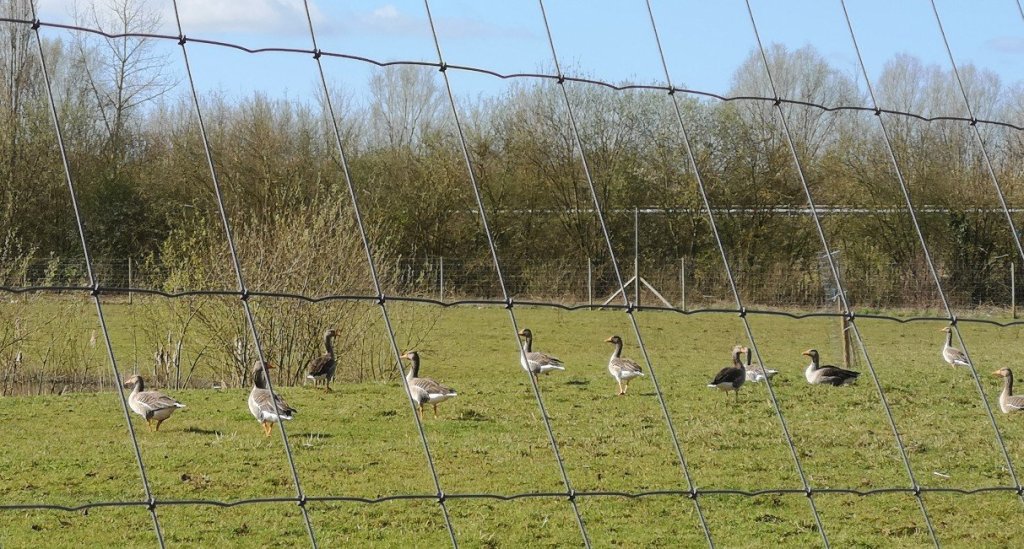
The Greylag geese were happy there
Where graffiti artists and pigeons congregate to make art and to coo
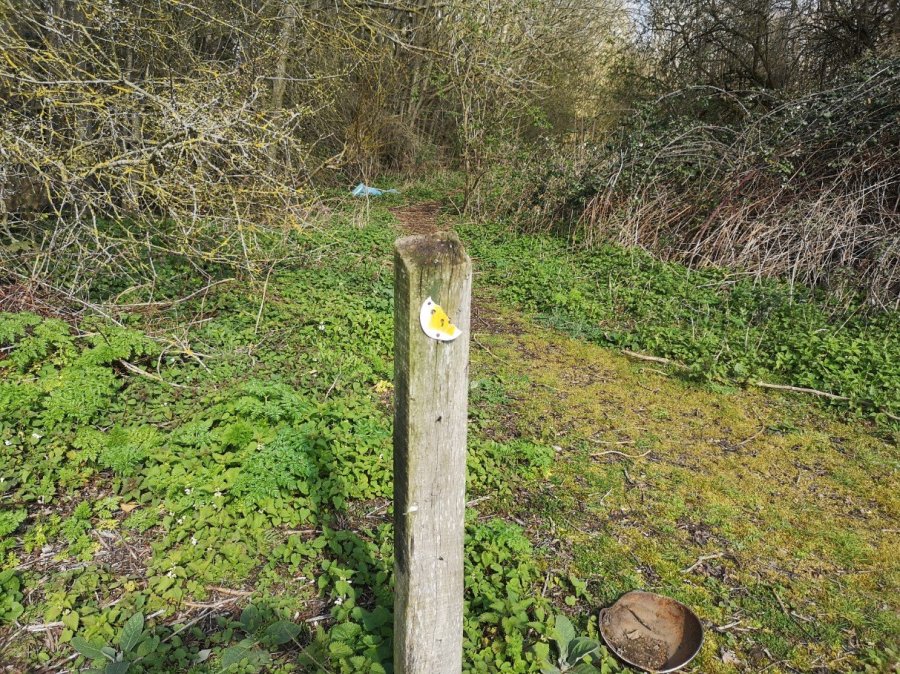
Which way? The clear sign posting at East Peckham
Coming up onto the road, I was in East Peckham with the food Co-op to my left. I spotted footpath signs up ahead pinting to the industrial area where they burn acrid things in backyards and the flooded woods are full of metal rubbish. Nevertheless, birds sang, woodpeckers clacked their beaks against bark, I spotted mallards and blackbirds, a thrush, a chaffinch – simply delightful.
Primroses
Across here to the weir
I was not clear which path to take at Sluice Weir Lock #6 located between the ‘River Walk Junction (Junction with the northern route to the railway bridge) (5 miles and 7¾ furlongs and 5 locks to the west) and Yalding Wharf (2 miles and 1 furlong to the northeast)’ also known as Branbridge’s Whark, Arnold’s Mill Lock, Pinkham. ‘Straight on to Hadlow and Golden Green, or over there to East Peckham which is very pretty’ said the male half of a couple I had been playing overtaking with for half an hour or so. They had a massive dog called Rudolf who, when he jumped up, was taller than me! I took the attractive route and they took the other. After all, we were supposed to be ‘social distancing’ which is possible but a bit weird – speaking to others with a 2 metre gap.
Note: a furlong is an eighth of a mile, 220 yards or 201 metres
Showing the footpath through the woods to Pinkham, East peckham – unclear. However, at the foot if the warm wood was a basking butterfly
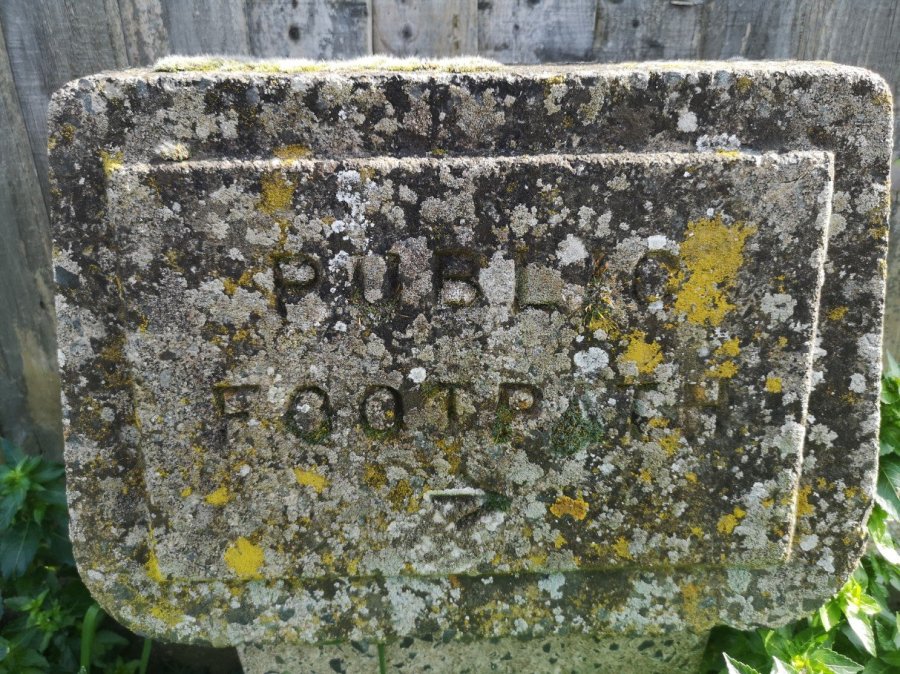
A significantly older public foothpath stone with splashes of sunshine
I explored the lock a little and then perused the woods where a huge bumble buzzed around my feet and a robin warbled and squeaked alongside me. There was the first butterfly of the year – bright orange like the redbreasts chest – on my return I saw a uniformly delicate yellow one.
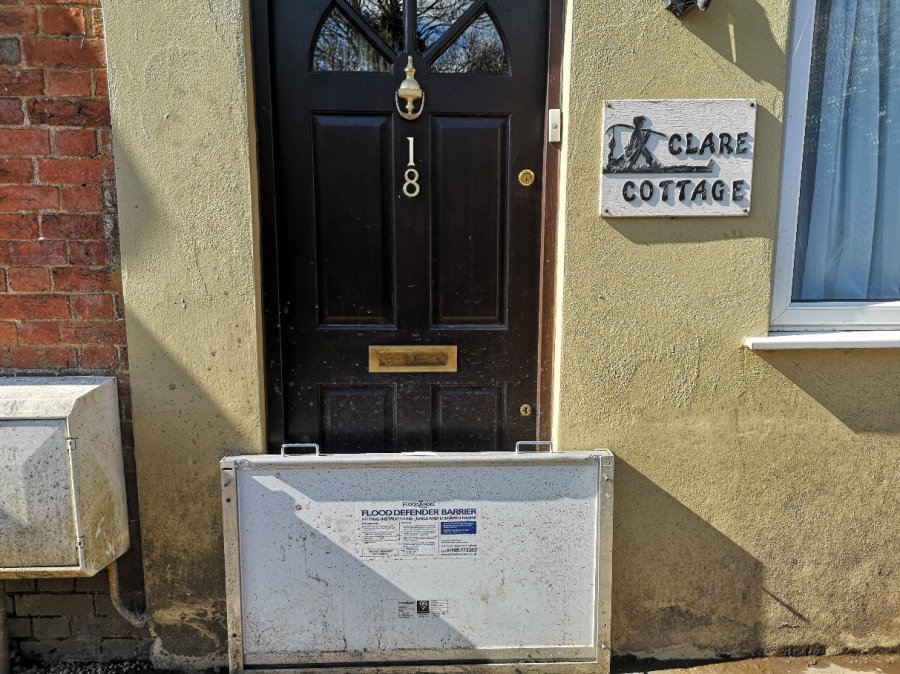
The little figure on the outside of Clare Cottage reminded me of a boy walking with a stick and victuals, but it maybe that he is a fisherman or something else
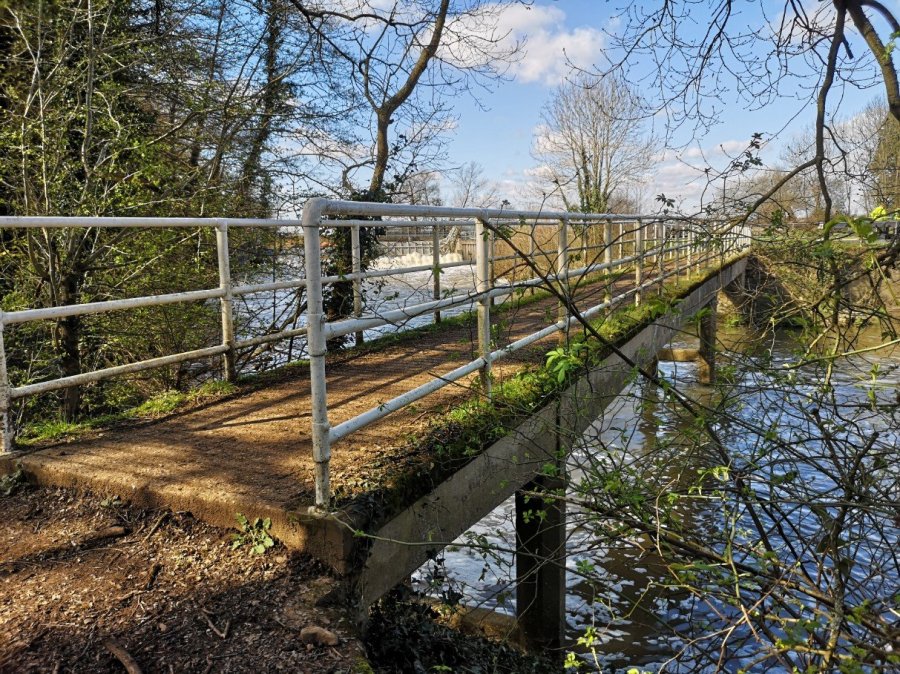
I meanered through the trees, across a pedestrian bridge and came out at a big house and paddock, then a row of cottages. The house plaque reminded me of Dick Whittington which I took as a good sign – a pilgrim if ever there was one, with his staff and pack over his shoulder.
Popular legend makes Dick Whittington a poor orphan employed as a scullion by a rich London merchant. He ventures his only possession, a cat, as an item to be sold on one of his master’s trading ships. Ill-treated by the cook, Dick then runs away, but just outside the city he hears the prophetic peal of bells that seems to say “Turn again, Whittington, lord mayor of great London”
I came out by bus stop on Old Road, East Peckham, opposite the street with the General Store and post office. The sun was warm and my 1.5 hours almost up before turning back. Retracing my footsteps and having a seat on the steps of the bridge, an satsuma revived me. I watched a cat emerge from the woods. She caught sight of me and took a sharp angle to avoid contact. There was a squirrel, but no chatter nor conversation.
Classical, traditional Kentish oasthouses – I liked the way the garden shrubbery was the same colour as the roof
I waved at a woman sitting under blossom reading. She had on a cardi which exactly matched the house and brown-red bush to her left. It tuned out to one of my mother’s friends – a village is a small place. She was bemused, not knowing me at all.
This walk took me just under 3 hours from yalding High Street to Pinkham and back along the river (allowing plenty of time for photo taking!)
It could almost be a gingerbread cottage, were it not for the sandbags at the door – protecting the cellars from the flood waters which have engulfed parts of this village three times this winter
Walking keeps my energy flowing so I find I can be kinder. It does no-one any harm, and it feels as if it boosts my immune system. Do you like to walk? What effect does it have on your spirits?
October 2nd 2019. The final leg of the Portuguese Camino de la Costa or Caminho da Costa from Porto in Portugal to Santiago de Compostella in Spain. 125 kms in total, today was a walk of approximately 15 kms.
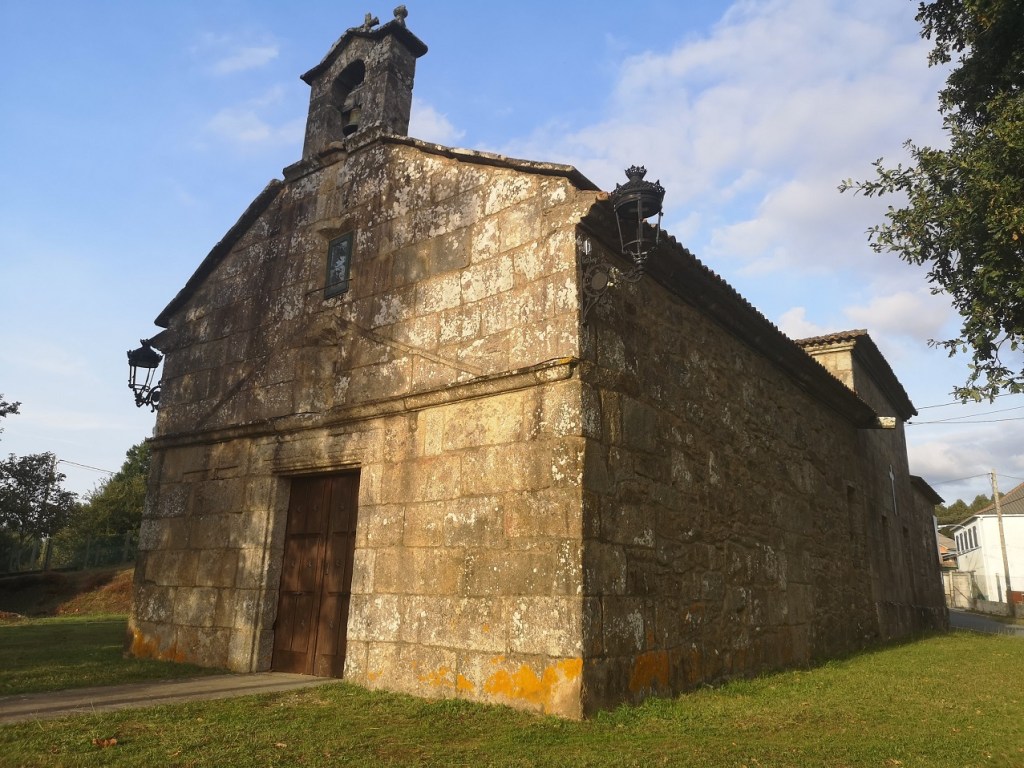
St James, patron Saint of the Camino, holding his staff and sitting in a little nook on the side of the Capela do San Martino near the cross, Cruceiro de Rua de Francos, near Teo, Galicia
Retracing my steps from the night before, I left the albergue at Teo at 7.45am and began the last leg of this Portuguese camino. It was misty, cold and the path went steeply up. Thankfully the weather cleared later. I had to take painkillers for my foot for only the second time on this way. It didn’t hurt when I was sitting down – a clear message.
Lugar de la Grela with roof crosses typical of the region, Galicia
Overall, this way into Santiago de Compostella is hilly and it was hard going, however it was lovely countryside. I breathed in the fresh air before entering the city.
We hiked forested paths, up and down hills, crossed rivers and railways, passed shopping centres, went down narrow alleys between houses, climbed a steep hill beside a hospital, and then walked on city streets. Spencer Linwood’s blog of this final day
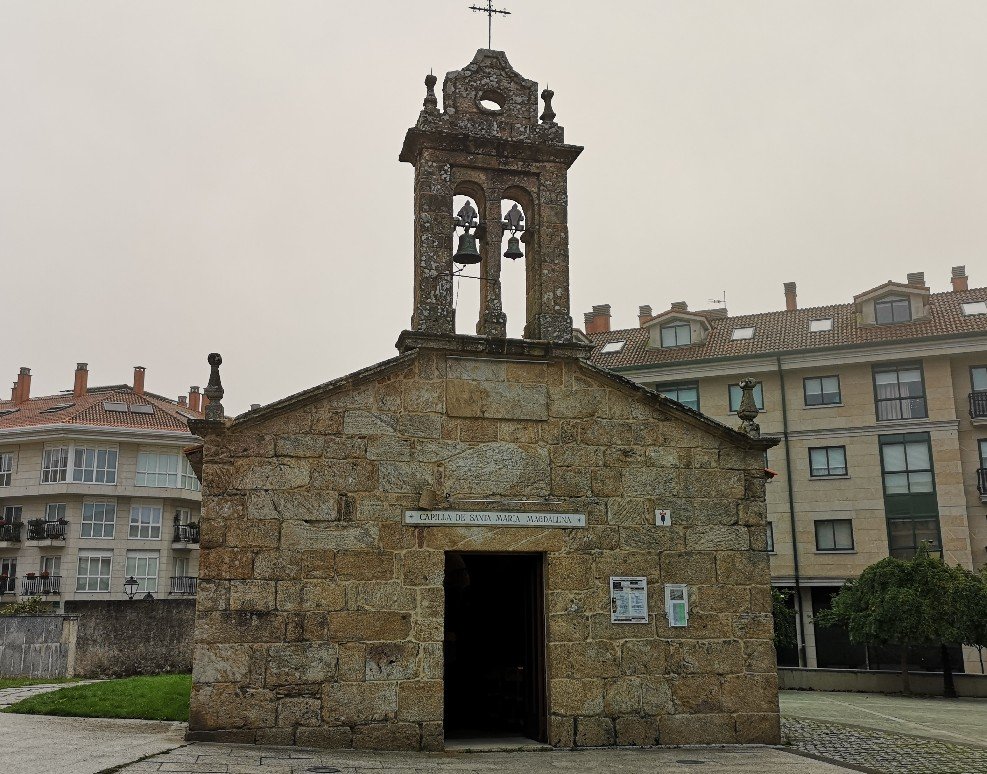
Capila de Santa Maria Magdalena, Galicia
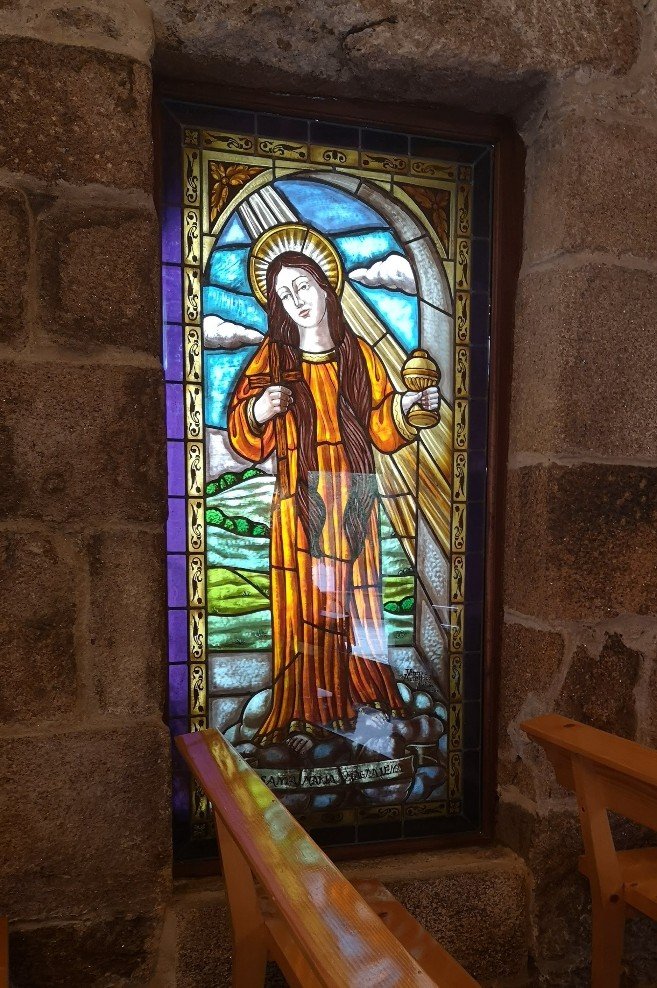
Stained glass at the Capila de Santa Maria Magdalena, Galicia . She is often depicted with long flowing tresses, a cross in her right and in her left hand she presents an egg (in an eggcup?) to Emperor Tiberius as a symbol of Christ’s resurrection. There are some great stories about Mary and her egg
According to tradition, after Jesus’ Ascension into heaven, the Magdalene…boldly presented herself to the Emperor Tiberius Caesar in Rome to proclaim the resurrection of Jesus Christ, with an egg in hand to illustrate her message. Holding the egg out to him, she exclaimed for the first time what is now the universal Easter proclamation among Christians, “Christ is risen!” The emperor, mocking her, said that Jesus had no more risen than the egg in her hand was red. Immediately, the egg turned red as a sign from God to illustrate the truth of her message. The Emperor then heeded her complaints about Pilate condemning an innocent man to death, and had Pilate removed from Jerusalem under imperial displeasure. Mary Magdalene continued her mission as an evangelizer, contemplative, and mystic in the heart of the Church.
By Grechen Filz (link under photo above)
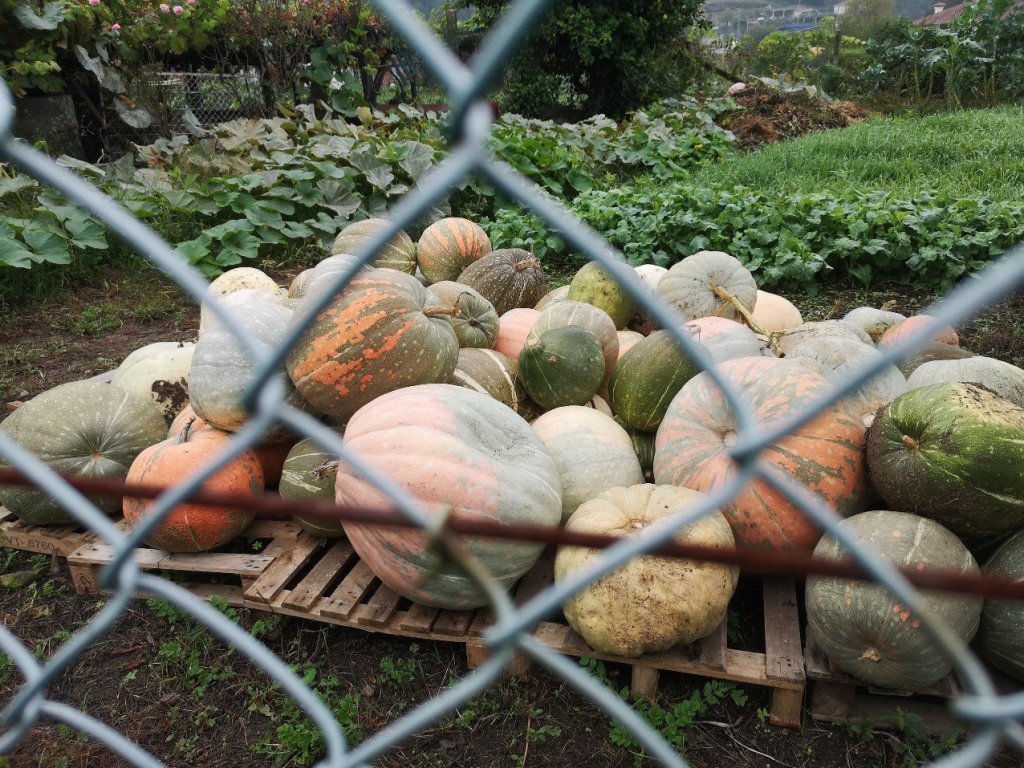
Autumn squash piled up after harvest, Galicia
At one point there was a cacophony of hunting dogs and two men wandering around looking very guilty, a huge 4×4 a little further on. The hounds seemed to be nosing around for something, but it wasn’t clear what and otherwise the area was deserted. Moving away, up a inclinne, I passed a female backpacker going in the opposite direction, so I repeatedly glanced back. I knew she would be passing the men and wanted to keep an eye out for her in case she needed back-up.
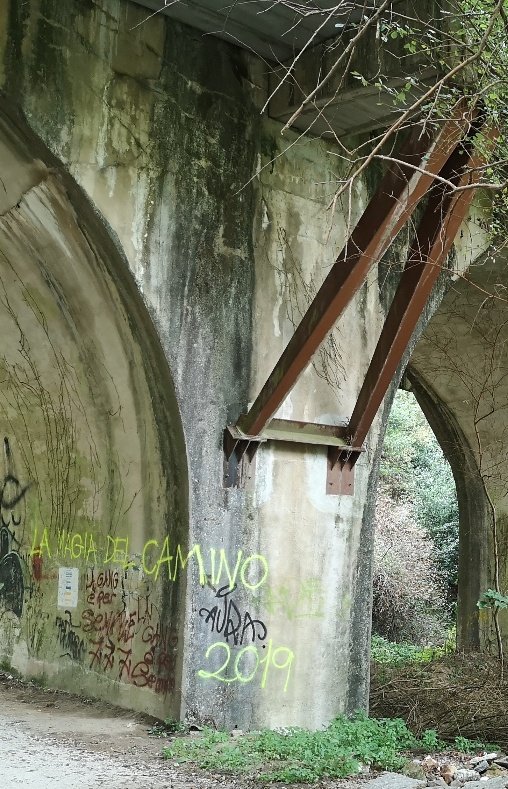
La magia del camino graffiti, underpass of the main AG56 road which goes past Santiago and on to Noia on the west coast
Much to my disappointment, I started to feel some back pain as I traipsed up towards the city centre, searching for signs and arrows to no avail.
Tip: Remember that google maps is all but useless in the Poruguese / Spanish countryside, but great in towns and cities, so at this stage when there is a dearth of directions, you can switch on the GPS.
The outskirts seemed to go on and on and so I took an elevenses pitstop in a city cafe enjoying some green tea and sweet Santiago tart which I remembered well from my first visit in 2016, when my life had already started to change.
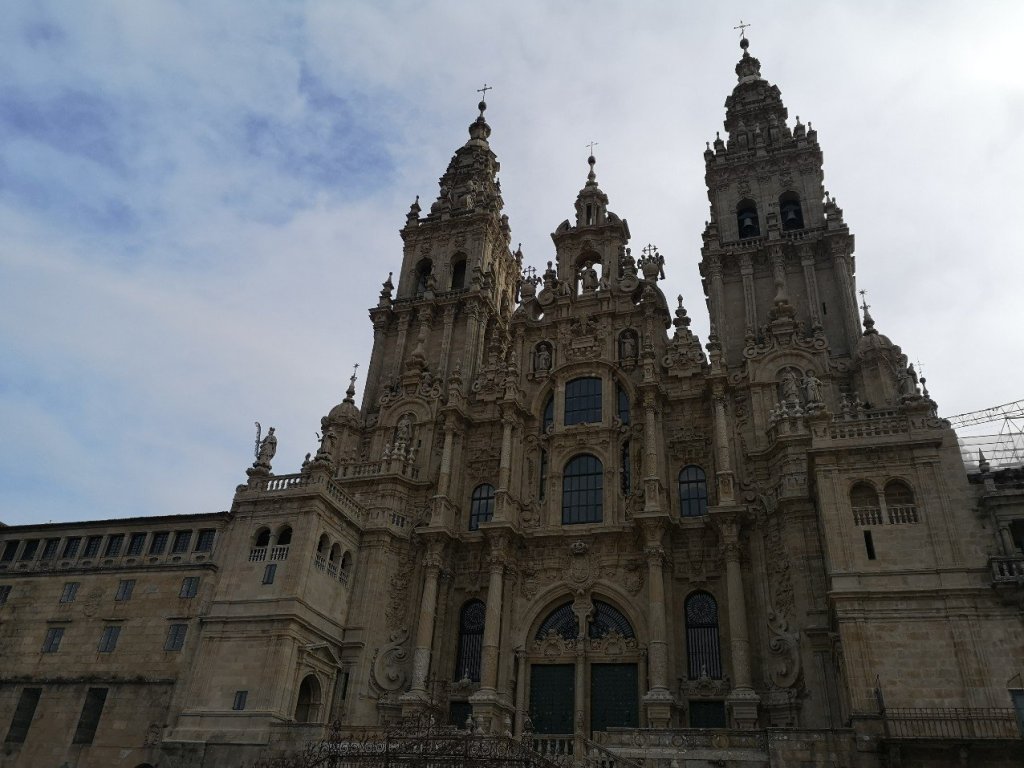
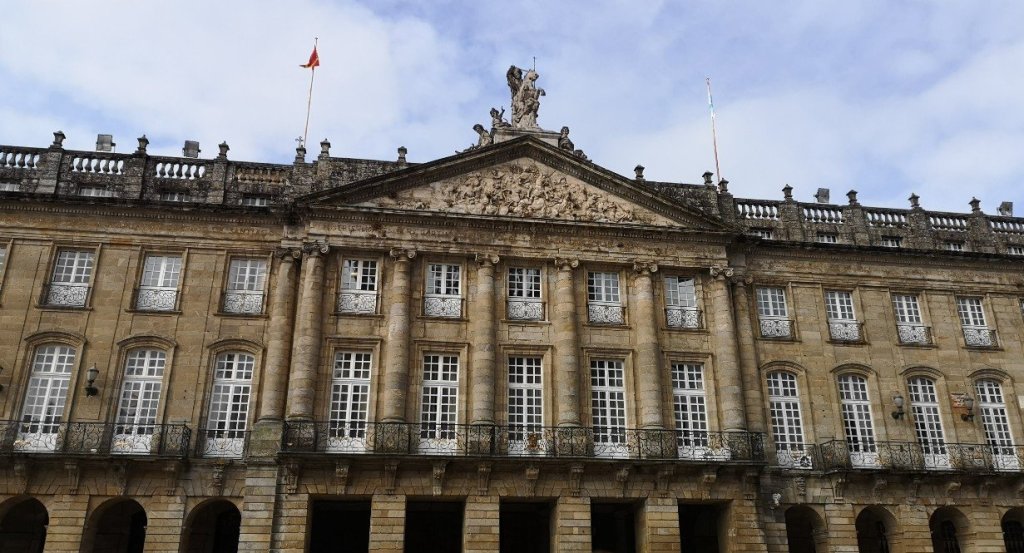
The Cathedral of Santiago de Compostella, Galicia seen from the ground looking up
I arrived in the main square at 12.15. Someone asked whether I was going to lie down. I didn’t know about this, but apparently there is a tradition to prostrate, head towards the towering building and admire it upside down, so I did. Of course.
This was my second time in Santiago despite having walked three caminos. When I walked the Via de la Plata, I initially headed south, towards Seville (1000 kms away). Later I started there, walking northwards until I got back to where I had finished that section the year before. I didn’t do the final stage for a second time, and so didn’t visit Santiago. I didn’t go to the special Mass this October 2019 either, for the same reasons.
View of the cathedral of Santiago de Compostella from the balcony at the Roots and Boots hostel
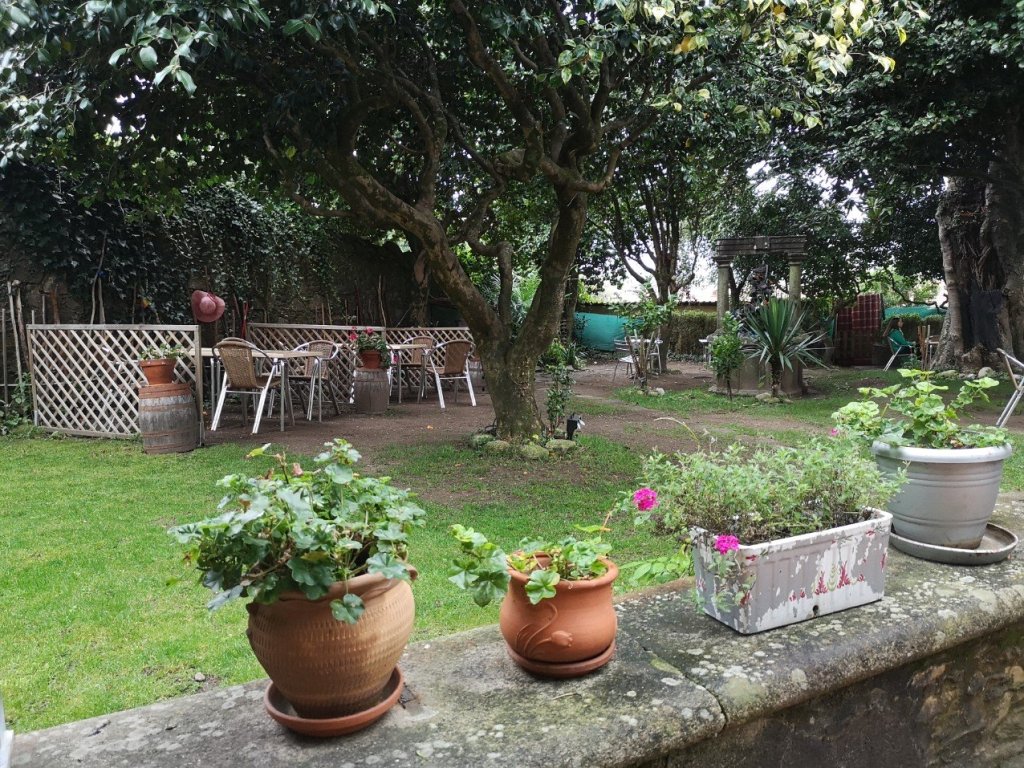
The garden at the Roots and Boots hostel, Santiago de Compostela, Galicia
I had booked the Roots and Boots hostel in advance and was very happy with it. Very close to the centre, the rooms are small (no extensive dormitories) and mine had a magnificent view of the cathedral. There is a pretty, enclosed garden with tables and chairs by a reasonably priced, hole-in-the-wall, cafe. I sat out there until quite late at night, getting slightly chilly but enjoying the situation, especially given it was October.
I had lunch in a large restaurant, very popular with pilgrims. I was surprisingly tired and the large portions and very quick service suited very well!
Laundromat courtyard out back, Santiago de Compostela, Galicia
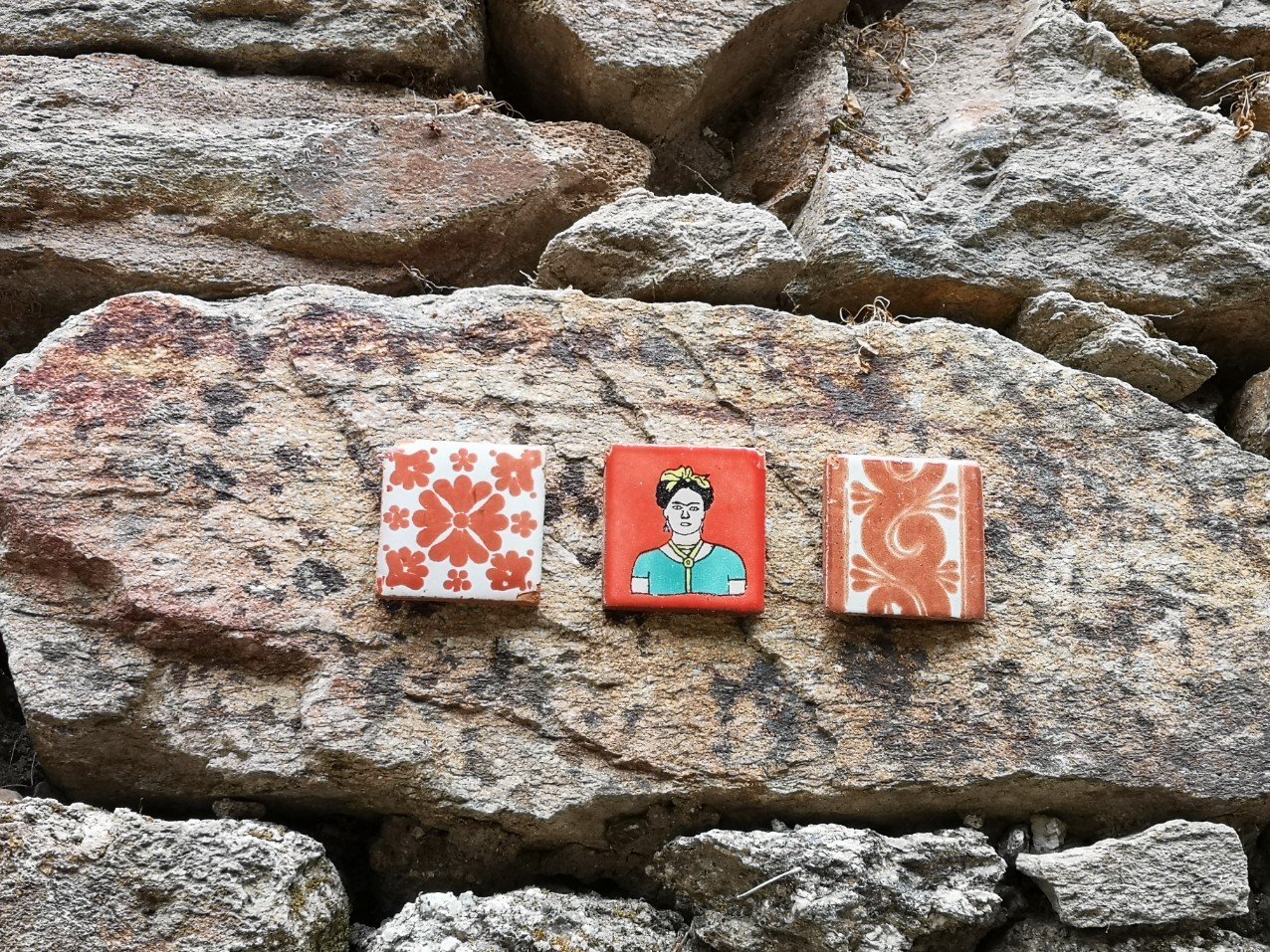
Frida Kahlo on tiny tiles in the courtyard of the launderette, Santiago de Compostela, Galicia
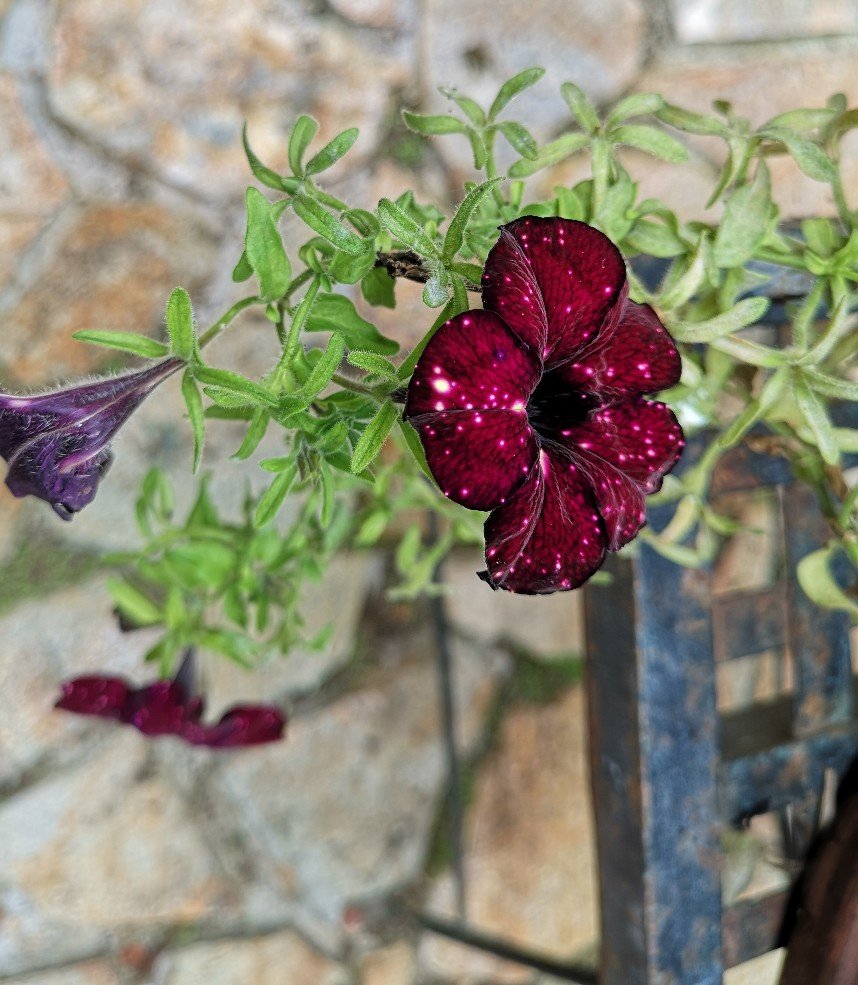
Glowing Petunia in the same courtyard
Then I left clothes to be washed at a rather nice launderette (as launderettes go) on Rua das Hortas which had a decorated and flowering courtyard. You can also get washing done at Pilgrim House, a veritable Santiago institution.
I had not planned what I would do next until a few days before, when I came across a post on the Camino forum which set me off on a new trail. I contacted the redoubtable Rebekah Scott at her Peaceable Kingdom to ask if I could stay with her at Moratinos on the Camino Frances, in the name of research. She kindly obliged, but later sent me an email saying that she couldn’t host me after all because she looks after a hostel on the Camino Primitivo and had to go up immediately. Unless, she added, I wanted to go too. More on this adventure later…..
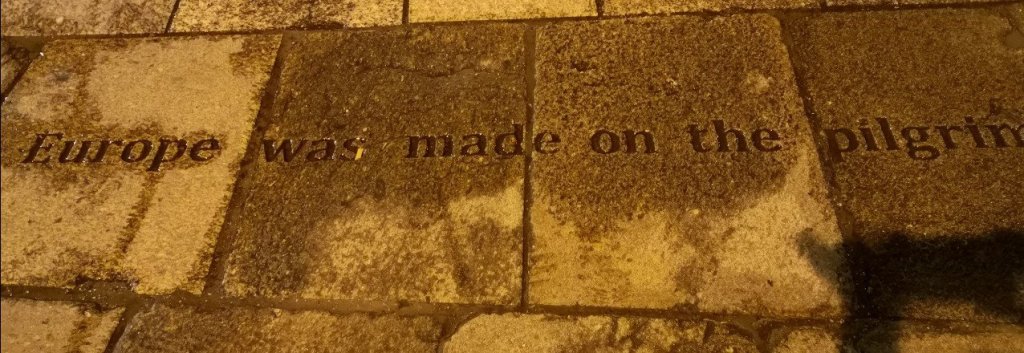
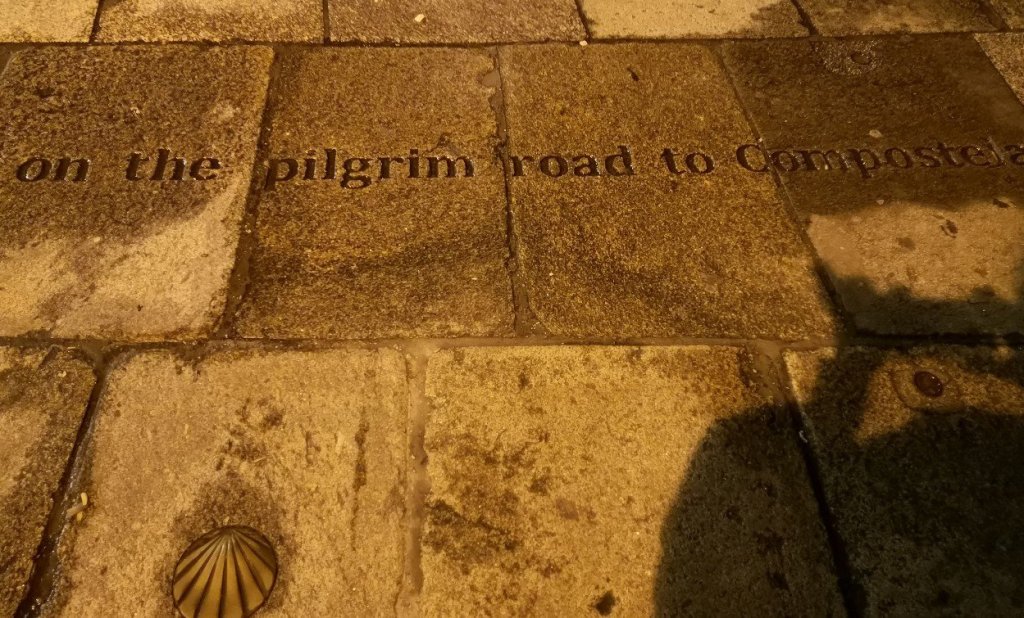
Pavement message in the early morning of the next day: Europe was made on the pilgrim road to Compostella
Footnote: If you have some cash at the end of your camino, you could try the Parador, one of the famous Spanish hotels which offers pilgrims a free lunch, so I am told.
The camino shell necklack I bought in Porto for 5 euros and which I wore as a talisman for the Camino to Santiago de Compostella
Camino Portuguese da Costa – Day 14, October 2nd 2019
It is 25 kms from Padron to Santiago and I was not confident I would manage that with the extra 3.2 kms from Herbón to Padrón, so I decided to break my journey in Teo, making two, admittedly short, days out of one longer one.
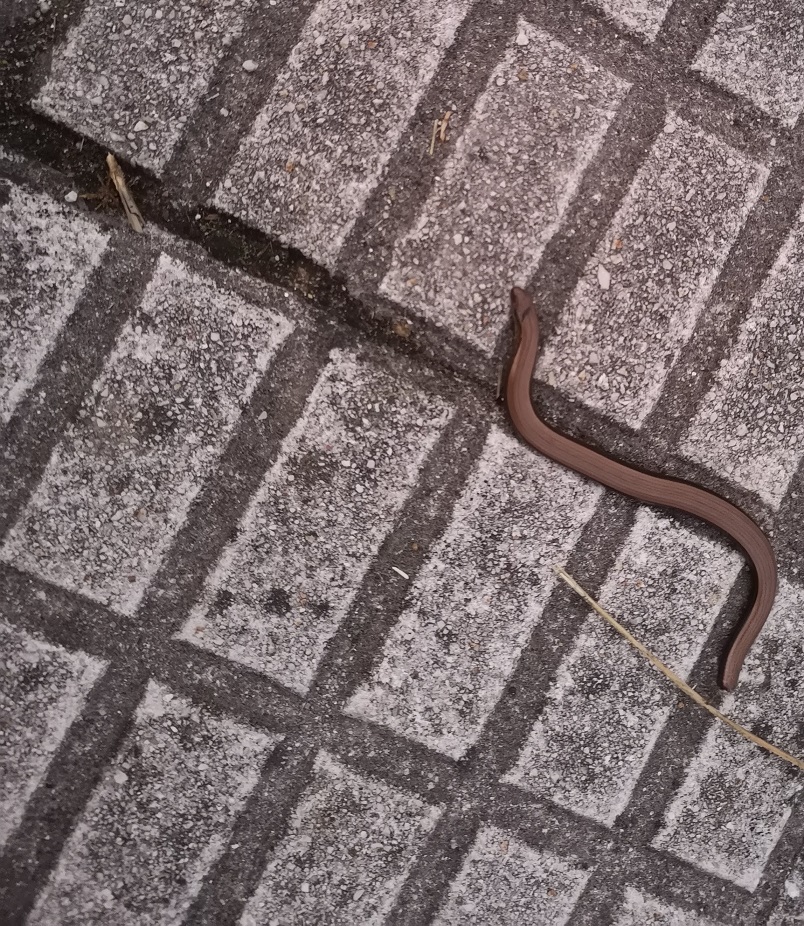
I took a last look at the gardens of the monastery of Herbón, Spain and spotted this little critter slinking its way amongst the stones
They played music to wake us up at the Herbón monastery and then there was a return to the large dining room for a shared breakfast. Although we had arrived through countryside, the path out, towards Padrón, was almost immediately into a village and then along a main road.
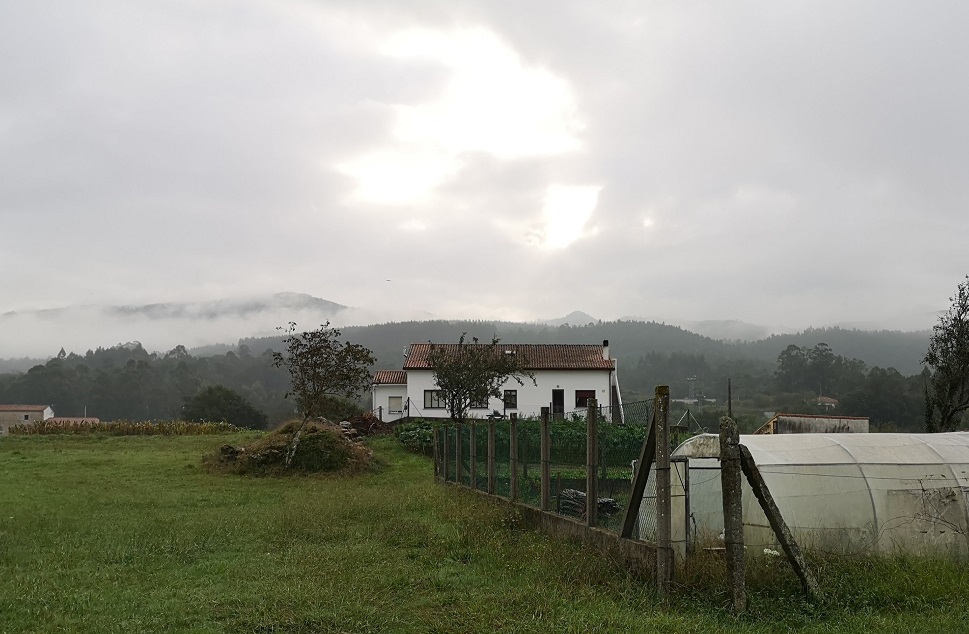
A typical Galician scene with terracotta rooves, fruit frames and misted mountains in the background, Spain
I was on the Ruta dos Xardins da Camelias, heading towards the home of padrón peppers which we had been told the previous evening didn’t really emanate from Padrón at all. It doesn’t stop them being one of my favourite dishes.
Crossing the River Sar with a wonderful view of the Iglesia de Santiago de Padrón. Still dark enough to merit headlights. Spain
I waited in a bar for the pharmacy to open so I could get some anti-inflammatories for my left foot which was still very painful.
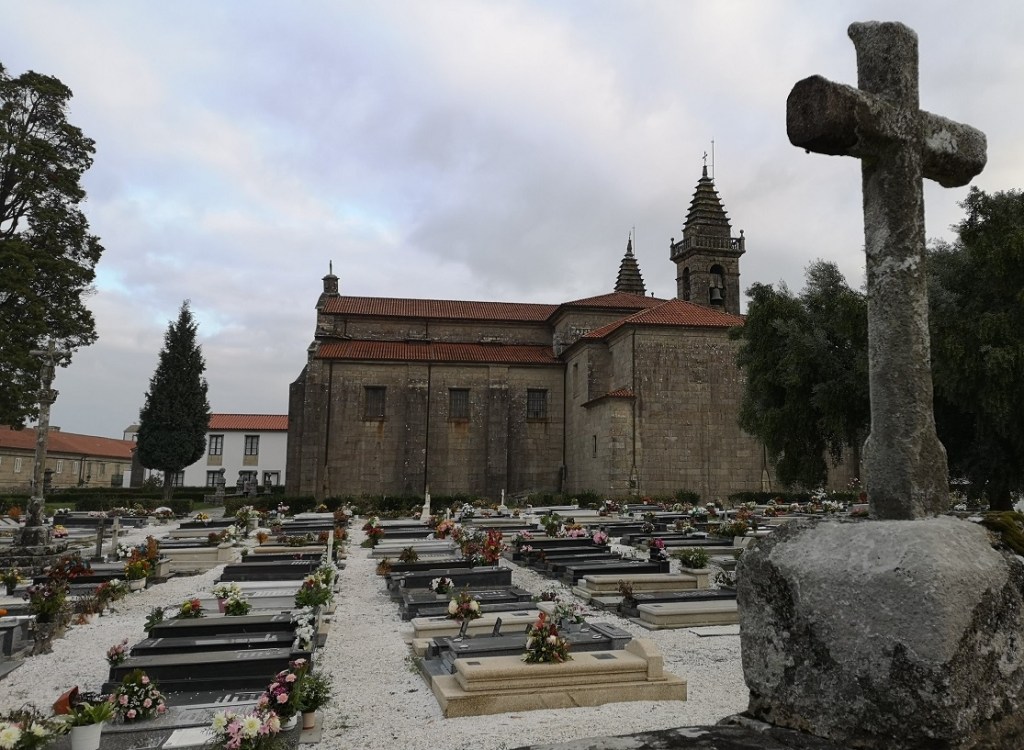
Flattened graves surrounding a traditional Galician church, Padrón, Spain
Perhaps that is Monte Meda (1454 feet) in the distance, half hidden by low cloud cover, the sun trying hard to shine through, Galicia
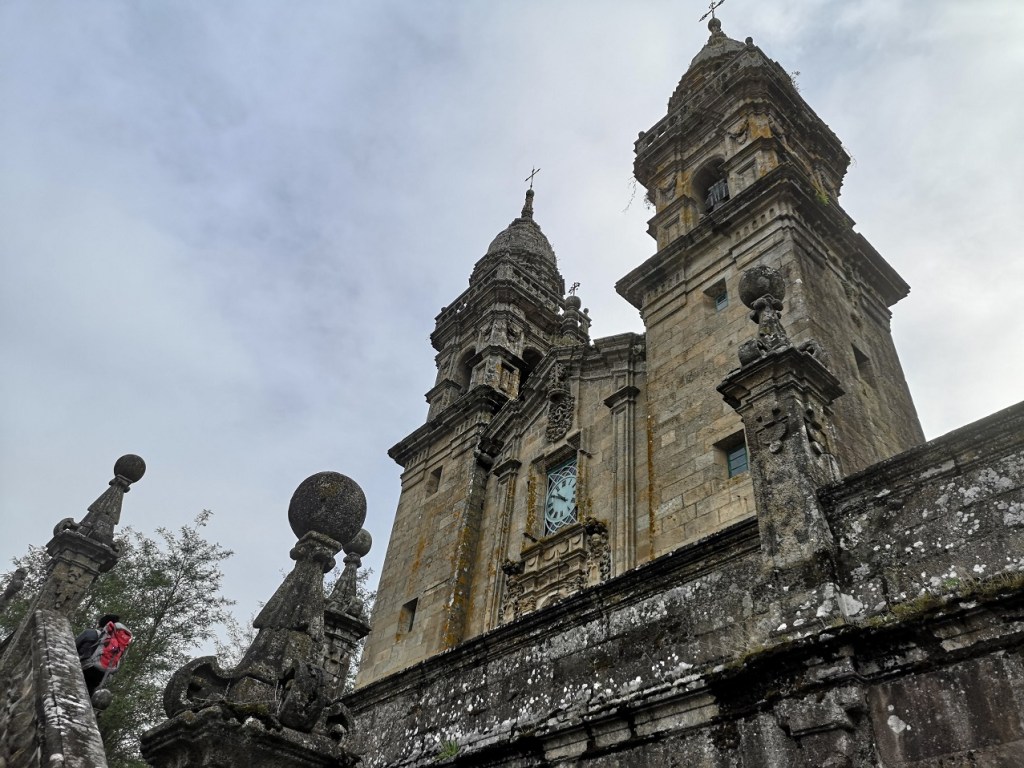
Approximately half way there and I came across the Santa Maria de Cruces Church with its ornate twin steeples, A Escravitude, Galicia
I heard them before I saw them! Hunting dogs keen to get a look at the pilgrims
One was really determined – squeezing sideways under the fence!
And then I was in the rural landscape I love so much. Grass and sheep, scarlet willows with yellow branches stemming from a single point, just a few green leaves left now as winter approaches – nothing too carefully kept.
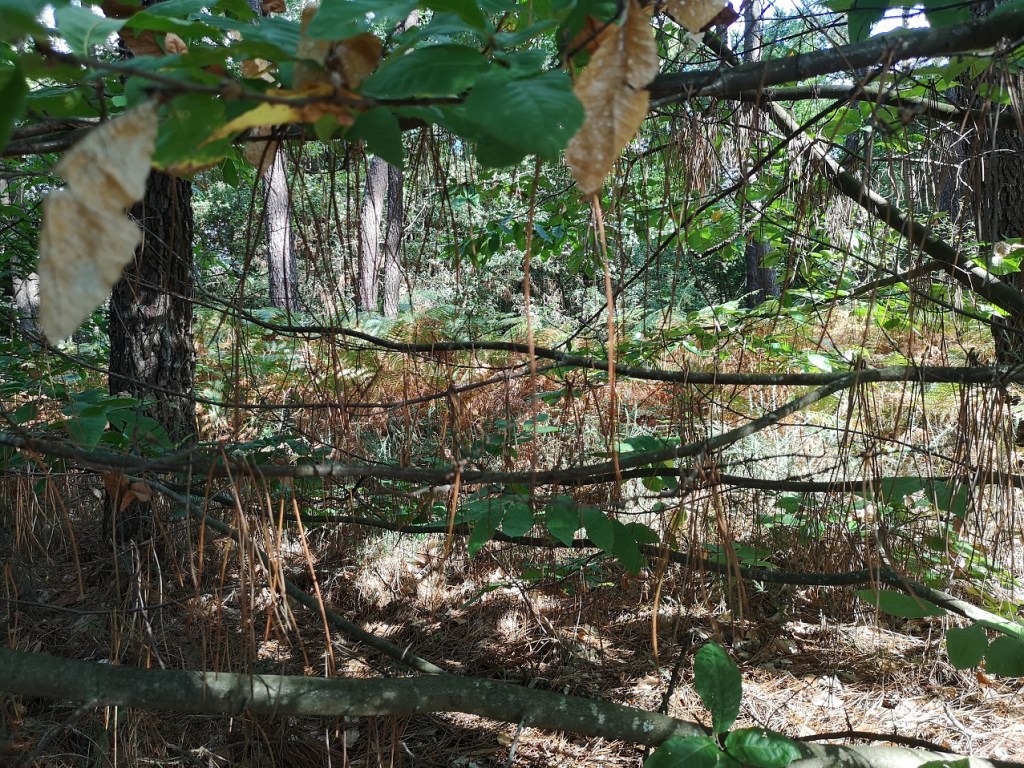
It’s when the pine needles turn brown and fall. They catch on branches below and create this chopstick effect
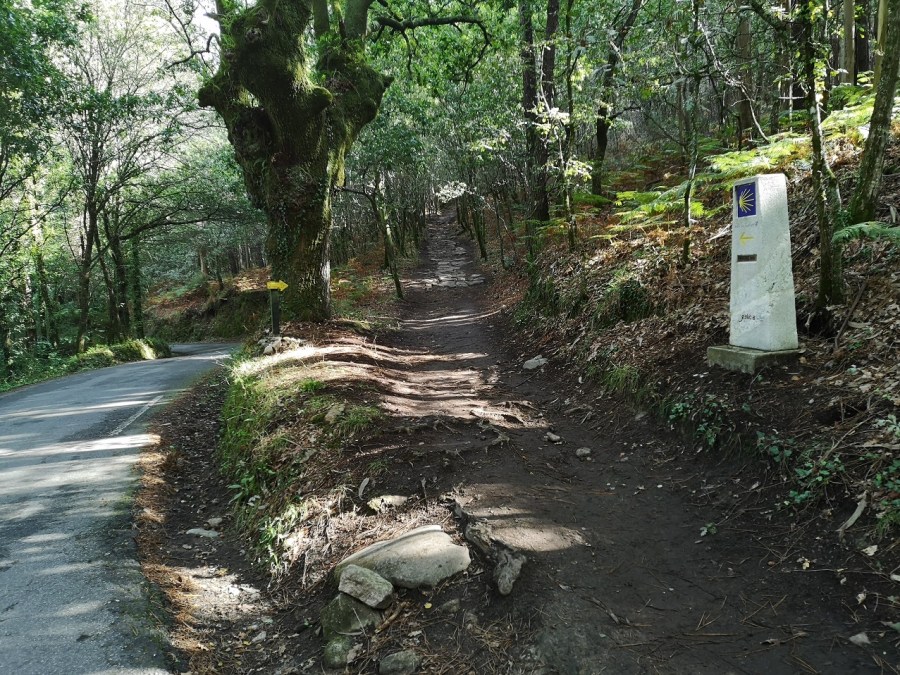
Look carefully and you will spot the yellow arrow on the tree in the centre. Getting close to Santiago de Compostella now – ‘the end of the road’, Galicia
Onto the Ruta Saudable de Teo, the healthy route, where you cannot pick flowers or frogs, but you can hike!
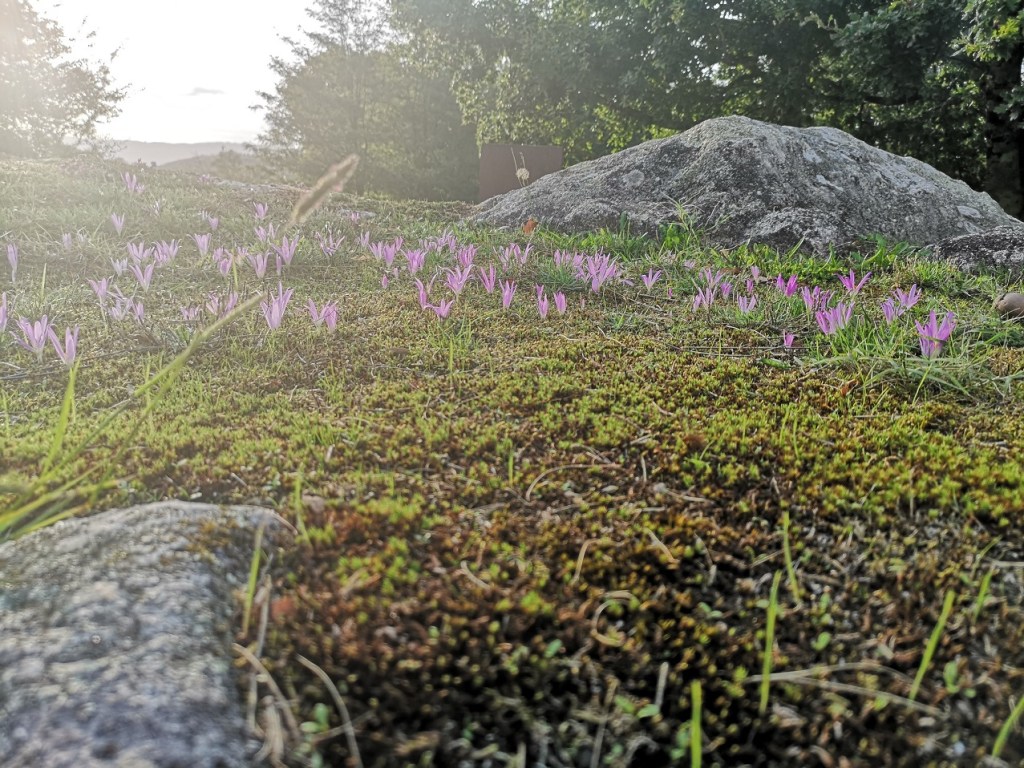
Autumn crocus in hazy sunlight
Capela de San Marino de Ruta de Francos: modest, solid, ancient, Galician
The country roads were lined with almond trees, almost neon in their greenness, and forming a backdrop to lush undergrowth, rough-stalked bracken. I happily trotted along, constantly overtaken by others rushing to the finish line.
The albergue Xunta de Teo (municipal albergue at Teo) is in a beautiful spot, a drop down from an extremely busy main road, but accessed by the walkers from the opposite, safe side. There are cafes both down and uphill, and they are equally idiosyncratic. Shops can be found even further on: the one at a service station is often open, the much smaller village store is shut for hours at lunch time.
The albergue was closed on arrival, only opening much later (4pm) with a queue, and filled up very quickly, so that many were turned away. It is run in a haphazard sort of a way and there are no utensils in the kitchen.
While I waited for it to open, I sat under a plastic awning and wrote and read and ate p. peppers and drank beer and it was expensive, in comparison to other places.
In all I went up and down that road a few times, eventually getting supplies for the evening meal, and then wandered back through the forest, past the church and other very smart looking buildings, several of which were supposed to be a restaurant and up-market accommodation, but both looked uninhabited. It was like a rekkie for the next day (in the opposite direction), very pleasant, and I returned to sleep when it was almost dark.




















 Walking without a donkey