Free to Explore, Glasgow City Of Walking A film by Tamsin Grainger
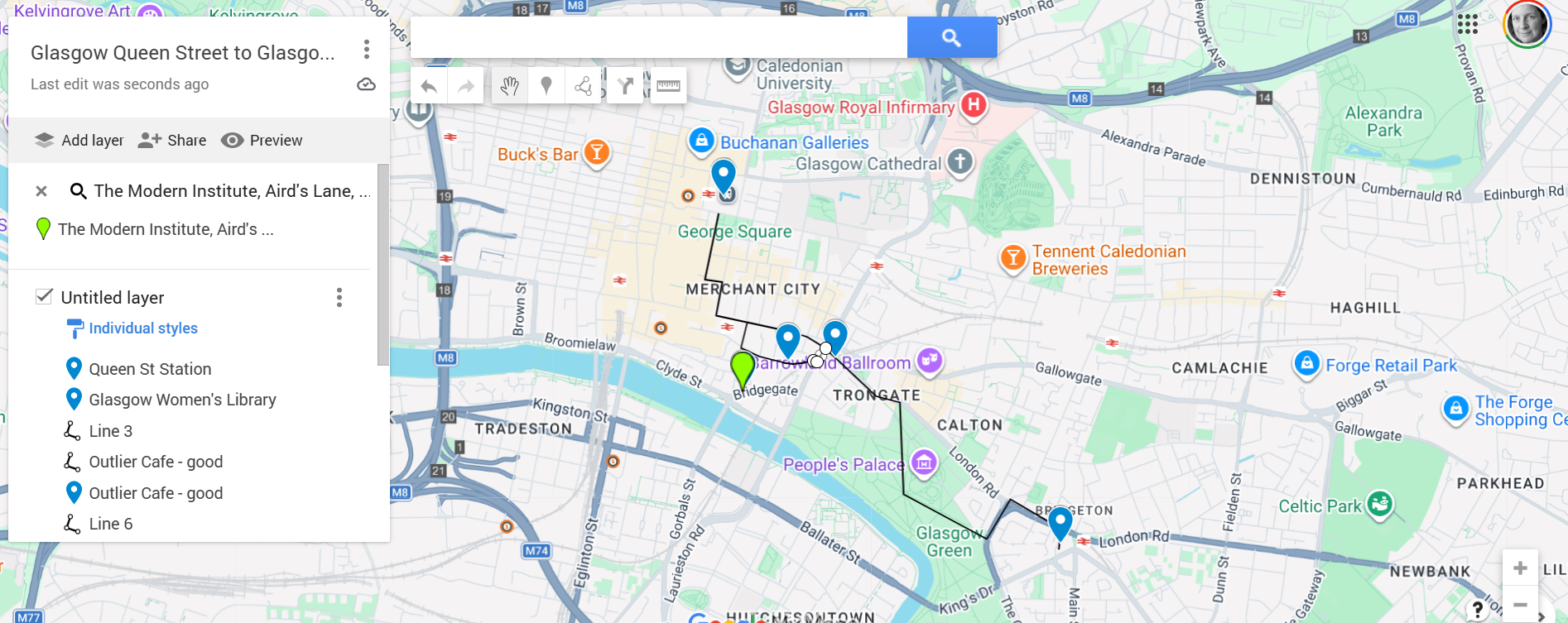
I took a walk from Queens Street Station to Glasgow Green for a Women’s Heritage Walk which was led by the Glasgow Women’s Library (GWL)
Walking route, Glasgow ScotlandMap of the route(s) I took, Glasgow walking
GWL Women’s Heritage Walking Tour
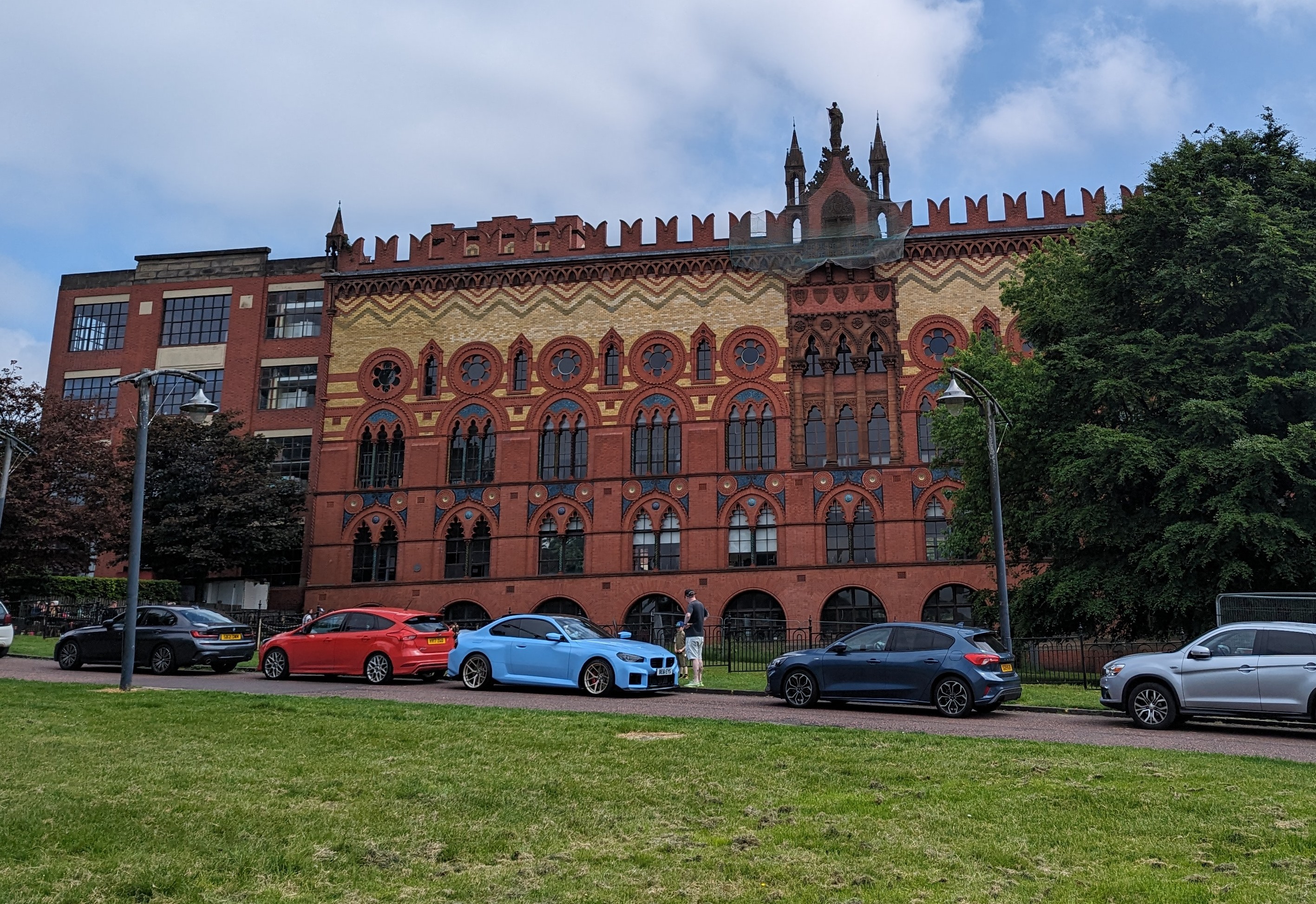
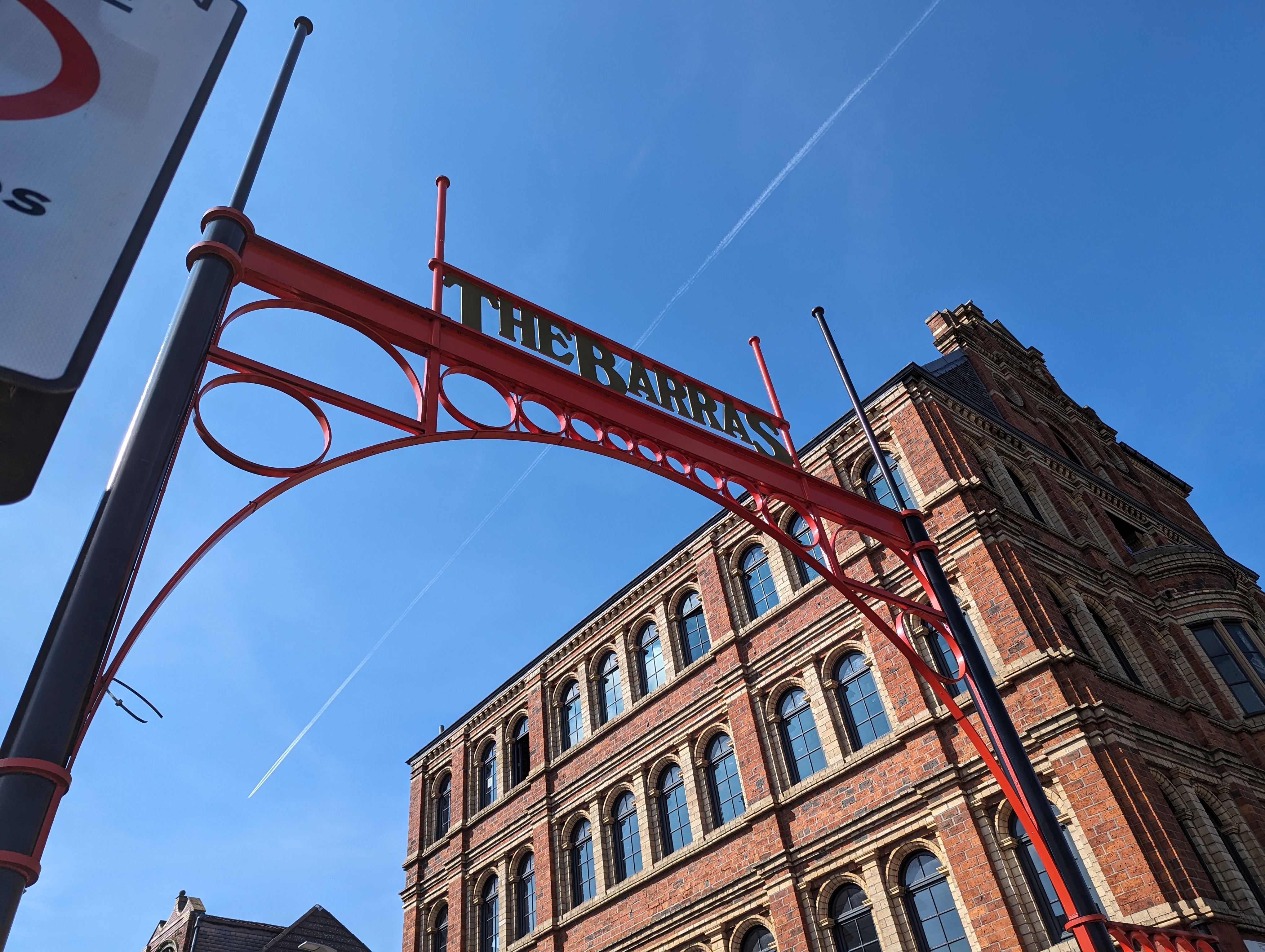
We walked around the East End area in Glasgow visiting different buildings and hearing stories from the industrial and social past.
‘The women of Glasgow’s East End have always had to be industrious and resourceful simply to survive. This walk focuses on some of their achievements and struggles, and the radical nature of the area which gave birth to them.’
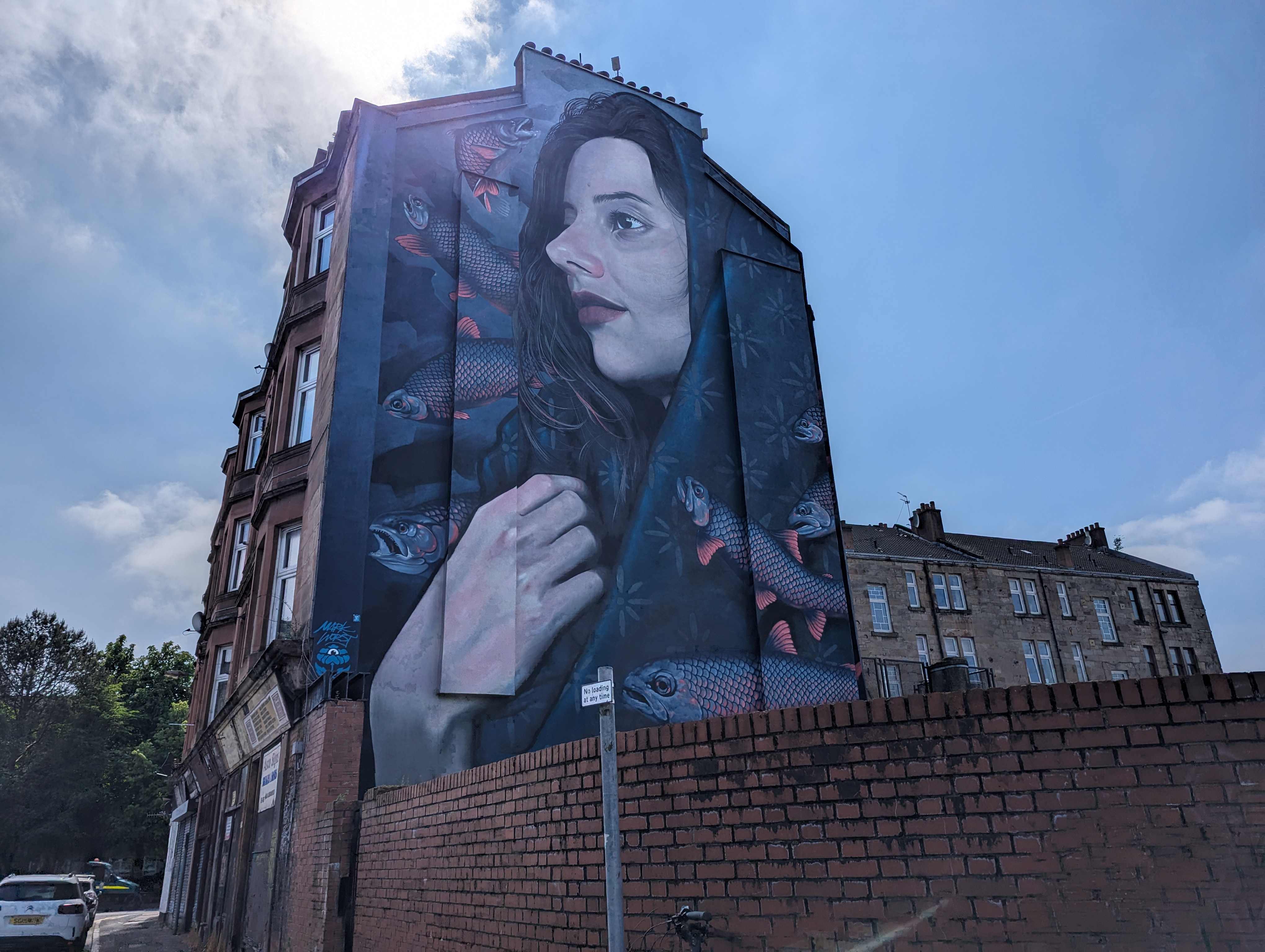
St Thenue (Enoch) is the mother of St Mungo, patron saint of Glasgow. The mural of her on the gable of 374 Abercromby Street, Calton, Glasgow is by Mark Worst. More info here
We were told about a famous event: On the morning of Tuesday 21 March 1911, 12 women went on strike at the Singer Manufacturing Company in Bridgeton, followed by 10,000 other women and men. This was a brave move against the international company (which also operated in Russia, the US and Germany) and brought the sewing machine plant to a standstill. Link to the Open University information page (now the site of a business park).
Glasgow Green has long been a site for gatherings. It is the place where I and my walking companions collected with millions of others after walking the Pilgrimage for COP26 in 2021.
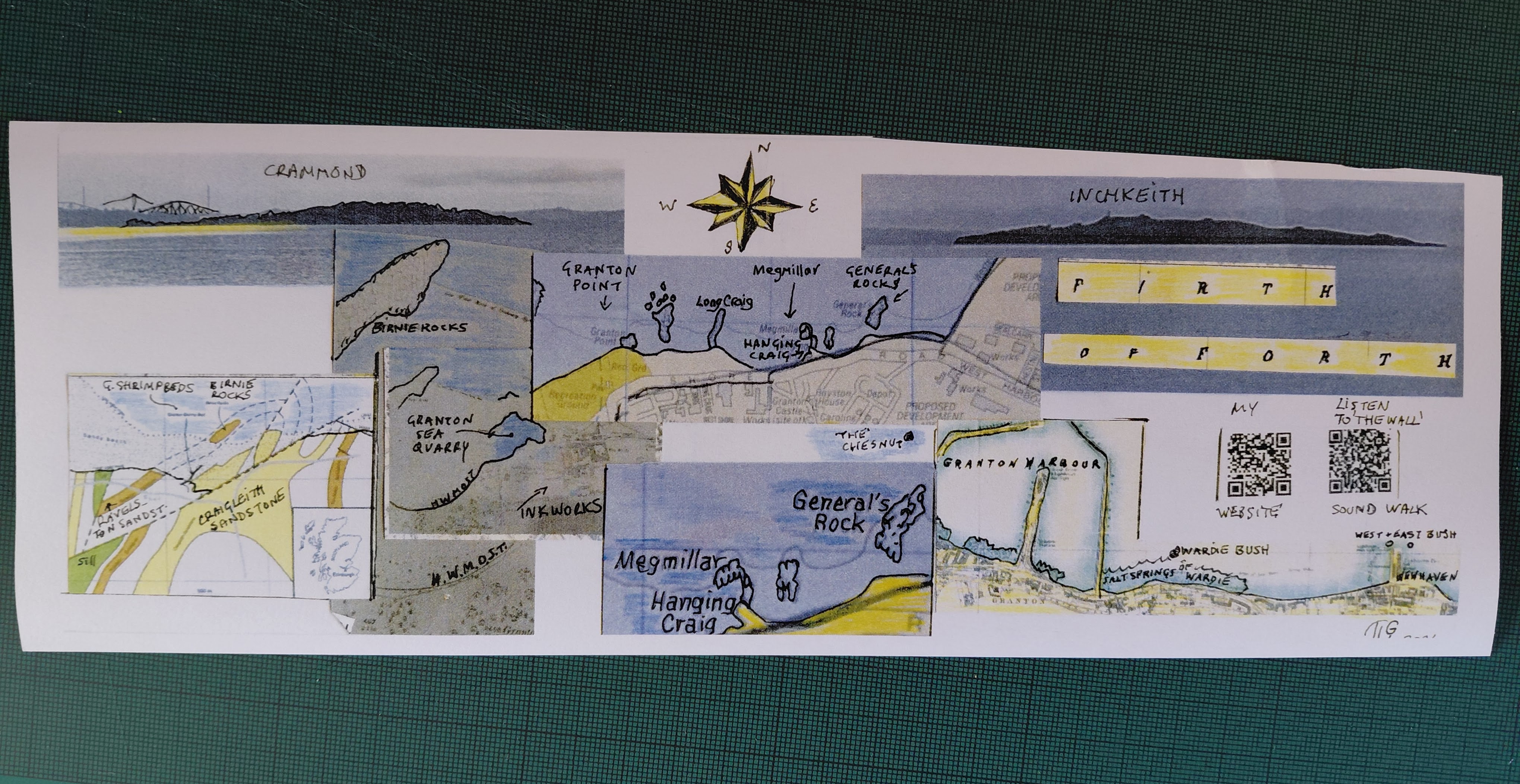
A community walk around the Bonnington area of Edinburgh – local history, nature and art.
Composite image of sites of interest around Bonnington, Edinburgh
Meeting on the Bonnington Toll corner outside Rosebank Cemetery w3w ///hoping.wells.admiral opposite The Bonnington (pub).
The Walk will visit sites of mills (including the early Chancelot Mill), cottages of the linen and wool workers (with some information about shrouds), the areas known as Bonnytoun and Bonnyhaugh. We will look into the origins of local street names such as Mill Lade, locate the site of St Cuthbert’s Well, and take in the Water of Leith where women bleached the linen.
A donation towards this event will be used to fund research and preparation time. Please note that even if free tickets are sold out, you will still be able to book a donation ticket.
This walk is open to adults, children (accompanied by an adult) and dogs. Please wear suitable clothing and shoes, and bring water to drink. This is mostly pavement walking that should be suitable for wheels too.
Other Upcoming Events
Knots, a community walk for all the family on Saturday 26th September, 1:45pm-3.00pm. It is part of the Granton:hub / Madelvic House Doors Open Day.
We will walk, play, do an art activity, and learn about nature too. This event relates to our neighbour, United Wire, and one of our other historical and contemporary industries, fishing. You will learn some basic knotting practices (appropriate for children and adults), make a joint artwork, and also something to take home with you to help you remember the walk and what you have seen.
Starting and ending at the Granton Hub / Madelvic House. Places are limited for participants’ safety and enjoyment. Suitable for those with wheels / sticks. Dogs on leads are welcome.
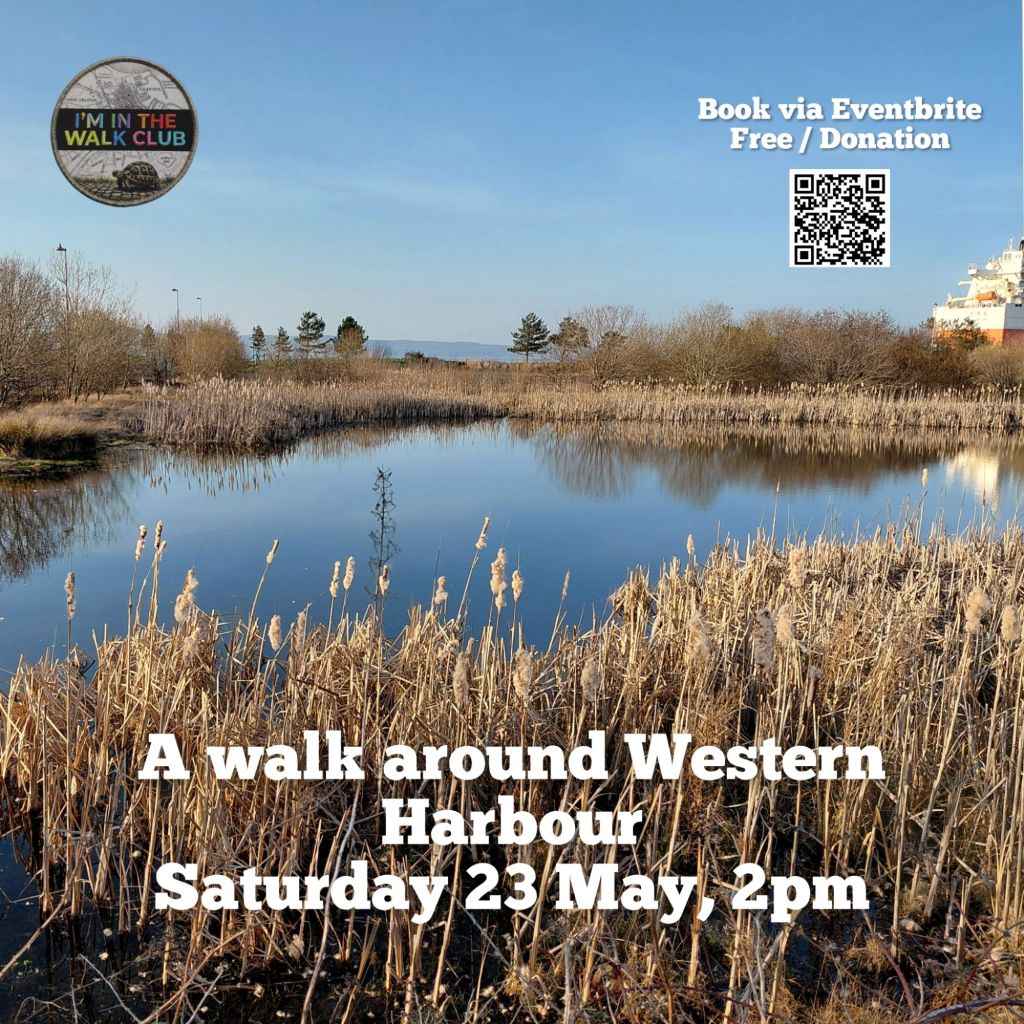
Saturday 23rd May, 2-4pm. Walk around Western Harbour together. Expect local history, information about the campaign to save the ponds, the wind/alternative energy structures, art, and local stories.Meet at the FRONT of Asda, the door that is closed where the trolleys are (not round the back by the petrol station and car park). There are bicycle racks close by. Buses to Newhaven / Western Harbour (10, 11, 16,17 etc)Flat walking taking in wetlands, landscaped gardens, wasteland and an optional cafe visit at 1pm (The Haven, 9 Anchorfield, Newhaven, Edinburgh EH6 4JG)Open to everyone, this is a Walk Club, Edinburgh event. You can find out more here The Walk Club.
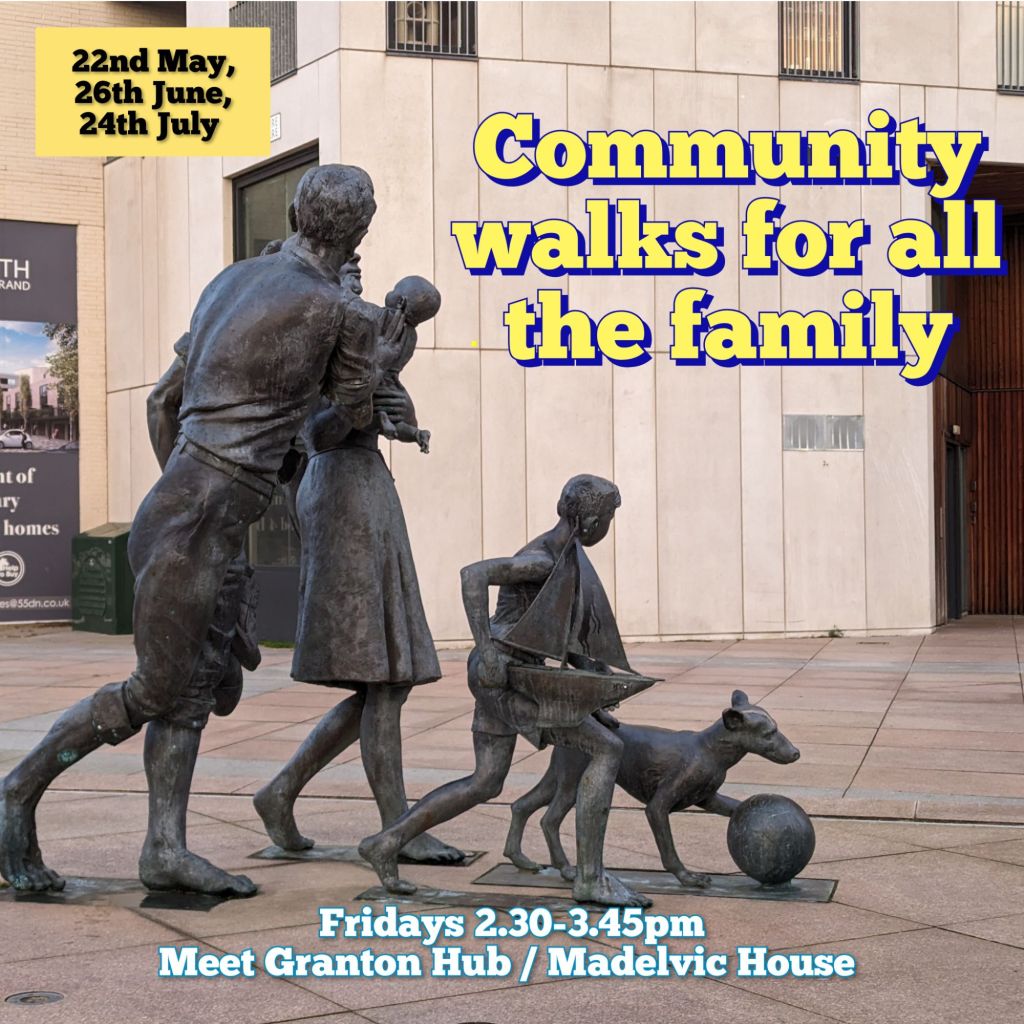
Community walks for all the family on Friday afternoons, monthly starting 22nd May. We will walk, play, do an art activity related to local history, and learn about nature too. Starting and ending at the Granton Hub / Madelvic House. All welcome. Please wear sensible shoes and warm clothes / sun hat plus suncream if appropriate. Bring water and snacks for yourselves. I am Paths for All trained, and have a DBS certificate. All children under 16 years must be accompanied by an adult.
Walking the Pennywell Labyrinth
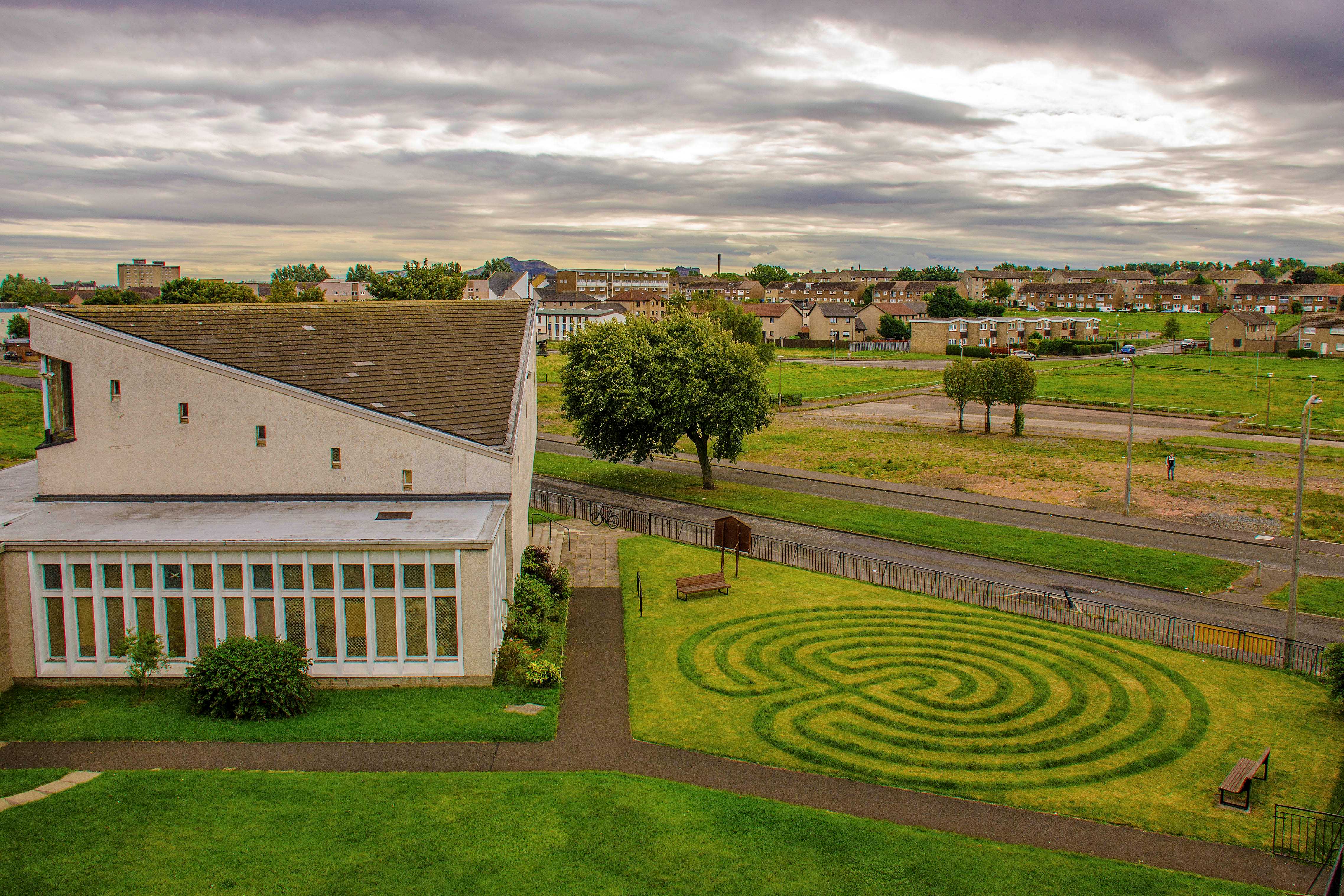
Pennywell Kirk, site of the labyrinth where Alan unexpectedly came along with the keys and gave us a guided tour
Each walk will have a theme and celebrate events such as the Festival of Terminalia, the Urban Tree Festival, May Day, and the Autumn Equinox. The events aim to be stimulating and the company friendly. Fresh air and gentle exercise are promised, whether you are on wheels or feet, and the Walk Club is open to everyone. Children and dogs are welcome (no membership fee for them!) The aim is to be accessible, inclusive, and flexible.
Moving slowly through the urban landscape allows for higher quality noticing and time to pay attention. Pauses are important so we can look, smell, and discover. We will embrace community, as well as silence and conversation.
Monthly walks around Edinburgh, often in less well-known areas Location: Each walk will be different Time: Sundays, 2-4pm, once a month Duration: Approximately two hours The walks will go ahead whatever the weather You are welcome to attend all or some of the walks as you wish
What will we do?
Meet-ups will involve:
Walking / wheeling
The opportunity to get to know one another
Local history, games, quiet meditative walking
Each one will be different in topic / theme. Just turn up. There is no need to tell me if you’re coming unless you would like to be certain that the walk will be possible for you.
Cost
For an annual membership fee of £10 (£5 concessions) you will receive a membership pack through the post (including a badge, welcome postcard, and the Walk Club membership card). You can make a donation per walk if you want – something like £5/£3 – no pressure.
Please note that at this time, you have various options in order to join The Walk Club:
Download the form by clicking the button above and print it out in order to fill it in. Then upload it and return it to me
If you have a programme on your phone / computer that will allow you to fill in a pdf on screen, then you can miss out the print-out part and simply click on the button above, fill it in and email it to me
You can email me now and I will send you the membership form.
My email is tamsinlgrainger@gmail.com and once I have your form and annual membership fee, I will send out your membership pack.
First Walk Club event
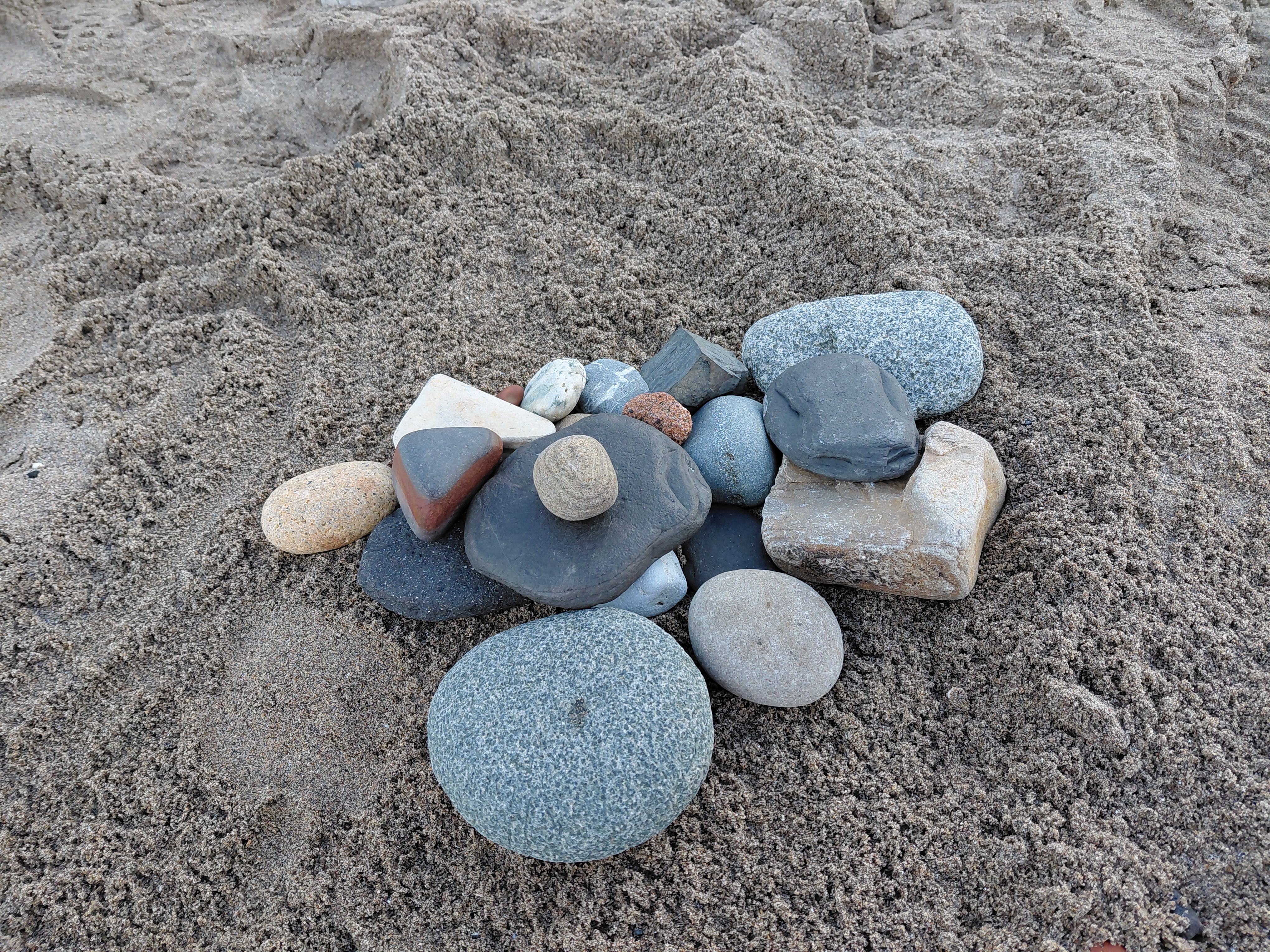
The first walk was on the Saturday 21st February celebrating the Festival of Terminalia: Rock On!
We collected stones at Wardie Bay and walked them past rock music studios to Granton ‘the Brick’ Beach and made a cairn
Upcoming Walk Club events
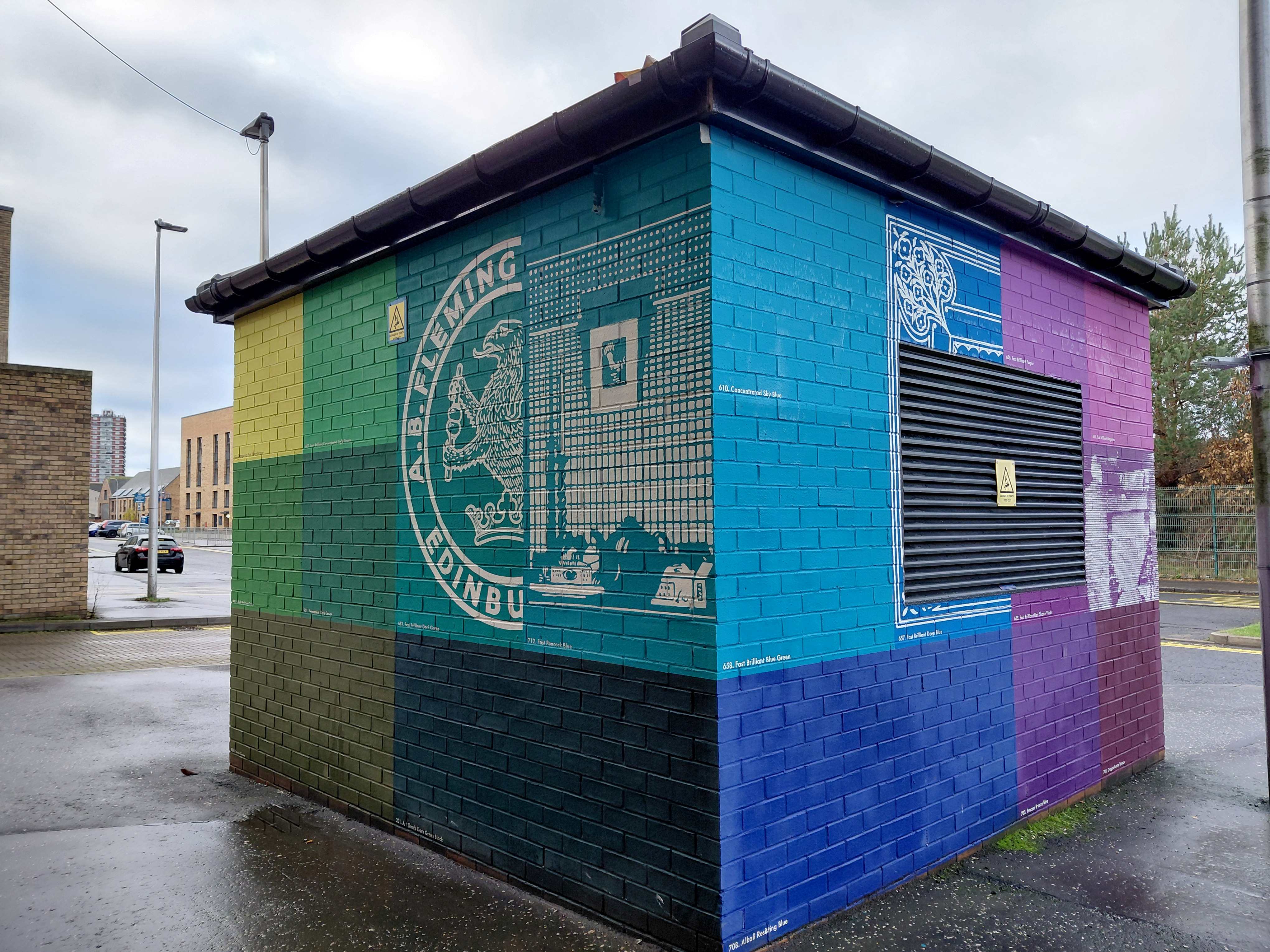
The next walk is on Sunday 22nd March marking the Spring Equinox and visiting the Pennywell Arts and Heritage Trail murals in North Edinburgh. The artwork is by Fraser Gray and the walk led by me, Tamsin Grainger, with local history, stories, art chat and discussion. All ages welcome. Foot, wheel and paw friendly. Dress brightly for all weathers! Information and booking here.
Mural by Fraser Gray, part of the Pennywell Arts and Heritage Trail
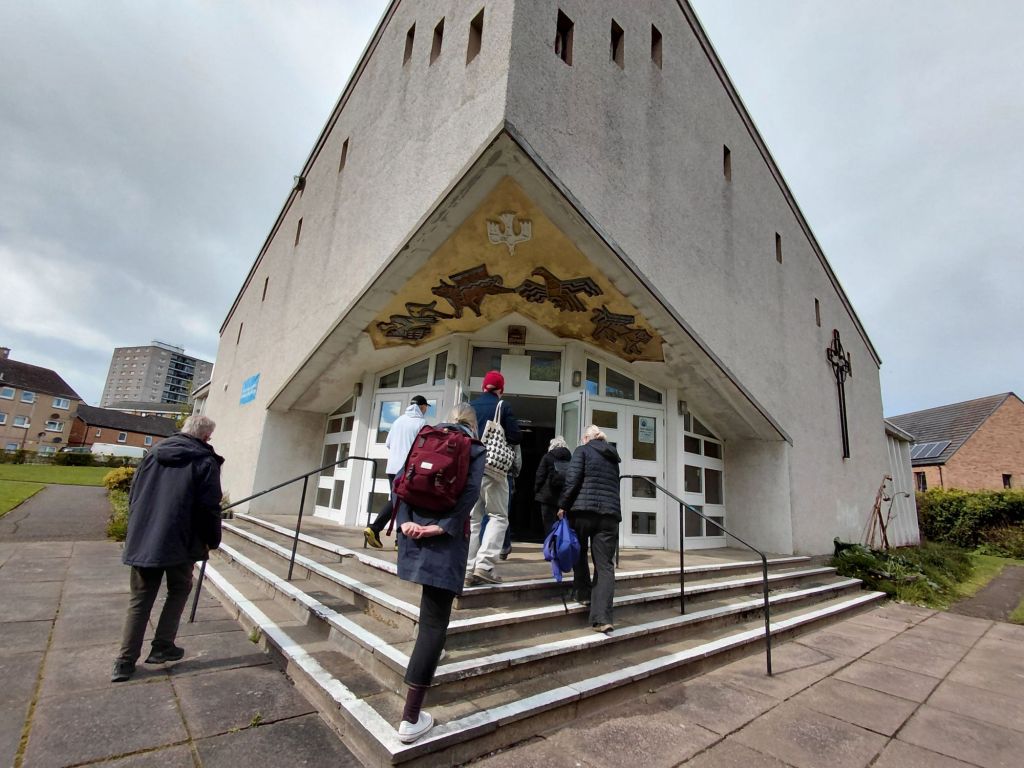
Walking the labyrinth The April meet-up will be on 19th April at 2pm meeting at North Edinburgh Arts and we will be walking the labyrinth at Pennywell Kirk. 2pm – 4pm. This is a there-and-back walk, and the labyrinth was designed by Natalie Taylor. Meet outside North Edinburgh Arts. Booking and more information here.
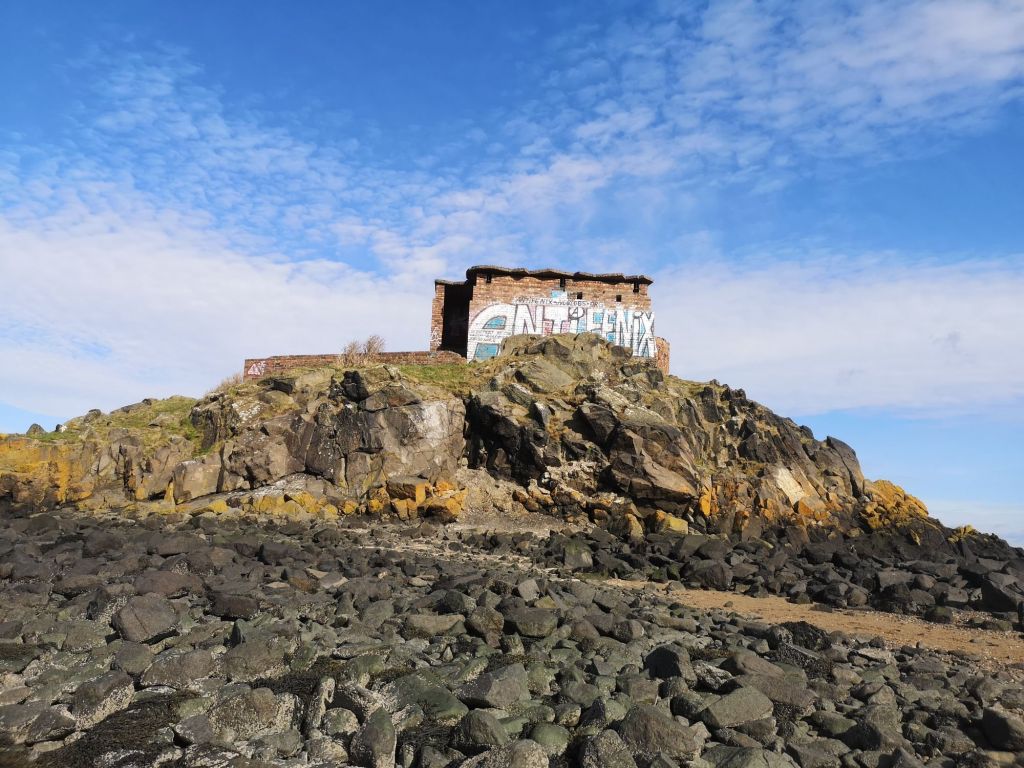
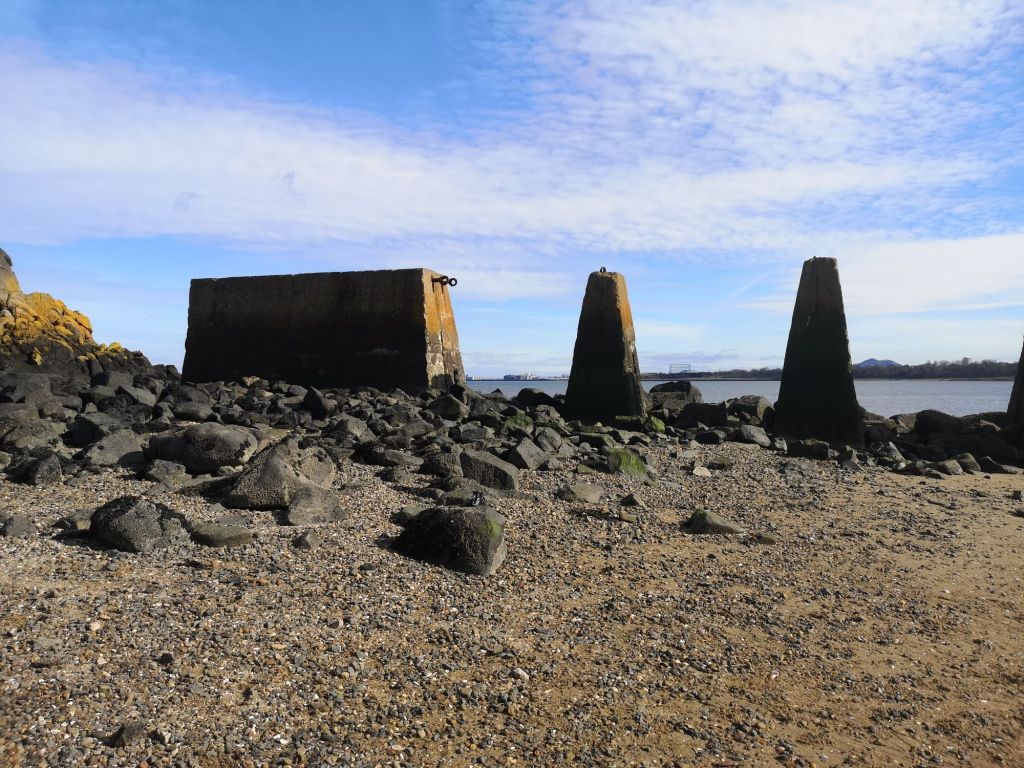
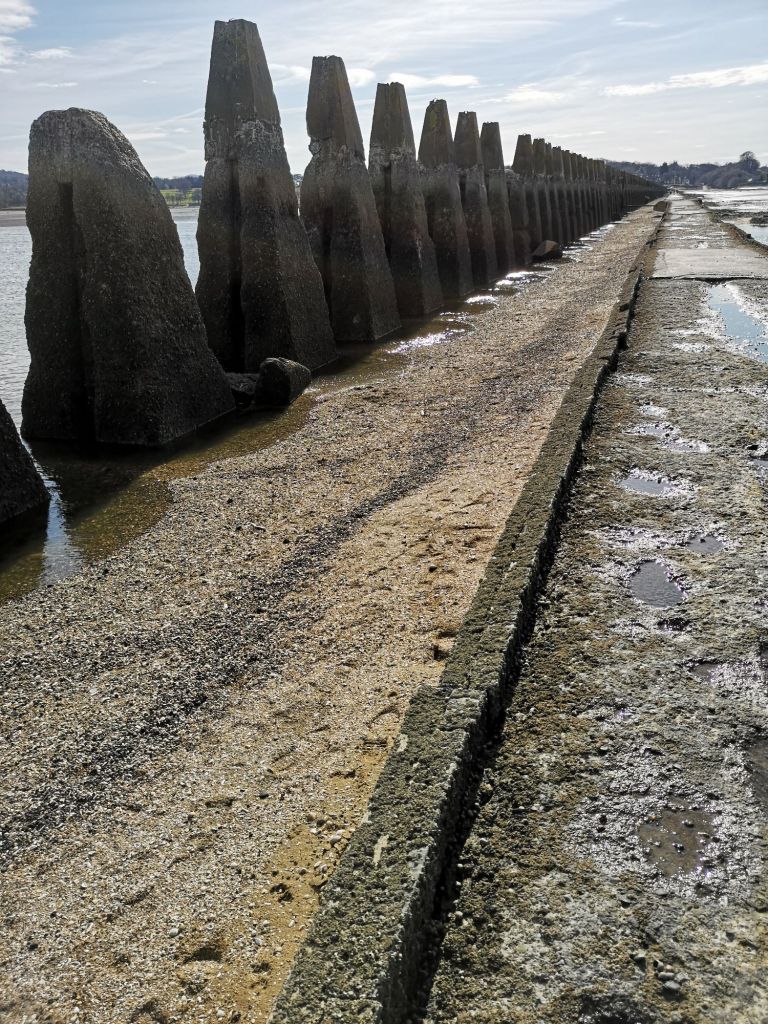
“… concrete pyramids, much larger than the usual dragons’ teeth, were erected alongside the causeway during the Second World War to prevent enemy boats coming through the gap between Cramond and Cramond Island.” Anne Burgess
Walk with us on Sunday 19th April 2026. Booking link
Walking the labyrinth at Pennywell Kirk designed by Natalie Taylor. This there-and-back walk will begin at 2pm and finish at 4pm outside North Edinburgh Arts, 12C MacMillan Square, Edinburgh, EH4 4AB. ///combs.chin.woven
Expect:
Fresh air and gentle exercise
An opportunity to get to know new people
Entertaining stories of local history
Information about art and murals
The chance to enjoy urban nature
Led by Tamsin Grainger, experienced community walker and Paths for All trained leader.
The Old Kirk, Pennywell, Edinburgh
Moving slowly through the city landscape allows for higher quality noticing and time to pay attention. Pauses are important so we can look, smell, and discover. We will embrace community, as well as silence and conversation.
Labyrinth by Natalie Taylor, artist
The labyrinth may not be wide enough for wheelchairs. Apologies, but please tell me if you will be using one and I will get back to you.
Getting to the starting point: Buses 17, 24, 27 and 37. There are bike racks outside the building.
Suggested donation £5 (£3 concession). You can join the new Walk Club Edinburgh. Contact tamsinlgrainger@gmail.com for details.
4th in the Walking in Pairs series with Kristina Rothstein in Vancouver, Canada and Tamsin Grainger in Edinburgh, Scotland. Walking together, apart. December 4th 2025. Our theme: Freedom / Constraint
KristinaTamsin
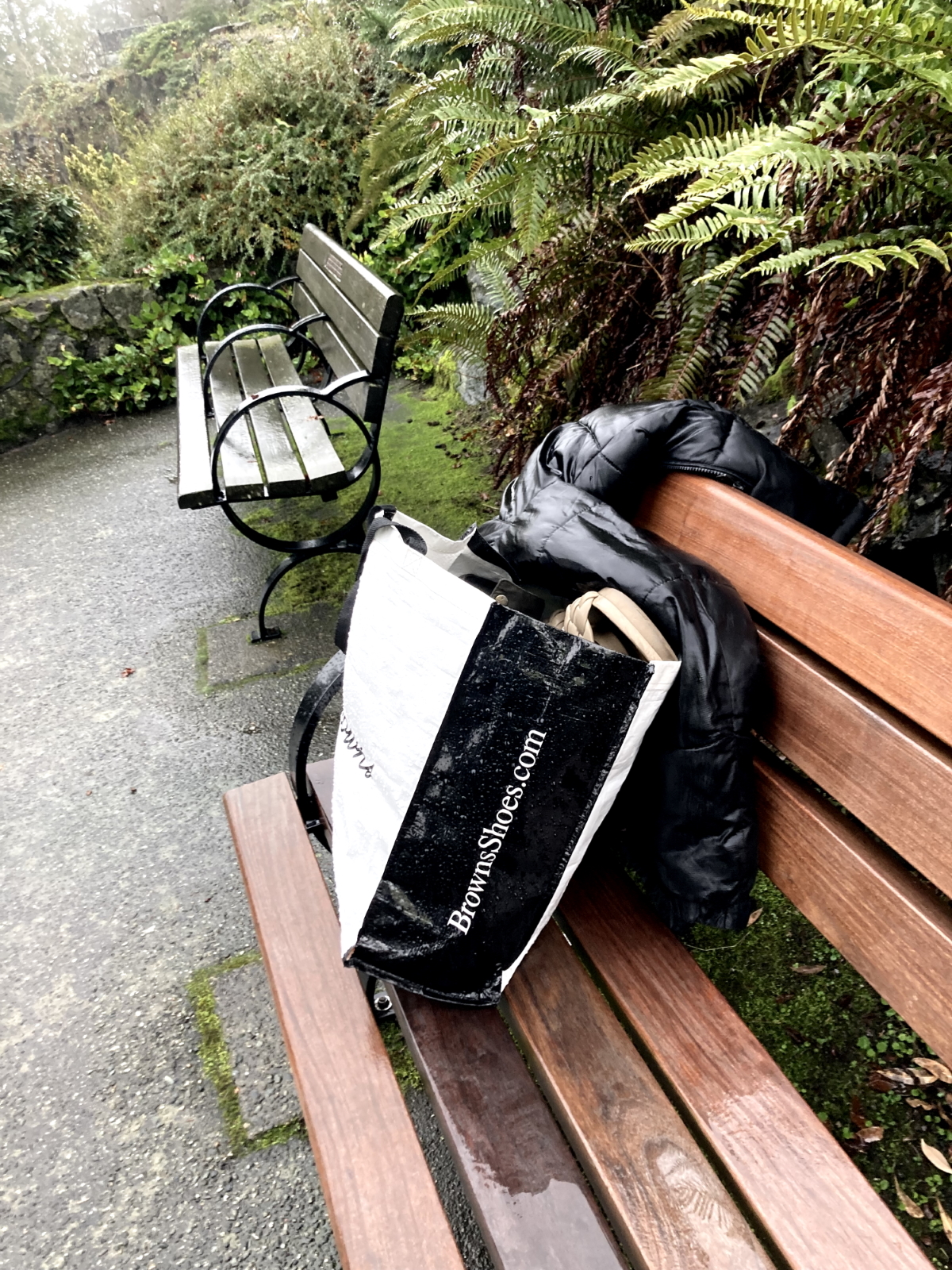
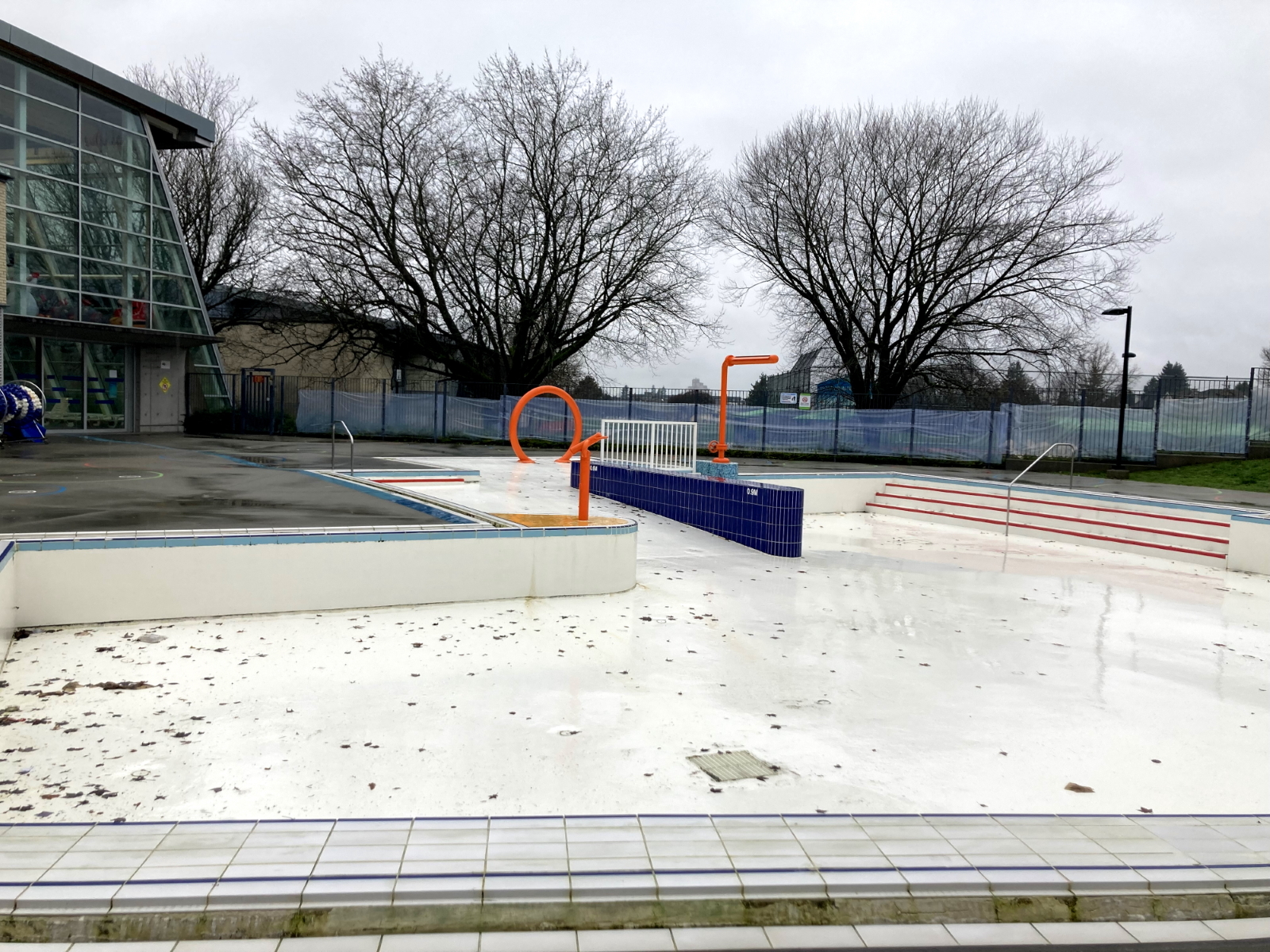
Kristina (9.45) : It was a chilly rainy day. I walked from my house to Queen Elizabeth Park, a large municipal arboretum which includes ornamental gardens, duck ponds, a pitch and putt course, frisbee golf course, restaurant, and tropical conservatory. It’s on the highest point in Vancouver, an extinct volcano, and is varied terrain.
This is my only regular walk site that I have visited for Walking in Pairs, and I felt like I could radiate and transmit information to Tamsin the whole time because of feeling so grounded. My impression was that she was also in a familiar location. I went to the highest point, where I gathered some audio for five minutes or so, rain on my umbrella, rain on leaves, probably some traffic, rattling a metal sculpture, a freshwater underground pipe, an exhaust vent from the conservatory.
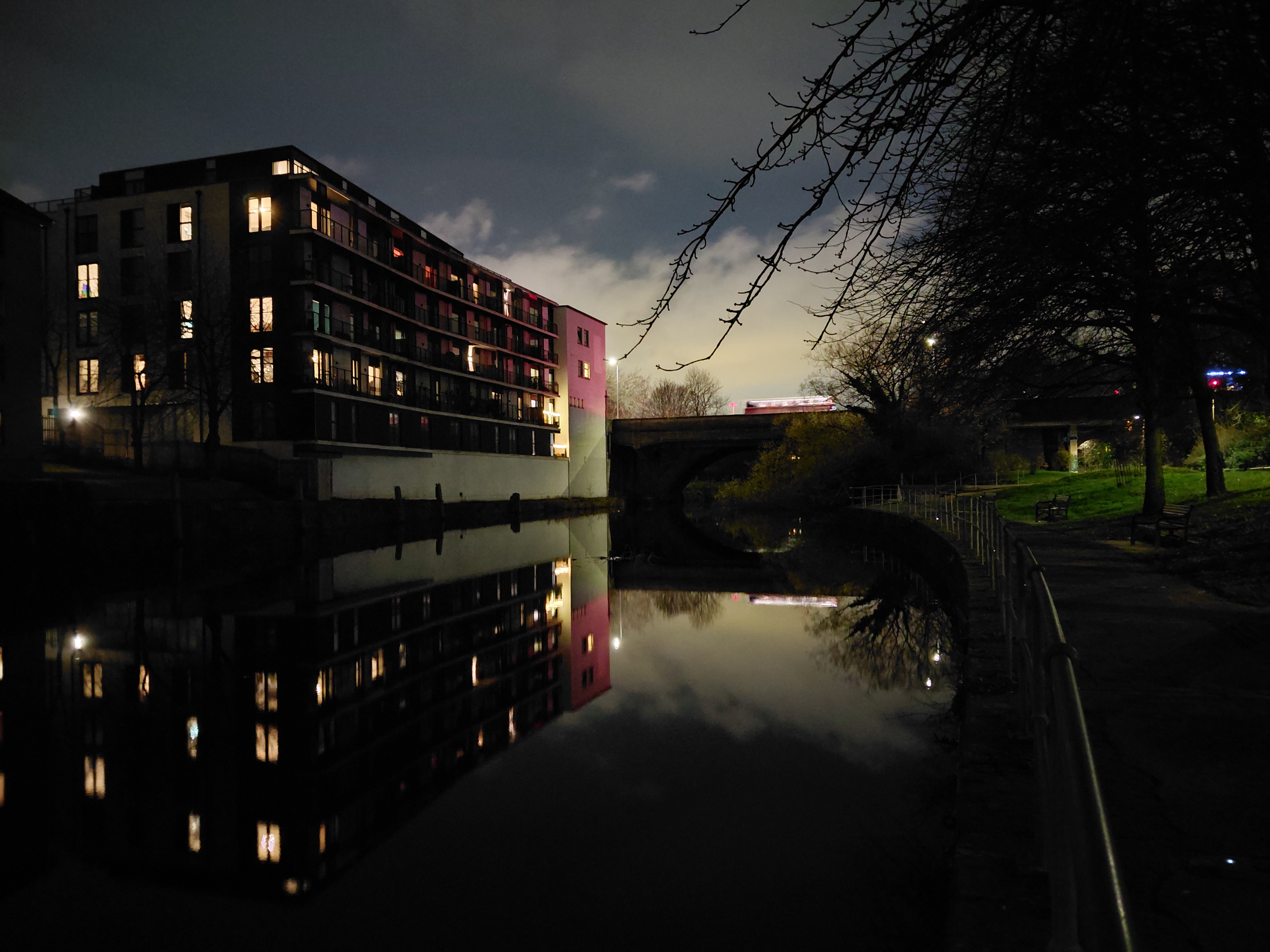
Tamsin (17.45): It was a chilly December evening in Edinburgh, a city built on an ancient volcanic landscape. There was no rain. Free-moving clouds only allowed me to see the full moon every now and then.
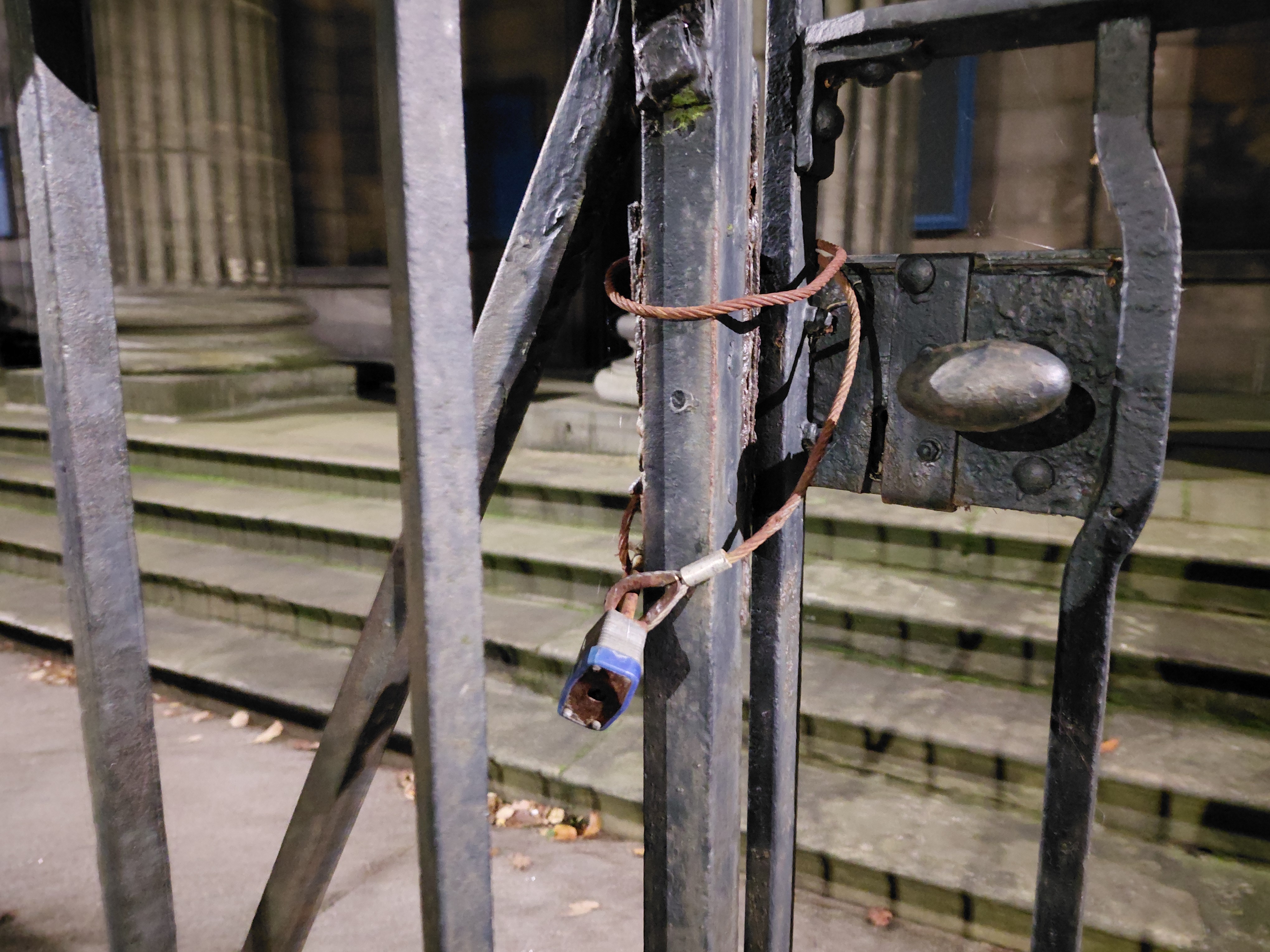
What route to take? On leaving the flat where I was staying, I soon came across North Leith Church, and though its grounds enticed me, lit as they were by an eerie light, I was unable to explore them because of a series of padlocks and ties. The plaque informed, Built 1818 by William Burn replacing the old St Ninian’s Church on Quayside Street. I’ll go to where it used to be then, I declared to the evening, and set off.
Where was Kristina walking? What was it like where she was, in the morning light over the other side of the Atlantic? Who did she meet and what sounds was she hearing?
KristinaTamsin – relating to the theme of constraint
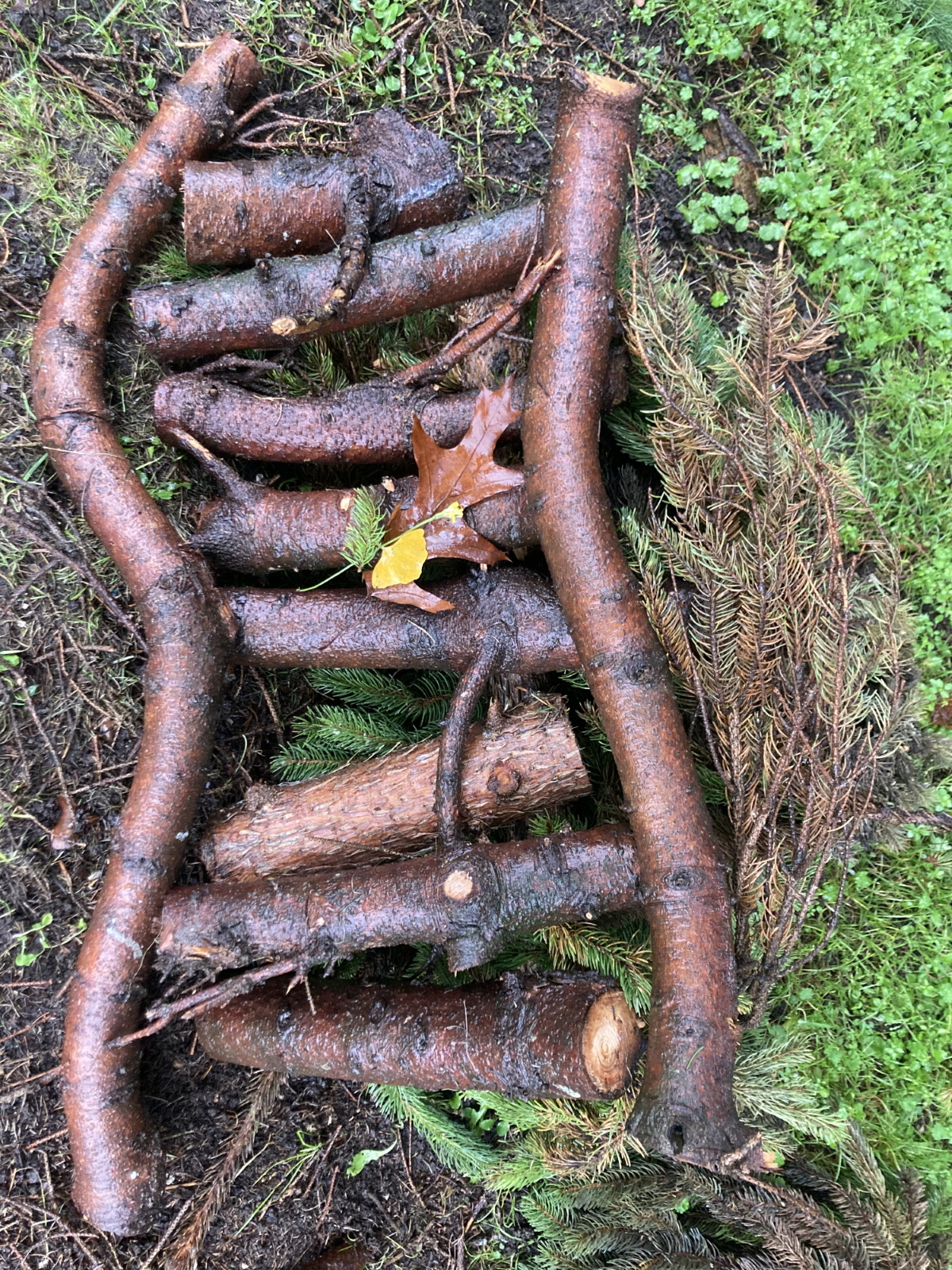
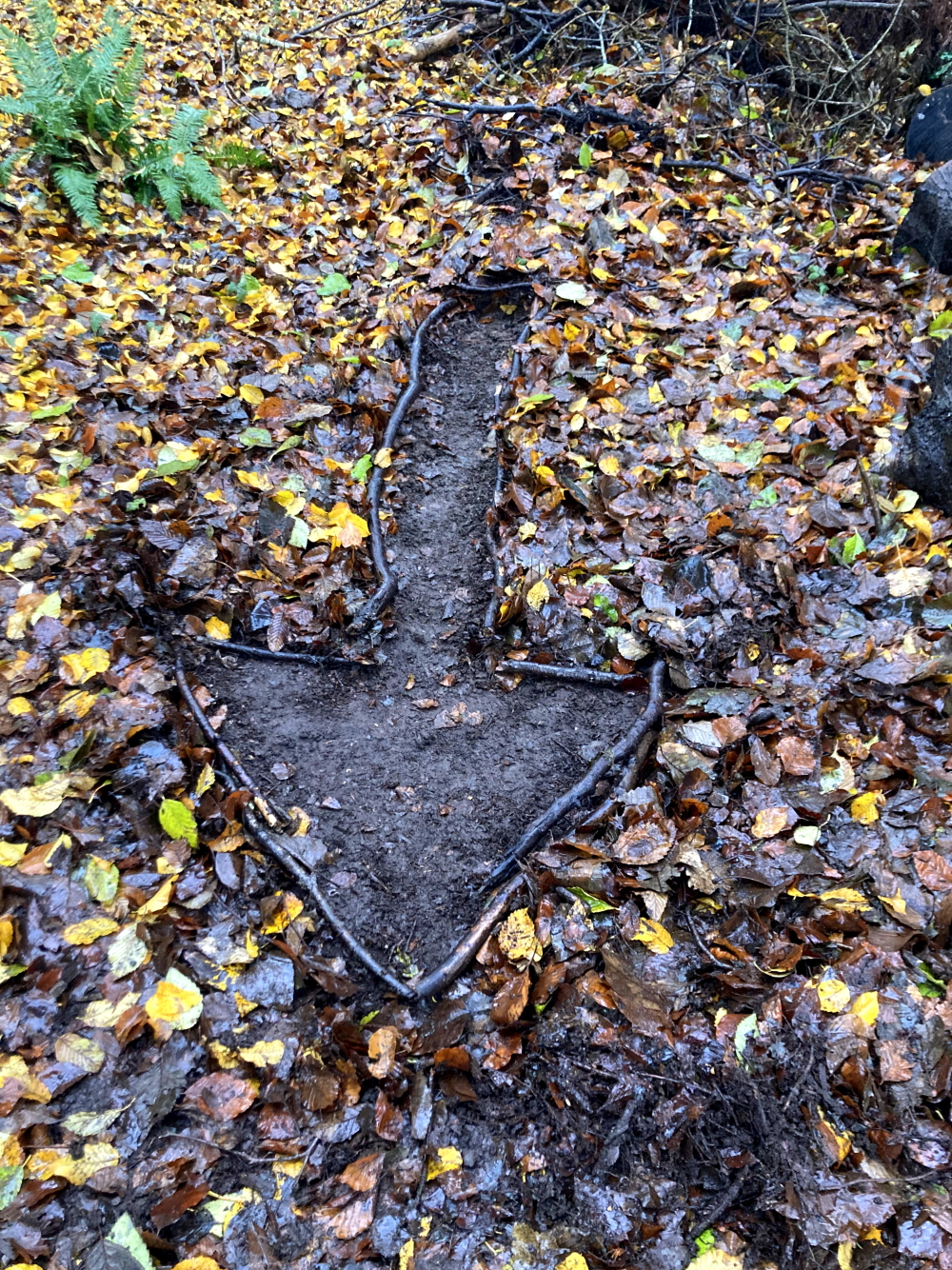
K: I entered the golf course, which is always deserted at this time of year and has some very wild, tucked-away areas. A fallen branch from a tree had been cut up, and I arranged some pieces into a pattern. I had had an idea to weave twigs or long grasses through a fence that runs along the golf course, and ventured into an area that I thought would be undisturbed. It was very wet and dirty, and I was not sure if the fence actually went through, so I walked back towards the golf course where I had thought instead to make a shape in the thick covering of wet leaves on the ground. I drew an arrow—a point of exit or escape—using our theme of freedom and constraint. I liked how it looked so I cleared the ground more and found twigs to line the arrow to give it more definition. This was challenging, given the rain, cold hands, and wet earth.
T: I joined the towpath at Coalie Park, a familiar location in the daylight, but not at night. It is not so much a park as a walkway beside the Water of Leith with municipal planting and wild greenery.
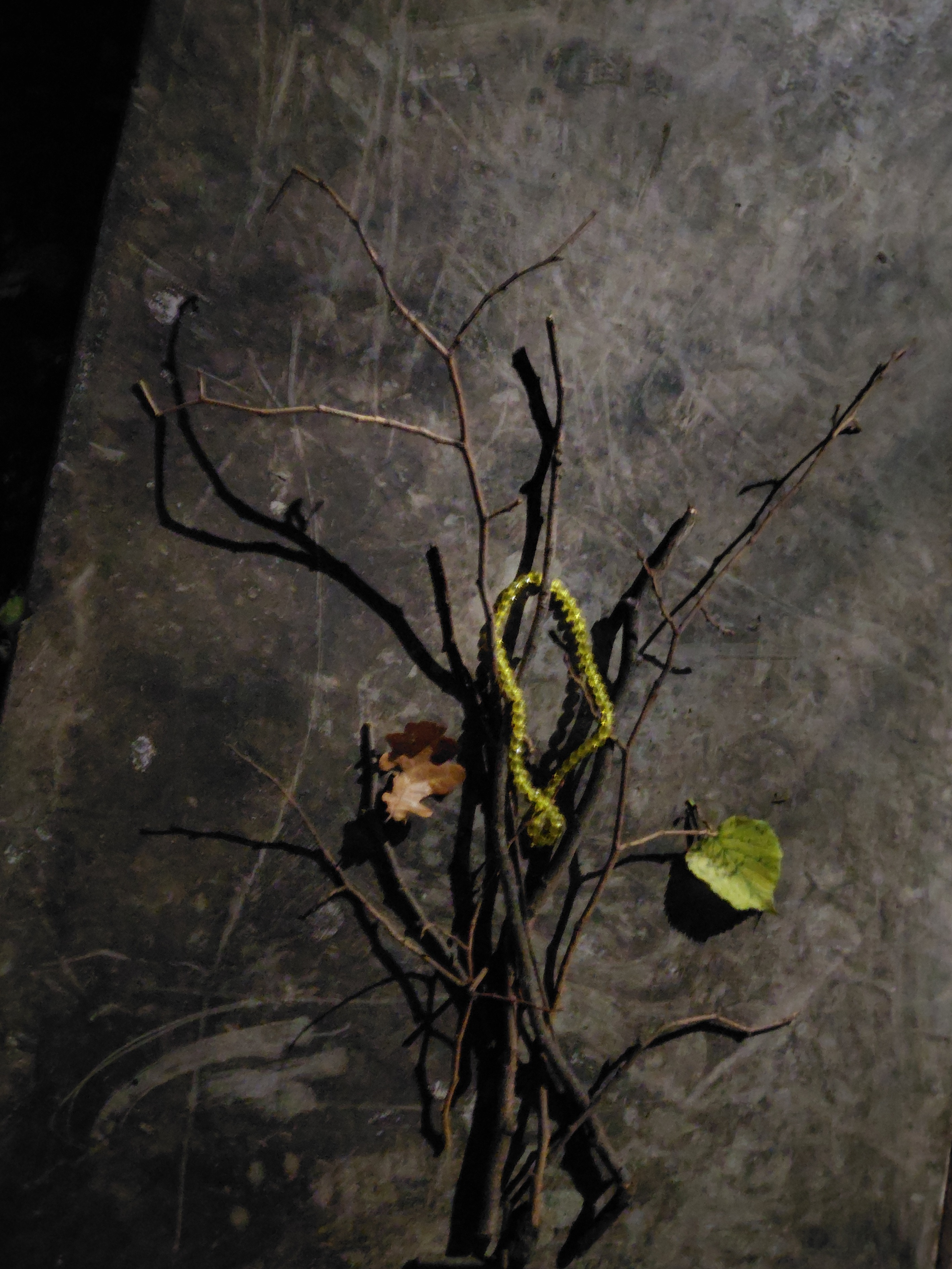
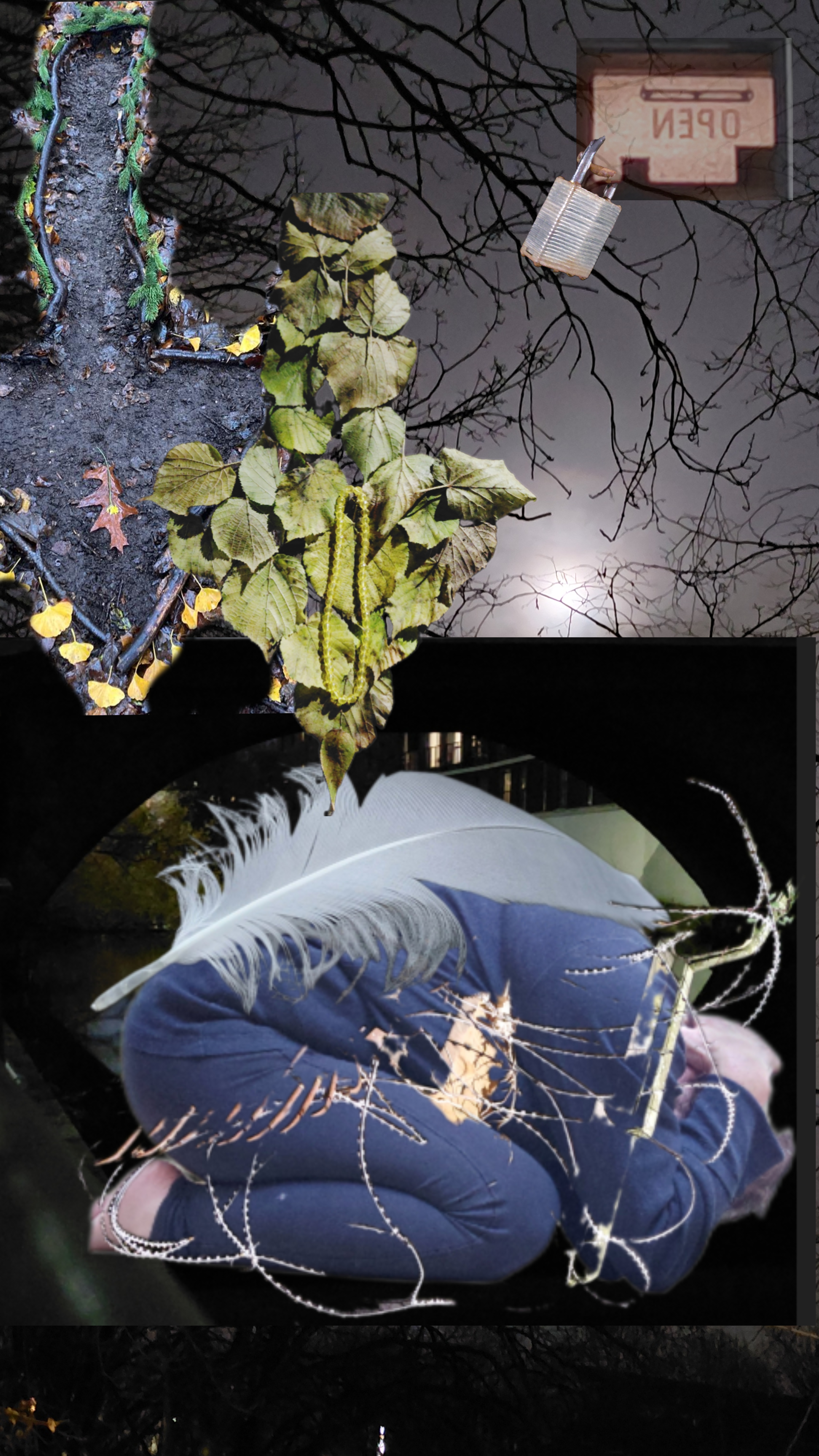
Collecting items which drew my attention, I arranged them on a shiny and durable surface that was part of a new skateboarding ramp. Collectively they spoke of my walk, our collaboration, themes, and the place itself. I was careful not to break anything, but juxtaposed them in a different way, forming a bouquet of natural branches and leaves and adding a necklace I had found earlier. My work was lit by street lamps which allowed the bauble to glitter. The background reflected in the same way that slices of the moon were being reflected in the water.
Kristina intervention 1Tamsin intervention 1
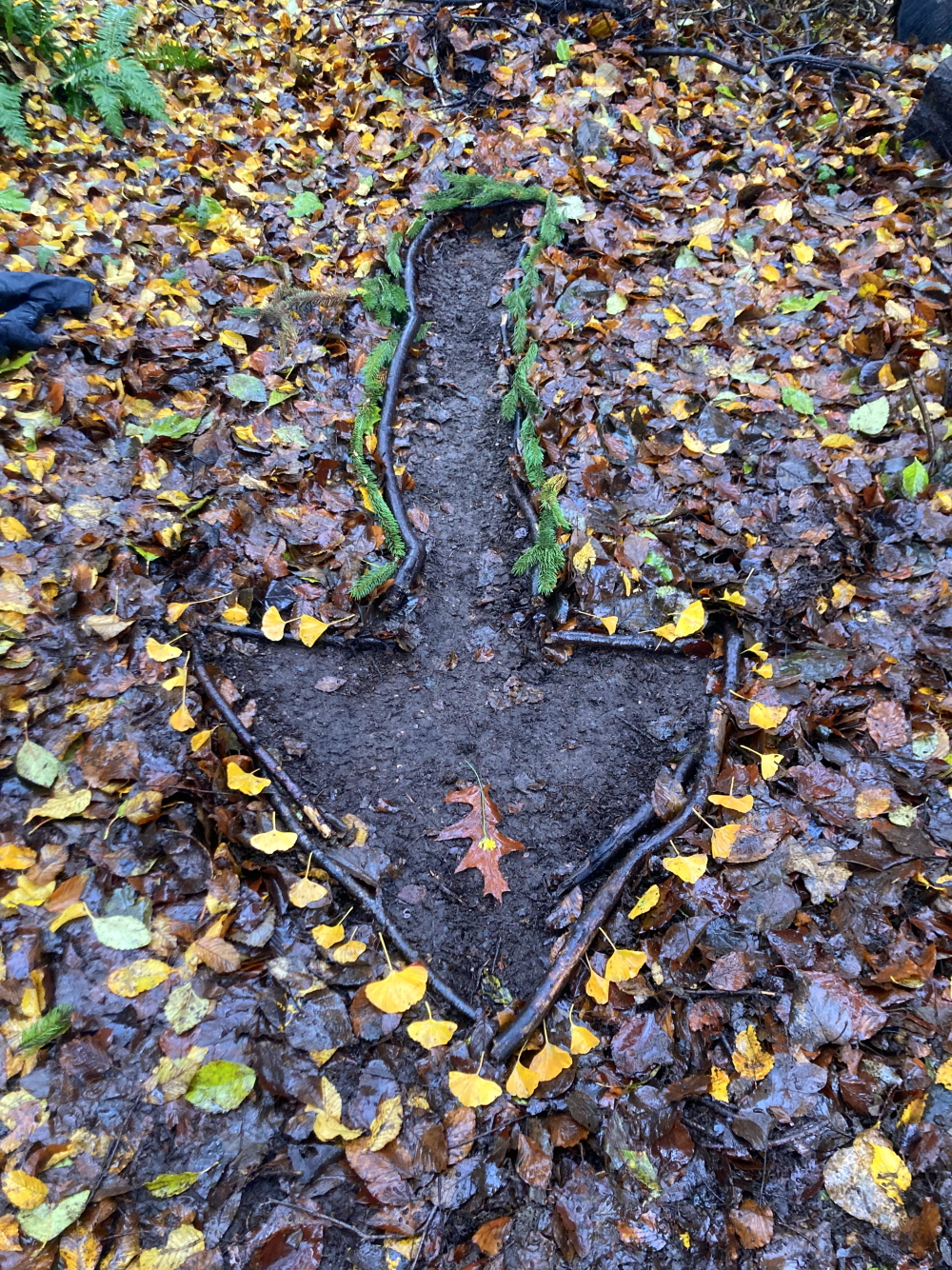
K: I sent my arrow photo to Tamsin, and when I saw the one she sent to me, I returned to the site of my earlier wood sculpture where I thought I might make an assemblage of my own. Instead I found the fallen leaves from a ginkgo tree, which reminded me of the colours in her piece, as well as pine boughs and some dandelion type flowers, which also echoed colours she used. I gathered a bunch of these, took them to the arrow and augmented the piece I had made.
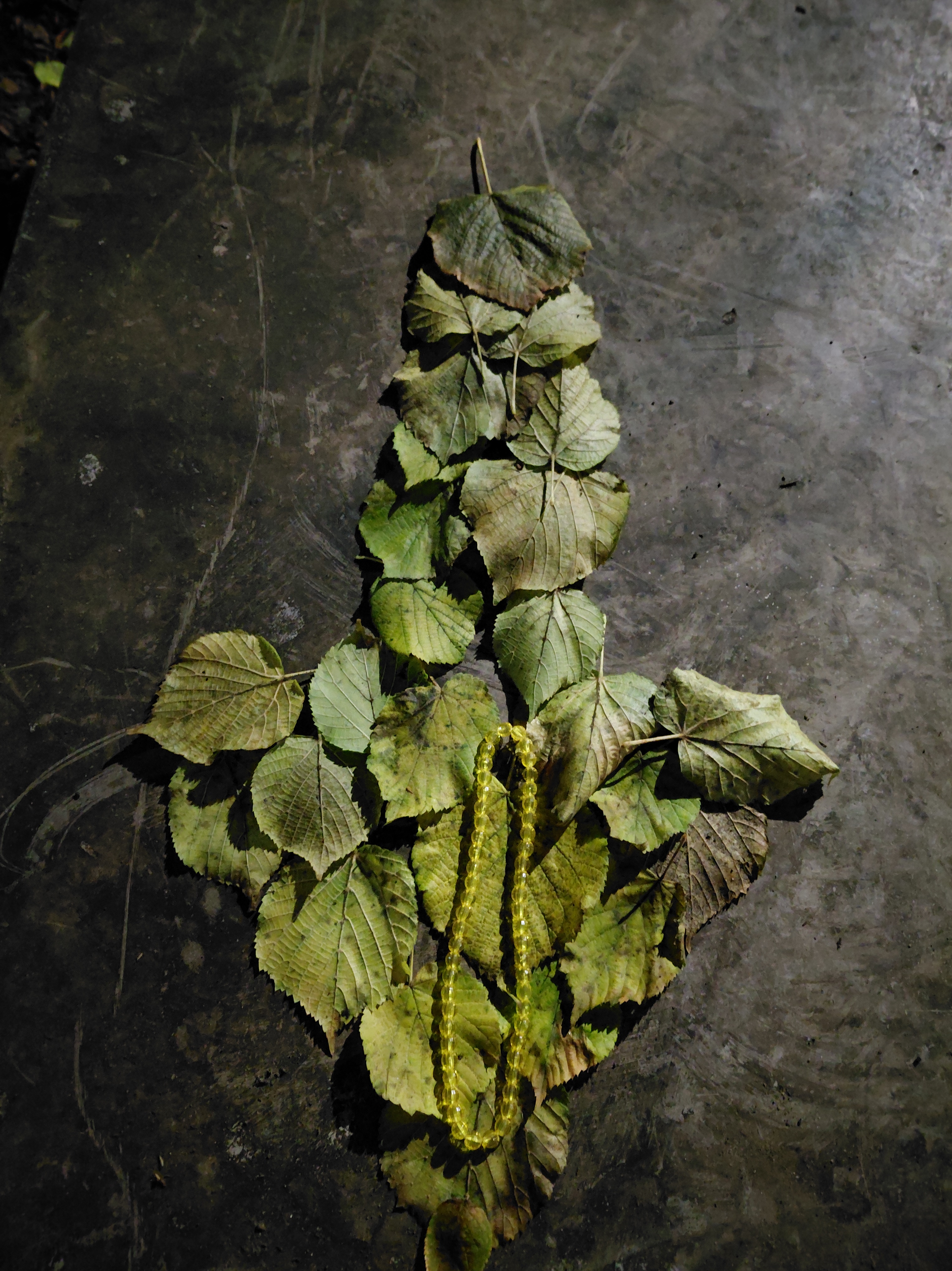
T: After sending an image of it to K, I responded to hers by dismantling mine and using the same sticks to form the outline of an arrow shape, allowing the earth to show through as she had. Not very happy with it, I returned to my metal surface and formed the arrow shape using more of the same lime tree leaves I had already used (ones that were littering the ground around my feet). Where hers was empty on leafy ground, mine was formed of leaves on a smooth surface.
Kristina intervention 2Tamsin intervention 2
K: At this point, I had a lot of mud on myself and it was almost time for another audio gathering so I went to a small stream that runs through the golf course and recorded the sound of water as well as the sound of pebbles in the stream clinking against each other.
T: As agreed, I made an audio recording 30 minutes in and must have left it on by mistake because there was 42 minutes of traffic noise, rustling, and water gurgling to listen to later! On finding railings and a metal bench, I used a branch to play rhythms and tunes, the sound ringing out across the water. I could hear snippets of conversation from the joggers: “Then I had some parmigiano left so I used that. Are you a parmesan fan?”
Freedom / Constraint
Listen to the audio collage that Kristina made using our sounds here:
K: Being engaged in an interactive activity created a sense of togetherness in a “beyond physical” way, that was probably more true than on previous walks for me. We retained minimal interaction, with only a few prompts planned ahead of time and one shared photo.
T: This was a satisfying way to deepen our collaboration, one in which we actively allowed our artwork to influence each other’s.




 Walking without a donkey