Reflecting is a vital part of taking a walk. It helps to embed or integrate the walking experiences – where I have been, and what I have learned – in the hope that any changes wrought will last.
Most of all, though, I failed to comprehend that the best things in life aren’t things that are visibly sexy on the surface. They don’t scream for attention, and they rarely invite adrenaline. Rather they come from quiet commitment, respectful engagement, and a love of something greater than yourself.
Before a sitting meditation I start by acknowledging or noting any issues which are bothering me, either to clear my mind, to problem-solve, or create focus. Then I try to simply sit. I have been doing that for years. As a result I sometimes come up with creative ideas, solutions and greater understanding, or at the very least a recognition of patterns of behaviour.
Walking is a kind of meditation and the more I walk pilgrimage, the more I realise that simply doing it: starting, trekking, and managing to complete, I’m learning what I need to.
I have habits that I try to pretend aren’t there most of the time. However, when walking a pilgrimage they come to the fore. It’s in the planning and facing of the realities of the land and the practicalities of accommodation and food that I am brough face to face with myself.
Is walking pilgrimage synonymous with being religious?
I do not follow a recognised religion. I was christened into the Church of England by my parents and had to learn tracts of the bible overnight for reciting in primary school the next day. Joining in assembly every morning at secondary school was obligatory, and I sang and read lessons during services; went on a Sunday School holiday; and spent years in the Girl Guides where Christianity was important.
I was steeped in it – the tenets seem to be in my soul (or perhaps in my cells). When I was learning to speak, religion provided me with a moral and ethical language, and I have discovered that it’s hard to shrug off.
Maybe I’m on a mission to get rid of the destructive part of what I was taught in those early years. I was encouraged to feel guilty, it was assumed that I had Original Sin, and I was told that I was bad in my core as were all other humans. Perhaps I now take ecumenical walks to give myself the time to recognise the impact of this and to let go of what seem now to be unhelpful lessons.
I do visit churches sometimes and I certainly respect believers, but I do not take communion. I have read widely, listened, and discussed religion with friends, but I cannot follow a Faith which seems to exclude or criticise people for being the way they are or believing what they do.
Historically, pilgrimage was a religious practice, so it’s not surprising that people keep asking me why I walk pilgrimage.
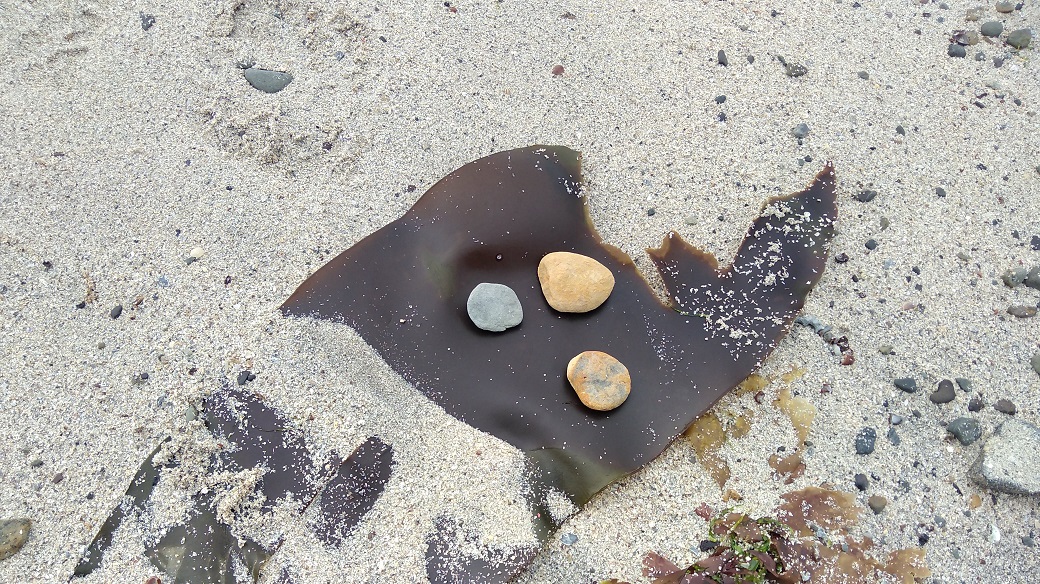
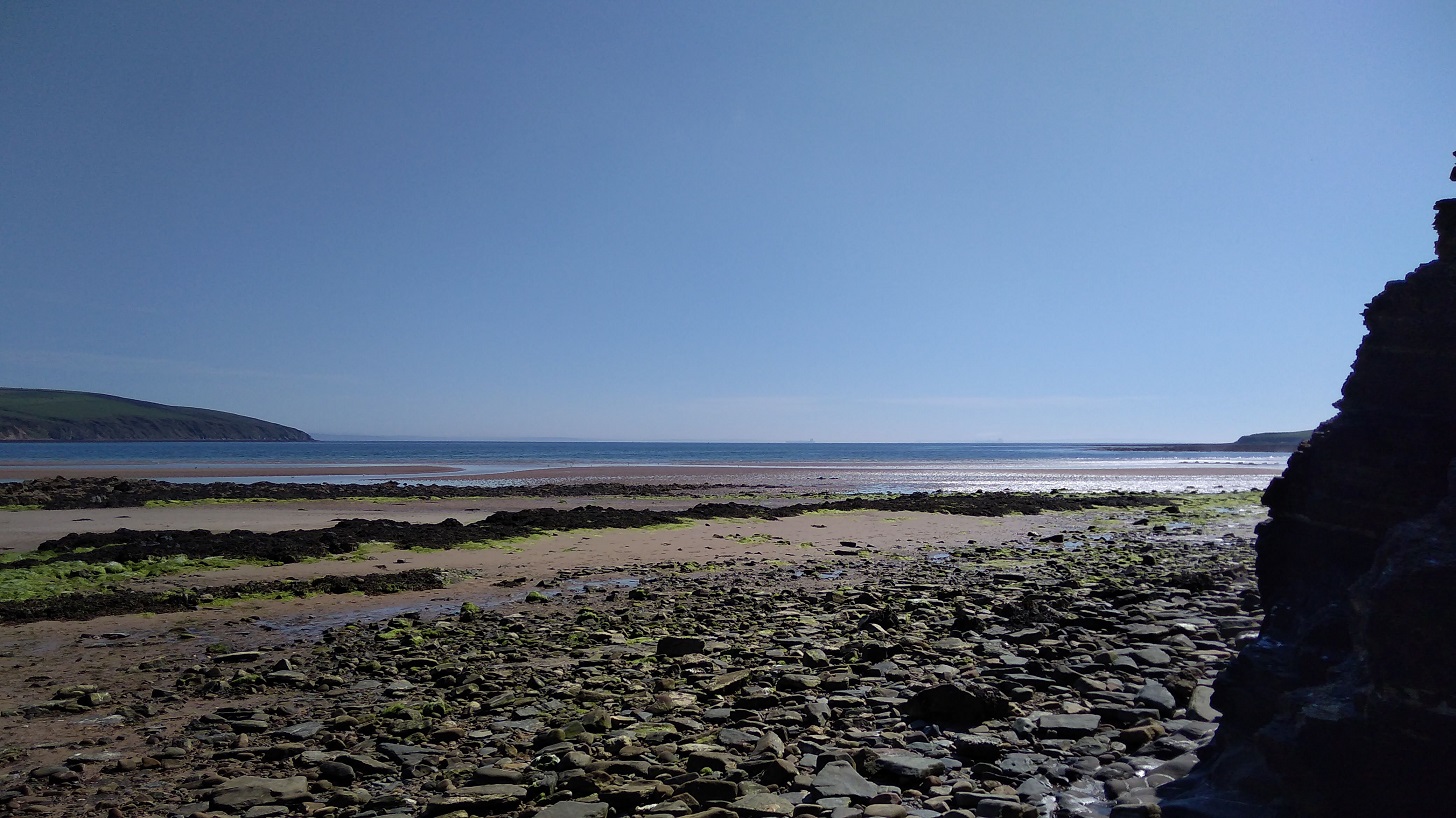
The three stones I found on Evie beach at the start of the St Magnus Way
Why pilgrimage?
For me, pilgrimage is more than a long-distance walk. It’s a walk with the added zizz of a specific intention, held to, and later reflected on. I’m walking in the fotsteps of others who were seeking enlightenment. Made with awareness and respect for tradition, there’s an in-built beginning, middle, and end, and it’s a project all in itself.
“The present, the present. It never stops, no matter how weary you get. It comes unstintingly, as a river does, and if you aren’t careful, you’ll be swept off your feet.”
Olivia Laing, To The River (p111)
Spirit, soul and understanding
In Chinese Medicine I was delighted to learn that there are a number of different ways to describe the spirit or soul. In Icelandic there are more words for snow than we have in English; in the Orient the parts of ourselves which relate to spirituality, to nature or to our innate relationship with other people are as important as our physical and mental aspects. Although the spirit is amorphous, hard to define, it is something I have a tangible sense of, particularly when I walk in nature. Although sometimes I am content to ‘be’, at other times I become curious and try to understand this puzzle.
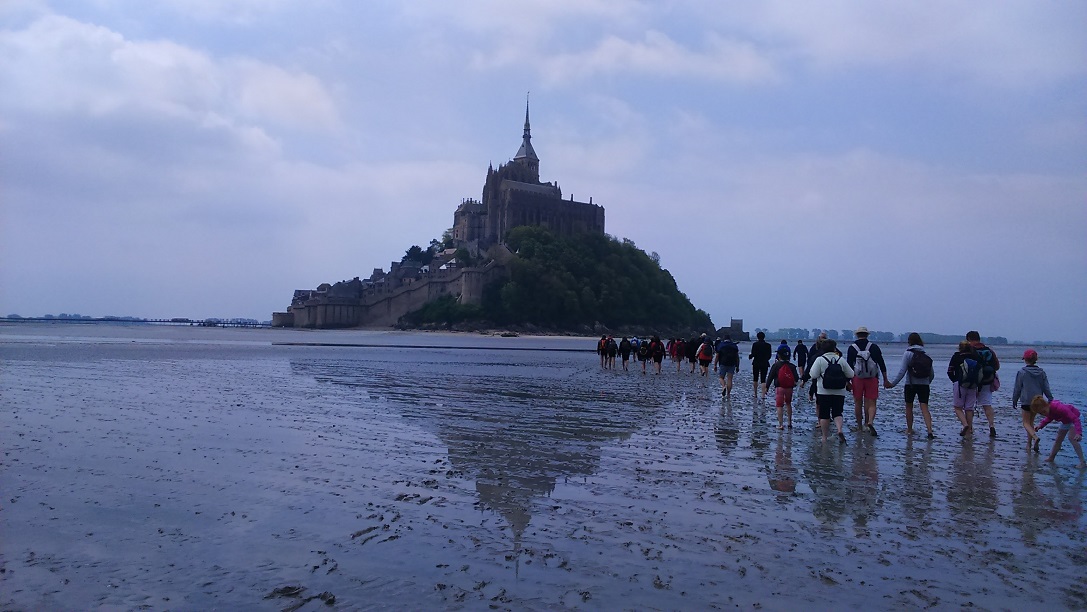
When I sit and meditate in my Shiatsu room in Edinburgh I can simultaneously be in Tibet or Japan or China. I don’t know why that is or how it happens and so I ponder on these things as I walk. I privately thought that at least one explanation was that I was a nun and a monk in former lives. It’s the best explanation I could come up with. The feeling I had, for example, when I crossed the sands, barefoot, to Mont Saint Michel was real – I ‘knew’ I had walked there before.
Walking across the sands to Mont Saint Michel, France May 2017
What is ‘knowing’?
We have discovered in the last 100 years or so that our physical cells destruct and reconstruct, so the ones I have now shouldn’t be the same ones I had when I was a baby, never mind the ones my mother or grandmother had. And yet we know that we share genetic material.
There is a theory that there is a collective knowledge which accumulates from the generations which came before. It could be this wisdom which tells me where to go to find what I seek, and what has got me here in the first place. However, current scientific methodology and outcomes deny me entry into this collective unconscious. It insists that I enter through the portal of logic and I am not sure that logic is the right way into that sort of understanding.
I have an intrinsic sense of the English phrase, ‘I know it in my bones’. My bones are made up of cells and that genetic material, yet in every text I read about pilgrimage something inside me recognises it. I seem to share the centuries of that collective knowledge, it is familiar.
There is my DNA and my body. There are my mind and my thoughts. There is my self, my soul, my spirit. In my work and my walking I am enquiring into the connections and (re)discovering dissociations between these.
It’s all about love
The more I listen to myself as I traipse, and the more I hear my clients in the Shiatsu room, the more I think that what we all seek is the connection to LOVE. It sounds like a familiar new-age thing to say, it’s straight out of the ‘all you need is ….’ 1960s, but I keep coming back to it.
I have a hunger for that ‘something for which we search’, and I know it isn’t just me, because when I tell folk what I do, they say, ‘Oh, I wish I could do that’ or, ‘I have wanted to do that for ages’. Or maybe they too have already started!
I seem to be part of a contemporary pilgrimage movement in which it is possible that we are seeking ways to integrate, comprehend and connect our-selves, personally and in community.
Pilgrims walking the Via de la Plata, Spain; Tourists flocking to the Sacre Coeur in Paris, France.
Restlessness
In addition to all this, I notice a compunction to move on, to save my soul, to find and to seek. The ‘thing’ I am looking for is at the same time inside me right now and just ahead of me. It is that towards which I reach or walk. It isn’t new. Everything I have done in my life so far is part of this instinctive movement towards being purer, ironing out the creases. That’s what I believe we are all doing wherever we are.
I know that inside me lies this knowledge, just as tangibly as I know my organs are there. I recognise that I am part of a continuum, a humanity of seekers. What is necessary is the time and space to better hear what is happening, and that is hard to find when I am at home looking after people and my surroundings, doing what most of us do in our adult Western lives.
The answer, it seems, lies in introspection. Without trying to be precious, I go quietly back inside myself when I walk, to hear the still, small voice.
Nan Shepherd wrote ‘These moments come… most of all after hours of steady walking, with the long rhythm of motion sustained until motion is felt, not merely known by the brain, as the “still centre” of being…
And so it appears I am descended from the ascetics and hermits of my history. I’m reborn into the liberated 21st century. I am, at one and the same time, part of a shared community – walkers and pilgrims, fellow monks and nuns, a group with shared values – and I am alone to ponder.
Some things are proving intractable and I expect that’s why I have to keep on doing it!




 Walking without a donkey
3 thoughts on “St Magnus Way – final reflections”