Via de la Plata Camino – Day 20 (Zamora to Montamarta). Monday 9 April 2018. 19 kms.
There was a deal of road walking on this leg of the journey.
Here are predominantly photos as the notes app on my phone failed and all were lost despite it promising to back-up. Aim: to find a way to reinstate it!
Walkers, be careful soon after leaving Zamora, because there are arrows off to the left to the Portuguese camino!
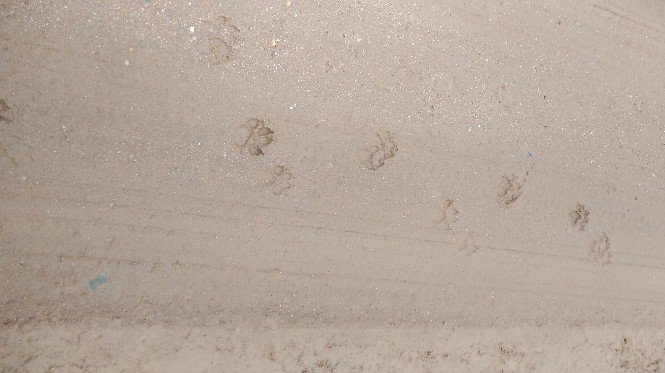
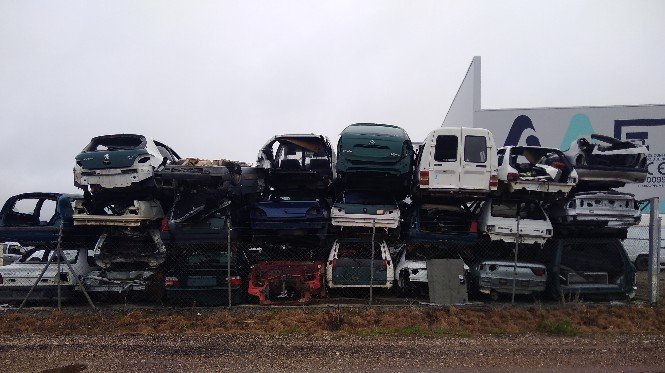
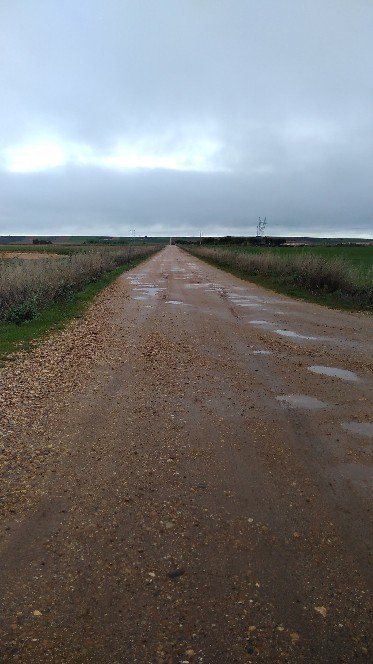
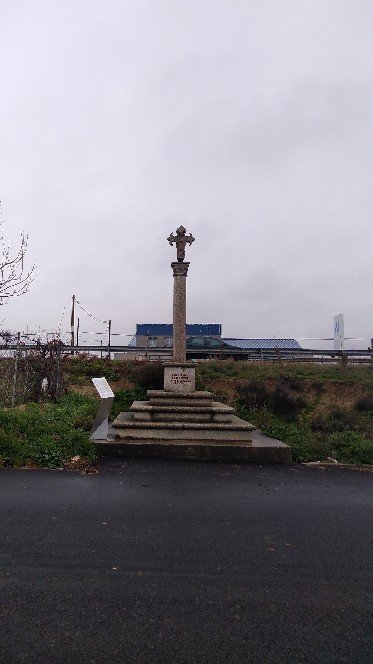
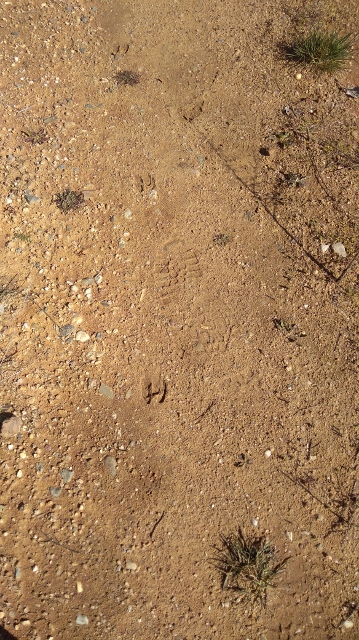
The tracks of the dog who went before me on the path.Cars stacked up beside the road. There are many car dealers in this area. The camino is not all beautiful countryside and olive groves.In fact, this part has long straight tracks of red earth between arable fields. Cloudy skies herald more rain.On the cross is a quote from Pablo Neruda: amar es vivir la existencia desde el corazón del otro which means something like, we live to love and be loved by others, to be in each other’s hearts.
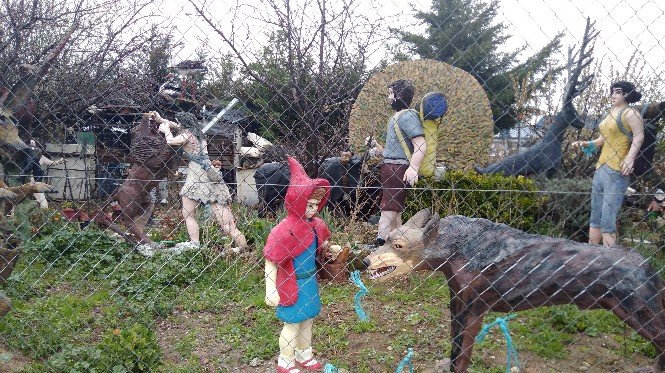
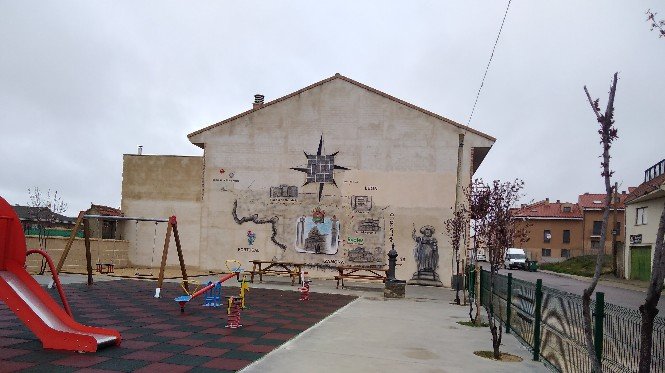
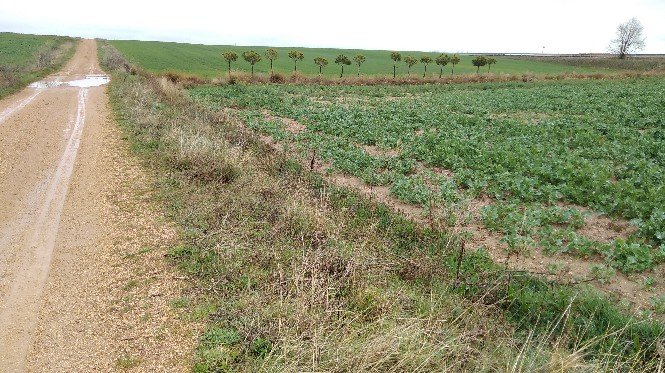
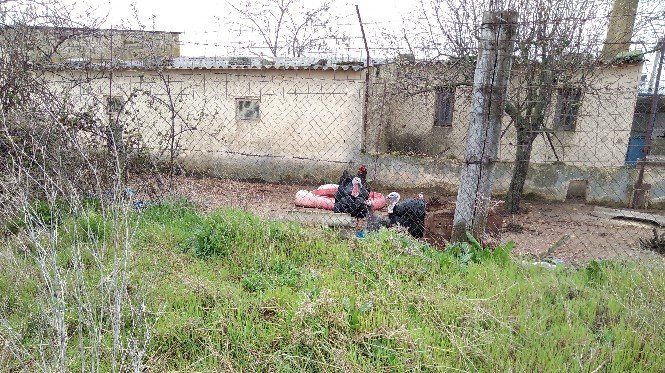
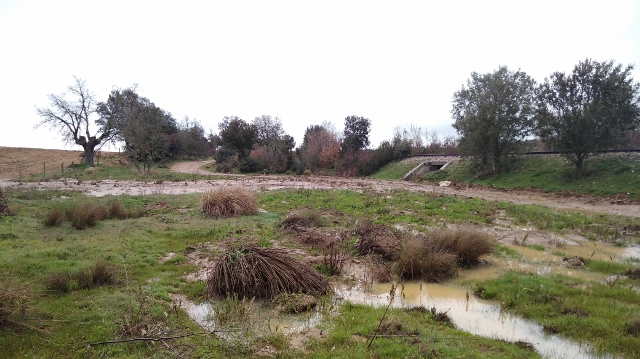
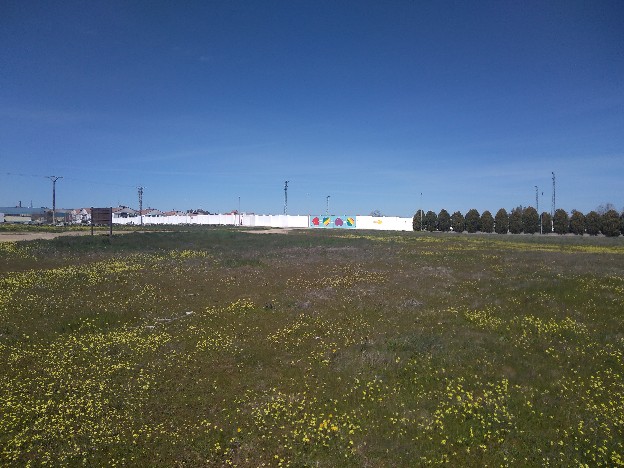
These statues of fairy tale characters were in someone’s front garden in Roales del Pan as I walked through.St James watches over the children’s playpark.Big puddles on the chemin, and a row of diddy little trees.Gobble, gobble, gobble, gob.
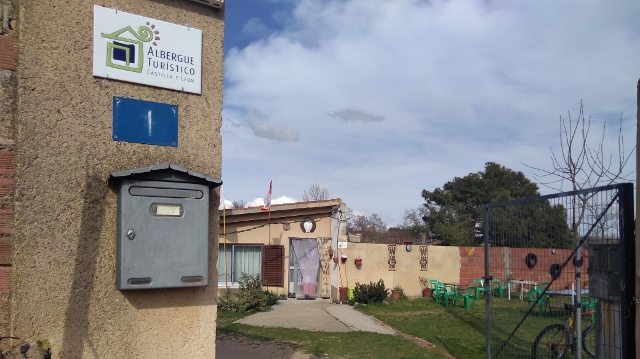
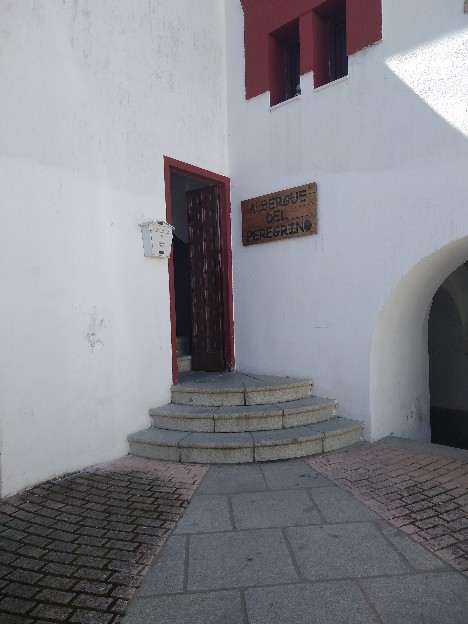
The owners of the private hostel Tio Bartolo also have a bar and work at the Covitan supermarket where you get the keys. It looks good in the photos and was recommended by the hospitaliere in Zamora, but I picked up some sort of infection walking barefoot on their floors. There were two American women and myself in the large dormitory under the roof, and we huddled in our beds and in our sleeping bags (there were blankets available). The weak, free-standing heaters which the landlady found us because all our clothes were wet, shorted the electric circuit and anyway, when the husband discovered she had given them to us (because he had to come and switch things back on) he shouted and swore and took them away. There were people in the small rooms downstairs who paid much more than we did (15 euros including breakfast which was left in the cupboards by the long-suffering wife and was not up to much at all).
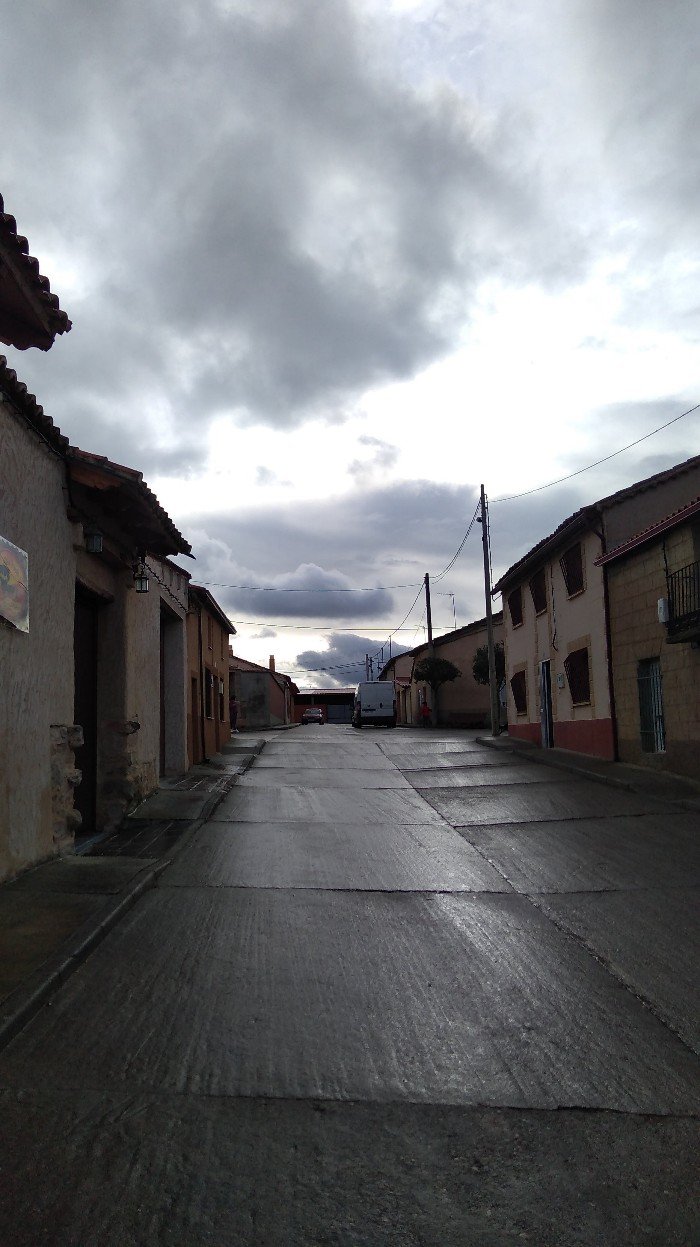
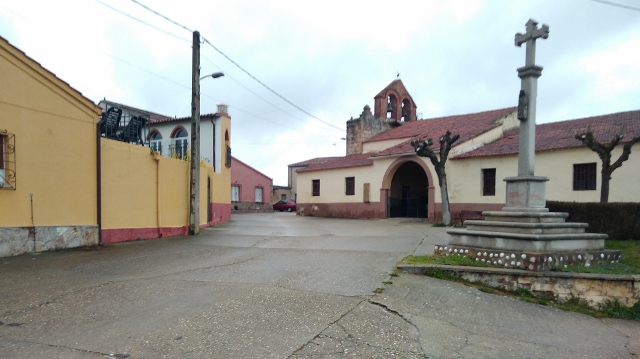
The hostel was on this street and I would absolutely not recommend it. Run by a kind woman and her angry husband, the rain came in downstairs and it was extremely cold.
Hostels and facilities
There are many facilities in Montamarta including a municipal albergue which had been shut for a while and opened the night I was there, but I had been told it was closed so didn’t try to find it. It is now rennovated and had good reports from the people I spoke to the day afterwards. There were two others mentioned in my book – El Bruñedo and El Asturiano – neither of which were open.
I had decided to go to Montamarta because otherwise it was a very long day (33 kms I think) and the pains I had been having in my feet dissuaded me from such a trek. I found a bar that wasn’t owned by the proprietor, on the main road, and charged my phone. The waitress was very kind, but it wasn’t somewhere I could stay long.
That was a really low few hours, and I used Facebook to send out a message to my friends, ‘Should I just go home?’ Some said yes, some no! I kept on going. And you know what? It got a whole lot worse the next day – in a different sort of way!!
‘But my business is unlearning, not learning, and I’ll change with the world but I won’t change it.’ from Ursula le Guinn’s Left Hand of Darkness.
Via de la Plata Camino – Day 17 (Mérida to Ourense). Saturday 7 April 2018. 13 kms.
The 7th April was a day of varied landscapes – some of the previous day’s wide open fields but also smaller agricultural plots, some houses, the ‘iron road’ etc. I was going at a faster pace, partly because it was cold but also as I knew it was a much shorter day. Going to Zamora in one leg was too long, so I was dividing it into two.
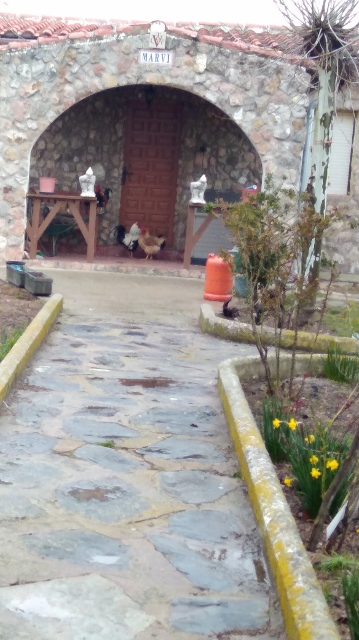
After last night’s heavy rain, it was dull but, hooray, dry! I passed out of the village, took a left over the bridge and straight into the country with no road – another big plus. Cocks were crowing and I spotted them at the front door.
A bit blurry because of the zoom. The good thing about hens is that they go up at both ends like two upside down commas joined together
Weirdly there was a digital town clock striking 9am, just as loud as normal bells but with an electronic tone, reminding me of the early days of mobile phones when TV programmes made jokes about huge handsets with ringtones sounding out across the country.
It was right at the fork despite no yellow arrow and I was walking by the railway. The next right was signed. I wondered, why one and not the other?
Walking beside the railway today. Sodden ground made the going slow.
I reflected on last night’s round-the-table conversations: how some people do the whole camino all at one go, others walk one weekend at a time; some start here, some there; and I have been meeting so many folk with injuries.
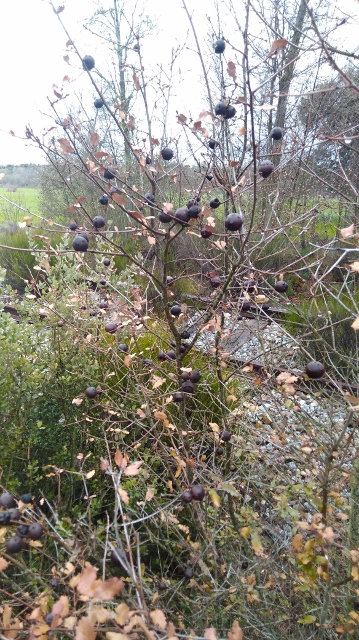
Plant of the day: once again I do not know the name. It has round burgundy / black pods or fruits that I have not seen before. They were hanging on dead trees and when I trod on one which had fallen on the path, it was full of diarrhoea-coloured mush which looked like wet plaster board.
Who would have thought Spain could be quite so cloyingly muddy with wet sand! There was that cuckoo again – Marie Noelle used to tell me it means she will be rich.
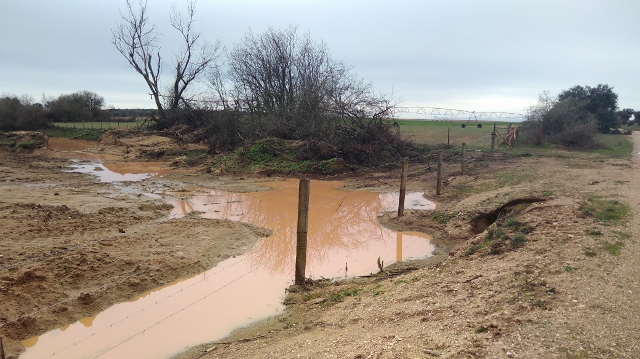
The water in the massive puddles is neon orange – so much brighter than in the photo. In the background are the chemical spraying machines like grounded corpses of fighter planes.
My nose runs and pilgrims behind me sneeze. I notice that cows do stand very, very still sometimes!
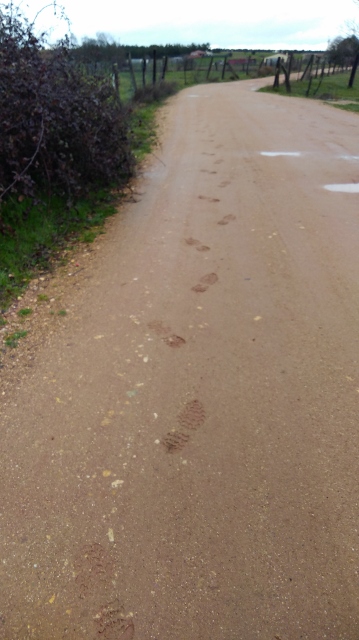
I muse: people I know walked here yesterday; or the day before; even 3 years ago. I can follow in their footsteps until it rains, wiping out all trace.
This guy in front was walking with Chaplin knees and his feet turned right out to the sides, indicating that his hips were tight.
The yellow arrows used by the Friends of the Camino to show us the way are not really the best colour given that there are a surprisingly large number of the same hue: yellow lichen beside the arrows on the gate posts, yellow triangles on pylons, and motorway relfectors found at ground level at the edges of the roads where we have to walk. They are all found in the very places we look for the indicators.
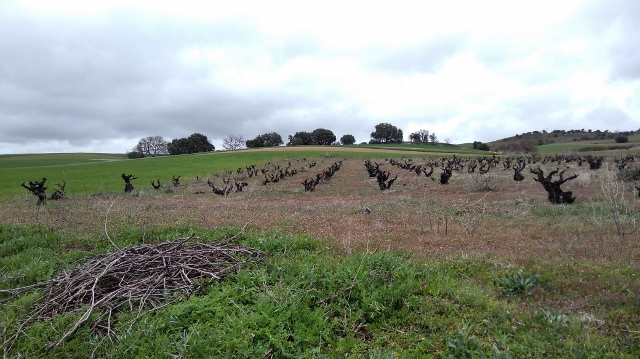
Vines at their dead-looking stage, black and twisted, organised in rows. The man I spoke to said they were ‘centenarios‘. Really old, then.
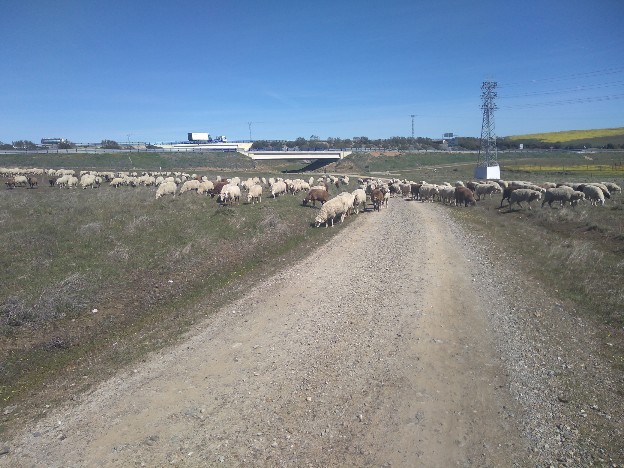
There is a great racket and then I see a flock of sheep being let out of the pen beside a farm, trotting into the field in single file with their new earrings, complaining bitterly.
Looking up I see it is going to become hilly again. The rabbits are too quick for my camera and there are definitely more flowers now, thank goodness. Beautiful purple / pink rocks are embedded in the white / yellow path amongst all the other colours of the irregularly shaped stones.
Cyclops!
I arrived at 11.45am and was second into the hostel. I stopped at the bar for the key and had a quick coffee (every now and then I enjoy a tiny decaff with sugar – something I never have at home).
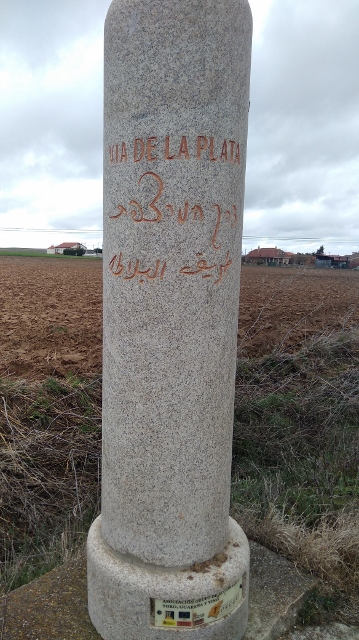
There was a long road getting into the town, with a ruined monastery on the right which I meant to go back and take photos of in better weather but forgot.The sign is also in Arabic – a reminder that the folk who started at Almeria or Malaga on the Camino Mozarabe joined the Via de la Plata at Mérida rather than starting at Seville. They are now beside us on the way to Compostella.
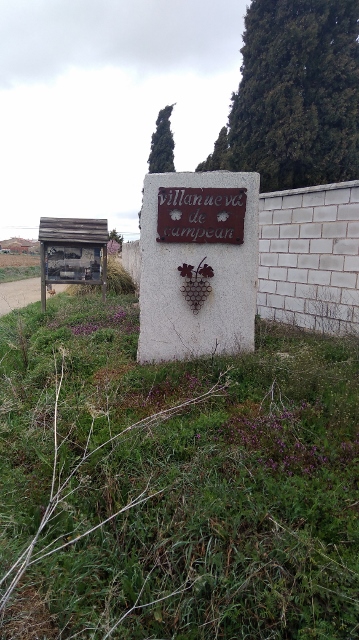
There are a number of albergues in Villanueva de Campéan, all apparently as low grade as the others, private ones costing the same as the municipal where I slept. I entered the sleeping area through the kitchen which had a microwave but no fridge and was dirty. Not only does the outside door open directly onto the kitchen, but there is a great gap above the wall between that and the dormitory so the cold and noise travels easily between the two and the street, as does the cigarette smoke. Luckily there were loads of us so we were cosy.
Villanueva de Campéan, Spain.
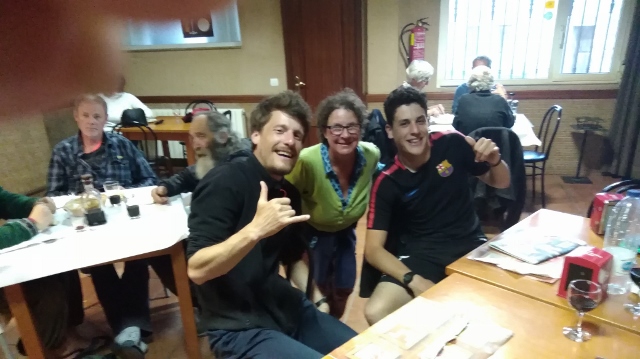
One by one we all settled in the bar for the rest of the day, and what a great band of cosmopolitan trekkers we were. I managed to write three blogs, trying to catch up, and then decided to continue when I got home. It was simply too loud and hilarious (the locals were playing cards and everyone was watching the football). Lots of red wine and menu del dia‘s were consumed and the atmosphere was most convivial.
The two guys from Seuil, the shoulders of the younger looking better after his Shiatsu (which he requested two days before) I thought! There is Carlos behind, with the beard – someone I was to come into contact with every day for the rest of my time in Spain.
In The Pilgrimage to Santiago, Edwin Mullins writes about the history of sending ‘sinners’ on the camino as far back as the 13th century: ‘…there is the case of the parish priest near Chichester [England] who would regularly fornicate, repent, then fornicate again, until in 1283 the Archbishop of Canterbury felt obliged to send him to Santiago as a penitent the first year, to Rome the second and to Cologne the third. What is not on record is whether the cure was successful or whether he thereafter weighted his repentance with the names of three foreign cities in which he had also fornicated.’
Via de la Plata Camino – Day 16 (Mérida to Ourense). Friday 6 April 2018. 20 kms.
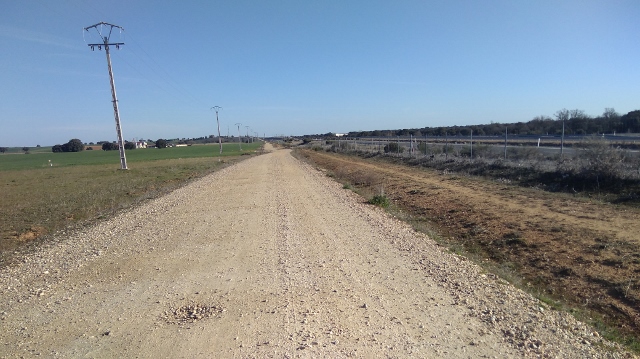
I am walking in Castilla y Léon and this part is very flat with a deal of road. The albergue in Calzada de Valdunciel is on the opposite side of the town, making it very simple and quick to find the way out in the dark.
‘Lodging facilities were generally provided outside the city walls to enable travellers to come and go after the gates of the town were shut at night’. The Pilgrimage to Santiago, Edwin Mullins.
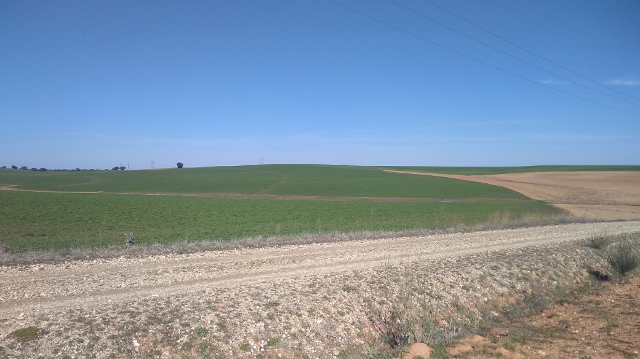
The long straight path was not overly attractive but as the sun rose, everything changed colour, even the barbed wire fence took on a precious shine.
I came across a small forest of teasal, all turned towards the sun. They stood tall and prickly in the light, old and brown but glowing at the same time. I have never seen so many of them at once. Perhaps because I knew I would be walking past a prison later in the day, they reminded me of inmates pressed against the boundary fence (there was not enough light to take a photo).
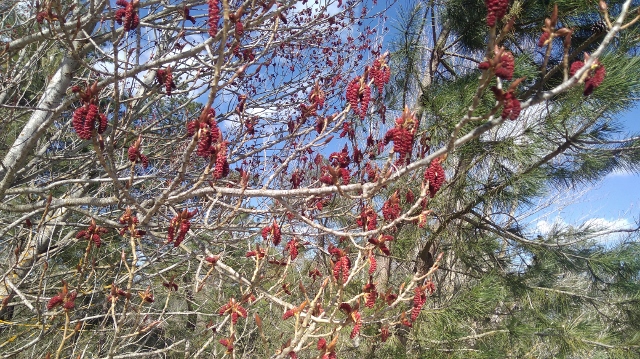
Plant of the day: the red catkin one – after searching the internet it could be Black Cottonwood
Opposite the sun, in the same cobalt sky, was less than half a lint moon, a wafer-thin gauze of a slither. Where the warmth had not reached it, the grass was still stiff with the haw frost.
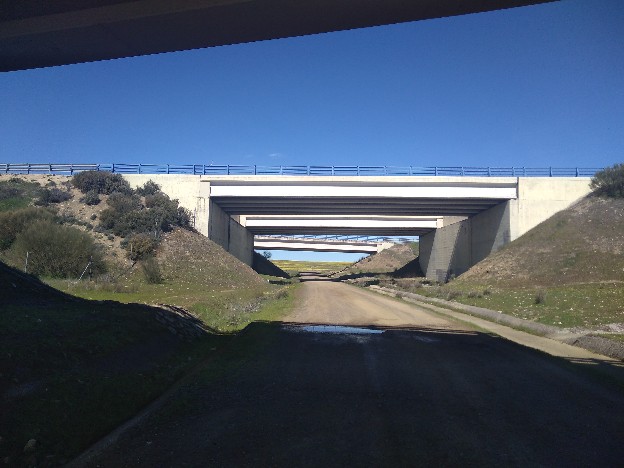
I followed the footprints of the people who had gone before me until a significant detour due to flooding. I was under a motorway bridge and the warning signs were easy to see except they were back-to-front, so first I took the left fork, met with the un-passable path and retraced my steps. Then it was not easy- arrows everywhere – and it was counter-intuitive winding back and over where I had already been. It seems that this diversion has been there a long time.
I ask myself, what is the person like who leaves these prints?
Soon it was lovely and warm. Straight, straight on, cars rushing past and I somehow missed Huelmos, the only pueblo between setting off and my destination. Shame about the sore feet. This type of stage often seems much further than it actually is, but I revelled in the wild flowers: the same selection from last week. I had hardly seen any since then and I wondered if the wheat spraying was responsible for the lack of them.
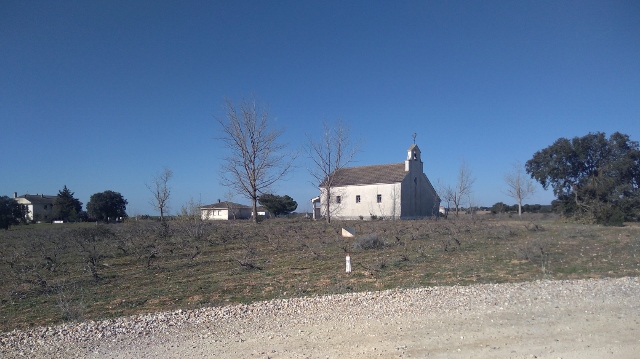
A typical, simple, Spanish local church.
This time the accomodation, a private hostel, was just off the first road I came to on entering El Cubo, sort of round the back and next to what looked like a derelict area. It had a spacious garden surrounding it and those strips of plastic hanging in front of the front door.
Albergue Torre de Sabre, Calle Traversís de la Ermita, El Cubo, Spain.
As there was no answer I phoned and the owner appeared very quickly, offering me a welcome beer. The books say people are welcome to pop in for a drink and a seat – a nice idea that I had not come across before. As I sun-bathed, I remembered that I had forgotten to leave a donation at the Salamanca donativo hostel and resolved to ‘pass it forward’, as the cyclist from Malta who came briefly by for a coke and to fix his bike, suggested.
Later I went into the village to buy my tea and next day’s breakfast. Two women sitting on a bench outside their house pointed me in the right direction. I am now familiar with shops which are in apparently residential dwellings. In Edinburgh it is the opposite – many of the old shops have been made into homes. White doves flew up from the church.
See the St James scallop shells decorating the base of the cross – eternal symbol of the camino.
Being private, there was no pilgrim’s kitchen but the retired owners allowed us to sit at the table alongside the others who were eating the supper provided. There were six of us including a young couple who are walking the camino, weekend by weekend, travelling by car from home on Friday nights, to the start of each stage, walking for two days, and then returning to their vehicle on the Sunday night for work the next day. It was a really enjoyable meal and the wine flowed freely – a delicious local white for the starter, red for the main – which I was (happily) encouraged to sample.
I was still meeting up with the duo from Seuil regularly. They always cater for themselves, being on a strict (almost impossible) budget, and the youngest is an avid footballer (he played for Rennes when he was younger) so despite walking every day, he goes out for football practice every evening – E, his ‘accompanying adult’, is consequently improving his moves!
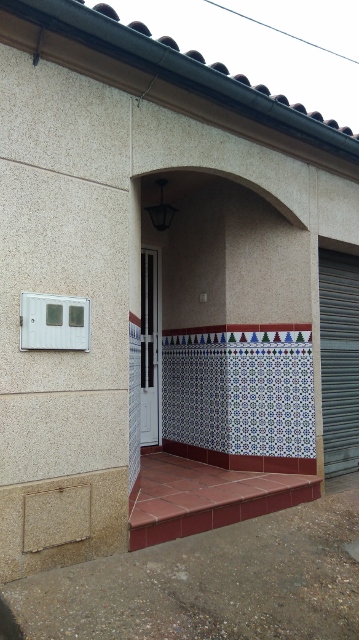
A plain, modern house with attractive decorative tiles.
They also washed our clothes for two euros, and there was plenty of hanging space in the garden. Unfortunately, having bought almost all of my stuff in before the storm except my double-layer socks which dry very slowly, I left them out all night. I padded out in bare feet through the puddles in the early hours when I remembered, but it was too late for them to dry for wearing that day.
I had a rather luxurious night: although I was in a shared room and had arrived first, picking the less expensive bunk, the whole establishment was full by 8pm and I was moved to a double bed – presumably because I was the matriach!!
Day 6 of my Via de la Plata Camino (Mérida northwards).
Casar de Cáceres to Embalse de Alcántara (27th March 218) approx. 22 kms.
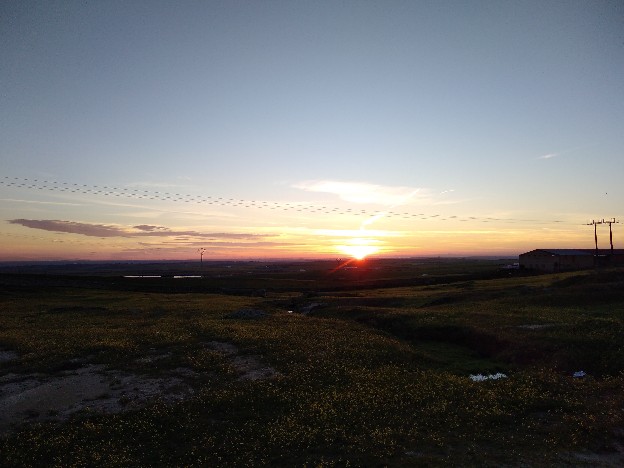
Sunrise outside Casar de Cáceres, Spain.
At 8am the incredibly loud bell in the square sounded and I left the hostel, two other women at short stages in front of me.
It was a clear run out of town and I really took my time, stopping even more often than yesterday, sometimes for five minutes, once for a snooze, three times for snacks.
These notices are all over the country: hunting social preserve (Google translate).
Immediately the temperature was warmer and by the last (hardest) stage on the hard shoulder or lane of the A road for 1.5 hours, the heat was truly coming up from the tarmac. Luckily all the time I was in view of the stunning embalse (reservoir) so I knew that I would eventually find myself by the water.
I had a lovely little sleep here for 10 minutes.
One couple walked together but everyone else, though friendly at the hostels, walked alone which suited me very well.
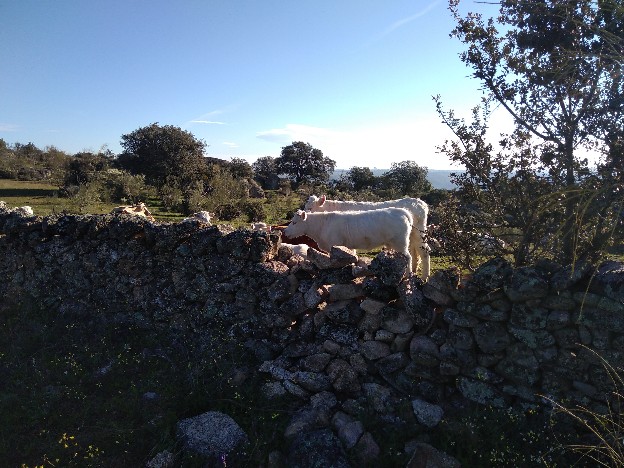
There are new calves with soft faces everywhere.
Quite a group has formed: the French speaker whose wife suddenly left him and who says he does not know why, their planned future in tatters; 3 other single women in their late 30s: an American living in Madrid, teaching English; a German who is more private; and someone from south east London whose long term partner just left her at a time when her possibility to have a baby is dwindling; a Dutch couple and a German man of my age – the latter telling me about co-operative learning and the former who made a cycle tour of Scotland last year and were bemused by our dance, strip the willow!
The signs for the final rocky path were very poor, although the GR113 red/brown signposts were efficient. Follow them in the direction of Cañaveral. Once faced with the road, take a right and stay on the path as long as you can.
Fragrant, white broom.
I did not realise the road part would last so long I stopped just off it to snack. Very soon afterwards I spotted a man looking at the gorgeous view by his car. He turned and spoke to me but I did not understand so he turned and showed me, shockingly, what he was up to, coercing me to come and join him. I had heard of these exhibitionists but never seen one. I shouted no, and a few other things and continued to walk on the hard shoulder, never changing my speed. Then I started to think about telling the police, remembering the Alert Corps app I had downloaded on my phone. It was then that I realised I had left the phone where I stopped, meaning I would have to go back past him to get it. When I turned around though I saw the Dutch couple who asked me if I was ok. They reassured me he had gone and watched out for me the rest of the way, which was great.
I did try to report the incident later because I would have hated another solo female to have to witness the same, although I was not in any direct danger, but the hospitalero said he phoned and the police were all busy and I should report it when I stop in a larger place. This did not sound the same as the promises the Guardia Civil are currently giving to protect trekkers.
The first hawthorn bush.
It was not long before I arrived, foot-sore, at the private hostel on the edge of the stunning Lake Tajo.
The owner worked really hard booking us in, serving us drinks and food, and washing our clothes. He said it saves water because even though he is by the magnificent lake he cannot use it and must get his from behind the hill from the well and when it runs out he has to close, earning himself the reputation of being unreliable.
We dined altogether on ensalada (salad with tuna and olives); bacalao (smoked cod), and .. flan! With wine – 13 euros.
New born lambs on wobbly legs, too.
There are spacious rooms. When I was awake at night I had snorers on either side, both young women: one squeaked; the other thrummed. And then there was also the sonorous person through the wall!
As well, there were people hobbling back and forth to the lav; the green flashes of the smoke detector; and the three-quarters moon shining in through the high windows. I was not sure if it was wolves or dogs baying.
The albergue at Cáceres was 15 euros (no extras), at Casar de Cáceres 5 euros (free washing machine and drier), and here 15 euros (as above). You can see that the prices of the hostels varies widely. The menu del día (usually 3 courses with wine) ranges from 8 to 12 euros.
Cáceres to Casar de Cáceres (26th March 2018), maybe 18 kms taking me 4 hours plus.
Today I did my morning meditation in a different position because I cannot sit cross legged in my sleeping bag.
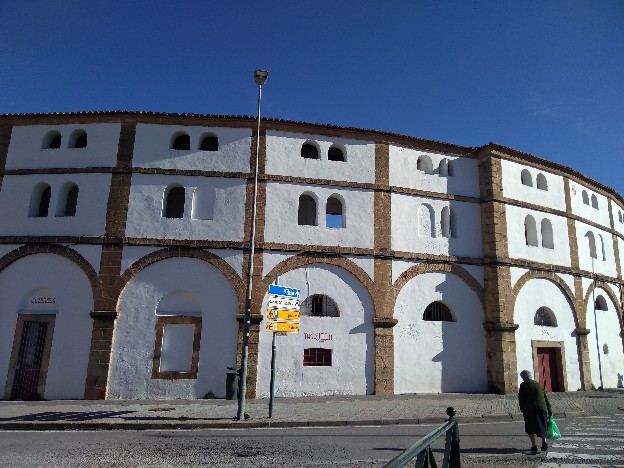
Bullring, Cáceres, Spain.
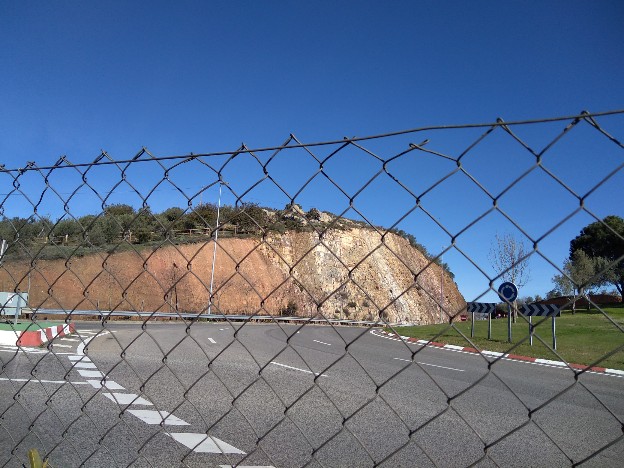
Walking out of Cáceres was smooth and I was impressed once again by the enormity and variety of the geology: the giant verticality of colour and strata exposed by road building.
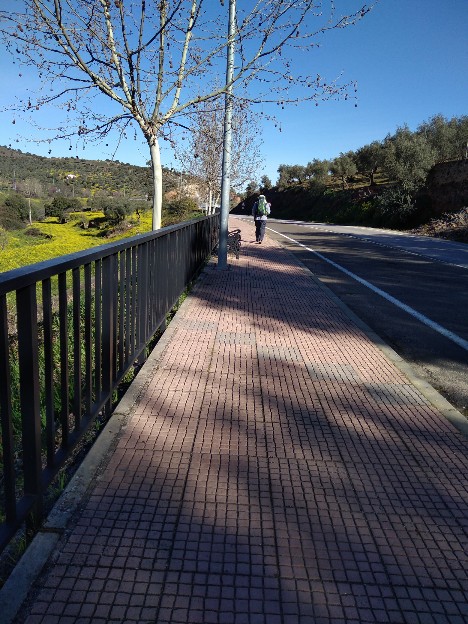
The roadside plants continue to be mainly rosemary and thyme but now with pink vetch. The Camino crosses main routes again and takes me along the highway. It is frustrating because I can see a beautiful path in the fields to my left but cannot get across the fences to it.
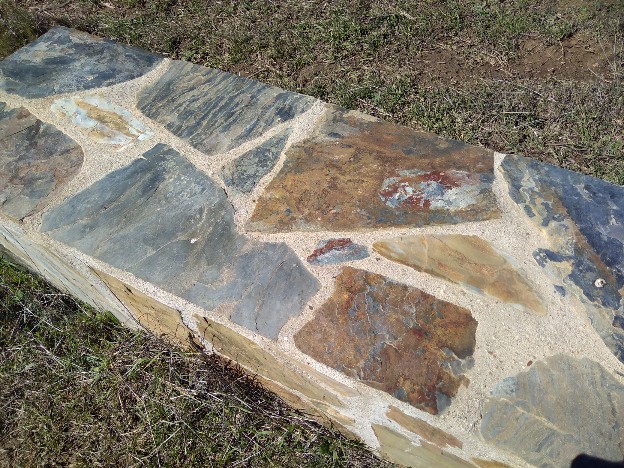
A handy seat made of beautiful local stone.
There was a brief conversation with a fellow pilgrim along familiar lines – nationality, where walking from and to – this time with an older Belgian man who is wearing a hat with sun flaps over both ears.
The sun was shining brightly but it was cold on my head. I reflect that if you are going to do this walking lark, you must be prepared for some hardship. Having enough money for hotels and being fit definitely helps.
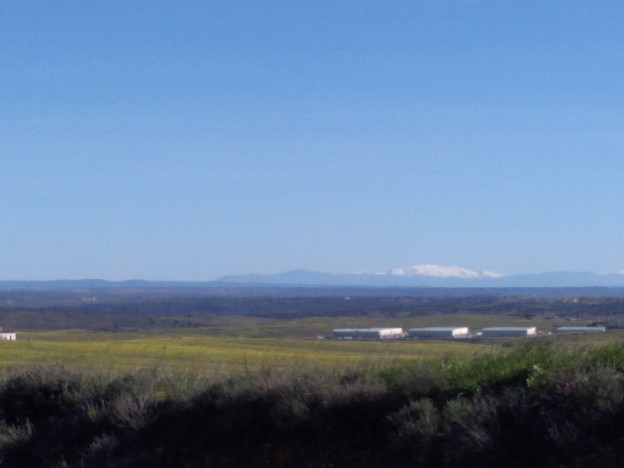
Because of my foot pain, I was already sitting in the sun to rest by at 11.05 after only 25 minutes, but I knew that this must happen if I am to manage to enjoy myself at all. I realised there were snow-covered mountains to my right and was awed by their beauty.
Snow capped Sierra mountains in the distance.
Once again I thought ‘that must be the camino over there, but how do I get onto it?’
The lovely Spanish cyclist and his German friend sped past waving a smiley buen camino to me.
Then I saw a gap, took off my rucksack and rolled under a fence, thinking perhaps I had just missed the turning to the path but no, I had to go back through a farm gate shortly afterwards and continue on the ‘hard shoulder’ which was very tiresome. In the process I put my hand on thistles and still have one spine in the tip of my thumb two days later. Maybe that will teach me!
There was a very nice sun and the remains of yesterday’s wind on my going-bald patch at the front of my head. Bravely I took off the bottoms of my trousers making shorts.
I spotted the new fennel leaves at the base of the old dry stalks and remembered how they were almost past seeding when I finished my first camino in November 2016 in Santiago de Compostella.
It was a long way beside that motorway. But my advice to others who might walk behind me is to wait, the off-road path eventually comes.
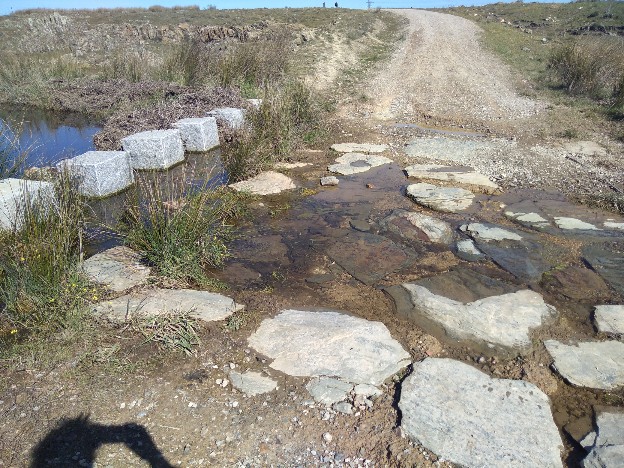
One of the many crossings – this one with stones provided to keep our feet dry.
There were still some of the dark brown and orange hairy caterpillars: one or two wibbling along over the gravel and some others fairly hurtling amongst the sheep droppings as if they were late for work. However there were nothing like the numbers of two days ago.
Other trekkers passed me occasionally and we fell into step for a while and shared pleasantries. I am trained to see the visual signs of the head-colds or tiredness, the dry lips, the excema under the nostrils, and do not ask questions.
Around me are small brown birds singing their little hearts out. I started thinking about this strange phrase – perhaps it is their puffed out wee chests and the high urgency of the pitch which has prompted it?
Now I was going uphill and was aware of my blister and that was only a tiny climb! I found myself saying blessings for dead animals by the roadside, and I finished planning my workshop for the end of April: the ideas popping into my mind unbidden.
It was very pleasant walking like that, with lots of tiny stops and the time to remember.
I came across a father and son, shepherds bringing up the rear with sturdy sticks but no dog. Overhead are three raptors and almost around my head are swallows flitting and flirting.
A flock of sheep to make my way through.
Once again I reflect that we walkers go so quietly that we come upon these creatures, or they on us, unexpectedly.
Oh those snowy mountains: simply majestic.
Finally I come into Casar de Cáceres and note the many expensive cars. It is presumably a commuter town for Cáceres itself. There are many helpful people including a woman who I had exchanged a few Spanish words with earlier and who later spotted me looking puzzled. She abandoned the wheelchair she was steering, grasped my arm and took me to the corner of the correct street.
The entrance to Casar de Cáceres – rainbow-coloured hearts and a huge yellow arrow: sign of the camino Via de la Plata.
It was long walk into town where I registered at the bar and then, having walked on far too far, retraced my steps to the nice albergue on the first floor in the corner of Plaza España. I arrived at 1.45.
The albergue entrance in the corner of the square.
The evening consisted of sitting in the sun with my cups of tea and chatting to the others; a beer in the cafe and very interesting conversation with a German teacher about co-operative learning; shopping (including a plastic mug for 39 céntimos), cooking a meal for myself and some others; giving what I call kitchen- Shiatsu (ie on the spot, me kneeling on the kitchen floor); and later, thoroughly enjoying the wine.
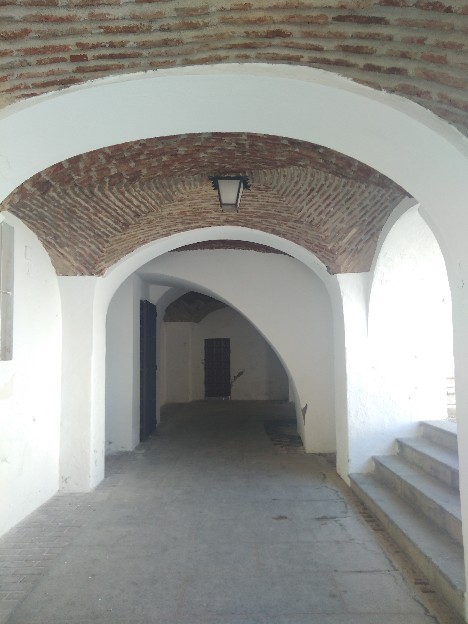
Beautiful Spanish architecture.
There was no WiFi, the shower flooded onto the floor, I did not enjoy my night-time visit to the toilet where someone had aimed and missed 😦 but it was great to have a kitchen with some utensils, and a free washer and dryer – all unbelievably, for 5 euros.







 Walking without a donkey