An evening wander in pictures (with a few words). Tuesday 26th September 2017
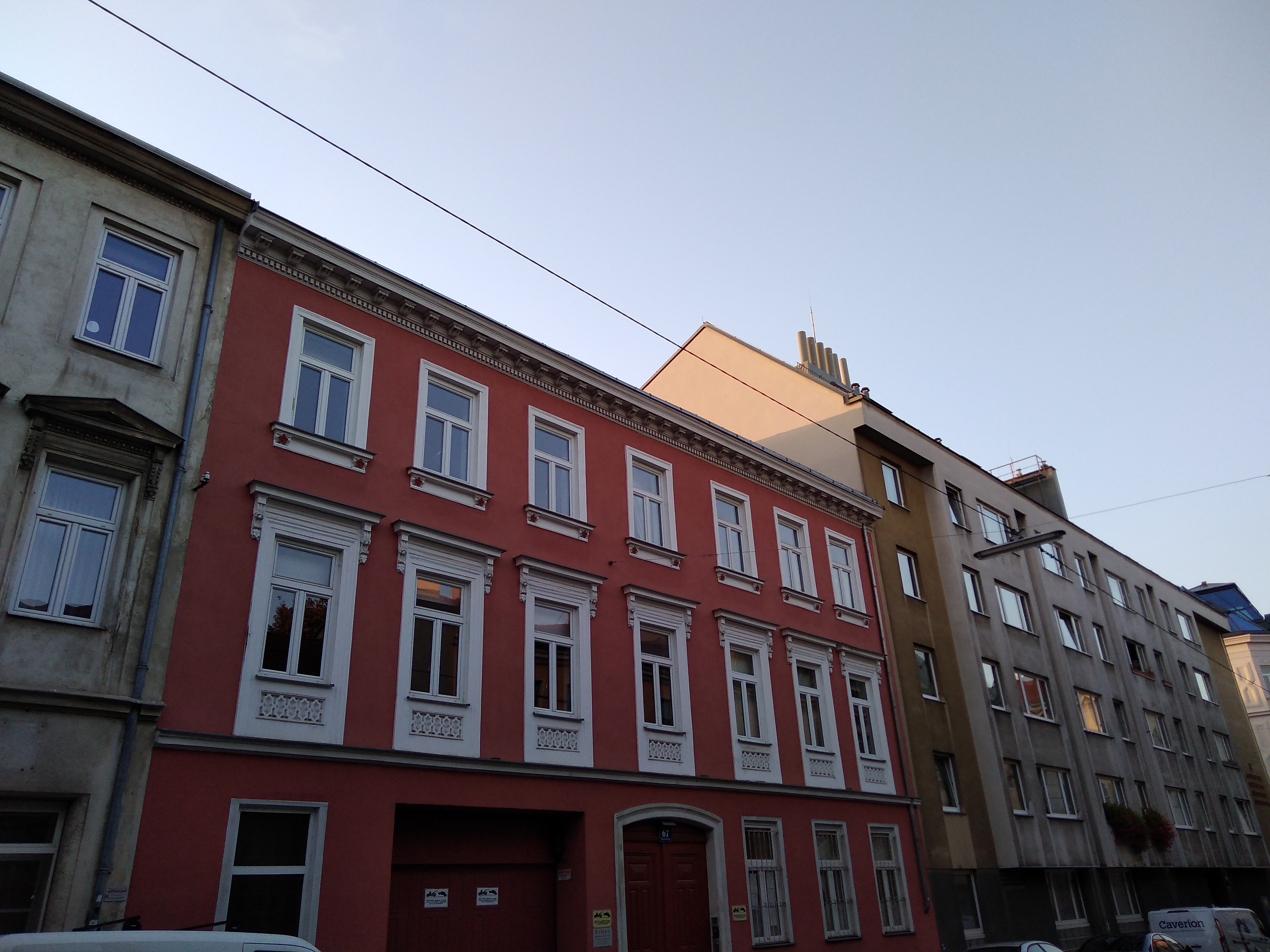
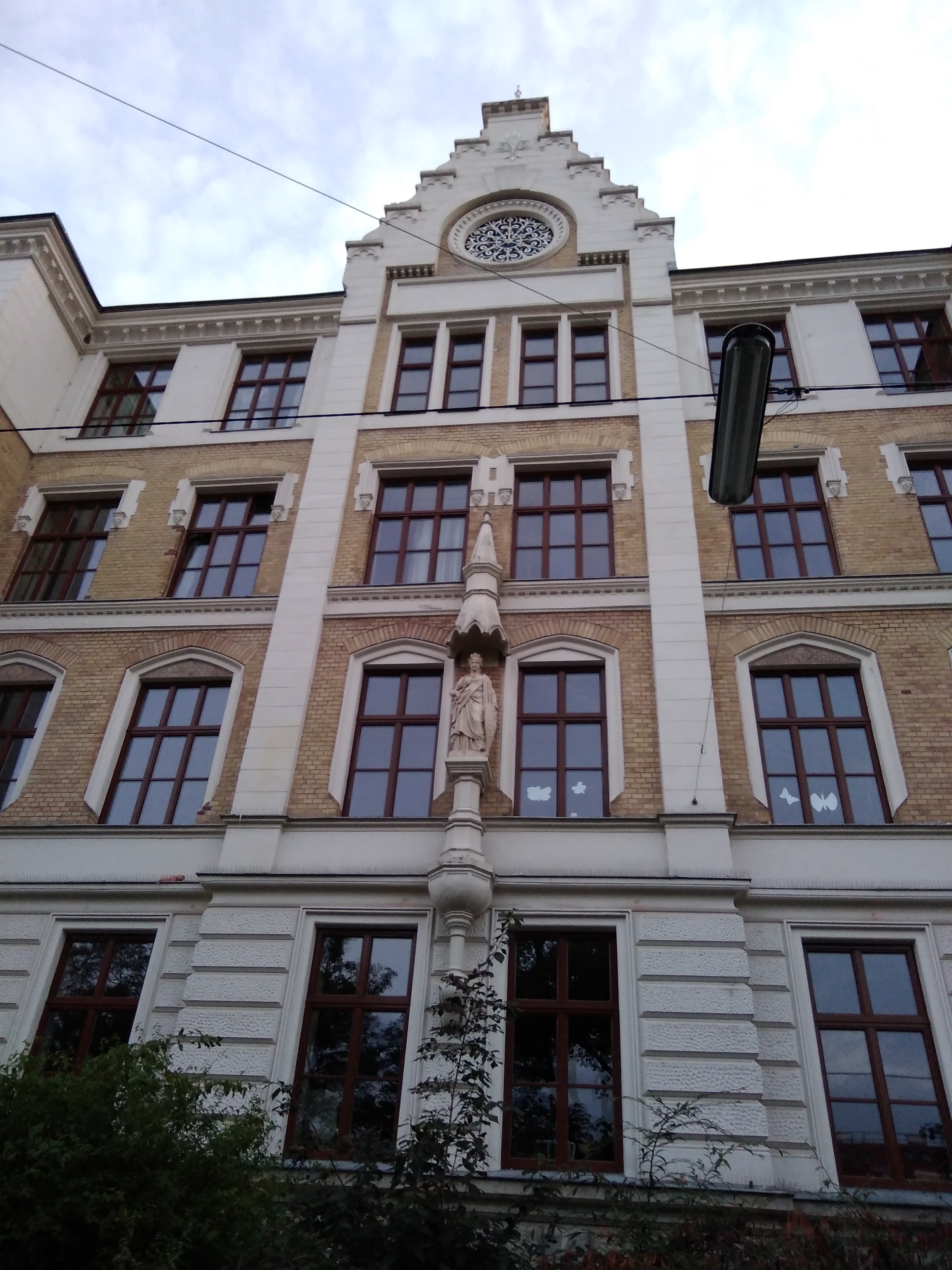
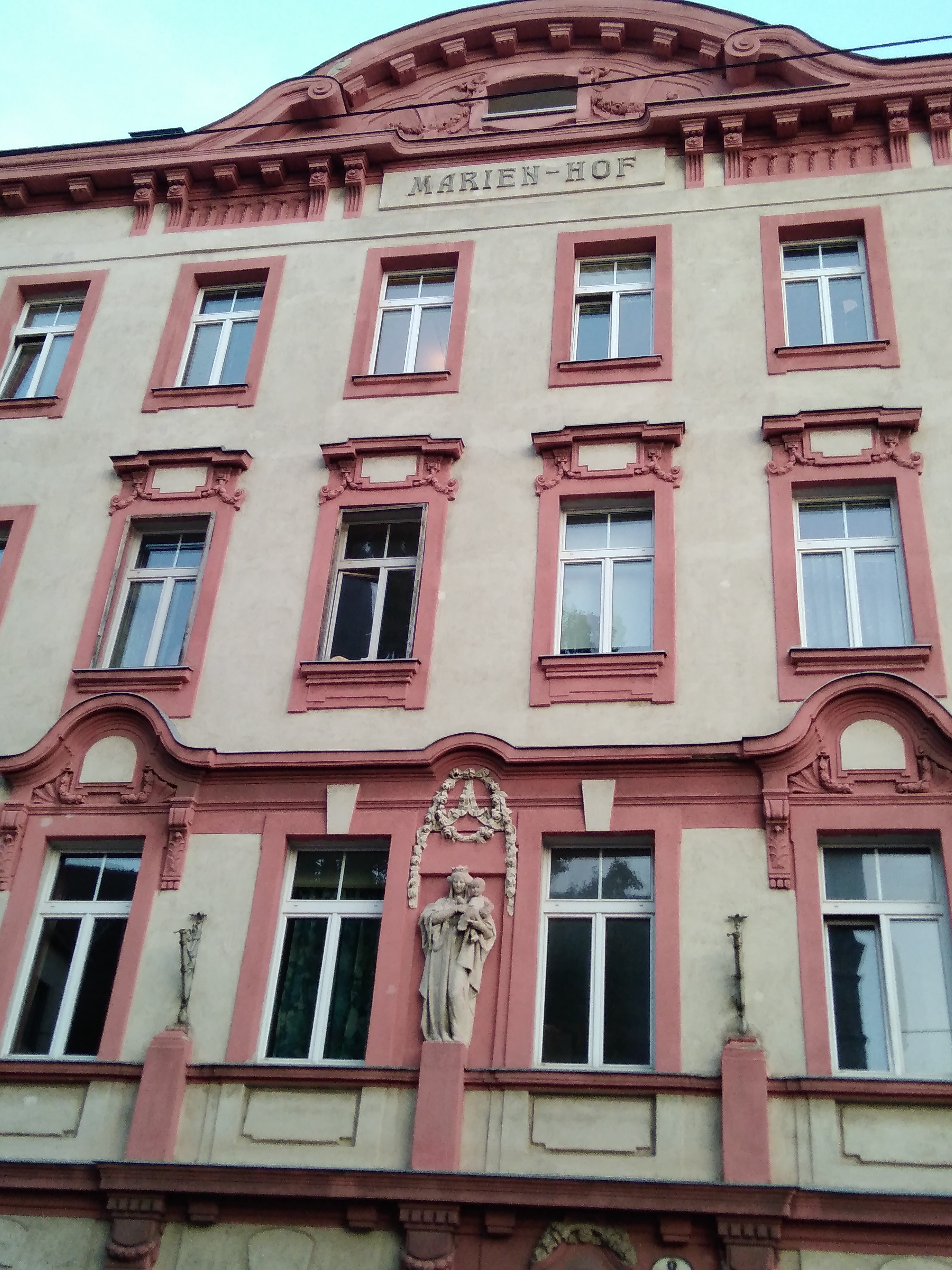
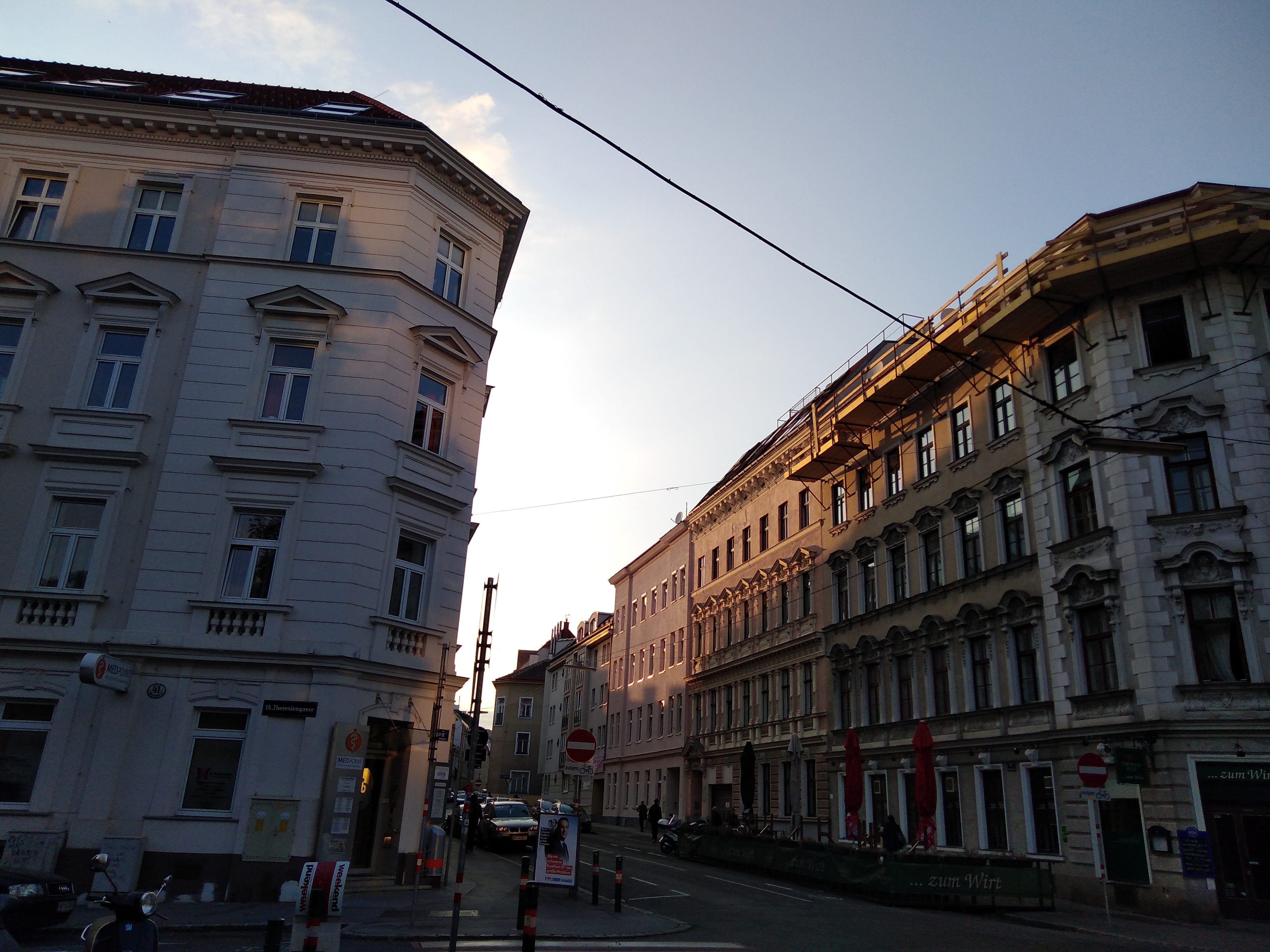
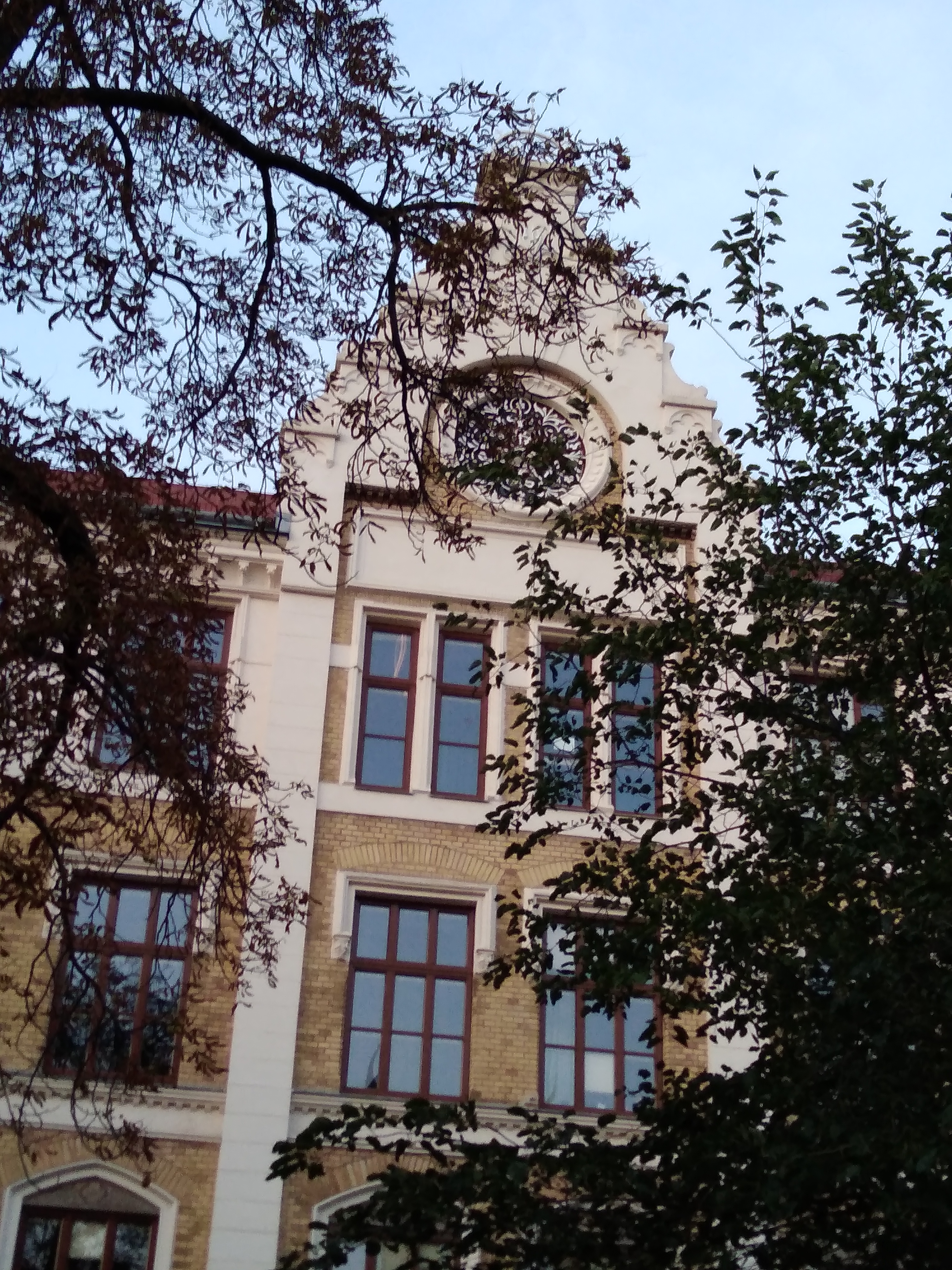
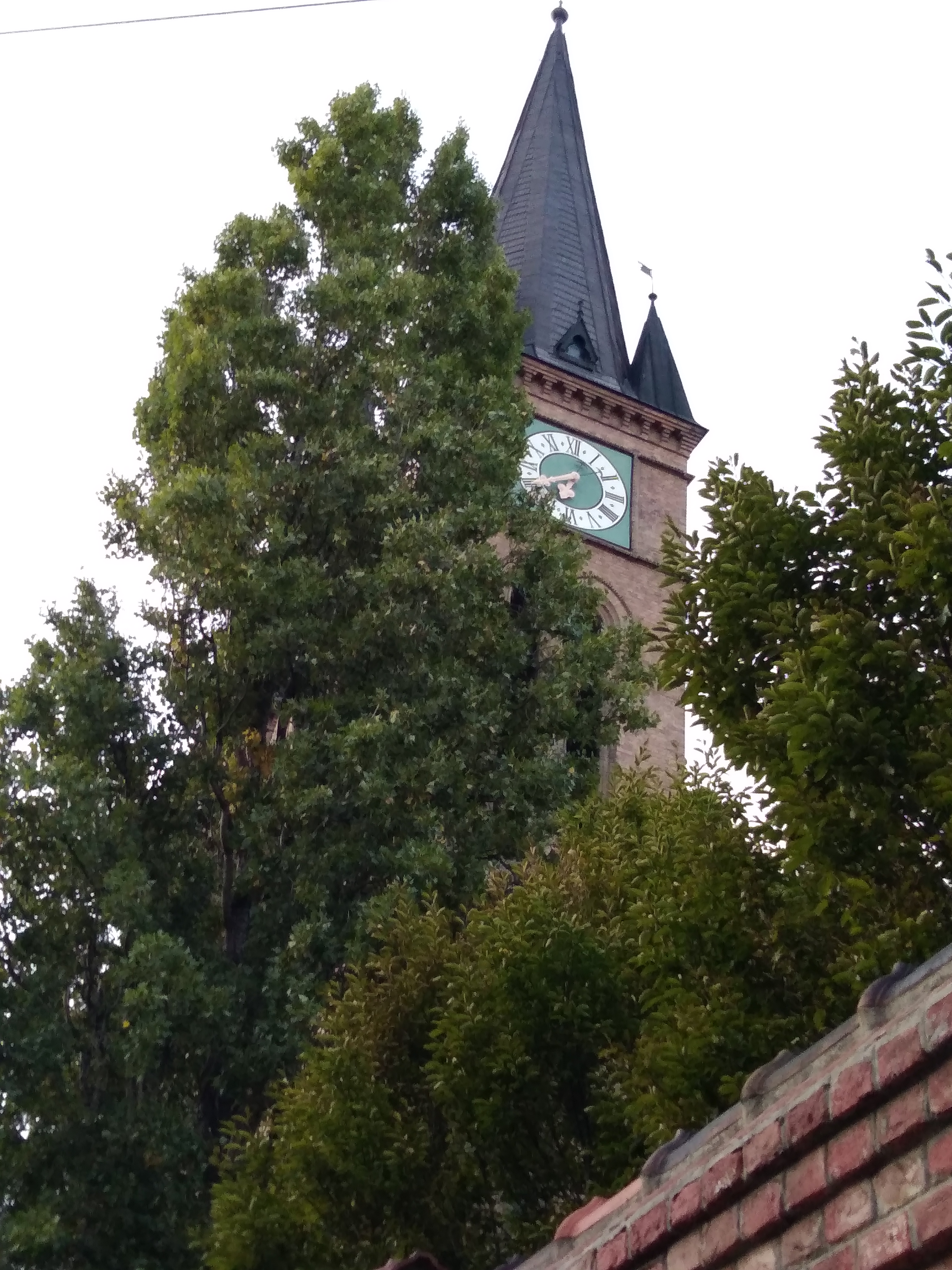
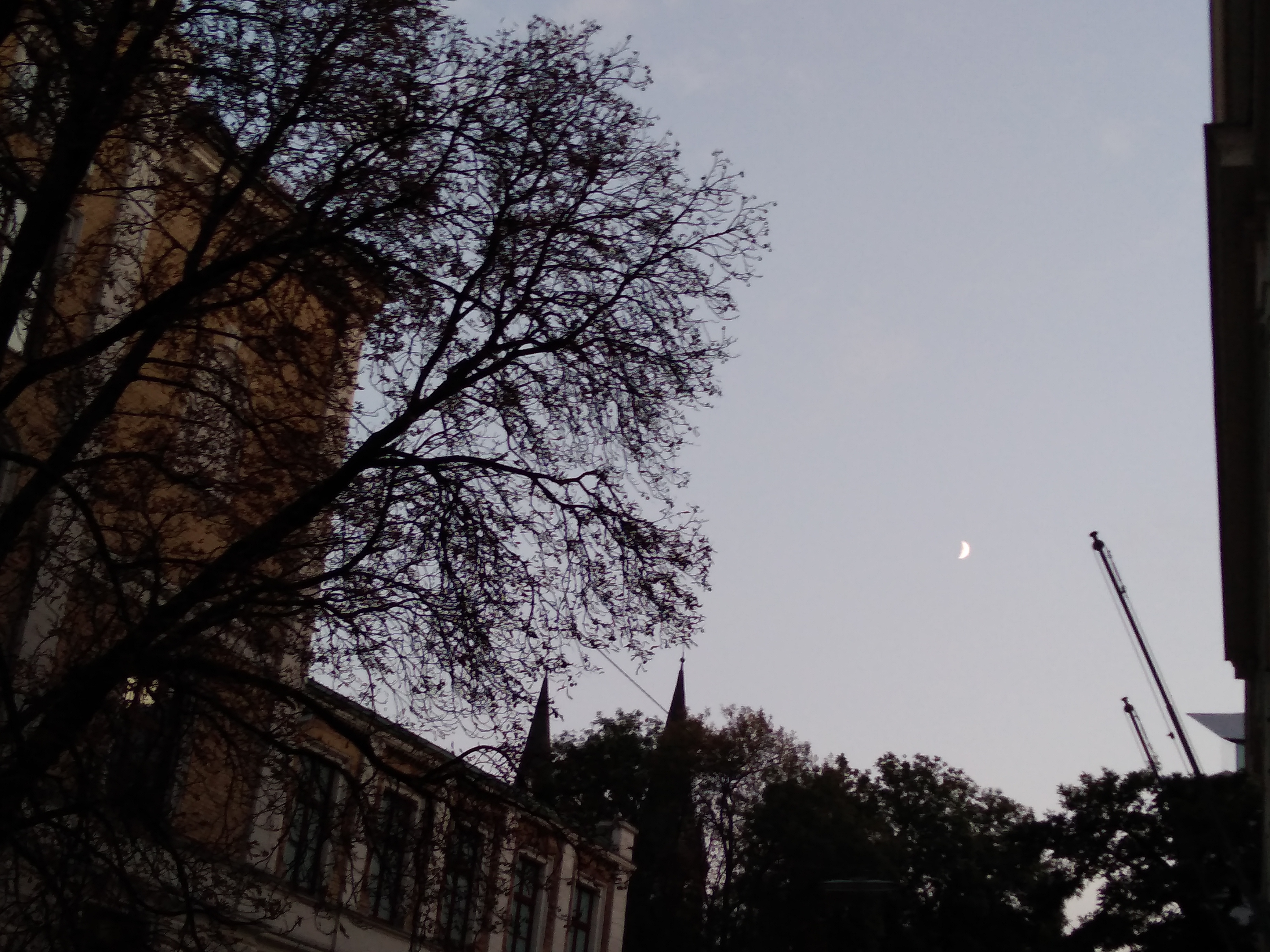
It was a stroll really, around the Theresiengasse area of Vienna this balmy evening.
Amongst pastel shaded, elegant streets looking mellow in the last rays of the day’s sunshine.
Craning my neck to enjoy the skyline.
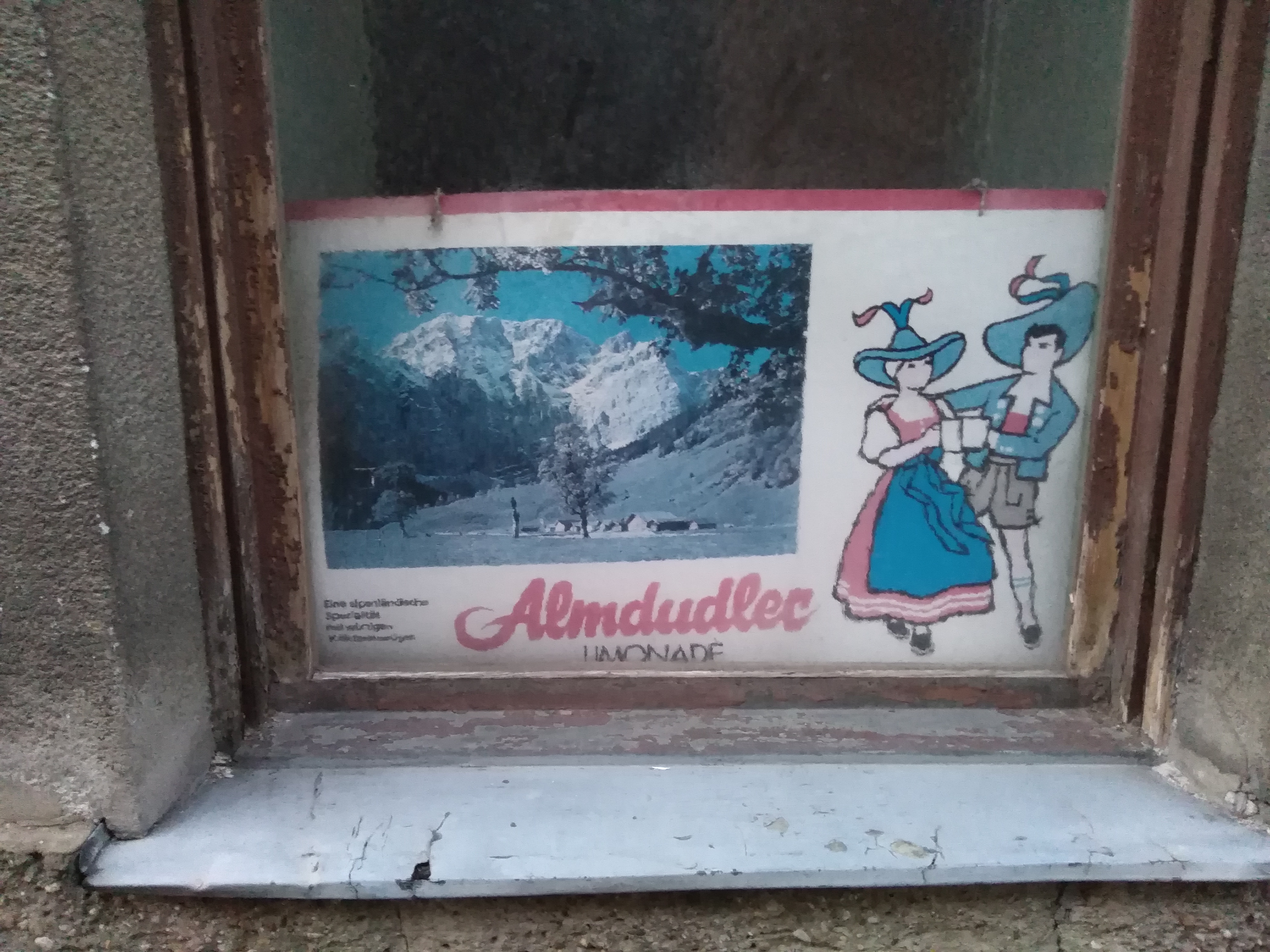
With a quiet mind. I realised it had something to do with the fact that the voices around me, the advertising posters and signs, were all in a language I can barely understand (although some German vocabulary is slowly coming back from O’ level days).
Mother and daughter on their phones, each walking a small dog, stop to untangle the leads.
I followed my nose, my only aim being to find flowers for my kind host Ursula, and tissues to stem my Autumn cold. I am reminded that these were my father’s last days 19 years ago.
Kids playing in floodlit playparks on street corners, people smoking inside bars, zebra crossings everywhere.
Night fell and I relied on my GPS to find my way back, still comfortable in sandals and shirt.
‘Don’t underestimate the value of doing nothing, of just going along, listening to all the things you can’t hear, and not bothering. Winnie the Pooh, A A Milne.
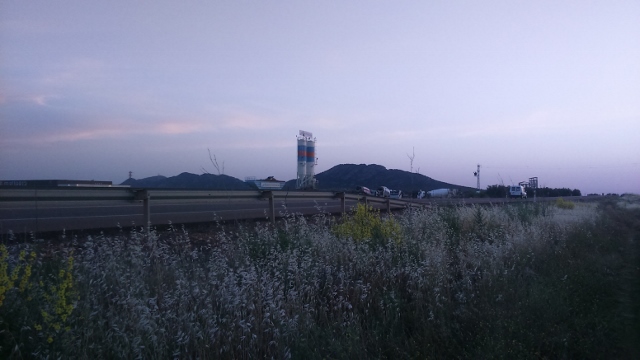
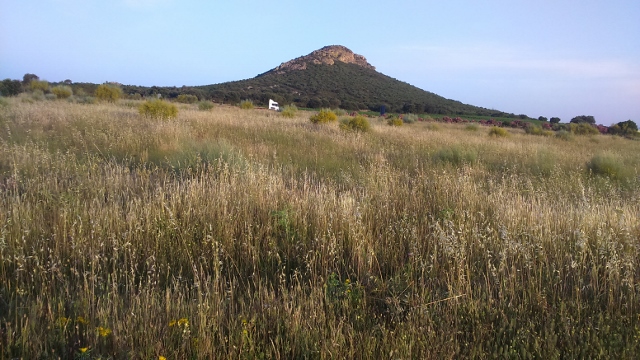
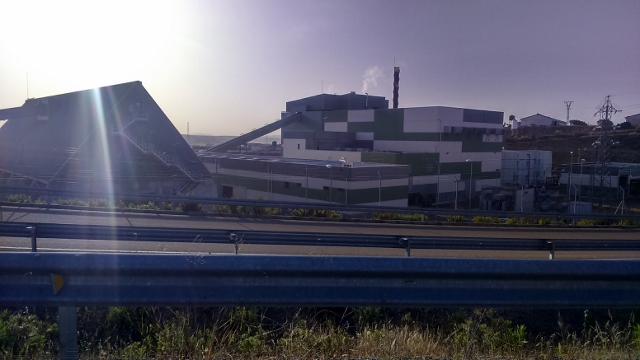
Today’s short walk took me past industrial areas.For a great deal of time this mountain and I were beside each other.Also fields of wheat, gleaming in the sun.And plane trees.
I was trekking through Badajoz in the Extremadura region of Spain. The mountains were in the distance, but on the ground it was tarmac and vehicular junctions. There was a blue sky and although I left in the dark to stay cool, it was getting very hot by 10am.
Causing a heat haze.The paths were stony underfoot, with fertile greenery, despite the lack of rain.
Soft grasses, Scottish purple thistles and long ochre paths stretched ahead of me, with an occasional fellow Camino traveller making his quiet way. Otherwise it was a peaceful walk as I approached Mérida and the end of my journey for this time.
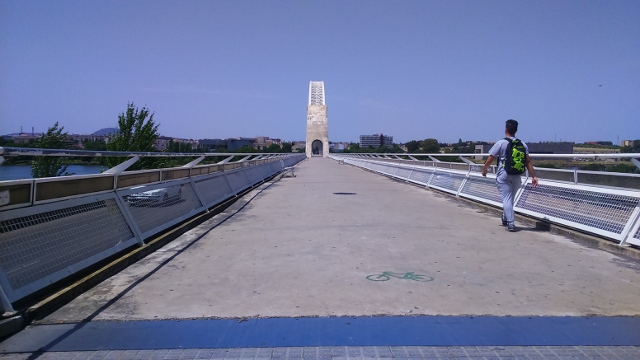
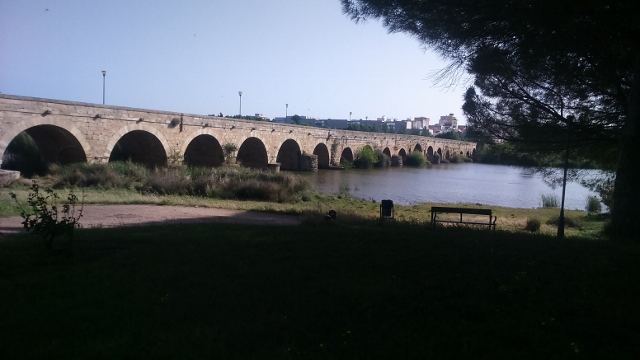
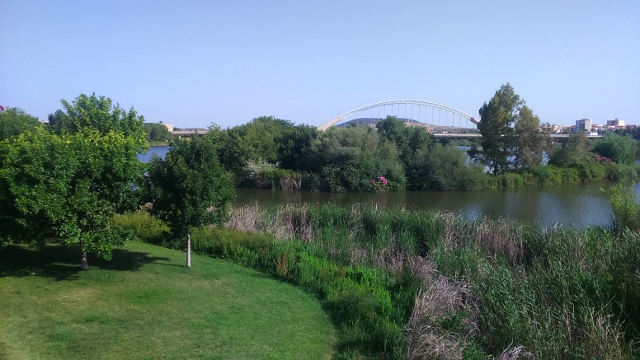
Lusitania Bridge, Mérida. It was 42 degrees by the time I walked across here to meet my driver!
I have a duty to many people and somehow I will discharge it. I have a duty also to some continuing part of myself. … I see now what I am….. it’s a question of being faithful to an essence. p. 239 From ‘On Green Dolphin Street’ by Sebastian Faulks.
Puente Romano (Roman bridge, 792 metres long) across the Rio Guadiana, Mérida.
Mérida is the capital of Extremadura and was founded in the 1st century by the Romans. There are plenty of attractions but I was taking a Bla Bla Car to Madrid for my return to Scotland and so had to reserve those pleasures til my next visit in March 2018.
Lusitania Bridge, Mérida.
I found a cool cafe which allowed me to sit for a while. I walked around the town and found everything I needed – it is well stocked with shops and so on.
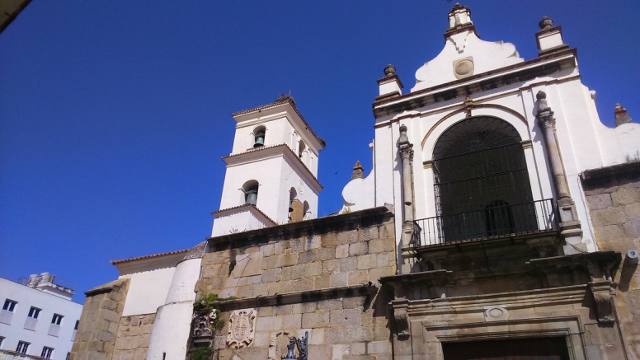
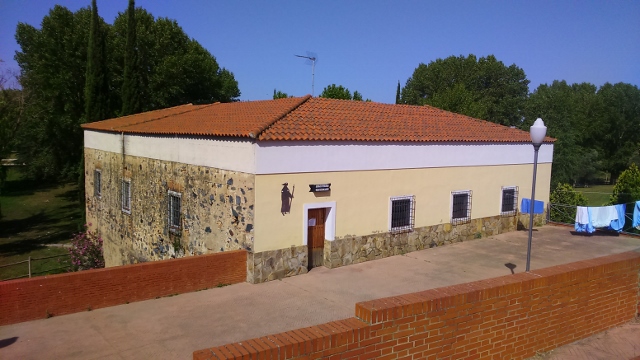
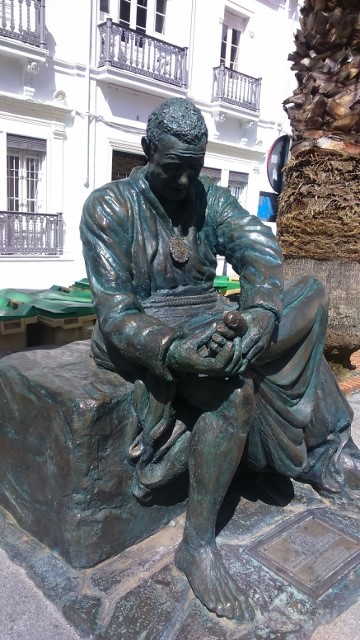
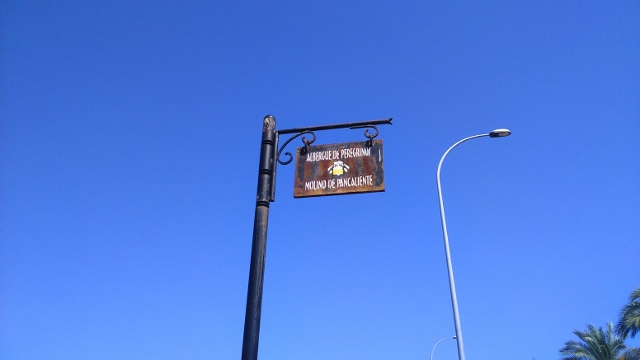
Mérida: I enjoyed the ancient walls in the medieval Plaza de España.I located the pilgrim’s albergue / hostel because I knew I would be back to continue the Via de la Plata from Mérida. It is by the River Guadiana.Classic pilgrim statue!Molino de Pancaliente, Av. José Fernández López, 32-40, 06800 Mérida, Badajoz, Spain.
Phone for the peregrino albergue called Molino de Pancaliente, Mérida +34 682 51 43 66. Cost: 8 euros. open all year round.
This was the last but one day of my Spring 2017 trip. I began teaching in Paris and walking in Normandy and Brittany. Here is the main page for my French blogs. Then I went to Zaragoza, Seville (via Madrid), and started to walk the Via de la Plata. Here is the Spanish page with links to each of those blogs.
After all that walking and fresh air, I felt strong, healthy and very, very grateful.
What to take with you (and more helpful info.) for beginners.
Just to give you an idea of the context: I walked the Camino Francés (Spain) in October/November 2016, two thirds of the camino Via de la Plata / Sanabrés (Spain) in December 2016 and May 2017, and some of the randonnée GR223 (Normandy, France) also in May 2017, so you will deduce that I have walked in temperatures ranging from 20 to 41 degrees, in a relatively small area of Europe. I am under 5 foot tall (1.524 metres) and 7-and-a-half to 8-and-a-half stone (50-55 kilos). Take into account that I am female, just over 50 years old, and pretty fit with no injuries.
The basic recommendation is 10 percent of your weight, but given that many women’s weight varies according to time of month / day etc, and that you will undoubtedly lose weight as you walk, this is just a general guideline. It does not include water (1 to 2 litres depending on the weather and the route), nor food (only snacks are really necessary for a basic 6 hour walking day, except on a Sunday).
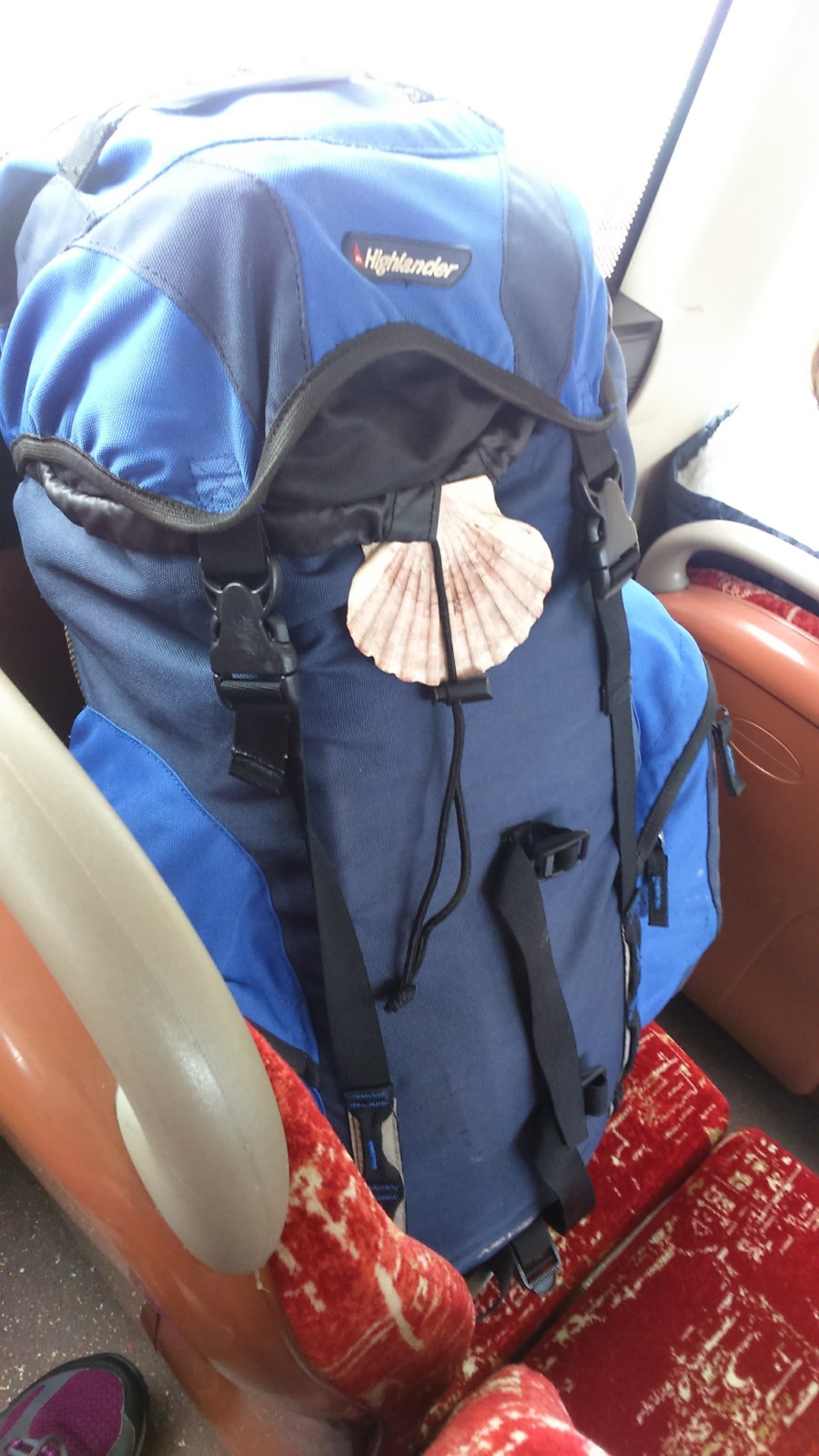
What sort of rucksack? I took a 44 kilo one which is easily big enough. Buy the strongest and lightest one you can afford, and you will need a cover for it. (Some people travel with nothing, or a laptop case with a toothbrush, but that’s extremely unusual.)
‘Each object a person carries represents a particular fear: of injury, of discomfort, of boredom, of attack. The “last vestige” of fear that even the most minimalist hikers have trouble shedding, he said, was starvation. As a result, most people ended up carrying “way the hell too much food”. He did not even carry so much as an emergency candy bar.’ M.J.Eberhardt, see below for link to Nimblewill Nomad.
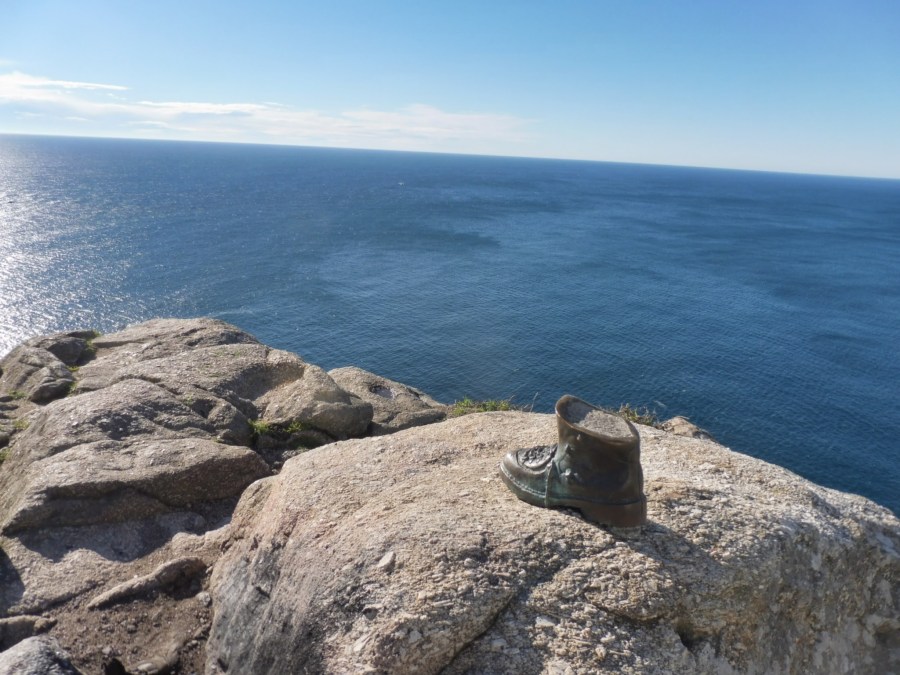
The iconic sculpture of a walking boot at Finnisterre, the ‘end of the world’, the end of the Camino Francés where many walkers ceremoniously burn their boots after the long trek as a symbol of what they have let go of and will not take home with them.
So these are the ‘I absolutely cannot do without’ items:
Boots or shoes: The first time I walked long distance, I wore second hand boy’s boots which a kind friend gave to me because her son had grown out of them. I did have blisters for a week or so, but after that my feet got used to the walking and I was mostly fine. They got very wet very soon after it began to rain, and took a long time to dry.
For my second trip I bought light-weight, waterproof, Columbia shoes, and they were wonderful except that they went into holes after 3 months. Not a blister in sight.
When I went to colder climes, I wore heavy-duty Vibram (with gortex) boots, suitable for snow and big stones. One of the little metal bits on one side, which the lace goes around, broke off on the first day, but I was already many kilometres from the shop and when I phoned they said I had to bring it or send it in, even though I sent a copy of the receipt and a photo. The boots have been supportive and comfortable pretty much from the start, with the right socks (see below).
Foot cream: maybe antiseptic or anti-fungal, but definitely creamy cream is an absolute must. I was taught by my guardian angel of a companion on the Camino Francés to massage my feet every day before putting on my socks and shoes, and to do it again and air them well at night or when I stopped along the way. Vital!
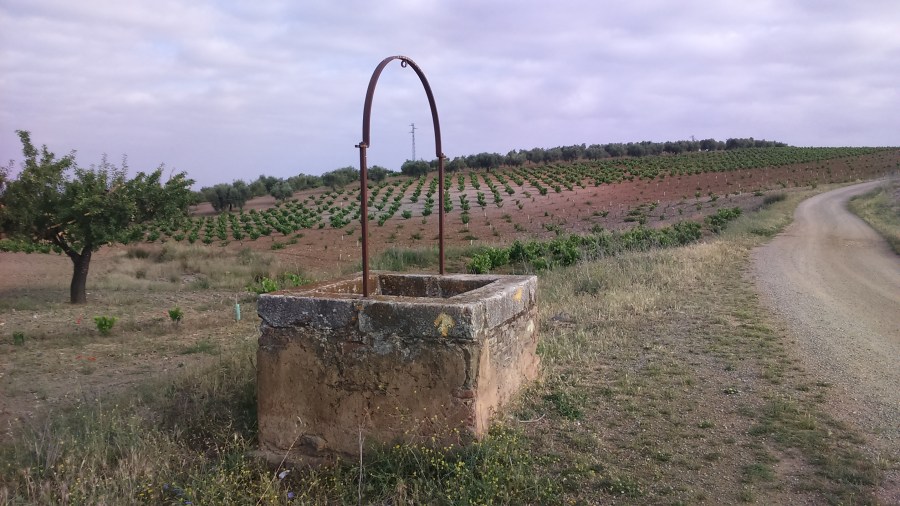
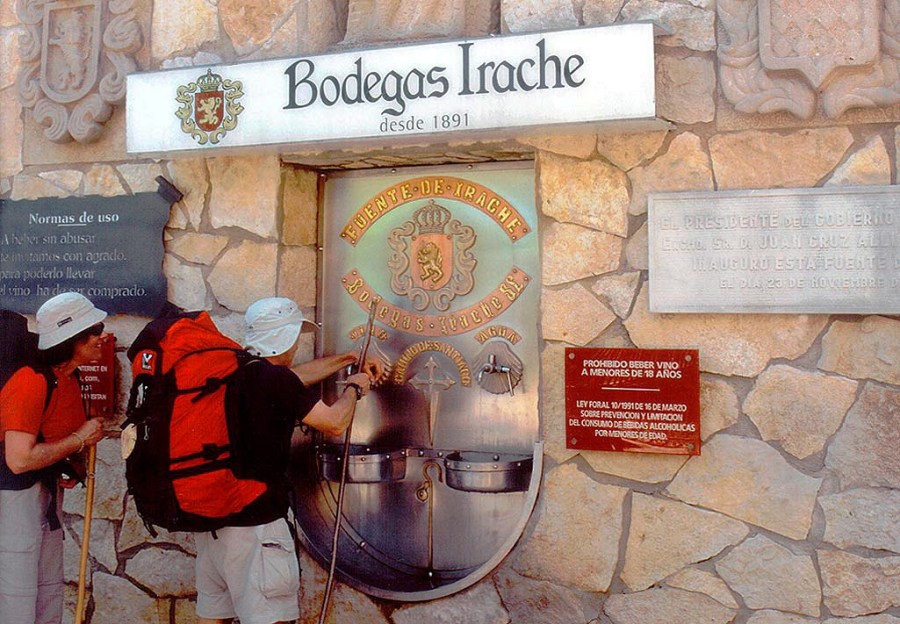
There are water fountains in some villages (not wells as above!) and a good guide book will tell you where. Make sure it was published recently.
Plasters (for blisters): preferably the special ones for all parts of your feet (heel, toes, balls), and I recommend the brand ones as the others come off after one day. A needle and thread – yes you heard right. Here’s why: thread the cotton through the needle and pierce the blister carefully with the needle. Draw the thread through the blister releasing the fluid (sorry!) and leave it there, removing the needle. Then tie a small knot and it should remain for a few days. The build-up of the fluid is the painful part, and this way that drains away whilst the skin remains almost in tact, allowing a new layer to grow underneath with the minimum of discomfort.
Passport and/or identity card, health card (to get free treatment in the EU, make sure it is up-to-date), and money: you may want one credit or bank card for emergencies (see below). I took a post office money card which, once I had worked out how to do it, I was able to quickly top up on my phone with euros.I also used it in big supermarkets and to pay for things over the phone/by internet like travel tickets. Paypal is also very useful if you have money in your account. Once again you can pay in £s or other currency. There are lots of cash machines on the Camino Francés and some on the other caminos. Banks are tricky because you have to be there when they are open and usually you will be walking during the morning and exhausted / too hot in the afternoon if they are open then, which they are not always.
Money: the Spanish caminos are cheap compared with France: allow 10 euros per night if staying at a hostel; coffee and tea are 1 euro each; the pilgrim menu is 6-10 euros; and supermarkets are basically cheaper than the UK. You will probably visit the supermarket every day as you will not want to carry food unless you have to (except for Sundays when everything is shut), and they are mostly geared to sell you one piece of fruit, one piece of fish, even eggs one at a time (watch the clever way they twist paper to make a carrying flute!).
This albergue, a few days walk from Santiago on the Camino Sanabrés, had no heating (December), no blankets, no utensils and no electricity! It was very unusual to have none of these things.
By comparison France is really pricey, particularly accommodation, with the ‘auberges de jeunesses’ (youth hostels) being the cheapest. The ‘randonnee’ I walked was divided into stages but, in my experience, there were no cheap places to stay at the ends of those stages, not for backpackers.
Useful tip 1: for hostels/hotels make sure you research in advance for France and Norway.
Useful tips 2 and 3: Do not change money at the airport as it is very expensive, so take some currency with you from home. Neither should you use your ordinary bank debit or credit card unless you have checked before you go that you do not have to pay exorbitant charges for withdrawing money or paying in local currency. Many Spanish hostels will only accept cash.
Something to carry your important things in: I had a bum bag and liked it, but when it poured with rain everything got wet. My friend had a thick, flat plastic pouch round his neck, under the outer layer, and that was safe and stayed dry.
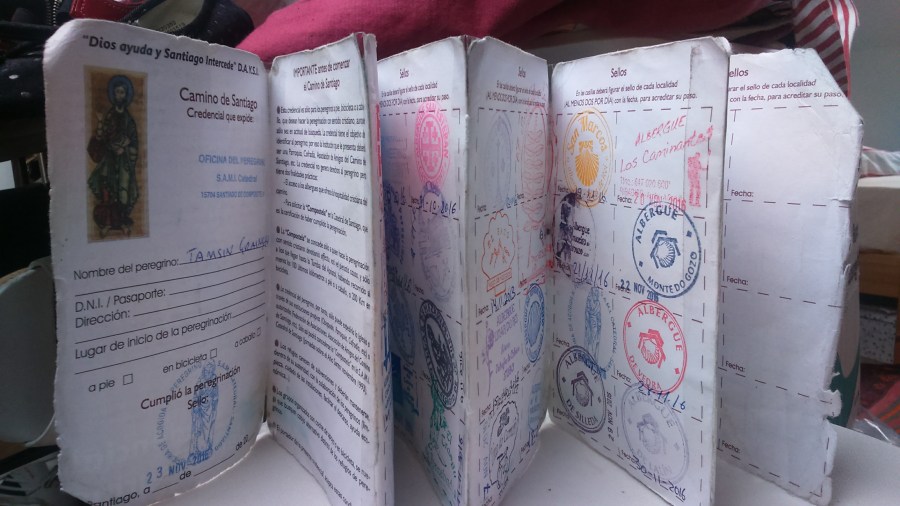
A ‘credential’, otherwise known as a pilgrim passport, which you can have stamped at every stop and will then present to the authorities in Santiago de Compostella so you can get your certificate of completion, your ‘compostella’.
A smart phone: I would suggest that you get the best phone you possibly can. One that
fits in your pocket
has as much internet capacity as possible (in the UK see ‘3’ for international packages and beware other companies who offer similar but which are geared to ‘normal’ holidays so are only valid for a month at a time)
has the best camera you can afford (back up your photos eg with Google which is free and easy)
has a torch
has maps (also useful for bus and train times etc)
has lots of space for apps (think guidebook app instead of a heavy Lonely Planet book, or specialist maps, airplane boarding passes, bus and other tickets, booking Bla Bla cars or accommodation, getting you out of trouble, making contact with home (or rescuers, or even new lovers)
has a translation app
has the capacity for writing notes as long as it is backed up (I write notes as I walk because I would not remember if not, but have been known to delete by mistake which is terrible ). You think you will remember everything but you probably won’t and so a notebook and pen or phone version may be invaluable
and possibly
has Spanish or other language lessons on it eg Duolingo
is ‘big’ enough for downloading a film or book if you want.
A smaller, cheaper, old-style phone: I recommend you also take one of these, especially if you don’t have a contract on your smart phone which allows you to communicate outside your own country. You can buy a SIM card wherever you are and this will enable you to phone or text within that place. Also, if you lose it it isn’t the end of the world. The only problem I encountered was that one shop wanted a local address so my friend who lived there used his which caused problems when I wanted to top up. I suspect this wouldn’t always be the case.
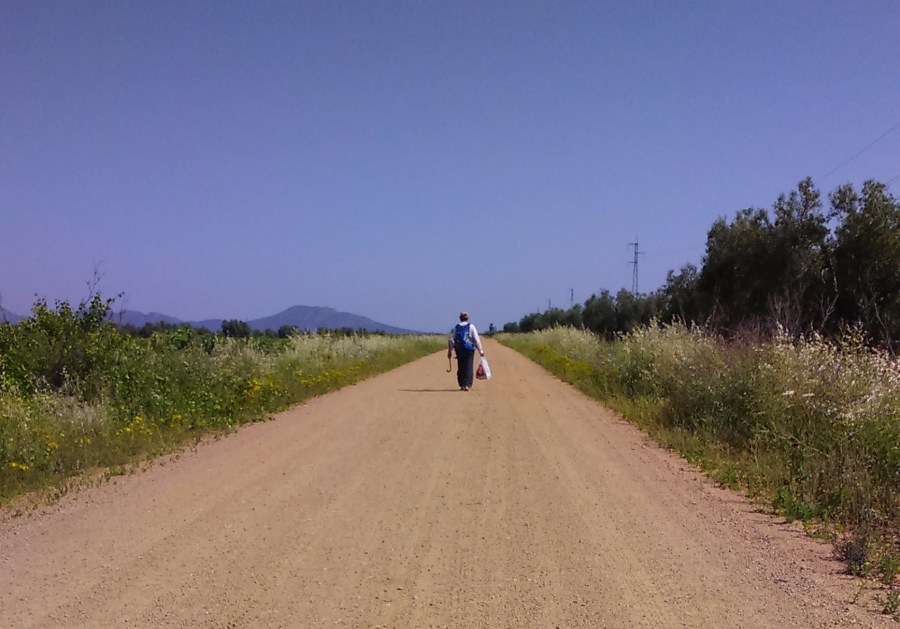
You could take a wooden walking stick with a hooked handle and carry a carrier bag if that suited you.
A charger: I have had a great deal of luck with people lending or giving me a spare charger, and not much in buying cheap ones. You can charge your phone at all albergues (hostels) but if it is busy there will be a great deal of competition for the sockets, and although they are often by the beds they can also be in the kitchen or hallway instead. This means that you either need to stand beside the phone or trust that no-one will steal it – I didn’t hear of anyone having their phone stolen.
Useful tip 4: In Madrid you can get phone accessories in vending machines so you do not have to wait for shops to open. The quality seems to be good.
Useful tip 5: Always set a password or pass pattern on your phone so that others cannot open it.
Useful tip 6: You can charge your phone while waiting at bus stations. The sockets are at elbow height in the semi-outdoor parts of the buildings. You can also charge and get wifi on all intercity Spanish buses (eg Alsa).
An adaptor for 2-pin plugs: depending on where you are coming from and are travelling to, there are expensive international adaptors which are good if you are going all around the world, otherwise it is cheaper to get a 3-to-2 pin. You will only need one if you only have one gadget!
A wrap: I would not be without this large pink piece of cloth which doubles as a scarf, something to sit on, something to wear when visiting churches or at the mass in Santiago out of respect, a pillow, a cover-up…invaluable.
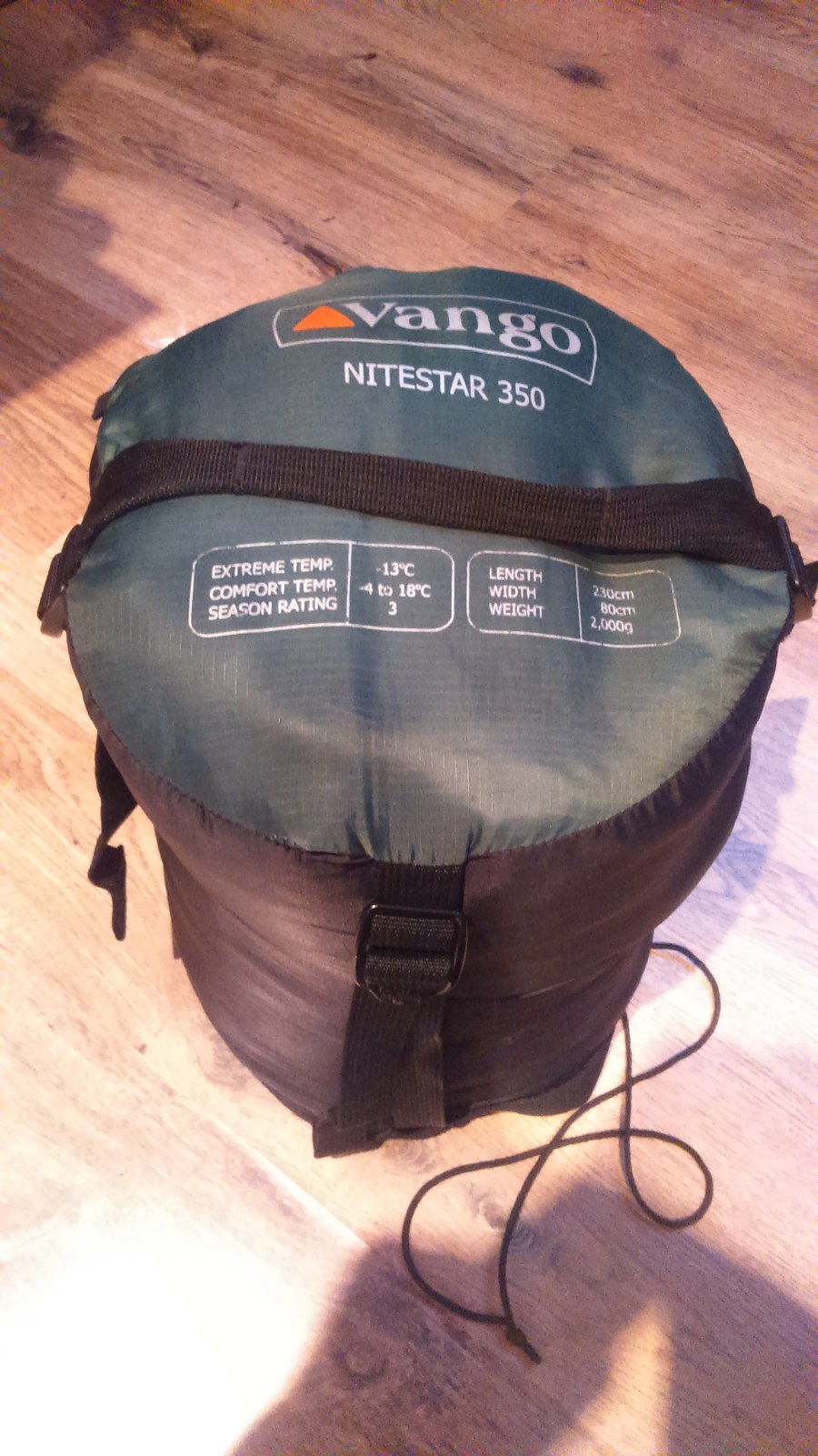
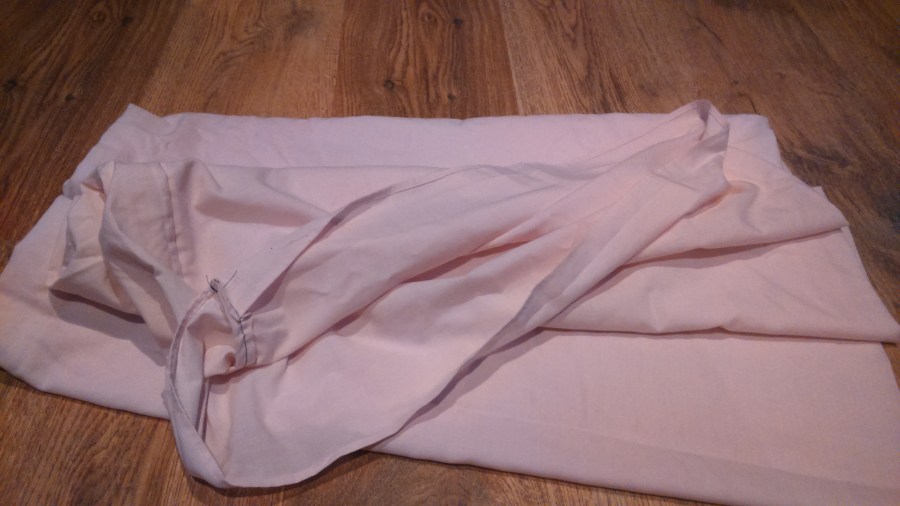
A sleeping bag or sheet: it depends on the time of year you will be walking and where. In the summer on the Spanish caminos you will not need a sleeping bag, but do take a sheet bag (I doubled over a single sheet lengthways and sewed the edges together), or buy a silk one. They stop you getting bitten in the hostels and keep you warm in the early hours or if the windows are open. In the late Autumn you will need a proper sleeping bag and if you can afford it, get a light-weight but warm one as they pack very small.
Old-fashioned, heavy and bulky.My home-made sheet sleeping bag.
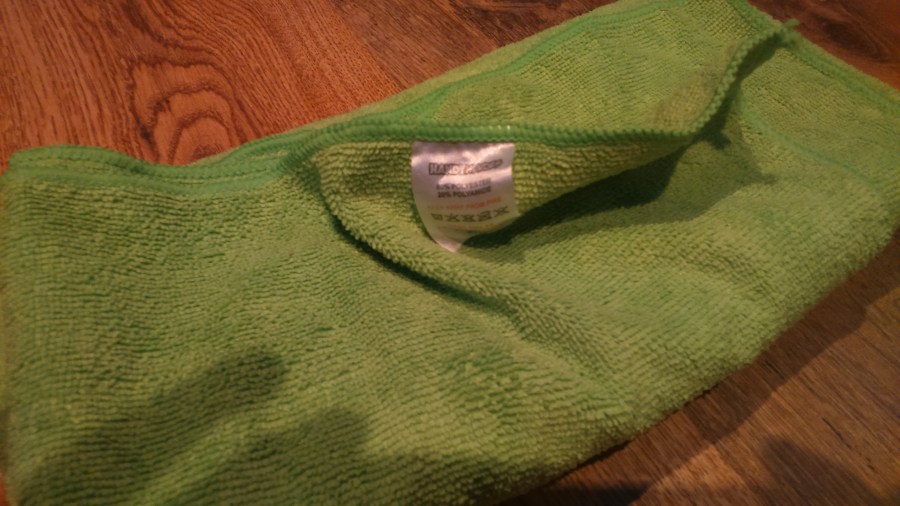
A light-weight travel towel: it dries really easily and is worth investing in if possible.
It even has its own little bag.
A torch: a head one is very useful if you walk in the dark, ie you might want to leave before sun-up in summer to avoid the heat of the day, and it leaves your hands free. You might manage with a phone torch to avoid the weight though.
Useful tip 7: You can buy replacement batteries easily, so don’t take them with you from home as they are very heavy. Or you could use an eco- wind-up one.
Camera: one person I know buys a cheap one before every trip so as not to carry a big heavy one or risk losing it or having it stolen. I would rather have one piece of equipment so my preference is to get a phone with the best camera I can afford, but I accept that often real cameras are better quality.
Pockets in my shorts: – one for water, one for phone and toilet paper. If you choose to have a water bottle attached to your rucksack with a tube to souk on, you would have a pocket free (see below). If you wear shorts without pockets, well, you decide, but if you take as many photos as me you will be wanting to have the camera on hand.
Useful tip 8: when you are on the path you will not want to keep taking your rucksack on and off unless you really have to because it is unwieldy. You would have to undo and do up, and then probably readjust all the straps, and you do want your hands free for the baton(s), or to swing your arms to keep the circulation going, or to hold hands with someone special.
There are not always places to rest or go to the toilet.
Poles, batons or walking sticks: I walked the whole Camino Francés without one. Then I was gifted one and used it for the more tricky terrain of the end of the Via de la Plata / Sanabrés and was very glad to have it. BUT. Then I lost it and although I bought another one for the next trip, I also lost that one. SO…
Useful tip 9: Tie your baton(s) to your rucksack or boots when you stop, and at night so you do not leave them anywhere. I bought a children’s one from Go Outdoors for £5 which was fantastic, but then again, I am very short.
A map or guide book: well, it depends. The Camino Francés is very well signposted and whatever time of year you walk it there will be plenty of other people to help you find your way. Some people use theirs for a record, write notes in it and keep it for posterity. Others ceremoniously tear out the pages each night, as a sign of completion and to lighten their load. It is useful for albergues and other places to stay, and many are very well researched and have lots of interesting information. On the other hand there are also fantastic apps. Or you could wing it. As for the other caminos in Spain or elsewhere, in retrospect I would say get a book or app, but you will manage, especially if you speak some of the local language. People love to help even if they do not really know or understand you, so be prepared to be sent in the wrong direction sometimes!
Your specs and/or contact lenses and cleaning fluids if you use them. Sun glasses (whatever time of year).
Clothes:
2 x knickers or boxers (cotton, easy-dry material)
2 x bras if you wear them – it is nicer not to, many don’t
3 x socks double layer ones come highly recommended but they are expensive. Or wear one lovely soft, easy-dry pair underneath with a second pair on top which won’t need washing every night. You will need others in case your usual ones are still wet in the morning, and another pair if it is cooler in the evenings or for bed.
Useful tip 10: Do not wear wet socks!
1 x easy-dry T shirt and one other light top for evening that doesn’t need ironing and doesn’t crease.
1 x fleece, preferably light but warm with a hood to avoid the need for a warm hat. Note that walking by the coast along a linear walk (eg along the Normandy coast or the Camino del Norte) means that there could be a strong breeze in one ear day after day.
1 x sun hat or cap (it is better to have a hat so that the back of your neck as well as your ears and face are shaded). Also a warm hat if you do not have a hood.
There are different sorts of head gear to choose from.
1 x light, easy-wash and -dry trousers if you don’t want to get sun burn, bitten or scratched. 1 x other pair of trousers – not jeans as they are normally heavy and even heavier if wet. A belt because you will get smaller!
Useful info: even if you don’t wear your jeans to walk in, your whole rucksack may get soaking wet and then you will still have to dry them and they take days.
1 x rain trousers and 1 x rain poncho / jacket. Make sure they are not just for light showers because if it rains all day everything will be wet through. Hopefully they will pack up very small.
Gloves: you might not need them but they are very small and light. I did wear them in the mornings in late November / December and once at night.
There can be a hard frost when you are high up in late November eg Galicia in northern Spain, so gloves and a hood will come in handy!
Useful reminder: if you are arriving by air and planning to take your rucksack on the plane, you can only take 100 ml per tube, bottle or pot, and all that has to fit in one very small plastic bag which seals, about the size of a small freezer bag. This includes all sorts of foodstuffs such as marmite and tahini. Neither can you take sharp things, so this also goes for nail clippers or scissors, pen knife and body hair razor.
You may also want:
a cream for between the buttocks /thighs or in the groin if you are male. All that chaffing…!
Sun tan lotion. Toilet paper or tissues. Toothbrush and toothpaste.
Condoms. The ‘pill’ if you are pre-menopausal and that’s what you usually use.
Hair ties are very small and light and you will probably want to keep your hair off your face if it’s hot.
Panty liners, sanitary towels etc. You can buy certain brands along the way.
Find a joint shampoo / conditioner / soap (there is rarely soap in hostels).
First aid: Antiseptic, sprain and bruise cream. I recommend natural calendula for cuts and rashes which also covers sun burn, and arnica (bruises, bumps), or Rescue Remedy cream for the same as arnica plus bites. Rescue Remedy for emergencies for you and others. Mosquito stuff. Any medications you usually take (order more before you leave home), and bring a repeat prescription just in case.
Utensils and food stuffs: A pan which doubles as a carrying pot, a tupperware for left-overs and freshness (bread, soft fruit, opened packets of biscuits, chocolate which might melt), knife/fork/spoon, salt/pepper/spices, water bottle(s), and green tea bags (obviously!).
Talking about rain, I happened to have a newspaper in the bottom of my rucksack (quite heavy in the scheme of things, but fortuitous) the day it rained and it soaked up the worst, whereas my friend’s things all got very wet.
A carrier bag or a small light rucksack: for shopping/evening or sightseeing when the big one is in the hostel but you still need something.
Notebook and pen: if you are not using your phone, and /or a sketch pad and pencil.
‘Shaving down one’s pack weight, he said, was a process of sloughing off one’s fears.’ M.J.Eberhardt, see below for Nimblewill Nomad link.
The thing I forgot and wish I hadn’t: a small plastic bottle to fill with delicious Spanish olive oil.
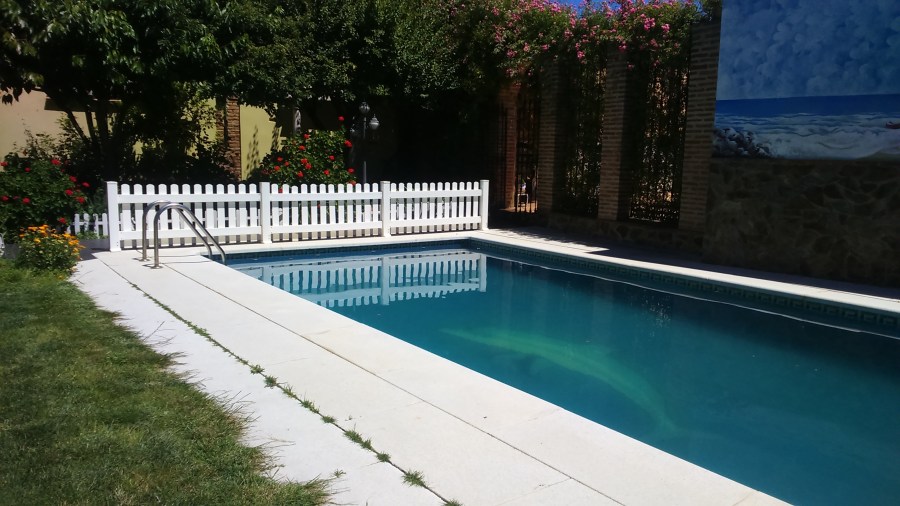
A swimming pool in the hostel in Fuente de Cantos, Via de la Plata.
And you will probably be happy to have these with you:
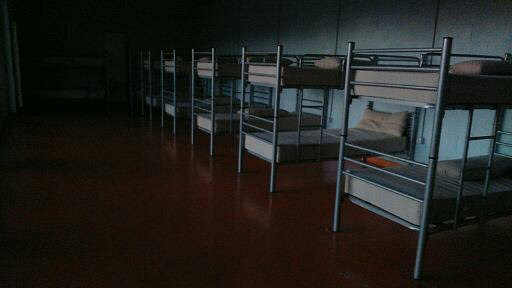
Earplugs. Some dormitories are vast and in busy periods they are therefore noisy.
One of those half circular blow-up cushions for plane / bus / car journeys when you might want to shut your eyes. And some like an eye mask.
Clothes pegs – very light and easy to find little tiny spaces for.
A corkscrew (or just buy screw-top wine and ring-pull beer), and a cup.
A swimming costume – there were several times I wanted one. Even when I remembered it on my second trip, I sent it back and then wished I hadn’t!
Think very carefully if you really need these:
A book or kindle: It depends on you. Both weigh quite a bit and personally I have not read much while on the road or seen others read. Many hostels have shelves of free books which you can pick up, read and then swap for another further along the route.
Please note that I have no experience of tablets or other phone alternatives, but do try to keep the number of appliances to a minimum.
A wrist watch: your phone will probably do, and your tissues / flesh swells as you walk, plus there’s the sun and sweat. I found it was a nuisance.
Same with jewellery, especially rings – they all came off and then had to be stored carefully to make sure they didn’t get lost.
Make-up, hair straighteners, drier etc – I would say unnecessarily bulky and inappropriate but you know your self. If you need these things you might prefer to be in a private hostel as they have more amenitities for a slightly higher price.
1 x long skirt for walking: stops you getting your legs burned but I would recommend that you wear light shorts or boxers underneath. You will have to hitch it up for steep climbing eg Galicia on the Camino Francés.
A coat, jeans, woollen jumper or cardi: they are all heavy and hot (even if the weather isn’t great, you will get very hot when walking), they get sodden and are then extremely hard to dry, plus bulky in the rucksack.
Washing powder or liquid for clothes: you can easily use soap. And a clothes line.
You can send things home relatively cheaply, many people do: I met an English man who had bought his guitar to Spain with him, and he was on the way to the post office to send it home!
Before you go, write down what you know of your itinerary, especially if you will be in the wild or possibly without phone signal. Leave it with someone – just in case something happens and they need to know where you are.
Don’t get attached to your belongings! You will probably leave things in the fridge, or forget them in cafés, or want to swap them for a bottle of wine. They are only things. Walking the caminos can help you with perspective.
Finally, always remember that you will not be very far from shops most of the time. Do some research of your route before you leave, but the caminos in Spain and the randonnées in France are near civilisation, at least every few day, so you can buy most things. You will be surprised what you can do without, source from other walkers, substitute, or find lying around.
23rd May 2017. Via de la Plata camino walk, Spain. Day 8: Villafranca de los Barros to Torremejía, in the autonomous community of Extremadura, Badajoz province. 26 kms which should take a minimum of 6 hours with breaks.
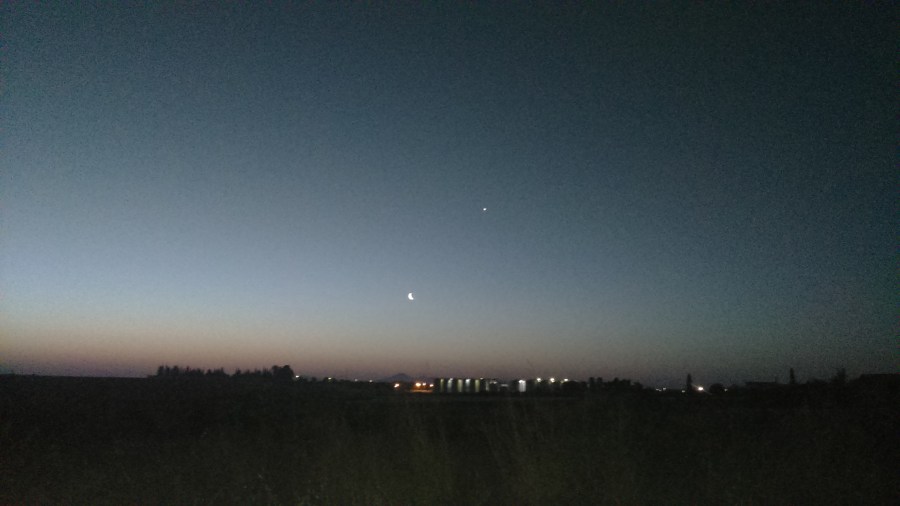
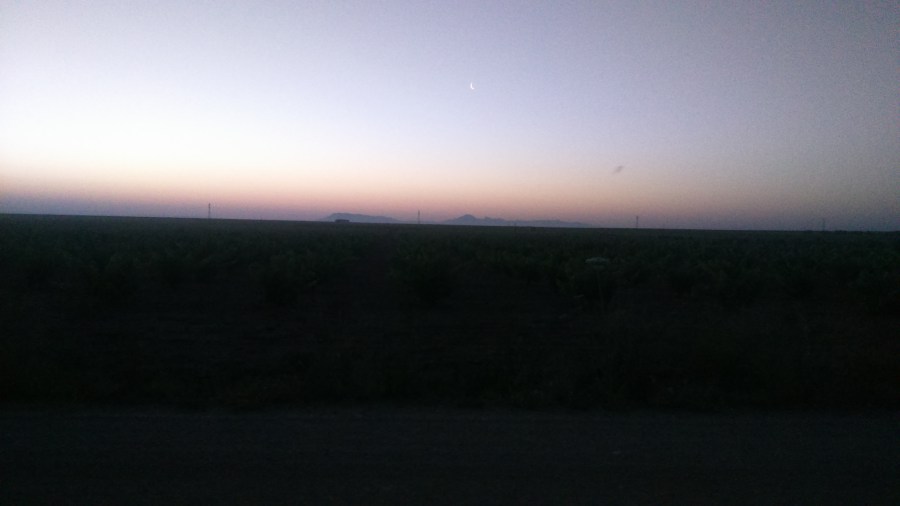
One star shone beside the moon (or was it a satellite?)
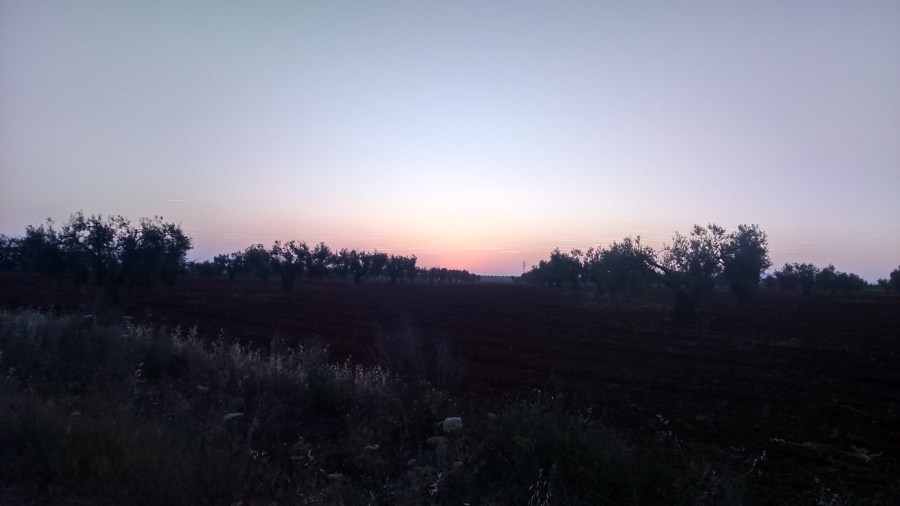
I left Villfranca at 5.50am and it was darker than ever before. Once I had found my way out of town I was in open scrub land. There was the dawn at the edge of the world; the sky was blue, red and orange. I heard the sound of a lone cockerel, a white horse was just visible, and I smelled the faint odour of farm fertiliser.
There were orange lights already in the distance, and tractors passed me under the tiny, thin crescent moon. The dawn chorus was sounding: Oh, the sweet, sweet feathered melodies!
As I found my stride, my state of mind calmed. My pack was extra heavy with provisions, and my feet already hot, but the air was cool and I gave thanks for that. The dusty path was occasionally lit up by one or two red tail lights of farm vehicles. Then it went quiet. The flower buds were tightly shut.
The sky was a bright orange purple and the fiery dome took three minutes or so to appear
The moment when the the sun finally rose was very exciting, and afterwards the opposite sky was a blank in comparison.
‘(Pilgrimage is) … walking in search of something intangible..’ p. 45Wanderlust by Rebecca Solnit.
Some travellers write their blogs after getting back home, after the whole trip has ended, and I can see why; although the trekking itself does not take all day every day, so that you would think there was time enough in the evenings to write, I find that the attention needed to deal with practicalities, together with the attendant tasks of looking after the BodyMind, can take up a surprising amount of time and energy. On this journey I started posting my blogs daily, but gave up part way through.
I recently advised a prospective peregrino to leave books at home. That was partly due to the weight, but also because I do not read much when I am on a pilgrimage, and I do not see others reading around me. Fiction can transport you to another place, and many pilgrims believe that focussing on their spiritual goal is vital and do not want to be distracted.
‘…- and for pilgrims, walking is work.’ p. 45 Wanderlust by Rebecca Solnit.
As I walked, I was reflecting: I could see that I have a tendency to set myself extra and unnecessary tasks. Yesterday I did some work for the business back home (perhaps thinking I was indispensible) and it transpired that it was a needless task. As I put one foot in front of another I could take note of such patterns and habits of mine.
Camino Publico de Chaparral , longitude 3,600 km, Ayuntamiento de Villafranca de los Barros
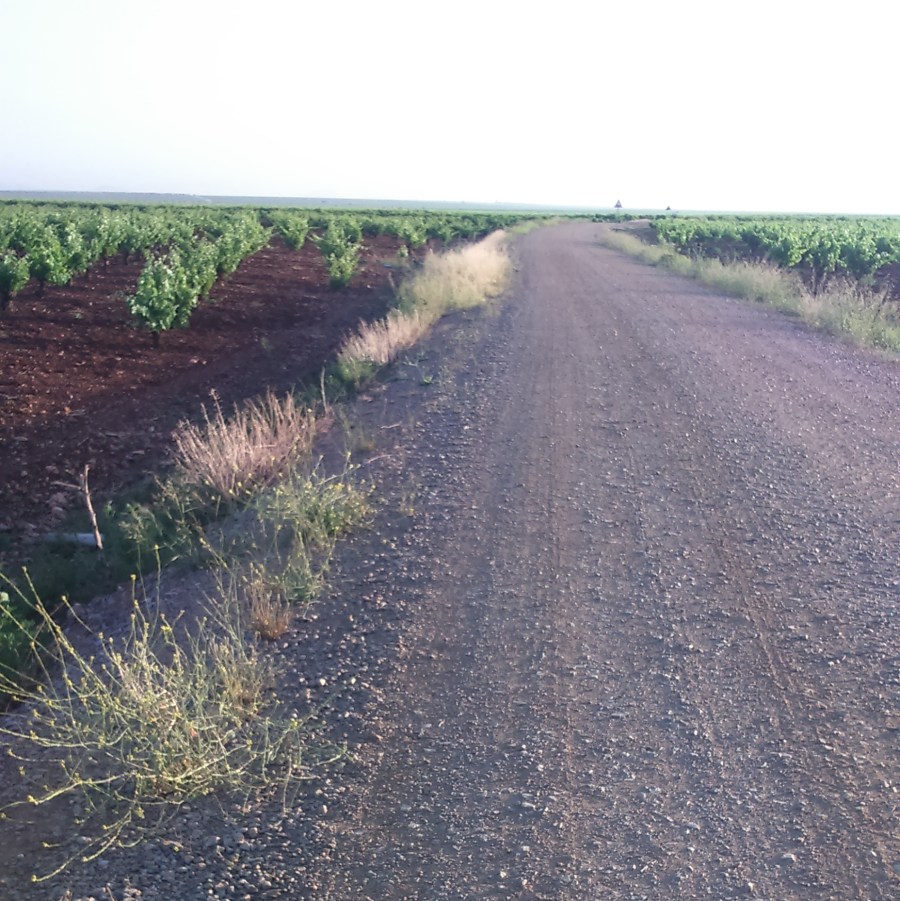
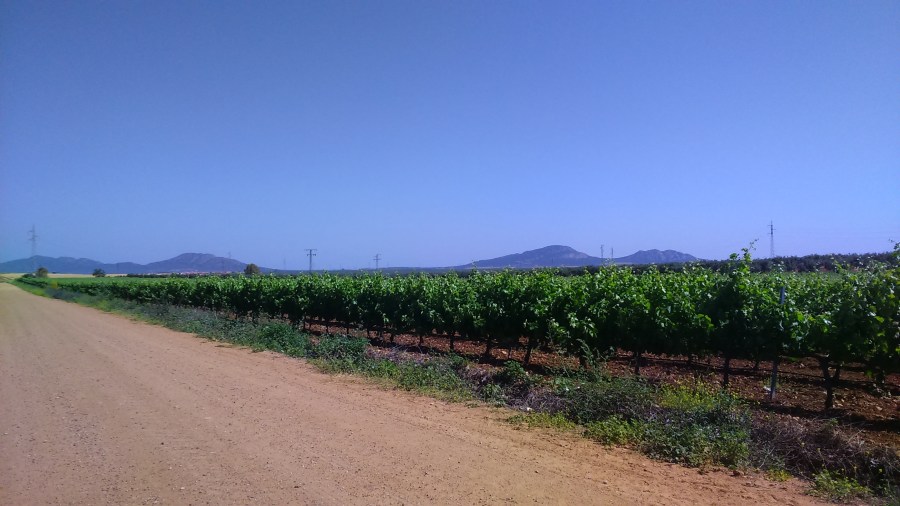
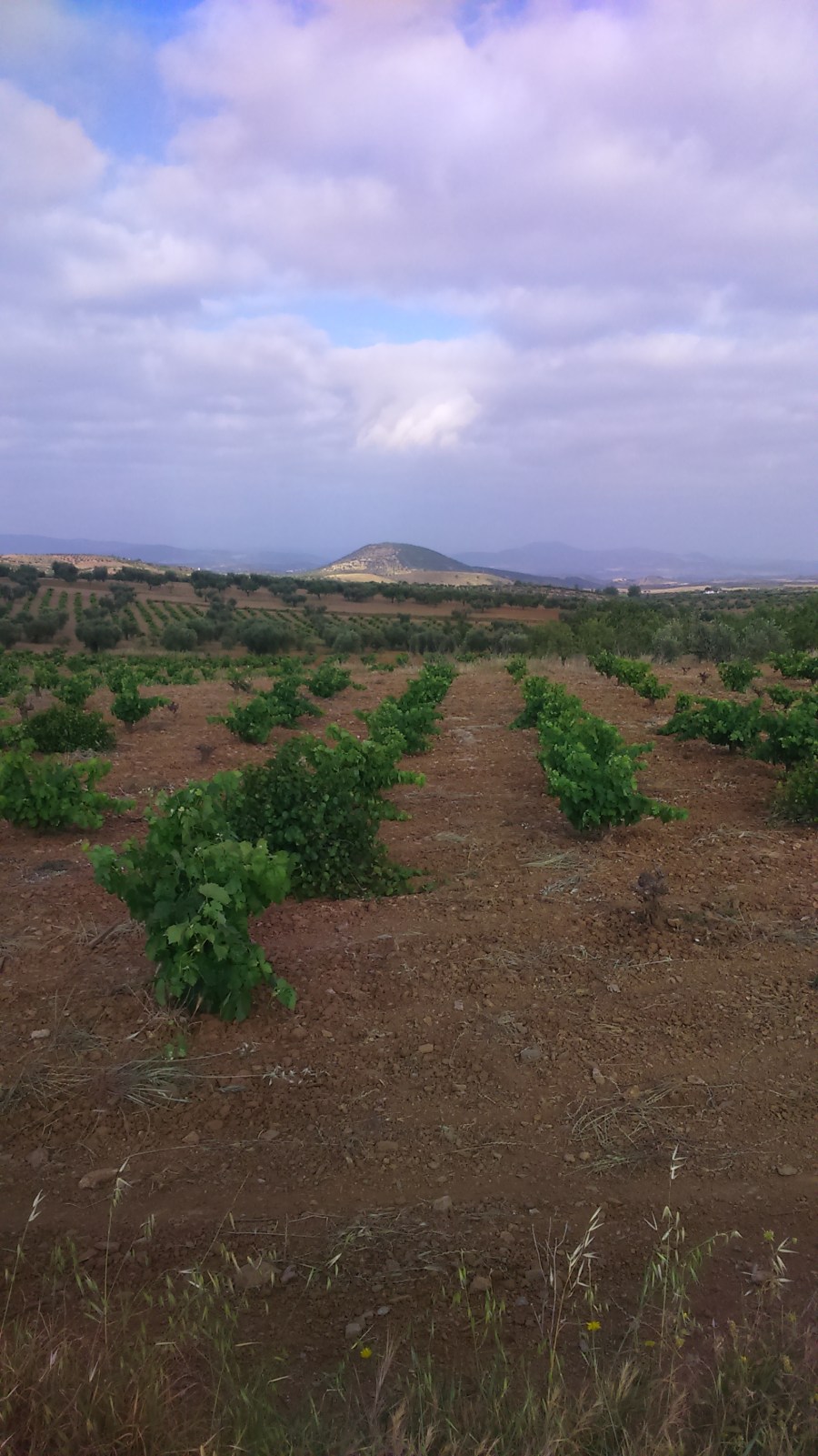
To the east were hills like different sized piles of manure you will clear up later, whereas the other half of the globe was flat to the horizon, and the vineyards of the Ribeiro region a uniform blue. The arrows were easy to see, the backpack was no bother, but my feet were still calling my attention at times.
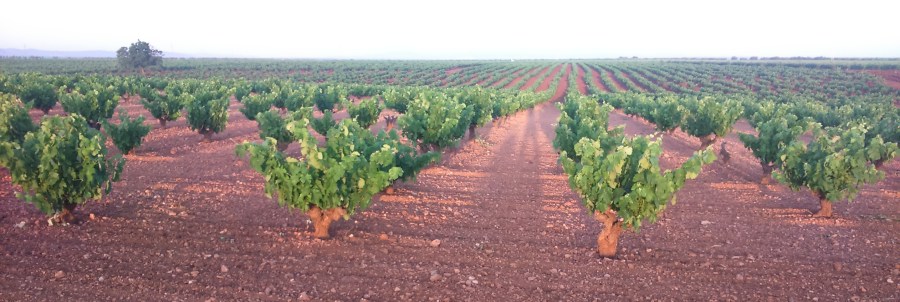
Not long after, the sun lit them up and I enjoyed the immaculately ploughed red soil between rows of vines.
The world was in technicolour
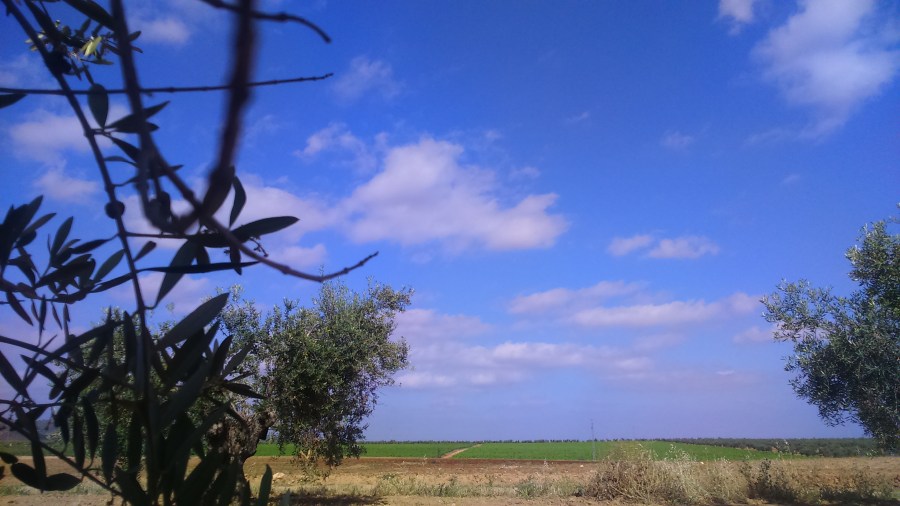
Olives, with their stumpy wiggly trunks, stretched into infinity. One patch had solar panels and an extra crop of what might have been green alfalfa between the trees. The cordoned vines had thin little stems, perhaps because the wires were supporting them so they did not need to be stronger. I would like to know why some rows were planted north-south, and some east-west.
The sweet fennel and cow parsley smelled delicious. My skin remained cool, and it was brightening quickly. Other wild flowers competed with the blue of the sky, and there were His Master’s Voice horns of pink, common bindweed by the path.
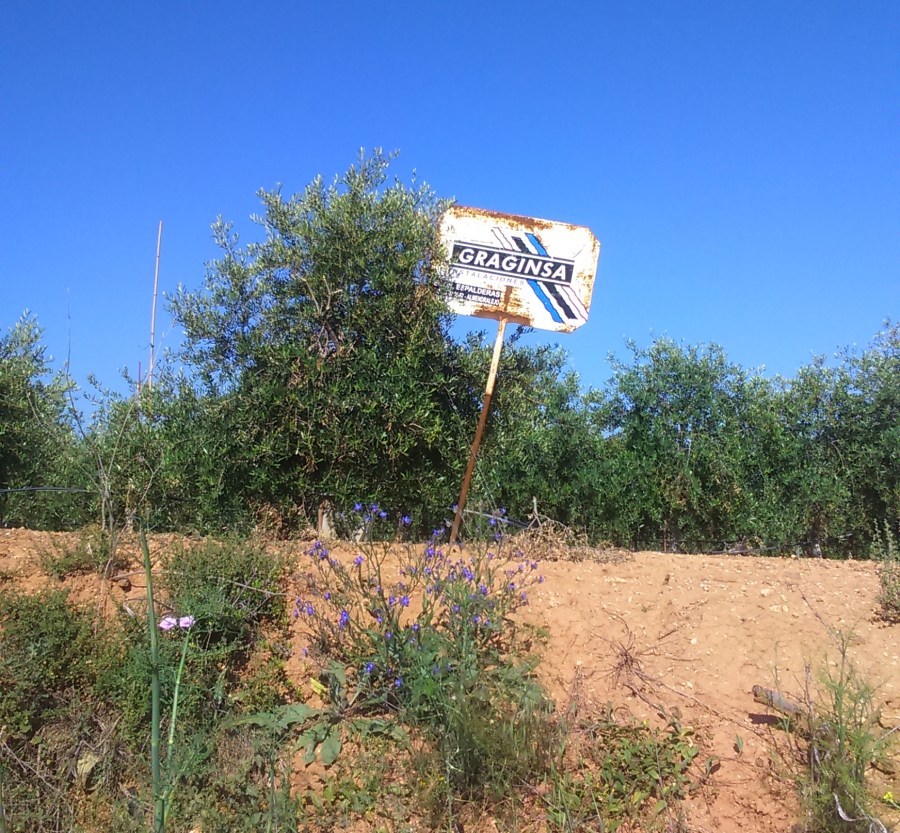
Bright blue wild flowers competeing with the azure sky
Before I left the hostel, breakfast looked better than usual so I had paid for it, and consequently I was full of sugary energy. On the ground, my shadow was really tall; I thought it must be my alter ego which could reach things down from high shelves in the supermarket!
In the fields, today’s job was trimming the long tendrils, and other than those men working (an occasional conversation reached me), it was me, myself, I as far as the eye could see.
Vast expanses of sky and road
I liked the swirls in the earth at the ends of rows where the tractor had turned; hated the repetitive machinery noise to my left which source I could not see; and blocked my nose from the acrid, chemical smell I had been warned about.
I had also read that there was neither village nor water for the entire 26 kilometers, and I could believe it. I only had one litre of water and so knew that I would have to be careful not to drink too much too soon. Sadly, as I took the signposted turning, the noise got louder.
The tireder I got, the less time had passed since I last looked at my watch! Chemicals smelling like paint were being sprayed, so I tried to pick up pace, but my body had set its own rhythm. Tonight, I thought, I am drinking some wine!
By 8.40am I was no longer alone; there were four Italians in a group and another solitary man on the road. We moved at regular intervals from each other.
The same person I had shared a dormitory with the previous night, with his hat, carrier bag and wooden walking stick
After almost three hours without a break, I was casting ahead for a tree throwing shade, but there was not one until 9.20. After a fifteen minute break, and having eaten my orange because full much needed fluids and was the heaviest (delicious it was), I deduced that we were barmy, the lot of us, walking so far in this heat!
I then passed the hat-wearing man sitting on a wee waymarker, and he said he was muy cansado (very tired). He added that we were half way. On I went.
A town with unusual looking farm buildings appeared. Ah! maybe wine vats. It looked like the outside edges of a huge swimming pool and I imagined it was full of grapes with barefooted people trampling around inside it. Do they actually do that these days? I then realised that could of course be sewage, which would be considerably less ‘romantic’.
Luckily, the actual smell was of newly cut branches and very fresh sap.
For some reason I suffered a lot of pains on and off, and I also started to feel the skin on my right arm and leg, the side where the sun was, getting that soon-to-be-burned feeling. To remedy it, I draped my magenta wrap over that side of me – that scarf sure does come in handy. (See my blog on what to pack in your rucksack).
You cannot see from the photo, but the mountain rock strata were clear to the human eye
Swifts zapped flies, zig-zagging across my view. Were those cordoned olives? If they were, then that would make for many more plants per acre than the row system, so it would certainly make financial sense, if the earth could sustain it.
I broke again at 10.45 for lunch under a tree, feet throbbing – it was so very hot. A pylon was crackling like a fire, indeed there was a smell of burning. As I ate I let my crumbs drop for the ants and watched one carry a huge piece away, picturing it arriving back home, saying ‘look what I got!’ When I got up, I noted that it was a messy business for the bottom, sitting on the earth like that. I restarted at 11am and, yes, there were a lot of little inexplicable, smouldering fires alight between the olive trees.
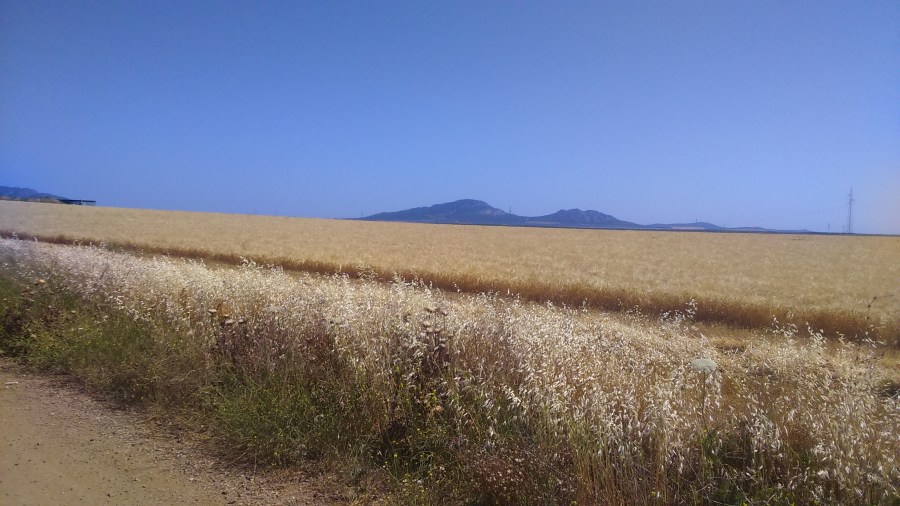
A sea of bleached wheat
Towards the end of the day’s walk I spent a short period, only the second time in the past eight days, talking to someone as we went along. He was from Barcelona and was doing the camino to get away from his demanding family, he said. He assured me that despite the exhaustion, of course he wanted to keep on walking until he reached Salamanca (a further eleven days). Such determination!
At 1pm in a 31 degree heat, and after seven rather than six hours of walking, I arrived in Torremejía. (Put the accent on the final ee: toh-ray-mah-heee-ah).
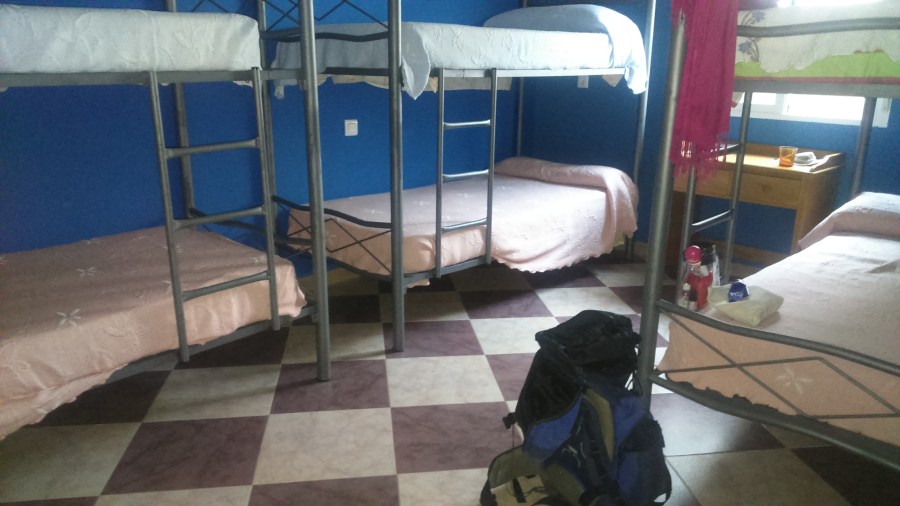
Privacy – all the other beds were empty
The hostel host owns a bar as well, on Avenida Extremadura, but there was a family issue and it was closed that evening, so I sat in the one opposite and had a beer and wrote my notes.
Useful info: the supermarket on the same street is shut for a long time between lunch and evening.
I did buy that bottle of wine I had promised myself, and I also invited the man in the above photo, plus a Dutch cyclist new on the scene, to join me. We had some surprisingly entertaining conversation, in divers languages, and it was very enjoyable to sit around the table with fellow travellers again, as I had done so often on the Camino Frances.
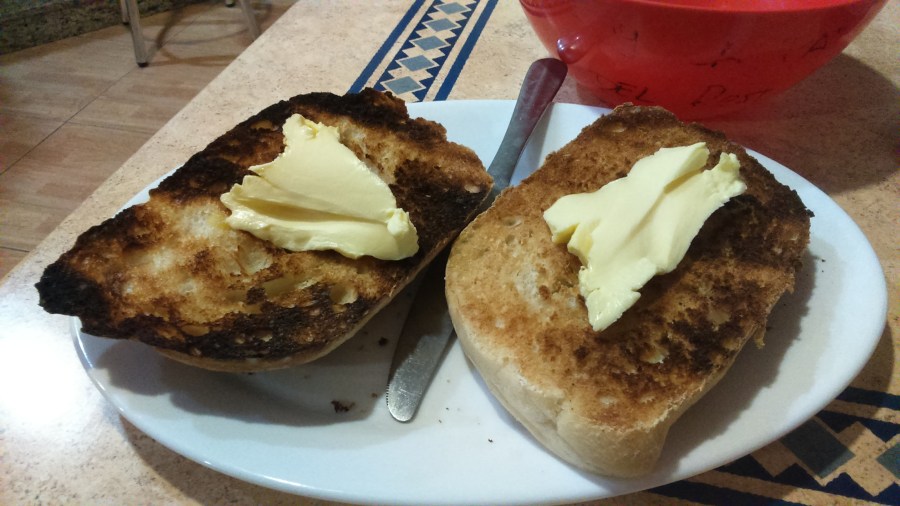
For some reason the host kindly offered us a free breakfast when his bar reopened the next morning; it provided simple fare with generous portions and friendly service.
Toast for breakfast, with a great deal of butter
Tomorrow would be my last day on this leg of the 1000 kilometer Via de la Plata, so I would have to wait to see Salamanca another time.
For a list of stages of this camino and other information, check out this link:
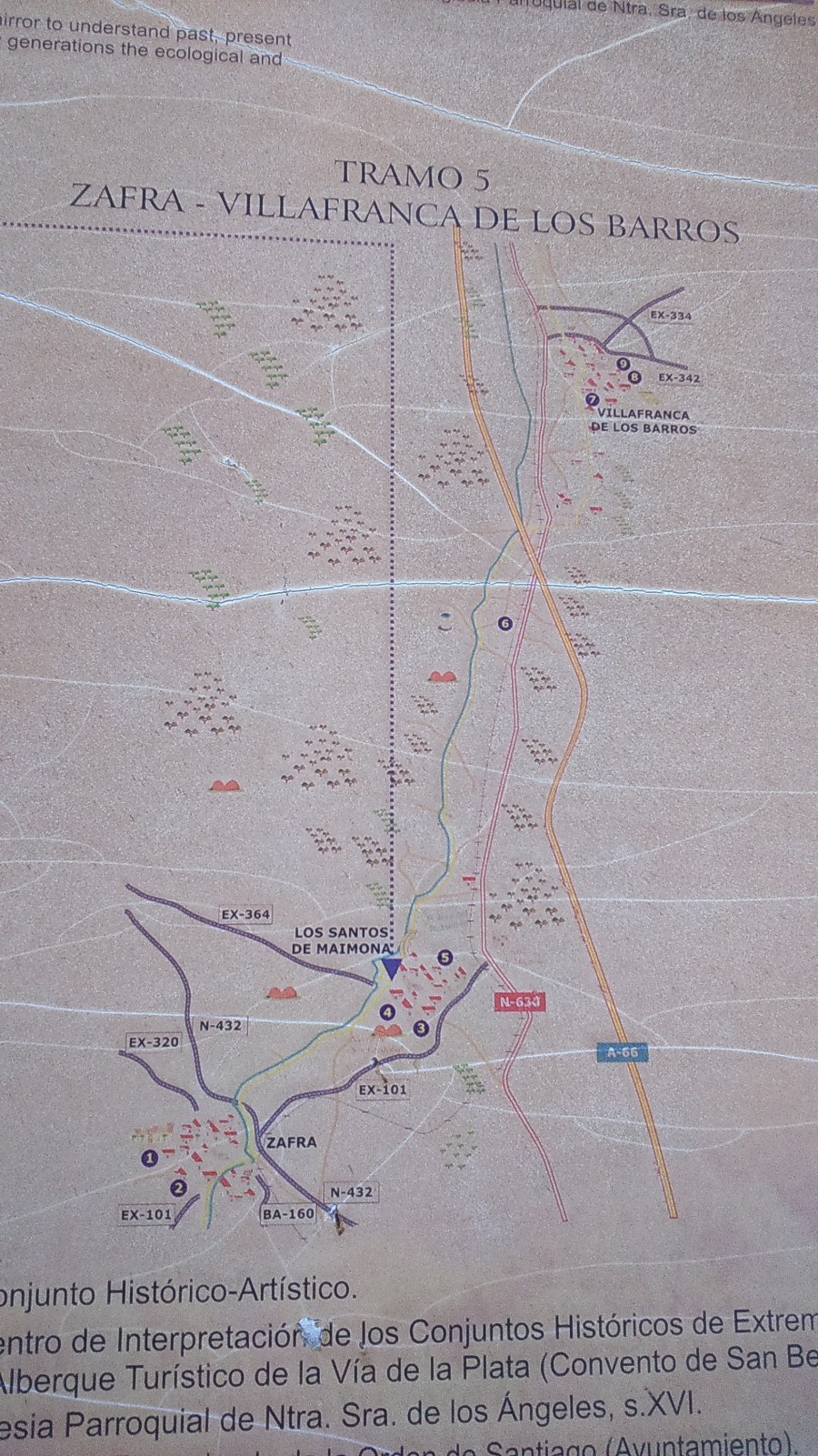
22nd May 2017. Via de la Plata camino walk, Spain. Day 7: Zafra to Villafranca de los Barros, in the autonomous community of Extremadura, Badajoz province. 19 kms.
It was already 22 degrees when I left at 6.45am with no breakfast or tea because I could not use the kitchen at the municipal hostel in Zafra. My body had had a good rest and felt better, but not my mind which was busy again trying to puzzle out why life offered me some things and then promptly took them away again.
I passed Spanish farmsteads in the flat brush land, exactly as I imagined Australian ranches. There was honeysuckle and abundant roses in deep pink, red and orange; puppies frolicking, watched and kept in line by the absolute authority of the papa; cats wary of a large bird nearby; and my way was uphill. It was the second cloudy day, although it had cleared late last night, and it was pleasant, cool on my skin. There was a smell of olives and thyme crushed under foot, and the scent of pine added to the pleasure. I saw an almond tree for the first time on this trek.
I compare the two aspects of my life: walking outdoors in this beautiful natural place, and working at home with family and friends in Edinburgh. I had spent the week basically alone, and this sort of retreat was continuing to raise things about being with others or not. I reminded myself I could stop any time.
In her discussion about religion and walking, in Wanderlust, Rebecca Solnit describes, ‘…that non-believer’s paradise, nature…’. This rather densetome covers the origin of bipedalism right up to modern day pilgrimage.
There was activity all around me: wheeshts of sparrows, and wooden clagging of storks’ beaks as they stretched their throats and pointed at the sky. The sun was catching the tops of the grasses and there was a large town and farmland spread ahead, with a chemical factory spewing in the distance.
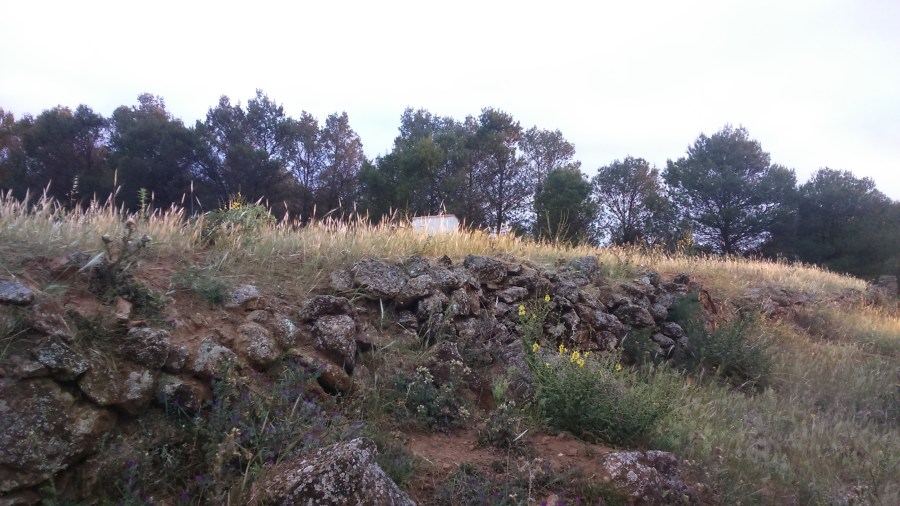
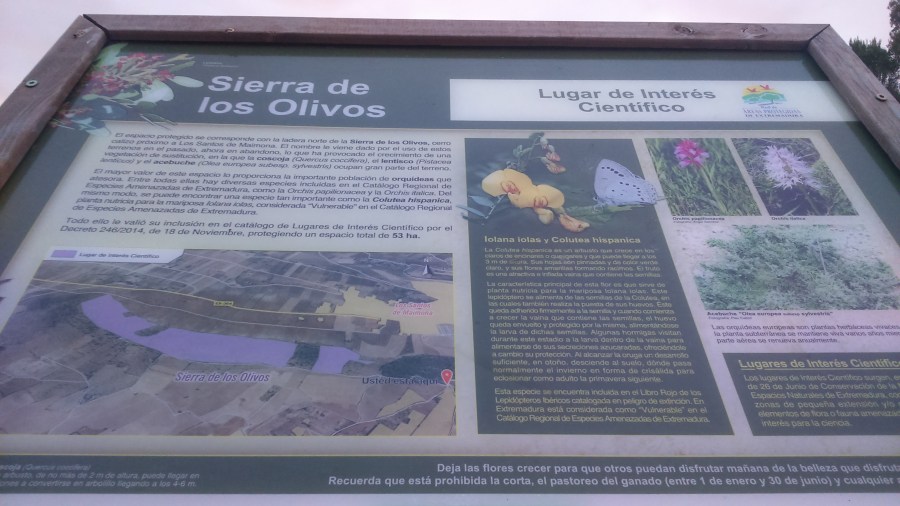
Sunrise from Sierra de los Olivos.
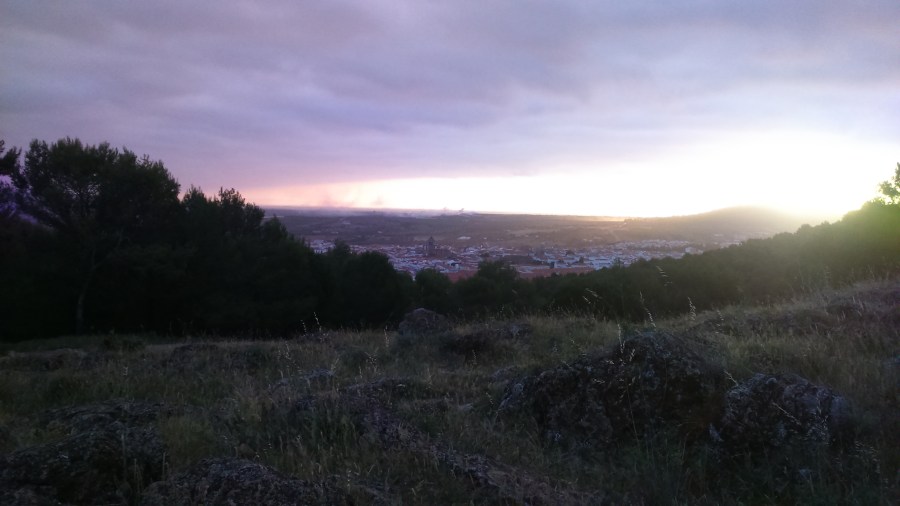
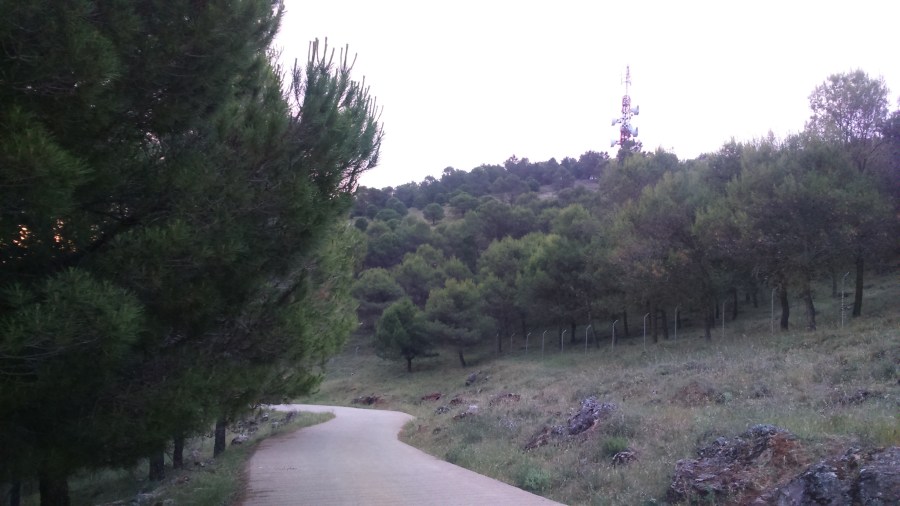
There was a satellite tower on the peak I had reached after the climb, and then I descended through pine trees with rabbits popping up all over, but still no deer. I was an hour from Los Santos de Maimona.
A satellite instead of the figure of Christ (as in many Spanish places eg Monte Naranco, Oviedo which I visited in 2016).Getting closer to my first repast of the day.
A new house with a solar panel heralded the place I was planning to replenish myself. Another commuter town to Zafra, I guessed, with its BMWs and smart houses. I seemed to have a dreadful tendency to be self-pitying at times. It is a good thing I am walking to balance my earth element which that is related to.
“A young German man expressed it this way: ‘In the experience of walking, each step is a thought, you can’t escape yourself.'” p. 51, Wanderlust, Rebecca Solnit.
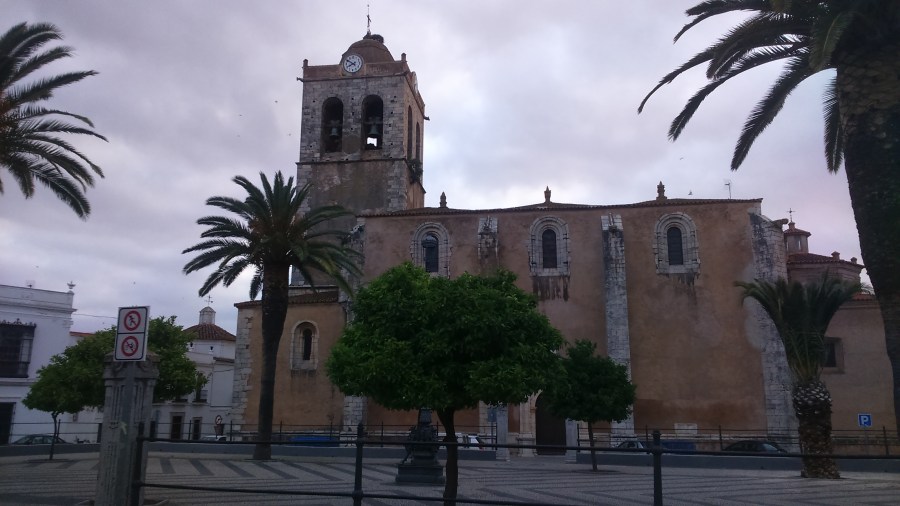
Thankfully I could not risk missing the signs so that bought me into the present. There was a double bell tower and the familiar, beautifully-kept town square.
Kids were off to school in skinny jeans and trainers, rucksacks and hoodies, with straightened hair, all so familiar from our Scottish children. But what a soulless place it was at 8am, and how very, very hard to find bar.
The search and service took a while, but the tea and tostada con tomate (basically toast with garlic and tomato paste) were good and the women very friendly. I left at 8.30am.
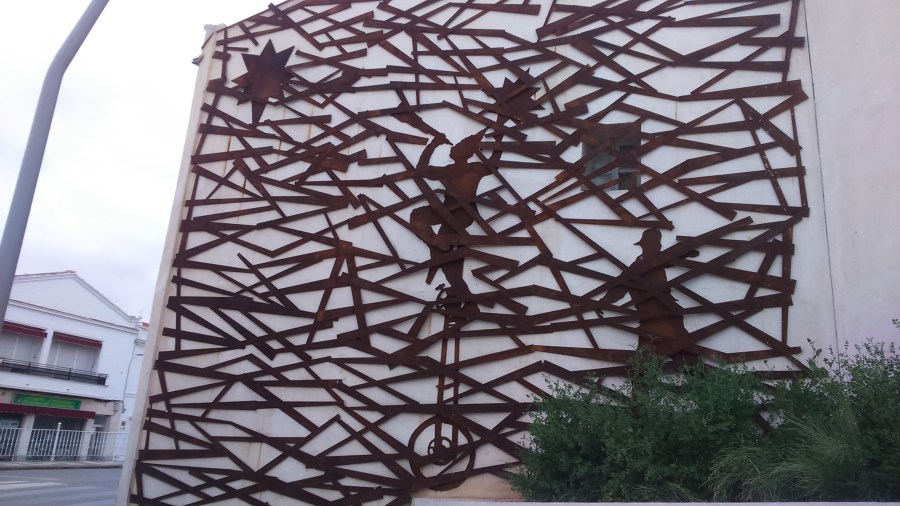
An unusual scuplture cum mural of circus performers in Los Santos de Maimona.
Black pigs were grooming each other which I had not seen before, but otherwise there was more of the same really, day after day walking forward with a pack on my back, trying to understand life, except I was ever fitter and feeling better about myself overall.
Walking is to ‘nourish a profound, fruitful relationship with the self.’ Taken from Christophe Andre’s La Vie Interieure in France Culture magazine.
Two men, each with multiple greyhounds passed me an hour apart.
A huge horse rolled over in the dust, and I was not that different, having to brush away metaphorical flies myself. Doing something repetitive helps you see the differences or similarities between things. Then again, sometimes even the most beautiful views, seen repeatedly, become commonplace.
I thought there were a few pilgrims gaining on me from behind, but it was a man on a tractor on his phone. And ten minutes later there he was again still on the mobile. At 10.30am my day’s destination was sighted, and I was resting under olive branches. Just me, the birds and that tractor.
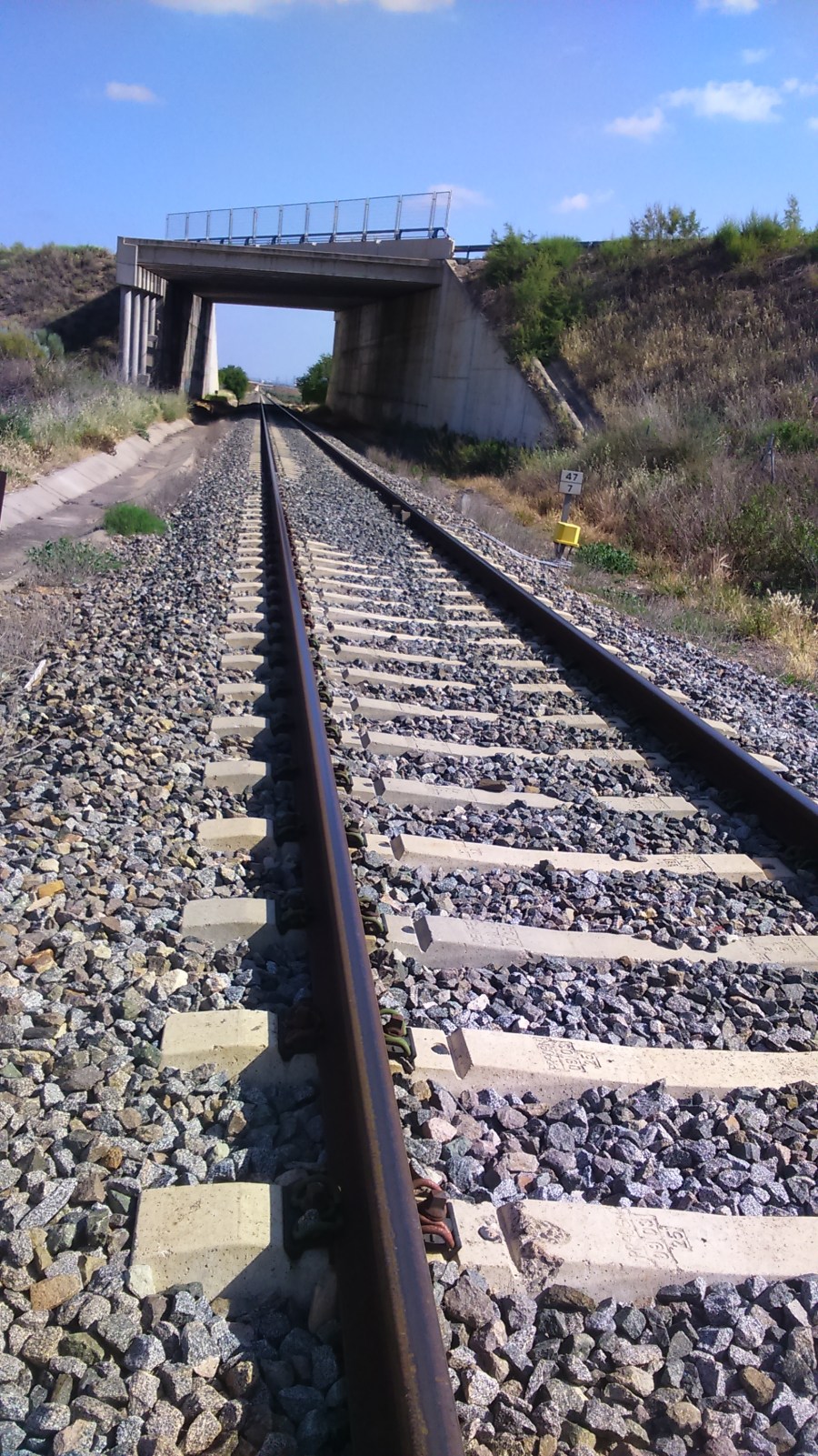
I crossed the train tracks and a busy road, managing through a semi-rural urban environment, one dusty route in a long uphill haul in the heat. The French couple were there, he having insisted on walking 30 kilometers and she with blisters. I felt for her. Now that I did not have my baton, the woman I met a few days earlier was right, the blood does collect into my hands and they get swollen. I expect the heat does not help. Sometimes I also experienced really sharp pains in different parts of my body, mostly the inside edge of my right foot, but they passed.
‘Pilgrimages make it possible, through the exertions of ones body, step by step, toward those intangible spiritual goals that are otherwise so hard to grasp.’ p. 50 Wanderlust, Rebecca Solnit.
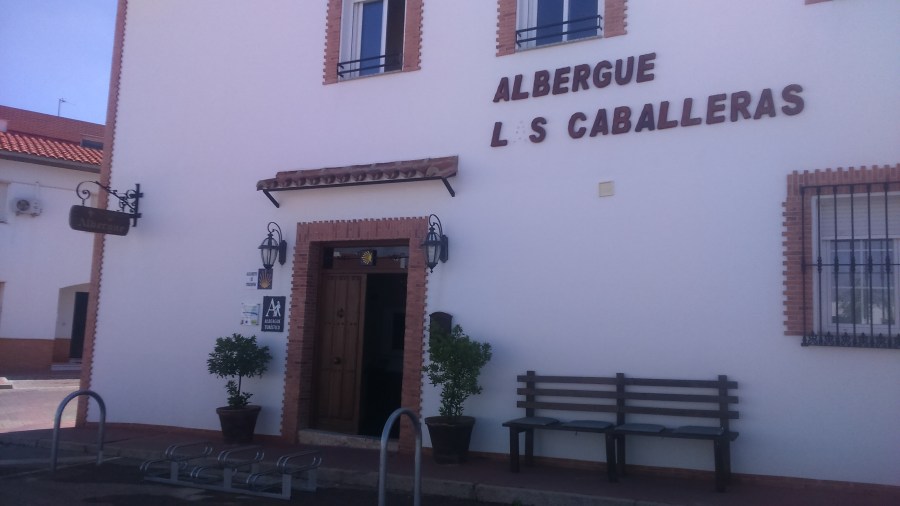
I had read that there was a choice between two albergues and that the far one, the municipal hostel, only had one toilet for everyone, so when I arrived at the edge of the town and immediately found the private albergue, I stopped there.
The nineteen kms took just under 3.5 hours, 4.5 if you count the 1 x 45 and 1 x 15 minute detours/breaks, averaging 5.5 kms per hour, although noting that one is likely to go slower at the end and if it is very hot. If you were chatting that could slow you down too. Today I arrived at noon.
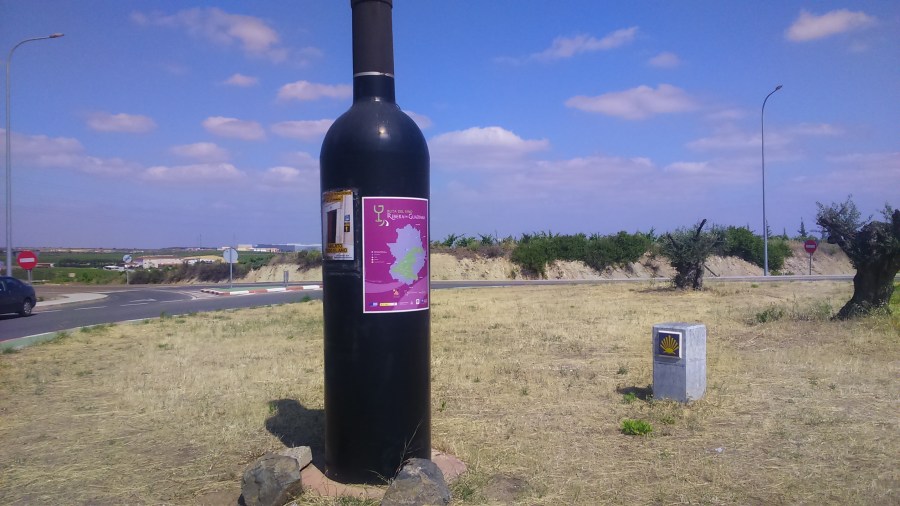
An interesting juxtaposition of massive wine bottle and Camino signpost in the middle of a roundabout on the way into Villafranca de los Barros.
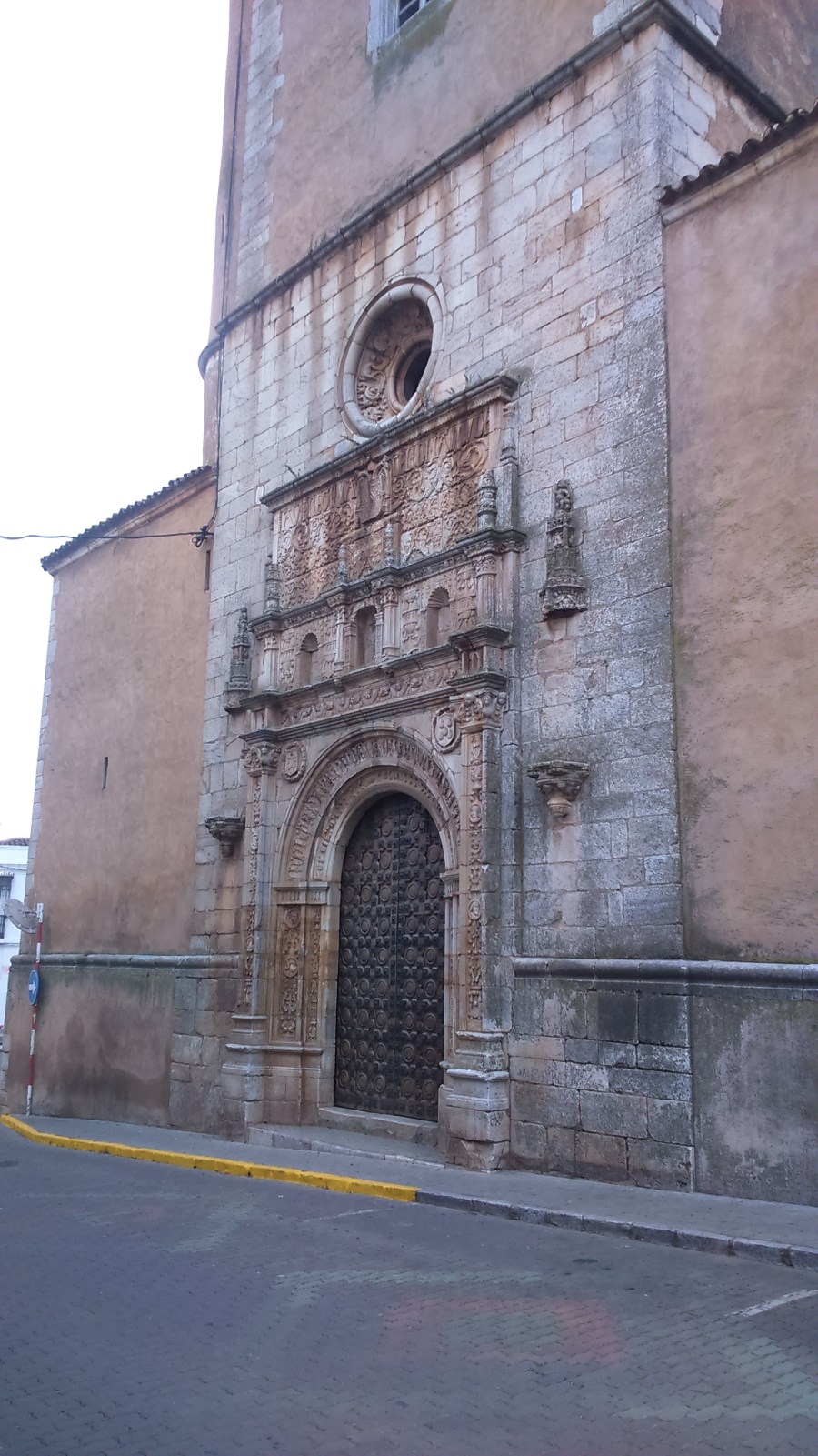
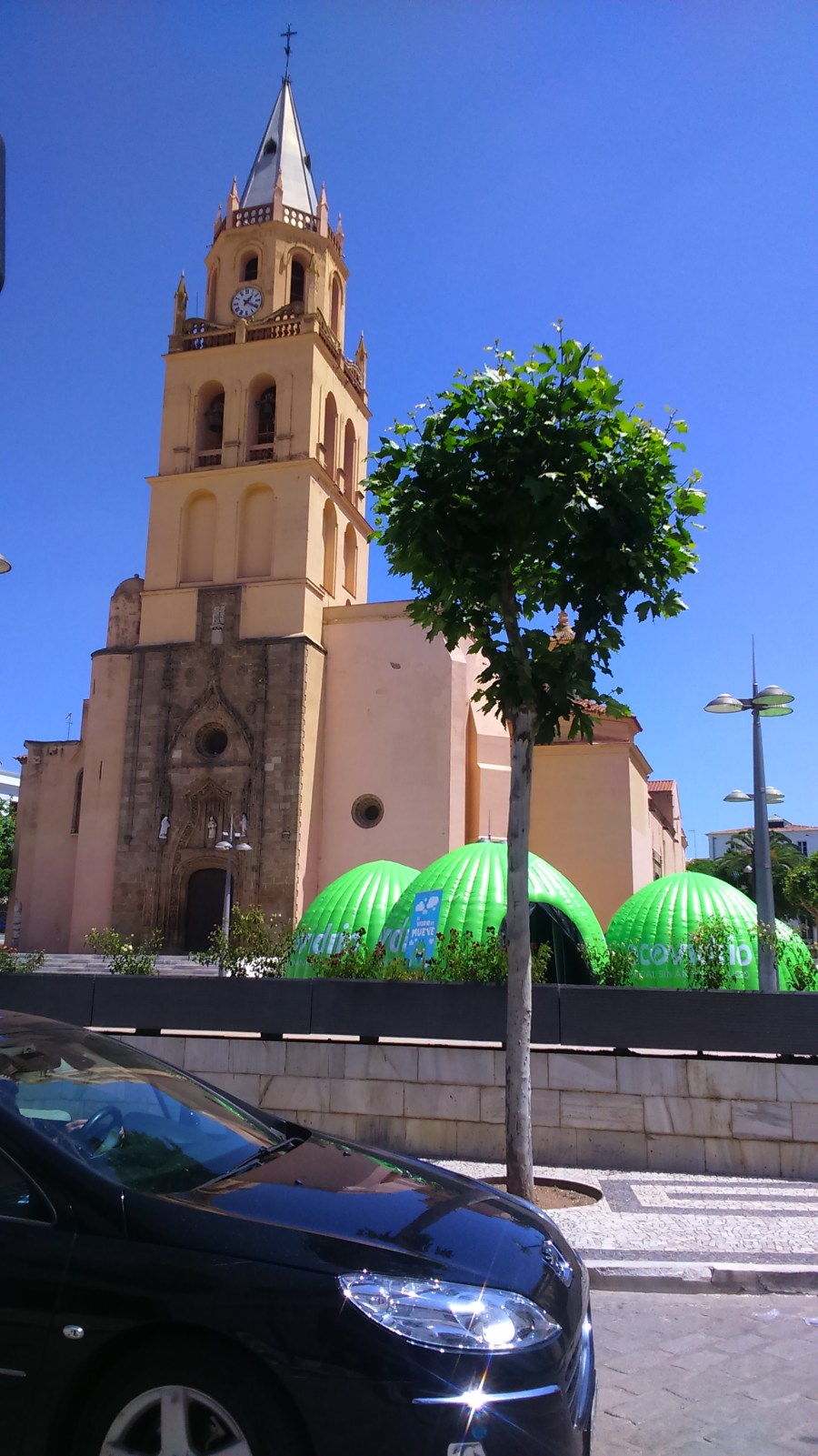
My advice: do not try to find the tourist office or follow the signs as no-one knows where it is but they do kindly guess, sending you off on a wild goose chase every time! In fact, I think it is usually, or used to be, behind the lovely apricot-coloured church next to the police station, and that place is worth visiting because it has good maps and they can stamp your credential (the pilgrim paper for collecting proof of stages attained).
Villafranca is a big, prosperous town with a smart new medical centre and a wide, dry river bed running through the middle. There are lots of shops which do of course shut in the afternoon.
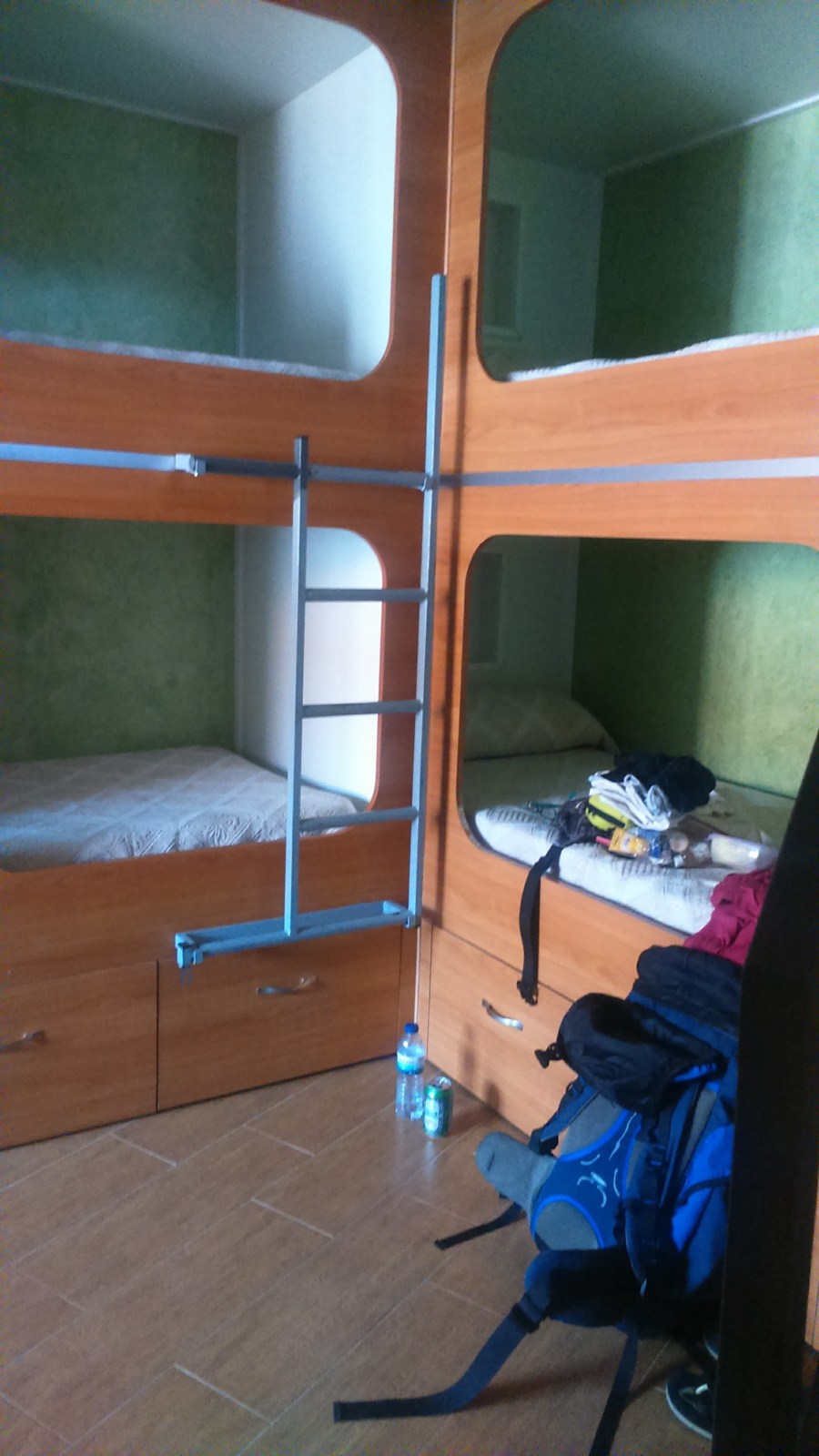
The Iglesia (church) with it’s telescopic tower(s).My little cabin bed in a dormitory I shared with an older Spanish man. We had become familiar with each other and smiled, but not exchanged more than one or two words. We did not seem to disturb each other and in fact overtook one another throughout the day. I was starting to keep an eye out to check he was OK as he was struggling and sad at times.
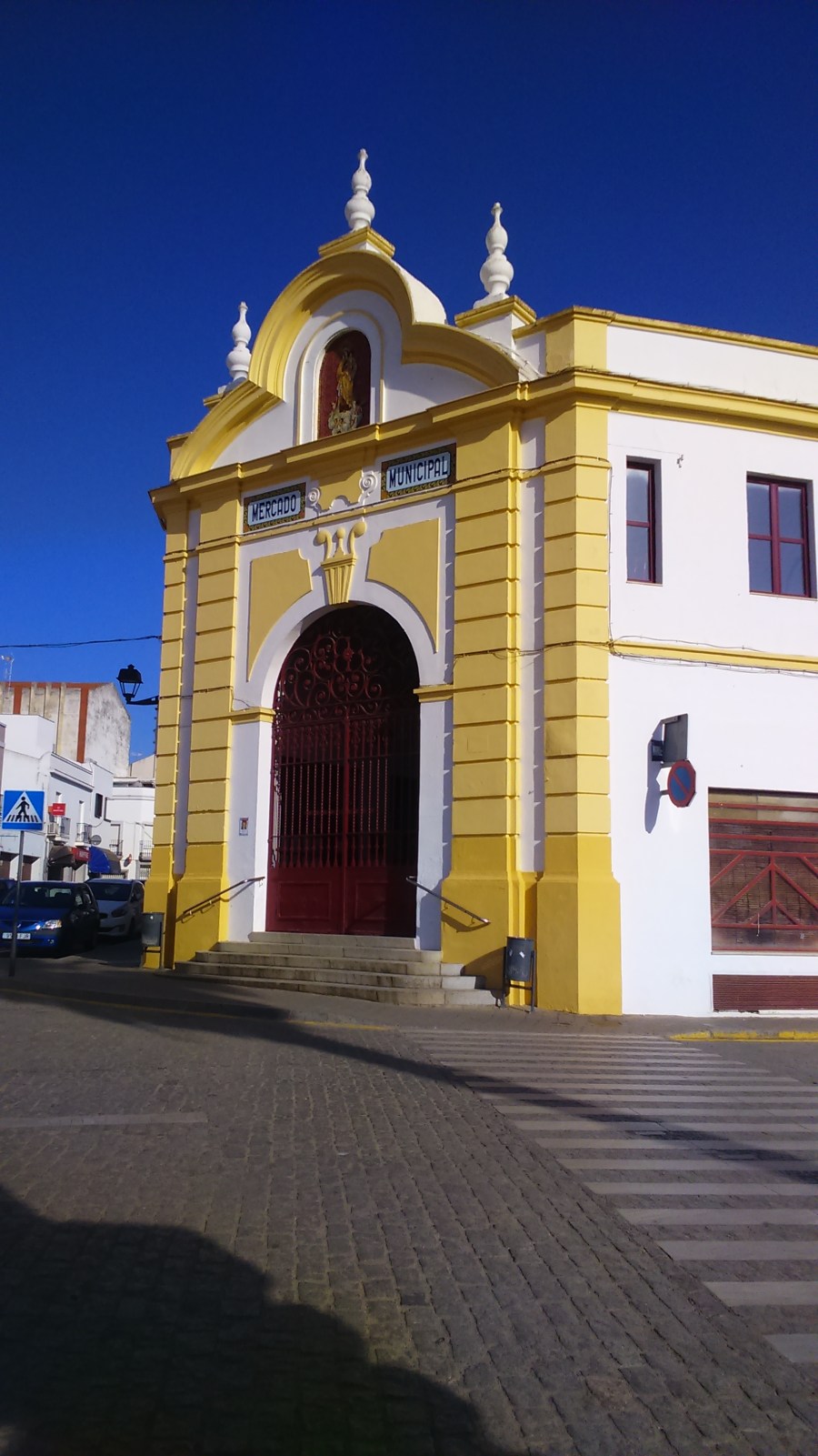
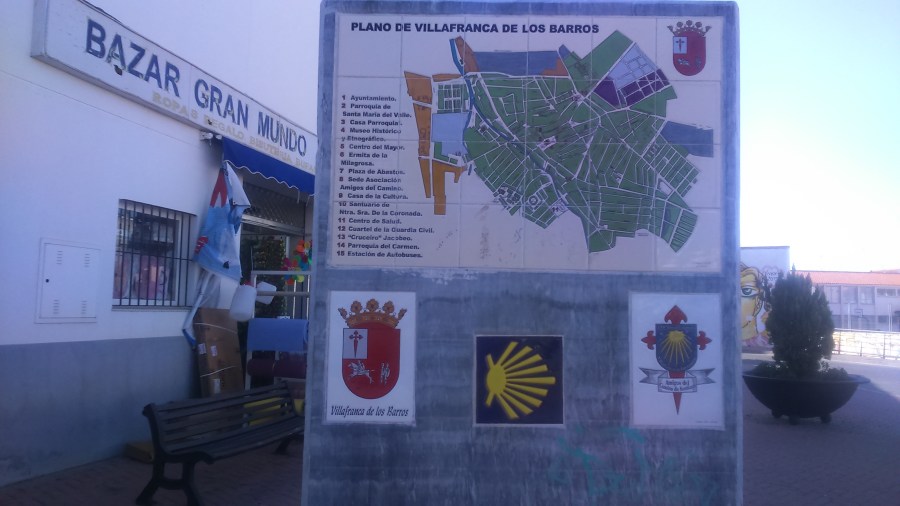
The mercado (market) building rivals one in Madrid, and the bazaar shop has more things crammed into it than I have ever seen, except postcards which was what I was after.
Very handsome market building.
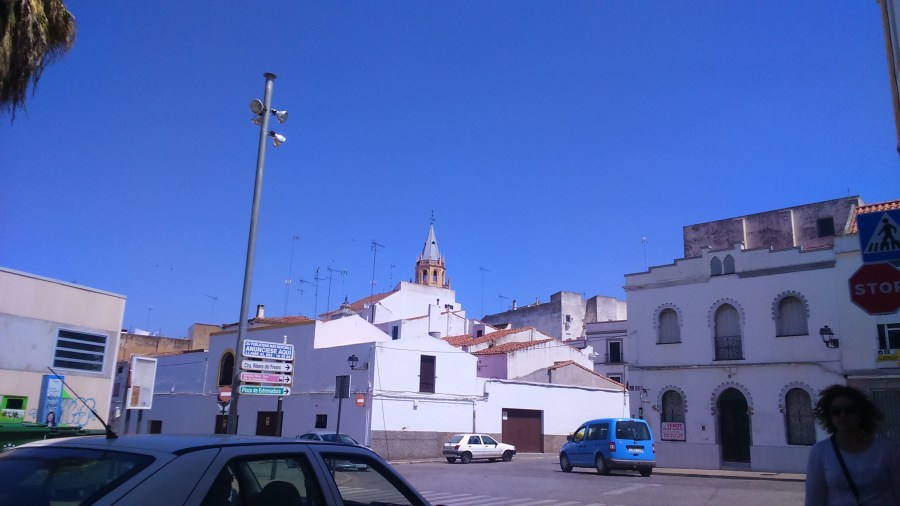
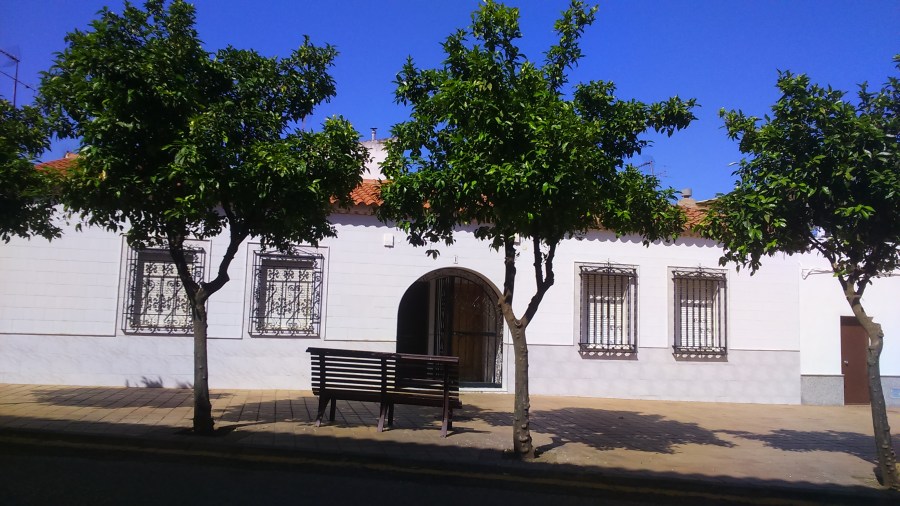
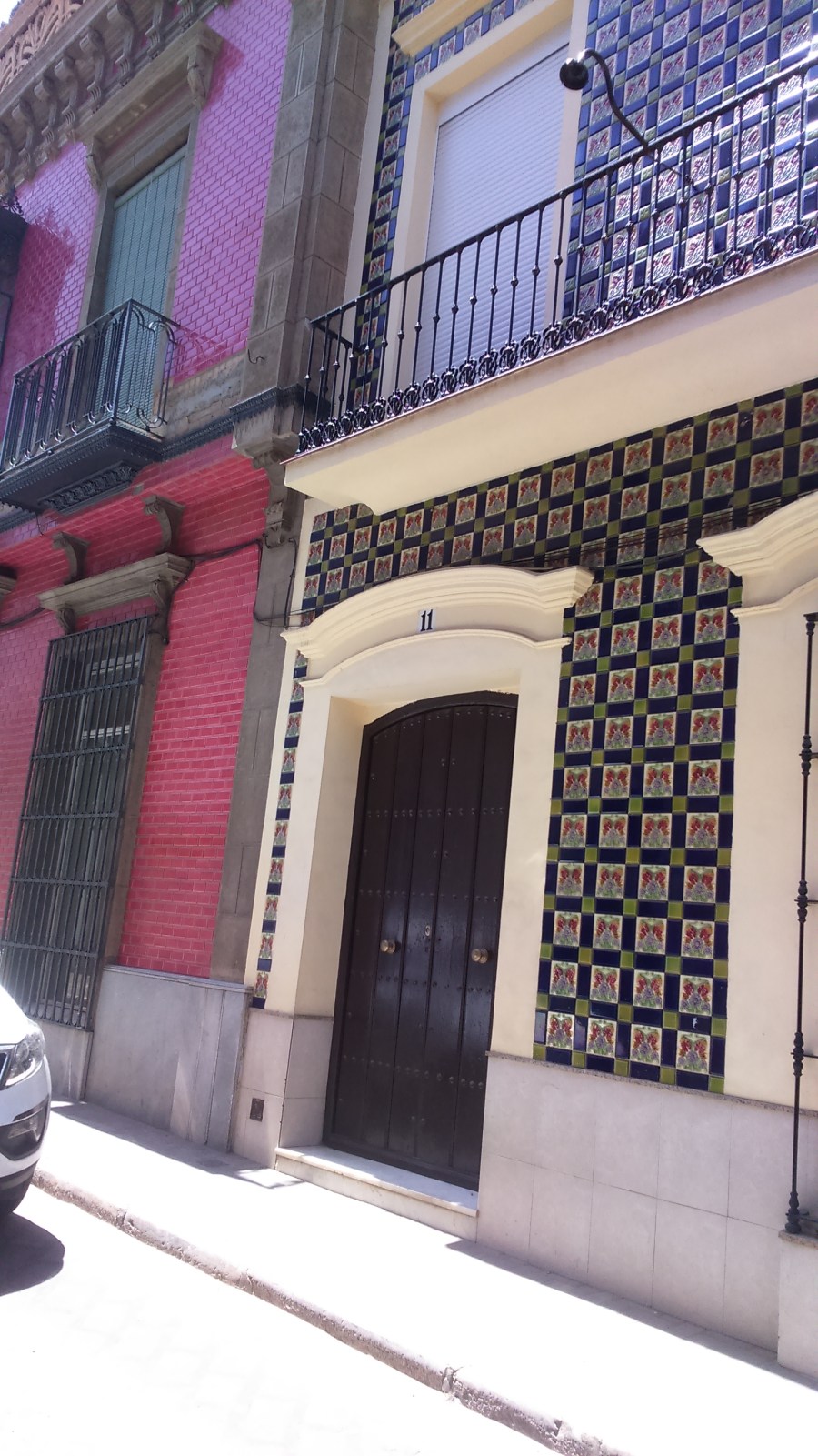
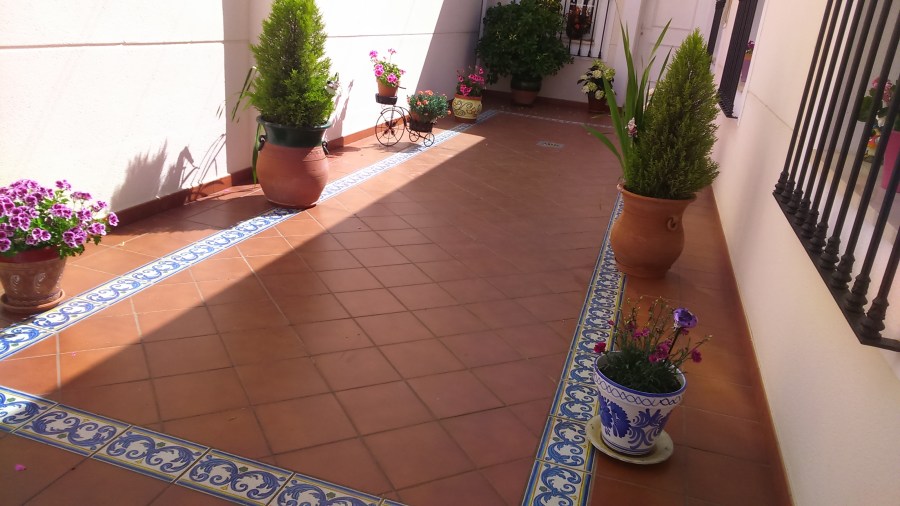
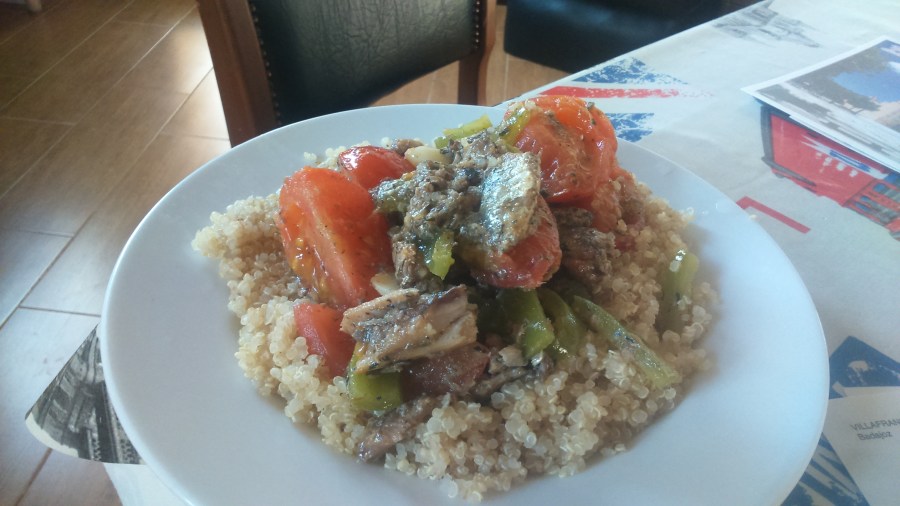
General view of the town.Much prettiness.Glorious tile work.And cool courtyards.If I can get to a food shop and have a kitchen to prepare, using my new pan (a gift from my daughters and mum), this is what I eat of an evening: quinoa, sardines and veg.

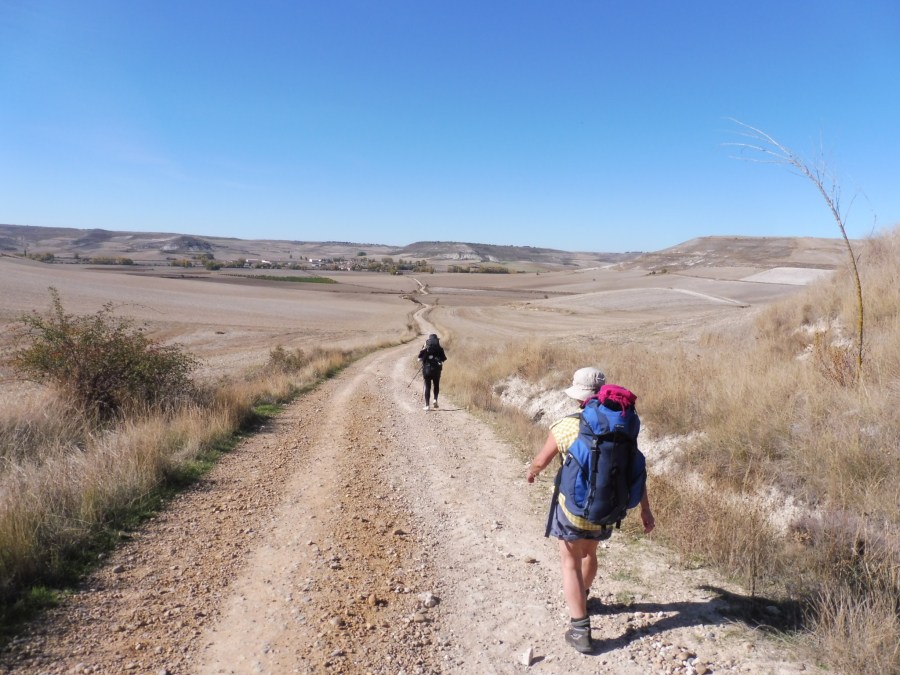
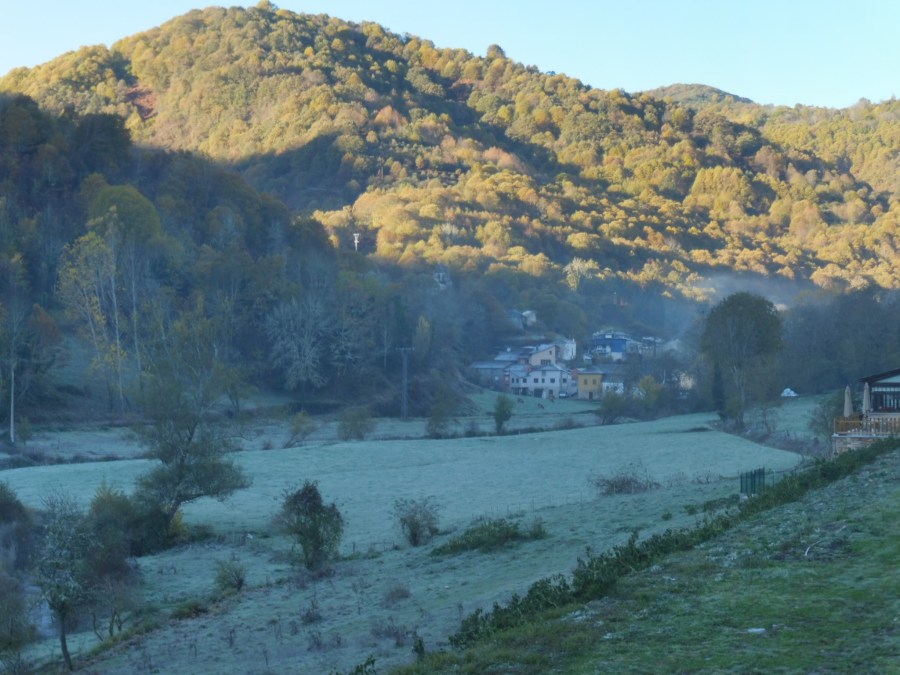




 Walking without a donkey