I am walking the St Magnus Way on Orkney, and this is one of the blog series: 21st May 2018. Below, you can find links to all the others (introduction, transport, accommodation, resources etc). The overall walk is 55 miles over 5 days plus a visit to the island of Egilsay where St Magnus was said to have been murdered and, initially, buried.
I like travelling. Moving through places. The train hurries. I sit, read, write, think. I watch the world through the window.
Scottish mainland to Orkney:
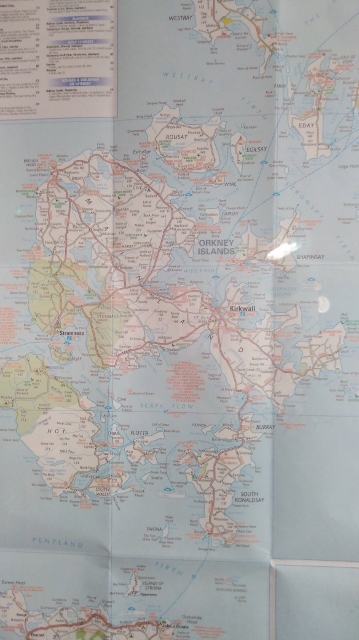
Here is a brief account of my journey to Egilsay where I started the St Magnus Way pilgrimage. The detail is below.
Edinburgh – Thurso by train; Thurso – Scrabster by ferry with a free taxi ride and a bus inbetween. To return I did the same in reverse.
- Scrabster – Stromness, ferry
- Stromness – Kirkwall by Stagecoach bus (free because the ticket machine was broken)
- Kirkwall to Tingwall by local bus (£1.80)
- Tingwall – Egilsay ferry (£8.50 return, takes 1 hour). Tip: the office opens at 8.30am
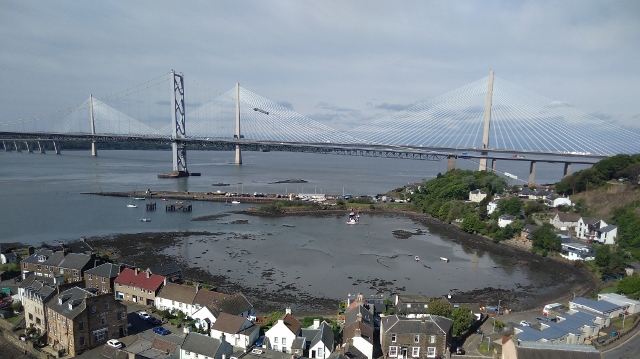
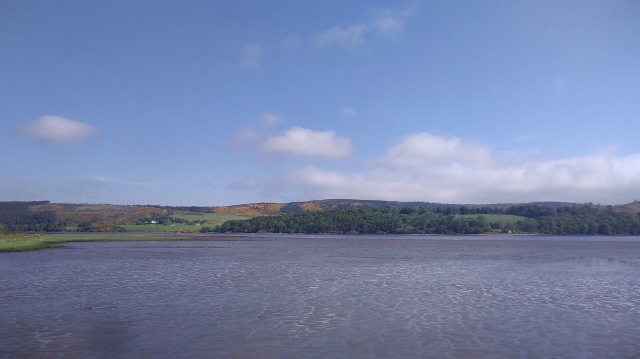
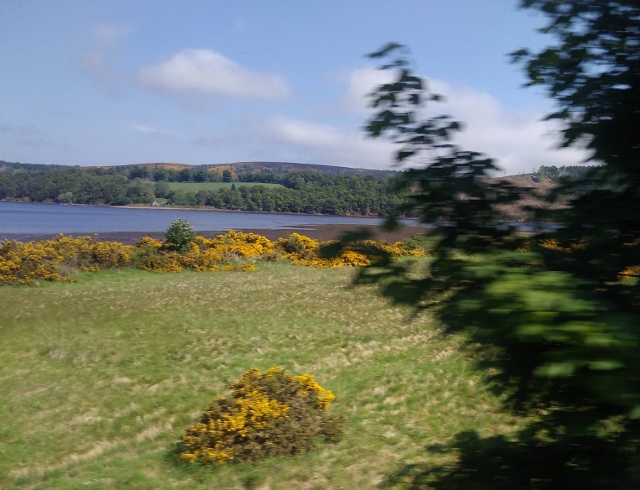
I headed out of my home city of Edinburgh by train, rushing beside the Fife Coastal Path and taking mere minutes to reach the place it took me 4 days to get to on foot! The sun shone; the sea was on my right and the links on the other side where they were setting up the circus. I was reading Spanish Steps by Tim Moore, laughing out loud about, yes, you guessed it, the Camino. Subtitled My Walk with a Donkey, he writes, ”Let the Camino commence! Make way for the assmeister.” (p. 55)
It was a busy train: the ginger-haired Americans patiently waited half an hour for the guard to move the man with the headphones who was sitting in their seat. Perhaps they didn’t insist themselves because they do, after all, come from the Land of Guns. There was a skinny, swearing, drunk man wearing four ties and a T-shirt with his can of G&T and a glass. It was 10am. He had one of those voices that carries, you know, when you can hear every word however far down the carriage you are sitting? Most unfortunately he happened to have chosen to sit opposite a couple of nattily dressed Perthshire ladies who I suspect Scotrail may have heard from afterwards.
There I was, chuckling away at donkey antics and remembering my first Camino days in the Autumn of 2016, whilst we chugged through a sloped landscape covered in trees, when the third thing was sent to challenge us. It was a sort of white noise, like a very loud radio being tuned, beside the virgin patches of snow outside the windows. The loud man shouted ‘Aviemore – hooray for they (sic) witches! (see Macbeth)’. He was on his second can by this time. We never found out what the disturbance was, but I must say the guard was very, very tolerant and managed all these situations admirably.
Detail: My Edinburgh to Thurso, return, cost £64 with my over 50s railcard and was a smooth journey. I was able to book seats for most sections.
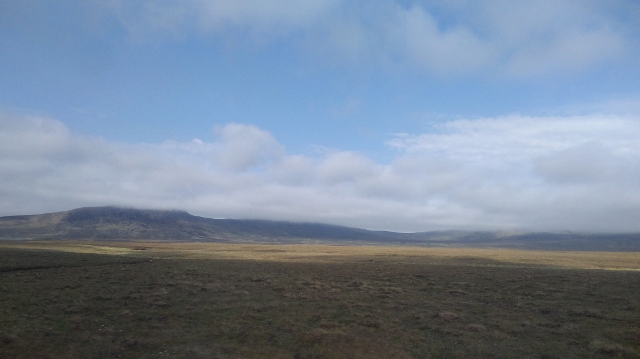
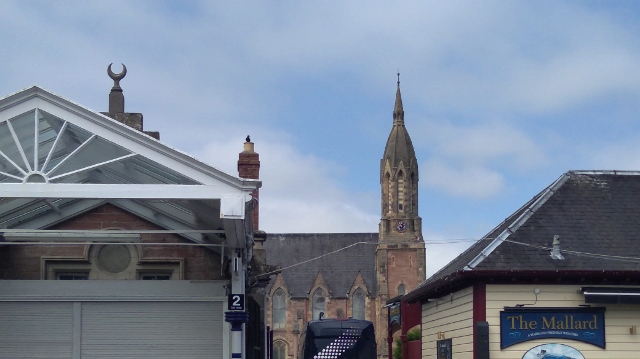
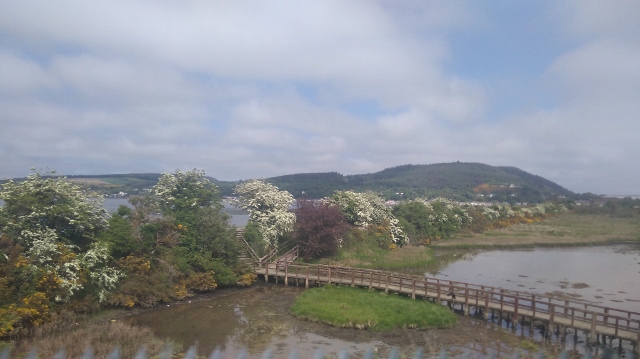
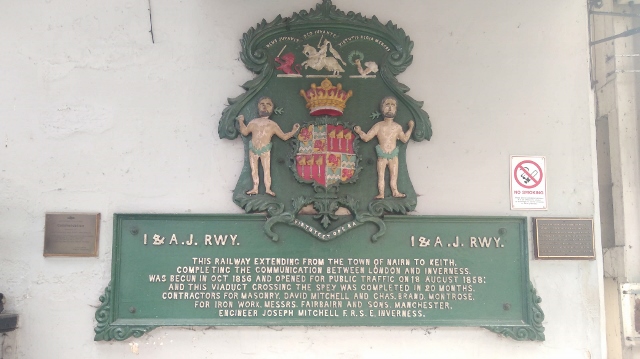
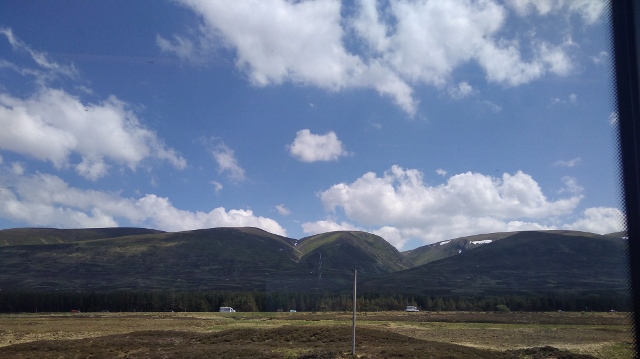
The Cairngorms National Park was spectacular: covered in snow and cloud; no plants except dour heather; the young birches not yet silver, their trembling leaves all shiny in the new season. Stopping randomly for 10s of minutes, as only British trains seem to do, there was no working wifi so I was using up my whole month’s allowance. Through forests and under quaint stone bridges; by Kingussie where the roads were wet; fair hurtling northwards to Inverness with a reassuring da da dah, da da dah – loud because the windows were open. It was a long time since I had been in a train where the windows opened.
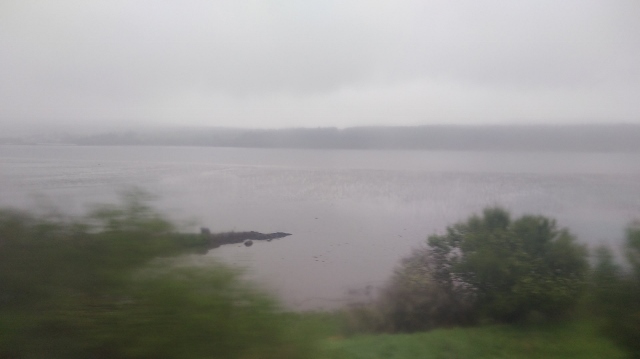
I had not been to all these places in years: Dingwall, where I and my fellow dance animateurs choregraphed for the Festival; Tain, the long-ago Royal Wedding; Dornoch, where I lay with hips propped up to turn my breech baby (successfully) on a family holiday. Happy memories!
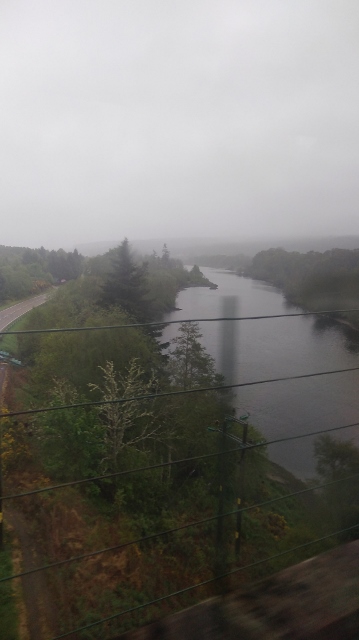
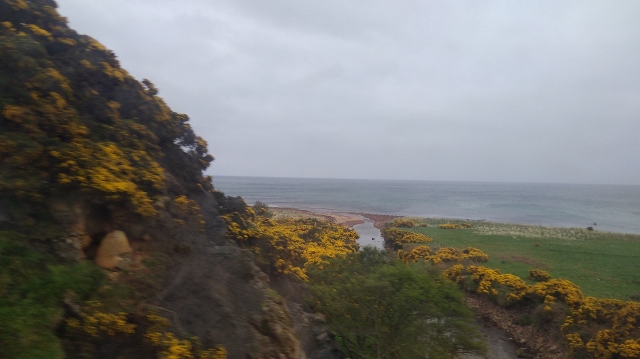
We were trundling into the land where ‘no service’ or ‘emergency calls only’ messages flash up frequently on mobile phones.
Moreover, I realised it was dolphin and whale territory, and I thought, ‘Maybe this will be the trip where I see one’.
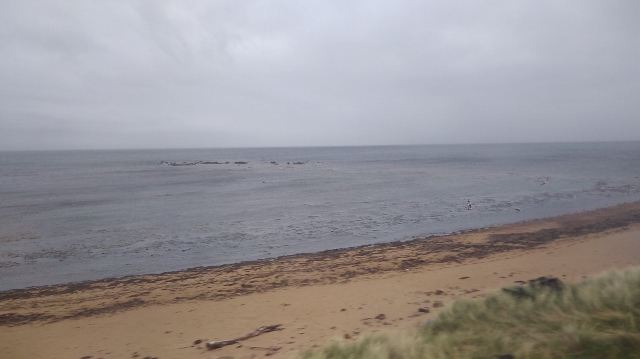
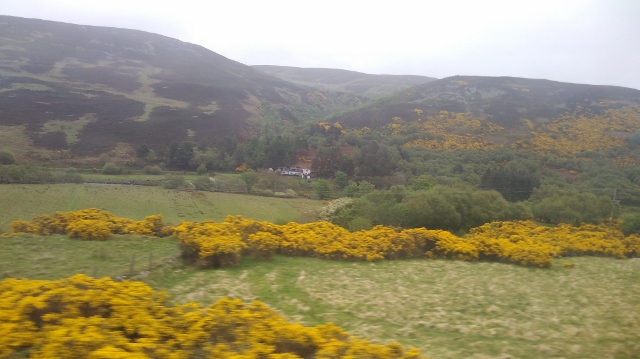
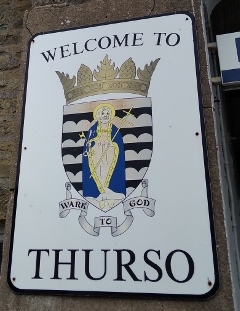
I alighted at Thurso which is a 10 minute car journey away from the Scrabster ferry terminal. A sign said, ‘Bus stop at front of station’, but I could not find it. I asked a woman who was picking up her nephew and his girlfriend, and she spoke to her taxi driver friend and he took me there for free, saying that buses sometimes stop but sometimes do not, and that no-one ever knows if it is an on or an off day! He dropped me at the door of the ticket office, sweet man. I found myself thinking that he would surely go to heaven for helping a pilgrim. (I might have been reading too many history-of-the-Camino books)
As I waited I thought ahead: ‘Do I walk to the campsite when I get there, and try and erect the tent for the first time, even though it may be dark?’ (I didn’t try it before leaving home, which in retrospect might have been a good idea). Or, do I forgo the pre-paid £8.25 and stay at the hostel, whose kind owner had emailed several times that day telling me I could have a bed there for the night? You can even sleep in my sitting room, she had added, if there is a sudden rain-induced, last-minute rush. What kindness!
As the queue built, there was a man with a trolley and the biggest, shiniest awards cup I had ever seen perched on top of his belongings. I surreptitiously snapped a photo (which, later, turned out to be too blurred to reproduce), but the American woman went straight up to him and said, ‘aw, how did you get that?’, in her immediately identifiable drawl. Fly fishing, apparently.
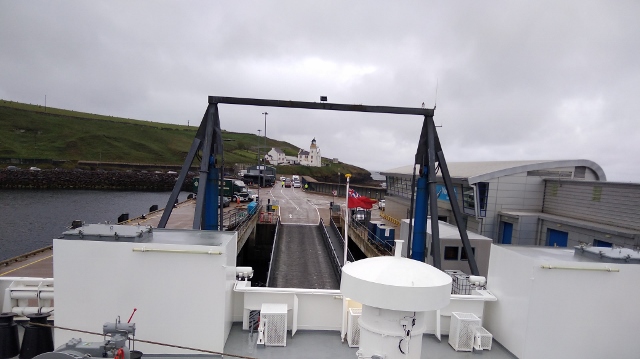
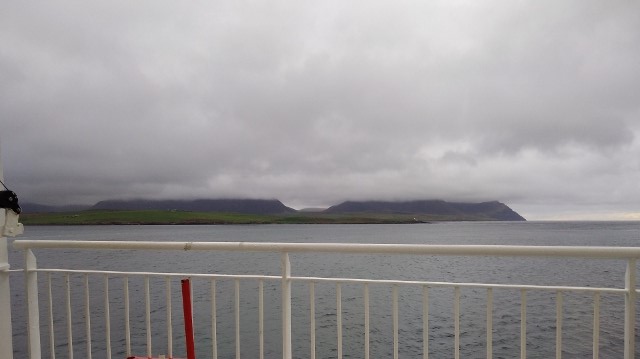
I thought I might try an Orkney ale on board ship – I chose Raven with its ’classic, malt, tangy bitterness’ costing £4.95, and ate something before I went up on deck to view the choppy – rolling – swaying – splashing sea. The variously grey-hued land had an undulating peak-line which exactly matched the heaving waves.
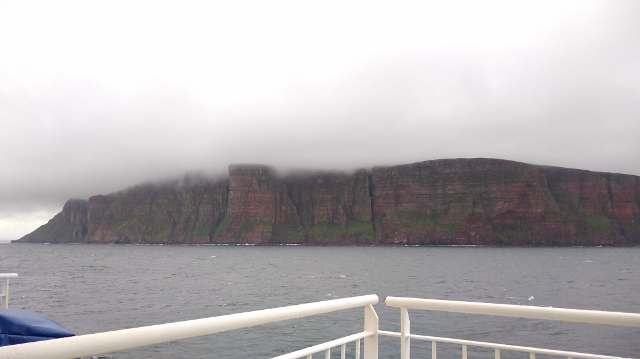
I sighted the vertical cliffs of Hoy which reminded me, first, of a lightly charred steak, and then as if someone (God?) had chiselled down trying to make a straight edge. It was darker in the foreground and mistily pale behind. The tips were lost in cloud as we steadily churned our way towards Rora Head and past The Point of Oxan, Graemsay.
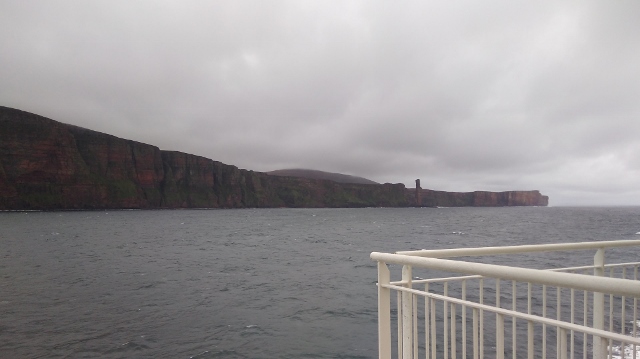
The gap narrowed and the same cliffs became green and orange/brown with their archaeological stripes. I spotted the noble totem pole of The Old Man of Hoy (a 449 foot (137m) high seastack of red sandstone). Great blocks and crevices, darkly, vertically-bevelled, looked as if a car vandal had repeatedly run a sharp implement along them, port to starboard.
Even closer still, it actually looked like a salmon steak with pesto dribbled over. There was a frothy beer-head of a dividing line between the land and the brine and it was getting to be very cold, even though I was wearing every article of clothing I had with me. Perhaps I should have bought my jacket? Yes, later, I knew I should have. (See the ‘what I took with me’ link below).
I once again contemplated putting up the tent and wished I had read the instructions in the dry, but they were in my rucksack and that was in the hold of the boat. At least I had my waterproof trousers for the pitching, and my warm sleeping bag and new blow-up mat for the sleeping.
An alternative to my route would be to take the Stagecoach bus X99 all the way from Inverness to Scrabster, eliminating the need to find a way from Thurso to Scrabster ferry terminal. When you look at the timetables, make sure you check for suitable connections before booking, as they are not automatically linked up. https://www.stagecoachbus.com/
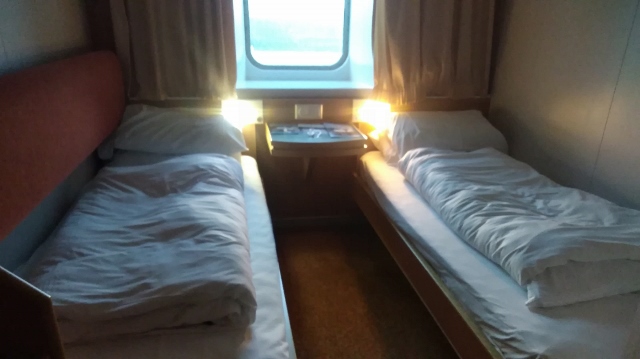
North Link Ferries (which has a particularly impressive website picture of a pointing Viking) sails from Scrabster (mainland Scotland) to Stromness (Orkney) taking 1.5 hours. For a bed in a shared cabin, it costs £25 (varying prices at different times of the year). You get the bed (and towels, tea, TV, own toilet and shower) plus snacks in the evening, and a full, eat-as-much-as-you-can breakfast. What a bargain! The staff are all helpful and their booking system is super-flexible, allowing you to change the time of your sailing the day before. I recommend phoning or doing it in person if you speak English and are nearby.
Orkney
we sail past Stroma’s empty fields
the maidens grind the sea-god’s salt
binoculars to scan the scene
the latent power the races holddivers down among the wrecks
I don’t know what it is I’ve found
a haar drifts in across the rocks
the crab’s blue shell fades in the sunthe Romans came and saw and left
Vikings named themselves in runes
a hoard of shards the dig unearthed
the sacred grove is made of stoneunfurl your banner to the breeze
starlings wheel across the sky
a spotted orchid in the verge
the wind is in the blades and flagsKen Cockburn from ‘Floating The Woods’
For details of campsites etc, see Accommodation: where I stayed (link below).
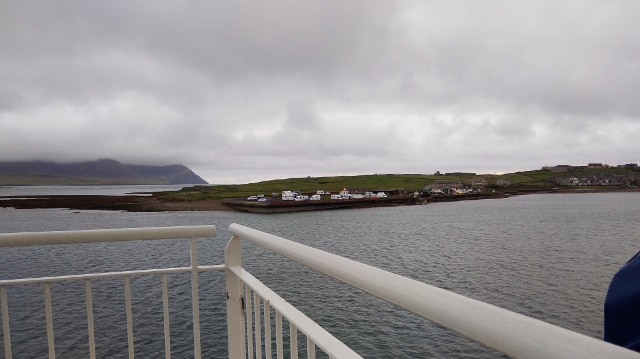
The pitching of the tent was in fact straightforward. Perched on the south eastern corner of the West Mainland sticking out into Hoy Sound, it was actually the cold that got to me. I did not feel it from underneath as you might expect, but from above. I had a fitful night. After years of listening to women’s birth stories, what do I always say? If anything does go wrong at all, the thing that happens is not the thing you fear the most; it is something you haven’t anticipated. Perhaps the same is true of all problems.
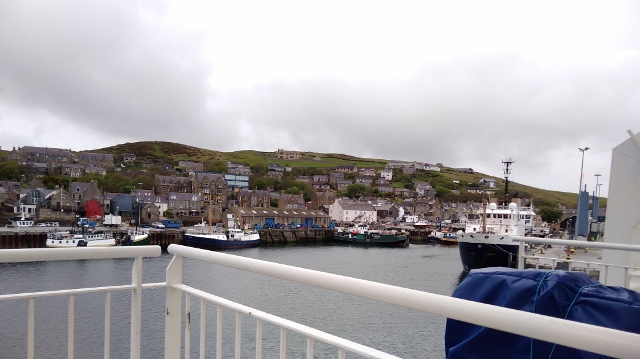
The next day I took a very early bus (number 6 from the ferry terminal at Stromness) to Kirkwall, waited half an hour by the sea, and then travelled on a second bus (X1) to nearly-Tingwall (a 15 minute walk to the ferry terminal from the main road).
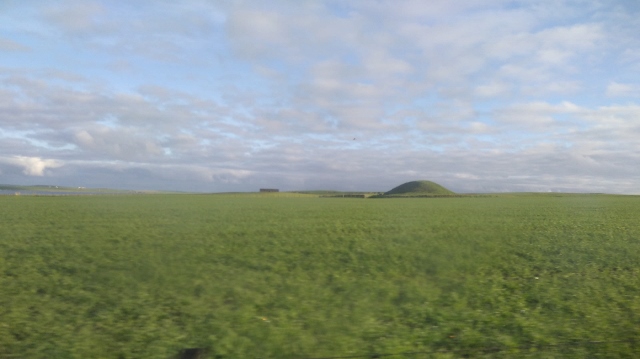
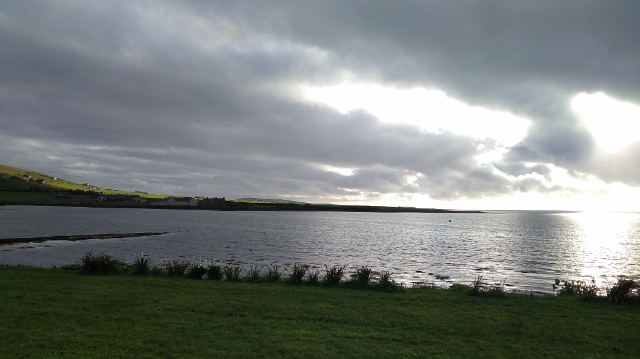
As the office is shut at that time of the morning and there seemed to be no indoor place to sit, I squatted in the corridor of the toilet block which was warm, and read my funny book. My time on Egilsay is in the next blog.
Other transport details:
Please note that the travel details in this blog are for one foot passenger – it is more expensive with a car / camper van. Try this website for the best route.
There is an ‘Orkney Bus‘ from Inverness to Kirkwall (£19) which is like the channel tunnel service between England and France: taking you there on one ticket. It operates from 1 June to 31 August.
The Tingwall – Egilsay service is operated by Orkney Ferries who, once again, have helpful staff. There are two stops at the ferry terminals of Rousay each way (I would love to go there) and one at Wyre. There is a hot drinks machine on the boat but no refreshments at any of the terminals. You do not have to get the early ferry like I did as Egilsay is small and you will have plenty of time if you get the mid-morning boat and return in the afternoon. http://www.orkneyferries.co.uk
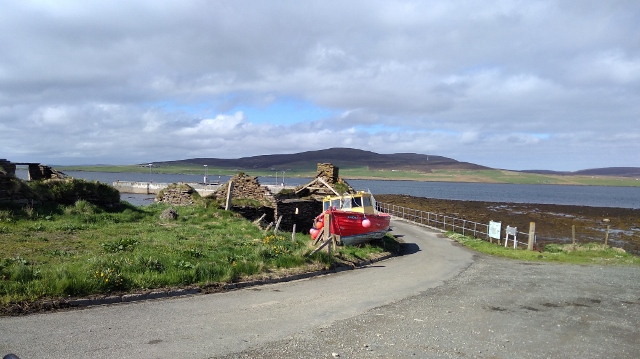
On my return I took the X99 from Scrabster ferry terminal (it departed shortly after disembarking), which dropped me in Thurso town.
You can also get to Orkney by taking the John O’Groats ferry to Burwall on South Ronaldsay (40 minutes) and make your way from that island to the West Mainland; or by ferry from Aberdeen to Kirkwall (6 hrs or overnight, £63); or Gill’s Bay to St Margaret’s Hope on South Ronaldsay (which sounds lovely as there are lots of things to see and do there) (1 hr, £32).
Links:
Accommodation – where I stayed
Resources – what I took with me
The Last Day
Resources – shops, cafes, pubs etc
Finding your way
Reflection