The Bluebird Call by Mal Pelo at Bòlit, Centre d’Art Contemporani, Girona. In two parts: Bosc Tancat (‘Dense/Enclosed Forest’) in Bòlit_LaRambla, and Taller-Memòria in Bòlit_PouRodó.
“If the main driving force of our dynamic is walking then that of our identity is asking questions.”
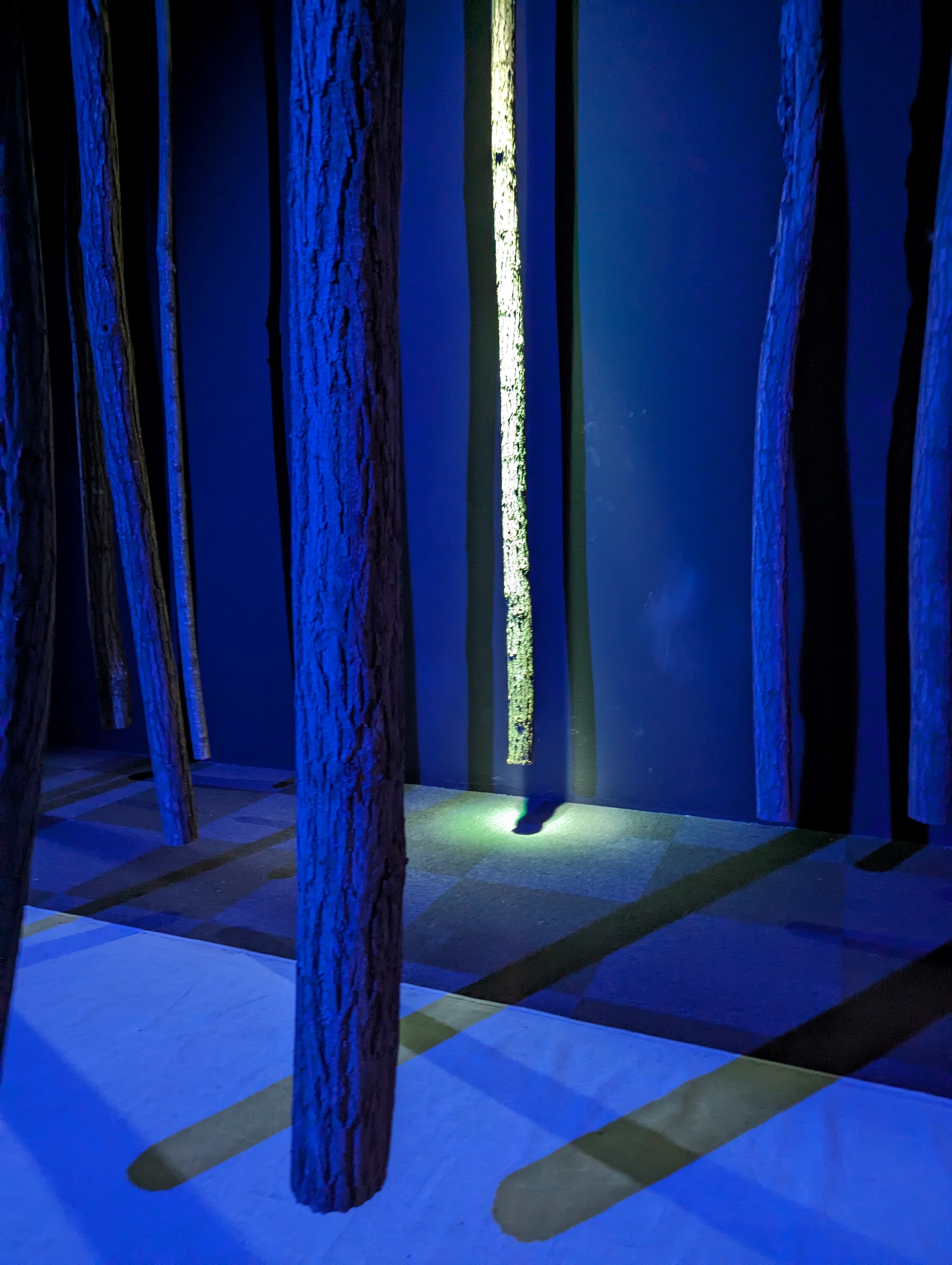
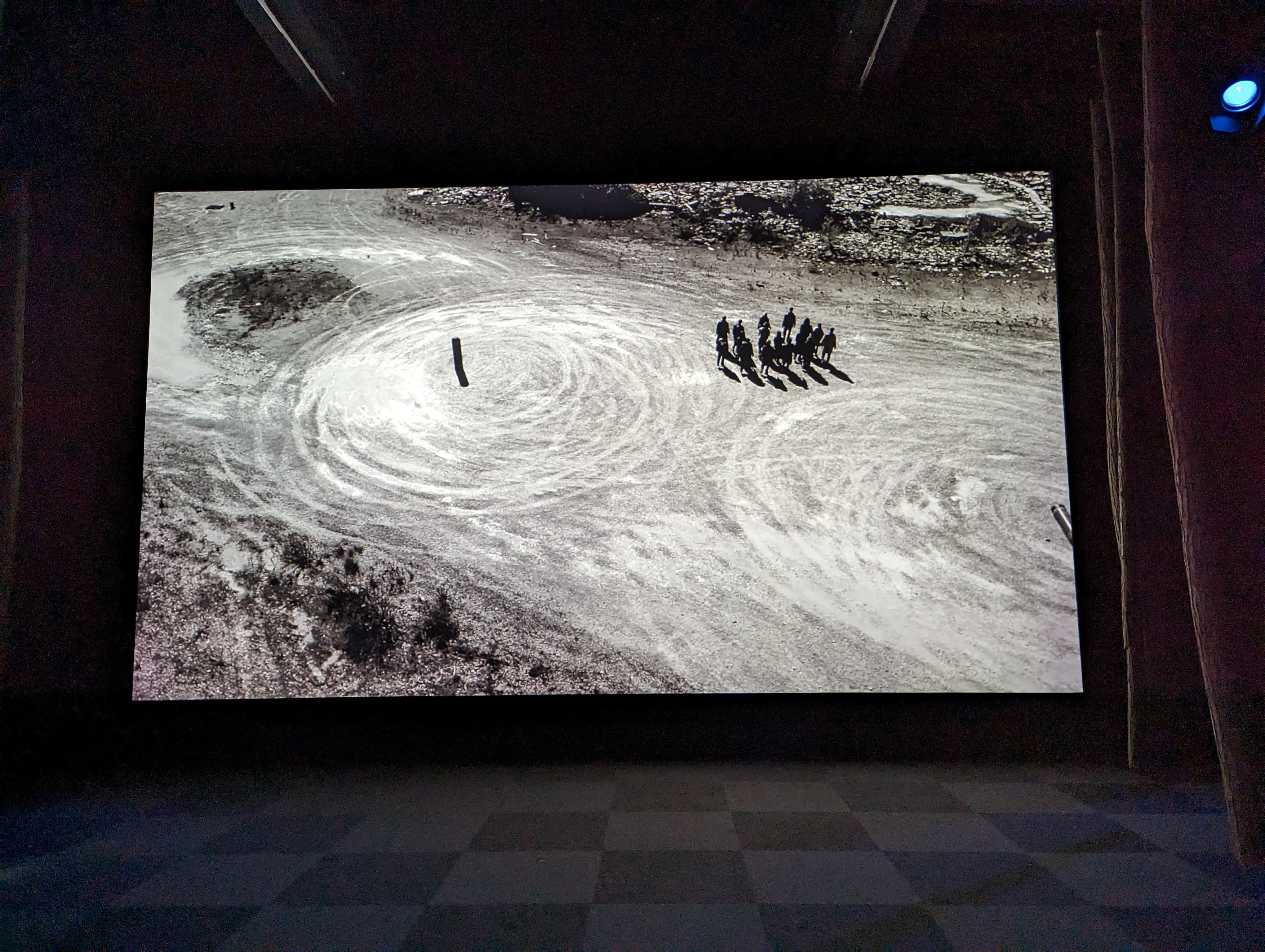
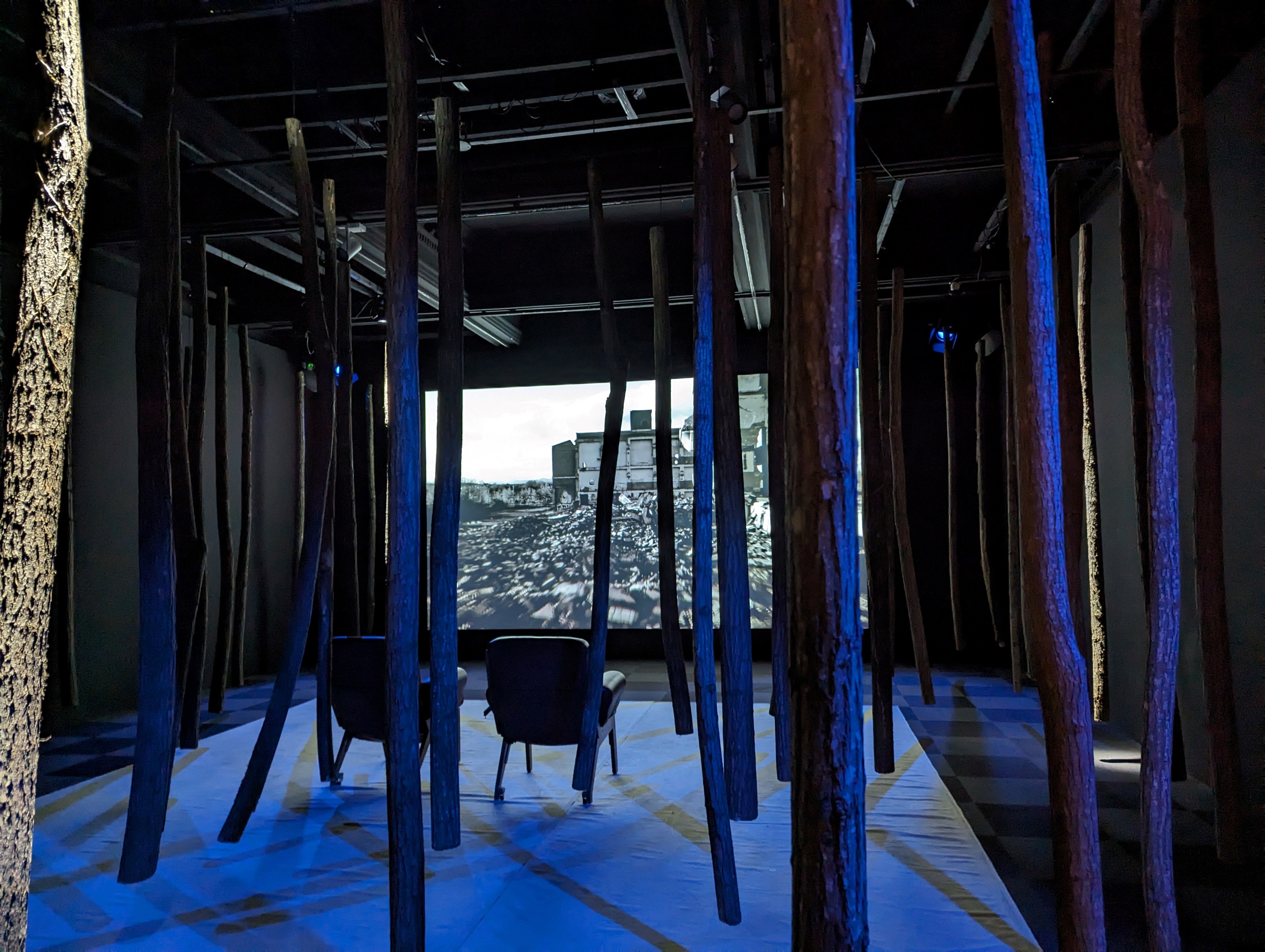
In this video-art-light installation at the Bólit, Centre d’Art Contemporani in Girona, tall, straight tree trunks are suspended. Hanging off the ground without roots, they exist in an other-worldly, ghostly light in front of a large screen showing a black and white film. On that screen, people swarm slowly, alone and blank-faced, in step with each other. They walk rhythmically, turning at random intervals, sometimes in concert with others in the group. They walk and walk.
Based on a poem, Separation, by art critic, painter and writer, John Berger, the company state that the work is “about the ambivalence of the individual and the community”. Using the medium of contemporary dance in the broadest understanding of that word, and highly respected within the artistic community (they were directorial collaborators in the extraordinary Falaise by company, Baro d’evel, for example), Mal Pelo are the artistic co-directors, dancers and choreographers Maria Muñoz and Pep Ramis based in Girona.
Their film is set in bleak forests and abandoned industrial and rural wastelands where an assembly of overcoated, beanie-hatted people walk together. With arms swinging naturally or hands in pockets, they carry nothing, though we see them sharing sliced bread, offering it to each other when they make a meal stop. In Separation, Berger writes, “… in our hearts we carry everything …”.
Afterwards, they wind between trees, something we must do to get to one of the two chairs which invite us to sit and watch. There’s a sense these humans — for there is a homogeneity about them — are searching, and yet they seem aimless. Are they a tribe? An extended family? They wander individually, collect for a moment like a flock of ground-based birds arcing en masse, still moving, before separating again.
Stylistically, the collaborative choreography is reminiscent of the early pedestrian experiments of the Judson Dance Theater in the New York lofts of the ‘60s, harking back to the very early work of Simone Forti, Steve Paxton and Yvonne Rainer. This work marked an important departure from the dark auditoria, proscenium-arch theatres, in which dance had almost exclusively existe
d before that, to more quotidian spaces, to the studios and pavements of America. The participants often had no training, they were ‘ordinary’ people who were simply interested and willing to experiment. There was an anarchic spirit about the period.
The filming in Bosc Tancat is often from above, inverting our ground-based habit of looking up to see a skein of geese flying in formation, our normal way of seeing. At other times, the walkers move directly at the camera, passing by without acknowledging it. Walking away from us without pausing, they continue to walk as if forever, pacing without stopping. Are they in harmony? Are they moving away from home or life or land, or towards it?
The haunting, instrumental score in Dense Forest by Fanny Thollot, is interspersed with Berger’s poem, gently spoken. There are occasional silences, too, as if the wind has momentarily ceased though the movement is ever onwards.
Sitting amongst the ‘Dense Forest’ close up to the wall which is filled with this film, I am carried along the paths with the chorale, as if lacking a sense of autonomy. I feel as if I am slowly floating and looking down even when the lens is not, my wings outstretched, my seeing and hearing alert, but when the company eventually come to the end, it is at an edge. They collect at the top of a cliff, a vista ahead of them and there they sit with their backs to me, still, at last, and I am left, melancholy.
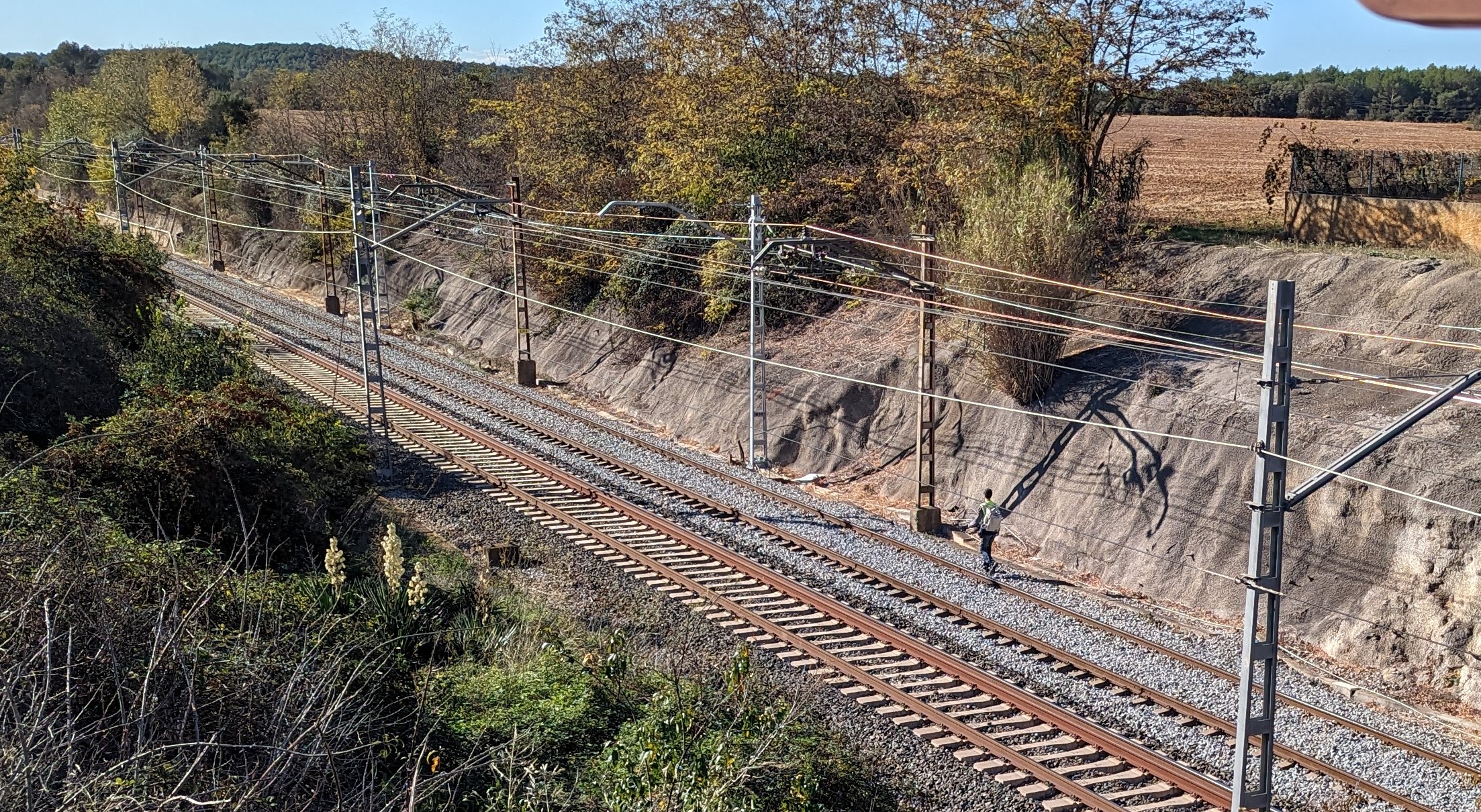
I am suddenly taken back to two occasions when I have witnessed single men walking along train tracks with no luggage. Once, in 2018 in north eastern Greece not far from the Turkish border, I was in a car witnessing through the window as we passed him walking into the distance. The other time was just last week in Cataluña when I stood on a bridge and looked over and down watching this tiny figure recede.
The actions, the behaviour of the performers in the carefully chosen landscapes of Bosc Tancat have a timelessness and as I leave I feel a deep connection to them.
A Community Walk was held on Friday February 23rd between 4-5.30pm, with drinks and discussion afterwards to chat about the walk and what we had seen and felt, at 5.30-6.30pm. Eventbrite was used for booking and everyone and their dogs were welcome!
The walk began and ended at the Granton:hub, Madelvic House, Granton Park Avenue, EH5 1HS.
I contributed words and images to a video assemblage, together with a host of other artists and Kel Portman, whose provocation this was. The link is here on the YouTube channel of Kel Arrowsmith. (My part is at 6:30 minutes.)
Introduction
A Granton Boundary walk was made in the Autumn of 2023, in advance of the opening of the Walking Like a Tortoise exhibition at the Granton:hub. It invited people to walk slowly together with a paper map, and annotate that map with places of interest (objects passed, thoughts thought, feelings felt, sites appreciated or not). We meandered, responding to participant’s interest, to their prior knowledge of the area, and to our whim. This might happen again! It was followed by a standing-up discussion and sharing of maps outside the building.
What happened on the walk
I proposed a (repeat) Midwinter walk around the same edgeland, as the evenings lightened, and I invited those who still had their maps to bring them and make comparisons. I brought the ones I was given after the original walk and handed them back for the purpose.
Tamsin
There was a brief introduction, then we walked together and had the opportunity to chat about borders and territories.
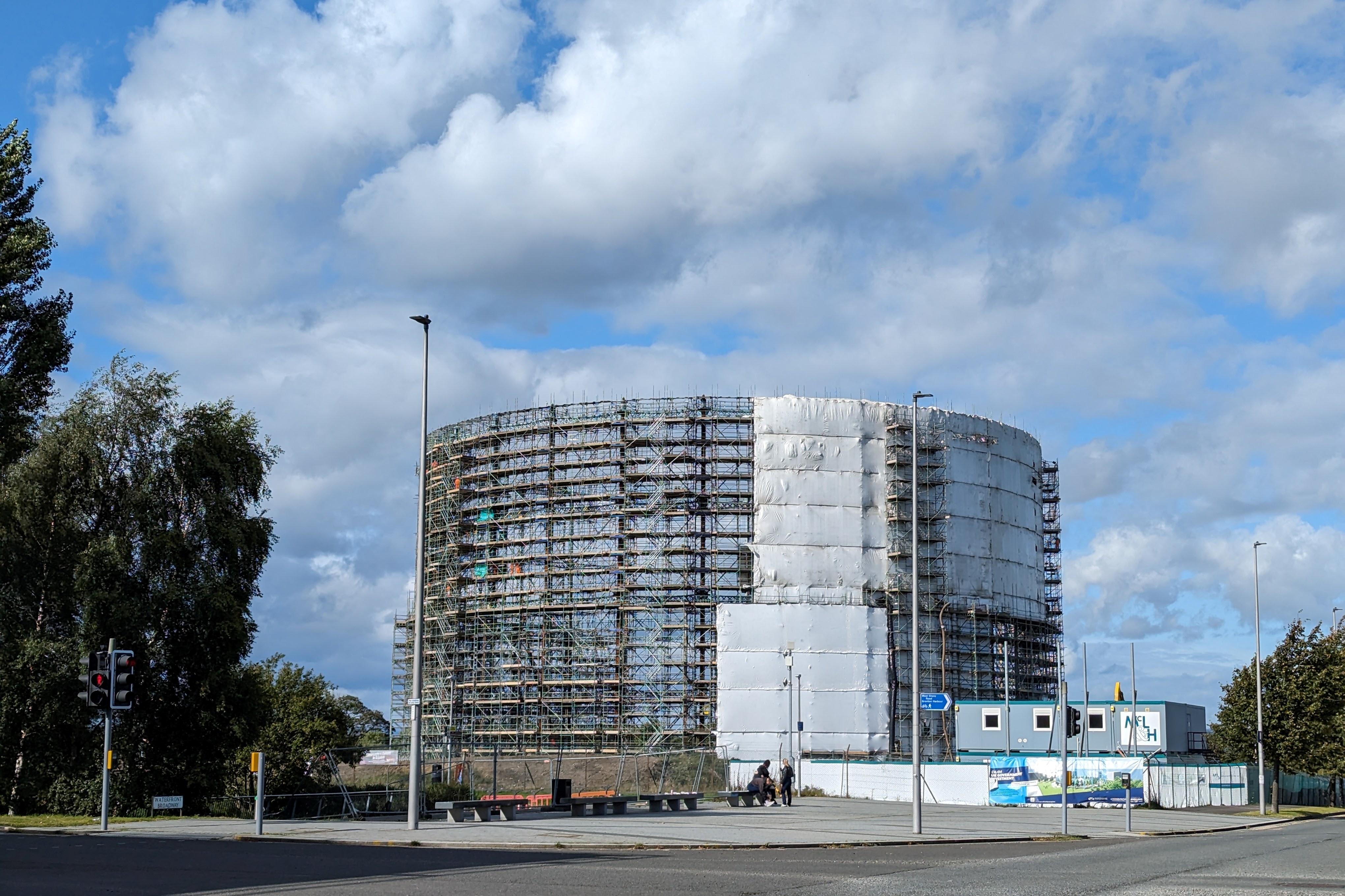
The remaining Granton Gasholder which is being built around, providing new housing and arts interventions
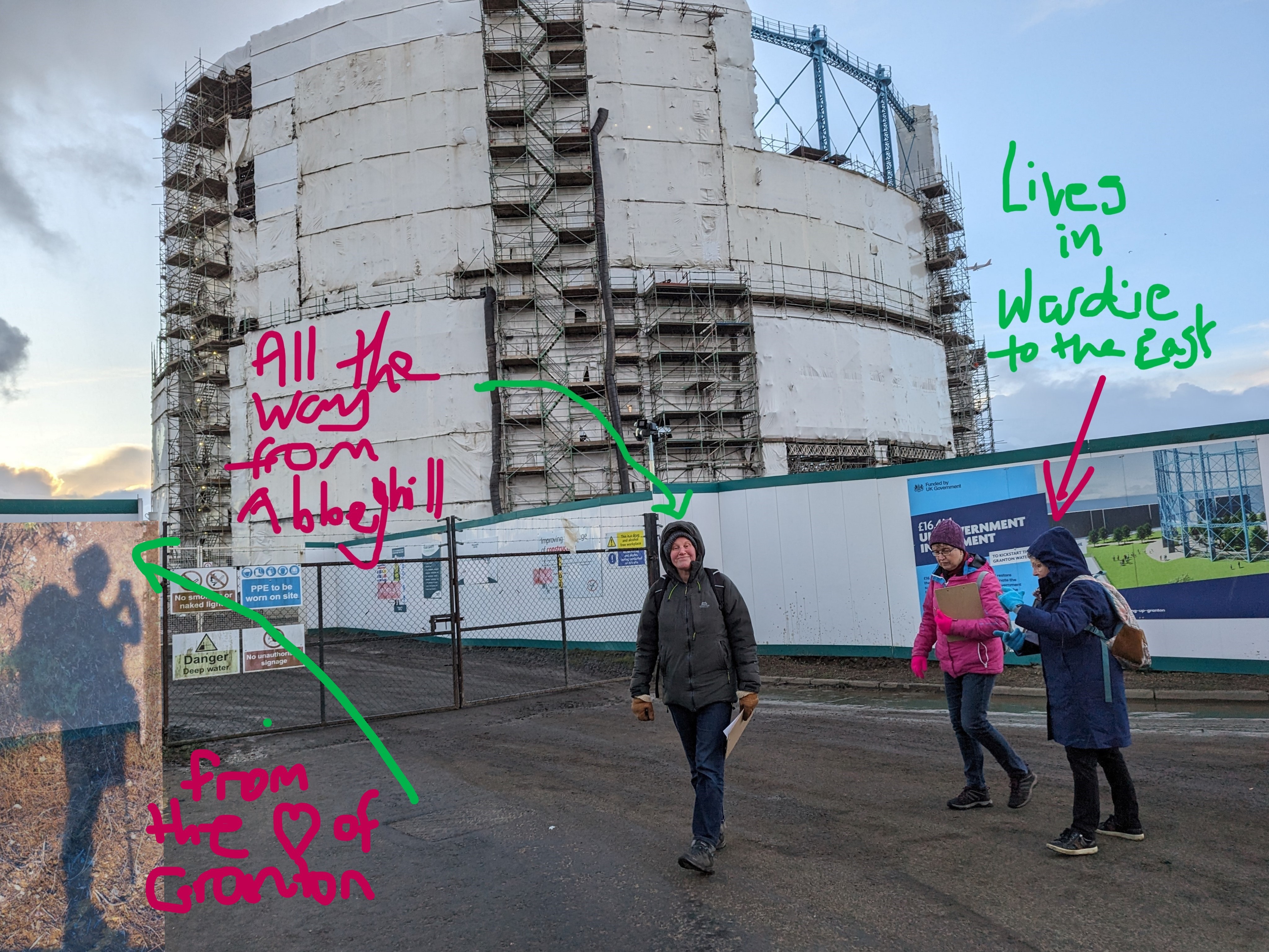
The immediate area around Madelvic House has changed considerably, as has the Gasholder (it was partially wrapped up) and the harbour, and therefore the new maps created will be likely to chart those changes, together with that of the seasons, and the alterations in us and the environment during the past quarter year.
Some of the group at the gasholder
This was an inclusive walk, paced for everyone, which was therefore on pavements.
Festival of Terminalia
This event was part of the Festival of Terminalia, an annual one-day celebration of walking, space, place and psychogeography.
Terminalia is a one day festival of walking, space, place and psychogeography on 23rd Feburary. Terminalia was the festival of Terminus, Roman god of boundaries and landmarks! Events have been run on this day since 2011.
Tim Waters tim@geothings.net
Tamsin is a wanderer and psychogeographer. She has nomadic habits and is very often found in the marginal areas around her Granton home. She is a qualified walk leader with Paths for All Scotland, and liked to perambulate with the Ageing Well group who belong to Victoria Park in Edinburgh. Her first art exhibition was Walking Like a Tortoise in 2023. She also writes and walks here .
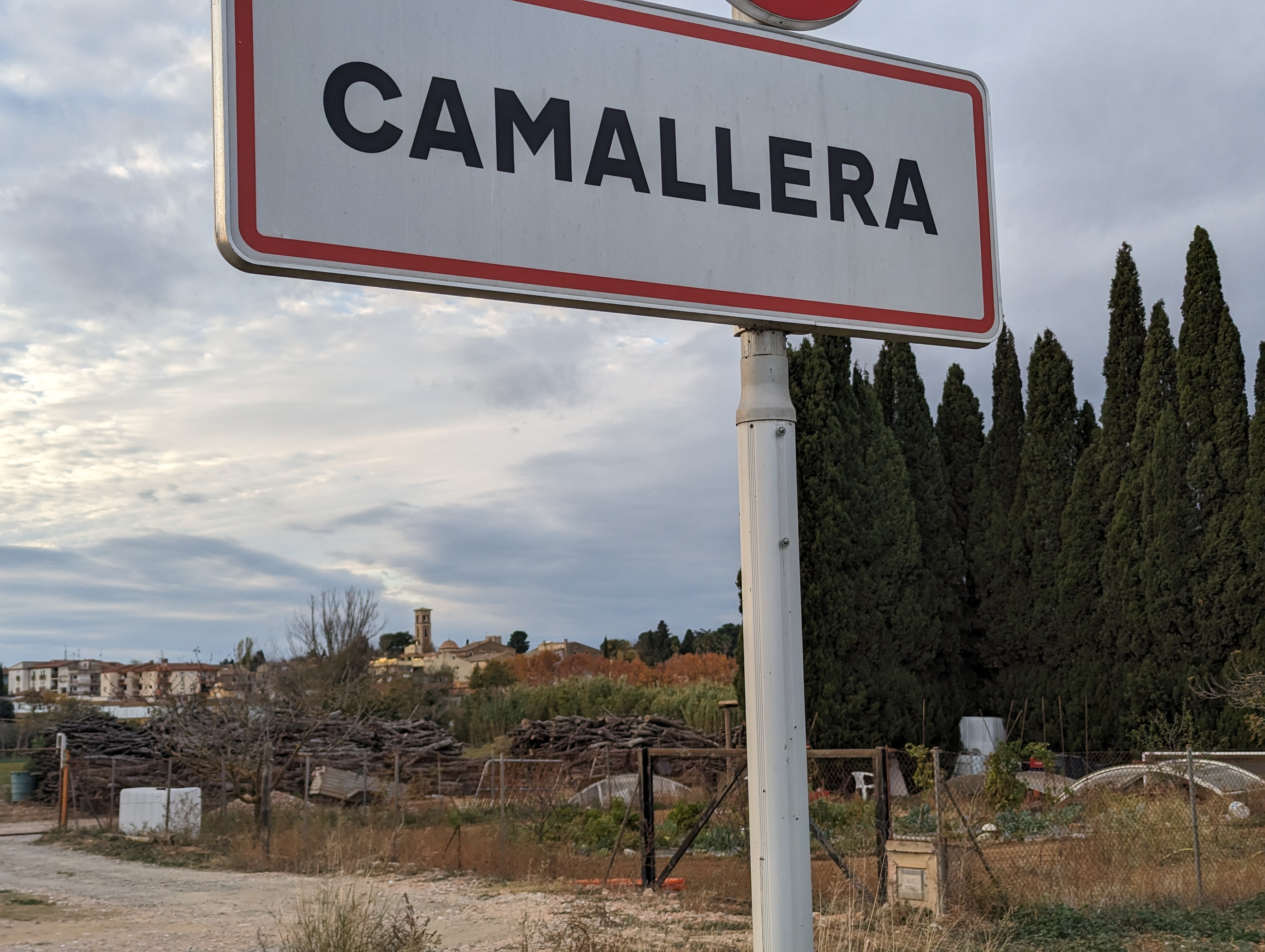
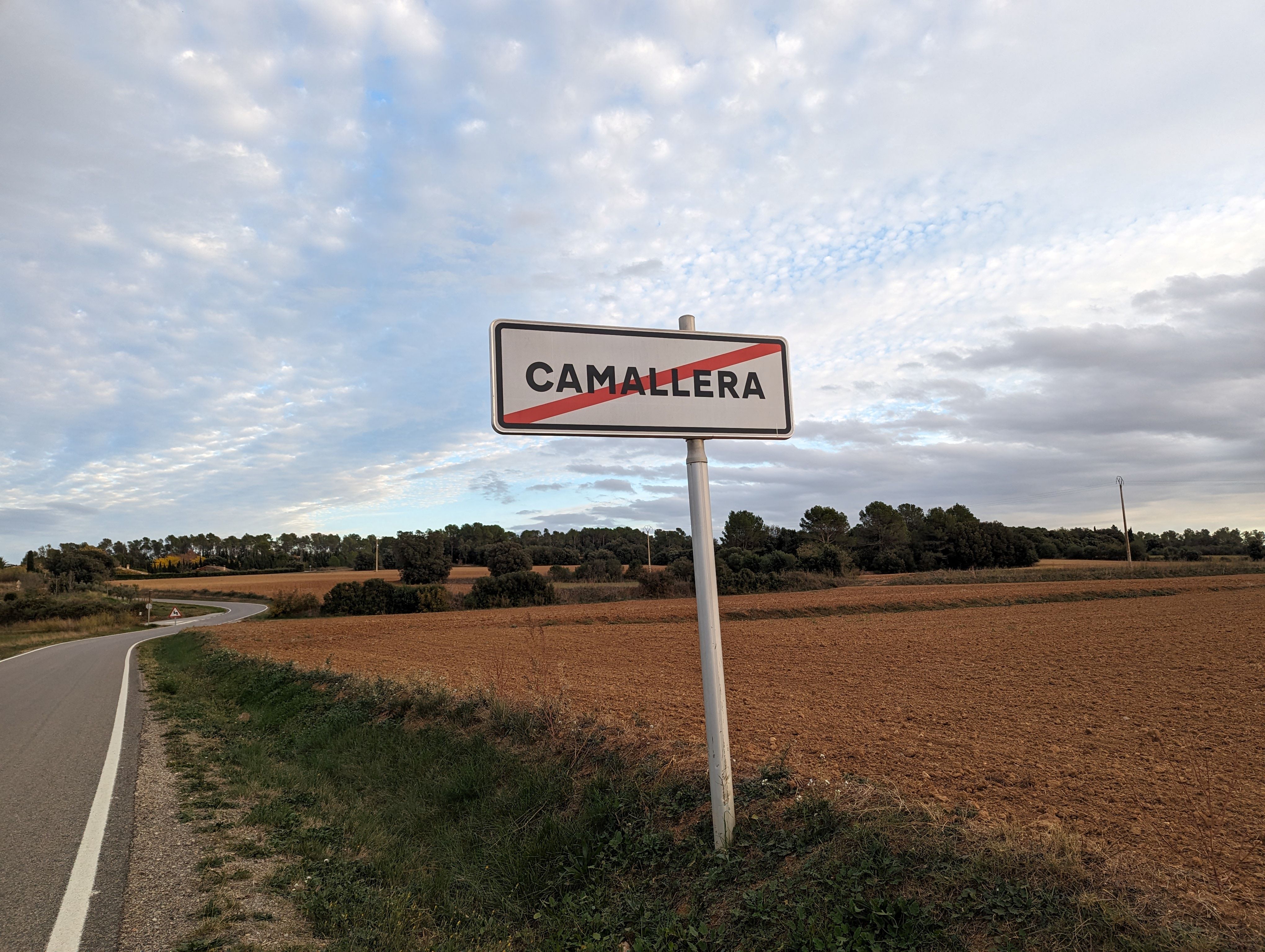
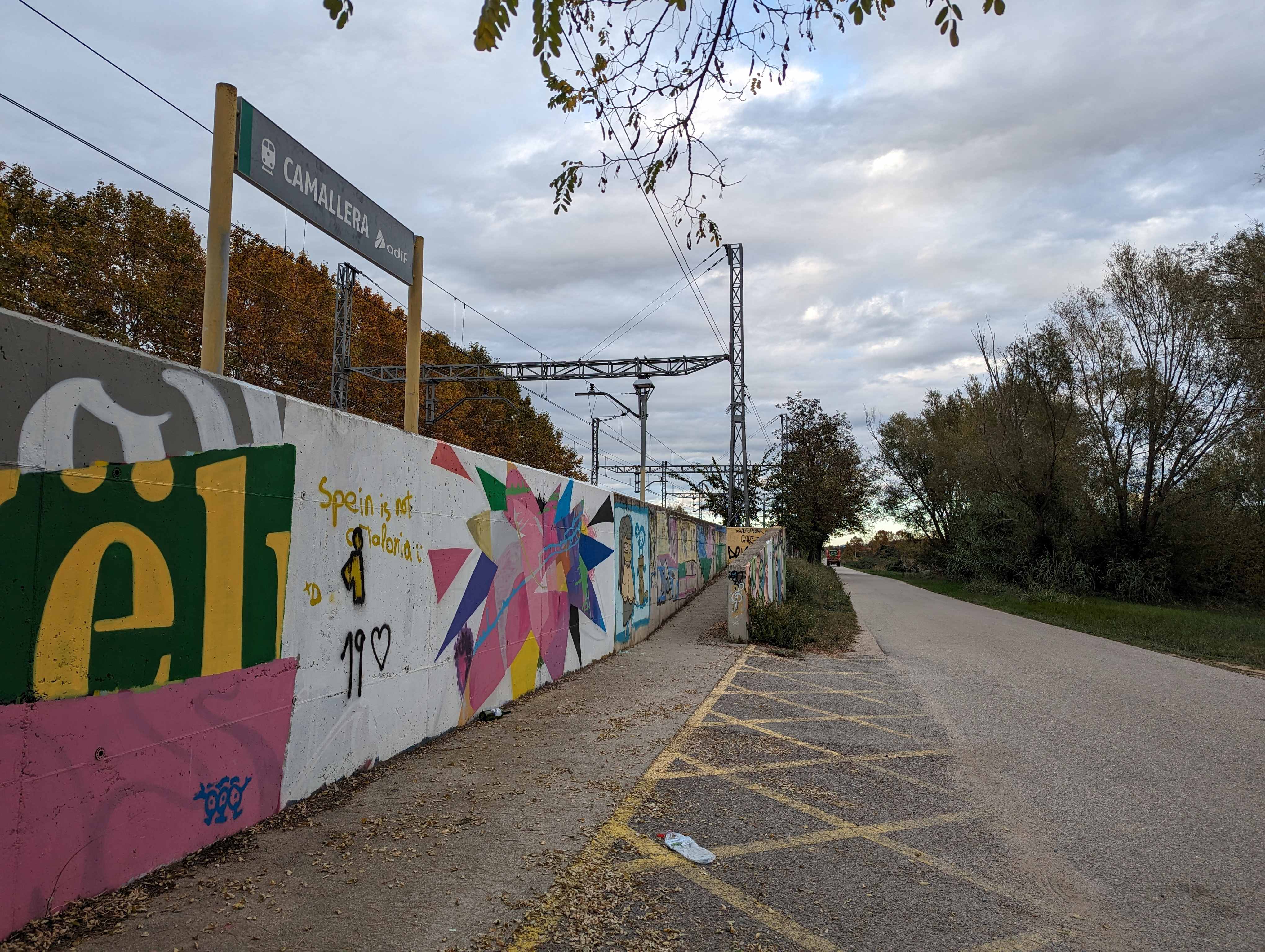
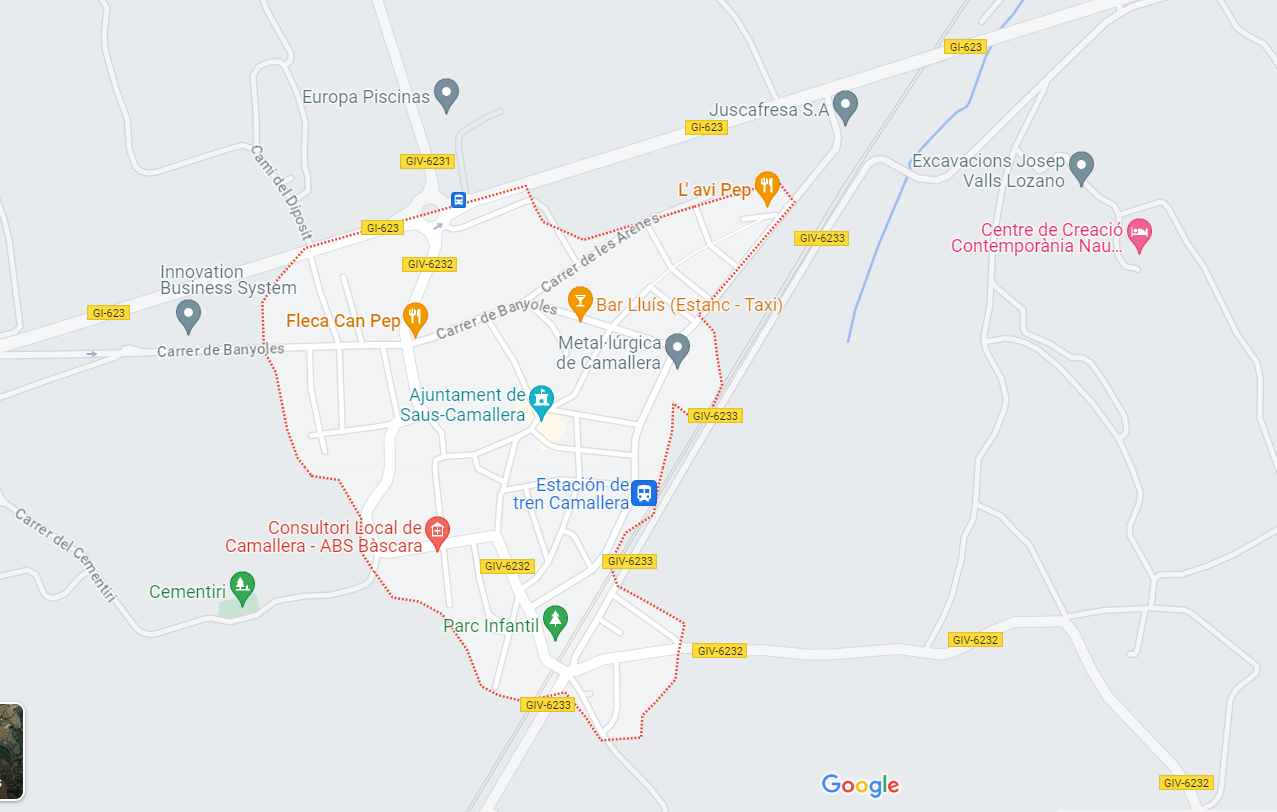
The Camallera Sound Walk is a walk around the border of the town of Camallera. There are 12 stages to the walk, and at each stage there is an original sound montage to listen to. It was created during an artist residency at Nau Côclea, Camallera, in Cataluña.
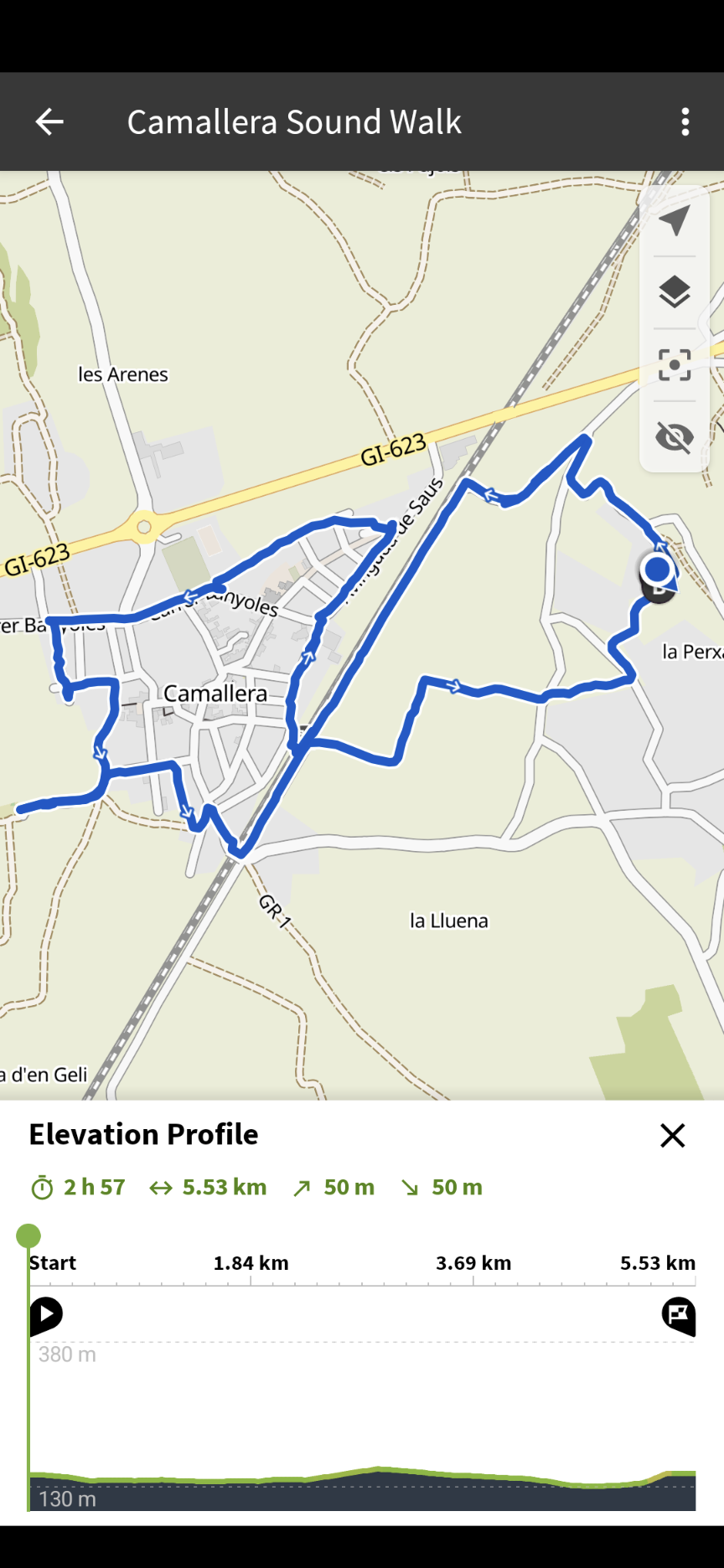
The walk is on flat, smooth land except for a short climb through the woods between Stages 2 and 3. You do not need to be very fit. It will take approximately 1.5 hours depending on your pace and how long you stop at any one time. There is a cafe / restaurant: L’avi Pep, half way round if you get thirsty (see map below). You are advised to wear sensible footwear and appropriate clothes for the weather. Bring water with you to drink.
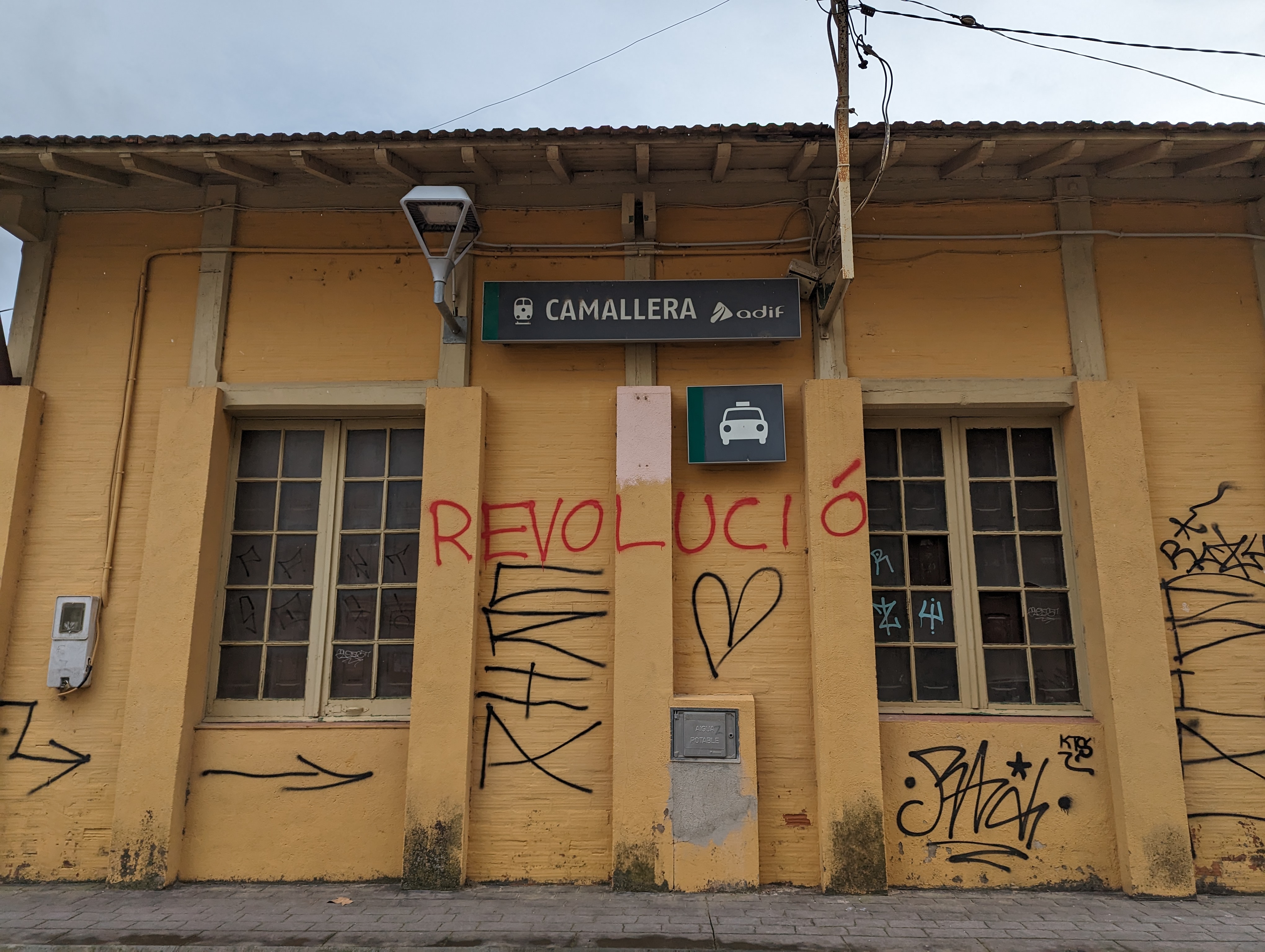
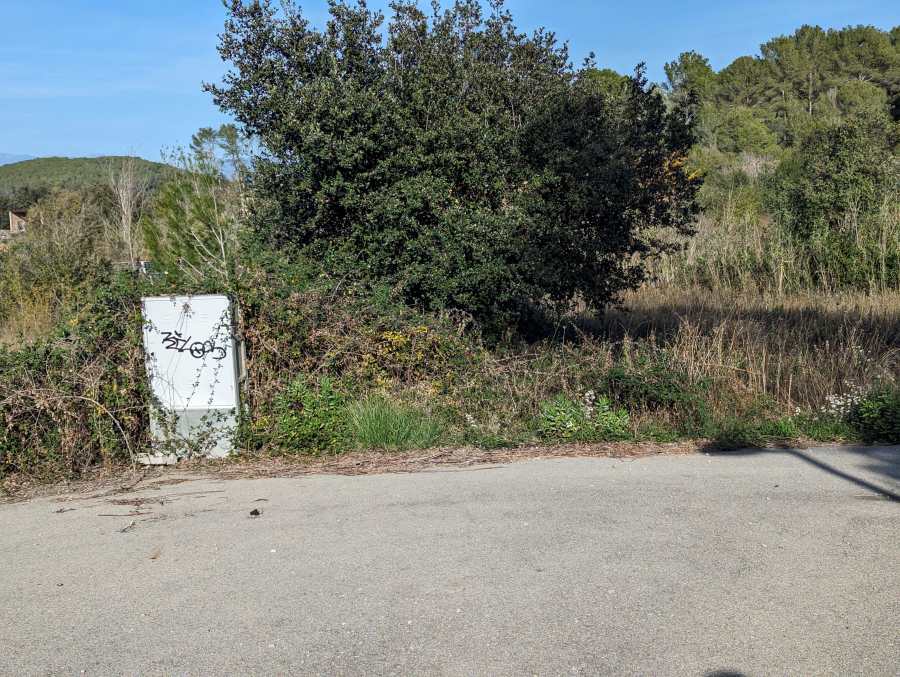
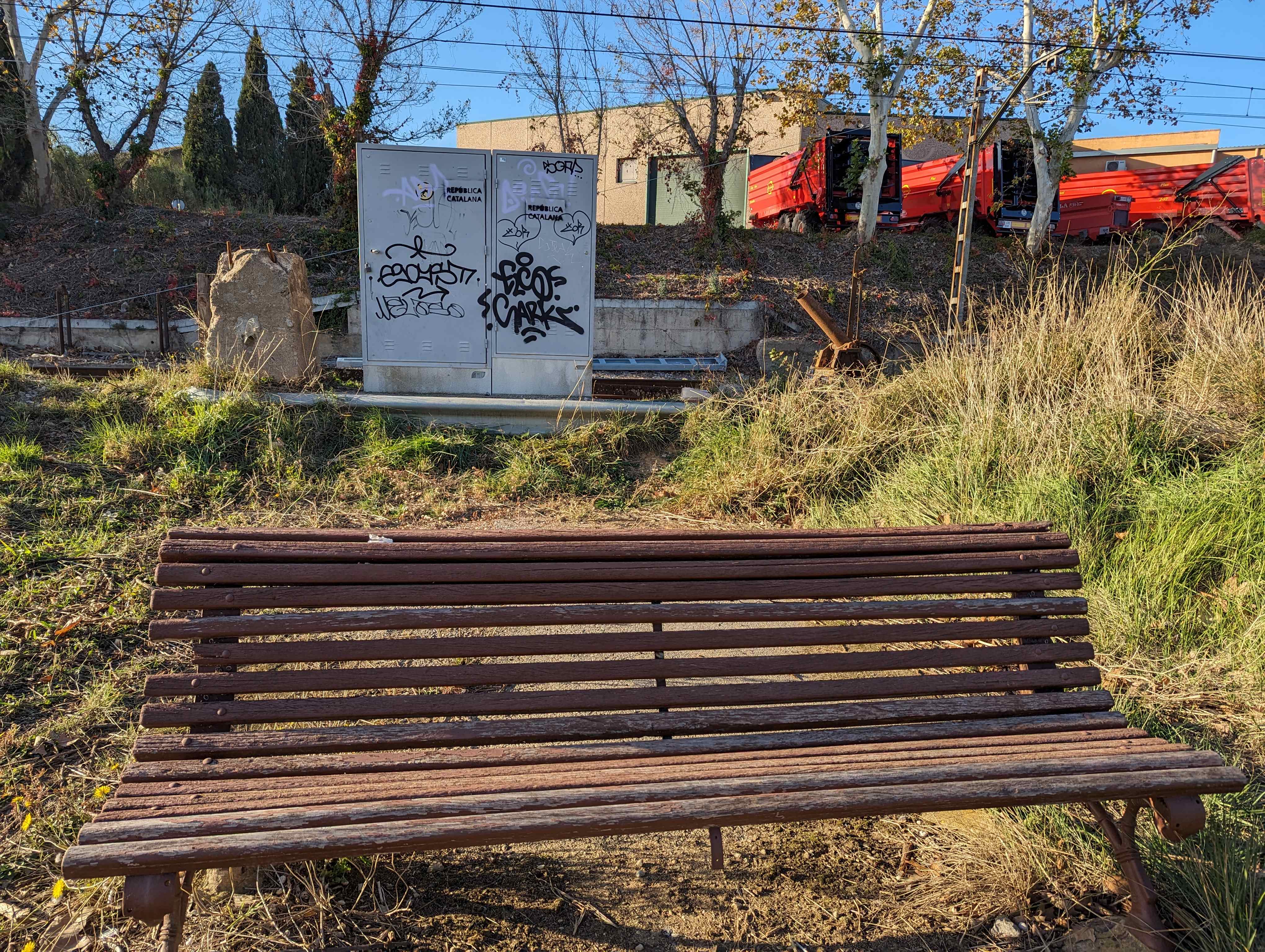
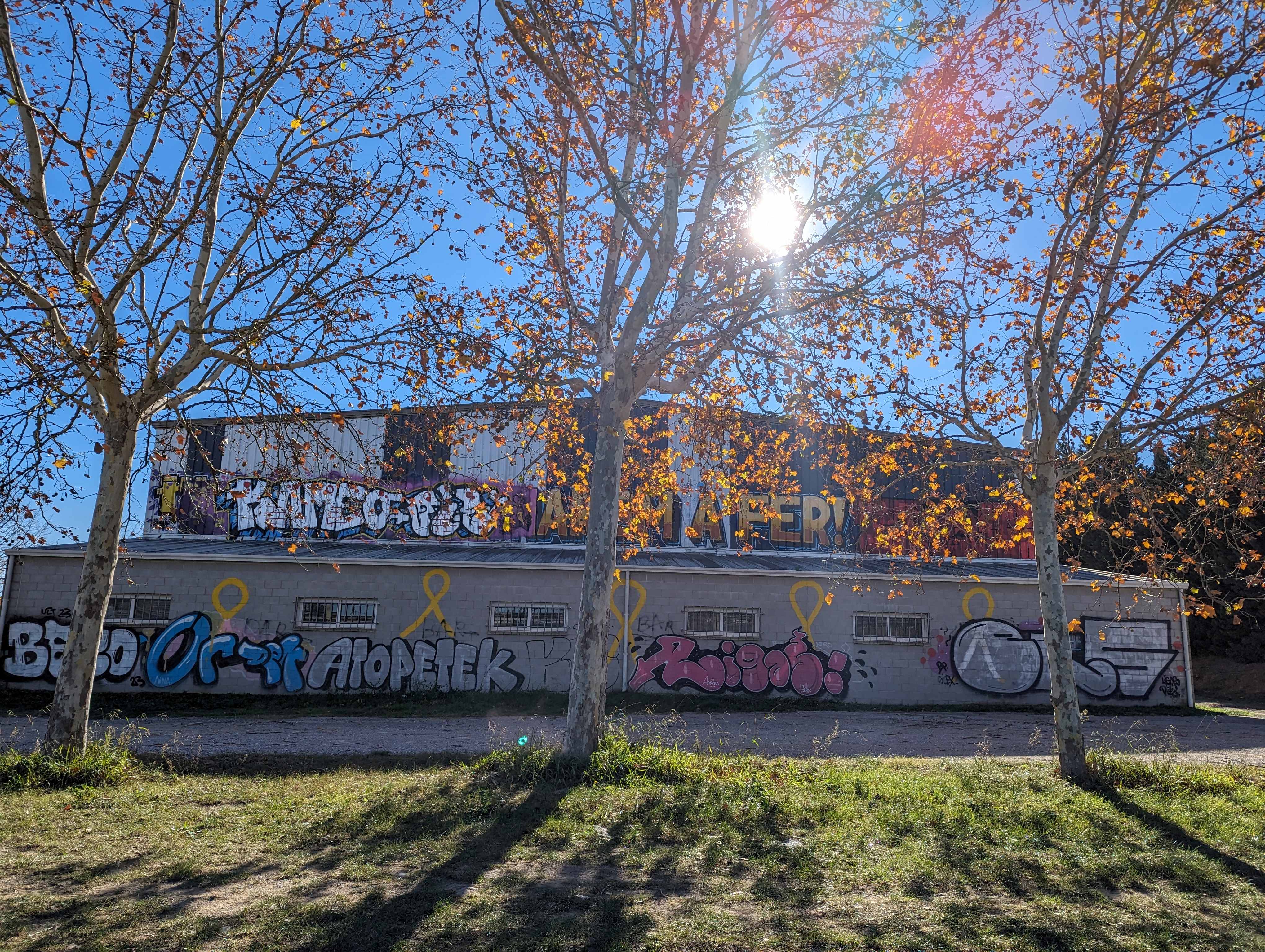
Local graffiti
Part of the Separation and Unity Project
This walk is part of the Separation and Unity project. Part One began in Spring 2023 with walking the St Margaret’s Way pilgrimage in Fife, and the oak forest of Dalkeith, both in Scotland (Caledonia). Shortly afterwards, I walked part of the Camí de Sant Jaume (Camino Catalán) pilgrimage for the Walking Arts Encounters in the summer, located in Girona, Olot and Vic, Cataluña, first alone and then leading others.
Part Two were Boundary Walks: the first around Granton in Scotland followed by an exhibition, Walking Like a Tortoise, and then this Camallera Sound Walk.
All my walks are part of my on-going life’s walk, all are connected, and each one leads on to the next.
Camallera
Camallera is a small town in the comarca (region/county) of Alt Empordá which borders with France, and includes Figueres. The municipal border (shown in yellow on the maps) between it and Vilaür slices through the top. It is a third of what I would call a parish in the UK – the trinity of Saus-Camallera – which also includes Saus to the north-east and LLampaies to the west. There are around 800 people living in Saus-Camallera, and it is a mixed agricultural, industrial and tourist area.
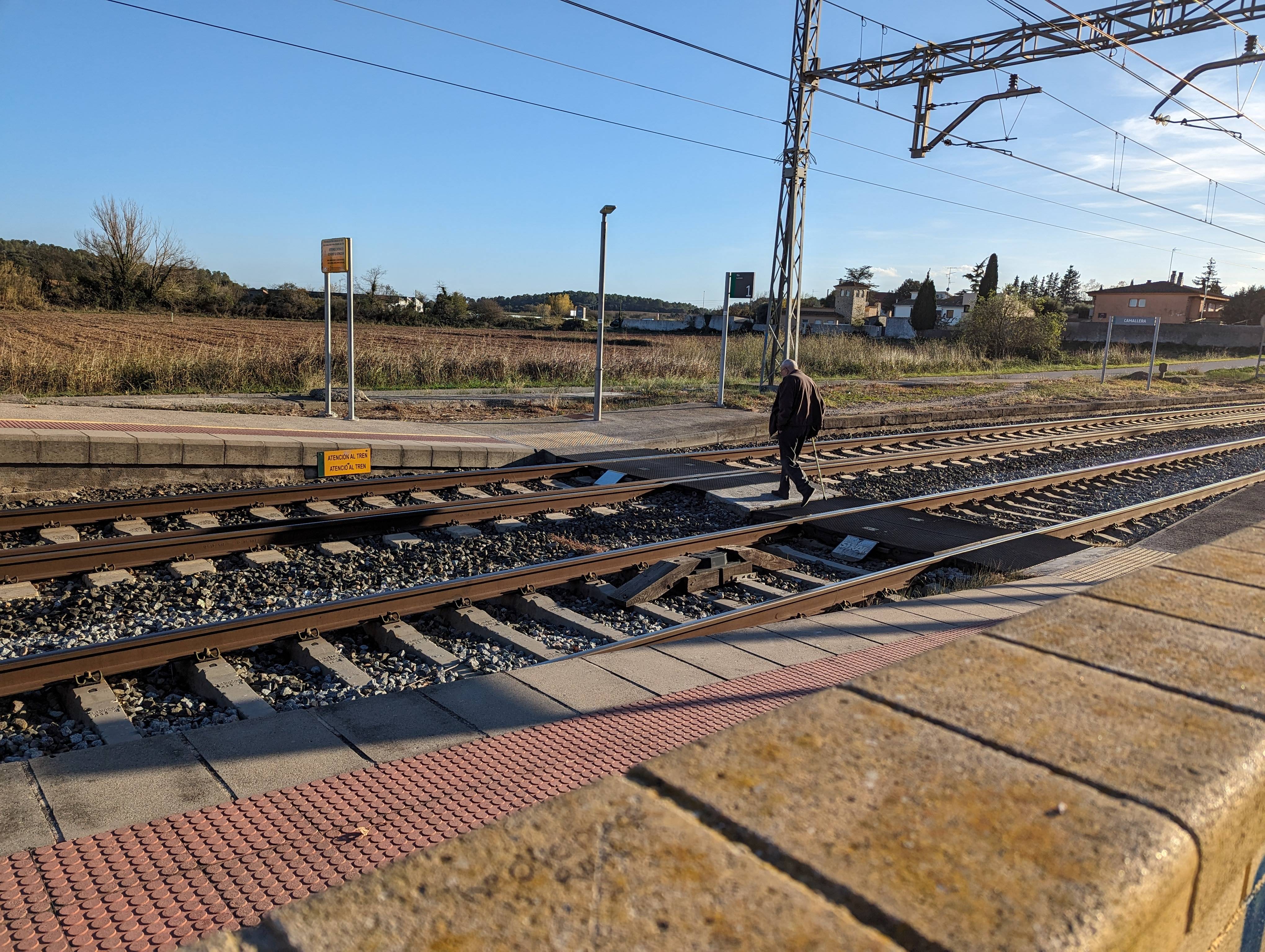
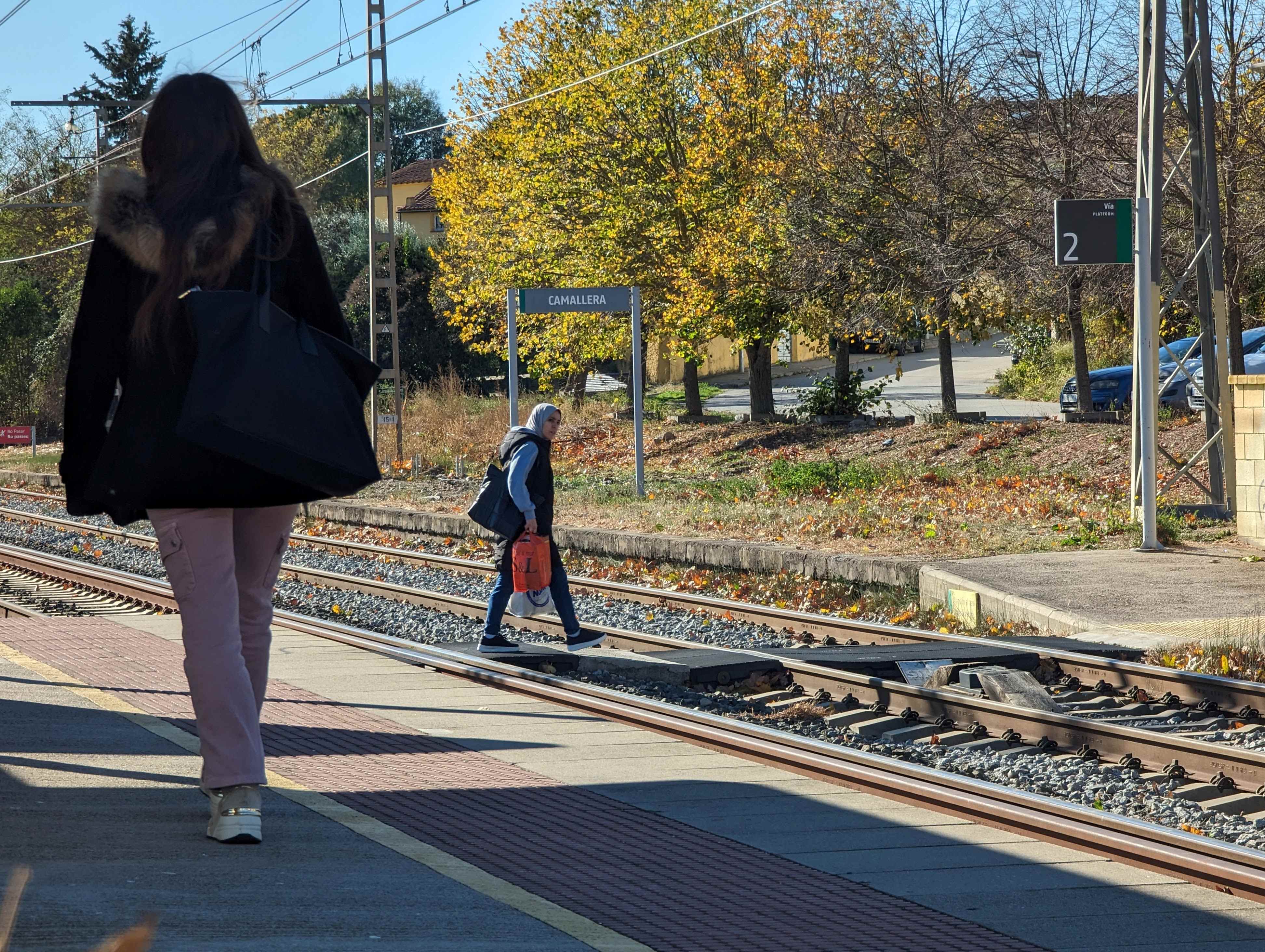
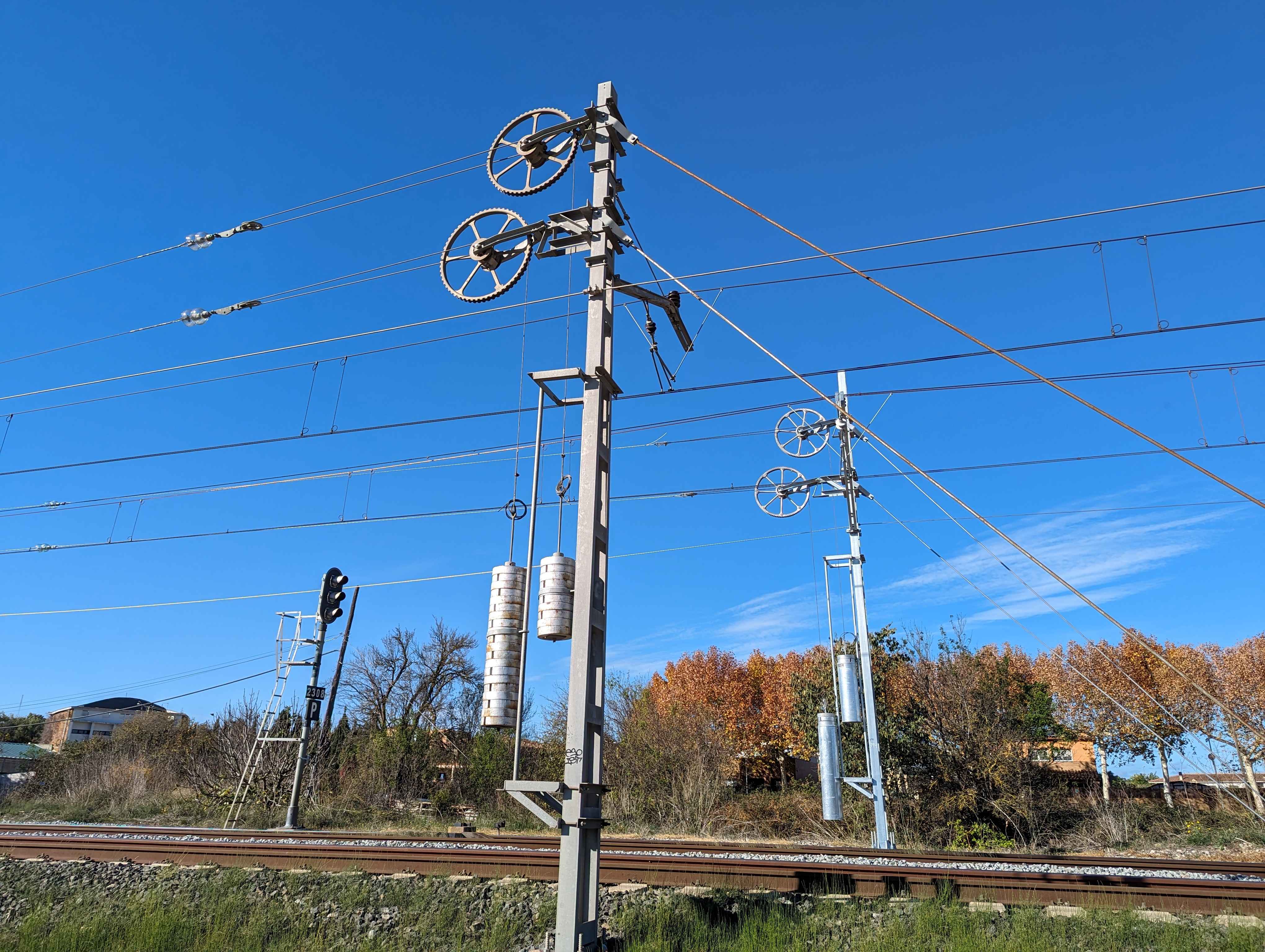
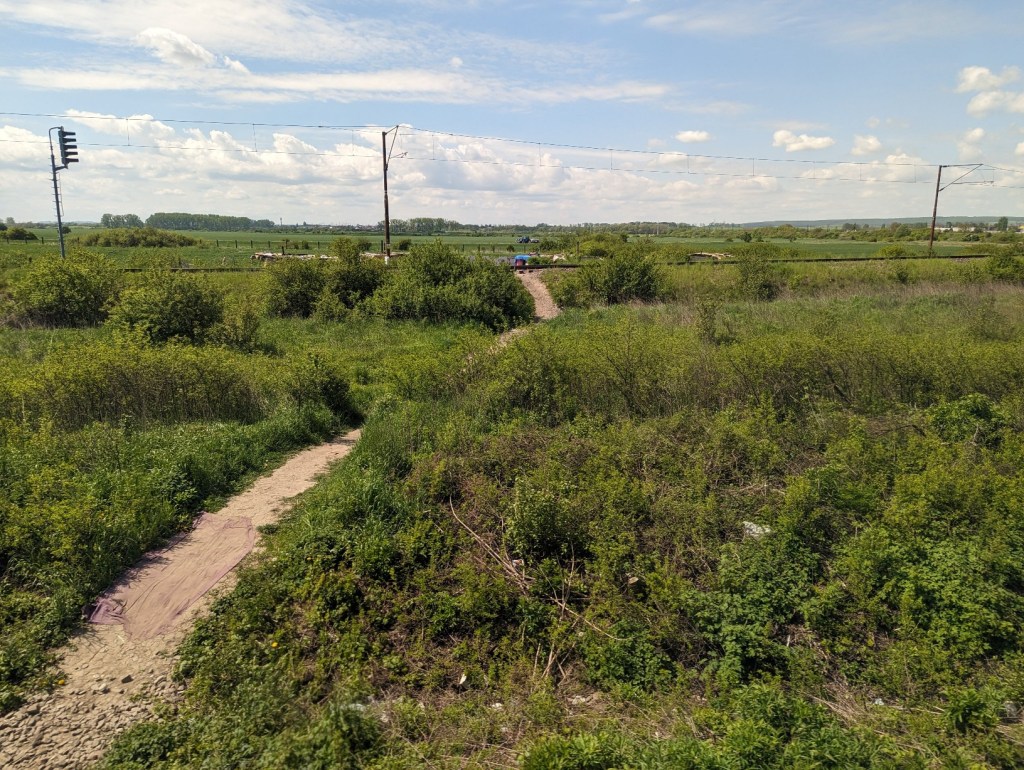
The railway divides the town with a strong and noisy diagonal line linking France to Barcelona and Spain. There are only three crossings, one for motorised vehicles (it is possible, but not advisable, to walk along the hard shoulder), a bridge between Stages 10 and 11, and the other is for feet, over the rails themselves – be careful! (You can also walk through an underpass to visit Saus (see Option 1 below), but you cannot get into Camallera that way except via the busy main road). If you are a bird or insect, you may cross wherever you want.
Crossing the railway line – stages 1, 12 …… and the crossing between stages 4b & 5
The language of the Sound Walk
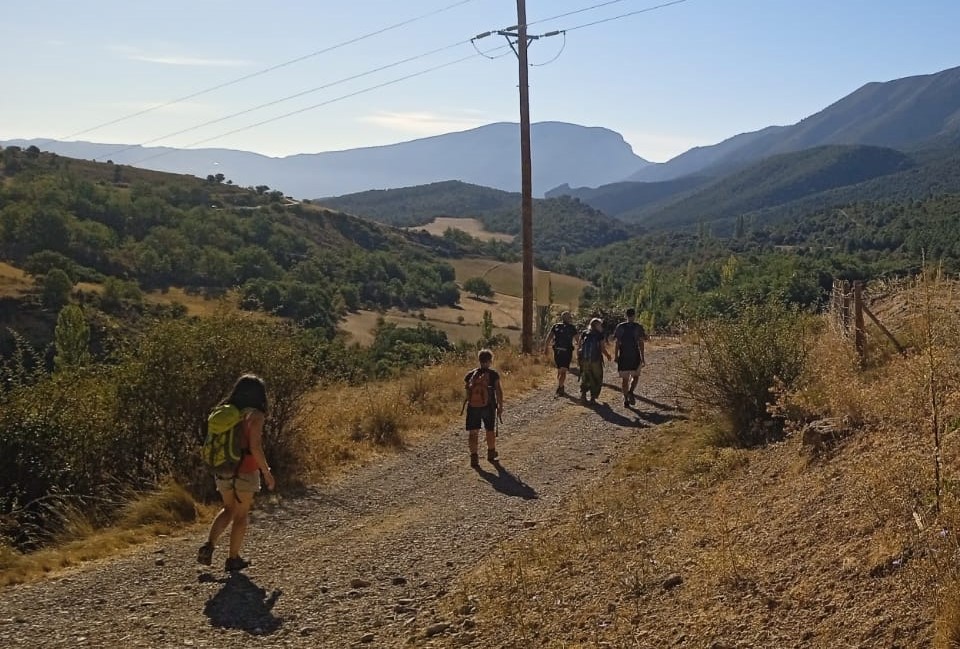
I do not speak Catalán, the language of this town, nor can I act as your guide using Castillian Spanish. When I participated in El Grand Tour in August, often having to look down and watch where I was putting my feet in order to negotiate the stony hillsides of the pre-Pyrenees, I could not understand each word and phrase that my fellow walkers were speaking, instead I heard these languages as music, the flow and the cadences of them. I learned to distinguish their different speakers without seeing the people as they spoke. The undulations of the landscape and the sentences informed each other, one perhaps having grown out of, or together with the other. They flowed around and through me as we walked, and I even began to understand some of them in this way.
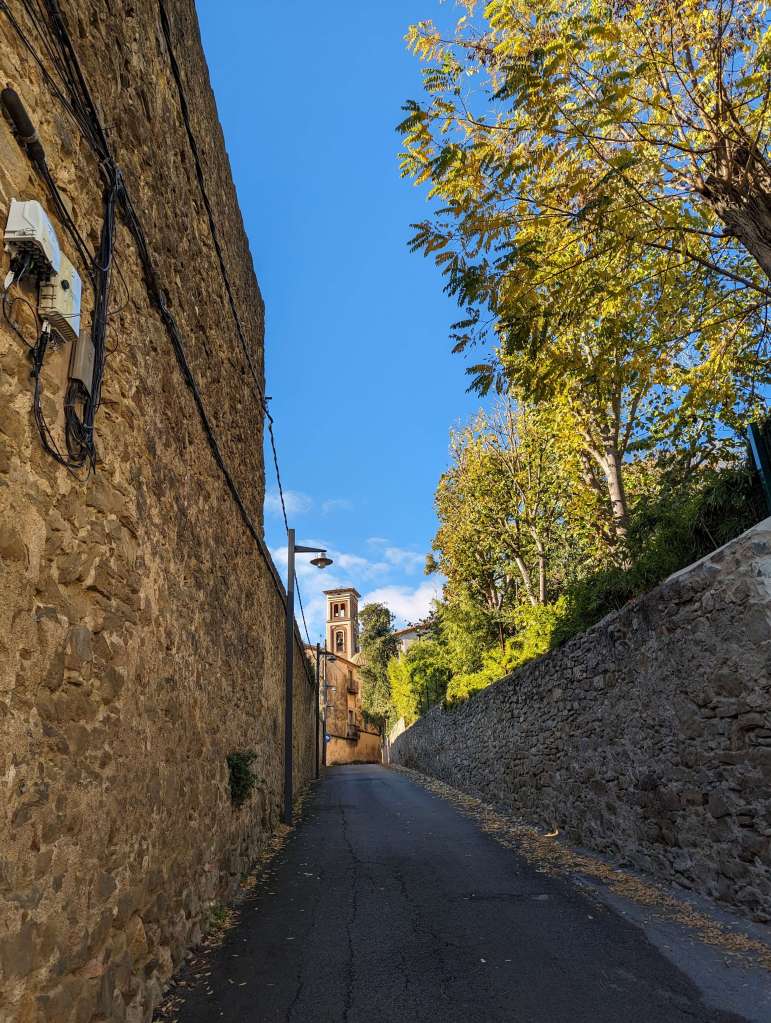
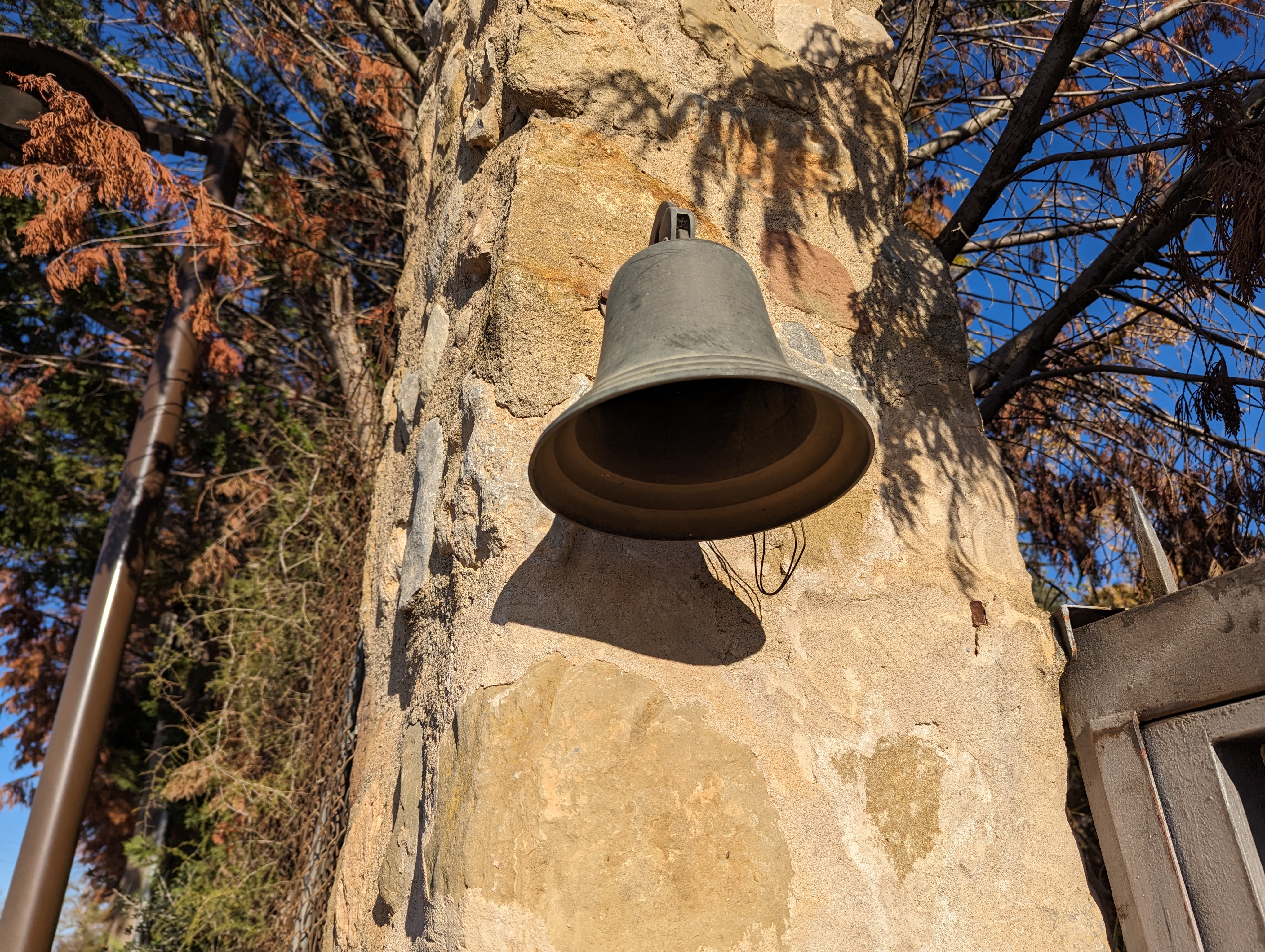
San Bartomeu de Camallera, source of the bellsSign for the trails which skirt the town
So, this Sound Walk has no words; you do not have to speak one language or another to participate. It uses all manner of sounds and various versions of silence which I hope will evoke feelings, memories, thoughts, and local history even if you don’t know any details of it. My research consisted of walking around and around, gleaning a sense of the place through the ground and the soles of my feet, and discovering its energy through the air and my skin. I sat at each stage; sensing, intuiting, noticing, meditating and receiving. Two weeks is a very short time during which to get to know somewhere, and I am therefore grateful to Clara Garí, Anna and her children, and Martina for their anecdotes, familiarity with, and knowledge of the area.
Clara Garí at Stage 11
The found sounds were all recorded by me on my Google pixel pro 10 mobile phone, mostly from the area, and a few from nearby Girona, and Scotland. They have been supplemented with one or two others from online libraries. I used Adobe Premiere Pro to assemble them.
Note to the walker
If you want the whole Camallera Sound Walk experience, I suggest you start at the train station and follow the trail anti-clockwise (widdershins in Scots). The walk describes 2 loops, so you will be crossing the railway line several times. Listen to the sounds around you, and those you make, as you walk. When you arrive at the first of the 12 stages, stop and listen to the audio. First a gong will sound, and then there will be a track lasting about 3 minutes. A quieter gong ends the stage. Turn off the sound as you walk to Stage 2, and when you turn it back on there will be a short gap of silence before the next gong sounds for the start of Stage 3. Repeat until you get back to the train station after Stage 12.
My first task in making this sound walk was to map the route around the boundary of Camallera and then choose the direction. When it came to creating the audio, I knew what experience I wanted you to have, however I know you may actually walk the whole thing differently. You might walk clockwise or visit the stages in a random order. Perhaps you will only go to one stage. You might listen to an audio that belongs to Stage 2 at Stage 3, or you might follow the walk at home without being in the town at all, with only the photographs to orient yourself. None of this will matter. What I’m interested in is that you will find or feel or think something when you’re listening.
I have endeavoured to translate the local Camallera stories which residents told me, together with my personal experiences, into audio. I hope that they will open portals to other worlds.
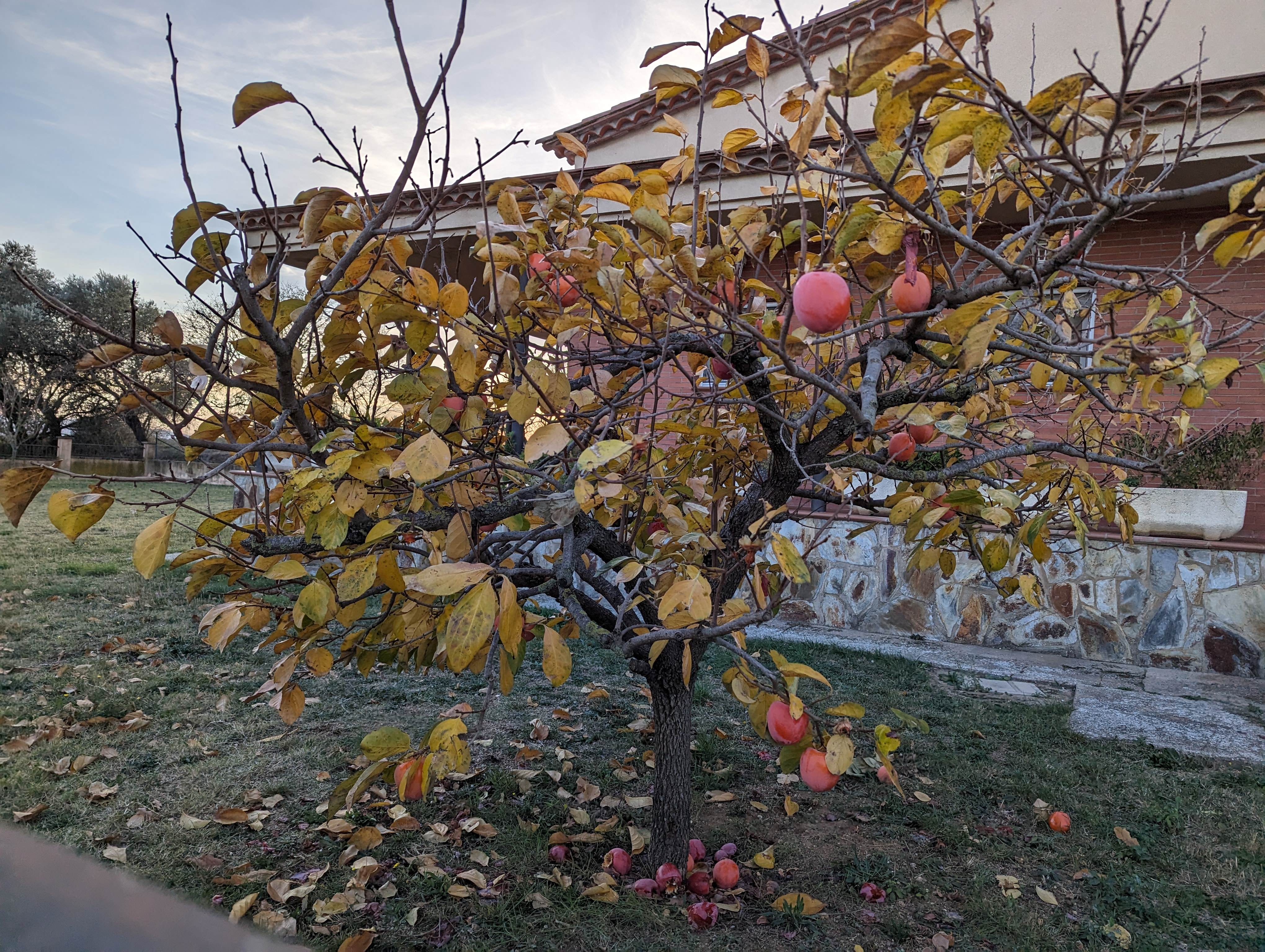
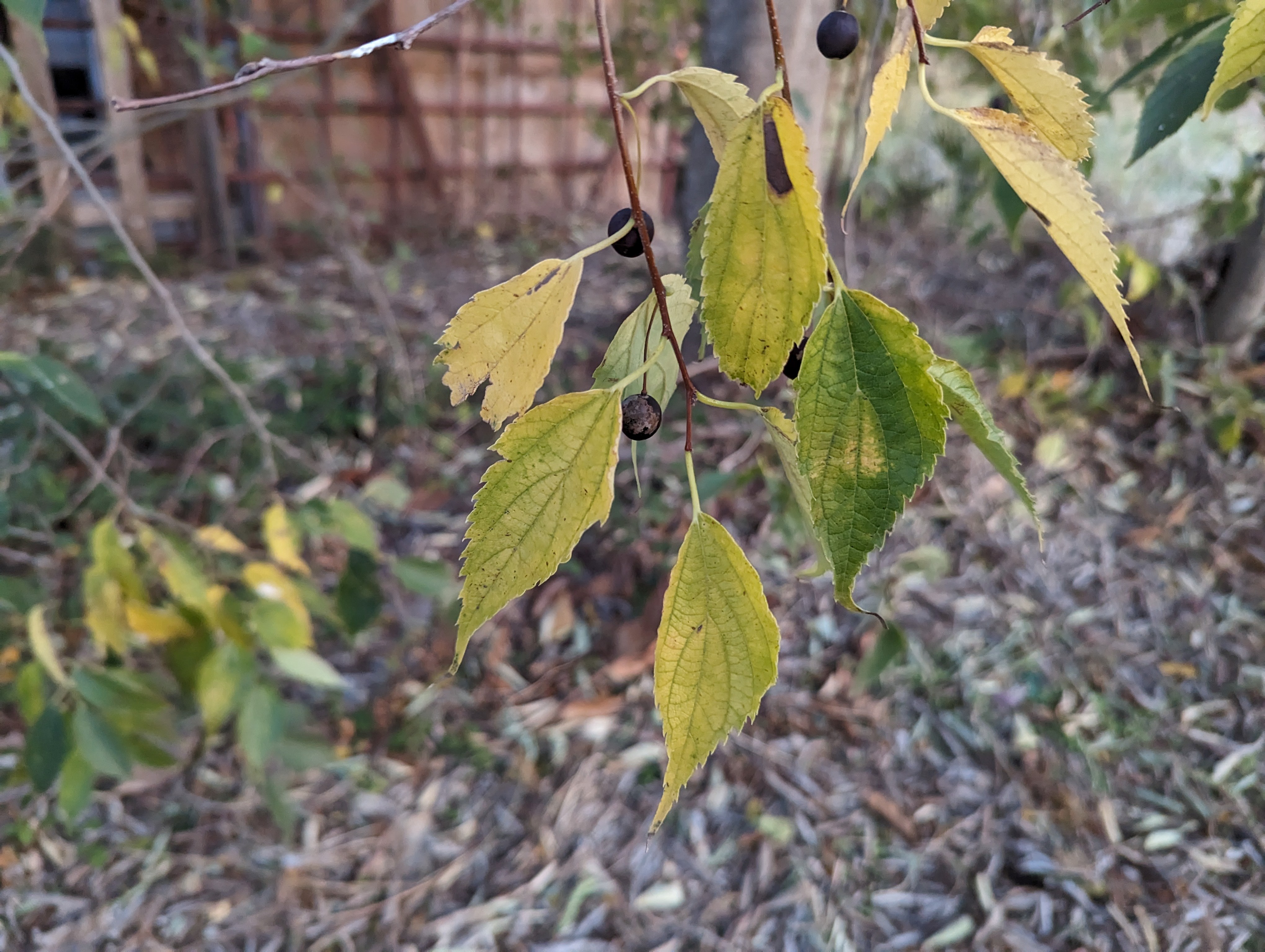
Persimmon tree can you find me? what do I sound like?Sketchbook
12 stages around a boundary
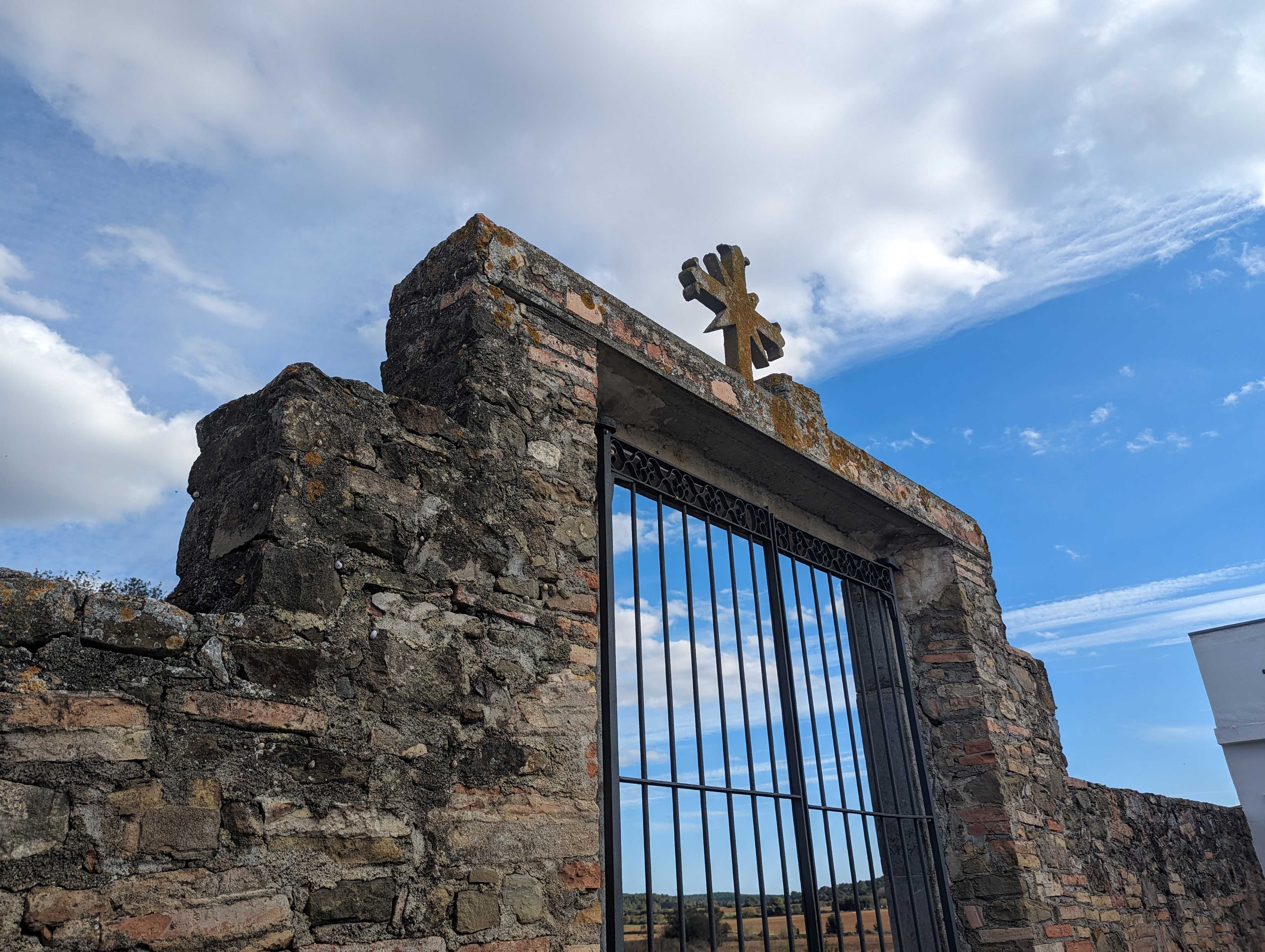
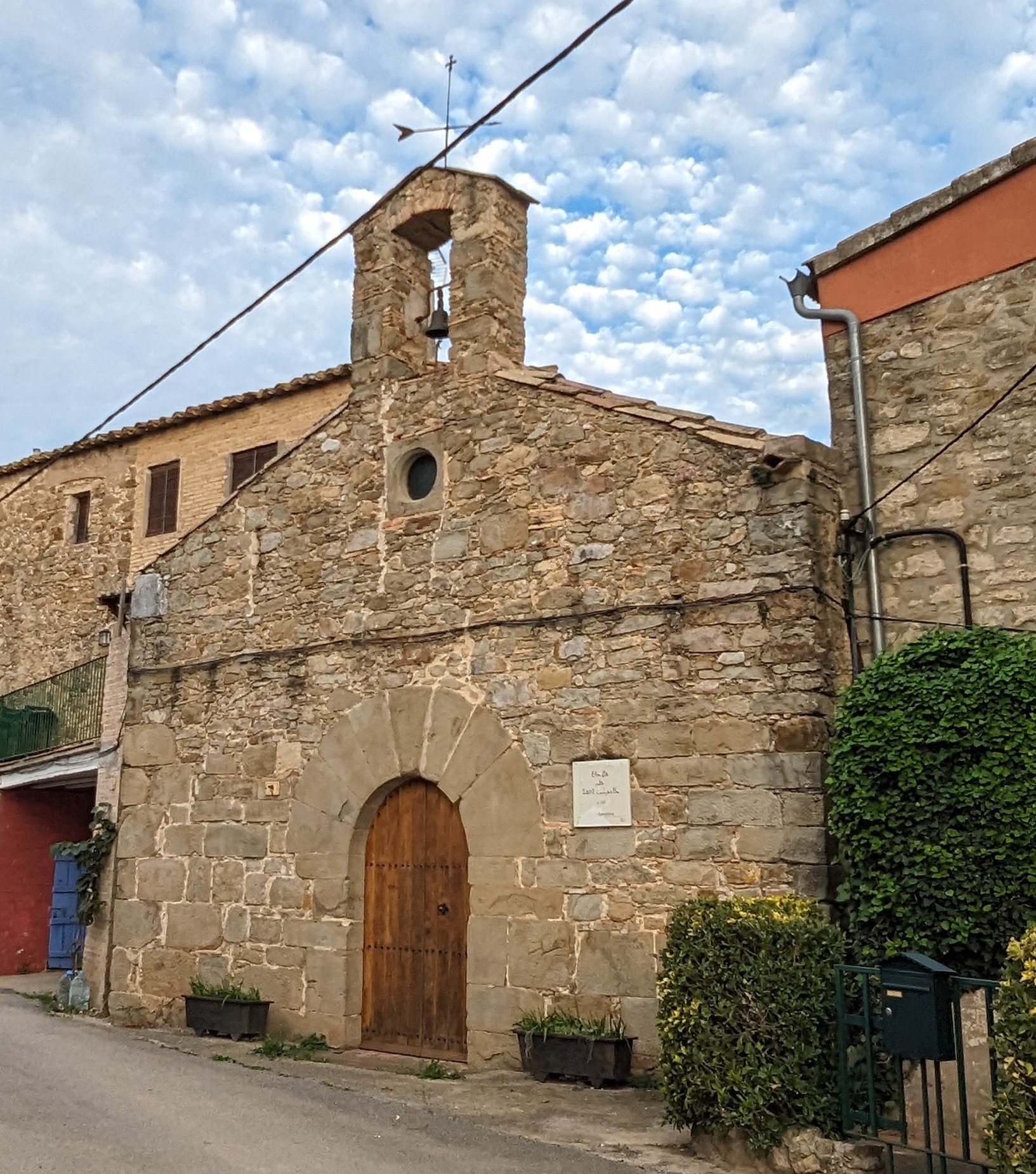
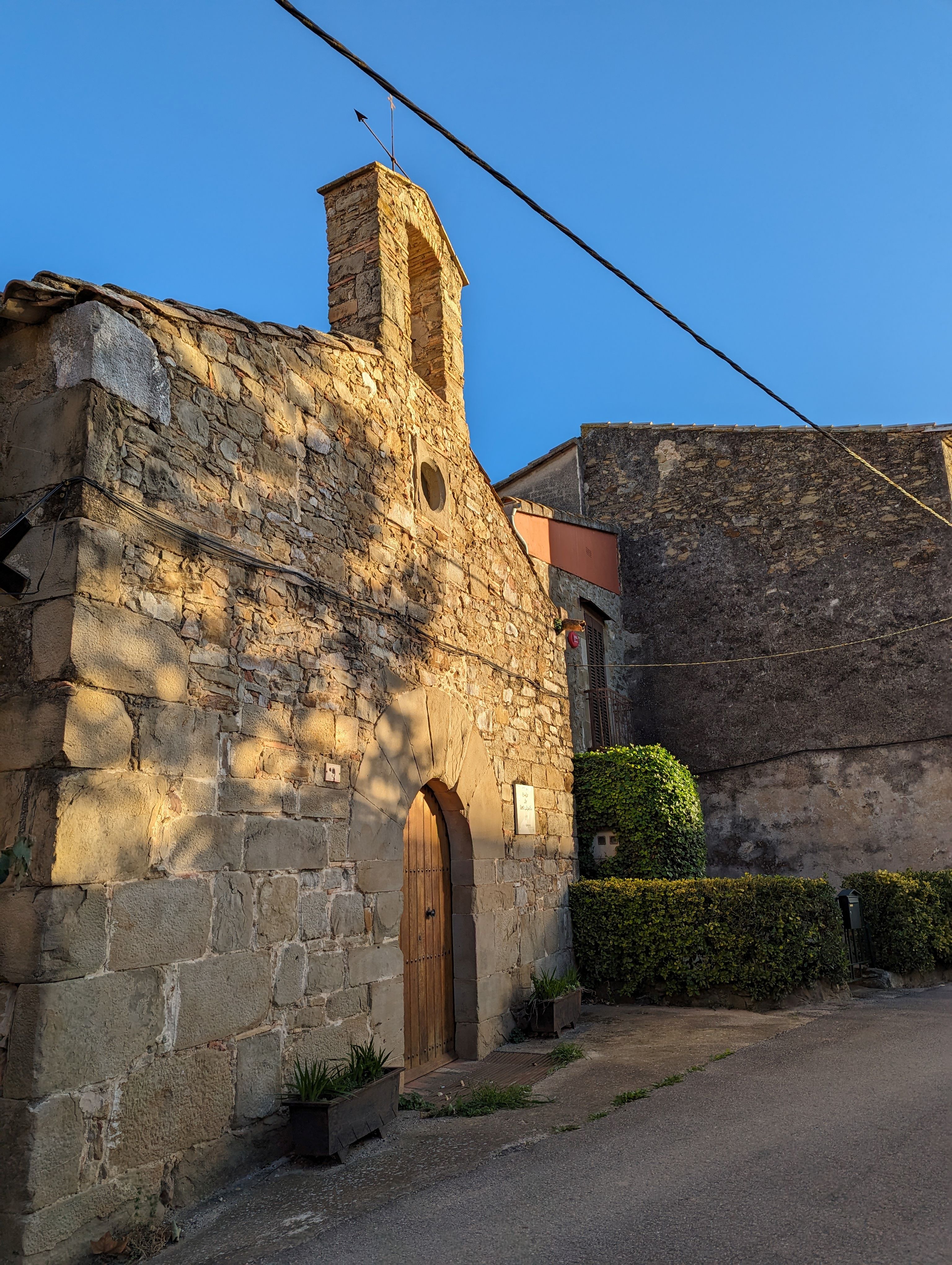
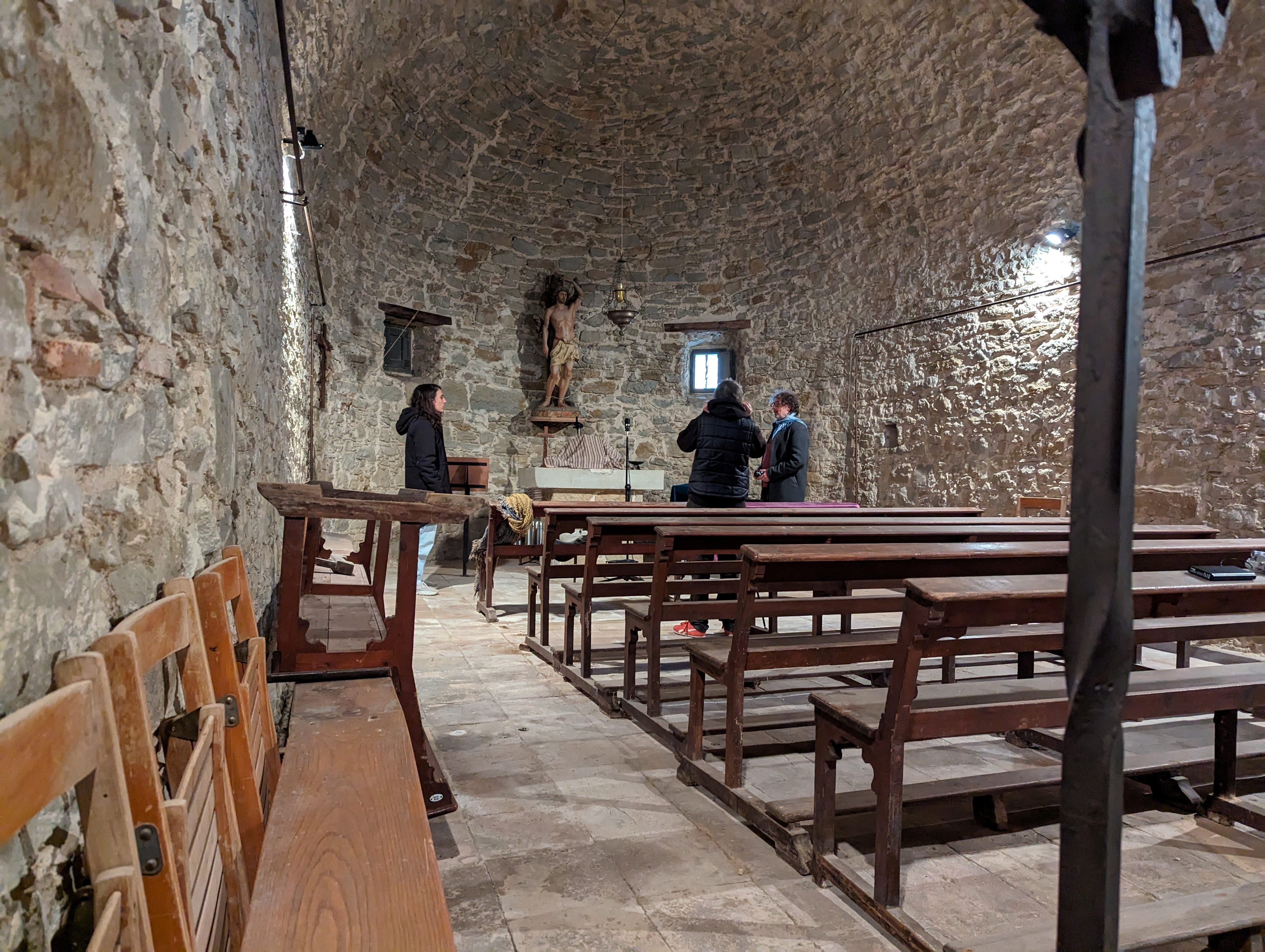
I have a history of walking pilgrimage, and although my pilgrimages have been secular rather than religious, it is interesting that this boundary walk developed 12 stages. I did not plan this in advance, it is just what emerged. Many pilgrimages are based on the Via Crucis, the 12 Stations of the Cross or Way of Sorrows, depicting the path Jesus walked to Calvary. It is said that the path was first mapped with stones by Mary, Jesus’ mother (it is known as the Via Dolorosa in Jerusalem). This Sound Walk has other spiritual associations: bird song and bells, a cemetery stage, and one at the Chapel of Saint Sebastian who had a particularly violent death.
In the 12 spaces, I listened; I dreamed into them. This method of ‘feeling into place’ is quiet. My art practice has made me sensitive to the nuances of somewhere, and I’m always attending with respect, sitting as in meditation with an open mind and accepting what arises. I’m noticing what I feel in my body, what emotions, memories, and thoughts come to me, and I have tried to convey that to you through this soundscape. I hope that what speaks to me is in a universal language that can be effectively communicated. I also invite you to sense each stage yourself and respond.
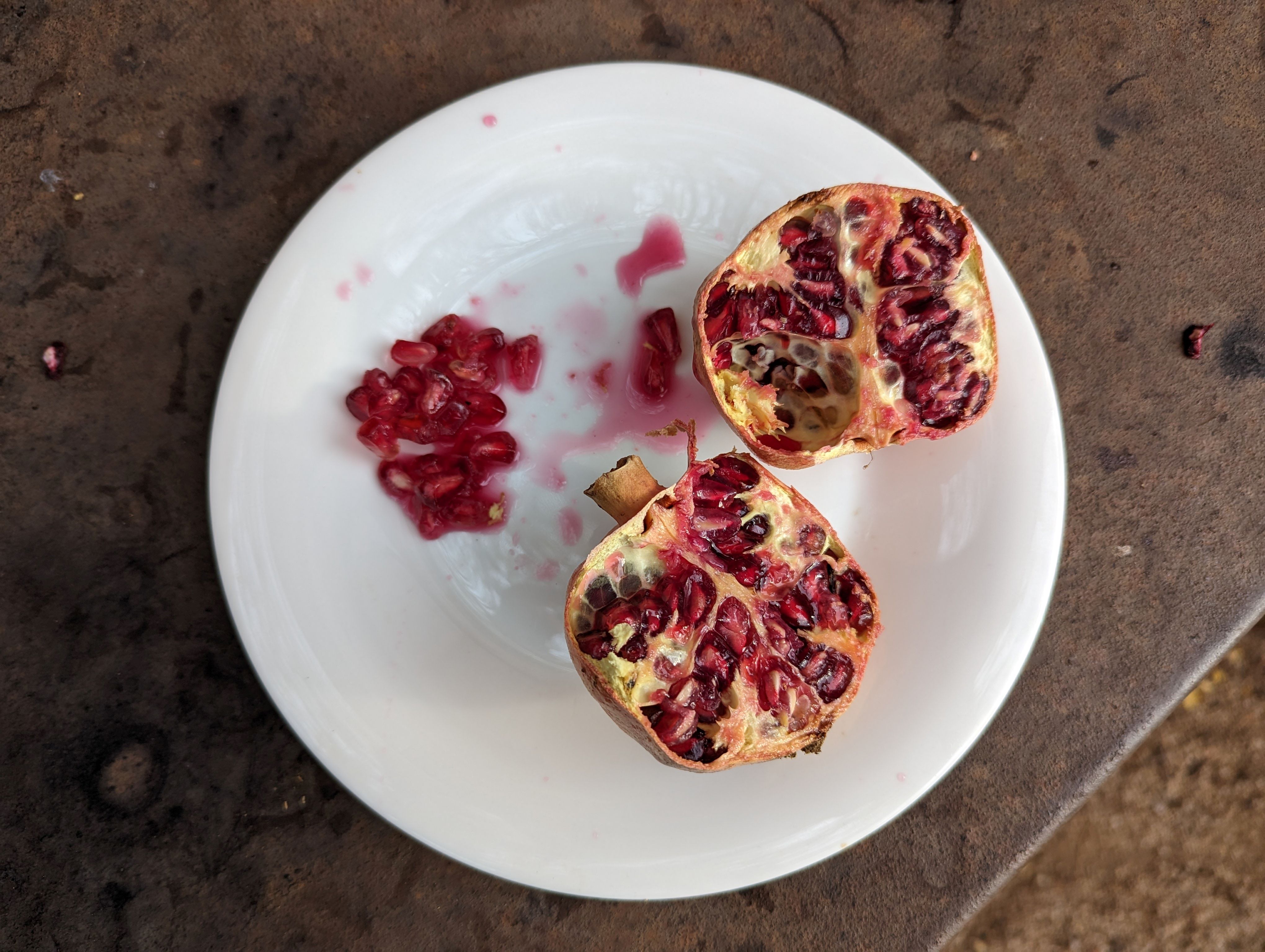
A pomegranate from Stage 3, Nau Côclea
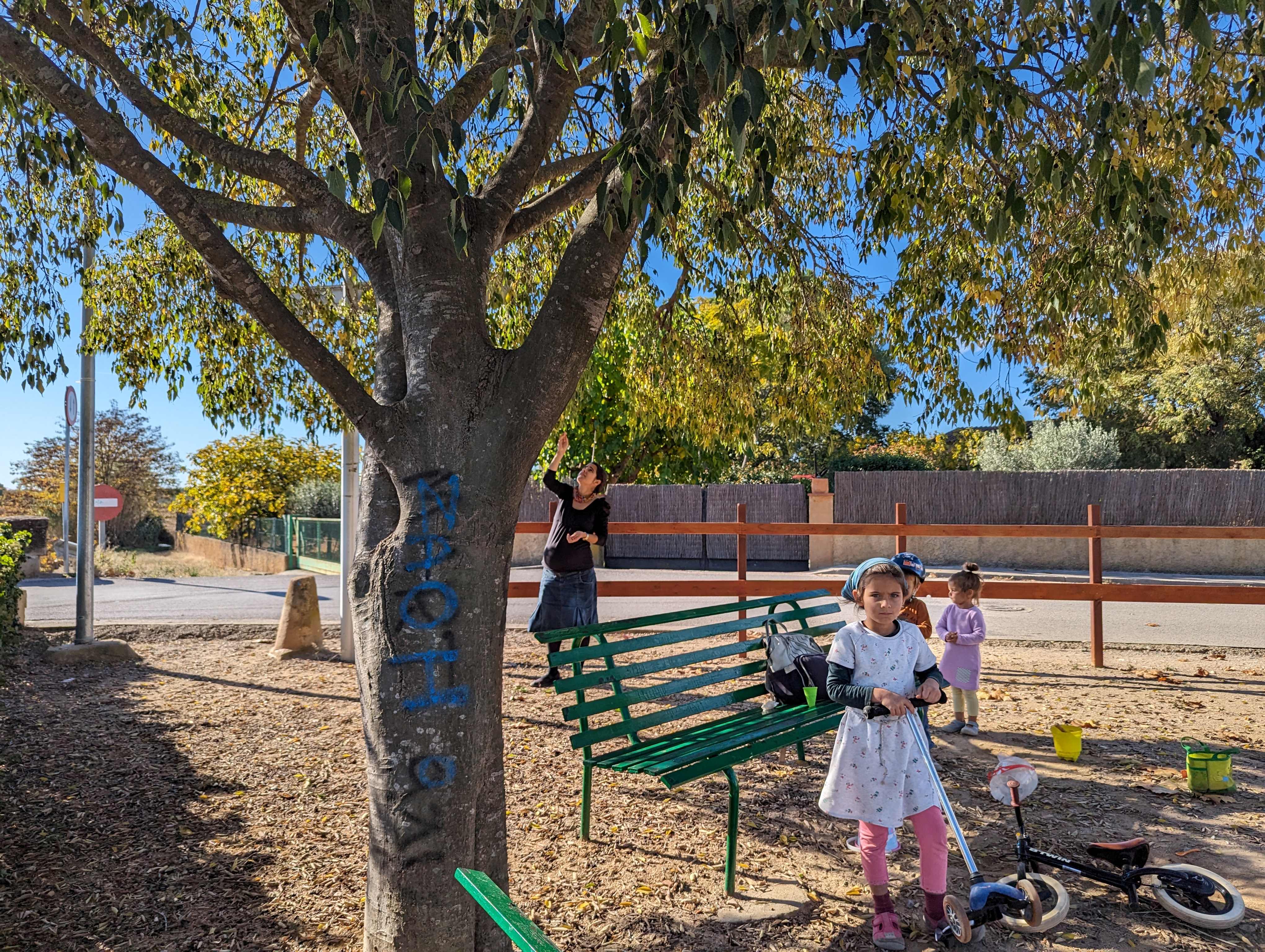
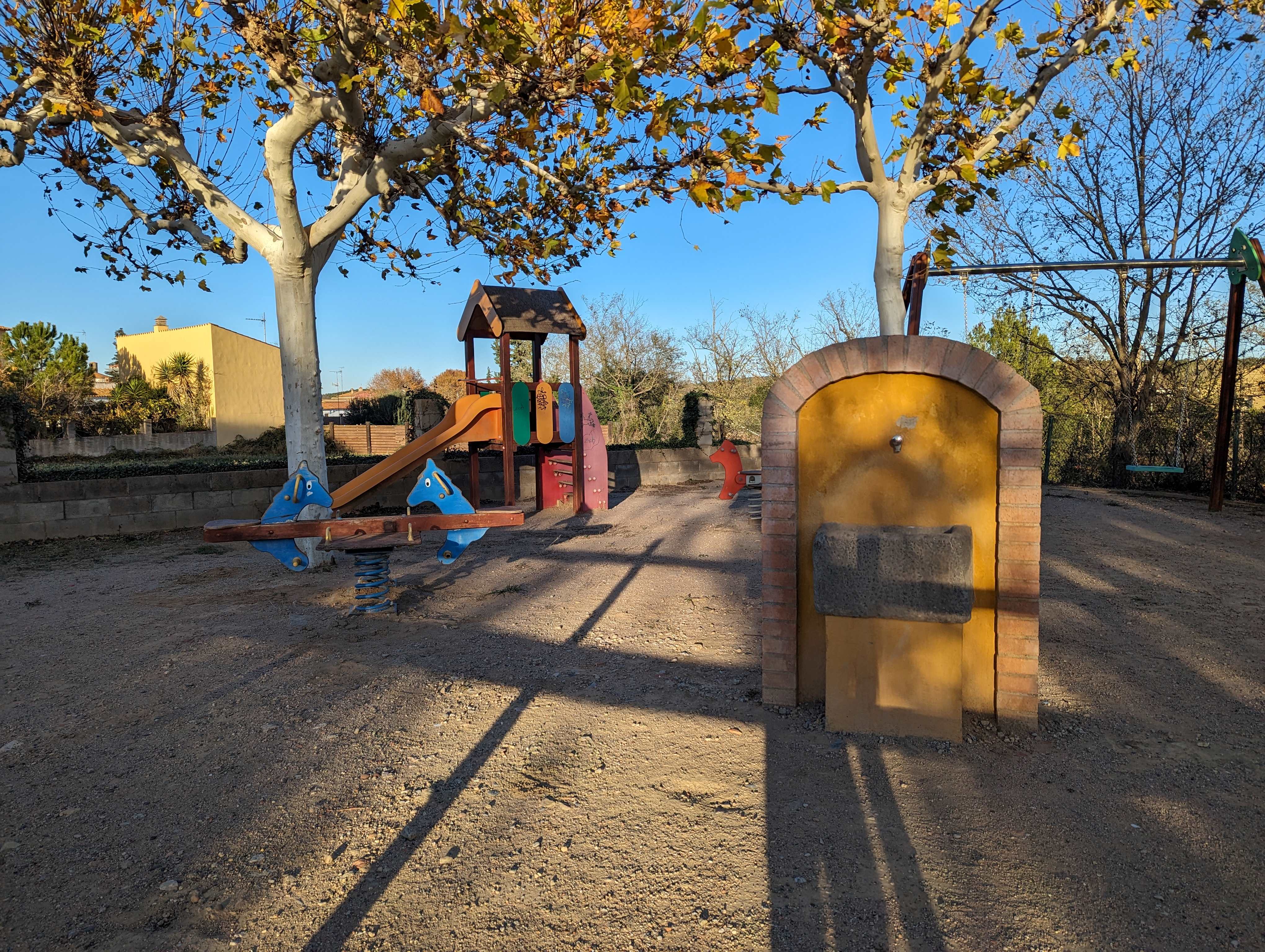
In every microcosm is the macrocosm. Therefore, when you take a seat, or pause under the sweet white acacia tree, you are not only in a playpark or on a pavement, you are in a whole environment. You stand on top of an ancient land, a topography of millennia; you are amidst a community of human and other-than-human beings (herbs, insects, for example); and you are under a vast, borderless sky. Your own electrical energy will immediately engage with that of those beings beside, under and above you. When you open to that flow and connection, you will be able to pick up the subtle connections.
We are all so different
You and I will experience the Sound Walk differently. I brought all my life experiences with me to Camallera, and the audio responses are particular to me as an individual (not part of a pair or group) and a woman. I’m a certain age (60 years), and I’m Caucasian and privileged through education and upbringing. I’m not from Camallera, nor Cataluña (though I have spent 3 months here in the past 18), not even from Europe anymore, though I was, and feel as if I am. The audio I have made will reflect this.
And yet, I submerged myself in the place, filled myself with local stories, tried to make a soundtrack that contains all that. Although I don’t know how you will respond, I know that what’s in those places is limitless, that being in those spots with the sounds reverberating in your ears, head and nervous system, will give you the opportunity to listen through me, and beyond, may be a jumping-off place to another locality, connect you with someone else, or stimulate a feeling that doesn’t, in the first instance, seem related until you sink into it and let it trigger you. Can you sink through its layers and find points of contact, of resemblance and recognition?
The 12 stages
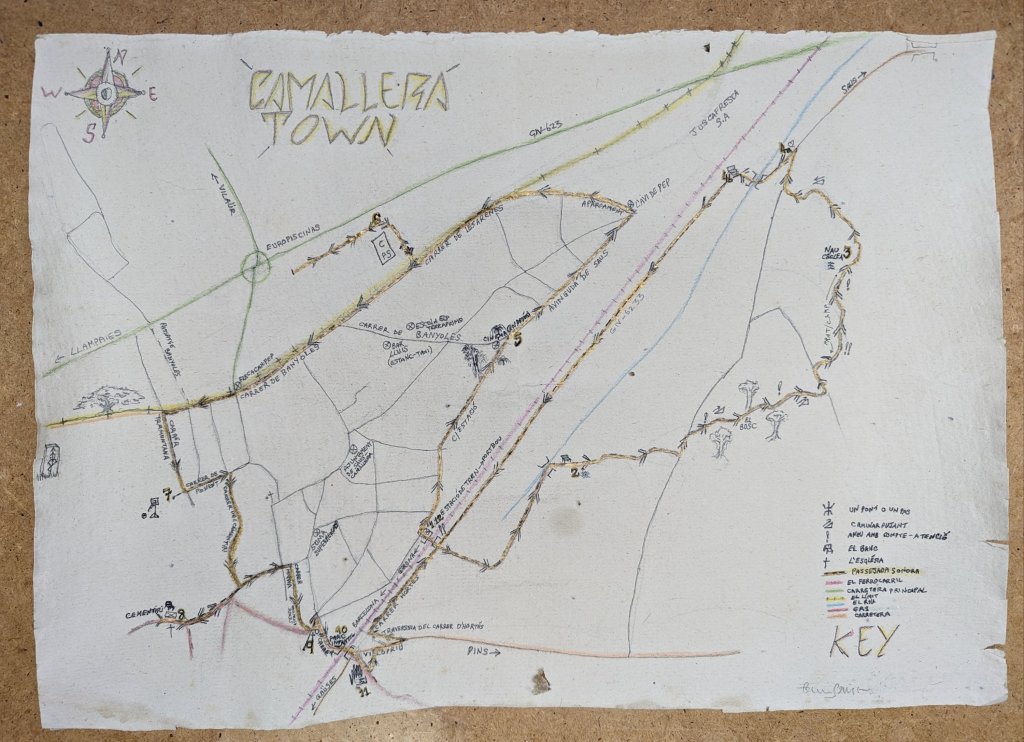
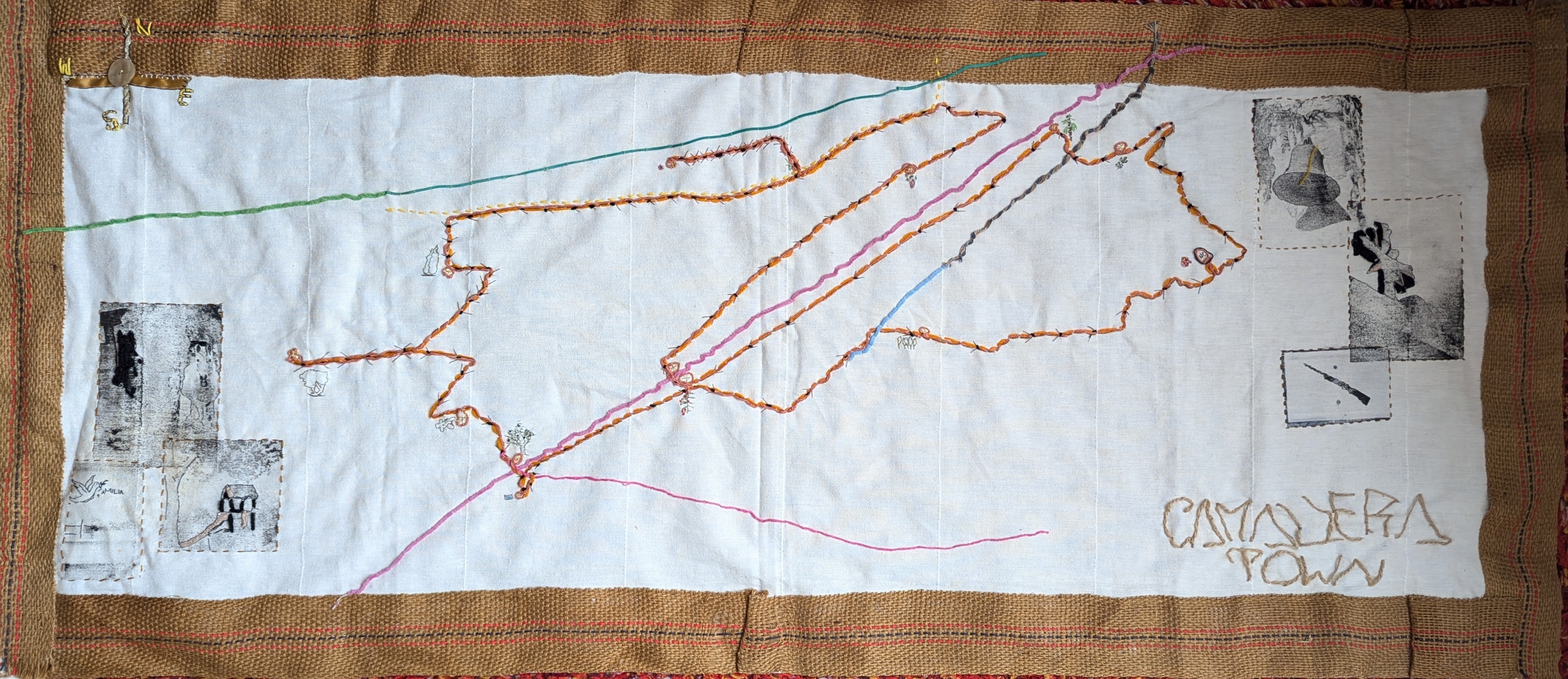
Sound Walk Camallera route map, drawn on 1950s handmade paper Stitched map, Camallera. Gift to Clara Gari
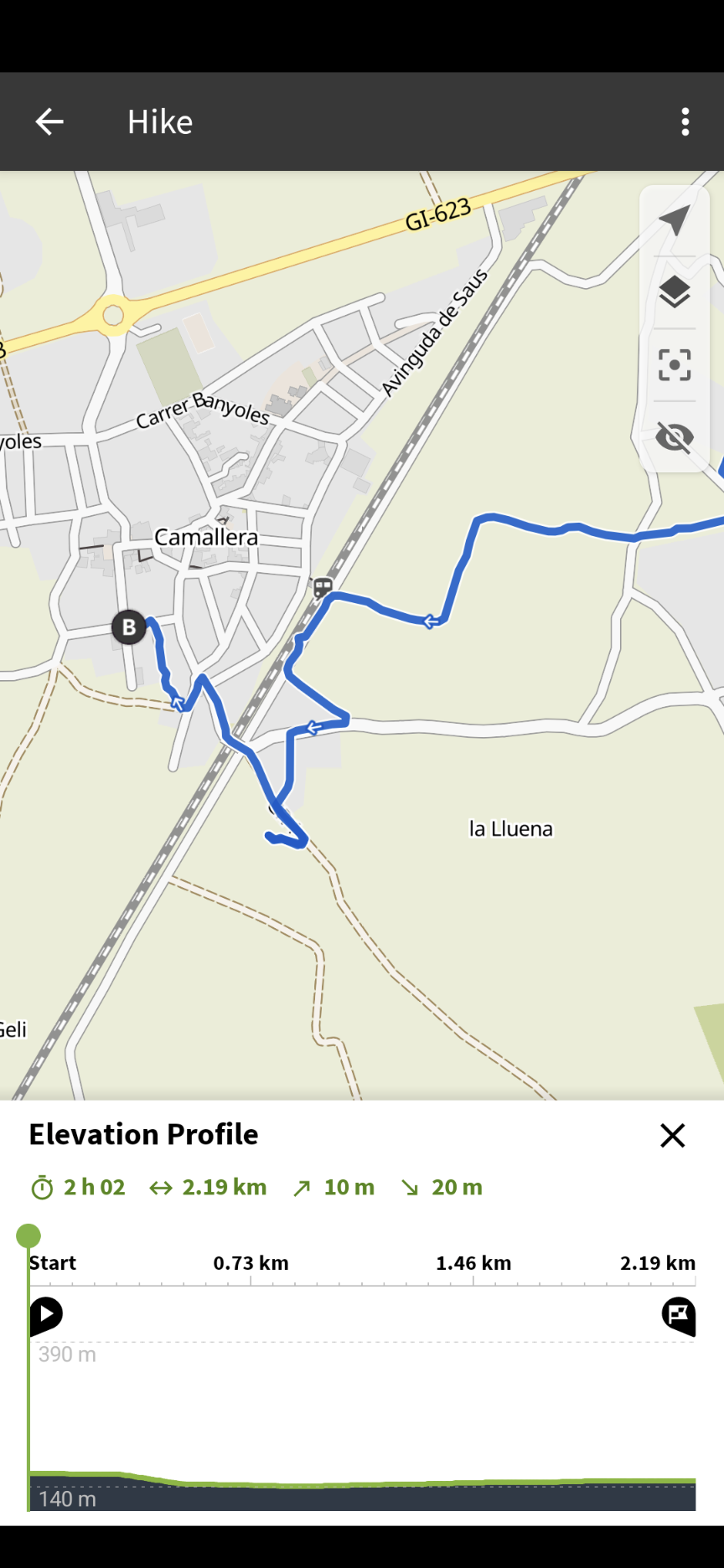
Here is the map. Enjoy your walk, whether you live in Camallera or are a visitor (in-person or virtual). There are other maps below, a pdf download, and it can also be found on the Komoot and Echoes apps.
Each stage is a resting place, and each of these resting places is also a transition from the previous stage to the next. Together they make up a whole and I hope you like exploring them as much as I did.
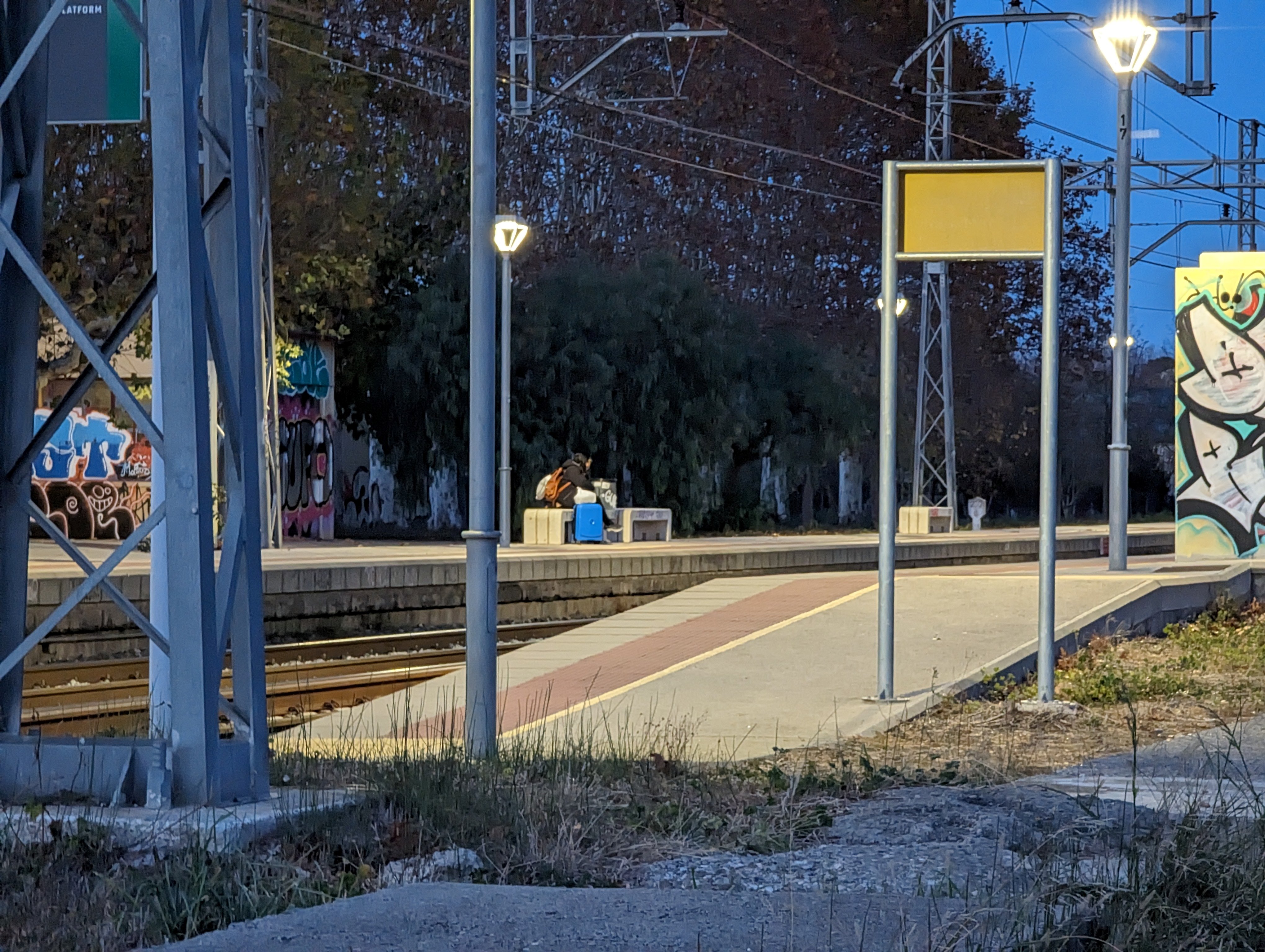
Stage 1, the stationTrain station
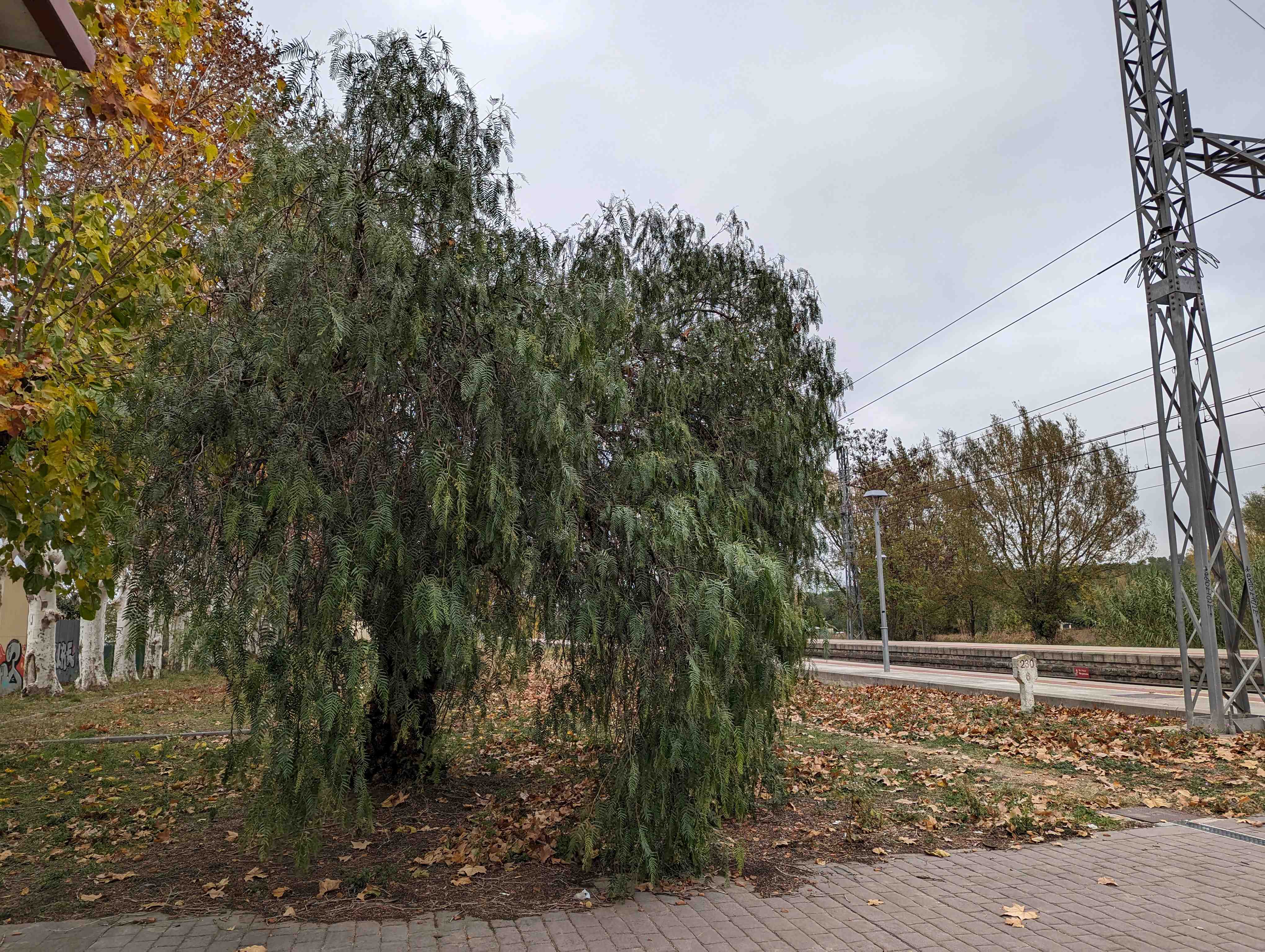
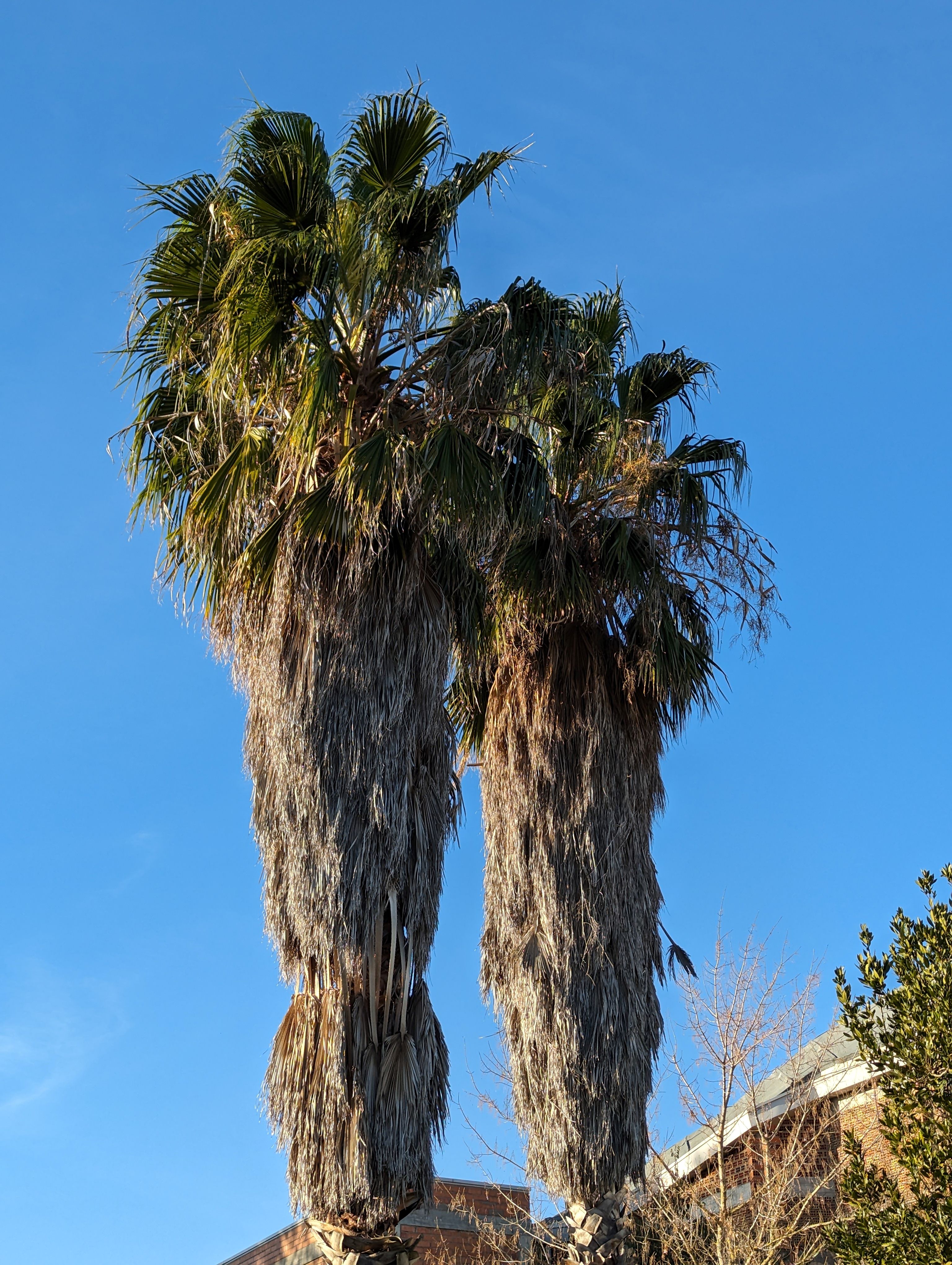
Stage 1 Arriving – Train station (Estacion de tren). Tree: Peruvian peppertree
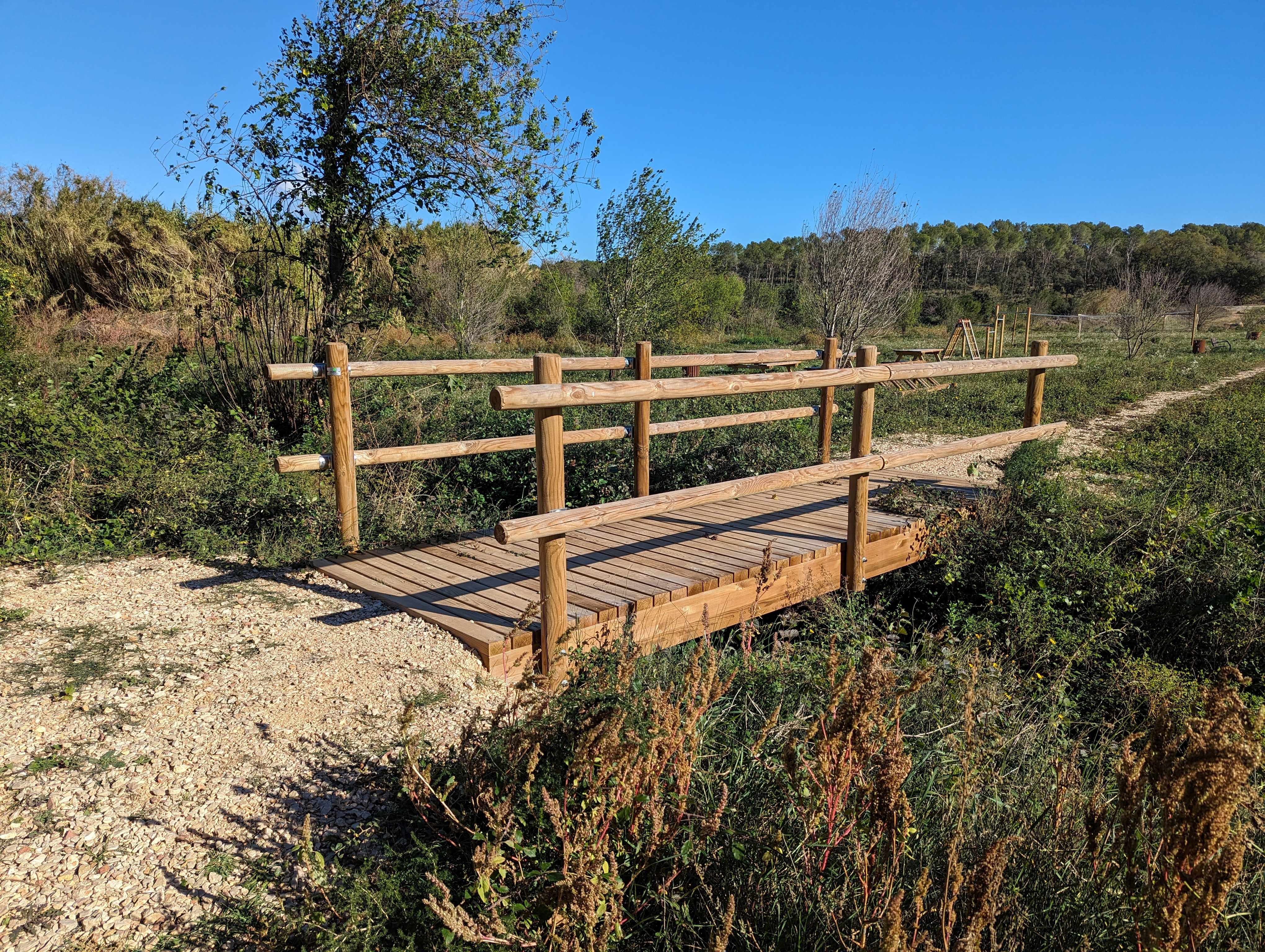
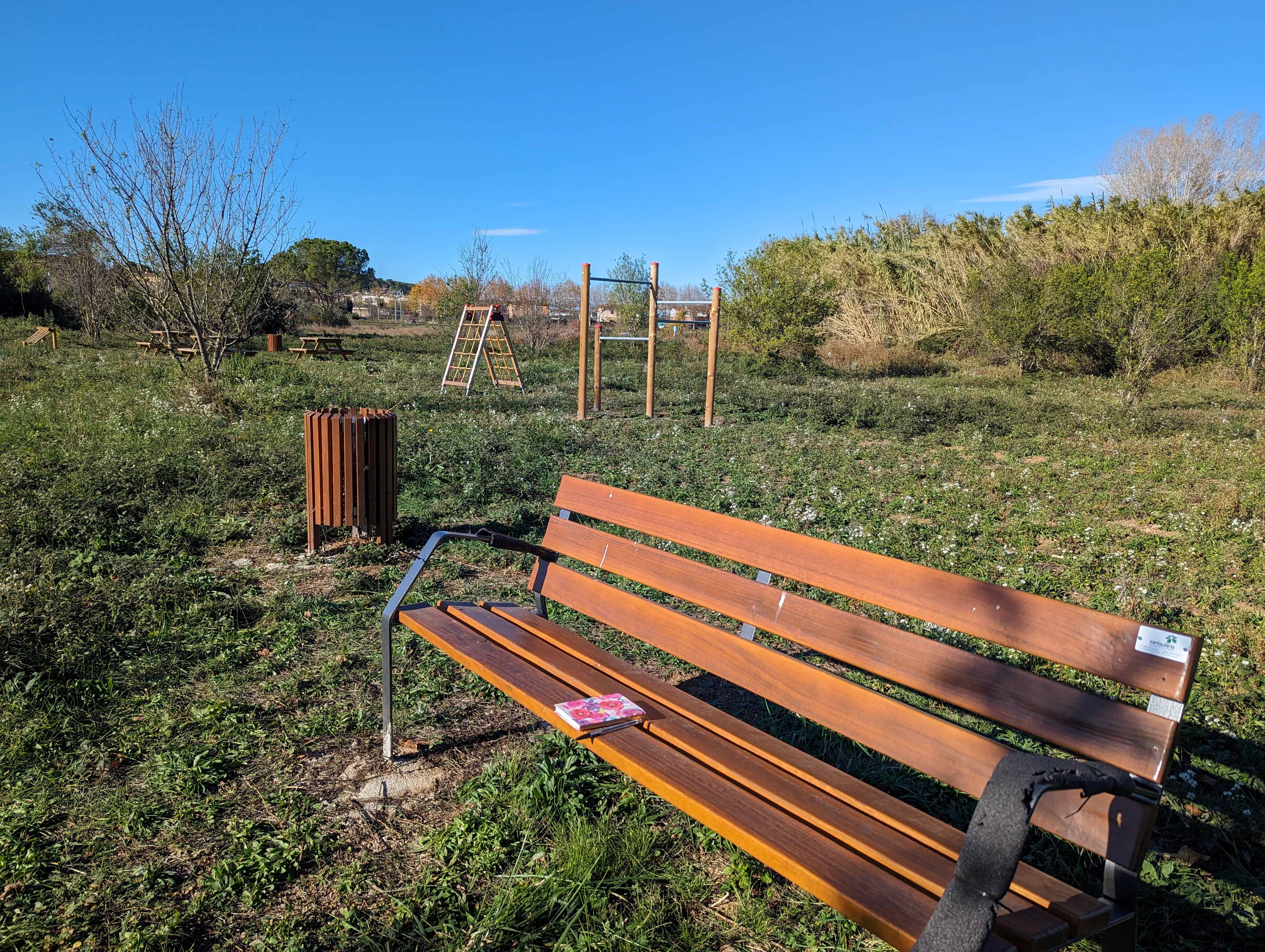
On the way to stage 2Stage 3: take a seat and admire the poplar trees (see photo below)
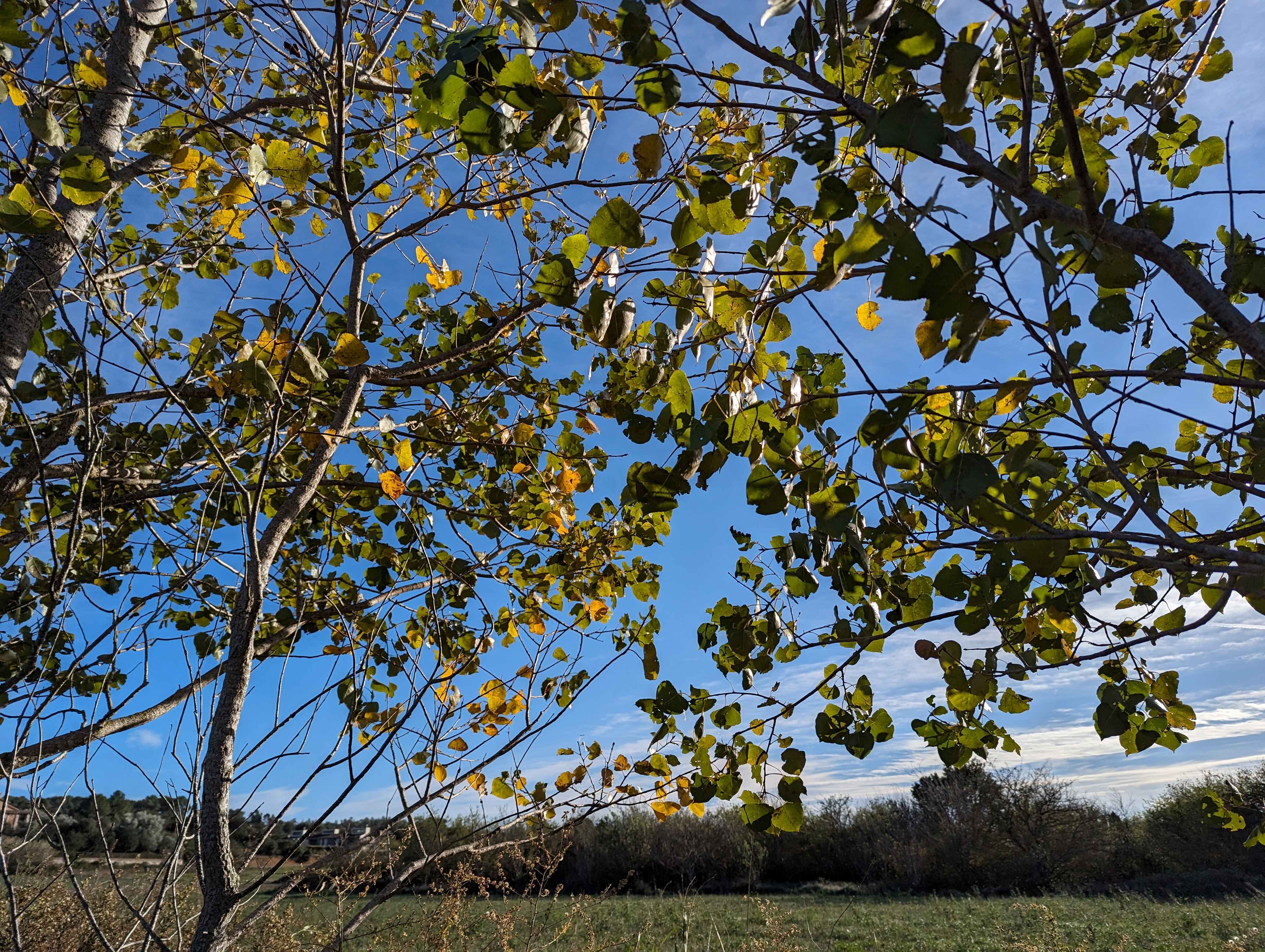
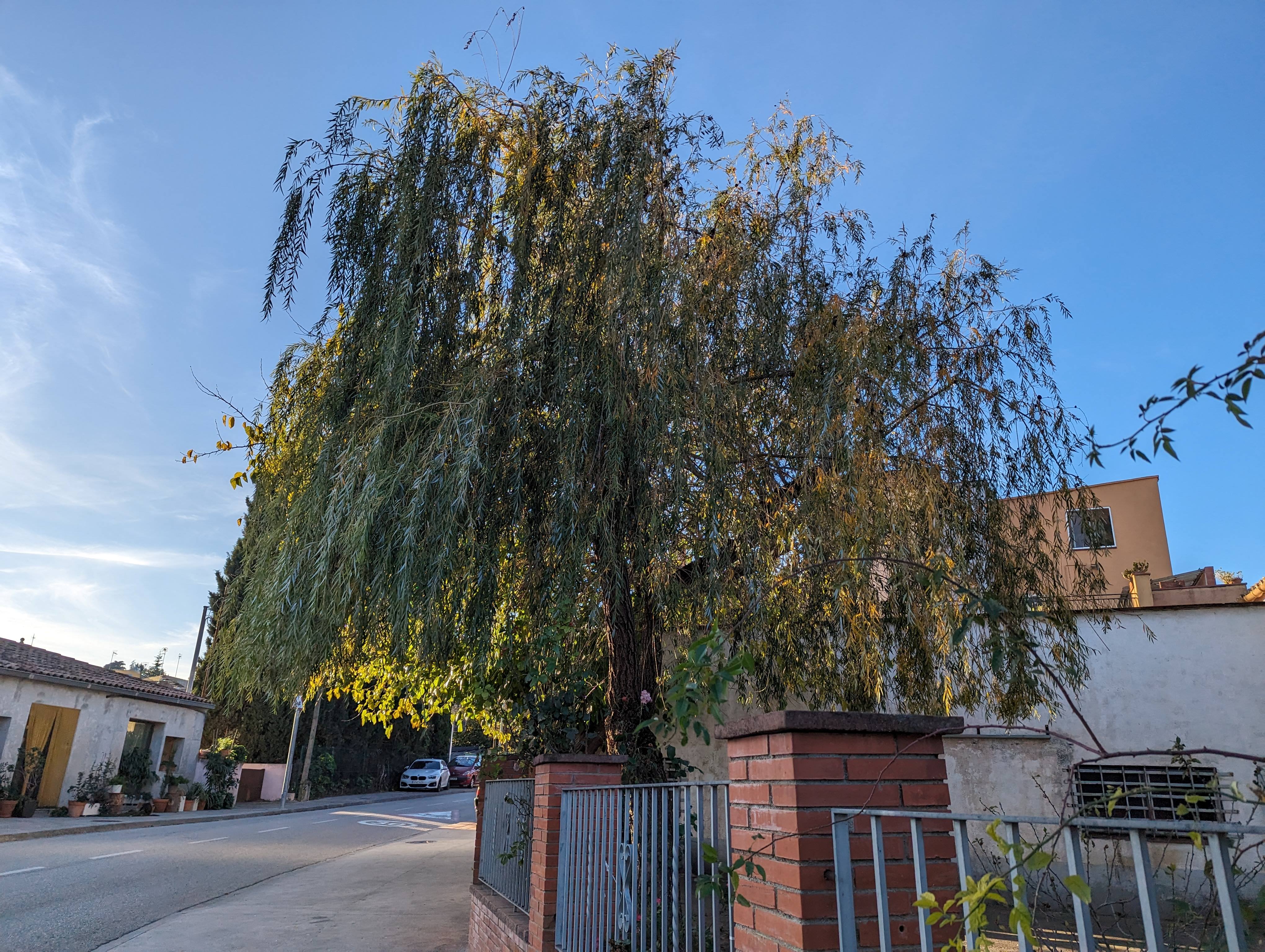
Stage 2 Listen to the water – Recreation area. Tree: 5 poplars
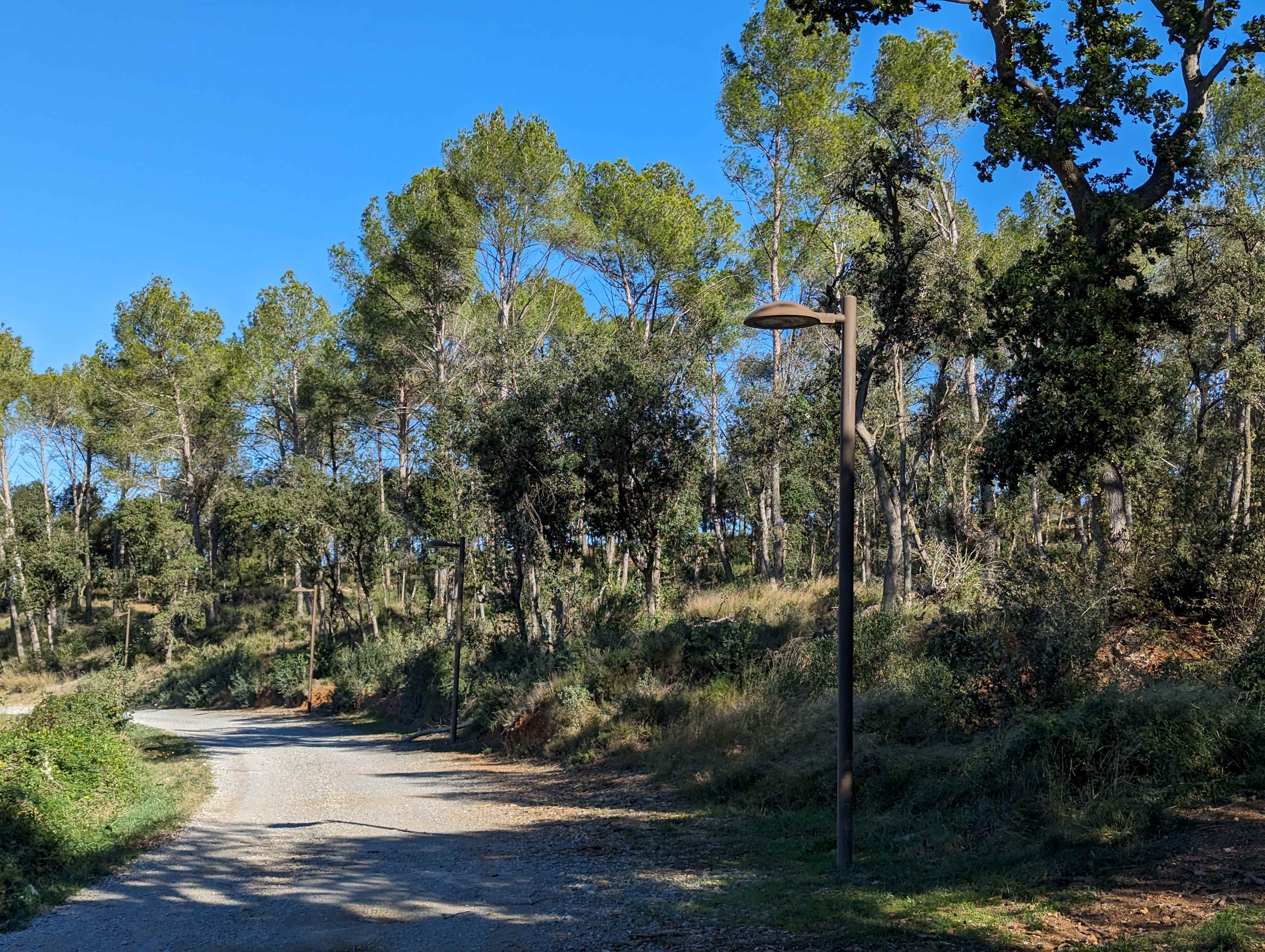
Cross over the roadUmbrella and Scots pineWalk uphill through the woods Turn left along a roadTurn right & take path at dead endCareful of the drop
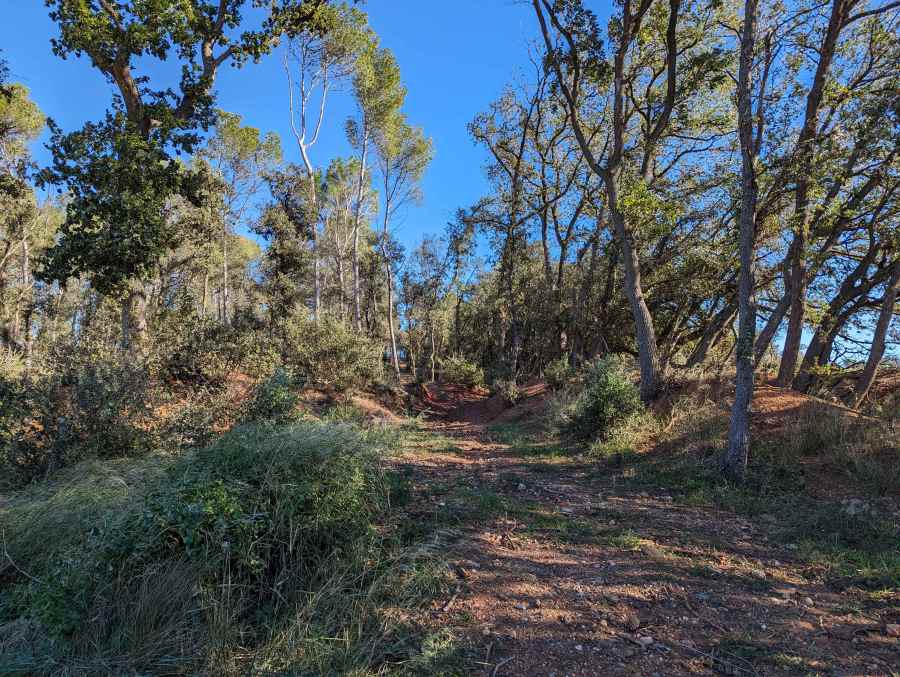
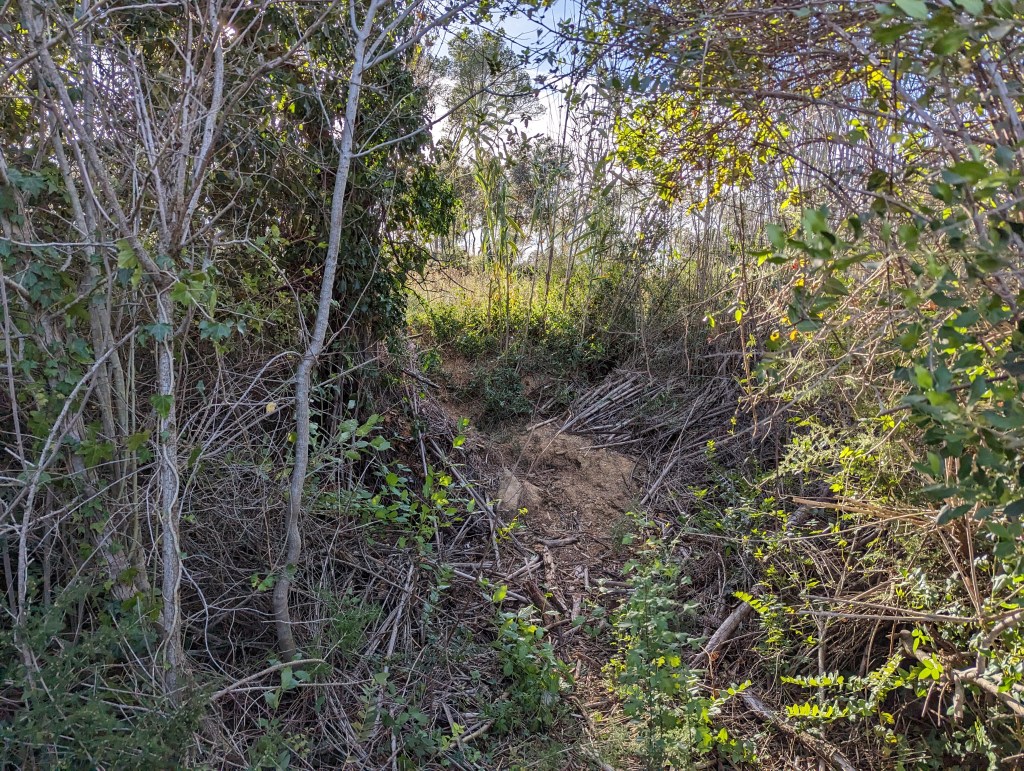
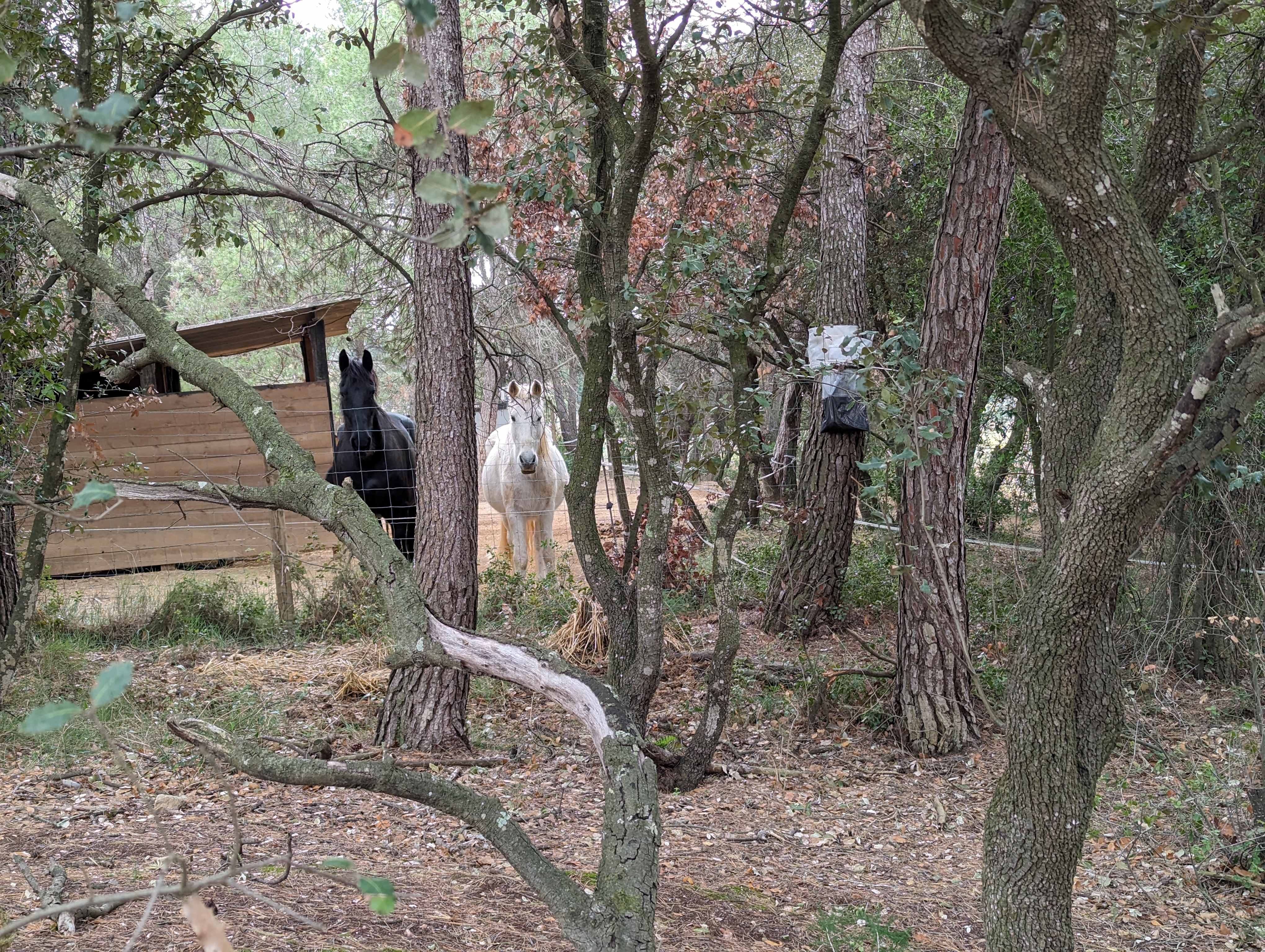
From the recreation area, walk on until the end of the path (there are two huge stones at the entrance). Cross over the road. Walk uphill through the woods along an uneven path (look out for 2 horses, 1 black and 1 white on your left), turn left along a road for a short time. Take the first right, a dead end, and walk right to the end. Look for a path through the meadow, but be careful of the small drop half way along where it turns sharply left. At the end of that path is another tarmac dead end road and stage 3 is on the left through a small gate.
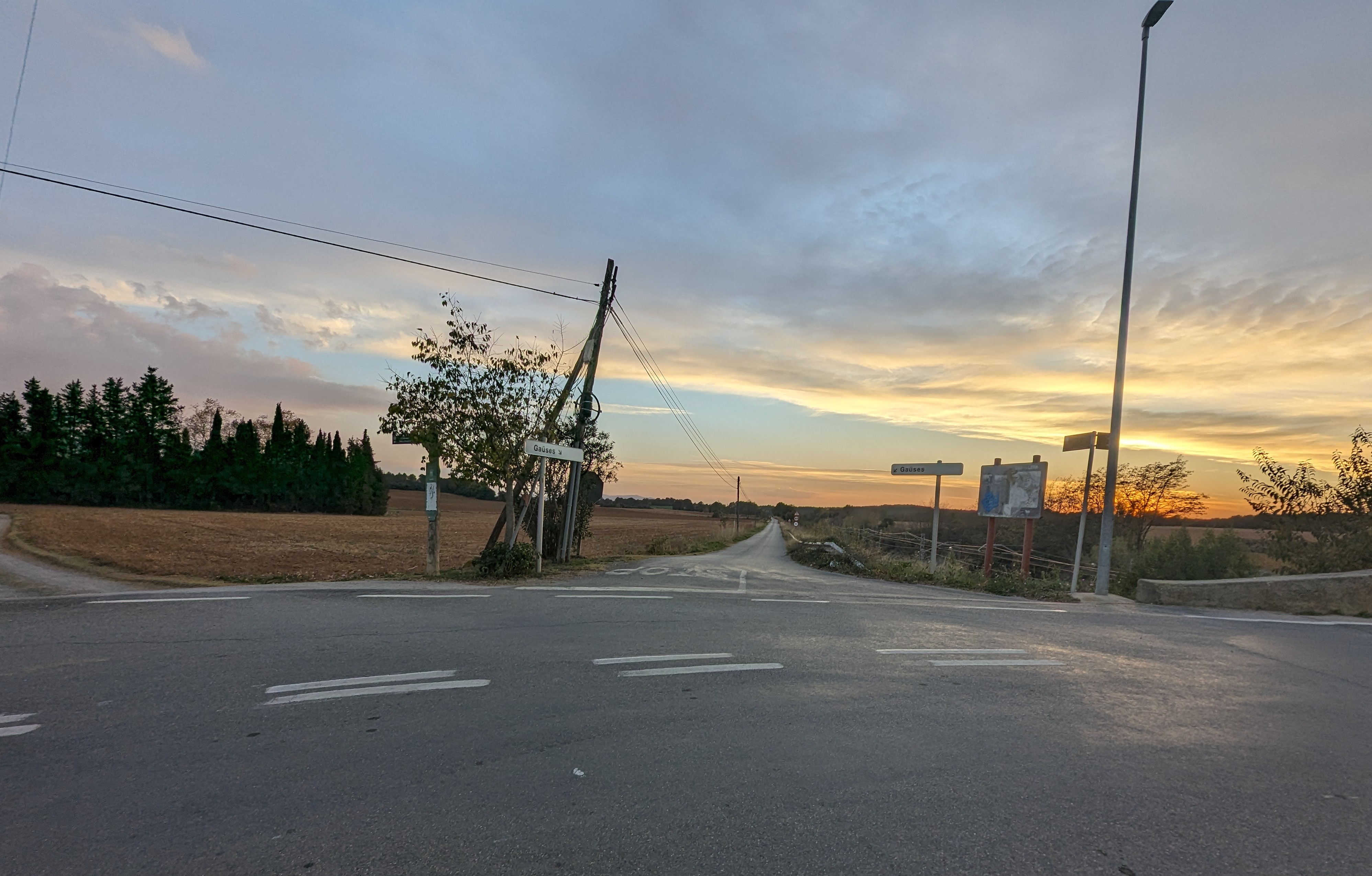
The bridge between Stages 10 and 11 is on the right, the road to Gaüses in the middle, and the small road to Stage 11 is on the leftEntrance to stage 11Stage 11
After leaving Stage 11, turn left towards the way you came but then take the next right, behind the houses, between them
Stage 12: Departing – Train station (Estacion de tren, reprised). Tree: Pink pepper tree
Train station Stage 12Peruvian Pink Pepper Tree
The Camallera Sound Walk and climate change
Under the pomegranate tree (stage 3)
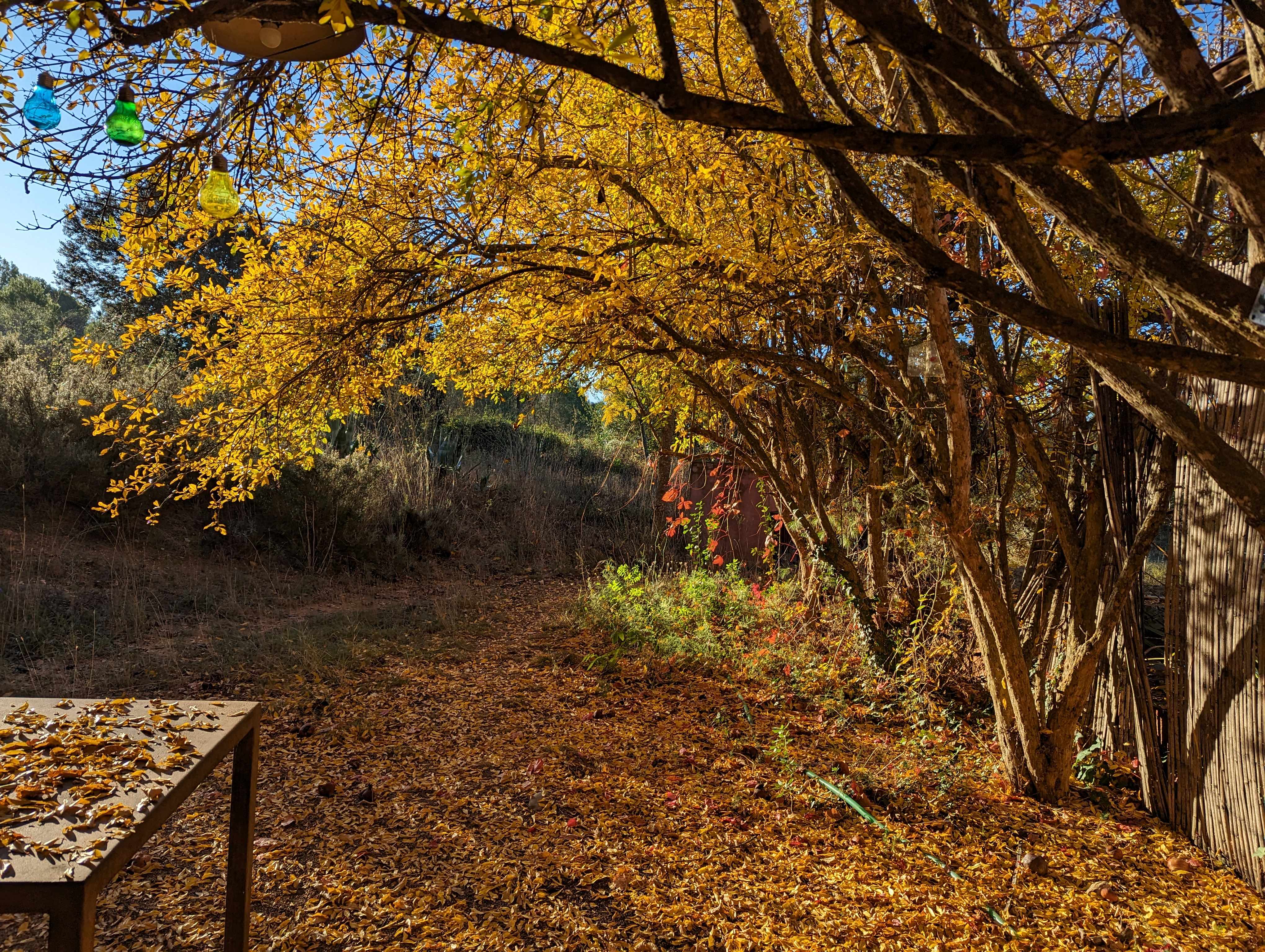
I was walking around the edge of Camallera at a specific time. I wandered during the change from Autumn to Winter when the leaves were turning from green to orange and amber, but red admiral butterflies still gorged on the fallen pomegranates.
The climate as we knew it in recent decades has changed rapidly, so when I walked in 2023, we were already years into an extensive crisis. It rained properly once, and spat occasionally, but the area is still drier than it was even last year. Temperatures were on average 1.5 degrees (at times 2 degrees) centigrade hotter, though I left on a white, frosty morning.
2023 is the driest on record in the 109-year history of the Fabra Observatory and the driest in 73 years in parts of Bages, Osona and Moianès
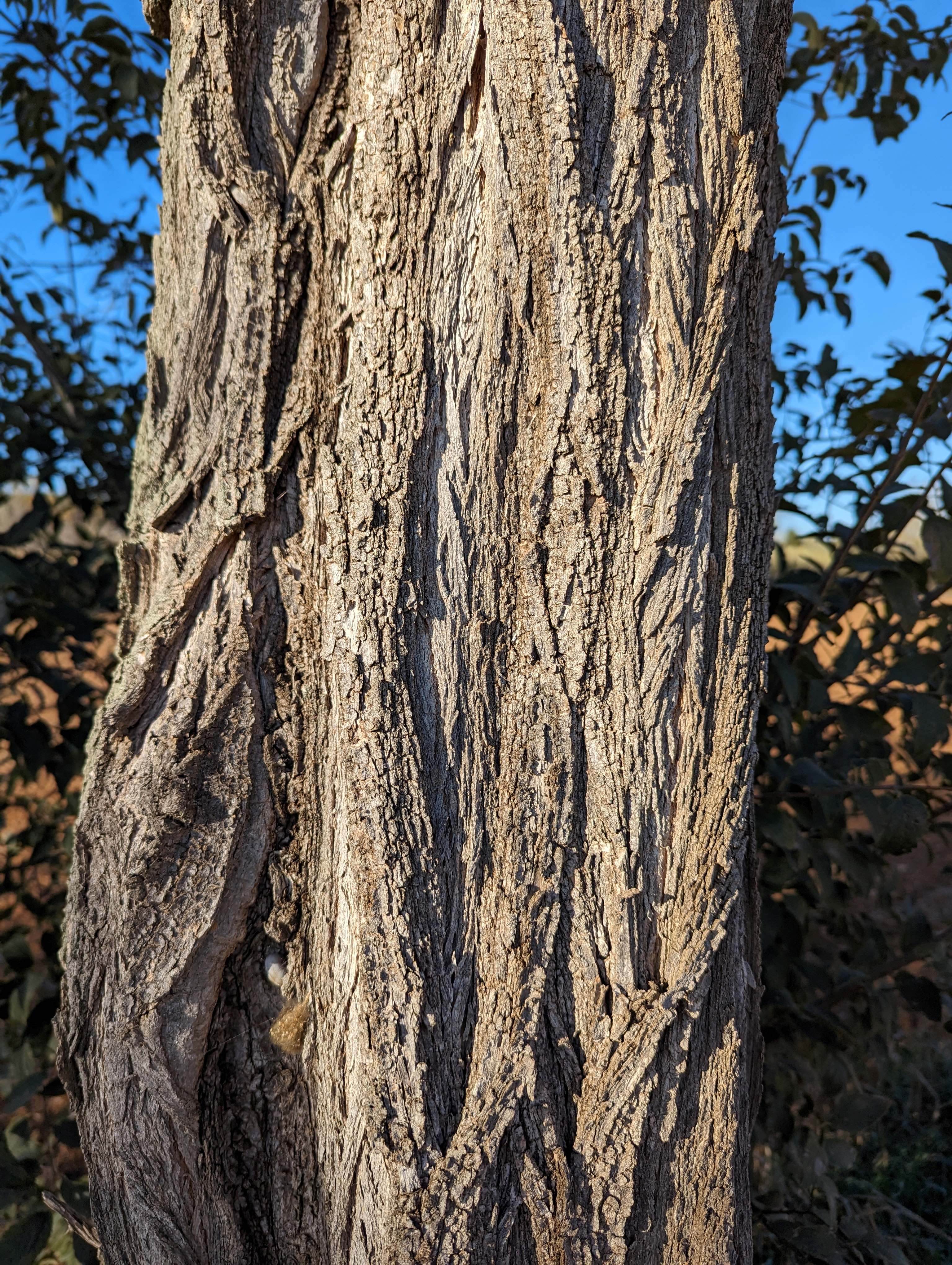
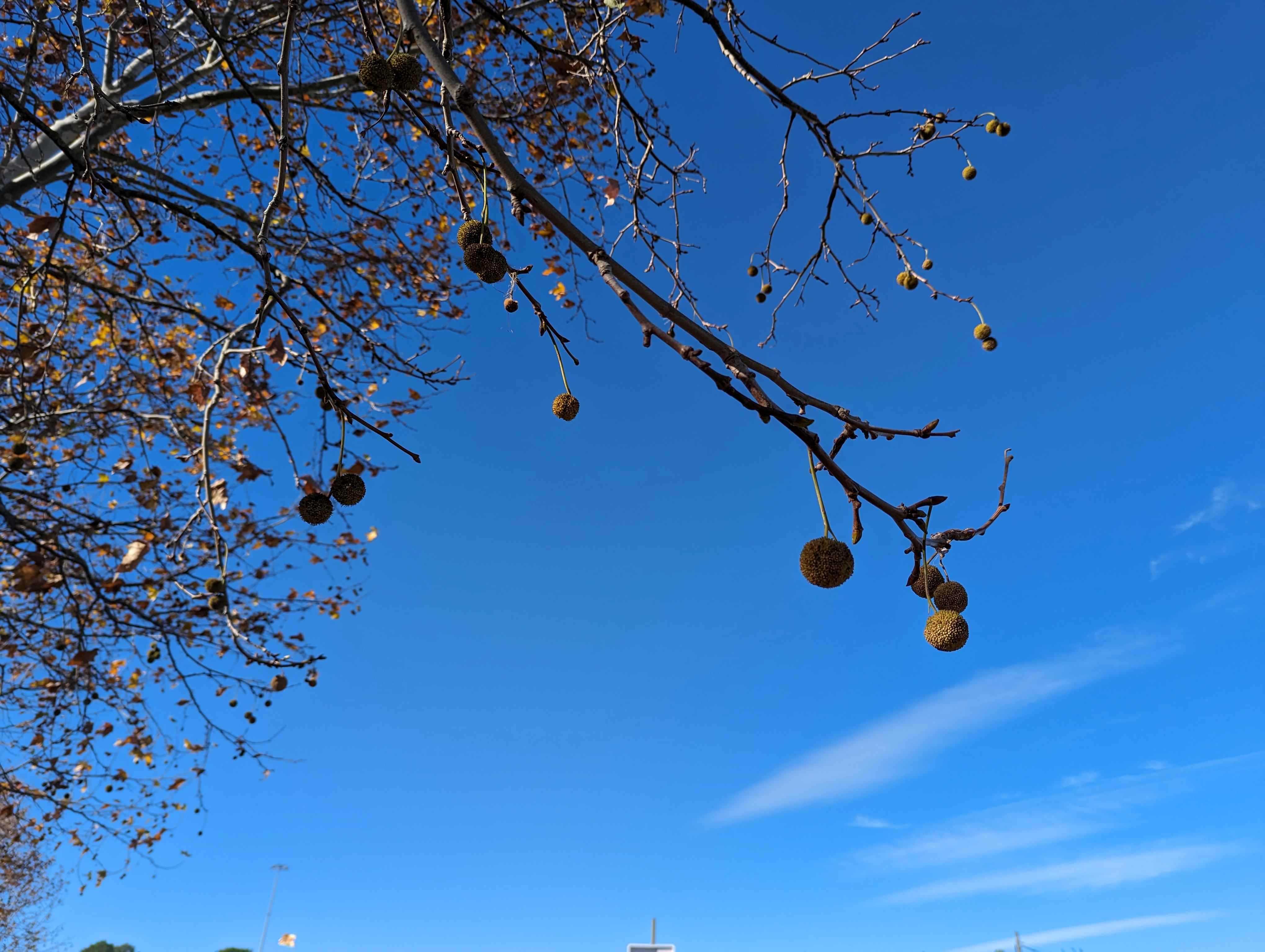
Camallera is rich in trees. There are plane trees (Platanus hispanica) everywhere, at almost every stage of the walk, but I have chosen others to give a sense of the variety in the area. There are more to be found between stages and if you venture inside the boundary.
Senses
Remember to taste and smell too! At each stage, roll your tongue around in your mouth, swallow the saliva, focus on what taste is there. Is the flavour of stage 1 different from stages 2, 3, 4 … ? You will find wild fennel, rosemary and thyme to satisfy your tastebuds.
At each stage, take a deep smell of the space you are sitting or standing in. Does it smell differently from your home or from the way it smelled in the previous season of the year? Savour the scent of pines and sage when you crush it, the warm tarmac in the sun, and whatever else you discern.
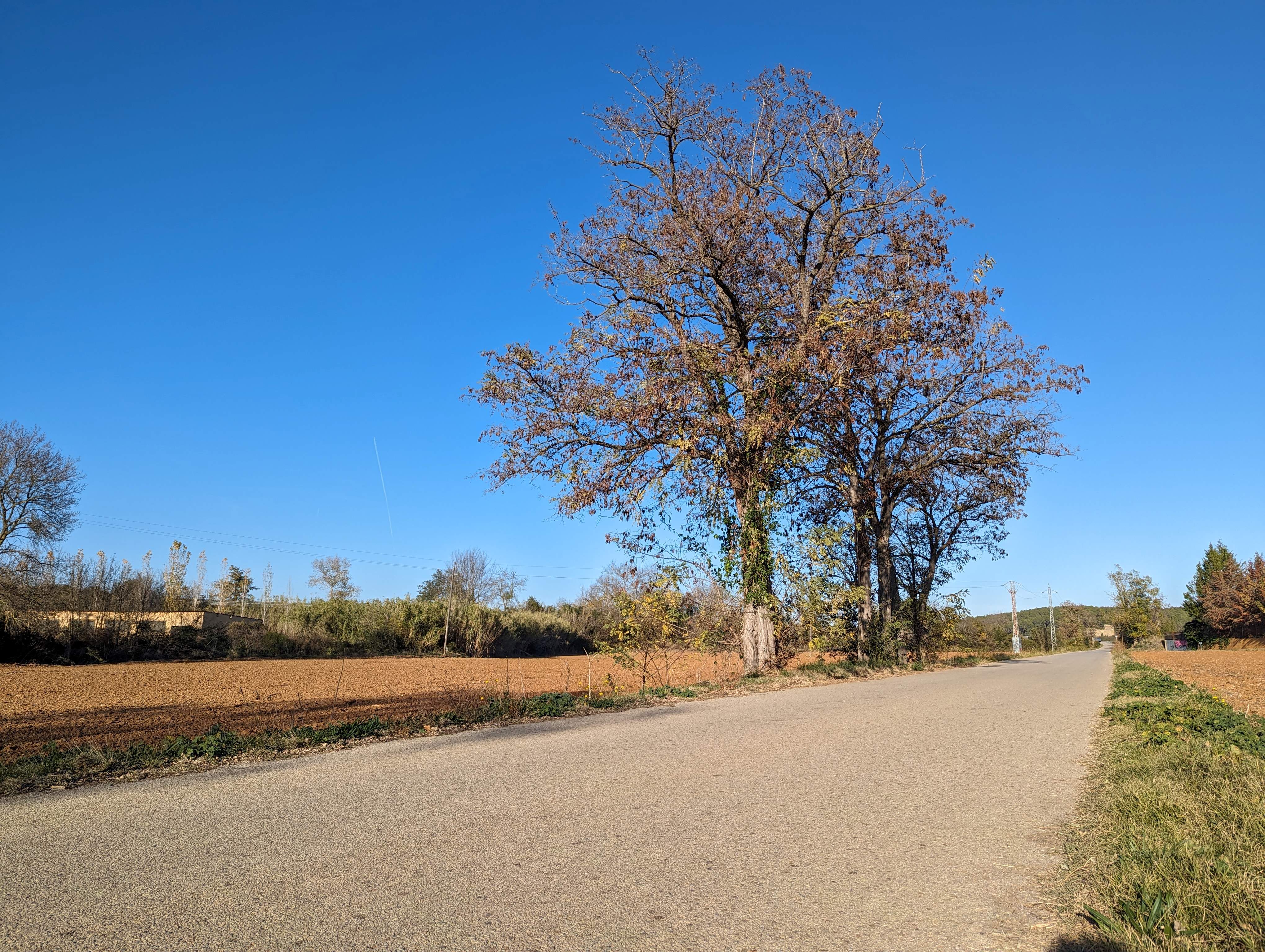
The area is a feast for the eyes: the newly ploughed, ochre-coloured earth, the graffiti everywhere, the blushing fruits and golden leaves, all depending on the time of year.
Listen for animal sounds& human ones
Options
There are 3 optional loops that can be added to the Sound Walk. They don’t have recorded excerpts to listen to, but are rich in sounds.
Look out for the bell between Stages 3 and 4a
Option 1: Saus, between stages 3 and 4a. Leave Stage 3 behind you, walk downhill past the barking dogs and turn right (following the Sound Walk), but when you get to the sharp left-turn, continue instead straight on towards the main road GIV623. You are now on the GIV6233. Follow it around to the right and take a left through the underpass to the other side of the main GIV623. Take Carrer Oest into the town of Saus and don’t forget to visit the 11th century church – Església de Santa Eugènia de Saus. Please note that you have to go back the same way you came as there is no other route between Saus and Camallera.
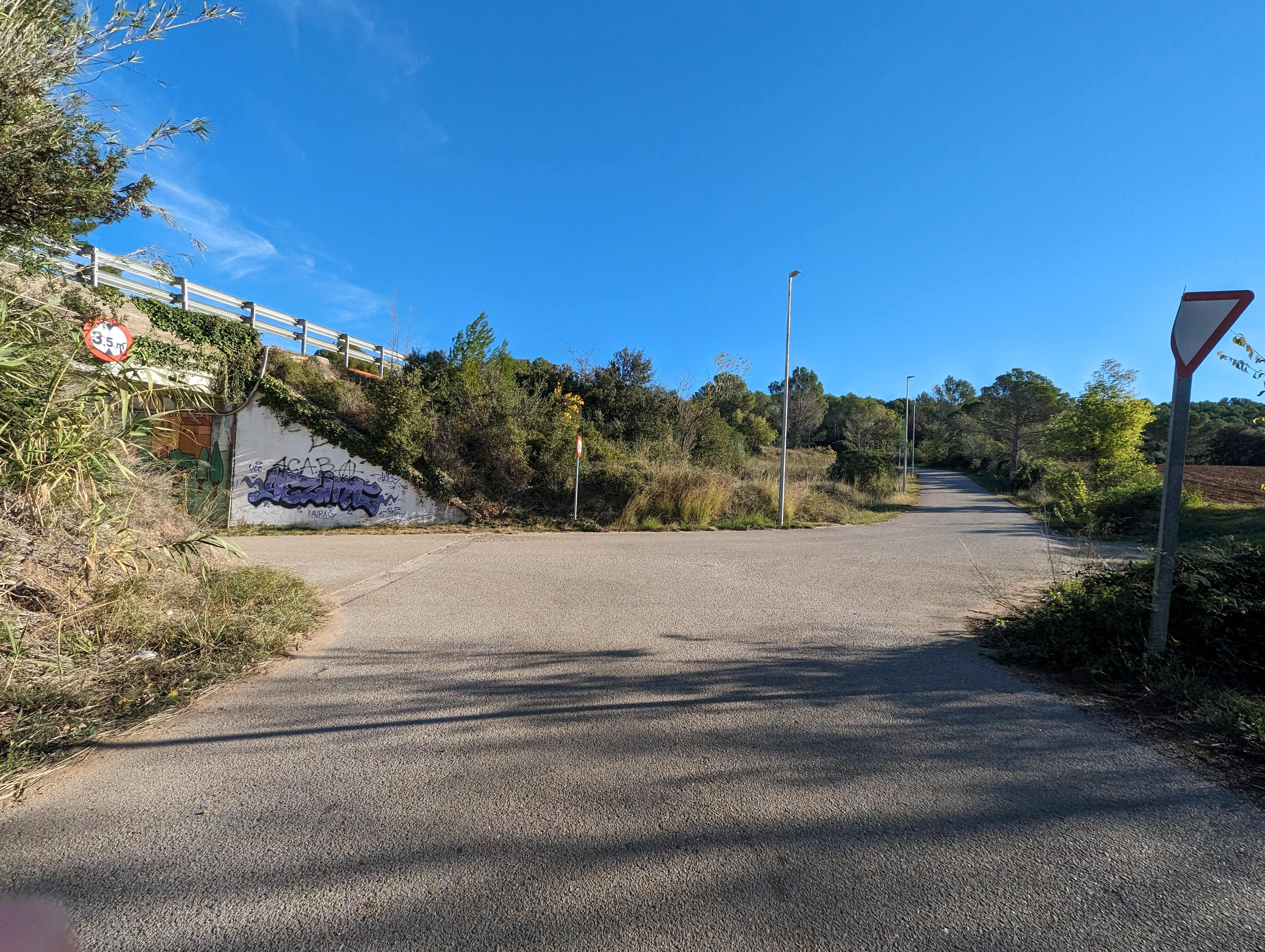
On the GIV6233. The underpass is on the left of the photo
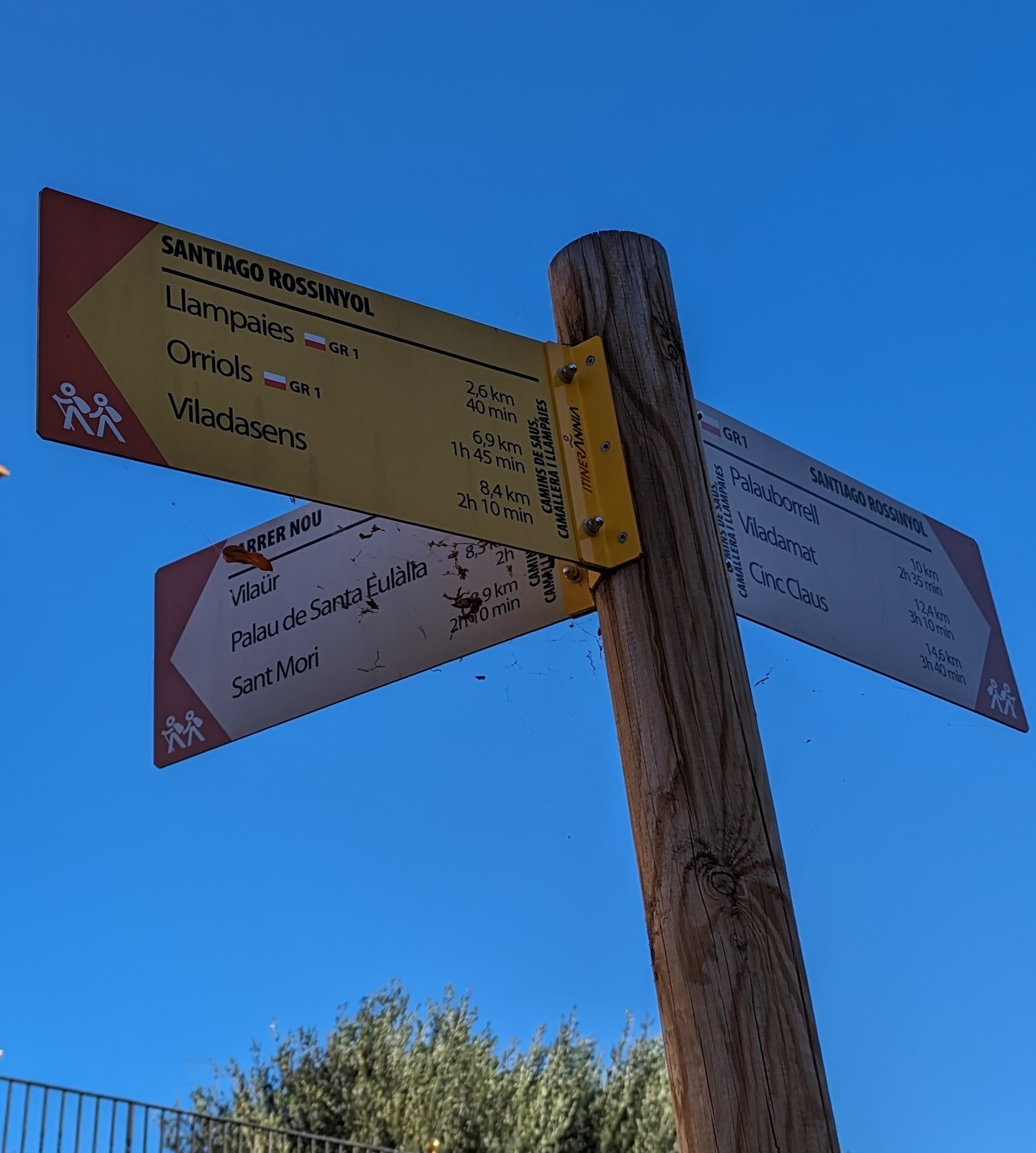
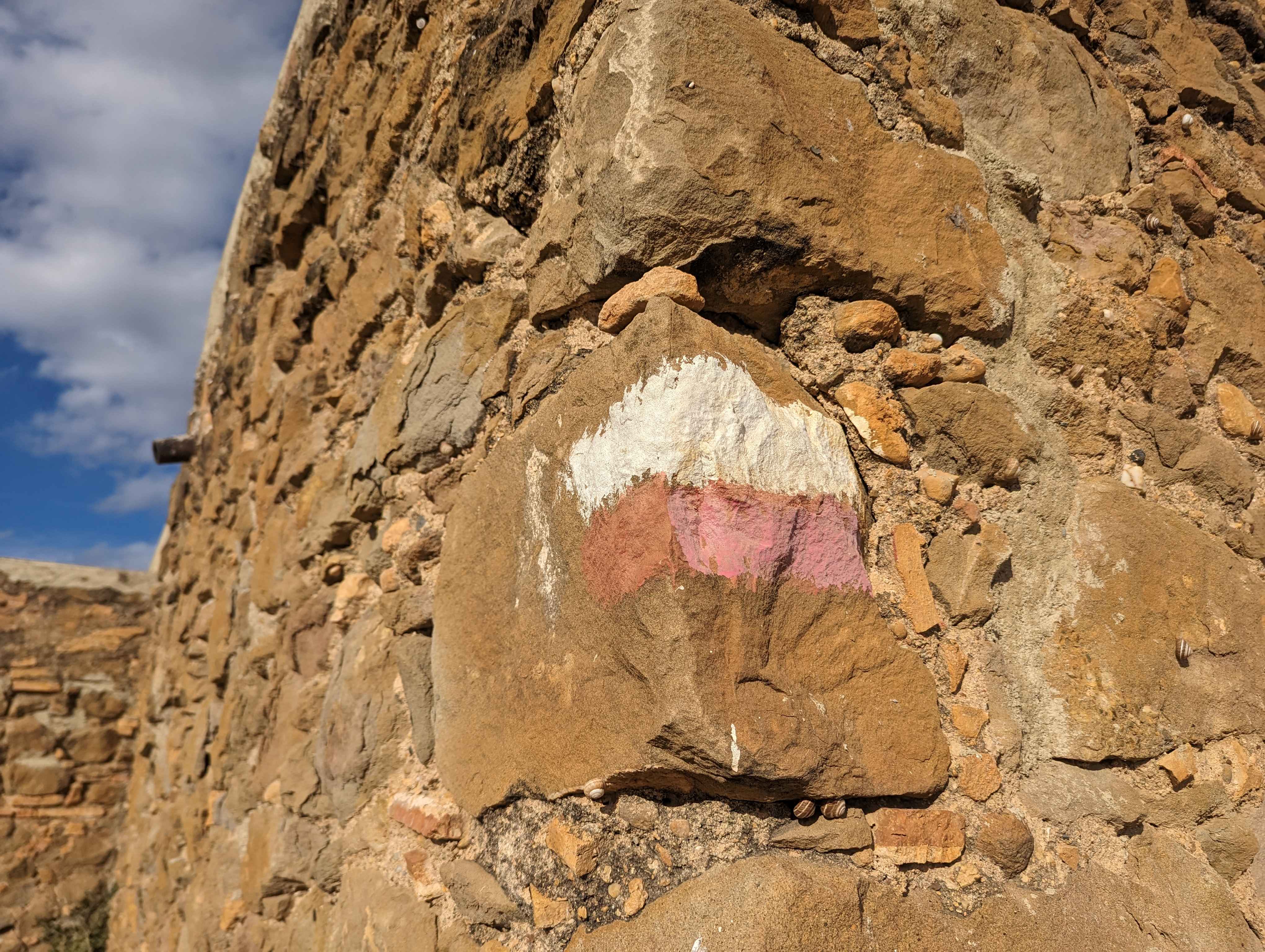
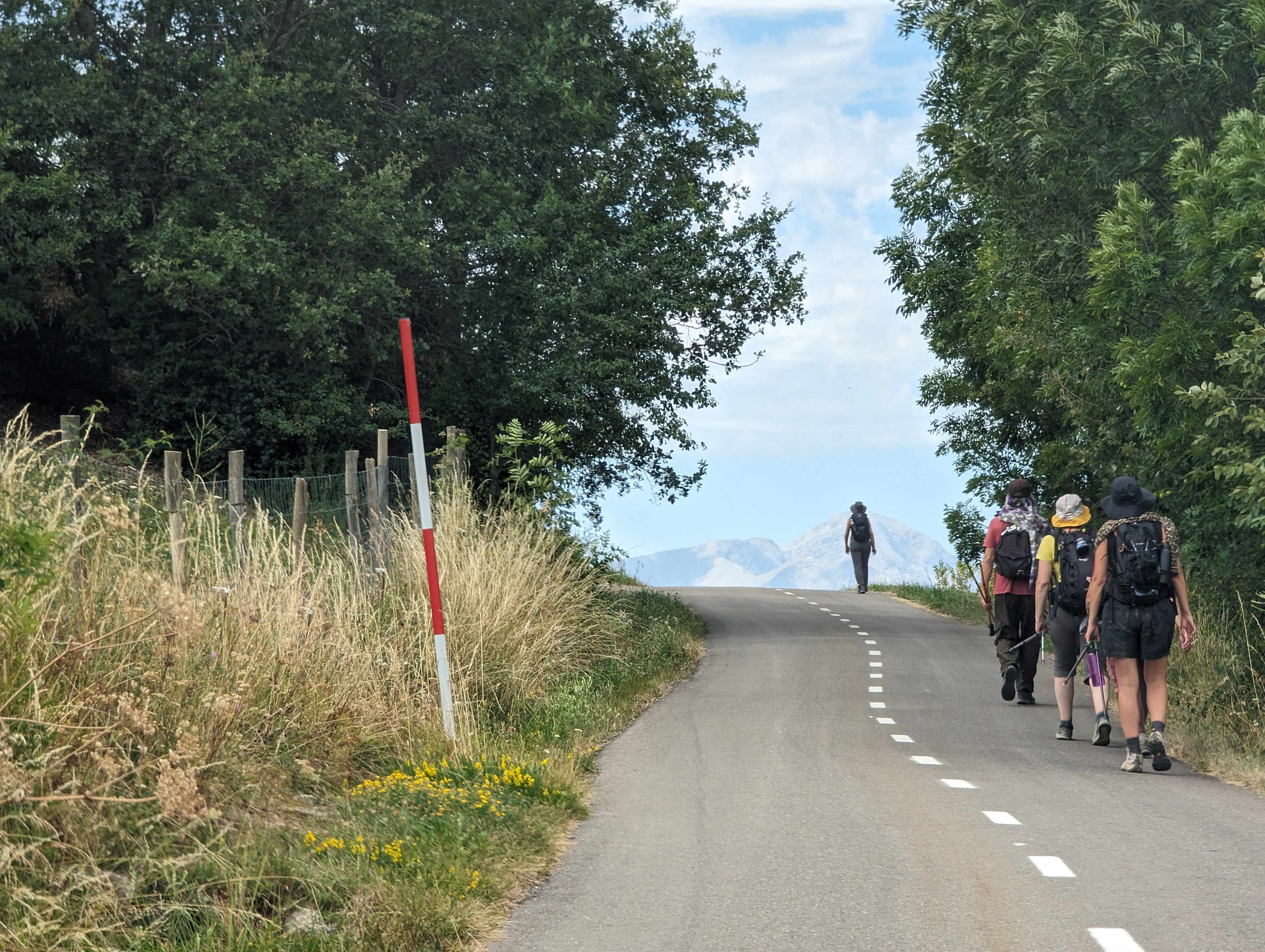
Option 2: The woods beyond the cemetery (Stage 8). Continue along the same road, keeping the cemetery on your right. There is a junction with 3 options. Take the second left and walk a loop, coming back via what would have been the third left. The GR1 trail runs along that south western corner of the town, so look out for the red and white striped signs (photo below) and the sign posts (photo above).
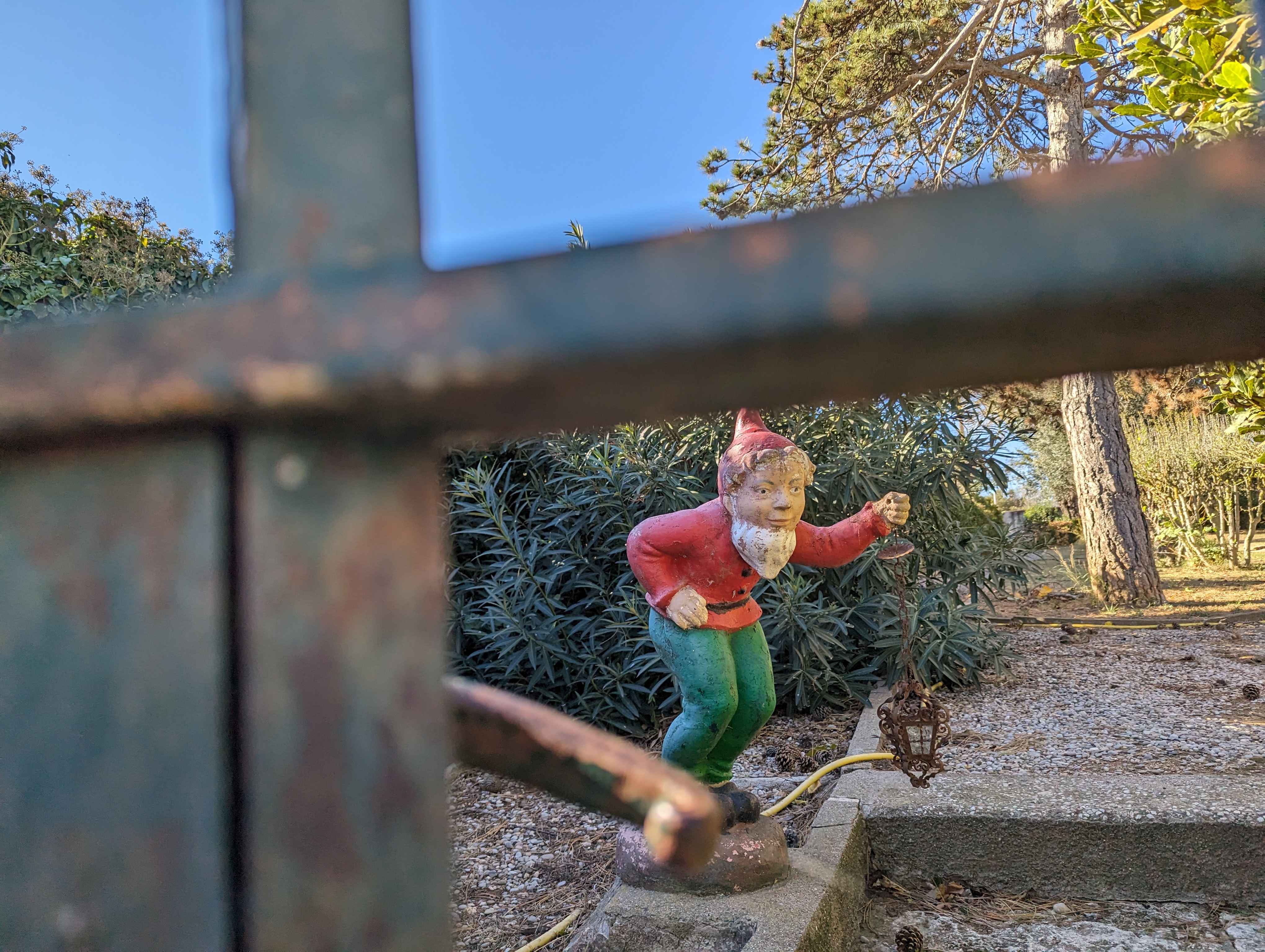
Option 3: Llampaies. From Stage 6, continue along the Carrer de Banyoles (it becomes the Carretera Girona-L’Escala) instead of turning off left along Carrer Tramuntana to Stage 7. Look out for a whispering gnome, the sound of a beautiful cedar tree in the wind, some silent graffiti (see main map above) in a field on your left, and the clangs and vrooms of Responsive Business (a transportation company, maybe) with a red chair on the balcony for peacefully sunning oneself during work breaks.
Where am I?
Thanks
Many thanks to Clara Garí and Nau Côclea for the opportunity to discover this wonderful place. Also to the singers Jordi Homs and Mar Serinyà (listen to Stage 9), and to percussionist Jordi Rallo and his group who feature in Stage 4a.
My workshop participation in, and listening to, Viv Corringham‘s work has been an influence, as, I’m sure, have all the other captivating sound walks and works on walklistencreate.org. I have not studied with Pauline Oliveros, but I have read a lot about her work and learned from others who have. My conversations with Igor Binsbergen while we walked, were fascinating and also important.
Nau Côclea offers a grant consisting of accommodation, follow-up and public presentation. This walk will be presented as part of the Walking Arts Encounters in Girona in July 2024.
I am happy to say that I am on my way to Camallera near Girona in Cataluña / Catalonia, where I am taking up an Artist’s Residency at Nau Côclea (Centre de Creació Contemporània Nau Côchlea).
I will be walking around the edge of the town, the boundary of the area, listening to the sounds of the place, and to ‘stories’ from the soil. When I make a Sound Walk, I follow the signs. I take notice of what happens around me when I am in the research and preparation stage.
I had been reading about the current interest in engaging with the legacy of Francisco Franco’s authoritarian regime, and consequent human suffering. The suppression of democratic freedom and the Catalan language had far-reaching results. I have studied The Historical Memory Law, followed the opening of some Civil War mass graves, spoken with people about inherited grief, and noted the rituals being enacted around the acknowledgement of the loss on many levels.
When I discovered that my visit corresponds with the annual walk across the Pyrénées from France in memory of Walter Benjamin, I knew I must join it. Benjamin was directed across the mountains by Lisa Fittko and received bad news on arrival in Port Bou on the Spanish side. He died by suicide that night, before being able to finally escape to the United States.
This level of inter-generational trauma takes time, so much time, to leave the gene pool. It surges through bloodlines … How to tell a new story of resilience and hope? Is this history of loss held in the soil?… How can we honour the suffering of our ancestors – of those who came before us – but still try to unravel the chains we find ourselves bound by? Is the answer held within the very soil… Is the answer held in the residue the ghosts leave behind?
Kerri ni Dochartaigh Thin Places p186
I come to this residency with many years of embodied study of death, grief and loss – personally, and through my Shiatsu work, death cafes, and writing. This coincidence, then, came as no surprise. I know that the Sound Walk that I will be making during my residency may concern grief, loss and renewal as a result, although I won’t know until I begin.
If you are interested in this project and able to come between 20 November and 2 December, I am inviting you to join me for one day or part of one day, to walk and listen, to share your feelings. We will co-create a Sound Walk from these experiences which will then live on in Camallera for anyone to join at a later date.
Dates: 20 November and 2 December. There is one bed for you to stay a night in the artist’s cottage. Let me know if you are interested! tamsinlgrainger@gmail.com
Festivities and DelegatesEl Grand Tour Grave, Cataluña
Nowadays, I travel overland. This is a personal choice based on the the current state of the climate. We know that air travel contributes so much to the amount of carbon which is in the atmosphere, and I’d rather not add to it unless absolutely necessary.
The first time I went to Greece this year, it took me 10 days to travel back to Edinburgh from Athens, though I broke my journey many times. I went from Athens, overnight by bus, to Budapest via Belgrade, then to Berlin (by bus), Amsterdam (bus), Hook of Holland (metro), Harwich (ferry), London (train), Edinburgh (train). I announced on social media that I was doing this and asked if anyone wanted to do a Shiatsu-hospitality swap. I received invitations in reply, so the journey took longer and I was able to renew friendships, give Shiatsu, see new places and much more besides.
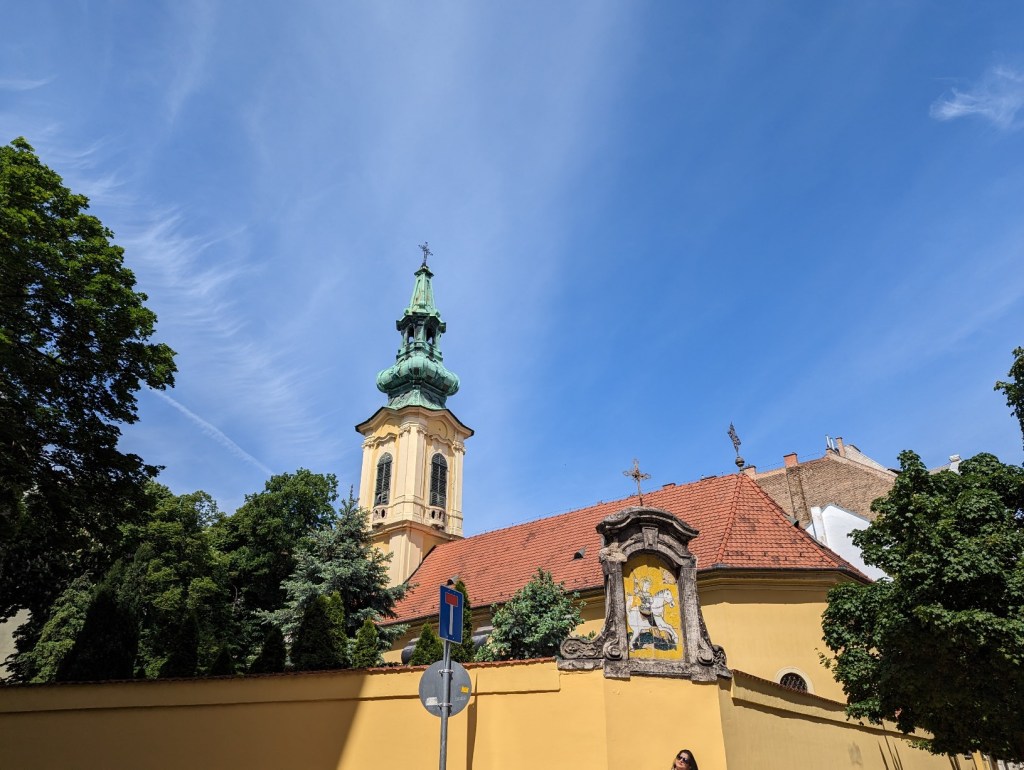
Church, Hungary
It was more expensive, but more fun than flying, when I’m picked up and put down without seeing the places I am travelling through and am discombobulated by the speed and height.
Some people go slow because their body doesn’t go fast, or because they have small children who wander and stop a lot to smell the roses. I tend to walk slowly a lot of the time though I’m lucky to be relatively fit. I meander and follow my fancy, heeding the landscape ‘s call as psychogeographers have a habit to. You can’t rush easily with a huge rucksack anyway, not unless you want to rupture something!
Slovakia
It’s a privilege and a choice. I do usually travel as cheaply as possible, exchanging as I go where possible, and I give up work to do it, hoping that I will find a way to live somehow. One day, who knows, my book will get published and I’ll make some money with it. In the meantime, I consider myself to be lucky.
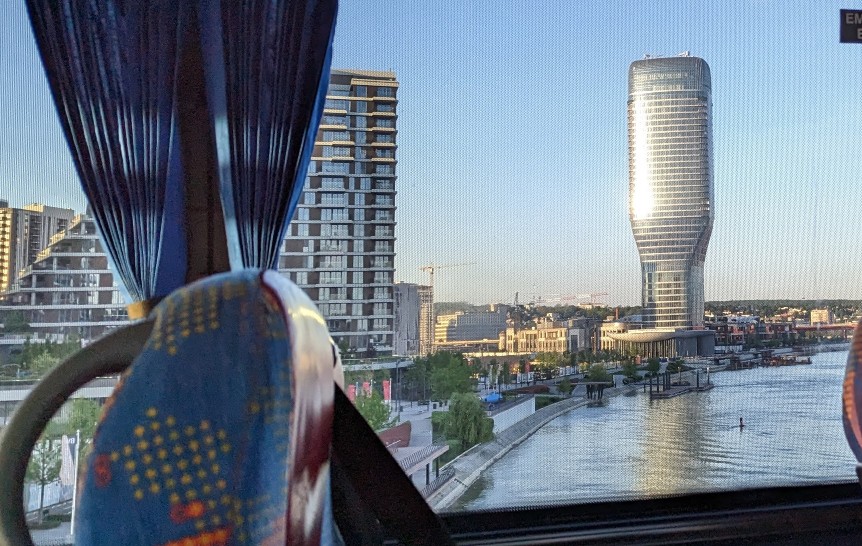
Belgrade from the bus
There is plenty of time for rest, reflection and reassessment when you travel this way, which is vital for a satisfying life. Instead of rushing from one place to another, there is time to look and smell, to have good conversations.
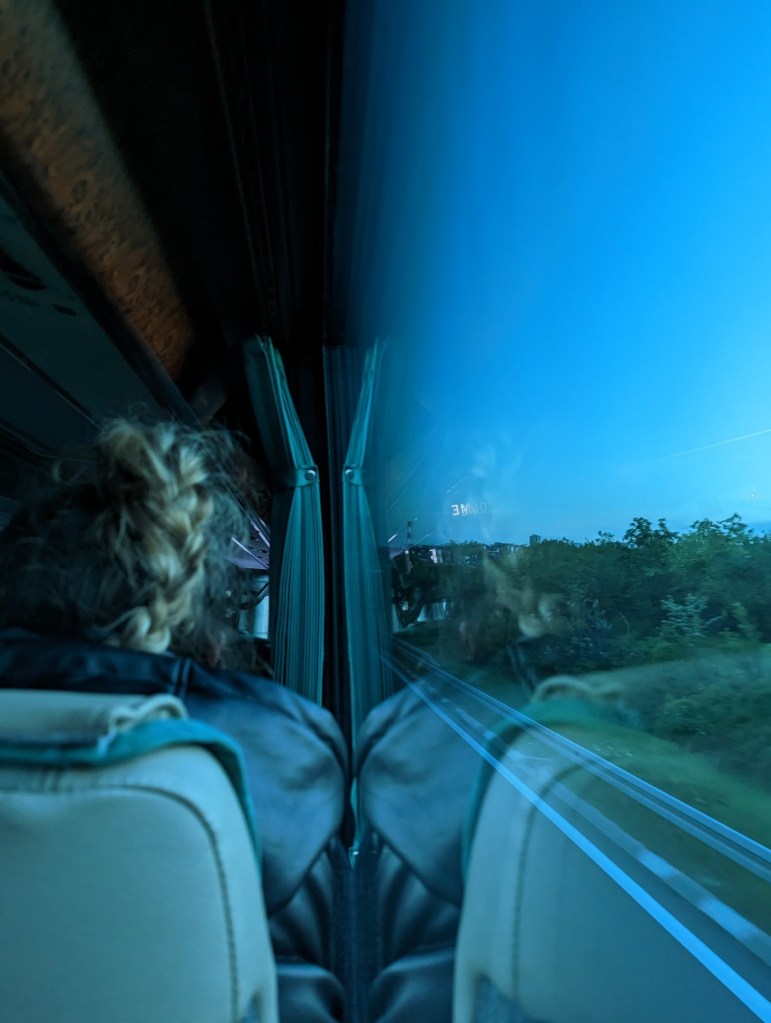
Reflecting time on long bus journeys
Overland from Edinburgh to Greece, return.
The second time I made the journey, I went by train and ferry through Italy.
I bought an Interrail ticket: 7 days used within 1 month costs £352. In retrospect I suspect it was not worth it. It’s a great deal of hassle trying to understand the system and negotiate the website, plus I turned into a Senior traveller in the middle of this period and they were unable to cope with that. It’s cheaper if you’re older or younger. Others I have spoken to since then, have also used this type of ticket and found it worked well for them.
Day 0 Edinburgh to London
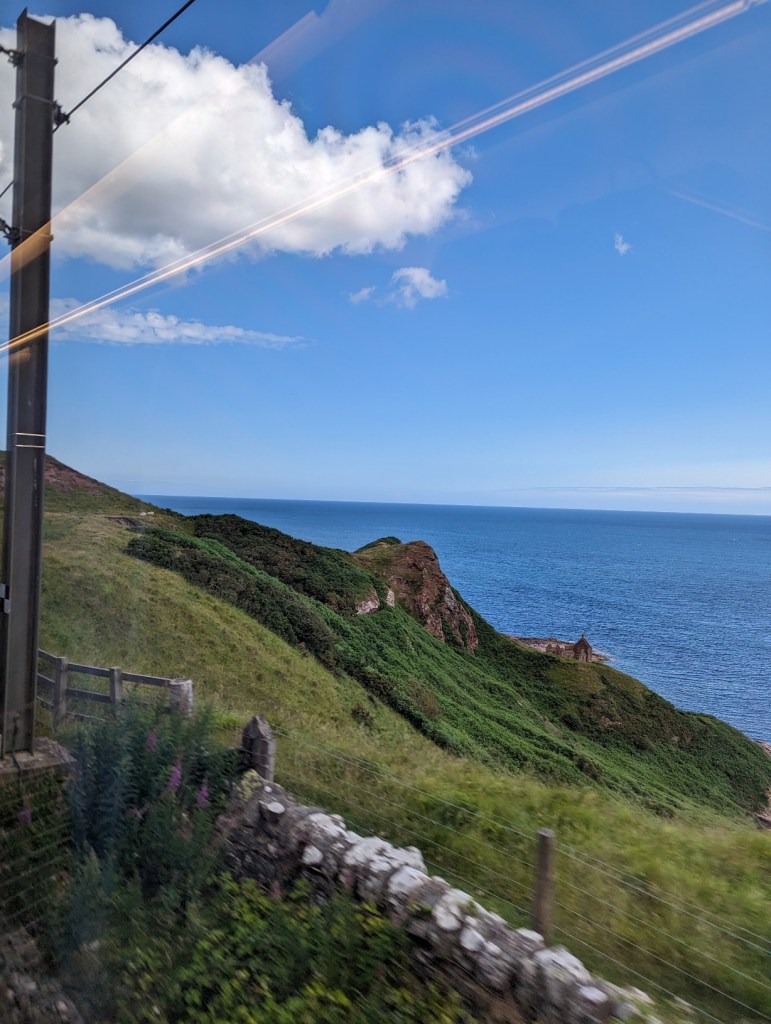
Edinburgh to London – the Northumbrian Coast
Edinburgh Waverley – London Kings Cross by LNER train (not included). Prices vary. Website: easy to use.
Day 1 of the interrail ticket: London to Paris
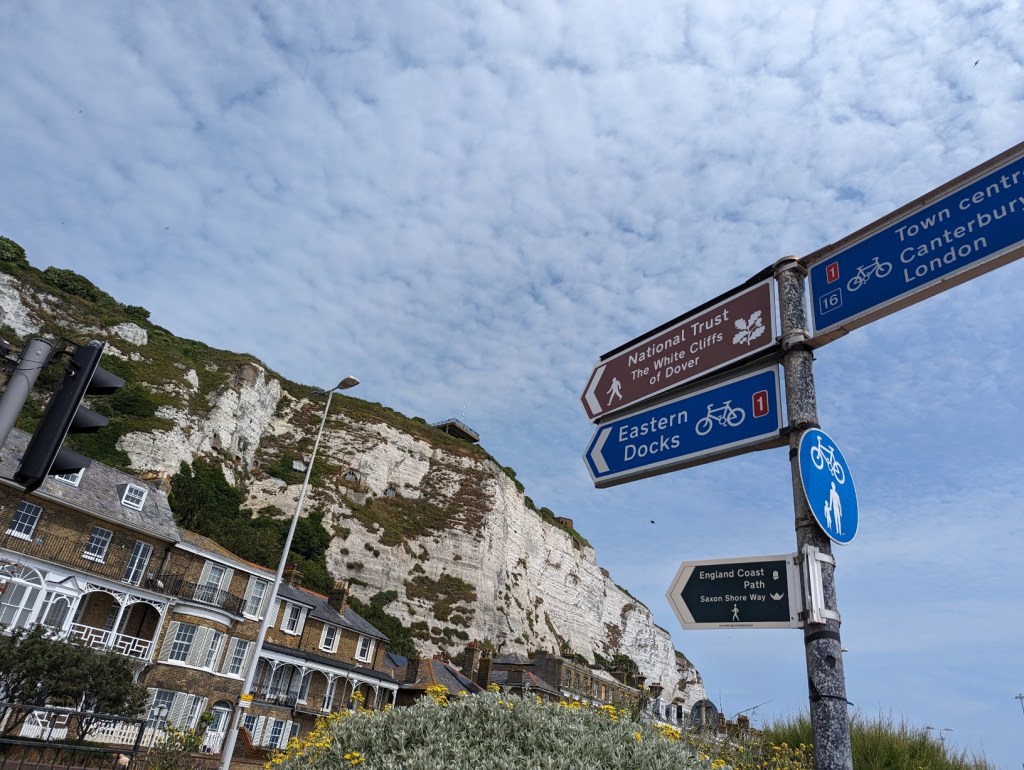
London St Pancras – Dover by South Eastern Trains (free). On time. It takes 30 minutes + to walk to the port, though there is a big Marks and Spencer food shop on the way (just a little detour) and you ghet a great sight of both the castle and the sea.
Dover, England
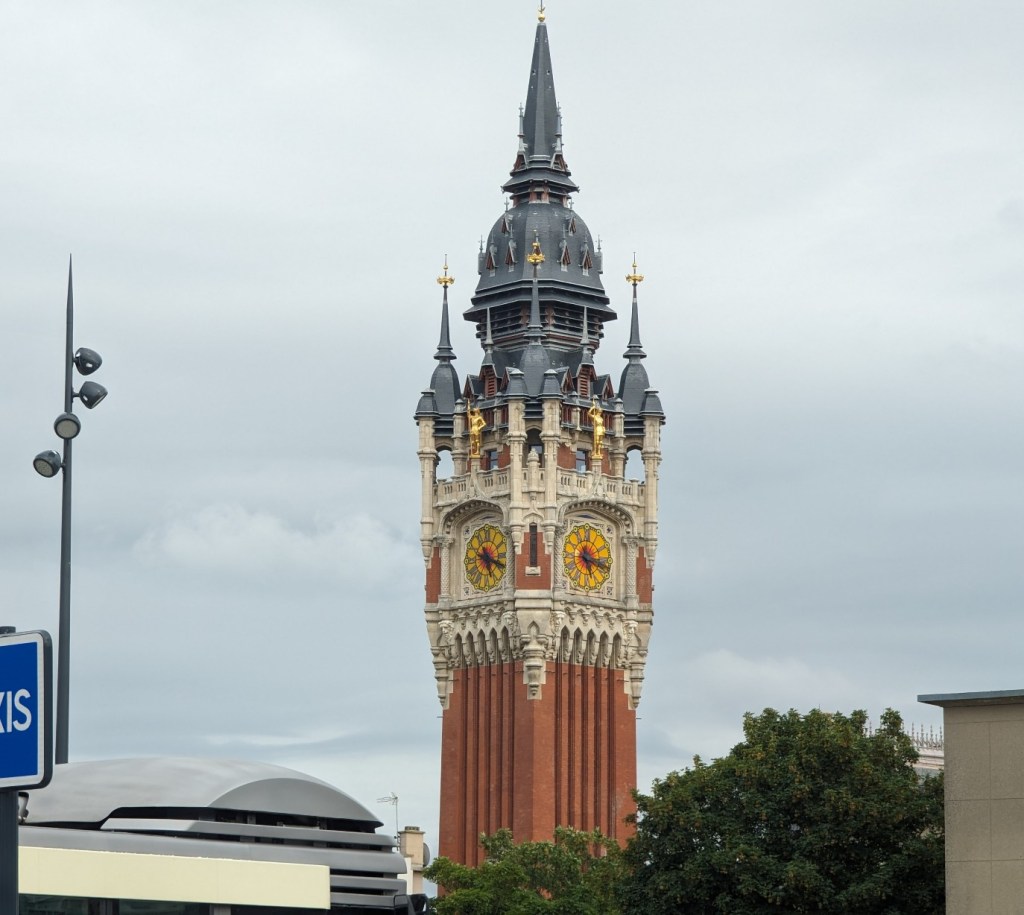
Dover – Calais by P&O (free) on time. Cost: £30 one-way, for foot passengers.
Calais, France
You can, of course, take the Eurostar train which is efficient, but to use the interrail, you must book months in advance. It can also be very expensive if you don’t manage to get one of the advance, cheaper tickets, and beware of their promise of ease of cancellation and transfer to another journey. It is easy, but can only be transferred to a journey in the same direction, and is very expensive (a last minute change I had to make due to a bus delay (see below) cost an extra £130).
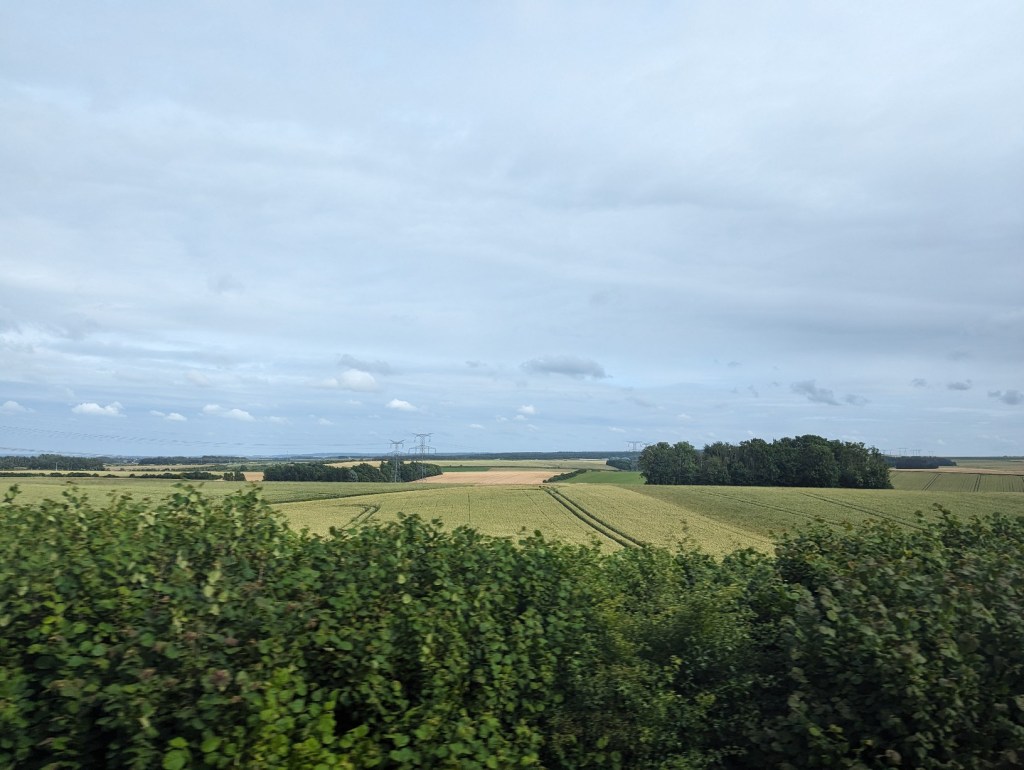
Calais – Paris Est (East) by SNCF train (free with the Interrail ticket) delayed
Calais to Paris through the train window
I stayed overnight with a friend; very many thanks for the bed and patience at the lateness of my arrival, Helena.
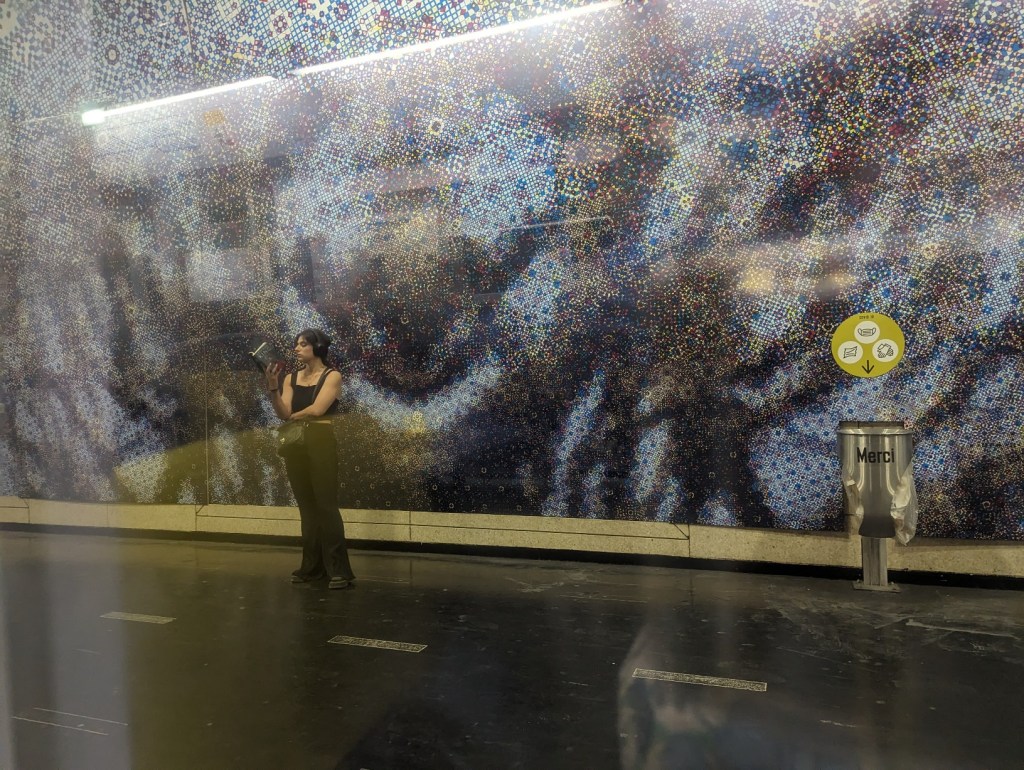
Paris métro
Day 2 Paris to Bari
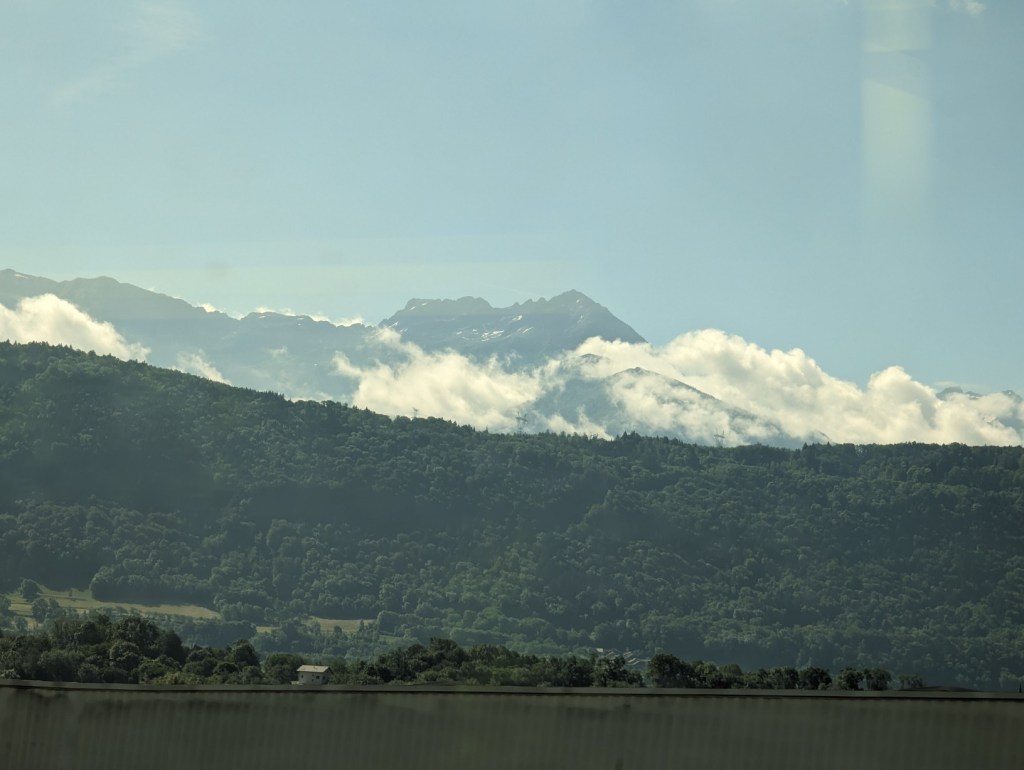
The Paris to Milan journey is scenic and spectacular
Paris Nord (France) – Milan (Italy) – Bari (Italy) by SNCF and Trenitalia trains, all booked in one ticket, but BEWARE the interrail website did not allow enough time to cross from one side of Milan to the other, so I missed the connection. Remember to check in advance! Happily, there is a Last Minute Ticket Booth at Milan, and after quite a time in the queue, the woman managed to book me onto the later train without charging me a second seat booking fare, for which I was immensely grateful. People are always so kind to me when I travel and it is such a wonderful antidote to some of the things I hear about in the news.
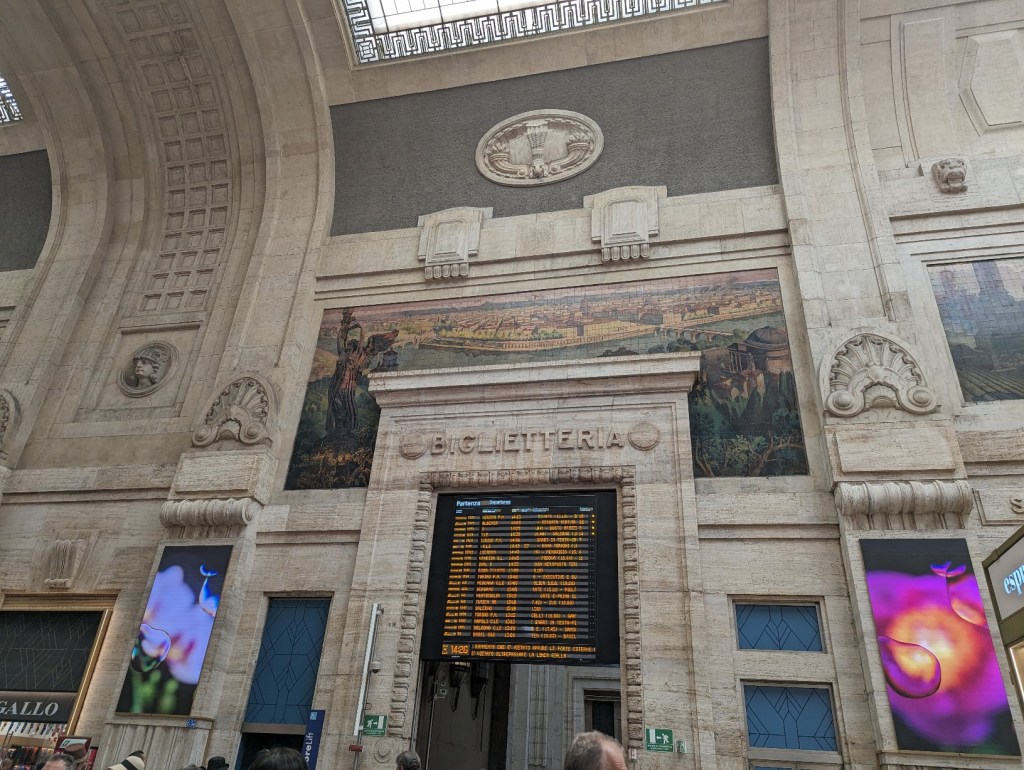
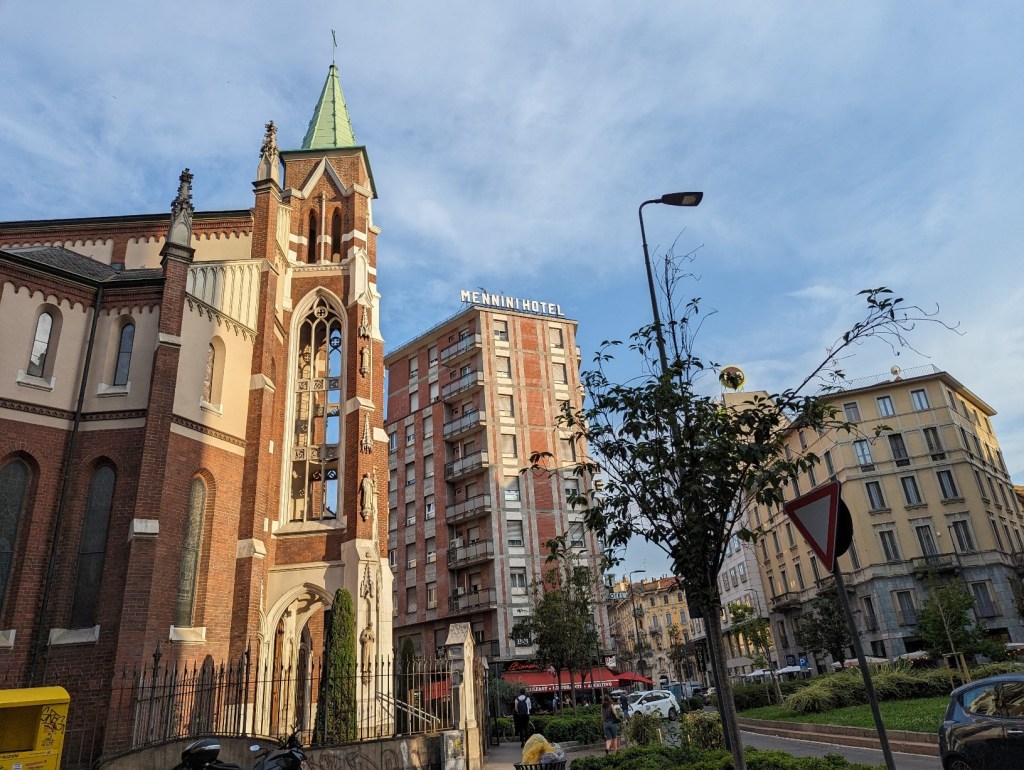
Milan Centrale (station)
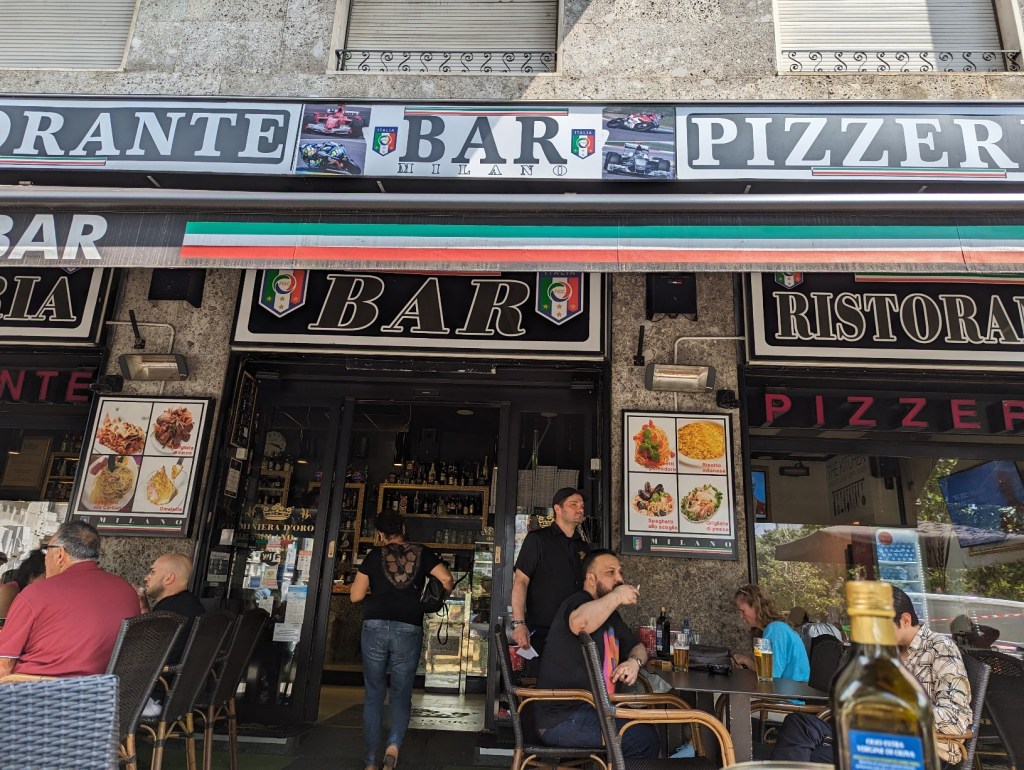
What you can do in Milan: bask in the sun, fill up your bottle using the safe drinking water fountain in the square outside the station, eat a tuna salad at the Pizzeria near the station (good salad, stale bread, patchy service).
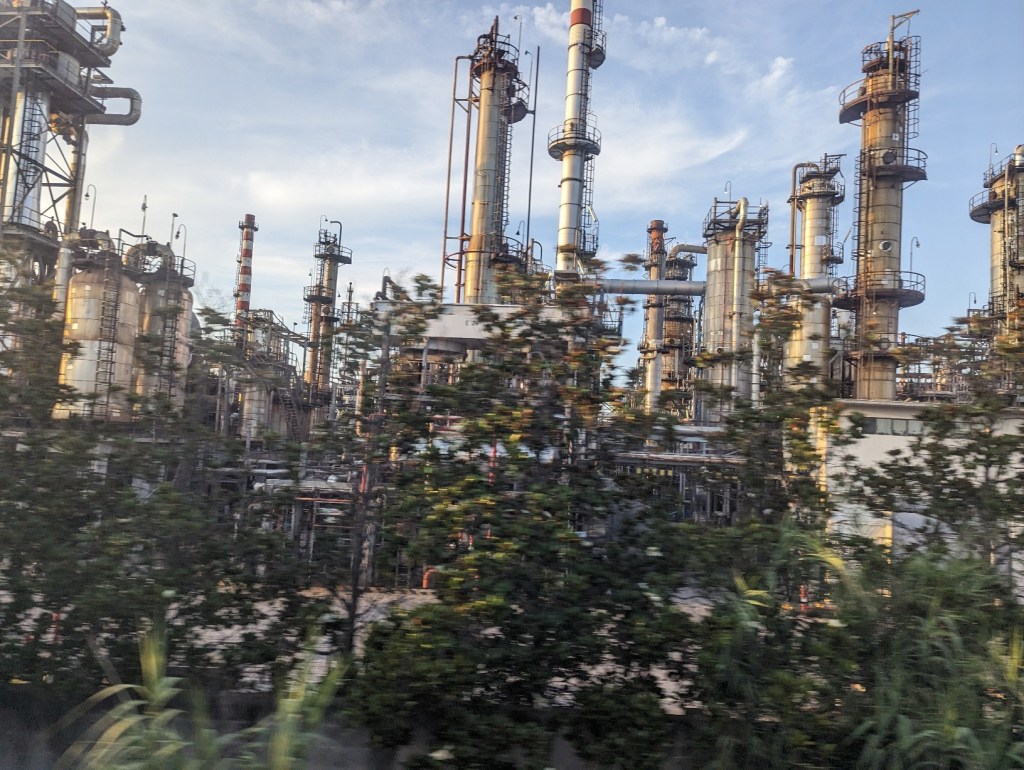
Not highly recommendedThe Milan to Bari train also has great views, especially the second half which travels down the coastThere are industrial attractions on the Milan to Bari route too The Movida Blablabla hostel, Bari, Italy
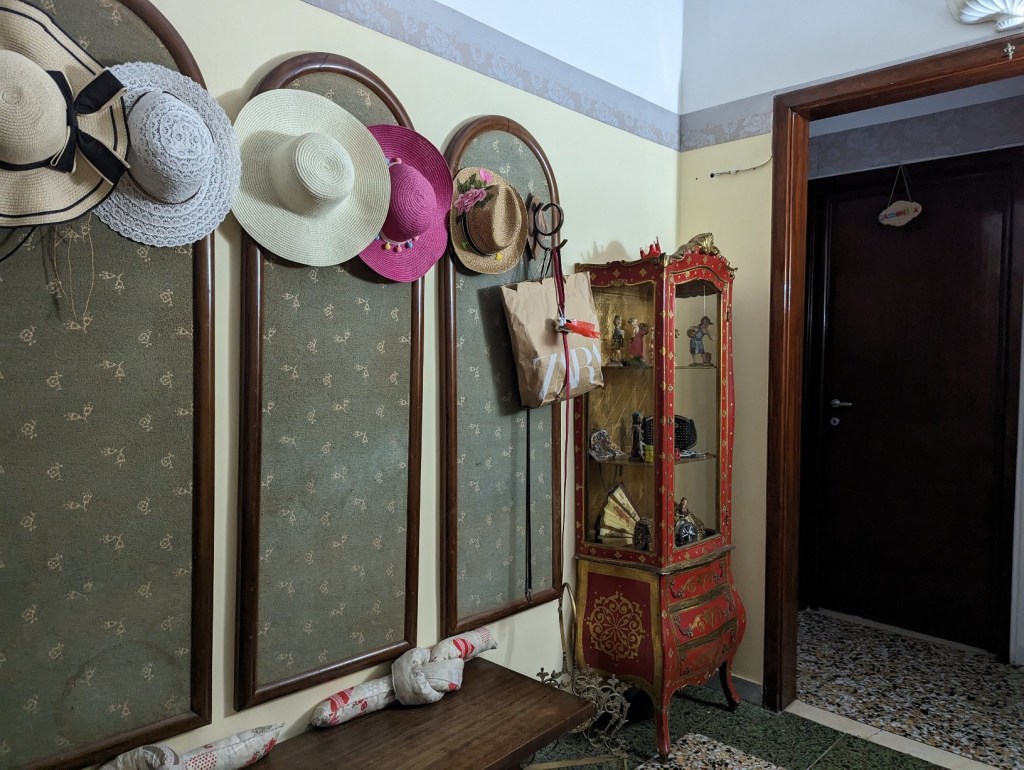
I recommend Movida Blablabla, a hostel for €35 in a 6-bed, all-female dorm. They accepted my very late arrival (after midnight) when I explained that it was due to the train delay though they did ask for €10 extra. Positives: kitchen, dining room decor, better than normal toilets and shower (hand-held in the bath). Negatives: the usual heat and noise from a dorm-sleeping situation.
Day 3: Bari, Italy to Igoumenitsa, Greece
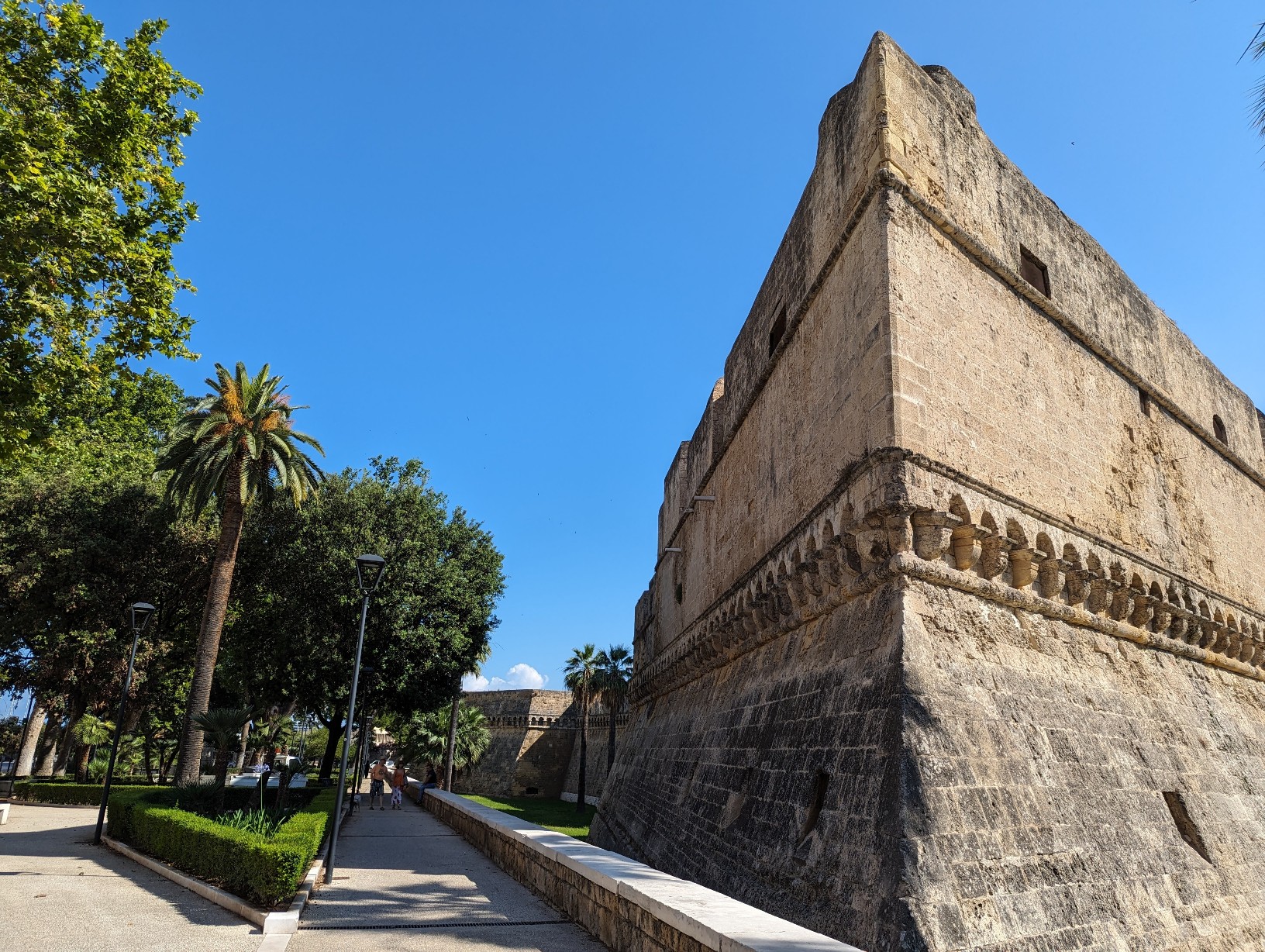
Castle, Bari, Italy
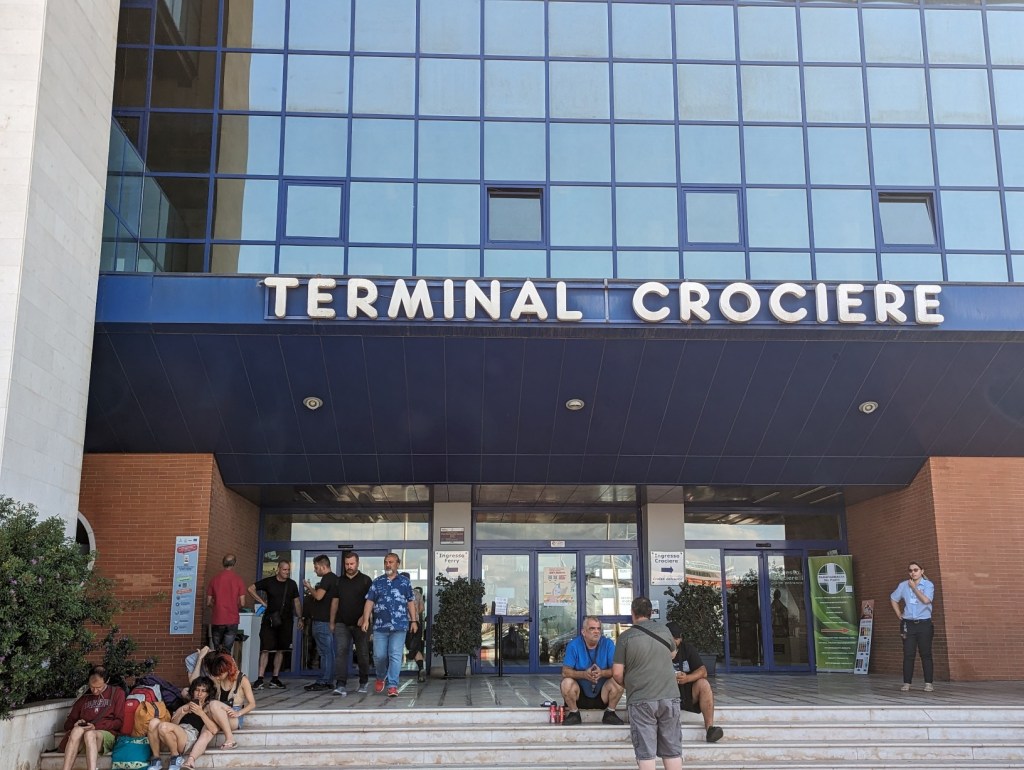
There was a repeat of previous difficulties I have had in finding the right booking office to transform my online ticket into a paper one. It was even worse this time as I hiked in seriously hot sun (despite the early time of day) and walked for 1.5 hours before having to go part way back. It might be worth knowing that there is a free shuttle bus from the Albanian ticket office (where I somehow found myself) to the Greek one, but it’s hard to find out when it comes. There’s also a little cafe and toilets very near the same Albanian ticket office in the port, but otherwise it’s a great big, busy car park with no pavements. Though the ferry leaves at lunchtime (the summer timetable has a Sunday crossing), there was no time for sight-seeing in Bari in the morning, although, instead of walking you could look for a bus from the centre of Bari to the enormous port.
This is the building you are looking for in Bari, Italy, to get the boat to Igoumenitsa, Greece
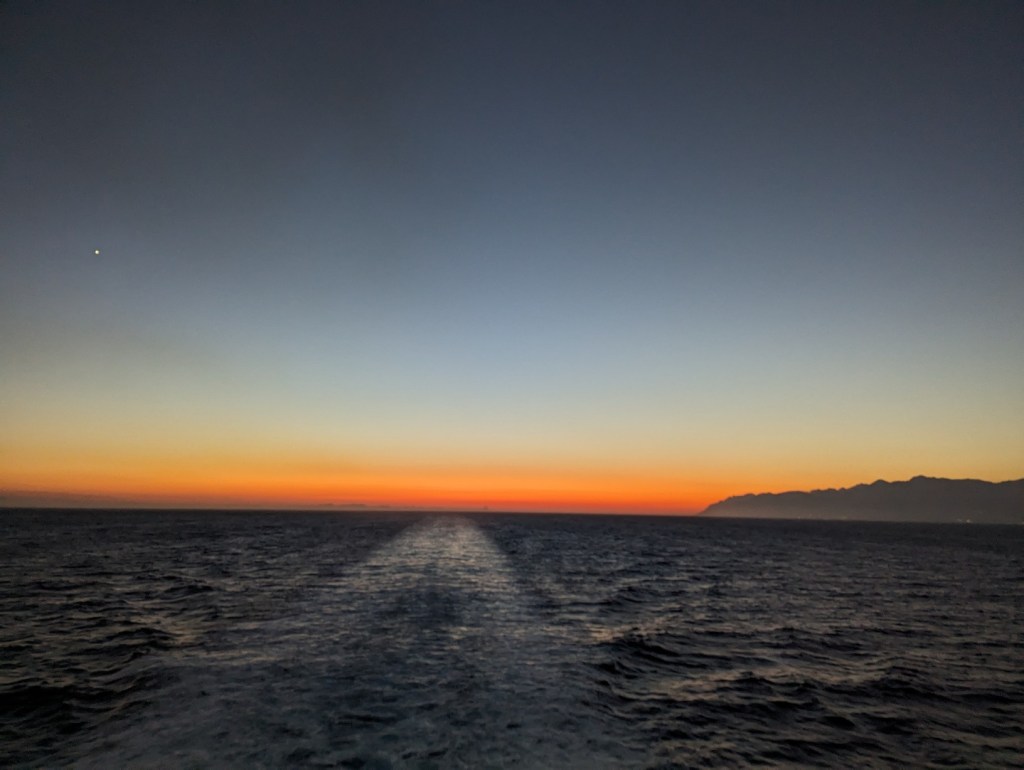
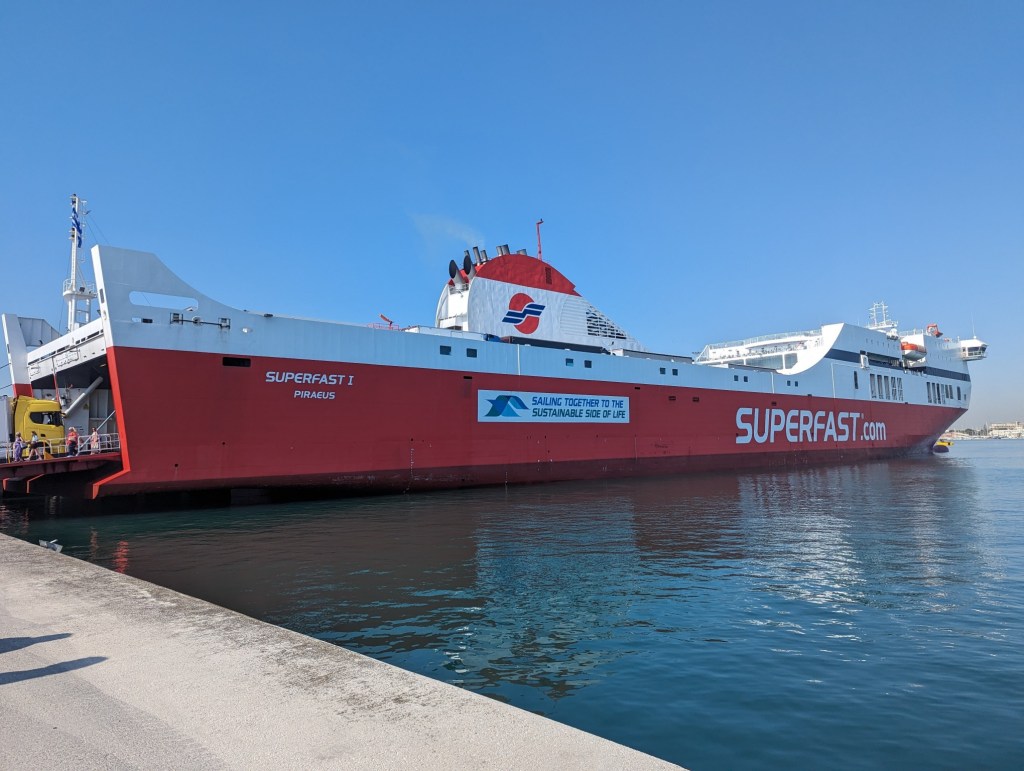
Bari – Igoumenitsa by boat with Superfast Ferries. The outgoing route was paid via Interrail, the return not, as the over 60s fare was cheaper so I paid for that separately. It was severely delayed. I booked a Deck Seat (you have to book somewhere and it’s worth noting that a cabin works out as more than a posh cruise ticket!) Deck seats are not on deck, they are inside. A shower (not clean) is available – ask at reception and a man will take you there with the key and wait until you finish. There’s a cafe with stressed staff and two restaurants which open later: one self-service (decent prices), and one more expensive. It is worth staying awake for the sunset.
Sunset from the Bari to Igoumenitsa Ferry. I didn’t see a whale, nor a dolphin
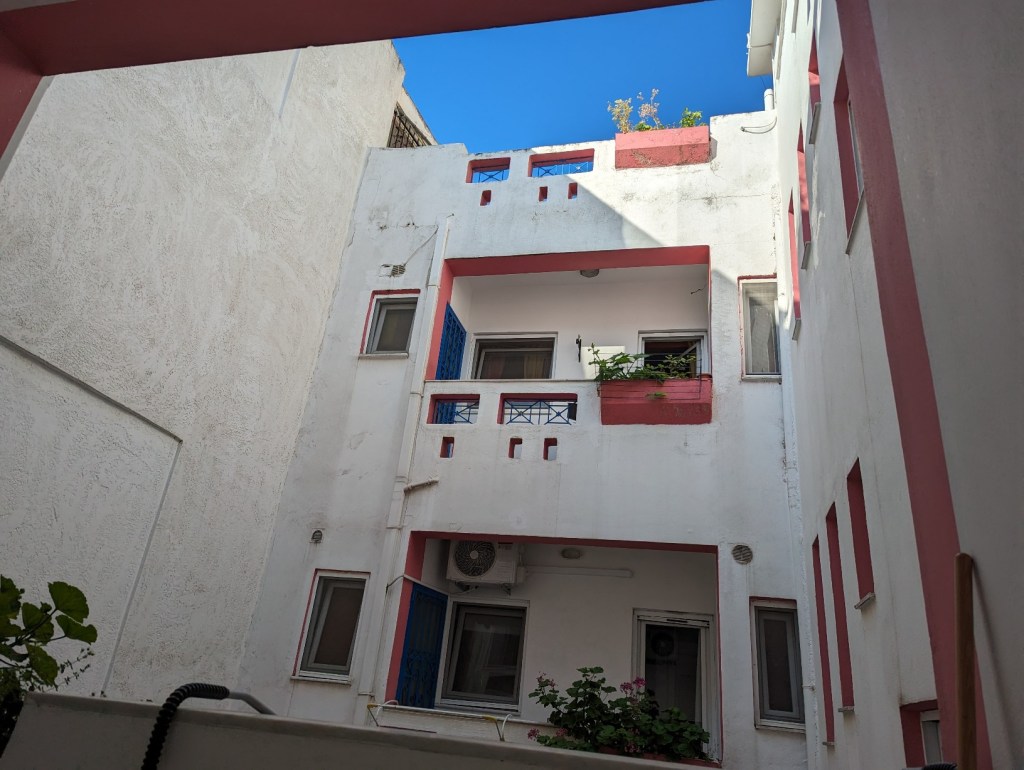
In Igoumenitsa, I stayed overnight at Maria’s rooms, Chantzara Spyropoulos Flats to Let-City Center via booking.com. I don’t like the site (I had a bad experience that was never addressed in Finistere and there is excessive advertising), but they have a monopoly. Remember to check every detail you can think of and read the reviews before booking. Cost: €45.57. Positives: it has its own kitchen and balcony, and it was clean and has Wi-Fi. Negatives: when I arrived there was no-one there and although it was clearly marked, I couldn’t initially find it in the dark and was slightly discombobulated. The host arrived soon afterwards. He understood why I was late, but it was awkward.
Maria’s Apartments, Igoumenitsa, Greece
Day 4: Igoumenitsa to Psarades
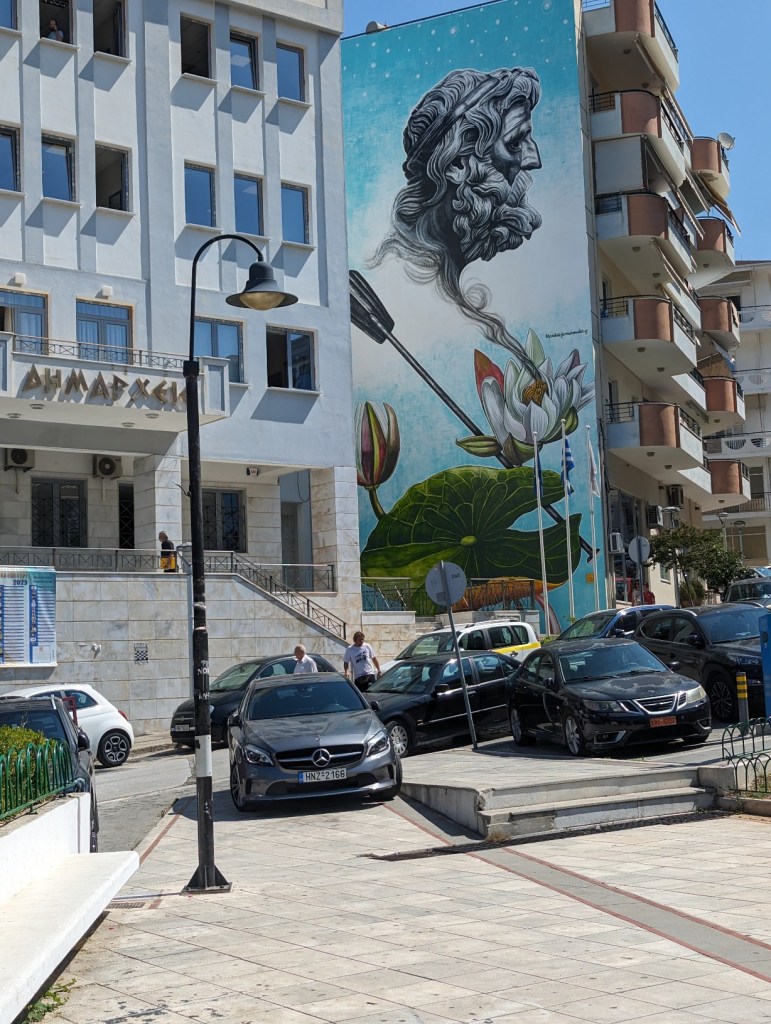
Igoumenitsa, Greece
I was due to meet someone at Ionanina (say, Yo-an-ina) to take me onwards into north eastern Greece. It was only at this juncture that I realised I had made a big mistake thinking that Ionanina was an alternative name for Igoumenitsa. It seems really stupid now, but I didn’t doubt myself and so didn’t think to check. This meant that I had to take a bus to Ioannina and there aren’t that many of them, so the woman who was kindly driving me from there to Psarades had to wait and we were both late arriving as a result. I was so embarrassed by the situation that I went into shops in Igoumenitsa asking if anyone knew how I could get there more quickly, having visions of myself travelling in a fish delivery van or something, but to no avail. Thank you so much to Korina for her kind acceptance of the situation and the great conversation during the journey.
There’s a very nice, cool bar opposite the Igoumenitsa bus station where you can wait for ages if you need to, with a spacious toilet, and thoughtful staff. Note: it’s an uphill walk from town.
Western Macedonia
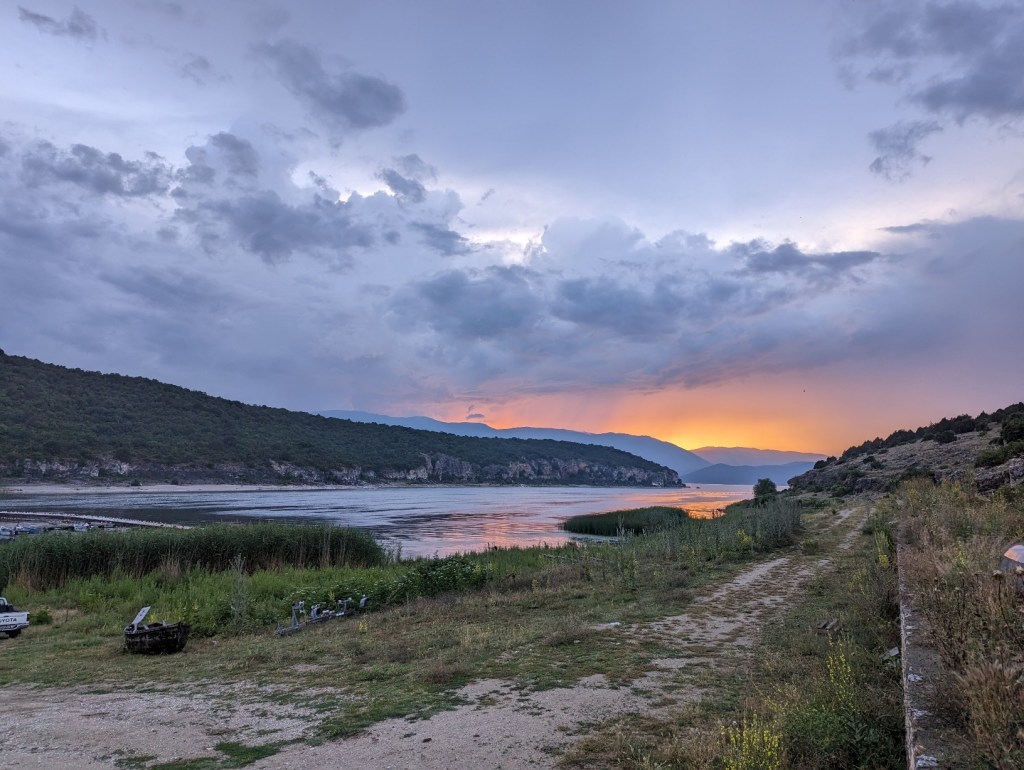
View of Lake Prespa from Psarades village
I was in Greece for the Walking Arts Encounters in Psarades (also known as Prespa and Prespes) which is a very small village by a big, beautiful lake in an Area of Outstanding Natural Beauty. It’s surrounded by mountains and has lots of cafés / restaurants, a church, a small shop with gifts for sale, and some air bnb / B&B / hotel rooms. There’s no public transport, but there is a branch of the University of Western Macedonia in the old station building. Swimming: fantastic. Bird life: amazing. Walks and trails abound.
Return journey
Prespes – Florina by taxi. €75 divided between 3 people, but the price changes randomly and it’s recommended that it be negotiated with the driver before he starts driving.
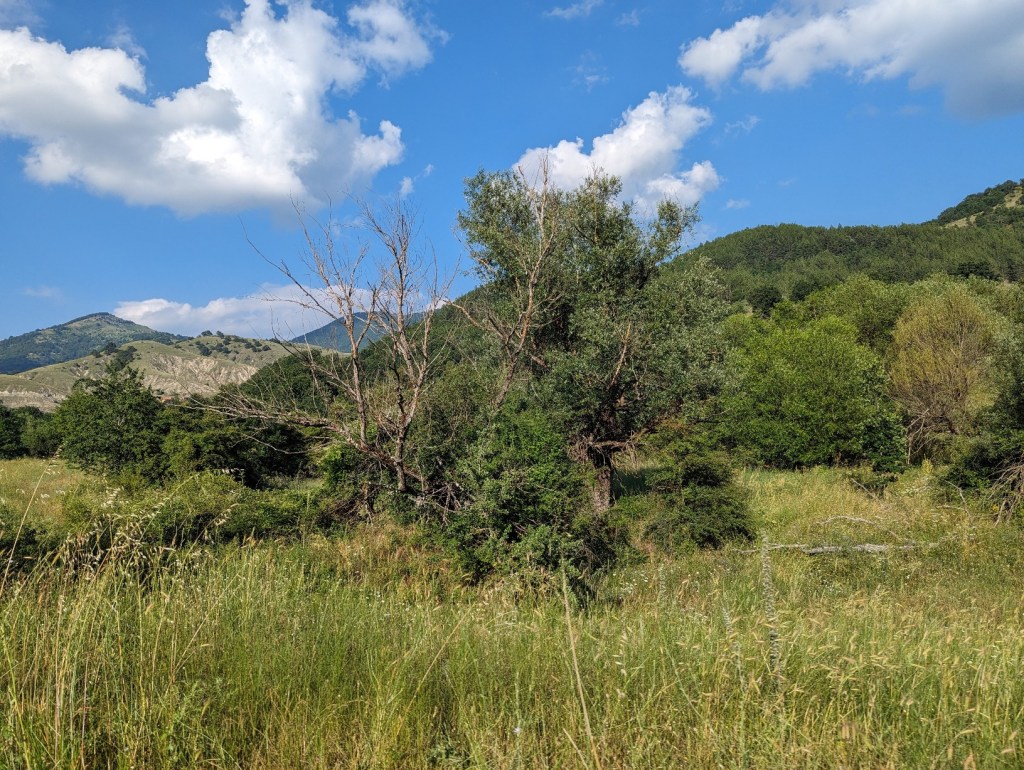
Greek countryside
Accomodation: Filareti Hotel, Florina. A clean double room for €28, booked at the very last minute on booking.com. Positives: a comfy bed, kind staff, clean, fluffy white towels, soap and shampoo, air con, great location, balcony, Wi-Fi . Negatives: the drains were smelly and there are no kitchen facilities.
The alternative route from Psarades to Igoumenitsa is via Kastoria and Ioannina which cuts down 3 buses to 2. The taxi, however, is even more expensive from Psarades to Kastoria. Alternatively, you can go via Thessaloniki which is a very long was round, but it’s a good place to visit.
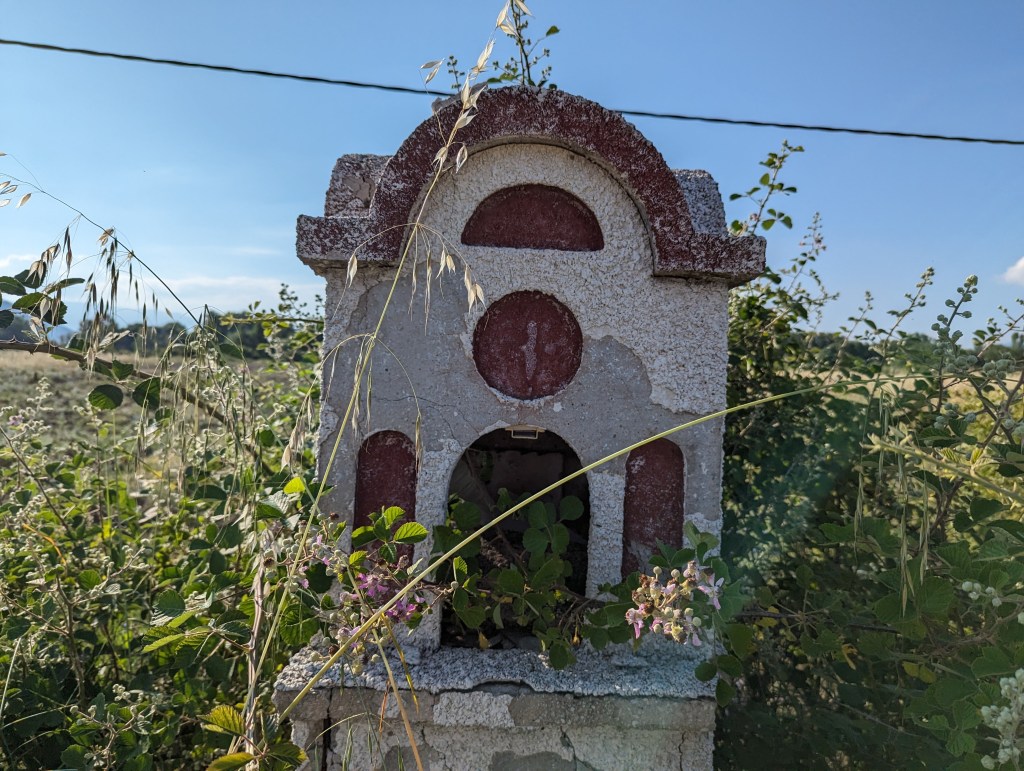
Typical roadside shrine, Greece
KTEL
You cannot book tickets online with a UK bank card and don’t bother emailing as they don’t answer. If you know someone who speaks Greek, you could ask them to phone on your behalf to get the times, or even possibly to book tickets. They are open on Sundays. See below before you do this.
KTEL buses and website: Although the website translates some information into English, it doesn’t cope with English variations of place names or days of the week. Note: D=Monday and so on. One way is to look up the place names with a translate app so you recognise them in Greek characters (even better learn Greek before you go), and then look at their drop-down menu. If you cannot find a place you are looking for, that is probably because you’re on the wrong version of the site. Each bus station/place has its own version, so I suggest you put ‘KTEL Kozani to Ioannina’ into Google for example, and go from there. The same applies to their phone numbers: you must phone each individual bus station for the place of departure if you want information and/or to book tickets.
Lodochori, Greece
Overland travel is certainly more complicated and whole lot more fun than going by air. If you plan to take the bus, check how long a particular journey is using Google maps, and then allow an extra hour each side. Then, go to the first bus station in your journey and buy a ticket there, in person (everyone seems to speak some English), and so on down the line. Take (in other words) one step at a time, poco a poco as they say in Spain. This is slow travel; there’s no point in going overland if you want to get there quickly; there are too many variables. Until all the different countries decide to co-operate and work out a way to make an efficient website which allows us to book all of this, it will be SLOW!
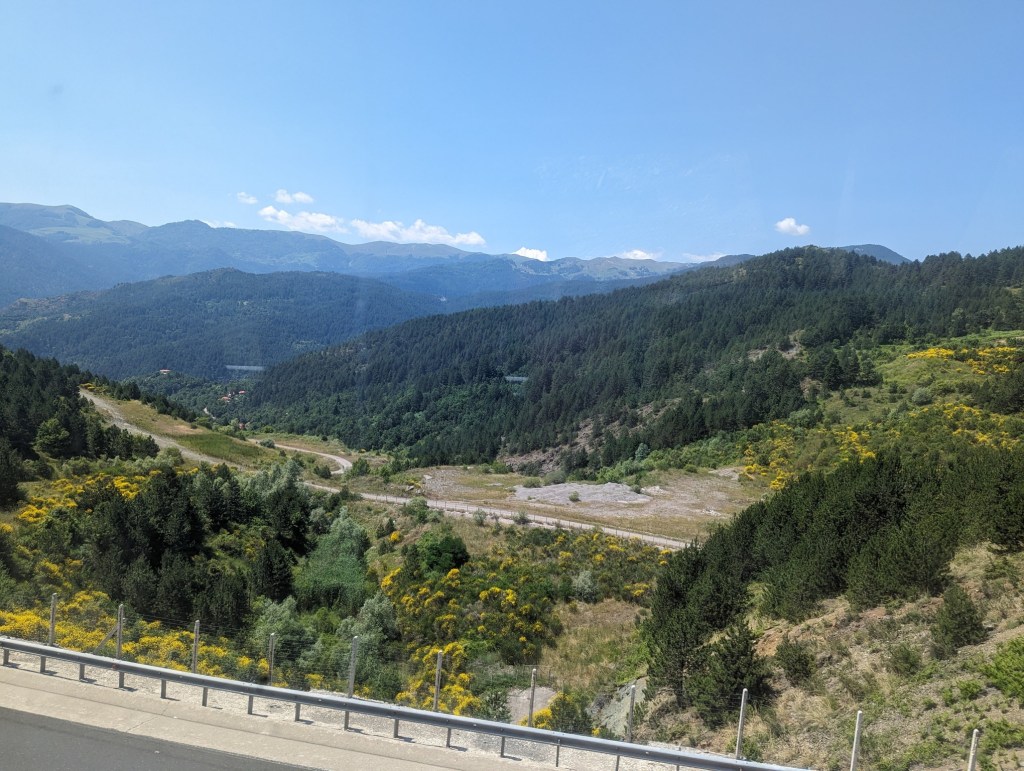
From the bus
Note: there are no phone chargers, toilets or WiFi on KTEL buses as far as I can tell. They do stop to let folk on/off, so if you were desperate for the toilet they might oblige.
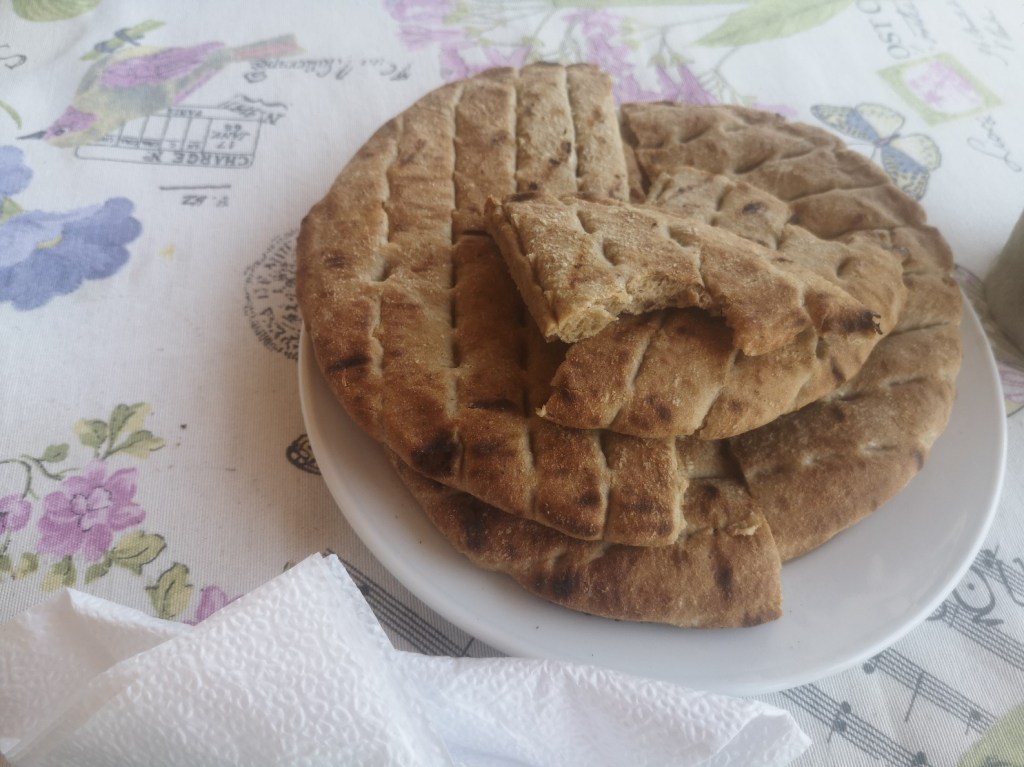
Kozani – Ioannina by KTEL bus €20.40 10.45 am. Takes approx. 1.5 hours. Lunch in Ioannina (see below) opposite the bus station (a kebab place: Greek salad, good wholemeal bread, a beer and a very clean WC.)
Ionanina – Igoumenitsa by KTEL bus €9.80, 14.15 (2.15pm). Takes approx. 1 hour 45 mins. I arrived far too early (8 hours) for the midnight ferry, although remember that you need to book-in for the ferry early – see your ticket email for details.
There is good ferry port info. for Igoumenitsa (and more) here.
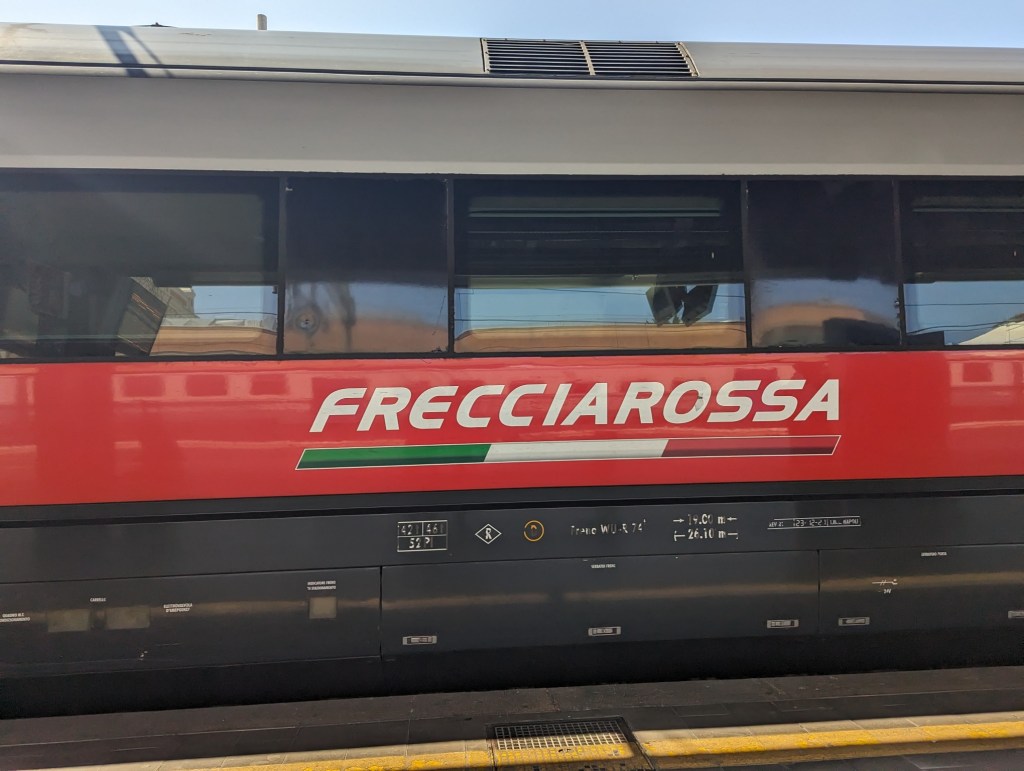
Superfast ferry from Igoumenitsa, Greece to Bari, Italy. Frecciarossa train from Bari to Milan, ItalyMilan, Italy
If you are also travelling overland in Europe, rather than flying, and have information you’d like to share, please add a comment below.






 Walking without a donkey