El Grand Tour

El Grand Tour is an annual walk in the Pyrenees and its foothills which I joined this August 2023. It was organised by Clara Garí (Nau Côclea), Beatriz Aisa (geographer), and colleagues.

Pont de Suert, start of El Grand Tour 2023, on the border between Aragon and Catalunya

Every day we do a stage of about 15 km with artists who have projects and proposals to share with the walkers.
On the way or at the destinations we will meet artists and other people from the territory every day, who often also accompany us. We look, feel, read, listen and participate in the proposals: poetry, dance, installations, performance, music. We also explore the territory through the hands of the people who live there.

Clara Garí

The route

The red marker is Pont de Suert in the Pyrenees mountains, with Barcelona bottom right, Zaragoza on the left, and the black dotted line of the Catalan / Aragonese border running down the middle

The trek began on August 12 at Pont de Suert and ended, 20 days later, at Cellers Bridge on 31st on the full moon. Each year the walk begins where it ended, more or less, and continues through this magnificent mountainous area. We started not far from Andorra and France on the border with the Aragon region of Spain, circled west and south, through Graus and Benabarre, before returning to the River Ribagorza and crossing, in an eastwards direction back into Catalunya via the magnificent Montfalcó.

Montfalcó at the Catalan / Aragonese border
  • Pont de Suert (camping Balliera)
  • Laspaúles
  • La Muria (to La Turbon (peak))
  • Padarnieú
  • La Puebla de Roda
  • Molino near Centenera
  • Graus
  • Aguinaliu
  • Benabarre
  • Tolva
  • Montfalco (Mont Rebei)
  • Sant Esteve de la Sarga
  • Cellers

Terrain

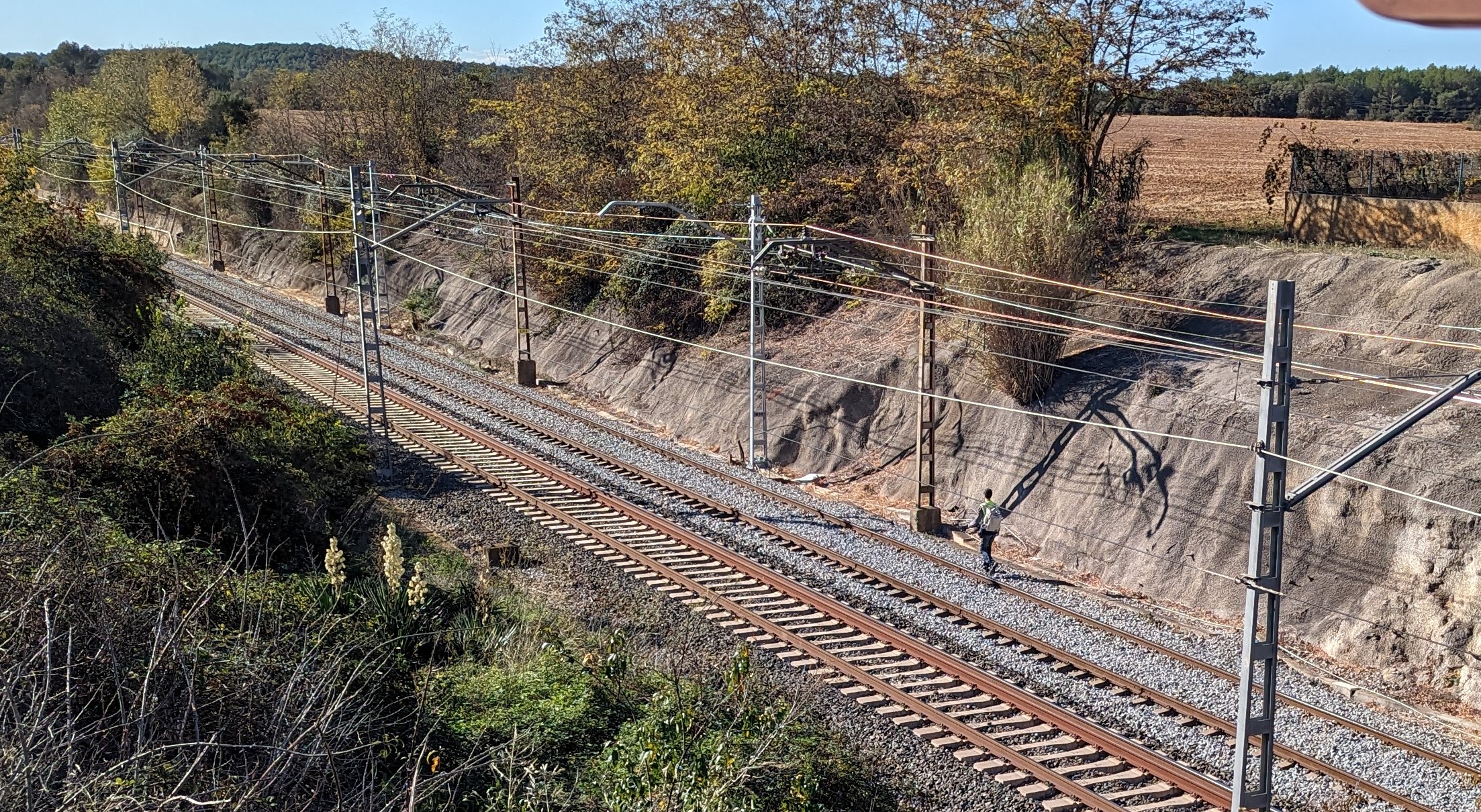
The first days were tough, with steep climbs and descents on paths which often consisted of a tumble of stones and rocks, so my fitness levels, particularly for climbing, had to improve rapidly, and frequent rest stops were vital. We climbed La Turbón (a massive rocky limestone outcrop standing on granite, horse-shoe shaped, which runs north-south for 6.3 kilometres and is just under 2500m high) in Huesca province on one memorable and very long day!

We also trekked through forests, up bare tracks, along a few roads, admired the best of views and visited fascinating places.

Who walked?

There was a core group of nine walkers who completed the tour, of which I was one, and around thirty others who joined us for two or more days. Dduring the period we were entertained by La Borda del Títere – Trapusteros (puppet) Theater in Aguinaliu, Javier Selva at his rennovated molino (water mill), and Eloy in Sant Esteve de la Sarga. Two artists travelled with us: Beatriz (see above) and Clara Nubiola who both gave workshops. There were also performances by Christina, Zoe, Anna, Quim and children, and others.

He caminant tots els carrers d’Olot by Clara Nubiola

Sleeping and Eating

We usually stayed one night at each stop, but sometimes more, camping in fields and municipal sites, kindly housed by performers and those who had walked in previous years, as well as in an air b’n’b. Thankfully, our camping and other gear plus the Book Library were transported for us, and breakfast and delicious evening meals were prepared by Jordi Rallo, supplemented by others and the occasional cafe/restaurant.

The library consisted of books chosen by the walkers, mostly in Catalan though a few were in English, which were given out at the end of the walk

Sing for water, dance for rain

The weather was hot for most of the time, with occasional rain and hail. Temperatures cooled in the final week, but we always carried a lot of water and sometimes needed to find extra supplies along the way. Despite the on-going drought which was evident all around us (there has been almost no snow on the mountains this year) and low or non-existent river levels due to climate changes, we were always lucky with various water sources appearing just as we were getting desperate. We bathed and swam in them, soaked our head cloths and clothes to keep cool, and of course drank it gratefully. Once we even came across a lawn of sprinklers at the top of a hill at midday and danced in their spray until we were soaked through. Bliss!

Separation and Unity

My on-going multi-media project, Separation and Unity, was symbolised by small tartan ribbons which I made for my fellow walkers. I was happy to be able to offer some Shiatsu (one-to-one), chi gung and meditation (small groups), a silent walk (for the participants who were there that day), and a Scottish reel (all together) as a dance of celebration on the last night. My thanks go to Anna and Quim for their help with the sound.

Above images: Left – Both Catalunya and Scotland have vigorous independence movements and my ribbons aimed to signify both unity with the loop, and separation, with the two ends. I used tartan which is a traditional Scottish material in the colours of the Catalan flag. Independence supporters in Catalunya use a twisted ribbon to raise awareness of their cause. I added one of these to a shrine at the Ermita de Santa Quiteria y Sant Bonifacio, Montfalco. Right – The Scottish and Catalan flags hanging side-by-side in Girona.

Separation and Unity is an on-going, walking art project. It began as a link between Scotland’s political bid for independence from England, and Catalunya’s from Spain, looking at the two struggles and identifying similarities and differences in the impetus and on-going situation. It asks what it is in us that wants to be recognised as part of a smaller nation rather than be part of a larger entity. More generally, it looks at our individual need to belong and, at the same time, for individuality.

Usually I walk alone through the landscape – separated from others and from my home life, and at the same time seeking some sort of unification with the people, villages and countryside I’m travelling through by using touch and mindful attention. Then, more lately, I walked the Pilgrimage for COP26 as one of a group, have led community walks, and am doing El Grand Tour.

El Grand Tour was, for me, a part of the Separation and Unity project. As a group we were visitors in the places we walked to, separate from them and united with each other, identified as a company. When we stayed somewhere, we became temporarily unified with our hosts as performers and residents. Within the ever-changing collection of people who walked El Grand Tour, we were individuals and at times formed small groups within the larger one. We brought our own interests to the Tour, and we also had a group identity. All of these roles and identities impacted differently on us and the way we behaved together.

I knew in advance that the predominant language spoken on the walk would be Catalan, and meant to learn it better before I went. I understood some, but it wasn’t enough to engage in deeper conversations as I had hoped. This meant that I often walked on my own, and although this is something I am used to, I focused on really feeling what it’s like to be separate from a group, to be a foreigner and not to understand, not to know what was making them laugh.

Lone walking

Sometimes it was a relief: I had space and time to immerse myself in the landscape without being rude and ignoring conversation, a valuable opportunity for reflection; at other times, I felt inevitably left out and lonely. My fellow trekkers were all friendly and generous, and many spoke English very well and were happy to translate for me. I am really grateful to Igor, Bea, Cristina, Oriol, Pau, Nuria and others for that – thank you.

Links

Igor’s website, musician and composer

Magazine article about Javier Selva’s molino / water mill. In Spanish.

Christina Shultz Visual Artist and Performer

Zoe Belasch Movement Artist and Teacher

Pau Cata Writer, Collaborateur, Conversationalist

Sound Walk Map

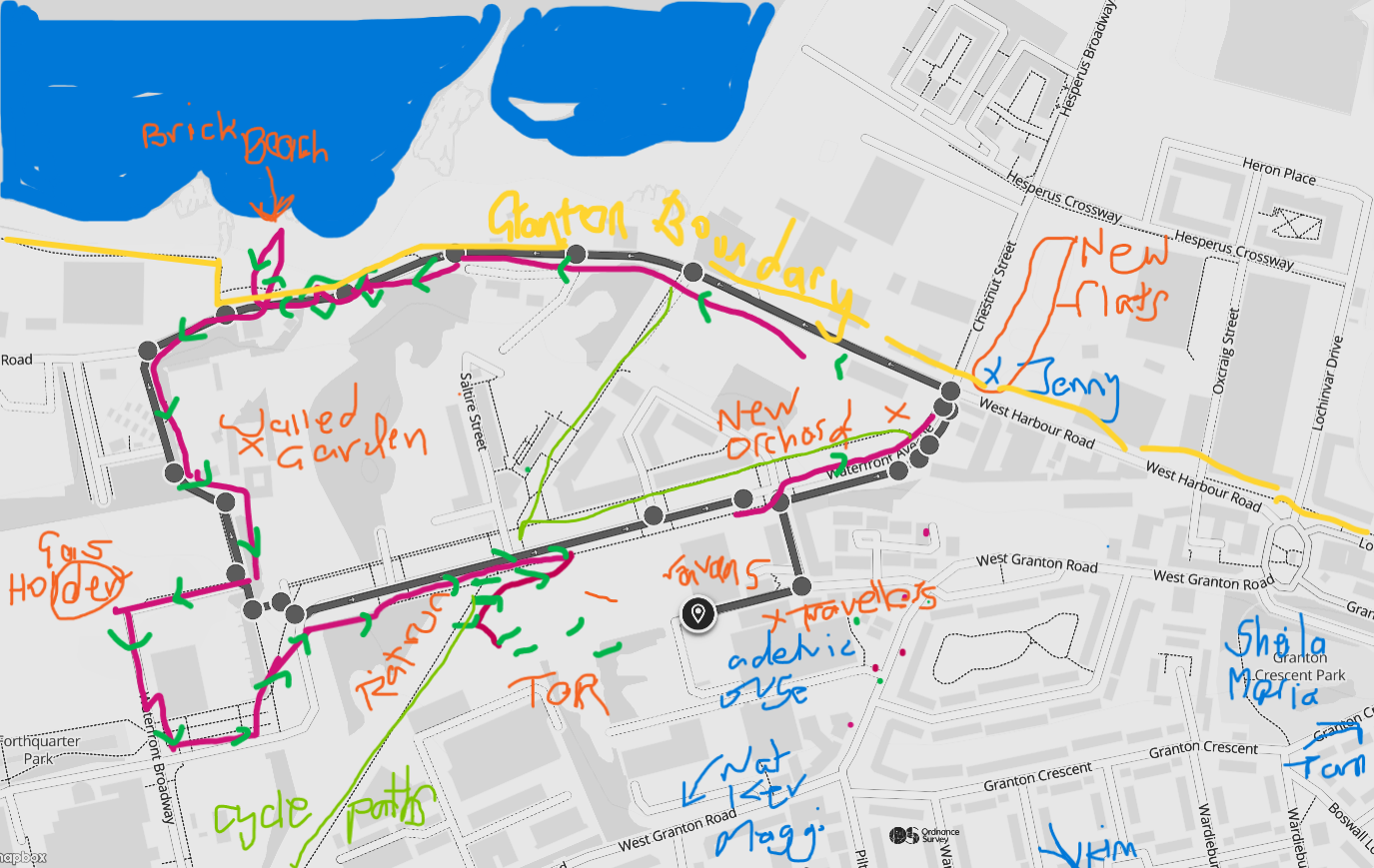
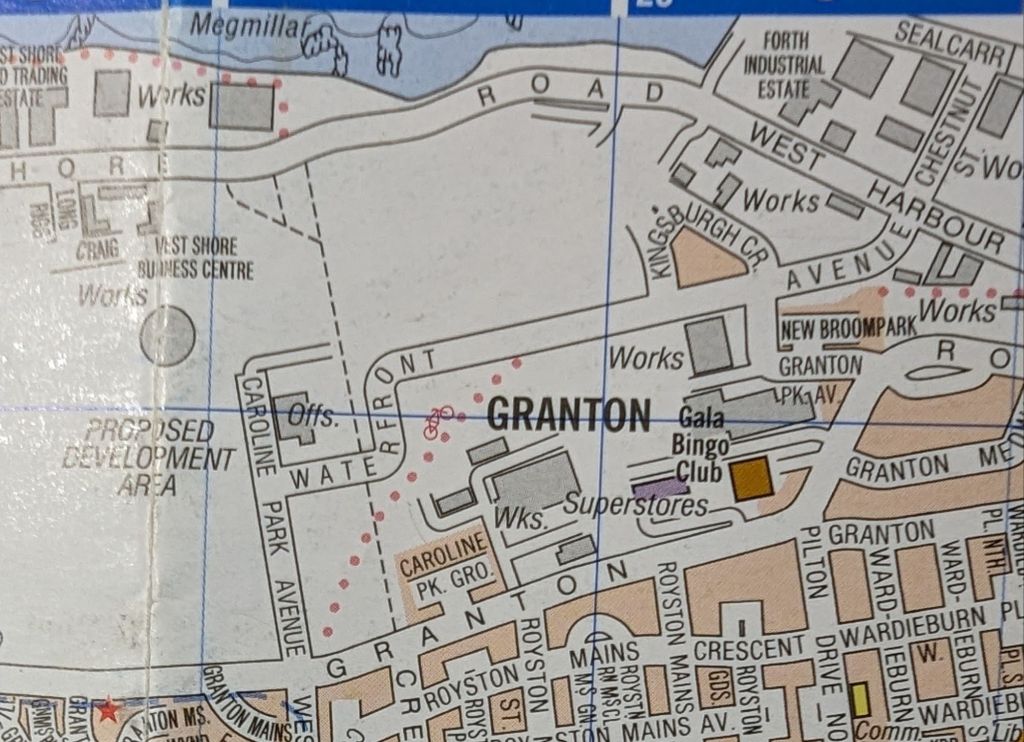
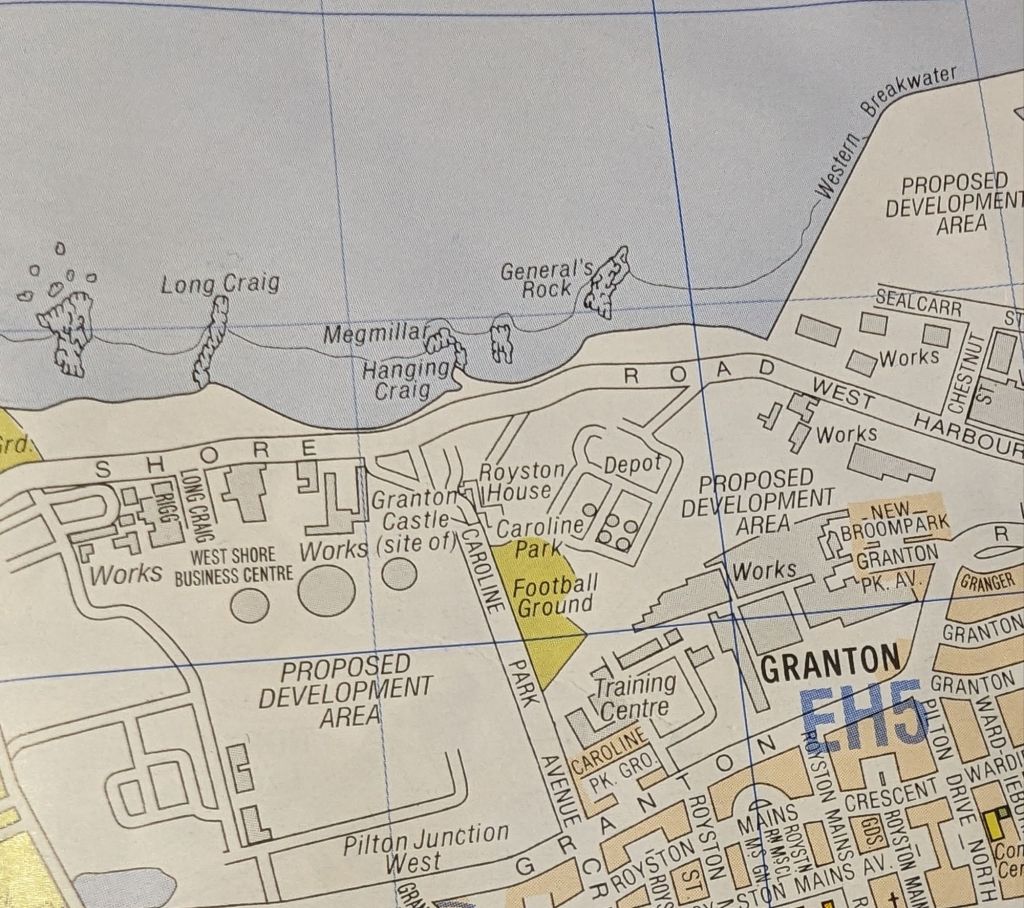
A map of sound walks in Edinburgh EH5

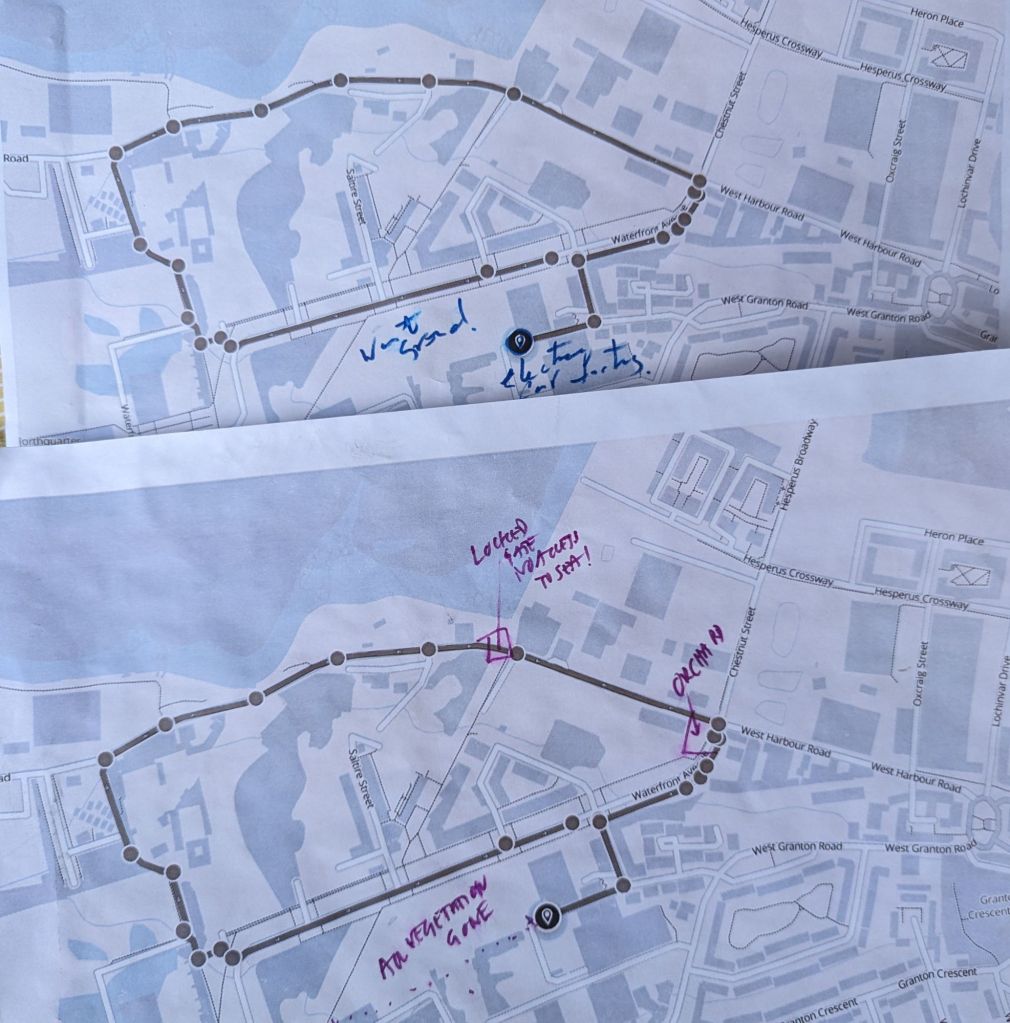
This is a map showing the locations of three soundwalks in Edinburgh EH5 by Tamsin Grainger: ‘The Wall’ and ‘No Birds Land’ were both shortlisted for Sound Walk September awards (walklistencreate.org). Is There a Place for REVOlution or Peace and Biscuits was a 4WCoP23 event. Detailed information can be found on the links below, together with Soundcloud and Vimeo connections.

Whilst ‘No Birds Land’ and ‘Is There a Place for REVOlution or Peace and Biscuits’ have recently been renewed and mended with new pennants, I’m sorry to say that ‘The Wall’ installation has become ragged from the weather and time. You can still walk along the wall / Western Breakwater of Granton Harbour and listen to the Sound Walk on your phone, but you will need to access it either before you leave home or from here if you have sufficient data, as there is no QR code currently at the site. Links to ‘No Birds Land’ and ‘Is There a Place for REVOlution or Peace and Biscuits’ are below.

My sound walks are site-specific sound/art installations with QR codes for you to listen to on your phone as you are walking through the tunnels or along the wall on the Western Breakwater of Granton Harbour.

Links

The Wall

No Birds Land

Is There a Place for REVOlution? or Peace and Biscuits

Is There a Place for REVOlution? or Peace and Biscuits

A sound walk and installation made in a tunnel for ‘Watch This Space’ #4WCoP23 September 2023 using graffiti by North Edinburgh artists and local history. Listen here.

Hand stitched pennants in the Ferry Road Tunnel on the Chancelot Path. Is There a Place for REVOlution? or Peace and Biscuits

Location

‘Is There a Place for REVOlution? or Peace and Biscuits’ is a site-specific Sound Walk and Art Installation on the Chancelot cycle path under Ferry Road in Edinburgh. It is on Google Maps and the location using What3Words is ///fallen.reach.bottle

You can use your phone to activate the QR code and listen while you walk through the tunnel. You can also listen at home (without the full effect).

Understanding the text

The text of this Sound Walk uses other people’s sprayed graffiti words, so it sometimes sounds like nonsense. In it, I am playing with the found text, trying to make sense of it. Sometimes I read the words (like ABDO or REVO) from left to right (as English) and sometimes from right to left (as Arabic), highlighting the effort we often have to make to understand each other, and how important it is that we do. Because this is a sort of creative prose or poetry, I also make up my own words to fit in with the letters I find.

Sound Walk topics include:

  • Local history
  • Communication between us (reading and language)
  • How to keep yourself going when everything seems bleak
  • How the Red Line has been used in activism, in this and other countries
  • The capitalist system and whether it helps us
  • Slowing down and noticing nature; using wall- or street-wisdom

Site-specific Art Installation

You will find hand stitched pennants looped on a red line on one side of the tunnel. The string of triangular flags are hanging from old metal hooks which were originally used for cable and wires when this cycle path (or greenway) was a railway. The images and found text are from the walls and surfaces around North Edinburgh.

#4WCoP23 Is There a Place for REVOlution? or Peace and Biscuits

“AET REY NOOD Do you recognise this language? DAERB REY TAE. Can an internet app translate it? It’s ABout DOing /  Or Don’t Be And (face the consequences).” This is text from the new Sound Walk. For clues, see the images below.

Doon Yer Tea, graffiti on the North Edinburgh cycle paths. Is There a Place for REVOlution? or Peace and Biscuits

I’m playing with words, making my own acronyms which are inspired by the found text. For example, ABDO (reading from left to right and back again from right to left etc) becomes: “And Between Doing Or Don’t Be. Anyway, By Doing Otherwise, Deciding to Be And Bide, Doesn’t Our Doing Become……A Beautiful Door Opening. Or Don’t Butterflies Ascend?” Am I speaking in riddles? I hope I haven’t lost you.

ABDO, graffiti in the Ferry Road Tunnel of the Chancelot Path. Is There a Place for REVOlution? or Peace and Biscuits
Is There a Place for REVOlution or Peace and Biscuits mini-video
REVO and BISTO, two of the most familiar ‘words’ of graffiti found in the Ferry Road tunnel of the Chancelot Path. Is There a Place for REVOlution?
ABDO (reading from right to left: ODBA) is a character in Egyptian writer, Deena Mohammed’s Your Wish is my Command, a graphic novel. Is There a Place for REVOlution? or Peace and Biscuits

Using found words / graffiti that spoke to me

Unless you people see signs and wonders you will never believe
80% of ocean life is dead
Many
Deaths
Lives Matter
Unfuck the system
Fight
REVOlution, Revolt, Revoke 
Part of the Peace and Biscuits sound walk script
Postcard made for the 4th World Congress of Psychogeography 2023. Is There a Place for REVOlution? or Peace and Biscuits

In this soundwalk, there’s some local history, activism and suggestions for when you are in a dark tunnel and cannot see the light at the end, the way out. There’s a film here on Vimeo that gives you a (silent) idea of the walk.

Walking across the Red Line . The Red Line is a symbol that a line has been reached and should not be crossed. An example of this would be the amount of carbon emitted into into our atmosphere. Is There a Place for REVOlution? or Peace and Biscuits

“I often use Street Wisdom if I need to get an insight on a situation or a problem. Once I’m tuned up, I’II hold the issue and just walk with that in mind and body, and see what happens. (It’s basically a shorthand way of doing the Quest: “Streets, show me some options with all this!”) Something often, if not I j. The other day I was full of different stresses, and the streets shared with me all kinds of patterns that seemed interconnected. I interpreted that insight as “Everything’s connected” (it’s nice to reduce the insight to 2 or 3 words). And that really helped!

Philip Cowell from Street Wisdom
Local graffiti Edinburgh. Is There a Place for REVOlution? or Peace and Biscuits
Hand stitched pennant. Is There a Place for REVOlution? or Peace and Biscuits

With MANY thanks to Alba Bersolí (film maker ‘El día que volaron la montaña’ (When the Mountain Rumbles shown at the Catalan Film Festival in Edinburgh 2023 on Instagram @albabresolí ) for lending me her laptop and teaching me some Premiere Pro, going above and beyond to support me, and being an all-round wonderful woman.

New pennants (August 2025)

Notes

‘Your Wish is my Command’ is a graphic novel by Deena Mohamed reviewed here in the Guardian newspaper. There is a charcter called Abdo in it. ABDO is a word graffitied on the wall of the Ferry Road tunnel on the Chancelot Path where my Sound Walk is located.

First Friday Walk – July, Psarades

7 July 2023

A maze of pathways scored into the hillside
Stories, only half-hidden
Of children severed from Spain, England, Western Macedonia.
Women walk the whitening circle of remembrance.
Marble slabs lie aslant.

The First Friday Walk is a Walking the Land artist collective monthly event. The brief for July 2023 was from Amanda Steer @adamandadraws ; the theme of the walk was our tracks and the traces we leave in the landscape.

Kel Portman and I walked together through the village, up and along to the cemetery.

Cemetery Psarades, Greece

On the evening of the FFW, Soazic Guezennzec invited us to listen to the memories of older people living in the area, and Alexandra spoke movingly about her sisters and brothers who were evacuated from the village (200 young children) in 1948 when she was a baby.

Alexandra and Soazic, Psarades, Greece

The next morning (8 July), I participated in a pilgrimage organised by Jenny Staff (see The Roll of Emplacement) in which seven women collectively walked over 19,000 steps in a circle in the town square. Each carried a stick which had white chalk on its end which drew on the ground.

Invisible to Visible by Jenny Staff, Psarades, Greece

I was at the Walking Arts Encounters ’23 at Psarades / Prespa in Western Macedonia, Greece.

All photographs copyright Tamsin Grainger

Budapest on foot

Budapest is a city of contradictions: of dilapidation and shiny surfaces; of slow, leafy suburbs and frantic roundabouts; of climbing frames for dogs, vending machines for books, fast food and deliciously prepared brunch, kindness and dismissal, a really great synagogue and more than one scary-to-walk-over bridge. I came across all this by simply walking.
By the River Danube, Budapest, Hungary

There are many blogs about the tourist sights of this Hungarian capital city, so I will try not to repeat too much. (You will find some of the links below.) I came by bus from Athens, overnight, arriving half a day late due to a five-hour delay at the Serbian border (I’m told it’s to do with gangs and cigarette smuggling). I came and went a few times, but despite that I saw a fair amount of the place in quite a short time.

Budapest-keleti, the main train station. To book tickets, go to MAV direct. The website is slightly annoying, but workable, and is also in English

As a UK pedestrian, I had to keep reminding myself to look left before stepping off the pavement, and to beware motorbike and bicycle food delivery guys as they come upon you (often on the pavement) from behind, unexpectedly. I walked everywhere, from bus station to hostel to train station to a different hostel, and so on, meaning that I saw outlying as well as central areas. However, I’ll start with the more famous middle.

Liberty / Freedom Hill, Budapest, Hungary

Budapest sits either side of the River Danube which you can walk along, but don’t think Paris and the Seine, nor even London and parts of the Thames, as it’s bordered by busy roads and tram/train lines. I stayed at two cut-price hostels: The Heart of Budapest on Dohány útca (street) and the Maverick Urban on Lónyay utca. Because they are cheap, they are both east of the waterway which divides Pest (where I was) from Buda and Óbuda. It is worth knowing that Pest is the party side and Buda the quieter, sight-seeing part (more about the hostels below).

Szabadság hid or Liberty Bridge and the Gellért Spa Baths, Budapest, Hungary

The Budapest sights and architecture

My first early morning walk took me to the near bank of the Danube from where you get impressive views of the Budapesti Müszaki és Gazdaságtudományi Egyetem (BME, the University of Technology and Economics) opposite, with its deep terracotta, mosaiced roof, the Gellért Spa / Baths, the Citadella Fortress on the wooded Gellért Hill and the Liberty or Freedom lady-Statue on top holding her palm leaf aloft. Between, are the bridges: the green (London Tower-type) Liberty Bridge with its golden crown, the Elizabeth Bridge (no, not our Queen, we don’t hold any sway here, for once, thank goodness), the Széchenyi Chain Bridge, and more. I crossed two of them and they’re scarily high above the water. On one, bikes whished past my ear, and on the other there was an army of older men with white hair and beards cleaning its white girders. I got a light spraying!

The Erzsébet hid or Elizabeth Bridge with the statue of Elizabeth, Queen of Hungary and the Schoch-Hegedüs Villa, Budapest, Hungary

Some of the architecture is grand, not unlike that in Vienna (remember your school history and the Austro-Hungarian Empire?), with royal statuary on the external facades. Some is old, buildings which haven’t seen a lick of paint in a while, but are active. Look through the dilapidated outside, and there are green living quarters where children safely play inside.

Typical glimpse of courtyard hidden by what seems to be a derelict building. District VIII, Budapest, Hungary
Then there are the more modern places like the enormous Modern Art Gallery with it’s smart cafe, plus miles of half-built apartment blocks going up between the gallery and the bus station.

Ludwig (modern art) Museum Budapest, Hungary
Some, like the skating rink on the river bank, are squashed between older red-brick edifices. I thought it seemed to be sailing out like the prow of a great ship, leaving behind the huge bar / restaurant complex and shopping mall which flank it.

There are lots of turquoise church steeples in the Central European Baroque style; some Catholic, others Orthodox, and numerous other steeples, new and old.

The Saint George Serbian Orthodox Church, Szerb ut 4, Budapest, Hungary
The Great Market Hall, Budapest, Hungary
Our Lady of Hungary Catholic Church near Szenes Iván ter, Budapest, Hungary

As an older woman alone here, I was struck by how numerous are the ‘sex palaces’ and other sex shops / references, and this was replicated in Siófok, a town on the bank of Lake Balaton which I also visited. I met with a lot of surly male responses to questions like, ‘Please can I fill my waterbottle?’ – scowls, disinterested shoulder shrugs, and turnings away without bothering to answer. A couple of times men just stood close by and stared for too long, but I was never approached nor subjected to anything worse than that. I felt safe walking around in the day and evening. Indeed, I witnessed the same sort of men being kind and loving to their wives. The younger men who worked in the cafés I ate in, like their female counterparts, were polite, very helpful, and spoke excellent English.

Hostels

The internal courtyard off which The Heart of Budapest hostel is. Find it on booking.com Budapest, Hungary

The Heart of Budapest hostel on Dohány útca is okay. It consists of two spacious rooms, one for women only (sadly, it’s very unusual to find such dormitories at hostels nowadays which doesn’t encourage us to travel alone), but you do have to go through the mixed dorm (4 beds) to get to it. There’s one toilet / shower for everyone, and a self-catering kitchen with small table and facilities (both moderately clean, not bad). Although it’s on a main street, it takes some concentration to find it, even with the detailed instructions. The room was warm, so the window was open, meaning it was unavoidably noisy.

Sculpture: Barbarian Struggle with the Romans, Március 15 ter, Budapest, Hungary

There’s no washing machine or drying area, not even somewhere to hang damp towels after a shower, though there is a ‘super’ quick launderette almost next door (Árlista on Dohány u) which provides automatic powder and has driers. Cost: 1800 Forint (HUF) for a wash, 700 HUF per dry (self-service).

Interesting relief beside the river, Budapest, Hungary

Currency – forints

Forints are the local currency – they don’t use the euro. At the time of writing, you would get approximately 427.5 florints to £1 stirling. It took me a while to get my head around the conversion.

A beautiful oak worth visiting on the banks of the River Danube, Budapest, Hungary

I booked the room late, so was with the men. A Ukrainian ex-soldier (retired) dressed only in his boxers, told me about himself – how things were so bad at home with bombing and children being killed, that he thought he might as well go touring, look for beautiful places, after all he didn’t know what would happen next (by which I understood him to mean that he may not survive into old age). He was very enthusiastic about the war museums he had seen, and he sat (uninvited, but friendly) on the edge of my bed to show me photos of himself beside tanks and holding guns in the places he’d visited. The other two were quiet (apart from snoring) and smiled politely.

WeHummus is very close to the hostel, an independent (sort of fast-food) place with cheap, good fare. I had an excellent chat with Adam who was serving, a highly competent high school lad who talked interestingly about history, politics, and Budapest of course.

The hostel is in the Jewish Quarter, very close to the beautiful Great Synagoue, and opposite Magveto book cafe (just drinks and snacks, but good to sit and write in).

The other place I stayed was the unfortunately named Maverick Urban hostel, and it is near the top of my list of good, cheaper places to stay in Europe. It can be found on a street corner with tables and chairs outside, and you go through the bar to the reception. It resembles an Ibis-type hotel, but that’s a good thing for a hostel because it means it’s clean!

Each bunk has a curtain round it, a light, and a phone-charging socket inside. The mattress was comfy, the bedding clean. There are big, safe lockers which emit quite a loud buzz in the middle of the night when opened (as does the door when returning from the toilet) with the key card, but they are also clean. Importantly for a backpacker, there is a clothes drying rack next to a hot radiator in the women’s toilet which is a few doors down the corridor. There was hot water. Bliss. The kitchen I used was very small – okay – and there was a separate table to eat at. My food was stolen from the fridge, which is pretty normal. Finally, there is a “chilling-out area” on the roof which I didn’t see.

There is quite a lot of Art Nouveau architecture in Budapest, Hungary
The modern approach to the stately train station, Budapest, Hungary

Recommended

Petofi Irodalmi Múzeum, Budapest, Hungary


Petofi Irodalmi Múzeum – this is an historic museum of Hungarian literature with a lovely courtyard and garden. The cafe opens at 10am. “Sandor Petofi was a passionate young poet who during his short life (he died at age 26, presumably in battle) created an enduring literary work that motivated the Hungarian people during the rebellion of 1848 against the Austrian domination. His poetry continues to be taught and recited today.” (from Trip Advisor by Gabriel H, Bellaire).

Pocketbooks machine and free book library, Budapest, Hungary


It backs on to Károly-kert, the oldest garden in Budapest which has one of the city’s many dog playparks (yes, you read right!) as well as one for kids. There is also a Pocketbook machine (sadly there was no literature by women, although there were a few female faces pictured on the outside of stories by men, including Lina and Panni (YouTubers), Juhaksz Anna (cultural manager), and Eszter Horgas (flautist). George Orwell and Shakespeare featured.) Two men bought books while I was there, so it is used – a great idea. Beside it was one of those free book shelves where you can put your finished one (mine: an interesting but curiously unsympathetic biography of Elizabeth Barrett Browning by Margaret Forster) and take a new one. There’s a map of all the similar places around the city. Unfortunately the city library was shut.

One of Budapest’s dog playparks, Hungary
I also came upon the lovely Bástya park (V District) next to the Pest city wall, squashed, apparently between office buildings, Budapest, Hungary

Beside it was a sign about the Towering City Wall and the Murder Chamber (in Hungarian) and it was established in 2022. There is a city history museum here, another good (children’s) playpark, and a great place to sit and listen to the fountain and enjoy greenery in the middle of the city.

Cakes at Portobello (Coffee and Wine) Budapest Hungary

I have always been an early to bed /early riser and so, once again I went for a morning stroll. When hunger started to call, and because finding somewhere which was open at that hour and was good for breakfast took me some time, I will share what I eventually found: Portobello (good title!) The green tea and sourdough with miso roasted mushrooms, sauerkraut and walnut muhammara were excellent. There was also an impressive range of cakes. Walking back to the Maverick with a contented tummy, I found a great barber who spoke English and kindly shaved the back of my neck for free (see below). There were other possible breakfast places (Mantra was one) which opens at 8am.

TimarT Hair, Veres Pálné u. 27, 1053 Budapest Hungary. Find them on Facebook
Some trees had colourful streamers flying from them. This was because of the recent Mayday / Labour Day (1st May) and it is traditional to have a May Queen and to decorate in this way.
Hungarian coat of arms – a white Lorraine cross with a crown at the base on three (green) hills
Budapest is famous for its outdoors street food areas. They are teeming with life in the evenings but quiet early on in the day.

If you don’t want to walk or can’t, here’s a link for travelling in other ways.

Budapest by Locals – history page

Budapest City Guide

Architecture, Budapest

Offbeat Budapest 10 best Ruin Bars

10 Weird things to do in Budapest

May 2023 Title photo: Nyitvatartása Park, Budapest