I am walking from Mérida to Ourense along the so-called Silver Way, the Via de la Plata Camino.
I have not been able to meditate recently because the bunk above me is too low and the floor too hard and cold. However I did do my tai chi in the night which, though painful for my foot, was beneficial overall.
Once again, there was a community sense of pilgrims all looking out for each other.
Halfway through yesterday evening the temperature had changed and the wind got up. It heralded, we were told, the rain.
But, beautiful was the word of the day; the one I kept coming back to as I walked through the gorgeous scenery.
It was a cold morning, frost on the ground. I had my trouser bottoms on!
Then an hour later they came off and it was bare calves for the rest of the day. Not bad for March.
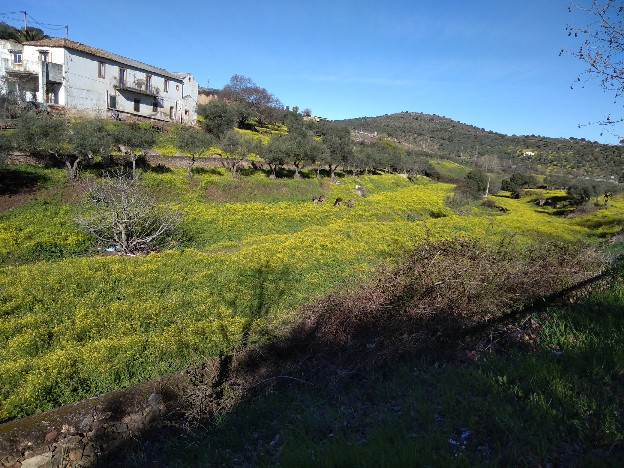
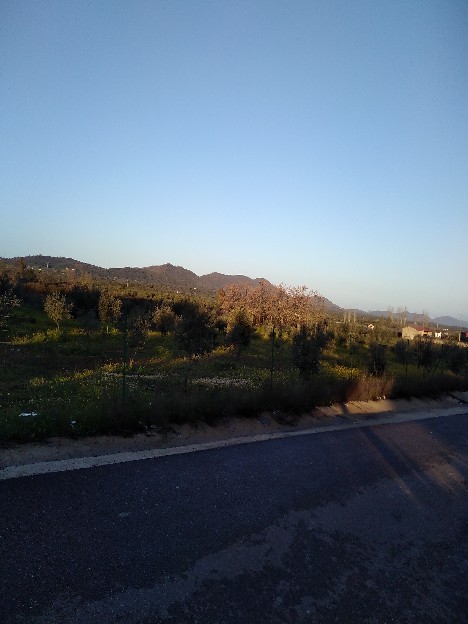
The mountains were beauti…. No, they were amazing, in the early morning. Everything was on the rise, spring in the air. All was lush and abundant and I could not stop taking photos.
After leaving the small town of Grimaldo I walked past private houses with swimming pools, then took a left off the road.
It was a beautiful camino: through fields and grass; winding between trees; very wet underfoot, but the sun was throwing slanted rays and the birds were tweeting away ‘fit to burst’.
There were thin films of spiders’ webs on the ground. I attempted to answer messages as I walked.
I was inching my way to Santiago. There was a road at a distance to the right, between me and the mountains, but I was in the countryside on the uneven ground. I felt full of love.
I only managed to snatch a quick pee if there seemed to be enough polite space between the others and me. There was that cuckoo again.
And.. what.. security cameras? Yes I think so. Standing tall in the middle of nowhere. Perhaps to catch poachers.
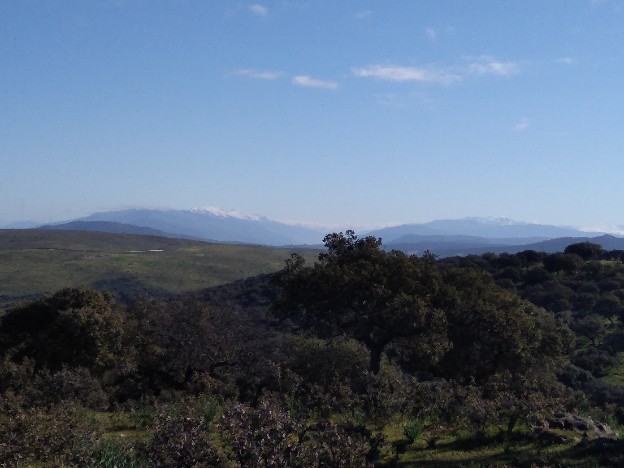
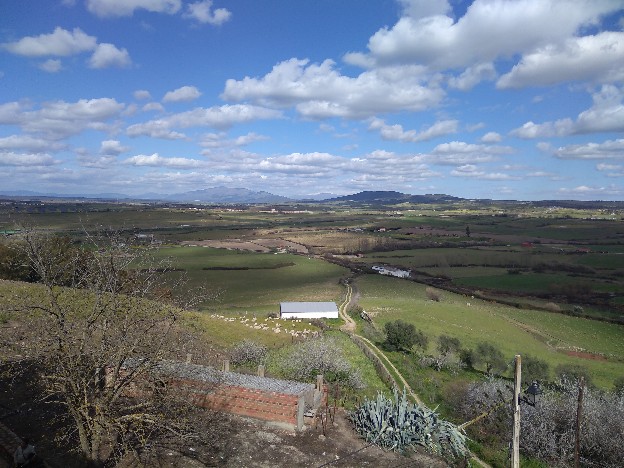
Up and down I walked and all the downs were very boggy. There was snow on the mountains again, in front of me. In fact, there were hills or mountains on every side.
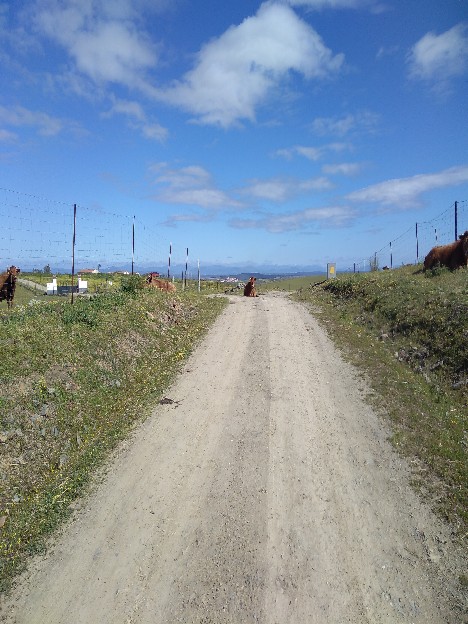
I picked my way between cow pats and acorns; grand and tiny stones; negotiated a series of big gates.
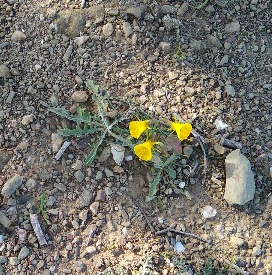
Today’s flower: a very small, yellow, slightly ridged cone (like a tiny daffodil trumpet), very often a singleton, but sometimes in twos or more; with a fine, sparse ruff of lemon-yellow, and a long stamen.
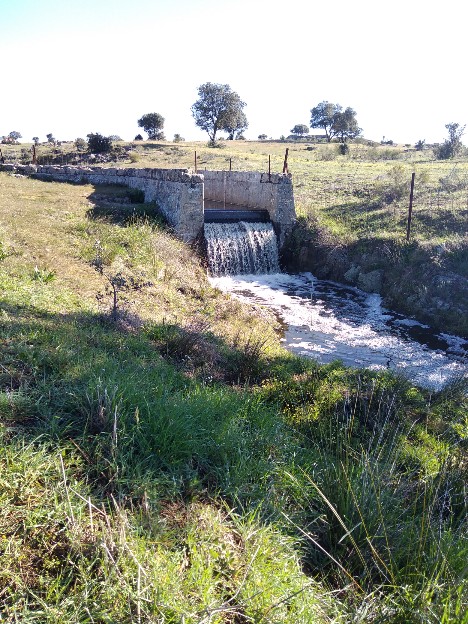
At the barrage were herons fishing, and there were deep pools alive with toads.
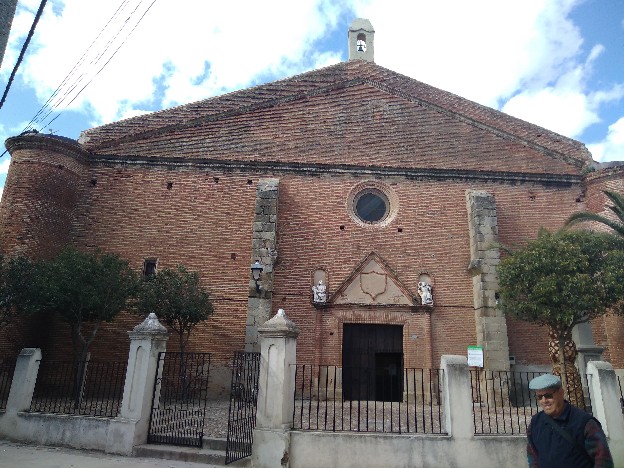
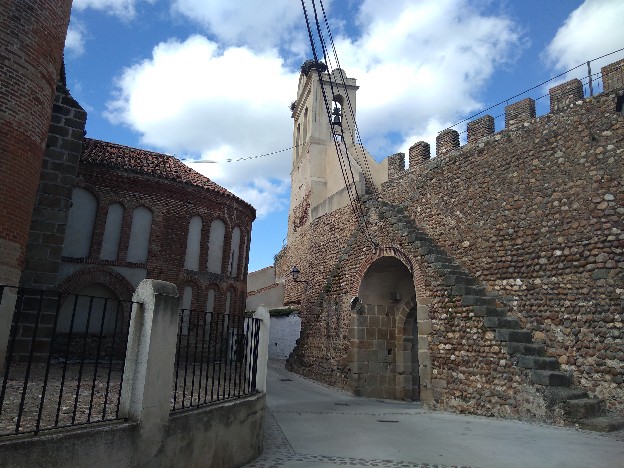
I arrived in the town of Galisteo quite early. What a sight! A former Almohad fortress, the walls envelope the inner streets and dwellings with medieval features and a simple but entrancing church, Nuestra Señora de la Asunción.
Iglesia Nuestra Señora de la Asunción, Galisteo.
The albergue was shut and so I gave someone with terrible pain some Shiatsu in the outer bar of Los Emigrantes, kneeling amongst the cigarette ash.
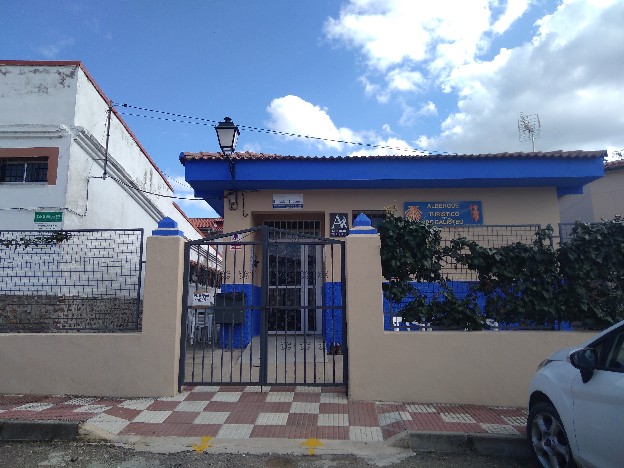
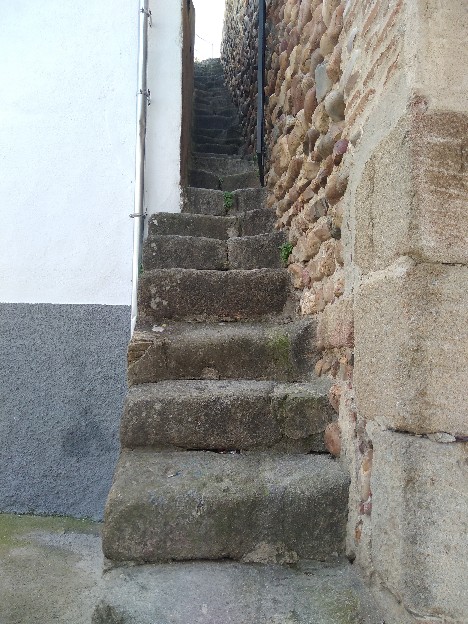
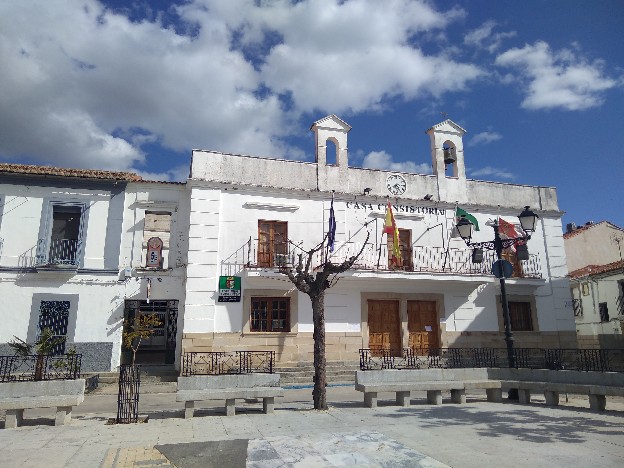
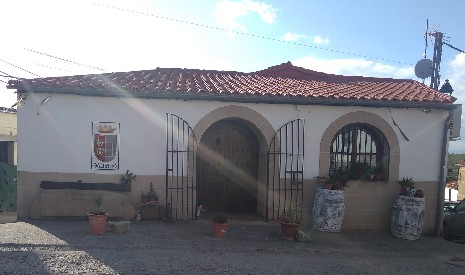
The municipal albergue, Galisteo, Extremadura, Spain. It was full by 5pm.Steps up to the battlements of the Mozarabic walls of Galisteo. Detail.Ayuntamiento (Town Hall), Galisteo.
Afterwards, the hostel was full as were the rooms at the bar. Luckily the man was very happy with his treatment telling people excitedly in Spanish how it felt, so there was a general movement to find me somewhere to sleep. This resulted in a beautiful twin room where I was alone. With crisply ironed sheets and bleached white towels in a quiet pension just up the road, it was the same price as the municipal albergue – 15 euros – including breakfast. How lovely to have peace and space after many nights in communal accommodation.
Pension El Parador, Galisteo. Comes highly recommended.
Thanks so much to all my readers who send me corrections or answers to my queries, and who share their Spanish memories (especially of the Santa Semana processions which are currently happening across the country). I do look for the correct details before posting, but it is hard to identify flowers, trees or birds sometimes, so I am grateful to you.
Cáceres to Casar de Cáceres (26th March 2018), maybe 18 kms taking me 4 hours plus.
Today I did my morning meditation in a different position because I cannot sit cross legged in my sleeping bag.
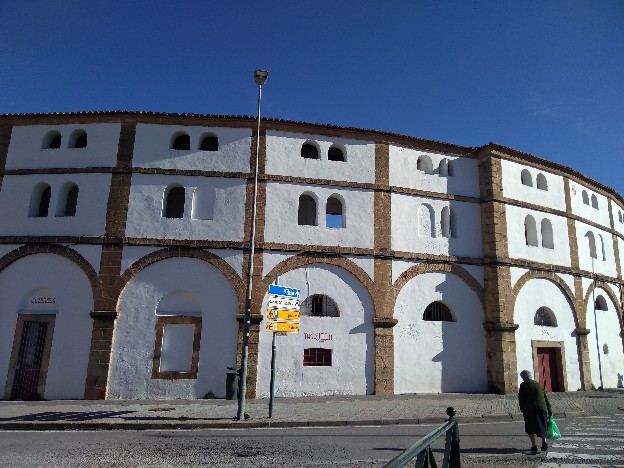
Bullring, Cáceres, Spain.
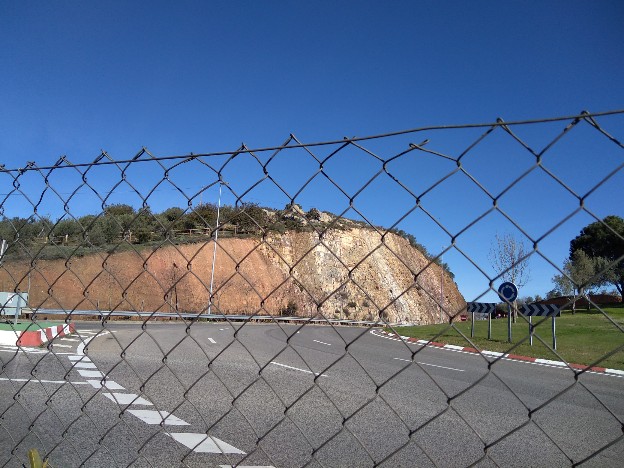
Walking out of Cáceres was smooth and I was impressed once again by the enormity and variety of the geology: the giant verticality of colour and strata exposed by road building.
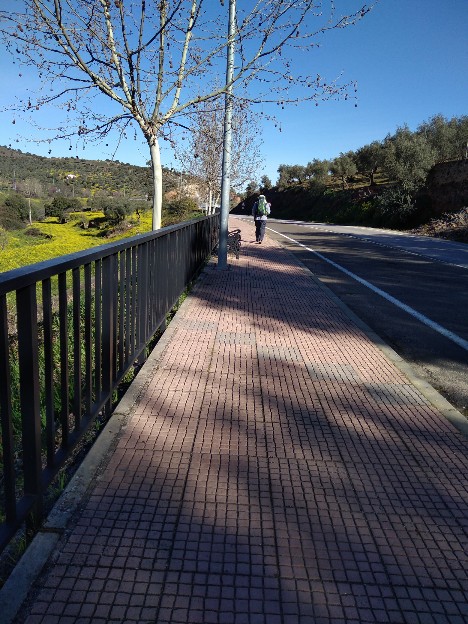
The roadside plants continue to be mainly rosemary and thyme but now with pink vetch. The Camino crosses main routes again and takes me along the highway. It is frustrating because I can see a beautiful path in the fields to my left but cannot get across the fences to it.
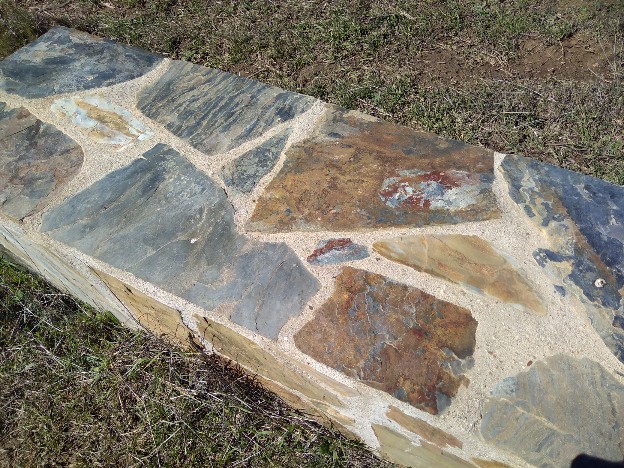
A handy seat made of beautiful local stone.
There was a brief conversation with a fellow pilgrim along familiar lines – nationality, where walking from and to – this time with an older Belgian man who is wearing a hat with sun flaps over both ears.
The sun was shining brightly but it was cold on my head. I reflect that if you are going to do this walking lark, you must be prepared for some hardship. Having enough money for hotels and being fit definitely helps.
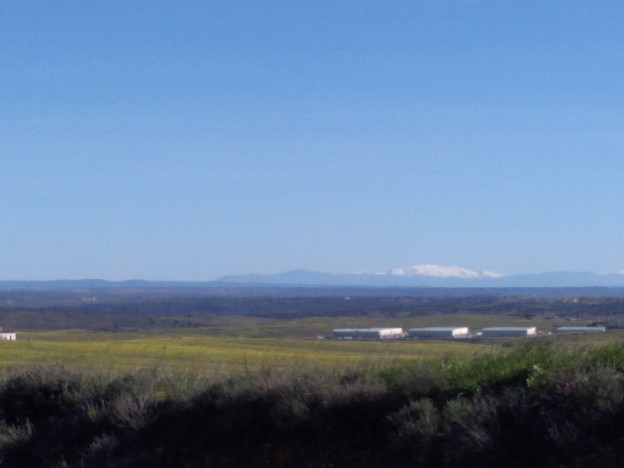
Because of my foot pain, I was already sitting in the sun to rest by at 11.05 after only 25 minutes, but I knew that this must happen if I am to manage to enjoy myself at all. I realised there were snow-covered mountains to my right and was awed by their beauty.
Snow capped Sierra mountains in the distance.
Once again I thought ‘that must be the camino over there, but how do I get onto it?’
The lovely Spanish cyclist and his German friend sped past waving a smiley buen camino to me.
Then I saw a gap, took off my rucksack and rolled under a fence, thinking perhaps I had just missed the turning to the path but no, I had to go back through a farm gate shortly afterwards and continue on the ‘hard shoulder’ which was very tiresome. In the process I put my hand on thistles and still have one spine in the tip of my thumb two days later. Maybe that will teach me!
There was a very nice sun and the remains of yesterday’s wind on my going-bald patch at the front of my head. Bravely I took off the bottoms of my trousers making shorts.
I spotted the new fennel leaves at the base of the old dry stalks and remembered how they were almost past seeding when I finished my first camino in November 2016 in Santiago de Compostella.
It was a long way beside that motorway. But my advice to others who might walk behind me is to wait, the off-road path eventually comes.
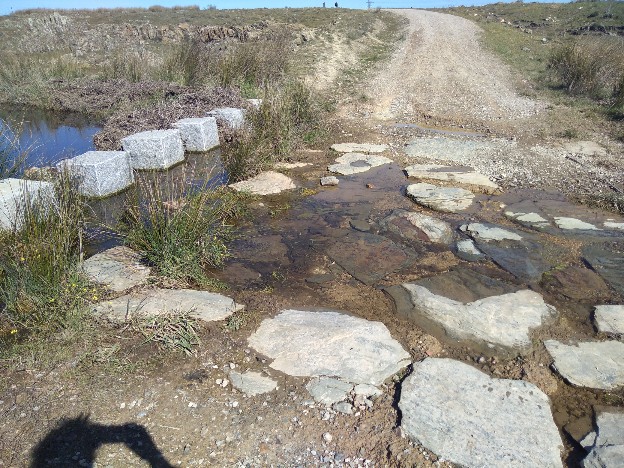
One of the many crossings – this one with stones provided to keep our feet dry.
There were still some of the dark brown and orange hairy caterpillars: one or two wibbling along over the gravel and some others fairly hurtling amongst the sheep droppings as if they were late for work. However there were nothing like the numbers of two days ago.
Other trekkers passed me occasionally and we fell into step for a while and shared pleasantries. I am trained to see the visual signs of the head-colds or tiredness, the dry lips, the excema under the nostrils, and do not ask questions.
Around me are small brown birds singing their little hearts out. I started thinking about this strange phrase – perhaps it is their puffed out wee chests and the high urgency of the pitch which has prompted it?
Now I was going uphill and was aware of my blister and that was only a tiny climb! I found myself saying blessings for dead animals by the roadside, and I finished planning my workshop for the end of April: the ideas popping into my mind unbidden.
It was very pleasant walking like that, with lots of tiny stops and the time to remember.
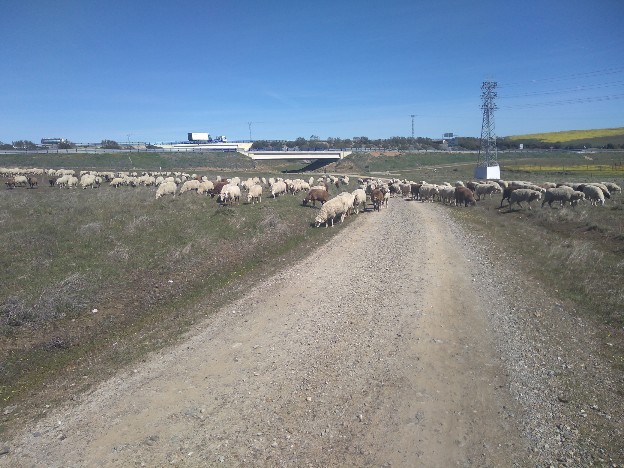
I came across a father and son, shepherds bringing up the rear with sturdy sticks but no dog. Overhead are three raptors and almost around my head are swallows flitting and flirting.
A flock of sheep to make my way through.
Once again I reflect that we walkers go so quietly that we come upon these creatures, or they on us, unexpectedly.
Oh those snowy mountains: simply majestic.
Finally I come into Casar de Cáceres and note the many expensive cars. It is presumably a commuter town for Cáceres itself. There are many helpful people including a woman who I had exchanged a few Spanish words with earlier and who later spotted me looking puzzled. She abandoned the wheelchair she was steering, grasped my arm and took me to the corner of the correct street.
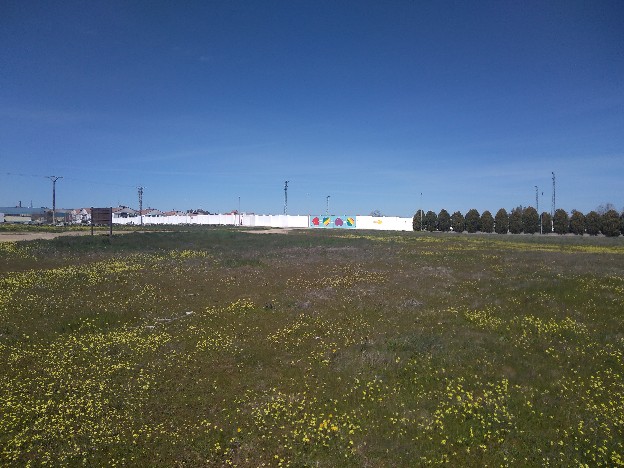
The entrance to Casar de Cáceres – rainbow-coloured hearts and a huge yellow arrow: sign of the camino Via de la Plata.
It was long walk into town where I registered at the bar and then, having walked on far too far, retraced my steps to the nice albergue on the first floor in the corner of Plaza España. I arrived at 1.45.
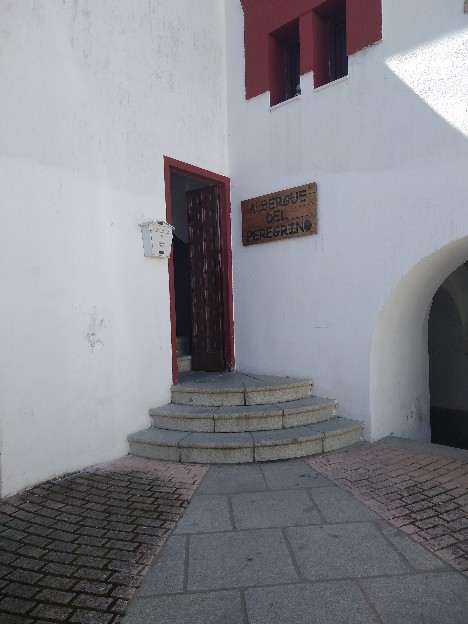
The albergue entrance in the corner of the square.
The evening consisted of sitting in the sun with my cups of tea and chatting to the others; a beer in the cafe and very interesting conversation with a German teacher about co-operative learning; shopping (including a plastic mug for 39 céntimos), cooking a meal for myself and some others; giving what I call kitchen- Shiatsu (ie on the spot, me kneeling on the kitchen floor); and later, thoroughly enjoying the wine.
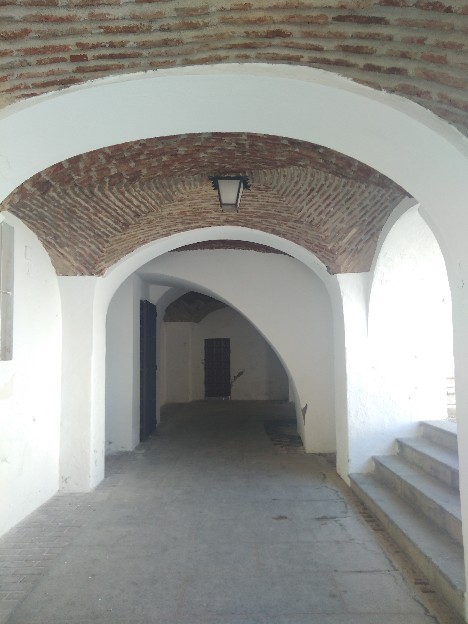
Beautiful Spanish architecture.
There was no WiFi, the shower flooded onto the floor, I did not enjoy my night-time visit to the toilet where someone had aimed and missed 😦 but it was great to have a kitchen with some utensils, and a free washer and dryer – all unbelievably, for 5 euros.
Last night I stayed at a Franciscan monastery Casa de la Misericordia, Los Esclavos (slaves) de María y de los Pobres (poor) in Alcuescar, started by Leocadio Galán in 1939 to house and educate the orphans of the war, both academically, religiously and in the arts, sports and culture.
I gave a Shiatsu to a deserving fellow trekker who had a neck problem; I was able to dry my boots and have a hot shower, but there was neither kitchen nor clothes washing facilities. We were invited to take a tour of the building with one of the Brothers and to attend Mass (a sign informed us that whatever our religious inclinations, we would be saved).
The soles of my feet ached well into the evening so it was good to give them a massage this morning and feel how Kyo the insteps, KD1 and the backs of the ankle were, even after 9 hours in bed. At least I did not feel the cold that the others did – what with my new sleeping bag and all so my Water element cannot be in that much imbalance!
Yesterday a group of us had to wait until 1pm to be admitted and they played us beautiful Spanish music while they booked us in. This morning we were all ready with our boots on when 7.30am arrived and the doors were opened. The hospitalero played the hallelujah chorus!
As soon as I walked across the road, my left heel remembered its blister, but later it was another part of my other foot which complained more bitterly.
Sun rise.
Breakfast was at the café Alta Cuesta over the road (I bought a coffee and ate my left-over bread and cheese) with all the other pilgrims assembled before the day’s walk. What bonhomie (though most were German!). The Way was clearly marked, directly beside the albergue (hostel), and the tarmac quickly became a sandy path: good for the walkers’ feet. There were fields of goats; lots of dogs; and black/white storks flapping their ungainly wings, necks outstretched like flying geese.
The olive green (obviously!) hills were on my left, in the distance, for half of the journey.
Today’s weather: sunny, cold (no need to stop and de-robe), with a glacial and an ever stronger, west wind.
Sign posting: Very good all day – even on the way out of the town. No need for a book or an app.
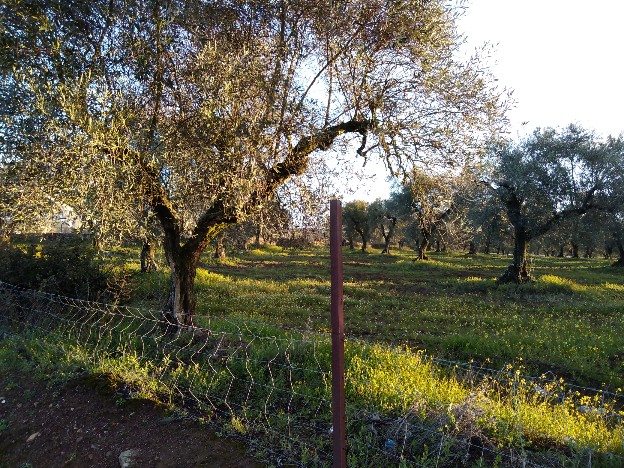
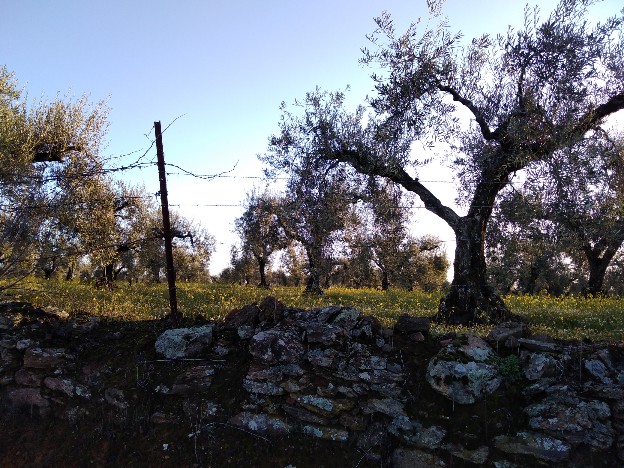
Soon I was walking between olive fields and hedges. The ground was sodden from yesterday’s rain.
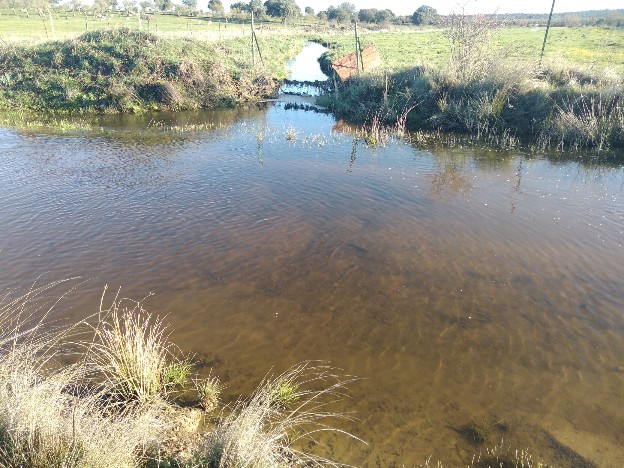
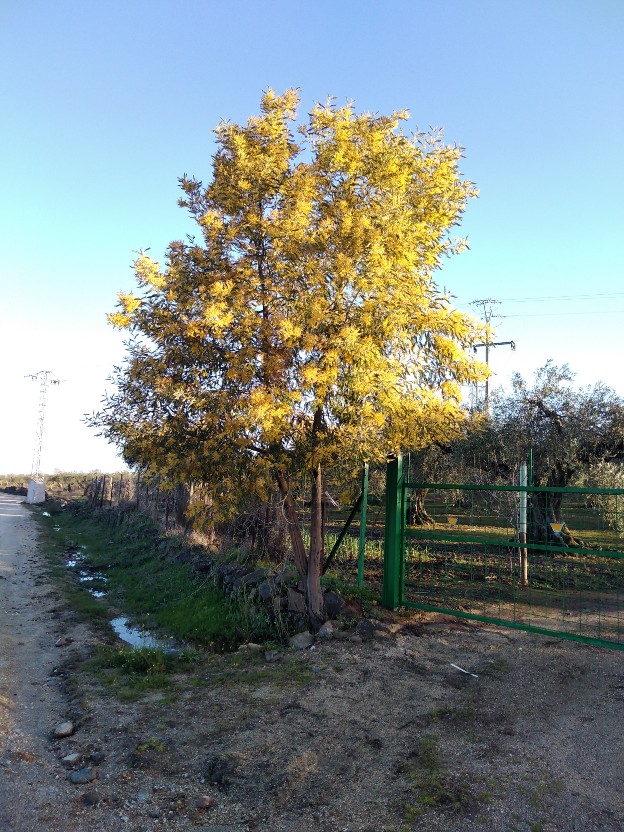
Throughout the morning I was dodging puddles, stepping on useful stone blocks positioned by the Amigos (‘Friends’) who look after the Camino, or skirting around small lakes of rainwater.There was a small plot of newly planted, straggly onions growing underneath this glowing tree.
I tried to phone ahead to reserve a bed last night because I saw in my book that it was only a small hostel, but I was informed that bookings were impossible. So I was reminded to leave the situation to fate, stop counting the people who might be in front of me, and not to rush to keep up with them.
One of the many German people, this guy with sexy socks.
There were men at work stripping the olive trees with forks at arms length, presumably ridding them of the old, dead wood.
A little loud dog made a noise which was not relative to her size, and of course the boo boo boo bird serenaded me in addition to the chatterings of starlings.
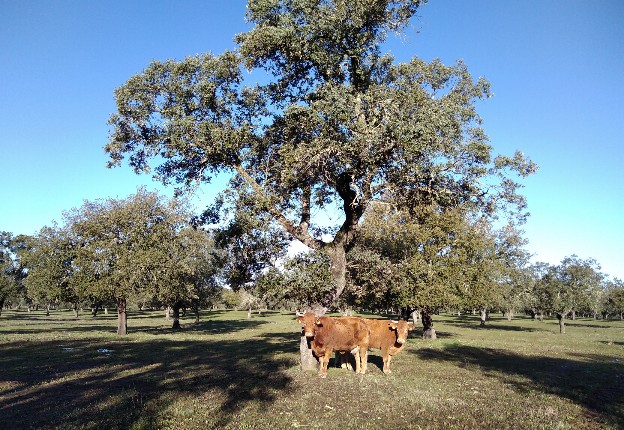
The calves were running, the cows sedate; their colours reminiscent of the Olocau dogs: a lovely warm, beige brown.
When I talk with another as I walk, I forget myself. This can be good because they always have an interesting story to tell. However, in some ways, not, as I cannot tell if I am going too fast for example, not until they walk on and I re-focus.
I spot a beautiful lake but it is behind a fence.
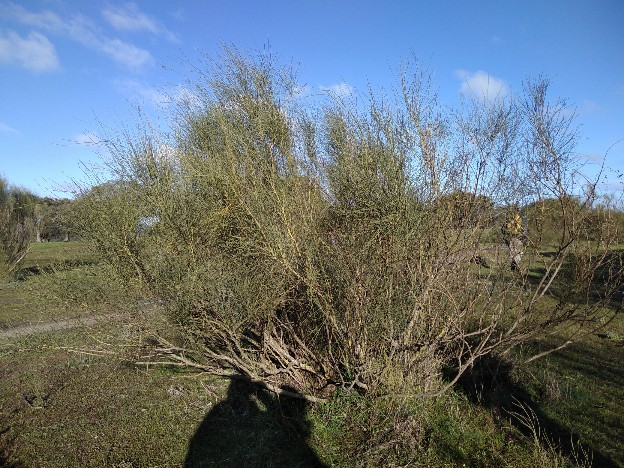
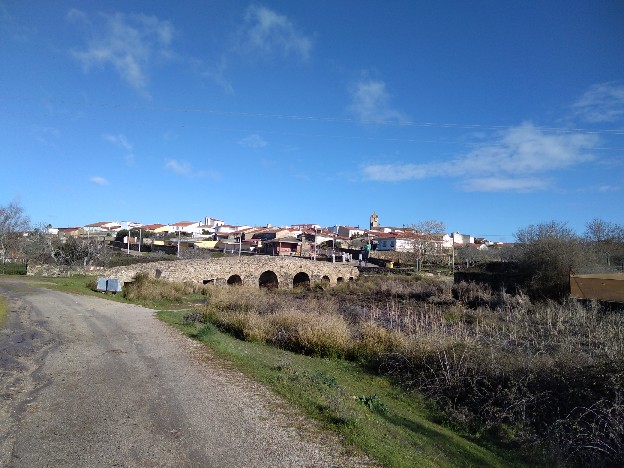
Someone told me this is tamarisk.The red rooves and white houses of Casas de Don Antonio, Extremadura, Spain.
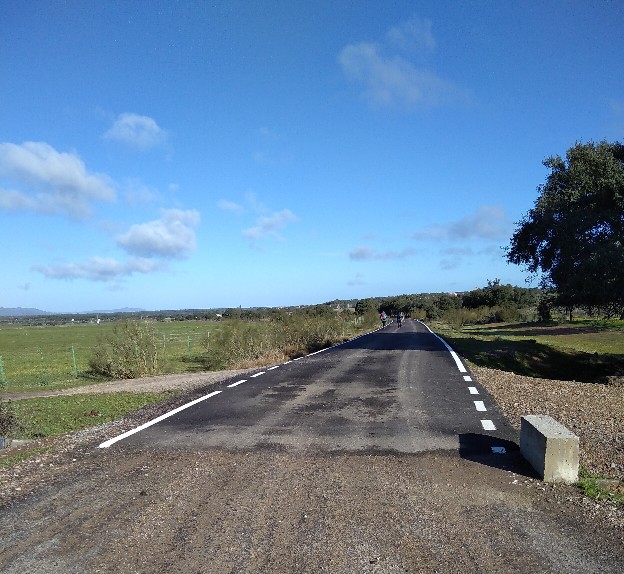
With cow bells tinkling, I was suddenly directed onto a runway-type paved road. Wow, the wind was so strong!
But then almost immediately the signs were off to the right. I reflected, on listening to others, that some of my old habits have passed. That sort of mirror can be very helpful.
There is straight, strong grass poking through the night-sky-blue bog water.
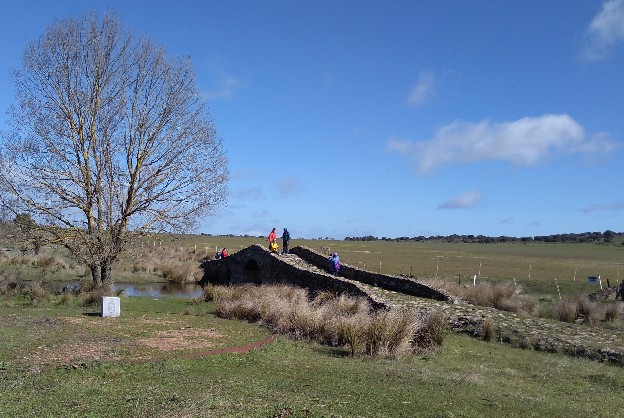
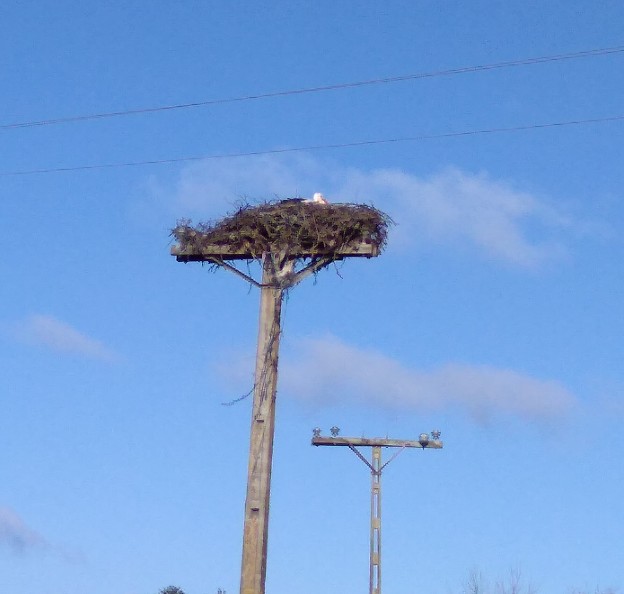
A group of Saturday walkers in anoraks of primary colours were having their photographs taken in the bridge. Smile!Here is a stork on top of an old pylon. It is blurred but you can just see the orange beak.
I was very stiff by now and when I squatted to pee, I asked myself ‘can I get up again?’ I wondered how I could ever have walked 6, 8 or 10 hours a day.
Note to self: try the she-wee Alice (eldest daughter) gave me.
When I notice myself thinking too much, or worrying, I imagine the image of praying hands in the centre of my chest. This is to try and centre myself, to try not to think of others. Otherwise, their Ki comes into contact with mine and I have more than me to deal with, and this camino must give me the chance to spend time inside.
The wind played havoc with my phone. I think, anyway. It seemed to be typing all on its own. One way or another it was impossible to take notes.
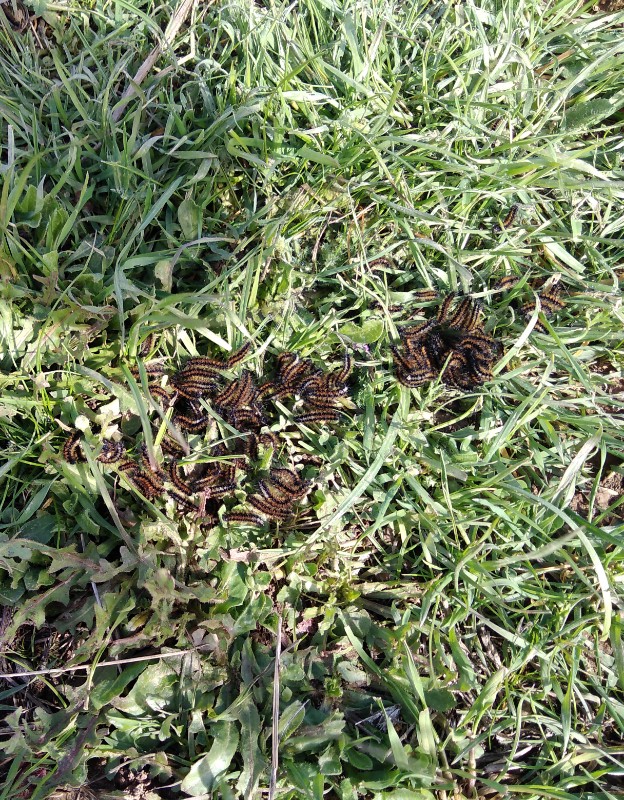
One fan-tailed raptor flew over and first 10, then 1000s of caterpillars who I had been told liked to move in a queue, were struggling between being stepped on, drowned and blown over. Poor things, they were having a harder time than I was, though they do have more legs.
Through a flock of sheep we wove, and off to to the right onto a road and the final destination.
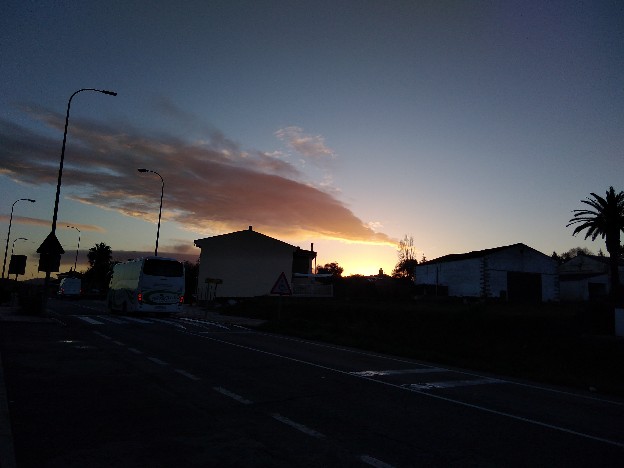
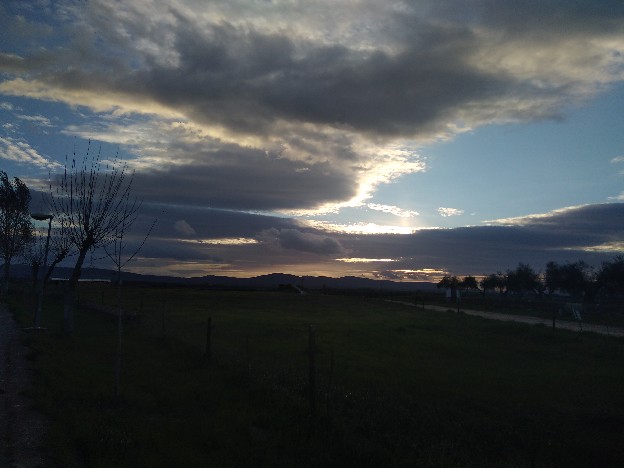
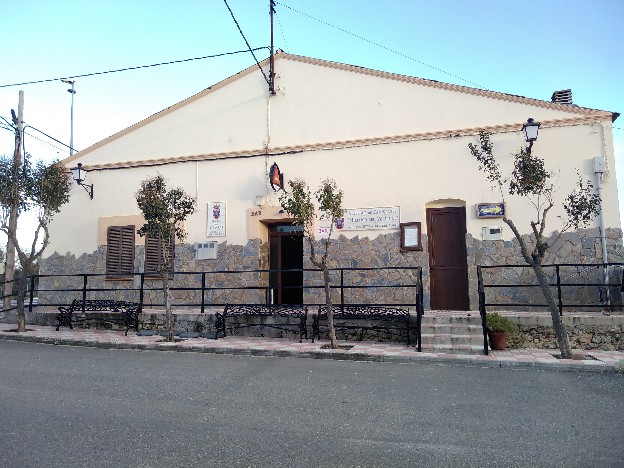
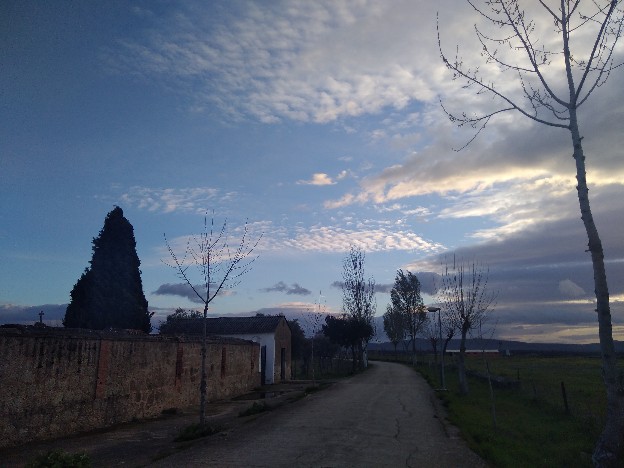
Sunset.The municipal albergue, Aldea de Cano, Spain.A mackerel sky.
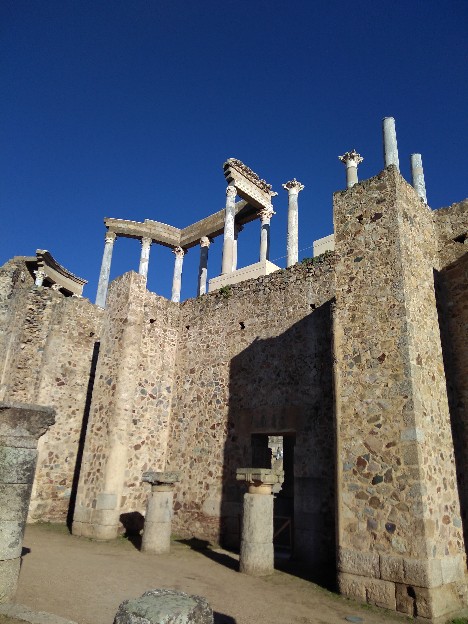
I went to Mérida by bus from Seville because I completed that 10 days last year. The Leda bus took 3 hours and cost 9 euros.
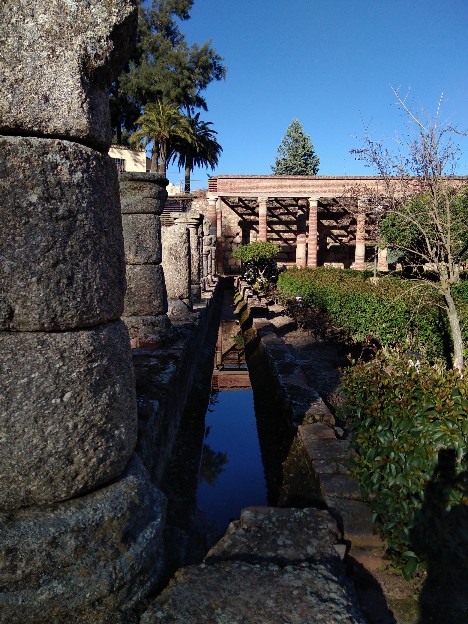
The beautiful gardens at the Roman Theatre, Mérida, Spain.
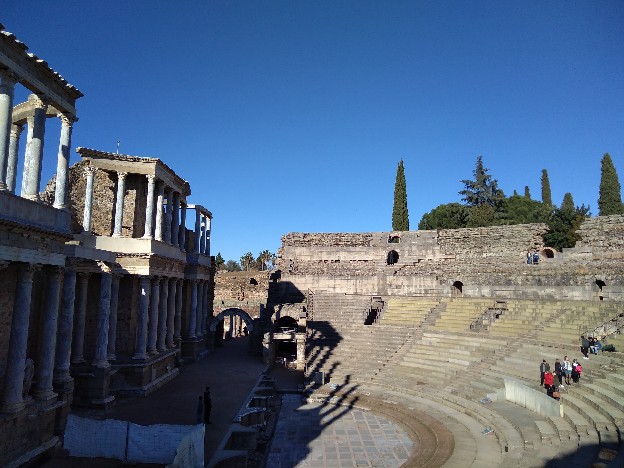
I enjoyed a beer and pinxos in the Plaza España (tortilla with bread and goats cheese on toast, neither of which were good but cheap) and visited the crypt (3 euros) and amphitheatre (12 euros) in the afternoon. The people at the tourist information were most helpful.
Roman Amphitheatre, Mérida, Spain.
The out-of-town shopping centre where I bought my new baton was across the Roman Bridge (which is totally pedestrian and a great sight). I was foot-sore but it was a successful trip and after bread, cheese and lettuce I went to bed at 7.30pm.
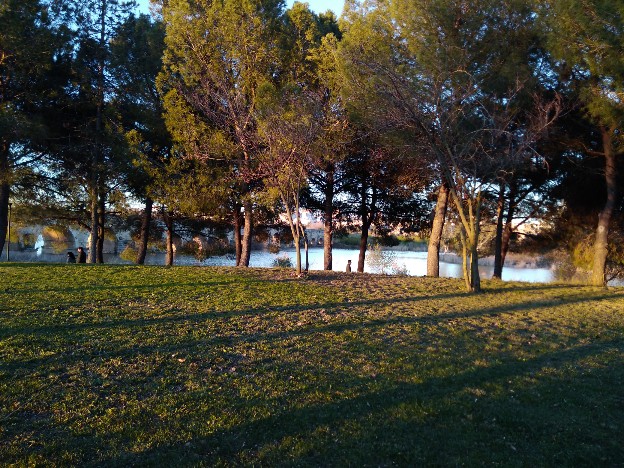
An evening shot of the Puente Romano (Roman Bridge) over the Guidiana River, Mérida, Spain.
I woke at 6am after a passable night. A cacophony of snorers accompanied me in the 18-bed dormitory which was almost full. I did my meditation and as I went outside to do tai chi I disturbed a heron on the river.
View from the hostel window.View of Mérida, looking back on departure.
I had a breakfast of milky coffee and packet cakes (2 euros), and was ready to go at 7.30am, only having to return once for my water bottle and map!
The buildings are industrial and utilitarian on the outskirts of Mérida, Spain.
The road took me uphill and although there was ice on the parked-car windows, the sun shone all day; the birds sang to me and, in general, the yellow arrows were clear. I asked a woman for directions at one of the many roundabouts, and the first hour was along the side of busy cars going to work, as well as a green cycle track bedside the motorway.
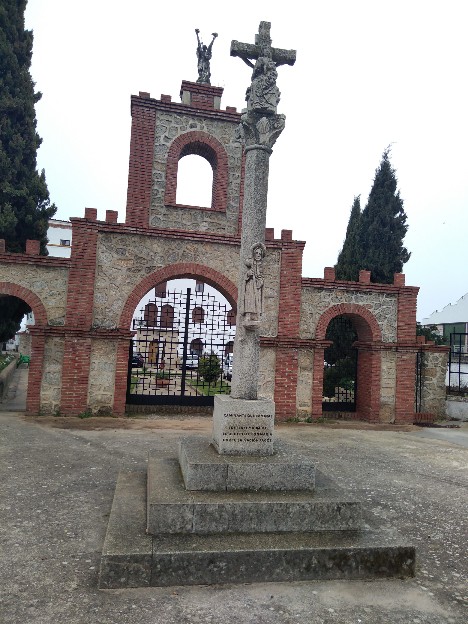
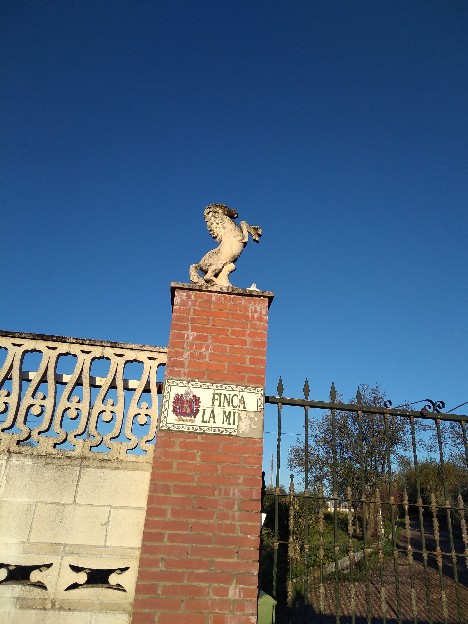
The statues on the gateposts are impressive.
The flowers were stunning: purple mallow; yellow rape; pink campion and ragged robin; white wild rocket and chamomile with their sunshine middles. Wood pigeons cooed at me when I shed a few tears, sure I had missed the way, although it transpired I had not.
Later, rabbits played with their white tails bobbing, and cow bells sounding like an orchestra of kalimbas were so beautiful.
I climbed up again to the top and there was the first view of the Prosperpina Reservoir. All morning my feet and other joints were taking it in turns to hurt, my back pack felt very heavy, but these things were familiar and if I have learnt anything from sitting it is that everything will pass eventually.
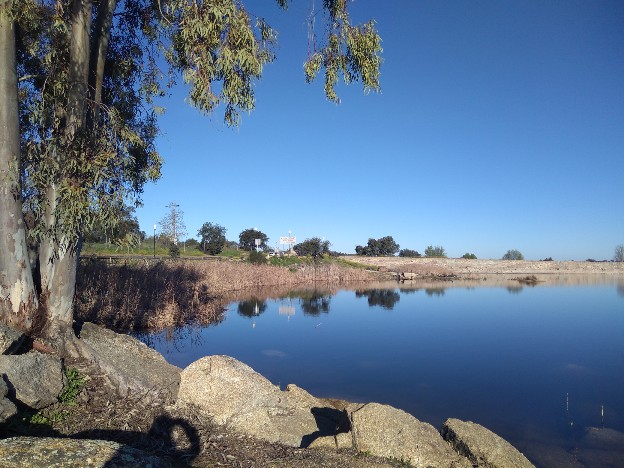
The Prosperpina Reservoir is glorious.
I sat and enjoyed it. I watched the heron on a rock, mirrored, stretching out its long black neck, and the swallows darting around for flies over the water. Individually the birds sang regular songs but together they created a mélange of sound.
I spent almost an hour near the reservoir reading the tourist information and changing out of my cold-weather layers into shorts and T-shirt.
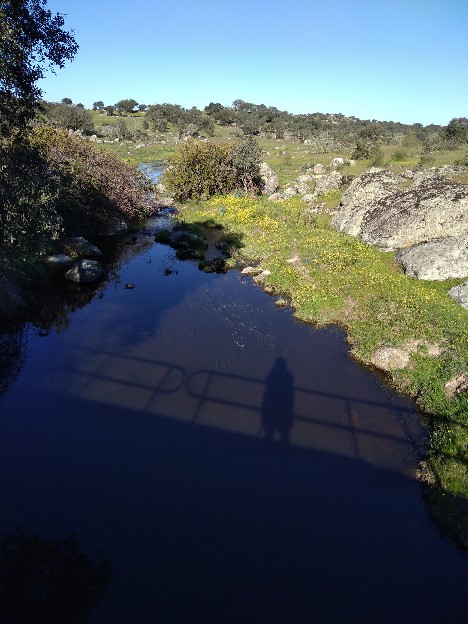
After skirting the lake, I walked by the babbling brook and this second part of the days walk was much closer to what I was hoping for: peace, with the call of the cuckoo and the water swirling amongst the bright green weed and sparkling in the sunshine
This path was across country although initially along a little road with lots of arrows, plastic bags and signs, all yellow to help us find our way. My feet were very grateful for the soft sand, although there were quite a few wet and boggy places.
I saw dog walkers by the reservoir, 2 local cyclists and 2 camino ones. No-one else.
Note for those walking this way: Remember to look on the pavement for arrows and indications, as well as on trees, the backs of street signs and the obvious marble blocks.
A gentleman opened the gate for me as I trekked up into the village of El Carrascalejo where the church was shut.
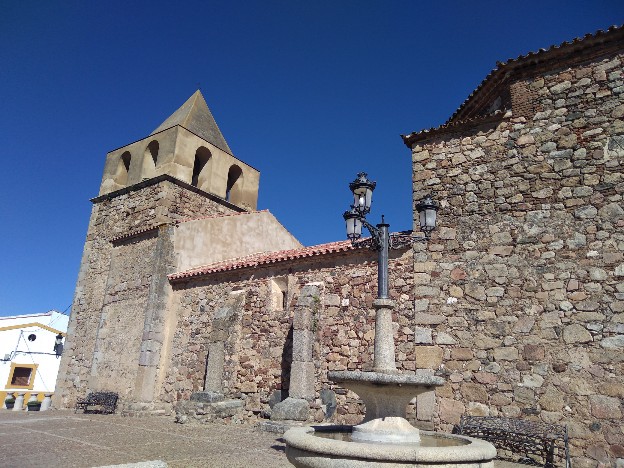
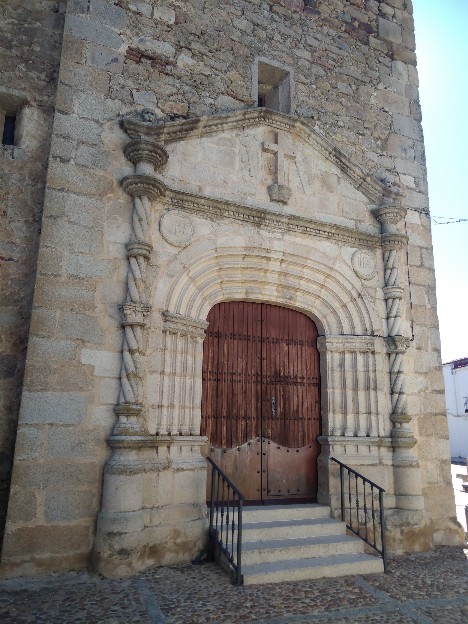
Parish Church, El Carrascalejo.Renaissance entrance of the Parish Church, El Carrascalejo.
I snacked at 11am with no sign of any café despite the information in my book (remember, it is March). On the way out of this tiny place there is a playpark and attractive picnic area.
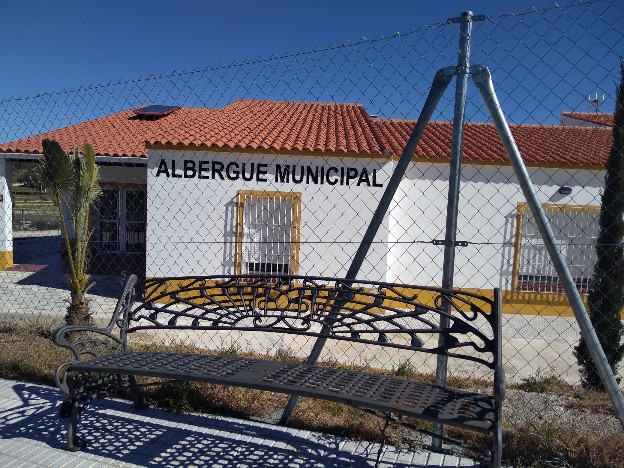
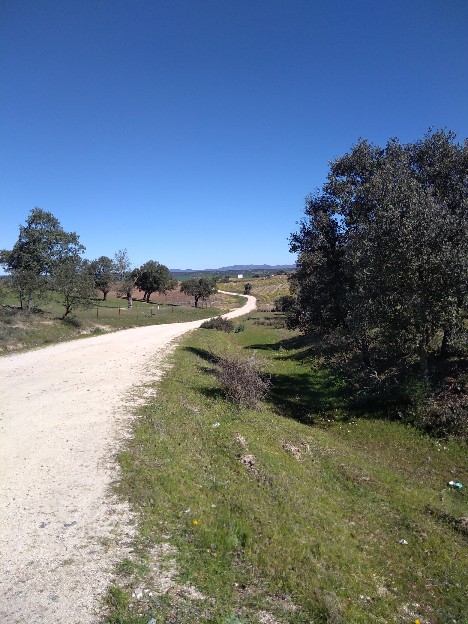
There are lots of lovely benches but the El Carrascalejo albergue is shut at this time of year.White winding road with fields of vines on either side.
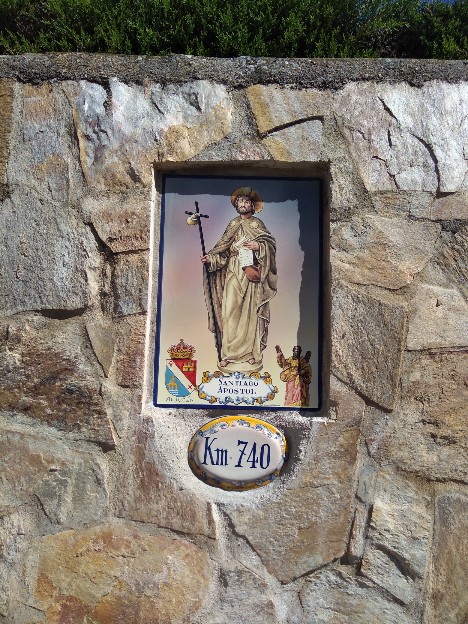
After all my winter reading about the history of the pilgrimage and monasteries, I really felt like a happy pilgrim with my staff and shell, sign of Saint Jacques interred at Santiago de Compostellla, the end of this 1000 km route
Saint Jacques.
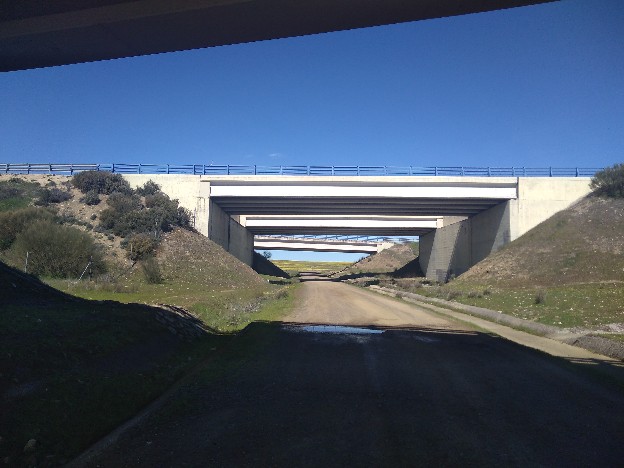
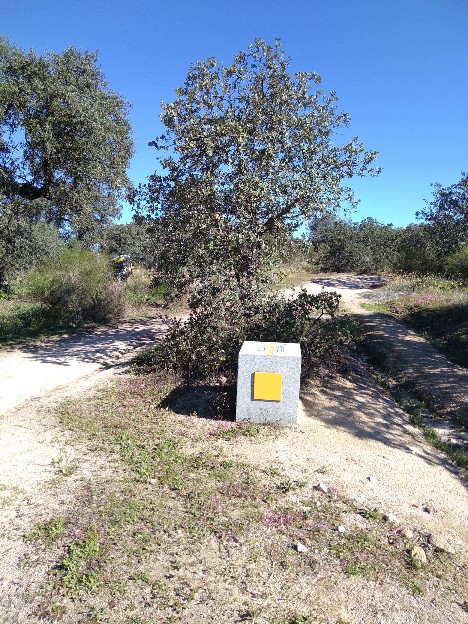
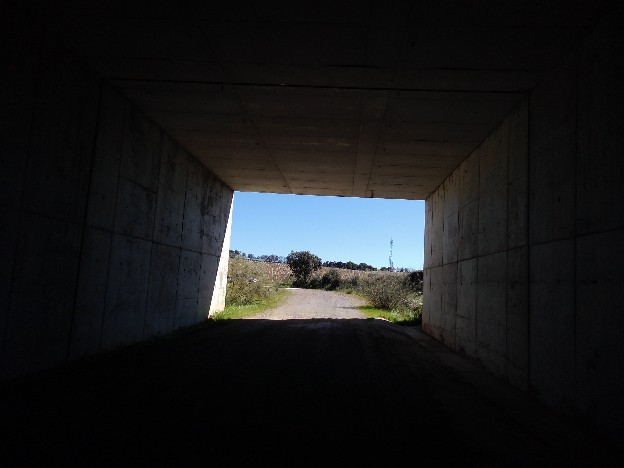
As I approached the motorway I took a left turn along a small road and then a right at a Mondrian-like cube with its yellow square and walked through the underpass.
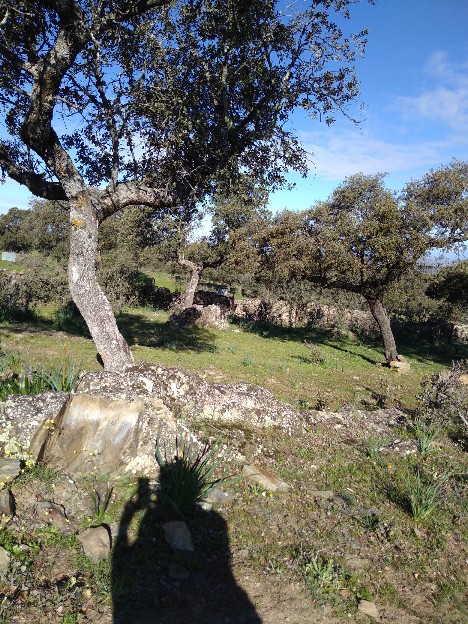
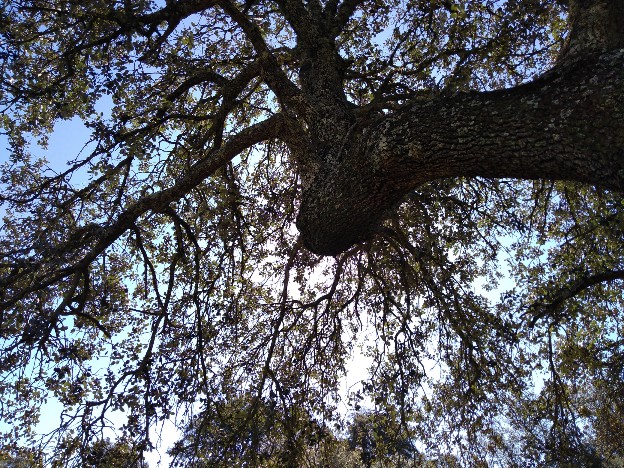
There are many Holm oaks in this area of Extremadura.
Up another little hill I went, along a farm path and past a group of men taking a break who called buen camimo and then I had a view of Aljucén.
I crossed the main road for the last time, straight on between green fields lush after the rain (the farmers must be happy anyway!) and although there are no signs I kept on going right into the village where they were planting lots of new trees and arrived at the Albergue Turístico Río Aljucén at midday.
Costing 10 euros, this hostel was recommended by the previous hospitalero, has excellent, free Wi-Fi, is spotlessly clean and although it has a washer (3 euros) there is no dryer. I was the first to arrive so I got to have the hot shower and choose my bed in the small dormitory. All my things dried quickly in the sun as other pilgrims arrived. We sat together, mostly German people, one Argentinian, a couple of French and myself from Scotland We spoke French, German, and a little English and Spanish.
23rd May 2017. Via de la Plata camino walk, Spain. Day 8: Villafranca de los Barros to Torremejía, in the autonomous community of Extremadura, Badajoz province. 26 kms which should take a minimum of 6 hours with breaks.
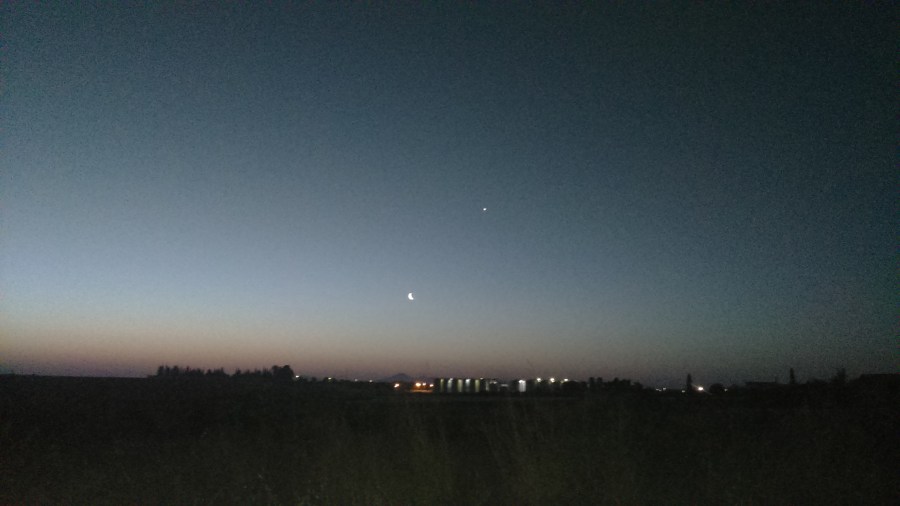
One star shone beside the moon (or was it a satellite?)
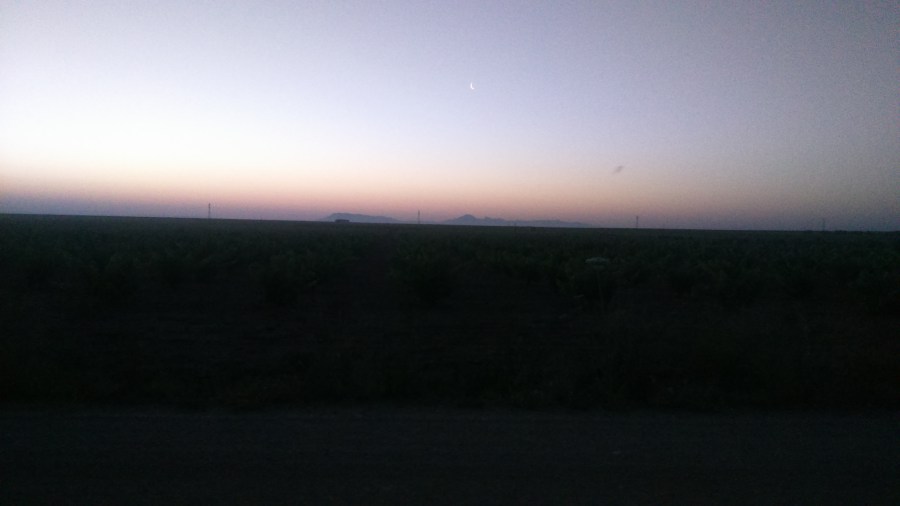
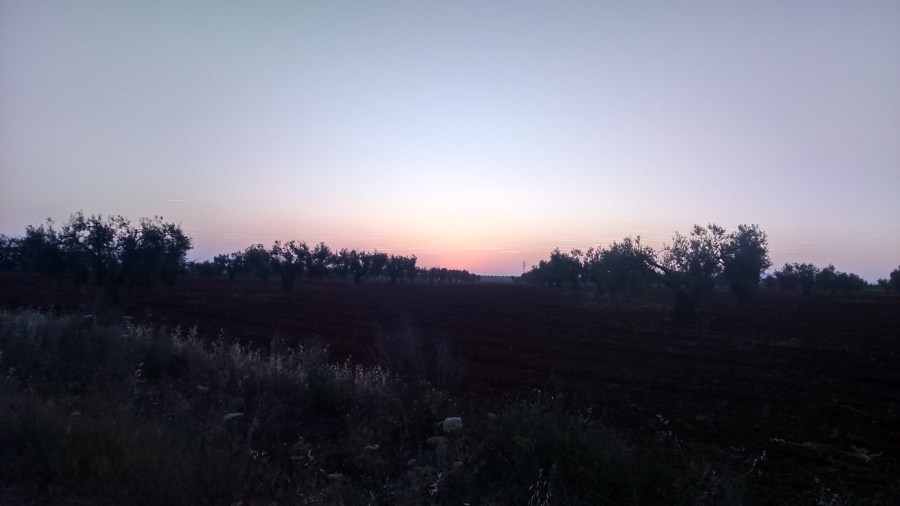
I left Villfranca at 5.50am and it was darker than ever before. Once I had found my way out of town I was in open scrub land. There was the dawn at the edge of the world; the sky was blue, red and orange. I heard the sound of a lone cockerel, a white horse was just visible, and I smelled the faint odour of farm fertiliser.
There were orange lights already in the distance, and tractors passed me under the tiny, thin crescent moon. The dawn chorus was sounding: Oh, the sweet, sweet feathered melodies!
As I found my stride, my state of mind calmed. My pack was extra heavy with provisions, and my feet already hot, but the air was cool and I gave thanks for that. The dusty path was occasionally lit up by one or two red tail lights of farm vehicles. Then it went quiet. The flower buds were tightly shut.
The sky was a bright orange purple and the fiery dome took three minutes or so to appear
The moment when the the sun finally rose was very exciting, and afterwards the opposite sky was a blank in comparison.
‘(Pilgrimage is) … walking in search of something intangible..’ p. 45Wanderlust by Rebecca Solnit.
Some travellers write their blogs after getting back home, after the whole trip has ended, and I can see why; although the trekking itself does not take all day every day, so that you would think there was time enough in the evenings to write, I find that the attention needed to deal with practicalities, together with the attendant tasks of looking after the BodyMind, can take up a surprising amount of time and energy. On this journey I started posting my blogs daily, but gave up part way through.
I recently advised a prospective peregrino to leave books at home. That was partly due to the weight, but also because I do not read much when I am on a pilgrimage, and I do not see others reading around me. Fiction can transport you to another place, and many pilgrims believe that focussing on their spiritual goal is vital and do not want to be distracted.
‘…- and for pilgrims, walking is work.’ p. 45 Wanderlust by Rebecca Solnit.
As I walked, I was reflecting: I could see that I have a tendency to set myself extra and unnecessary tasks. Yesterday I did some work for the business back home (perhaps thinking I was indispensible) and it transpired that it was a needless task. As I put one foot in front of another I could take note of such patterns and habits of mine.
Camino Publico de Chaparral , longitude 3,600 km, Ayuntamiento de Villafranca de los Barros
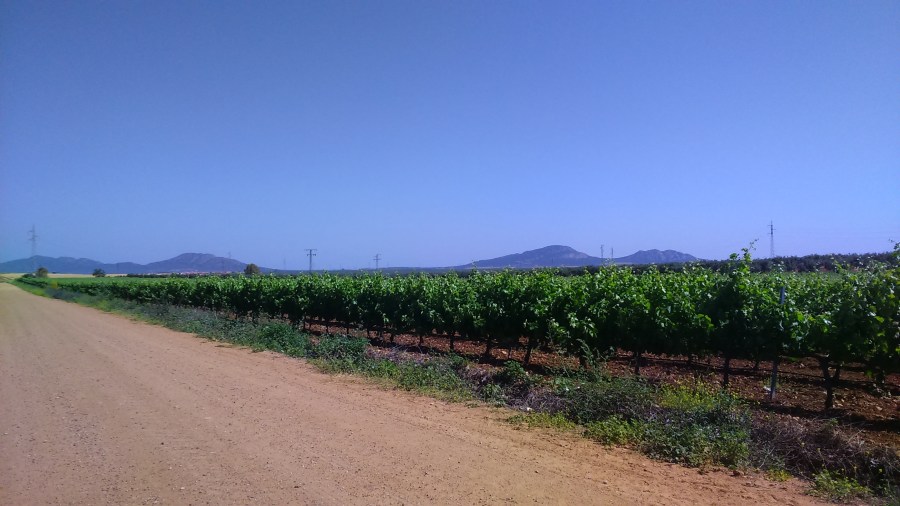
To the east were hills like different sized piles of manure you will clear up later, whereas the other half of the globe was flat to the horizon, and the vineyards of the Ribeiro region a uniform blue. The arrows were easy to see, the backpack was no bother, but my feet were still calling my attention at times.
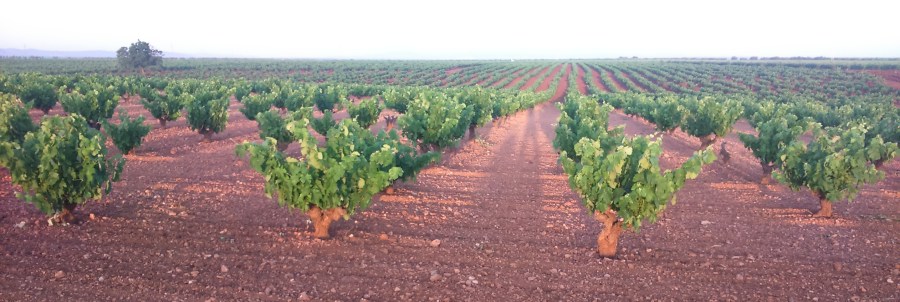
Not long after, the sun lit them up and I enjoyed the immaculately ploughed red soil between rows of vines.
The world was in technicolour
Olives, with their stumpy wiggly trunks, stretched into infinity. One patch had solar panels and an extra crop of what might have been green alfalfa between the trees. The cordoned vines had thin little stems, perhaps because the wires were supporting them so they did not need to be stronger. I would like to know why some rows were planted north-south, and some east-west.
The sweet fennel and cow parsley smelled delicious. My skin remained cool, and it was brightening quickly. Other wild flowers competed with the blue of the sky, and there were His Master’s Voice horns of pink, common bindweed by the path.
Bright blue wild flowers competeing with the azure sky
Before I left the hostel, breakfast looked better than usual so I had paid for it, and consequently I was full of sugary energy. On the ground, my shadow was really tall; I thought it must be my alter ego which could reach things down from high shelves in the supermarket!
In the fields, today’s job was trimming the long tendrils, and other than those men working (an occasional conversation reached me), it was me, myself, I as far as the eye could see.
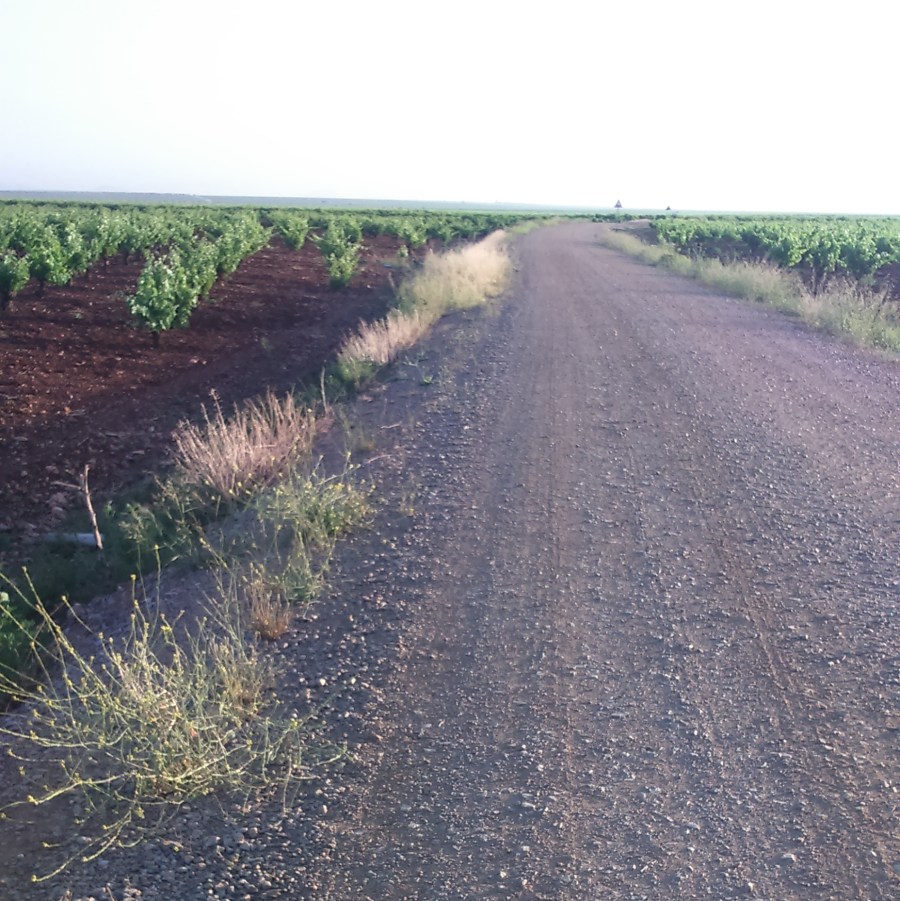
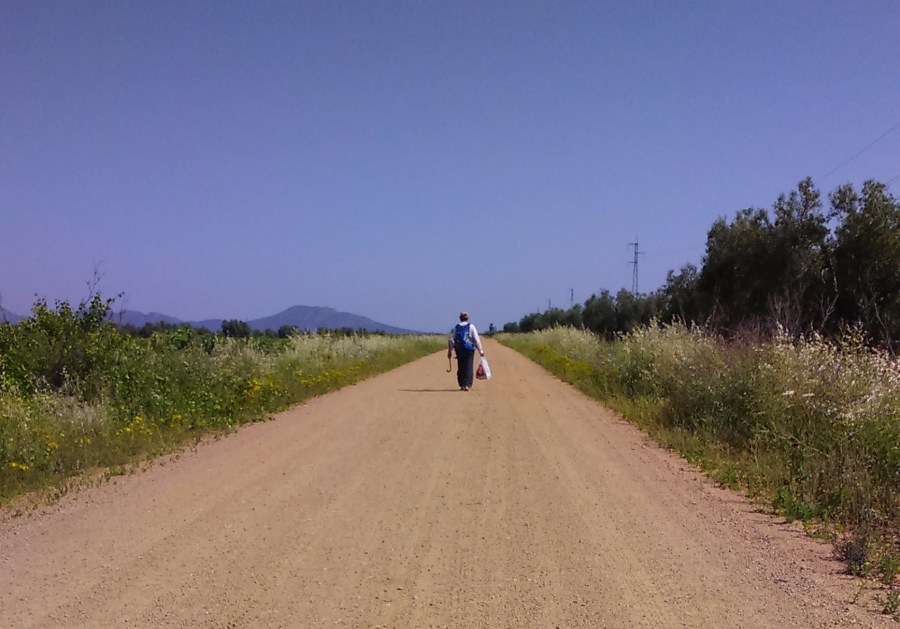
Vast expanses of sky and road
I liked the swirls in the earth at the ends of rows where the tractor had turned; hated the repetitive machinery noise to my left which source I could not see; and blocked my nose from the acrid, chemical smell I had been warned about.
I had also read that there was neither village nor water for the entire 26 kilometers, and I could believe it. I only had one litre of water and so knew that I would have to be careful not to drink too much too soon. Sadly, as I took the signposted turning, the noise got louder.
The tireder I got, the less time had passed since I last looked at my watch! Chemicals smelling like paint were being sprayed, so I tried to pick up pace, but my body had set its own rhythm. Tonight, I thought, I am drinking some wine!
By 8.40am I was no longer alone; there were four Italians in a group and another solitary man on the road. We moved at regular intervals from each other.
The same person I had shared a dormitory with the previous night, with his hat, carrier bag and wooden walking stick
After almost three hours without a break, I was casting ahead for a tree throwing shade, but there was not one until 9.20. After a fifteen minute break, and having eaten my orange because full much needed fluids and was the heaviest (delicious it was), I deduced that we were barmy, the lot of us, walking so far in this heat!
I then passed the hat-wearing man sitting on a wee waymarker, and he said he was muy cansado (very tired). He added that we were half way. On I went.
A town with unusual looking farm buildings appeared. Ah! maybe wine vats. It looked like the outside edges of a huge swimming pool and I imagined it was full of grapes with barefooted people trampling around inside it. Do they actually do that these days? I then realised that could of course be sewage, which would be considerably less ‘romantic’.
Luckily, the actual smell was of newly cut branches and very fresh sap.
For some reason I suffered a lot of pains on and off, and I also started to feel the skin on my right arm and leg, the side where the sun was, getting that soon-to-be-burned feeling. To remedy it, I draped my magenta wrap over that side of me – that scarf sure does come in handy. (See my blog on what to pack in your rucksack).
You cannot see from the photo, but the mountain rock strata were clear to the human eye
Swifts zapped flies, zig-zagging across my view. Were those cordoned olives? If they were, then that would make for many more plants per acre than the row system, so it would certainly make financial sense, if the earth could sustain it.
I broke again at 10.45 for lunch under a tree, feet throbbing – it was so very hot. A pylon was crackling like a fire, indeed there was a smell of burning. As I ate I let my crumbs drop for the ants and watched one carry a huge piece away, picturing it arriving back home, saying ‘look what I got!’ When I got up, I noted that it was a messy business for the bottom, sitting on the earth like that. I restarted at 11am and, yes, there were a lot of little inexplicable, smouldering fires alight between the olive trees.
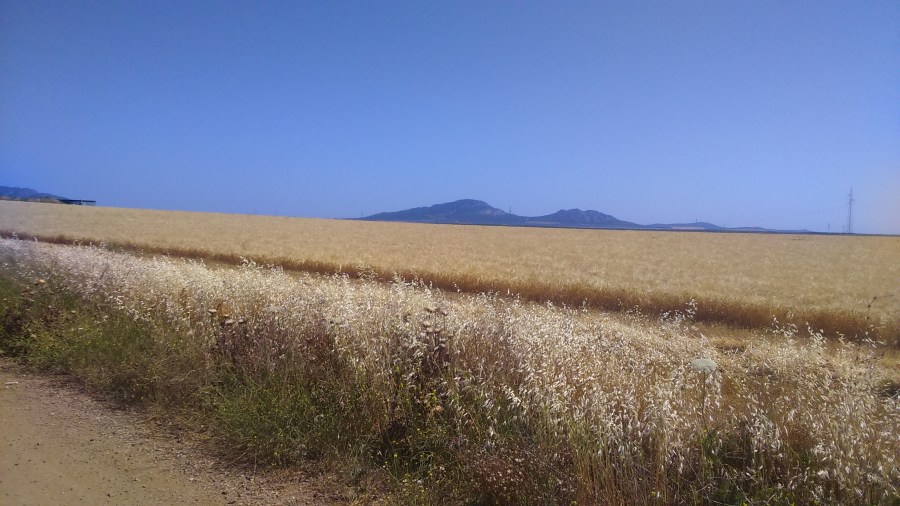
A sea of bleached wheat
Towards the end of the day’s walk I spent a short period, only the second time in the past eight days, talking to someone as we went along. He was from Barcelona and was doing the camino to get away from his demanding family, he said. He assured me that despite the exhaustion, of course he wanted to keep on walking until he reached Salamanca (a further eleven days). Such determination!
At 1pm in a 31 degree heat, and after seven rather than six hours of walking, I arrived in Torremejía. (Put the accent on the final ee: toh-ray-mah-heee-ah).
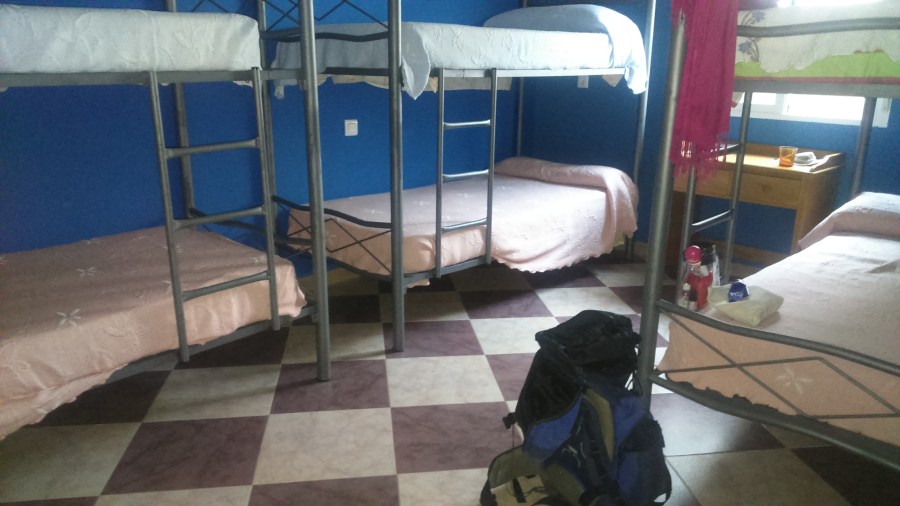
Privacy – all the other beds were empty
The hostel host owns a bar as well, on Avenida Extremadura, but there was a family issue and it was closed that evening, so I sat in the one opposite and had a beer and wrote my notes.
Useful info: the supermarket on the same street is shut for a long time between lunch and evening.
I did buy that bottle of wine I had promised myself, and I also invited the man in the above photo, plus a Dutch cyclist new on the scene, to join me. We had some surprisingly entertaining conversation, in divers languages, and it was very enjoyable to sit around the table with fellow travellers again, as I had done so often on the Camino Frances.
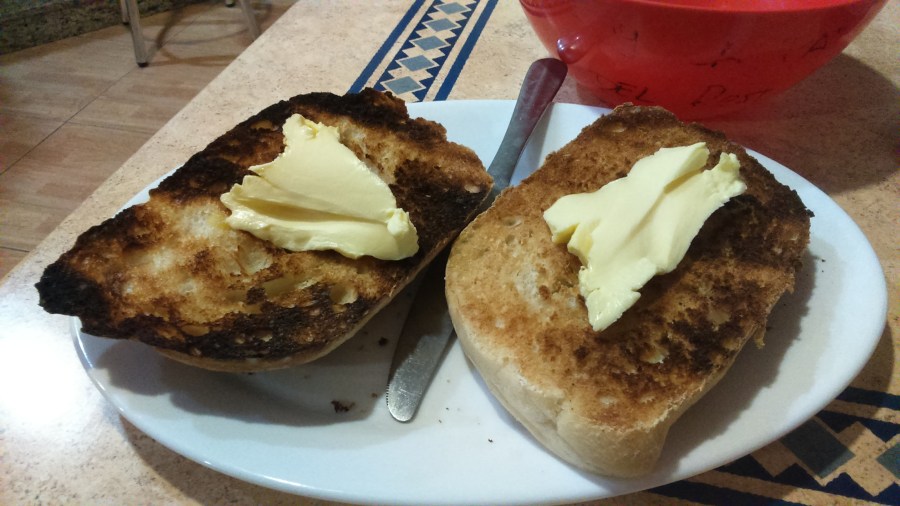
For some reason the host kindly offered us a free breakfast when his bar reopened the next morning; it provided simple fare with generous portions and friendly service.
Toast for breakfast, with a great deal of butter
Tomorrow would be my last day on this leg of the 1000 kilometer Via de la Plata, so I would have to wait to see Salamanca another time.
For a list of stages of this camino and other information, check out this link:


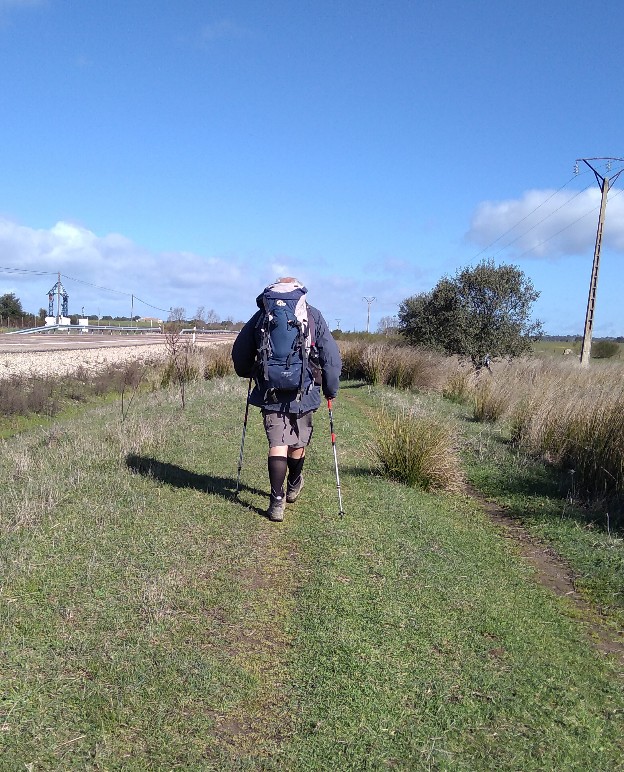


 Walking without a donkey