Walking Between Worlds – 3

The third and final part of a circular tour of Leith, starting at the North Leith Burial Ground.
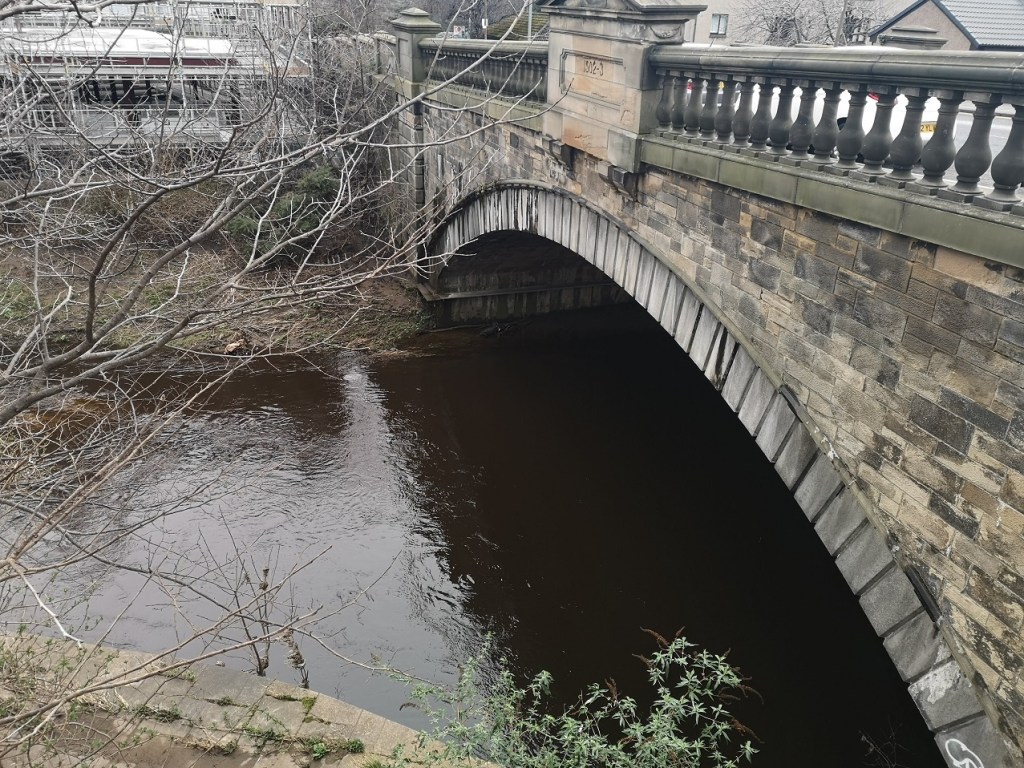
One of a flock of goosander on the water of Leith close by Coburg Street, Leith
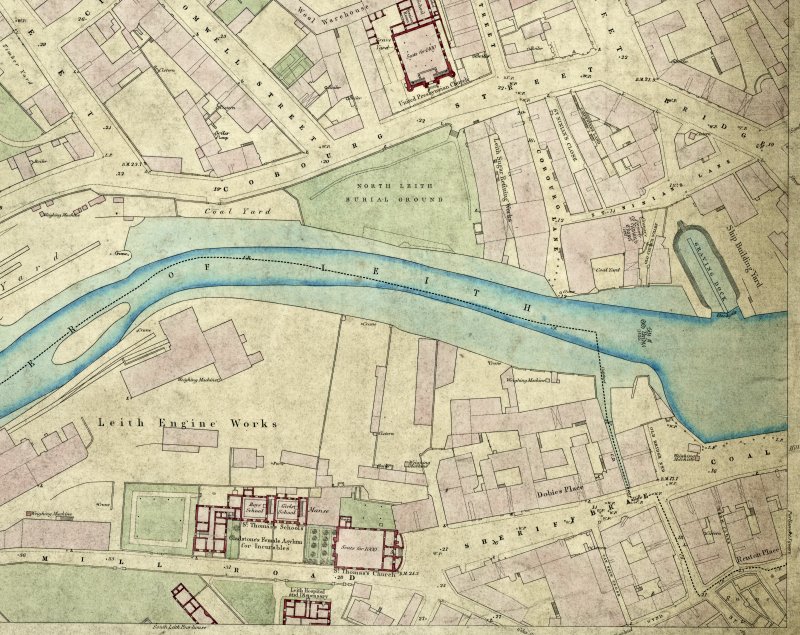
Old map showing St Ninian’s Chapel, Leith
Old St Ninian’s Chapel (1675) with a golden cockerel weather vane on the top of its Dutch-style steeple, Quayside Street, Leith, Scotland

Along the road and down to the right beside Coburg House artists studios (well worth a visit) is the gloriously orange, former St Ninian’s Chapel (you can see St Ninian himself (360 – 432 AD) carved onto the doors and representing the Picts, at St Andrew’s House (St Andrew’s Square) in the centre of Edinburgh.) St Ninian’s Chapel is a 15th century bridge chapel, part of the complicated history of North Leith Parish Church which can be found on Wikipedia.
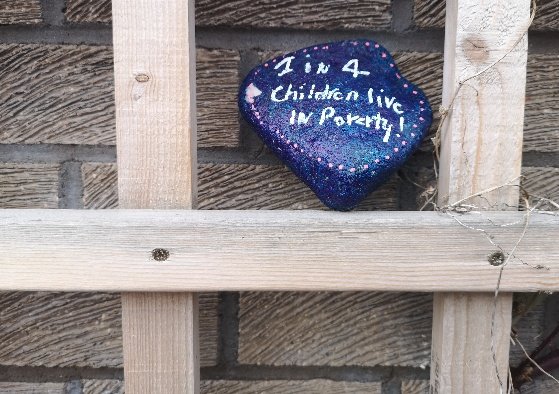
Back by the water, I spotted this little talisman when I did my rekkie, but it was gone when I visited there, later, with one of the groups. It reads, ‘1 in 4 children live in poverty’.

As we crossed Sandport Bridge, I drew attention to Broad Wynd on the left, where the Leith Dispensary and Humane Society hospital and clinic were first situated (of which, more later).
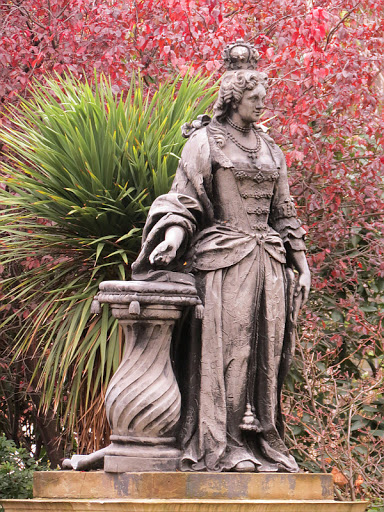
Queen Charlotte in Bloomsbury Square, London

Along Tolbooth Wynd we wandered, and on to Queen Charlotte Street, named after the Queen of Mecklenburg-Strelitz (1744-1818). She is remembered in Queens Square, Bloomsbury, London with a statue (see above). The Leith stories were starting to fit into themes: Charlotte was an immigrant and did not support slavery. Also a botanist, she founded Kew Gardens, was married to King George III, had fifteen (that’s 15!) children and was, famously, painted by Allan Ramsey 1762 when she was aged 17 years. She was an anti-slavery campaigner and that portrait is owned by the Scottish National Galleries. Recent articles have posed the question, ‘Is she of African origin?’

St Mary’s Chapel (1483) at South Leith Parish Church, not to be confused with St Mary’s Star of the Sea further down the road. Looking blue at dusk

At the Hideout Cafe (where I had a delicious and expensive hot chocolate on a previous occasion), we turned onto Constitution Street which was shut to traffic on account of the endless and frustrating tram works when I walked with the groups (so blessedly quiet to walk along) but is now open in all its splendour. Listen out for the dining of those tram bells announcing their arrival! We continued on, past St Mary’s Star of the Sea Catholic church, to the South Leith Parish Church and its graveyard.

St Mary’s Star of the Sea is the home of the missionary oblates

Hail, Queen of Heav'n, the ocean Star, 
Guide of the wand'rer here below!
Thrown on life's surge we claim thy care,⁠
Save us from peril and from woe.

Mother of Christ, Star of the sea,⁠ 
Pray for the wanderer, pray for me

Based on the anonymous Latin hymn, Ave Maris Stella
See how this woman is named a ‘relict’ of her husband, South Leith Parish Church, Scotland!

I spent some time researching the women in this kirkyard, trying to find out their stories, but to almost no avail. I focused on another Charlotte, Charlotte Lindesay (1780-1857, who died aged 77) and discovered that she was one of a brood of six from Feddinch in Fife, and that her parents were William Lindesay and Elizabeth Balfour. In 1805, she married her cousin, Patrick who was very active in the community. Amongst other things, he was the president of the Leith Dispensary and Humane Society (see above) which was formed in 1825 on Maritime Street, later to become Leith Hospital on Mill Lane, and brought healthcare (via a clinic and hospital both initially in Broad Wynd) to the poor.  I like to imagine Charlotte accompanying him, or even visiting the needy with a basket over her arm as portrayed in countless Jane Austen films, but I am woefully ill informed about her particulars.

Some of my information was gleaned from ‘The Jacobite Grenadier’ by Gavin Wood.
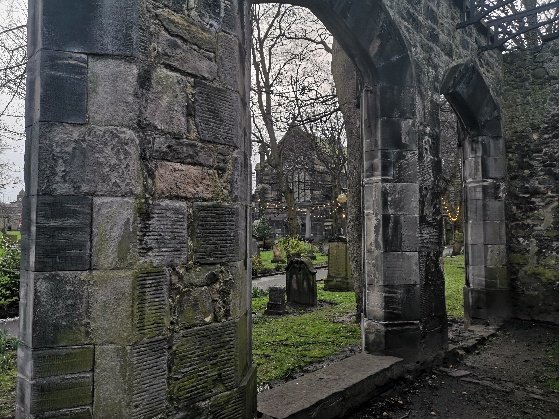
The South Leith Parish Church seen through a stone arch in its graveyard, Leith, Scotland

Incidentally, the Leith King James Hospital was demolished in 1822, and part of the wall can still be seen today, forming the boundary between the Kirkgate and the South Leith Kirkyard.
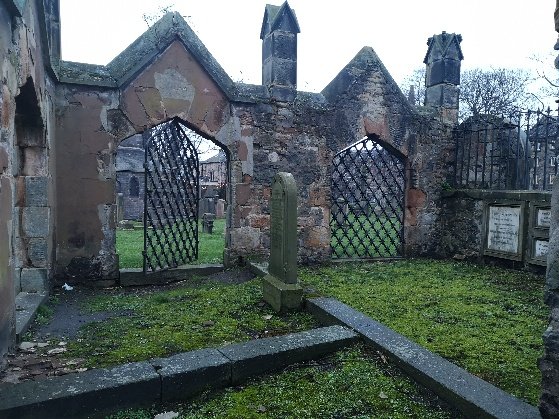
These iron gates (often seen in Edinburgh kirkyards – they swing on a central axis) protect the corpses, and predate 1832. We know this because it was the year of the Anatomy Act which allowed medical schools to legally acquire subjects for dissection and so there was no need to rob graves after that! South Leith Parish Church, Scotland

Some other women associated with this church

Mary of Guise (also called Mary of Lorraine), ruled Scotland as regent from 1554 until her death in 1560. A noblewoman from the Lotharingian House of Guise, which played a prominent role in 16th-century French politics, Mary became queen consort upon her marriage to King James V of Scotland in 1538. (Wikipedia). She worshipped at this church in 1559 and her coat of arms is displayed in the entrance today. Mary had fortified the town and she was in Leith being guarded by the thousands of French troops stationed there at the time.
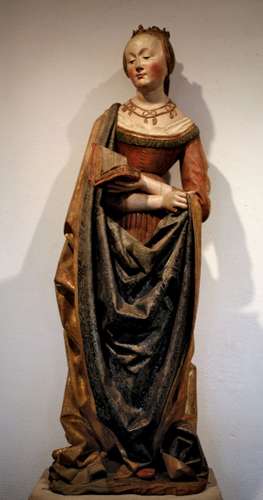
Saint Barbara, whose altar sits in South Leith Parish Church, Scotland

There is also an altar dedicated to St Barbara who, we are told, had a very sad and sorry life. She wanted to dedicate herself to Christ, instead of marrying the man her father wanted her to (Dioscorus, 7th century), and so she was tortured and her head was chopped off by said dad. He got his comeuppance, apparently, being struck by lightening and reduced to ashes. She is, therefore, invoked in thunderstorms, and is also the patroness of miners although I am not sure why. (From the Britannica and Archdiocese of St Andrews on facebook).
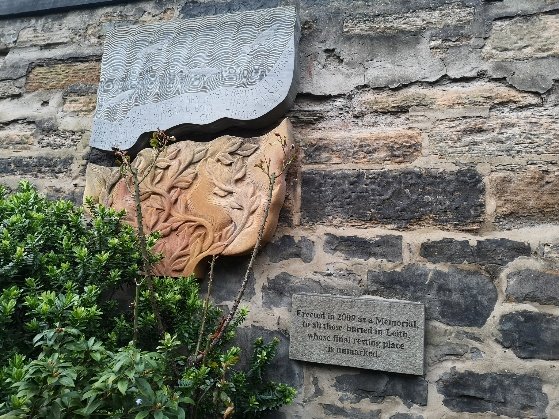
A beautiful clay memorial to those who were buried around the church, but in unmarked graves (2009), South Leith Parish Church, Scotland

When excavating for the trams, they found mass graves. There were 50 per cent more bodies of women than men, and everyone was smaller and showed signs of malnourishment compared to the national average. An exhibition and book were made and it was posited that their low weight had something to do with the plague and/or that they were from the workhouse.
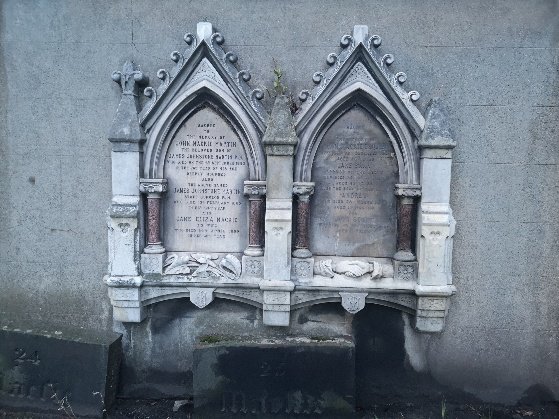
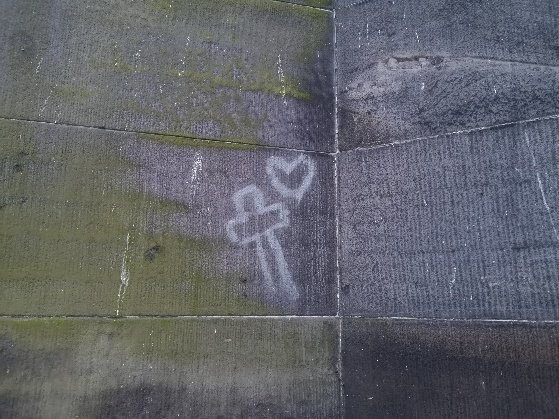
As a way of paying respect to the women whose names I discovered here, I read out a list of them to those I was walking with, together with their relationships, but omitted the names of their male relatives. I was attempting to recognise how many there were and about whom we know so little, as well as the manner in which they were remembered.

I have used the original spelling from the graves. They are referred to by their maiden names.

  • Elizabeth P. K. Smith Known as Betty by her friends
  • Helen their daughter whose dust reposes in the Church-yard of Thurso in Caithness being there suddenly cut off in the flower of her age
  • Elizabeth Maxwell, Maiden Lady Daughter of…who liv’d much esteem’d and Died regrated by all who had the Pleasure of her Aquaintance
  • Mary Jackson his Spoufe who departed this Life…much and juftly regrated, being poffeffed of the moft amiable accomplifhments…also near this lyes three of her Children who all dyed before herfelf
  • Ann McRuear Relick of…
  • Barbara Adamson, Spouse of…
  • In memory of his grandmother Mrs Ann Kerr… aged 76 years, His aunt Jean Tait.. aged 40 years, His mother Robina Tait… aged 44 years, His niece Jane Briggs Dickson …aged 33 months
  • Here lyth Jeane Bartleman Spouse to…
  • Sacred to the memory of Jessie Blacke..Beloved Wife of…Also of her infant baby…aged one month
  • Juliana Walker Wife of …. Janet Scott their third daughter of…
  • Catherine Stewart Rennie (wee Kitty daughter…)
  • Mary Finlay or Best …. And of her Grandchild Margaret Dick who after a few days illness … aged 18 years Let the Young Reflect on the Uncertainty of Human Life…
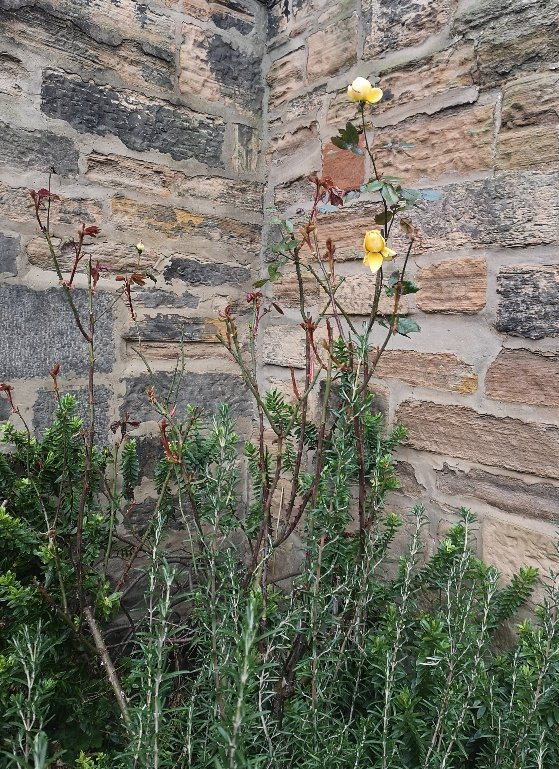
Rosemary for remembrance, South Leith Parish Church, Scotland
After paying our respects to a further queen: Victoria (see previous post), who sits, most regally, up high on her plinth outside Lloyd’s Pharmacy, we made our way up Leith Walk to Robbies.

Once in Robbies bar on the corner of Iona Street and Leith Walk, more or less opposite the start, I summed up the walk: It had taken us approximately 2.5 hours and we mused and meditated on boundaries and borders. We talked of the contrasts between one community of people and another and how often this causes stress at the join between areas (we were sitting close to the boundary between Leith and Edinburgh), about how we felt different at dusk and at dawn as we cross over from dark to light and vice versa, and whether we notice how we are on the cusp of the new moon. We spoke of women’s stories – in the past and now – and how they are so often seen through the lens of their menfolk and consequently hard to celebrate in their own right. And, finally we discussed the hardship of life in centuries gone by, especially how close death was, and about its symbols and community rites.

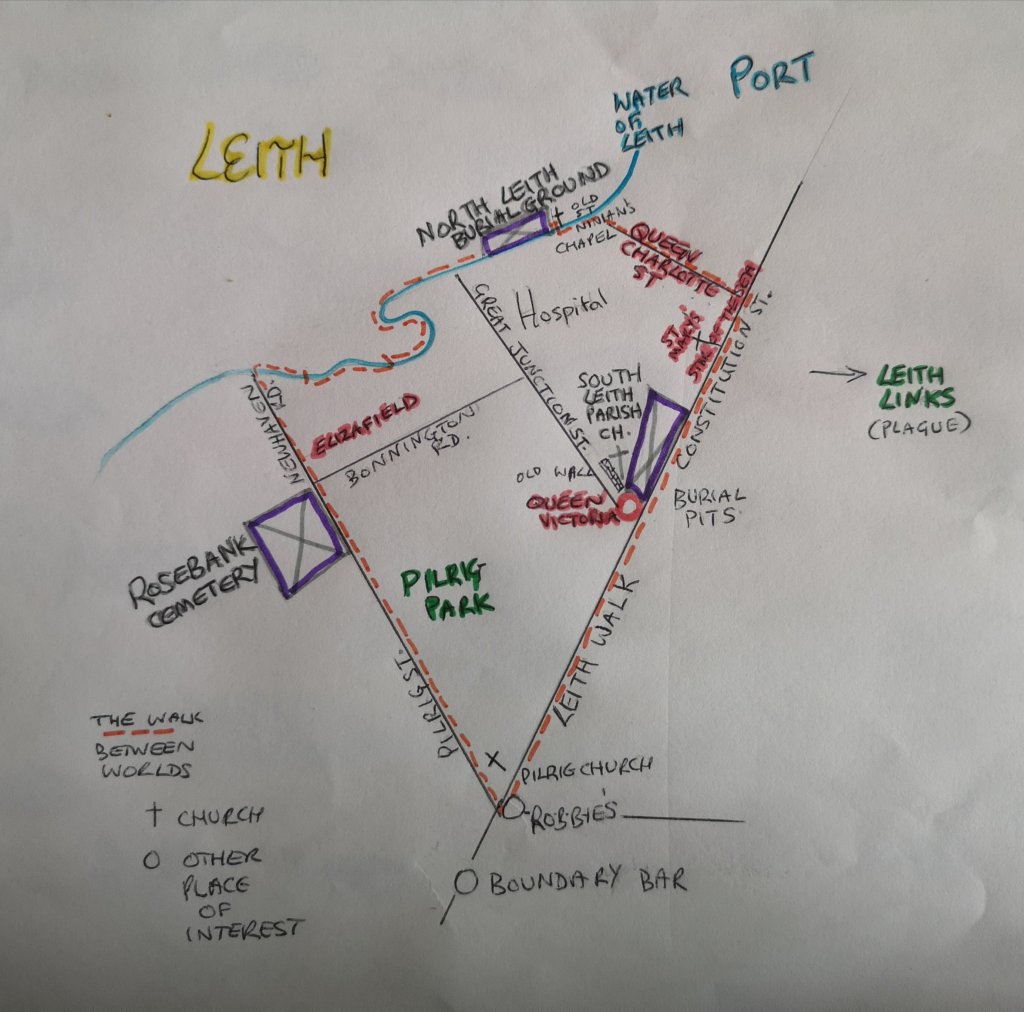
I explained that I hoped to make a map which somehow denotes and represents this event, that will contain some of its psychogeography. Wikipedia quotes Guy Debord on this: psychogeography is “the study of the precise laws and specific effects of the geographical environment, consciously organized or not, on the emotions and behavior of individuals.” I think of it as a human map, not simply one containing measurements and precise locations, but including feelings, activities and conversational responses as well.
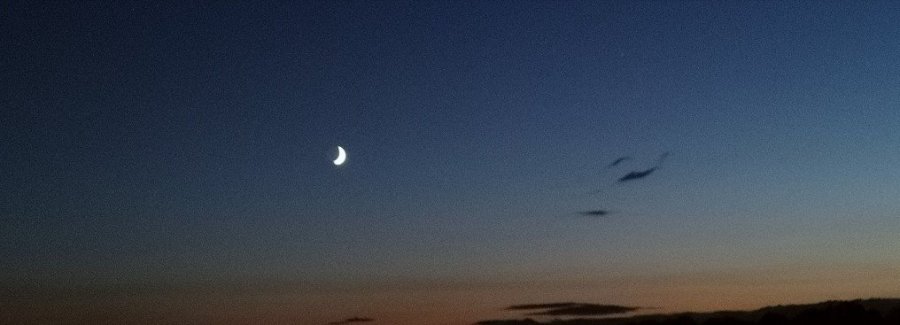
We walked together at the new moon, just over the border from one cycle to the next.

This was originally a series of guided walks, in-person ones (eg in celebration of the Terminalia Psychogeography Festival (23rd Feb, annually which happily coincided with the Women Who Walk Network and Audacious Women Festival (AWF)), and online during Covid. I would like to thank everyone who came along with me.

If you have information about the women who are featured in the walk, have made a similar walk, or would like to share anything about these subjects, please do so in the comments box below.

Walking Between Worlds – an introduction

Walking Between Worlds 1

Walking Between Worlds 2

For a lovely blog on Warriston Cemetery, see Edinburgh Drift
Walking Between Worlds – 2

An account of the second part of a circular tour of Leith beginning at Bonnington Toll.

Route Map
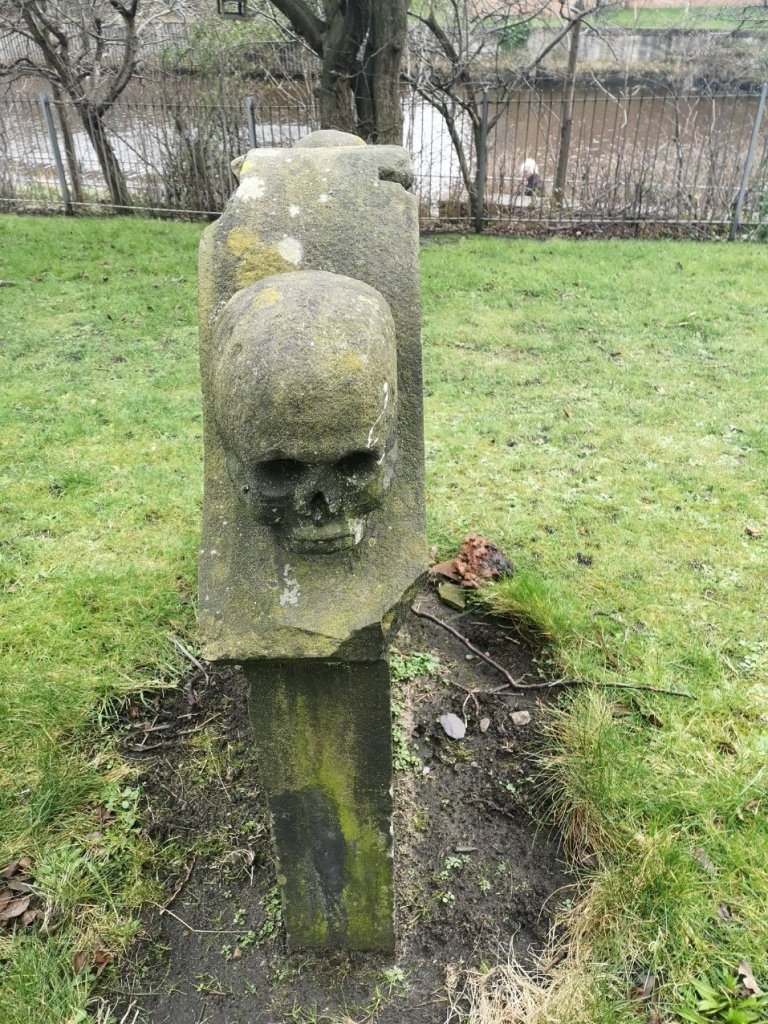
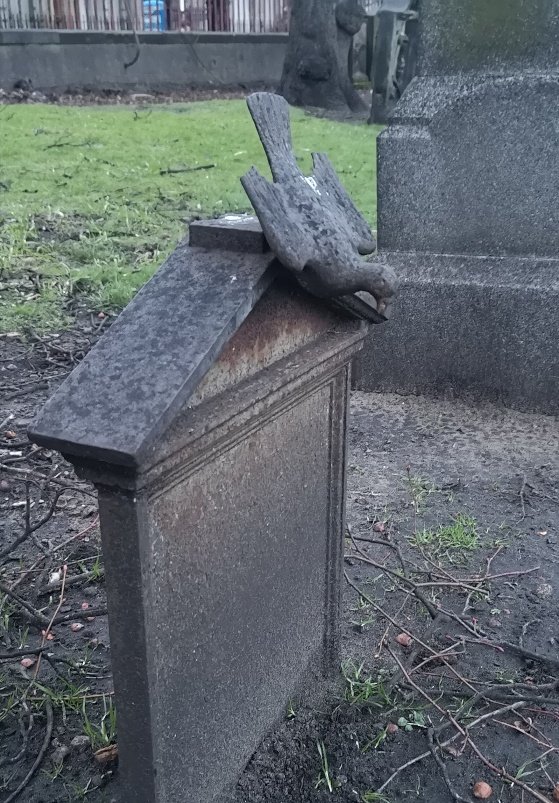
Graves often have angels or birds at their tops and a skull and cross bones at their base – symbolising that the body dies but the spirit soars to heaven in the Christian tradition. The way, according to the ancient Chinese, is not so very different. The soul has different aspects to it, two of which are the Po which goes down to the earth at death, and the Hun which rises out of the top of the head and joins our ancestors

Focus on women

I chose to focus on women’s stories during this walk, because, as a woman and a feminist, it is necessary to know about who came before me, I need to know my backstory. I find that it helps me sense my place in the continuum of the generations. Several of these walks took place at the same time as the Audacious Women Festival, whose byline is: ‘Do What You Always Wish You Dared’. I was involved in the 2019 Audacious Women Festival, sitting on a panel which looked at women who travel and move to different countries: how we support ourselves, make friends, manage the language difficulties and so on. That women-only event engendered a lively discussion with the audience, in which women of all ages shared their emigrant and immigrant experiences. My first guided walks was open to men and women, children and dogs, and it was something I was daring myself to do!

The tools of the leather workers’ trade on a grave stone in North Leith Burial ground, Edinburgh

Bonnington

After leaving the Rosebank Cemetery, we cross Bonnington Road, a toll road at the end of the 18th century. We enter into what would have been Bonnytoun (pretty village in Scots), encompassing mills and land which was part of the Barony of Broughton (mentioned in a Royal Charter 1143). Flanking both sides of the road are modern estates as well as the much older red stone Burns Tenements (on the right), which used to be the tannery. We were also going to be seeing the graves of leather workers with their pincer tongs and other tools adorning them in the North Leith Burial Ground, further along the way. Using the power of the Water of Leith, there was a conglomeration of businesses in the Bonnytoun area, and there is one existing mill wheel in the mill lade at Bonnyhaugh Cottages (on the left).

Who was Eliza?

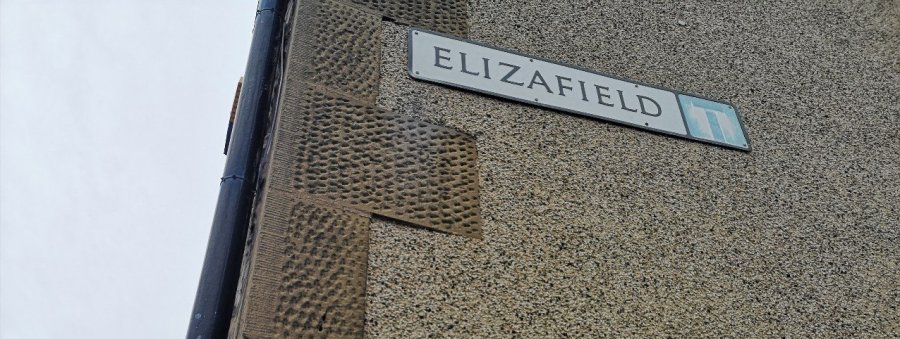
Second on the right is Elizafield, named after Eliza, a native of Leith, and the woman who bore Dr. Robert Grant. I have not been able to find out anything about her and her life. Her story has disappeared, perhaps deemed less important than his despite the fact that he would not exist if it weren’t for her, not least because birthing was such a dangerous task in the 1780’s. Grant was a surgeon and left Leith in his twenties to settle, very successfully, in South Carolina (US) marrying Sarah Foxworth. The rice plantation he established in Georgia (US) was also named Elizafield, and, as was the way then, it only drew the produce and profits it did, due to the female and male slaves who carried out the work: they were, ‘the driving force behind the success of the plantation’. (Amy Hedrick, author on glynngen.com)

Historically it [birth] was thoroughly natural, wholly unmedical, and gravely dangerous. Only from the early eighteenth century did doctors begin getting seriously involved, with obstetrics becoming a medically respectable specialty and a rash of new hospitals being built. Unfortunately, the impact of both was bad. Puerperal, or childbed, fever was a mystery, but both doctors and hospitals made it worse. Wherever the medical men went the disease grew more common, and in their hospitals it was commonest of all.

Druin Burch (2009) https://www.livescience.com/3210-childbirth-natural-deadly.html

We turn our backs on Elizafield to view Flaxmill Place. Flax was used to make linen, most of which was exported. It was so successful (employing 10000-12000 workers, many of whom would have been women, although the data is unavailable), that we know the Mills were able to loan Edinburgh Council a great deal of money. The Bonnington Mills, on the banks of the Water of Leith, made woollen cloth as well as linen and much of the wool was produced by women in their own homes nearby. The owners were always aiming to improve profits and cut corners, which resulted in the controversial introduction of Flemish and French workers (accommodated at Little Picardy(ie), the current Picardy Place). The women and girls spun the cambric yarn (for the close-woven, light type of linen), to try and improve the quality of the cloth, but this took away the local jobs.  

Persevere – representing Leith

In 1686, the first Parliament of James VII passed an ‘Act for Burying in Scots Linen’, the object of which was to keep the cloth in the country. It was enacted that, “hereafter no corpse of any persons whatsoever shall be buried in any shirt, sheet, or anything else except in plain linen, or cloth of hards, made and spun within the kingdom, without lace or point.” Heavy penalties were attached to breaches of the Act, and it was made the duty of the parish minister to receive, record and produce certificates of the fact that all bodies were buried as directed. On hearing this, we can imagine that the women in the graves we were visiting may have been bound in just such a linen shroud, made right in this place.

Women at work at the Burton’s Biscuit Factory, near Bonnington, Edinburgh

Before the Industrial Revolution, hand spinning had been a widespread female employment. It could take as many as ten spinners to provide one hand-loom weaver with yarn, and men did not spin, so most of the workers in the textile industry were women. The new textile machines of the Industrial Revolution changed that. Wages for hand-spinning fell, and many rural women who had previously spun found themselves unemployed. In a few locations, new cottage industries such as straw-plaiting and lace-making grew and took the place of spinning, but in other locations women remained unemployed.

Joyce Burnett (2008) This webpage has some fascinating pictures of women spinning at home and in the factory

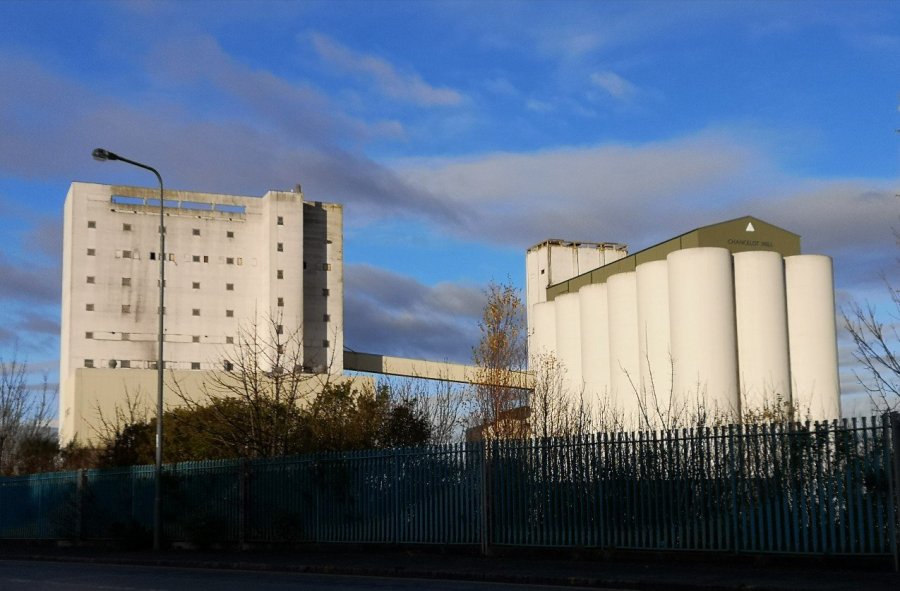
The current Chancelot Mill on Lindsay Road, Edinburgh, Scotland

A little further up the road is the original site of the Chancellot Mill (now on Lindsay Place) and this was where corn was ground into flour (perhaps the reason for those corn cobs on the Persevere flag?) It was steam powered and had an 185 foot high clock tower. Producing 43 sacks an hour (twice the original prediction), it was described as ‘the most handsome flour mill in the world’!

Site of The Bonnington pub, now destroyed several times over, Newhaven Road, Edinburgh

Urban myth

They were growing cannabis in the basement of The Bonnington and it spontaneously combusted in the middle of the night, causing the whole building to burn down. True or false?

We then started to walk along the edge of a section of the Water of Leith, the border between land and liquid. Bonnington Bridge, Newhaven Road, Edinburgh

Water of Leith

I invite you to look into the water here and think of the phrase ‘time immemorial’. Legally, this refers to the years before 1189, being the date set, in 1275, as the time before which no one could remember, and therefore no legal cases could deal with events before that date. ‘Time out of mind,’ recorded from the fifteenth century, is just the plain English version of the same thing. My information came from here and here.

As we cross Anderson Place, this quote from the Tao Te Ching is one to ponder: “The Master gives herself up to whatever the moment brings. She knows that she is going to die, and she has nothing left to hold on to: no illusions in her mind, no resistances in her body. She doesn’t think about her actions; they flow from the core of her being. She holds nothing back from life; therefore she is ready for death, as a woman is ready for sleep after a good day’s work.” (50)

North Leith Burial Ground

After rounding the corner of the Water of Leith and meeting the confluence of the wonderful network of Edinburgh cycle paths, we mount the steps onto Coburg Street where the North Leith Burial Ground is situated. According to The Spirit of Leithers (a Facebook Group) it is ‘The dead centre of Leith’!

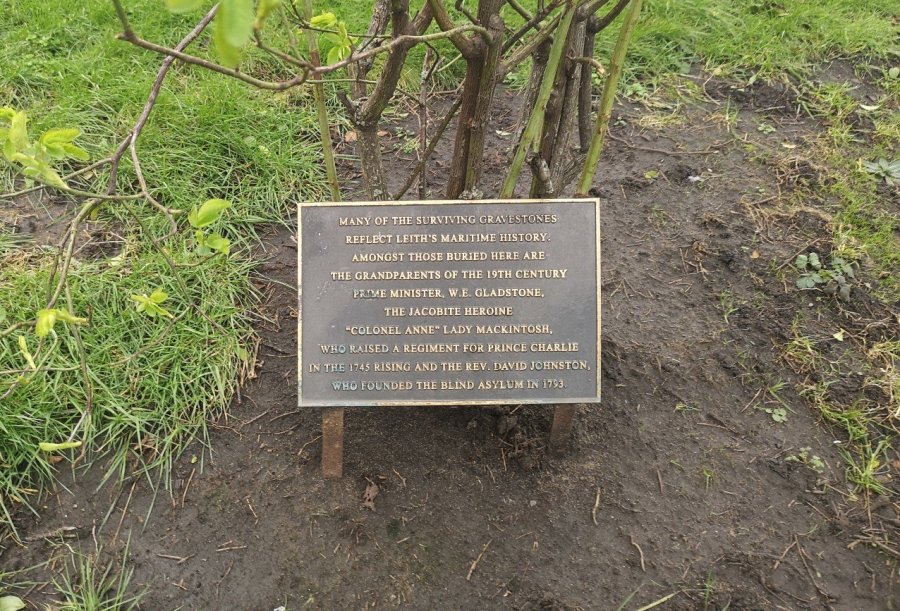
Here is the plaque saying that Lady Mackinstosh is under this ground, but is she?

The memorial stones are old (1664 – 1820) and varied. There are grand mausoleums, individual slabs – some half buried and unintelligible – and almost all have engravings worth seeing. This is a good time for a ‘treasure hunt’: search for the grave of Lady Mackintosh; a long bone; angels; and hourglasses (note: some are on their sides and others upstanding, the sands of time sifting down through the narrow neck as life passes by).

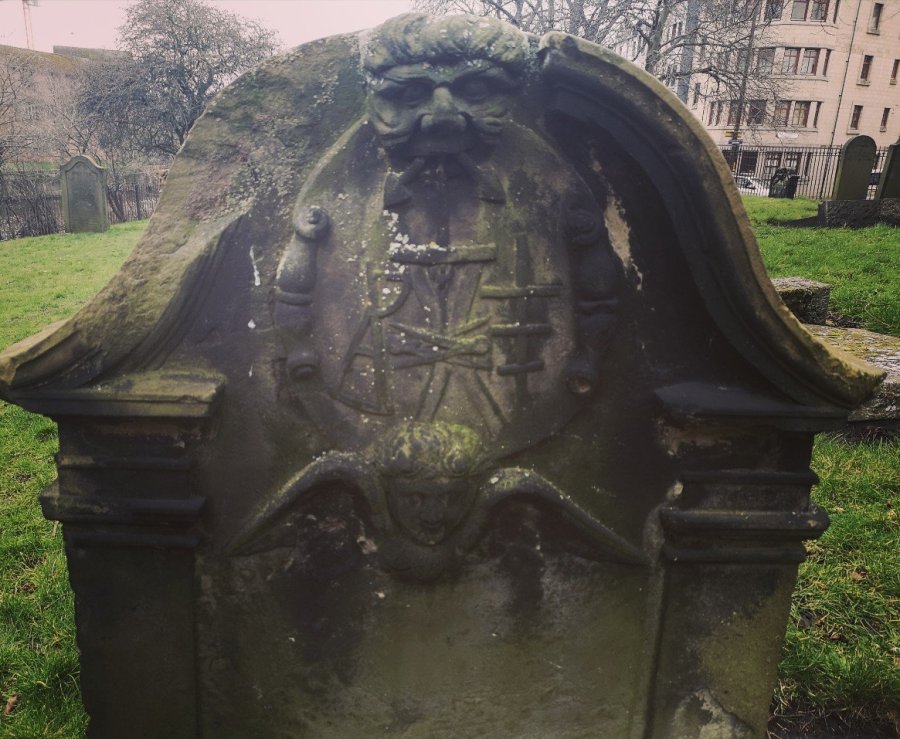
The graves are thicker than usual, and this one has a skeleton head on one edge and an angel’s head on the other – death and life, North Leith Burial Ground, Leith
Angel and skull, North Leith Burial Ground, Leith, Scotland

Lady Mackintosh is famous for raising a regiment for Prince Charlie’s 1745 uprising (variously known as the Jacobite, the ’45 rebellion or the ’45). It was an attempt by Charles Edward Stuart to regain the British throne for his father, James Francis Edward Stuart. 

In fact Lady Mackintosh is not here – she probably lies under the flats next door! How many people know that they are working or living over the top of dead bodies?

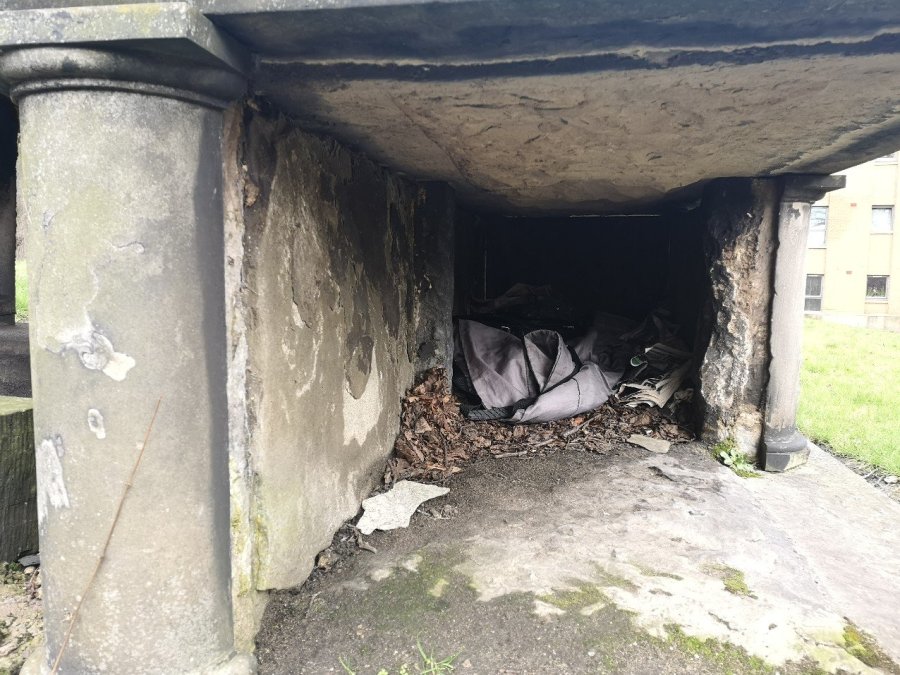
Sadly, it looked as if this was someone’s more contemporary (and probably rather cold) resting place. There are many homeless people who seek shelter in Edinburgh’s graveyards. North Leith Burial Ground, Coburg Street

This was originally a series of guided walks, in-person ones (eg in celebration of the Terminalia Psychogeography Festival (23rd Feb, annually which happily coincided with the Women Who Walk Network and Audacious Women Festival (AWF)), and online during Covid. I would like to thank everyone who came along with me.

Previous: Introduction to walking Between Worlds and Walking Between Worlds 1 

The walk continues in the final blog of the series, Walking Between Worlds – 3

If you have information about the women who are featured in the walk, have made a similar walk, or would like to share anything about these subjects, please do so in the comments box below.