A community walk from the Granton:hub, Madelvic House w3w: wished.visit.silver
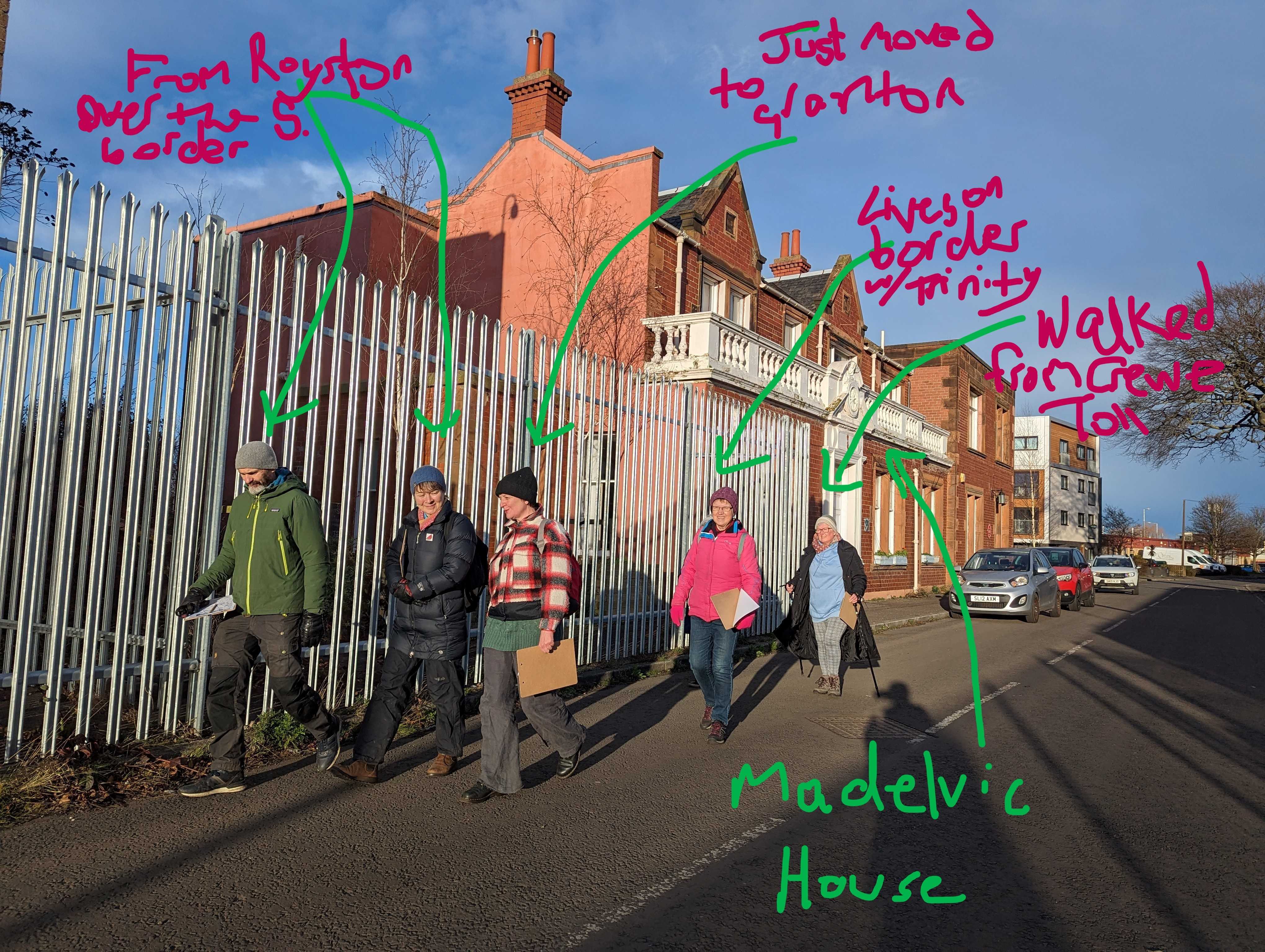
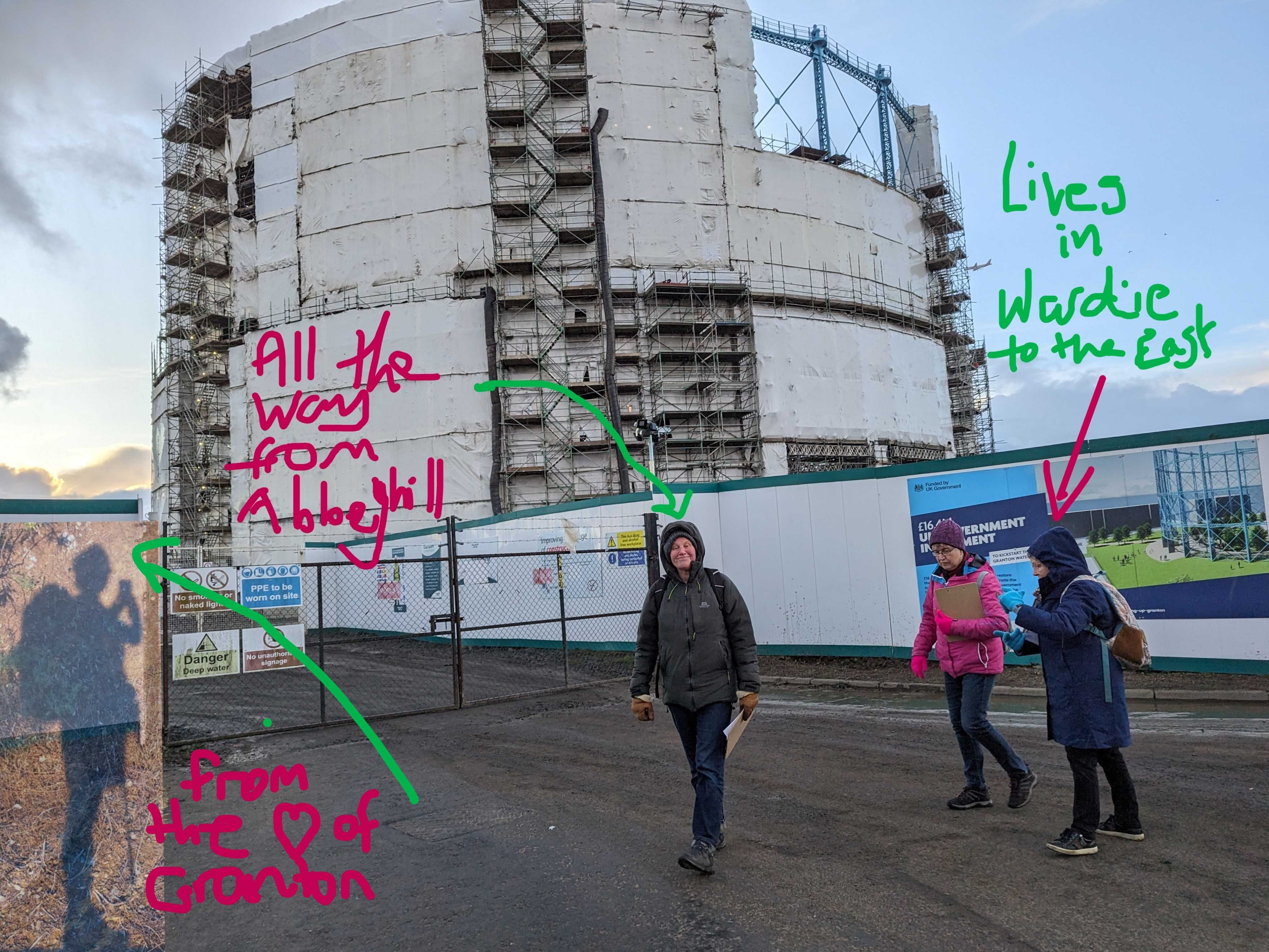
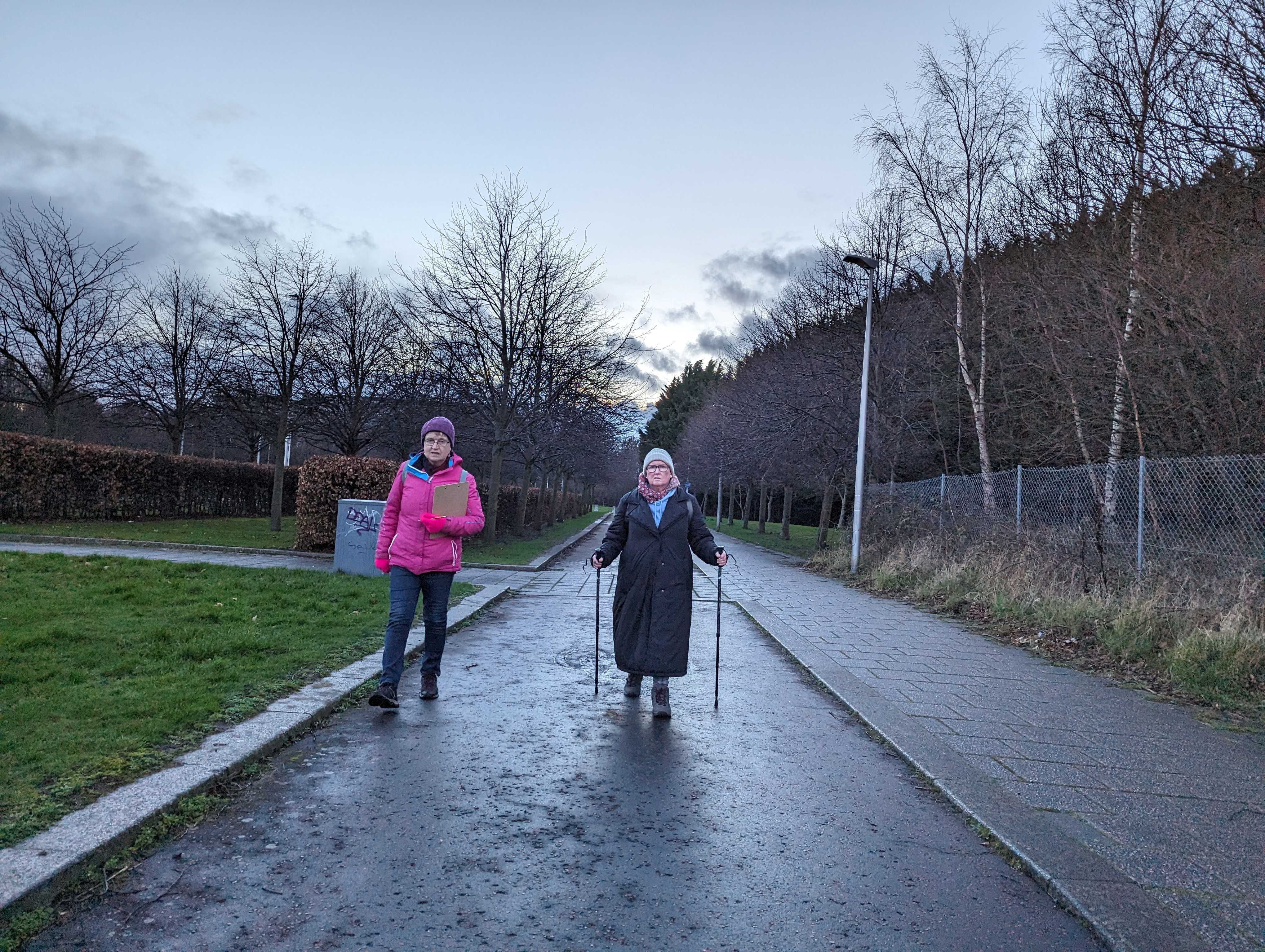
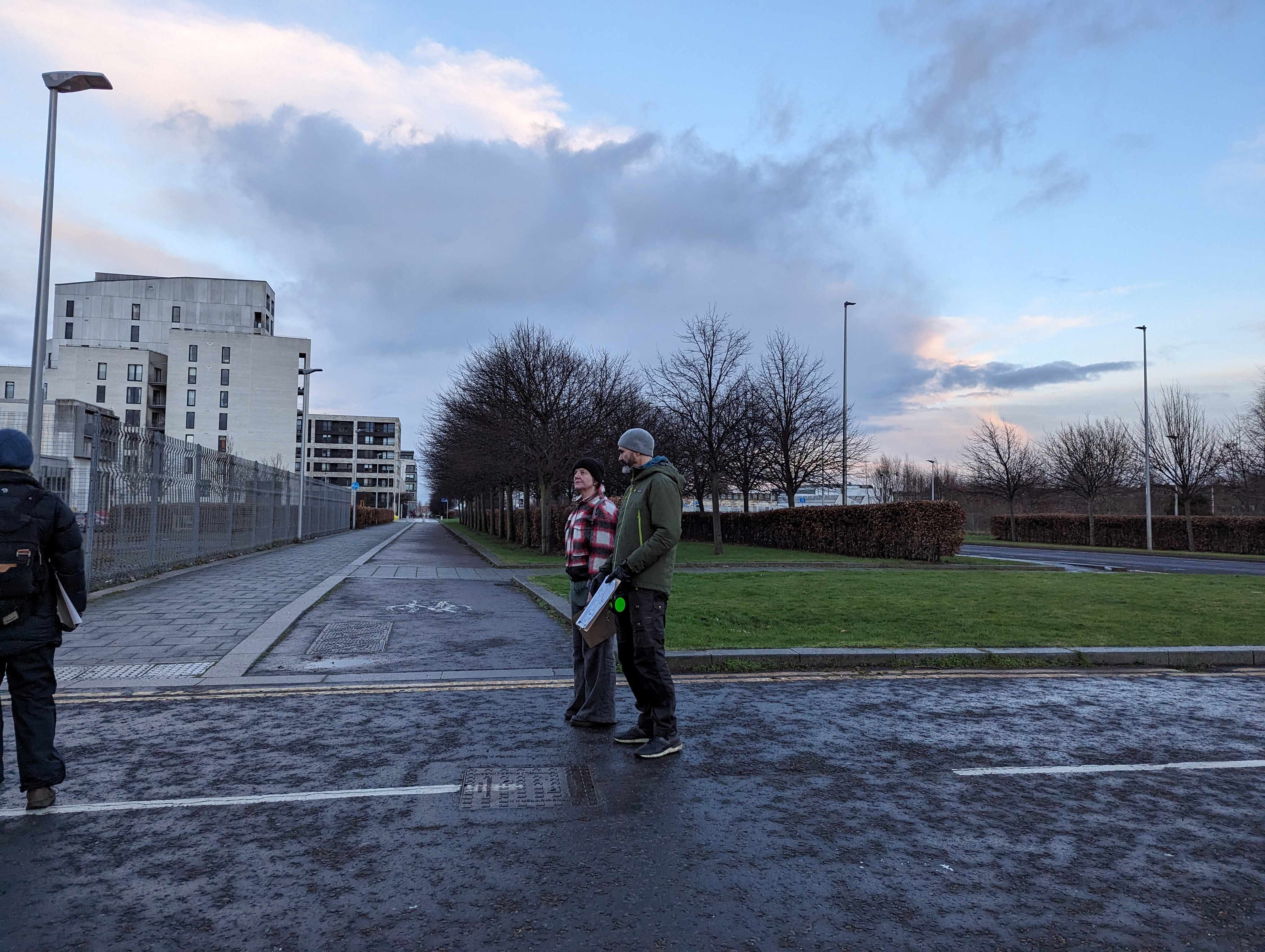
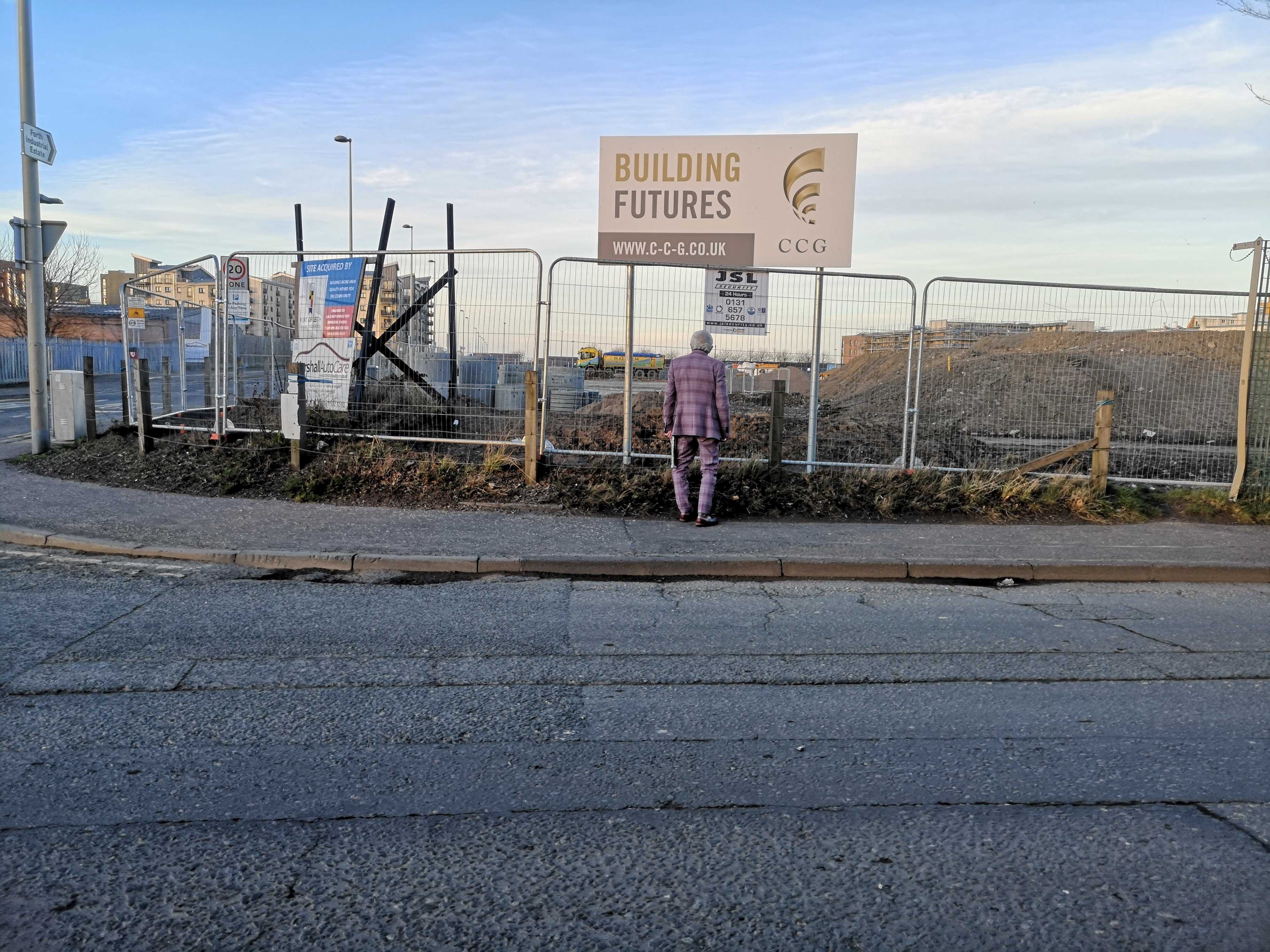
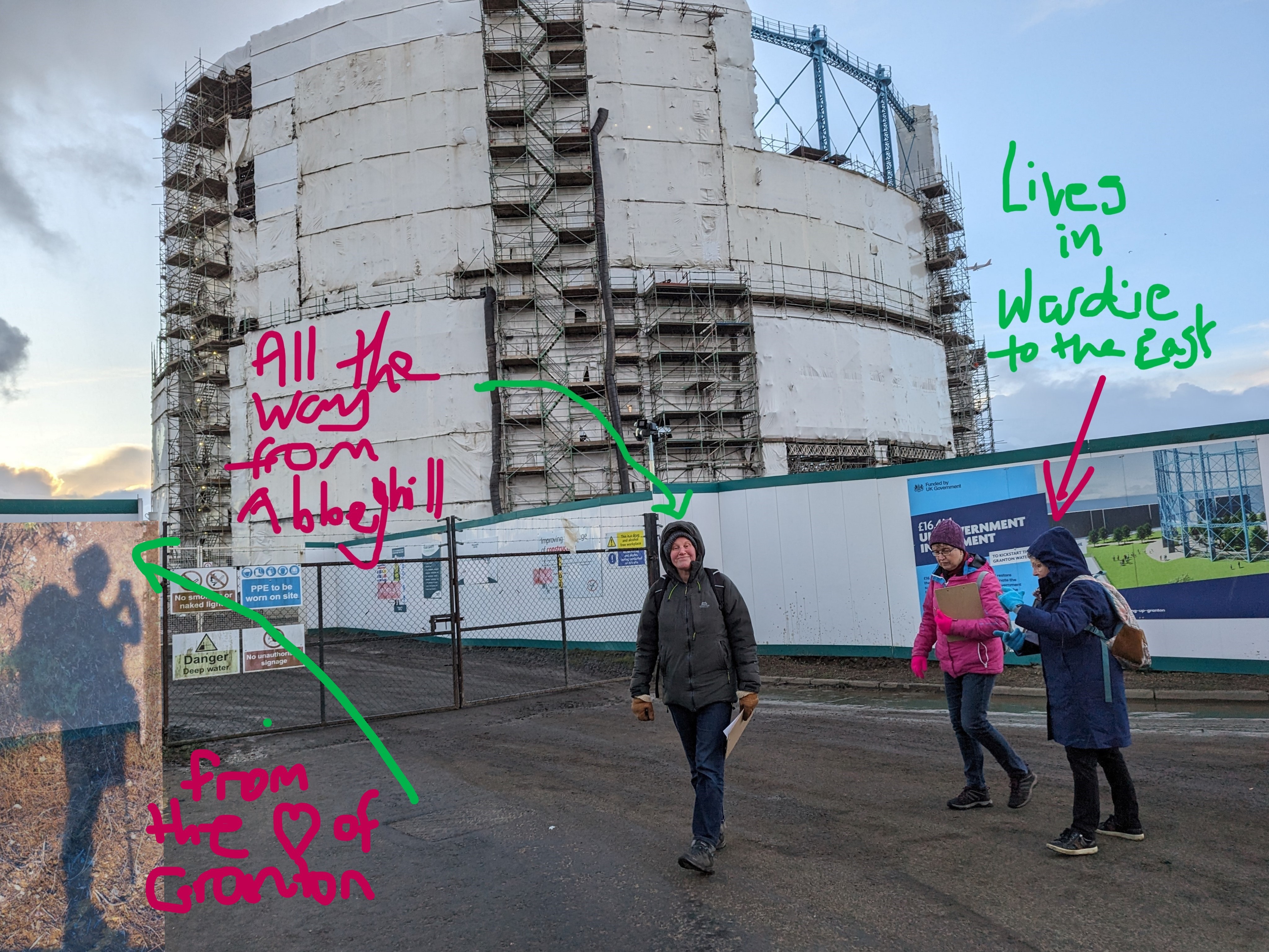
Captions for the images above: Left – The group, some from inside, some outside the Granton Boundary; Right – The group, checking out the wrapped-up Granton Gasholder, building site for new housing
At the edges of pavements, the walls of dilapidated buildings, the join between the land and the sea, and between homed and homeless, we wandered to mark the Festival of Terminalia on 23 February 2024.
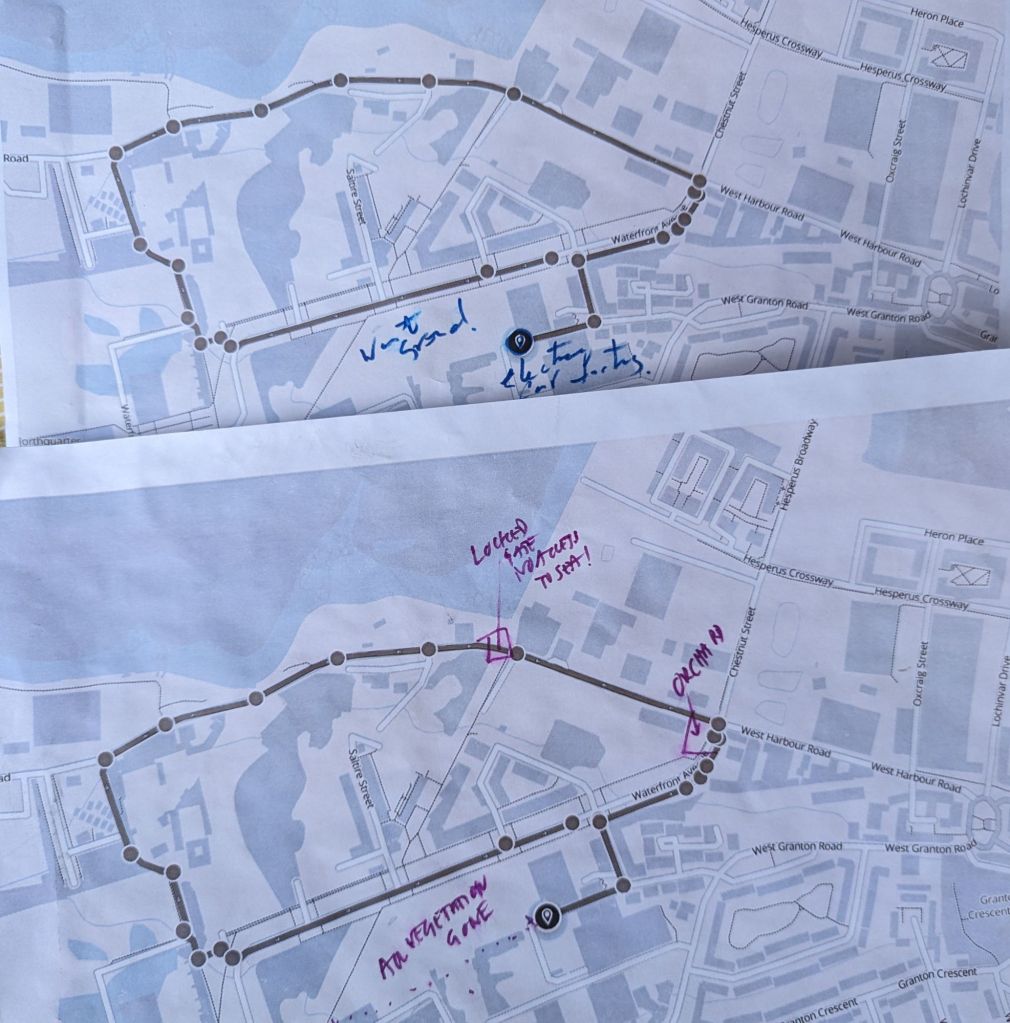
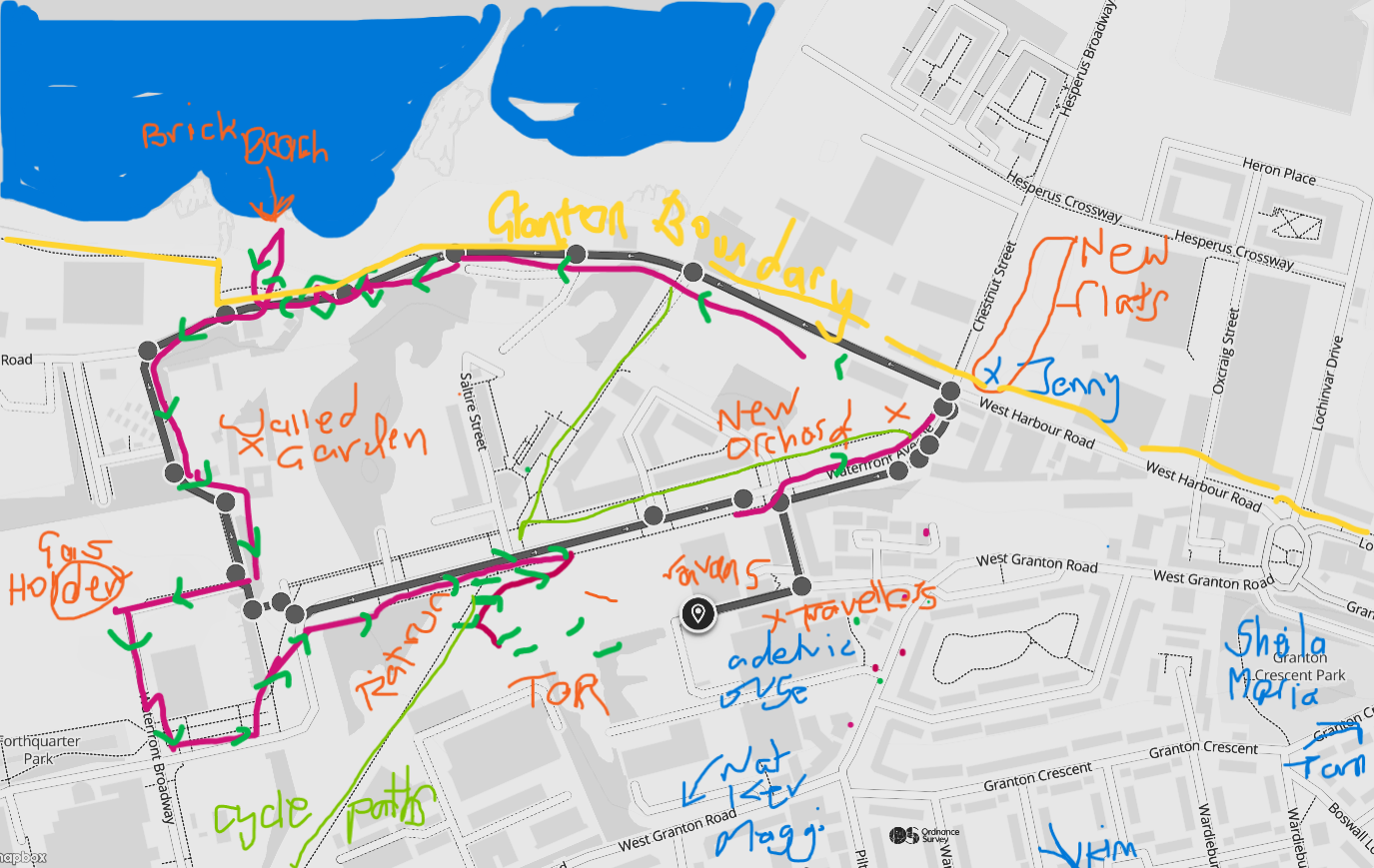
Maps annotated by group members
We walked a route familiar to some and unfamiliar to others, according to a path previously visited 4 months earlier in order to make comparisons. Mapping as we went, we strayed off that path occasionally, moved across the boundary several times when the sea or a plant drew us, and noted changes wrought in the natural and urban landscape over such a short time.
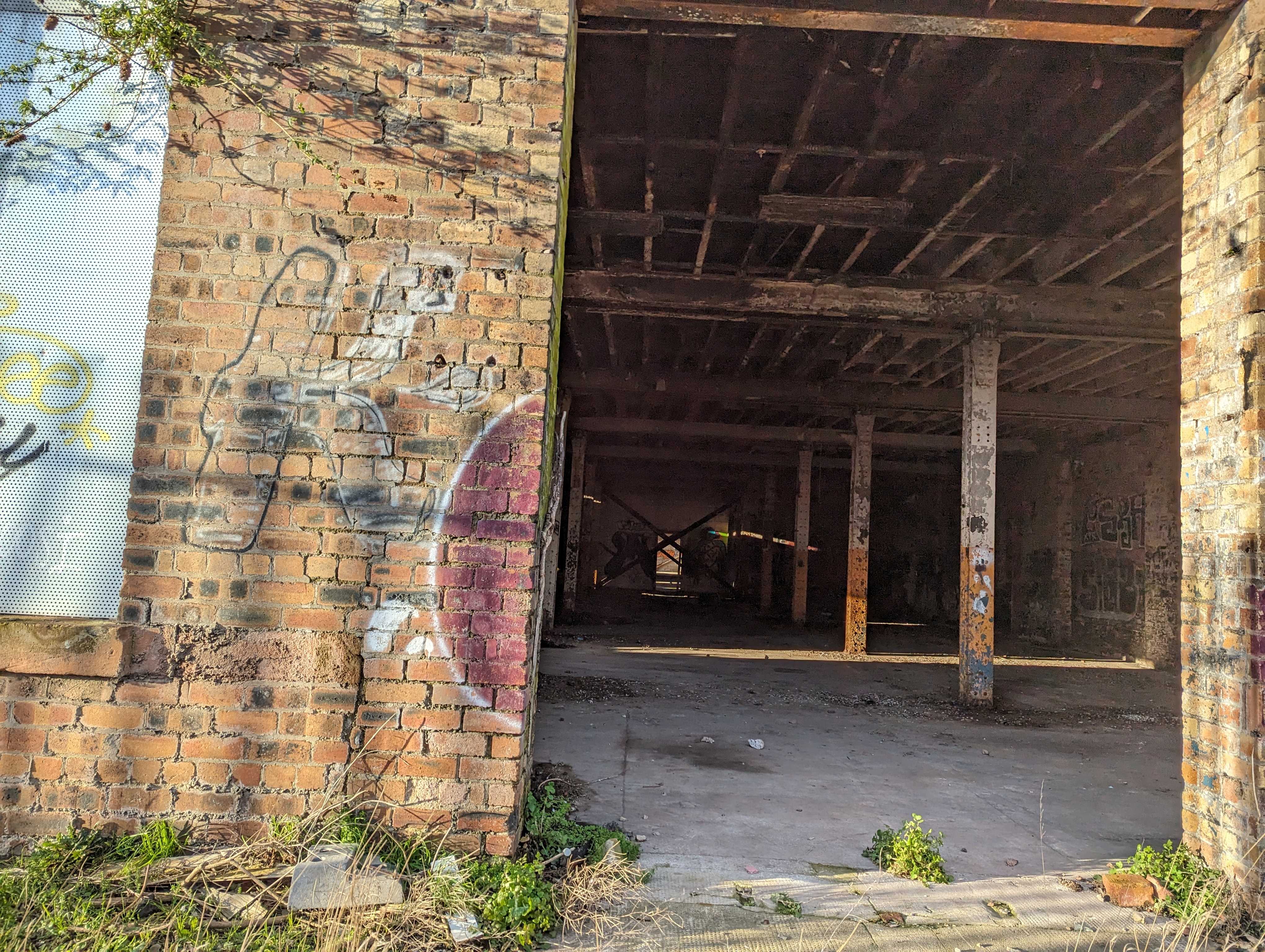
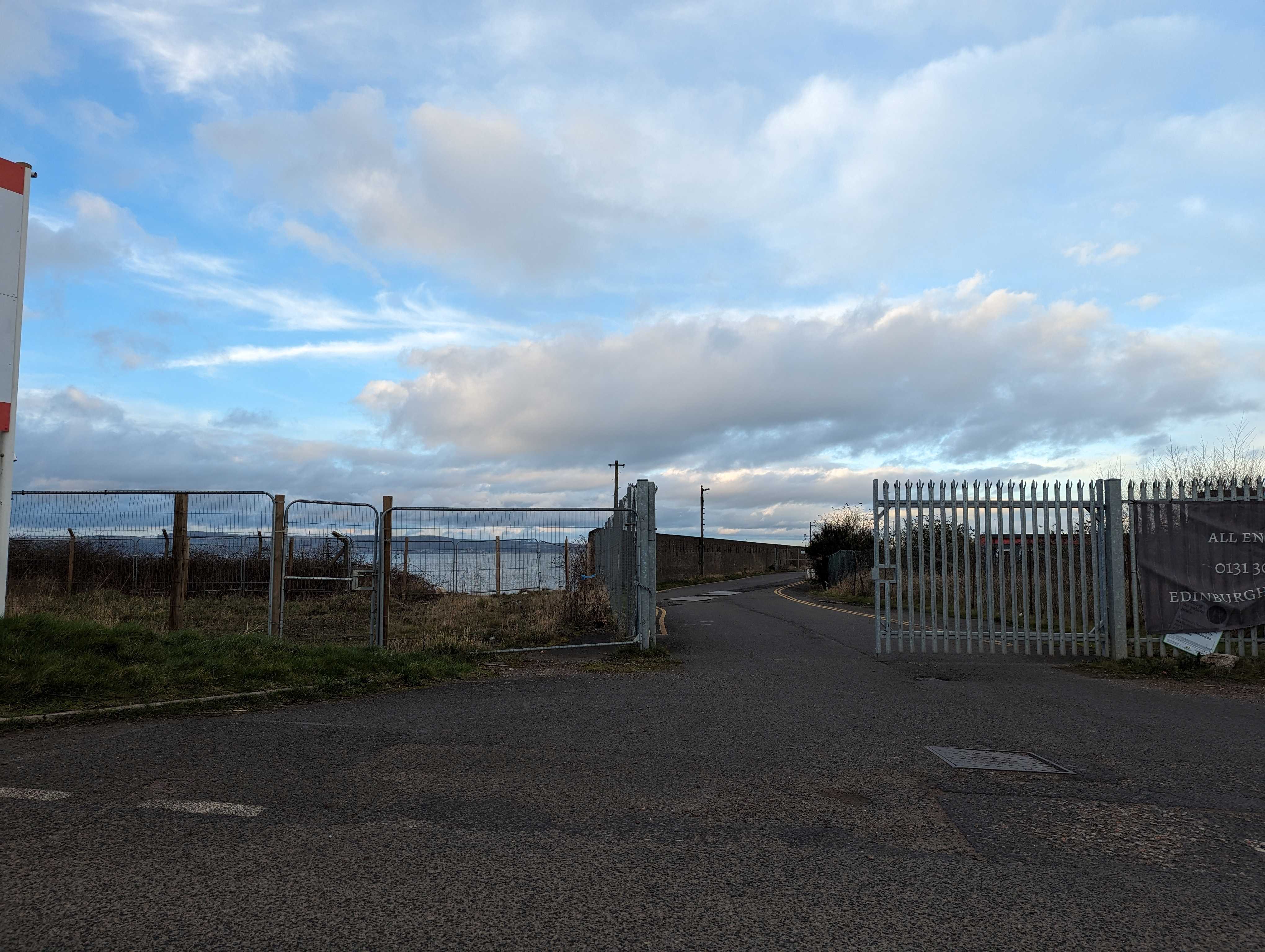
Captions for above photos: Left – Electric Car Factory. Planning permission has been gained for housing. Middle – Where Granton Harbour meets the Brick (Granton or Royston) Beach at the Western Breakwater. Right – Sheila and Margaret.
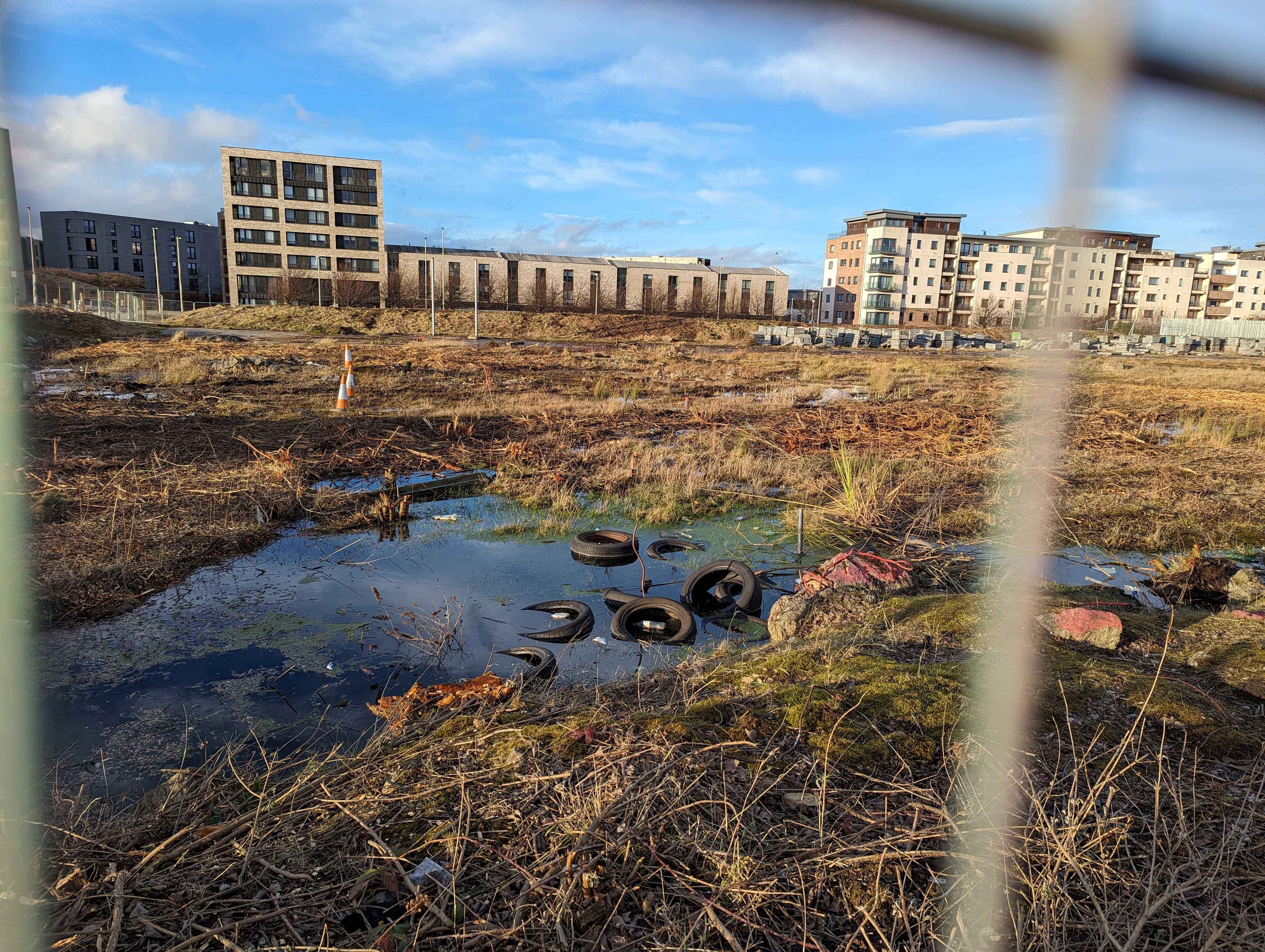
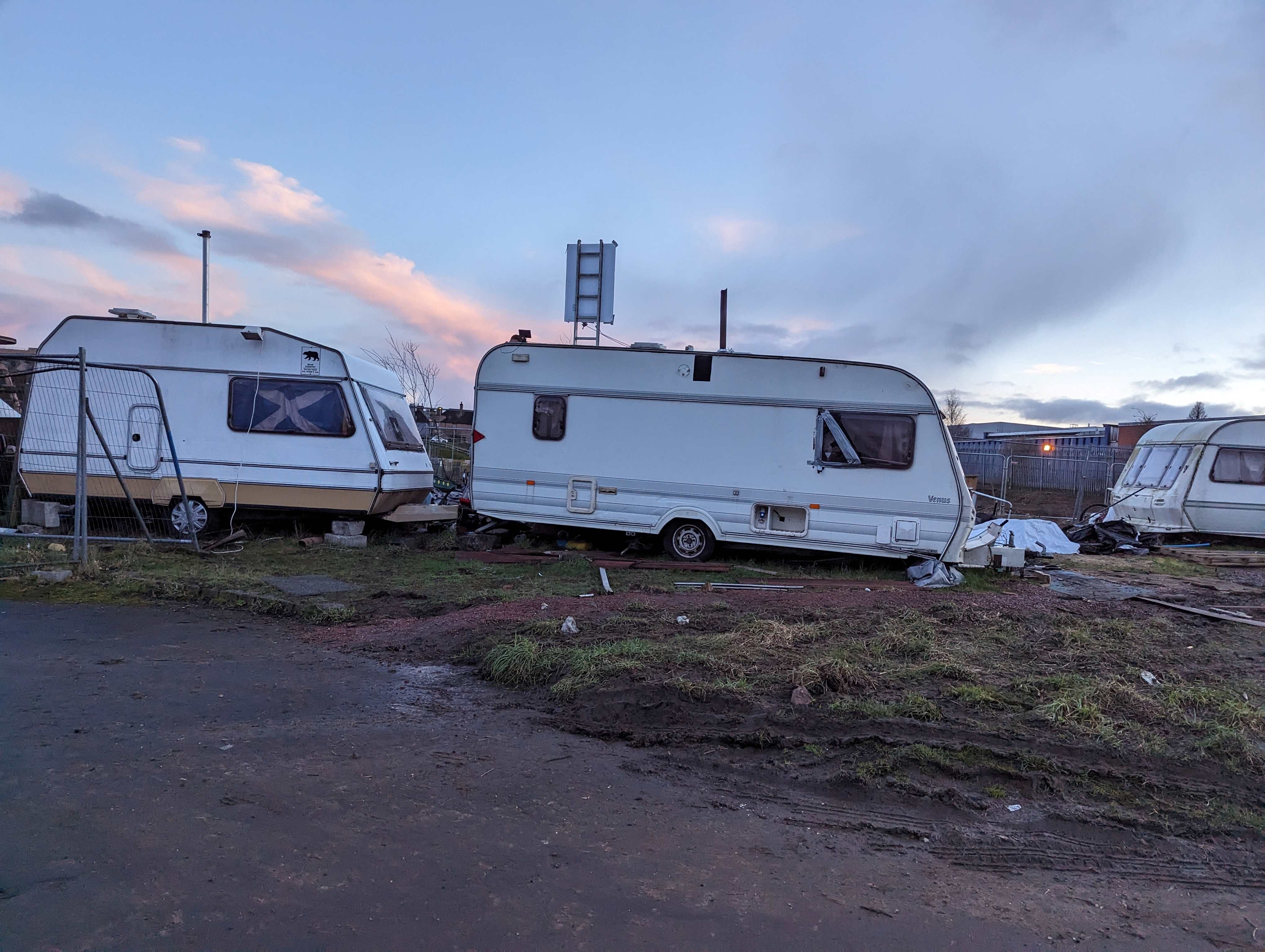
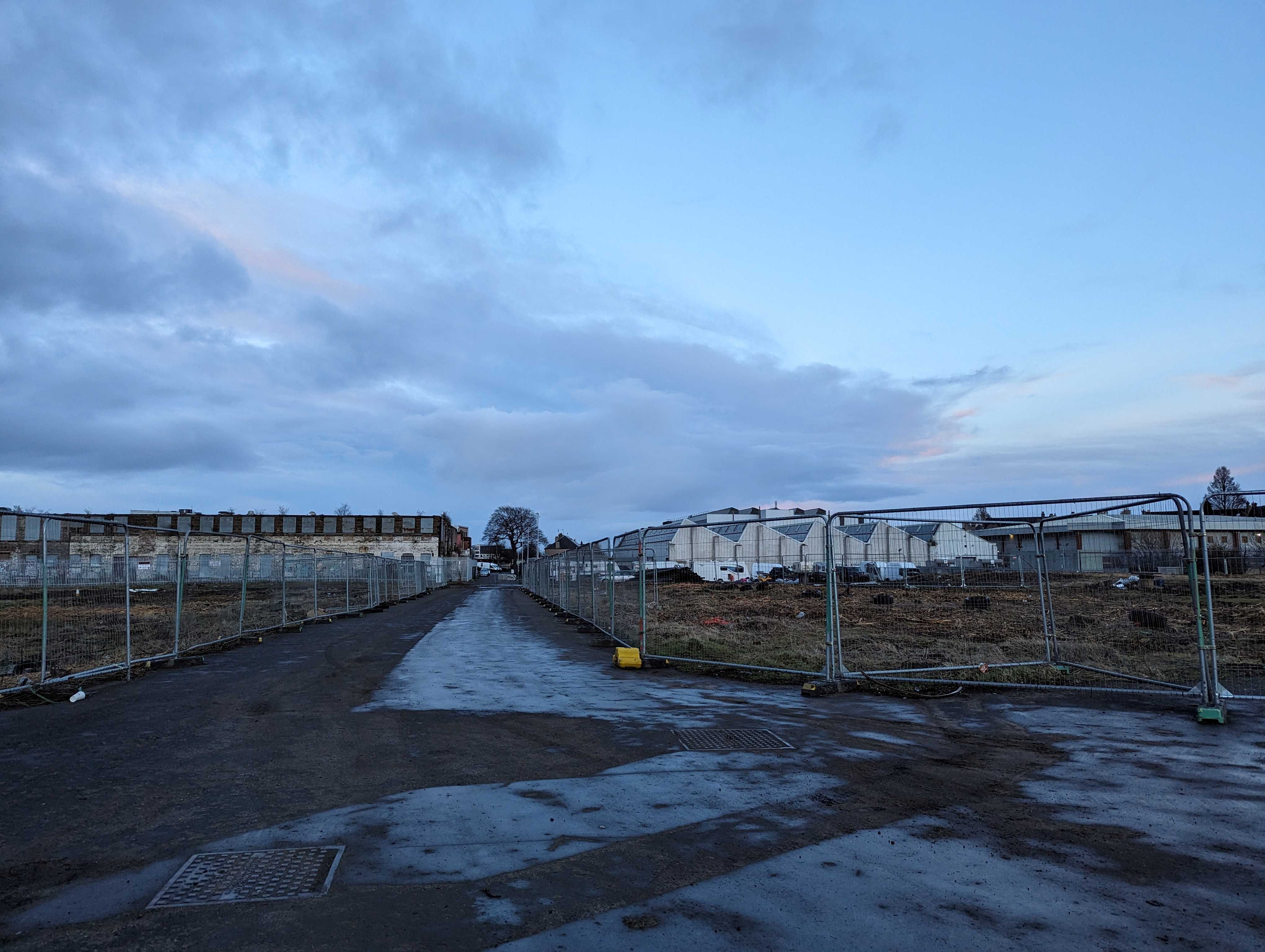
Leaving the Granton:hub / Madelvic House, we started off through the wasteland area behind, past the old Electric Car Factory which was, unusually, open. We passed the travellers’ community who were building a big fire of tyres and other rubbish; the caravans housing the community which has found its way here in 1s and 2s over the last 5 years (maybe), surrounded by dismembered trees; a couple of renegade trailers where men were working – one a local barber who was known to one of our party so we stopped for a chat – between fences newly erected and ground scraped clear of its soil.
Nat pointed out the copse of silver birch which have been cordoned off for keeping, the result of our extensive lobbying of the developers. Here, an art repository is planned by the National Galleries of Scotland, way down the line. It was also the site of our community orchard (at the Tor), once upon a time.
Captions for above photos: Wasteland area behind Madelvic House where people and more-than-humans live, soon to be developed into an Arts Centre
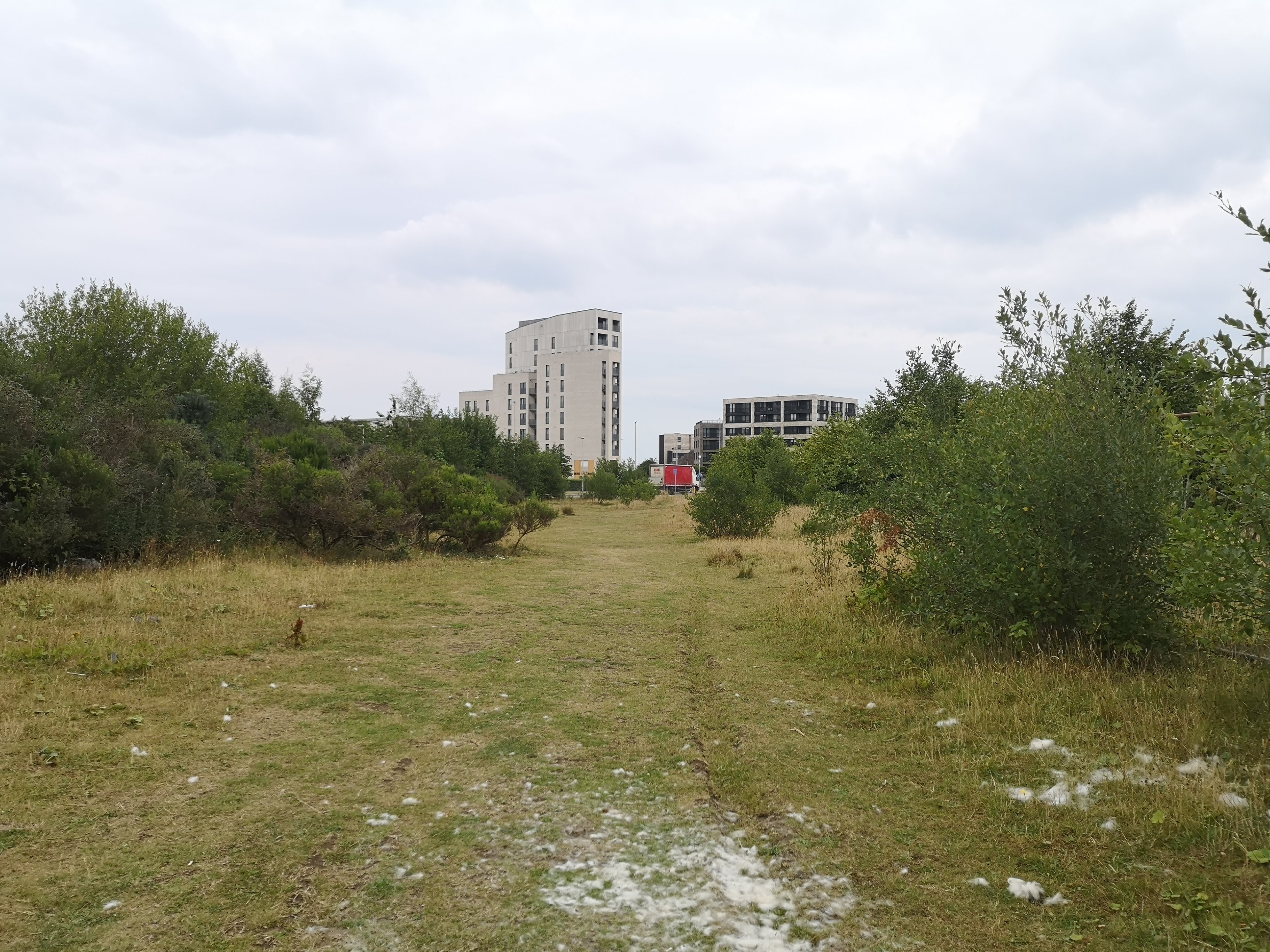
We skirted ‘The Rabbit Run’ closely bordered by towering new blocks and also threatened to be raised to the ground, and turned down towards the sea along Waterfront Avenue – created, named and planned to be this wide, so we are told, to accommodate the trams, though there is, thankfully, no sign of them as yet.
Waterfront AvenueRabbit Run
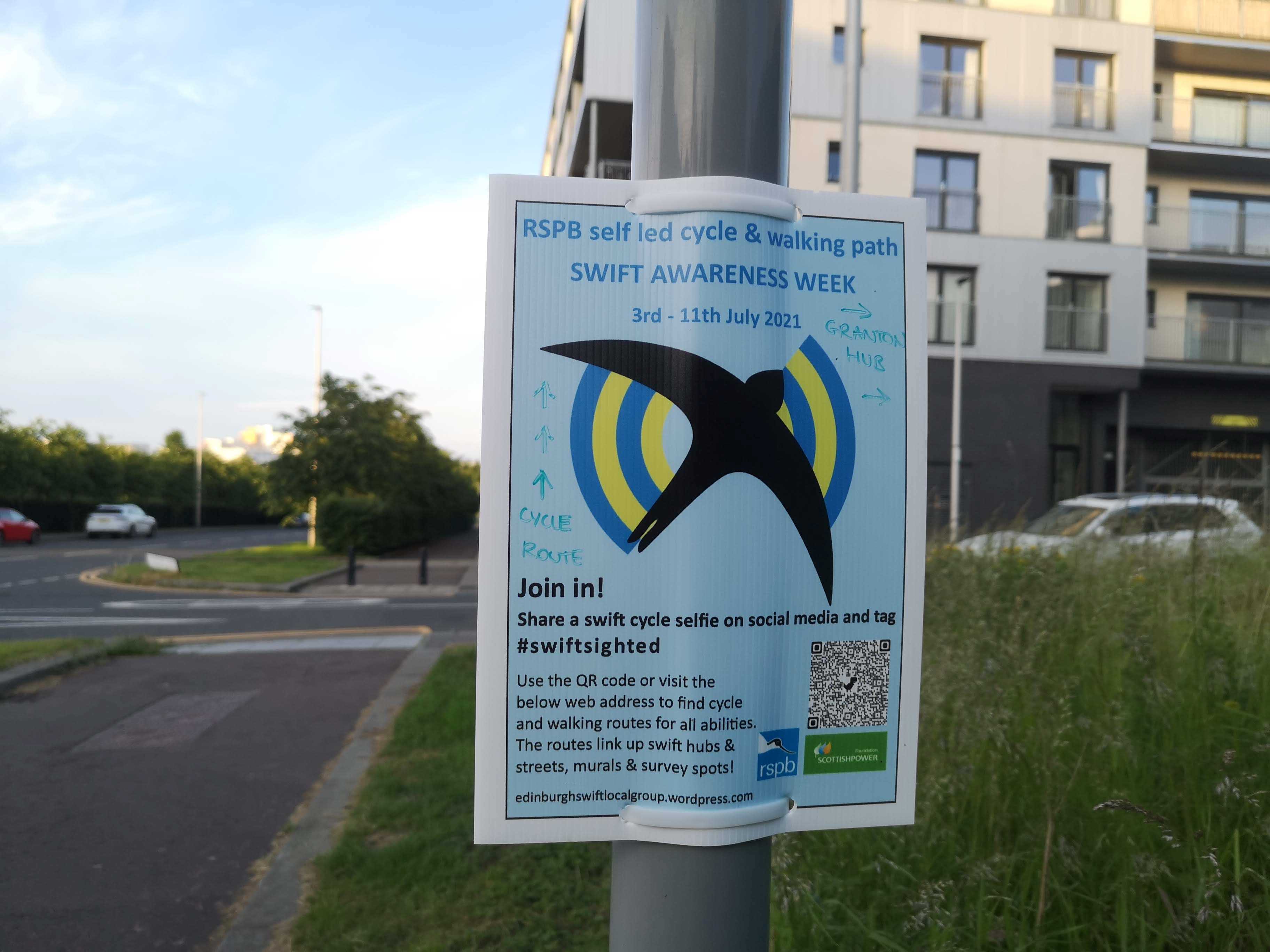
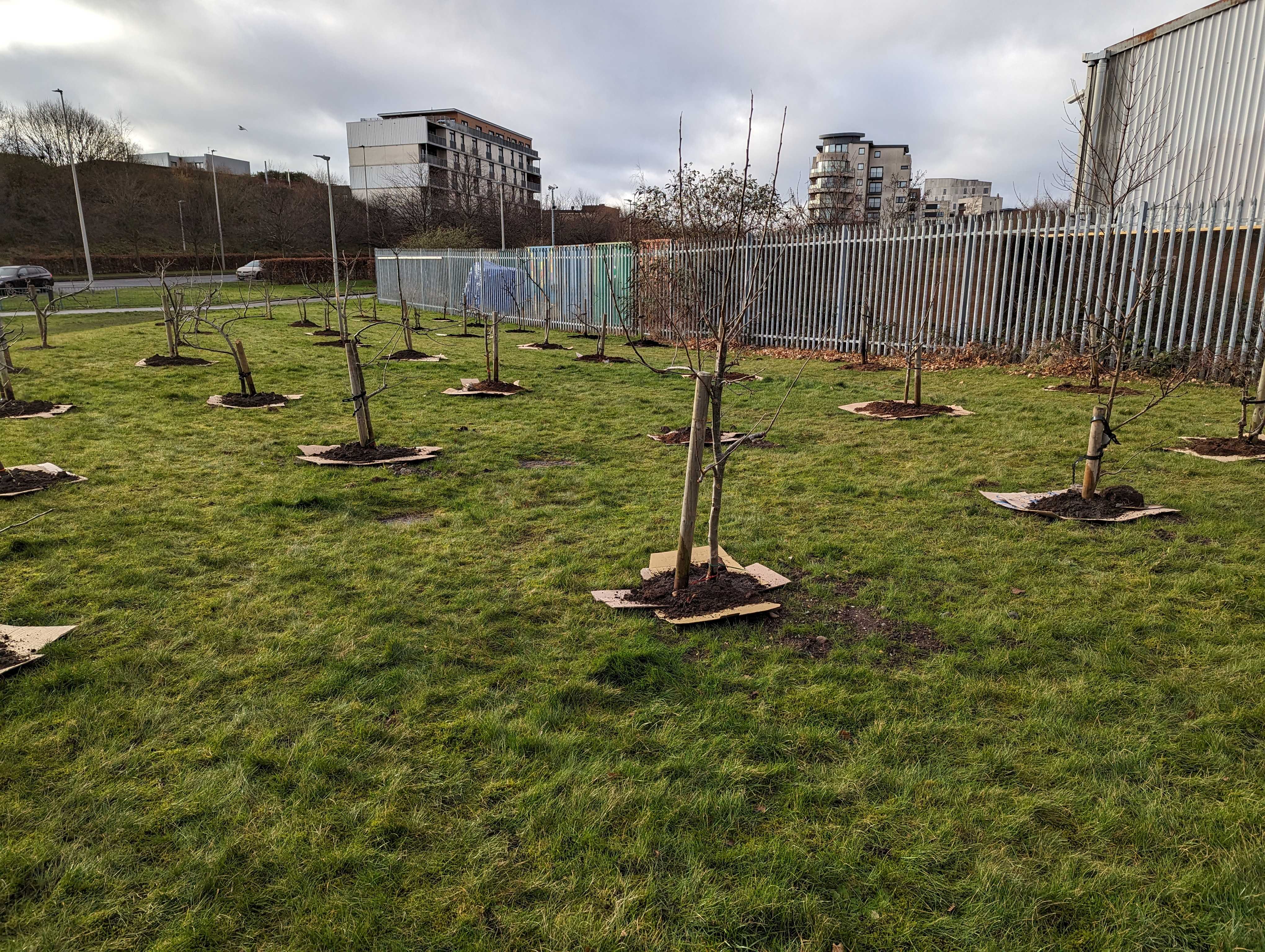
Stories were told as we hovered at the corner: of the swift boxes often erected on lamp posts next to the Swift business sign (coincidence); of Jenny’s tenacity – spending an officially homeless year visiting the housing association and getting to know them until she was allocated an apartment in the community ahead of us; and of the day we planted the orchard (from up the road) on the grassy bank by more newbies to the area, The Pianodrome.
“With the dog, we went to the rabbit run, behind that Beech Hedge; I know it will all dramatically change very soon.”
Nat
Captions for above photos: Left – Swift poster, Middle – Where Jenny lives now (before the block was built). Right – The new orchard at The Pianodrome
Now we were on the far northern boundary of both Edinburgh as a whole and Granton, whose territory we were beating the bounds of. Many of us bemoaned the lack of access to the Brick Beach, but then a desire path was spotted which turned out to be a thoroughfare. Jubilation!
“for a while I’ve not been able to get through (the wasteland between West Shore Rd and the sea / brick beach) That’s been irritating, having that little cut through blocked off. That used to be on my route so I could get a seat and watch the sea for a while, undisturbed. Tonight we were able to walk through for the first time in ages.”
Kev
The day was at its evening cusp and it was darkling, so we continued along West Harbour Road which becomes West Shore Road, past the new-to-the-area Edinburgh Palette (what we hope will be new artist studios and home for a weekend Street festival), and turned left onto the Speirs Bruce Way (more stories of Antarctic adventures and explorers are linked to this place). We went hard by what’s left of Granton Castle where the Walled Garden is hidden (a citizen success story as it was saved from developers and now houses countless allotments, natural dye- and community soup-makers), with the Social Bite village opposite.
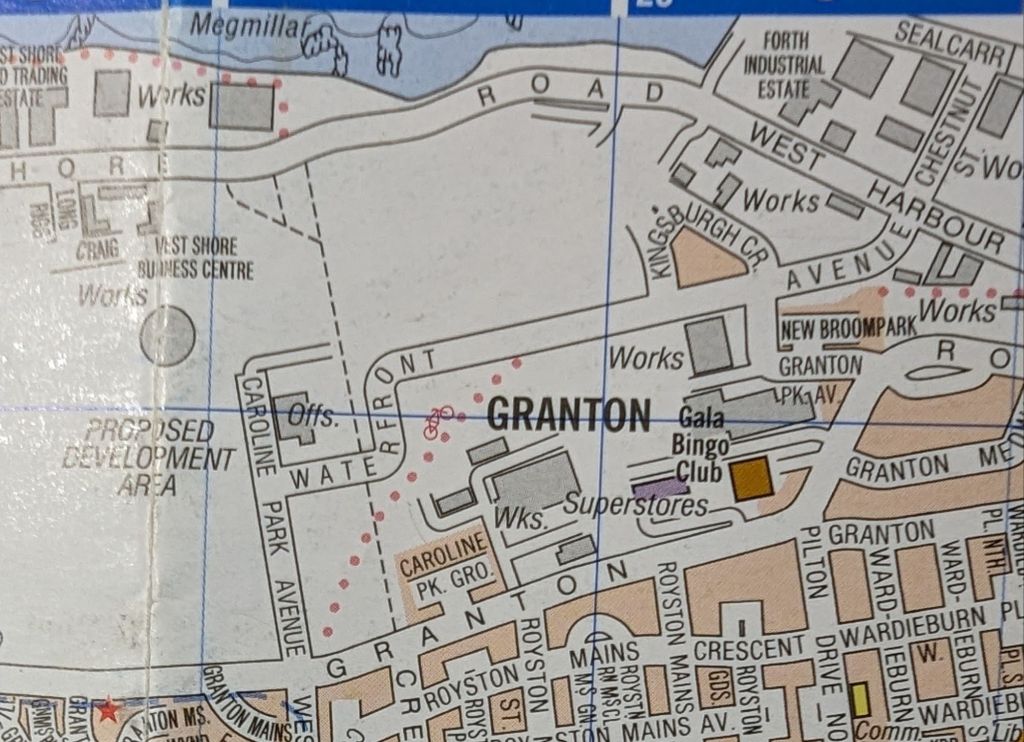
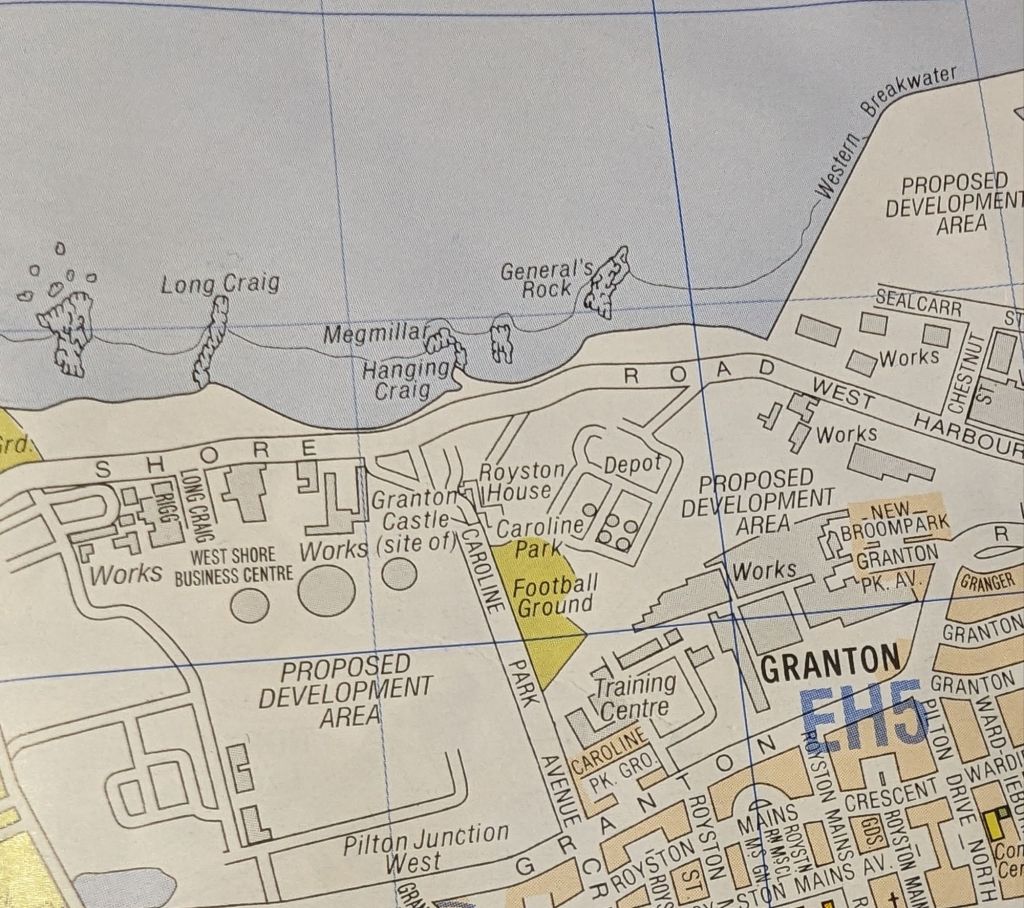
Captions for photos above: Two A-Z maps of Granton – 2004 on the left showing one gas holder, and 1999 on the right showing three as there used to be
I’m new to the area and walking is a way of feeling the local, recent history
Jenny
Uphill we traipsed, viewing the space for the new Granton Mural (end March 2024) and regaining the Gasholder. We stood in the rain to wonder why Caroline Park Avenue has become Waterfront Broadway, and returned to our starting point just as the fire engine arrived to douse the fire, now emitting acrid black smoke.
We’re from slightly outside the area. I’ve been down here a LOT walking the dogs so it’s very familiar, but it’s interesting to do it in a group because different people see different things. [Did you notice the changes?] Oh definitely.
Sheila
Toasting with a libation (warm apple juice), as is customary at this Festival, we swapped experiences, hopes and fears. Our discussion focused on the place where the inner landscape met the outer.
I used to like going there because of the nature around the gasworks. Because there was such a high fence and nobody could get in, it was undisturbed and there were wild orchids. To see it all demolished and a building site … it’s sad.
Maria
Along the bread line, the coast line, and the invisible lines between here and there, and us and other, we walked. It’s a time of great change in this area: trees taken down, blocks of flats going up, buildings repurposed and roads renamed (no-one knows why, though we suspect so-called ‘gentrification’).
The fire engine arrives just as we return to Madelvic House
A Community Walk was held on Friday February 23rd between 4-5.30pm, with drinks and discussion afterwards to chat about the walk and what we had seen and felt, at 5.30-6.30pm. Eventbrite was used for booking and everyone and their dogs were welcome!
The walk began and ended at the Granton:hub, Madelvic House, Granton Park Avenue, EH5 1HS.
I contributed words and images to a video assemblage, together with a host of other artists and Kel Portman, whose provocation this was. The link is here on the YouTube channel of Kel Arrowsmith. (My part is at 6:30 minutes.)
Introduction
A Granton Boundary walk was made in the Autumn of 2023, in advance of the opening of the Walking Like a Tortoise exhibition at the Granton:hub. It invited people to walk slowly together with a paper map, and annotate that map with places of interest (objects passed, thoughts thought, feelings felt, sites appreciated or not). We meandered, responding to participant’s interest, to their prior knowledge of the area, and to our whim. This might happen again! It was followed by a standing-up discussion and sharing of maps outside the building.
What happened on the walk
I proposed a (repeat) Midwinter walk around the same edgeland, as the evenings lightened, and I invited those who still had their maps to bring them and make comparisons. I brought the ones I was given after the original walk and handed them back for the purpose.
Tamsin
There was a brief introduction, then we walked together and had the opportunity to chat about borders and territories.
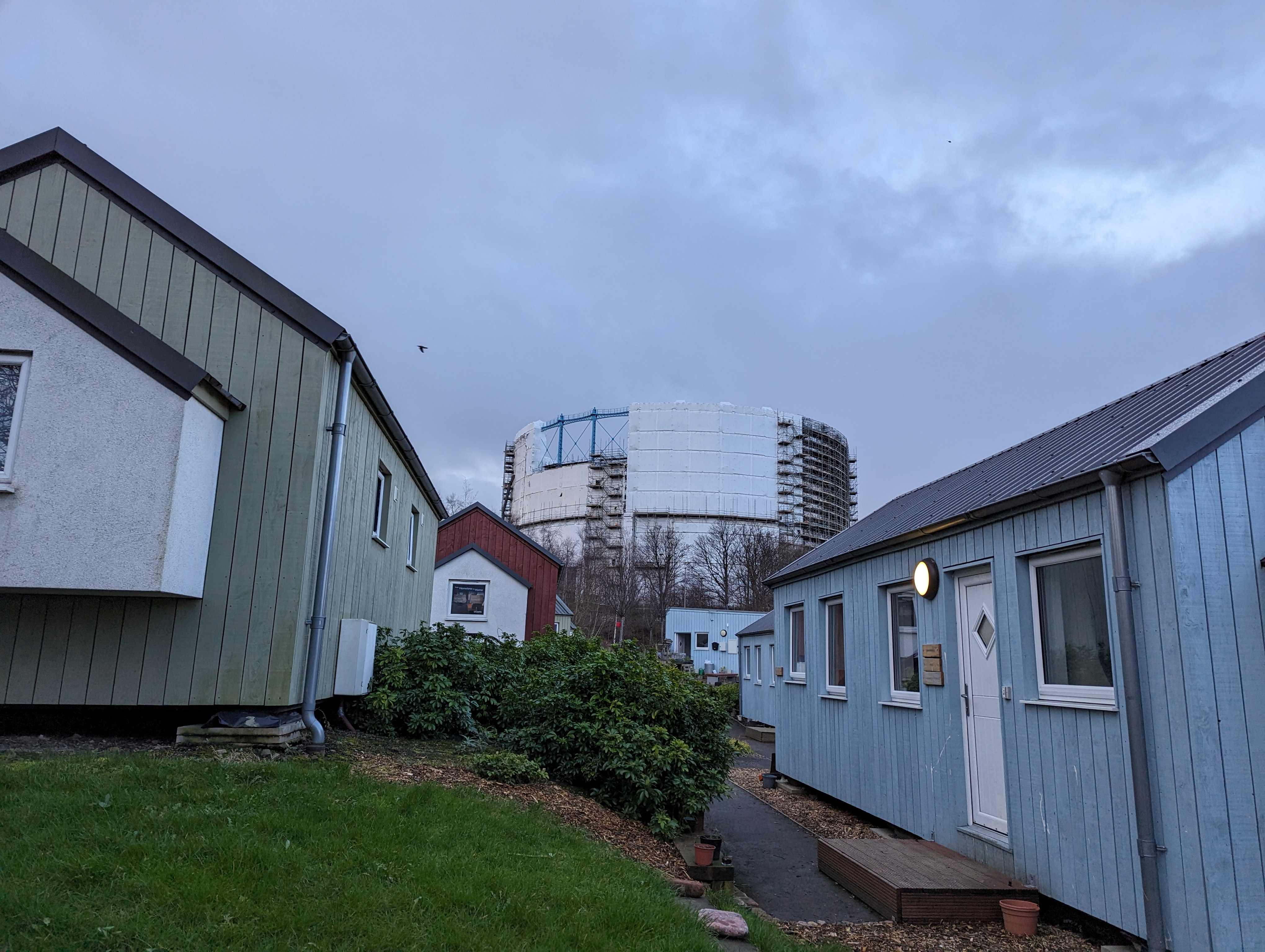
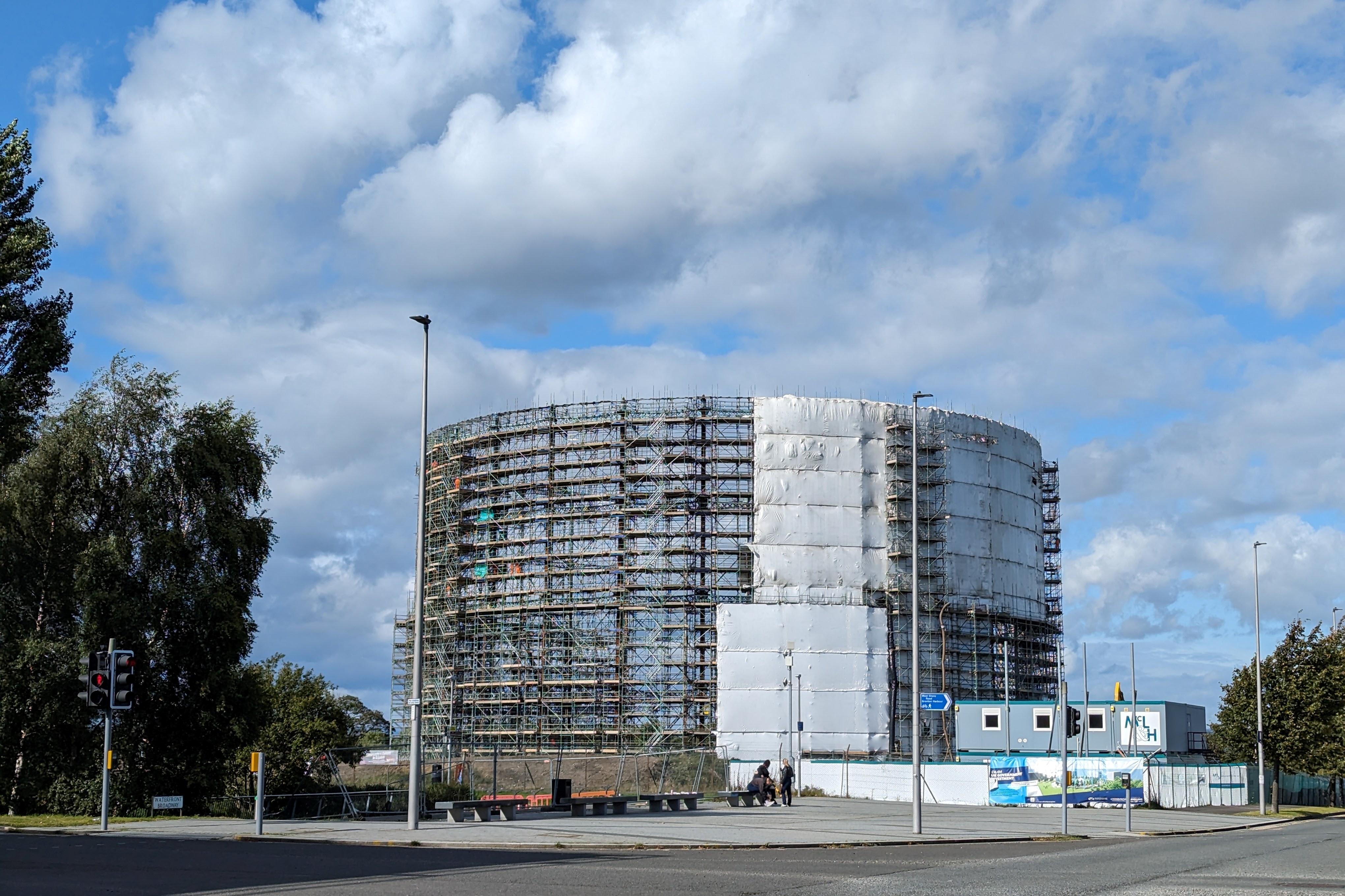
The remaining Granton Gasholder which is being built around, providing new housing and arts interventions
The immediate area around Madelvic House has changed considerably, as has the Gasholder (it was partially wrapped up) and the harbour, and therefore the new maps created will be likely to chart those changes, together with that of the seasons, and the alterations in us and the environment during the past quarter year.
Some of the group at the gasholder
This was an inclusive walk, paced for everyone, which was therefore on pavements.
Festival of Terminalia
This event was part of the Festival of Terminalia, an annual one-day celebration of walking, space, place and psychogeography.
Terminalia is a one day festival of walking, space, place and psychogeography on 23rd Feburary. Terminalia was the festival of Terminus, Roman god of boundaries and landmarks! Events have been run on this day since 2011.
Tim Waters tim@geothings.net
Tamsin is a wanderer and psychogeographer. She has nomadic habits and is very often found in the marginal areas around her Granton home. She is a qualified walk leader with Paths for All Scotland, and liked to perambulate with the Ageing Well group who belong to Victoria Park in Edinburgh. Her first art exhibition was Walking Like a Tortoise in 2023. She also writes and walks here .
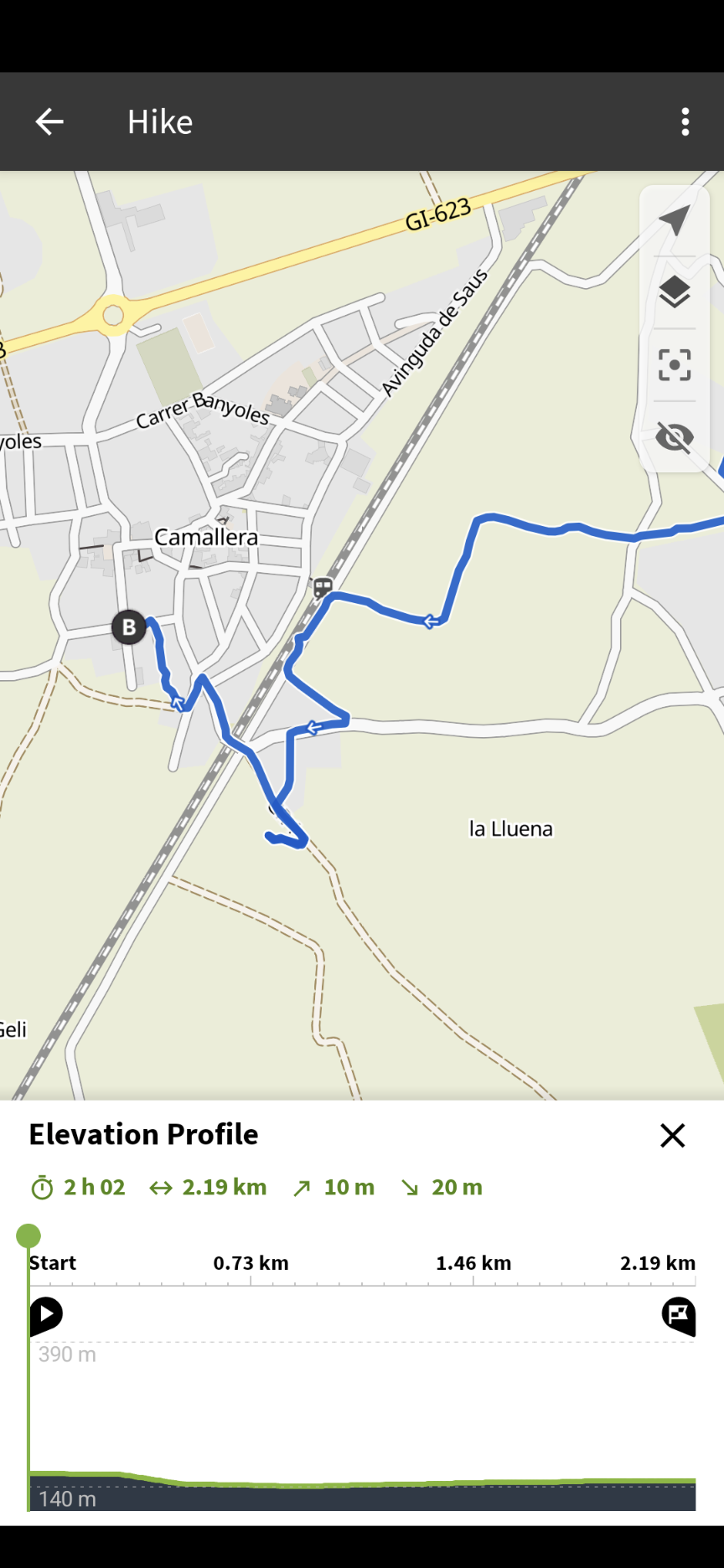
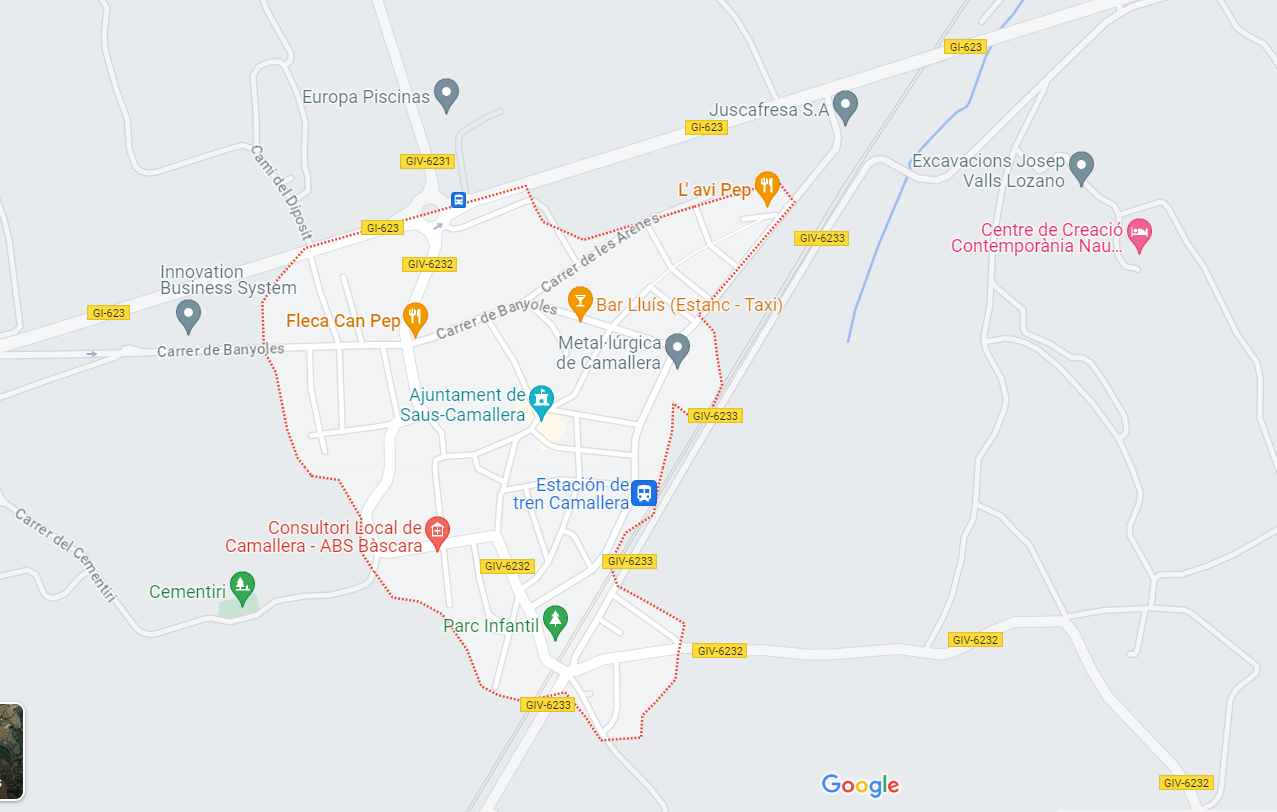
The Camallera Sound Walk is a walk around the border of the town of Camallera. There are 12 stages to the walk, and at each stage there is an original sound montage to listen to. It was created during an artist residency at Nau Côclea, Camallera, in Cataluña.
The walk is on flat, smooth land except for a short climb through the woods between Stages 2 and 3. You do not need to be very fit. It will take approximately 1.5 hours depending on your pace and how long you stop at any one time. There is a cafe / restaurant: L’avi Pep, half way round if you get thirsty (see map below). You are advised to wear sensible footwear and appropriate clothes for the weather. Bring water with you to drink.
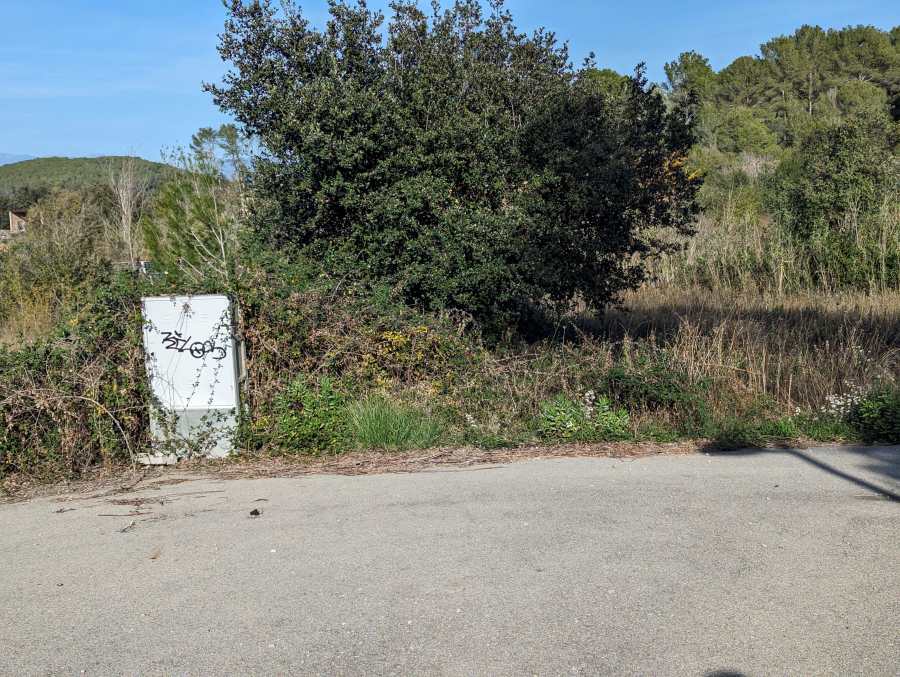
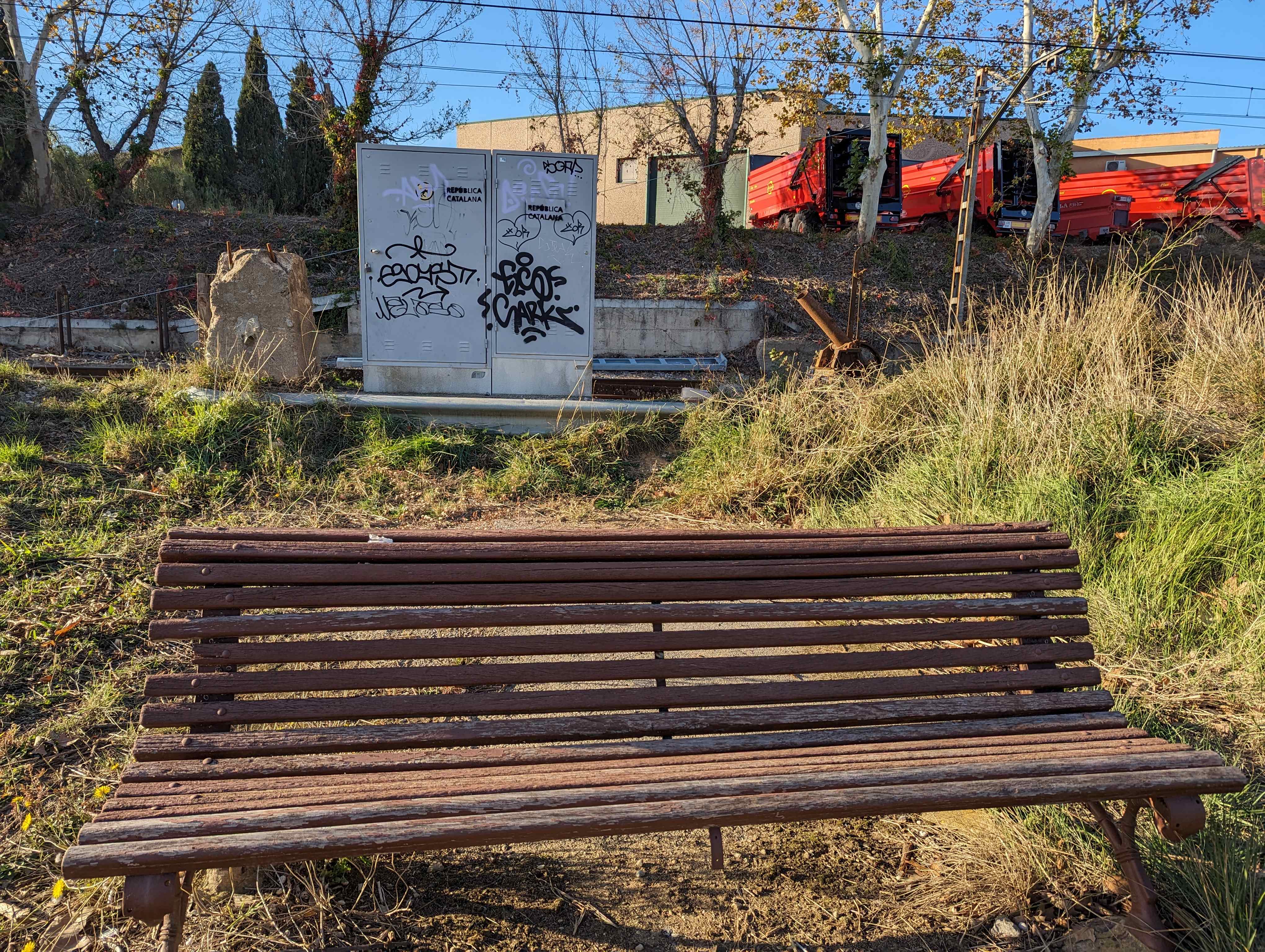
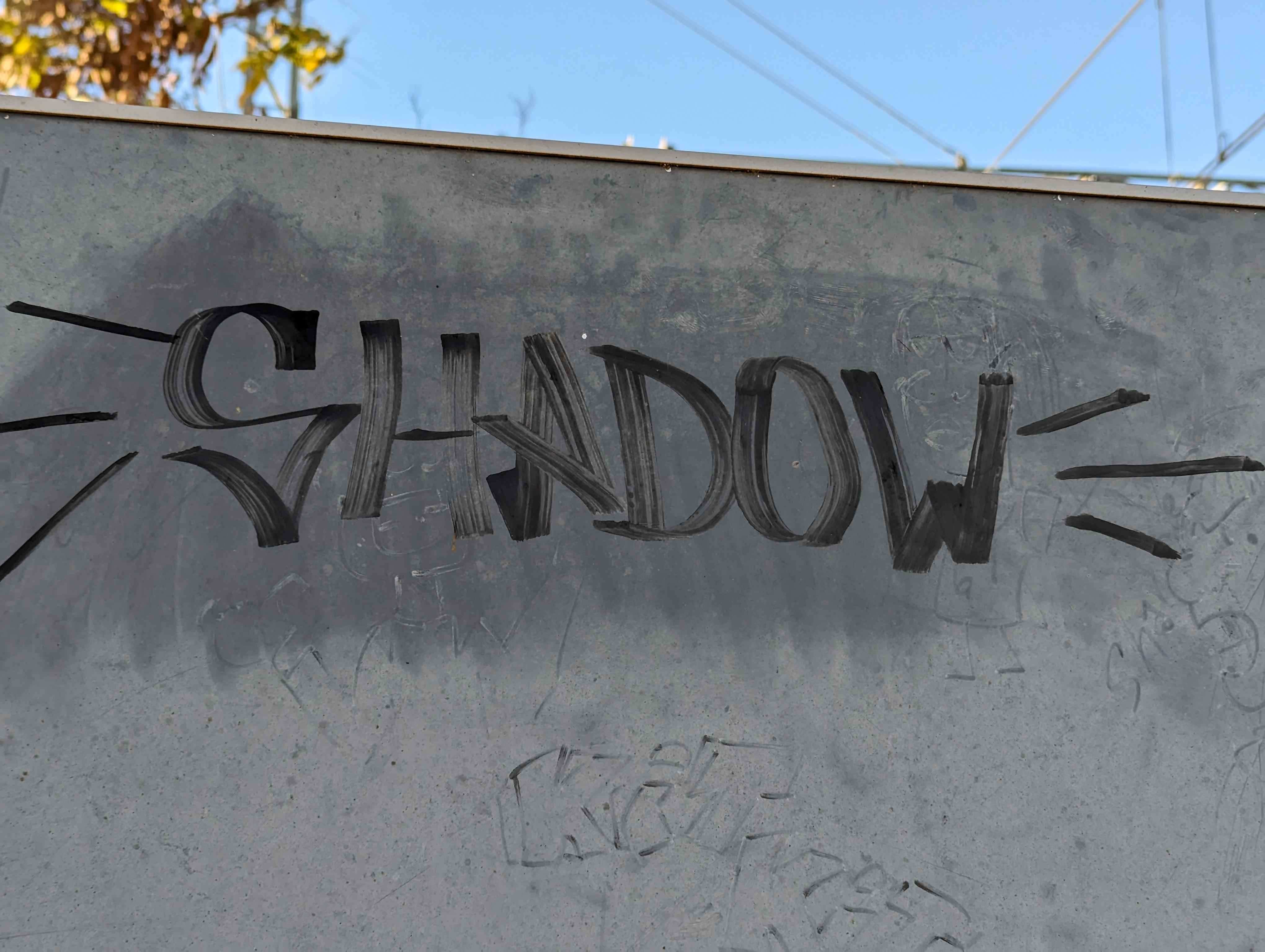
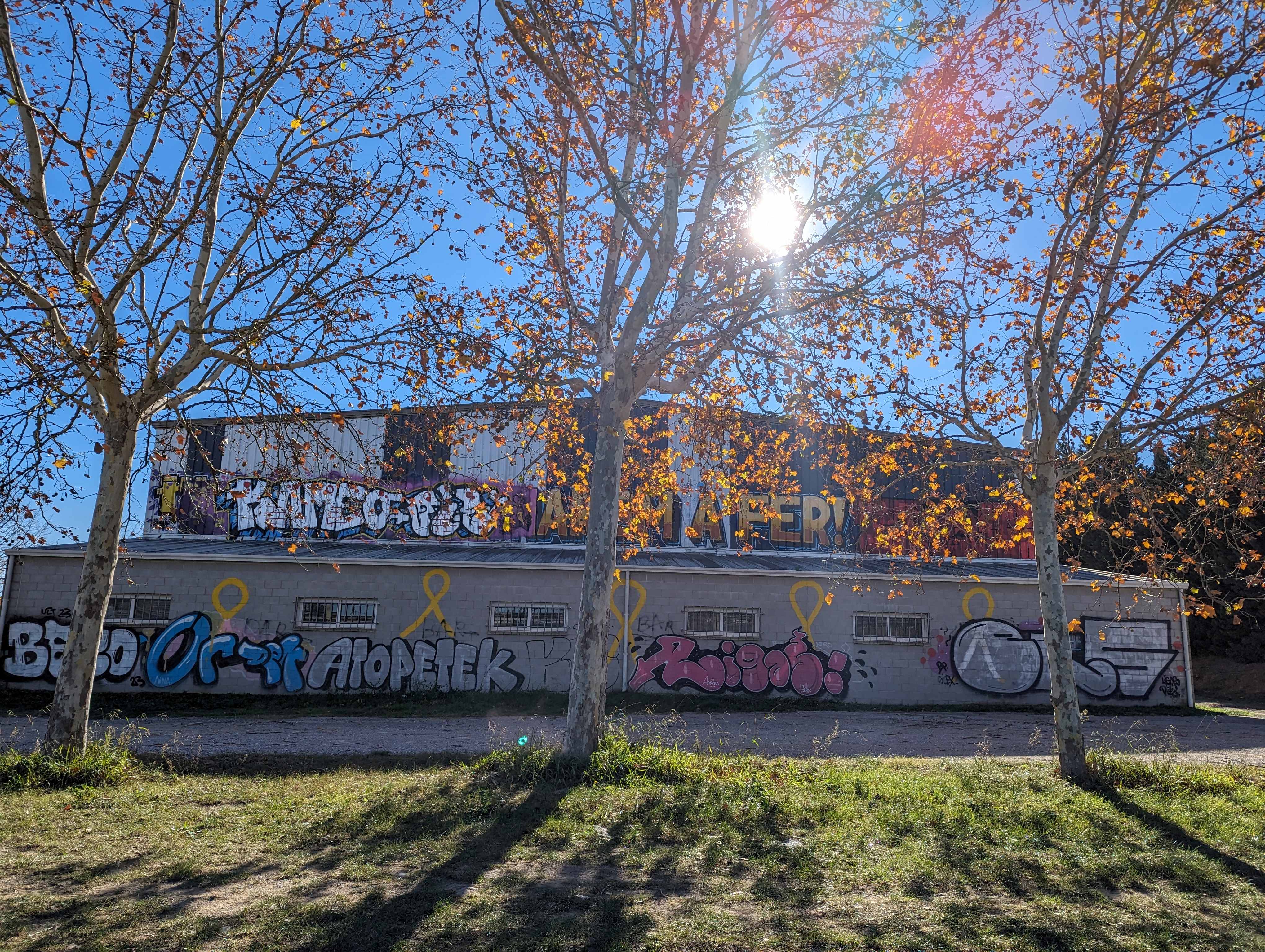
Local graffiti
Part of the Separation and Unity Project
This walk is part of the Separation and Unity project. Part One began in Spring 2023 with walking the St Margaret’s Way pilgrimage in Fife, and the oak forest of Dalkeith, both in Scotland (Caledonia). Shortly afterwards, I walked part of the Camí de Sant Jaume (Camino Catalán) pilgrimage for the Walking Arts Encounters in the summer, located in Girona, Olot and Vic, Cataluña, first alone and then leading others.
Part Two were Boundary Walks: the first around Granton in Scotland followed by an exhibition, Walking Like a Tortoise, and then this Camallera Sound Walk.
All my walks are part of my on-going life’s walk, all are connected, and each one leads on to the next.
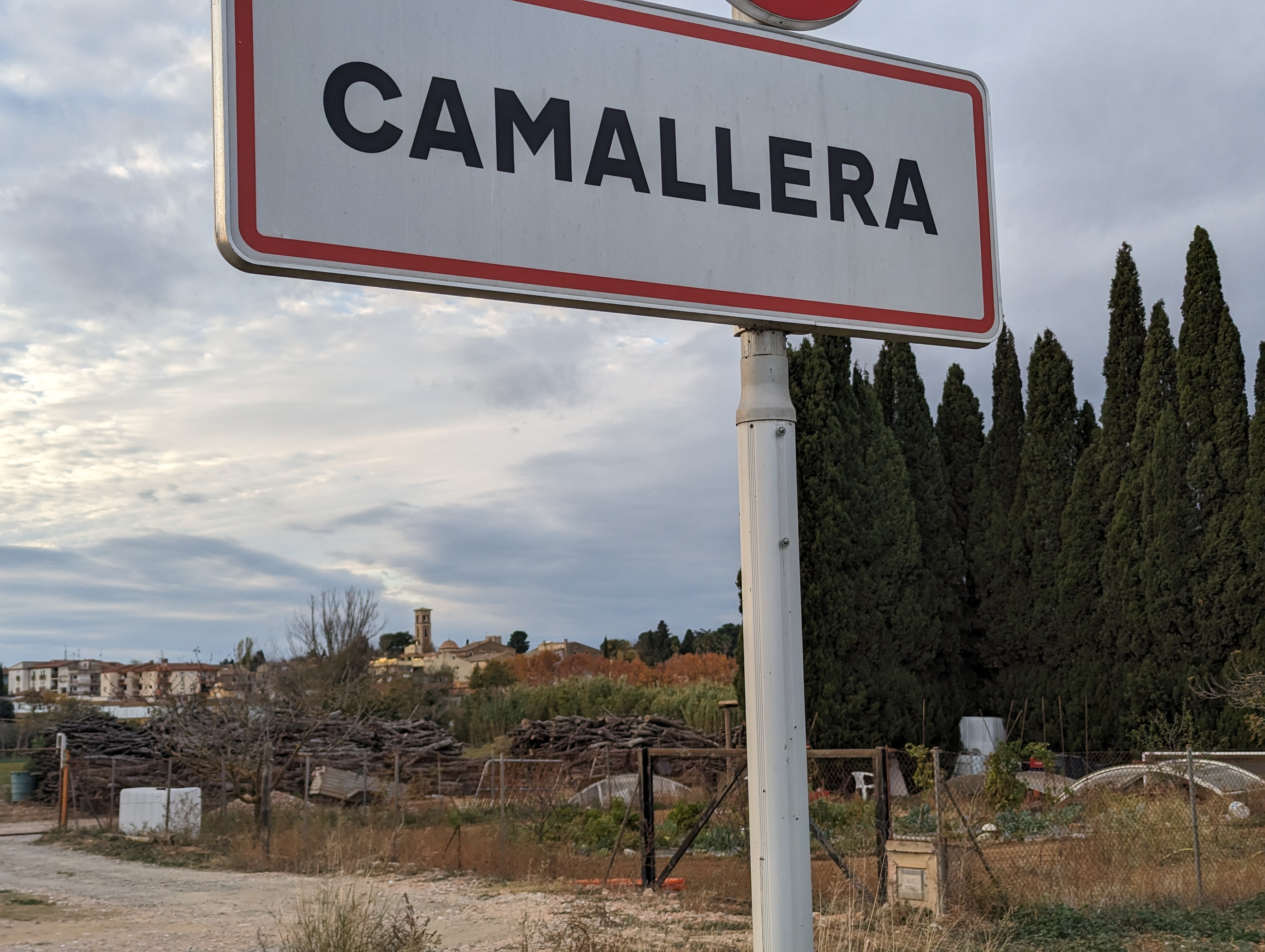
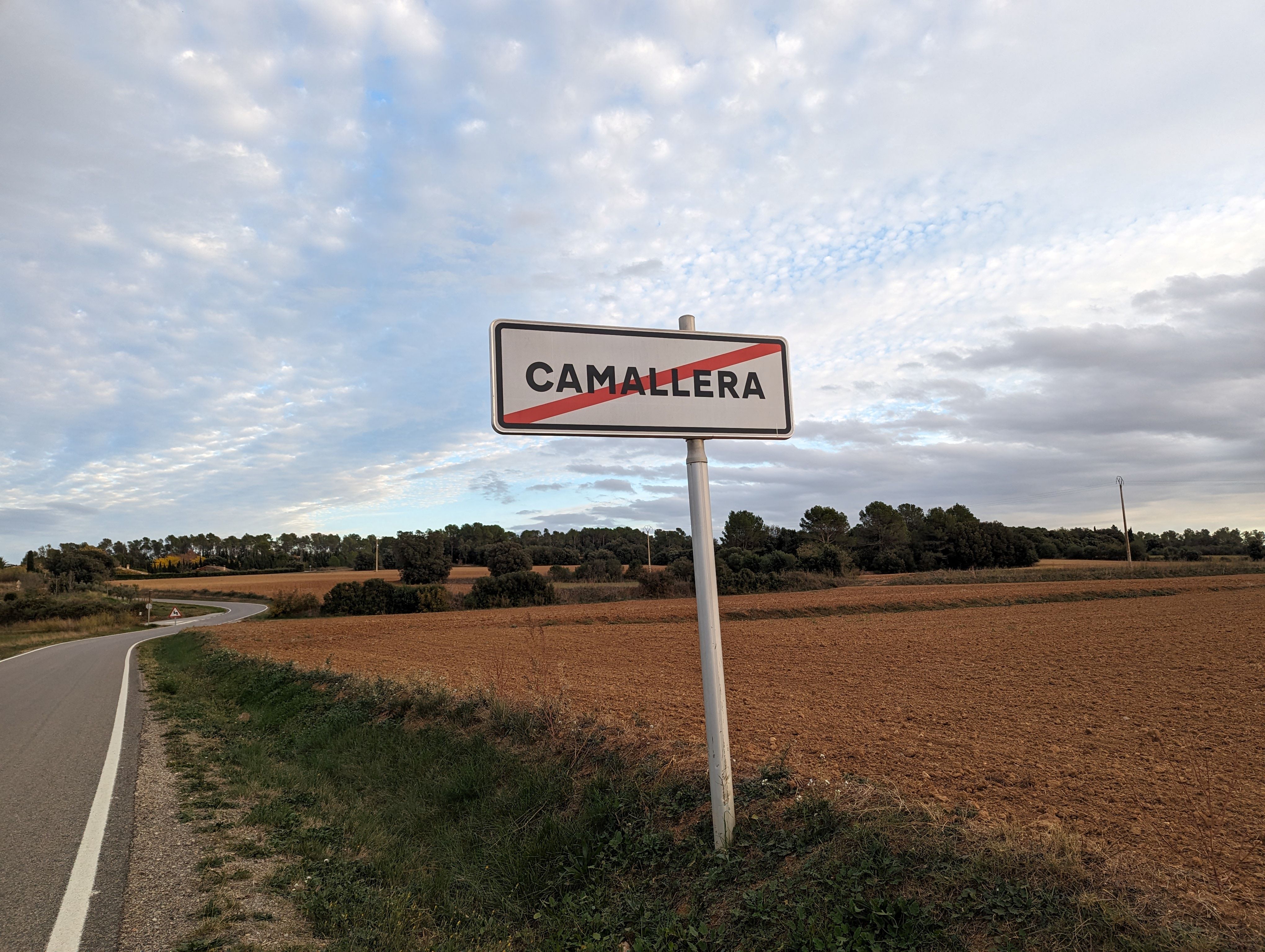
Camallera
Camallera is a small town in the comarca (region/county) of Alt Empordá which borders with France, and includes Figueres. The municipal border (shown in yellow on the maps) between it and Vilaür slices through the top. It is a third of what I would call a parish in the UK – the trinity of Saus-Camallera – which also includes Saus to the north-east and LLampaies to the west. There are around 800 people living in Saus-Camallera, and it is a mixed agricultural, industrial and tourist area.
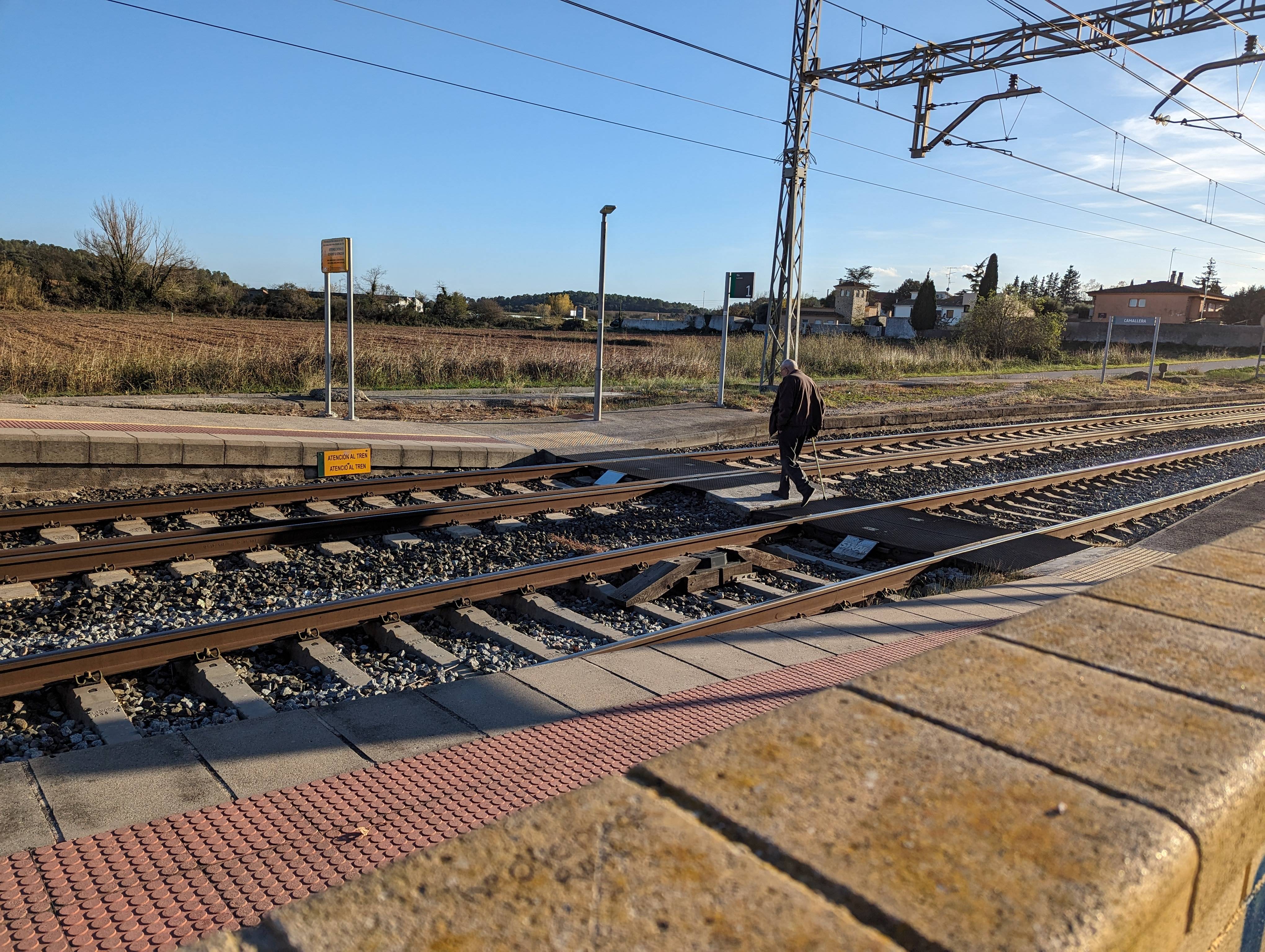
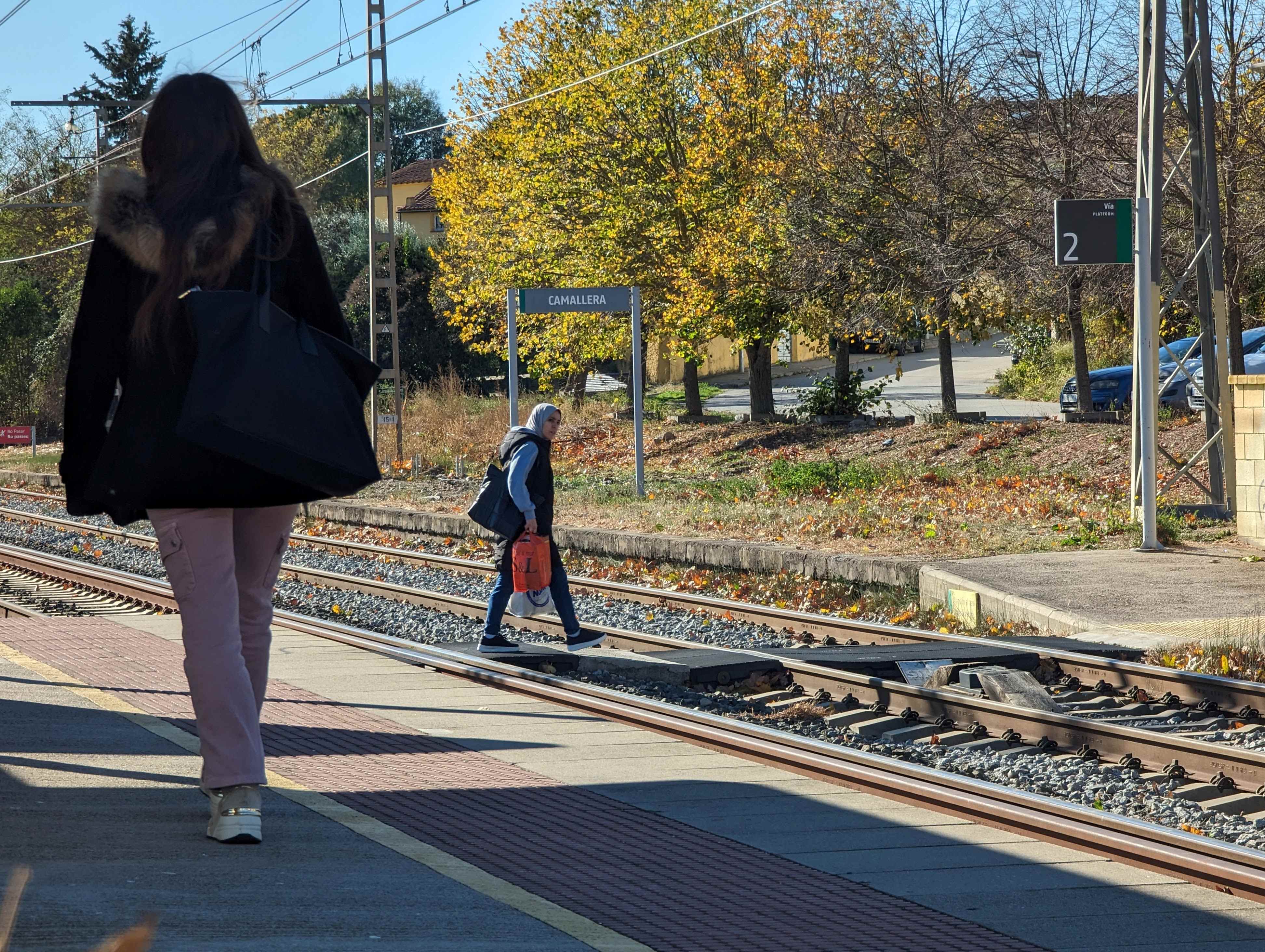
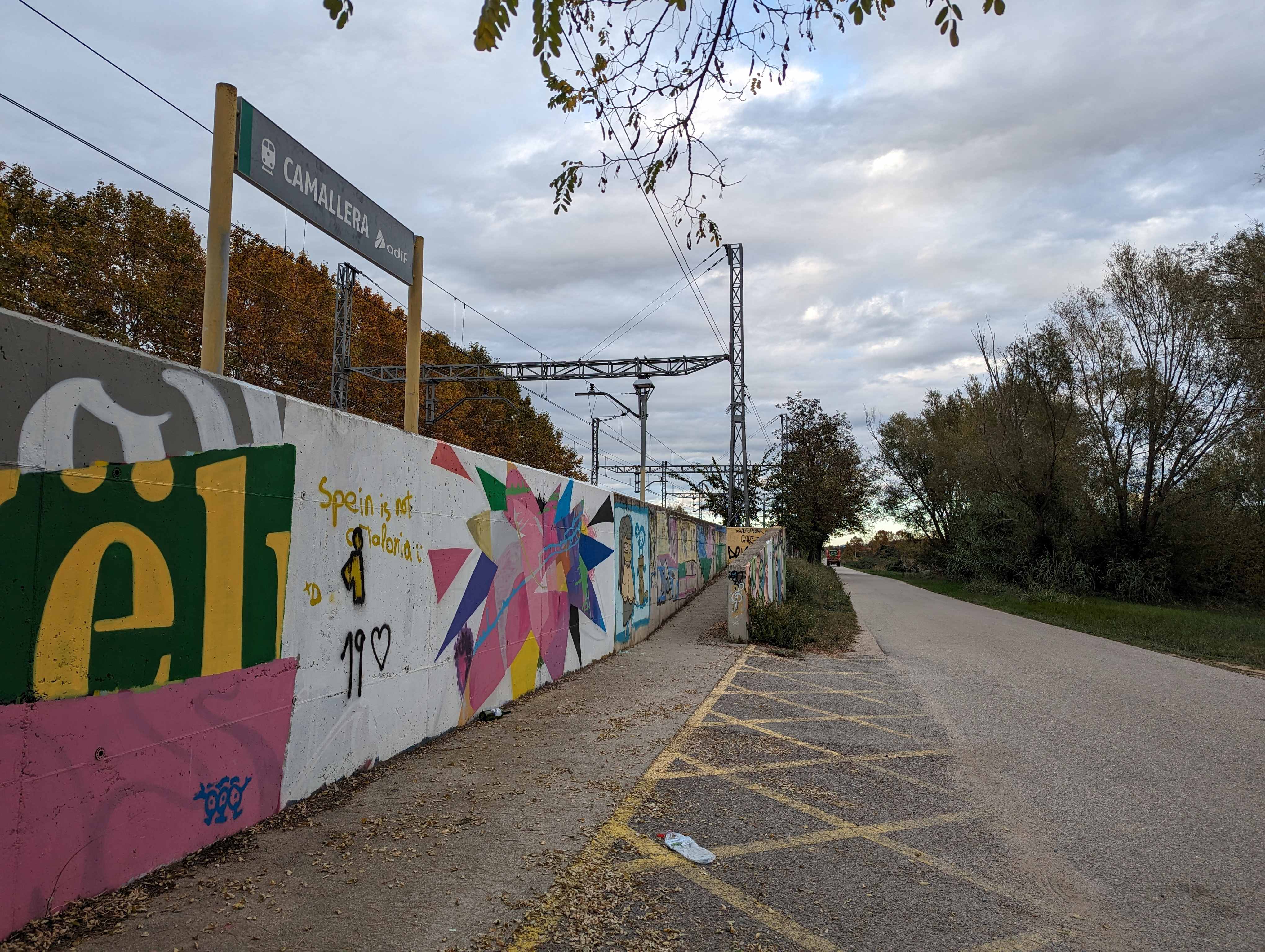
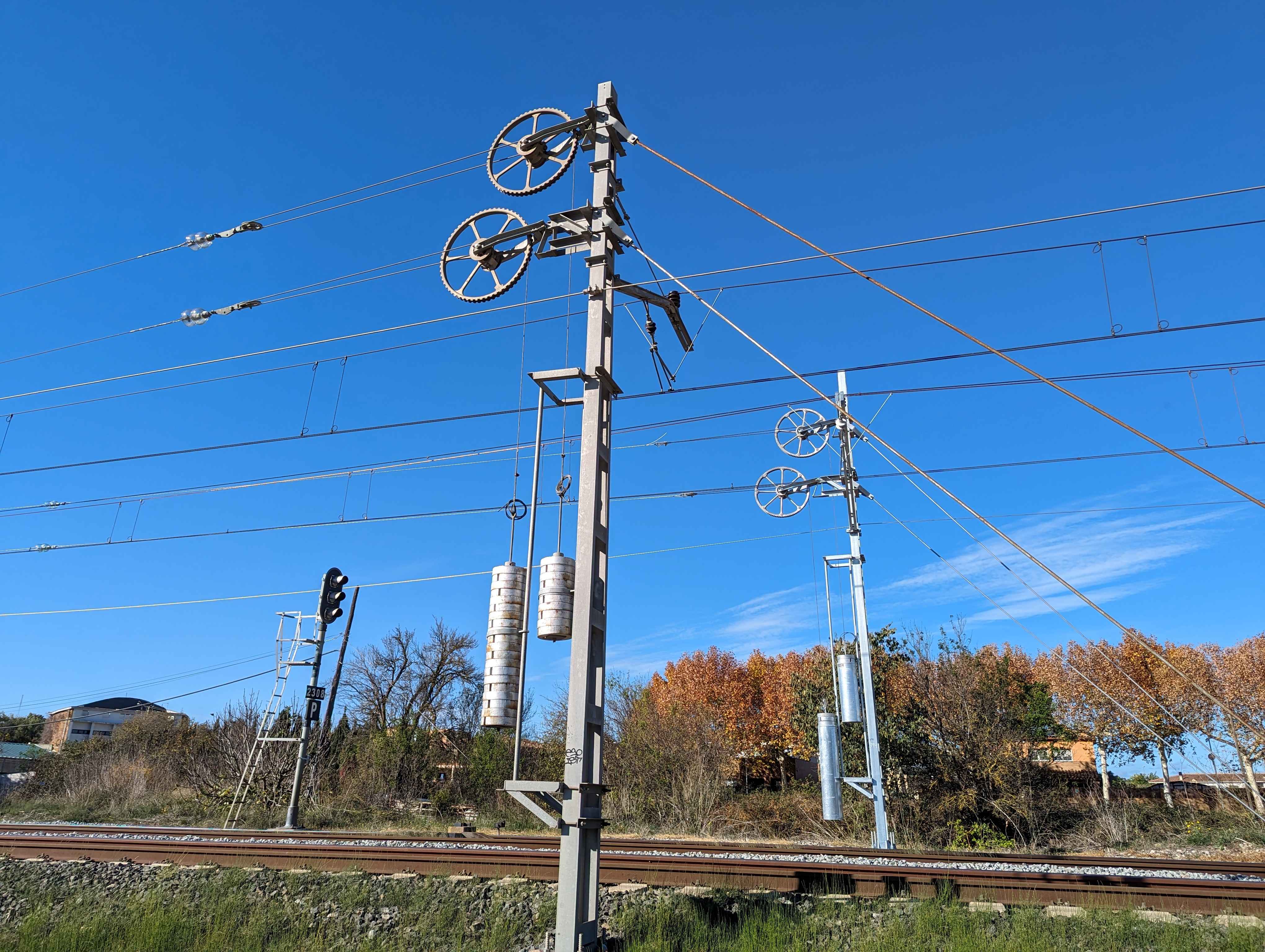
The railway divides the town with a strong and noisy diagonal line linking France to Barcelona and Spain. There are only three crossings, one for motorised vehicles (it is possible, but not advisable, to walk along the hard shoulder), a bridge between Stages 10 and 11, and the other is for feet, over the rails themselves – be careful! (You can also walk through an underpass to visit Saus (see Option 1 below), but you cannot get into Camallera that way except via the busy main road). If you are a bird or insect, you may cross wherever you want.
Crossing the railway line – stages 1, 12 …… and the crossing between stages 4b & 5
The language of the Sound Walk
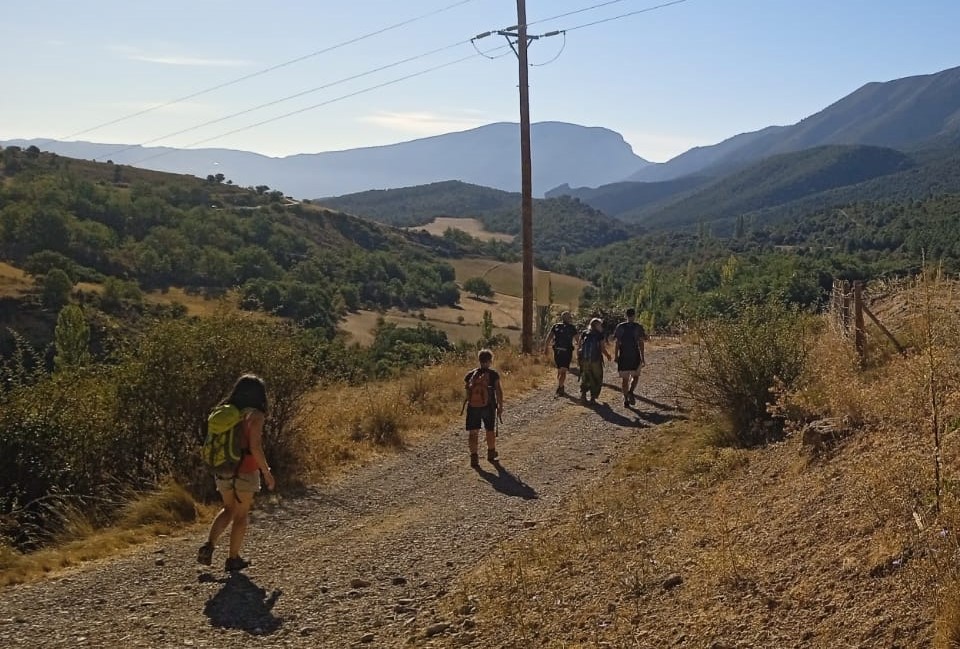
I do not speak Catalán, the language of this town, nor can I act as your guide using Castillian Spanish. When I participated in El Grand Tour in August, often having to look down and watch where I was putting my feet in order to negotiate the stony hillsides of the pre-Pyrenees, I could not understand each word and phrase that my fellow walkers were speaking, instead I heard these languages as music, the flow and the cadences of them. I learned to distinguish their different speakers without seeing the people as they spoke. The undulations of the landscape and the sentences informed each other, one perhaps having grown out of, or together with the other. They flowed around and through me as we walked, and I even began to understand some of them in this way.
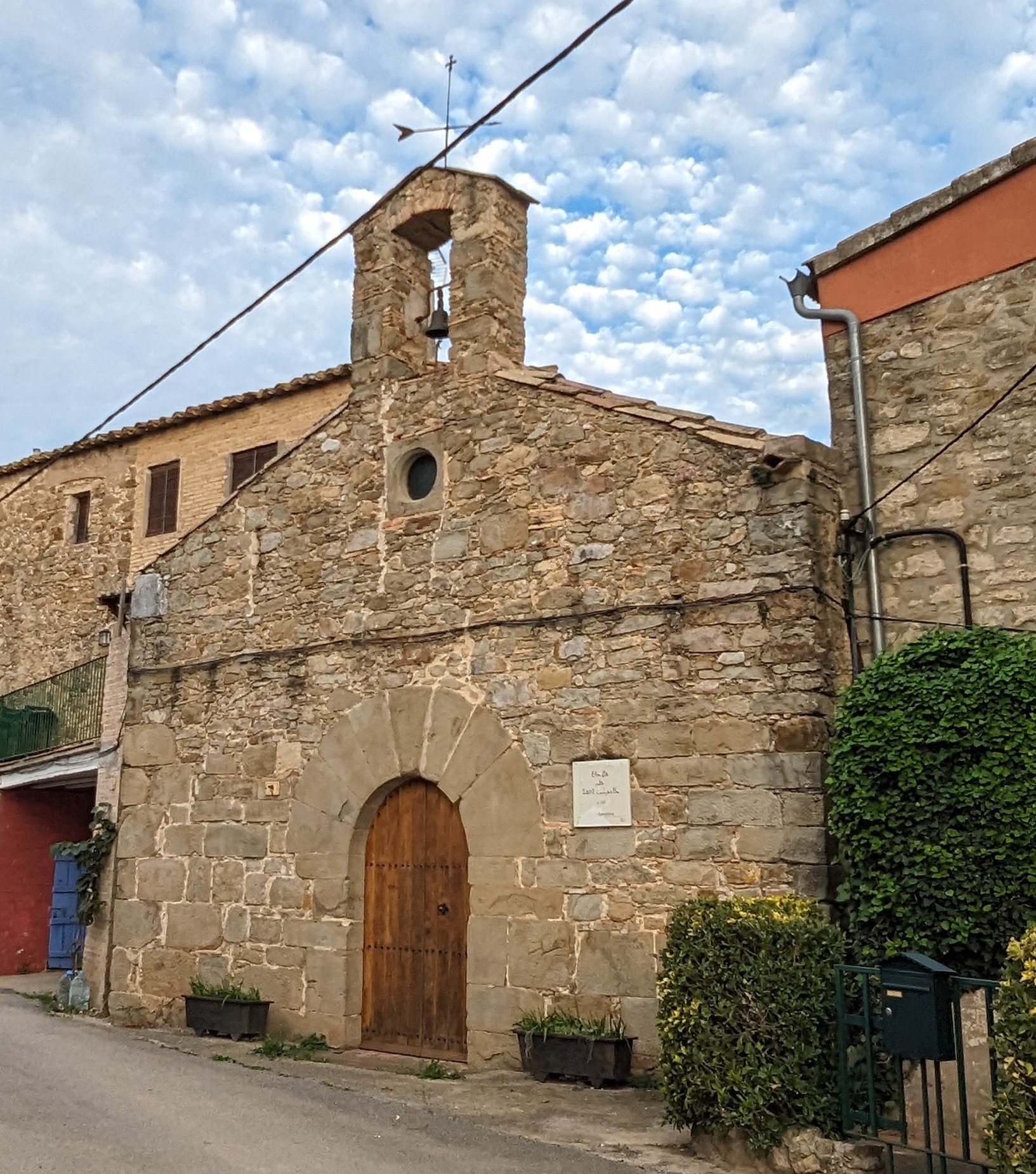
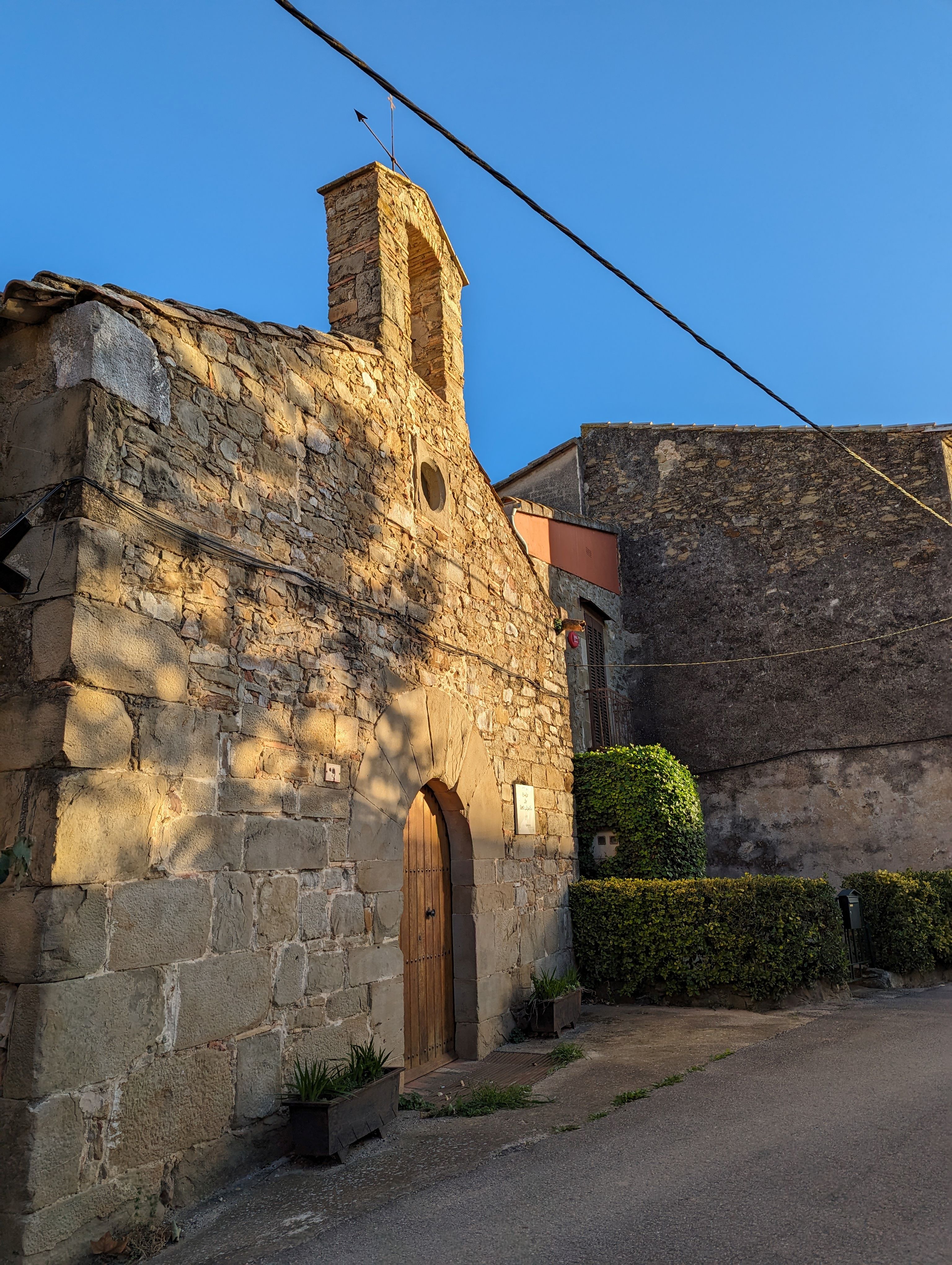
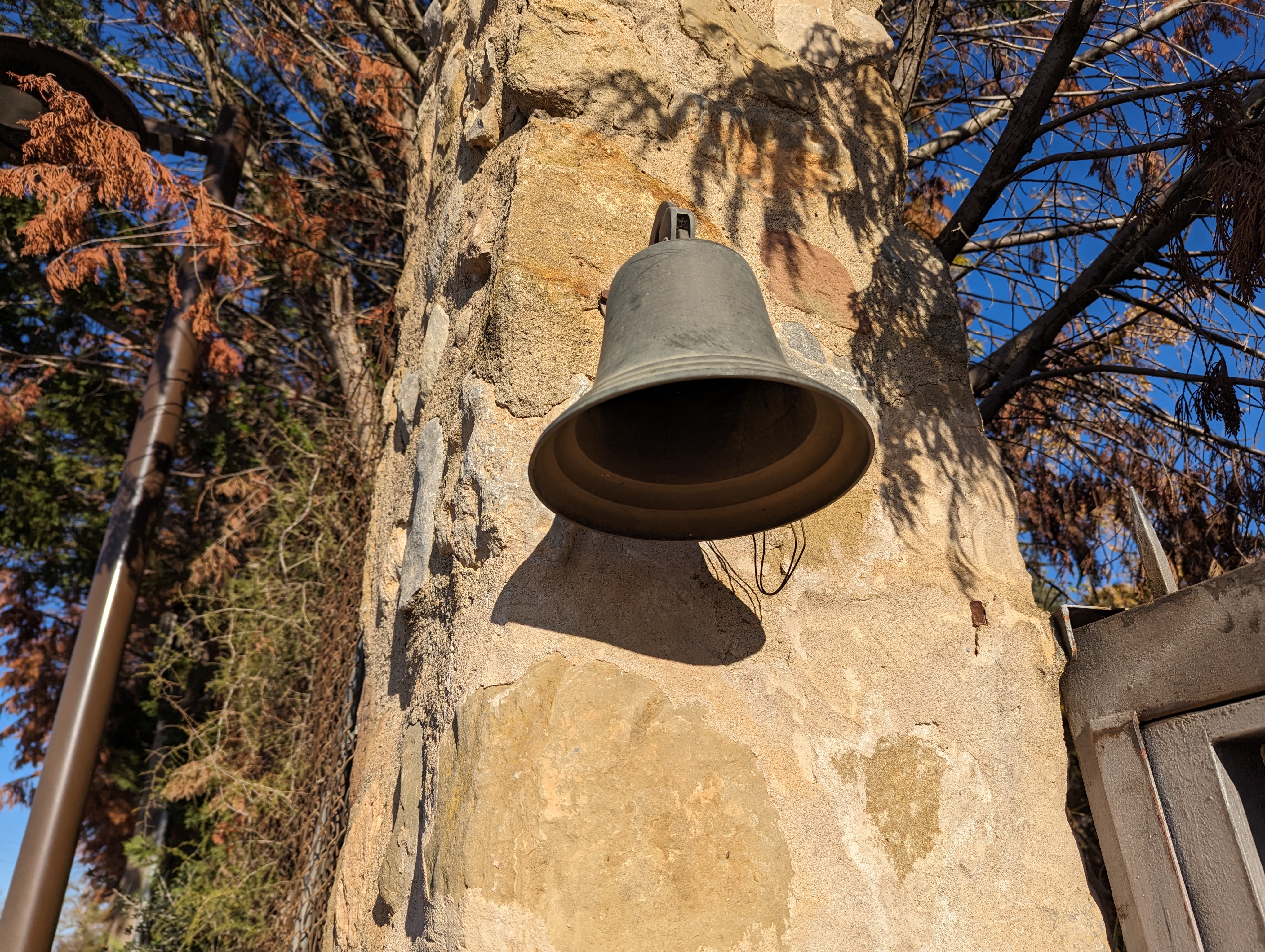
San Bartomeu de Camallera, source of the bellsSign for the trails which skirt the town
So, this Sound Walk has no words; you do not have to speak one language or another to participate. It uses all manner of sounds and various versions of silence which I hope will evoke feelings, memories, thoughts, and local history even if you don’t know any details of it. My research consisted of walking around and around, gleaning a sense of the place through the ground and the soles of my feet, and discovering its energy through the air and my skin. I sat at each stage; sensing, intuiting, noticing, meditating and receiving. Two weeks is a very short time during which to get to know somewhere, and I am therefore grateful to Clara Garí, Anna and her children, and Martina for their anecdotes, familiarity with, and knowledge of the area.
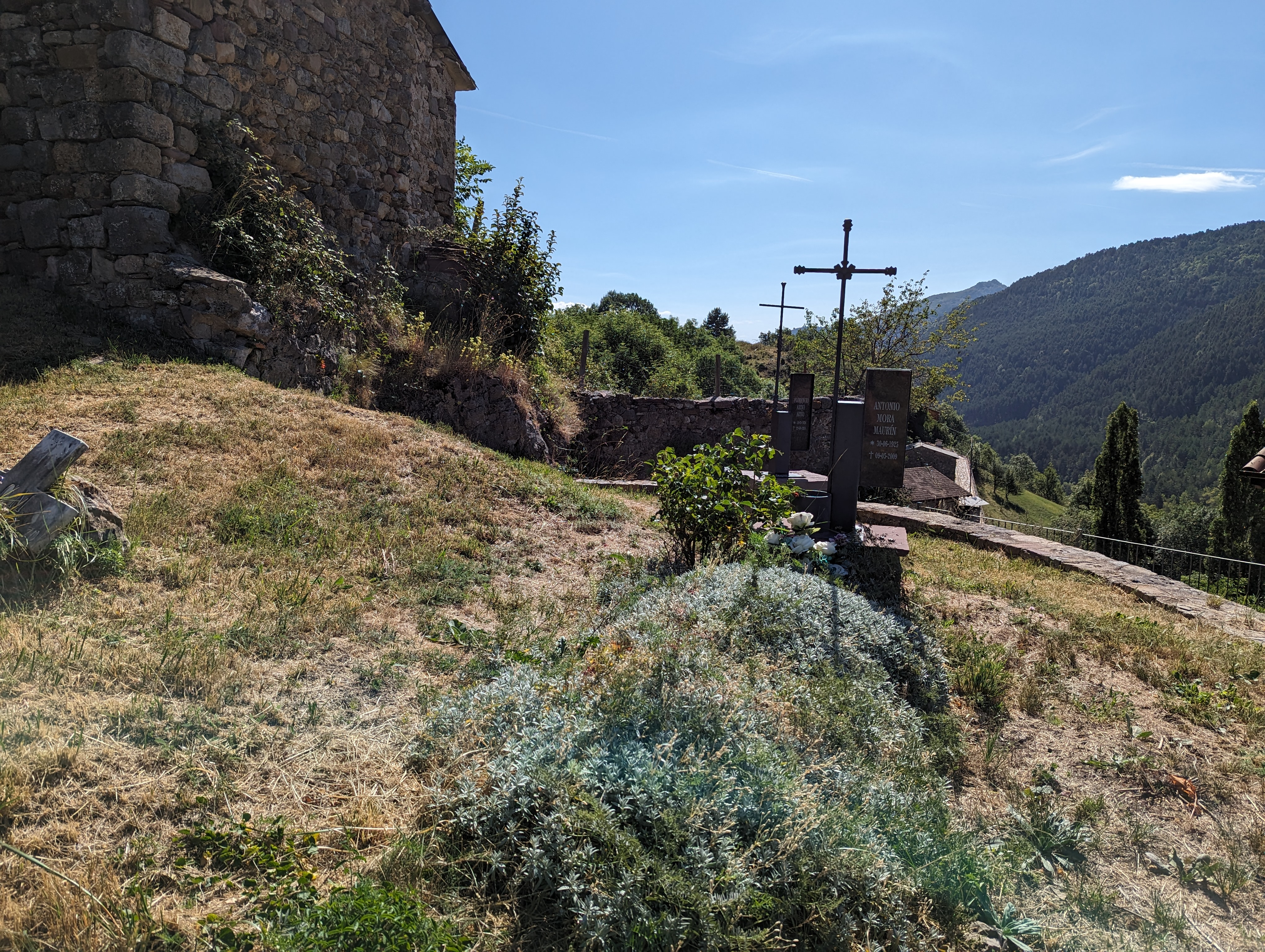
Clara Garí at Stage 11
The found sounds were all recorded by me on my Google pixel pro 10 mobile phone, mostly from the area, and a few from nearby Girona, and Scotland. They have been supplemented with one or two others from online libraries. I used Adobe Premiere Pro to assemble them.
Note to the walker
If you want the whole Camallera Sound Walk experience, I suggest you start at the train station and follow the trail anti-clockwise (widdershins in Scots). The walk describes 2 loops, so you will be crossing the railway line several times. Listen to the sounds around you, and those you make, as you walk. When you arrive at the first of the 12 stages, stop and listen to the audio. First a gong will sound, and then there will be a track lasting about 3 minutes. A quieter gong ends the stage. Turn off the sound as you walk to Stage 2, and when you turn it back on there will be a short gap of silence before the next gong sounds for the start of Stage 3. Repeat until you get back to the train station after Stage 12.
My first task in making this sound walk was to map the route around the boundary of Camallera and then choose the direction. When it came to creating the audio, I knew what experience I wanted you to have, however I know you may actually walk the whole thing differently. You might walk clockwise or visit the stages in a random order. Perhaps you will only go to one stage. You might listen to an audio that belongs to Stage 2 at Stage 3, or you might follow the walk at home without being in the town at all, with only the photographs to orient yourself. None of this will matter. What I’m interested in is that you will find or feel or think something when you’re listening.
I have endeavoured to translate the local Camallera stories which residents told me, together with my personal experiences, into audio. I hope that they will open portals to other worlds.
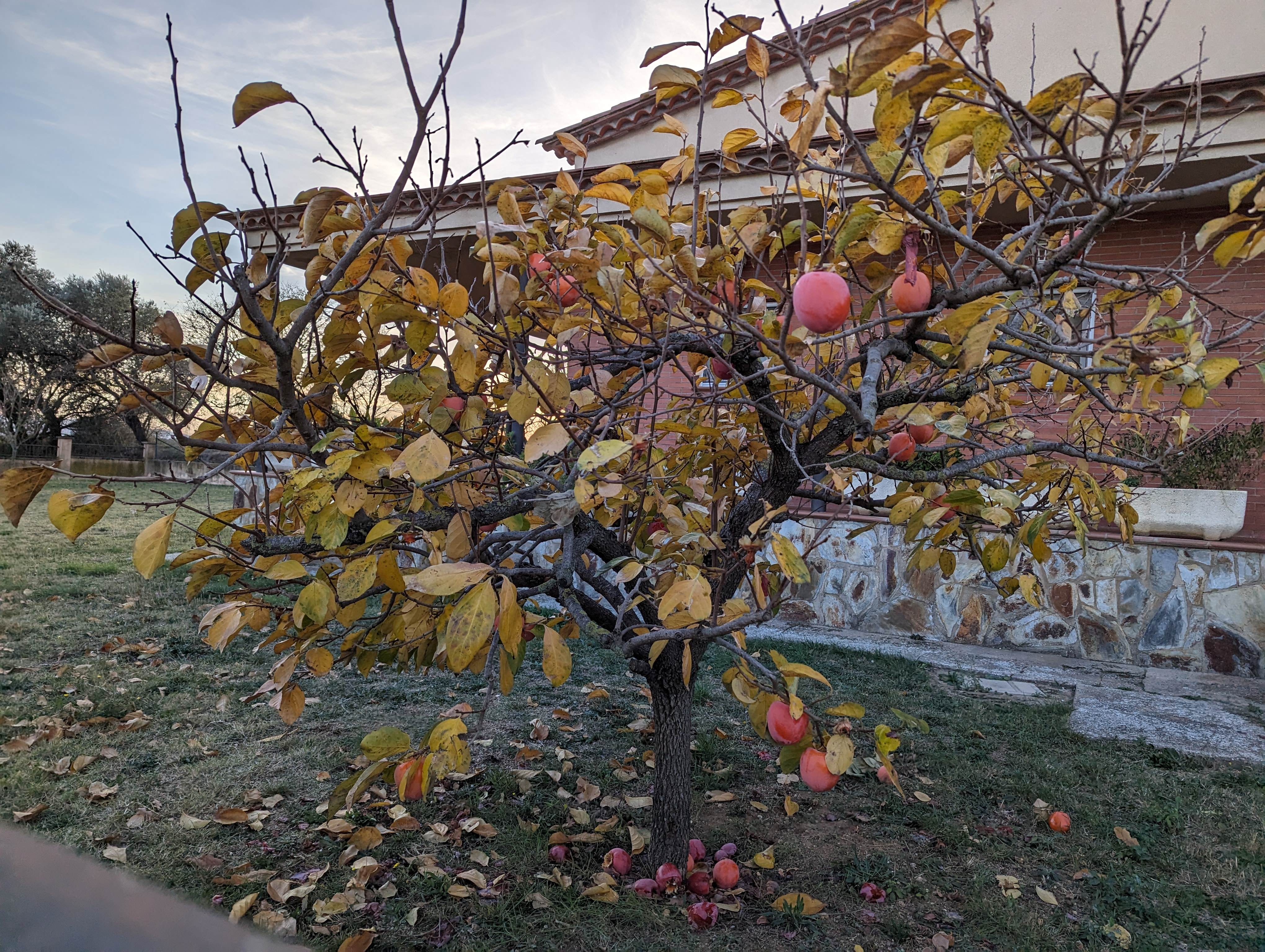
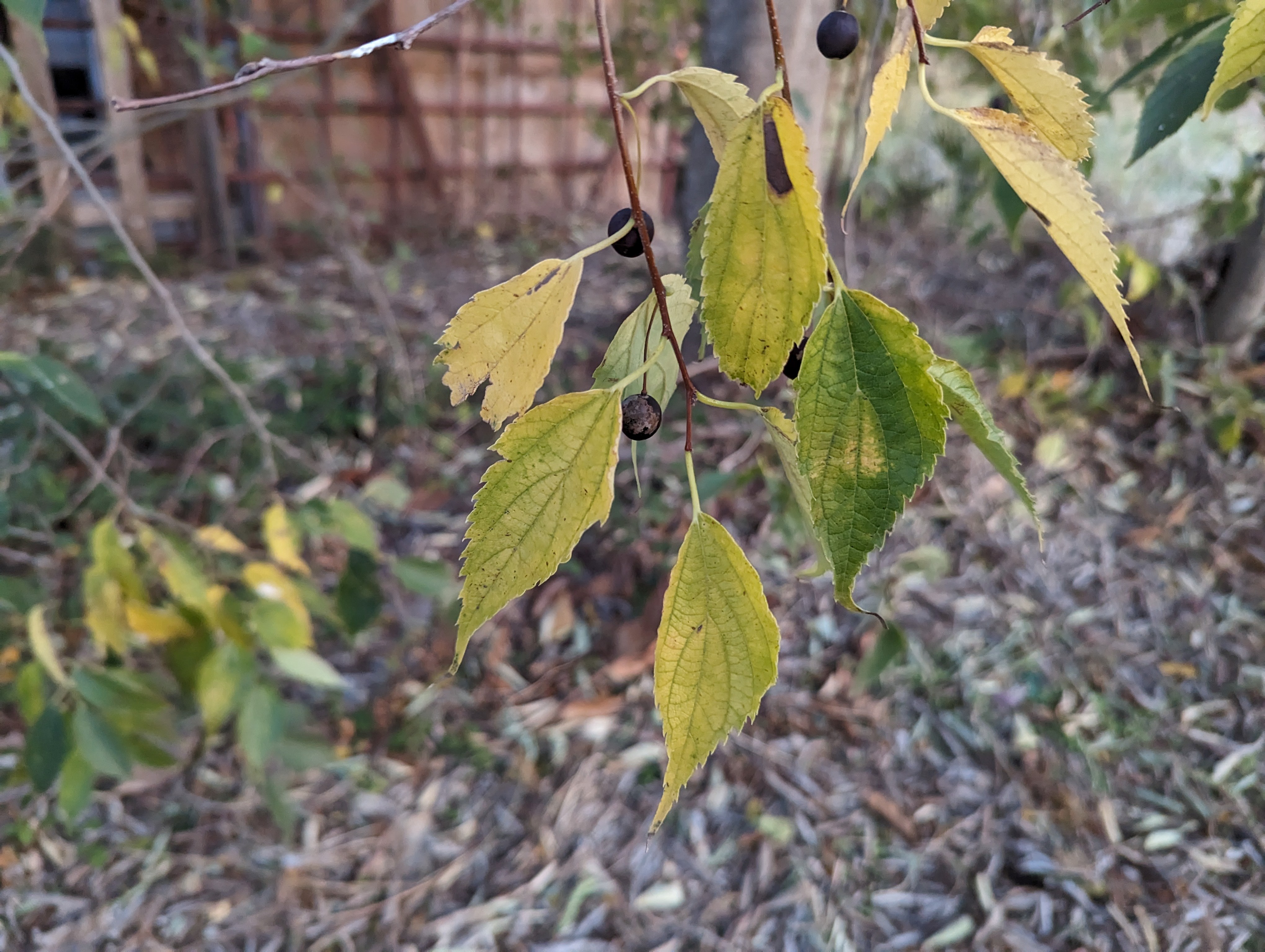
Persimmon tree can you find me? what do I sound like?Sketchbook
12 stages around a boundary
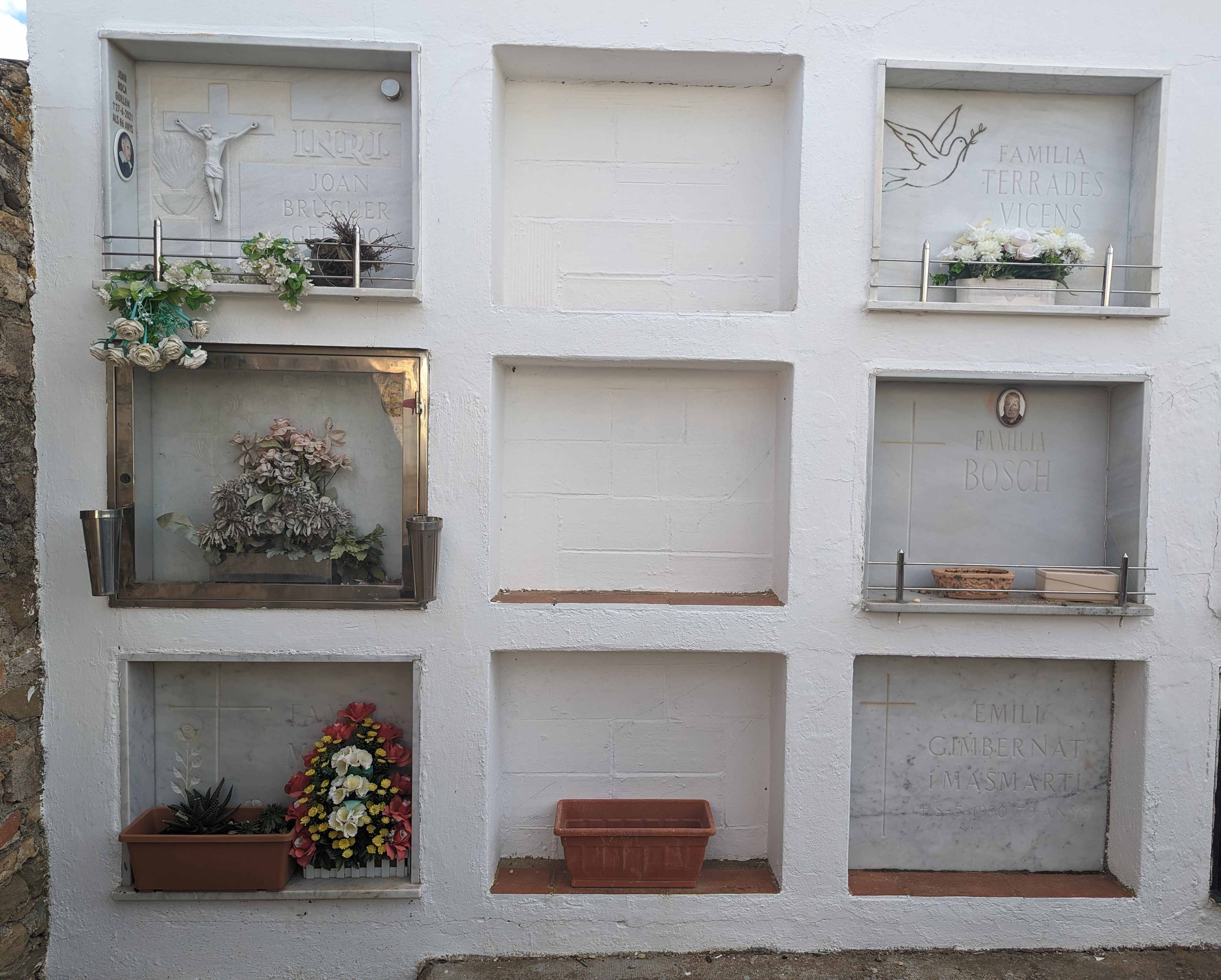
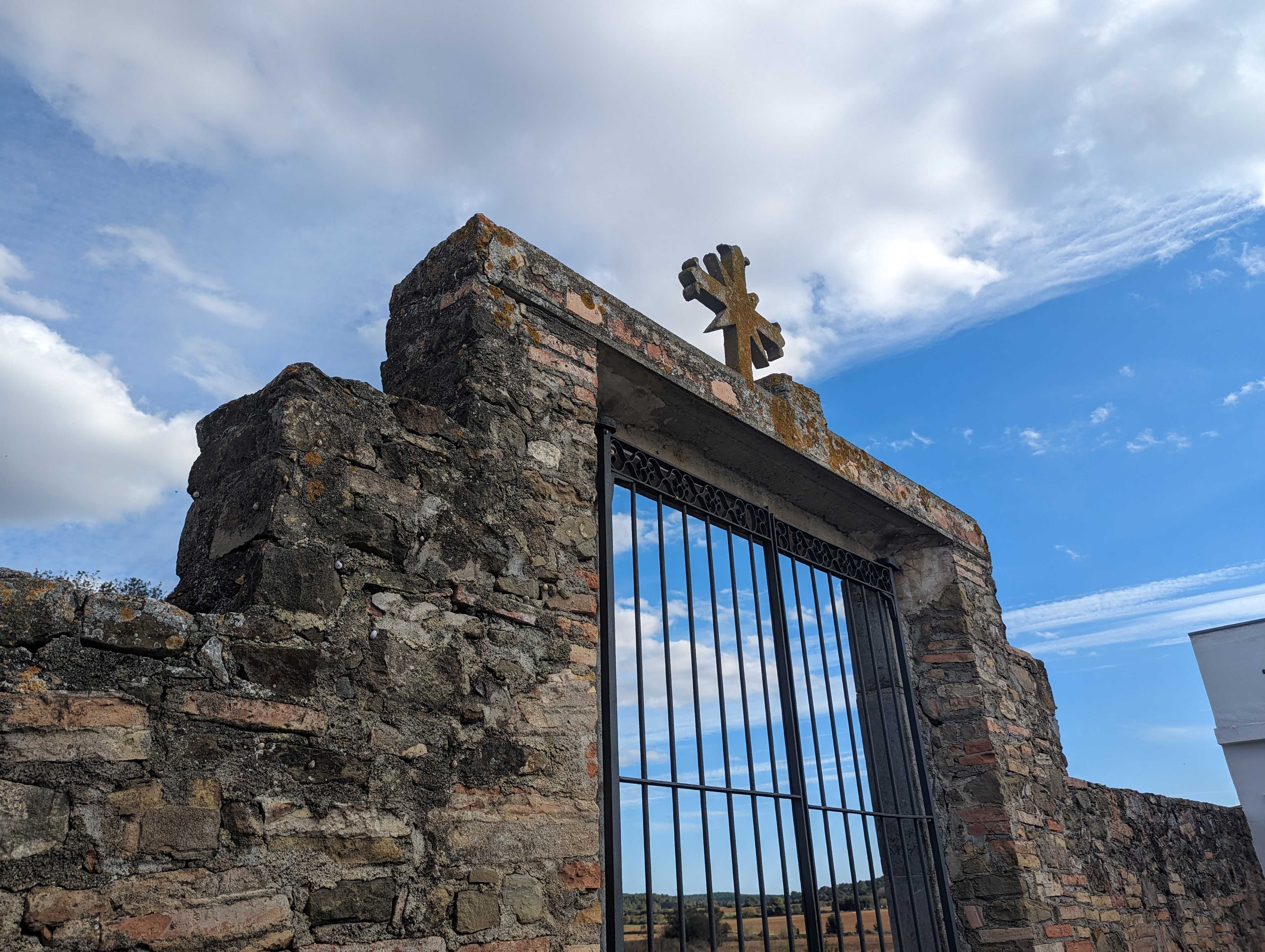
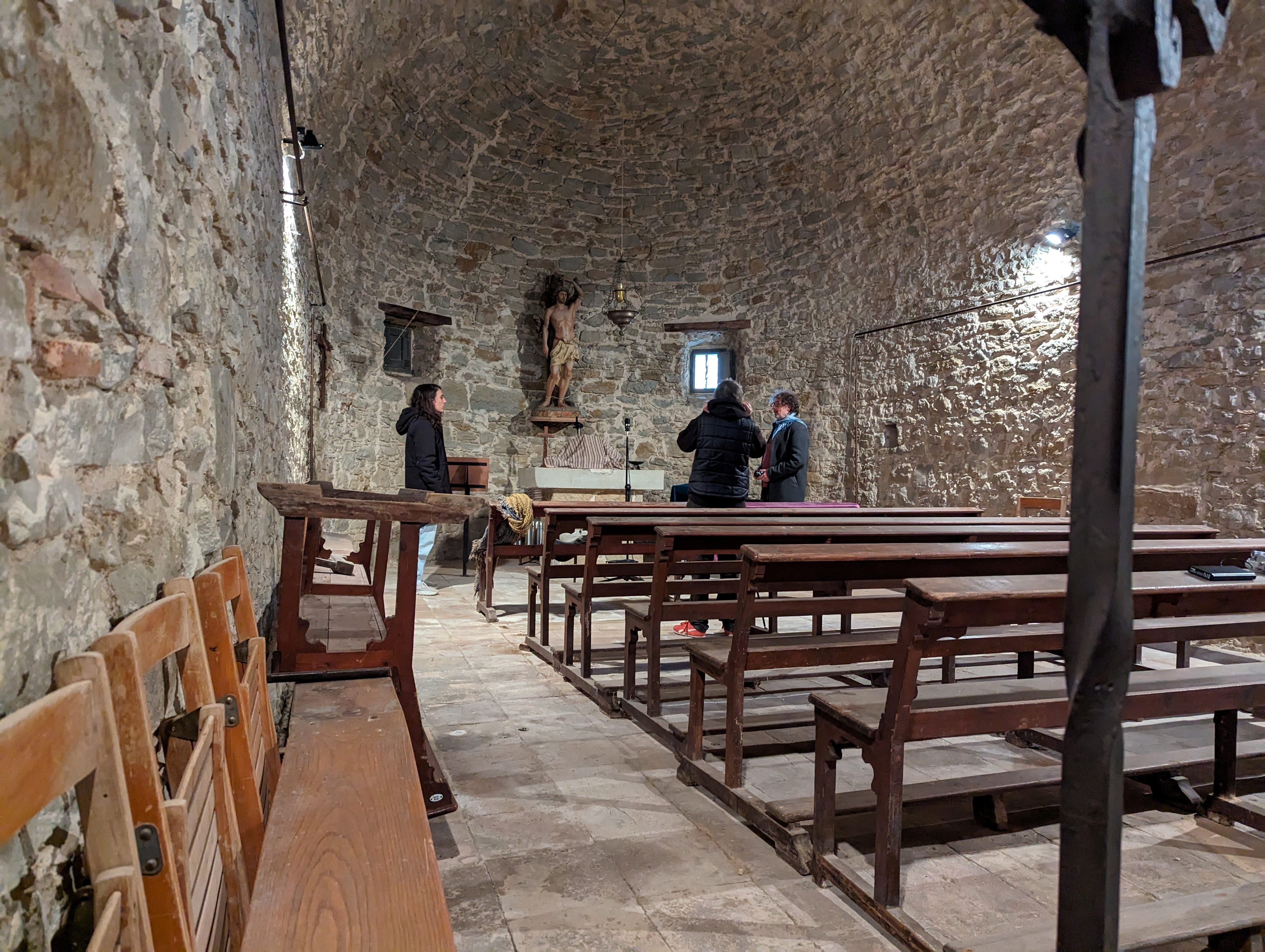
I have a history of walking pilgrimage, and although my pilgrimages have been secular rather than religious, it is interesting that this boundary walk developed 12 stages. I did not plan this in advance, it is just what emerged. Many pilgrimages are based on the Via Crucis, the 12 Stations of the Cross or Way of Sorrows, depicting the path Jesus walked to Calvary. It is said that the path was first mapped with stones by Mary, Jesus’ mother (it is known as the Via Dolorosa in Jerusalem). This Sound Walk has other spiritual associations: bird song and bells, a cemetery stage, and one at the Chapel of Saint Sebastian who had a particularly violent death.
In the 12 spaces, I listened; I dreamed into them. This method of ‘feeling into place’ is quiet. My art practice has made me sensitive to the nuances of somewhere, and I’m always attending with respect, sitting as in meditation with an open mind and accepting what arises. I’m noticing what I feel in my body, what emotions, memories, and thoughts come to me, and I have tried to convey that to you through this soundscape. I hope that what speaks to me is in a universal language that can be effectively communicated. I also invite you to sense each stage yourself and respond.
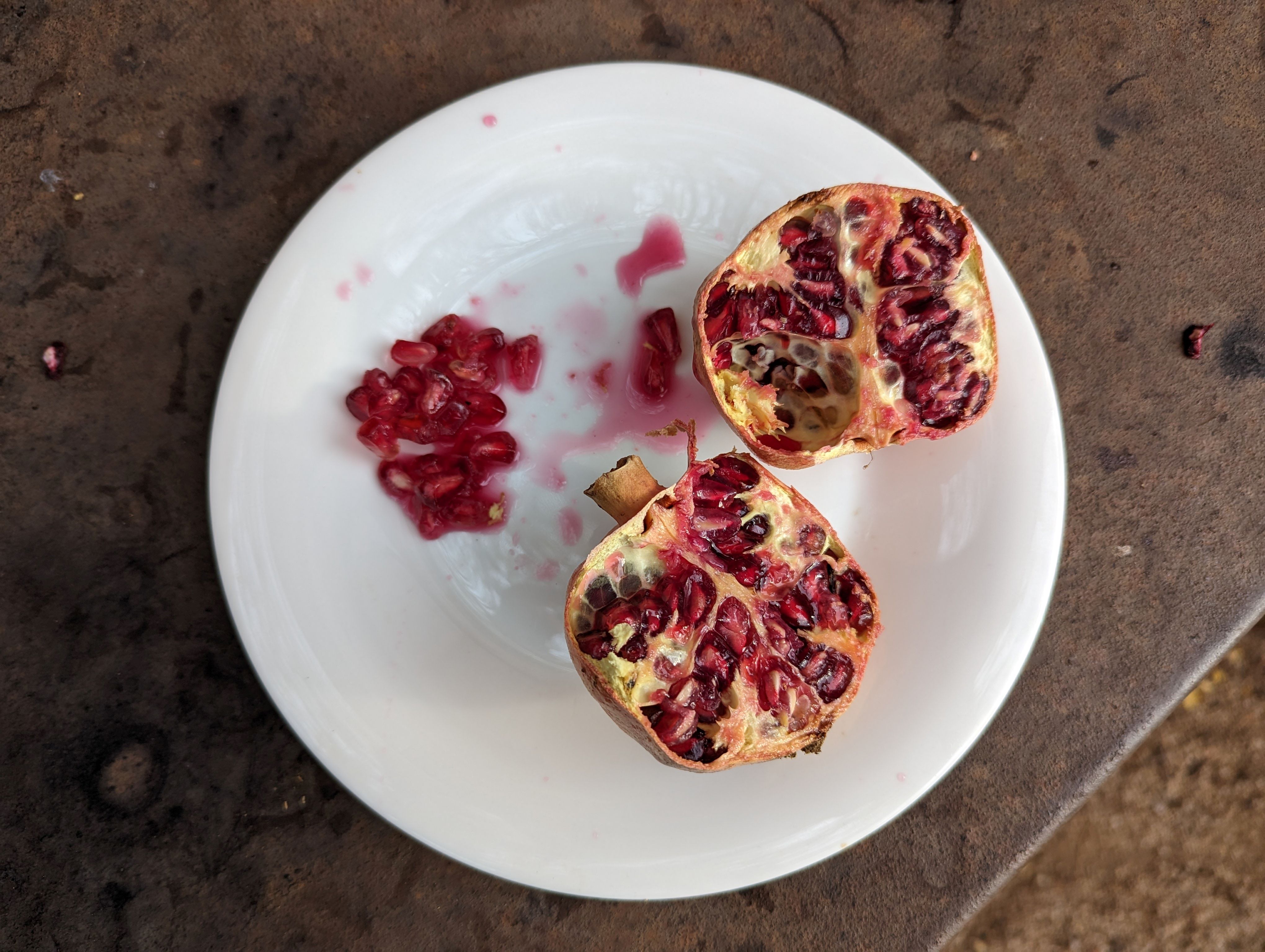
A pomegranate from Stage 3, Nau Côclea
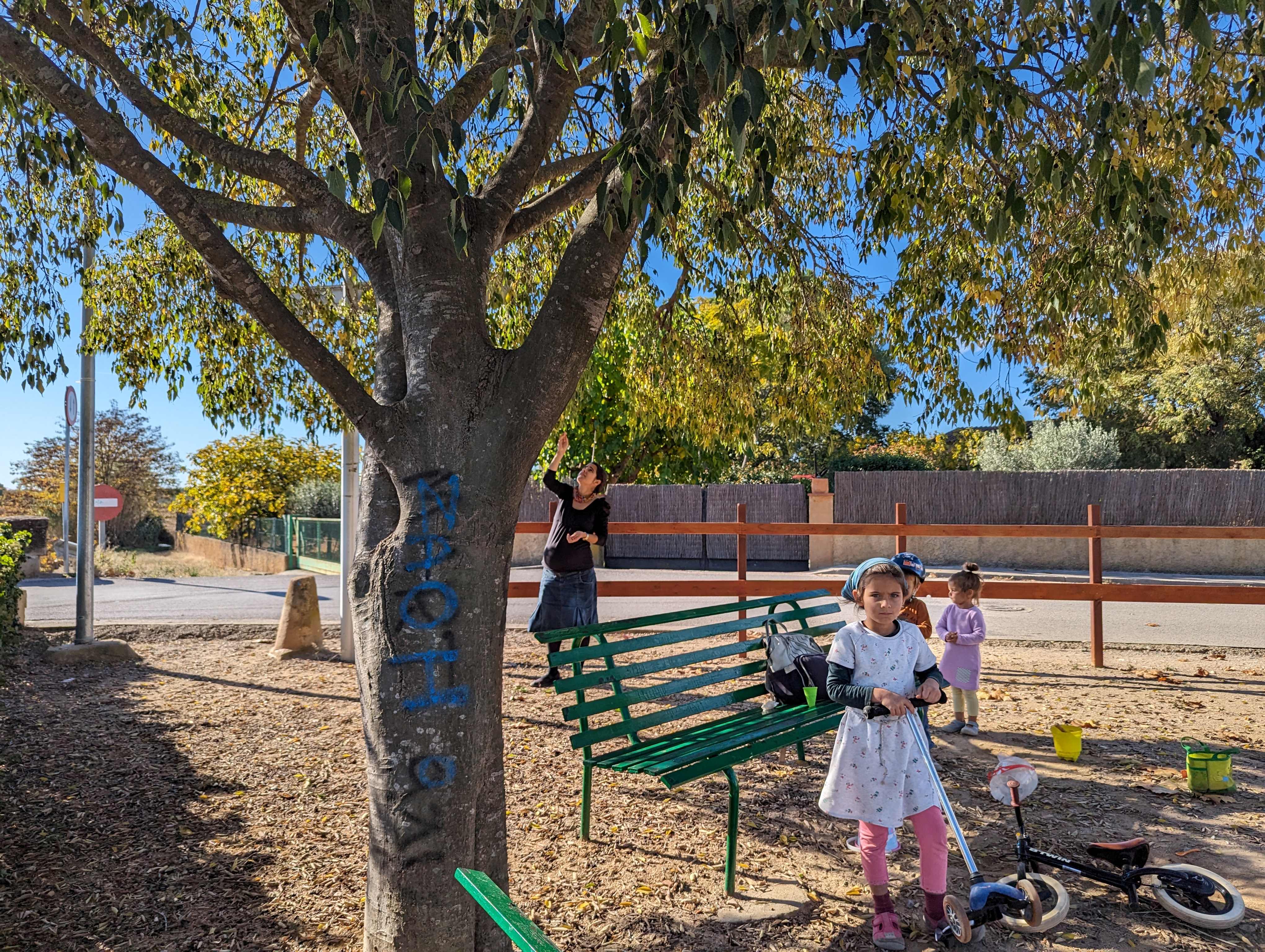
In every microcosm is the macrocosm. Therefore, when you take a seat, or pause under the sweet white acacia tree, you are not only in a playpark or on a pavement, you are in a whole environment. You stand on top of an ancient land, a topography of millennia; you are amidst a community of human and other-than-human beings (herbs, insects, for example); and you are under a vast, borderless sky. Your own electrical energy will immediately engage with that of those beings beside, under and above you. When you open to that flow and connection, you will be able to pick up the subtle connections.
We are all so different
You and I will experience the Sound Walk differently. I brought all my life experiences with me to Camallera, and the audio responses are particular to me as an individual (not part of a pair or group) and a woman. I’m a certain age (60 years), and I’m Caucasian and privileged through education and upbringing. I’m not from Camallera, nor Cataluña (though I have spent 3 months here in the past 18), not even from Europe anymore, though I was, and feel as if I am. The audio I have made will reflect this.
And yet, I submerged myself in the place, filled myself with local stories, tried to make a soundtrack that contains all that. Although I don’t know how you will respond, I know that what’s in those places is limitless, that being in those spots with the sounds reverberating in your ears, head and nervous system, will give you the opportunity to listen through me, and beyond, may be a jumping-off place to another locality, connect you with someone else, or stimulate a feeling that doesn’t, in the first instance, seem related until you sink into it and let it trigger you. Can you sink through its layers and find points of contact, of resemblance and recognition?
The 12 stages
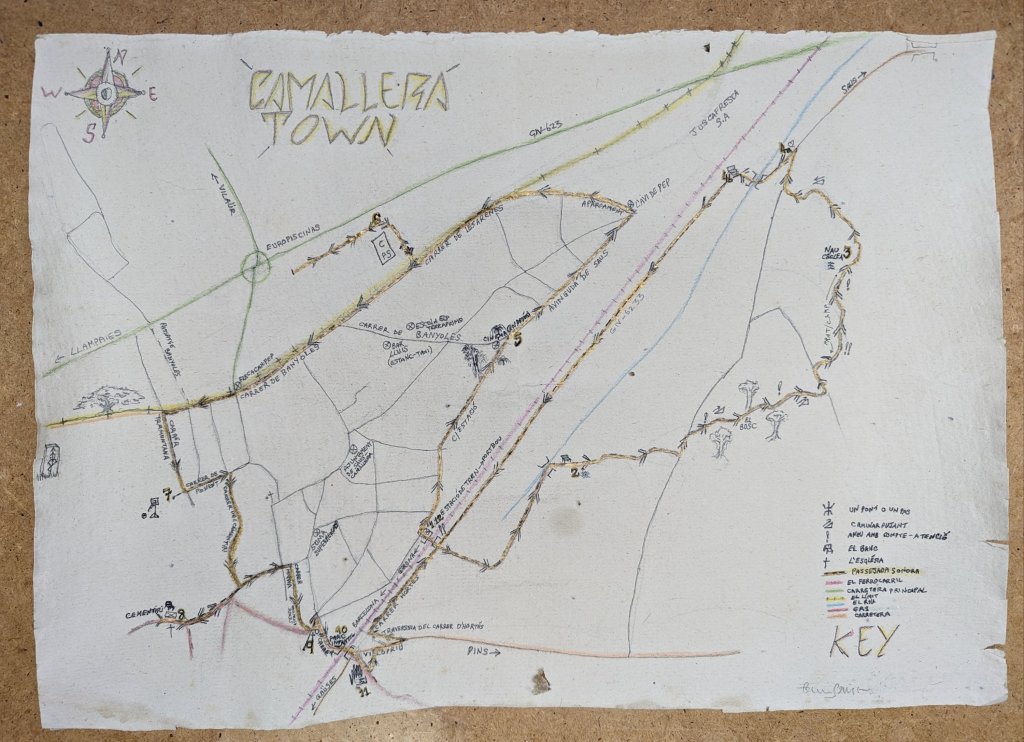
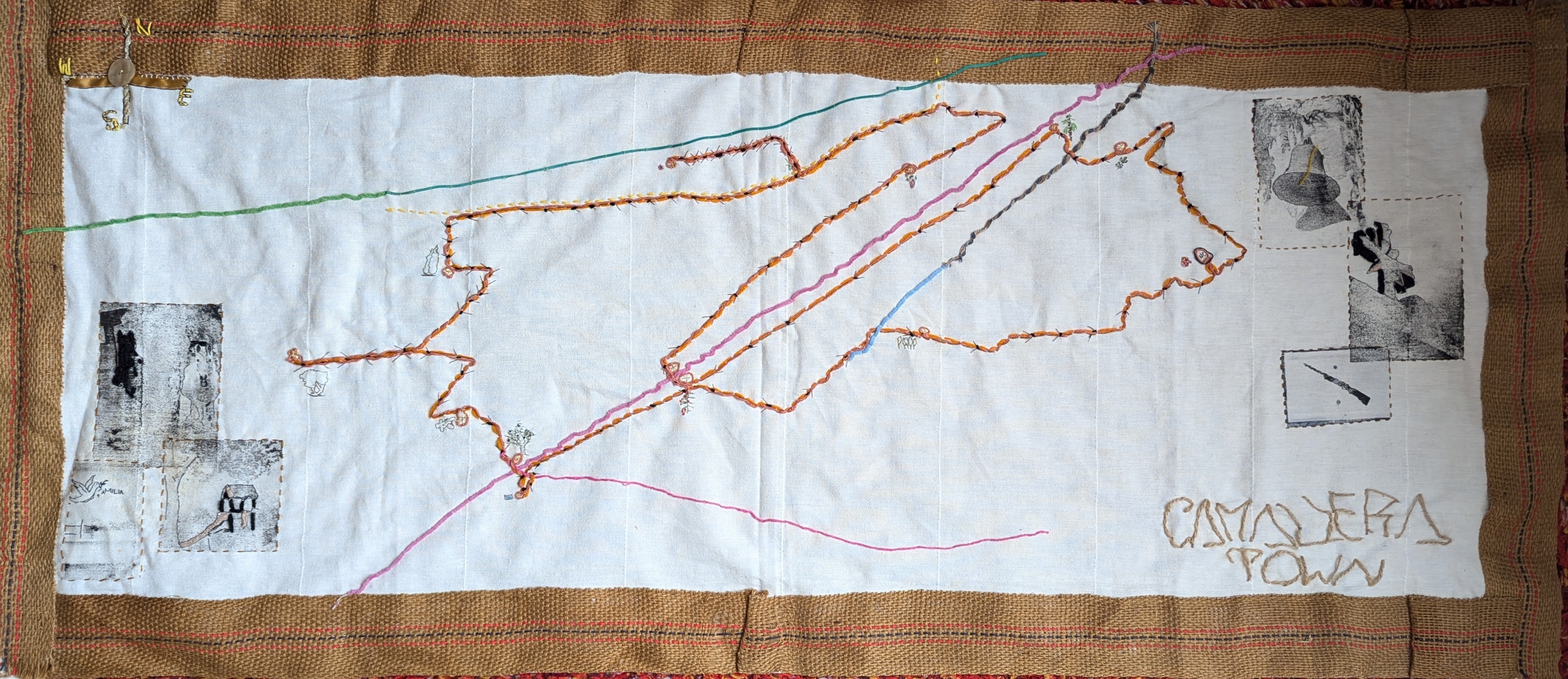
Sound Walk Camallera route map, drawn on 1950s handmade paper Stitched map, Camallera. Gift to Clara Gari
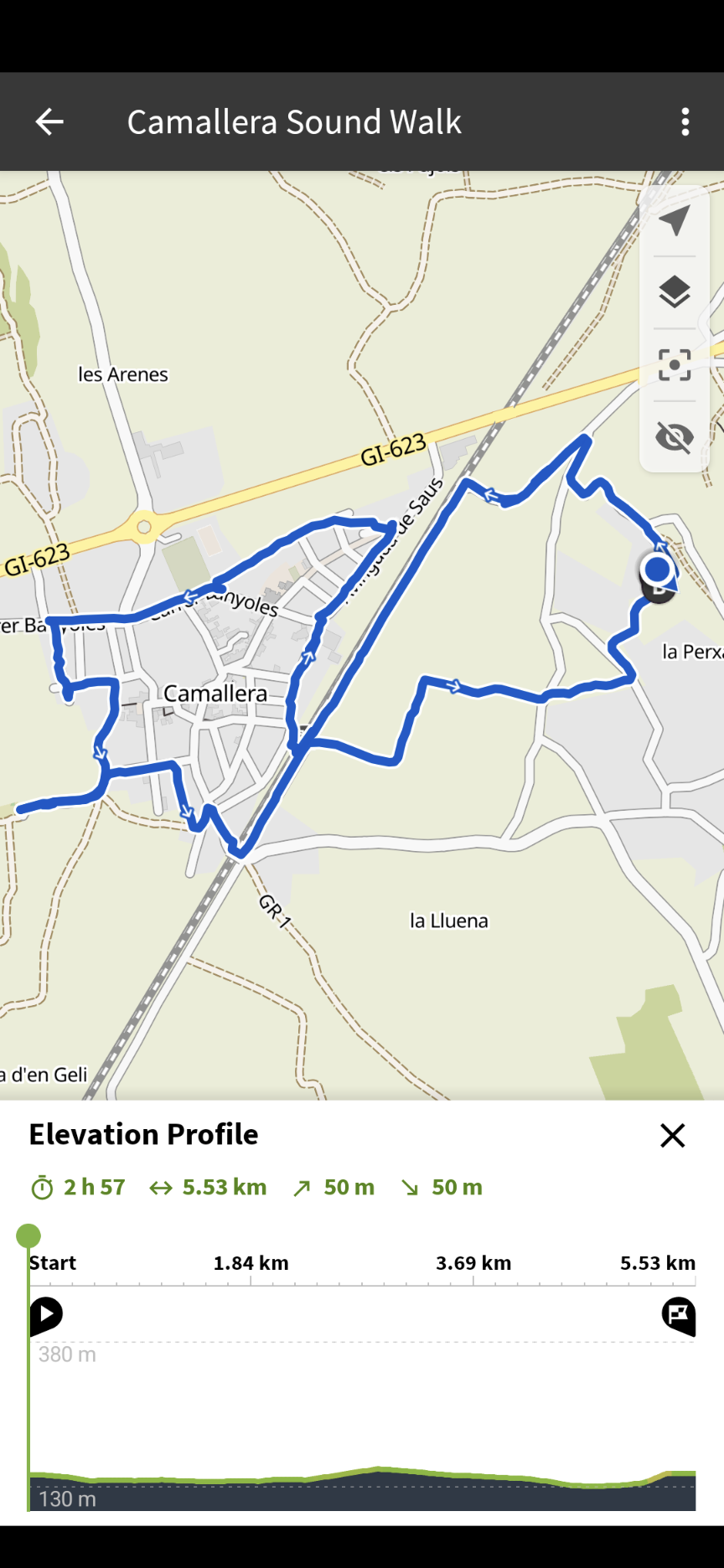
Here is the map. Enjoy your walk, whether you live in Camallera or are a visitor (in-person or virtual). There are other maps below, a pdf download, and it can also be found on the Komoot and Echoes apps.
Each stage is a resting place, and each of these resting places is also a transition from the previous stage to the next. Together they make up a whole and I hope you like exploring them as much as I did.
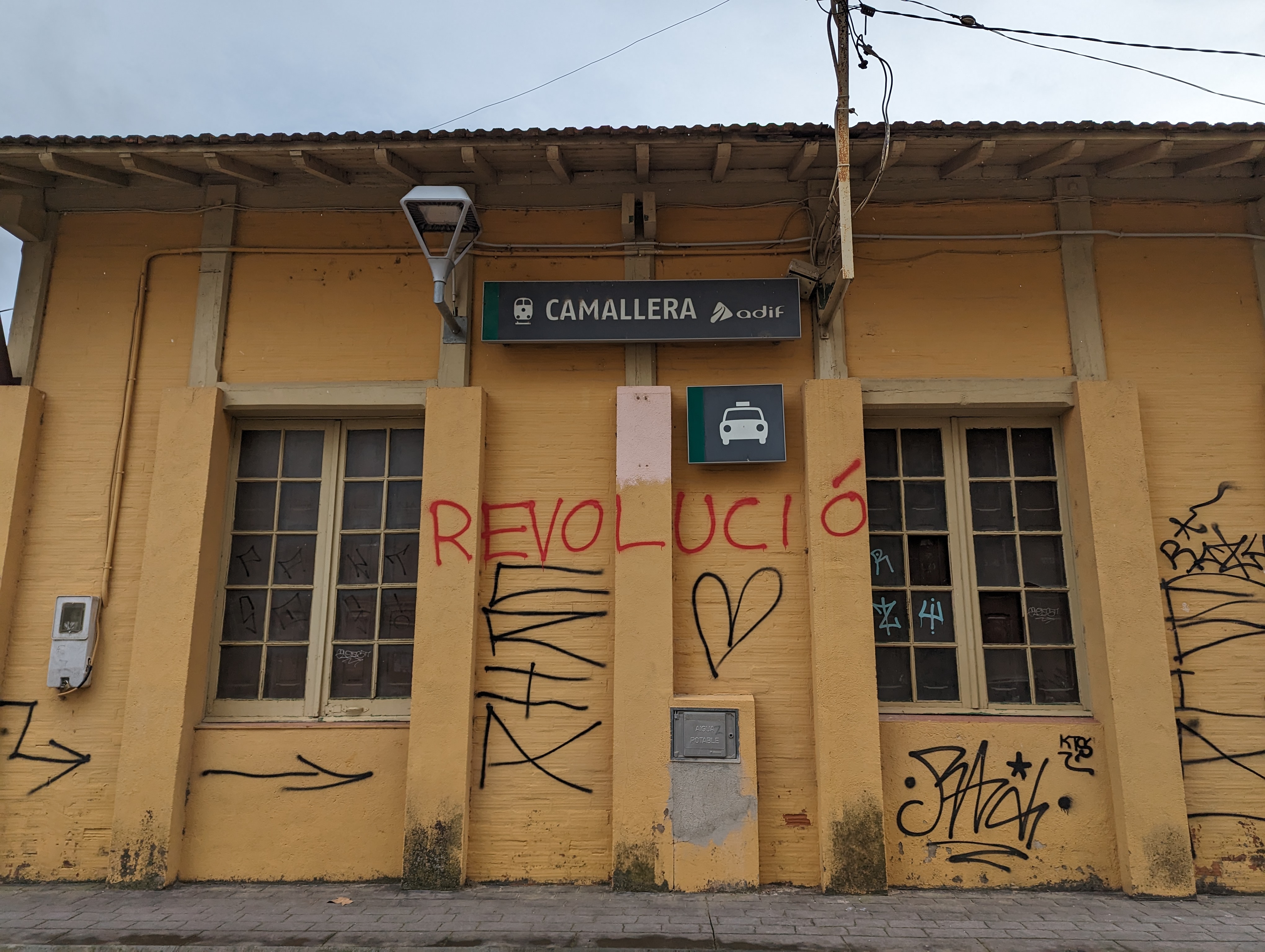
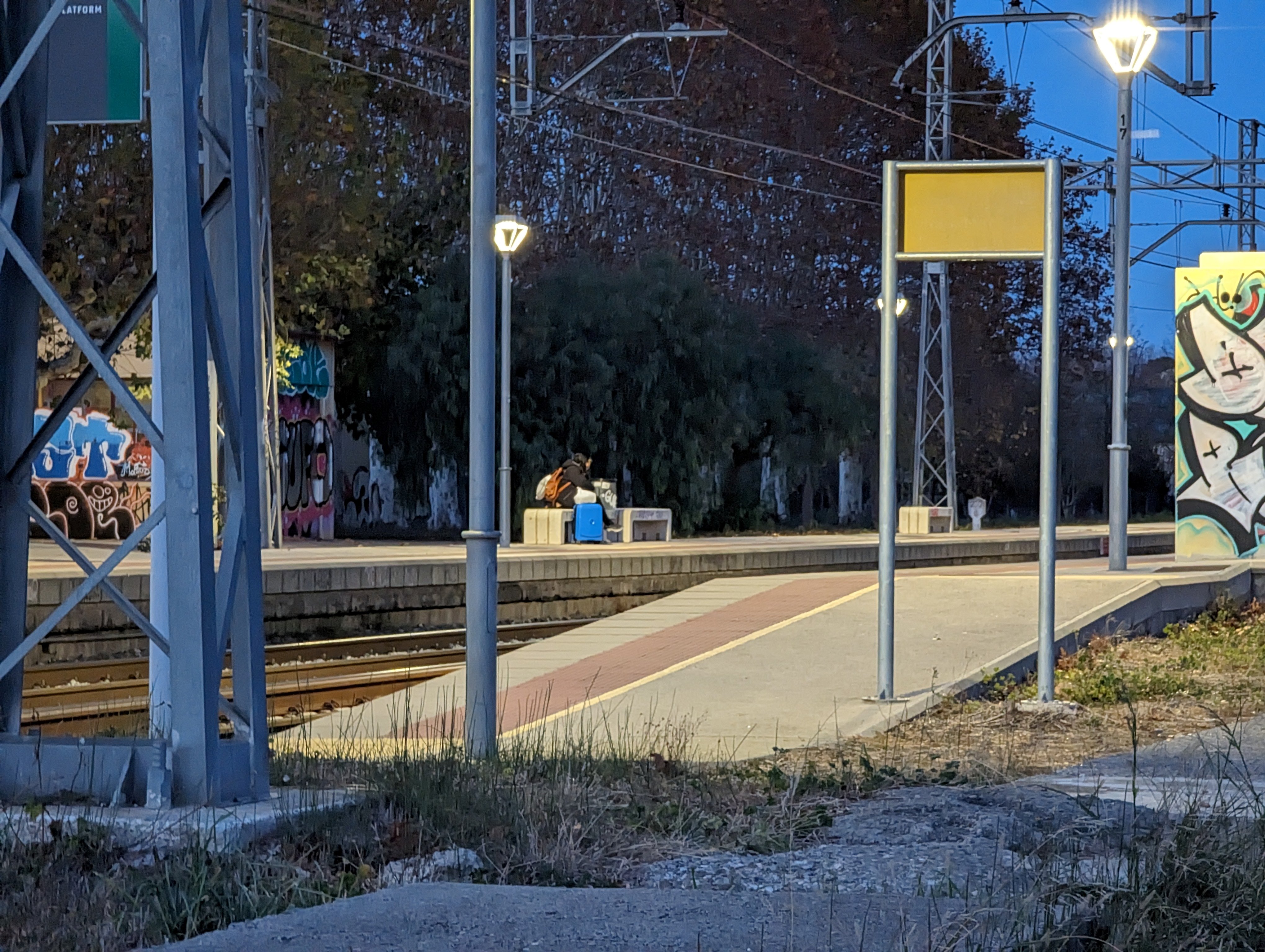
Stage 1, the stationTrain station
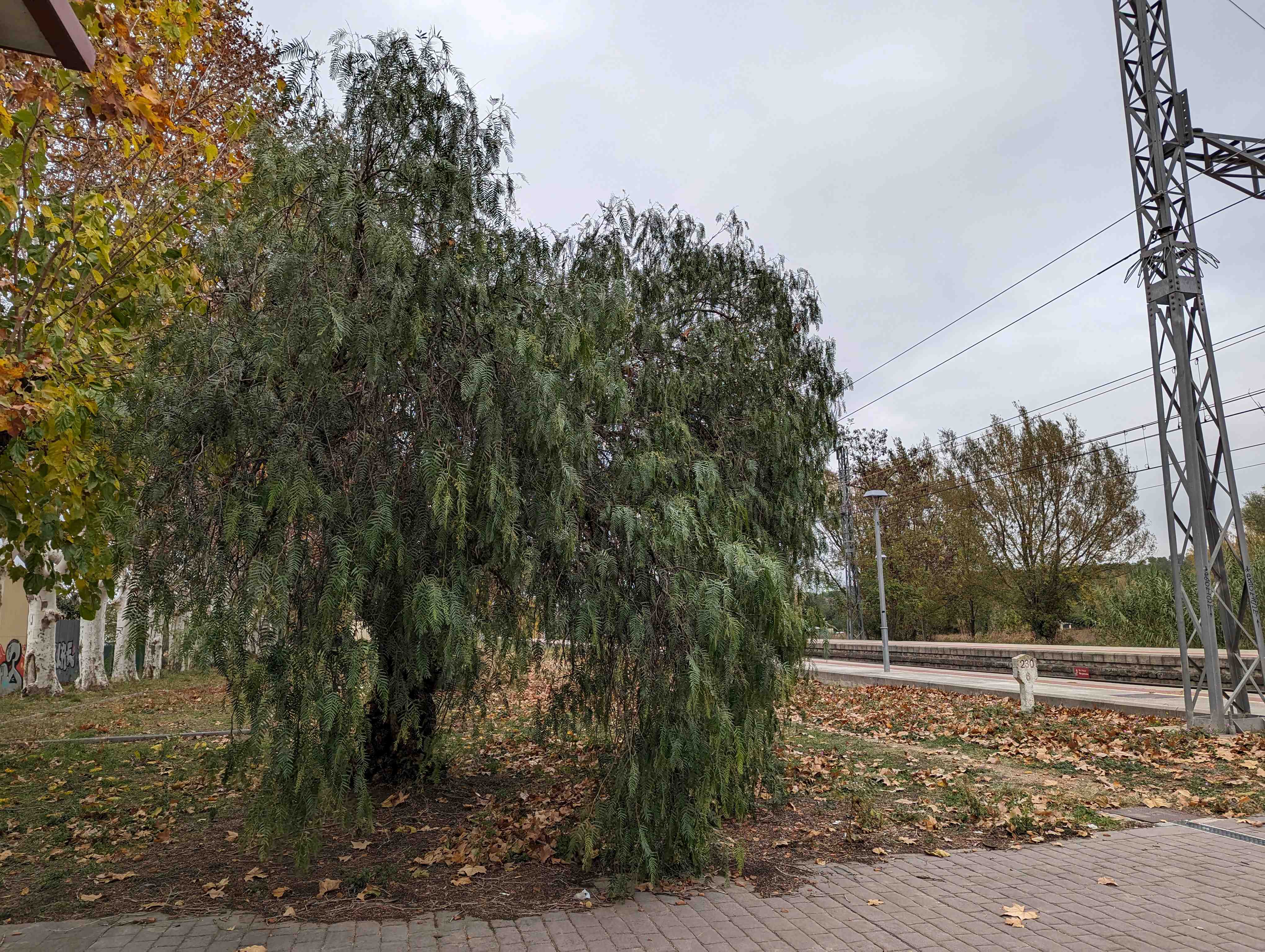
Stage 1 Arriving – Train station (Estacion de tren). Tree: Peruvian peppertree
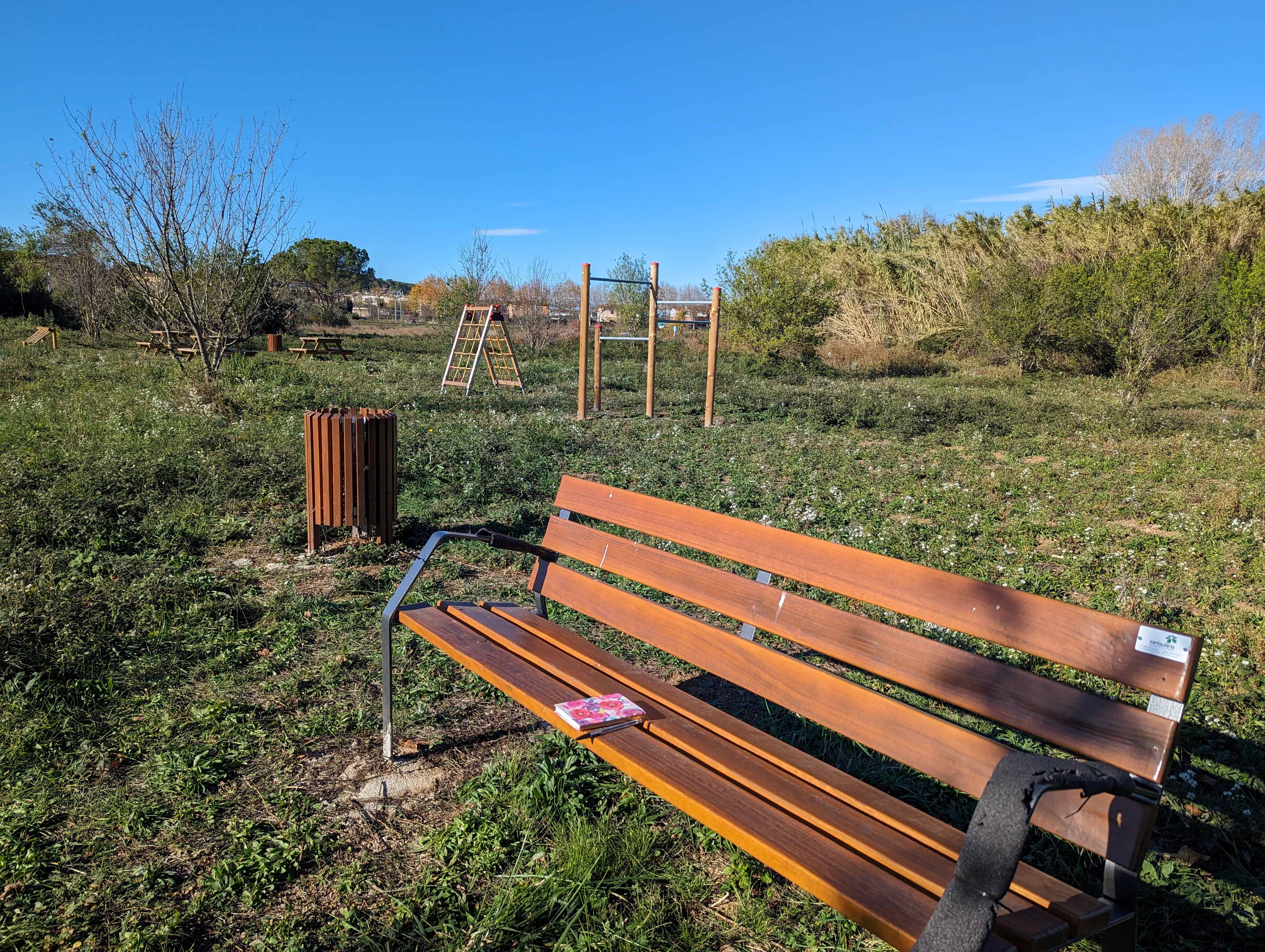
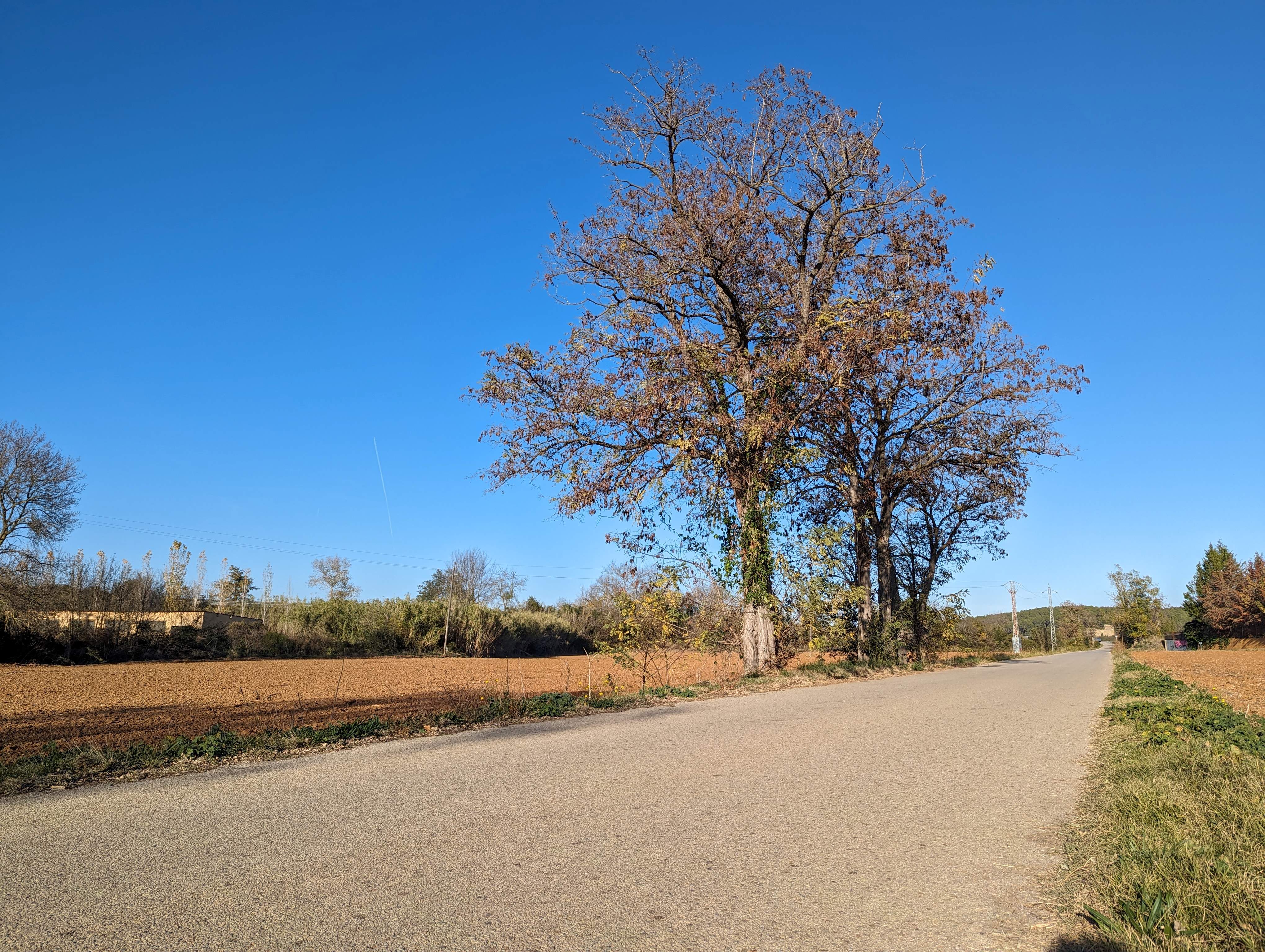
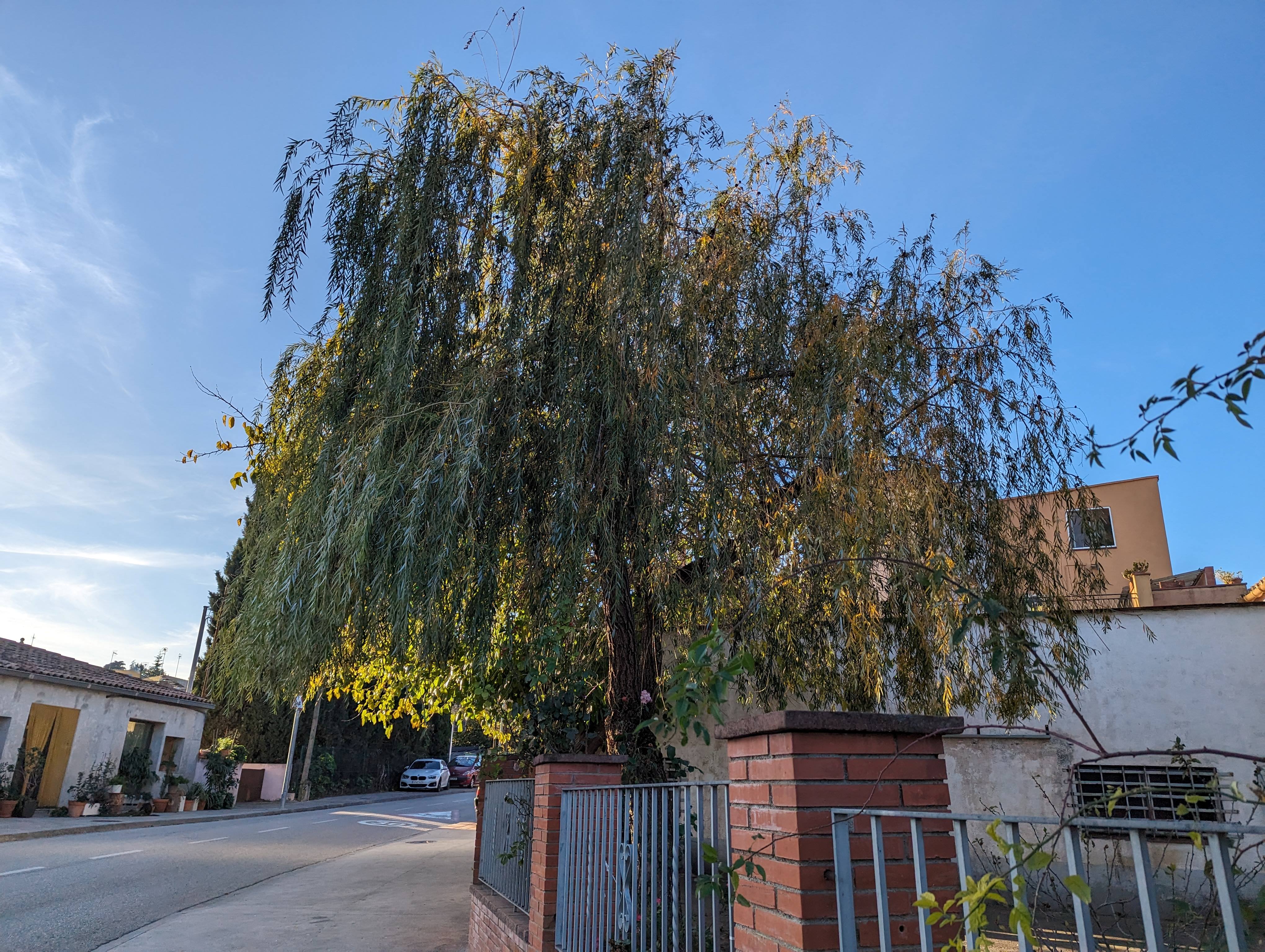
On the way to stage 2Stage 3: take a seat and admire the poplar trees (see photo below)
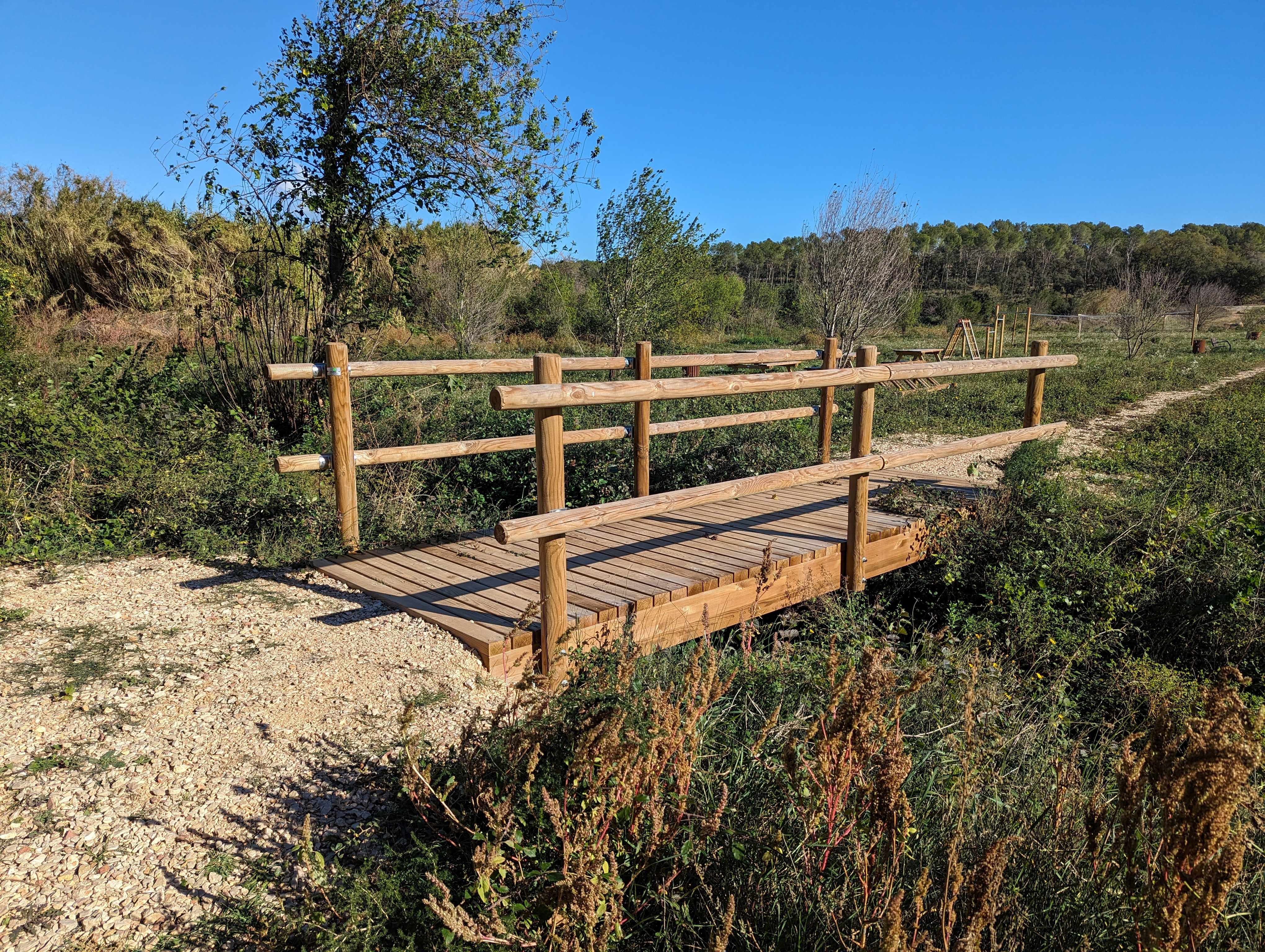
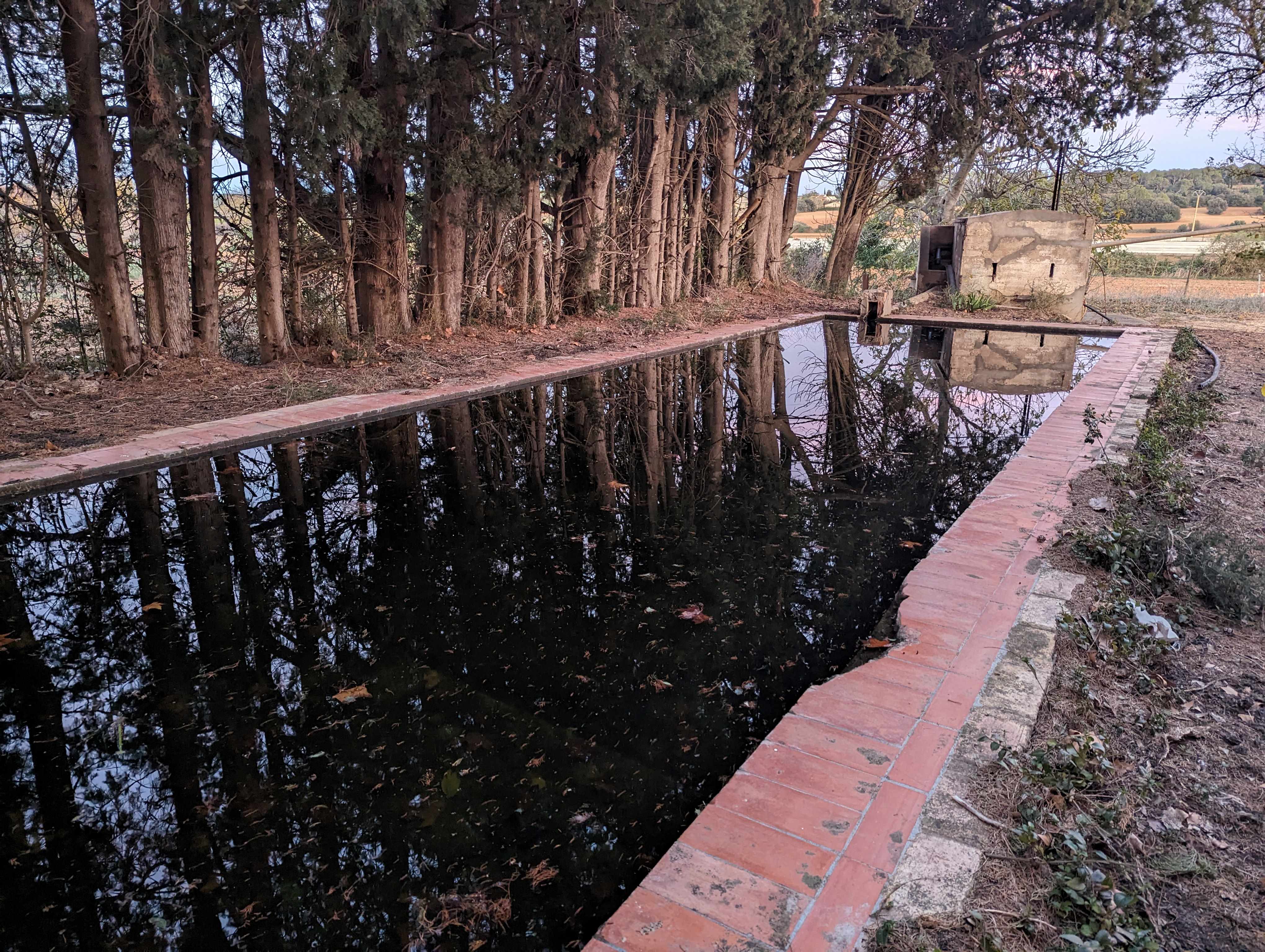
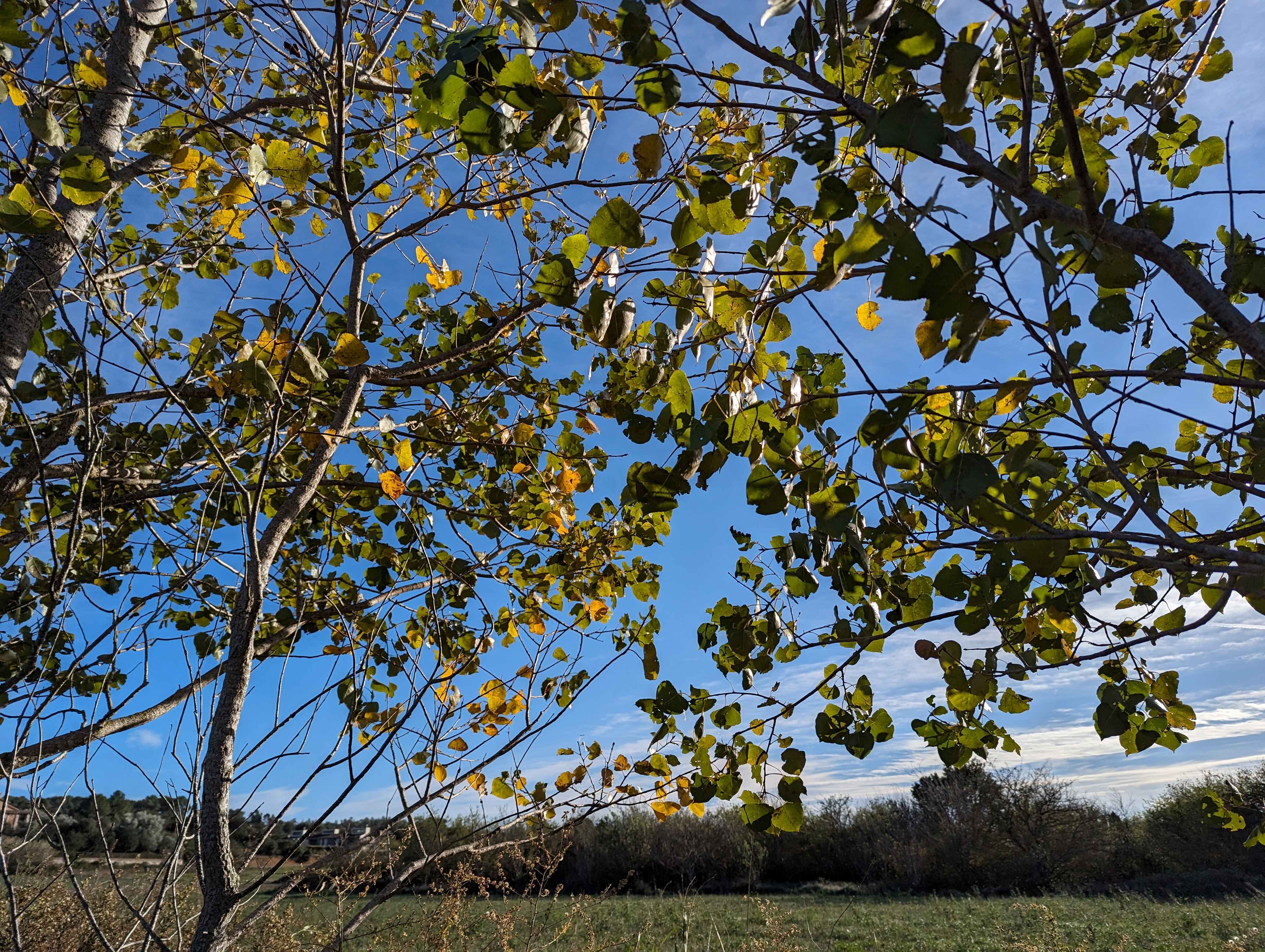
Stage 2 Listen to the water – Recreation area. Tree: 5 poplars
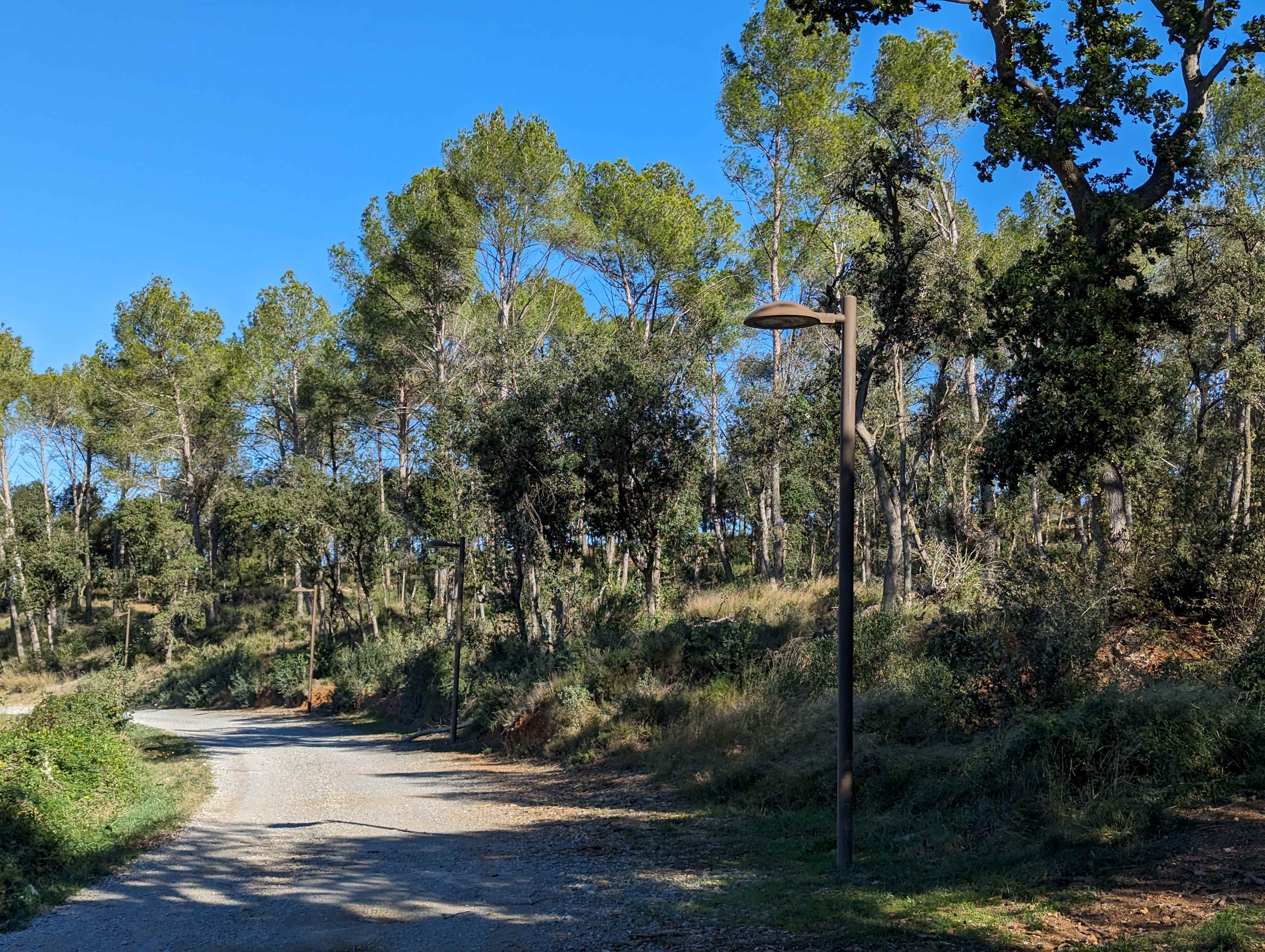
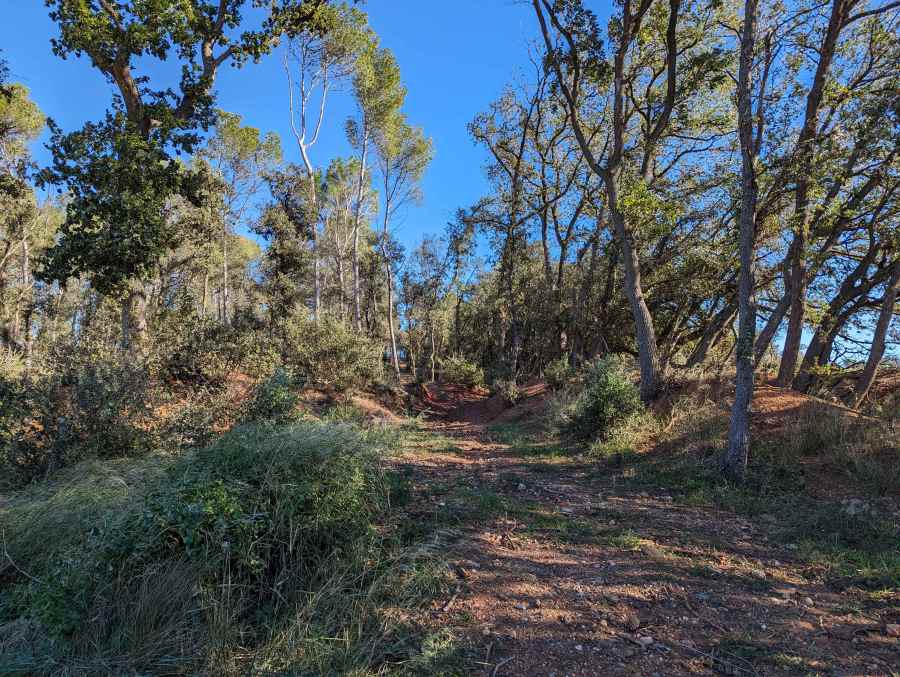
Cross over the roadUmbrella and Scots pineWalk uphill through the woods Turn left along a roadTurn right & take path at dead endCareful of the drop
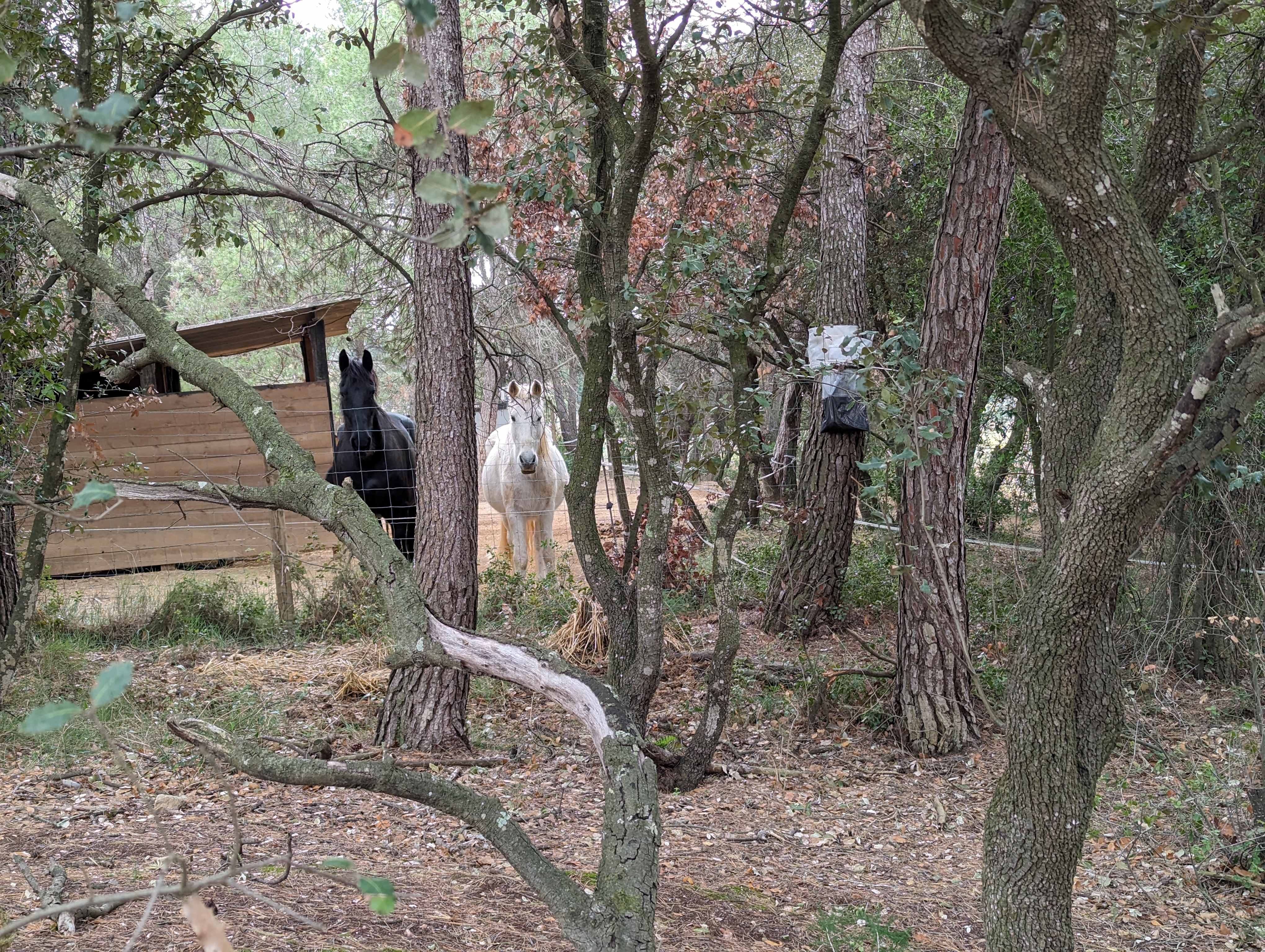
From the recreation area, walk on until the end of the path (there are two huge stones at the entrance). Cross over the road. Walk uphill through the woods along an uneven path (look out for 2 horses, 1 black and 1 white on your left), turn left along a road for a short time. Take the first right, a dead end, and walk right to the end. Look for a path through the meadow, but be careful of the small drop half way along where it turns sharply left. At the end of that path is another tarmac dead end road and stage 3 is on the left through a small gate.
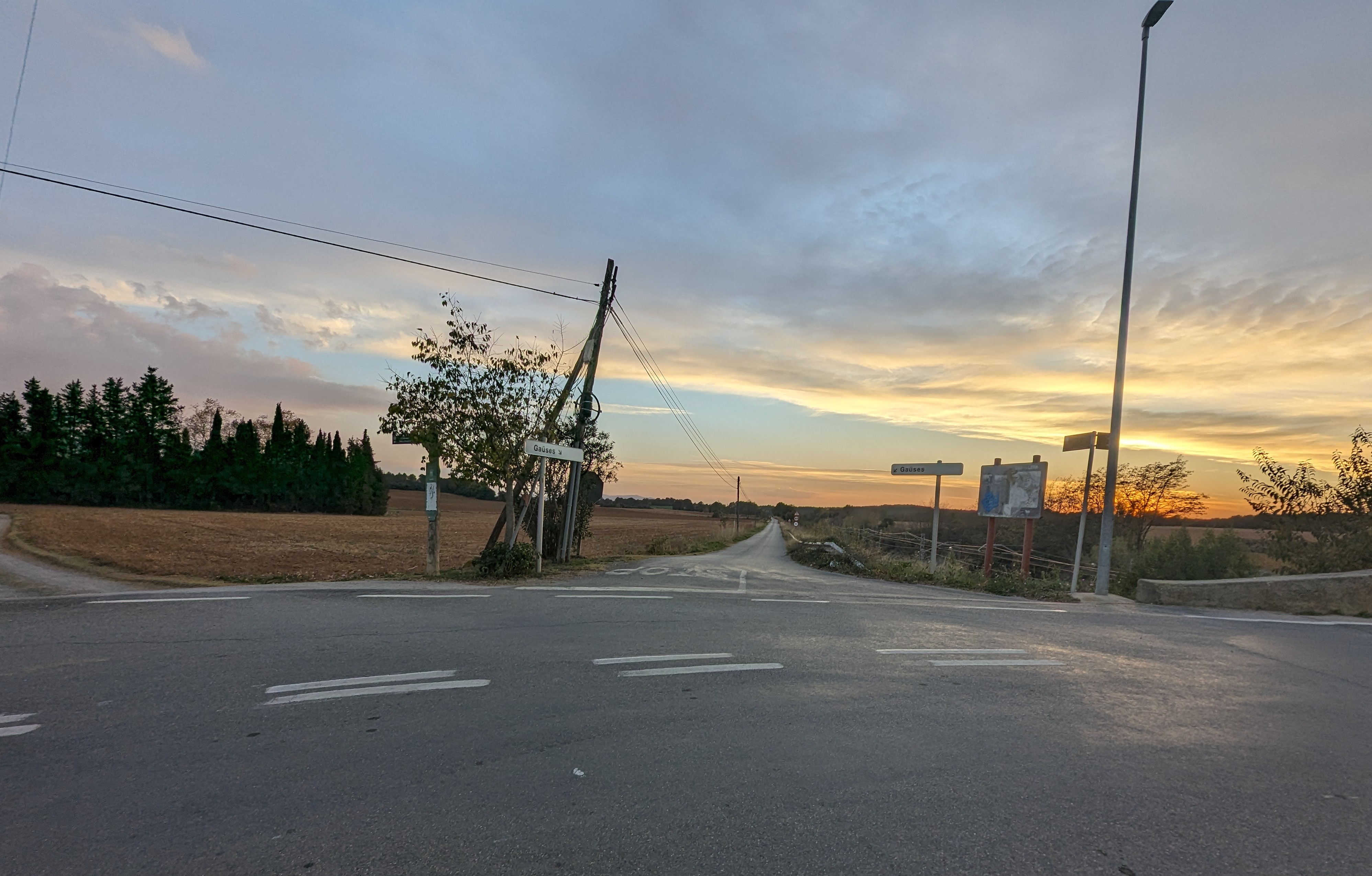
The bridge between Stages 10 and 11 is on the right, the road to Gaüses in the middle, and the small road to Stage 11 is on the leftEntrance to stage 11Stage 11
After leaving Stage 11, turn left towards the way you came but then take the next right, behind the houses, between them
Stage 12: Departing – Train station (Estacion de tren, reprised). Tree: Pink pepper tree
Train station Stage 12Peruvian Pink Pepper Tree
The Camallera Sound Walk and climate change
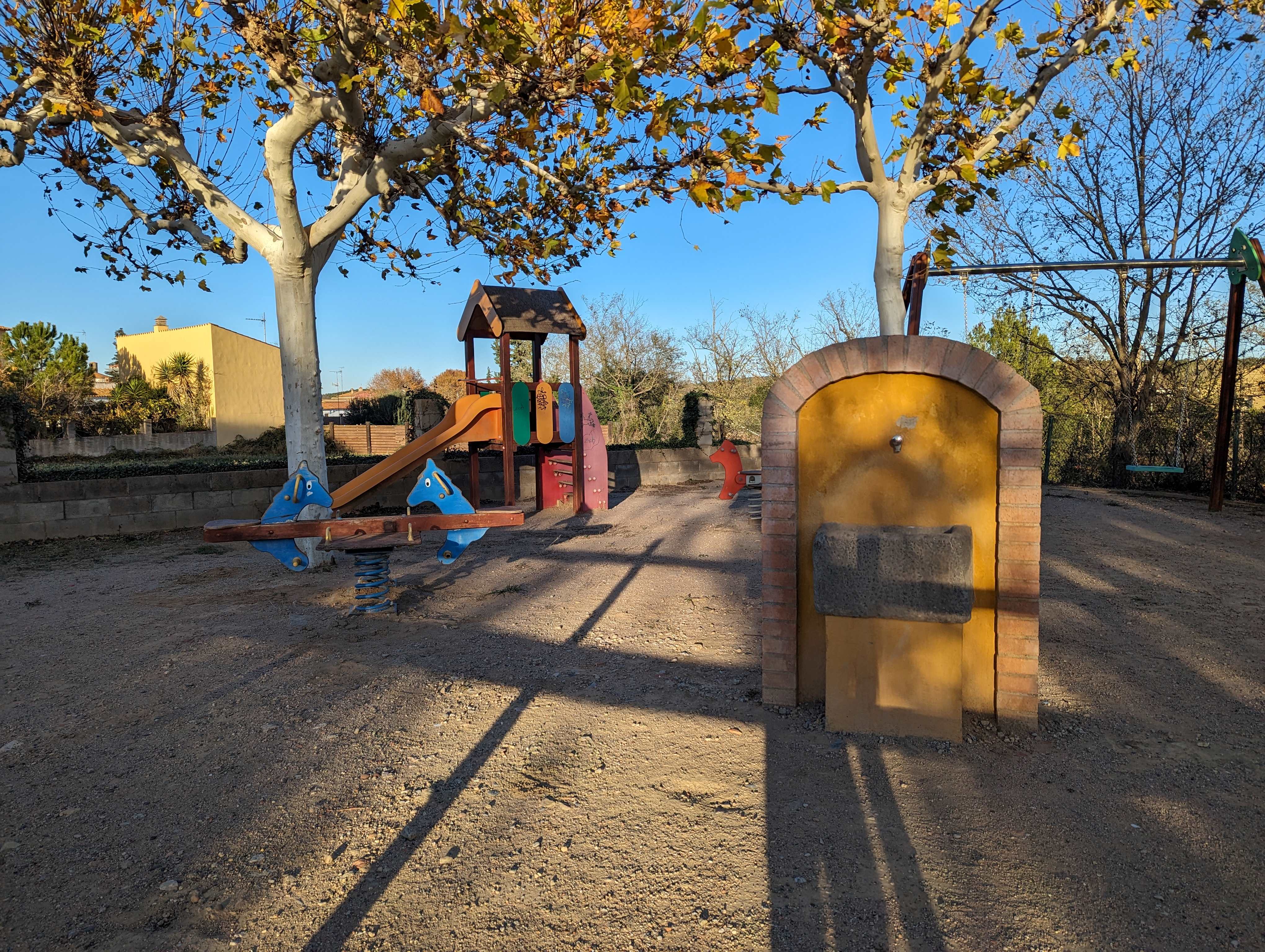
Under the pomegranate tree (stage 3)
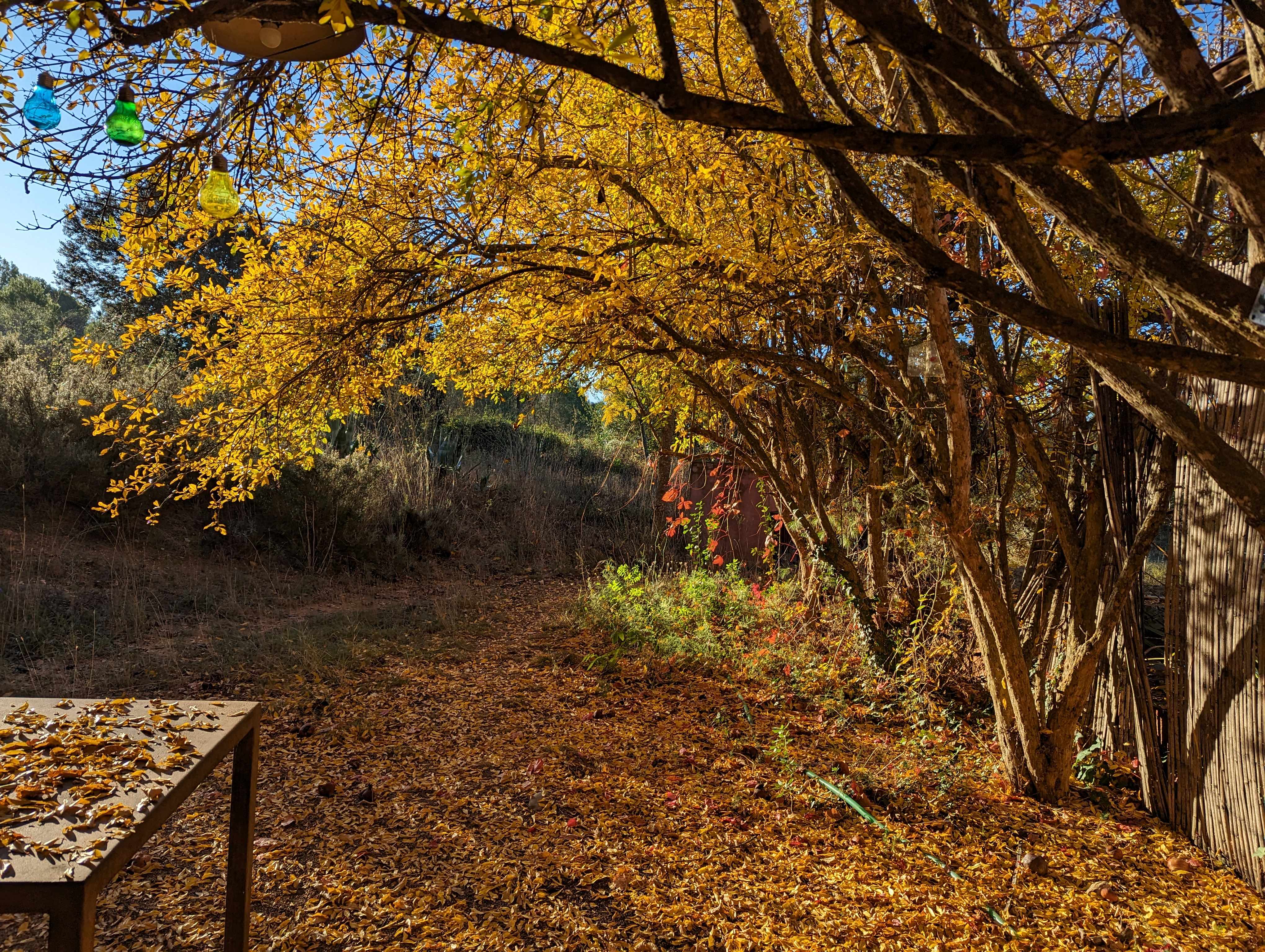
I was walking around the edge of Camallera at a specific time. I wandered during the change from Autumn to Winter when the leaves were turning from green to orange and amber, but red admiral butterflies still gorged on the fallen pomegranates.
The climate as we knew it in recent decades has changed rapidly, so when I walked in 2023, we were already years into an extensive crisis. It rained properly once, and spat occasionally, but the area is still drier than it was even last year. Temperatures were on average 1.5 degrees (at times 2 degrees) centigrade hotter, though I left on a white, frosty morning.
2023 is the driest on record in the 109-year history of the Fabra Observatory and the driest in 73 years in parts of Bages, Osona and Moianès
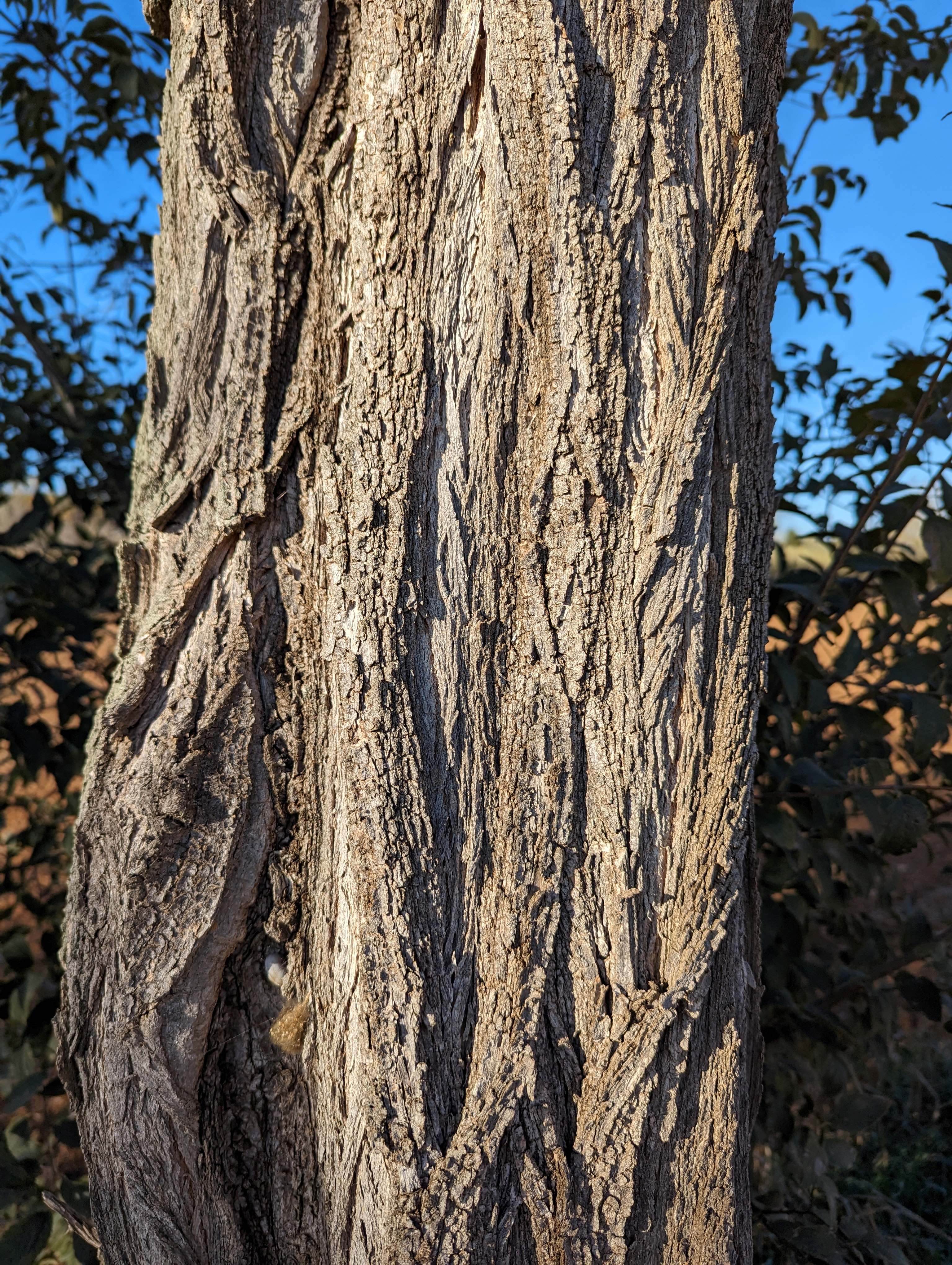
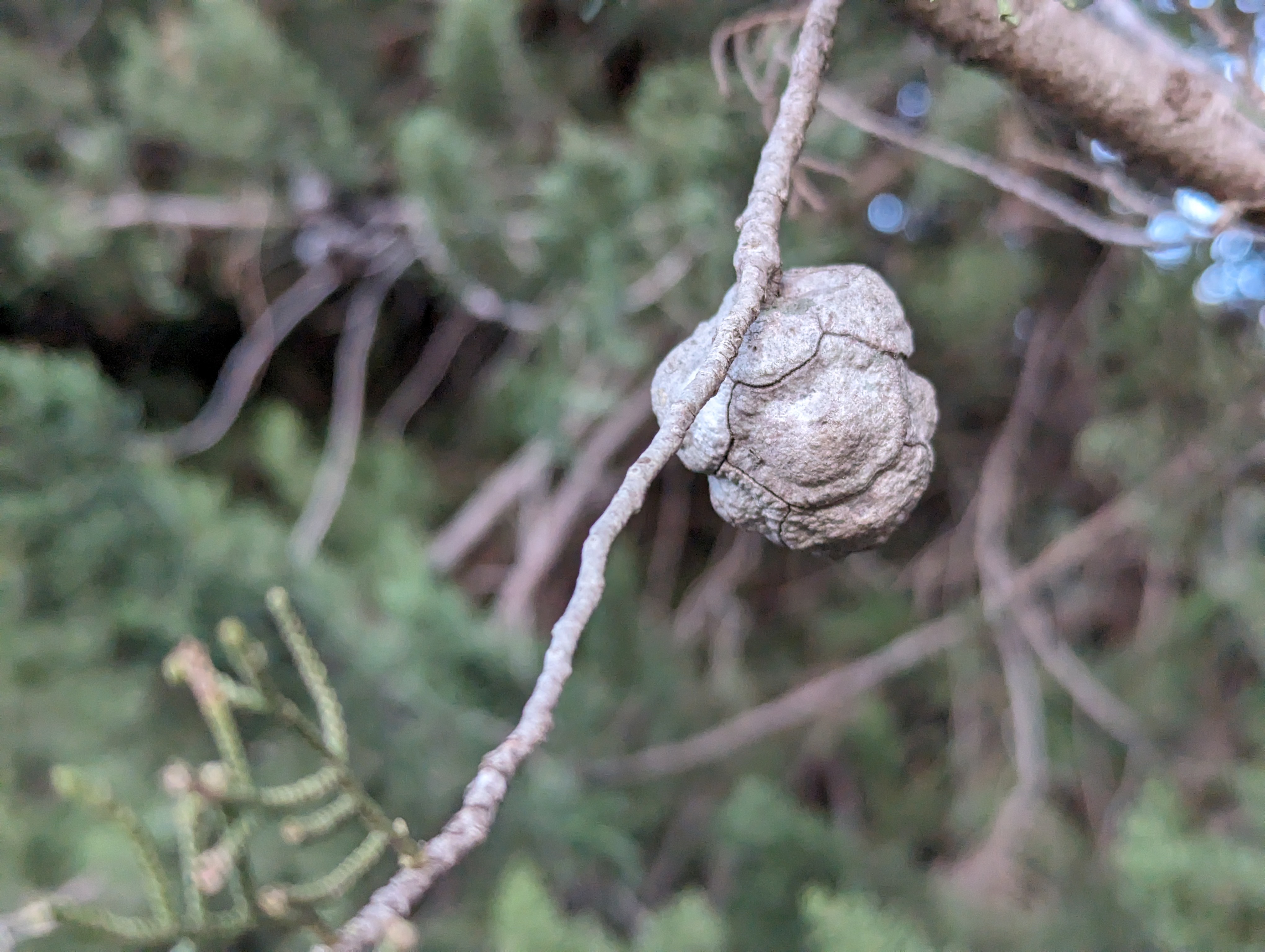
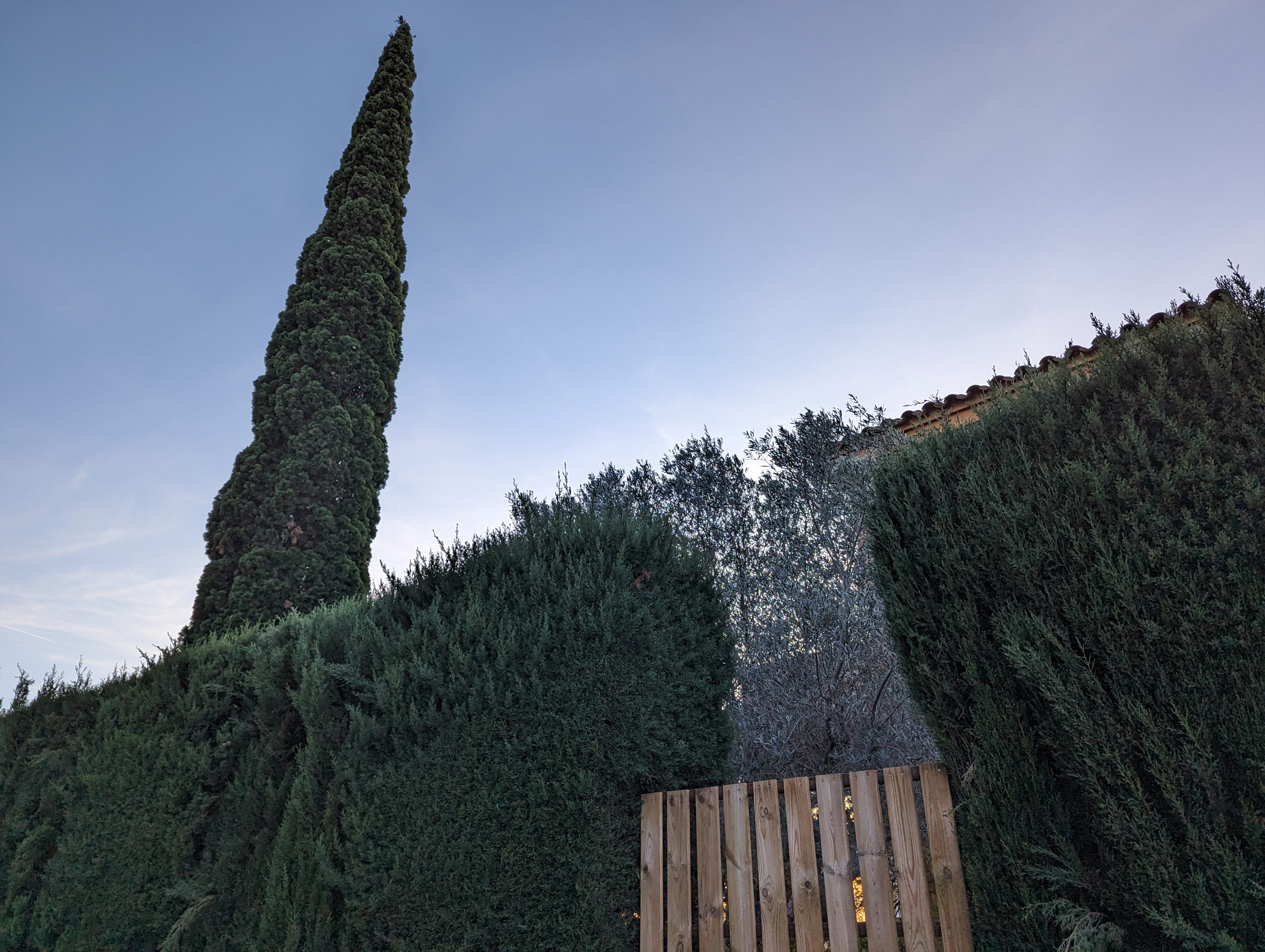
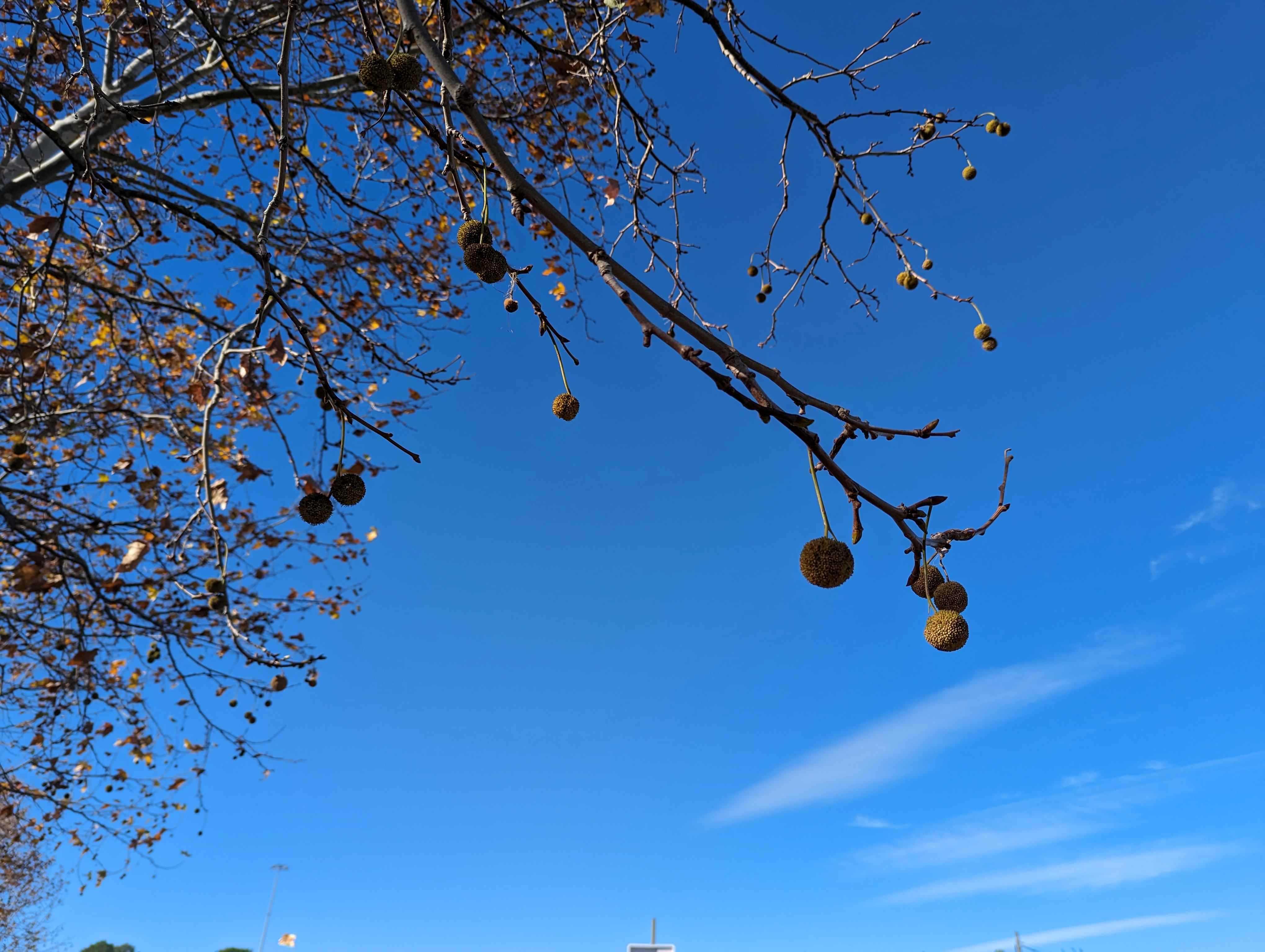
Camallera is rich in trees. There are plane trees (Platanus hispanica) everywhere, at almost every stage of the walk, but I have chosen others to give a sense of the variety in the area. There are more to be found between stages and if you venture inside the boundary.
Senses
Remember to taste and smell too! At each stage, roll your tongue around in your mouth, swallow the saliva, focus on what taste is there. Is the flavour of stage 1 different from stages 2, 3, 4 … ? You will find wild fennel, rosemary and thyme to satisfy your tastebuds.
At each stage, take a deep smell of the space you are sitting or standing in. Does it smell differently from your home or from the way it smelled in the previous season of the year? Savour the scent of pines and sage when you crush it, the warm tarmac in the sun, and whatever else you discern.
The area is a feast for the eyes: the newly ploughed, ochre-coloured earth, the graffiti everywhere, the blushing fruits and golden leaves, all depending on the time of year.
Listen for animal sounds& human ones
Options
There are 3 optional loops that can be added to the Sound Walk. They don’t have recorded excerpts to listen to, but are rich in sounds.
Look out for the bell between Stages 3 and 4a
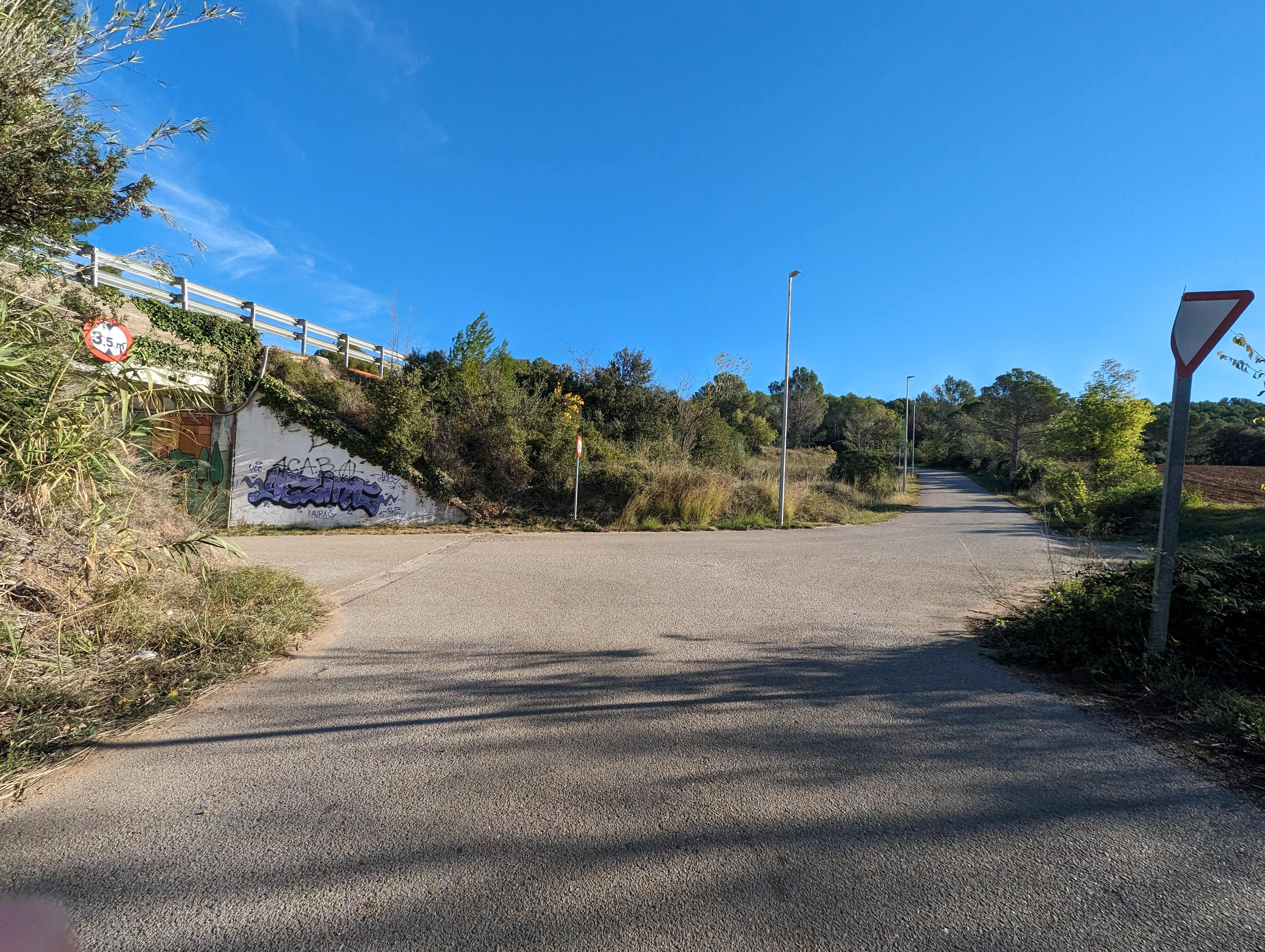
Option 1: Saus, between stages 3 and 4a. Leave Stage 3 behind you, walk downhill past the barking dogs and turn right (following the Sound Walk), but when you get to the sharp left-turn, continue instead straight on towards the main road GIV623. You are now on the GIV6233. Follow it around to the right and take a left through the underpass to the other side of the main GIV623. Take Carrer Oest into the town of Saus and don’t forget to visit the 11th century church – Església de Santa Eugènia de Saus. Please note that you have to go back the same way you came as there is no other route between Saus and Camallera.
On the GIV6233. The underpass is on the left of the photo
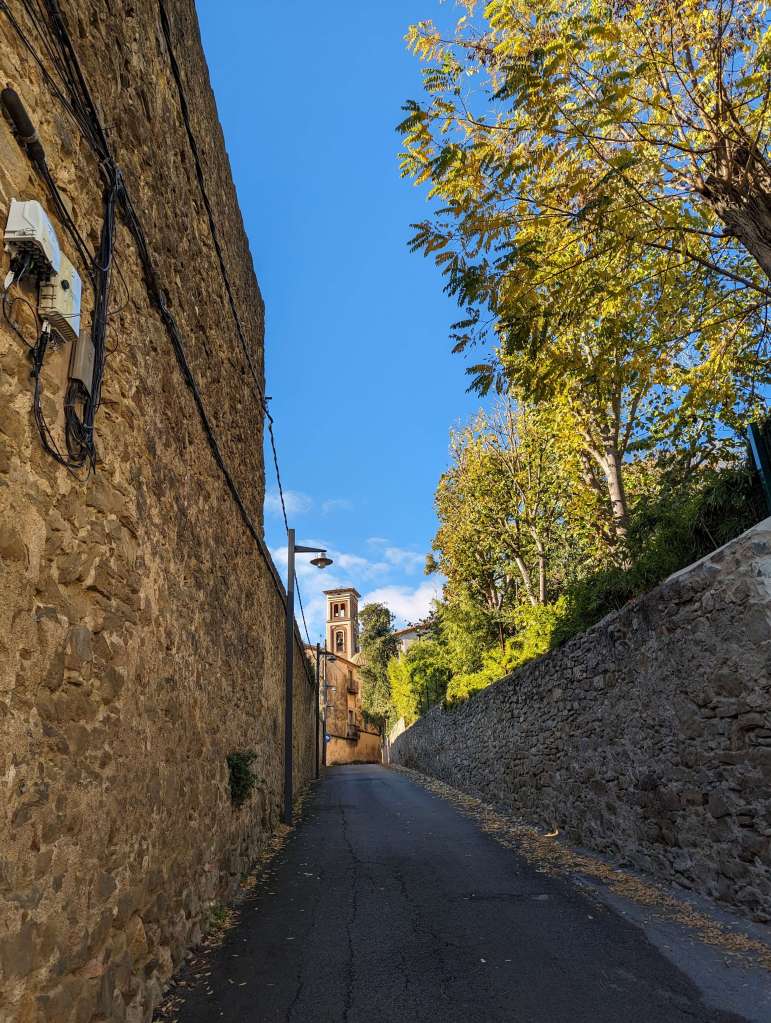
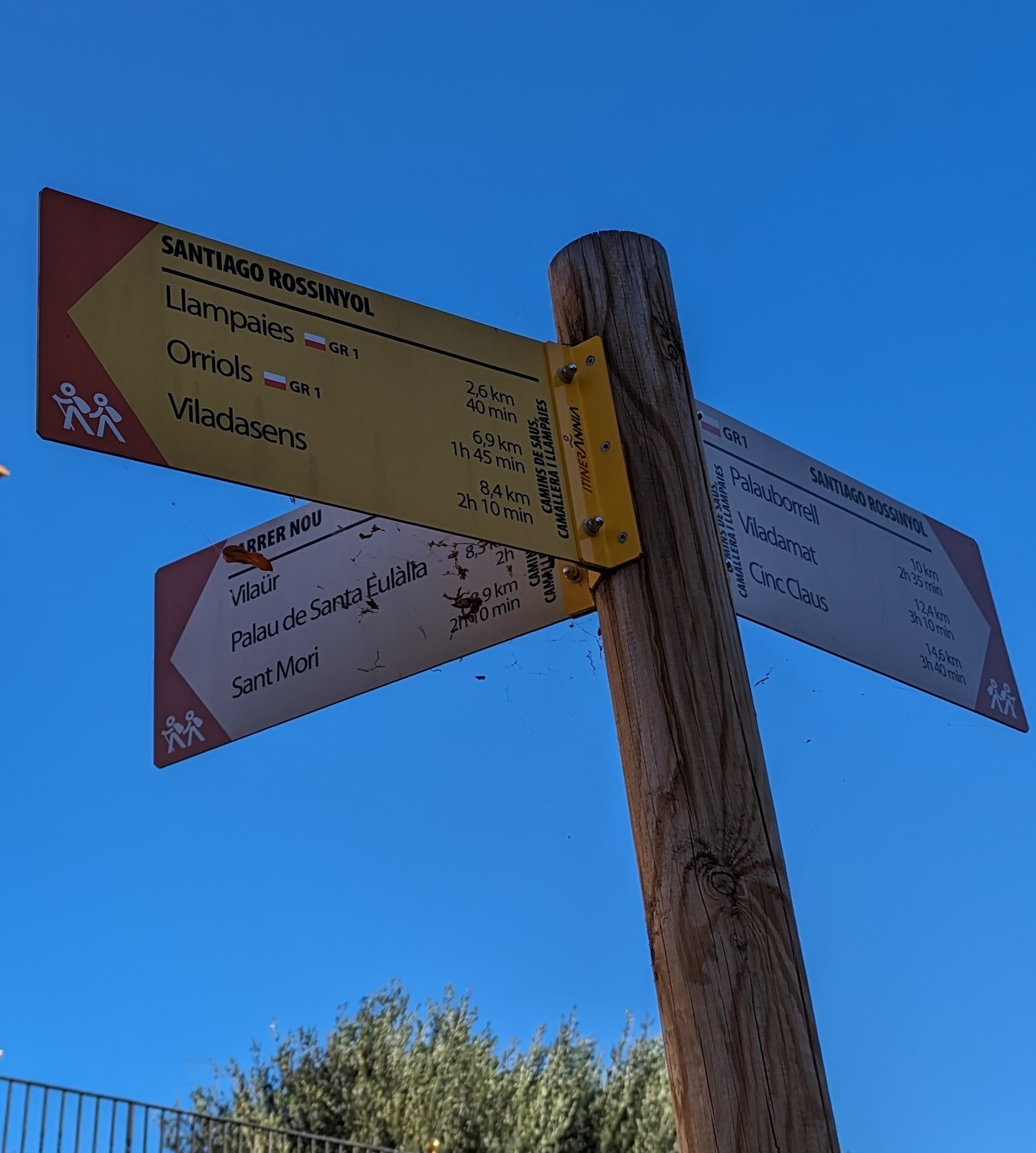
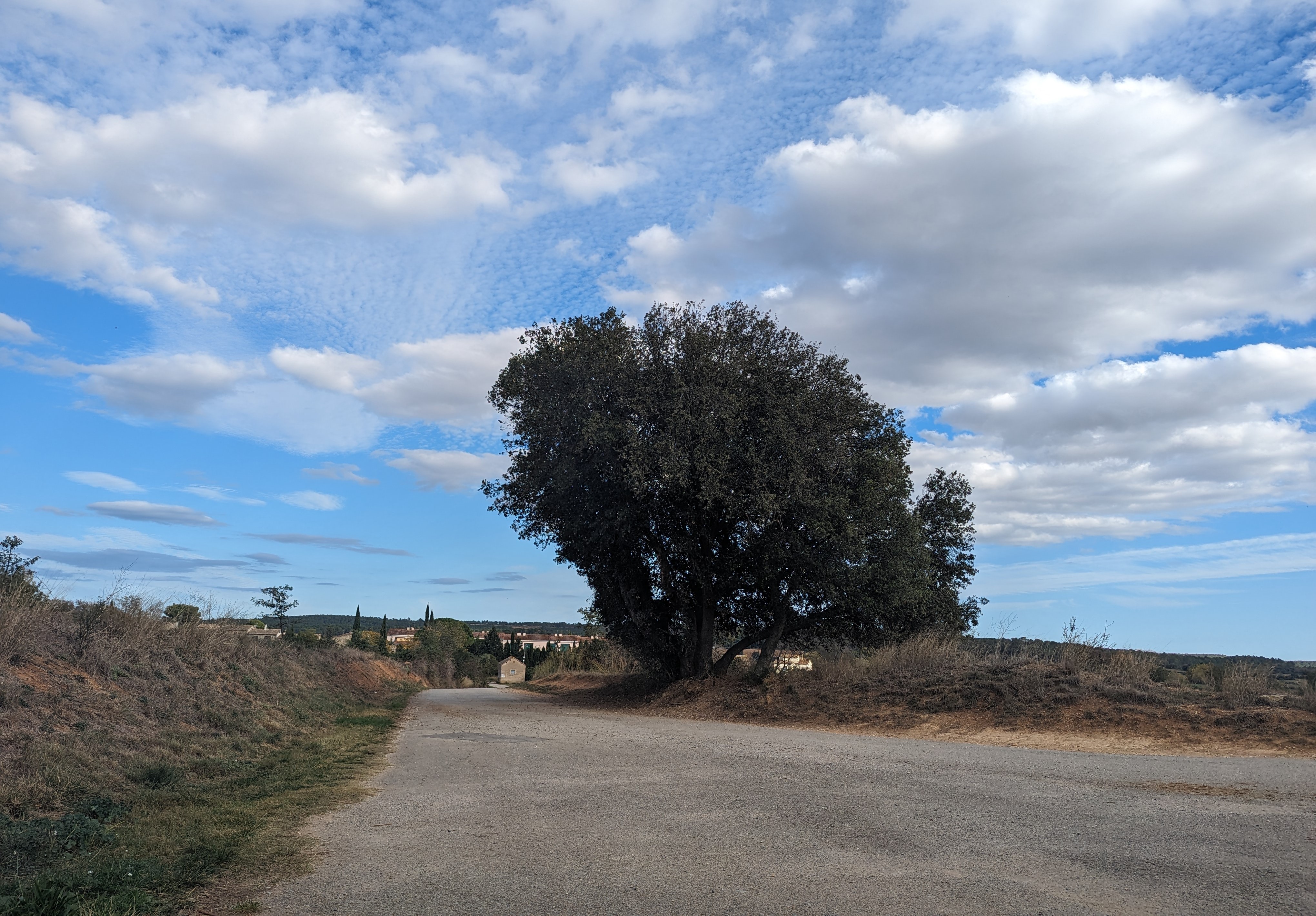
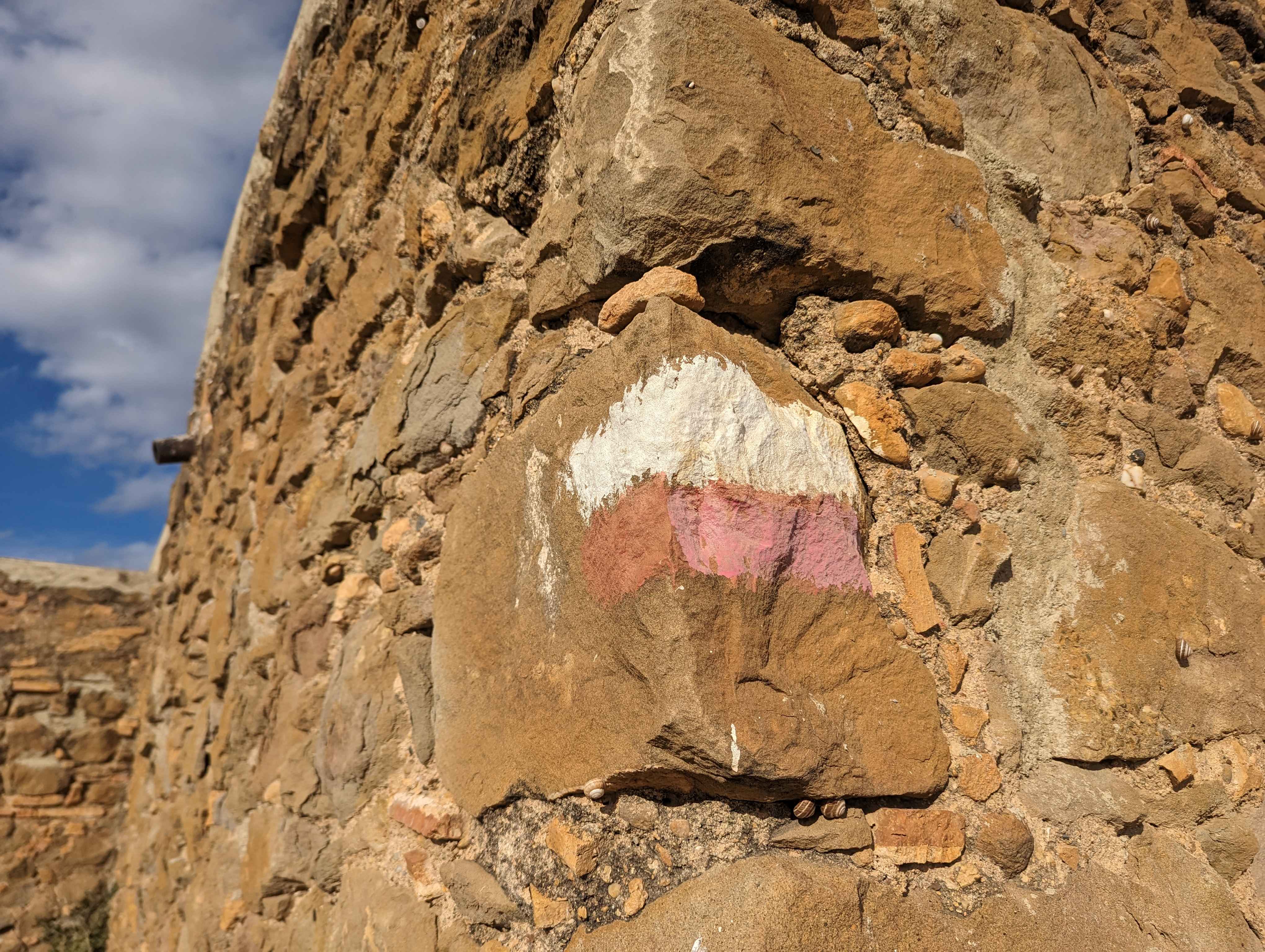
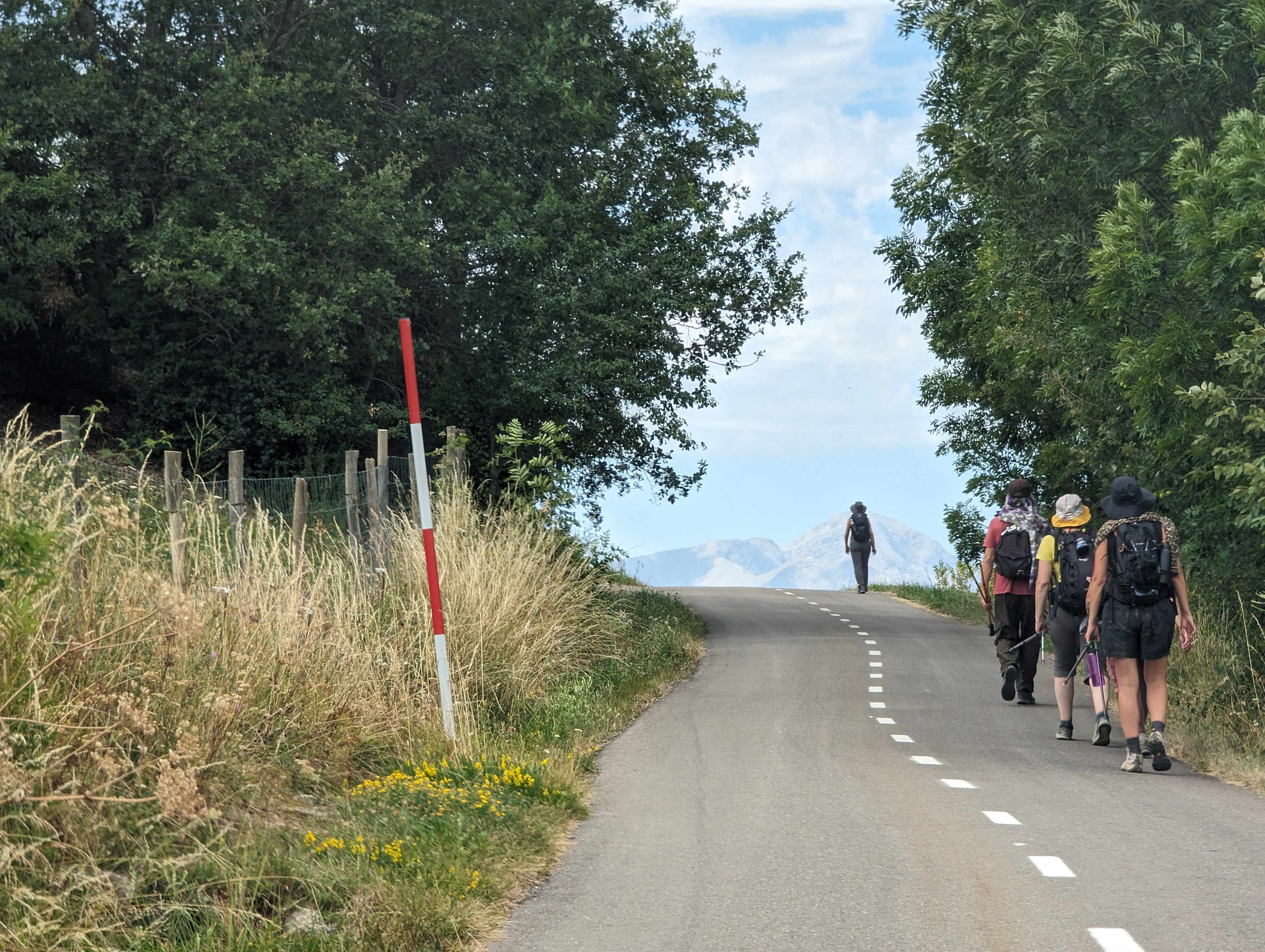
Option 2: The woods beyond the cemetery (Stage 8). Continue along the same road, keeping the cemetery on your right. There is a junction with 3 options. Take the second left and walk a loop, coming back via what would have been the third left. The GR1 trail runs along that south western corner of the town, so look out for the red and white striped signs (photo below) and the sign posts (photo above).
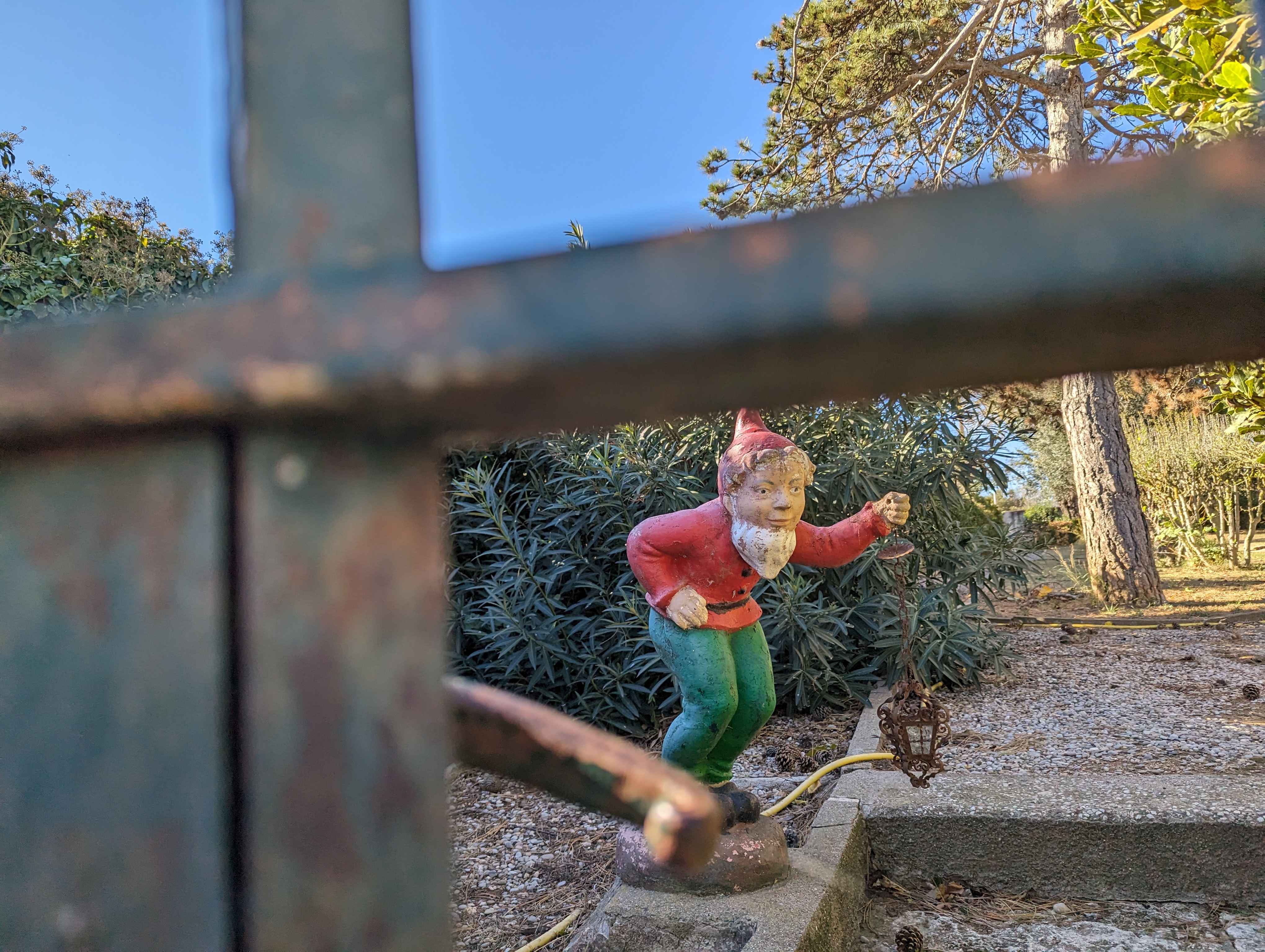
Option 3: Llampaies. From Stage 6, continue along the Carrer de Banyoles (it becomes the Carretera Girona-L’Escala) instead of turning off left along Carrer Tramuntana to Stage 7. Look out for a whispering gnome, the sound of a beautiful cedar tree in the wind, some silent graffiti (see main map above) in a field on your left, and the clangs and vrooms of Responsive Business (a transportation company, maybe) with a red chair on the balcony for peacefully sunning oneself during work breaks.
Where am I?
Thanks
Many thanks to Clara Garí and Nau Côclea for the opportunity to discover this wonderful place. Also to the singers Jordi Homs and Mar Serinyà (listen to Stage 9), and to percussionist Jordi Rallo and his group who feature in Stage 4a.
My workshop participation in, and listening to, Viv Corringham‘s work has been an influence, as, I’m sure, have all the other captivating sound walks and works on walklistencreate.org. I have not studied with Pauline Oliveros, but I have read a lot about her work and learned from others who have. My conversations with Igor Binsbergen while we walked, were fascinating and also important.
Nau Côclea offers a grant consisting of accommodation, follow-up and public presentation. This walk will be presented as part of the Walking Arts Encounters in Girona in July 2024.
I am happy to say that I am on my way to Camallera near Girona in Cataluña / Catalonia, where I am taking up an Artist’s Residency at Nau Côclea (Centre de Creació Contemporània Nau Côchlea).
I will be walking around the edge of the town, the boundary of the area, listening to the sounds of the place, and to ‘stories’ from the soil. When I make a Sound Walk, I follow the signs. I take notice of what happens around me when I am in the research and preparation stage.
I had been reading about the current interest in engaging with the legacy of Francisco Franco’s authoritarian regime, and consequent human suffering. The suppression of democratic freedom and the Catalan language had far-reaching results. I have studied The Historical Memory Law, followed the opening of some Civil War mass graves, spoken with people about inherited grief, and noted the rituals being enacted around the acknowledgement of the loss on many levels.
When I discovered that my visit corresponds with the annual walk across the Pyrénées from France in memory of Walter Benjamin, I knew I must join it. Benjamin was directed across the mountains by Lisa Fittko and received bad news on arrival in Port Bou on the Spanish side. He died by suicide that night, before being able to finally escape to the United States.
This level of inter-generational trauma takes time, so much time, to leave the gene pool. It surges through bloodlines … How to tell a new story of resilience and hope? Is this history of loss held in the soil?… How can we honour the suffering of our ancestors – of those who came before us – but still try to unravel the chains we find ourselves bound by? Is the answer held within the very soil… Is the answer held in the residue the ghosts leave behind?
Kerri ni Dochartaigh Thin Places p186
I come to this residency with many years of embodied study of death, grief and loss – personally, and through my Shiatsu work, death cafes, and writing. This coincidence, then, came as no surprise. I know that the Sound Walk that I will be making during my residency may concern grief, loss and renewal as a result, although I won’t know until I begin.
If you are interested in this project and able to come between 20 November and 2 December, I am inviting you to join me for one day or part of one day, to walk and listen, to share your feelings. We will co-create a Sound Walk from these experiences which will then live on in Camallera for anyone to join at a later date.
Dates: 20 November and 2 December. There is one bed for you to stay a night in the artist’s cottage. Let me know if you are interested! tamsinlgrainger@gmail.com
Festivities and DelegatesEl Grand Tour Grave, Cataluña
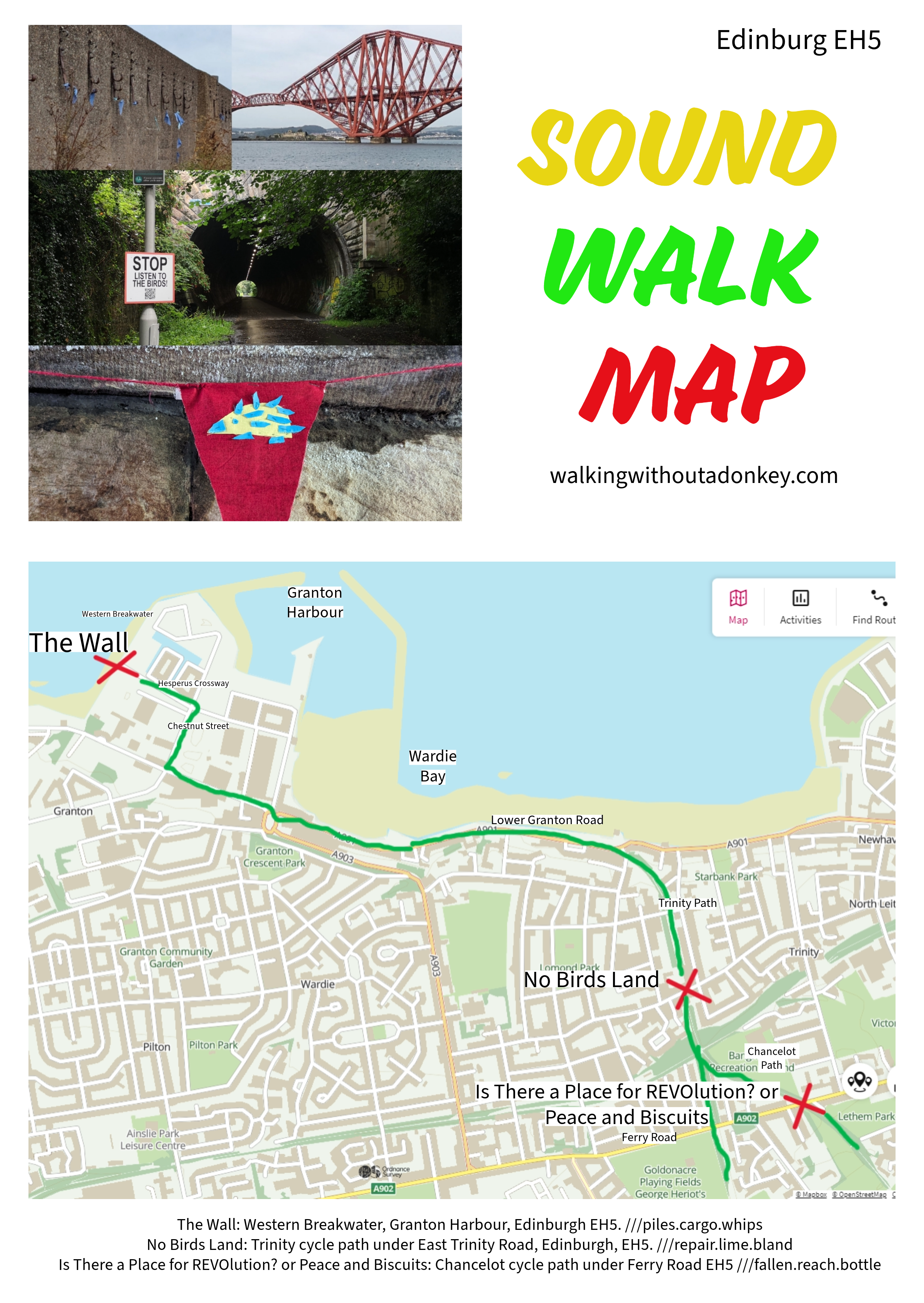
This is a map showing the locations of three soundwalks in Edinburgh EH5 by Tamsin Grainger: ‘The Wall’ and ‘No Birds Land’ were both shortlisted for Sound Walk September awards (walklistencreate.org). Is There a Place for REVOlution or Peace and Biscuits was a 4WCoP23 event. Detailed information can be found on the links below, together with Soundcloud and Vimeo connections.
Whilst ‘No Birds Land’ and ‘Is There a Place for REVOlution or Peace and Biscuits’ have recently been renewed and mended with new pennants, I’m sorry to say that ‘The Wall’ installation has become ragged from the weather and time. You can still walk along the wall / Western Breakwater of Granton Harbour and listen to the Sound Walk on your phone, but you will need to access it either before you leave home or from here if you have sufficient data, as there is no QR code currently at the site. Links to ‘No Birds Land’ and ‘Is There a Place for REVOlution or Peace and Biscuits’ are below.
My sound walks are site-specific sound/art installations with QR codes for you to listen to on your phone as you are walking through the tunnels or along the wall on the Western Breakwater of Granton Harbour.






 Walking without a donkey