Newhaven Harbour, Edinburgh

Late Winter / Early Spring 2017 / January 2018

IMG_20180101_151253 (640x480)

January 2018.

Would you ever know that this gorgeous place is a mere 20 minutes bus ride (2 miles, 3 kms) from the hustle and bustle of Edinburgh city centre? Found on the south side of the Firth of Forth, between Granton and Leith Harbours, it was James IV who created it in 1504 to build the warship ‘Michael’.

DSC_0019 (640x360)

Once a thriving fishing village, today’s piscary community is tiny compared with the fleets of the past. Well known for its oysters (until 1890), and once involved in whaling, it was Scottish folk songs about the herring business which first bought it to my attention.

The hard working women and girls who gutted and sold the fish from door to door in creels (baskets), are immortalised in songs such as Caller Herring (1798, words by Caroline Nairne and music by Nathaniel Gow) and Song of the Fishgutters.

Newhaven fishergirls pose with a creel. Photo by Hill and Adamson. 1840s

There is one boat I see regularly unloading its crab cargo, and the articulated trucks which carry the iced fish up and down the country are parked by the fish market in the eye catching red Victorian buildings where the museum used to be. There is a retail fishmonger there nowadays, Welchs, with its astonishing array of fresh and frozen sea food and associated goods.

DSC_0026 (640x360)
Newhaven Harbour and lighthouse, Edinburgh

This conservation area somehow manages to sit cheek by jowel with the imposing Chancelot Mill, the happily situated Holiday Inn, and ecologically designed supermarket, none of which contribute in any way to the architectural beauty of the area.

…as you can see!

But you can find a very friendly welcome, comfy surroundings, and the best raspberry scones, freshly made cakes and affordable all-day breakfasts (sitting-in or to take-away) very near by at The Haven cafe on Lindsay Road.

There are other sights to see in the area: a beautiful, wee community garden by the wall plaque.

banner-inner-01 (640x102)
Plaque_based_on_the_Newhaven_Stone

You can also find the upmarket Loch Fyne Oyster Bar; and the David Lloyd health club where you can swim outside in a heated pool right beside the seaside. There’s lots of accommodation, particularly air bnb (see below).

Spain autumn 2016 phone 128 (288x512)

The famously expensive Edinburgh trams are on their way here now – soon to run as far as Ocean Terminal (20 minutes walk east / 7 minutes on the bus). The airport bus (number 200) also runs past and takes you to your flight in just over an hour.

DSC_0022 (640x479)

The old church is now the very popular Alien Rock, climbing wall.

This area was part of a massive re-development reputed to be the size of Edinburgh all over again, going to be built on the docks and reclaimed land between Leith and Granton. The economic situation put paid to that, but there are some impressive tower blocks (Western Harbour for example) around which you can wander in the wind and some rocks where people picnic and fish with their hoods up.

IMG_20171202_082347 (640x480)

Western Harbour flats.

DSC_0020 (360x640)
The ‘secret’ beach – see if you can find it!

There is plenty to see whatever the weather: the water itself and the seasonal bird population; Inchkeith Island housing left-over battlements and a still operational lighthouse; and the view of Fife and its hills across the estuary. In the summer the massive liners disgorge their tourists who are ferried into the harbour to be whisked away by coach to see the castle. The coastguard from Granton Harbour (half an hour’s promenade to the west) are always buzzing in and out accompanying the visiting shipping from Denmark (oil tankers), Malta, the UK and further afield.

IMG_20170909_123009 (640x480)

Inchkeith Island, Firth of Forth.

Fishmarket Square is just opposite the Oyster Bar, a quaint place where a (sadly) one-off Apple Festival was held a few years ago.

The recommended pub in the area is the Dreadnought, 72 North Fort Street (the bottom end!) with open jam sessions, the ubiquitous pub quiz, and appreciated pizzas. It stocks local beers from the Leith brewery (eg Pilot), a permanent gluten-free lager from Brass Castle (the owner Toby’s brother’s brewery), plus guest and vegan ones.

18268105_1771648449814273_1483738194054028128_n

The Dreadnought independent pub stocking craft beer.

Newhaven won a Green Flag Award in 2017

Caller Herring on YouTube https://www.youtube.com/watch?v=oFtXrT5sxRk

Chronological map of Edinburgh showing Newhaven http://maps.nls.uk/view/74400069#zoom=6&lat=6345&lon=5409&layers=BT

Air bnb http://www.airbnb.co.uk

Growing Together, Community Garden in Newhaven http://www.elgt.org.uk/projects/community-gardening/5-1-5-newhaven

Alien Rock http://www.alienrock.co.uk/

You can see who is anchored in the Firth of Forth at any one time on this website: https://www.marinetraffic.com/en/ais/details/ports/22435/United_Kingdom_port:FIRTH%20OF%20FORTH%20ANCH

Lothian Buses, airport services: https://lothianbuses.co.uk/airport

Inchkeith Island: http://www.abandonedscotland.com/the-island-of-inchkeith/

Scotland – Fife Coastal Path stage 2

A dander along the Fife coast from Burntisland at low tide 9.15am to East Wemyss at high tide 3.45pm. Twelth Night – 6th January 2018.

400px-FIFE_&_KINROSS_SHIRES_Civil_Parish_map
Fife, the shape of a (Scottish) terrier’s head.

Fantastically well signposted (almost impossible to get lost if you pay attention). Distance: 19.5 kilometres (12.25 miles). Duration: the website said 4.5 – 5.5 hours, but if you have short legs and are out of practice (or both), and want to stop to take photos and have a cup of tea etc, then it takes longer. I took the 8.39 train from Edinburgh.

IMG_20180106_092422 (640x368)
Burntisland with pink buildings to rival Austria (almost).

 Terrain: mostly flat: there are a few sets of steps (ascending and descending), and a couple of sloping roads (out of Kirkcaldy, for example). There is some tarmac, but it is chiefly sand, grass, small stones and once (I am sure you could avoid it) a great tumble of rocks.

IMG_20180106_095325 (480x640)
In real life the rocks are actually black, so contrasting with the yellow gorse or whin.

IMG_20180106_100234 (640x480)
The tips of the sharp grasses are prickly in these ‘botanically important areas’.

IMG_20180106_110125 (640x480)
Ringlets of old man’s beard.

Linking the Forth and Tay Estuaries (Kincardine to Newburgh), the Fife Coastal Path runs for over 183km (117 or 105 miles according to different websites), through the varied landscapes of Fife. The route links some of Scotland’s most picturesque former fishing villages as well as the home of golf – St Andrews with its ancient University. In between are miles of golden beaches, attractive woods and nature reserves but the route also threads its way through industrial towns such as Kirkcaldy and Leven. History is everywhere, from the winding gear of the former coalyards (see below) to ruined castles and the pictish and prehistoric carvings in the Wemyss caves. (Mostly taken from Walking Highlands, with info from Fife Coastal Path and Birding the Fife Coast).

IMG_20180106_100923 (640x480)
Stunning beaches along the Fife Coastal Path.

I started at Burntisland, opposite my house on the other side of the Firth of Forth, regularly spied through my binoculars on a sunny day. A ferry used to run between the two.

IMG_20180106_091516 (640x480)
Too high for me to get a readable photo: it says ‘..station opened 1847..with a ferry to Granton (my home harbour) and thence by train to Edinburgh. The world’s first train ferry service started on this route in 1850. It ended in 1890 when The Forth Bridge opened with a new link line to Burntisland…’.

A few minutes from the station, the path begins near the links (links are green spaces in Scottish places, often on the dunes and used for golf courses). Straight down to the beach, I was going briskly to keep warm and happy to watch the dogs, spot shells (razors which I tasted for the first time in Santiago de Compostella at the end of the Camino Frances, cockles and the odd strongbow can.) All who passed wished a good morning, and that it was.

IMG_20180106_100131 (640x480)
A range of shells on the beach.

The path runs adjacent to the railway with its occassional very short trains and fumes punctuating my rural idyll. A bubble of joy was in me to be setting off on a hike again.

IMG_20180106_111513 (640x480)
The railway line, always there beside the path, glimpsed through the railings.

IMG_20180106_094020 (640x480)
The sun’s slanting rays emanated through the clouds – what a great antidote to doing the end-of-year accounts!

I chose the low tide route across the grass littered with droppings (deer? rabbit?). There was a sea odour; a raven with its dipped, dull head; the plaintive cry of the gull and peeping of the oyster catcher. Ahead was an obstacle and, immediately, boulders to clambering over. That definitely raised the body temperature. Anyone who follows my exploits knows this is business as usual, and it did not last long.

IMG_20180106_094737 (640x480)

IMG_20180106_100423 (640x480)
The scarlet gash of a kite: what a brilliant Saturday morning de-stressor from a sedentary day job.

After pacing the pavements of the city the sand was oh-so-soft away from it all.

IMG_20180106_101058 (480x640)

IMG_20180106_105203 (640x480)
Here was Petycur Caravan Site whose windows catch the sun so I can see them from my sitting room.

There is the constant background sound of the most attractive white horses rolling onto the edge of the beach. My peace is interrupted by a train or car, but otherwise I can focus on the wonderful sands and the marks of the dog who had been there before me. With a quietening in my belly I surveyed the uncreased sands.

IMG_20180106_100923 (640x480)

Kinghorn is the first of the dainty villages with its 5 or 6 boats tucked into the first harbour. Round the corner is a second with a lifeboat and pretty church. There is a smell of chips as I pass the cafe and another jolly greeting from those sitting outside at 10.40am.

IMG_20180106_103907 (480x640)
What a fantastic place for a holiday here in Kinghorn with its beach side bed and breakfasts – all pretty and welcoming.


It turns out that you can skip the ‘A’ road mentioned in the directions as I did, and get all the way here by beach, but you would miss the monument to Alexander III ‘who fell to his death nearby in the 13th century.’ (Fife Coastal Path website – see below for the link). The sand along the coast is black as well as golden, a reference to the once profitable, now plundered coal seams of this area. I glory in the muted palette of winter, similar but different to the Yorkshire Dales I walked 2 weeks ago.

IMG_20180106_103202 (640x480)

IMG_20171225_143025 (640x480)
Comparing the gentle winter colour scheme of the Yorkshire Dales…

IMG_20180106_125203 (640x480)
….with Fife.

IMG_20180106_145643 (640x480)
‘Black Gold’ (coal dust), a remnant of the past industry.

Out at sea are the ubiquitous oil riggs and red bottomed tankers. On land the municipal toilets are shut for the season. Perhaps, I wonder, I should have paid 30p at the last ones. There are lots of folk around so I cannae squat now!

IMG_20180106_150531 (640x480)
Two oil rigs and a tanker inbetween.

The path is well waymarked but I get very easily waylaid by views and ideas when I walk. The path moves away from the coast here under the aforementioned railway into a playpark, and through a little tunnel. It was nose-running weather but as per normal I was lucky – no rain and not too much wind though it was very cold even when the sun came out in the last third of the day.

Men from the train passed, going in the opposite direction. I stood aside and one kind one said ‘we are making you walk on the grass, go on, you go past’. What a sweetie.

The increasingly beautiful scenes meant I just could not stop taking photos. My weight felt heavy on the ground now and it was lovely. More tramping than skittering as at the start. Here was the promised rugged coastline with its horizontal striations of gentle sandstone, pillowed volcanic rock, columnar jointing of basalt and great hunks of black volcanic dolerite (a reminder of an eruption of The Binn volcano over 300 million years ago).

IMG_20180106_233710 (640x401)

IMG_20180106_113217 (640x480)

 A gentle incline led to a sunny path and the blue sky was reflected in the rock pools below. Real crowds of ramblers went by, and whereas the local people were friendly to a one, those from Edinburgh were not all, especially the women.

IMG_20180106_111950 (480x640)
There was Seafield Tower in the distance.

The yellow lichen contrasted with its grey and brown hosts, and I remembered the Judi Dench documentary about trees from last night, a new sense of awe at the immense benefit of the connected aspects of nature. http://www.bbc.co.uk/programmes/b09jxnv4

I listened to the unknown, feathered singer of dee doh dee doh dee doh dee doh deee.

IMG_20180106_112255 (640x480)
And Seafield Tower close up.

This tall beige and tan, broken 16th century castle with its 5 feet thick walls, stands above the beach where happy hounds bounce in the sea air, and there was a long legged, curved-beaked curlew at the waters edge. The chunks of rock cubes and parallelograms, the regular flat-topped mini cliffs of Dover, and occasional man-made stacks of concrete were all fascinating.

IMG_20180106_112951 (640x480)
Kirkcaldy was ahead with its three blocks of flats showing up their white frontages in the sun.

This poster was on the outside toilet wall and wholeheartedly subscribed to during my wanderings. Unless, that is, I have given Shiatsu, when a deep sense of relaxation is a happy thing to have left.

IMG_20180106_104148 (640x480)
‘Leave nothing but footprints!’

Walking over bumpy terrain is reputedly good for the brain. http://mxplx.com/meme/2622/  Plus, the inner ear has to constantly re-balance. My legs are starting to feel heavier but I am so glad this will not end soon.

I pass through the three quarters circular metal gate (a contrast to the stiles with tiny wooden ones in the Yorkshire Dales) into the Seafield carpark where there is a woman in her nighty and white ankle socks walking her dog. A man with purple lips at the end of his constitutional makes pithy conversation: ‘That’s a good walk that is’, he said, when I regaled him with my route, ‘I was a member of the Ramblers. Walked all over Britain we did.’ He corrected my pronunciation of Wemyss (say ‘weems’). ‘There’s a cafe in Dysart’ (say ‘die sut’) he went on ‘and toilets’. A fount of local information he was.

IMG_20171225_144929 (640x480) (640x480)
Each tiny stile also has a mini gate to pass through in the Yorkshire Dales.

IMG_20180106_114101 (640x480)
Whereas in Fife, it was this more mechanical one.

I made it to ‘The lang toun’ (meaning, the long town, which Kirkcaldy is known as) just after midday. There was the Raith Rovers football ground and a Morrisons. It is a large sprawl with inevitable industrial outskirts, space-age covered esplanade seats, and a weird public sculpture. I popped into Lidl for chocolate and a free pee where I saw what rosy cheeks I had developed from the wind. Then the way resumed by the really extreme sea wall of white concrete blocks which was a project for relieving unemployment in the Great Trade Depression of 1922/23. The Link Sands were softer, again, for my feet but with a smell of, what was it, chutney?


The Hutchison’s flour mill is like our very own Chancellot Mills in Newhaven, Edinburgh, and rows of  birds made a dotted silhouette on its roof like decorative braid. There was an unpleasant, burning plastic smell. Past ‘Ultimate Reptiles’ and hideous car parks I went, past the derelict Nairn Floor Cloth Manufactory (1847) which facade hid a modern place to learn fighting, and steeply up past the Nether Street cemetery into the spacious Ravenscraig Park with its Three Tree Legend. Apparently the three trees were planted over the graves of the trio of Sinclair brothers who, mistaking each other for robbers, killed the other. The dark shot of the nearby castle (built by James II for his wife Mary of Guelders) and bay behind was suitably sinister.

IMG_20180106_123224 (640x480)

IMG_20180106_124230 (640x480)

IMG_20180106_123334 (640x480)

IMG_20180106_124633 (640x480)
A Gothic looking, ‘Northanger Abbey’ type castle.

At the top of a flight of steps is a rather gruesome fishy poem by C W Berry (1927 – 1998). Here is the last stanza:

‘The gear’s aboard      reclining in the blood.     The slaughter’s done –     The silver’s down below.’

IMG_20180106_124840 (480x640)

There was an option here to go by the beach instead of following the signs, but this would have been missed. The sun’s rays splayed out over ripples of the rounded bay and in the distance the hills of Edinburgh showed in varying shades of grey, all lit up behind a path of silver sea.

IMG_20180106_125757 (640x480)

Stone art comes next, situated amongst foot-crunching beech husks. It is by Kenny Munro and features the poem Stanes by Duncan Glen (who ‘fittingly ascribes his achievements to his wife Margaret of 51 years’) with ‘Scots words [which] allude to the many stone features around us.’ (Quotes from the information sign nearby). There is also a doocot (dovecot) which provided the king and his court with meat.

IMG_20180106_130107 (480x640)

IMG_20180106_125426 (640x480)
The castle doocot (dovecot).

Next are a series of little coves divided by what look like noble curved walls. Many are  entered through tumbledown arches and are seriously narrow. Here are what one of Judi Dench’s experts called arboroglyphs (a great word for man-made tree carvings). As directed, I take a right at the four forks and trip under the railway to Dysart, ‘claustrophobic’ (as described by the Walk Highlands website) or idyllic, depending on your outlook. Here I saw ancient mariners in their wee huts flying the Scottish ensign; a handsome harbour master’s house (much mentioned as it is the official Fife Coastal Path headquarters but shut today despite the number of hikers and it being a weekend).


IMG_20180106_131148 (480x640)
Tree hieroglyphics.

IMG_20180106_132314 (640x480)
Fishermen busying themselves in and out of their huts.

There is a thunder of waves now, and another sculpture made up of wooden uprights in pastel blues and greens of the sea when seen in different lights. A herring gull with a gruesome beakful stands on a wall. A cute looking baby seal stranded on the beach was causing a right to-do.

IMG_20180106_132611 (640x480)
Modern scultpure, Dysart harbour.


Further on were many slightly incongruous, what I call Narnia lamp posts; gleaming white-washed stepped gabled houses; and I finally got my cup of tea which was a mere £1.50. It came with a sugary round of traditional Scottish shortbread, and I bought  a piece of tablet (a sort of hard fudge made here – popular and delicious if you have a sweet tooth) for my daughter.

IMG_20180106_133702 (640x480)

IMG_20180106_134607 (640x480)
Tea at the Timeless Tearooms.

IMG_20180106_141826 (480x640)
Dysart Tolbooth and Town House: erected in 1576, marking the Burgh’s medieval civic centre. It was originally partly a prison and still retains prisoner’s graffiti.

IMG_20180106_132036 (640x480)
Dysart harbour.

The next part of the path was sodden and my waterproof boots let the cold fluid in. The last remnant of the local coal mine has been left on this part of the Coastal Path as a reminder.

IMG_20180106_143220 (480x640)
The Frances Colliery Memorial, dedicated to the men and women who ‘wrocht’ (worked) there. Known locally as ‘The Dubbie’ because it stood above the Dubbie Braes (a brae is a steep bank or hillside).

Down a flight of steps I joined the very attractively stacked West Wemyss, and on the way in I passed another castle, this time with blue conical Chinese-looking hats atop its turrets. Behind the walls was an impressive hidden garden glimpsed through cracks. In the misty distance I spied Berwick Law (a low, lone peak in East Lothian- too far away for the camera to pick it up).

IMG_20180106_145133 (640x480)
West Wemyss beyond the magnificent sandstone boulders. The gulls breasts, like waiters’ bibs, caught the sun.

IMG_20180106_145245 (640x480)


The area has been decorated with lottery money and spring bulbs are starting to push upwards.

IMG_20180106_150654 (480x640)
Next time I plan to visit the Community Pub.

The tide was now crashing against the rocks and on the shingled and seeweed-covered shore there were more wonderful pinky orange rocks (colour-matched in the clouds). The words ‘gentle’ and ‘benign’ came to mind as I enjoyed their appearance in the glowing late afternoon sun. It was really so very pleasant.

IMG_20180106_145930 (640x480)
The Belvedere Miner’s Institute and Reading Room. Here you can see the same gorgeous stone (above) used for building West Wemyss.

IMG_20180106_152052 (480x640)
A coven of black cormorants, one with its familiar, jagged outstretched wings gathered at the end of the pier (blurry with the zoom).

IMG_20180106_150417 (640x480)

At the end of the day I enter East Wemyss, the home of Jimmy Shand (1908 – 2000) one of Scotland best known musicians (think ceilidh jigs and The Bluebell Polka).  you tube link

Do not turn off the path as soon as you arrive. Instead, stay on until you find Back Dykes (as I did not) on your left. At the end of that road turn left onto Main Street and then take an immediate right onto School Wynd. The bus stop is past the Primary School on the same side of the A955 High Road. If you are not sure, everyone is friendly and helpful, so ask.

IMG_20180108_144840 (640x336)
East Wemyss Primary School.

On the Stagecoach bus it took 15 minutes to get to Kirkcaldy, where it took me 3 hours to walk, and I drove home into the sunset, crossing the new Forth Road Bridge as the moon rose.

Fife 2 2017-02-20 006

Useful websites/information:

In case it is of use: for this cold January walk I wore long-legged thermals under thin jersey trousers with an elasticated waist (easy to pull up and down quickly when needed), my double layered walking socks (invaluable for avoiding blisters), a vest top, cotton long-sleeved blouse (better for the sweatiness), under a walking hoodie and jacket with a hat, gloves and scarf. I was cool enough what with all the movement, but also protected from the weather. Oh, and I had my sturdy boots on (thanks again, Sabine).

Scotrail. £6.70 for a one-way ticket from Edinburgh to Burntisland (it takes 35 mins). There is a toilet but no refreshments on the train.  https://www.scotrail.co.uk/

Stagecoach buses: £10 one way, £10.70 for all day and any bus. Buy on the bus or via the app. The journey takes 1.5 hrs Edinburgh to Burntisland with a change at Inverkeithing (which is why I took the train in the morning). In the evening the 16.03 from East Wemyss arrived at 17.15 in Edinburgh, and there were heated seats, wifi, a place to charge your phone, and a toilet. All 3 drivers I spoke to, though helpful, were very abrupt.

Timeless Tearooms, Dysart near the Tolbooth (no website). Not perfectly clean but there is a decent toilet, the staff were very friendly and helpful (she lent me a device so I could charge my phone while I drank). It was full of locals having a chat and crocheting, and there was a nice atmosphere and a good cup of tea. There are other cafes open in the summer season.

IMG_20180106_093732 (640x480)

 http://www.fifecoastalpath.co.uk/  This is the official Fife Coastal Path website, with the circular blue, yellow and green sign which is used to show the way. It has interesting facts but no detailed directions so I did not find it as useful as the Walk Highlands one below. Also the 2 websites divide the walk into different stages.

https://www.walkhighlands.co.uk/fife-stirling/fife-coastal-path.shtml Walk Highlands has much more useful information. You have to register and they ask you to say which is your favourite mountain etc, but they have good downloads of maps. The directions for this walk are beside photos and so had to be cut and pasted into a hand-made doc/pdf (which I am happy to send you (www.tamsinlgrainger@gmail.com).

Geology http://www.burntisland.net/geology.htm

Beautiful birdsong https://www.nationaltrust.org.uk/features/our-guide-to-birdsong

Some information about Duncan Glen  http://www.scottisharts.org.uk/1/artsinscotland/scots/archive/poemjunejuly2006.aspx

Via Sacra – Day 6

Via Sacra pilgrimage from Vienna to Mariazell, Austria. 10th October 2017. Day 6. The second half of Stage 3.

On foot with my backpack. It was 6 hours of spectacular climbs, rushing rivers, scary footbridges, and astonishing views, all in sparkling Autumn surroundings.

IMG_20171010_084458 (480x640)
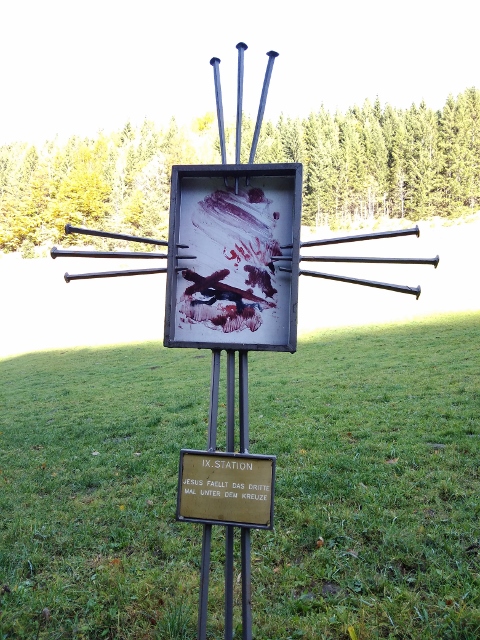
A reminder that this is a spiritual journey.

Route: Türnitz (Gasthaus ‘Goldener Lowe’ where I spent the night and had breakfast), 2.5 hours to Falken Ravine, then Ulreichsberg, Ebenbaueralm, and Annaberg.

‘If we are peaceful, if we are happy, we can blossom like a flower, and everyone in our family, our entire society, will benefit from our peace.’ Thich Nhat Hanh.


As I left Türnitz at 8.15am with its prettily decorated houses, I was minded of some early reads which have walking in them and which I still have a clear sense of. My mother read to us and gave us books throughout our childhood, and I am very grateful for the enjoyment she encouraged.  ‘Mary Jones and Her Bible’ was one I often returned to for some reason. Mary (16 December 1784 – 28 December 1864) was a Welsh girl who saved her pennies and then, at the age of fifteen, walked twenty-six miles barefoot across mountainous countryside to buy a copy of the Welsh Bible because she did not have one. I think it was her determination which impressed me, and it was a rare true story of a young girl’s strength.

Then there was ‘Heidi’ by Johanna Spyri. Heidi was another girl with spunk (though fictitious this time), who also lived in the mountains, not in Wales (UK) but in one of Austria’s many adjoining countries, Switzerland, where I was headed at the end of this trip. I had not thought about these tales for many years, but now I wonder what effect they had on me at an impressionable age.

IMG_20171010_125527 (640x402)
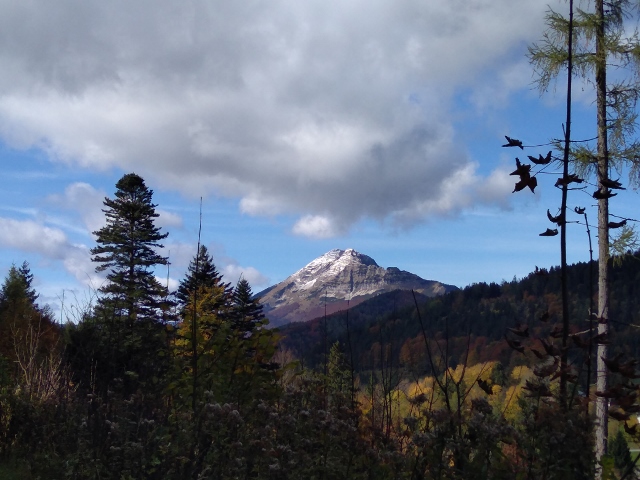
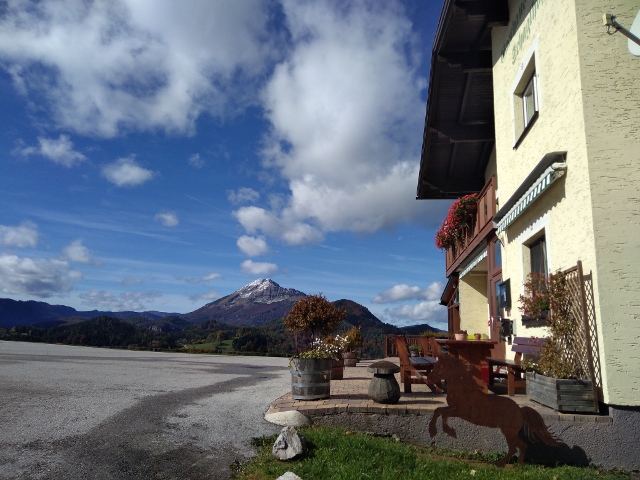
My first view of the mountains, later in the day, after the climb which was ahead.

IMG_20171011_101543 (640x480)
I wore boots for this walk.

I followed the River Traisen out of town and focused on the tiny lovely things around me: a small, darting bird, dark with a white throat; dams and pools with fish just visible in slow motion under the surface; tiny waterfalls; the sun on the back of my neck; a quarry creating a natural bathing pool; the water jostling and stressing in its rush; trunks and stalks blackened from the old year.

IMG_20171010_093848 (640x480)
Small streams feeding into the Traisen at intervals.

IMG_20171010_124628 (640x480)
A strawberry flower nestling amongst the dry stalks.

IMG_20171010_093305 (480x640)
Jade coloured water again and luscious lichen.

I was living a real life folk tale: First traverse the land…

IMG_20171010_091000 (640x480)
I had no idea what was to come.

…visit sacred places along the way….

IMG_20171010_092910 (480x640)
One of the many wayside shrines.

IMG_20171010_101419 (640x480)
Ecce Homo – Behold the Man.

… Ford the river five times (twice the socks and boots had to come off, 3 times it was a matter of balancing precariously on the tips of rocks which weren’t submerged and hoping I would not topple because once I start to go the weight of the rucksack takes me all the way!)

IMG_20171010_111305 (480x640)
You can see how fast the water was rushing by the fact that my camera could not get it into focus. A tottering traverse!

Carry your worldly goods on your back looking carefully for signs.

IMG_20171010_121508 (640x480)

IMG_20171010_095046 (480x640)
The wee red and white stripes are not always that easy to locate.

There will be obstacles on your path.

IMG_20171010_111051 (640x480)

IMG_20171010_105726 (480x640)
Many wooden bridges to manage the ravines.

IMG_20171010_112901 (480x640)
Some of them slippery from the wet and not a little hairy.

Finally climb the Three Sacred Mountains (this is truely what they are called) and only then will you…. what? Achieve enlightenment / win the heart of your true love / be forgiven?

IMG_20171010_121139 (640x480)

My heart sang as I watched the leaves meander to the ground which was itself glowing golden and bronze; as I observed the white waters cascade and crash between dark green rocks.

As I hike, I am constantly reflecting on what I am about, travelling through countries, going on foot wherever I can. Why am I drawn to this life? And I wonder if it might be that it is easier to do this in foreign countries rather than at home; in a place where no-one knows me and I seem to be easily welcomed. In Spain, for example, they said yes when I asked to stay, and let me sleep on the floor and then gave me an apple to take away with me in the morning. Simplicity. Nothing expected from me except human courtesy and attention, although I always offer Shiatsu.

I have an urge to do this, to keep on walking, treading ancient pathways, like The Sisters of Mercy, a non-cloistered institute where the ‘walking nuns’ cared for the poor outside a convent; or the blind practitioners of Anma (Japanese folk massage, linked closely to Shiatsu) ‘who were often nomadic, earning their keep in mobile massage capacities…. in the 19th century’ (ref. Wikipedia). It seems that another woman I read and re-read about in my childhood, Helen Keller, interceded on behalf of these practitioners after they were banned from practicing during the Occupation of Japan after World War II, and managed to overturn that edict.

IMG_20171010_122718 (640x480)
Colour, marvellous colours, all around.

As I climb higher, there are the deep blue mountains in the distance. I take one of those  videos entitled ‘here’s some of my silence!’

IMG_20171010_141813 (640x480)
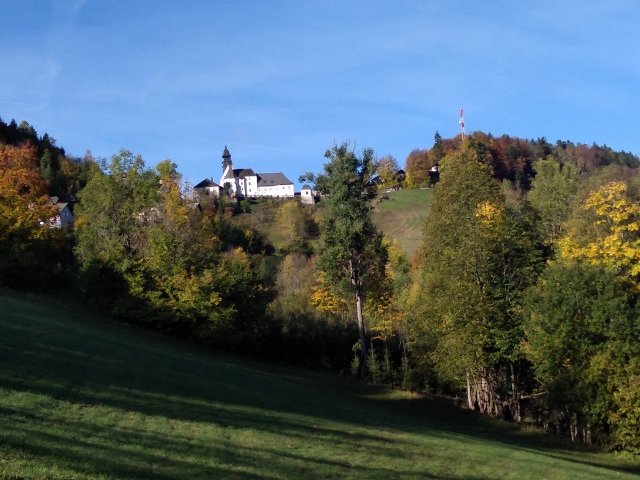
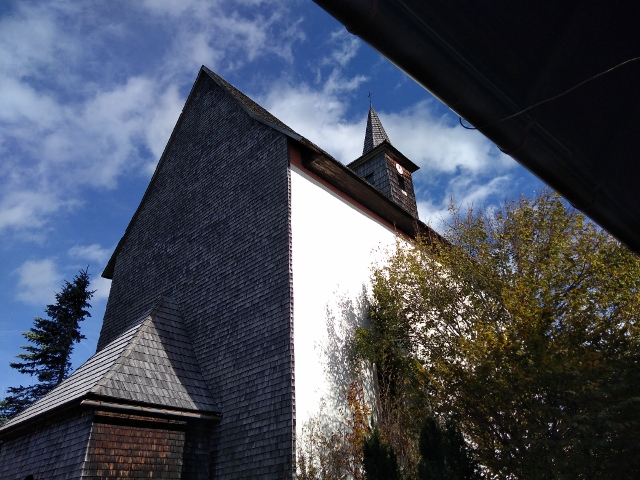
The pilgrimage church sanctified to St. Anna, 1217.

It was a steep descent out of the forest  and then a climb back up to Annaberg, perched high on a mountain of its own, where a funeral procession was reaching the Pilgrim’s church. In 1985 I arrived in a Sicilian mountain village by bus (many years before my walking days) in the middle of a wedding, and in Naples a week before I had almost interrupted an ordination ceremony for bishops in the only open venue due to the Holy holiday. However, this was the first funeral.

Most bars and cafes were closed for the village event and people were in traditional Austrian dress playing folk music. After a cup of green tea and a slice of cake, I made my way down the other side taking one of my short-cuts to save my tired back which meant crawling through undergrowth and squeezing under barbed wire – a bad idea which I do not recommend.

The Junges Hotel did not seem to have the booking. Strange. Until it transpired that I was not at the youth hostel, but at a much more expensive establishment next to the ski lift. As always I was treated with immense kindness. I was bundled into a van, and driven up the way I had just come, past the church again, and down (in fact only a small way from my original forest exit earlier) to the right place.

What a setting! Green slopes, grand trees, spire towering above in Annaberg.

There was no-one at reception although crowds of children played behind the building. I sat and waited and was eventually assigned my bed. The kitchens were full of preparations for the evening meal so I could not use them (although one kind man did pass me a flask of hot water over the counter). The wifi was intermittent, and what a lot of energy such large school groups create. As I was the only solo adult traveller and, moreover, in a dormitory of my own, they did not know I was there so in the end I had to ask them to quieten down in the corridor (2am), but they were very well mannered and friendly in response.

IMG_20171011_094558 (640x480)
Annaberg and its Catholic Church, from the youth hostel, taken the next morning.


If you want the youth hostel, be careful not to go here by mistake: Junges Hotel, Annaberg. https://www.annaberg.info/beherberger/a-junges-hotel-annaberg


Via Sacra – Day 5

Via Sacra pilgrimage from Vienna to Mariazell, Austria. 9th October 2017. Day 5. On foot with my backpack. The first half of Stage 3.

Route: Lilienfeld, Moosbach, Türnitz.

‘She had a long and uncertain road ahead of her, but once she was free again her serenity returned.’ from Gertrude Bell, ‘Queen of the Desert’.

IMG_20171009_094040 (640x480)

The architecture of Lilienfeld Monastery is impressive, and somehow felt like home, although I got lost many times and was late to Matins (the morning service) for that reason. I had been given a key and shown around when I arrived the day before, but it was dark in the early morning and all the doors looked the same. I opened them one by one, circumambulating the cloisters and finding myself repeatedly back where I began by the inside fountain.

IMG_20171009_072555 (640x480)

In the end I discovered the monks’ way in and sat silently behind the altar until the break between services when I moved into a pew.  I had received news of my Great Aunt’s death (she was an impressive 106 years old) and recalled happy memories and inevitably shed some tears.

IMG_20171008_175800 (480x640) (480x640)
The architect meant for the chapel to be simple (see the ceiling and basic shape) so that the focus was on worship, but nowadays there is a deal of gold and ornamentation.

There is a very famous library here with amazing sounding manuscripts, but nothing I could say would persuade them to allow me access. You can find information by clicking here.

IMG_20171008_154316 (480x640)
The exterior is all mostly angular matching the pines.

‘..taught at least some wisdom by solitude, taught submission,….’ Gertrude Bell from ‘Queen of the Desert’.

It was a chilly, almost sunny day when I got outside. The hours of silence between 4.30pm and 8am meant that speaking to the kind people in the bank was rather weird, and I felt shy with my limited German. Although many inhabitants of Vienna and nearby have great English, once in the countryside I found that I had to dredge my mind for my O’ Level deutsch.  I was very grateful to receive helpful tips to find the path.

Looking back towards where I had walked the day before, it seemed as if there was a large beast behind the buildings breathing cloud and mist up in front of the mountains.

IMG_20171009_094859 (640x480)

That drifting cloud made the slopes look other-worldly up there where it is so quiet. There was a smell of wood smoke down in the valley, and a roar of lorries driving through the industrial area, all against a backdrop of wooded hills draped in their early autumn colours. Everywhere during this period were orange, green and yellow pumpkins on doorsteps, window sills and in shop windows, heralding Halloween and harvest.

IMG_20171006_151254 (640x480)

IMG_20171009_100225 (480x640)
A very attractive town.

IMG_20171009_100257 (640x480)
The River Traisen.

50 kms to go – half way to Mariazell, my destination – with a cold wind about my ears once again. Men were at work and my footsteps felt gentle in this world of contrasts: a good balance between active Yang-type movement, and contemplative Yin-type peace by the River Traisen. Of course industry and nature both co-exist in the landscape.

The path was lined with silver birches and I was juggling my walking poles in order to take photographs.

IMG_20171009_101933 (480x640)
You can just see the blue sky reflected.

IMG_20171009_102905 (640x480)
The industrial area is further out of town.

IMG_20171009_122013 (640x480)
I walked along the bicycle track, parallel to the railway and river.

Further along there are two tunnels and the river is a jade green below.

I attempt to watch and follow my moods. Rather than fixing them in advance (deciding that I will feel good today, for example), or stopping myself by being critical (no, you can’t feel x), or practicing denial (of course you are not hungry, you have only just had breakfast), it can be interesting to follow them as they flow. In reality they constantly respond to the environment or to thoughts, and I observe that they change and morph if I do not focus on them too much. Moreover, very difficult ones do pass, perhaps more easily if they are not ‘trodden on’ or ‘pushed underground’.

There is more widespread logging at Moosbach, and bright yellow houses with pink pointed rooves. The slopes are steep and stony and there are Xmas trees growing. The  concrete paths are physically hard on the soles of my feet and mentally challenging with the repetition.

As I hike, family memories flit in and out of my mind; I spot Highland cattle and multiple funghi in all shapes and sizes; free range chickens seem to be enjoying their day.

IMG_20171009_133046 (480x640)

IMG_20171009_133145 (640x480)
Black toadstools.

IMG_20171009_133856 (640x480)
Funghi which reminded me of seaweed.

Myriad fascinations: Himalayan Balsam the colour of my magenta scarf; spears of grass spike through the mottled leaves, dark brown at the edges; green-fronded moss softens rock oulines; wild strawberries send out lifelines to enable their offspring to live before putting down their own roots; hard ash nibs are just waiting for a sheet of paper to write on; wild marjoram and self-sown beech saplings sprout in the undergrowth.

IMG_20171009_143151 (640x480)

IMG_20171009_140247 (640x480)
Water the colour of jade. I wondered if it was pollution but no, there was a big pike gliding under the surface.

There was more: a green field with a crop of solar panels; jolly geranium window boxes whose rooves sit over them like wooden bob caps; huge calving heifers; and inside an internal battle where I tell myself off all the time.

IMG_20171009_113814 (640x480)
Home from home: a rather blurry picture showing the hops in the hedgrows as in Kent (England) my home county.

There were rows of houses which might have been the first you drew and coloured in when you were wee. They have four square windows in front but no door. I note that, in line with the principles of Fung Shui which protects against negative, invasive Chi (which like all Chi moves in straight lines), the owners can see what is coming but because the door is round the side it does not let the unwanted energy in every time it is opened.


Well, it happened again! I arrived in Türnitz which was effectively shut for the winter, and although my leaflet gave me names of several places to sleep the night, the woman in the shop said there was only one option. I popped into that hotel/bar, disbelieving, to have a cup of tea and something to eat and she assured me her rooms were full anyway. But after investigating, it was clear that hers was indeed the only venue, so back I went to get my rucksack and to plead, and very kindly she allowed me to stay.

IMG_20171009_165353 (640x480)
Another expensive rooom, accessed via a metal walkway upstairs and through the back, however I had my own shower room, breakfast was included, and what a pretty suite of matching furniture!


Oslo 2, Norway

A rural walk: Hammeren to Frognerseteren via Ullevaalseter, November 2017

IMG_20171124_152206 (640x480)
The ice making beautiful patterns.

I stayed a night with Sarah Huby, a Shiatsu School Edinburgh graduate and Oslo Shiatsu practitioner specialising in mothers and babies; and the rest of the time with Guro and Chris with whom I renewed acquaintance after many years. I was pleased to give Shiatsu sessions to say thanks for all the hospitality which came my way, and I particularly enjoyed the conversation, delicious meals, Zen morning meditation and the countryside walk.

IMG_20171124_144428 (640x480)
There are many routes out of this area to the north including the St Olafs Way.

Oslo is the capital city of Norway, with a centre which wraps around the edge of the fjord rather than in the middle of the sprawl. Did you know that there are 40 islands within the city limits?

IMG_20171124_160748 (640x480)
In the distance you can just see the city centre beside the fjord with some of its islands.

That is where I sat the only other time I visited, on my 25th birthday (or thereabouts), before a women’s theatre ‘Magdalena Project’ took me to Porsgrunn where I stood on a bee.

More than 25 years later I spent 5 days here and I took simple ‘a to b’ utilitarian walks for visiting purposes or to the workshop venue, appreciating the scarlet houses, exposed millefeuille banks of rock on which the city rests, and a spectacular waterfall which is part of the Akerselva River.

IMG_20171124_183248 (640x397)

IMG_20171124_133813 (640x480)

IMG_20171125_092007 (640x480)

The countryside walk began with a gentle pavement climb from the flat along the bus route and, though freezing, the sun lit up the primary colours making a real contrast with Austria’s pastel shaded buildings.

IMG_20171124_122248 (640x480)

Once uphill we entered the forest, slipping on ice, inhaling the freshest air, and ‘putting the world to rights’ in compulsive conversation. It is not often I take a walk with others and I enjoyed the informed companionship of friends who could enlighten me about local customs and show me the way.

IMG_20171124_154755 (640x480)
Chris up ahead.

Others jogged by at quite some speed and made fascinating crunching noises leaving me wondering how they were not ‘coming a cropper’. Later, as I donned a pair of crampons for the first time (so simple – they just stretch and hug on to the toes and heels of walking boots), I realised why these athletes were safe: the tiny spikes on the soles break through the ice and hold you steady. I was like a child discovering something everyone else knew.

IMG_20171124_160345 (640x480)

I had been promised ‘rubber pancakes’, so we stopped half way at a large, warm hostelry with a great many dead beasts’ heads on the walls – moose and the like, as you would expect. It transpires that the local delicacy is so called because they are made in the morning and are considerably less fresh by 4pm! They are thicker than crêpes but not as deep as Scottish drop-scones. Served cold, they are pasted with butter and jam and I would not recommend them. The apple cake, however, was yummy.

IMG_20171124_145011 (640x480)
Guro putting on her crampons after ‘rubber pancakes’ and hot chocolate.

In the airport, everyone said ‘hi hi’ to me and were very pleasant, but as a rule Norwegian strangers do not smile easily at strangers. My friend tells me it is out of respect for ones privacy and space. It is weird for me when I am used to smiling and exchanging a greeting when walking in the Scottish or Spanish countryside.

IMG_20171124_131122 (640x480)
The sun catches the trees on its way down.

IMG_20171124_153533 (480x640)
The pathways are lit, so many Norwegians walk after work in wintertime, despite the dark.

IMG_20171124_151823 (640x480)
Frozen lakes.

IMG_20171124_144452 (640x480)

As I left Oslo, the flakes were falling once again, children in the playground had their tongues out to catch them, the edges of the motorway were edged with icing sugar, and I admired the neat pink and yellow gable-ended flats and very tall pointed trees. Of course the Norwegian people are very tall too, compared to me. The Oslo temperature was raised to a high 4 degrees, matching the Edinburgh weather we were flying into.

IMG_20171127_134712 (480x640)
Norway has perfect living conditions.

Gardermoen Airport (Oslo) is a peaceful and calm place: no-one seemed to be rushing or stressed. I wondered why and came to the conclusion it was because there was no canned music – fantastic. I had 50 NOK for refreshment which turned out to be very little, so in case you are in the same situation here is my advice: have a personal stock of tea bags and get a cup of free hot water which is available in all the kiosks (cold is available to fill your bottle too – after all this practice, I now remember to empty it before security). Add to your hot drink, a bag of nuts (29 NOK), a bread roll with chocolate bits (I thought they were sultanas) 17 NOK, and a piece of fruit (4 NOK) and you will have a feast.

Note: In the duty free shop you can use £ sterling but any change will be given to you in NOK so try to be exact.

I just cannot resist taking photos through windows when I travel.

I have to report that the Edinburgh Airport loos were for the first time cleaner than those of the country I had recently visited. And I am also proud to say that our Airlink buses have tourist information on video in BSL sign language. (Take bus number 100 to the city centre; 200 to Granton, Newhaven and Leith; 300 to Ingleston, Gyle, Saughton etc for £4.50 single, £7.50 open return (have the exact cash ready or download the m-ticket app (minimum £10 spend)).

IMG_20171127_165348 (628x640)
The Pentlands set against a backdrop of smog-like clouds and deep orange sky lent an eerie glow to the Forth and my home below as we descended.

I flew Norwegian.com which was affordable because I booked months in advance.

IMG_20171127_164516 (350x640)
Links

Sarah’s classy Shiatsu website (she speaks English): https://www.shiatsupunktet.no/

Norwegian Shiatsu Society website: Norges shiatsuforbund shiatsuforbundet.no

Search Shiatsu Norge for courses in Oslo with Ane Grimsaeth on Facebook or Twitter.

The Magdalena Project, Norway https://themagdalenaproject.org/en/content/background

Norwegian houses blog http://mylittlenorway.com/2009/05/norwegian-houses/

Free things to do in Norway, National geographic   https://www.nationalgeographic.com/travel/city-guides/free-oslo-traveler/

St Olaf’s Way, a long hike from Oslo to Trondheim http://stolavway.canalblog.com/