
This is part one of a circular tour of Leith, from Leith Walk to Rosebank Cemetery. Links to parts 2 and 3 are below.
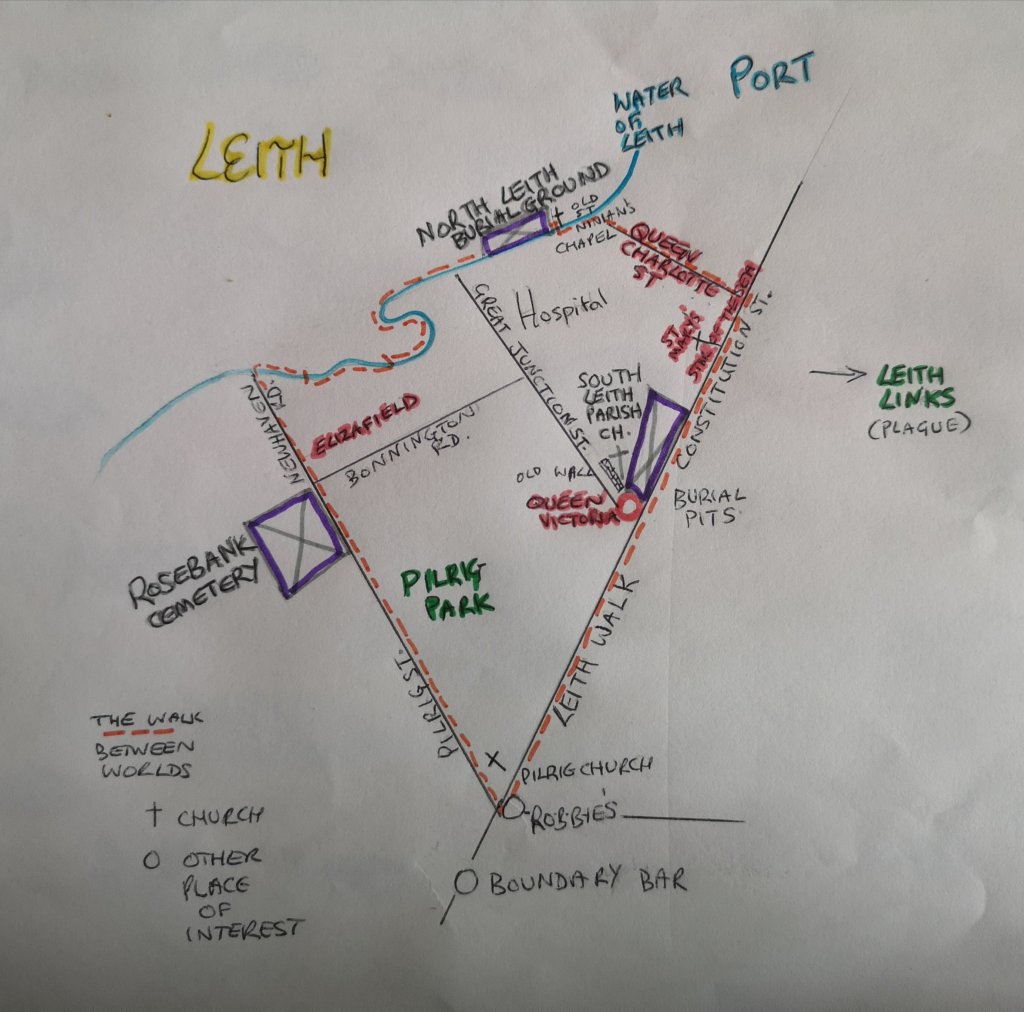
Can we ever stop for a moment? No! Time will always turn until we die. Is there ever complete quietness in life? No! But maybe we can quieten. Can we slow down? Well, walking is a good start. It leaves almost no trace and makes little noise. It allows time for thoughts to blow in, and for your footsteps to drown them out again.
Here, we walk between the worlds of Leith and Edinburgh, connecting with the past by celebrating the ancient Deity of Boundaries (held on the last day of the Roman year) where citizens traditionally process around their land and promote continued peace and stable borders – something I sincerely advocate at this time of disagreement and instability over nationhood.
Before we set off, we remember the 1920 merging between Leith and Edinburgh which, ‘despite a plebiscite in which the people of Leith voted 26,810 to 4,340 against the merger’ (Wikipedia, Leith) resulted in division and the loss of political identity. This walk initially took place shortly after the initiation of a further detachment, this time of the UK from the rest of Europe, which was initiated by many of those who oppose the separation of Scotland and England.
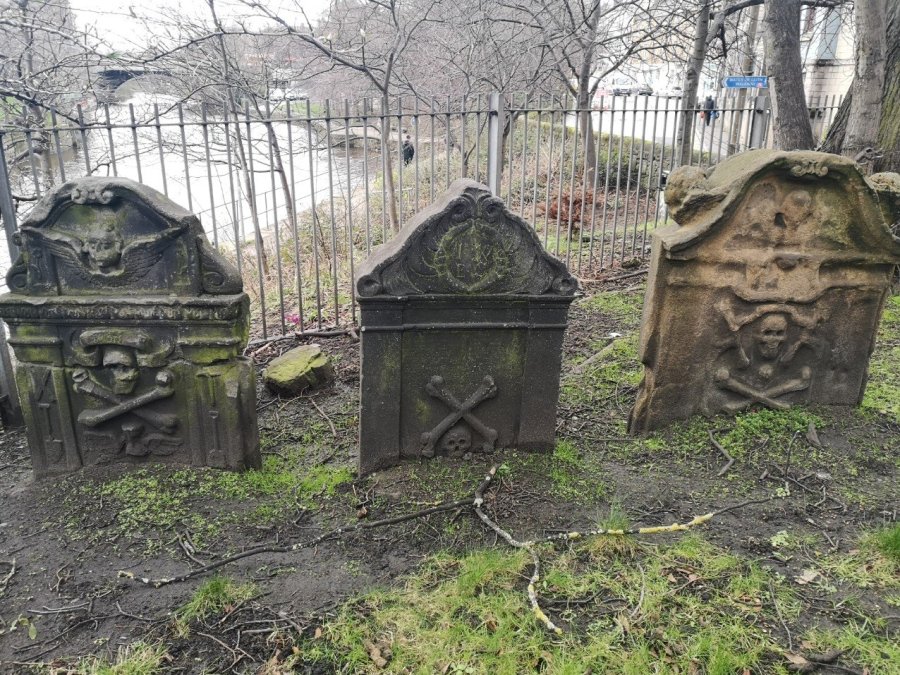
Take a minute to remember, or dedicate this walk to someone you know, because the second aspect of Walking Between Worlds is the acknowledgment that we are all, always, stepping on a tightrope between life and death, never knowing when it will happen.
We will be visiting the graves of notable women in Rosebank Cemetery, North Leith Burial Ground and South Leith Parish Church. I have a special interest in the lives of women who are often forgotten or overlooked, and I want to focus on those who are connected to this area.
The steps we take between an information stop on a guided walk such as this, or when on errands, from one hiatus to the next, are equally, if not more important. They are an opportunity for exchange with others or silent contemplation in the middle of busyness.
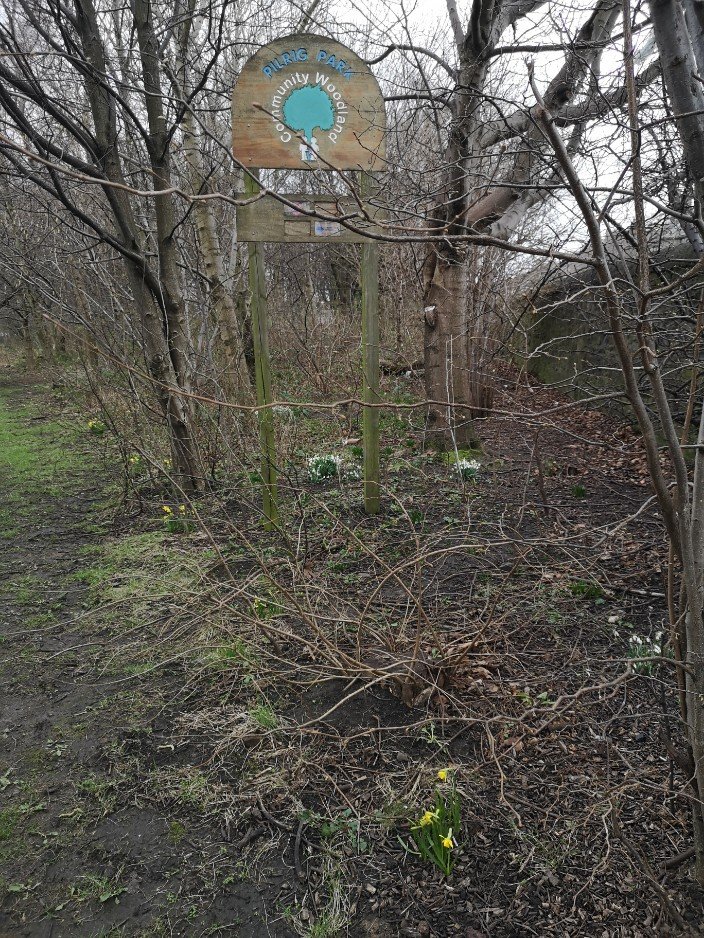
We make our way past Pilrig Park. The community woodland was planted by the Friends of Pilrig Park (and supported by Fields in Trust) way back when I had my allotment there and my kids were wee. Years later it is thriving – a lovely spot for hiding and playing in, whether you are human, animal or bird.
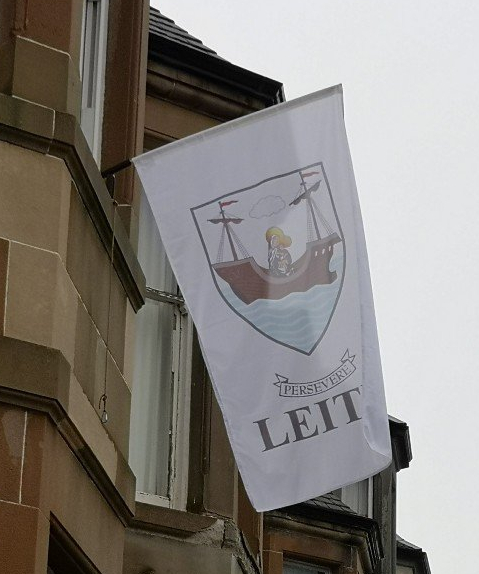
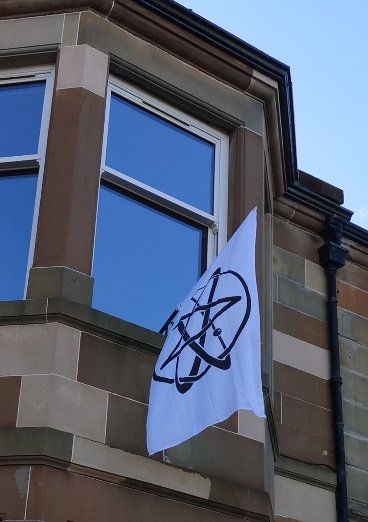
Nearly opposite, we make our first stop to note the Leith (with its motto of ‘Persevere’) or other flag which blows from a top window.
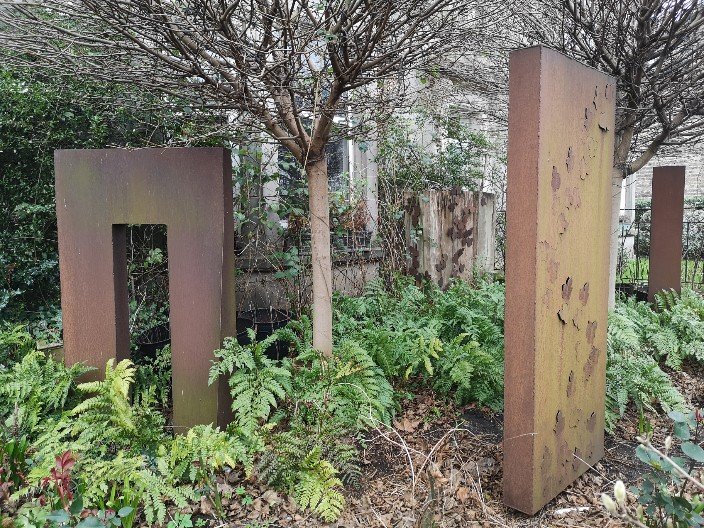
At #86 there are metal sculptures worth admiring in the front garden. A gateway (perhaps it is between worlds), and a panel that is the shape of a large gravestone with leaf motifs in relief, are my favourites. I cannot identify the sculptor, and take this opportunity to share that Fi Bailey, an Edinburgh artist, draws our attention to what may be private information which those who are dead or behind closed doors cannot or do not want to disclose. Let’ us focus, then, on what exists before our eyes.
Tip: In the interests of mindfulness and memory, when or if you see something which interests you as you are walking, say it to yourself three times for later. You may still forget, but that doesn’t mean you didn’t see it and that traces of it aren’t going to stay with you, ready to pop up in another moment.
Rosebank Cemetery
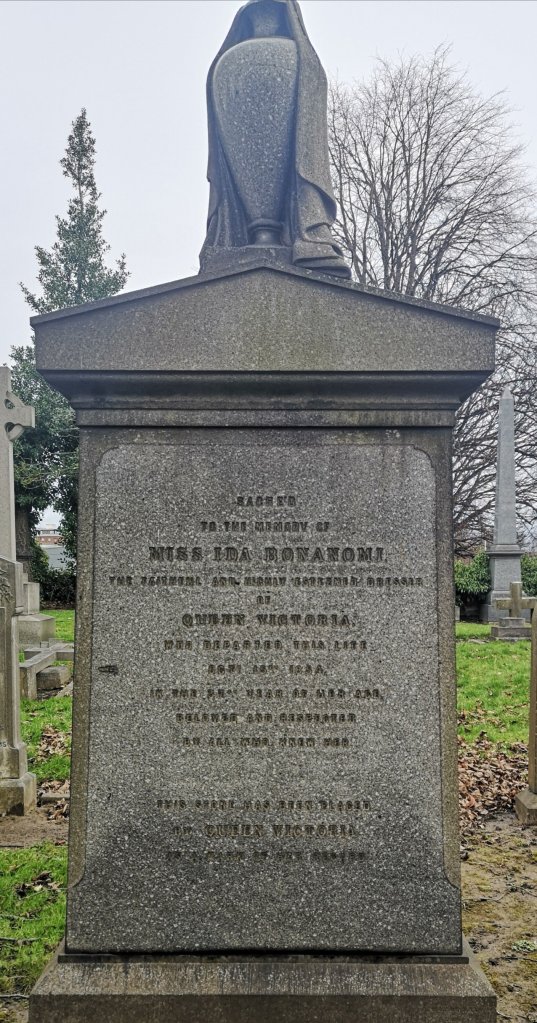
In the same way that there is no night-time dark without a glimmer of light somewhere, so there is no life without some death in it and no death without life. As the bodies in the first graveyard, Rosebank Cemetery, decompose, they become earth and support living things which are in that earth. We, by being interested and remembering those who are interred, raise the dead in a manner of speaking.
We stand in front of the grave of Ida Bononomi (probably Italian). It reads, ‘Sacred to the memory of Miss Ida Bonanomi, the faithful and highly esteemed dresser of Queen Victoria, who departed this life October 15 1854, in the 37th year of her age. Beloved and respected by all who knew her. This stone had been placed by Queen Victoria as a mark of her regard’. Bononomi’s job was a position of extreme intimacy with the monarch.
That Autumn, Ida had travelled with the Queen and stayed with her at Holyrood Palace where the former fell ill. In her journal, the Queen wrote, ‘Saw Sir James Clark, who brought me a telegram with the this sad news that my excellent maid Ida Bononomi, whom I had had to leave at Holyrood as she had become so ill, not having been well at Balmoral before – had died last night. It was a great shock to me, & I was thoroughly upset, for no one, including Sir James had apprehended any immediate danger. She was the kindest, gentlest, best being possible, & such a pleasant servant, so intelligent, so trustworthy & her calm, quiet manner had such a soothing effect, on my often over wrought nerves. To lose her thus, and so far away, surrounded only by strangers is too grievous. Everyone was shocked & grieved, for she was quite adored.’
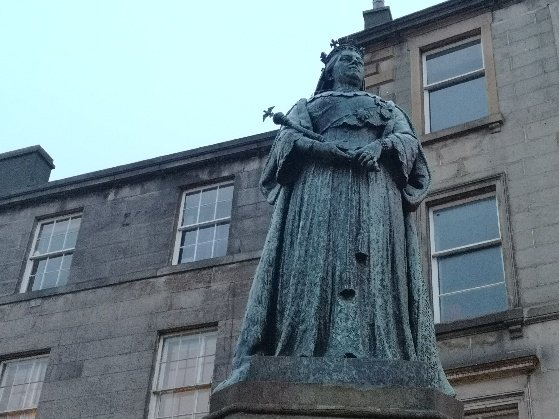
Queen Victoria liked funerals and had an interest in the protocol of mourning, ‘a mentality as much as a personal observance’ (see below for references). It is known that she recognised the deaths of her housemaids and others with ritual in which other members of the household were require to be involved, and also that she visited this grave six years after Ida died.
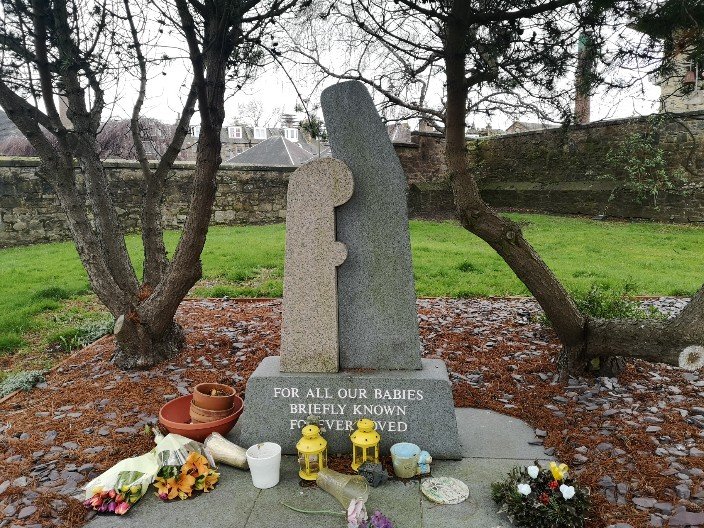
There are, of course, many other graves of interesting women in this cemetery, and there is one which commemorates the stillborn babies who, by Scots law, cannot be cremated and must be buried.
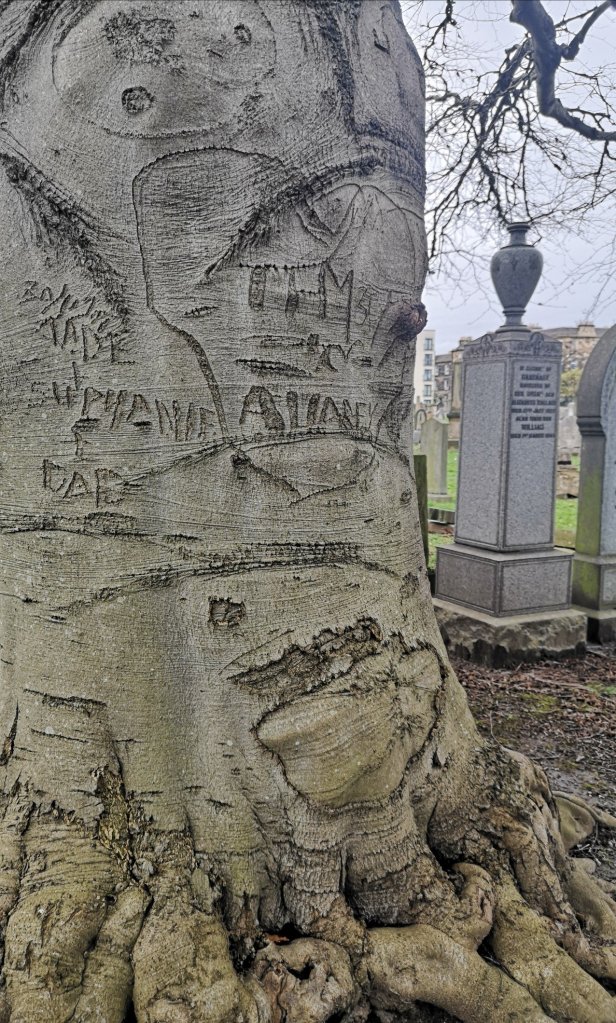
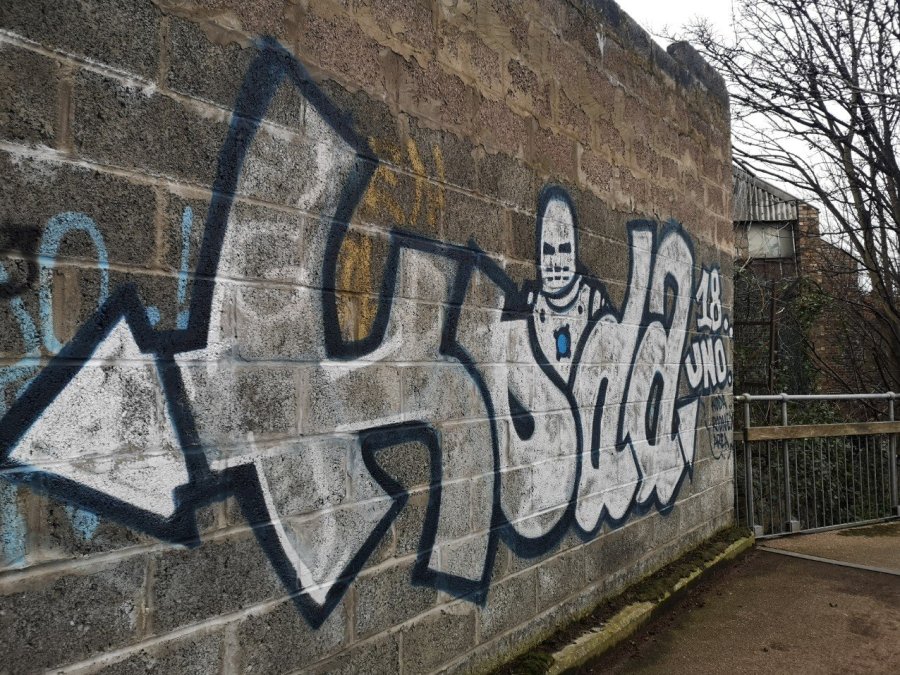
Arboglyphs can be seen at the cemetery and they contrast with the grave inscriptions and, later, the graffiti which we saw beside the river. These different types of markings are official and unofficial, consisting of numbers, letters, words and images cut into or sprayed onto stone or bark with or without permission. They engrave death, and mark political or personal messages, causing us to remember and take note. They sometimes do damage to community surroundings and cause loss of life to the tree, but are always used to communicate and are often enjoyed, even viewed as art.
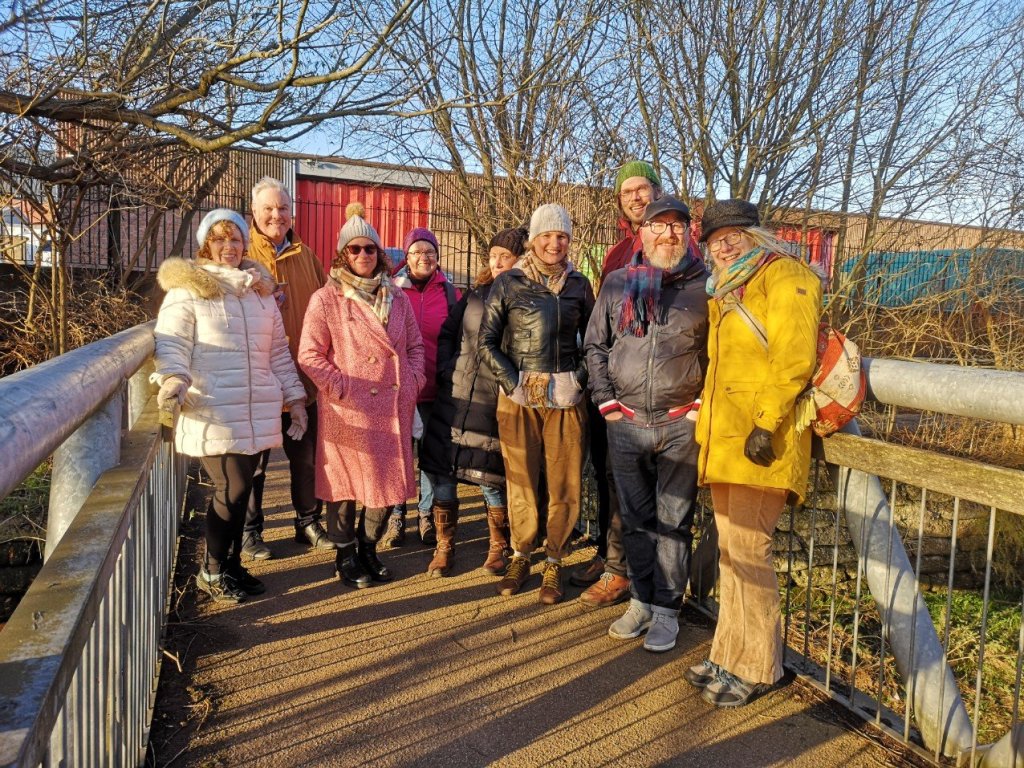
This walk was originally with ten others, and made in celebration of the Terminalia Psychogeography Festival (23rd Feb, annually). It happily coincided with a Women Who Walk Network event and the Audacious Women Festival.
Links
Introduction to walking Between Worlds
We continued our walk across the junction at Bonnington Road: Walking Between Worlds 2.
The walk continues in the final blog of the series, Walking Between Worlds – 3
I am indebted to Elizabeth Jane Timmins, 2019 and this blog for the information about Ida Bononomi and Queen Victoria.
 Walking without a donkey