Stretching from the River Almond to the River Esk, Edinburgh’s remarkable coastline runs from one of the few Roman ruins in Scotland to buried quarries and beaches made entirely from the rubble of the city’s demolished buildings. Through docks and ports to beach resort, nature and culture, past and present are brought together in diverse ways.
This part of the city has enjoyed something of a revival of interest over the past few years: esplanade, beach, and shore, making new lungs for the city. How might engaging with this oldest and most ephemeral boundary of the city help us re-imagine it anew?
Jonathan Gardner is a contemporary archaeologist and critical heritage studies researcher. His work examines processes of recent and contemporary large-scale landscape transformations in the UK using archaeological methods, with his current research looking at the longstanding exploitation of Scottish hydrocarbon resources as a form of contested heritage. Gardner’s talk, ‘Washed up on the beach: revisiting the heritage of Edinburgh’s coastline‘, aims to provide an overview of some of the history and heritage of the city’s coastline and its importance for thinking about the city of the future.
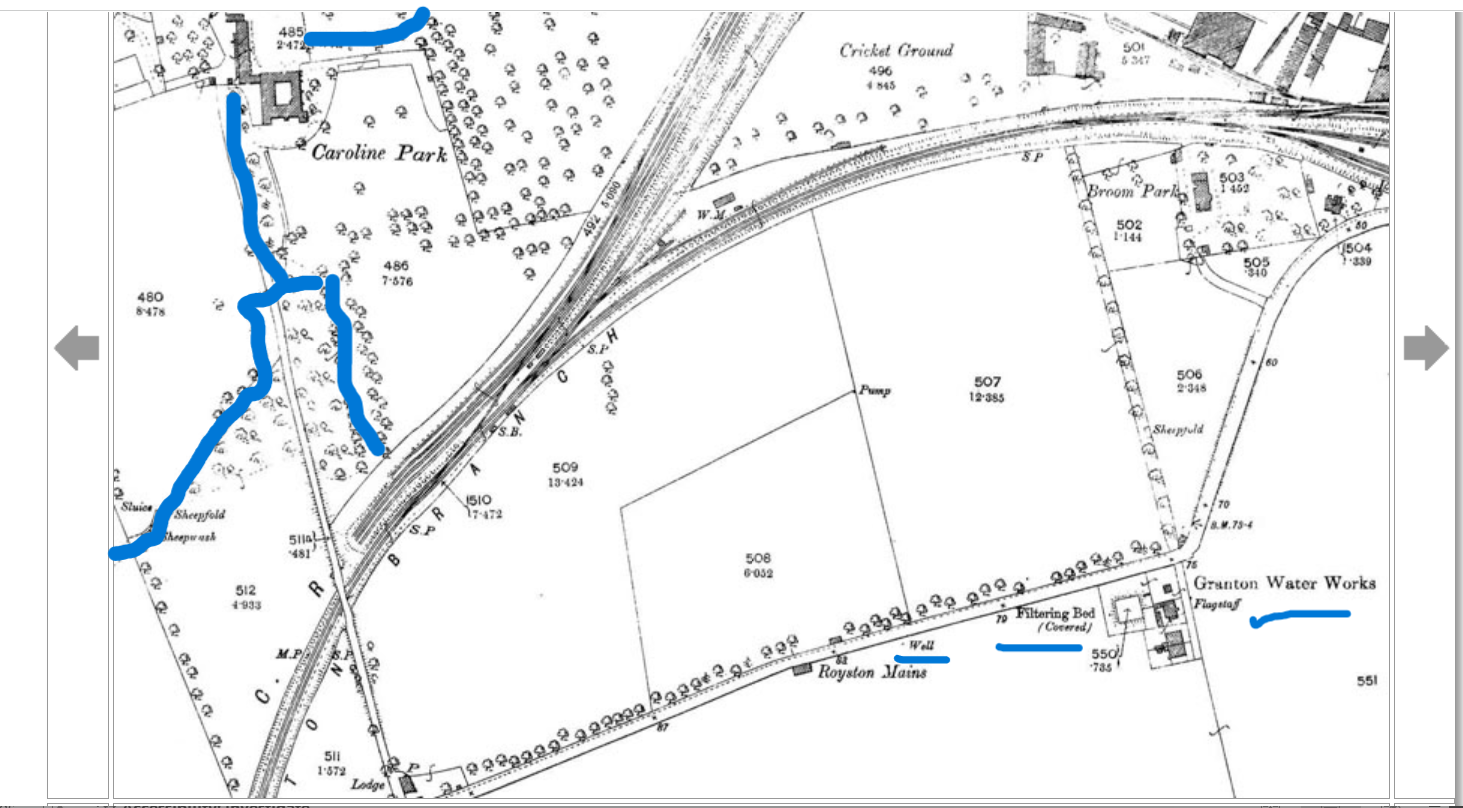
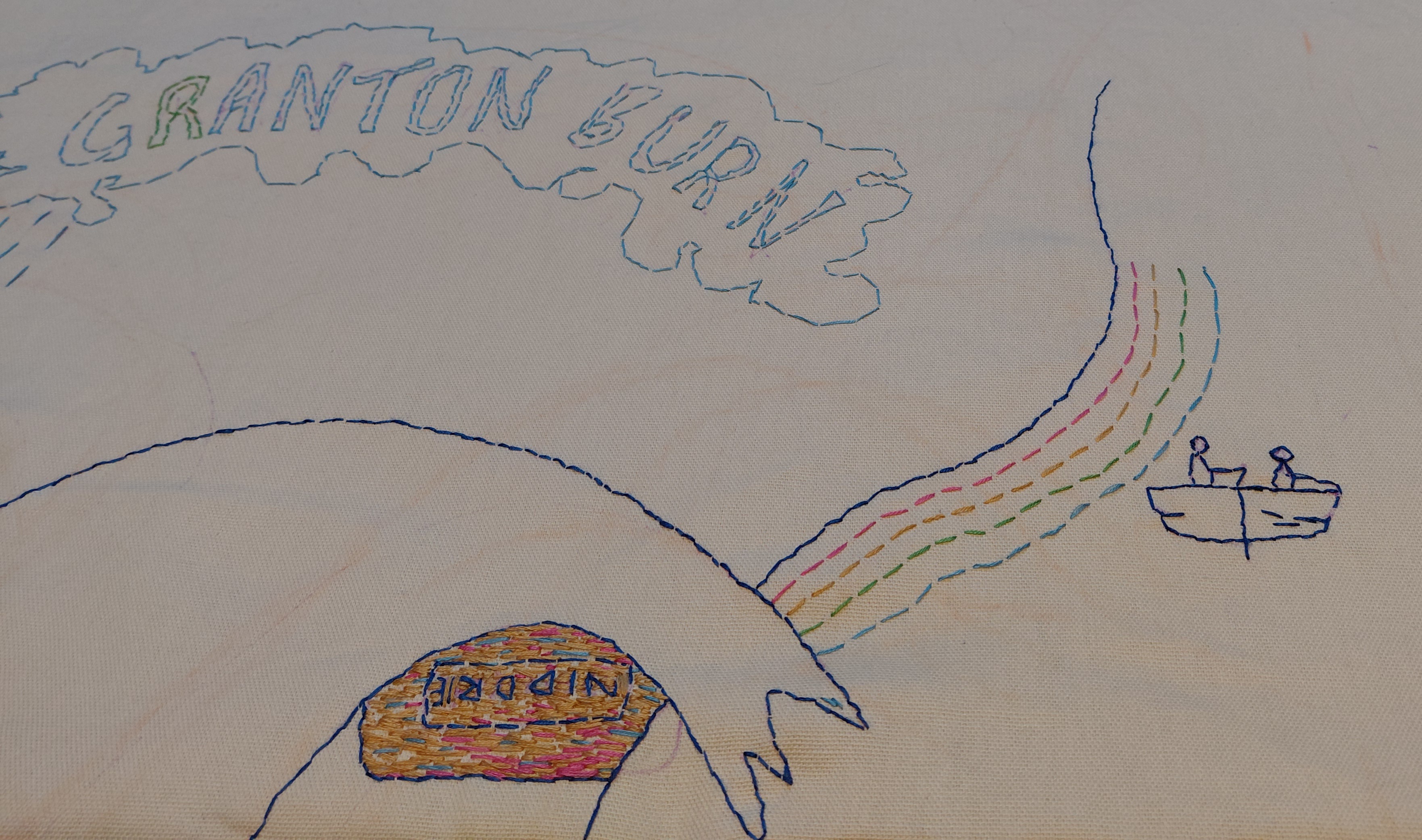
Tamsin Grainger is a Walking Artist and writer. Her recent work, ‘Walking Like a Tortoise’, explored the edge of Granton using maps from 1870 to the present day, each showing a different boundary line, and collected stories of peoples’ heritage and local history. This work asked, ‘How are the people who live in Granton related to each other, the wider area, and the rest of the world?’ and became an enquiry into the links between geography and community, into mapping and belonging.
1896 Granton map (annotated to show the Granton Burn and nearby wells and springs)
Tamsin’s talk, ‘A walk along the Granton Burn, from Hill to Sea’ follows a newly created map that traces the Burn’s journey from Corstorphine Hill Tower to the sea, reflecting May East’s* advice not to rely on old maps when navigating changing urban landscapes.
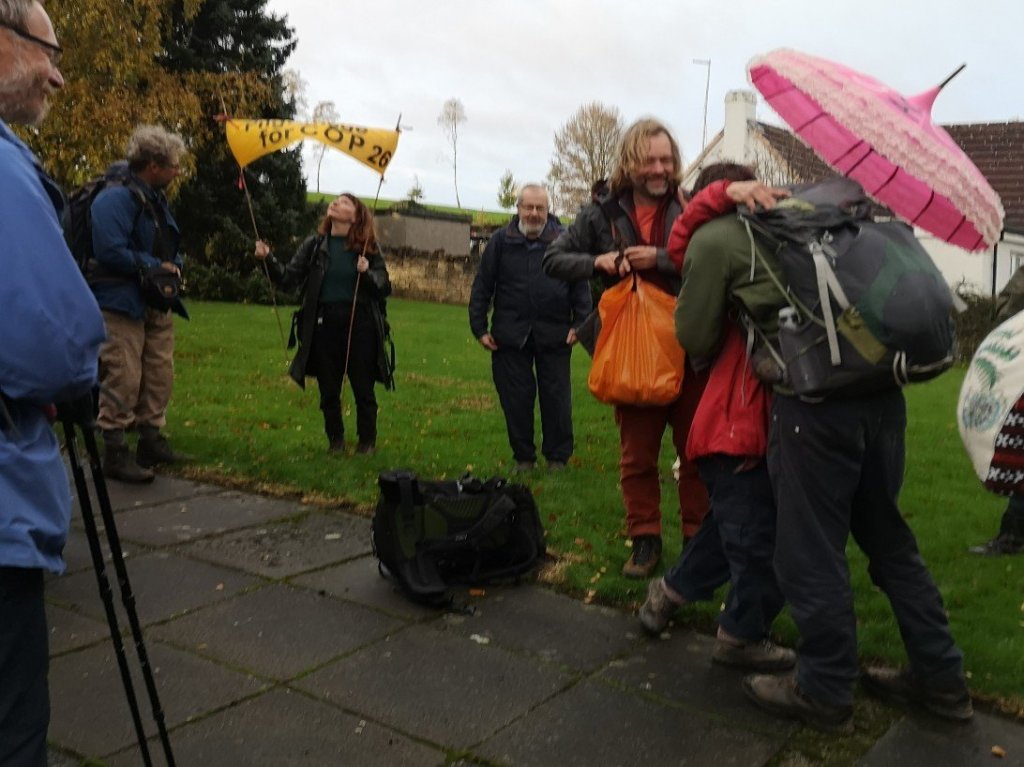
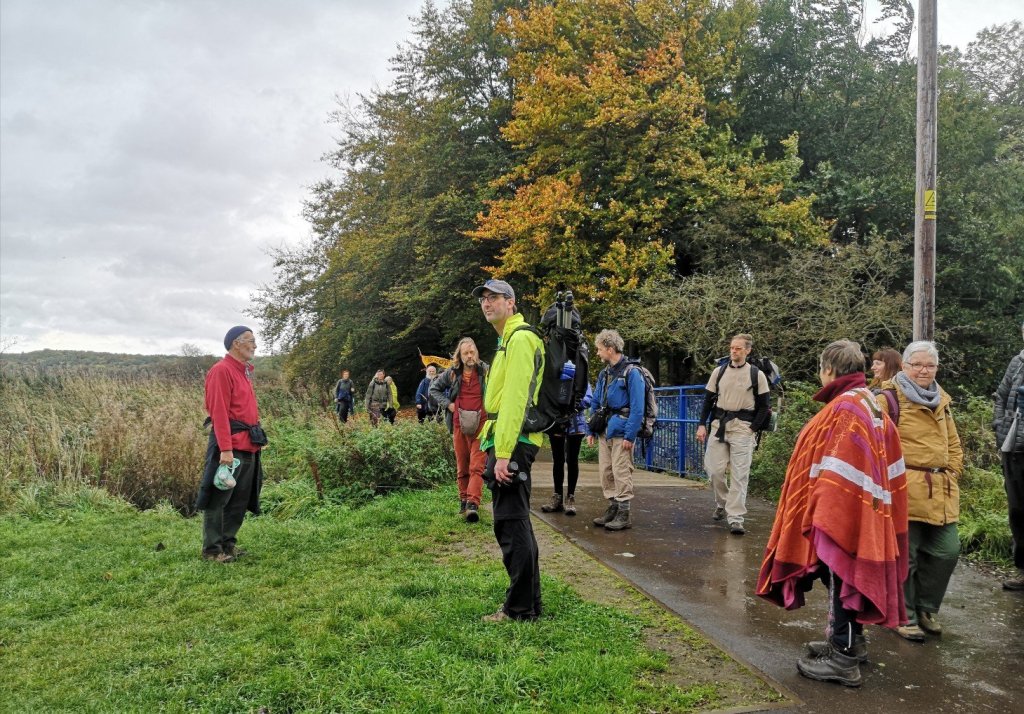
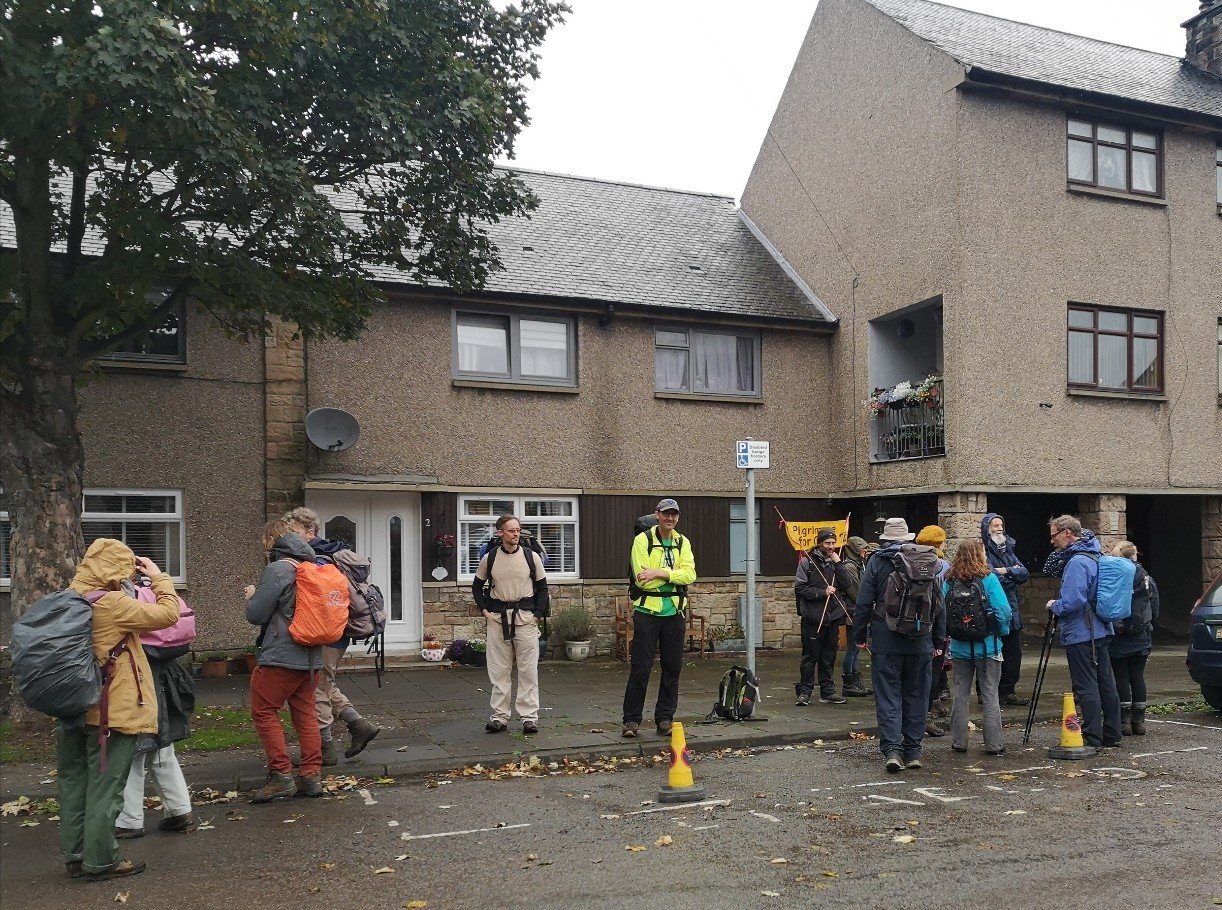
Getting ready to set off from Bo’ness on day 10 of Pilgrimage for COP26
Industrial landscapes and ecological regeneration
The theme is Industrial landscapes and ecological regeneration, though the latter was going to be hard to focus on in the face of the intense piping, cooling towers and wot-not of the space-age area. There is nothing fantastic about it, but I am getting ahead of myself.
Bo’ness local history
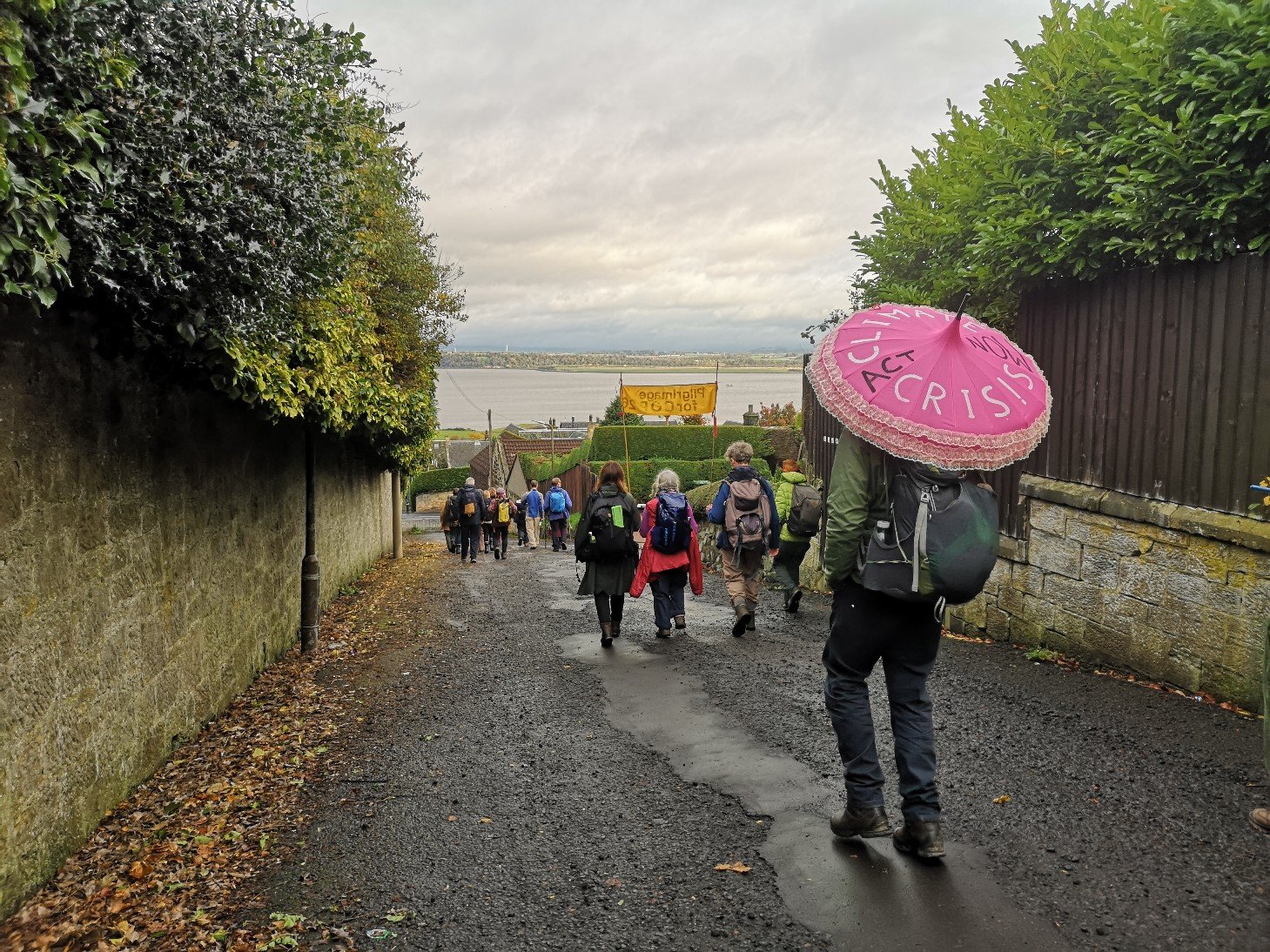
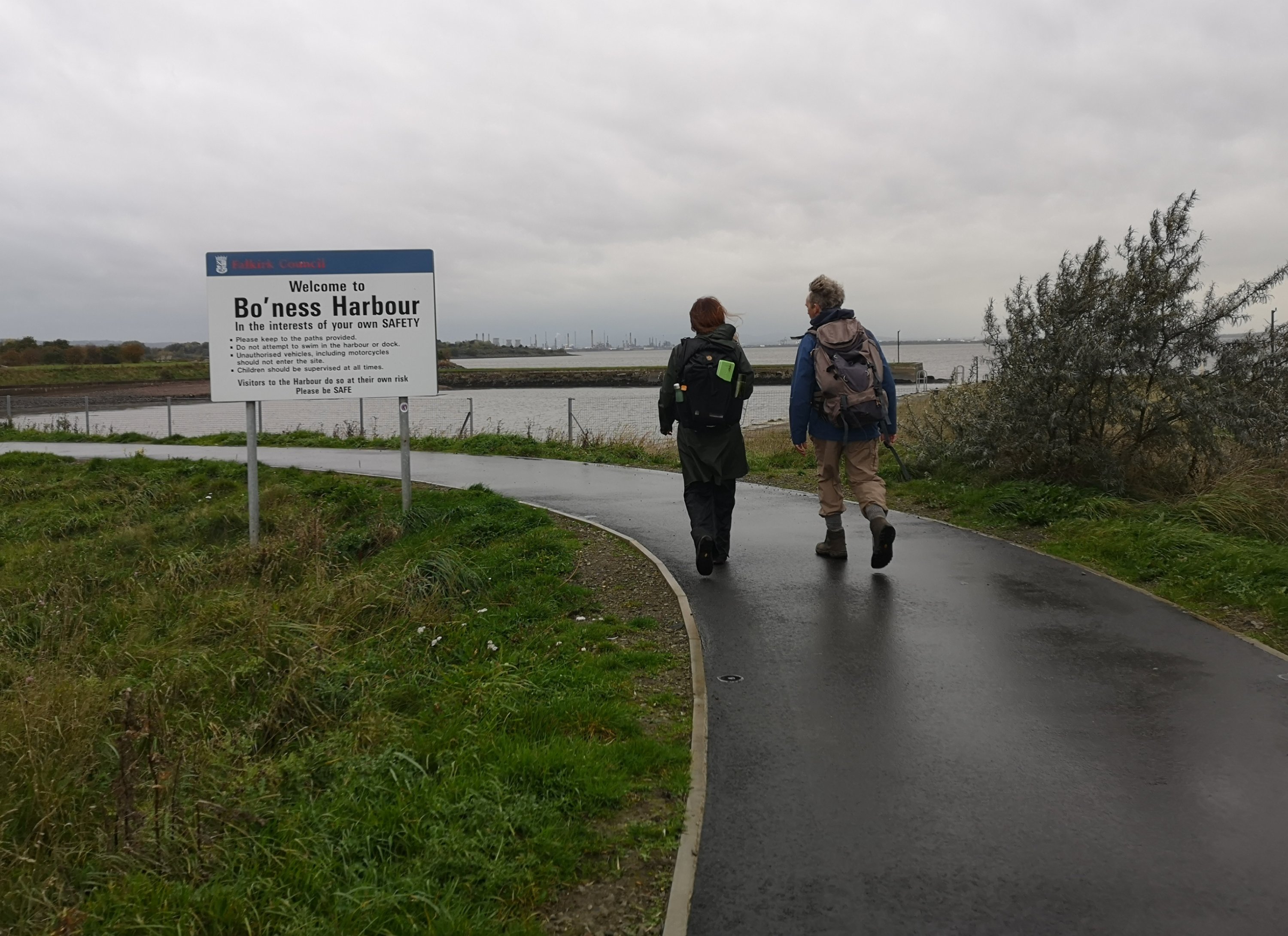
We leave Bo’ness (formerly known as Borrowstounness) around 9am as usual, going downhill one more time, crossing the old Bo’ness to Slamannan railway to Glasgow and rejoining the edge of the Firth of Forth. (The line was usurped in 1842 by the intercity one we now use, and is used for the Bo’ness and Kinneil Heritage Railway. There is also a large Museum of Scottish Railways, and the facilities here were used for the testing of a new hyrogen train. More about the UK eco-train plans here).
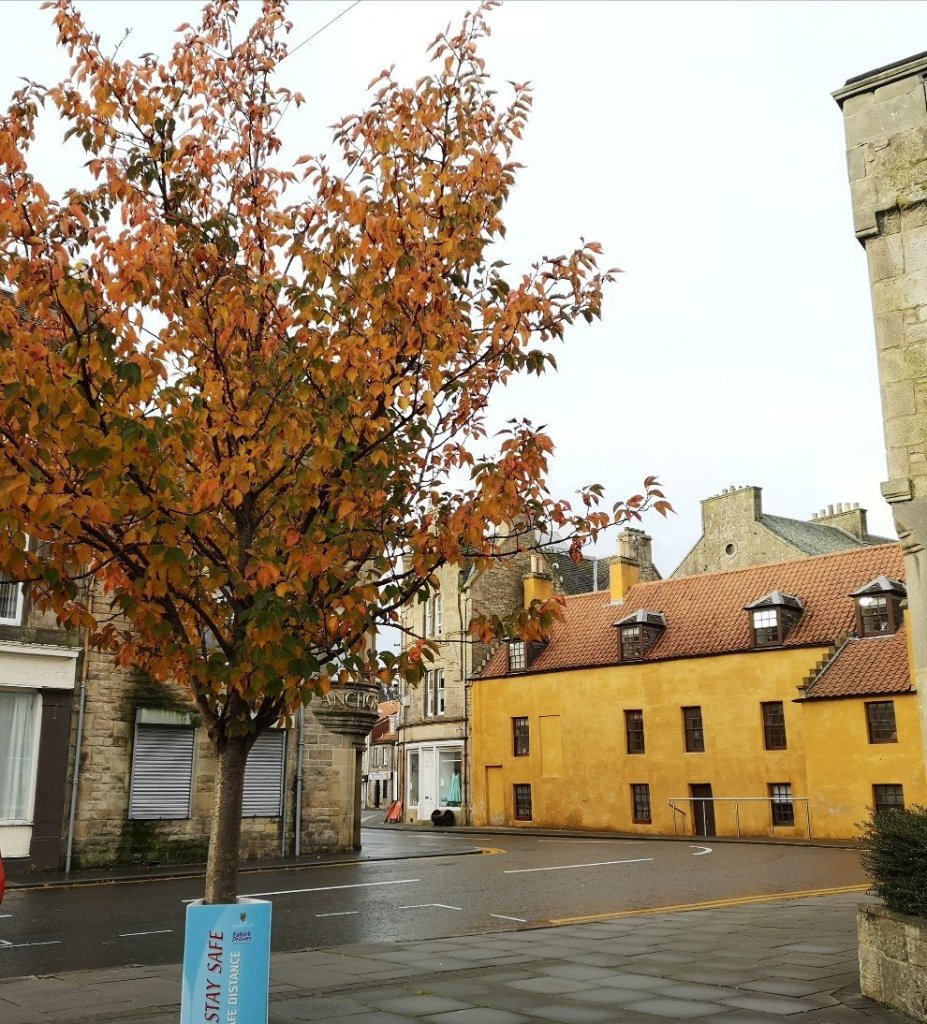
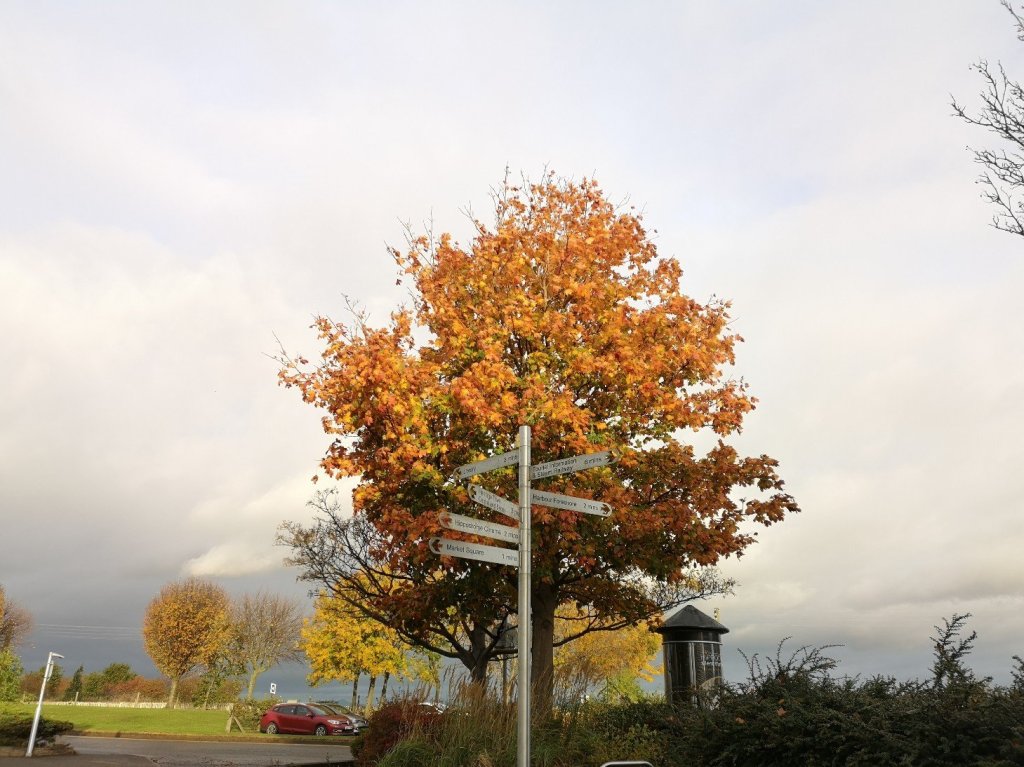
Bo’ness in the Autumn: Dymock’s Building, a restored Merchant’s House and signposts to the many sights of the town
Here we are met by the day walkers who included Ian from the Friends of Kinneil House, built by the Hamilton Family. The Friends help to promote and develop the Estate and the foreshore of Bo’ness where we will be walking this morning.
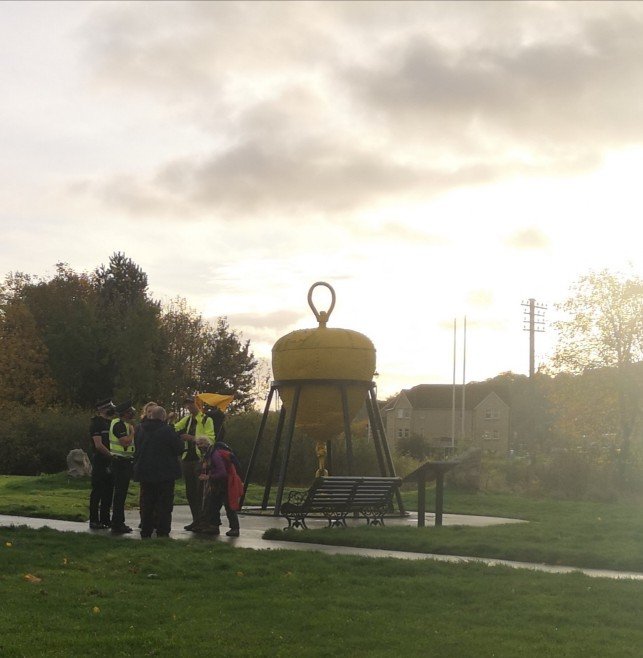
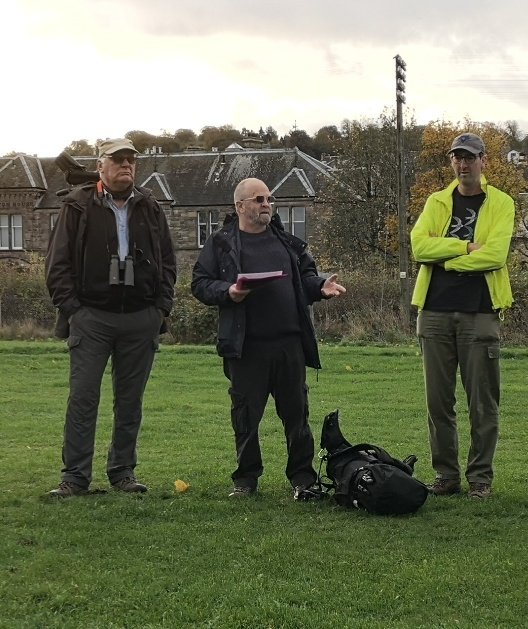
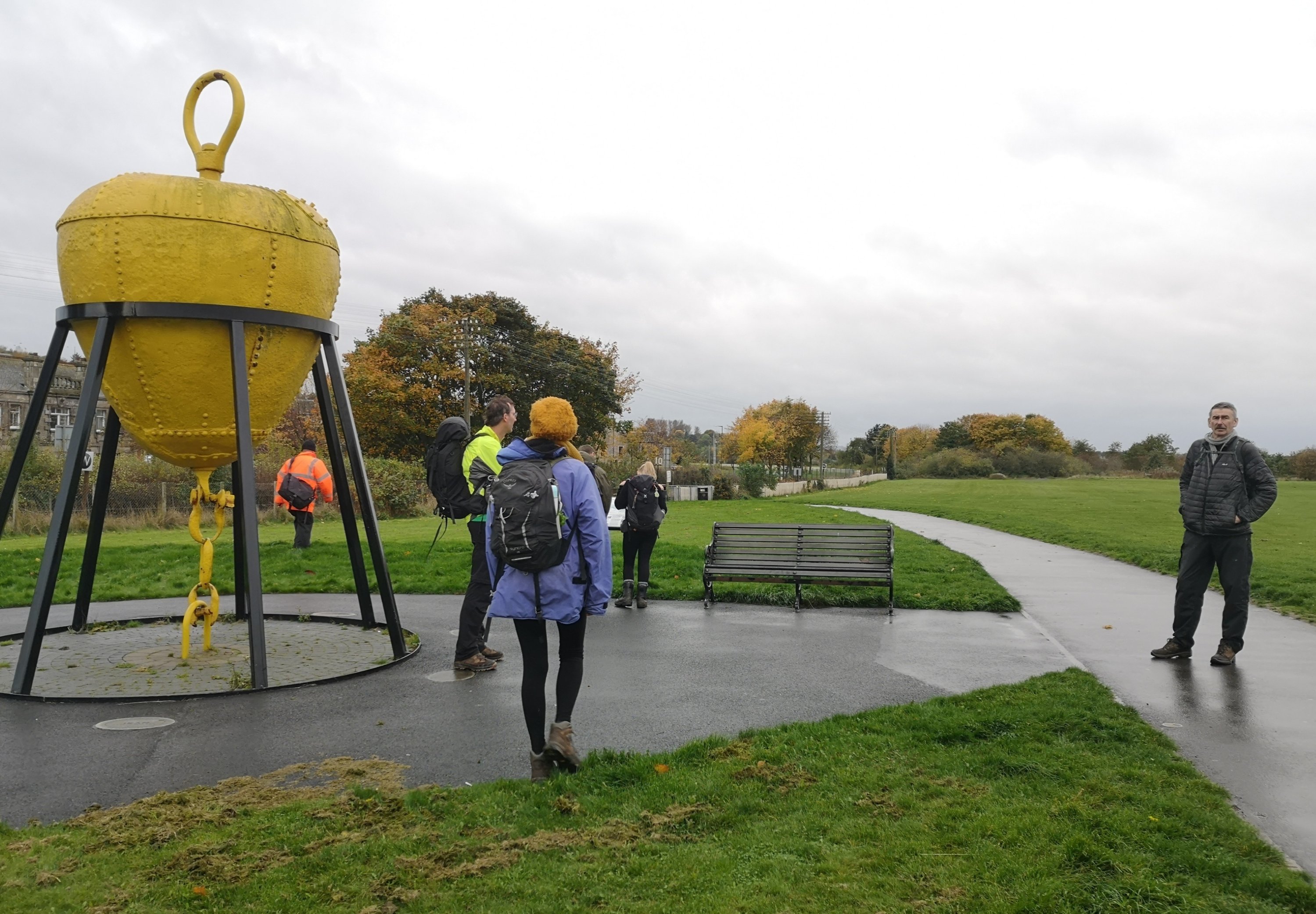
Back at the Bo’ness Buoy where we have our first encounter of the day with the police, and where Ian and Billy join Willie (in the high vis) and us with their wealth of knowledge of birds and local history respectively
The port was recognised from 16th century, ranked as the third most important in Scotland in the 18th century, and the area was a hub of industry. Harbour construction started in 1707, and was closed in 1959 due to silting and the demise of the coal mining industry. Later, the port was the site of shipbreaking, with the ships being sailed as far up on the shore as possible, the bows nearly reaching Bridgeness Road, which must have been a sight.
There were 96 pits, one of which was connected across in Fife by mining under the river, and we are told about the bell pit that was sited in nearby Kinneil woods, now a nature reserve. The pits were closed by 1983 and lots of the remains were put in the river, including medical waste, and chemicals such as arsenic. There is a James Watt (b.1736, of steam engine fame) Supper at Kinneil House on Burns Night to look out for!
Maria Ford, the chair of The Friends, said: “Probably very few of us have a copy of Rabbie Burns’ Complete Works in our homes – but nearly everyone will have lightbulbs measured in Watts.
Mussels were gathered and eaten by our mesolithic ancestors, as evidenced by archeological finds near here, middens of oyster shells, for example, which have been found along these shores. Salt panning, ironstone and clay mines, potteries, whaling and gas were all local industries.
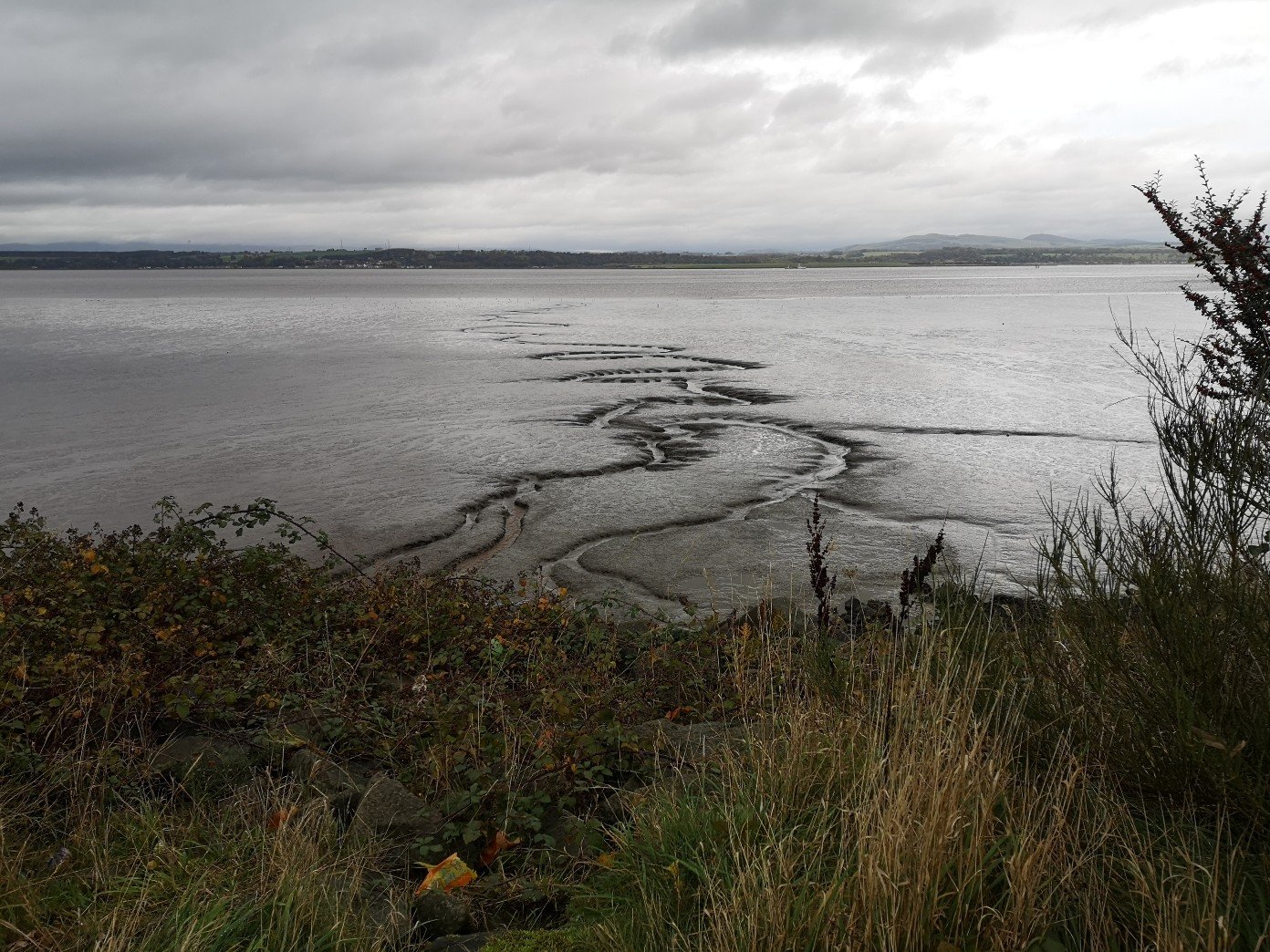
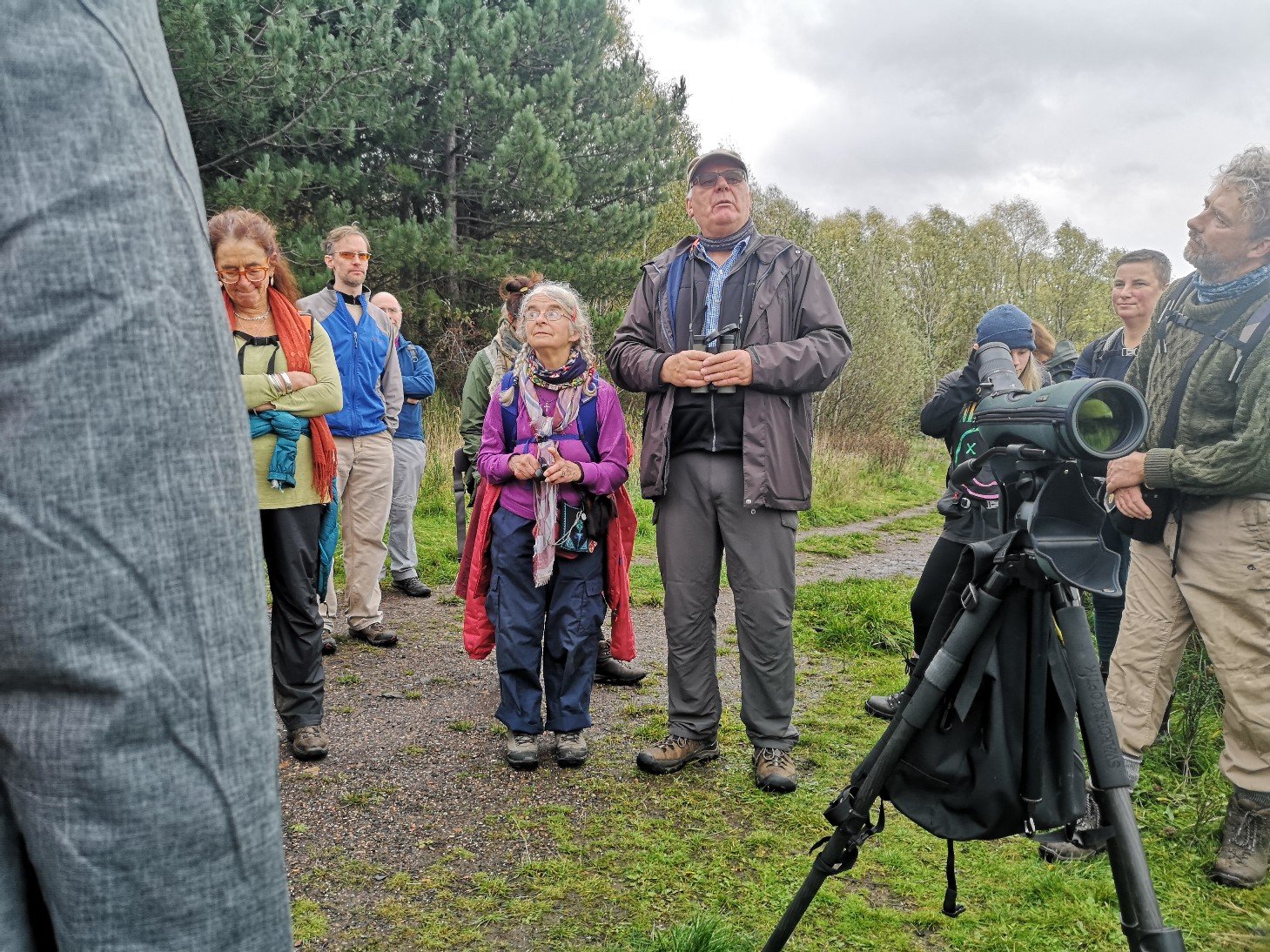
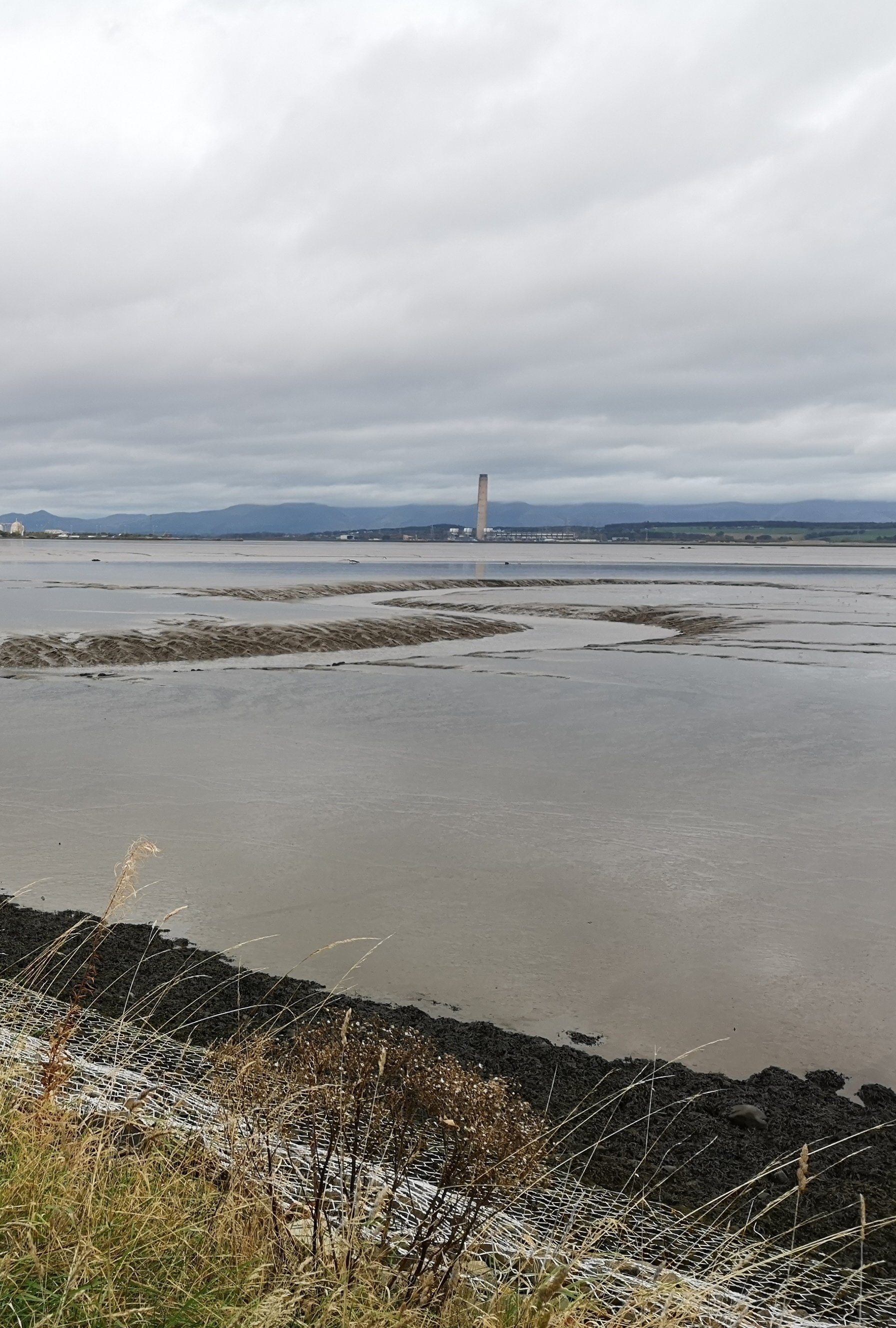
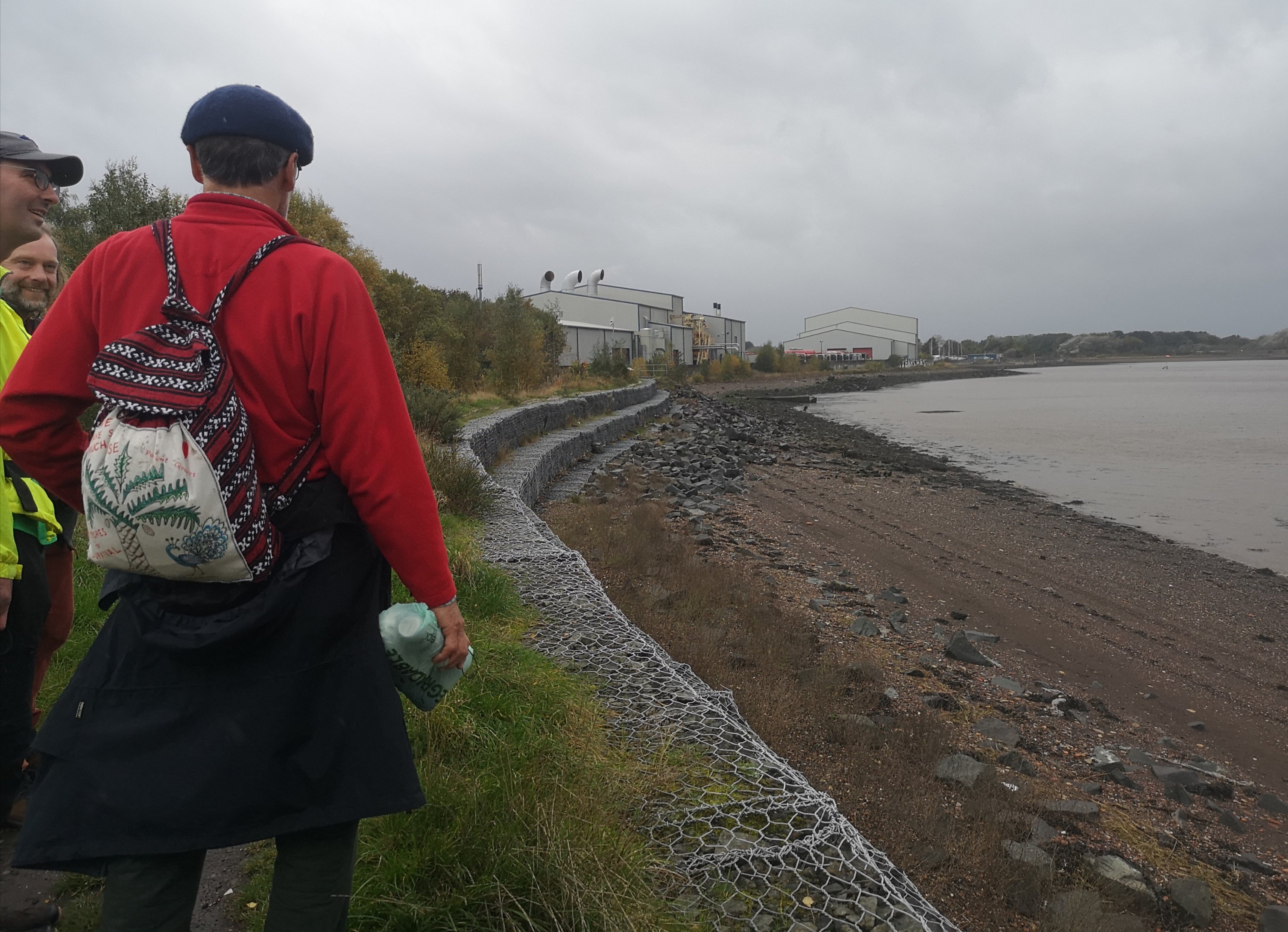
We started walking the Forth river Site of Special Scientific Interest (SSSI), stopping often to learn about the area, much of which is recently reclaimed industrial land, and we admired the lagoons and reed beds owned by the RSPB. Short-eared Owls, Kestrels and Buzzards have been sighted, reeling through the skies. We asked, what is needed to improve it for wildlife, and Billy replied, “Nothing, leave it alone. We hope that there is enough local interest to keep it like this.”
Looking across to Culross, Fife, the birthplace of St Mungo, patron saint of Glasgow, where we are headedStopping to appreciate, identify and learn about the birds of the Forth in light of climate change. With Billy and Gillian centre stageSoil Ceremony #1 with Cath as the Keeper of the Soils displaying the pockets which house the soil samples
There were two soil ceremonies today. This was the first and Liz read out a quote from Wendell Berry‘s The Unsettling of America:
the soil is the great connector of lives… Without proper care for it, we can have no life
Wendell Berry
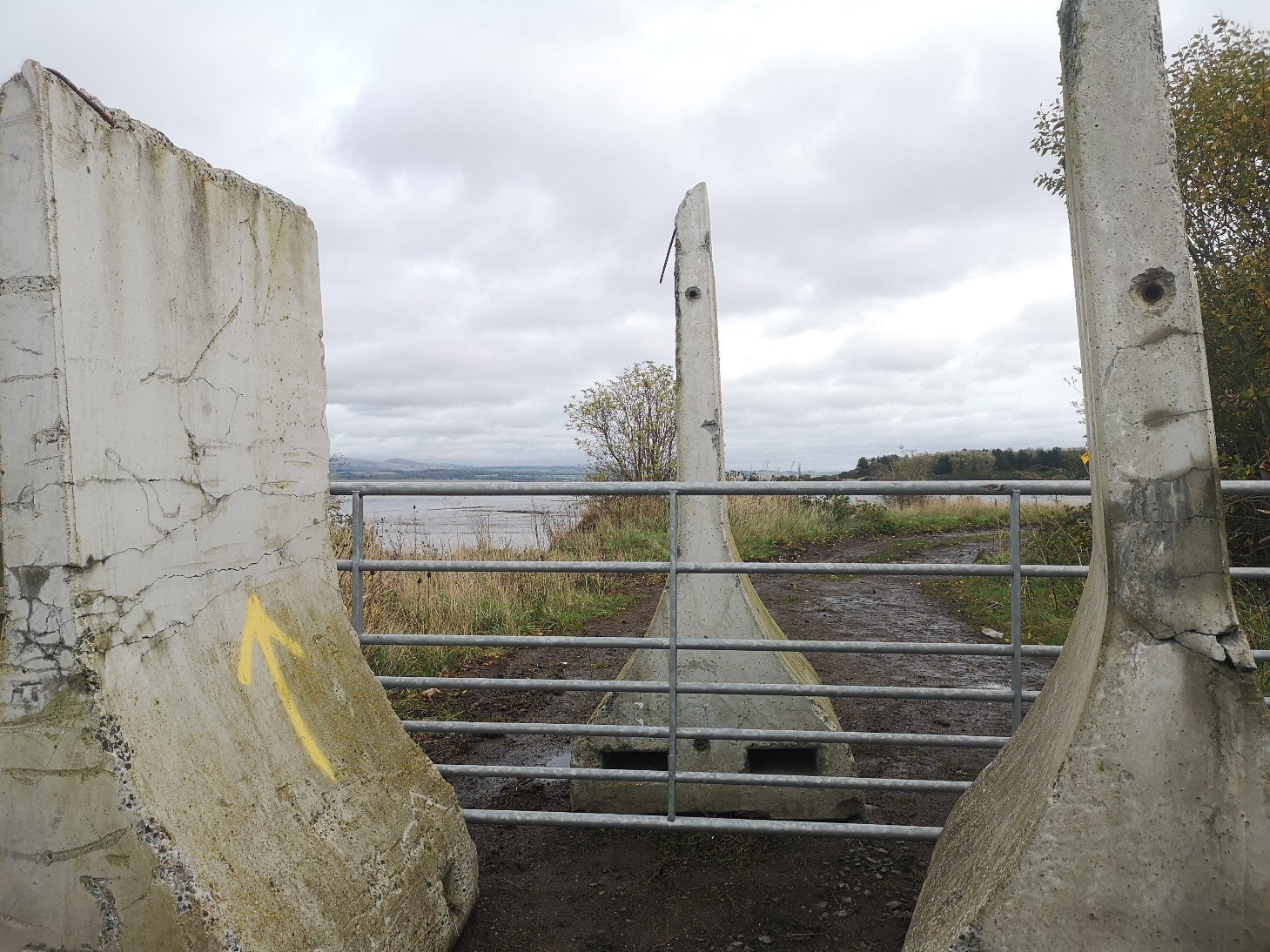
The Spanish camino directs pilgrims with large yellow arrows like these. I have my eye in for them still! Where would we go if we followed them I wonder?
You had to have a pass to walk in this area during WW2 as they were making torpedos here.
Early sightings of Grangemouth dominating the landscape
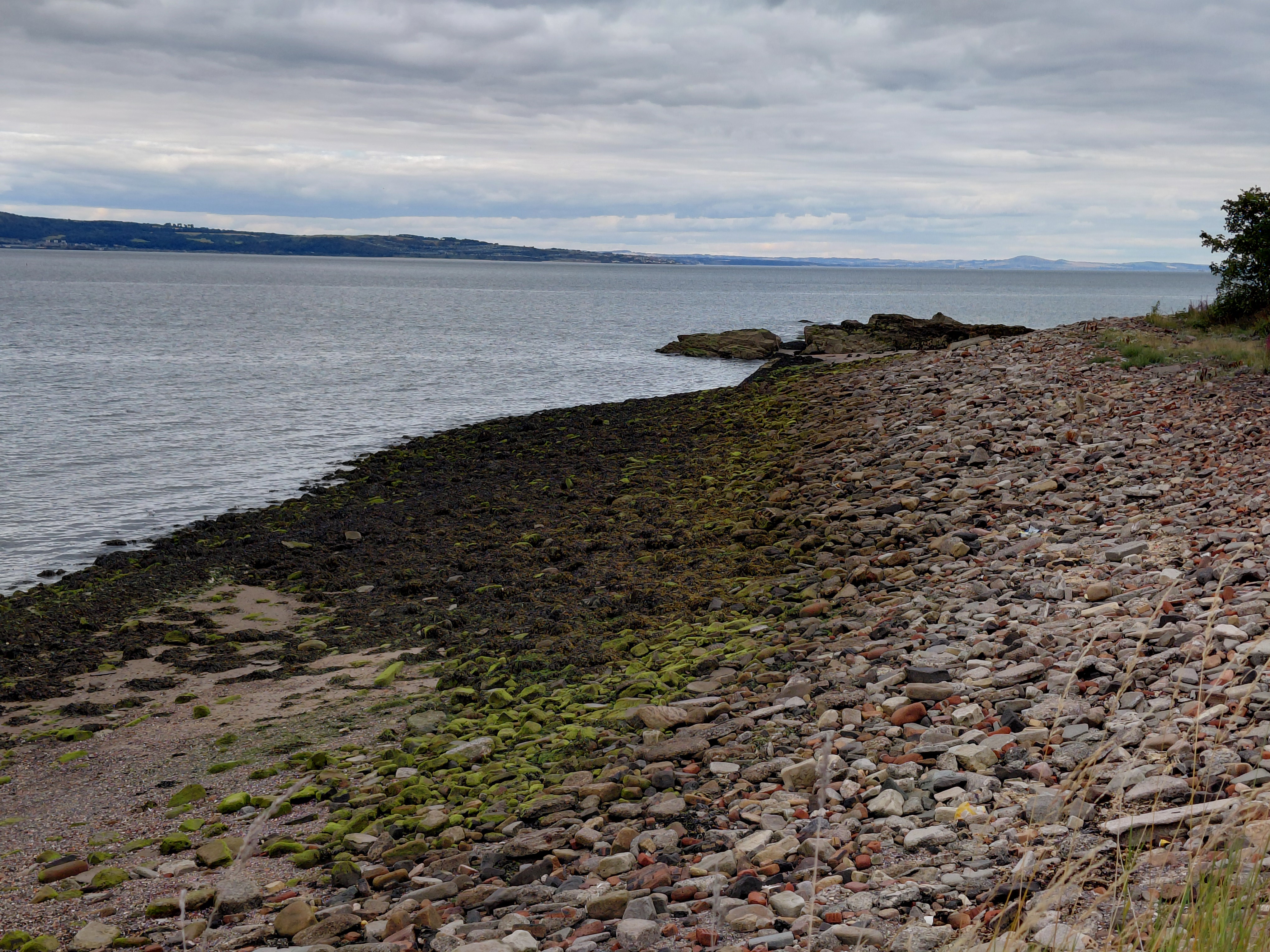
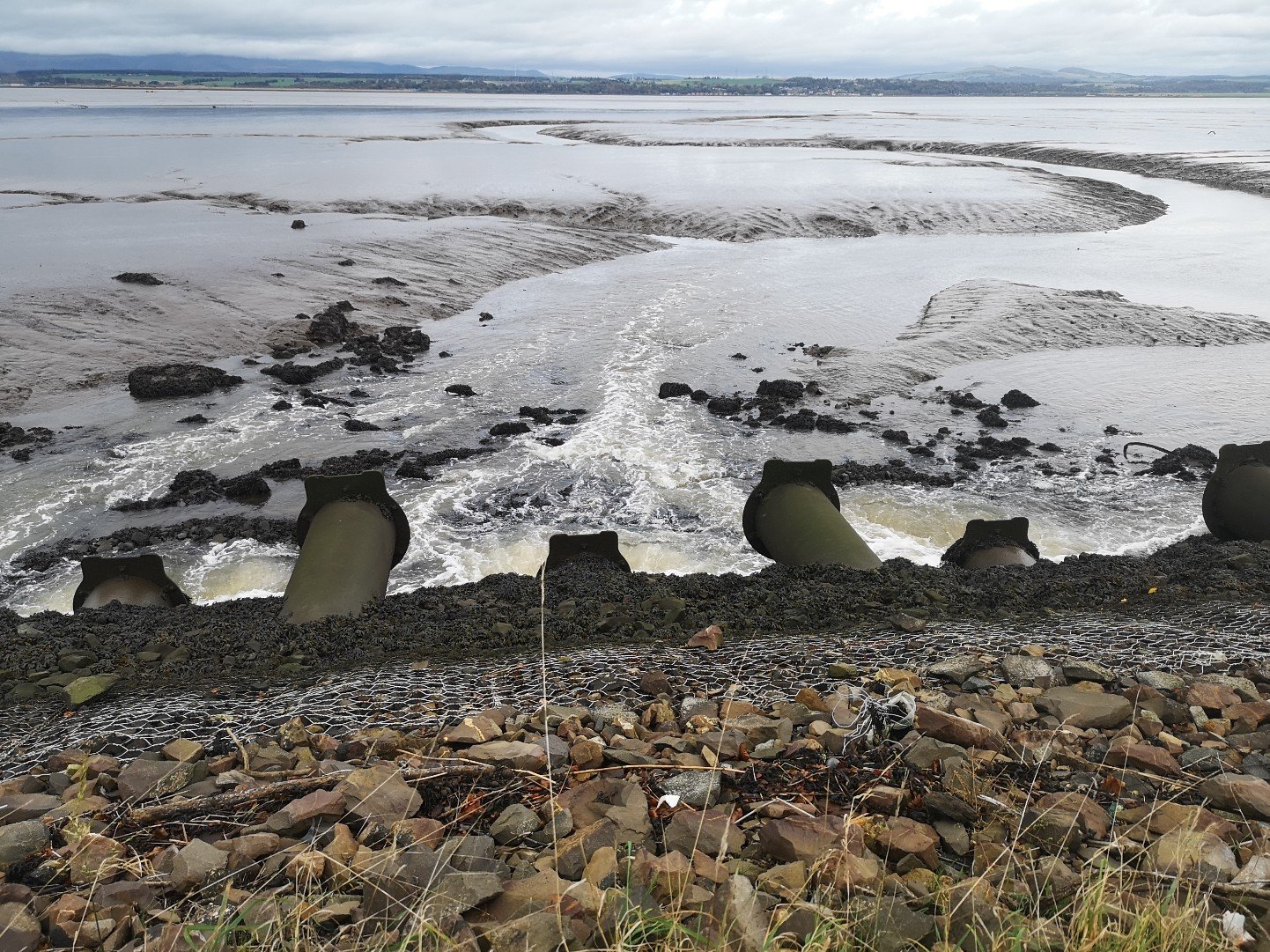
We come to the site of the former 18th century Bo’ness Distillery (almost at Kinneil Halt (station)) and are reminded that it, too, produced effluent, discharges which seeped into the Forth. The Pottery was nearby (at one stage in its long history, Alexander Cuming gifted it to his 12 year old nephew, James, and at another it was inherited by a 3-year old boy). We are told that it burned down in 1963. We could clearly see old bricks on the shore, as you can also see in Granton a few miles further east where we had walked earlier in the week.
We see Godwits reaching for worms deep in the sand with their long, scimitar-like bills, and hear the plaintive piping of Curlew (their bills curve downwards). We move past delicate grasses, moody bulrushes, and stems of orange sea buckthorn berries highlighted against pale, sage-green leaves. The intense silver-white softness of the rosebay Willowherb contrasts with its rusty foliage, and the slim Salix stream in the wind above Hypericum, wild Stawberries, Brambles, and spiky Teasle. The Gorse sports both dry black pods and bright yellow flowers on the same bush.
A system of moving water between the Firth and the inland wetland area to account for the tide.
The landfill attracts Redshanks, Lapwings and Shelduck, and the absence of people during the early Covid period was advantageous for them. It is noted that the Shelducks (brown necks) moult here, a sign that they are feeling safe (they can’t fly when that is happening). The bigger issues, now, as at the reclaimed land we walked over in Musselburgh, are uncontrolled dogs off the lead.
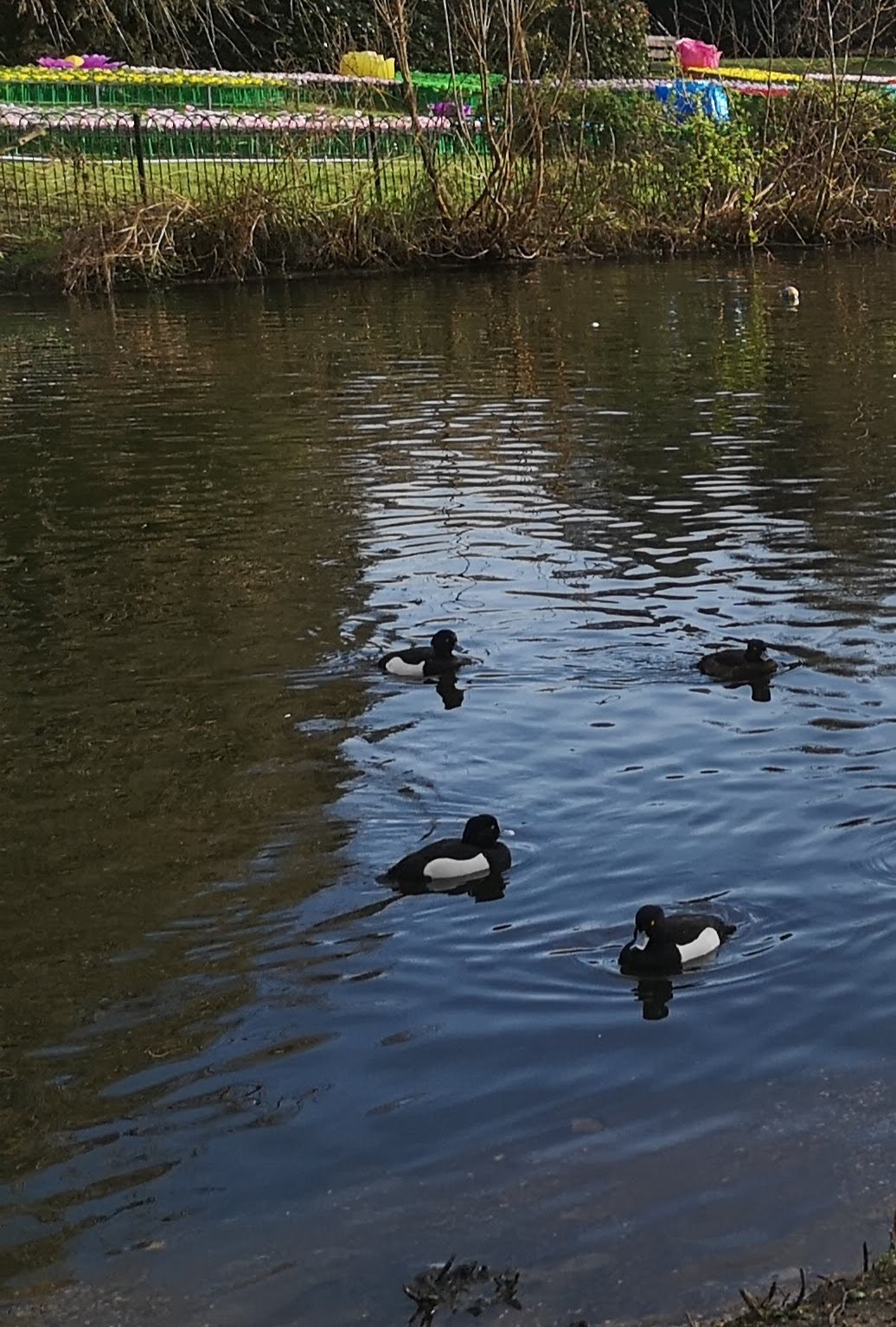
Scop or Scaup ducks, Chiswick Park, London
By way of explaining the change in wildlife in the local nature reserve as a result of cleaning up the waters, Billy explained about the Scop or Scaup (ducks) who used to live here alongside the molluscs and mussels. The sewage actually helped and now there is less, they have disappeared. However, when the refinery flares at night and the tide is at the right stage, Redshank feed at night, so there are more of them.
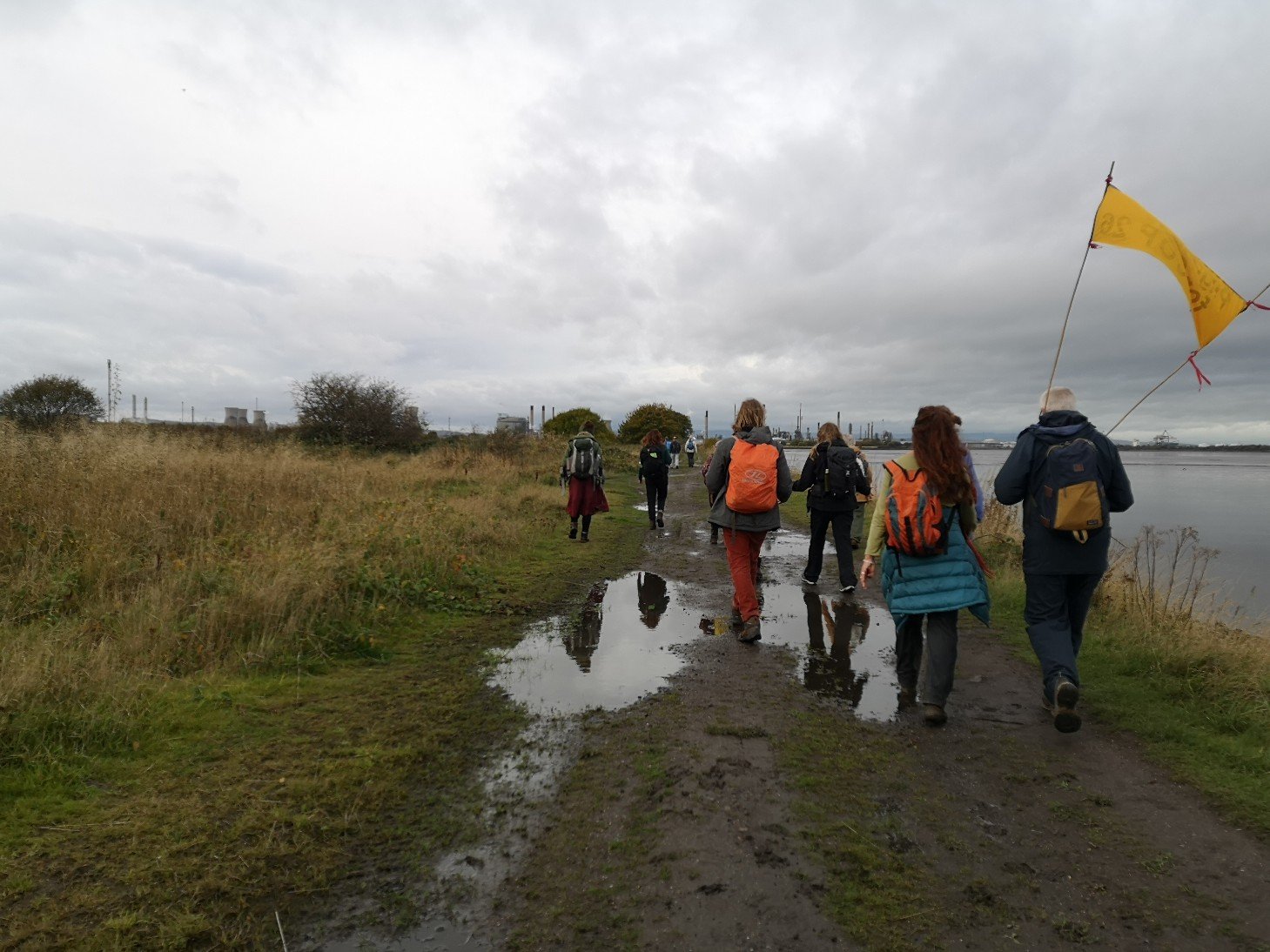
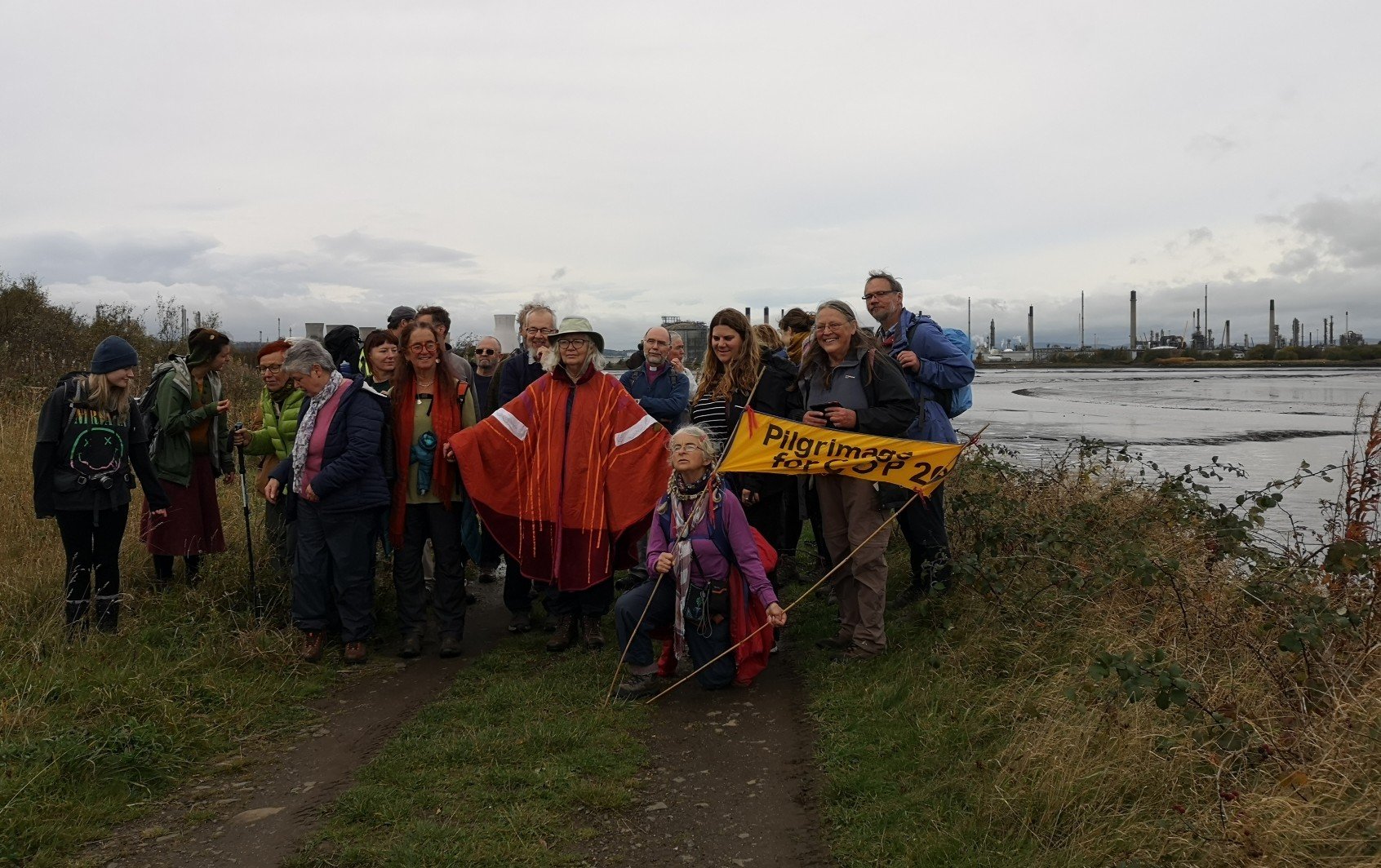
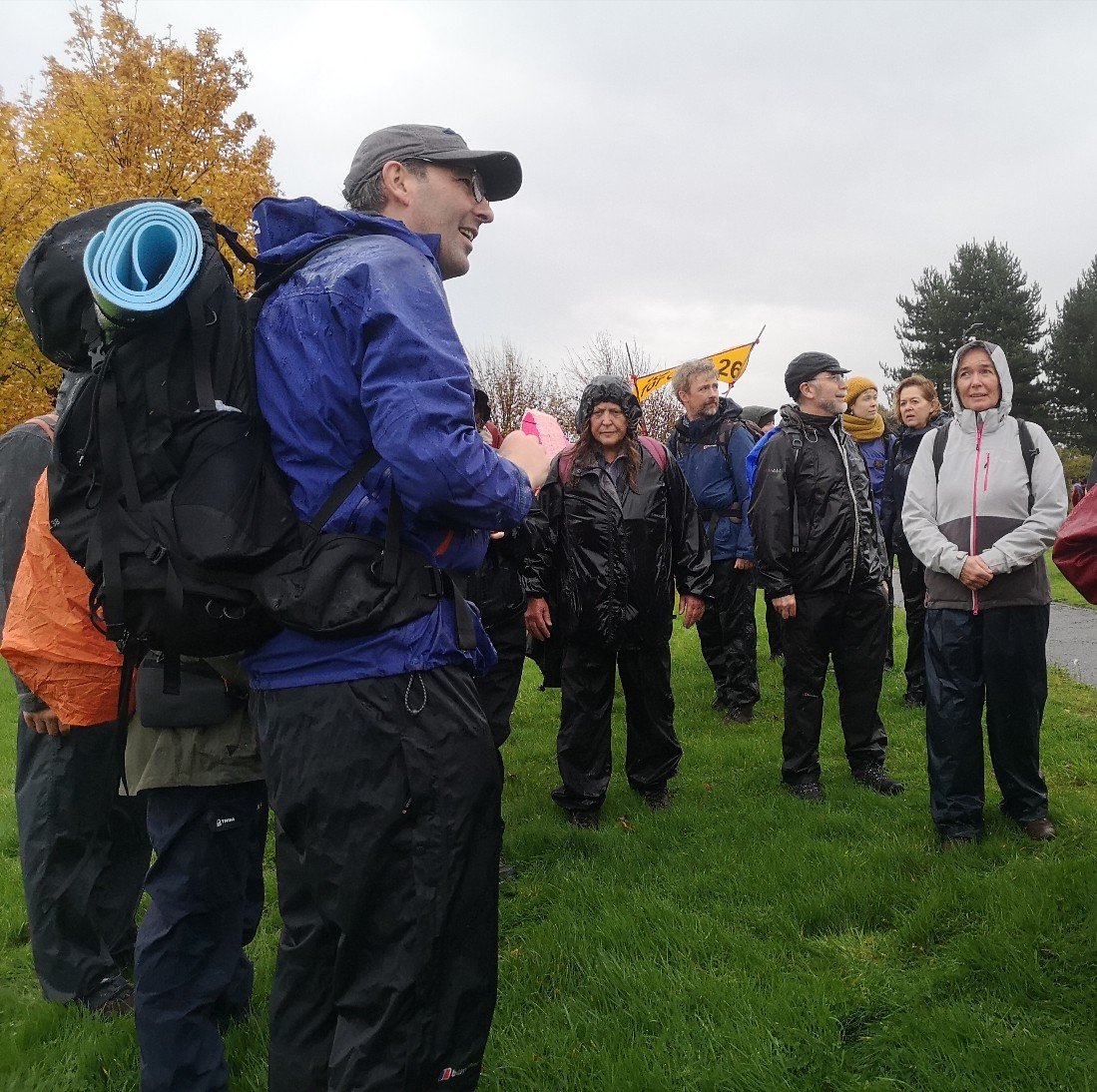
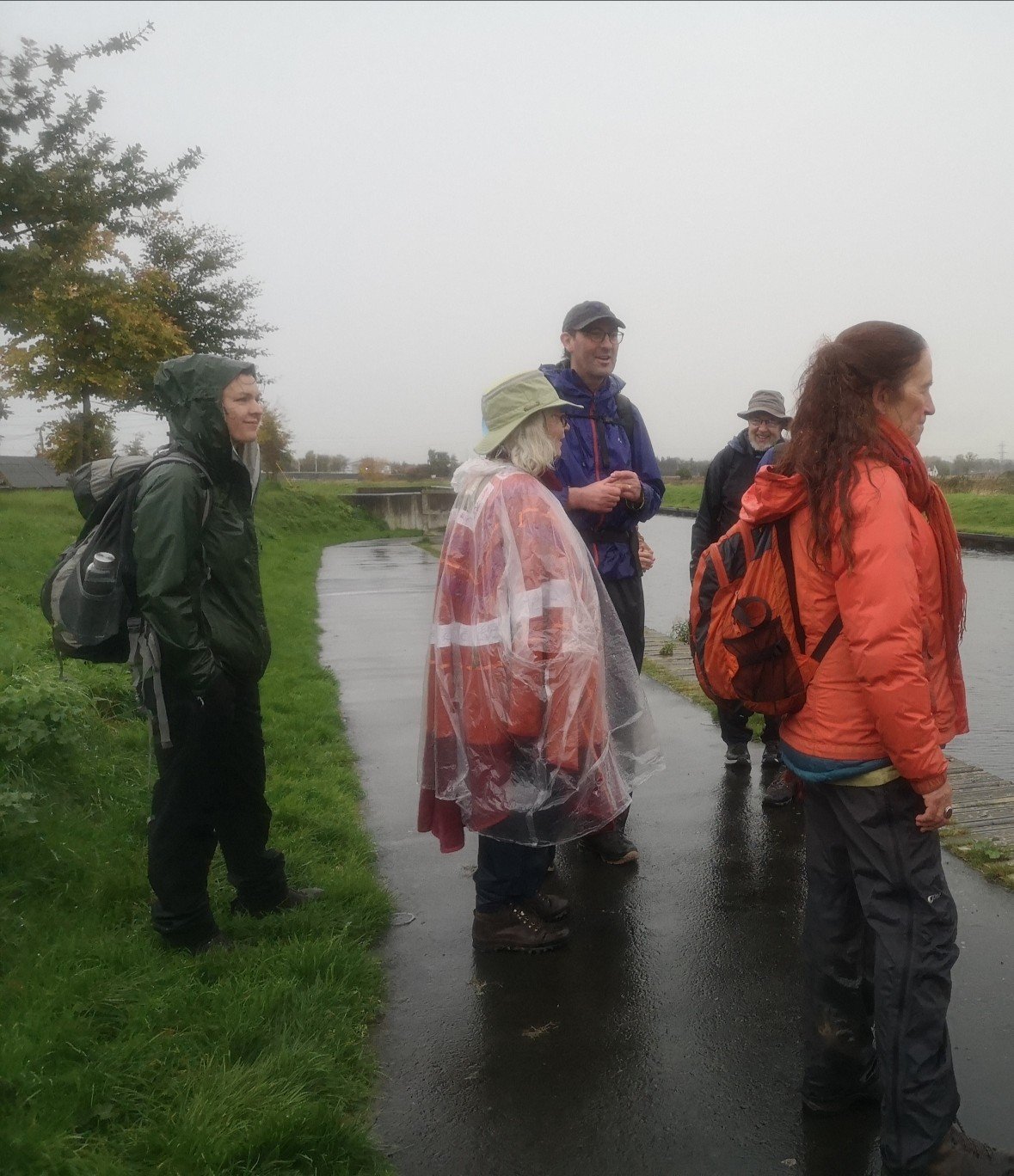
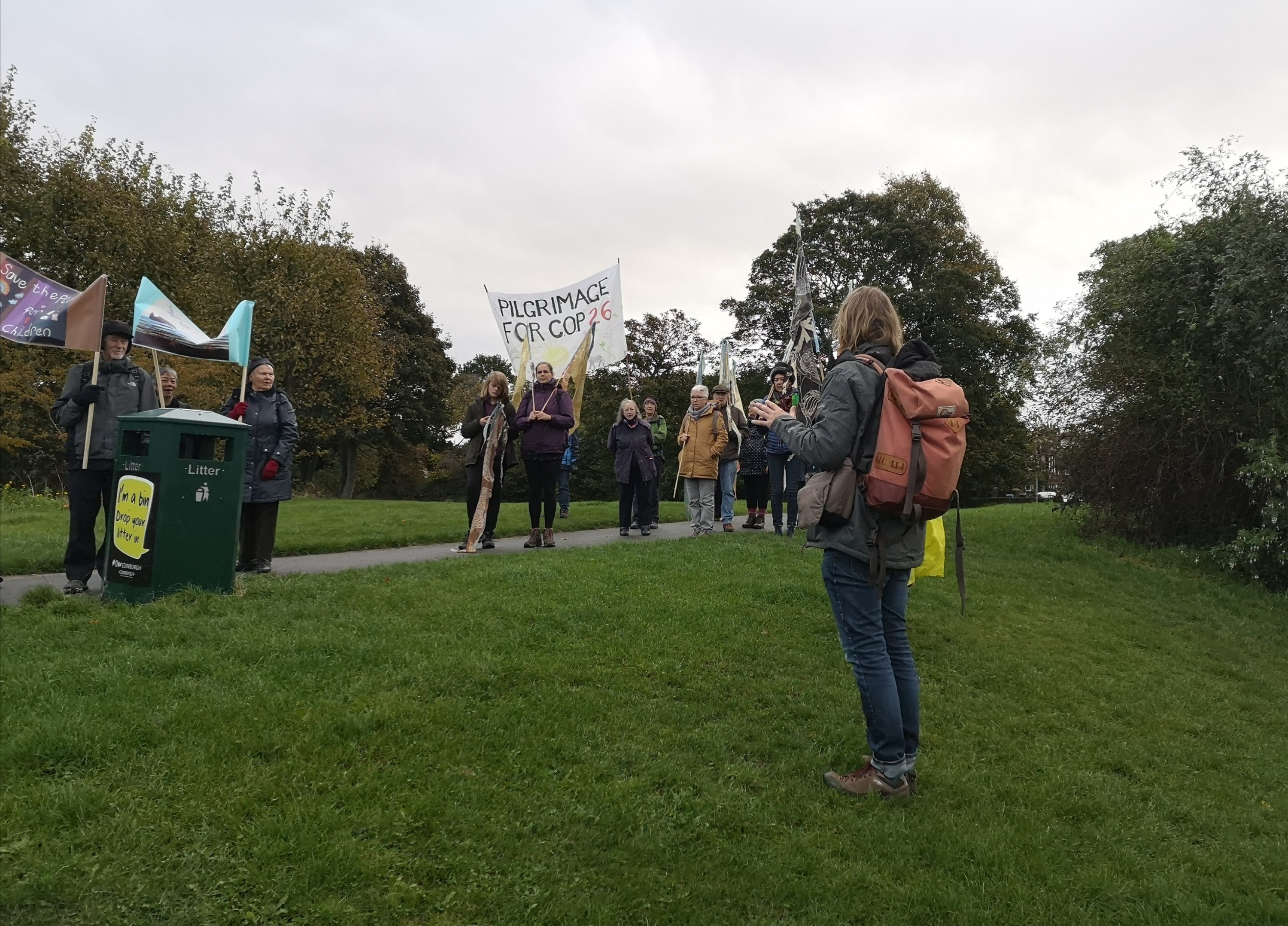
Today’s group of pilgrims walking to Glasgow COP26
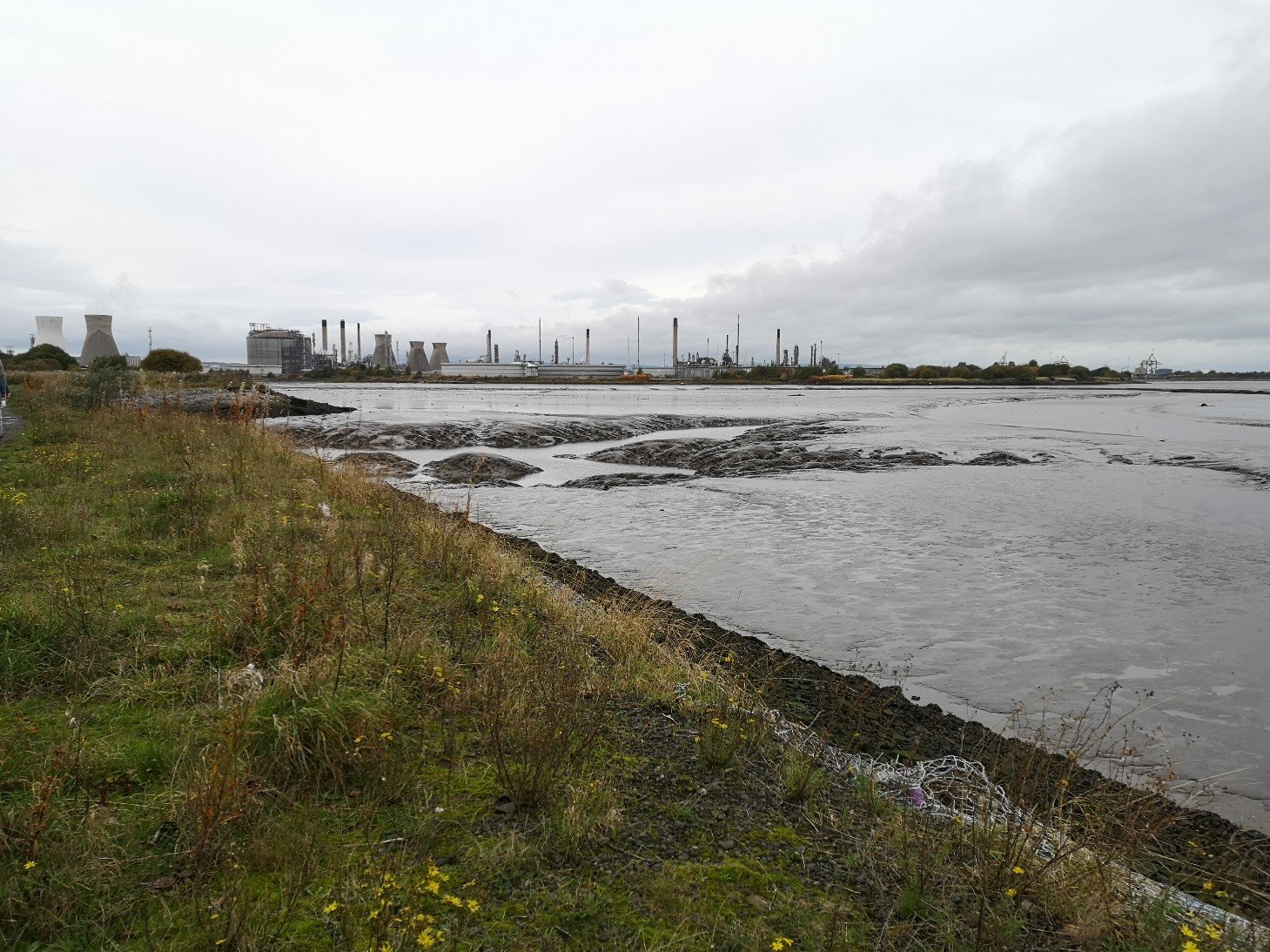
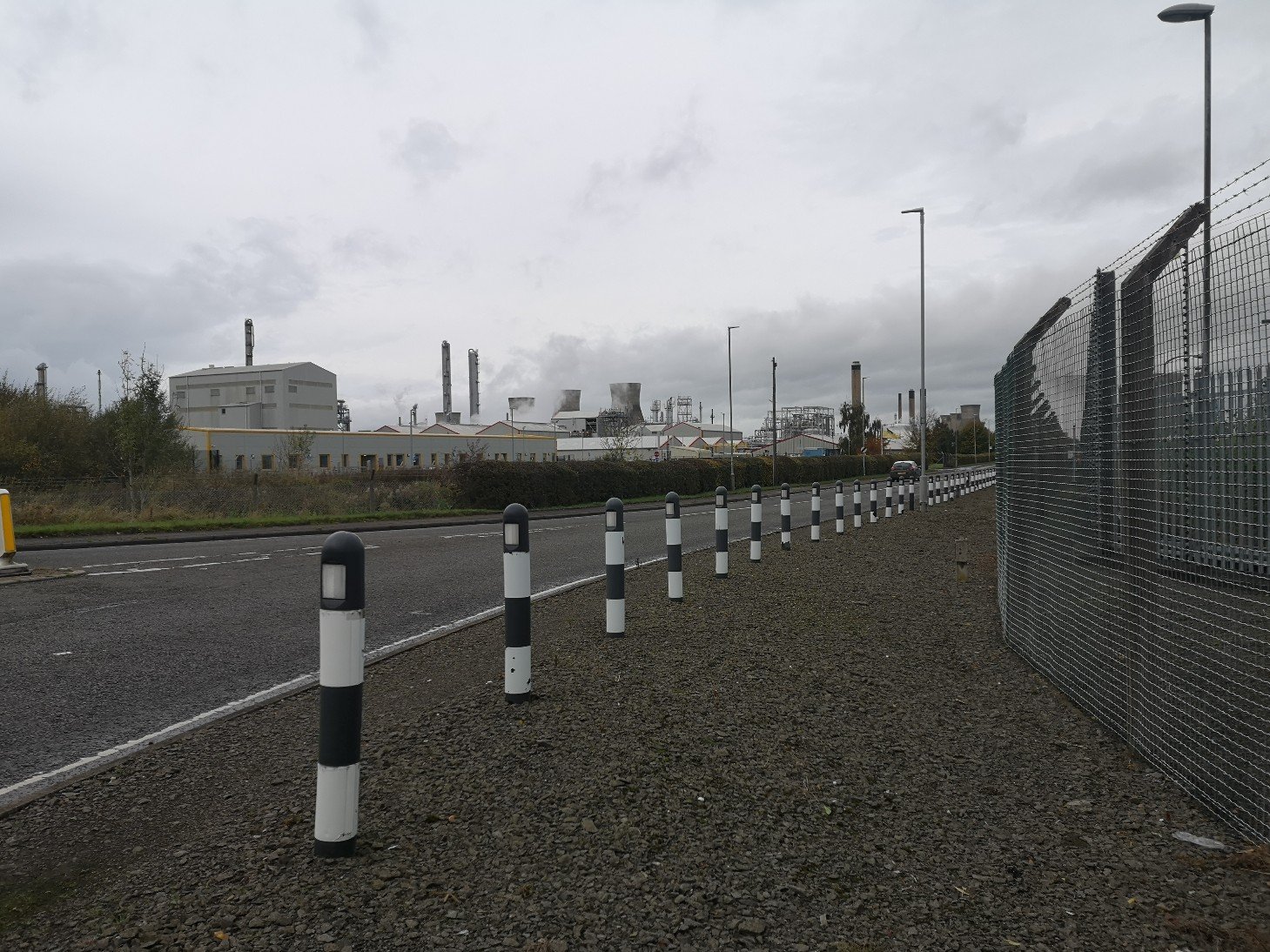
Grangemouth Oil Refinery
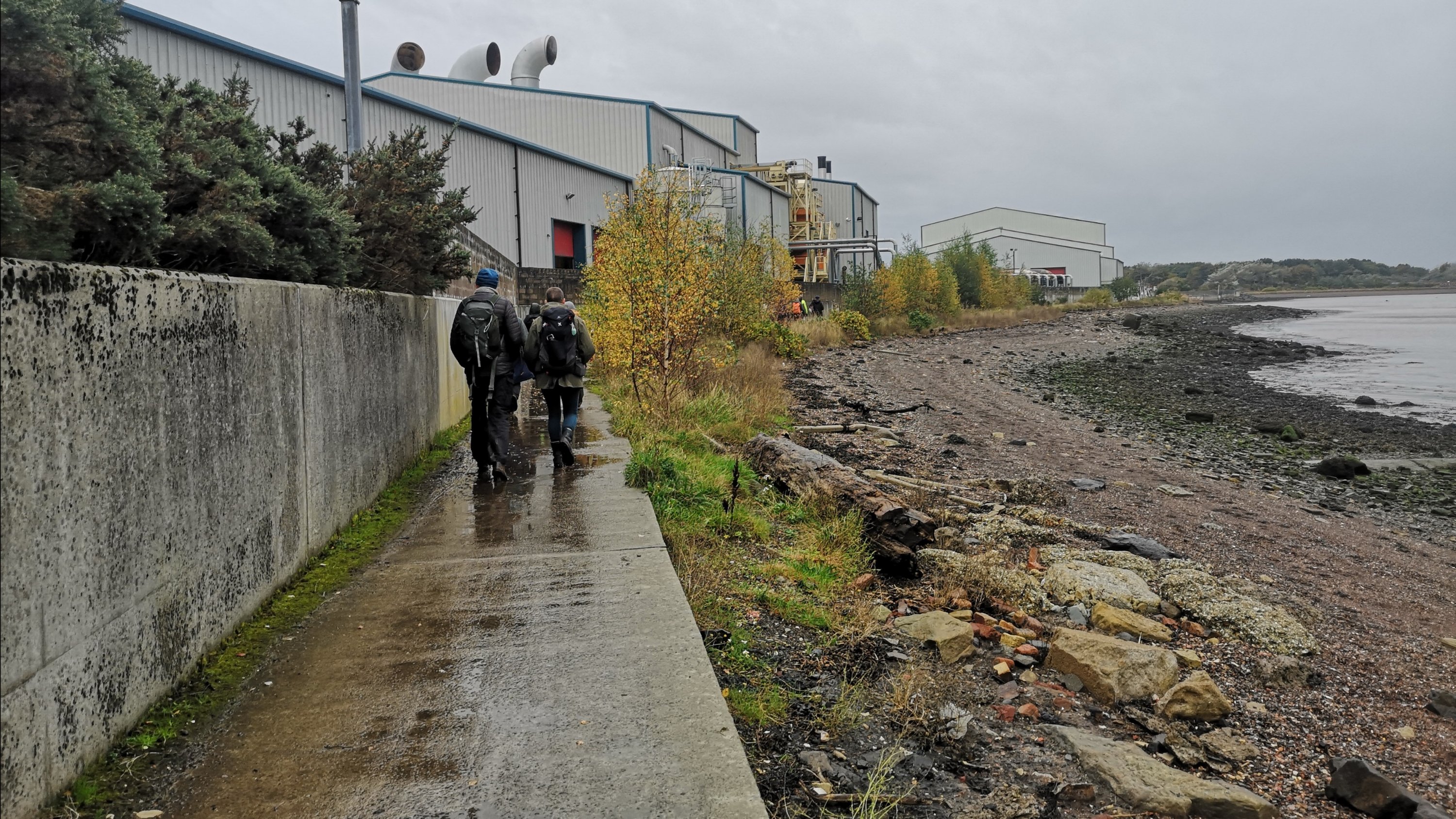
And then we turn away from the water and head inland towards the Grangemouth Refinery. Grangemouth port was founded as a result of the construction of the Forth and Clyde Canal (which we are scheduled to walk beside later today), in 1768. Grain and timber came in there, and coal went out. The first factory in the area was making soap and glycerine (1897 Scottish Co-operative Wholesale Society), and paraffin started to be produced from shale or coal in 1919. Then, as the Polish oil wells opened up and the prices for Scottish products went down, treating and refining became the focus.
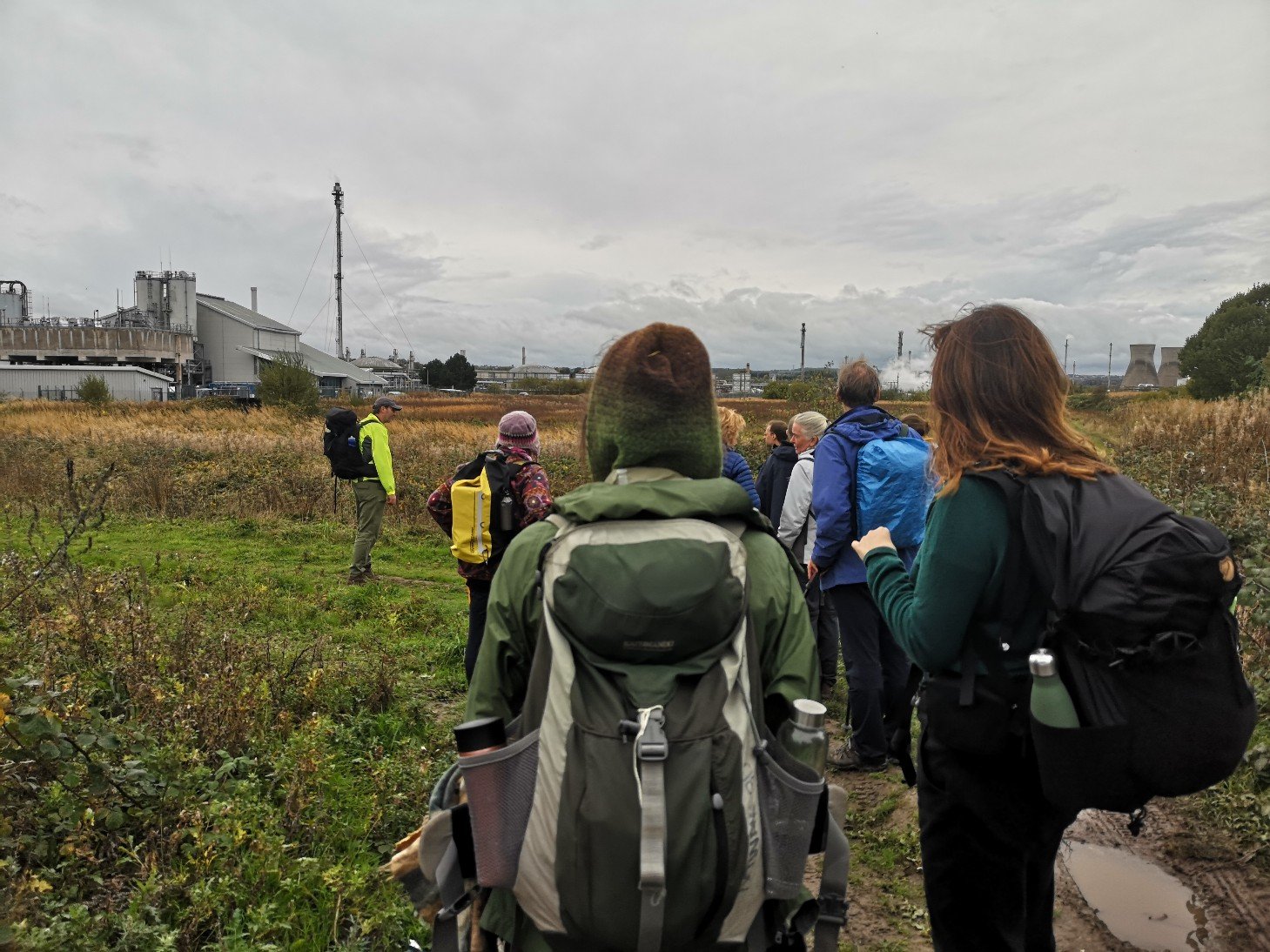
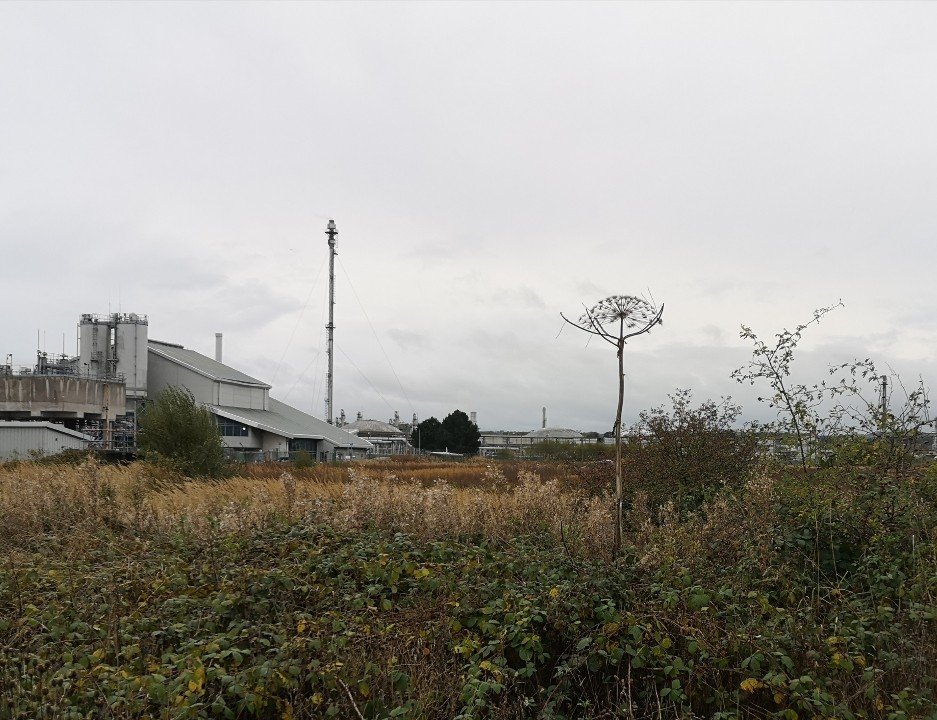
Grangemouth Refinery, a skyscape of sci-fi appearanceGetting close to the Grangemouth Refinery. There was a terrible smell and someone kindly lit a stick of incenseThe sloping metal and cooling towers of the Grangemouth Refinery, quite a contrast to the area of natural beauty we had just walked through
BP, former owners, sold up in 2004 when there were difficulties, and now the Plant is part-owned by a Chinese company and the greater part by Jim Ratcliffe, the richest man ‘in England’ (he lives in Monaco, “a move that it is estimated will save him £4 billion in tax”). Ratcliffe is the CEO of INEOS which includes Grangemouth as well as refineries in Italy, Germany, France, Belgium and Canada. Petro-chemical processing is a lucrative business, earning him an official Honour and wealth reputed to be worth £21.05 billion.
Leaving the estuary and heading inland
Wikipedia writes, “In February 2019 it was announced that Ineos would invest £1bn in the UK oil and chemical industries, to include an overhaul of the Forties pipeline system that is responsible for transporting a significant percentage of the UK’s North Sea oil and gas. On 1 May 2019, Ratcliffe criticised the current government rules which say fracking in Britain must be suspended every time a 0.5 magnitude tremor is detected, which has led to a de facto ban on fracking. He said: “I think the government has been pathetic on the subject.” In fact, although the Scottish government states “no support for unconventional oil and gas” (in a report which strongly resembles the spoofs in ‘Yes Minister‘), and has the reputation for banning, or at least not renewing or accepting new licences for shale (fracked) gas, it is important to note that it is still imported from the US (Pennsylvania) into INEOS right here.
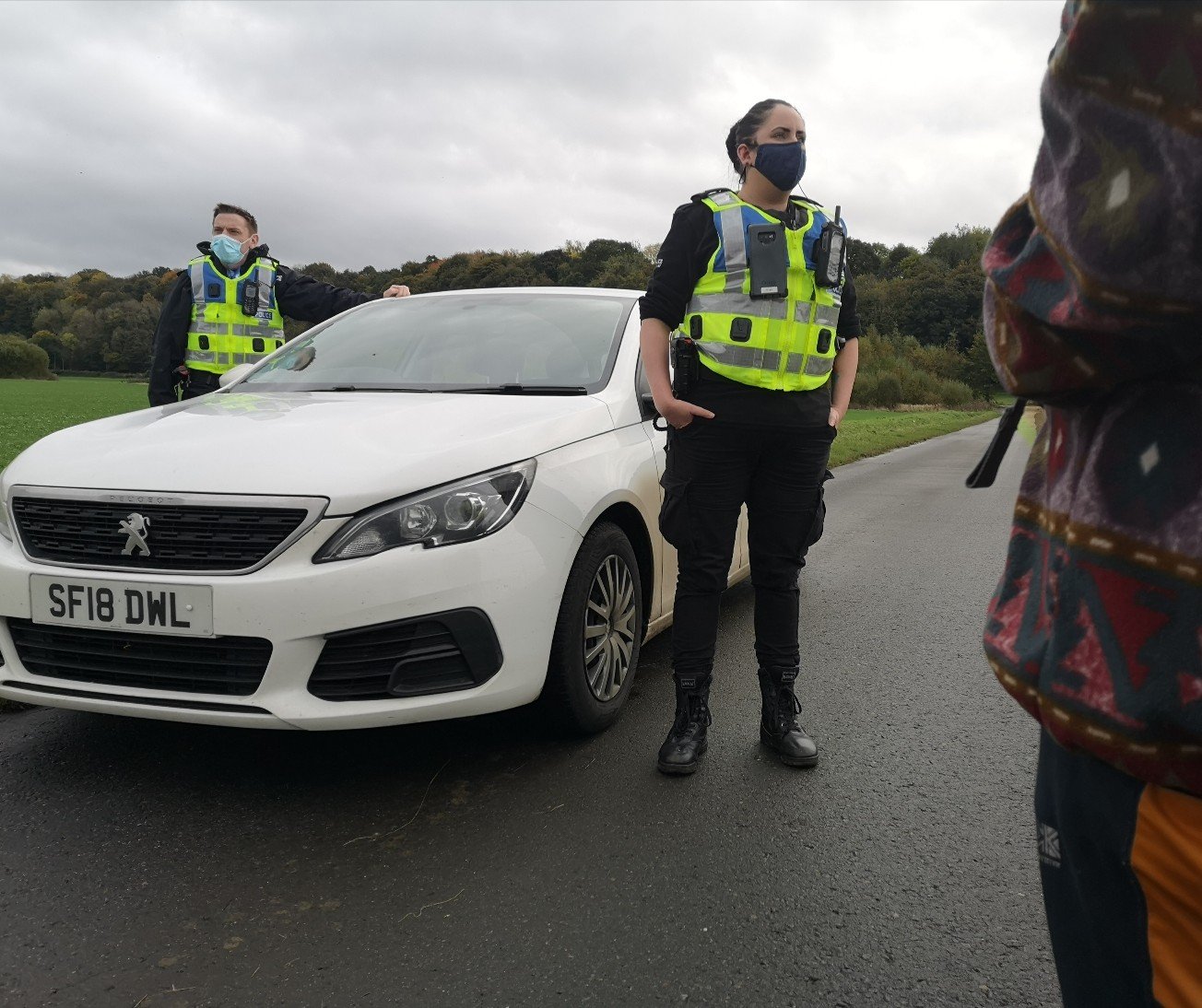
One of several times that the police stopped their cars and questioned us
Before we entered Grangemouth, we were stopped twice more by police. One man told us, “I’ve been brought up from South of the border to join the COP26 security forces here. Are you the minister who’s going to bless the land?” Our reputation as a peaceful lot had proceeded us.
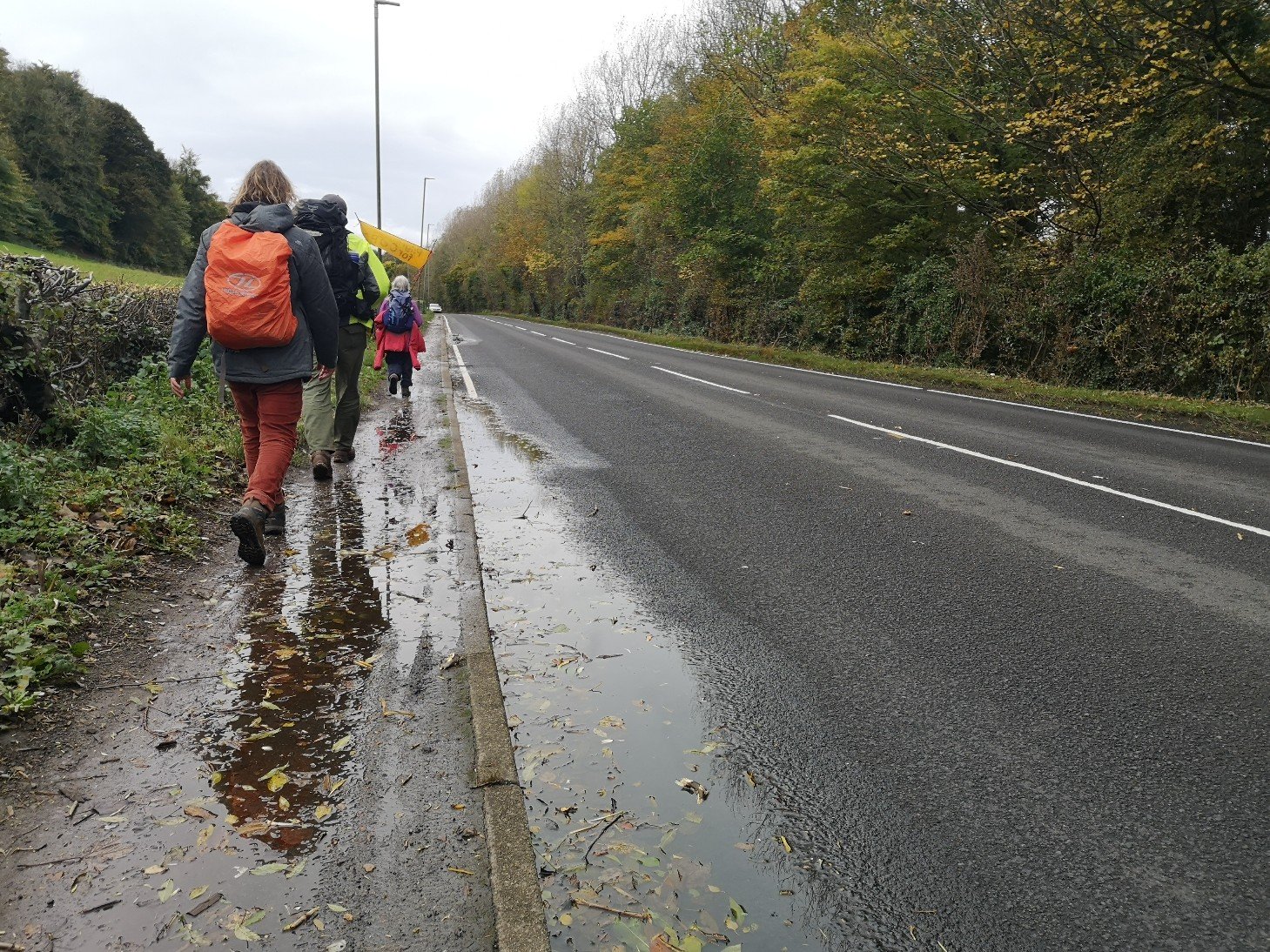
Road-walking in the mud and rainSite of a section of the Antonine Wall just as we are about to trun right and head through Grangemouth, West Lothian
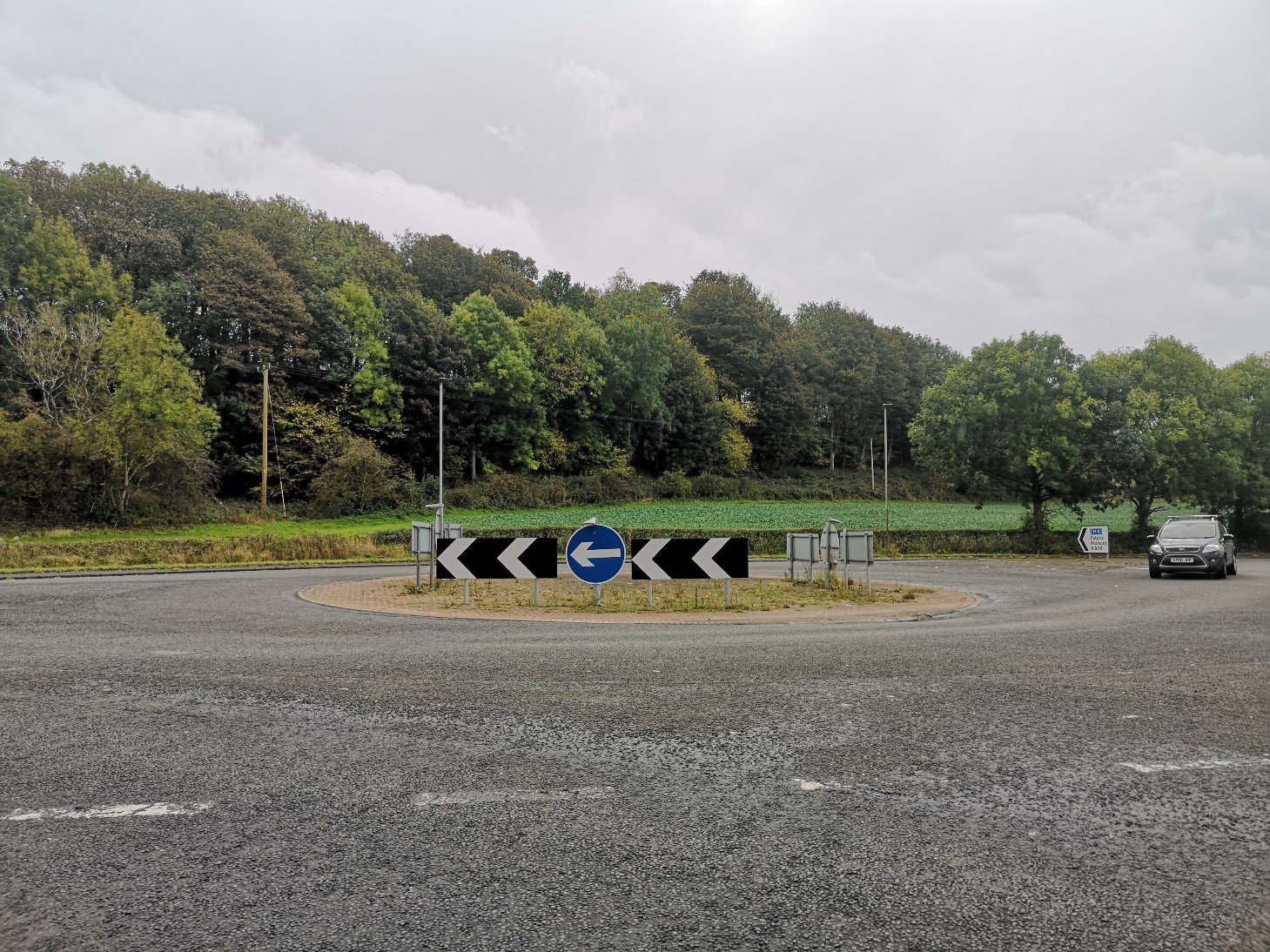
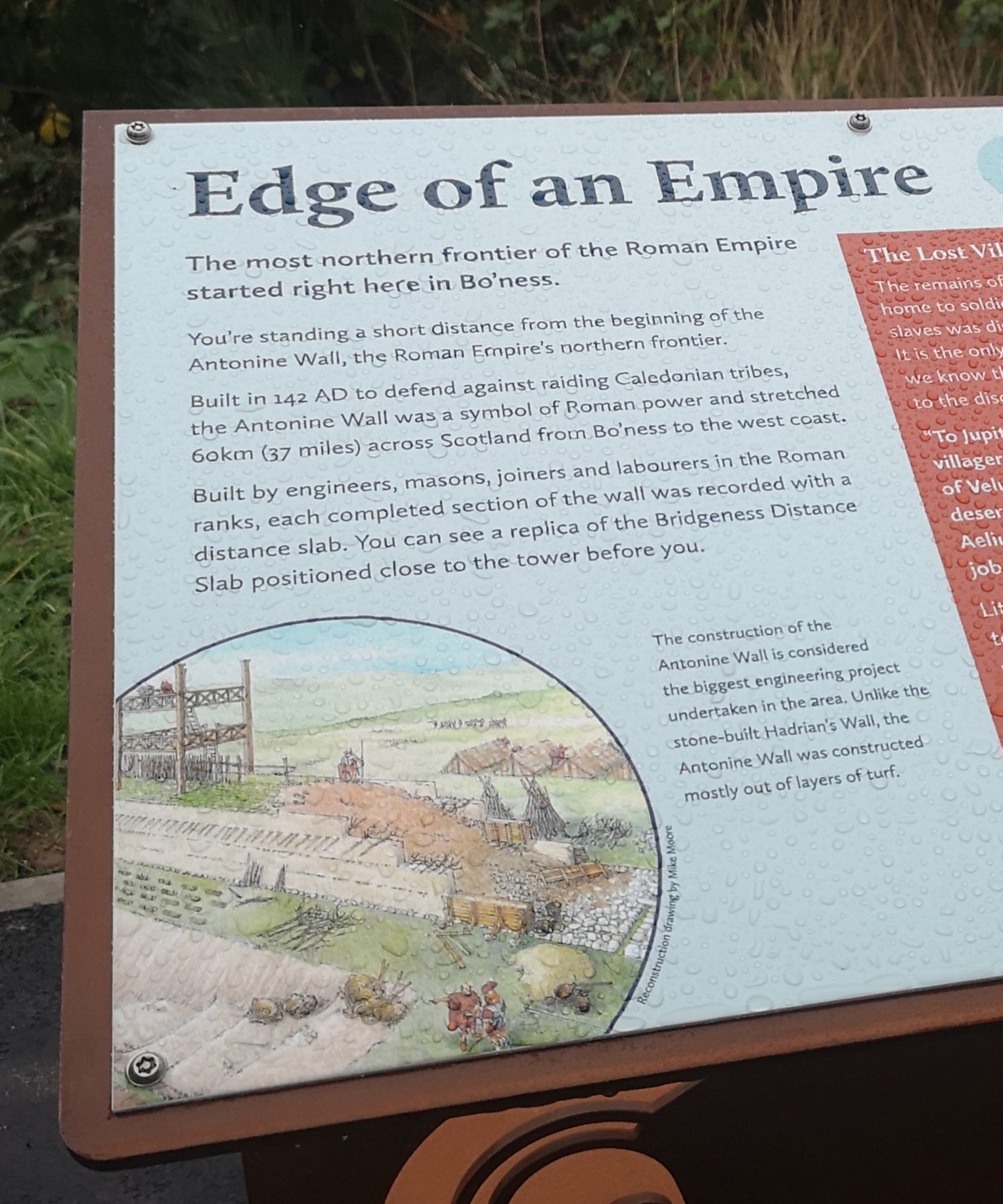
We are reminded again of the Roman Antonine Wall which runs from Carriden, near Bo’ness, and which sports a 2nd century fort at the eastern end. It stood near this roundabout for 20 years, though it was supposed to be there for ever.
My last photo – we were asked not to take any after this
I am struck by the drear of the utilitarian and inanimate lengths of piping. Wide-diameter, above-ground conduits run the length of the road and the few desultory trees and mini-‘gardens’ don’t make up for the carbon that is produced in the petro-chemical works. These are not kilns for making beautiful pottery, not repurposed gas works recently used for art and music, but hydro-crackers involved in making products that most of us use in the form of health and pharmaceuticals, food and beverage packaging, and construction and utilities. Phasing them out means a change in what we expect to do and have, and we had plenty of silent walking time to ponder on that.
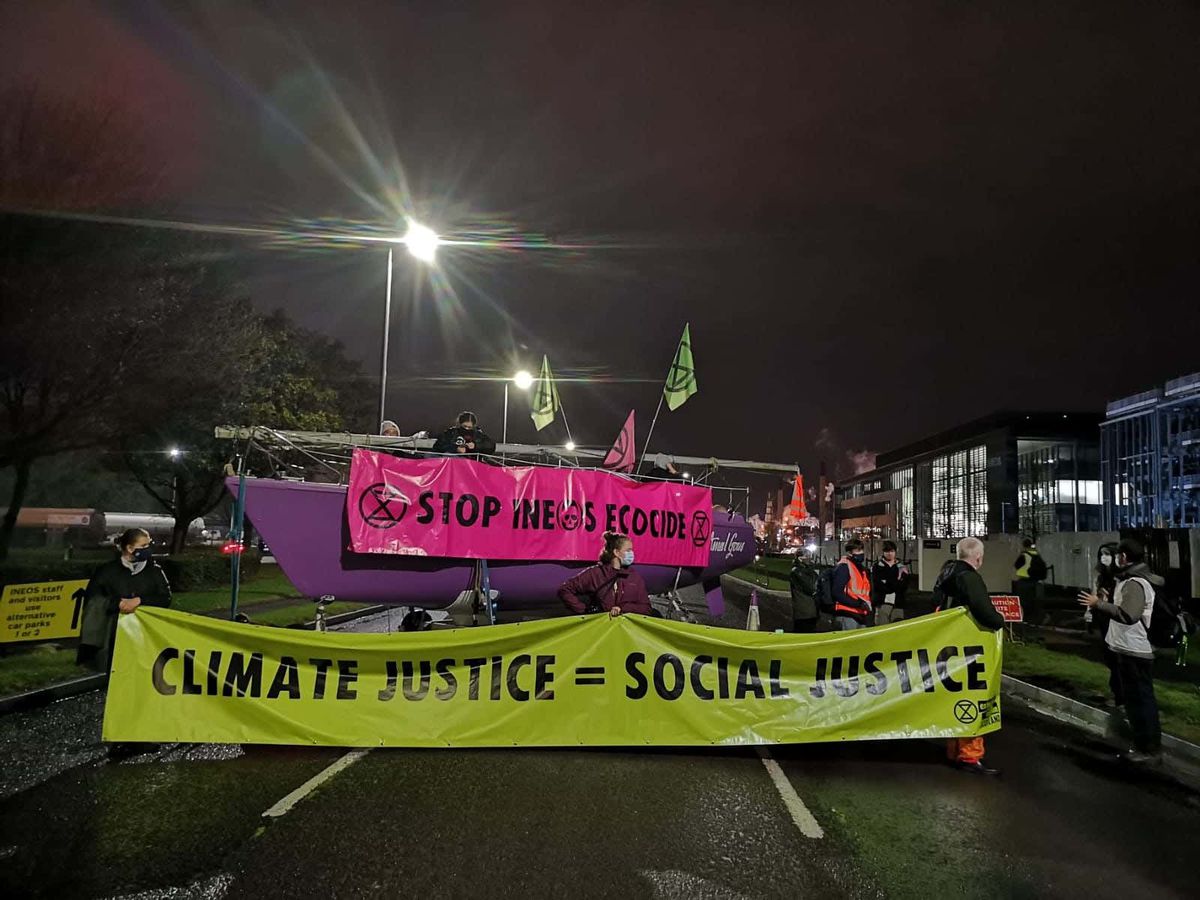
Blockade 23 October by Extinction Rebellion. From the Shropshirestar
In March 2019 INEOS said it would close its Middlesbrough manufacturing plant unless it was allowed to ‘defer compliance’ with EU rules designed to prevent air and water pollution. An analysis of data from the Environment Agency (EA) also reveals the plant clocked up 176 permit violations between 2014 and 2017. An EA spokesperson said: “air emissions are well over legal limits and this poses a risk to the environment”. INEOS director Tom Crotty said the firm “cannot justify” the investment required to comply with EU air and water pollution rules due to come into force in the coming years.
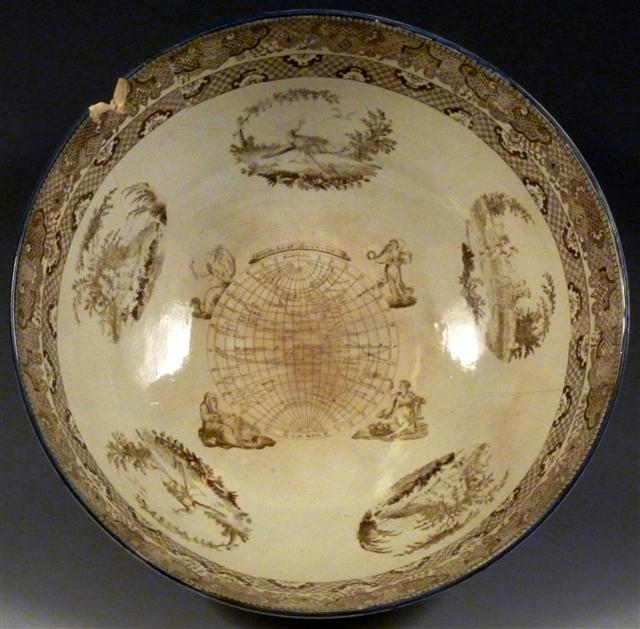
The World in Planisphere, from the Bo’ness Pottery circa 1800. The world is inscribed ‘From the Latest Discoveries’ and shows North and South America.
The engineering is, of course, state-of-the-art, but there is disparity between the shiny exteriors and the black-black oil which I knew was pumping inside, or the high-pressure gas contained within them. There were tin sheds and poles with what looked like guy-ropes stretched from their tips to the ground, and crows-nests at the top of them. I felt a sort of deadness in the air. The words of songs we had been singing sounded in my ears: We are a gentle, quiet people (1978, Holly Near), and our anthem for the Pilgrimage, Another world is not only possible (2021, Jane Lewis)
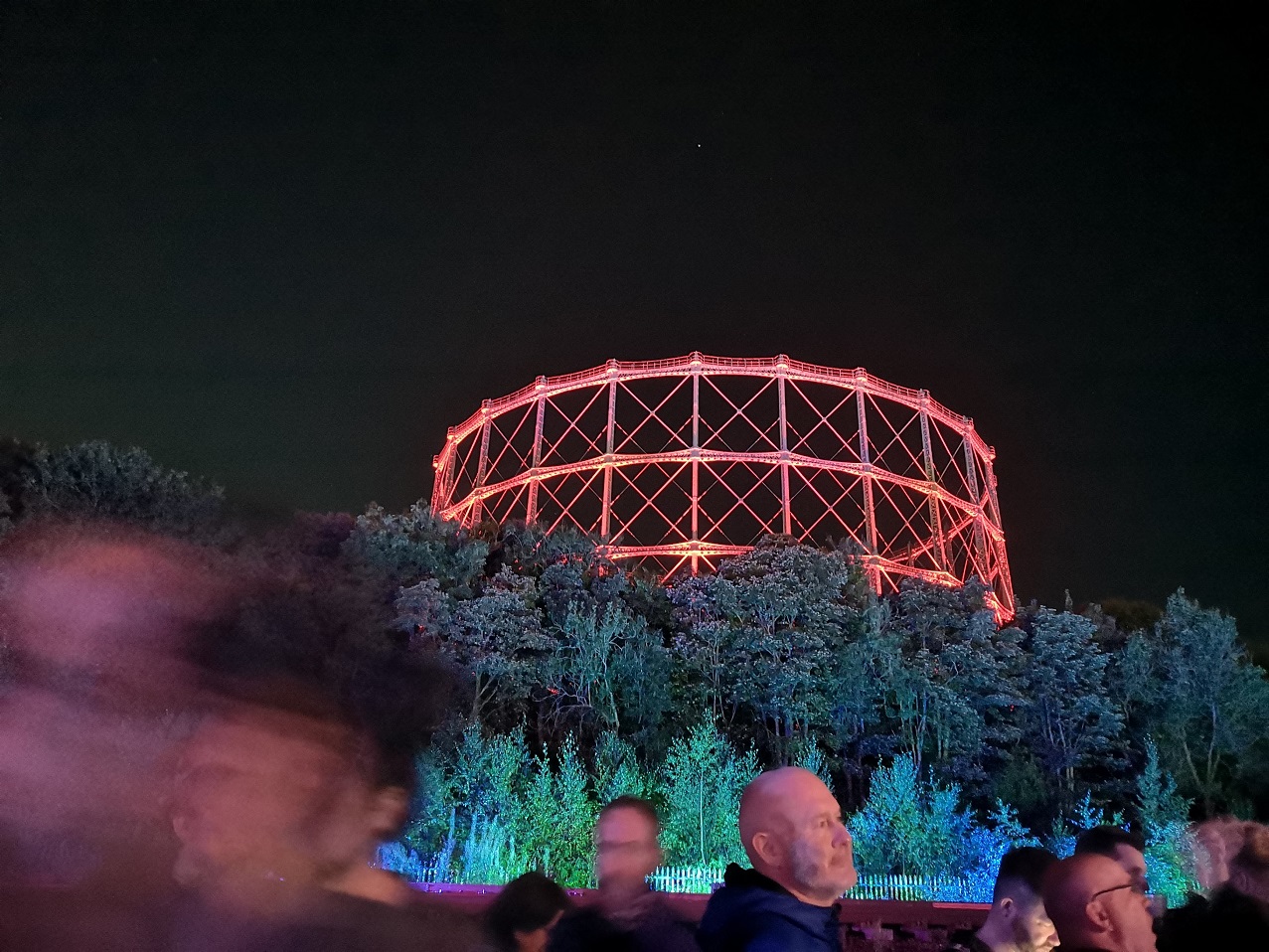
Granton Gas Works during the Hidden Doors Festival 2021
Tea, glorious tea
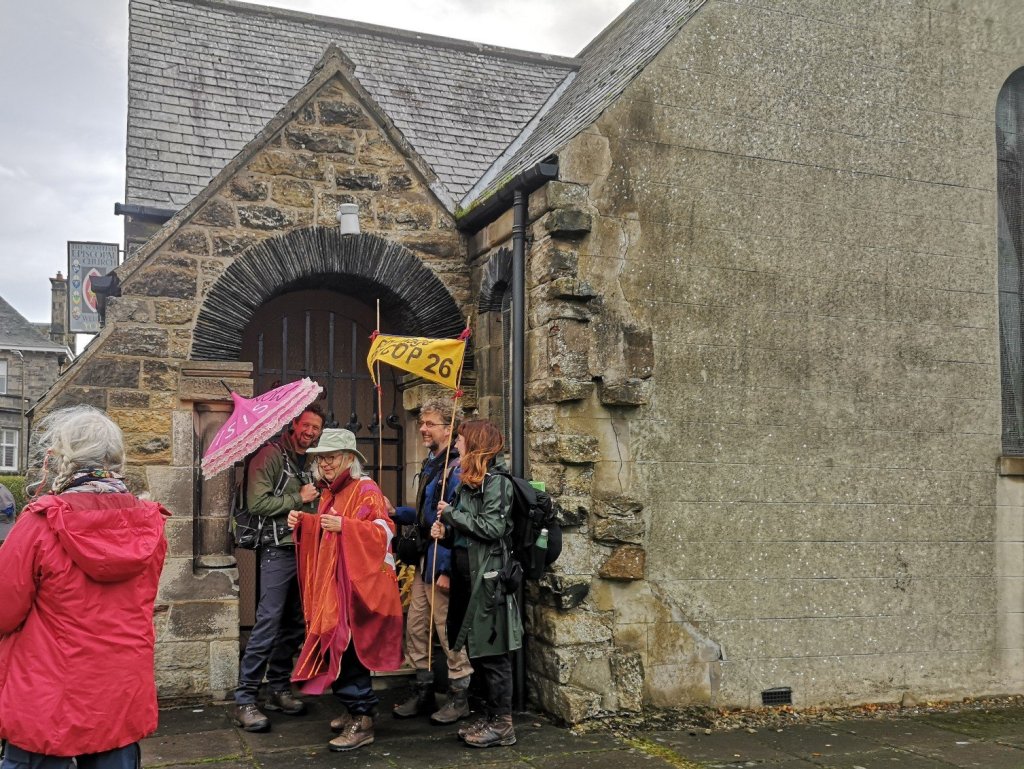
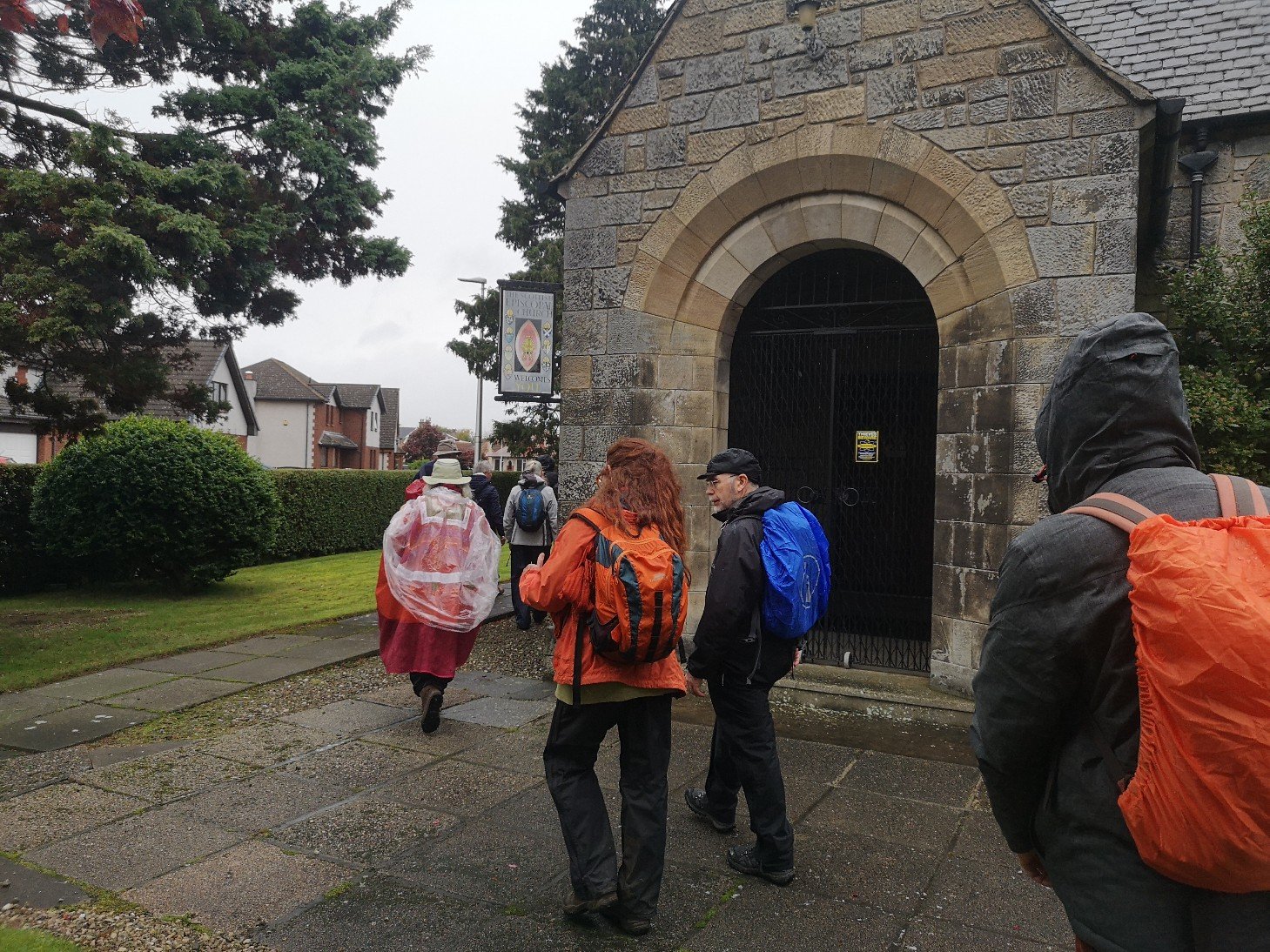
Wet and rather subdued, we were most grateful for a cup of tea and a sweet thing at St Mary’s Episcopalian Church in Grangemouth town. Thank you for those who made that for us, and in doing so, for counteracting the energy of the businesses that try to make even more money by changing pension rights for their workers.
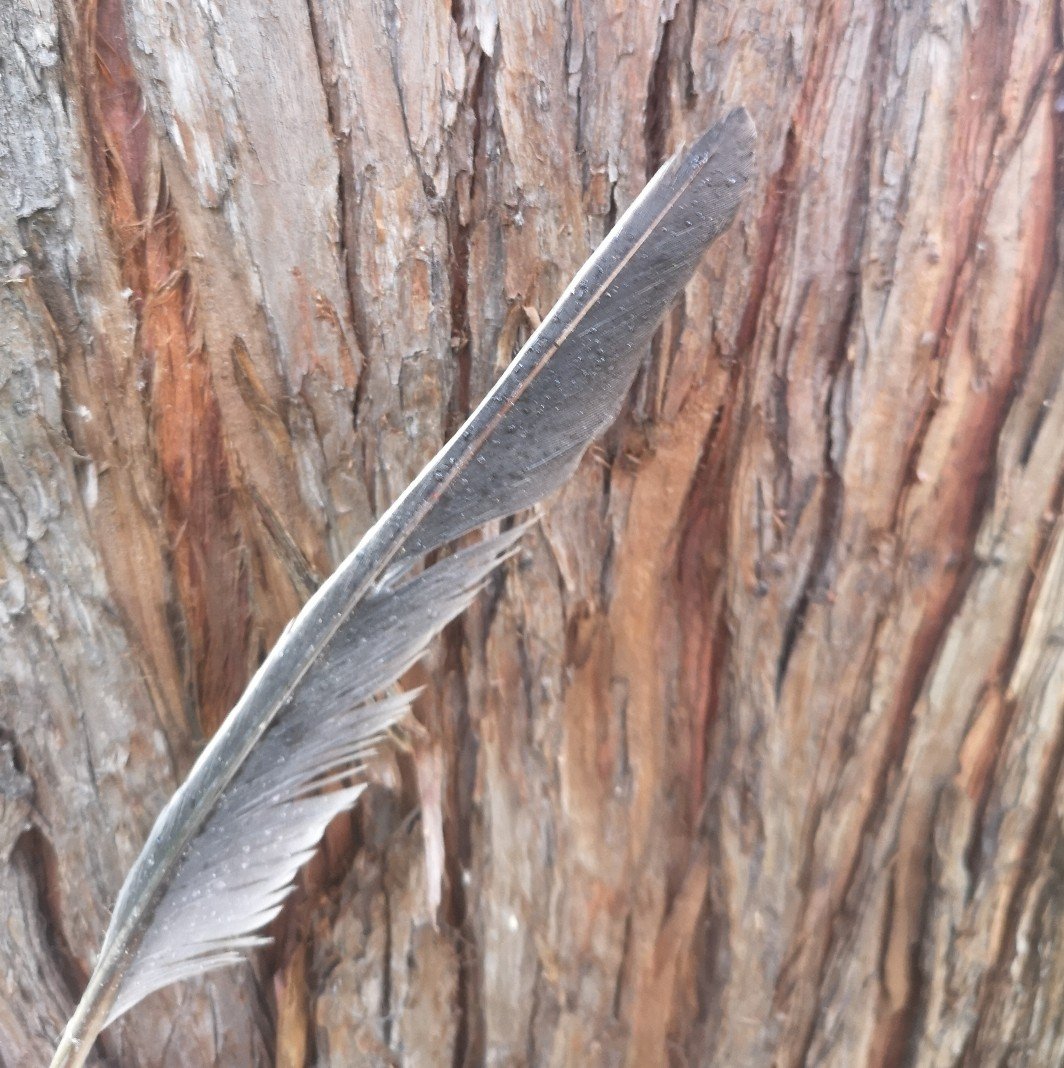
Arriving for a very welcome and steaming cup of tea The bedraggled feather of the day. (I am collecting feathers and stories that connect walking and grief as I am on the pilgrimage)And we’re off again! Grangemouth
We put our wet clothes back on and set off for the 40 minutes’ hike to our next stop.
Crossing the South Bridge, Grangemouth Footpath beside the River Carron. The sky was crying.
The Lungs in Chinese Medicine are associated with grief and sadness, and it is said that our tears are like their melt water
Joyce Vlaarkamp
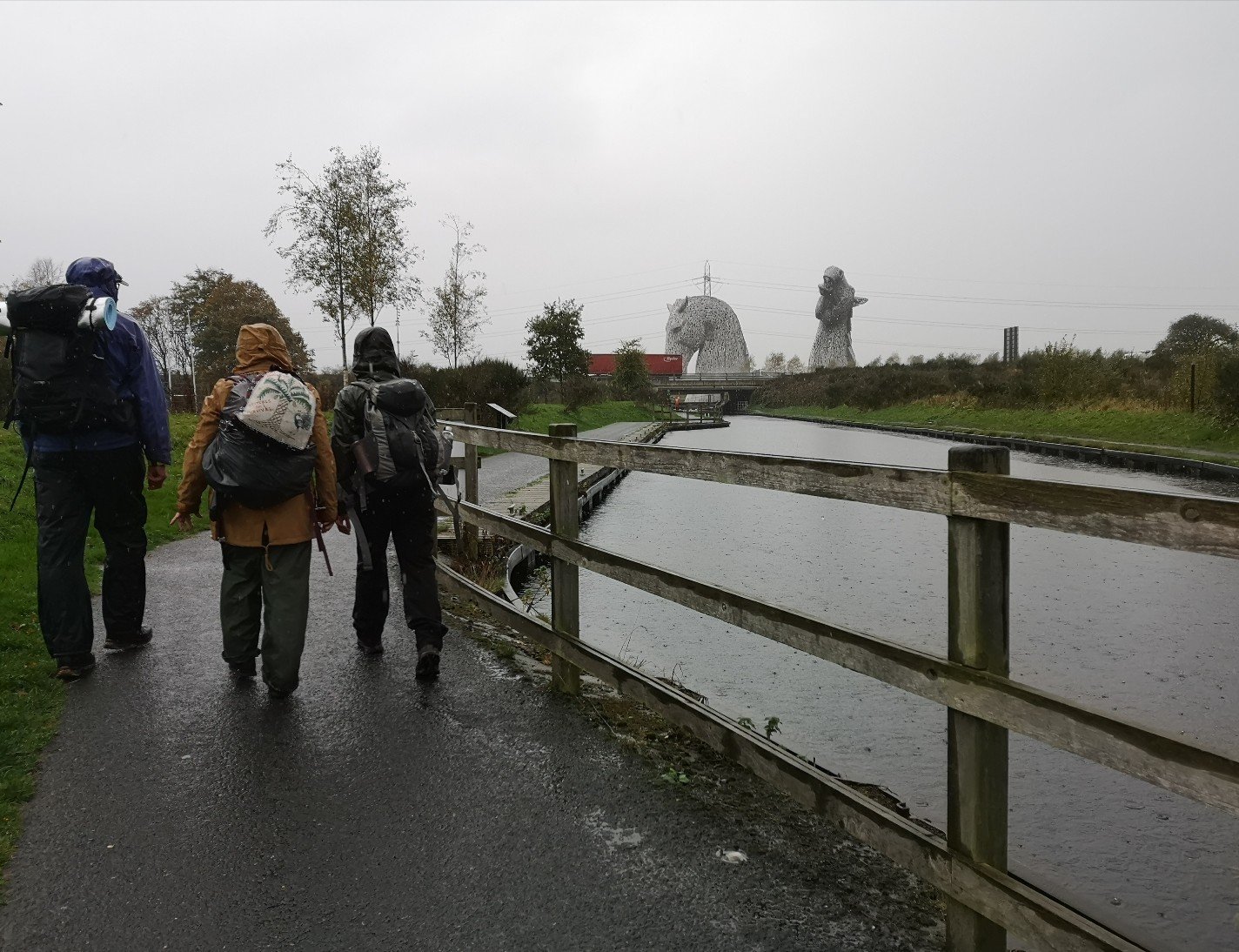
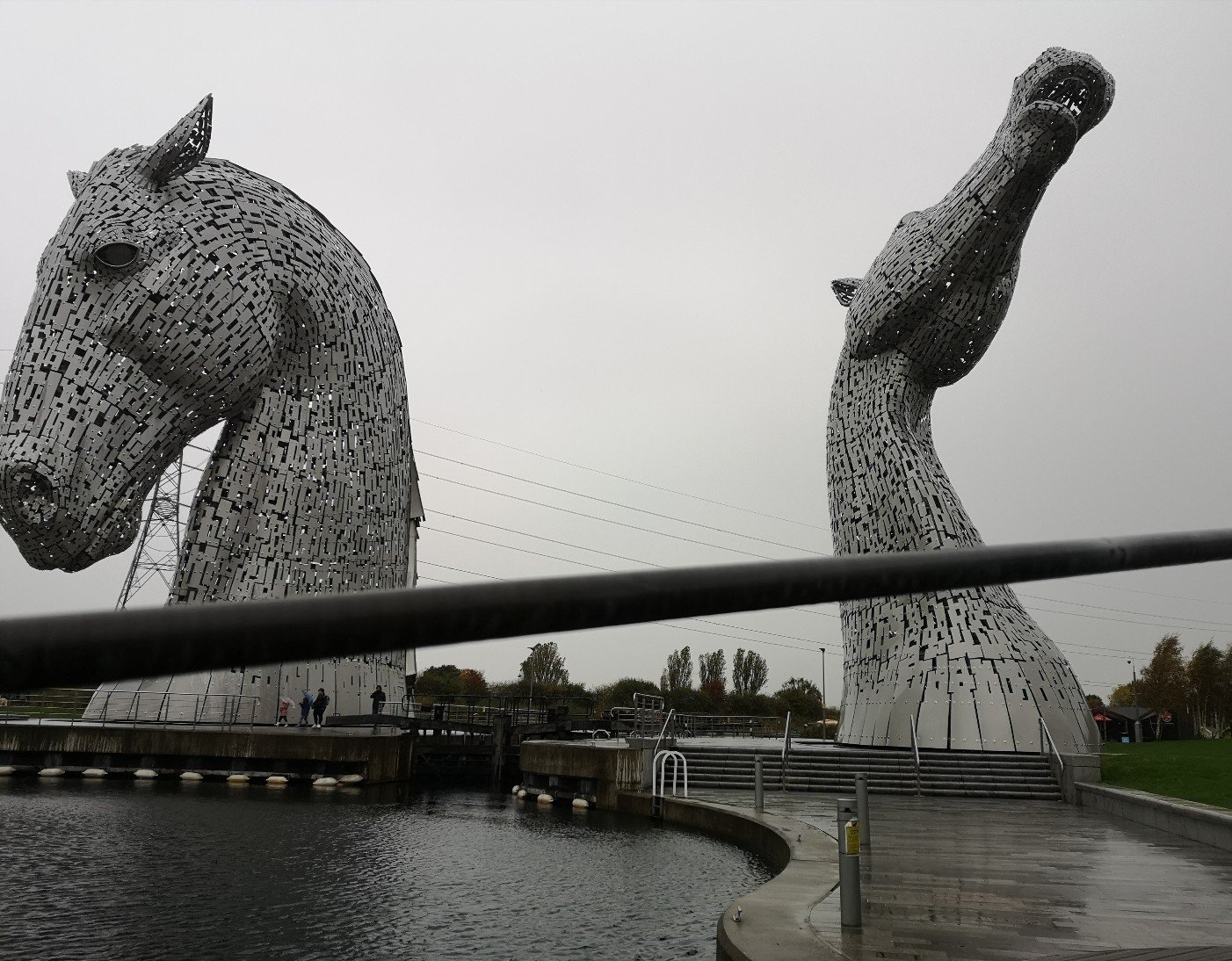
Heading towards the Helix and the Kelpies along the River Carron
They stressed that the way we manage our energy needs must change, but that it is vital that people are redeployed in equivalent level jobs once their current ones have gone.
Climate justice recognises that the industrialised countries of the ‘global North’ like Scotland have grown rich over the past few centuries through polluting the atmosphere while at the same time extracting resources from the ‘global South’ under colonialism. It recognises that those on the sharpest end of climate impacts in the global South have done least to cause the crisis, and are often without adequate resources and technologies to deal with its impacts. Therefore countries of the global North bear a far greater responsibility for addressing the climate crisis.
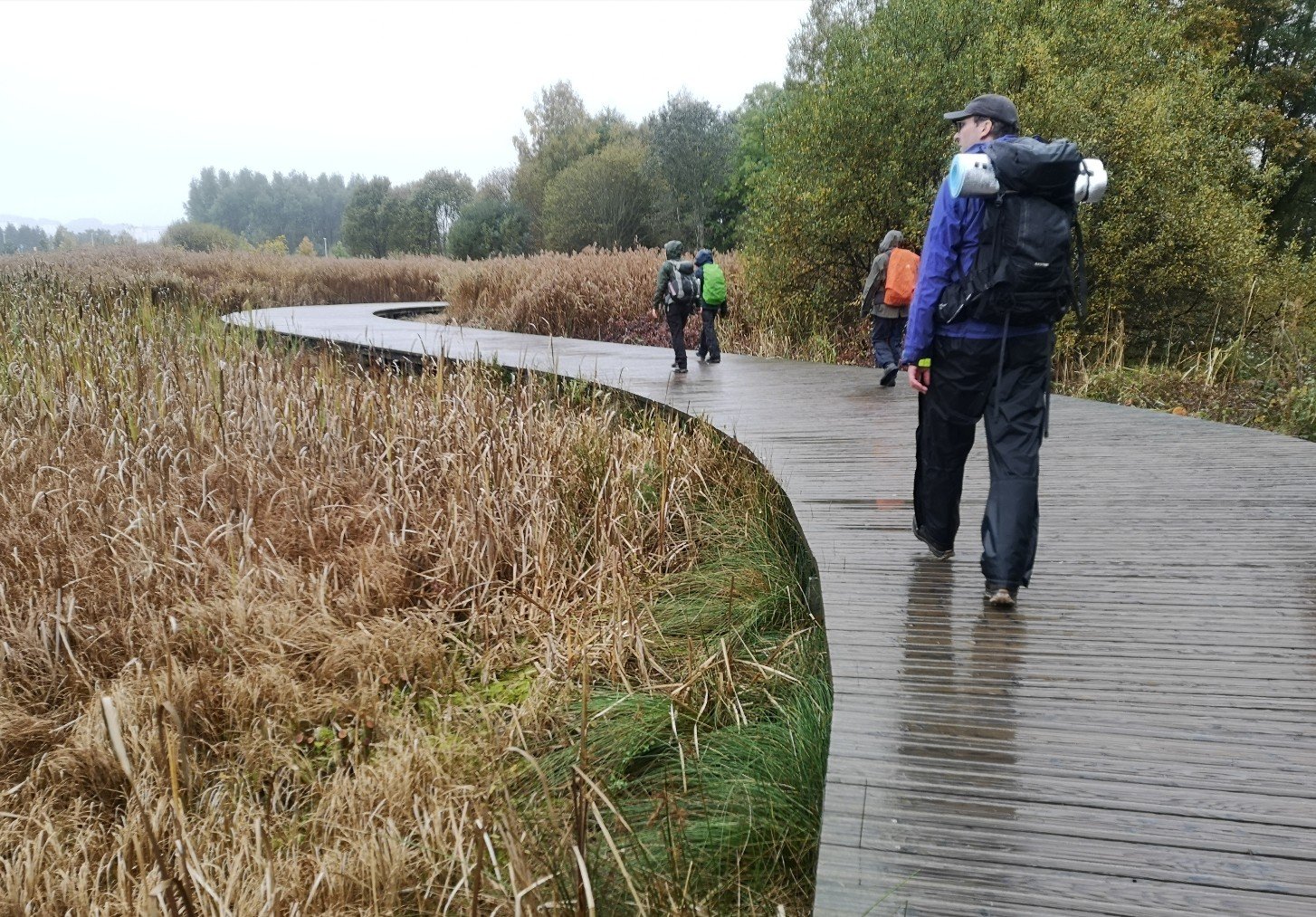
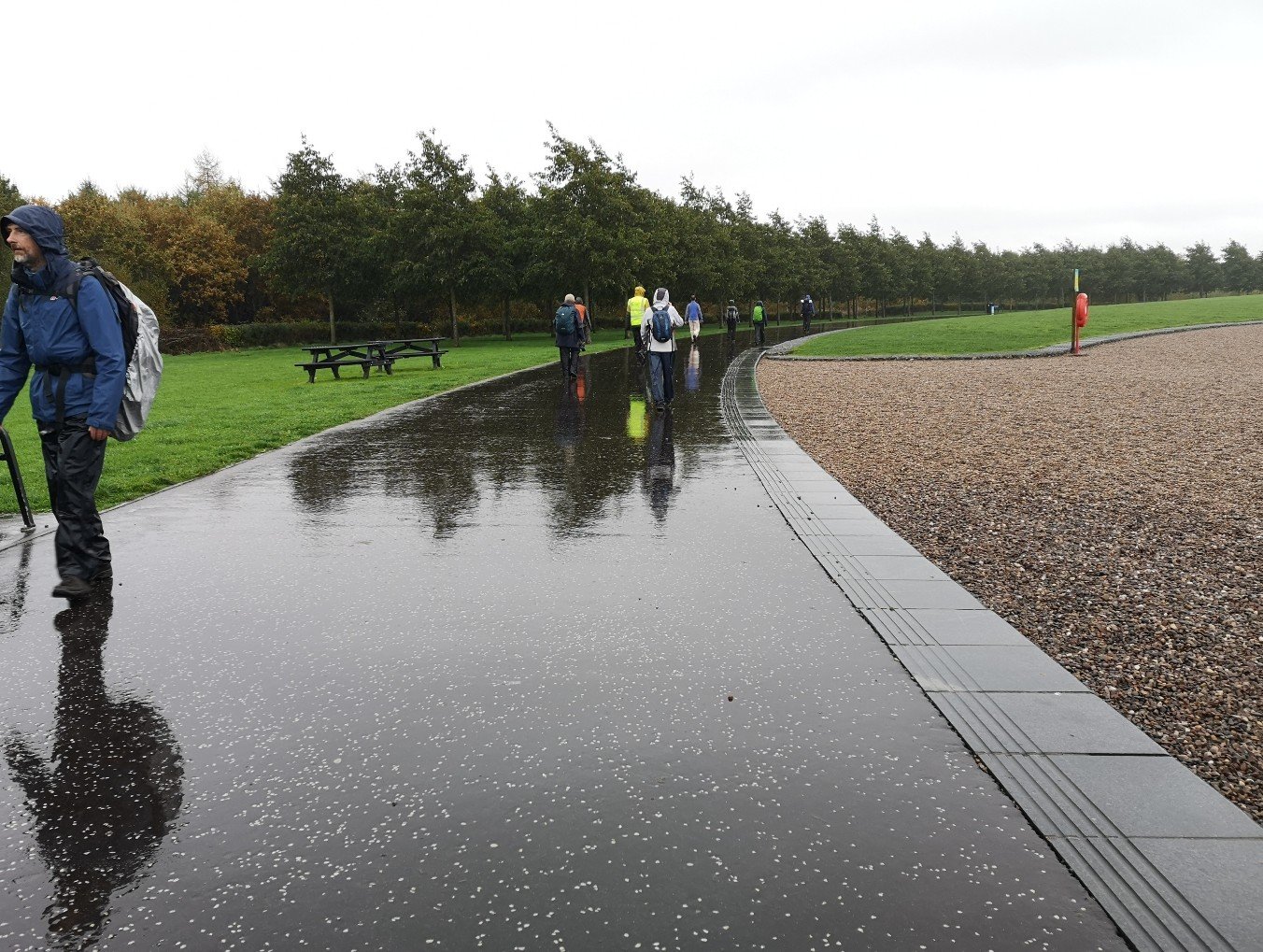
Along the Helix boardwalk (see Kelpies link above)Walking the glassy path. We had to do it over and over so the photographer could get a good shot for the local papers
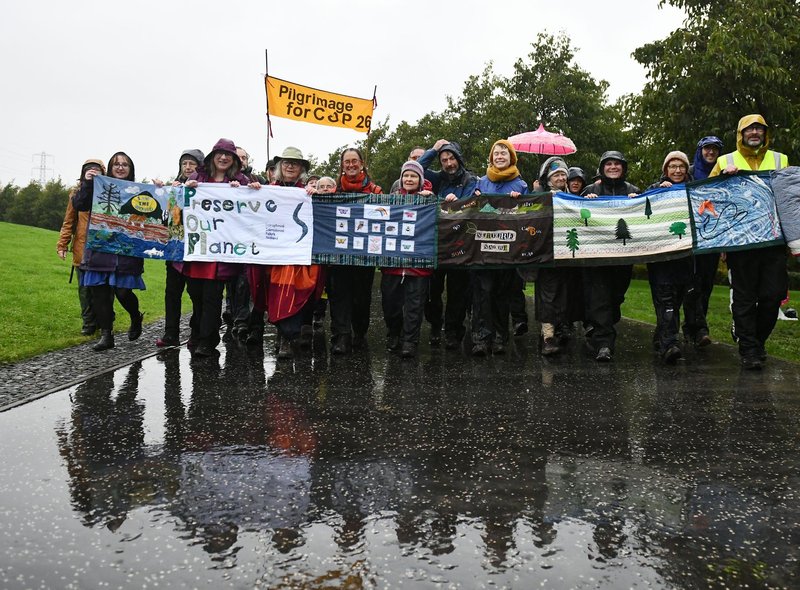
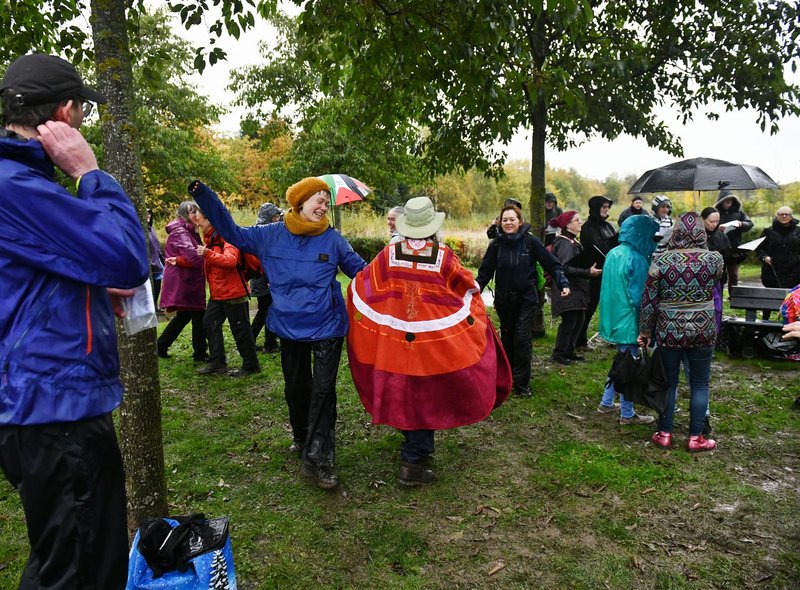
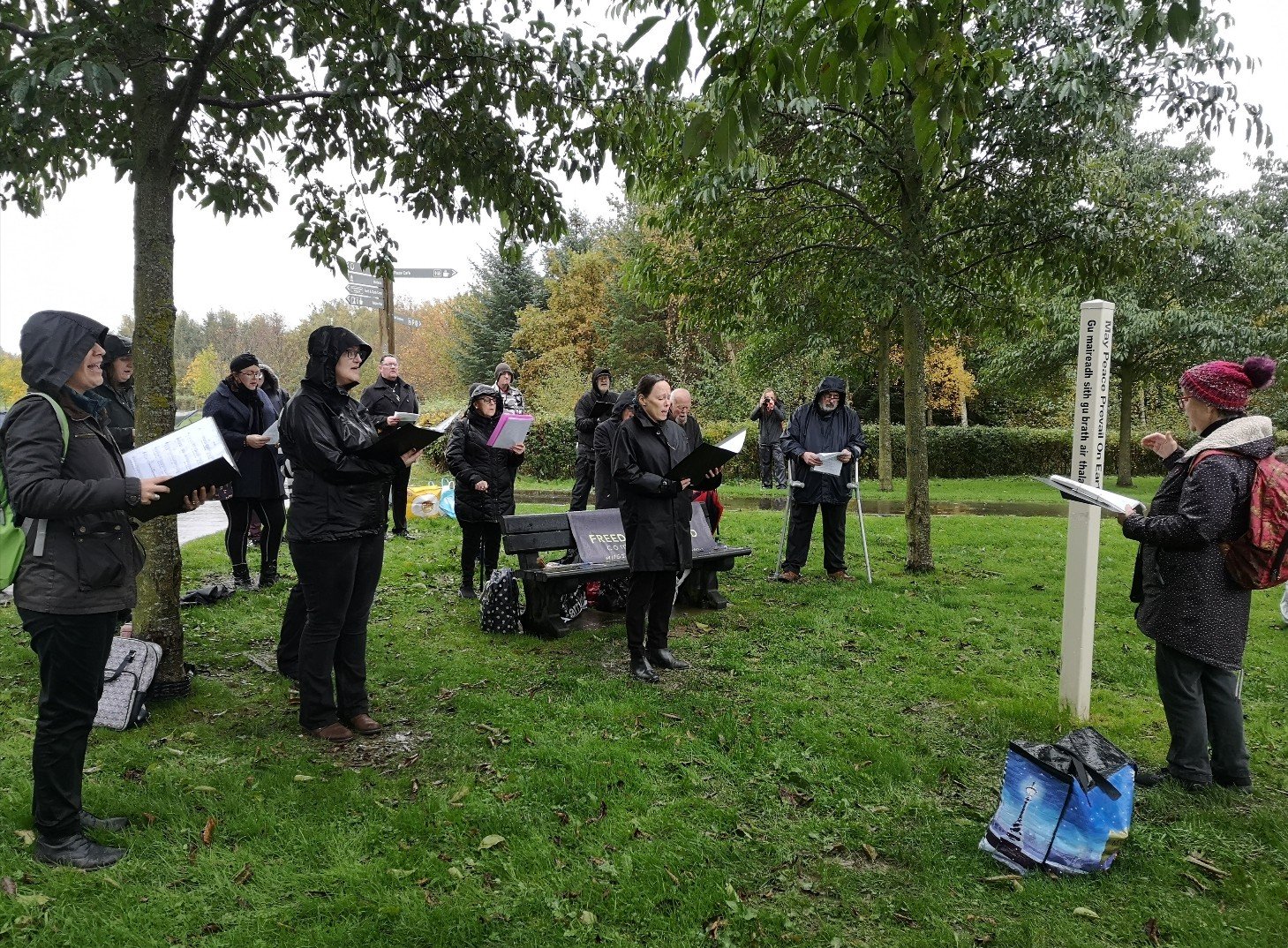
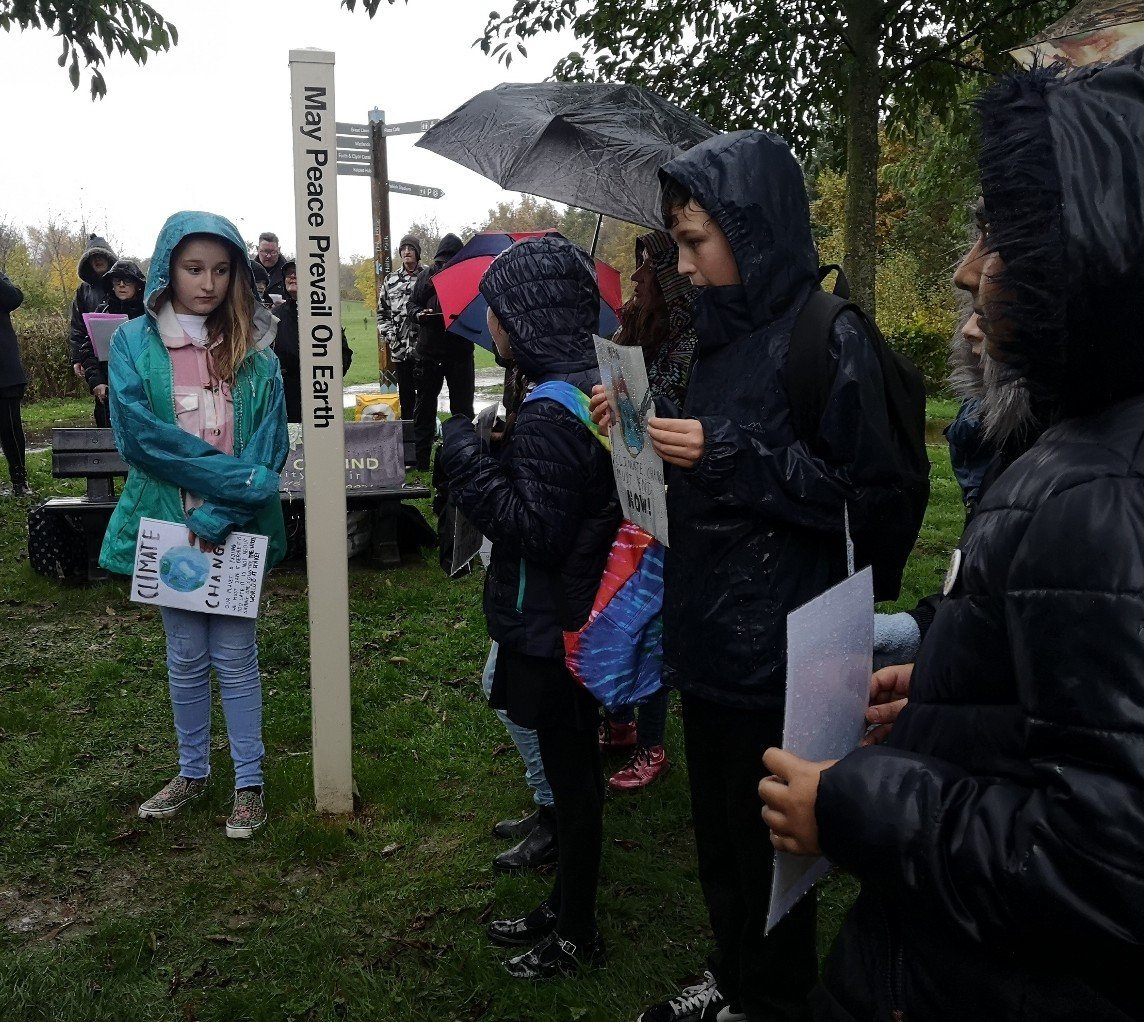
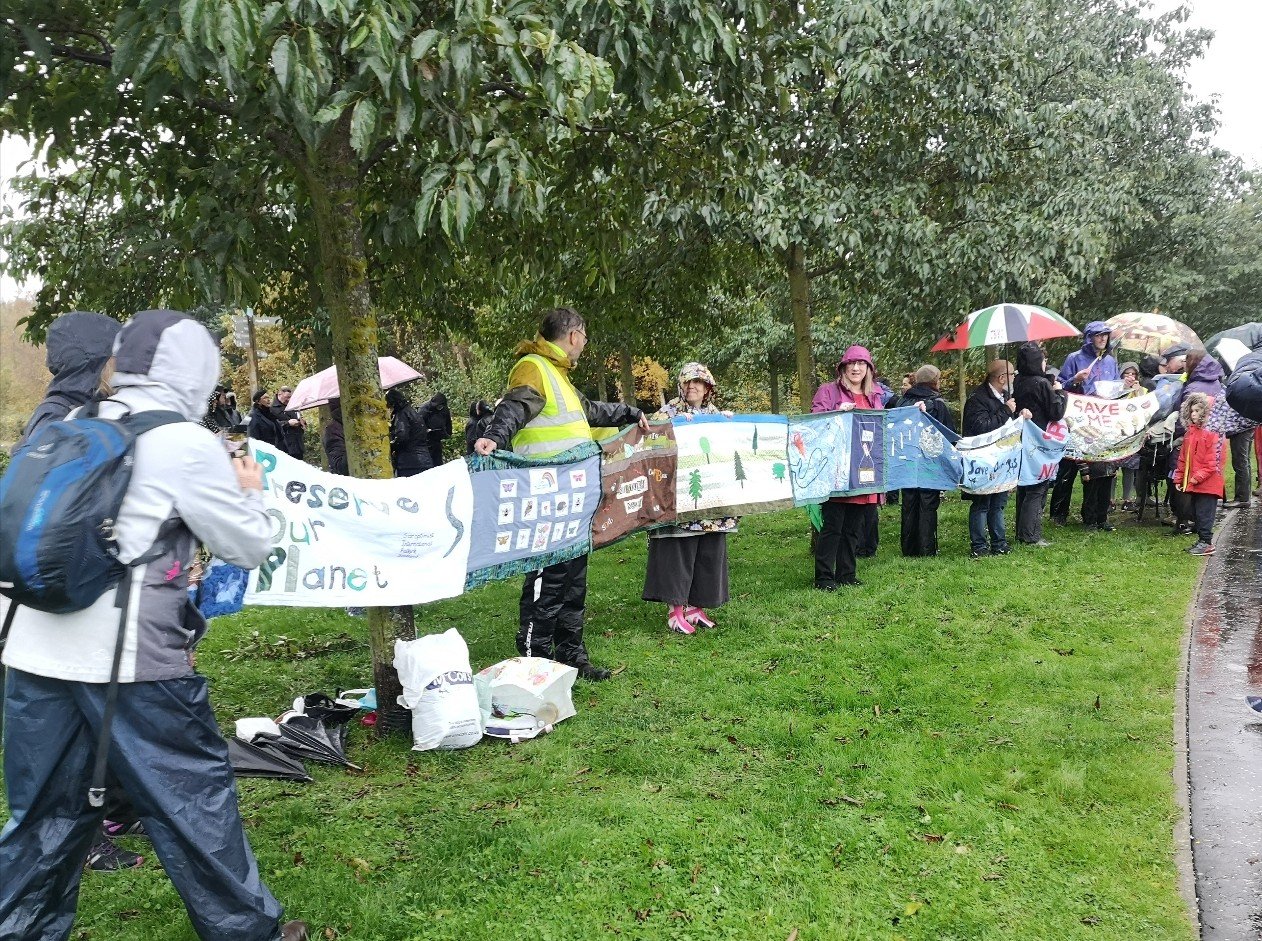
Smiling despite the rain. Photo by Michael Gillen, courtesy of the Falkirk HeraldOlga dancing with Cath in the squelching. Photo by Michael Gillen, courtesy of the Falkirk HeraldThe Freedom of Mind community choir who waited for us and then sang so beautifully in the rain, Falkirk‘May Peace Prevail on Earth’ and the wonderful children who stood in the rain with the posters they had designed and made, at the HelixStitches for Survival banner at the Helix
It must be said that the final stretch in the dark, up and into Falkirk’s town centre, in the really, seriously pouring rain was a hard one.
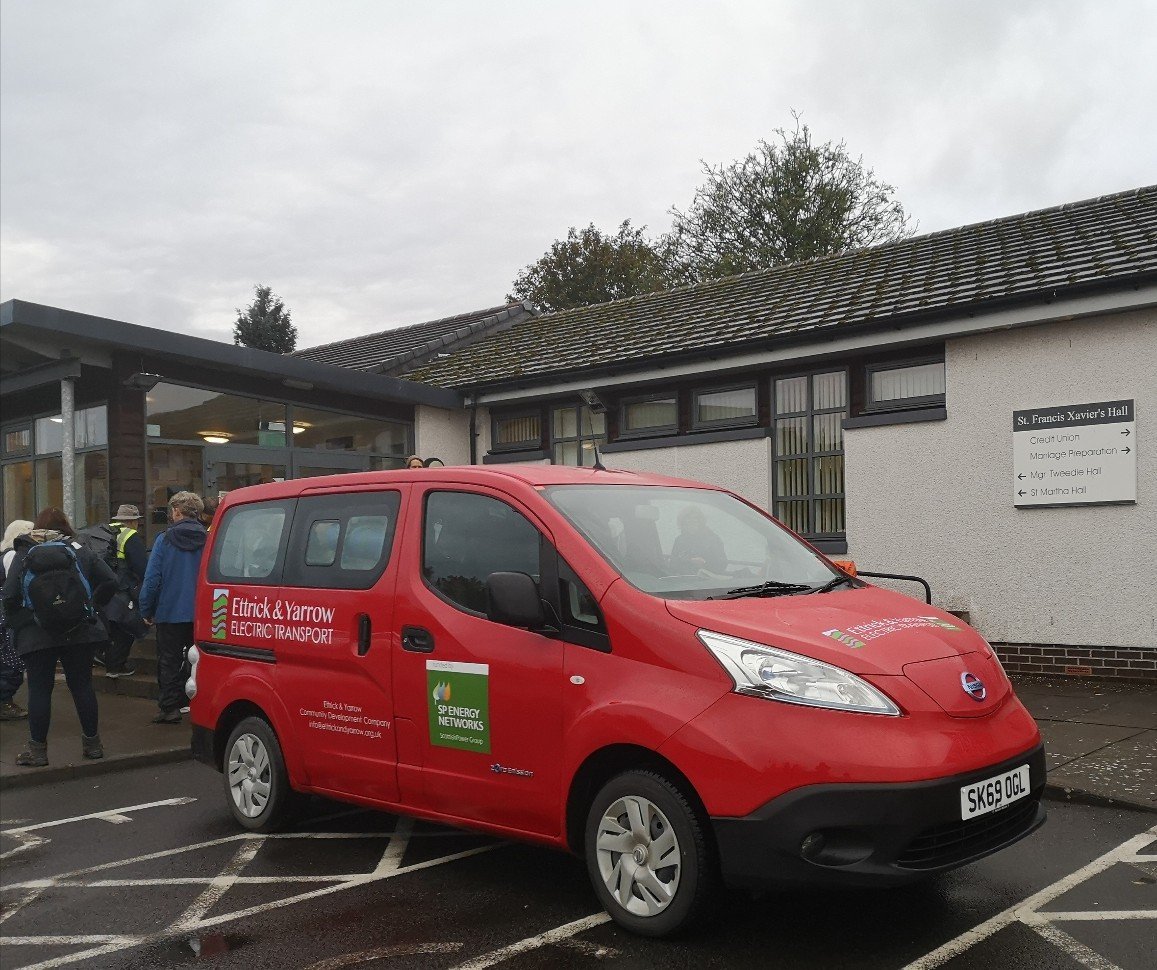
Our doughty electric support vehicle which carried the bulk of the rucksacks and food to St Francis Xavier’s Catholic Church where we spent the night
Falkirk
We spent the night at St Francis Xavier’s Hall, arriving wetter than it is hard to imagine any group of pilgrims could be, and presenting quite a challenge to the very kind folk who welcomed us, provided hanging rails and upped the heating before preparing our evening meal.
Alisar made a contribution to our soil collection. She is a New Scot, Syrian by birth, and had gathered it from her mother’s garden in Falkirk. Our food was cooked and served to us by members of the Muslim and Interfaith community in Falkirk, and it was delicious.
Here are some of the replies to ‘What keeps me Walking?’ read out at the Pilgrim’s Ceilidh on 22 October 2021.
In 1972 I walked from Canterbury to Winchester, a kind of reverse Pilgrims Way,and we camped by the side of a wood. As we cooked our noodles, a wren sat in the bush and sang his heart out. I have remembered that wren for nearly 50 years.
What keeps me walking? Hope.
Freedom Come All Ye on the pipes with a lot of background noise. Footage of today’s walk
Later that night, there was a reflection circle and enjoyable, high-energy workshop about group dynamics.
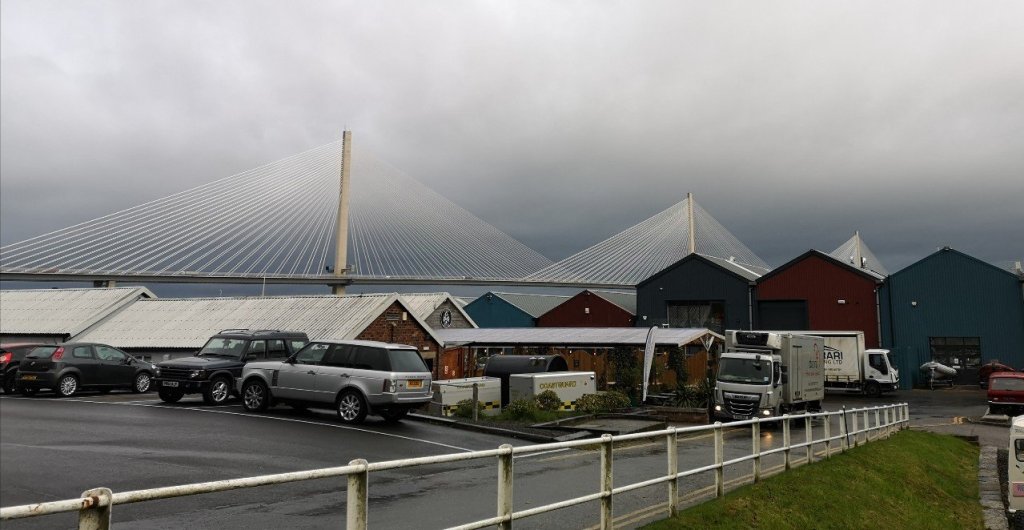
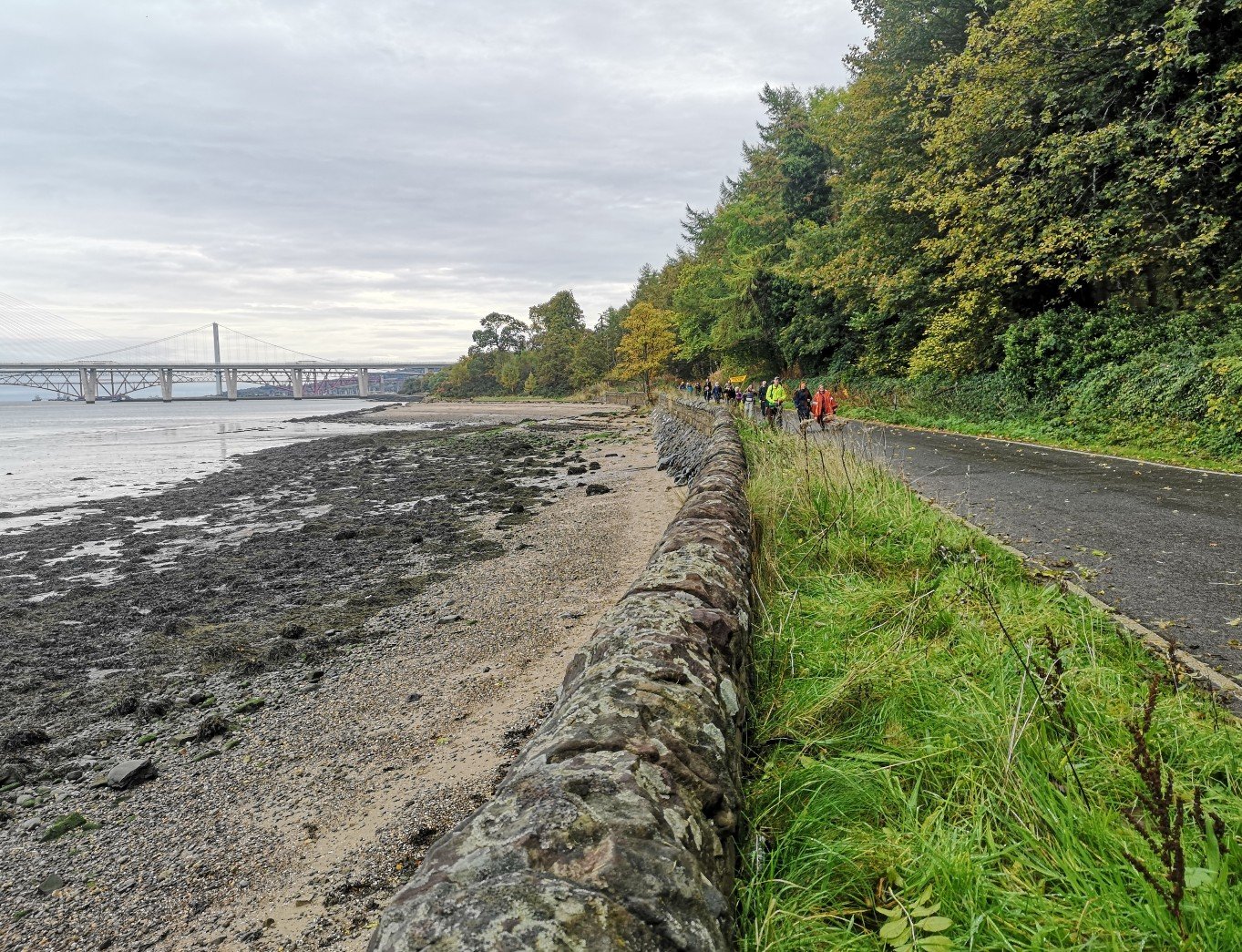
We leave the Priory Church close to 9am and walk through the residential streets and warehouse area on our way out of South Queensferry, getting a good sight of the bridges from the other side.
A great view of the ‘new’ Fife Crossing from South Queensferry
Today’s walk is in the area that is part of the Inner Forth Initiative, a collaboration between the RSPB (Royal Society for the Protection of Birds); Scottish Heritage; Central Scotland Green Network Trust; Clackmannanshire, Stirling and Falkirk Councils; Sustrans; and Historic Environment Scotland. It reaches from Stirling at the Forth’s head to the Bridges at South Queensferry and takes in both sides of the estuary with beacons and markers celebrating the area’s history, wildlife and culture, including the John Muir Way which we are walking and the Fife Coastal Path on the opposite shore.
As well as the beauty and interest of the area, the Forth has many industrial sites, and as we near Grangemouth (its heart?) in a few days time, we are also getting close to areas in which fossil fuels are processed, received and disseminated.
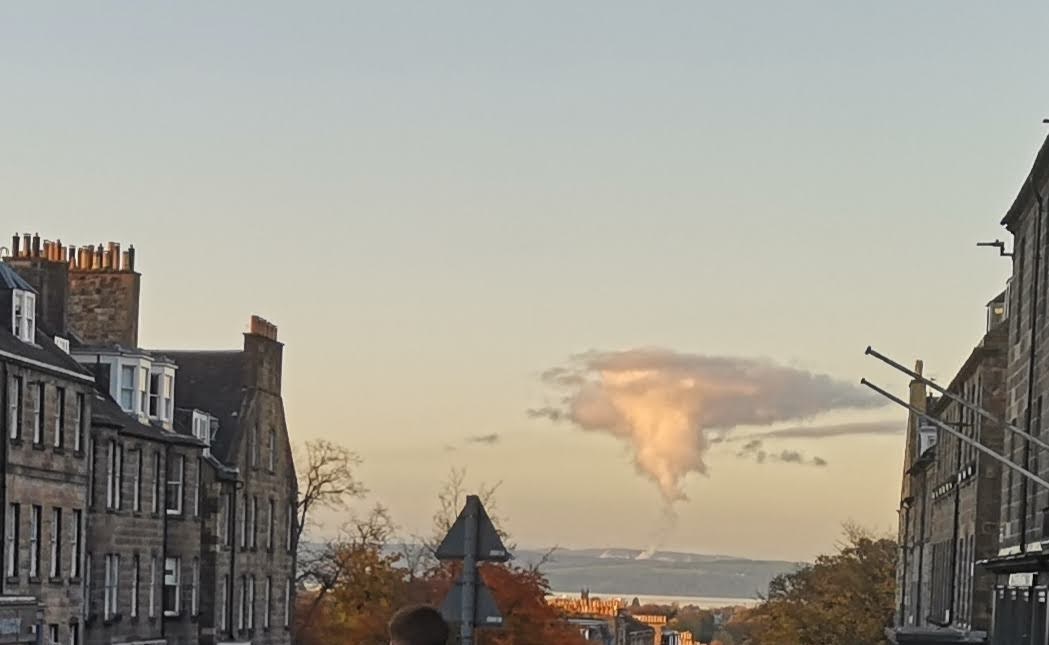
Example of a mushroom ‘cloud’ flare from Mossmoran 13 November 2021 from top of Dundas Street, Edinburgh
The Mossmoran NGL (natural gas liquids) processing facility is located on the opposite side of the Forth. Owned by Shell and ExxonMobil, the former were fined in 2013, 2014 and 2015, with complaints made and investigated every year between 2017 and now (information source here). The plant is part of the North Sea Brent oil and gas field system, and should not flare, but does regularly, paying fines every time it does. The Mossmoran Action Group campaigns for safer communities in the area. The BBC reported that “up to 13,800 tonnes of CO2 could have been emitted from a Fife chemical plant during October 2020 flaring, according to figures from the Scottish Environment Protection Agency (Sepa).” It continued, “The Scottish Greens say that is equivalent to 9,140 people taking a return flight from Glasgow to New York. The Mossmorran flaring lasted three days from 4 to 6 October. Fife Ethylene Plant operator ExxonMobil said it was committed to minimising carbon dioxide emissions. It was the fourth period of elevated flaring at the ExxonMobil plant in 2020. Sepa receives over 380 complaints of plant flaring and Environment officers probe chemical plant flaring. Green MSP Mark Ruskell said it would take up to 13,800 trees 100 years to offset the same amount of carbon. He said the climate impact of the flaring was “catastrophic” and he renewed calls for a transition plan for the plant.”
The new Forth bridge is still just visible as we walk away from South Queensferry
We are veering between the depressing state of affairs which is evident in the form of coastal erosion and continuing CO2 emissions to name only two; and the sense that we are doing something significant by walking in this way. We are raising awareness, walking for those who also want to combat the effects of climate change but cannot leave their work / caring responsibilities, and taking the time to learn as much as we can about the reality of the situation, our place within the natural order, and what we need to do in the future. Most of us are taking annual leave or unpaid time off, simply not earning (many are self-employed) because we believe that we are doing something worthwhile. There is a history of this type of peaceful activism, and walking is one of the least injurious modes of transport, giving us time to feel, think, and discuss.
As citizens of the Earth, we have a responsibility to participate. As citizens massed together, we have the power to affect change, and it is only on that scale that enough change can happen.
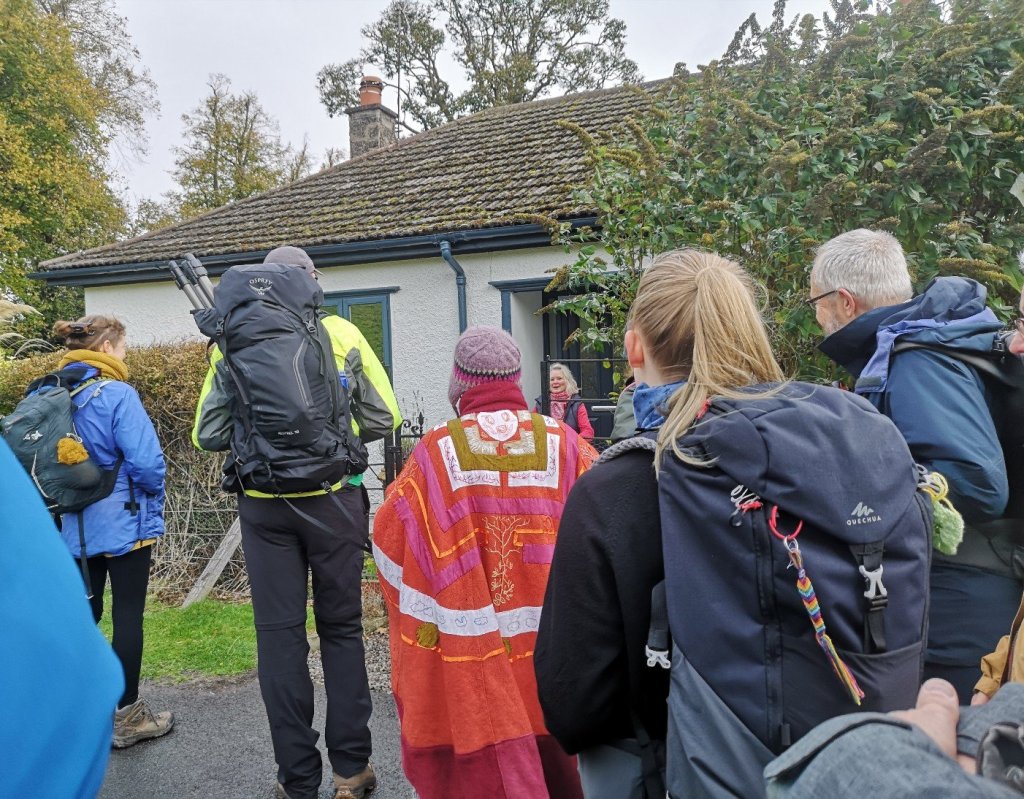
Left or right? We did not carry on along the water’s side, but branched off here onto the Hopetoun Estate Sue was Keeper of the Soils today. She takes long walks with her horse. More information on such walks can be found in the Facebook group Saddle Tramping UKChatting to a local woman outside her house when she became interested in what we were all doing Hopetoun Estate, West Lothian
Hopetoun House and estate
We followed the John Muir Way and Cycle Path 76 through the Hopetoun Estate (6,500 acres including the villages of Abercorn, Winchburgh and Newton) where the house is home to the Earl of Hopetoun and The Marquis of Linlithgow lives too. The public are allowed to traverse certain parts.
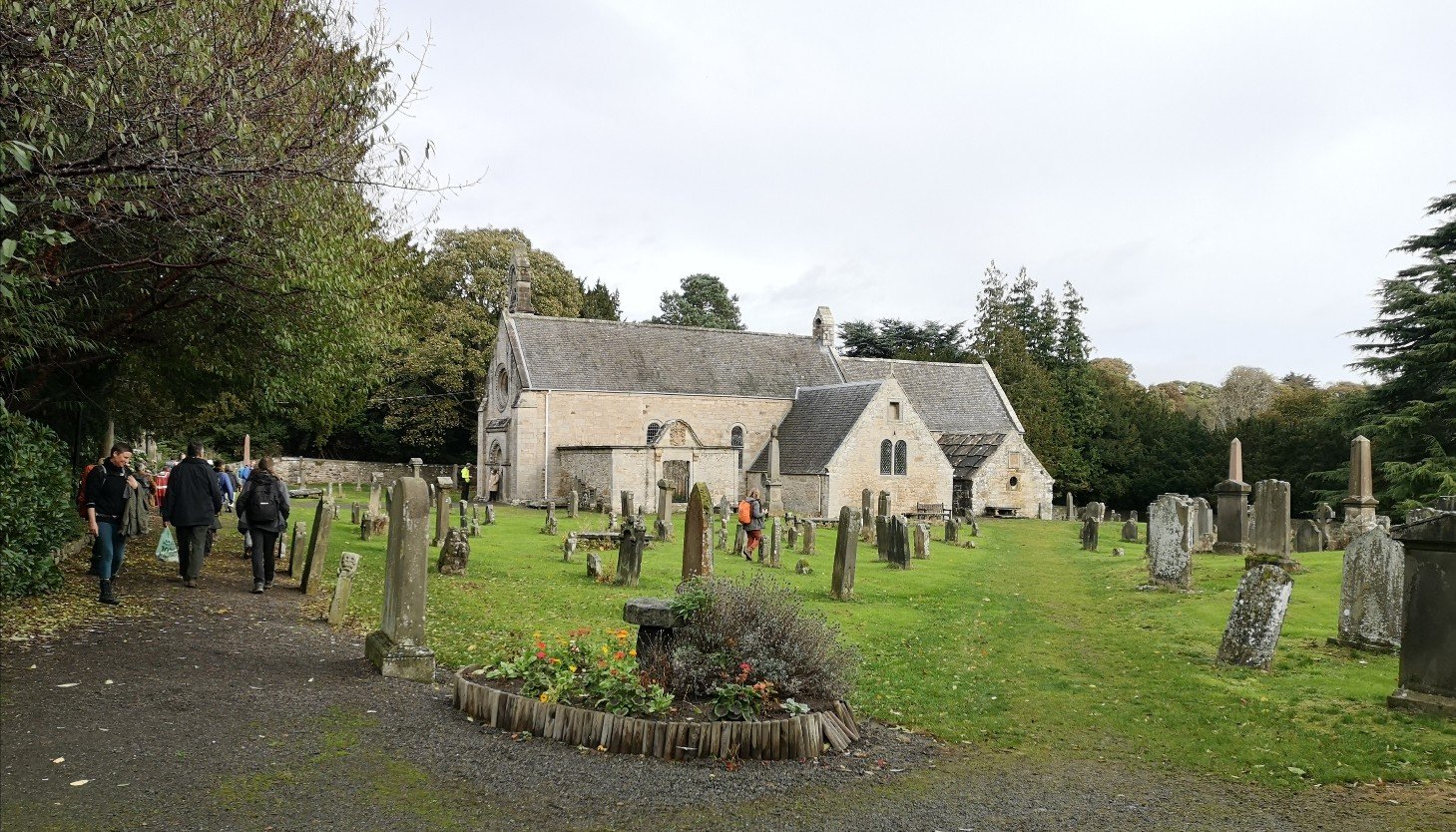
Abercorn Church on the Hopetoun Estate, West LothianAbercorn Museum on the Hopetoun Estate, West Lothian
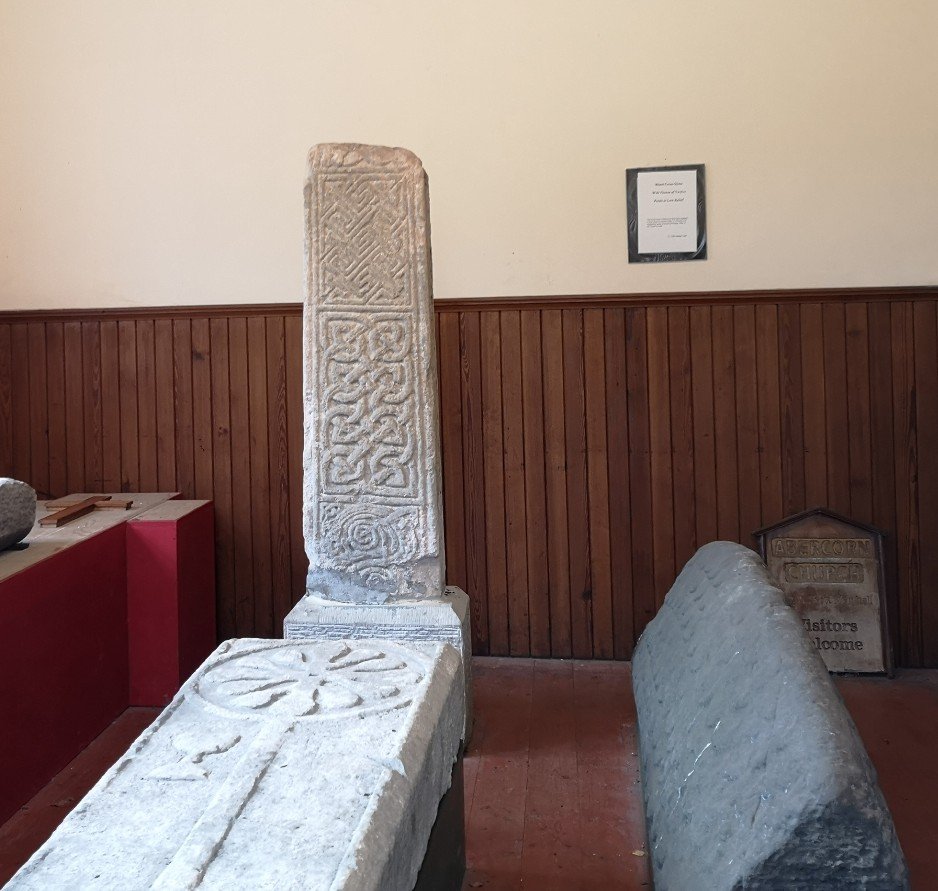
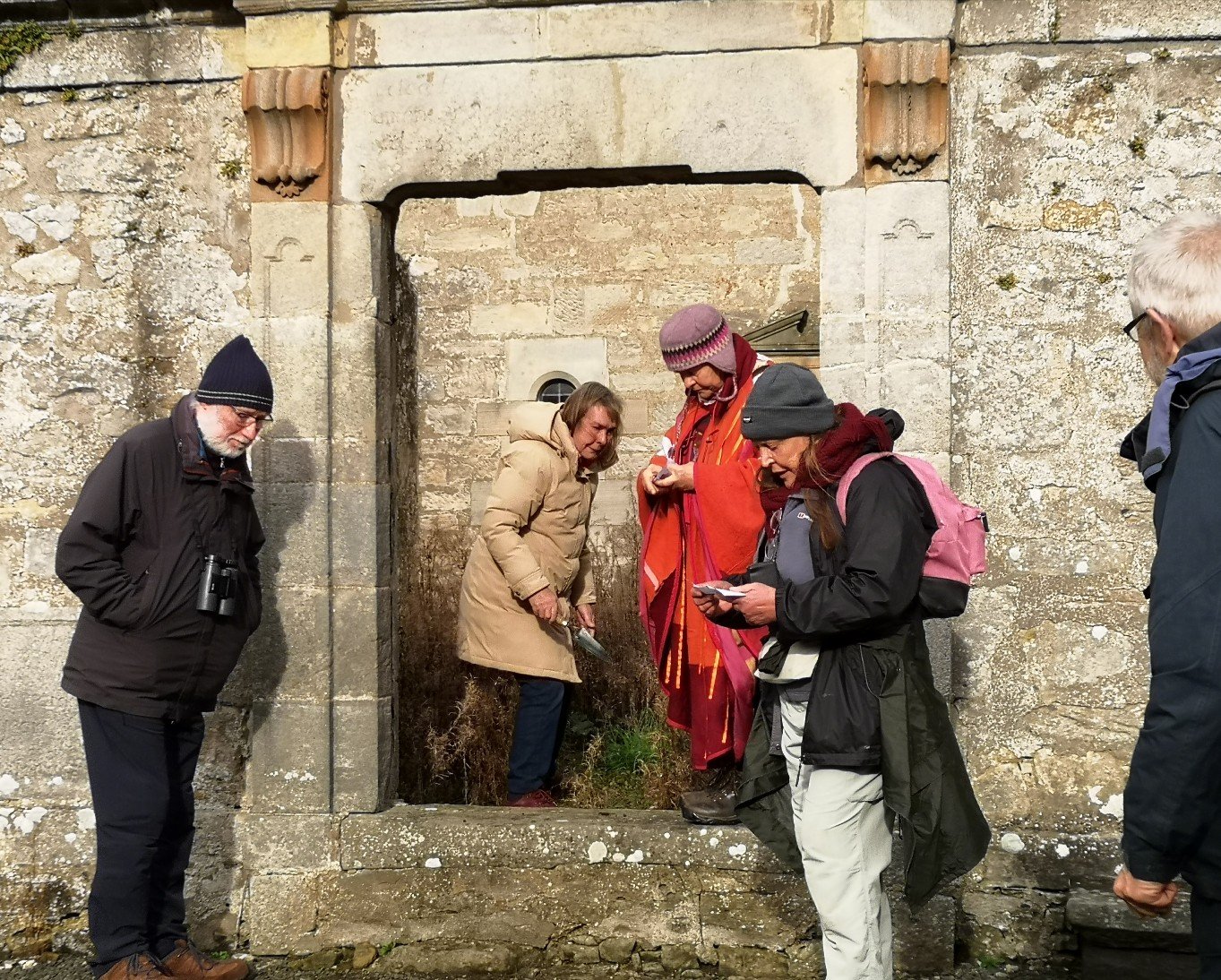
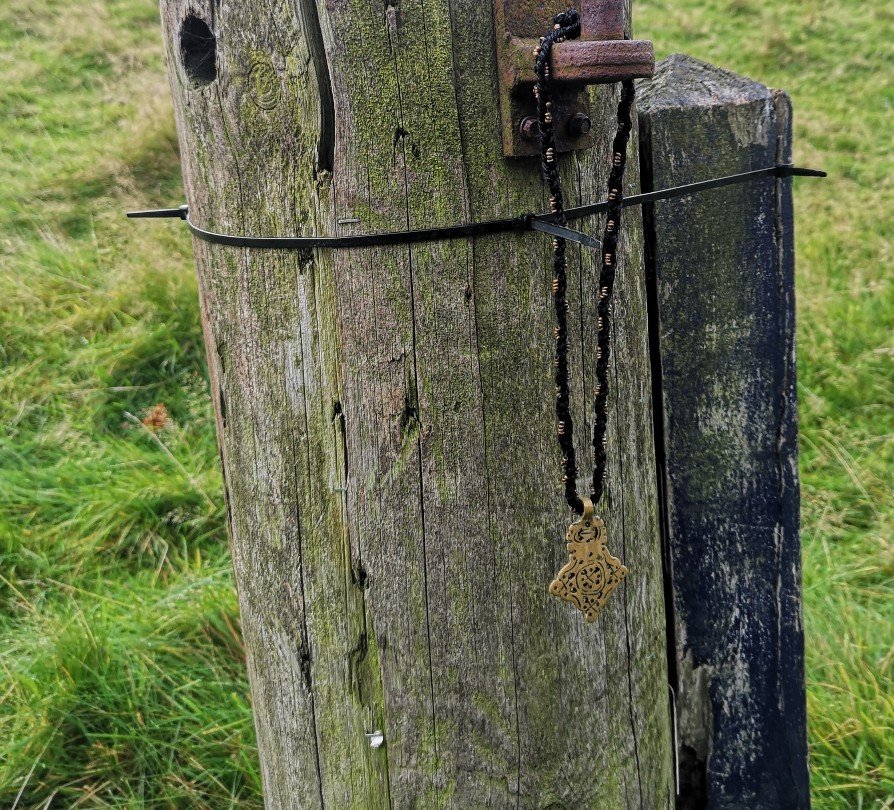
There is a cross from Lindisfarne (circa 7th century) and ancient burial monuments in the museum at the Abercorn Kirk. The chapel is said to have been the site of a monastery in 681, once the see of the Northumbrian King of the Picts. More information here, here and here.
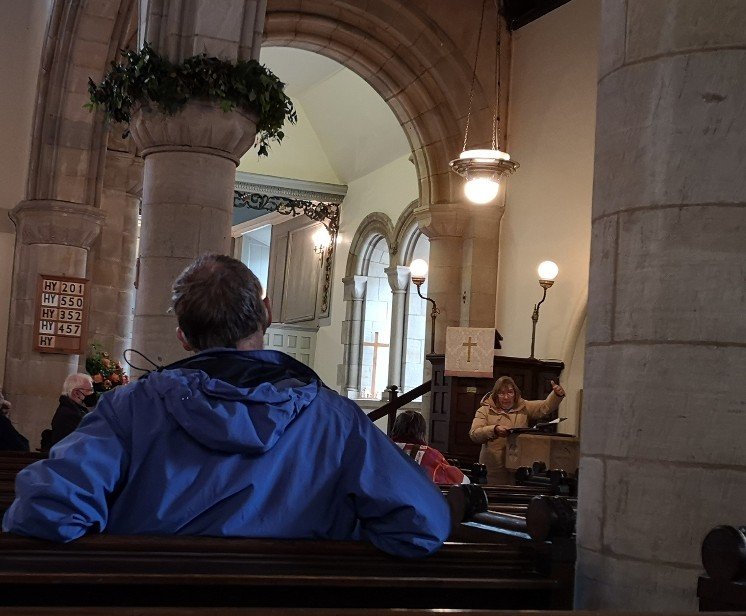
Interior, Abercorn Kirk where we enjoyed a talk about the architecture and history.
Some random facts about the area:
In 545 it is known that there was a pre-reformation church here dedicated to St Serf
It has one of the oldest pagan festivals sites on the hill
Tam Dalyell, Scottish Labour Party politician, is buried here (d. 2017)
The Earl and Marquis are both known as Elders and they follow the ancient tradition of entering the kirk by a separate door and sitting high above the altar and the rest of the congregation in their own section called the Hopetoun Loft
There is a fine Romanesque Norman doorway with gargoyles.
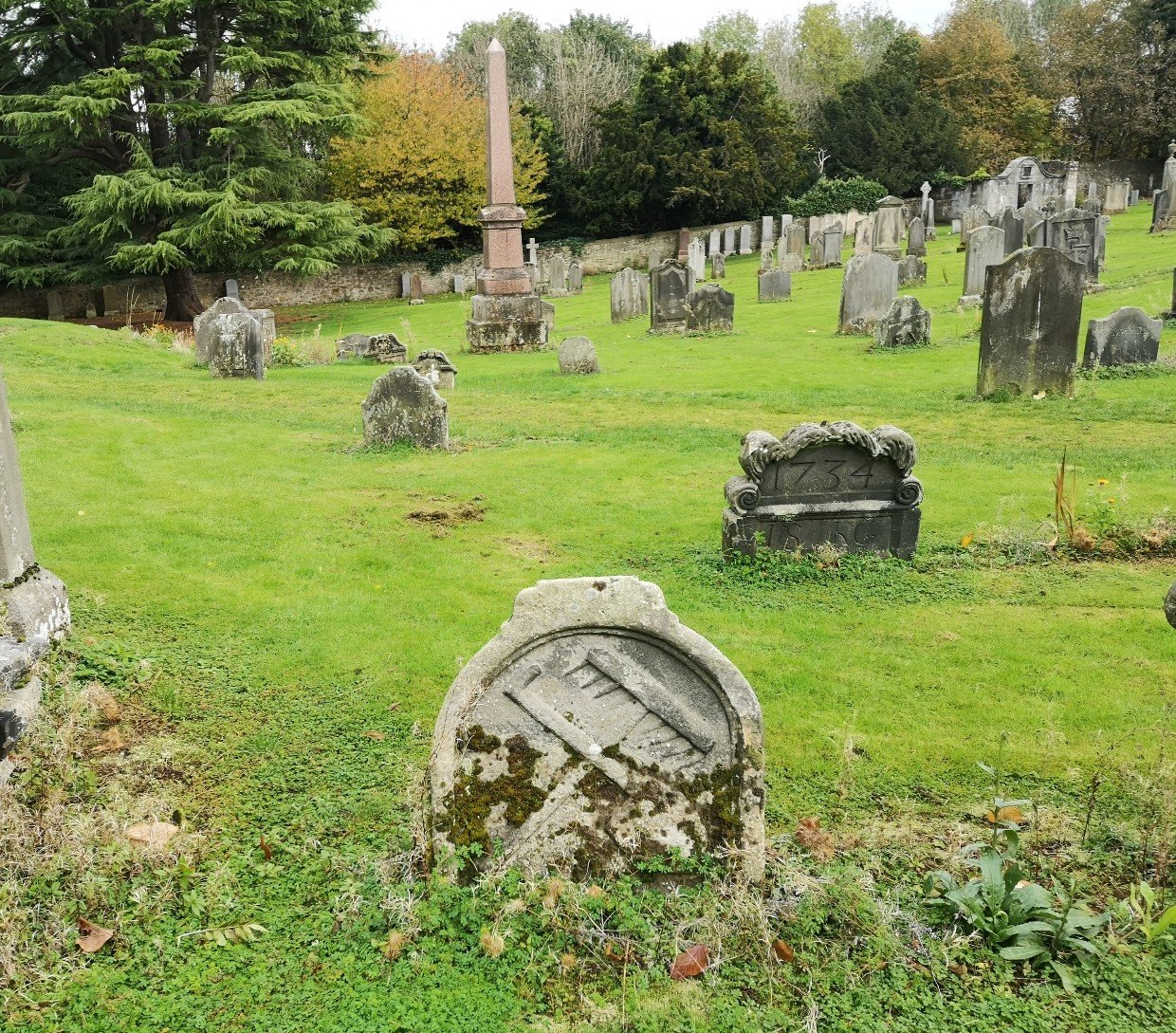
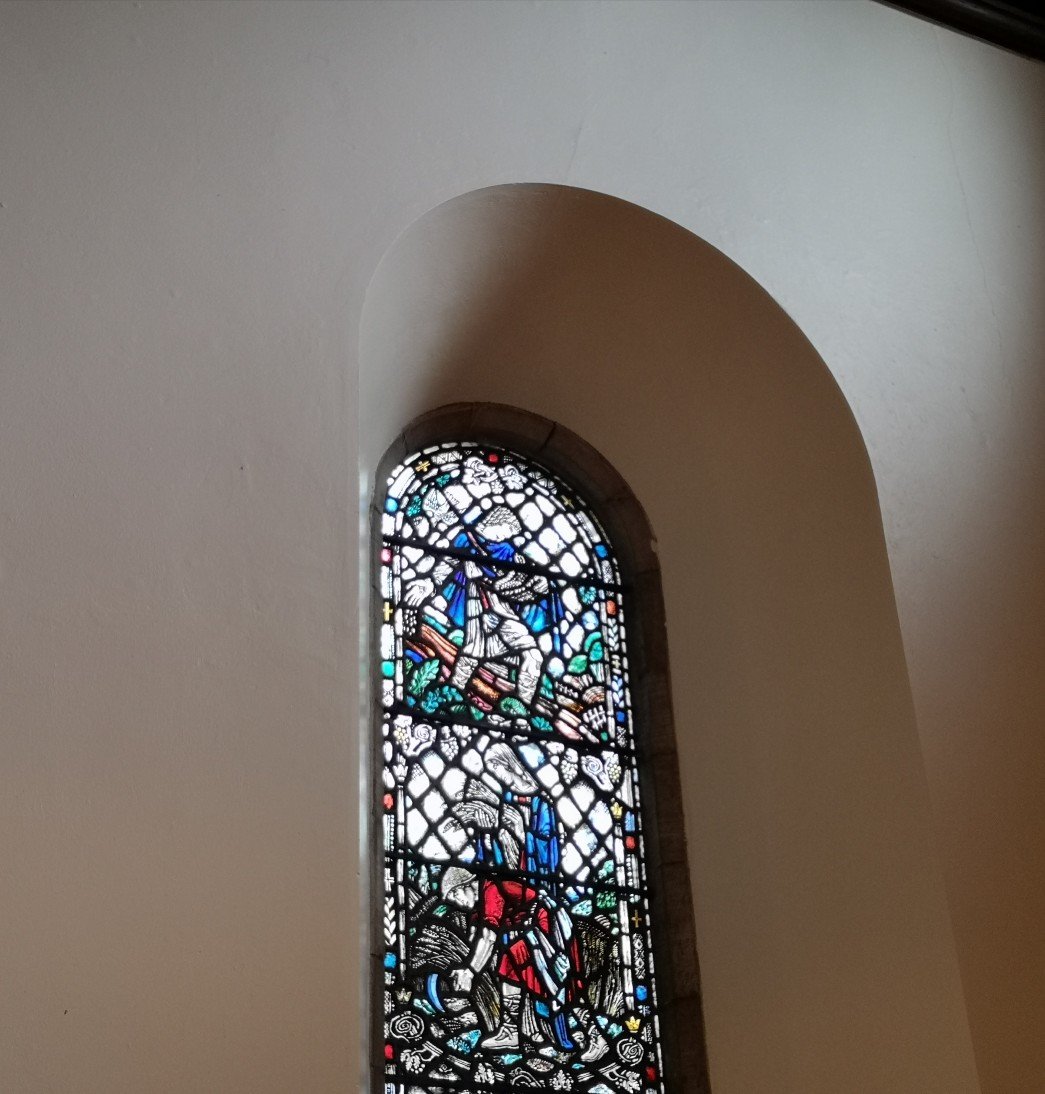
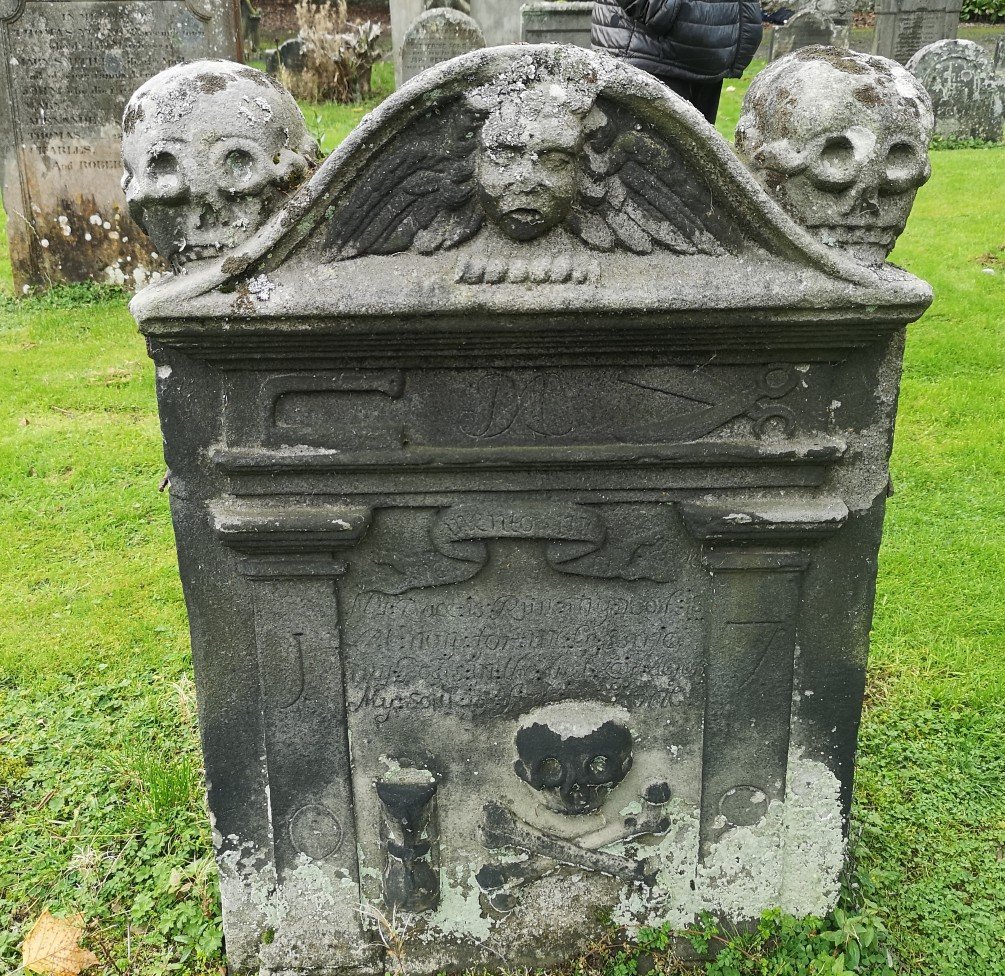
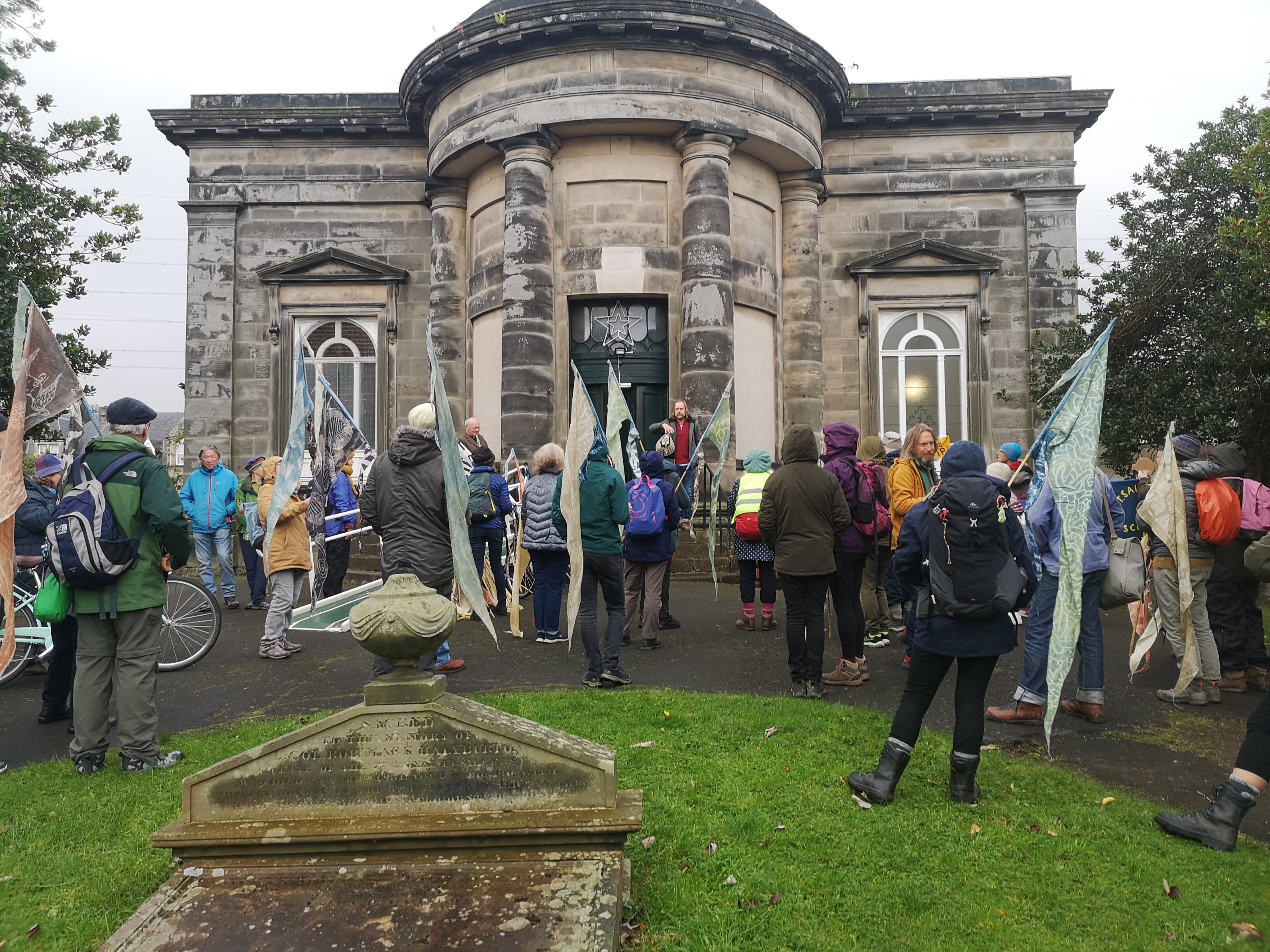
Abercorn Parish Church, Hopetoun Estate, West Lothian. Stained-glass windows by Douglas Strachan, 1921; skulls look east and west and ward off the devil; and the tools of the trades of those buried underneath can be seen on the memorial stonesWe had a soil ceremony at the Abercorn Kirk
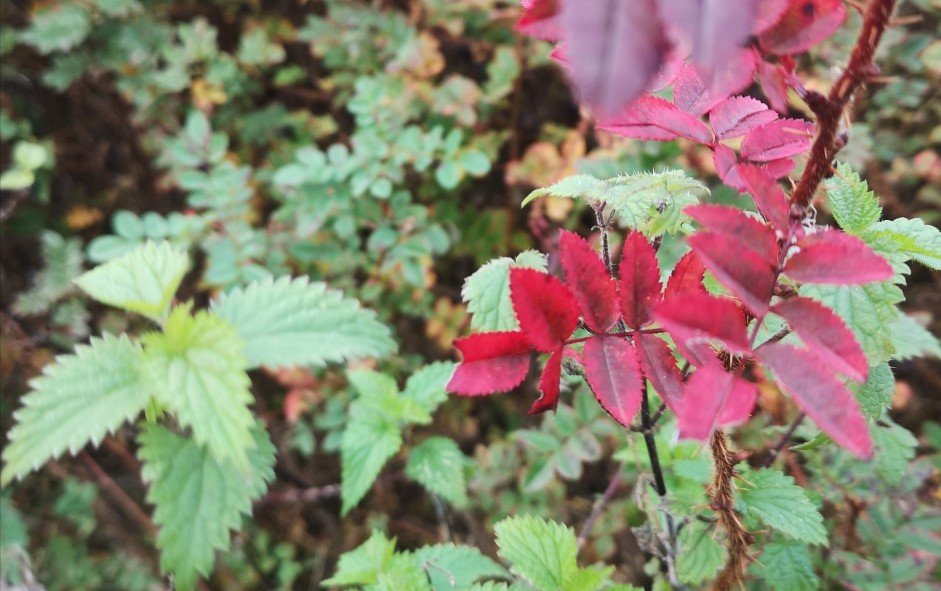
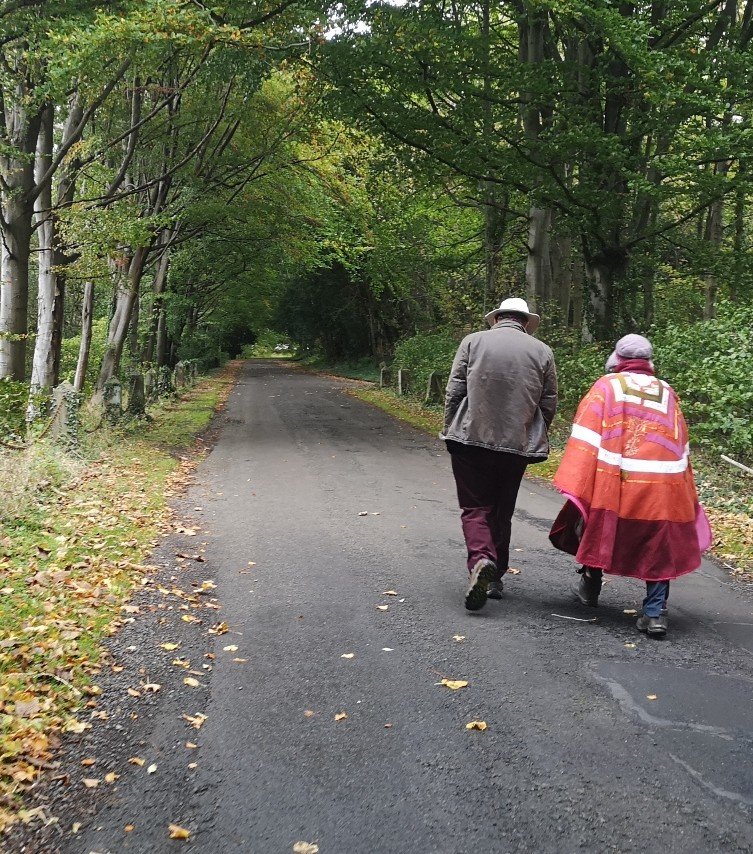
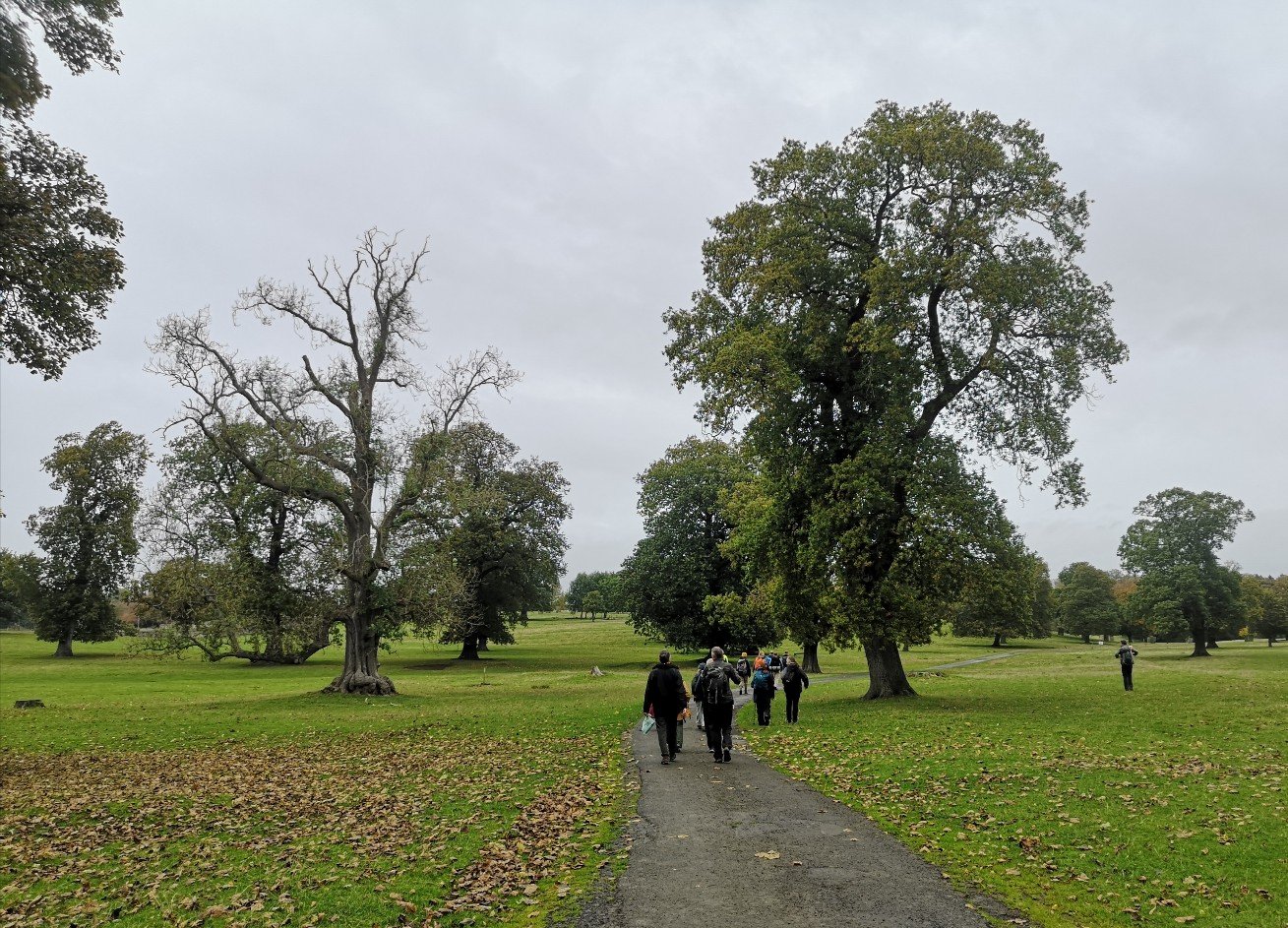
After a long stop to dry off, we walk on through misty riverscapes, along grand avenues of still very green Beech trees, by Sycamores which are changing colour and showing their ochre, marigold and tangerine leaves. Small stems of Ash are strewn over the path, emerald on one side and a paler pistachio on the other.
Through the greenwood past the Cornie Burn in the Hopetoun Estate, West LothianThe local landscape through which we walkedThe Rev Willie Shaw in his high-vis jacket about to brief us on the area we were walking through on the Pilgrimage for COP26
Blackness (nose of black rock)
Heading towards Blackness Castle, West Lothian
Nurdles are plastic ‘buttons’, little beads that all plastics are made of and which are found all over the beaches in this area. There is more information here on nurdlehunt.org.
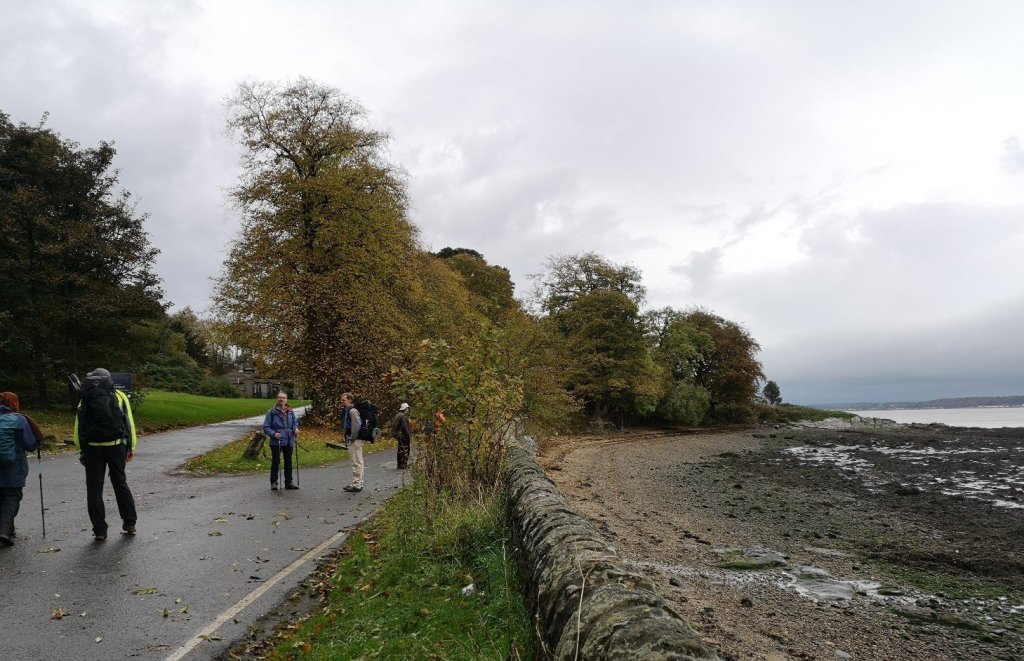
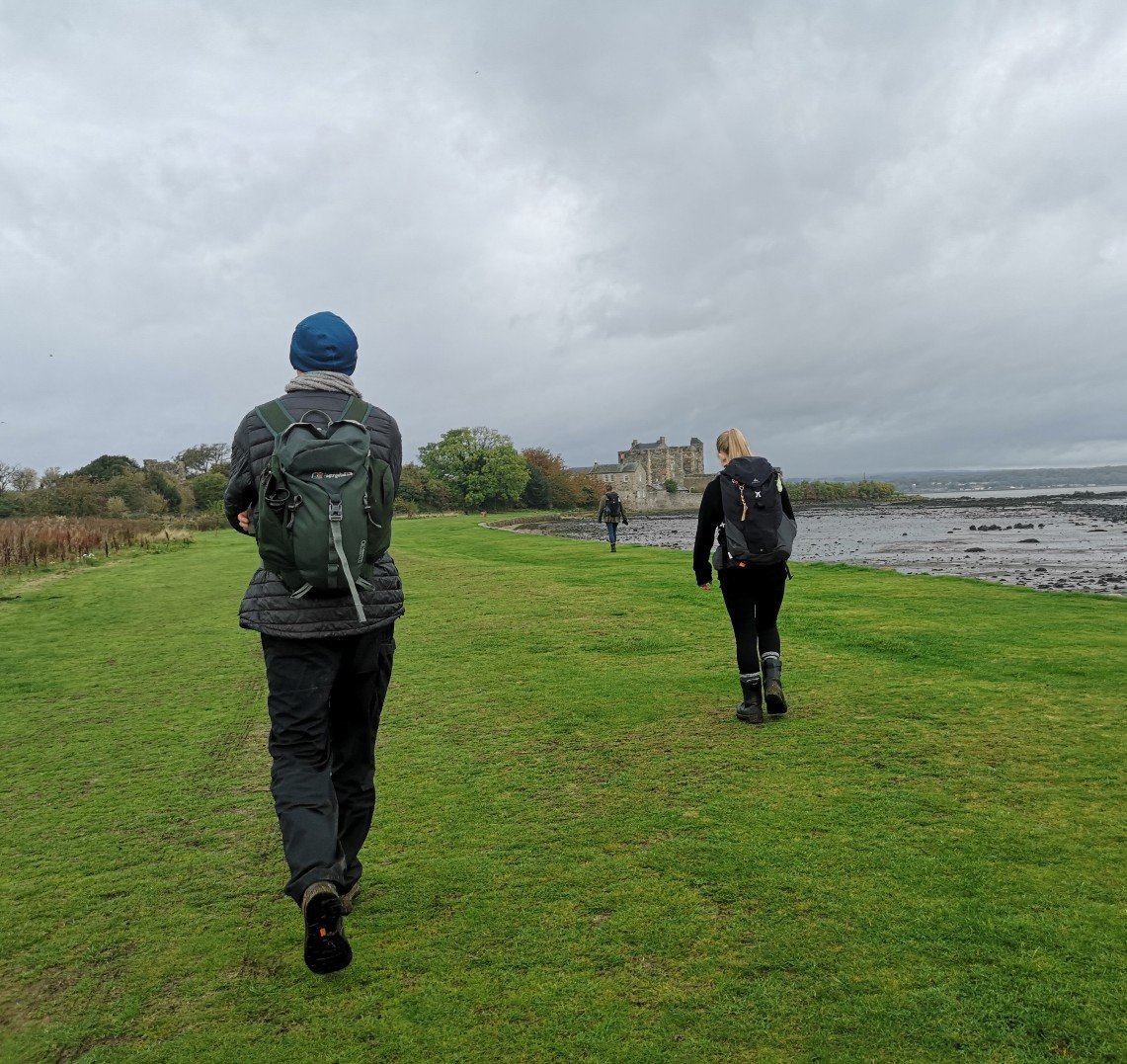
Along the Forth foreshore where the tide is out and the mudflats bleak, we walk to Blackness Castle, a 15th century fortress where Franco Zeferelli’s Hamlet was filmed. We have a wee seat and a cup of tea from our flasks just in time to avoid the rain. There’s a dovecot here, a 17th century pigeon house where the birds provided eggs and ‘fresh meat’ to the inhabitants.
Dovecot at Blackness
We look across to Charlestown, owned originally by the Earl of Elgin. Site of 14 massive limekilns, now preserved Grade A listed, it was one of the hubs of industrial Fife, and shipped goods to the Baltic. More information here on Fife Photos and Art.
Through the late C18 and C19, the kilns were part of a major industrial complex of the time, including coal mining, ironworking and salt extraction. Coal and limestone were brought in from the local quarries, also on the Earl’s estate. The adjacent harbour was as well built by the Earl and used for transporting the lime products, limestone and importantly coal.
Wikipedia
Just west of Charlestown are the three Crombie gantry cranes, easily seen from where we are. They are part of the Armament Royal Navy Ordnance Depot.
Blackness village – a toilet stop
Antonine Wall
We go near to the site of The Roman Antonine Wall (named after Antoninus Pius) which protected the province of Britainnia from the Caledonian tribes. It starts in Carriden near Bo’ness and runs westwards to West Kilpatrick on the Clyde (Glasgow). With 37 miles of ramparts (20 feet high), ditches (20 feet deep), roads, and approximately 20 forts, it was occupied for over 25 years. More information here (BBC).
The next day Ian tells us about the Carriden (Karedyn) Estate. 900 Years ago, the monks from Holyrood Abbey were granted a tithe, the right to collect a tenth of the coal from there, around the year 1200. The property went over to the Cockburn family in 1330.
The Corbie Inn has a replica of a sandstone slab recording the Roman army’s building work on the easternmost part of the Antonine Wall, Bridgeness, West Lothian, 142 – 143 AD. There is a dedication to their Emperor, and the original is in the National Museum of Scotland.
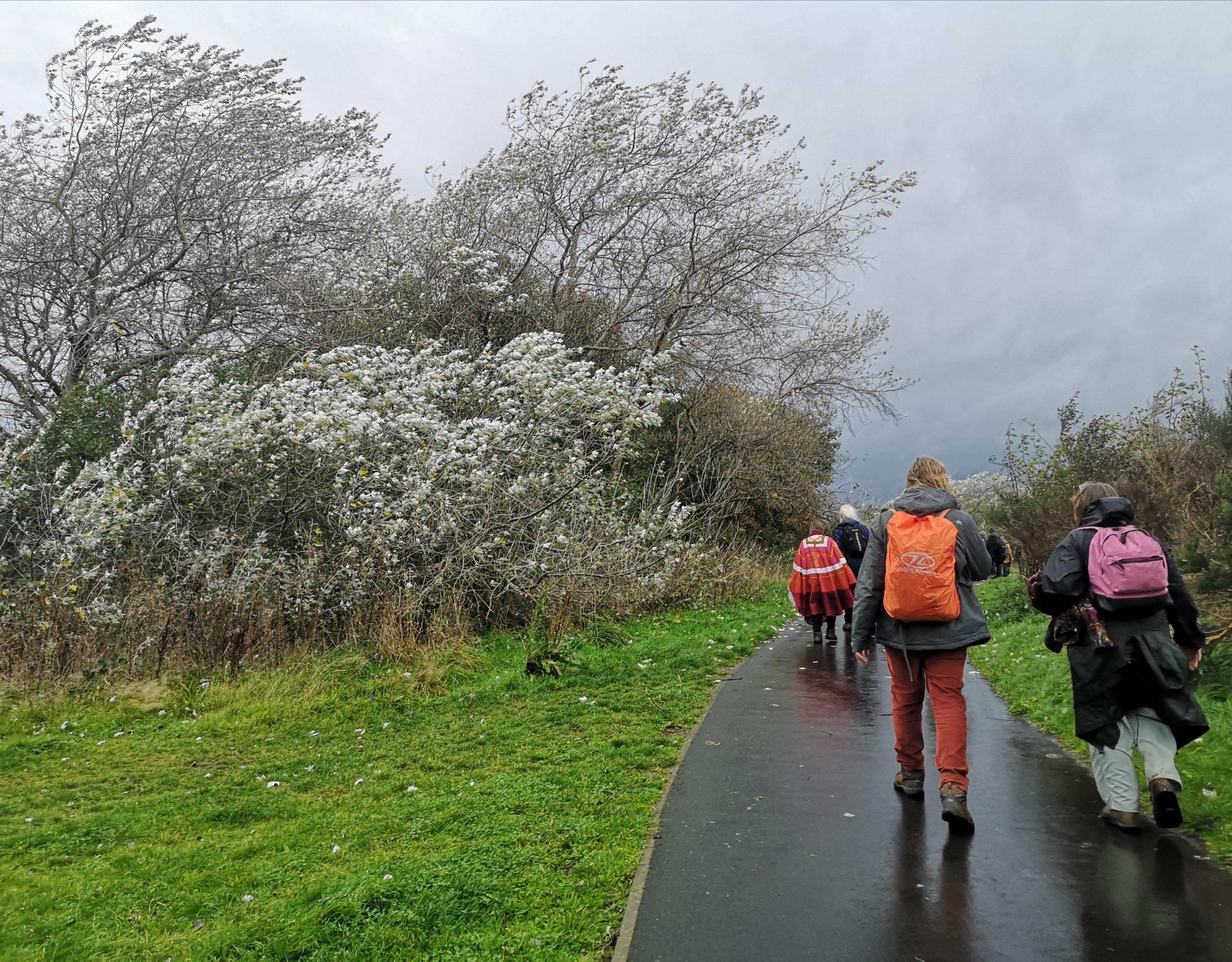
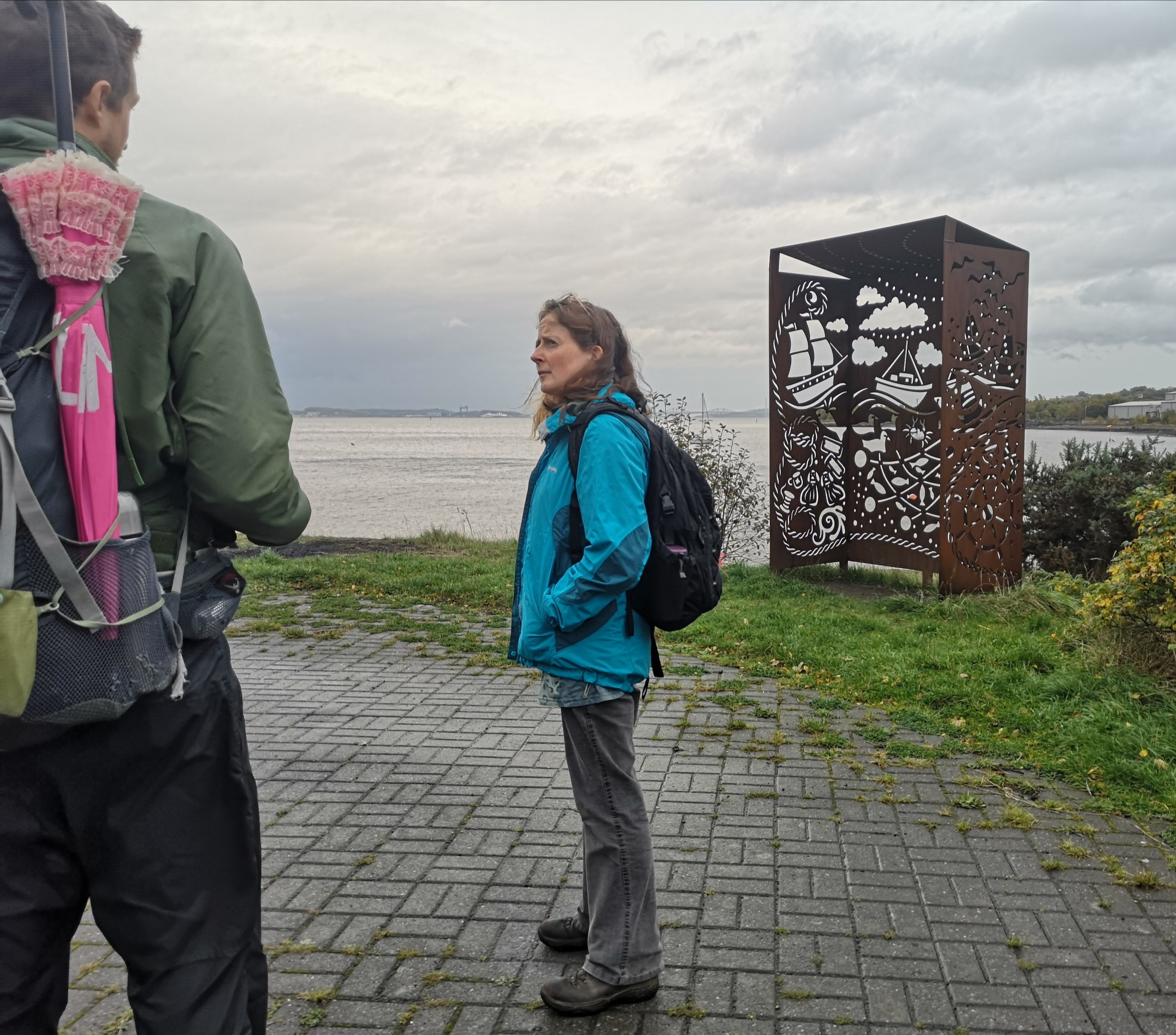
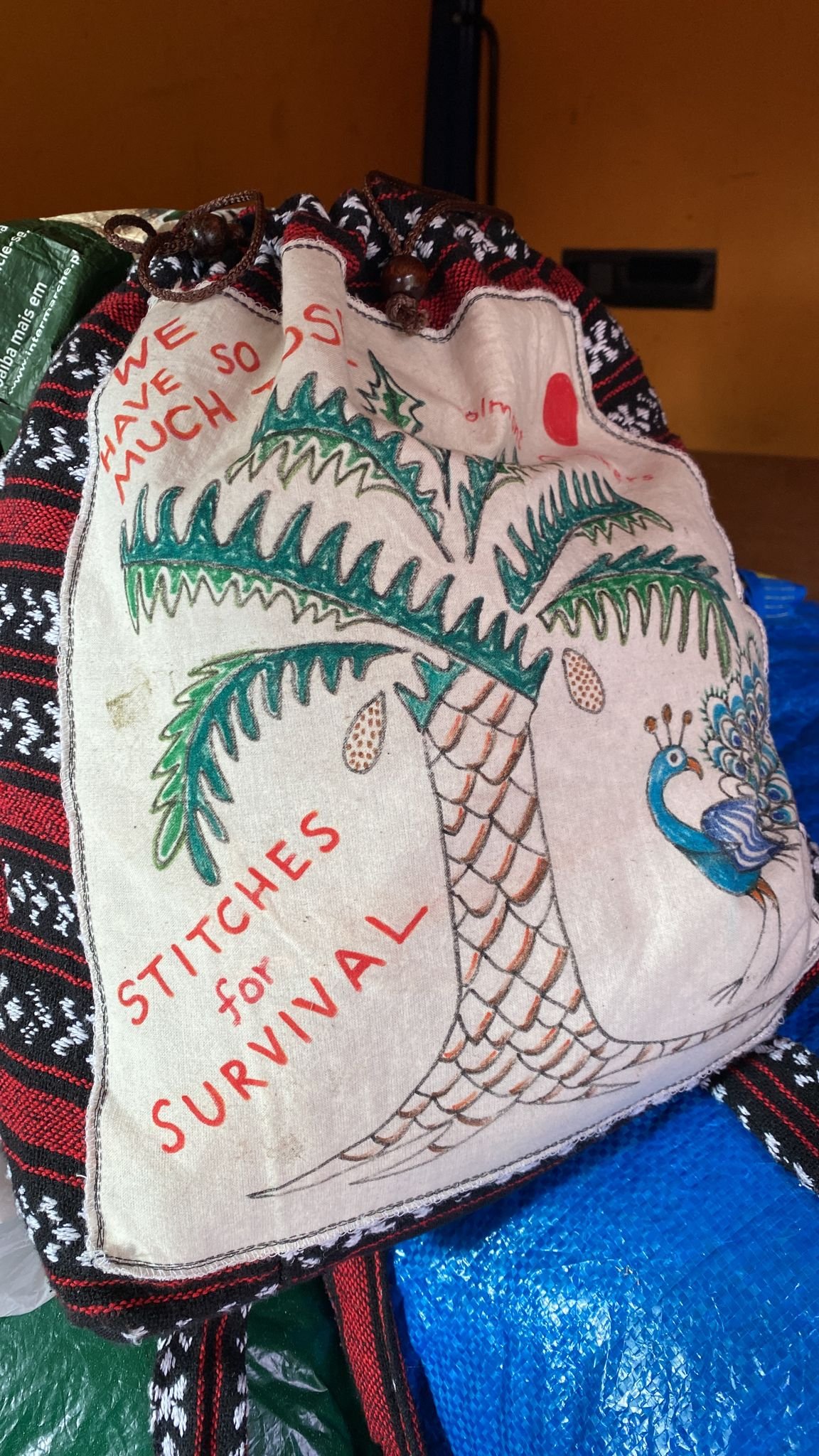
Matthew was wearing the Stitches for Survival bag as we neared the industrial outskirts of Bo’nessIt was very wet! Towards Bo’ness, West LothianAnd blustery, although the silvery trees are spectacularRuth and Tom (with his pink umbrella) by one of Ivar Struthers’ three metal artworks on the Foreshore
Bo’ness
David and MichelleThe Bo’ness Buoy where we collect for a final information session and to say goodbye to the day walkers and those who are leaving us here. Ewan, Willie and Olga
Salt and coal, trade and taxes once made the Bo’ness rich, but the pits and mine shafts are now quiet.
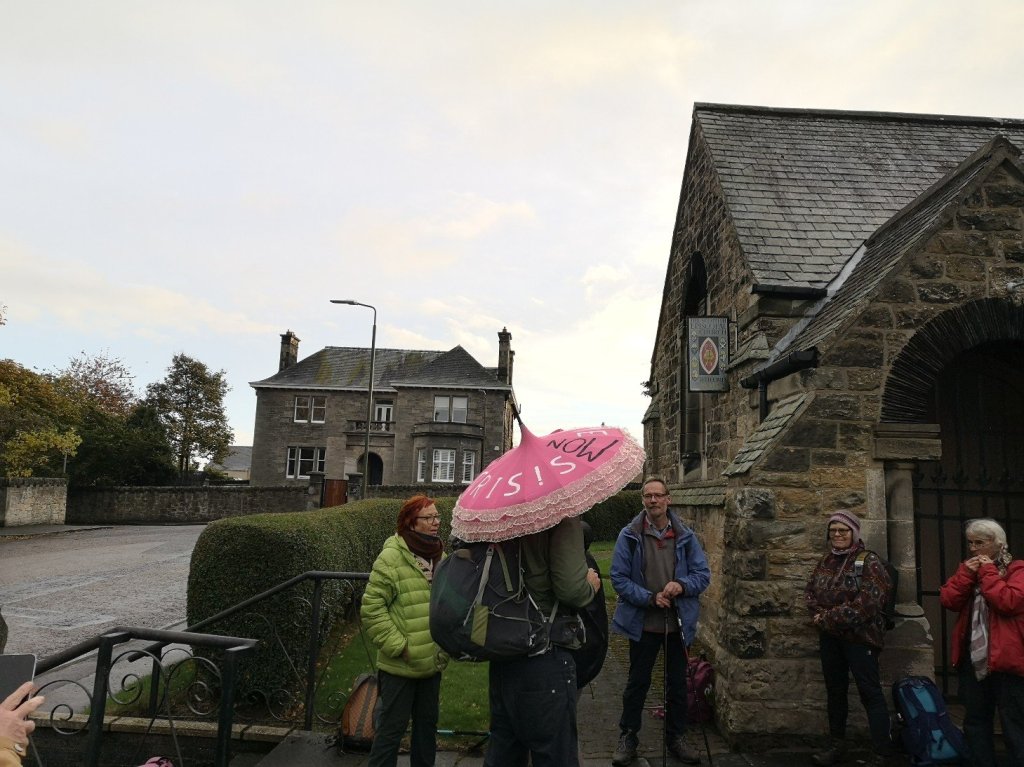
Oh, it is one steep climb up School Brae to St Catharine’s Episcopalian Church where we were spending the night at the end of a good day’s walking! There we are given another lovely meal – thank you.
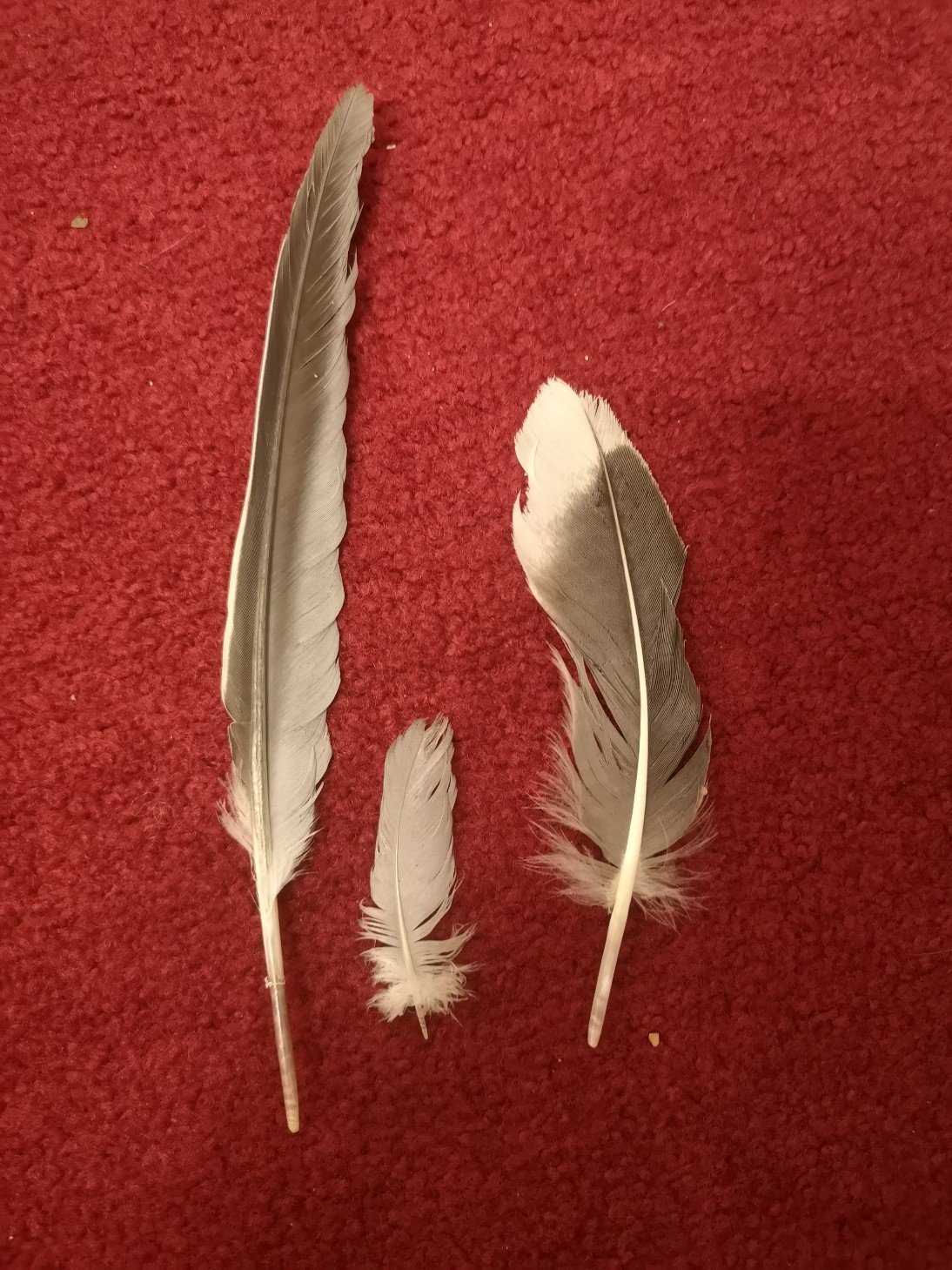
Today’s feathers, relics collected along the way. Some of us had a carpet to sleep on by a radiator which was heavenly
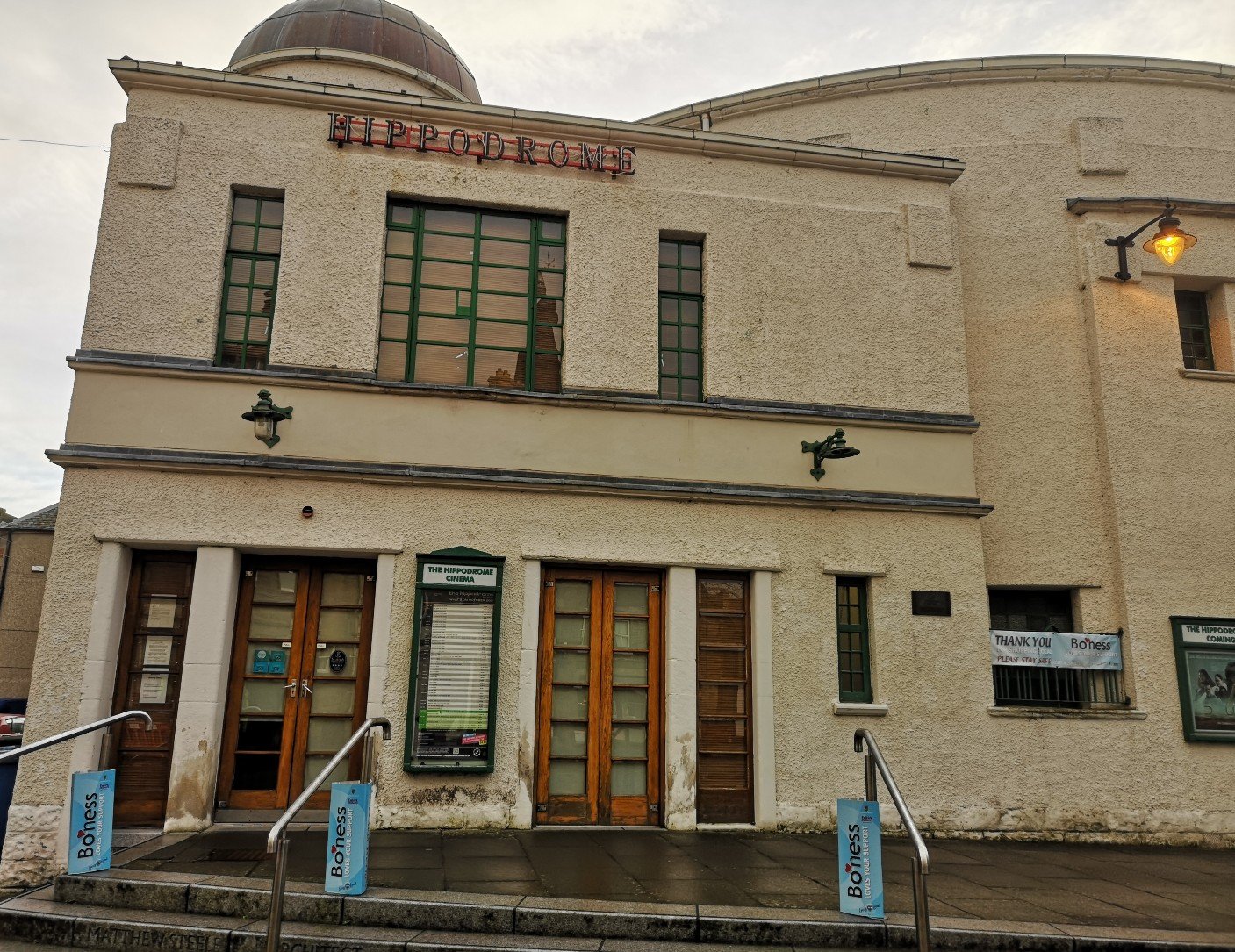
Though some complain now that no-one has any reason to go to Bo’ness, in fact we find it a lively place with an Art Deco cinema, the Hippodrome, and an acclaimed, annual Silent Film Festival. A film had been arranged for us to see there later.
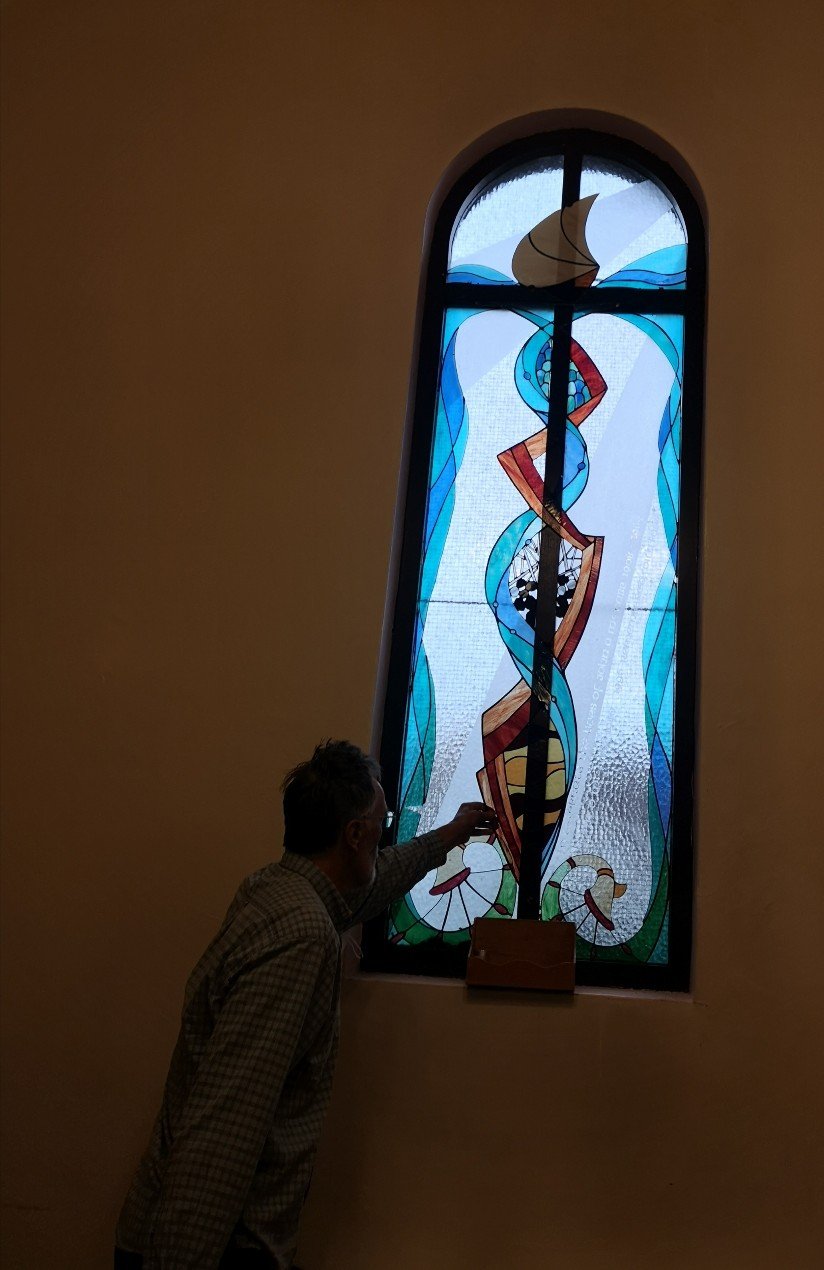
Stained glass window, St Catharine’s Church, Bo’ness
The film, in collaboration with Take One Action, is Anote’s Ark. Made in 2018 by director Matthieu Rytz, it tells of the impact of climate change on the island of Kiribati, found where the international dateline meets the equator. It is anticipated that Kiribati will entirely disappear as sea levels rise. Anote Tong is the former president and he has repeatedly lobbied the international community to do something. It is a chastening watch and our mood is subdued as we go to sleep.
Blog 8 – Walking into Edinburgh and staying for a day 22/23 October 2021
Hope’s Walk
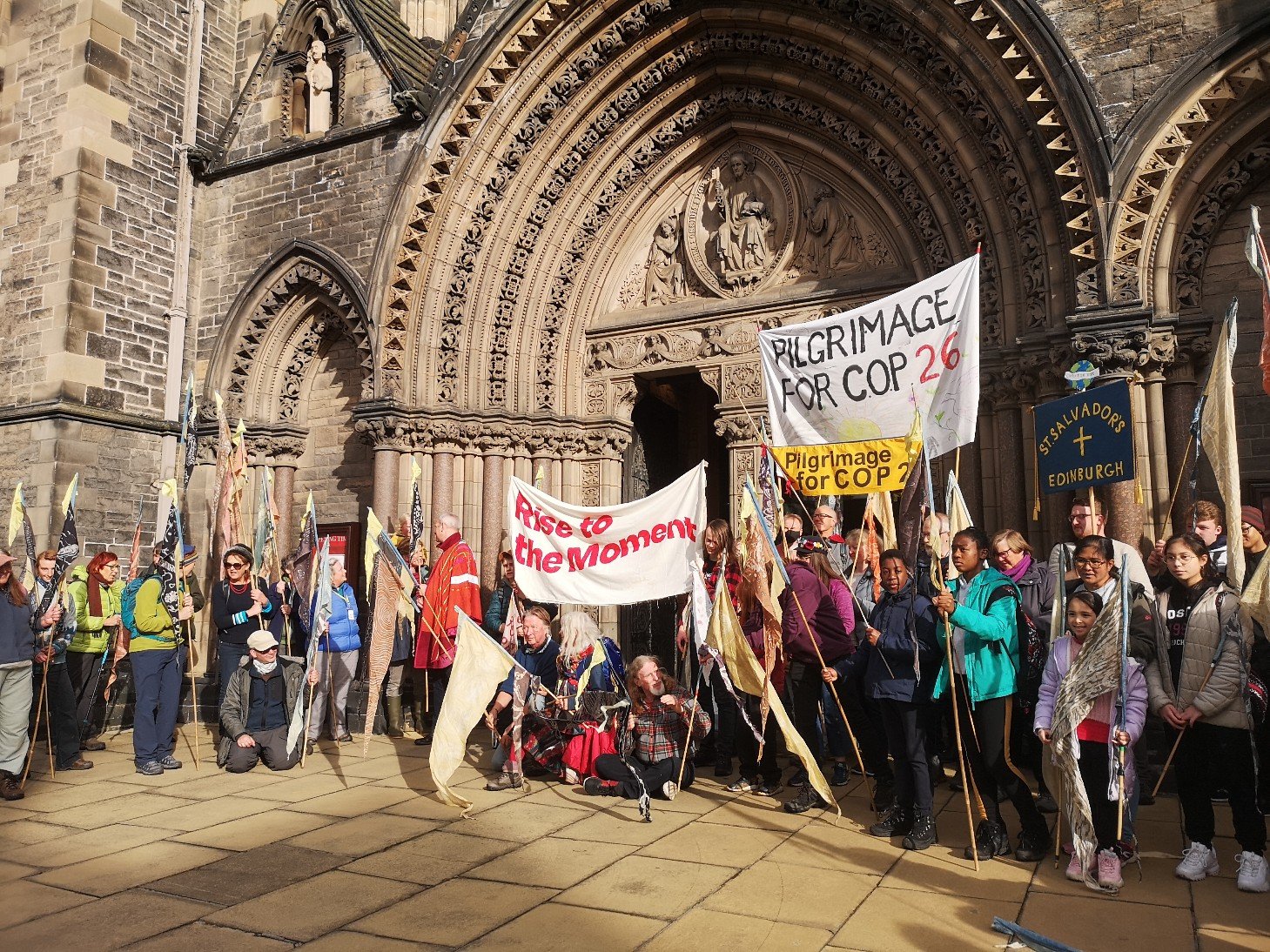
This morning’s route begins at St Marks Portobello where we had spent two nights (see blog 7 for details of the Portobello waystation), and we are joined by daily walkers. Jonathan Baxter who conceived of the Pilgrimage, Cath who is carrying the Stitches for Survival bag, and members of the YCCN (the Young Christian Climate Network, who made a grand relay from to Glasgow between June and October 2021) speak before we leave.
In years to come, we want to be able to look back and say “we did not sit at home while unjust decisions were made on our doorstep, we set sail towards a just future”.
YCCN website
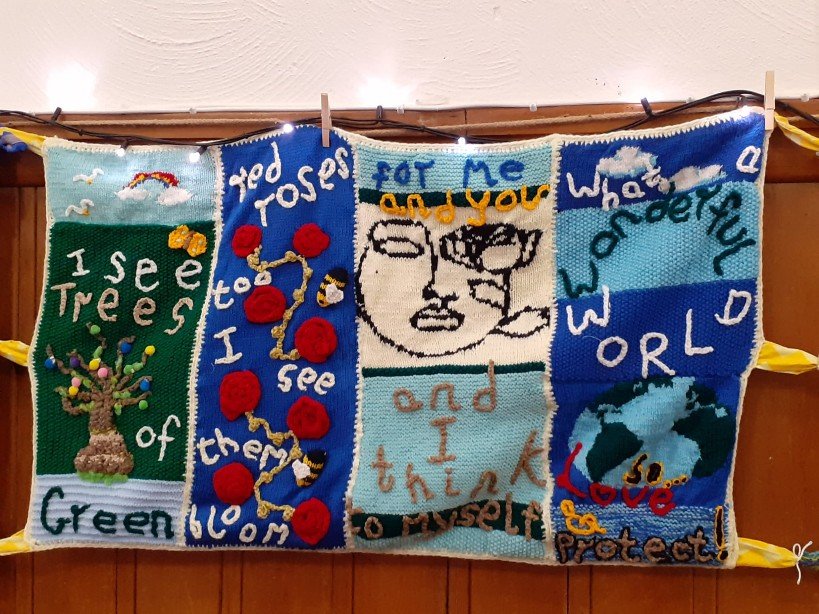
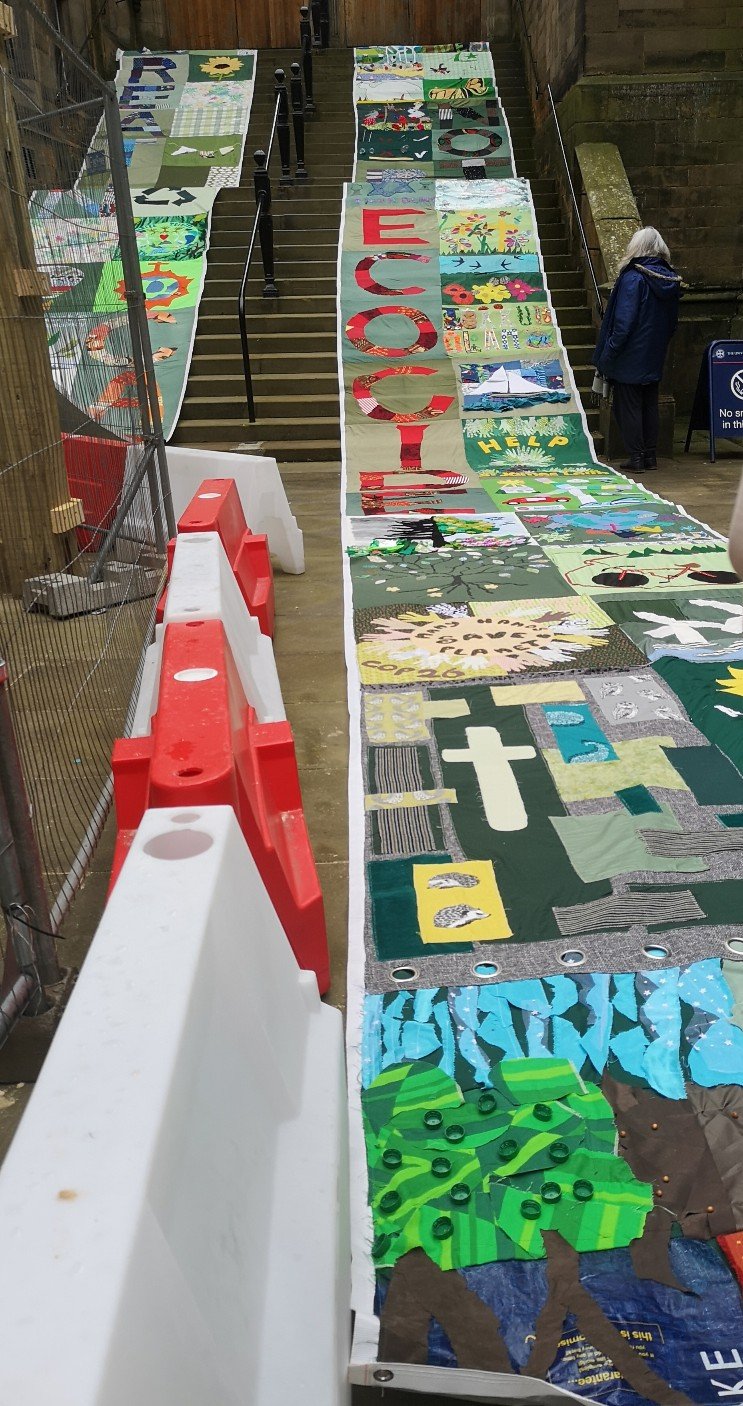
Stitches for Survival are a mass-craftivism volunteer organisation who are gathering all the knitted, crocheted and sewn panels which people have been making around the country, and joining them together to make 1.5 miles of climate messages for COP26 to encourage politicians and others to put the earth centre-stage
One of the Stitches for Survival panels. Photo Gareth
Hope
The theme that we come back to time and again on our pilgrimage is hope. On Sunday, Alistair McIntosh advised against despair, perhaps the corollary of hope, and advocated lamentation (see this earlier blog). Now, at the end of the first week of walking and learning together, we are making the Hopes Walk and on Sunday held a Deep Time, Wonder and Grief Circle in which hope and hopelessness were both expressed. In between these two events was a Silent Meditation on the Mound and an Interfaith Pilgrimage which visited Christian, Buddhist, Muslim and Hindu meeting places.
Jonathan addressing the Pilgrimage for COP26, Edinburgh
Walking itself is an act of hope – hope that the ground will be there the next time you depend on it, hope that you will be alive and able when your instinct is to step forward, hope that you will reach your destination and not die doing it. Every time the ball of your foot pushes off and the ground simultaneously launches you from itself, you sail through the air in the unspoken belief that you will land somewhere safe. Yes, walking is an act of faith; it is inherently hopeful.
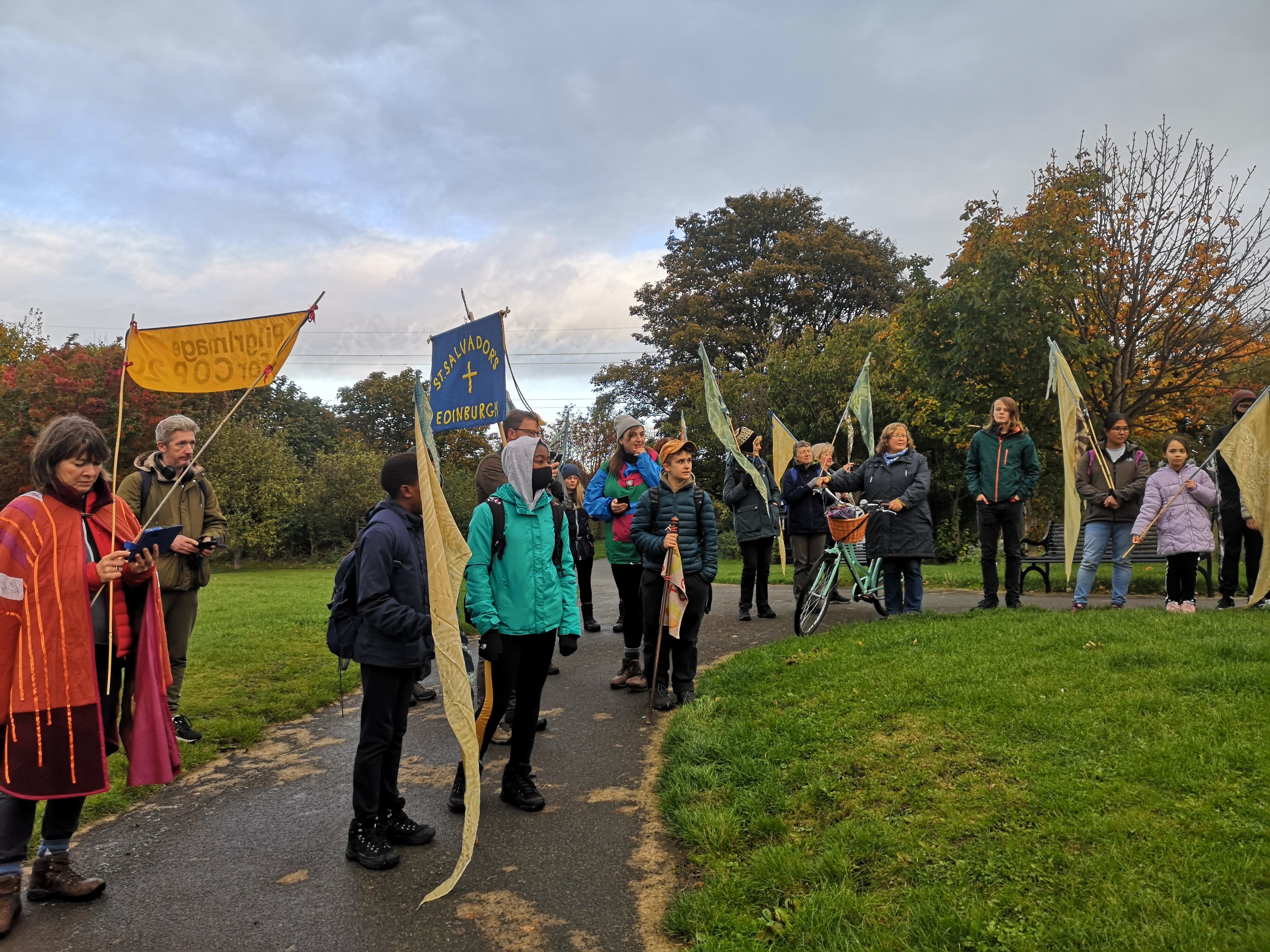
Several groups were represented by walkers in our number
You may well ask:
What do we have to be hopeful about at this time of climate crisis?
…and it seems to me that it is this very act of walking together which is creating hope. If we all care enough to make the journey by taking this time out of our lives, putting up with sleeping on wooden floors and getting soaked in the rain; if we put aside our busy schedules and join up for a day’s march; if we bother to comment on blogs, toot our car horns when we see a group walking past with a banner – Pilgrimage for COP26 – and send messages of encouragement and solidarity, then it seems that the making of this pilgrimage, the doing of it is galvanising hearts and minds, educating and setting an example. This walk says, together we are moving, together we are doing something to bring about change.
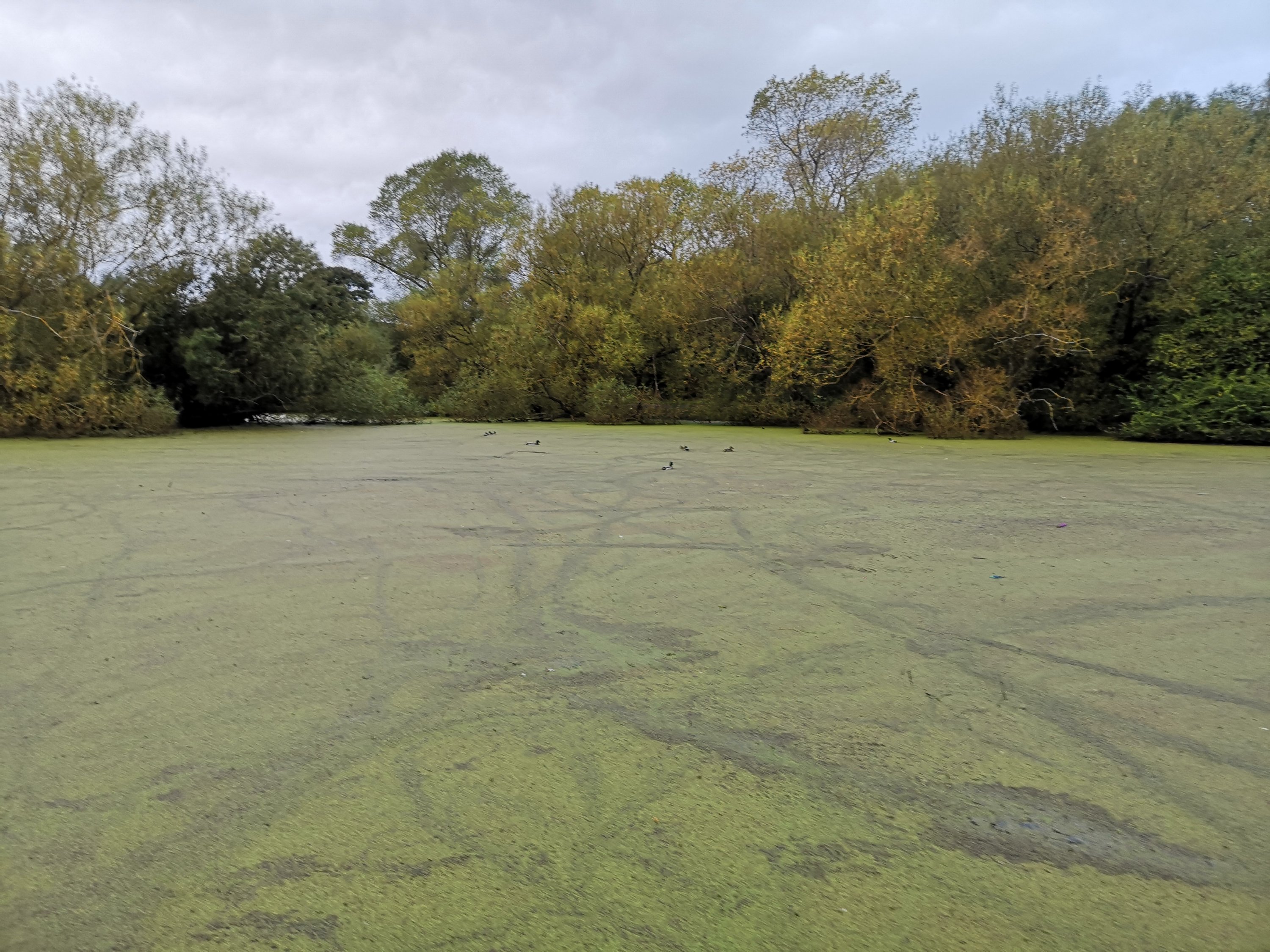
We walked through Figgate Park between Portobello and Abercorn.. This is Figgate Park pond – is that algae?
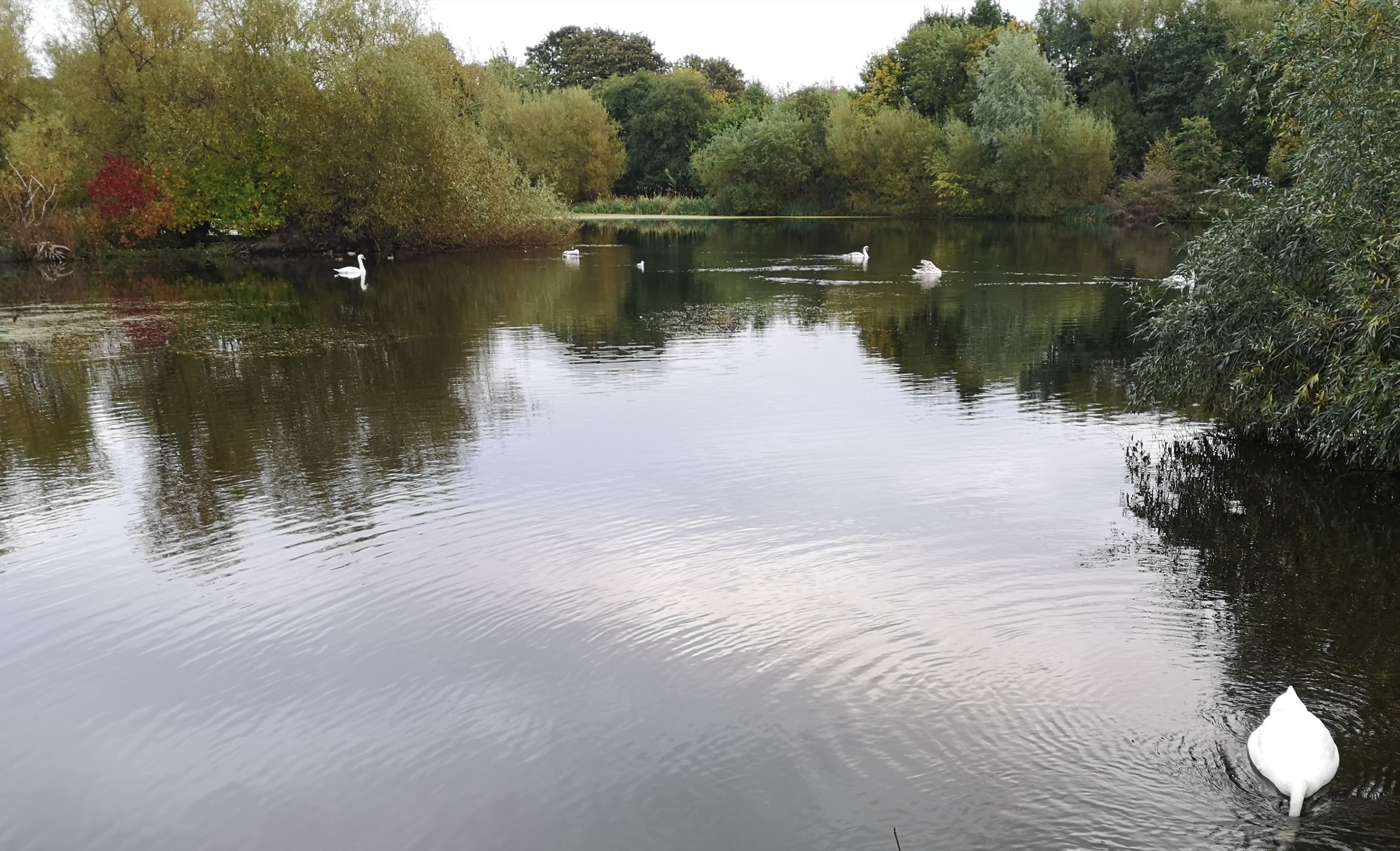
No, and neither is the water stagnant! The Friends of Figgate Park facebook page states that the covering is Duckweed, a fast growing, thin-layer of plants which grows in nutrient-rich water (much like algae does), especially in areas where lots of bread may be thrown in (despite the signs, duck-feeders still do this). It is not harmful, there are even some benefits: Waterfowl like Mallard Ducks and Moorhens absolutely love it, and the Mute Swans have been eating it too. As it’s such a thin layer it doesn’t impede them moving around (notice the trails in the photo above), can shelter small fish, and is possibly one of the reasons the latter seemed to do so well last year.
We know that species adapt, that people care enough to look after parks and ponds, and that plants respond ‘intelligently’. Here there is a balance between human and other-than-human (for want of a better collective term) and that gives me hope. The environment is finding ways to cope and now that more and more of us are determined to stop hindering it and start supporting, things are beginning to move in the right direction. Albeit slowly, I know.
Another body of water in the Figgate Park, Edinburgh
The Duckweed does mean that certain species such as Kingfishers can’t hunt, so they’ll be restricted to the burn elsewhere in the park, and the otters are less likely to visit, but if the fish are helped by the covering then next year we may well see more frequent appearances than this. There is a Grey Heron around, and it seems to be able to hunt despite the growth.
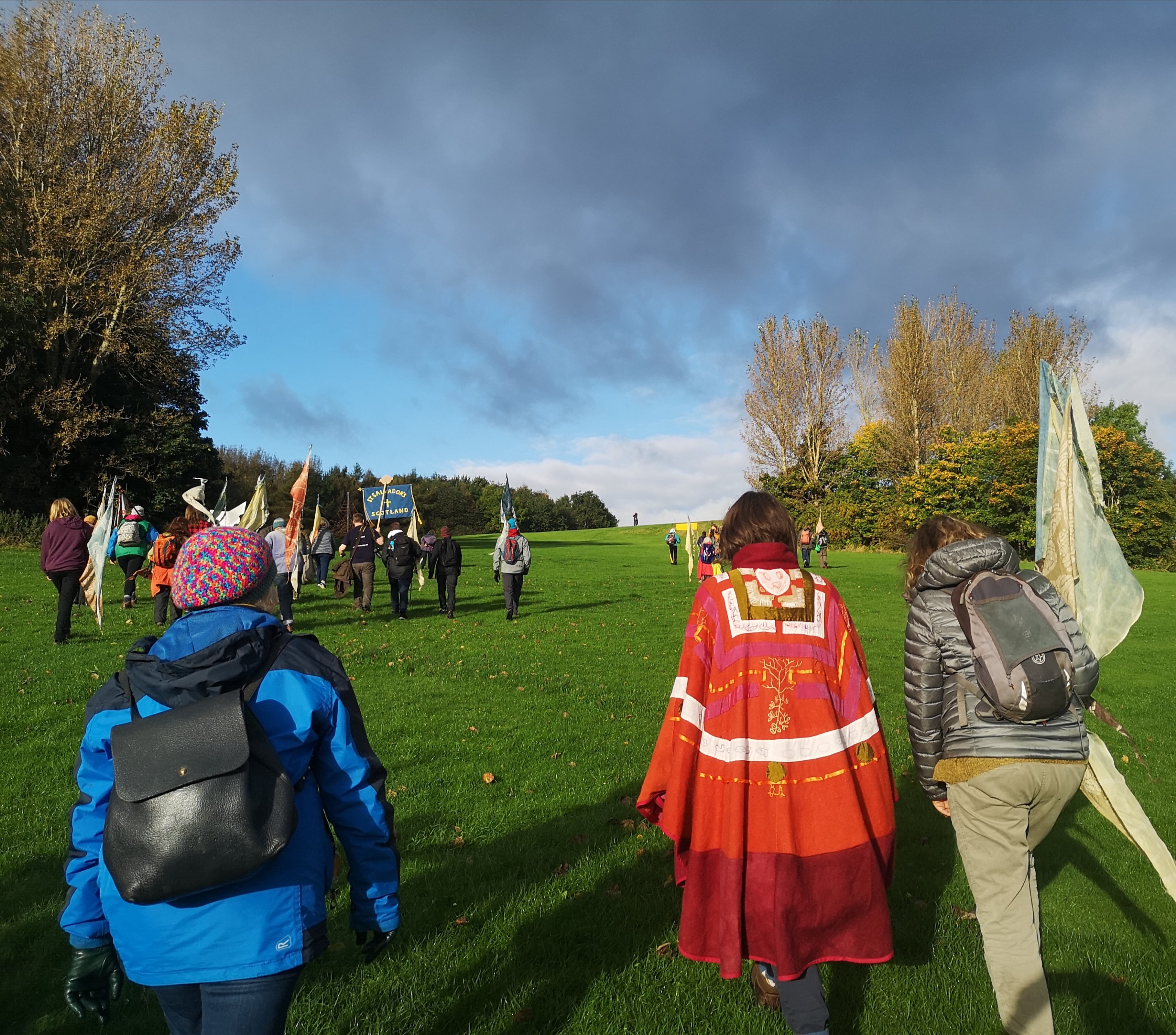
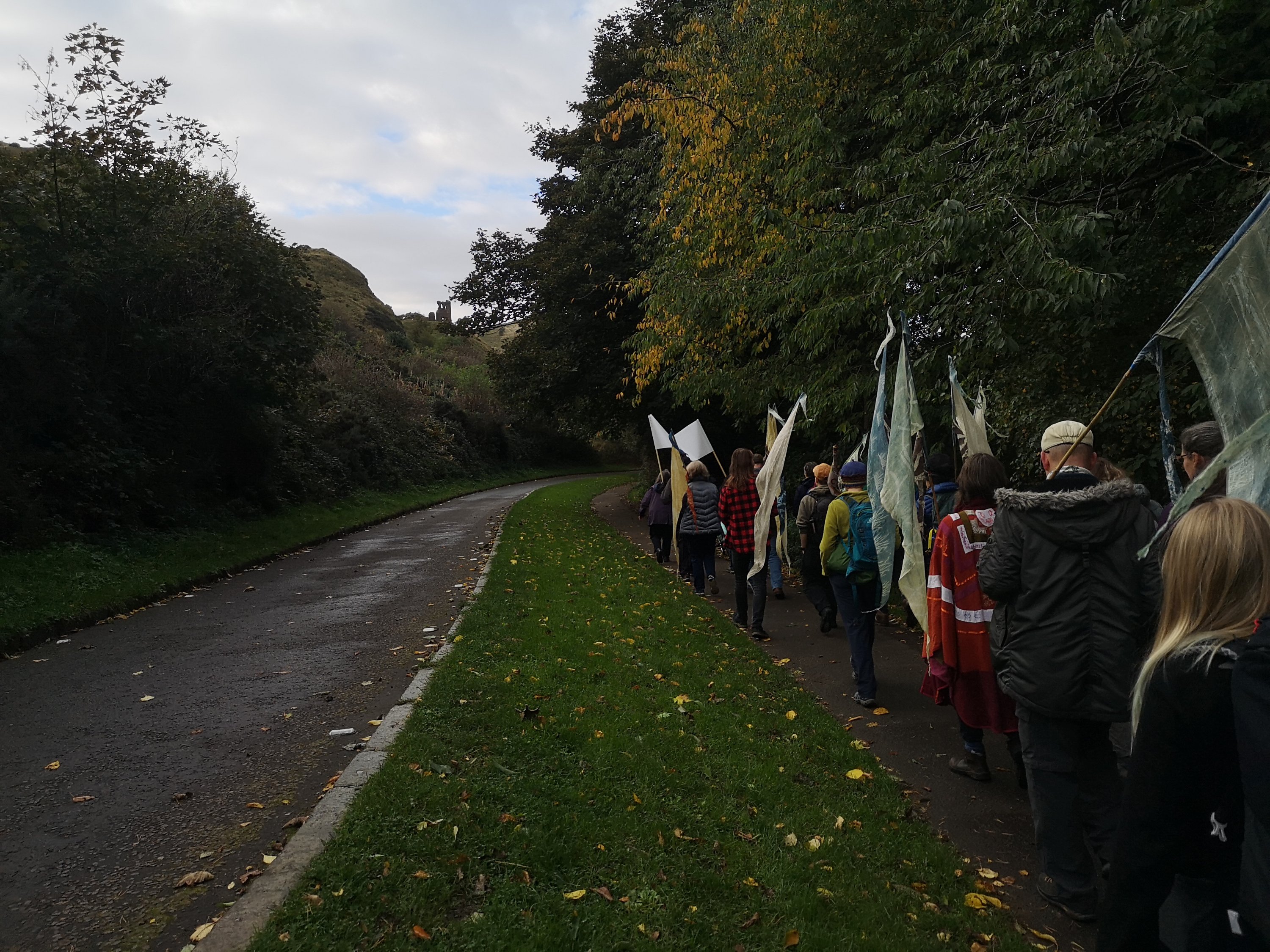
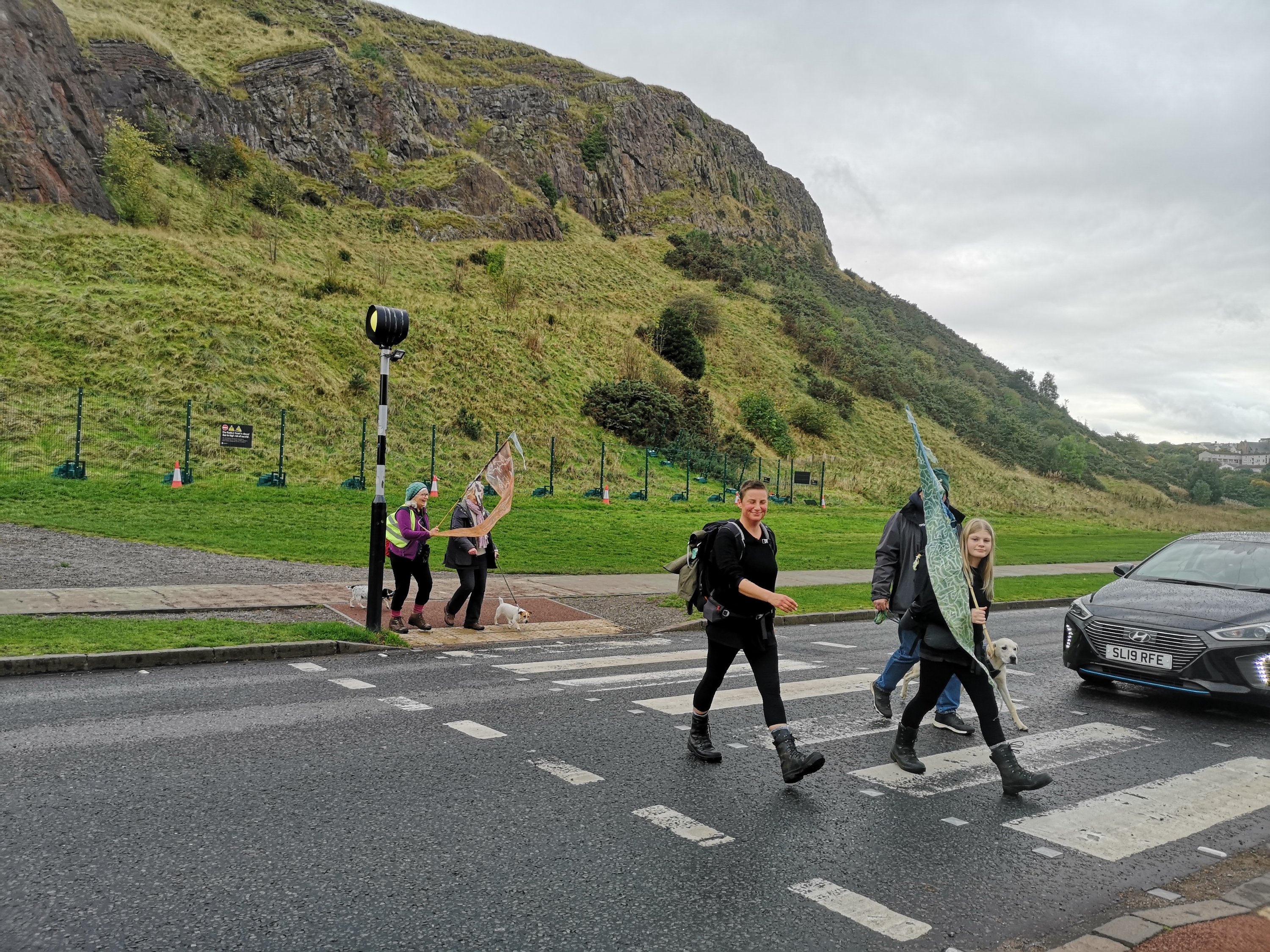
We traipsed up the steep hill and into the Queen’s or Holyrood Park. The Keeper of the Soil cape, walkers carrying banners and Beach of Dreams flags are shown here. Holyrood Park, Edinburgh
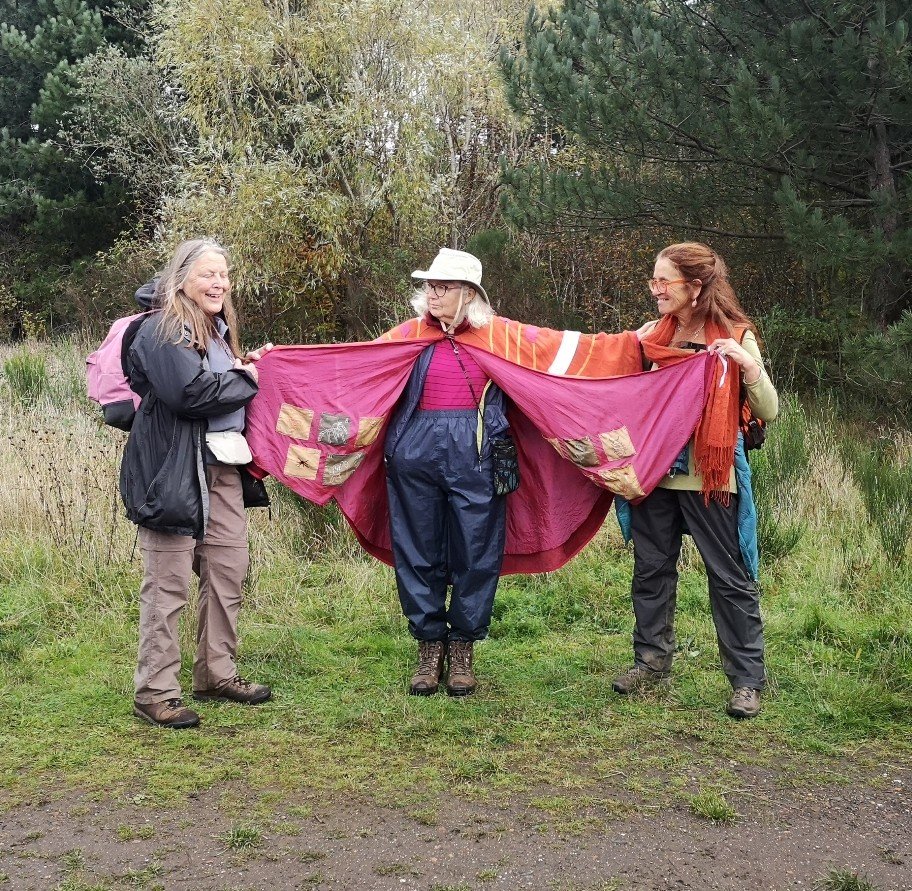
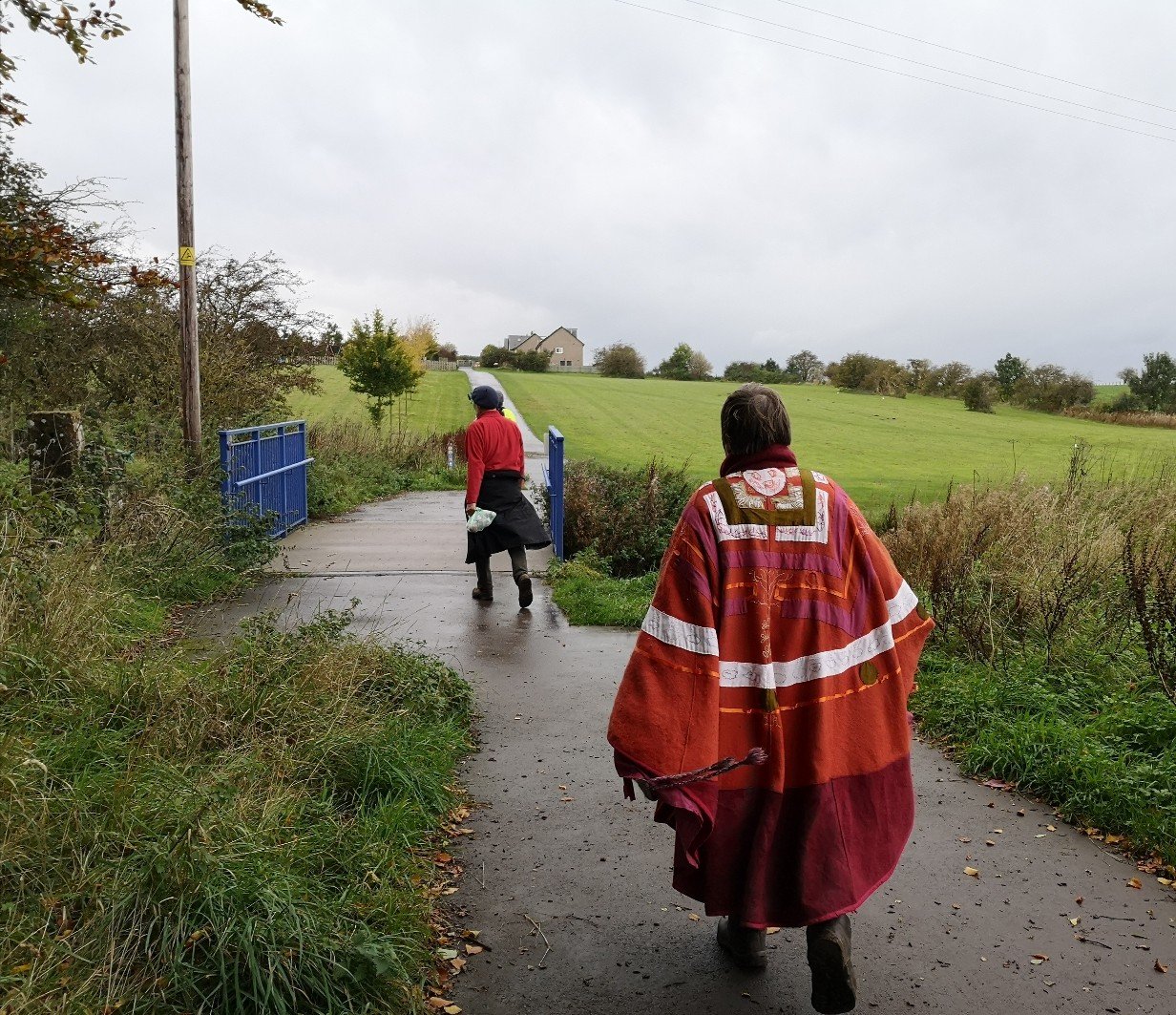
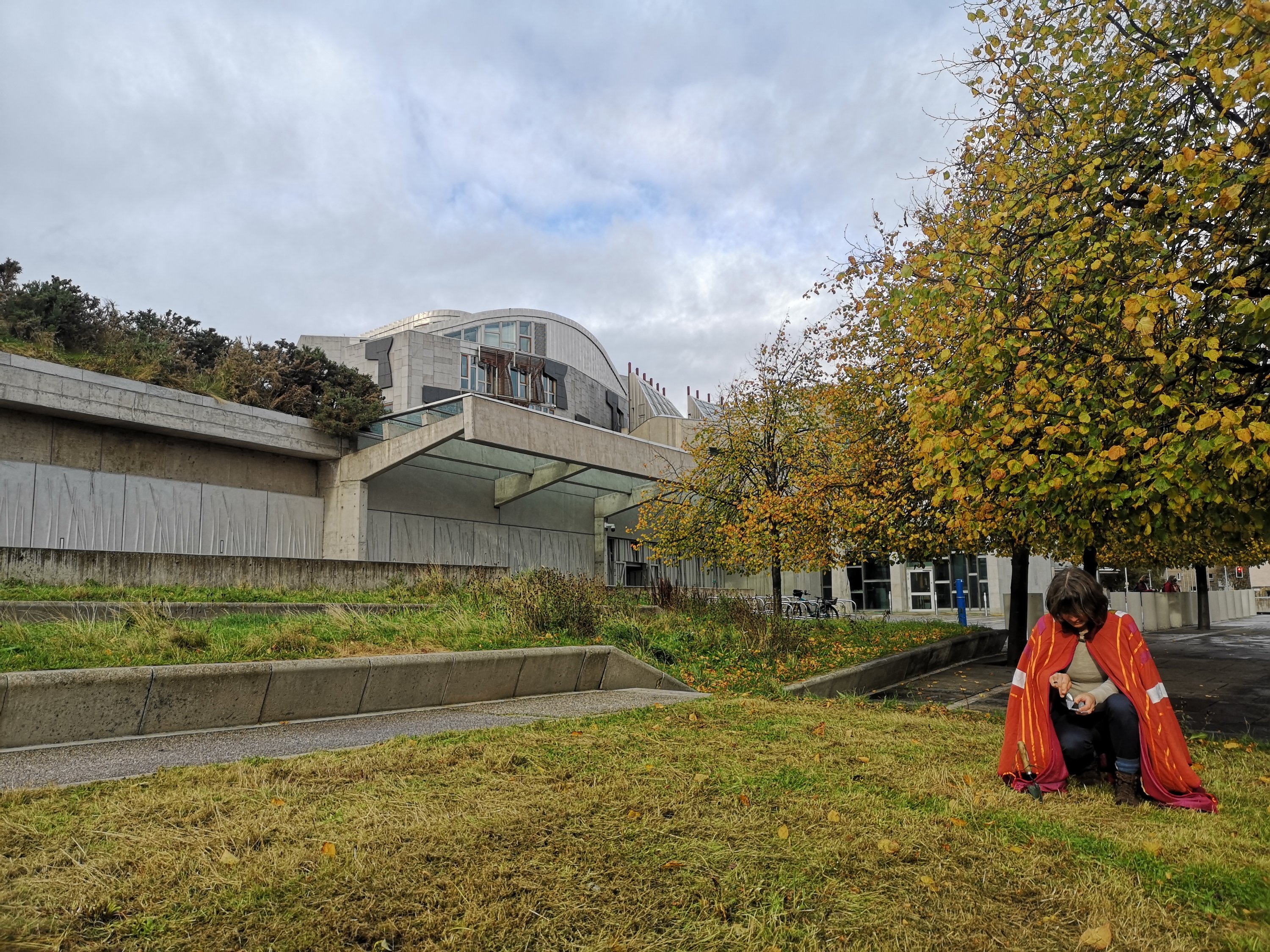
North Light Arts commissioned Natalie Taylor to make the cape, asking ‘Earth – is soil alive? It was coloured using natural dyes such as madder, grown by Kirsty Sutherland at the Granton Walled Garden. The hues of these dyes reflect the soils of Central Scotland that we are walking through and from which samples are being gifted to be stored in the inside pockets. Every aspect of the design has been considered, from the panels depicting a soil food web in which four of the world’s key crops are shown, to the almost-undecorated front indicating how between 30-40% of global soils are unusable for the cultivation of food, depleted of its nutrients. I was lucky enough to visit during the dying process and witness the huge cauldron of red-burgundy water heated over a burner with the good-witch stirring the blanket samples into it for hours.
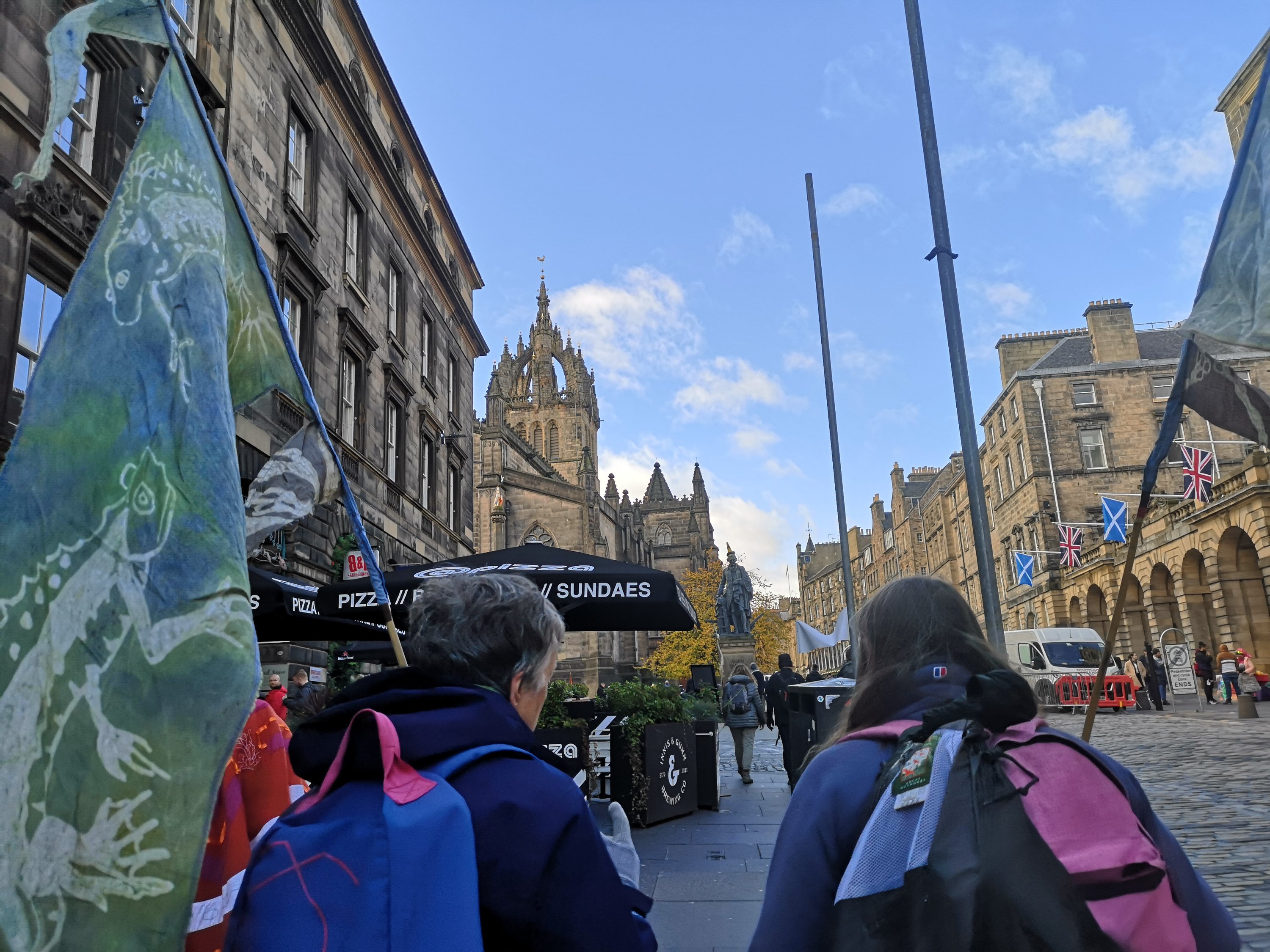
Heading down towards the St Margaret’s Loch, Holyrood Park, Edinburgh – overcastOnce again we stop the traffic – apt considering that we are walking to the COP26 climate conference in Glasgow where it is hoped (there’s that word again!) that world leaders and business owners will determine to reduce carbon levelsNatalie Taylor, John Muir Fellow, artist and today’s wearer of the Keeper of the Soil. She’s wearing the cape she made with the help of other stitchers in DunbarHeading up the Royal Mile with St Giles on the horizon, Edinburgh
En route interpretation and peer-learning will be provided by an emerging community of peer-educators and cultural partners. These include arts and cultural organisations, interfaith communities, educational institutions, and grass roots community activists.
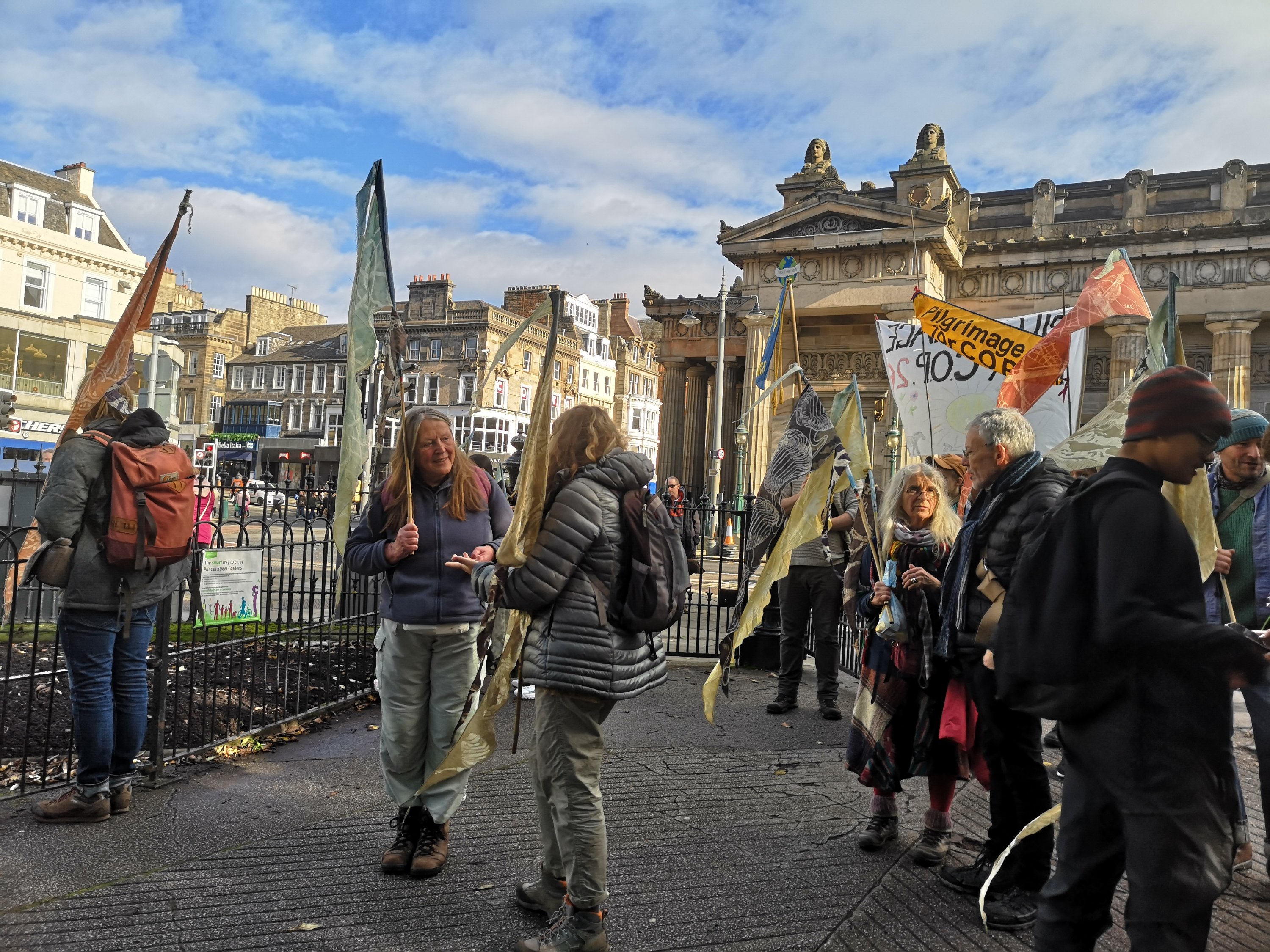
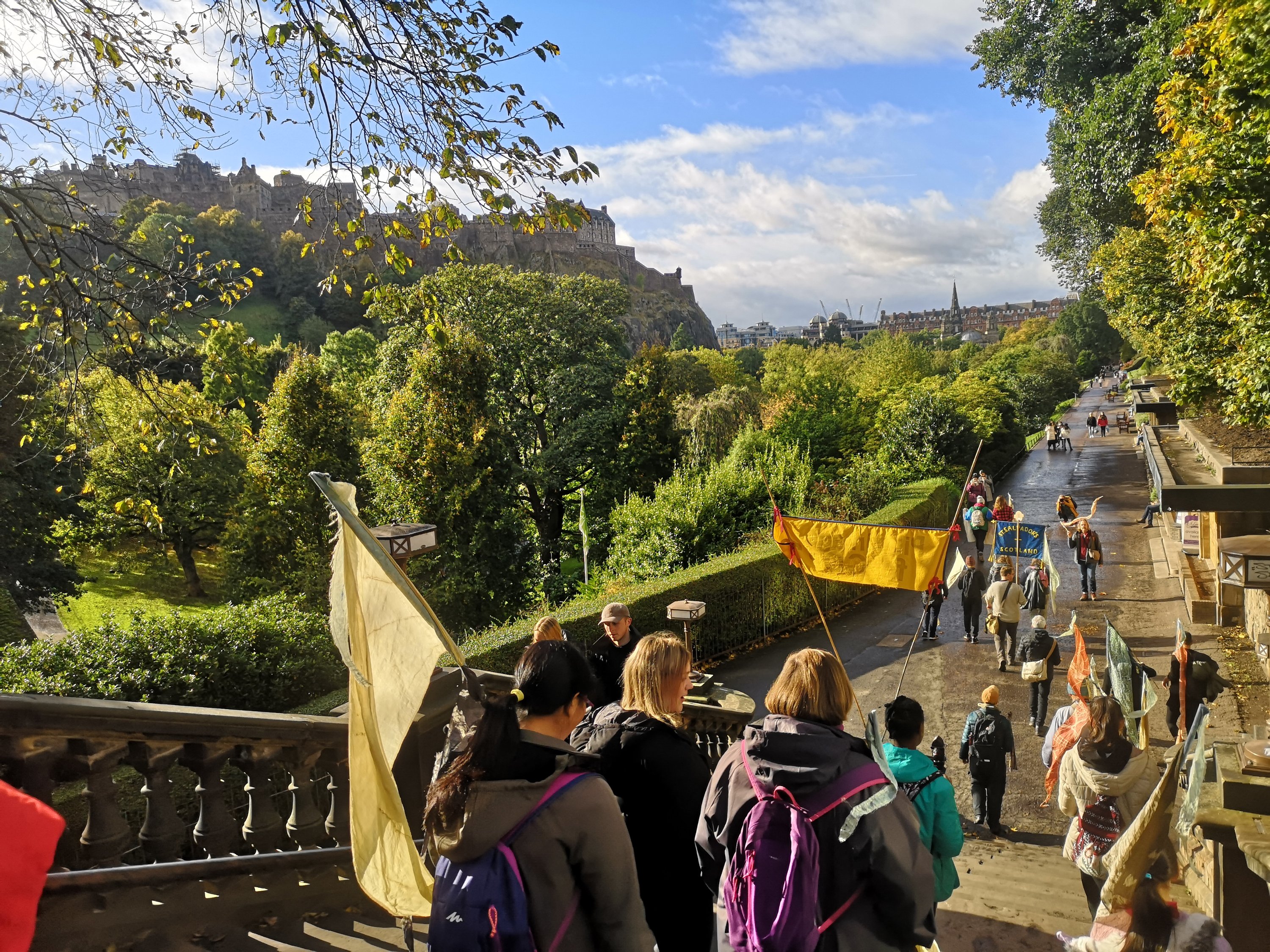
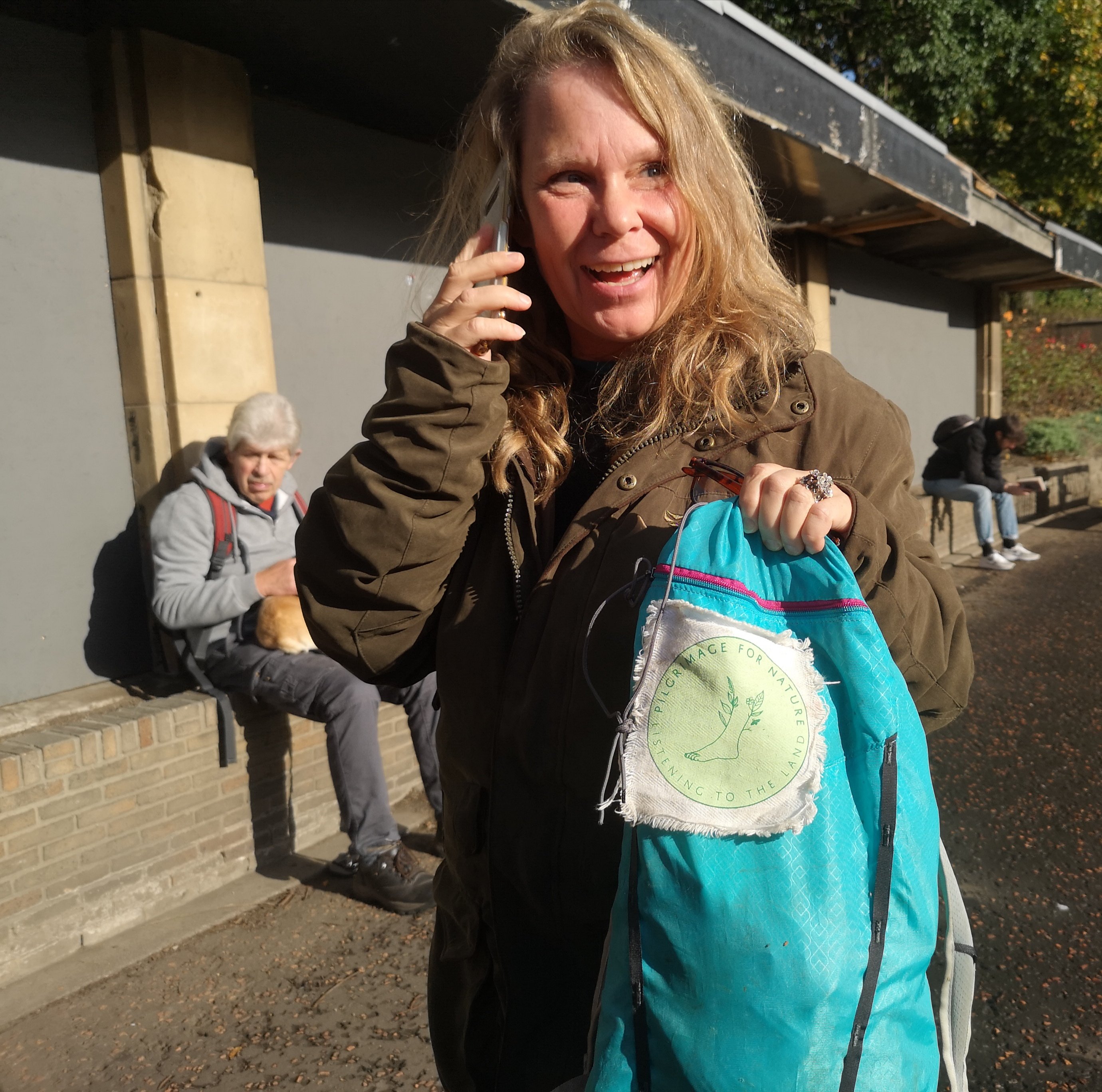
At the foot of the Mound with the National Galleries in the backgroundWe walked through Princes Street Gardens with Edinburgh Castle looking over us and the trees still very green despite it being mid OctoberWe met a woman from the Pilgrimage for Nature whose walk began in London. Princes Street Gardens, Edinburgh
At this time of unique peril for our planet and all its inhabitants our plan is to deeply connect with and listen to the land we travel through, the species we encounter on the way and the communities living along the route. Our walk is a uniquely hopeful, creative and reverential kind of activism.
There were a group of families (10 children and 10 adults) waiting to join us in Edinburgh. They had been hanging around for a long time, but the kids were well entertained.
Coat of Hopes
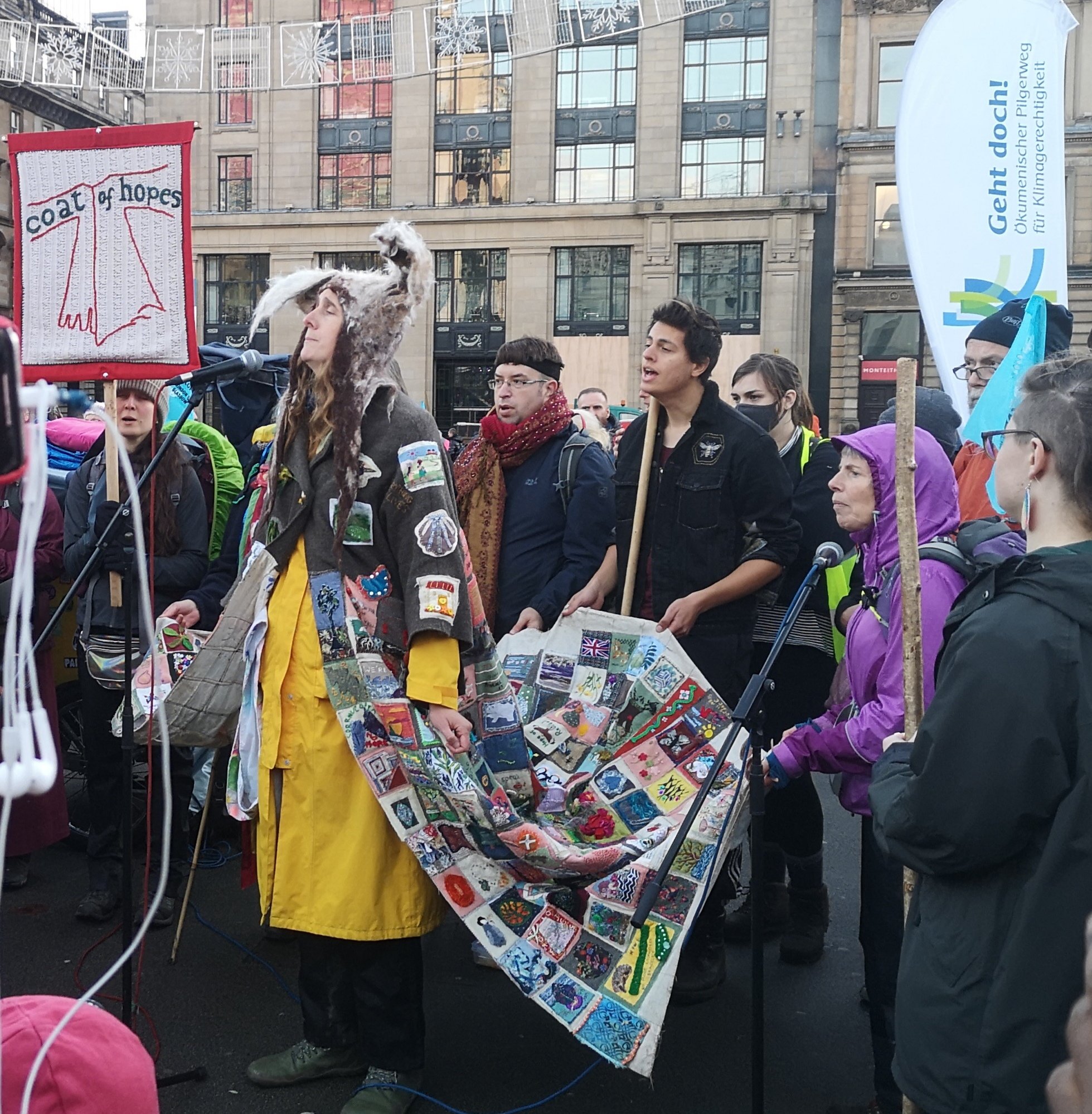
Another pilgrimage is being made by the Coat of Hopes group. This other garment is made of patchwork, and carrying it is described as performance craft. It is being worn and added to between the starting point of Newhaven on the south coast of England near Brighton, and Glasgow (500 miles). It carries stitched griefs, remembrances, prayers and hopes connected to the landscapes they pass through, as well as stories of migration. The coat pilgrims will take 62 days with twice weekly stitching stops and songs while it builds connections between people and communities.
Here is the Coat of Hopes when it arrived in Glasgow in all its glory
Pilgrimage is a journey of transformation, states their website, and that means change. It’s another hopeful statement. As I walk, I become clearer that it is a sense of respect for people, plants and animals that I hope for. Respect underpins the basic adjustment which needs to happen if we are to turn this crisis around. Respect is about listening and supporting, and that cannot be done by staying ‘at arms length’. The closer we get to others, the more likely we are to hear their needs and know what has to be done. That is part of the function of this pilgrimage, to move through towns and countryside and listen.
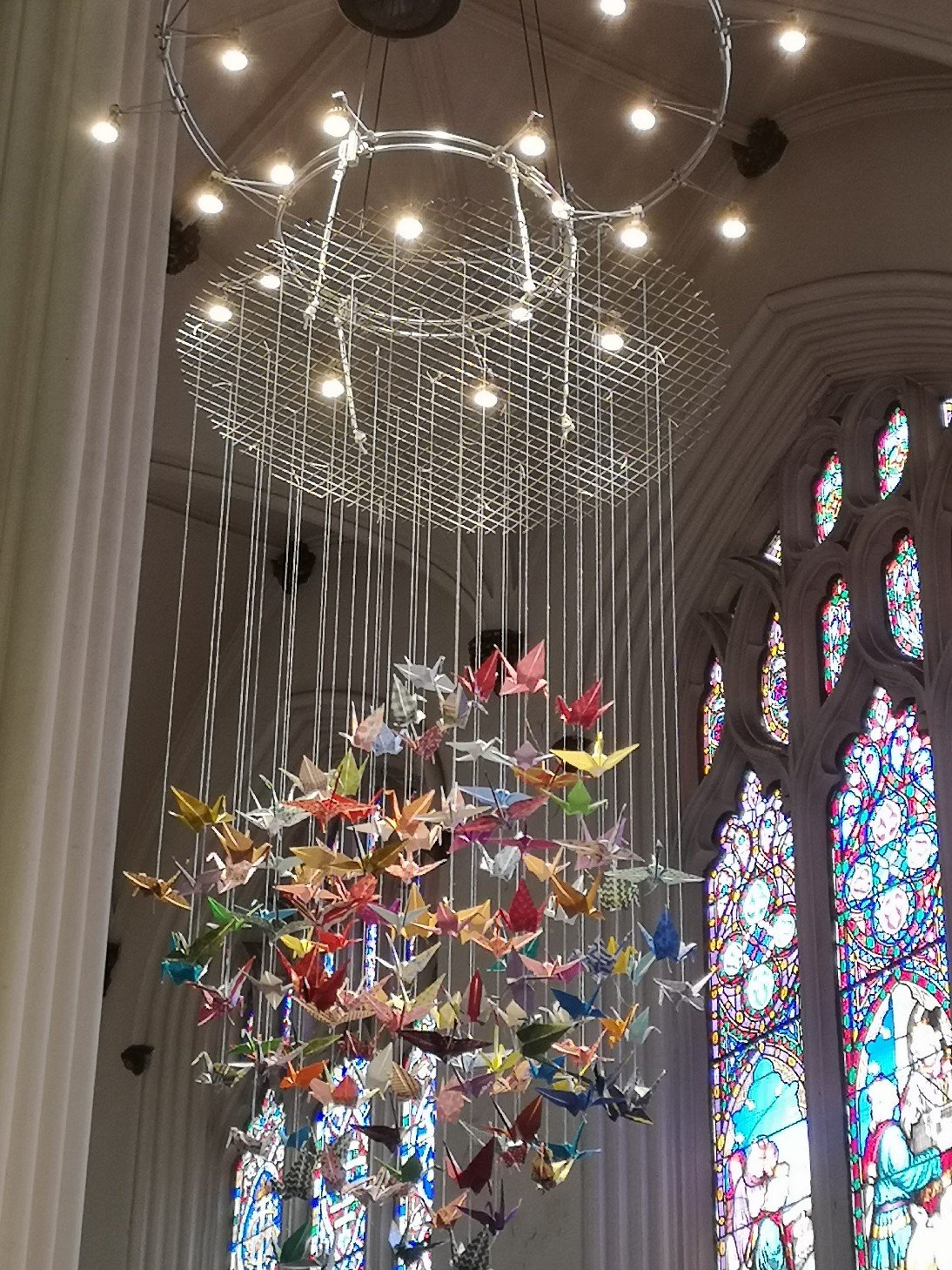
Peace Cranes
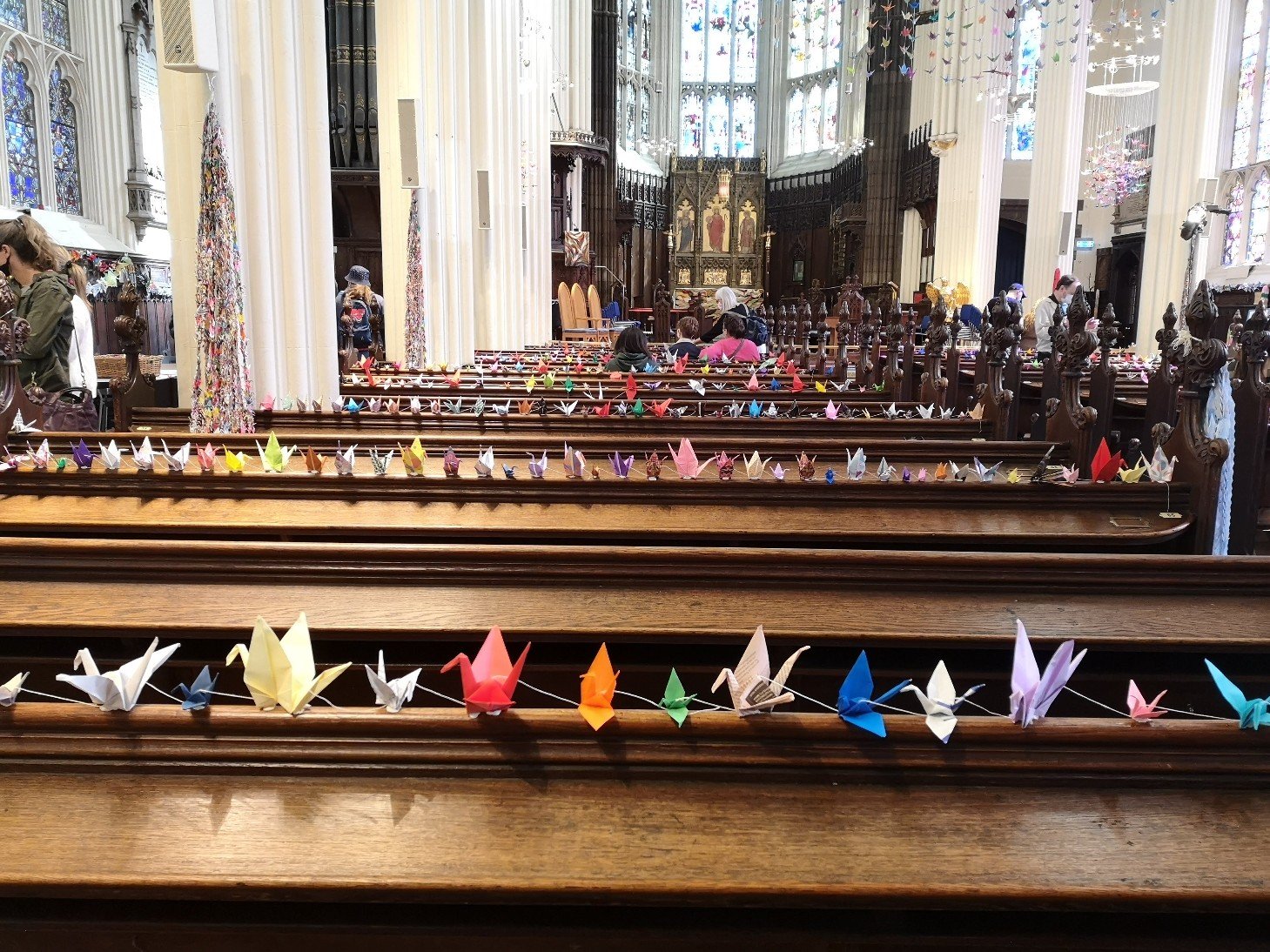
Peace Cranes – detail. St John’s Church, Princes Street, Edinburgh
The Peace Crane project by artist Janis Hart was open for us to see in St John’s Church at the foot of Lothian Road. It consists of approximately 140,000 origami cranes (miniature birds) of peace and hope, made by people from all over the world. This vast number represents not only the people who were killed when the nuclear bomb was dropped on Hiroshima, Japan in 1945, but also those who lost their lives to Covid-19 and the many other-than-human species which are now extinct or endangered, such as the red-crowned crane.
Peace Cranes – detail, St John’s Church, Princes Street, EdinburghSt John’s Church – exterior, Princes Street, Edinburgh
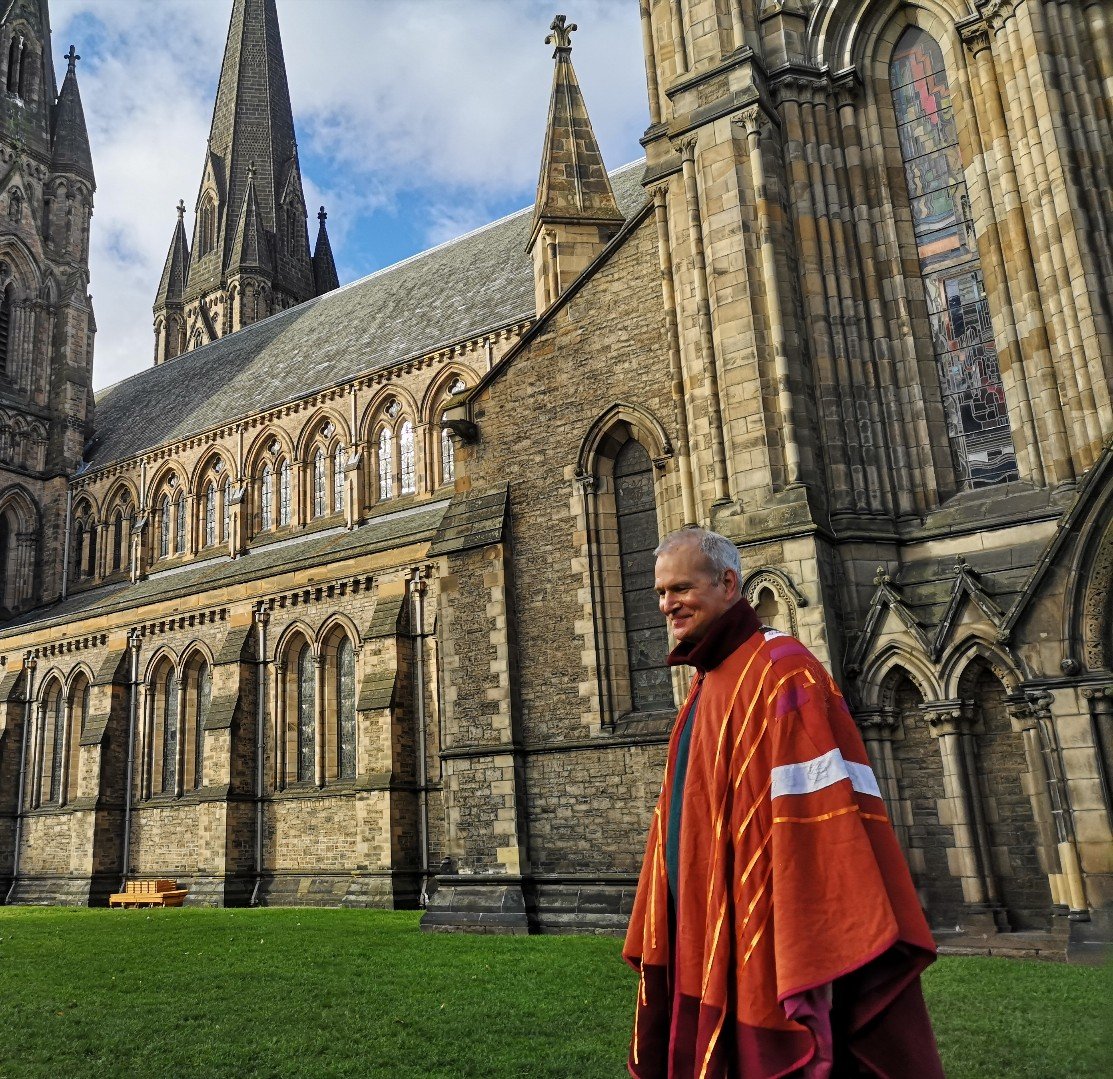
John Conway, Provost of St Mary’s Cathedral, Palmerston Place, Edinburgh who is granted the cape during the soil ceremony which takes place when we arrive The spectacular Gothic arch of the main entrance to St Mary’s Cathedral, our destination
Fun fact: Did you know that the twin spires pf St Mary’s Cathedral are called Mary and Barbara? They are named after two women from the Walker family who funded the building of the Cathedral in the 1870s. (Thanks to Edinburgh Tourist for that information).
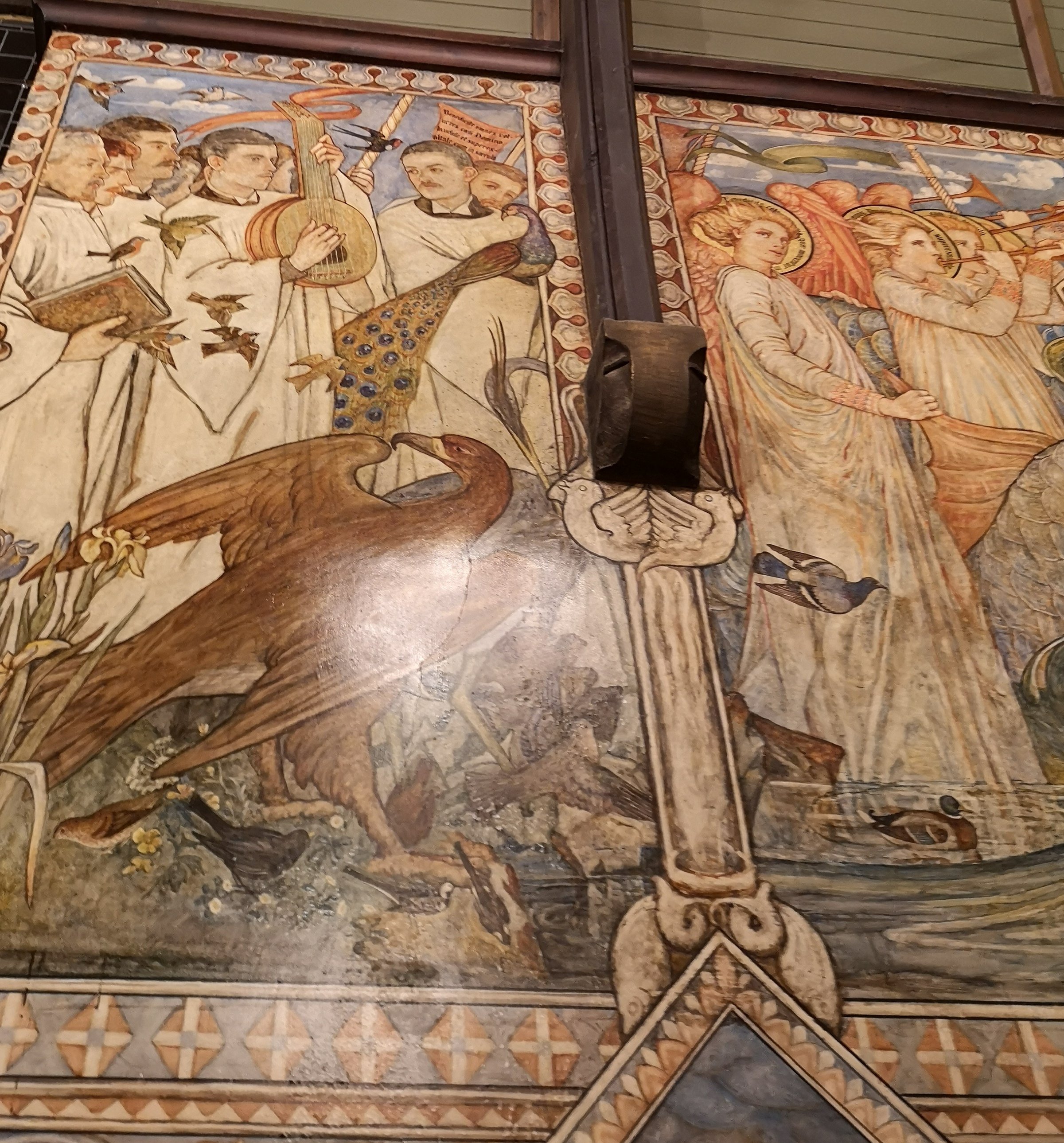
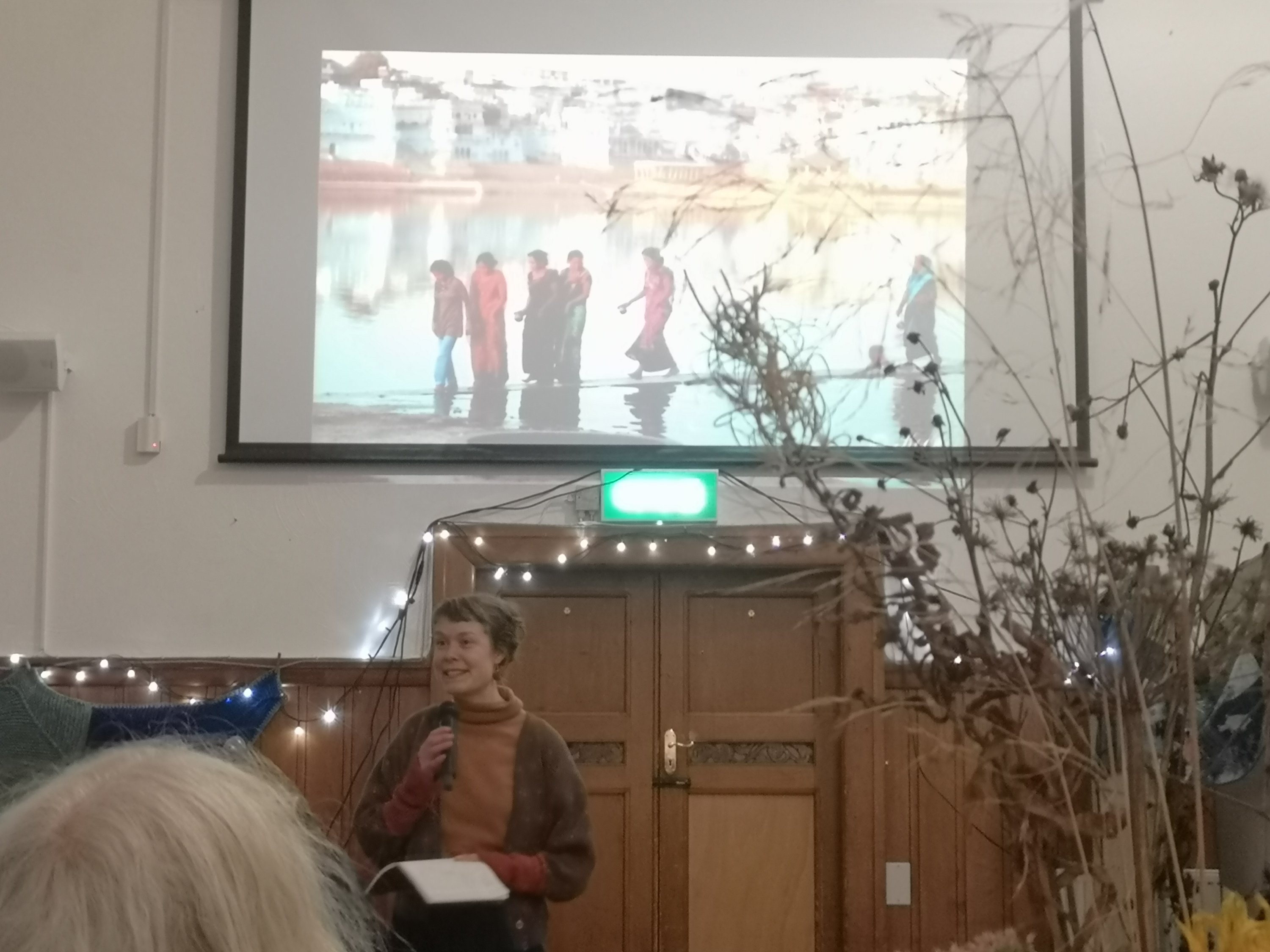
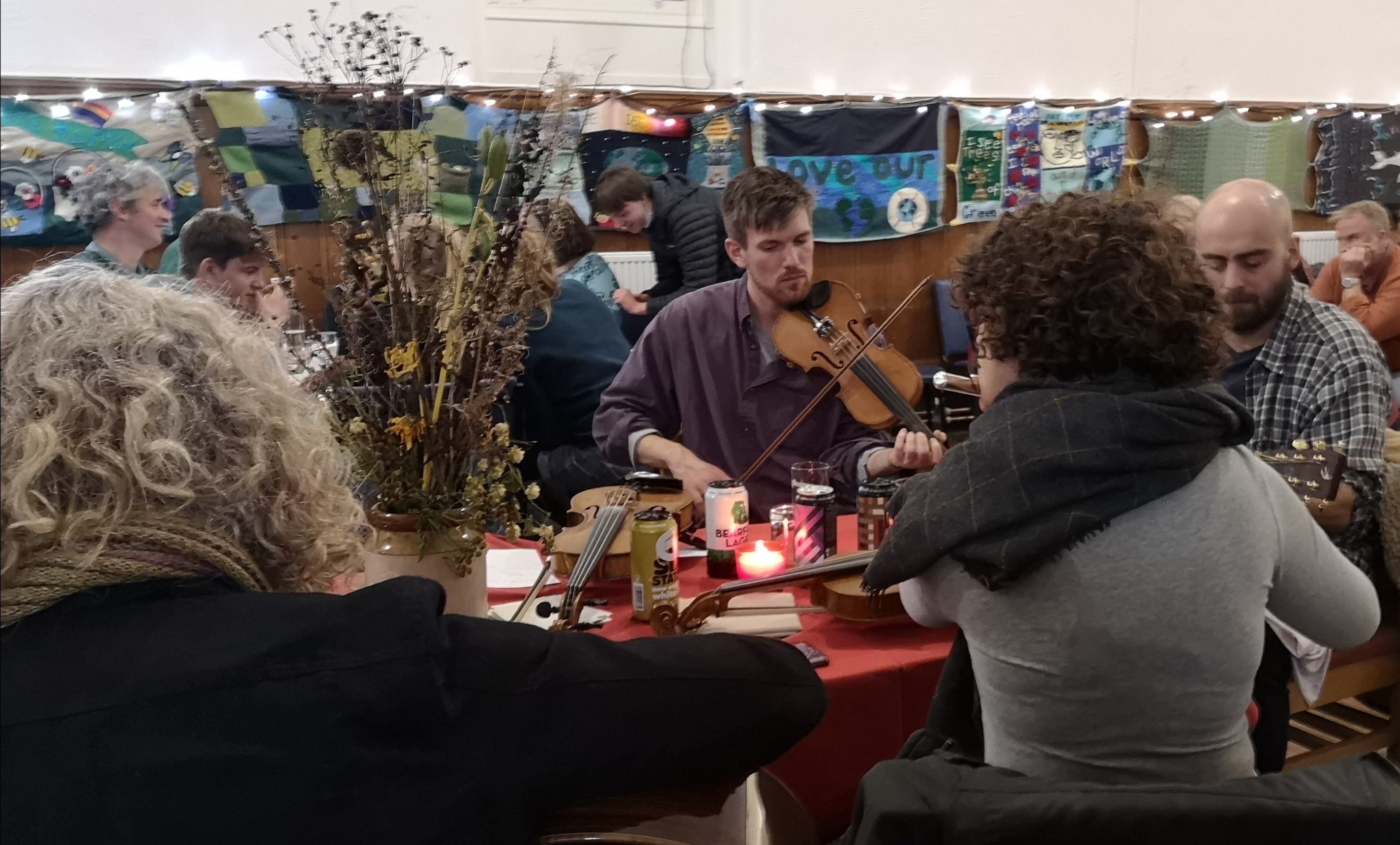
There is an afternoon of workshops including flag making with Ali Pretty of Kinetika (see above), and in the evening, a celebratory ceilidh. It isn’t possible to dance (what? no dancing at a ceilidh!) which is sad, but we are regaled with poetry, stories, a slide show, music, and eat fantastic food (thanks to Robin and co of the Ceilidh Collective). We are also shown the choir’s practice room which has paintings by Phoebe Anna Traquair.
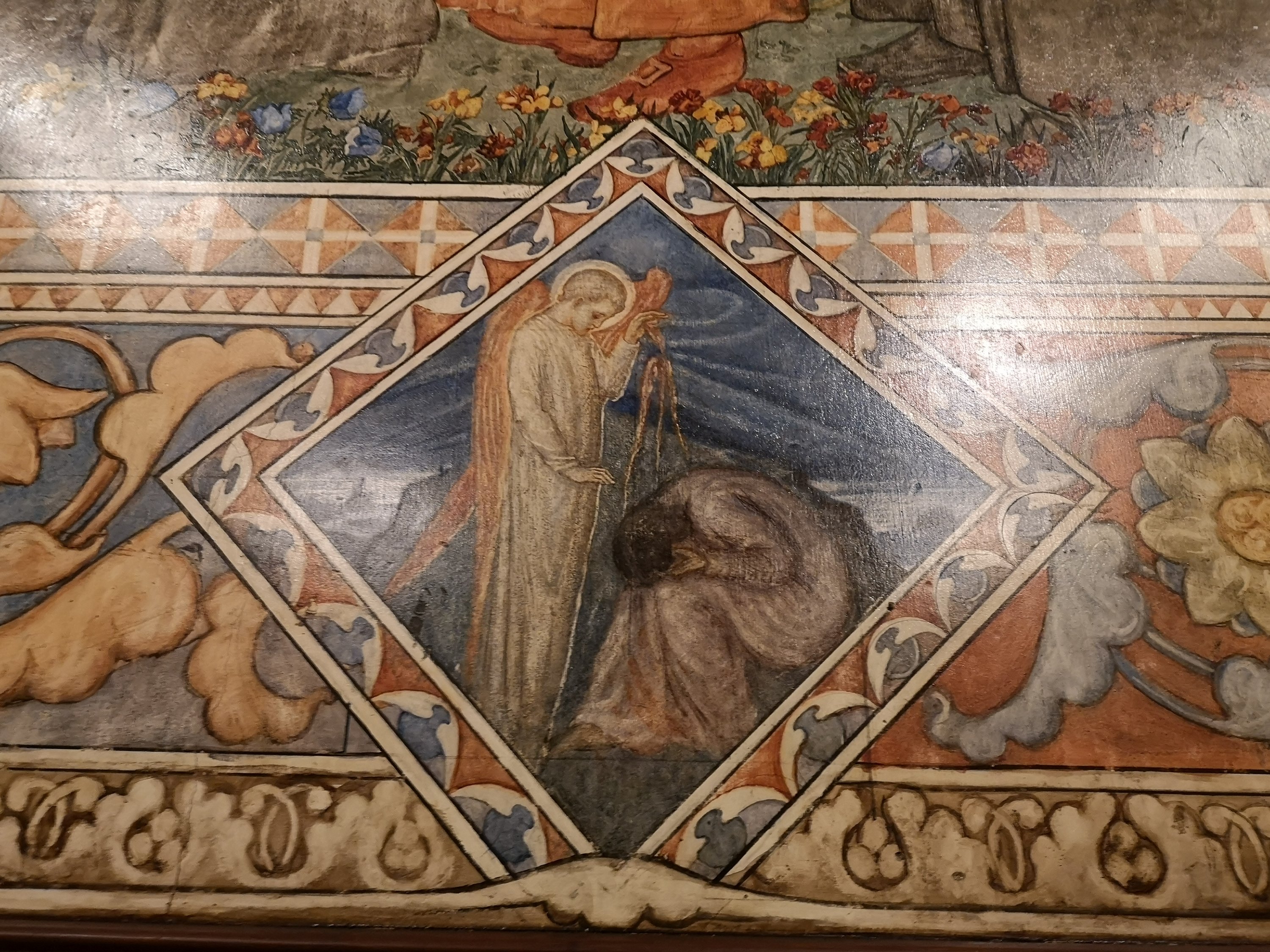
Inspiration from sorrw and renewal of spirit, Phoebe Anna Traquair panel found in the Choir Practice Room at St Mary’s Cathedral, Palmerston Place
I know of the church at Bellevue (Mansfield Place) which is decorated with Traquair’s murals dating from the 1890s, and have seen exhibitions of her work at the Gallery of Modern Art, but the Choir is a hidden gem. It is a working space, the Provost proudly tells us, used for daily practice and so not ordinarily open to the public. Here is a procession of creation, of angels and church men interspersed with famous writers, artists and politicians of the artist’s time. Like our motley crew of pilgrims, they traverse the walls of the small room alongside birds and plants, and the work aims to take inspiration from sorrow, for the renewal of spirit.
I am happy to see that the common pigeon which is featured in my recent exhibition, Clipp’d Wings, is here beside the mallard and eagleOur very own Olga at the Ceilidh
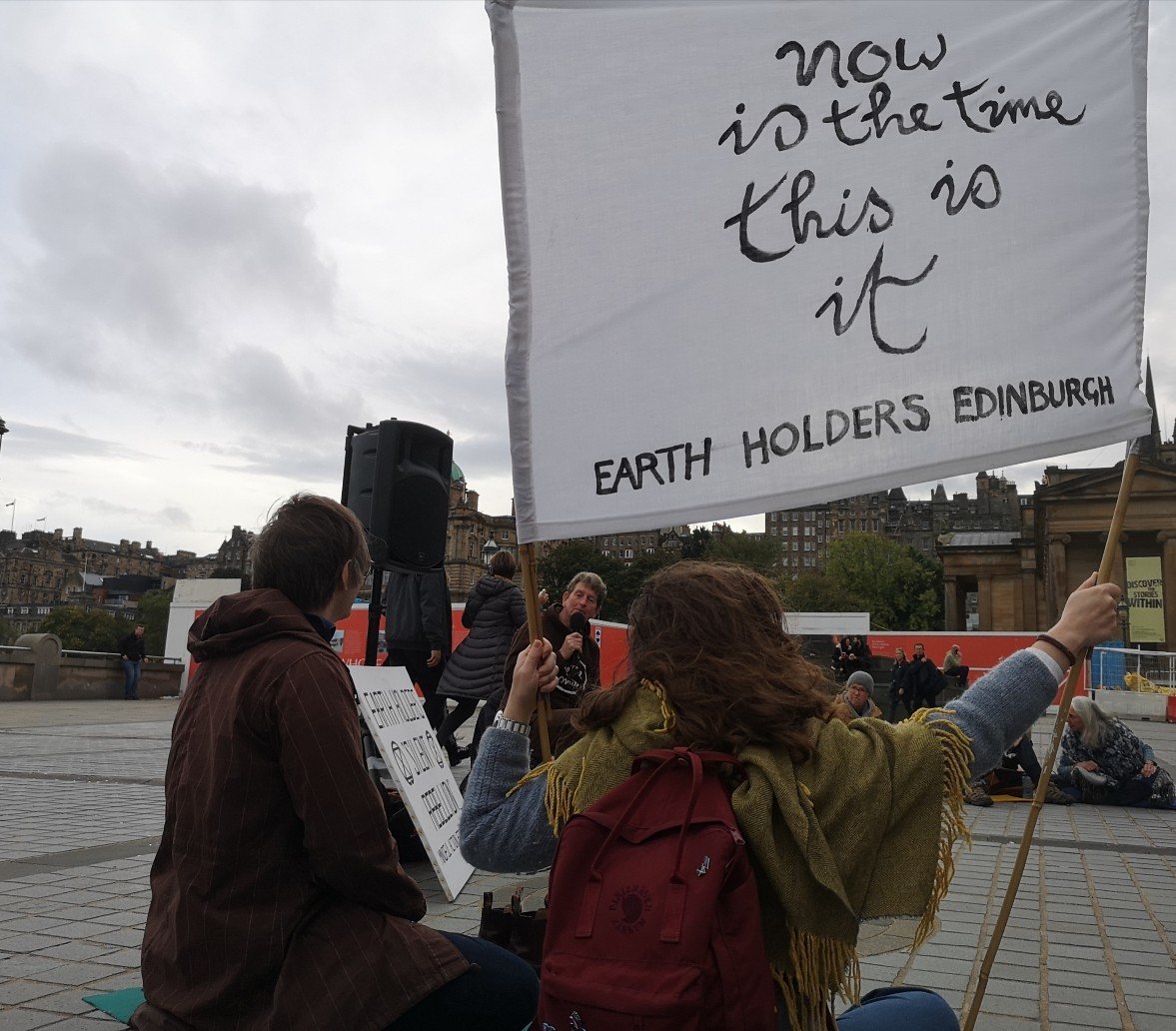
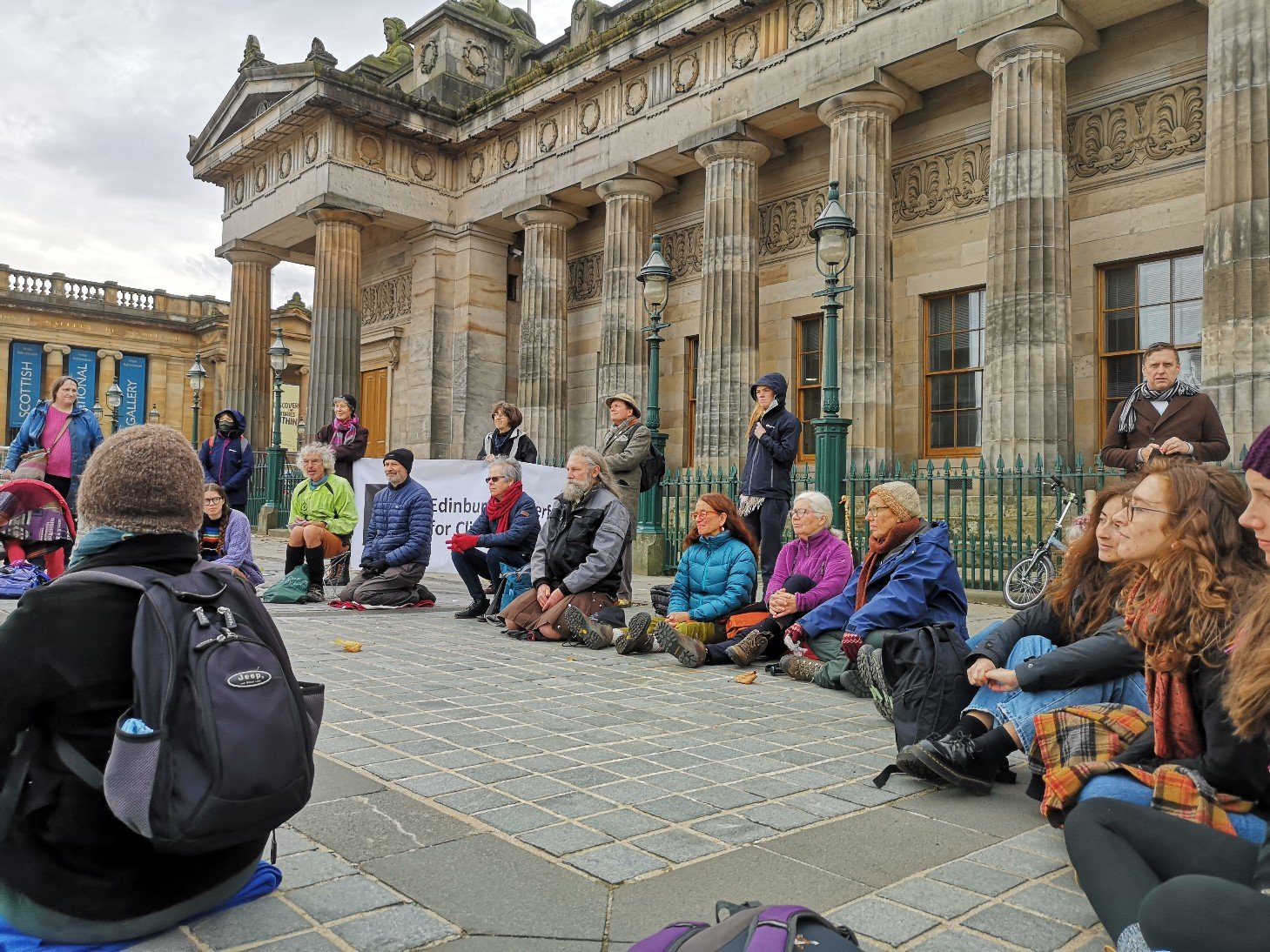
Silent Meditation at the Mound
Run by Earth Holders Edinburgh (which organises new moon gatherings at the Salisbury Centre, Edinburgh) an hour of contemplation on Saturday is greatly needed. Despite the cold and noise, it is vital that we engage in reflection using a variety of different metgods. Silence and stillness is an equally useful opportunity to allow thoughts and internal activity to settle, in order to hear ‘the quiet voice’. It is during meditation that hidden ideas and impulses surface, where connections can be made.
Inter-faith pilgrimage
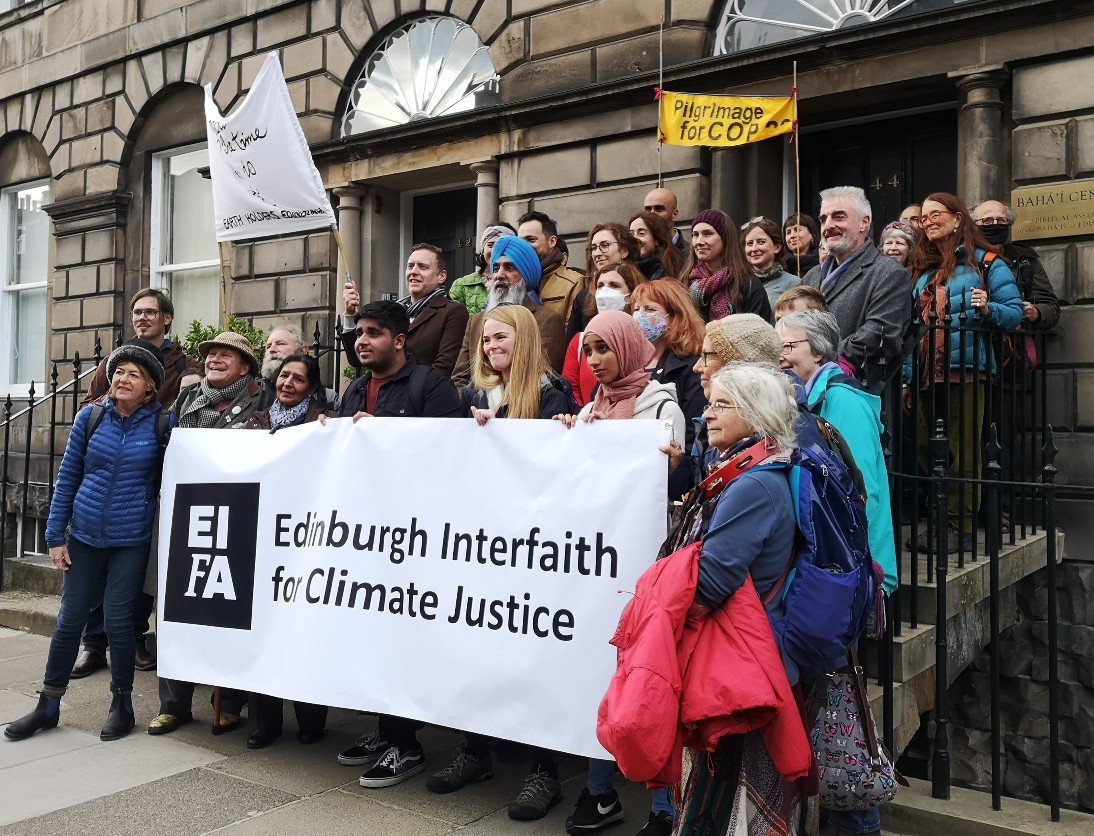
At New College for speeches before the Interfaith Pilgrimage began
For over thirty years, EIFA has diligently and effectively sought opportunities to cultivate and promote interfaith progress in the City of Edinburgh. During these three decades, EIFA has been continuously recognised by other interfaith organisations throughout the world as an outstanding role model and best practice in terms of developing and delivering positively impactful interfaith programmes for our wider community.
from the Edinburgh Interfaith Association website
Apple sharing outside the Temple
Pilgrimage is often a walk which moves, like ours, across long distances, however that doesn’t have to be the case. Indeed, there was an increase in the number of stay-at-home pilgrimages developed during the Covid19 lockdowns – from walking around your garden to following a route online. Our afternoon one is organised by the Edinburgh Interfaith Community and takes us through the city – from New College where we listen to speeches from a Pagan celebrant (“To protect and restore the world’s biodiversity”), Ani Rinchen from the Kagyu Samye Ling Tibetan Buddhist community (“To continue to take responsibility for our actions. We will solve the problems, so we must look after our minds so that we can act wisely, and wisely elect our leaders”), and Jewish community leaders, among others, to visit the Baha’i community, the HinduMandir (“We are all the same, we all have the same nose, two eyes and a mouth” Neela Joshi), and various venues, ending at the Sikh Guru Nanak Gurdwara (“No one group, no one faith can do it alone.”) where we are treated so attentively and fed a delicious langar, a community meal which is prepared daily for anyone who needs it.
Edinburgh Interfaith for Climate Justice – the group smiling
Deep Time Walk
On Sunday we go on a Deep Time Walk using the app below.
Deep Time Walk is a transformative journey through 4.6bn years of Earth history via a 4.6km guided walk. It is an invitation to view the world differently, encouraging positive action and advocacy for a regenerative Earth. Our vision is to empower an ensemble of geographically specific and culturally nuanced Deep Time Walks, providing a unique intercultural platform that helps bring about a diverse, flourishing ecological civilisation.
from the app page
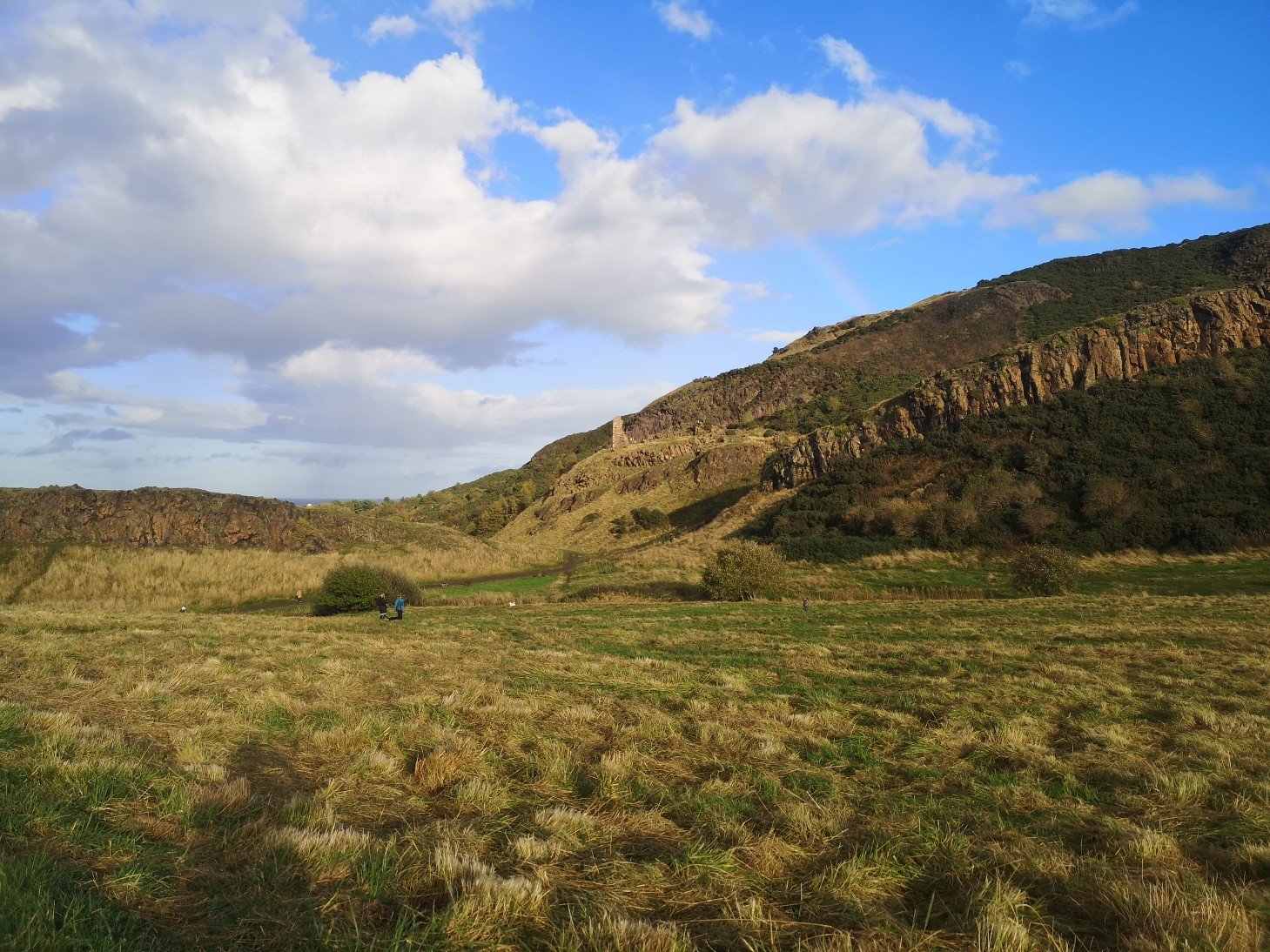
Salisbury Crags, Edinburgh
Quaker Meeting House – reflection
Our final Edinburgh experience is the Deep Time, Wonder and Grief Circle at the Quaker Meeting House where we were able to share our thoughts and feelings about our place in the deep time of things, our fears for the future, and sadness at the prospect that not enough is being done by government leaders and big-business owners. We were again treated to a generous meal by members of the Quaker community for which we were very grateful.
The violence at the heart of the system is something we need to address
Jonathan Baxter, Pilgrimage organiser
Thanks to all those who hosted and fed us, and to the St James community who organised house stays for some of us while we were in Edinburgh.
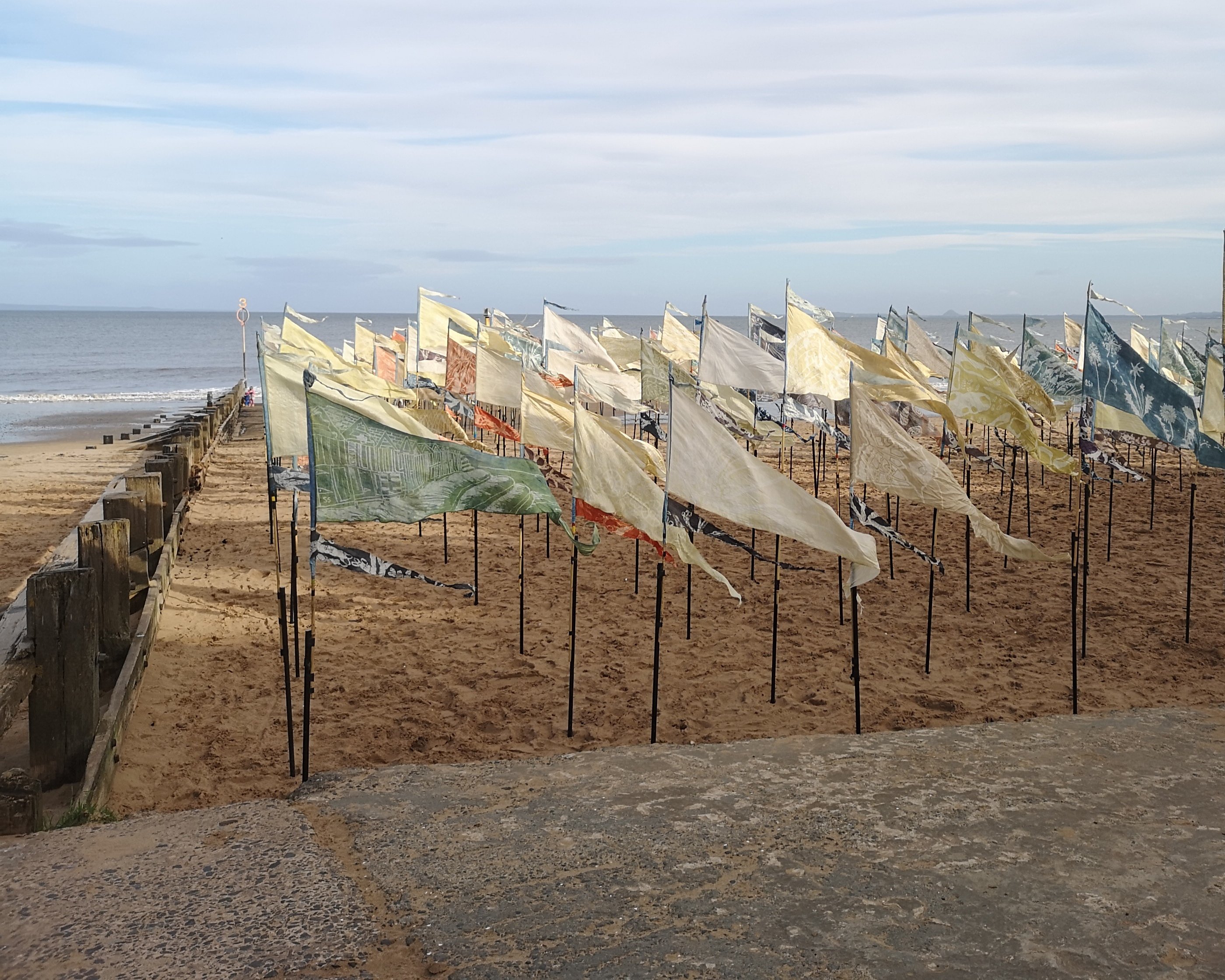
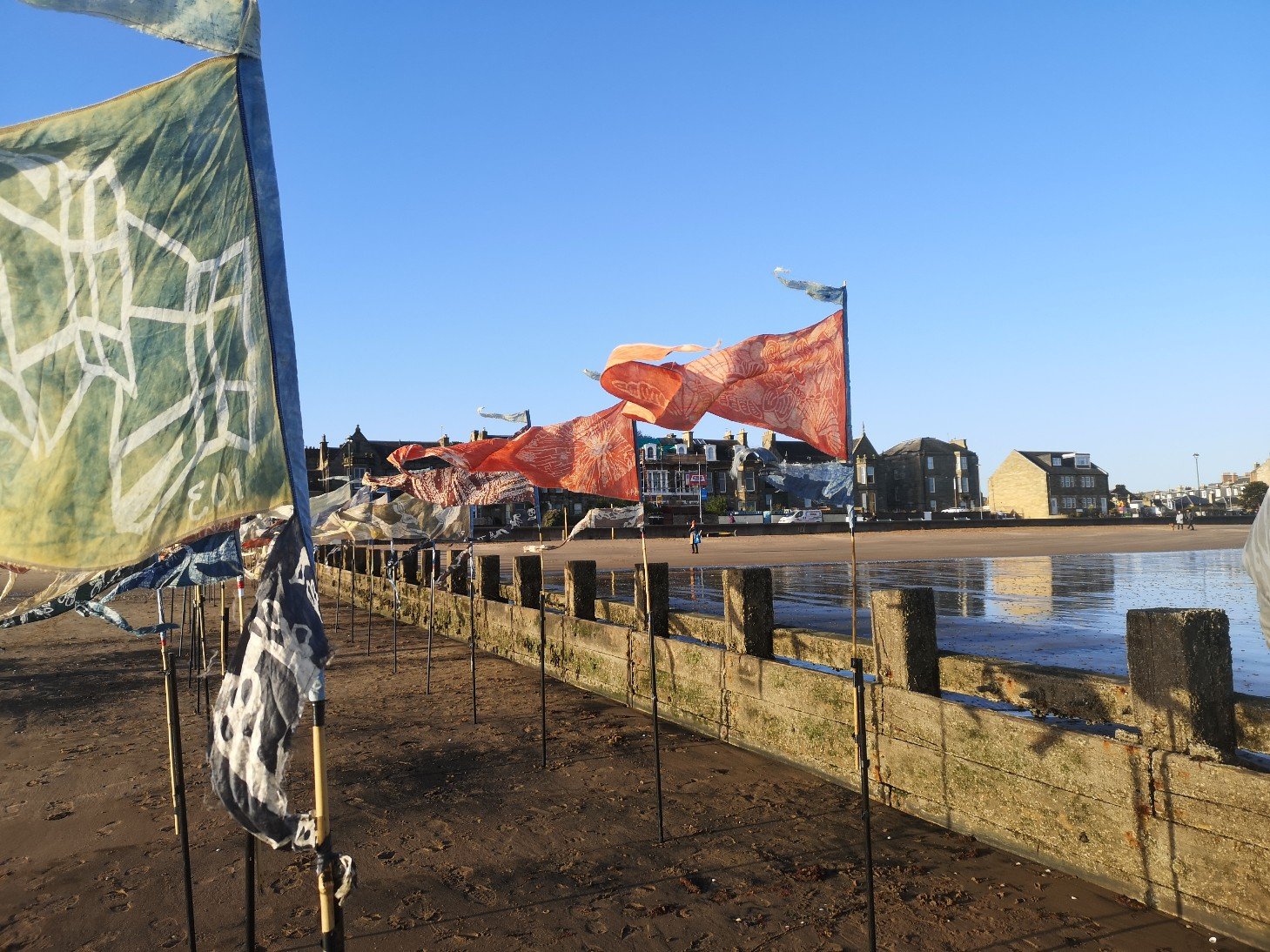
The public highlight of our Portobello stay was the Saturday morning Beach of Dreams installation by Kinetika, led by artist, Ali Pretty.
Beach of Dreams, Ali Pretty and Kinetika, Portobello, Edinburgh
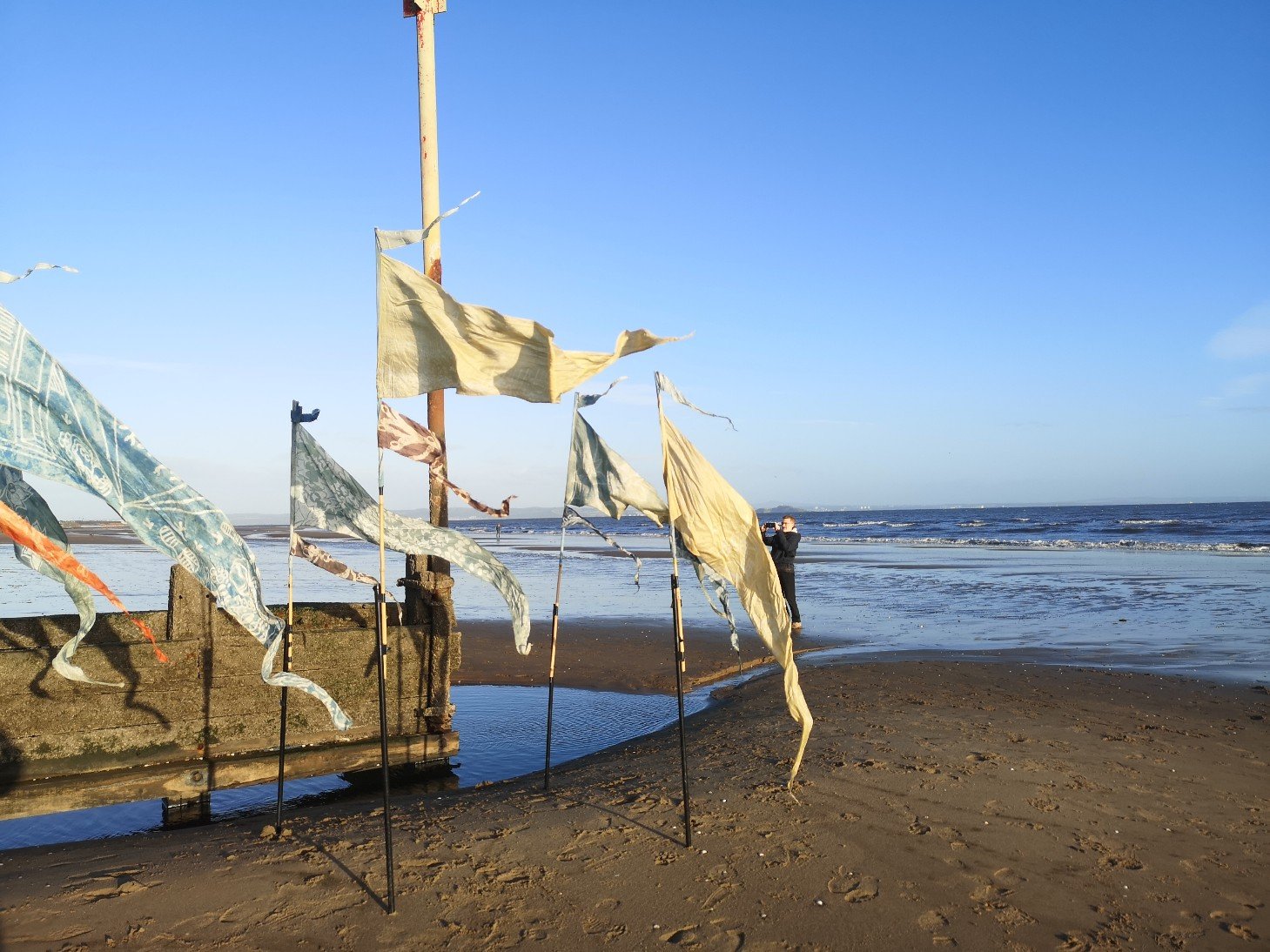
This art installation is made up of 500 silk flags flying from poles which were planted on the beach, each representing a mile of the Essex coastline. A new pennant was created for each of these miles by Kinetika artists in response to photos or other images which were produced by people living in this edge-country, people who are witnessing the disintegration of the ground on which their houses are situated.
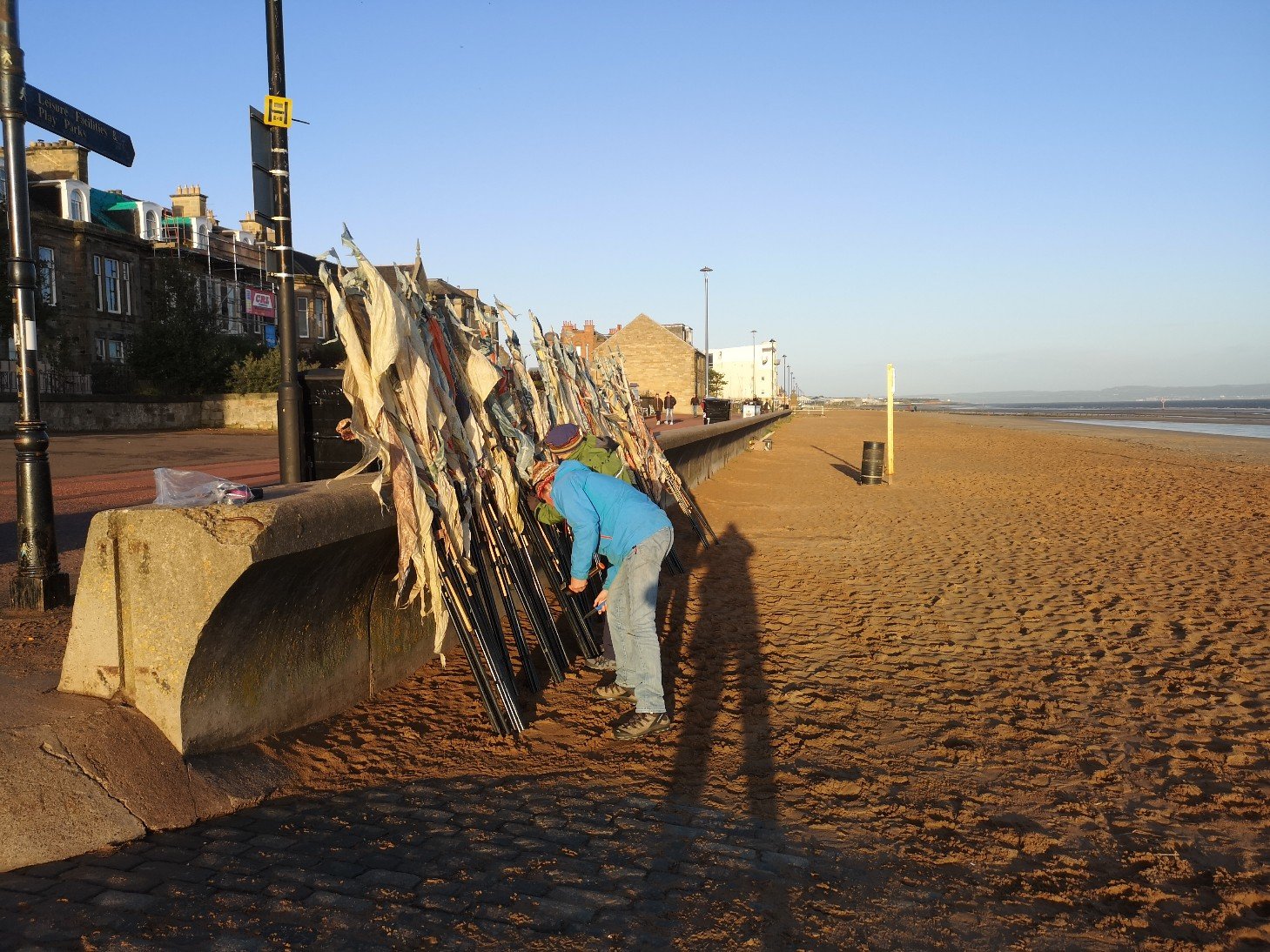
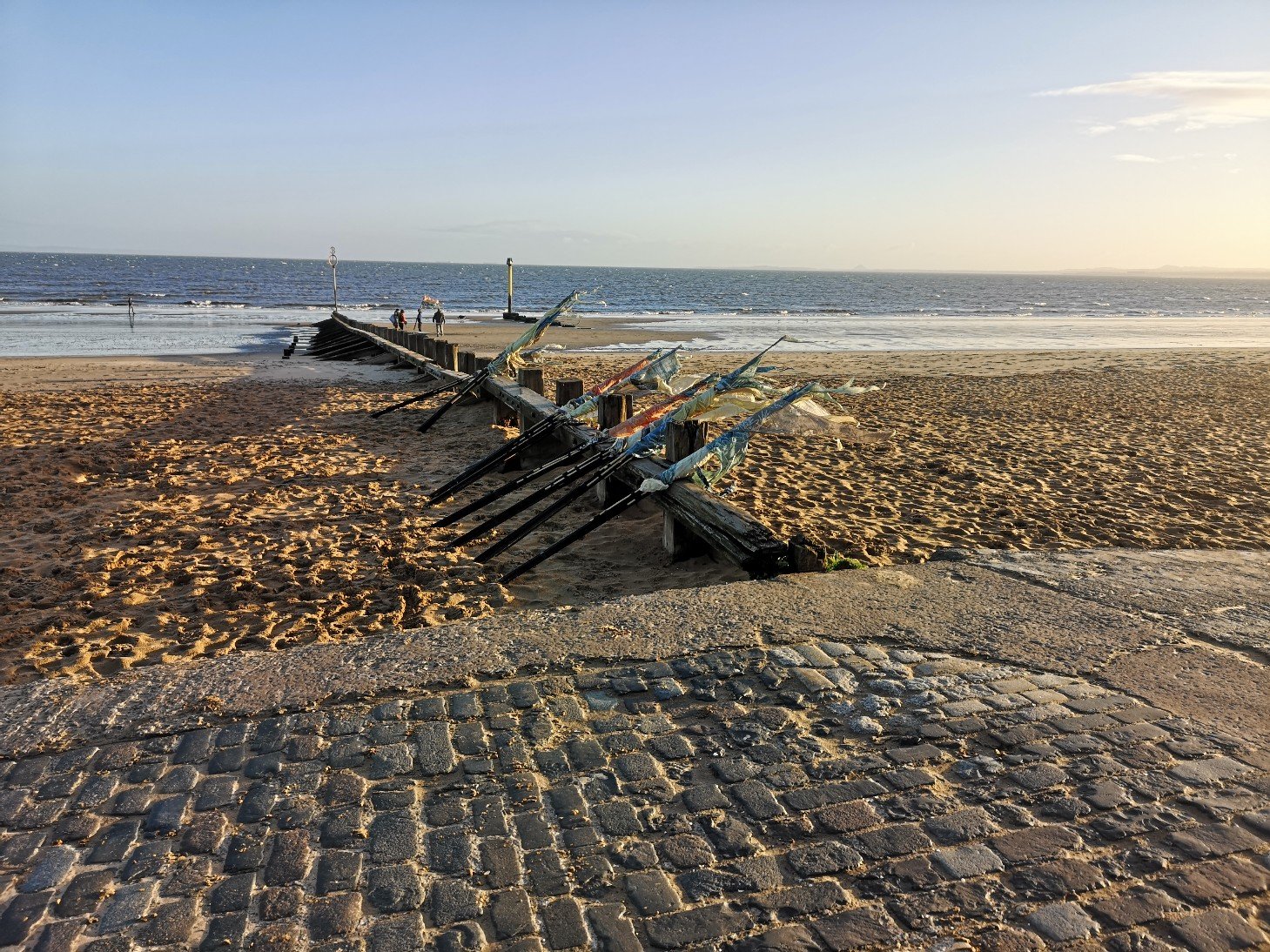
Setting up Beach of Dreams, Portobello, EdinburghPreparing for the installation of Beach of Dreams, Portobello, Edinburgh
Beach of Dreams was an epic journey to walk 500 miles over 35 days (June to August 2021) along the east coast of England. The purpose – to explore how we can take care of the environment, take care of the coast, take care of the community and ourselves.
from the website
The flags were initially positioned in lines parallel to the Portobello breakwater, but as the sea came in, volunteers hurriedly moved them, re-sinking them in the sand higher up the beach and creating a tide of people and artworks rushing away from the approaching waters.
In danger from the incoming tide, Portobello, Edinburgh
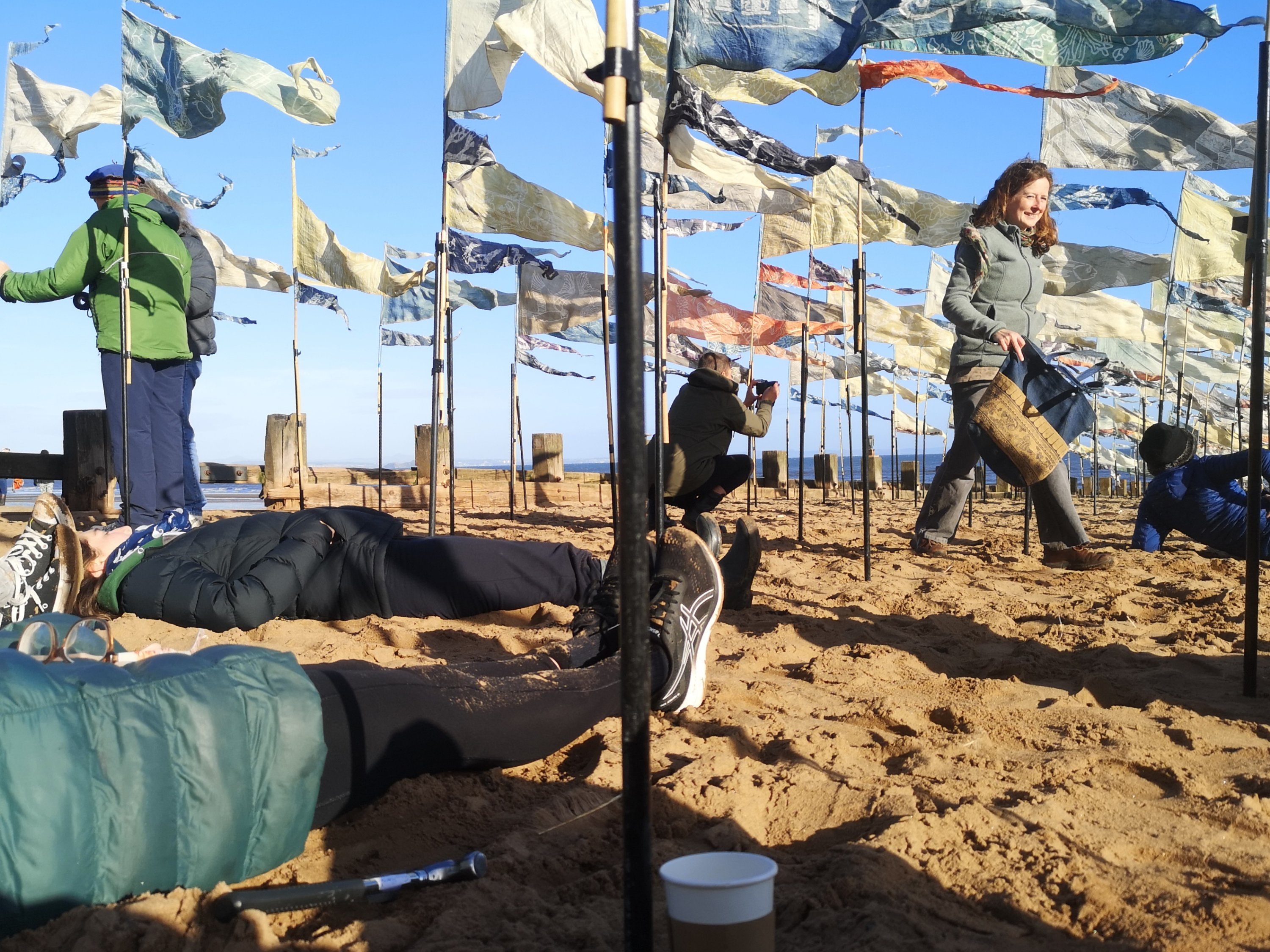
These flags represent the dreams of the people of Eastern England for the future. Like urgent messages to us here on the east coast of Scotland, they tell of the vulnerability of our coastlines as sea levels rise. Moving, literally and emotionally, they are fragile, though steady, ephemeral but made of real stuff. They flutter and flap in the wind, prompting questions, ‘What’s blowing away? What are we losing?’
‘What’s blowing away? What are we losing?’ Portobello, Edinburgh
The poignant sound, as we lay under the flags and watched their subtle colours – lemon and rose – move against the cerulean sky, was a constant reminder that things are changing. The irregular flick-flack of the fabric responding to the capricious breeze wouldn’t let us drift away contentedly. Their beauty contrasted with the reminder that the sea levels are constant rising due to climate change.
View from underneath, the Beach of Dreams Portobello, Edinburgh
Hospitality
We stayed for two nights at St Mark’s Church where we were cared for with much-appreciated heat and facilities. Even a short walk like this focused our minds on the luxury, the privilege of having a roof over our heads and a floor to sleep on.
Portobello, Edinburgh
Walking the labyrinth
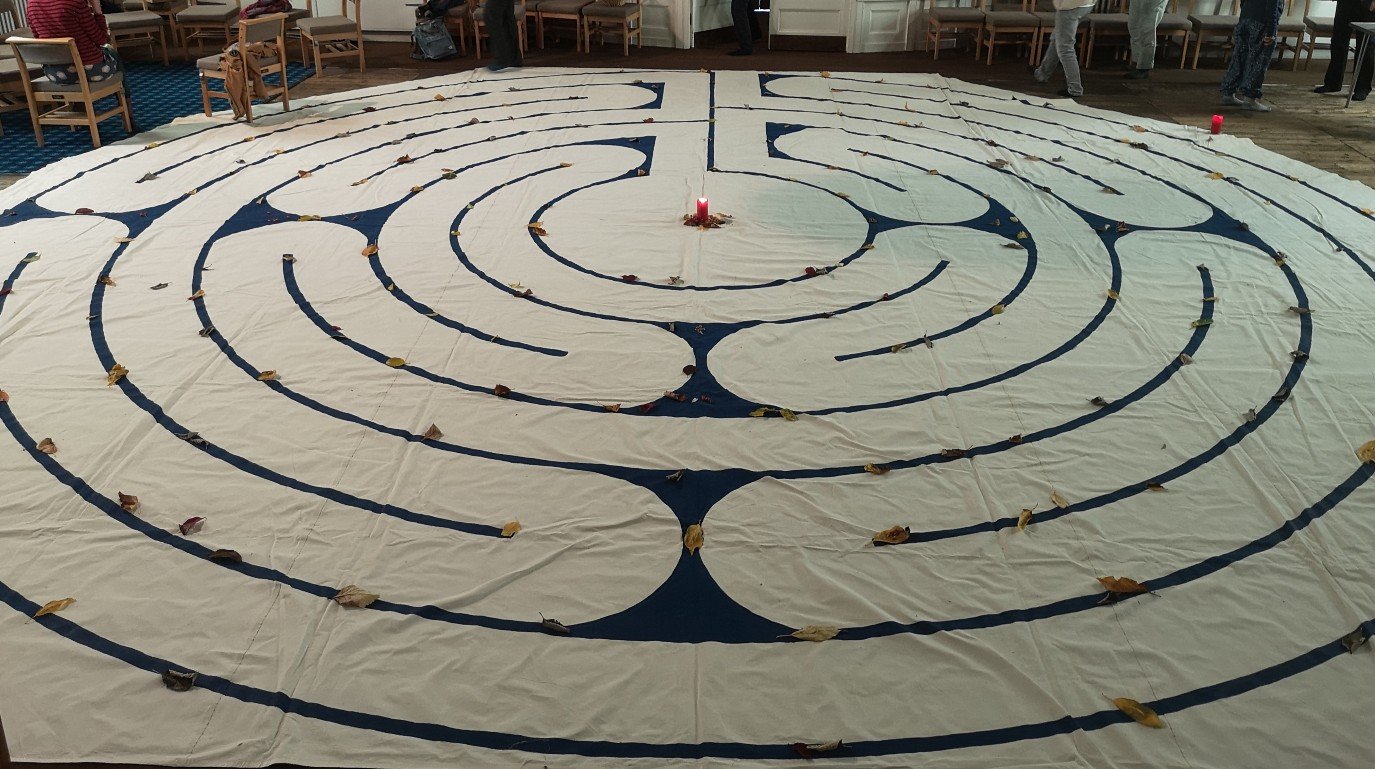
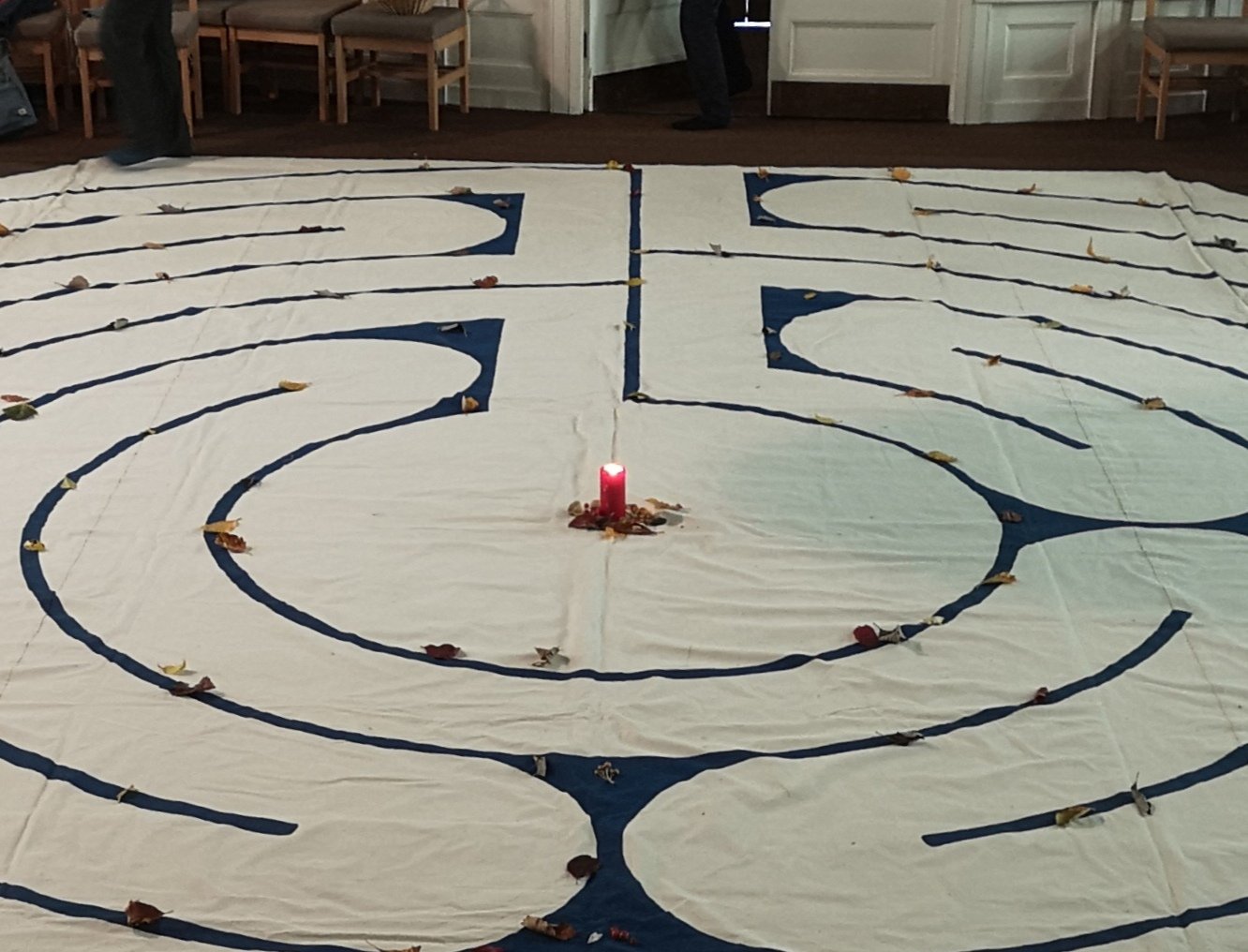
The full programme of events continued with a labyrinth. Set up by Ali Newell with red candles and autumn leaves, we were first given a short introduction to their origin and useage over the centuries. Then we were invited to take something from her basket and enter, one by one.
Labyrinth, Ali Newell
The minute I started, I felt such sorrow. Was it the music by Arvo Pärt, or the accumulated feelings of the group? Was it my grief at the state of our world, or a more personal sadness rising up into my throat? One stained glass window showed a man with his arm around a child, another depicted men embracing, with the words: ‘The soul of Jonathan was knit with the soul of David’ as a caption. That tenderness was one trigger for my weeping.
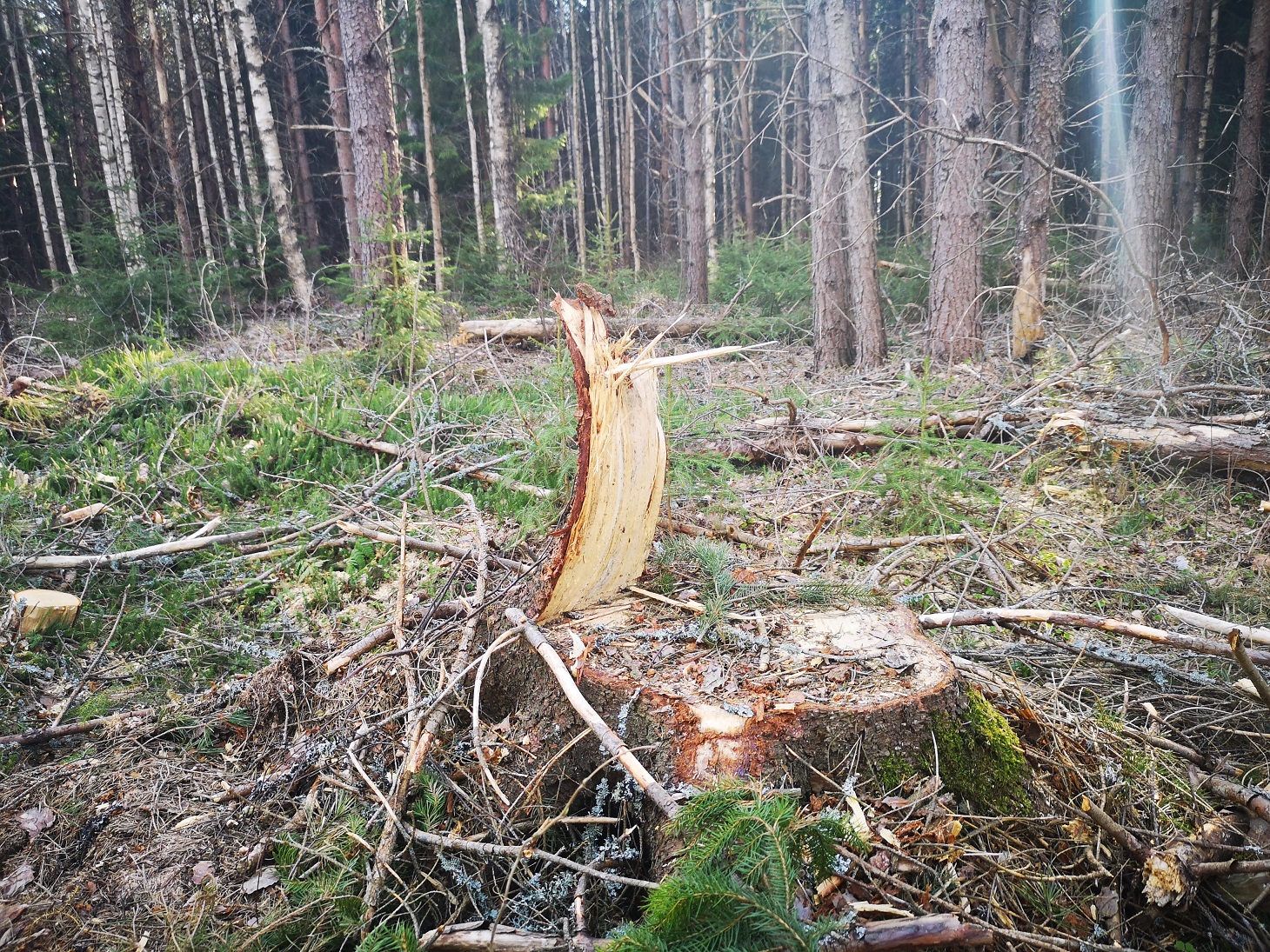
I lived in Estonia for a short time, where Pärt was born, and memories of those times bubbled up. I was writing a book about death and loss, and each day I walked the forest paths. I remembered the shock of turning a corner and coming across a large area of deforestation with trunk stumps all jagged and broken.
Pines interspersed with silver birch because the foresters know that these trees grow better in community than alone, EstoniaThe trees are grown to be cut down, but that doesn’t make the sight any less distressing when you come across it. Estonia
Around the labyrinth I slowly walked, doubling back on myself, at once facing centre, then away from it, moving nearer, then seeming to be distanced. The narrow channel between the lines gave a sense of safety and the golden leaves which were scattered around, encapsulated the passing of the year. Eventually the tears dried up and there was something like peace, or at least calm as I continued. The sun was shining and it threw shadows across us and the room. I was conscious of passing shoulder-to-shoulder with friends on a similar journey to mine, others with wet cheeks. Someone walked with her arms crossed over her chest, another with his hands cupped in front of him, a woman with arms raised up, palms to the ceiling. In this way, we almost-met, though we didn’t stare or speak. We were all in it together.
And then I saw, ahead of me, the entrance, not the centre. I stopped dead. I must have made a mistake because I was almost back where I started. I traced the way in with my eyes; how had that happened? I hadn’t crossed a line, hadn’t cheated.
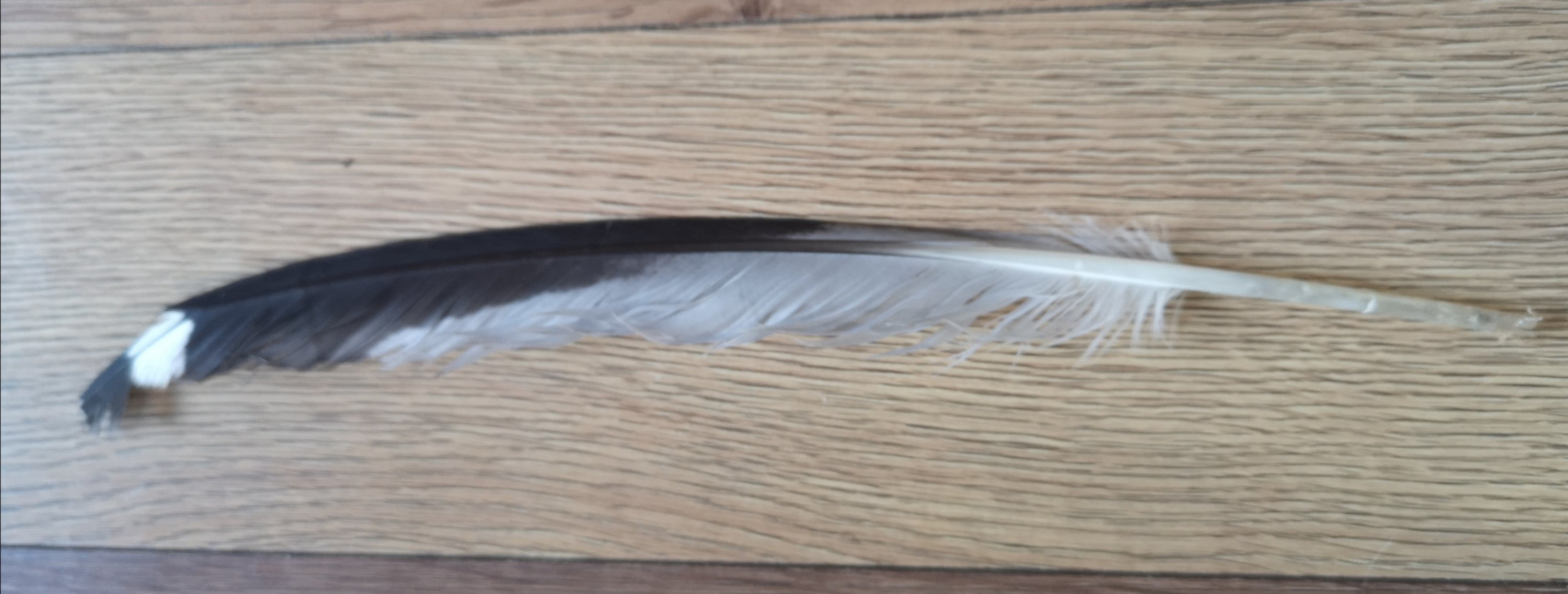
I decided to step out of my passageway into one which would take me on, along the way I had been going, and then, no! That wasn’t possible somehow. So I followed the direction my path was taking and found myself right where I began, ready to start over again. There, at my feet, was a battered magpie feather.
Magpie feather
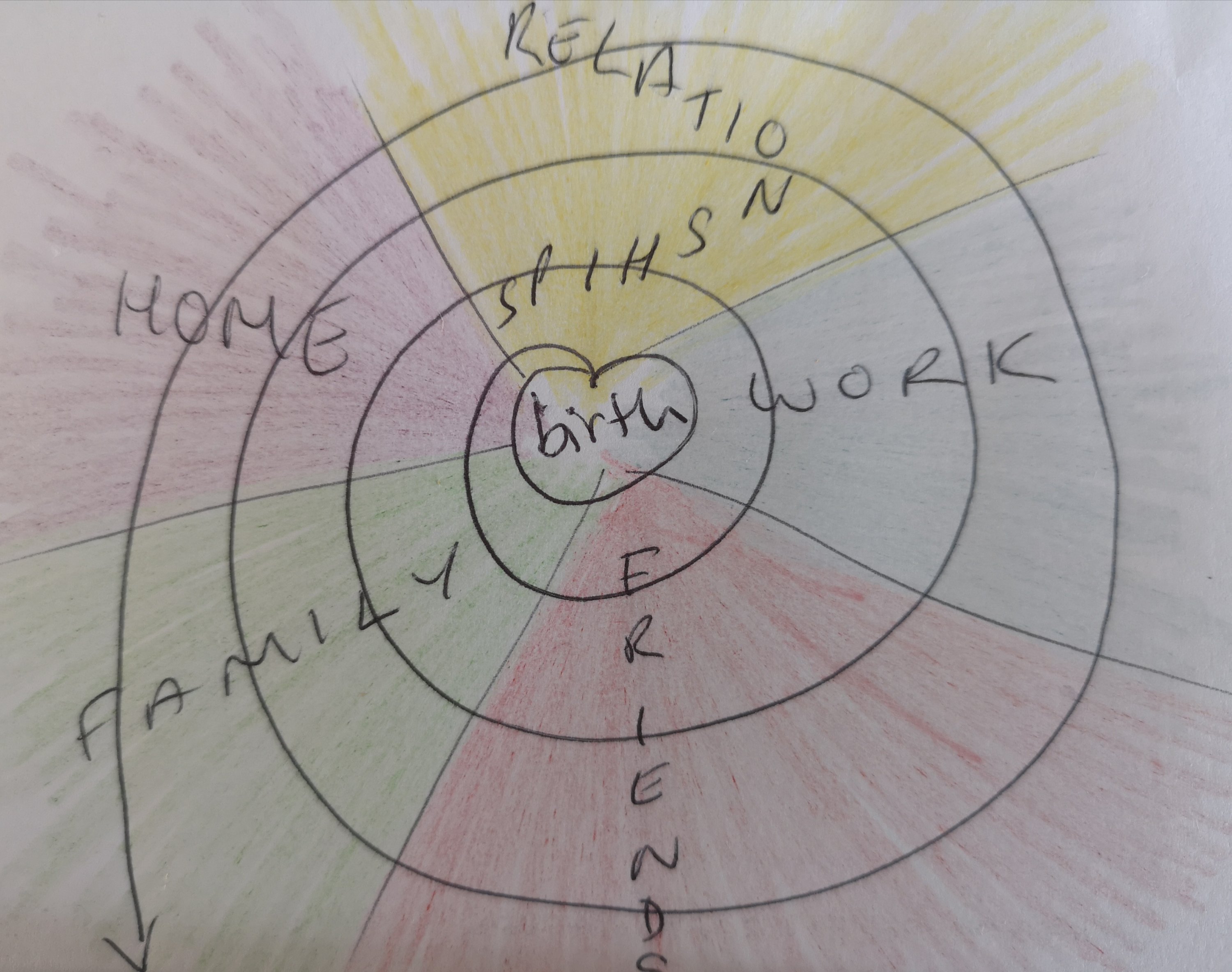
I hadn’t seen it earlier, even though I am collecting one per day (see my first blog of this series) and so it was somehow special to find it at the moment that had I been ‘sent’ back. I picked it up, took a deep breath, turned around and carried it with me as I re-negotiated the labyrinth. Though I walked faster the second time, there was another onslaught of grief. It reminded me that we walk round our lives, spiralling outwards from our birth, but coming back through key elements of it. We are given the chance to go through stages again with our accumulated wisdom. I hoped I was wiser after the event.
The spiral of life
Many of the fallen leaves had wafted onto the paths. They seemed to represent people I have known. Sometimes, unwittingly, I stepped on them, sometimes over and left behind. The person following me picked each one up and put it back in a safe place. I began to feel so weary, I wobbled, even once overbalanced into an adjoining track and had to step back. There was a small, wooden African sculpture in a corner, on the piano, of someone reaching down to touch a baby. It was similar to one I had at home. Again, it touched me deeply. Would this emotion go on for ever? I realised I needed ‘stamina, endurance, resilience’ which were Liz’s words, if I was to complete this Pilgrimage for COP26.
Entrance and centre of the labyrinth, Ali Newell
As I got closer to the centre, I feared I might not make it and I noticed that I wanted to get to the end as soon as possible. It was like my relationship to death; in the past I have willed it, later I decided against it and pleaded that it wouldn’t happen soon.
I did eventually get there, knelt and placed my stone, and, as Liz said afterwards, it was hot from my hand. Of course, it wasn’t an end at all, it was a mid point. It also wasn’t the way I experienced it when sitting beside the dying – a dwindling, a merging into another place and state – rather, it was part of the whole process of life and it was on-going.
As I walked out, I was coming in the opposite direction to others who stood aside to let me pass. Or sometimes I did that for them. It was a smooth, mindful journey, and I was changed at the end of it.
We set off one by one, but as we walked we kept coming into contact with each other. It was like a metaphor for life; people you see once and never again all moving in the same direction, all inspired by love and hope. We acknowledged each other as we passed. We were not alone.
Gareth
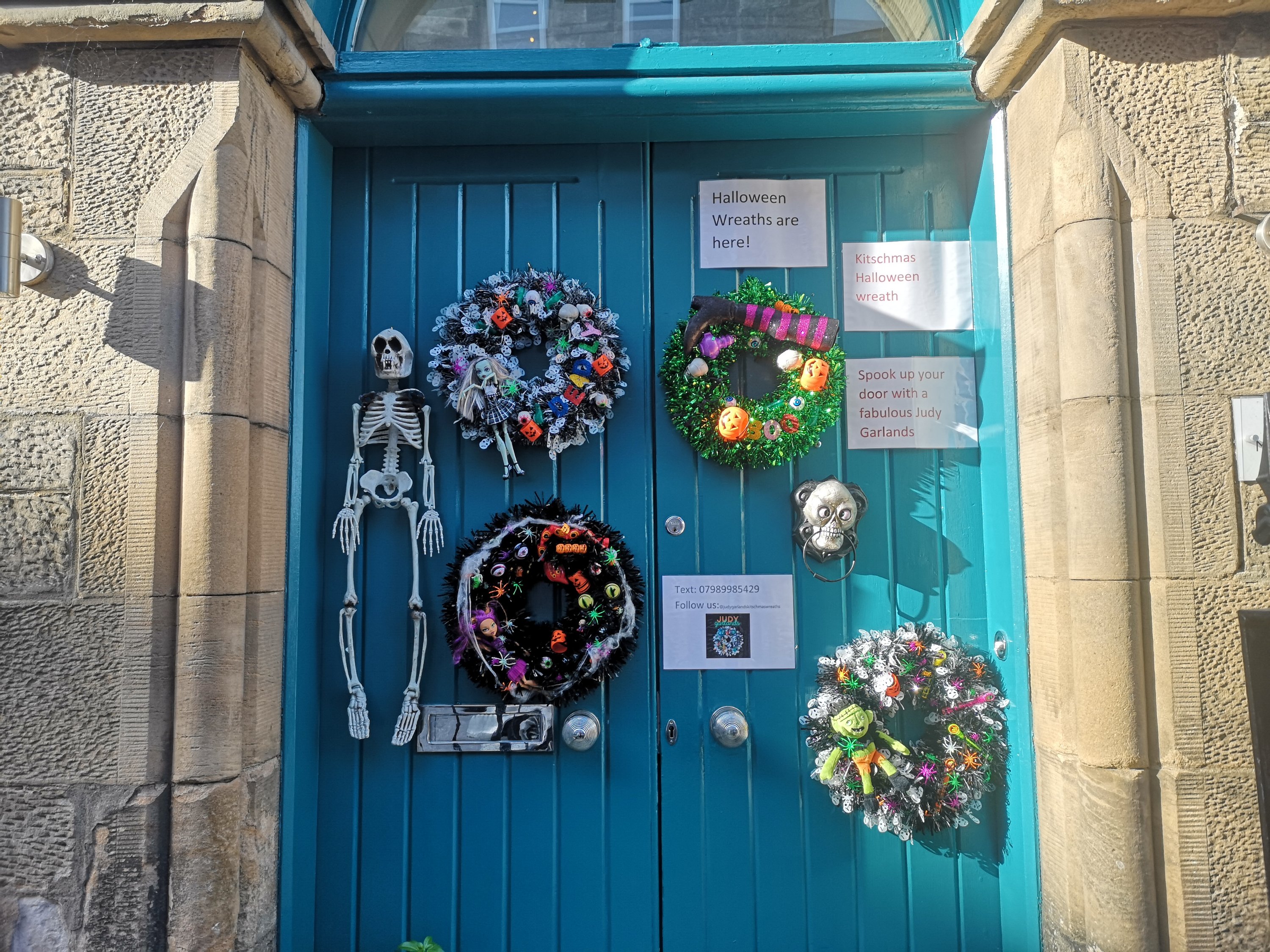
Front door, Portobello, Edinburgh
Even more kindness, and a change of perception
I went for a swim in the sea after that. Margaret who knows the seas, watched over me, signalling to keep away from the pipe which I had not noticed. Ruth offered me a shower at her flat, the first since leaving Dunbar on Monday, four days before, and I was really grateful for the hot water and her hospitality.
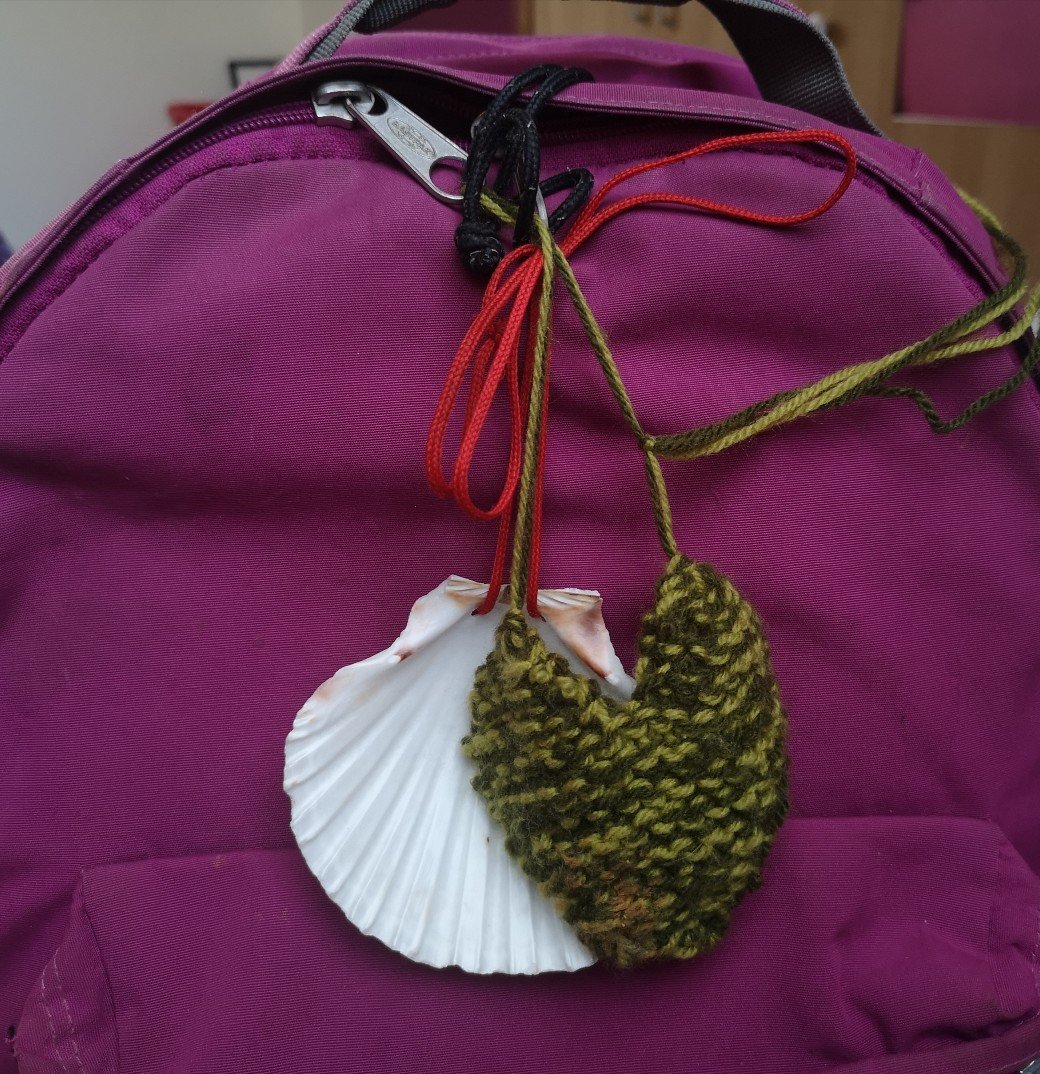
Coming back, I was struck by the frivolity of the home decoration items outside the shops on the High Street, items I usually enjoy, even covet. I was walking through such a familiar place, but my Camino shell dangled from my rucksack reminding me I was in the stream of the pilgrimage, and I felt like a different person.
Camino shell symbolising that all paths lead to the same destination, eventually
Thanks go to members of the congregation of St Mark’s for a most delicious meal, particularly as the oven failed and food had to be ferried next door and back for warming – a much appreciated effort.
Community choir
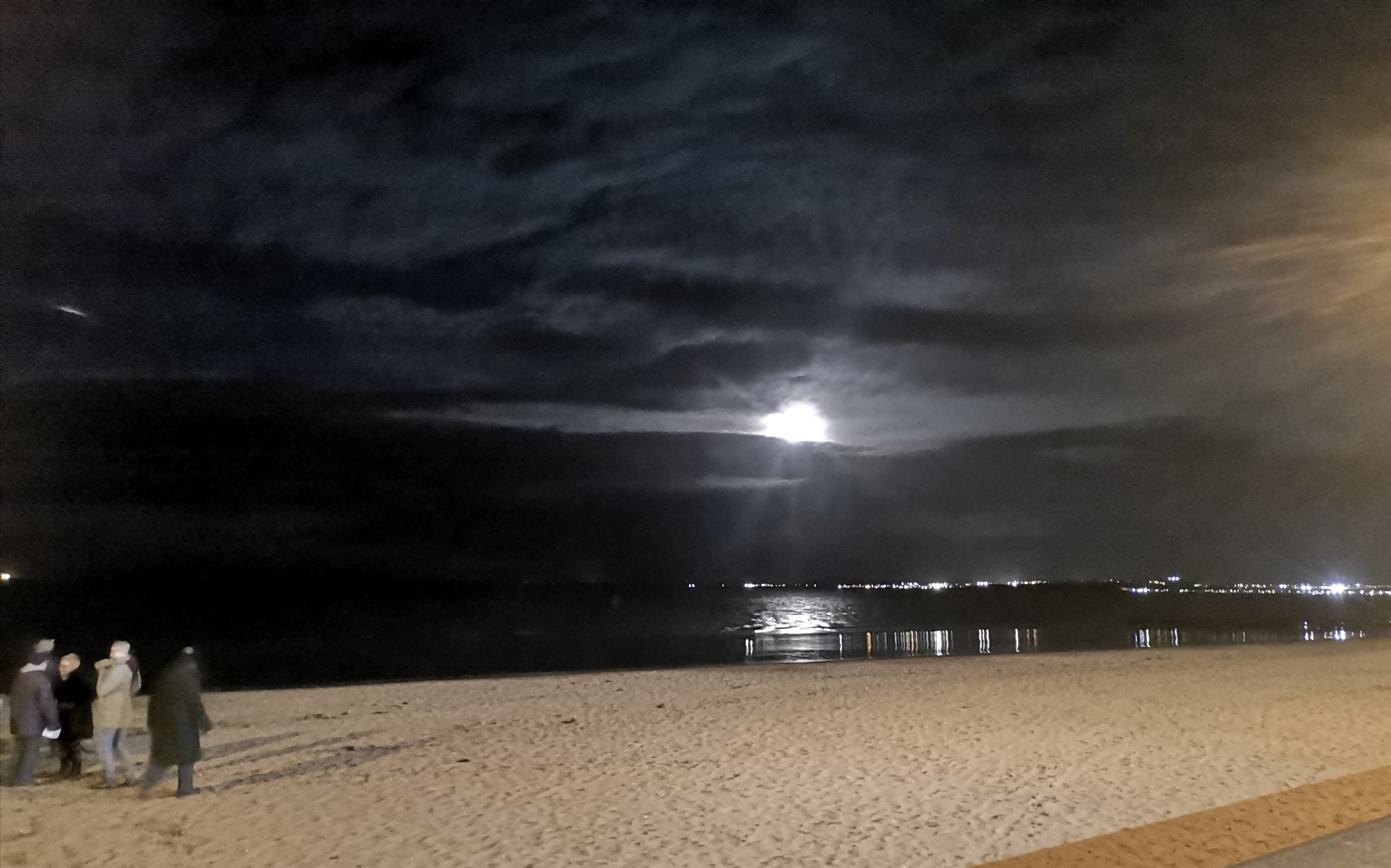
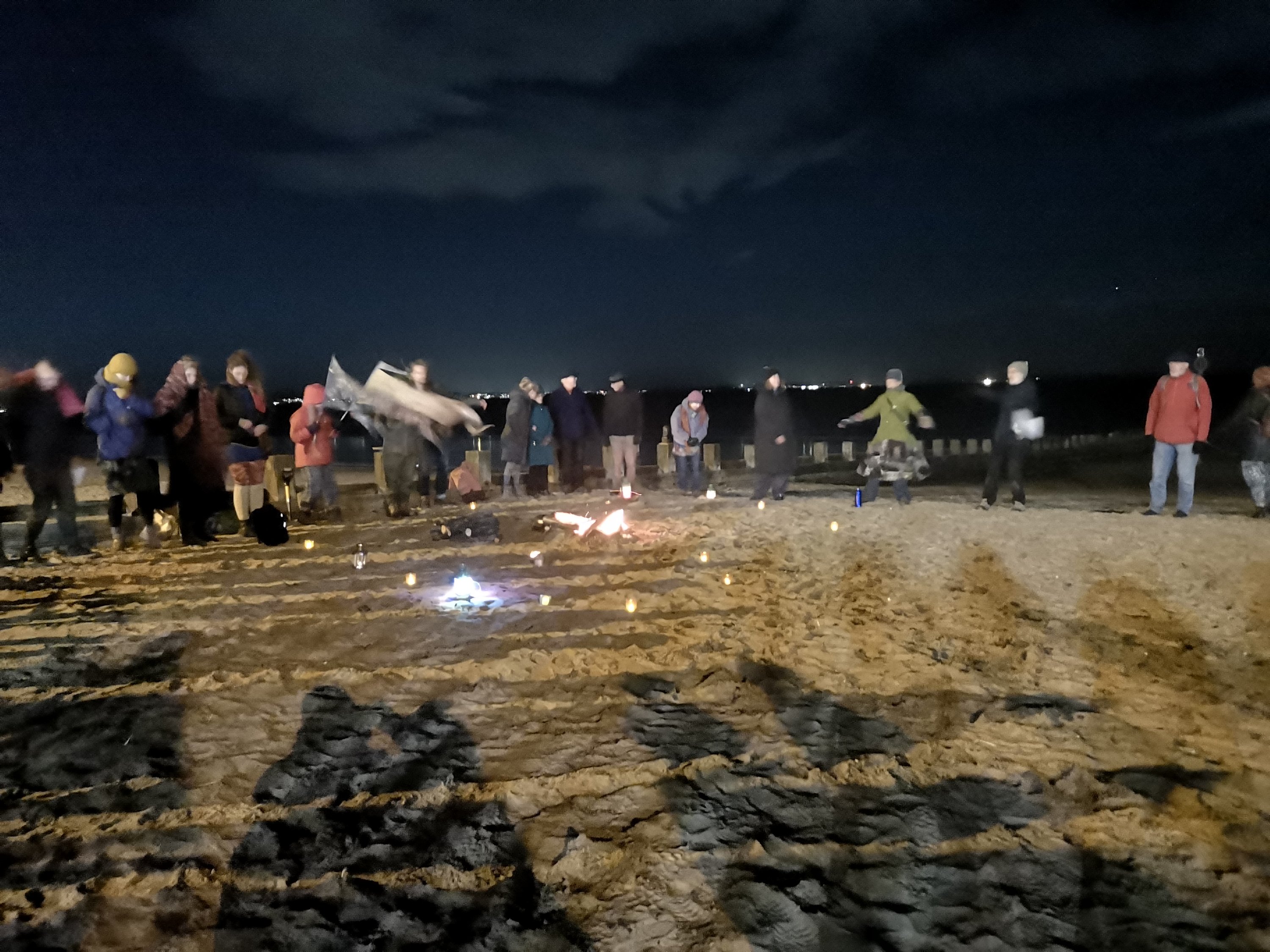
And as if all that wasn’t enough, Jane Lewis led a singing circle on the beach under the almost-full moon. She exhorted us, ‘ If we listen to the earth breathing, then we will know what to do’, and we learned her new rendering of Arundhati Roy’s words (from Capitalism, a ghost story).
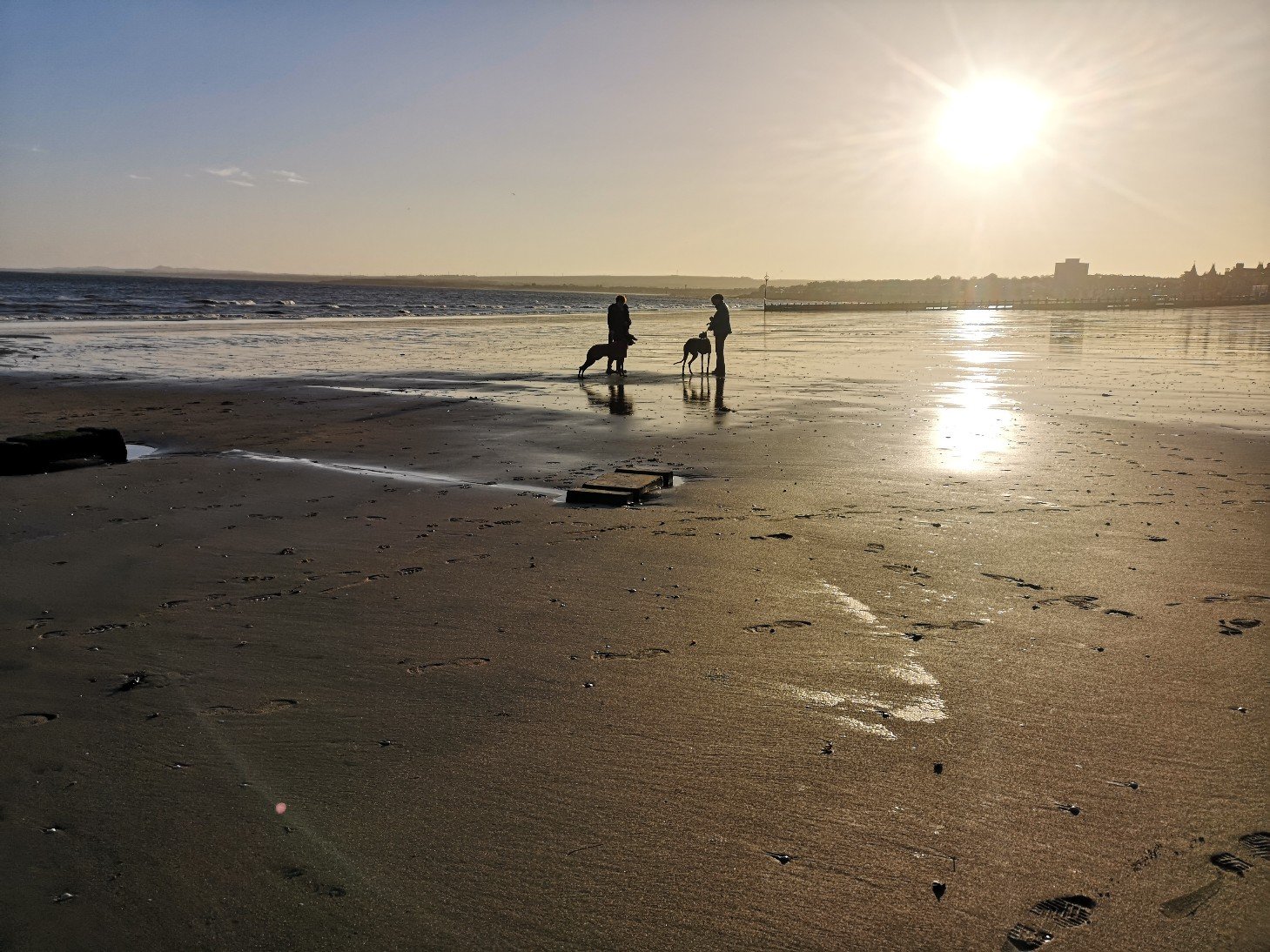
Portobello Beach, Edinburgh under the almost-full moon
Another world is not only possible, she is on her way. On a quiet day, I can hear her breathing. Can you hear her breathing?
A very blurry singing circle with Jane Lewis, Portobello.
Though a hiatus from the long-distance walking, this day was full of opportunities to reflect on our journey, to learn from the communities we were passing through, and to receive.
We were nearly half way through the Pilgrimage for COP26 from Dunbar on the east coast of Scotland to Glasgow, where the COP26 Climate Change Conference is now taking place. It was organised by A+E and many volunteers.

 Walking without a donkey